
Article

The Effect of Hydrogeological Heterogeneity on Groundwater Flow Field at Tunnel Site: A 2D Synthetic Study of Single and Multiple Tunnels

1
College of Environmental and Civil Engineering, Chengdu University of Technology, Chengdu 610059, China
2
State Key Laboratory of Geological Hazard Prevention and Control and Geological Environmental Protection, Chengdu University of Technology, Chengdu 610059, China
3
Key Laboratory of Mountain Hazards and Engineering Resilience, Institute of Mountain Hazards and Environment, Chinese Academy of Sciences, Chengdu 610229, China
4
China Railway Chengdu Institute of Science and Technology Co., Ltd., Chengdu 611730, China
5
Faculty of Geosciences and Engineering, Southwest Jiaotong University, Chengdu 611756, China
6
School of Earth and Space Sciences, University of Science and Technology of China, Hefei 230026, China
*
Authors to whom correspondence should be addressed.
Hydrology 2026, 13(2), 44; https://doi.org/10.3390/hydrology13020044
Submission received: 18 November 2025 / Revised: 19 January 2026 / Accepted: 23 January 2026 / Published: 27 January 2026
(This article belongs to the Topic Water-Soil Pollution Control and Environmental Management)

Abstract

The rapid expansion of tunnel construction in mountainous regions faces significant challenges due to the heterogeneity of surrounding rocks caused by faults, fractures, and karst features, which strongly affect groundwater seepage. Traditional homogeneous assumptions are inadequate for accurately predicting tunnel water inflow, while current heterogeneous assumptions primarily focus on the permeability of the medium near a single tunnel. This study employs 2D numerical modeling based on the Kexuecheng Tunnel in Chongqing, China, to investigate the effects of geological heterogeneity on tunnel discharge and groundwater drawdown. A methodological advancement of this work lies in the quantification of the impact of non-permeability heterogeneity, stratigraphic continuity, and dip angles on groundwater under multi-tunnel conditions. Four stratigraphic continuities (R = 60 m, 120 m, 180 m, 240 m) and four dip angles (θ = 0°, 30°, 60°, 90°) are considered for permeability variations. Results demonstrate that heterogeneous formations produce irregular discharge and non-uniform groundwater drawdown, closely reflecting field conditions. Increased stratum continuity intensifies discharge and drawdown at smaller dip angles, while combined variations yield complex hydraulic responses. In multi-tunnel settings, reduced spacing amplifies discharge and drawdown, exacerbating groundwater impacts. Compared with homogeneous conditions, heterogeneous formations yield higher water inflow and uneven drawdown. The findings underscore the necessity of accounting for geological heterogeneity and tunnel interactions in hydrogeological evaluations and design. In addition to permeability, stratigraphic continuity and dip angles during simulation validation, especially in multi-tunnel configurations, enhance safety and reduce engineering risks.

1. Introduction

With the rapid economic development in China, the construction of tunnels has significantly increased, as efficient transportation heavily depends on road and railway tunnels for both long-distance travel and metropolitan areas [1,2]. In addition, due to the limitations of certain underground spaces, new tunnel construction often requires bypassing existing structures with parallel or cross-configurations [3]. In Southwest China, characterized by mountainous terrain, the rise in tunnel construction primarily involves tunnels through mountainous regions [4]. The complex geological conditions in these areas present significant challenges for tunnel designers and constructors. Tunnels constructed in regions with intricate geological conditions and ongoing tectonic activity are particularly susceptible to geological hazards, such as water inrush and tunnel collapse [5]. The high degree of heterogeneity and anisotropy in these geological formations results in complex flow dynamics, complicating the study and assessment of flow behaviors [6]. When tunnels intersect with groundwater in such complex geological settings, the risk of tunnel water inrush is further exacerbated. Therefore, exploring the impact of geological heterogeneity on tunnel water inrush and groundwater environments is of critical importance.
To ensure the safety of tunnel construction, extensive and diverse studies have been conducted by numerous researchers on the interaction between groundwater and tunnel dynamics. Deformation and displacement of the surrounding rock and lining are induced by tunnel water discharge, which mainly arises from hydrodynamic pressure, water expansion, and softening effects [7,8,9]. Additionally, significant hydrogeochemical effects occur in the drainage zone of the depression cone formed by long-term tunnel drainage, influencing tunnel lining stability [10,11]. Beyond tunnel water inflows, the impact of tunnel construction on groundwater environments also leads to a series of problems. The influence of tunnel drainage on groundwater systems and ecosystems partly manifests through alterations in the distribution patterns of water resources and modifications to the groundwater flow field [12,13]. The excavated tunnel usually becomes a gathering place for groundwater or a new discharge channel, causing substantial water drainage and widespread groundwater level drawdown. This process can disrupt local ecosystems and deplete water resources, leading to a series of hydrological changes as well as various environmental and socioeconomic consequences. Consequently, investigating groundwater level drawdown and predicting water discharge during tunnel construction have become increasingly vital.
In key transportation areas, tunnel construction tends to be highly concentrated, with multiple tunnels often located in close proximity [14]. This spatial clustering exacerbates the overall instability of the tunnel system, as a soil–water inrush in one tunnel can induce cascading failures throughout the entire cluster [15]. For example, during the construction of the cross-passage of Shanghai Metro Line 4, a soil–water inrush event led to the collapse of two tunnels over a total length of 274 m [16]. Similarly, on Shanghai Metro Line 18, severe deformation and damage occurred in both tunnels due to groundwater gushing [17]. These incidents underscore the necessity of investigating the interactions among multiple adjacent tunnels [3]. Current knowledge suggests that the superposition effect of groundwater induced by tunnel group construction cannot be simply regarded as a linear extension of single-tunnel effects. However, research on groundwater behavior in multi-tunnel systems remains limited.
When assessing the impacts of tunnel excavation on the groundwater environment and tunnel water inrush, the focus is on predicting water discharge into the tunnel. Currently, common methods for predicting tunnel water discharge involve using empirical calculations, analytical solutions, numerical analyses, and other methods for calculation [18,19,20]. The empirical formula approach overlooks the inherent geological complexity by representing aquifers as homogeneous and isotropic media, where hydraulic conductivity (K) is treated as the exclusive governing parameter [21]. For complex hydrogeological conditions, numerical methods have shown excellent results in predicting tunnel water discharge due to their flexibility [5]. Among these, the most widely applied is the MODFLOW model developed by the United States Geological Survey (USGS) [22], which, owing to its modular design, is capable of simulating a wide range of aquifer systems and hydrological conditions [23]. Bai et al. [24] addressed the dual-continuum characteristics of karst aquifers by enhancing the MODFLOW-Conduit Flow Process (CFP) module to better capture their complex flow dynamics. Meyer et al. [25], based on MODFLOW, presented a systematic approach for regional-scale groundwater modeling, analyzing how historical water management and complex geology control regional groundwater flow.
Affected by structural activities and excavation disturbance, the surrounding rock is often heterogeneous. Therefore, studying the influence of strata heterogeneity on tunnel water discharge holds great theoretical significance and engineering application value [14,15]. However, characterizing the formation of geological heterogeneity remains a significant challenge. The use of homogeneous models to estimate water discharge leads to discrepancies from actual field conditions, which in turn contribute to notable uncertainties in assessment outcomes [26]. To address the impact of geological heterogeneity, geostatistical and stochastic estimation approaches have been extensively adopted. These methods utilize interpolation techniques and other approaches to model and predict groundwater dynamics [27,28]. In recent years, these methodologies have been increasingly utilized in tunnel drainage research to more effectively investigate the pronounced effects of geological heterogeneity on seepage behavior during tunnel excavation and its consequent implications for structural safety and stability [29,30]. Sun et al. [31] investigated the influence of soil heterogeneity and pore water pressure on the stability of shield inclined tunnel excavation faces as the burial depth changes. Shen et al. [29] conducted an analysis of water pressure in a shallow circular cross-section tunnel, taking into account heterogeneity and anisotropy. Huang et al. [32] presents a limit equilibrium model for the shield face stability with special emphasis on the effects of ground heterogeneity and seepage flow. However, previous studies have not fully addressed the 2D variability along the vertical direction of the tunnel or the variations in key factors related to heterogeneity.
To further investigate groundwater drawdown and its controlling factors during tunnel excavation under heterogeneous conditions, extending beyond permeability to include stratigraphic continuity and dip angle, and to address the existing knowledge gap concerning the influence of heterogeneity in multi-tunnel systems, this study investigates the influence of strata continuity and dip angle on seepage behavior around tunnels by quantifying tunnel discharge and drawdown. For this purpose, a 2D numerical model was developed based on field data from the Kexuecheng Tunnel, incorporating the vertical spatial variability of hydraulic conductivity to achieve this objective. In addition, the characteristics of the effect of tunnel group construction on the groundwater environment in the construction area are also discussed. The results underscore the necessity of accounting for geological heterogeneity within tunnel surroundings and practical engineering design.

2. Materials and Methods

2.1. Study Area

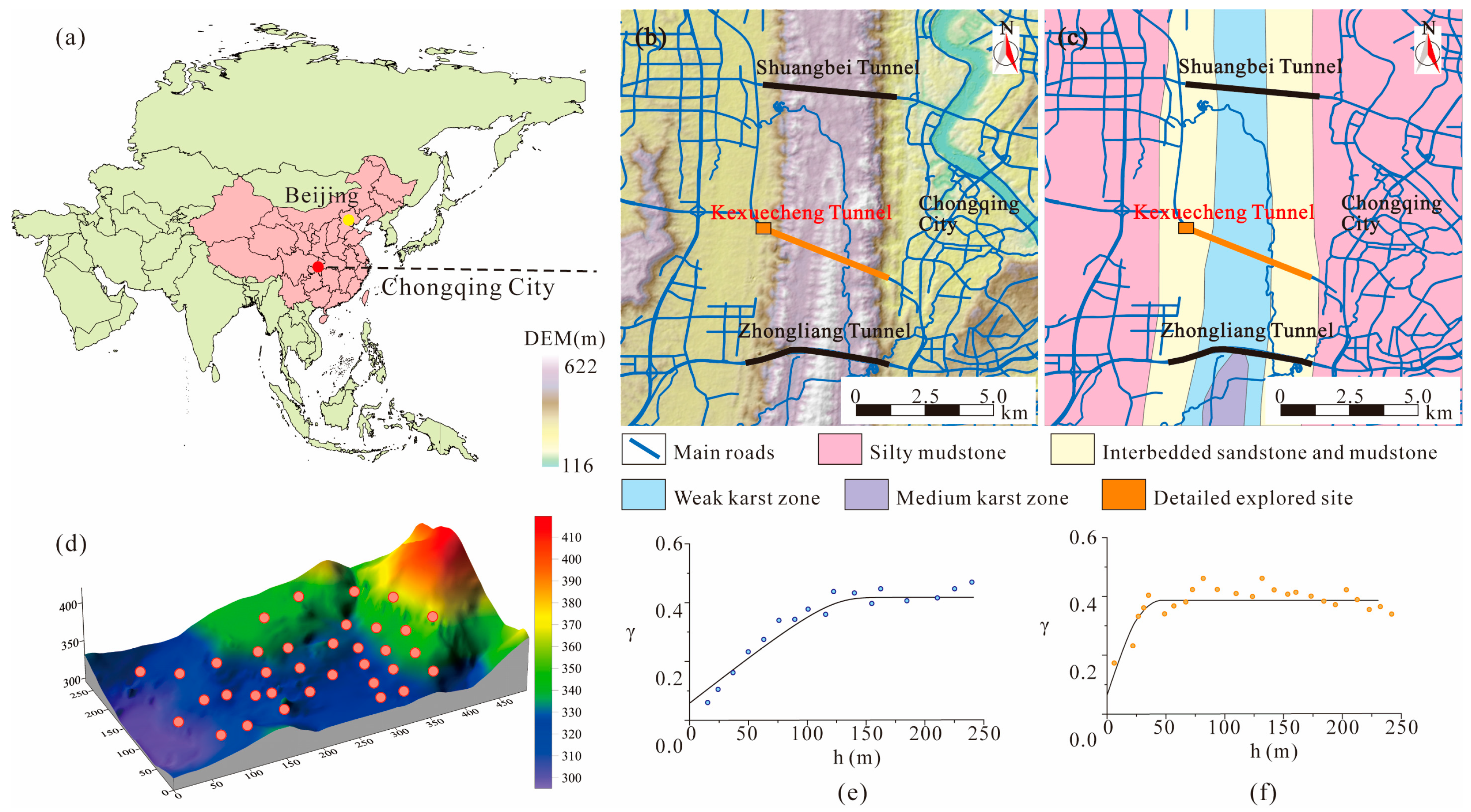
The heterogeneous strata data in this study were collected from Kexuecheng Tunnel, Chongqing City, Southwest China (Figure 1). This tunnel is a double-track tunnel and is currently under construction between two existing tunnels, which are the Shuangbei Tunnel and Zhongliang Tunnel. The Kexuecheng Tunnel is being excavated via the drill-and-blast method, reaching depths of approximately 200–300 m and spanning a total length of roughly 4 km. Geologically, the tunnel traverses Triassic and Jurassic strata primarily composed of mudstone, shale, sandstone, and carbonate rock (Figure 1c), with stratigraphic dip angles ranging from 15° to 80°.
To characterize the site’s geologic properties, detailed geological surveys and slug tests were performed at the western inlet of the Kexuecheng Tunnel (Figure 1b–d). A total of 35 boreholes were drilled to depths between 50 and 350 m within a 500 m × 300 m area. Following drilling, slug tests were conducted at 5 m or 10 m intervals. In this localized study area, the predominant lithology consists of sandstone, mudstone, and dolomite, with a consistent stratigraphic dip angle of 30°. The depth of this sandstone–mudstone aquifer is around 310 m. The slug test results indicate that the hydraulic conductivity (K) exhibits a mean value of approximately 0.01 m/d and a log(K) standard deviation of 0.38. Additionally, we calculated continuity of hydraulic conductivity using a spherical variogram model (Equation (1)) [33]. The variogram range of permeability continuity is 180 m along the strata and 30 m perpendicular to the strata (Figure 1e,f).
γ ( h ) = C [ 3 2 ( h α h ) 1 2 ( h α h ) 3 ]
where γ is the variogram; C is the sill; h is the lag distance; αh is the range.

2.2. Model Setup

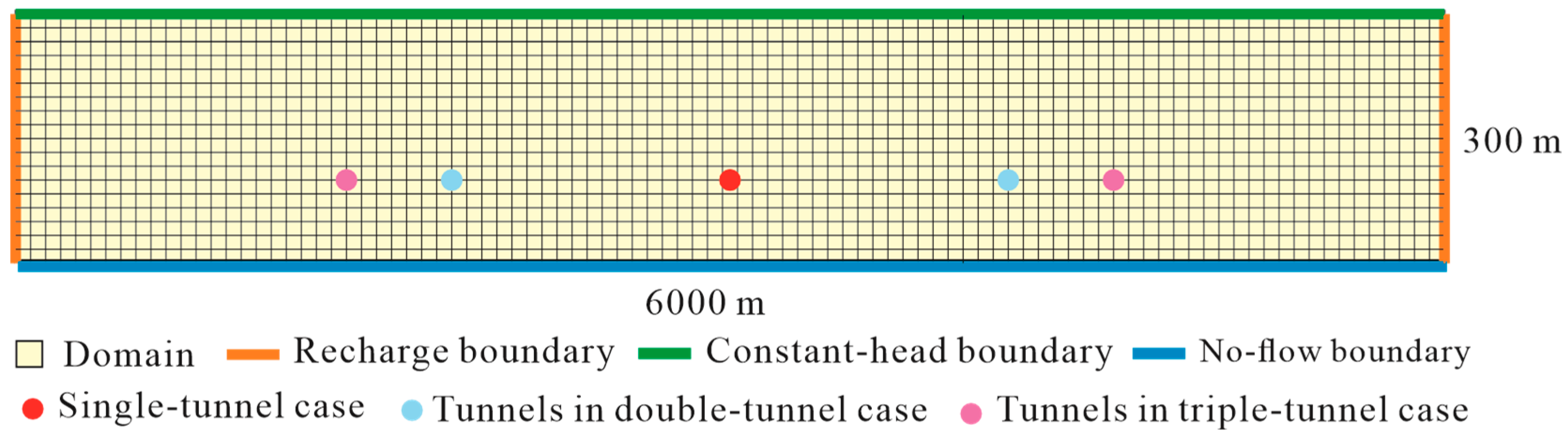
To circumvent the substantial computational burden associated with 3D heterogeneous simulations and sensitivity analysis, this study utilizes a 2D synthetic model to investigate the effects of geological heterogeneity on groundwater flow. MODFLOW (Reston, VA, USA) [22] was employed to simulate Darcian groundwater flow and head variation during the tunnel construction and maintenance process. In the MODFLOW simulation, the finite difference equations of water movement in porous media were utilized [34], which were solved using the Preconditioned Conjugate-Gradient package (Equation (2)). The constant precipitation of the model is defined as 3.15 mm/day based on the average local rainfall condition, and the infiltration rate is 0.3. To focus on the influence of geological heterogeneity and reducing computation burden, certain simplifications were applied to 2D models oriented perpendicular to the tunnel direction. The model domain covers a horizontal extent of 6000 m and a vertical depth of 300 m, discretized into numerous cells measuring 10 m × 5 m (Figure 2). The dimensions in both directions are significantly larger than the variogram ranges, satisfying the requirement of geostatistical stationarity and decreasing boundary effects. For simplicity, geomorphological features were ignored, and the bottom boundary was considered a flat, impermeable bed. Two sides are defined as two built tunnels due to their water drainage effect, the Shuangbei Tunnel and the Zhongliang Tunnel in Figure 1. Thus, constant head boundaries are used with −200 m (Figure 2). Additionally, since the model is inspired by the hydrogeological conditions in Chongqing, where multiple parallel tunnels frequently traverse the same mountain range, we considered a double-tunnel case and triple-tunnel case to synthetically analyze the effect of tunnel number on the groundwater. The initial condition of each scenario is the pre-excavation steady-state simulation result.
x K x x h x + z K z z h z + W = S s h t
where K is hydraulic conductivity; x, z are cartesian coordinates; h is hydraulic head; W is volumetric flux per unit volume representing source and/or sink terms; Ss is specific storage of the porous material; t is time.

2.3. Geologic Heterogeneity Generation

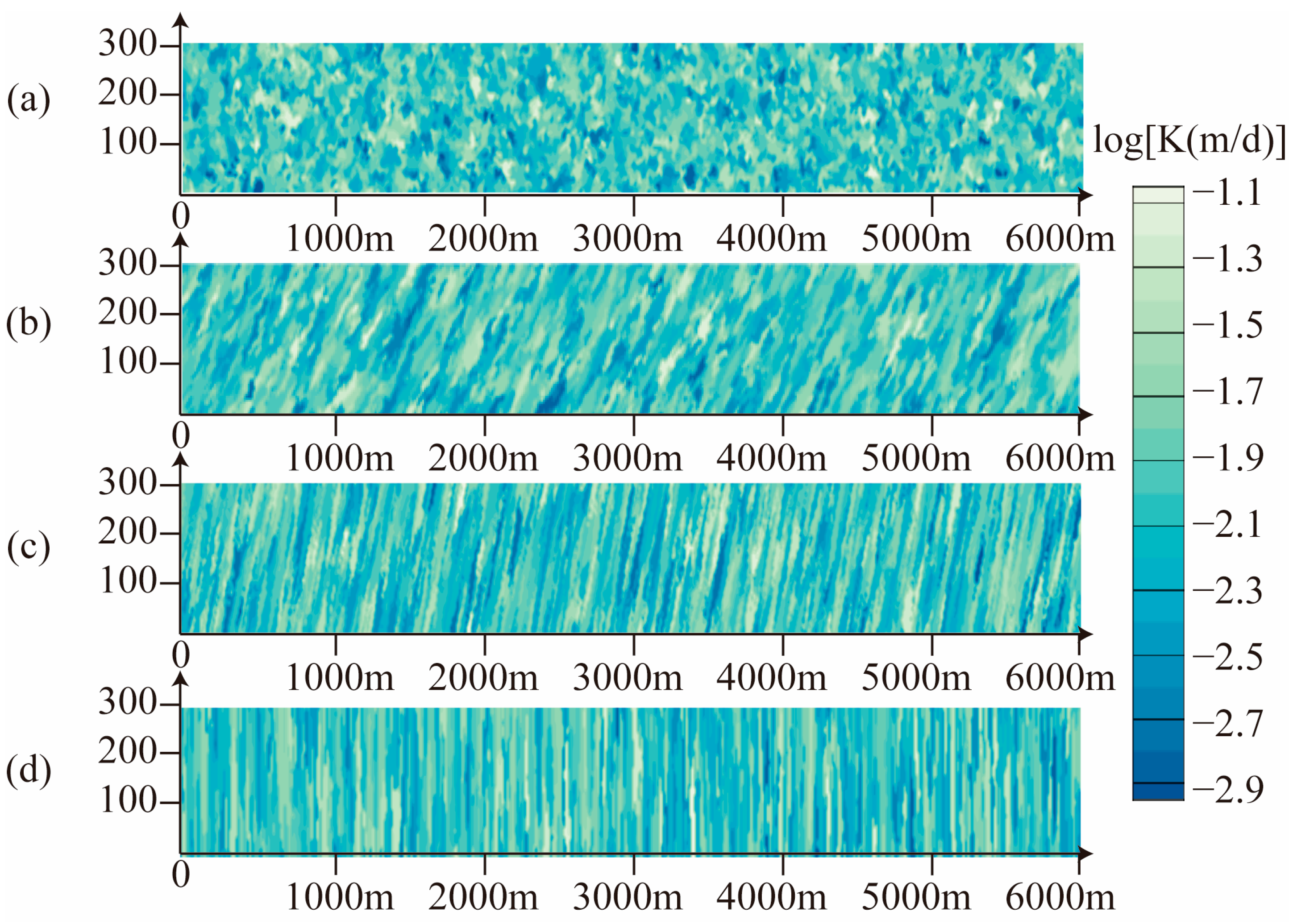
Geostatistical modeling based on variograms was employed to represent stratum continuity and dip, aiming to assess the role of geological heterogeneity in tunnel inflow at the Kexuecheng Tunnel (Figure 3). This is a widely used method to generate the multiple heterogeneous fields and investigate groundwater flow control by heterogeneity [14,35,36]. Heterogeneous scenarios were considered based on two factors: (1) different stratum continuities (R), set to 60 m, 120 m, 180 m, and 240 m parallel to the strata; and (2) different directions of main continuity (θ), set to 0°, 30°, 60°, and 90°, representing the dip angles of the strata. Consequently, 16 heterogeneous groups were analyzed, with 10 realizations generated for each group. Additionally, a homogeneous model with K = 0.01 m/d was developed for comparison with the heterogeneous realizations. In multiple-tunnel cases, we mainly compared the results of homogeneous distribution and heterogeneous models with R = 180 m and θ = 30°.

2.4. Hydrogeologic Evaluation Assessment

The flow response to geological heterogeneity and tunnel drainage was assessed through two principal indicators: water discharge and head drawdown. Water discharge represents the volume of groundwater infiltrating the tunnel from adjacent rock formations, signifying considerable hydrogeological risks that may endanger tunnel safety during operation. To better understand the comprehensive effects of heterogeneity on water discharge dynamics, we computed two indicators: (1) initial water discharge, which is the amount of water discharge at the tunnel face just after excavation (drainage volume simulated in the first time step after excavation); (2) total water discharge: the amount of water discharge along the entire tunnel. Drawdown refers to the reduction in hydraulic head observed following tunnel construction. It quantifies the depletion of groundwater in the vicinity of the tunnel site, reflecting the adverse impact of tunnel drainage on the local hydrological cycle and eco-environmental system [4]. Two indicators are considered: (1) area of drawdown ≥ 30 m, representing the overall groundwater decline in the tunnel region, with this threshold derived from the numerical range observed in our modeling and engineering experience; (2) maximum drawdown, which characterizes the most intense variation in hydraulic head following tunnel excavation.

3. Results

Model simulations indicate that the water discharge and groundwater distribution in heterogeneous scenarios differ markedly from those in the homogeneous model. This divergence arises from the decline in groundwater levels from the recharge boundary toward the tunnels, primarily driven by tunnel drainage effects. Moreover, in scenarios involving multiple tunnels, both the groundwater level and tunnel discharge exhibit substantial variability compared to the single-tunnel condition. These results underscore the pronounced uncertainty associated with groundwater assessment throughout the stages of tunnel development and operational maintenance.

3.1. Single-Tunnel Cases

3.1.1. Water Discharge

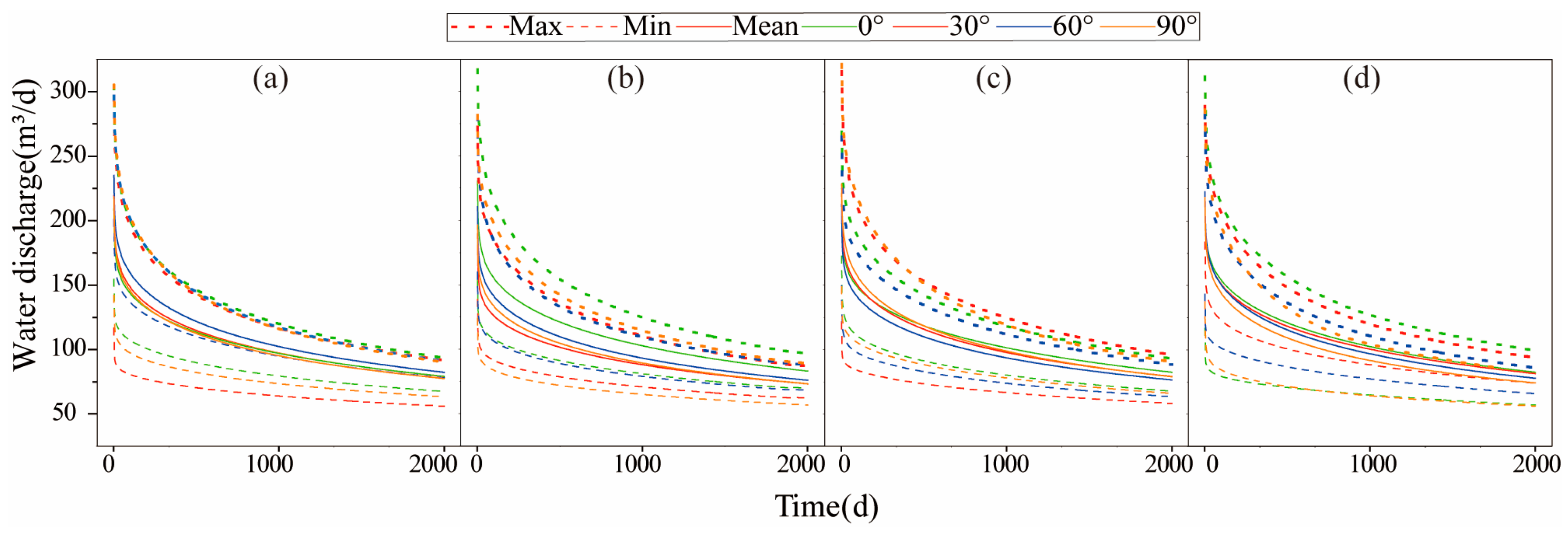
The water discharge of all models shows a very high value at the moment of excavation, and then decreases with time. The maximum water discharge at R = 60 m is nearly identical across cases, while the mean water discharge at R = 120 m shows substantial variability. At R = 240 m, the maximum water discharge decreases with increasing inclination angle, following a reverse order with respect to θ. Finally, the tunnel water inflow decreases slowly and reaches a constant rate over time at about 100 m3/d (Figure 4). Therefore, the initial water discharge is a significant parameter to evaluate the groundwater disaster in the tunnel as it brings the greatest destructive force.
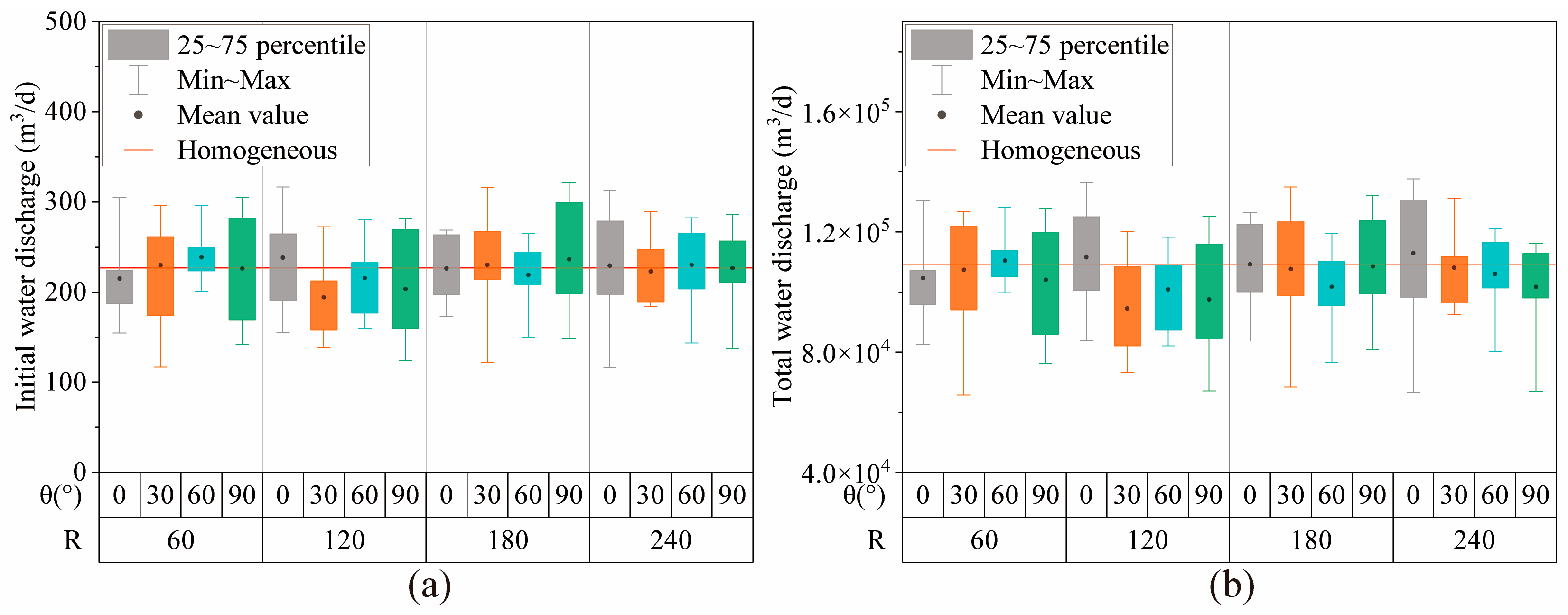
The initial water discharge of each condition is shown in Figure 5a. In the homogeneous case, it is 225 m3/d. In contrast, in the heterogeneous realizations, the initial water discharge varies across different conditions, influenced by the continuity and dip angle of rock strata. Figure 5a demonstrates that, under one condition, the maximum water discharge can approach 300 m3/d, whereas the minimum discharge is nearly 125 m3/d under the heterogeneous scenarios. The non-uniform water inrush in the tunnel is more closely coinciding with the natural state. The maximum value of initial water discharge in the heterogeneous realizations is consistently higher than that in the homogeneous model. Moreover, in most heterogeneous realizations, the majority of the 25–75% range of initial water discharge values are also higher than those under homogeneous conditions. At R = 180 m and R = 240 m, the influence of θ is relatively insignificant, and the mean values are close to those observed under homogeneous conditions. This may be attributed to the relatively small size of the tunnel compared with the heterogeneous realization model, which causes localized differences in tunnel drainage to become more pronounced. Under conditions of greater continuity, no significant trend was observed in the changes in results with respect to the continuity of strata or dip angle. This may be attributed to the relatively small size of the tunnel in comparison to the overall model, and its uneven distribution, which causes more pronounced differences in the tunnel drainage conditions.
The maximum total water discharge values of all heterogeneous realizations exceed those of the homogeneous case (Figure 5b). In contrast, most heterogeneous cases exhibit lower mean total water discharge values than the homogeneous case. When R = 240 m, the value decreases with the increase in θ. The orientation of continuity influences the preferential direction of water flow. Horizontal flow predominates at low values of θ, while vertical flow is significantly influenced by higher values of θ. The continuity orientation affects the preferred direction of groundwater flow, with lower values of θ favoring horizontal flow, while higher θ values encourage vertical flow. Horizontal continuity enhances the flow of water towards the tunnel, thereby increasing water discharge. In other heterogeneous cases, it can also be observed that the total water discharge is higher when θ is low compared to when θ is high. At R = 60 m, 120 m, and 240 m, the total water discharge exhibits pronounced variations with changes in θ, whereas at R = 180 m, the influence of θ becomes relatively minor. This behavior may be attributed to the effect of tunnel depth: as R approaches approximately 200 m, the sensitivity of water discharge to dip angle tends to diminish, while at depths that deviate substantially from the tunnel burial depth, the influence of dip angle becomes more pronounced. These findings suggest that potential geological hazards can be more reliably anticipated through detailed characterization of rock mass properties during tunnel excavation.
In conclusion, lower dip angles promote preferential horizontal flow along continuous strata, thereby increasing tunnel inflow. At shallow depths (e.g., R = 60–120 m), water discharge is highly sensitive to variations in dip angle, whereas this influence diminishes as burial depth approaches 200 m. This trend indicates that the effect of stratal continuity on water discharge is strongly governed by its relative position with respect to the tunnel burial depth than by the dip angle itself.

3.1.2. Drawdown Caused by Tunnel Drainage

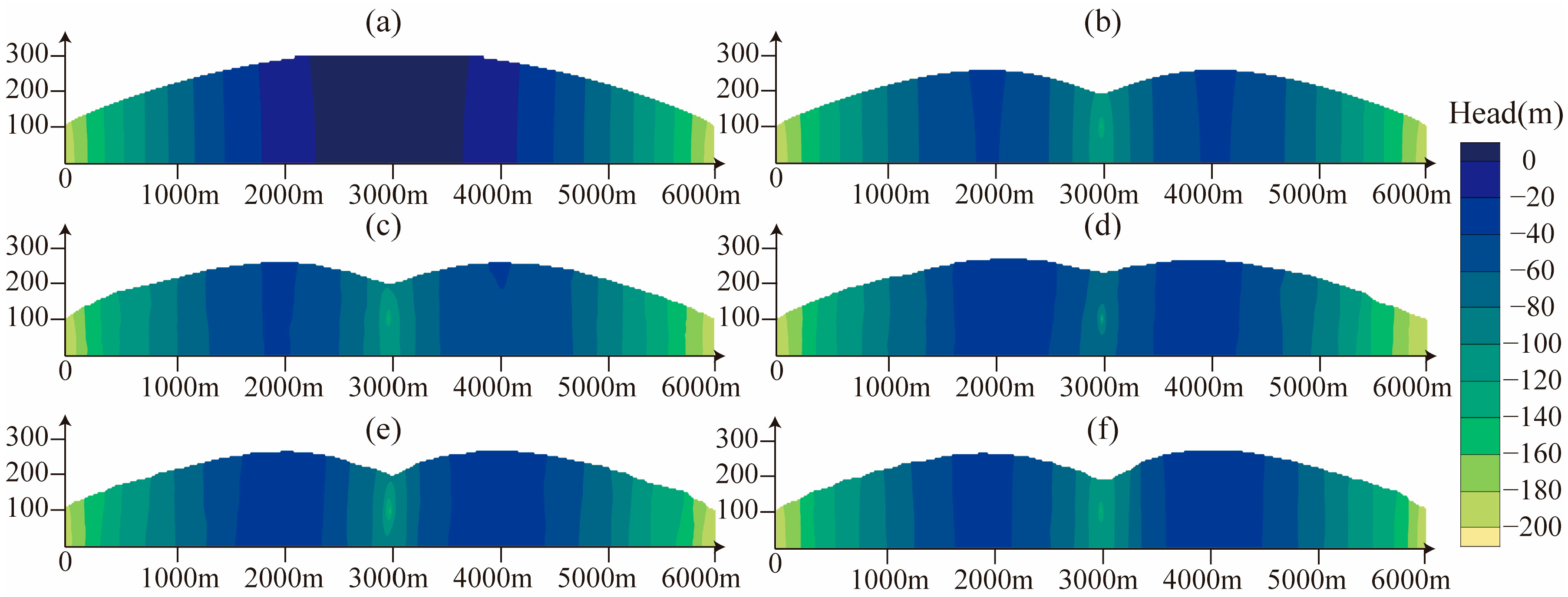
Groundwater table is significantly influenced by the construction of the tunnel. Before excavation, head distribution shows a higher water table in the middle of the model due to the rainfall recharge between two boundaries (Figure 6a). After the commencement of the tunnel construction, the groundwater level distribution of the model shows a significant decline in the water level around the tunnel, forming a depression cone above the tunnel (Figure 6b,c). It distributes more equably in the homogeneous model, while it shows a non-uniform and asymmetric shape in heterogeneous conditions. This uneven distribution poses difficulties in assessing the environmental impacts associated with tunnel drainage.
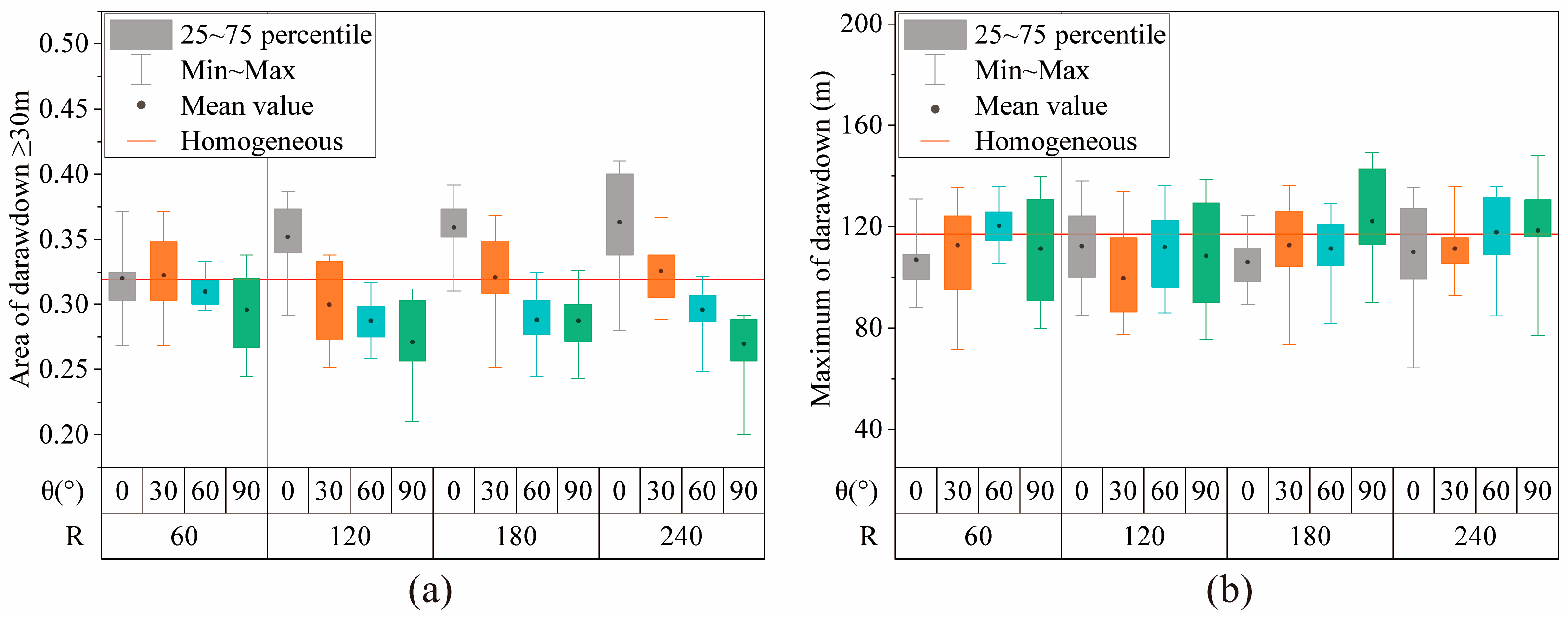
The zone with drawdown ≥ 30 m represents the general groundwater depletion pattern within the tunnel area (Figure 7a). As shown in Figure 7a, the difference in the zone of drawdown exceeding 30 m becomes more pronounced as the dip angle varies. This phenomenon is likely due to enhanced rainfall infiltration along preferential flow paths in the heterogeneous models. At θ = 0°, the area increases significantly with the increase in R. However, at θ = 60° and 90°, it decreases significantly with the increase in R. This may be attributed to the presence of relatively horizontal, highly permeable media, which causes water to predominantly flow in the horizontal direction when θ is small, while it tends to flow vertically when θ is large. This, in turn, affects the groundwater dynamics within the environment, resulting in a more pronounced groundwater drawdown under horizontally distributed strata conditions.
The maximum drawdown represents the most pronounced decline in groundwater levels (Figure 7b), which can potentially lead to severe ecological issues in localized areas. In the homogeneous case, the maximum drawdown at the tunnel site reaches 117 m. At lower R values (R = 60 and 120 m), the maximum groundwater head drawdown is more strongly affected by θ. In contrast, at higher R values (R = 180 and 240 m), the influence of θ on the maximum drawdown becomes relatively weaker, exhibiting a smaller range of variation. Nevertheless, the maximum drawdown generally shows an approximately linear increase with θ. Notably, at R = 60 m, the maximum head drawdown also increases linearly with θ, which is more clearly reflected when comparing the extreme values across different scenarios. A larger dip angle θ, under a given R (whether relatively large or small), tends to induce greater groundwater head drawdown around the tunnel, thereby potentially compromising tunnel stability and safety. This is likely attributed to the vertical continuity of R, which restricts water flow toward the tunnel.
Overall, lower dip angles enhance lateral flow and generate broader groundwater depletion zones, whereas higher dip angles favor vertical flow, reducing the spatial extent of influence but intensifying local drawdown. However, the impact induced by stratal continuity is more pronounced, as evidenced by the zone with drawdown ≥ 30 m, indicating that stratal continuity plays a dominant role in shaping the overall groundwater regime.

3.2. Multiple-Tunnel Cases

3.2.1. Water Discharge

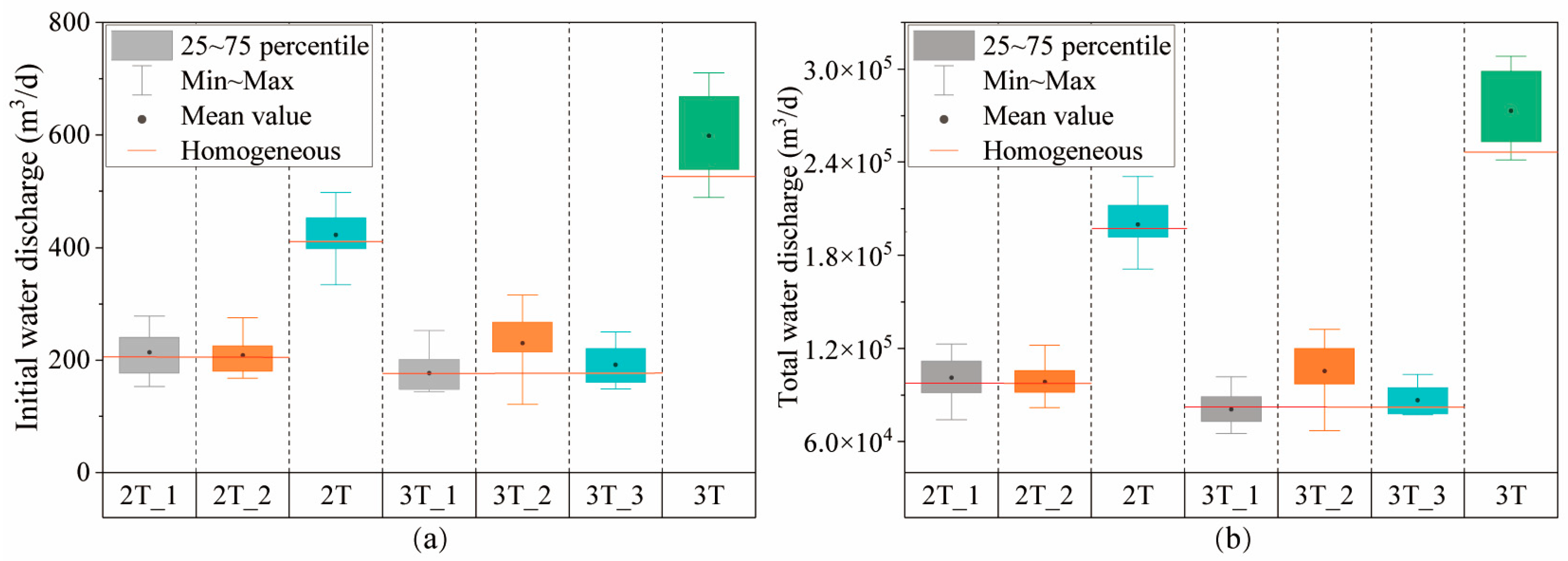
The simulation results of the homogeneous double-tunnel case and the corresponding heterogeneous case show notable differences. In the homogeneous case, the initial water discharge at each tunnel site is 200 m3/d, resulting in a total discharge of approximately 400 m3/d for the double-tunnel system (Figure 8a). In the heterogeneous case with R = 180 m and θ = 30°, the average initial water discharge per tunnel site exceeds 200 m3/d, with a maximum discharge of about 300 m3/d. The total initial water discharge ranges from 300 m3/d to nearly 500 m3/d, representing an overall increase compared to the double-tunnel scenario under the homogeneous condition (Figure 8a).
In the triple-tunnel cases, the initial water discharge at each tunnel site under homogeneous conditions is about 200 m3/d, resulting in a total water discharge above 500 m3/d (Figure 8a). However, for the case where R = 180 m and θ = 30°, the initial water inrush at each tunnel site exceeds homogeneous conditions. The discharge at the intermediate tunnel site is greater than that at the two outer sites, with a maximum value of approximately 300 m3/d. Overall, the mean total initial water discharge of heterogeneous conditions is around 600 m3/d. This is about three times the discharge observed for single-tunnel construction. The results indicate that the initial water discharge increases with the number of excavated tunnels, potentially introducing considerable uncertainty and challenges during the construction process.
The comparison of total water discharge between homogeneous and heterogeneous models is similar to the initial water discharge. In the double-tunnel case, the average value of total water discharge of heterogeneous models is slightly higher than the homogeneous condition, which is around 2 × 10⁵ m3/d (Figure 8b). In the triple-tunnel case, more water discharges into the center tunnel in the heterogeneous models, with about 5 × 10⁴ m3/d more than the other tunnels. Additionally, the total water discharge of heterogeneous models is obviously higher than the homogeneous scenario (Figure 8b).
In summary, geological heterogeneity markedly amplifies groundwater inflow during multi-tunnel excavation. Consequently, the total initial discharge in heterogeneous conditions can approach three times that of a single-tunnel scenario, reflecting increased hydraulic connectivity and heightened susceptibility to groundwater hazards. The inflow intensification is most pronounced at intermediate tunnel positions within triple-tunnel configurations.

3.2.2. Drawdown Caused by Tunnel Drainage

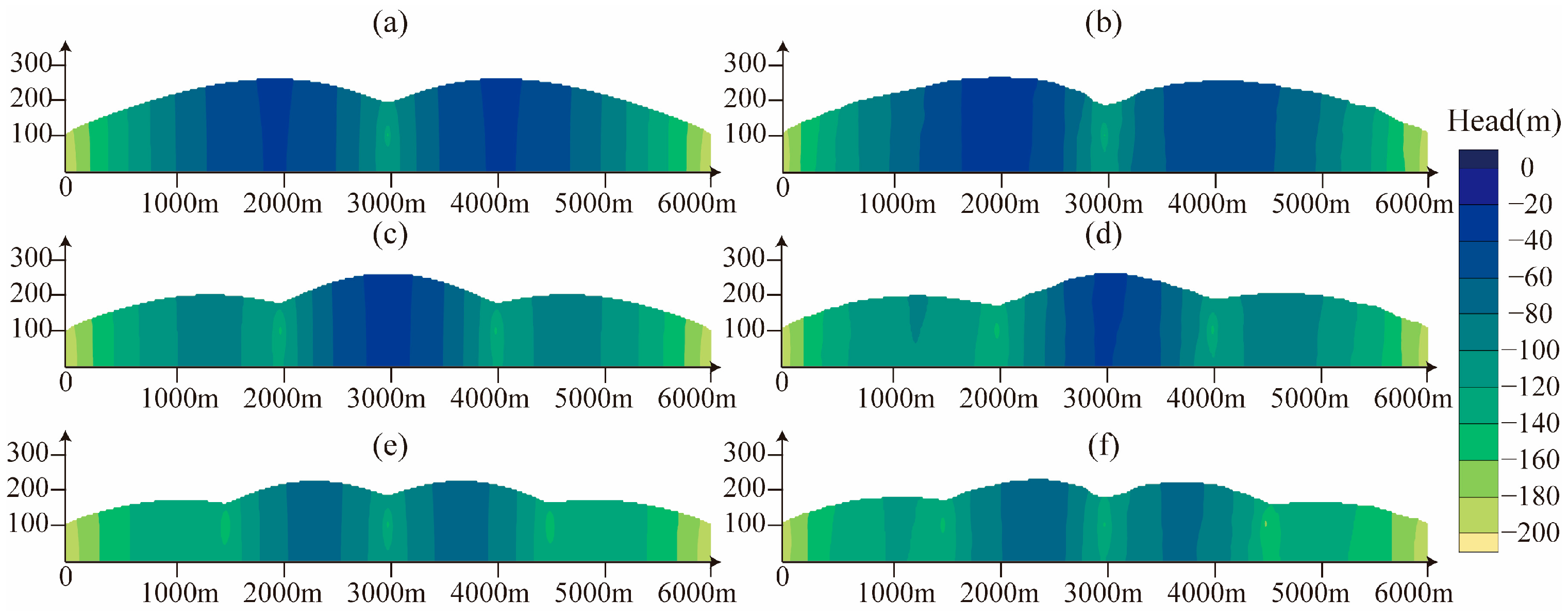
The effect of groundwater in multiple-tunnel cases is more complex than in the single-tunnel case. As shown in Figure 9, in multiple-tunnel scenarios, the groundwater level forms a funnel along the axis of each tunnel, and the overall influence range is significantly larger than that of a single tunnel. Unlike the single-tunnel case, the multiple-tunnel configuration forms additional drainage corridors, amplifying heterogeneity effects and resulting in a more significant impact on the regional groundwater environment.
In the homogeneous realization, the groundwater level drawdown in multiple-tunnel cases is significantly greater than that in the single-tunnel case (Figure 9). Additionally, the influence area of the groundwater level drawdown expands. The dual-tunnel layout results in a groundwater distribution distinct from that of the single-tunnel case, while the triple-tunnel configuration causes a more pronounced groundwater level decline near the tunnel of the single-tunnel configuration.
With an increasing number of tunnels, the influence and variability of groundwater induced by heterogeneity become progressively more pronounced. Furthermore, the distribution of groundwater level drawdown in heterogeneous models is more complex than in homogeneous conditions. In the double-tunnel case, the groundwater level drawdown on the left side of the tunnel increases, with a larger influence area compared to the homogeneous condition (Figure 9c,d). In the triple-tunnel case, the drawdown around the right-side tunnel is greater than the other areas, with a larger affected zone. While the groundwater level drawdown on the left side of the 1000 m region is diminished, the overall distribution exhibits greater irregularity (Figure 9e,f).
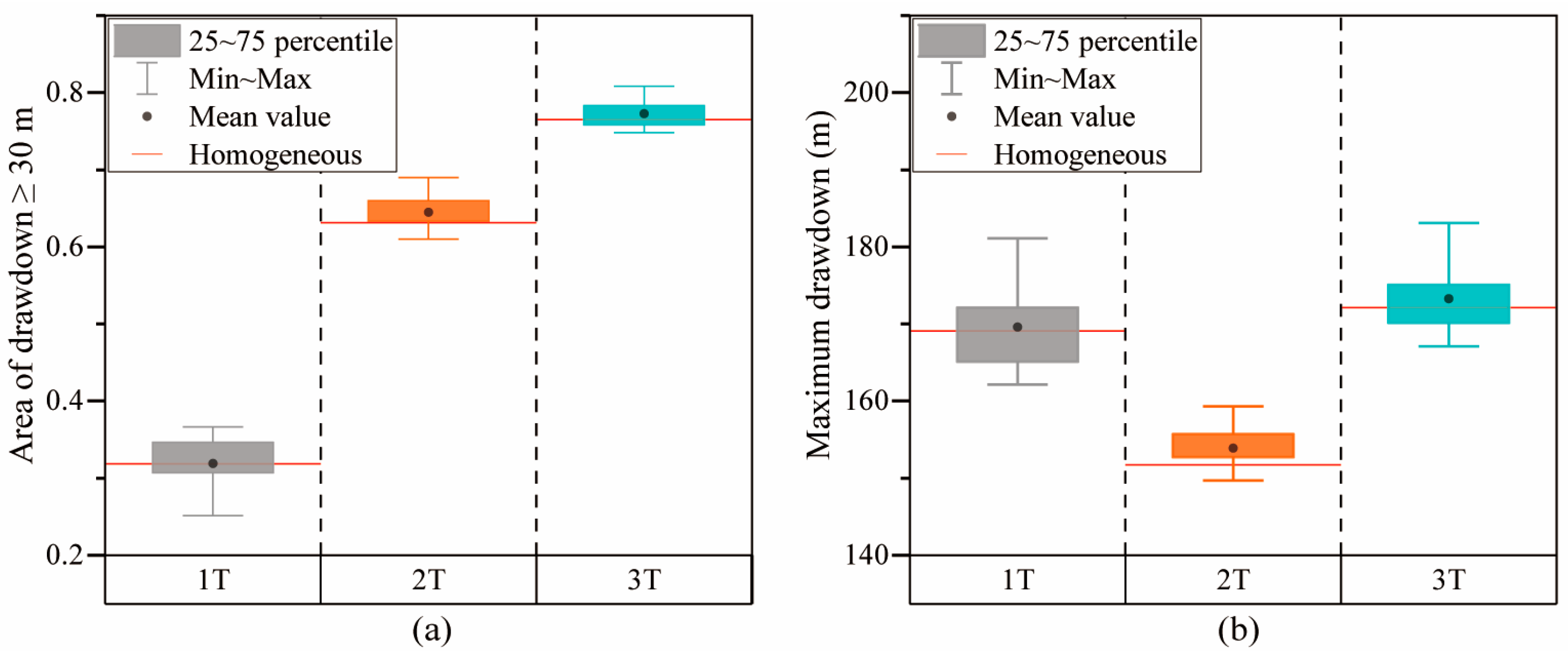
The area of drawdown exceeding 30 m increases as the number of tunnels increases, with the influence of heterogeneity gradually diminishing (Figure 10a). Tunnel-induced groundwater fluctuations become the dominant factor. In the 1T case, significant fluctuations occur under varying heterogeneity distributions. While in the 3T case, the variation in the area of drawdown exceeding 30 m due to different heterogeneity distributions is relatively small. Furthermore, under different tunnel numbers, the average area with a drawdown greater than 30 m is consistently larger than in the homogeneous case. The maximum increase in heterogeneity distribution relative to the homogeneous case is 15.2% for 1T, 9.2% for 2T, and 5.7% for 3T. Compared to the homogeneous scenario, heterogeneity results in a more significant impact on the surrounding groundwater.
The maximum drawdown, under the influence of heterogeneity, exceeds that in the homogeneous case for all tunnel configurations (Figure 10b). The maximum increase in heterogeneity distribution is significantly greater than in the homogeneous case, with values of 12 m (7.1%) for 1T, 7.6 m (5%) for 2T, and 11 m (6.4%) for 3T. Heterogeneity in multi-tunnel scenarios may exacerbate groundwater surges. However, the difference in maximum drawdown under heterogeneity is less pronounced than the variation in the zone of drawdown exceeding 30 m. This suggests that the overall impact of multi-tunnel scenarios on groundwater is more significant, potentially altering the groundwater environment and affecting water resources. The discrepancy observed in the 2T case may be attributed to initial head conditions and tunnel distribution.
In conclusion, increasing the number of tunnels consistently amplifies the effects of geological heterogeneity, resulting in greater groundwater depletion and a wider zone of influence compared with homogeneous conditions. However, the maximum drawdown more directly reflects the critical role of tunnel construction location. The relatively lower maximum drawdown observed in the 2T scenario can be attributed to the tunnel alignment avoiding the high hydraulic head.

4. Discussion

This study reveals that geological heterogeneity substantially affects water discharge and groundwater distribution within the tunnel area. Water discharge and groundwater drawdown serve as effective indicators for assessing the influence of heterogeneity on tunnel hazards and environmental issues. The findings indicate that geological heterogeneity, in contrast to the homogeneous model, results in spatially uneven tunnel drainage and increased uncertainty in discharge estimates. The groundwater level drawdown in local areas is higher in the heterogeneous case. In multiple-tunnel systems, heterogeneity further intensifies the magnitude and unevenness of water discharge and groundwater drawdown. These results underscore the significance of integrating geological heterogeneity into design and construction of tunnels.
The simulation further shows that variations in geological heterogeneity and anisotropy result in distinct patterns of discharge and drawdown. Previous studies have primarily focused on hydraulic head observations and geological data to develop approaches that enhance the predictive reliability and computational efficiency of groundwater flow simulations [37]. Subsequent improvements have optimized the representation of hydraulic conductivity and boundary conditions to achieve more accurate simulations [38]. However, other manifestations of geological heterogeneity, beyond hydraulic conductivity, have received comparatively limited attention. In the model, R represents the stratum continuities and θ represents directions of main continuity. Variations in R and θ make the drawdown behavior more complex, highlighting the need to further strengthen field investigations in environmental assessments. In multi-tunnel conditions, the safety of individual tunnel construction faces even greater challenges. In this study, the maximum drawdown under the twin-tunnel condition is significantly smaller than that under the single-tunnel condition. This difference can be attributed to the configuration of the initial seepage field and the spatial distribution of tunnel locations in the simulations. In the single-tunnel case, the tunnel is located in a region with a relatively higher hydraulic head, whereas in the twin-tunnel scenario, the tunnels correspond to locations with lower hydraulic head values. This discrepancy is likely influenced by the prescribed initial seepage field and tunnel positioning adopted in the numerical model. Therefore, given the presence of existing tunnels, it is essential to incorporate the effects of heterogeneity into the design of new tunnels. In particular, numerical simulations that account for heterogeneity when adjusting tunnel spacing may play a critical role in optimizing tunnel design. Zheng et al. [39] theoretically investigated the influence of different spacing between double-hole tunnels. Extending this analysis to account for multiple tunnels and their spacing in practical engineering applications would be highly valuable.
These findings underscore the importance of thorough geological investigation and careful engineering design to account for geological heterogeneity in tunnel construction. Previous studies have predominantly focused on investigating the variations in geological heterogeneity, with an emphasis on hydraulic connectivity [40]. In contrast, the present study highlights the critical role of both heterogeneity distribution and dip angle in regulating groundwater flow. These factors are shown to substantially affect the estimation of tunnel discharge and groundwater drawdown. Comprehending geological heterogeneity is crucial for accurately modeling groundwater flow and predicting geological hazards during underground l construction.
We investigate geological heterogeneity with groundwater dynamics surrounding multiple tunnels in this study. To extend simulation results to real conditions, several key considerations must be addressed. Firstly, this study only conducted two-dimensional simulations, whereas these factors may vary along the tunnel in real conditions. The simplifications adopted in the two-dimensional modeling of the tunnel, the reliance on partial field results rather than a globally high-precision representation, and the relatively large uncertainties associated with different working conditions during the simulation process all constitute the main limitations of this study. To extend these findings to practical tunnel engineering, more comprehensive field data and the development of detailed 3D models are required, necessitating further in-depth research. In reality, three-dimensional simulations can generate more complex groundwater behaviors and provide more comprehensive datasets [14], but they also demand significantly greater computational resources and time. Further research is needed to balance model accuracy with computational efficiency.
Second, in real conditions, R and θ exhibit greater variability, and their distributions become more complex along different tunnel orientations, potentially intensifying the effects of heterogeneity. In tunnel construction, this orientation and the localized stress distribution around the tunnel opening may exacerbate asymmetric instability [41]. Such spatial variability can cause significant differences, highlighting the need for high-resolution geophysical techniques to support accurate model development in engineering practice. Third, to isolate the effects of heterogeneity, the model employs constant-head boundaries along its sides. The model omits the effects of geomorphology, vegetation, and surface water, all of which strongly influence groundwater behavior. Cheng et al. [42] incorporated the consideration of vegetation-related ecological groundwater levels to prevent adverse impacts on the overall environment. Therefore, the effects of geological heterogeneity induced by tunnel excavation on construction safety, design, and groundwater environment still require more comprehensive investigation.

5. Conclusions

This study aims to elucidate the effects of geological heterogeneity and multi-tunnel construction on groundwater dynamics, with a particular focus on the roles of stratum continuity and dip angle in shaping tunnel hydrogeological responses. Utilizing field data from the Kexuecheng Tunnel, a series of synthetic models were developed to systematically examine how variations in stratum continuity and dip angle influence groundwater flow behavior around tunnels. The simulation results reveal pronounced discrepancies in tunnel discharge and groundwater drawdown between heterogeneous and homogeneous models, highlighting the critical influence of rock heterogeneity on tunnel construction processes. This study yields several key insights:
(1) Under heterogeneous conditions, tunnel water discharge varies significantly. As a key indicator of groundwater-related hazards, it exhibits significant fluctuations under heterogeneous conditions compared to homogeneous ones. Generally, total water discharge increases with strata continuity when θ = 0°, indicating that horizontal continuity enhances groundwater discharge. In most heterogeneous cases, water discharge is greater at lower θ. In addition, the strata continuity may be influenced by tunnel depth, potentially leading to variations in the drainage volume. These findings highlight potential challenges associated with tunnel excavation.
(2) In cases of geological heterogeneity, local groundwater drawdown is more pronounced compared to homogeneous conditions, leading to a highly uneven distribution groundwater level. The groundwater level drawdown increases with stratum continuity, which is more obvious when θ is higher. Conversely, no clear relationship between groundwater level drawdown and strata continuity can be observed if θ is low. Furthermore, the variation in the maximum groundwater drawdown with stratum continuity and θ exhibits a more complex trend, with most heterogeneous scenarios resulting in higher values than homogeneous cases.
(3) Compared to the water discharge and drawdown caused by the single-tunnel case, the multiple-tunnel case leads to more dramatic variations in the groundwater environment. Water discharge in the tunnel region and the affected range increase with the number of tunnels and the decrease in the distance between tunnel sites. Compared to homogeneous realizations, multiple-tunnel construction under heterogenous conditions leads to larger water discharge and uneven groundwater distribution.

Author Contributions

Z.C.: Visualization, Formal analysis, Investigation, Writing—Original Draft; W.H.: Methodology, Investigation, Data curation, Validation; X.W.: Conceptualization, Funding acquisition, Supervision; Z.X.: Funding acquisition, Project administration, Writing—Review and editing; Y.M.: Software. All authors have read and agreed to the published version of the manuscript.

Funding

This research was supported by the National Natural Science Foundation of China (No. 42207074, and No. 42307089).

Data Availability Statement

Data available on request from the authors.

Acknowledgments

The authors would like to express their sincere appreciation to Ziquan Chen (State Key Laboratory of Intelligent Geotechnics and Tunnelling, Southwest Jiaotong University; chenziquan@swjtu.edu.cn) for providing essential geologic data and tunnel engineering background information.

Conflicts of Interest

Author Weini Hu was employed by the company China Railway Chengdu Institute of Science and Technology Co., Ltd. The remaining authors declare that the research was conducted in the absence of any commercial or financial relationships that could be construed as a potential conflict of interest.

References

  1. Butscher, C.; Huggenberger, P.; Zechner, E. Impact of Tunneling on Regional Groundwater Flow and Implications for Swelling of Clay–Sulfate Rocks. Eng. Geol. 2011, 117, 198–206. [Google Scholar] [CrossRef]
  2. Zarei, H.R.; Uromeihy, A.; Sharifzadeh, M. Identifying Geological Hazards Related to Tunneling in Carbonate Karstic Rocks—Zagros, Iran. Arab. J. Geosci. 2012, 5, 457–464. [Google Scholar] [CrossRef]
  3. Do, N.-A.; Dias, D.; Oreste, P.; Djeran-Maigre, I. Three-Dimensional Numerical Simulation of a Mechanized Twin Tunnels in Soft Ground. Tunn. Undergr. Space Technol. 2014, 42, 40–51. [Google Scholar] [CrossRef]
  4. Lv, Y.; Jiang, Y.; Hu, W.; Cao, M.; Mao, Y. A Review of the Effects of Tunnel Excavation on the Hydrology, Ecology, and Environment in Karst Areas: Current Status, Challenges, and Perspectives. J. Hydrol. 2020, 586, 124891. [Google Scholar] [CrossRef]
  5. Li, J.; Hong, A.; Yuan, D.; Jiang, Y.; Deng, S.; Cao, C.; Liu, J. A New Distributed Karst-Tunnel Hydrological Model and Tunnel Hydrological Effect Simulations. J. Hydrol. 2021, 593, 125639. [Google Scholar] [CrossRef]
  6. Song, X.; Cen, C.; Liu, K.; Zhang, C.; Zhou, A.; Wang, Y.; Peng, Q.; Na, J. Numerical Simulation Analysis of the Impact of Tunnel Construction on Aquifers in the Karst Regions of Southwestern China. Water 2025, 17, 619. [Google Scholar] [CrossRef]
  7. Arjnoi, P.; Jeong, J.-H.; Kim, C.-Y.; Park, K.-H. Effect of Drainage Conditions on Porewater Pressure Distributions and Lining Stresses in Drained Tunnels. Tunn. Undergr. Space Technol. 2009, 24, 376–389. [Google Scholar] [CrossRef]
  8. Perazzelli, P.; Leone, T.; Anagnostou, G. Tunnel Face Stability under Seepage Flow Conditions. Tunn. Undergr. Space Technol. 2014, 43, 459–469. [Google Scholar] [CrossRef]
  9. Yang, F.; Zhang, C.; Zhou, H.; Liu, N.; Zhang, Y.; Azhar, M.U.; Dai, F. The Long-Term Safety of a Deeply Buried Soft Rock Tunnel Lining under inside-to-Outside Seepage Conditions. Tunn. Undergr. Space Technol. 2017, 67, 132–146. [Google Scholar] [CrossRef]
  10. Coli, M.; Pinzani, A. Tunnelling and Hydrogeological Issues: A Short Review of the Current State of the Art. Rock Mech. Rock Eng. 2014, 47, 839–851. [Google Scholar] [CrossRef]
  11. Li, X.; Li, Y. Research on Risk Assessment System for Water Inrush in the Karst Tunnel Construction Based on GIS: Case Study on the Diversion Tunnel Groups of the Jinping II Hydropower Station. Tunn. Undergr. Space Technol. 2014, 40, 182–191. [Google Scholar] [CrossRef]
  12. De Miguel-García, E.; Gómez-González, J.F. Concentrations of F, Na+, and K+ in Groundwater before and after an Earthquake: A Case Study on Tenerife Island, Spain. Hydrology 2024, 11, 138. [Google Scholar] [CrossRef]
  13. Chen, Z.; Yu, B.; Li, Z.; Zhuang, D.; Liu, M. An Active Drainage Method for Groundwater Environment Protection and Tunnel Safety Control. Transp. Geotech. 2025, 51, 101502. [Google Scholar] [CrossRef]
  14. Chen, Z.; He, C.; Zhang, Y.; Xu, Z.; Li, Z.; Yu, B. The Impact of Formation Heterogeneity on Water Discharge and Groundwater Depletion of an Excavated Tunnel. J. Hydrol. 2023, 627, 130403. [Google Scholar] [CrossRef]
  15. Chen, Z.; Zhang, T.; Zheng, G.; He, B. Modelling Cascading Failures in Two Parallel Shield Tunnels Induced by Soil-Water Inrush. Tunn. Undergr. Space Technol. 2025, 166, 106943. [Google Scholar] [CrossRef]
  16. Zheng, G.; Zhu, R.; Sun, J.; Zhang, T.; Tong, J.; Wang, R.; Diao, Y. Numerical Study on Failure Propagation between Two Closely Spaced Tunnels. J. Zhejiang Univ.-SCI. A 2021, 22, 894–908. [Google Scholar] [CrossRef]
  17. Liu, D.; Wang, F.; Hu, Q.; Huang, H.; Zuo, J.; Tian, C.; Zhang, D. Structural Responses and Treatments of Shield Tunnel Due to Leakage: A Case Study. Tunn. Undergr. Space Technol. 2020, 103, 103471. [Google Scholar] [CrossRef]
  18. Liu, X. Predicting Tunnel Groundwater Inflow by Geological Investigation Using Horizontal Directional Drilling Technology. Adv. Civ. Eng. 2022, 2022, 6578331. [Google Scholar] [CrossRef]
  19. Katsifarakis, K.L.; Kontos, Y.N.; Keremidis, O. Evaluation of Analytical Solutions Based on the Assumption of One-Dimensional Groundwater Flow Using Numerical Solutions for Two-Dimensional Flows. Hydrology 2025, 12, 226. [Google Scholar] [CrossRef]
  20. Lozano Hernández, B.L.; Marín Celestino, A.E.; Martínez Cruz, D.A.; Ramos Leal, J.A.; Hernández Pérez, E.; García Pazos, J.; Almanza Tovar, O.G. A Systematic Review of the Current State of Numerical Groundwater Modeling in American Countries: Challenges and Future Research. Hydrology 2024, 11, 179. [Google Scholar] [CrossRef]
  21. Bi, J.; Jiang, H.; Ding, W. Analytical Solution for Calculating the Flow Rate in a Lined Tunnel with Drainage Systems. Tunn. Undergr. Space Technol. 2023, 138, 105132. [Google Scholar] [CrossRef]
  22. Harbaugh, A. MODFLOW-2005: The U.S. Geological Survey Modular Ground-Water Model—The Ground-Water Flow Process; Techniques and Methods; USGS: Reston, VA, USA, 2005.
  23. Shekhar, S.; Jha, M. A Broad Review on the Usage of Modular Three-Dimensional Finite-Difference Groundwater Flow Model for Estimating Groundwater Parameters. Int. J. Environ. Sci. Technol. 2023, 20, 10465–10476. [Google Scholar] [CrossRef]
  24. Bai, Y.; Wu, Z.; Huang, T.; Peng, D. A Dynamic Modeling Approach to Predict Water Inflow during Karst Tunnel Excavation. Water 2022, 14, 2380. [Google Scholar] [CrossRef]
  25. Meyer, R.; Engesgaard, P.; Høyer, A.-S.; Jørgensen, F.; Vignoli, G.; Sonnenborg, T.O. Regional Flow in a Complex Coastal Aquifer System: Combining Voxel Geological Modelling with Regularized Calibration. J. Hydrol. 2018, 562, 544–563. [Google Scholar] [CrossRef]
  26. Janković, I.; Fiori, A.; Dagan, G. Modeling Flow and Transport in Highly Heterogeneous Three-dimensional Aquifers: Ergodicity, Gaussianity, and Anomalous Behavior—1. Conceptual Issues and Numerical Simulations. Water Resour. Res. 2006, 42, 2005WR004734. [Google Scholar] [CrossRef]
  27. Xue, L.; Zhang, D.; Guadagnini, A.; Neuman, S.P. Multimodel B Ayesian Analysis of Groundwater Data Worth. Water Resour. Res. 2014, 50, 8481–8496. [Google Scholar] [CrossRef]
  28. He, X.; Koch, J.; Sonnenborg, T.O.; Jørgensen, F.; Schamper, C.; Christian Refsgaard, J. Transition Probability-based Stochastic Geological Modeling Using Airborne Geophysical Data and Borehole Data. Water Resour. Res. 2014, 50, 3147–3169. [Google Scholar] [CrossRef]
  29. Shen, J.; Ma, H.; Du, H.; Xin, Y.; Liu, H.; Ma, W. Numerical Simulation of the External Water Pressure in Seepage Anisotropy Under Heterogeneous Conditions. Water 2024, 16, 3173. [Google Scholar] [CrossRef]
  30. Wang, R.-H.; Sun, P.-G.; Li, D.-Q.; Tyagi, A.; Liu, Y. Three-Dimensional Seepage Investigation of Riverside Tunnel Construction Considering Heterogeneous Permeability. ASCE-ASME J. Risk Uncertain. Eng. Syst. Part A Civ. Eng. 2021, 7, 04021041. [Google Scholar] [CrossRef]
  31. Sun, H.; Zhang, D.; Yin, H.; Hu, A. Stability Analysis of Shield Inclined Tunnel Faces under the Change Effect of Soil Heterogeneity and Pore Water with Buried Depth. Geofluids 2022, 2022, 9610289. [Google Scholar] [CrossRef]
  32. Huang, M.; Li, Y.; Shi, Z.; Lü, X. Face Stability Analysis of Shallow Shield Tunneling in Layered Ground under Seepage Flow. Tunn. Undergr. Space Technol. 2022, 119, 104201. [Google Scholar] [CrossRef]
  33. McBratney, A.B.; Webster, R. Choosing Functions for Semi-variograms of Soil Properties and Fitting Them to Sampling Estimates. J. Soil Sci. 1986, 37, 617–639. [Google Scholar] [CrossRef]
  34. El Mezouary, L.; El Mansouri, B. Groundwater Flow Equation, Overview, Derivation, and Solution. E3S Web Conf. 2021, 314, 04007. [Google Scholar] [CrossRef]
  35. Xu, Z.; Khan, M.R.; Ahmed, K.M.; Zahid, A.; Hariharan, J.; Passalacqua, P.; Steel, E.; Chadwick, A.; Paola, C.; Goodbred, S.L.; et al. Predicting Subsurface Architecture From Surface Channel Networks in the Bengal Delta. J. Geophys. Res. Earth Surf. 2023, 128, e2022JF006775. [Google Scholar] [CrossRef]
  36. Geng, X.; Michael, H.A. Preferential Flow Enhances Pumping-Induced Saltwater Intrusion in Volcanic Aquifers. Water Resour. Res. 2020, 56, e2019WR026390. [Google Scholar] [CrossRef]
  37. Kishor, K.; Aggarwal, A.; Srivastava, P.K.; Sharma, Y.K.; Lee, J.; Ghobadi, F. A Systematic Literature Review of MODFLOW Combined with Artificial Neural Networks (ANNs) for Groundwater Flow Modelling. Water 2025, 17, 2375. [Google Scholar] [CrossRef]
  38. Xia, Q.; Xu, M.; Zhang, H.; Zhang, Q.; Xiao, X. A Dynamic Modeling Approach to Simulate Groundwater Discharges into a Tunnel from Typical Heterogenous Geological Media during Continuing Excavation. KSCE J. Civ. Eng. 2018, 22, 341–350. [Google Scholar] [CrossRef]
  39. Zheng, X.; Pan, W.; Yin, Z. Stress Analysis of Arbitrary-Shaped Double Hole Tunnel in Orthotropic Rock Mass. Appl. Math. Model. 2026, 151, 116581. [Google Scholar] [CrossRef]
  40. Ezzeldin, H.A.; Bahr, J.M. Use of Geochemical and Mathematical Models for the Determination of Mixing Ratios in Groundwater from Municipal Wells, Madison, Wisconsin, USA. Geosci. J. 2023, 27, 367–383. [Google Scholar] [CrossRef]
  41. Fan, C.; Feng, X.-T.; Zhao, J.; Yang, C.-X.; Jiang, M.-F. Time-Dependent Asymmetric Instability in a Deep TBM Tunnel Due to the Combination of Mesoscopic Rock Heterogeneity and Triaxial Stress. Rock Mech. Rock Eng. 2025, 58, 1995–2011. [Google Scholar] [CrossRef]
  42. Cheng, P.; Zhao, L.; Luo, Z.; Li, L.; Li, Q.; Deng, X.; Peng, W. Analytical Solution for the Limiting Drainage of a Mountain Tunnel Based on Area-Well Theory. Tunn. Undergr. Space Technol. 2019, 84, 22–30. [Google Scholar] [CrossRef]
Figure 1. Study area and variogram model fitting. (a) Location of Chongqing City; (b) Elevation around Kexuecheng Tunnel; (c) Geologic map around Kexuecheng Tunnel; (d) Borehole distribution and elevations at the detailed explored site; (e) Variogram fitting in the principal continuity direction (θ = 30°); (f) Variogram fitting in the minimum continuity direction (θ = 120°).
Hydrology 13 00044 g001
Figure 2. Configuration and boundary settings for groundwater modeling.
Hydrology 13 00044 g002
Figure 3. Spatial heterogeneity of stratum continuity and dip angle under different realizations: (a) R = 60 m, θ = 0°; (b) R = 120 m, θ = 30°; (c) R = 180 m, θ = 60°; (d) R = 240 m, θ = 90°. (Ten heterogeneous distributions were generated for each modeling condition.)
Hydrology 13 00044 g003
Figure 4. Temporal variations in water discharge following tunnel excavation under heterogeneous conditions: (ad) Water discharge curves for models with R = 60 m, 120 m, 180 m, and 240 m, respectively.
Hydrology 13 00044 g004
Figure 5. Simulation results of water discharge in single-tunnel models: (a) initial water discharge; (b) total water discharge.
Hydrology 13 00044 g005
Figure 6. Simulated groundwater drawdown results: (a) initial model; (b) homogeneous model; (cf) heterogeneous realizations with varying correlation R and θ, where (R, θ) = (60 m, 0°), (120 m, 30°), (180 m, 60°), and (240 m, 90°), respectively.
Hydrology 13 00044 g006
Figure 7. Simulation results of drawdown in single-tunnel models: (a) zone with drawdown greater than 30 m; (b) maximum drawdown.
Hydrology 13 00044 g007
Figure 8. Simulation results of water discharge in multiple-tunnel models: (a) initial water dis-charge; (b) total water discharge. (2T_1 and 2T_2 represent left and right tunnel, respectively; 2T represents sum of 2T_1 and 2T_2; 3T_1, 3T_2, and 3T_3 represent left, center, and right tunnel, respectively; 3T represents sum of triple-tunnel case.)
Hydrology 13 00044 g008
Figure 9. Groundwater drawdown in tunnels under different conditions. (a) single-tunnel homogeneous realization; (b) single-tunnel heterogeneous realization; (c) double-tunnel homogeneous realization; (d) double-tunnel heterogeneous realization; (e) triple-tunnel homogeneous realization; (f) triple-tunnel heterogeneous realization.
Hydrology 13 00044 g009
Figure 10. Simulated groundwater drawdown results: (a) zone with drawdown greater than 30 m; (b) maximum drawdown.
Hydrology 13 00044 g010
Disclaimer/Publisher’s Note: The statements, opinions and data contained in all publications are solely those of the individual author(s) and contributor(s) and not of MDPI and/or the editor(s). MDPI and/or the editor(s) disclaim responsibility for any injury to people or property resulting from any ideas, methods, instructions or products referred to in the content.