
Half a Century of Civil Engineering in the Bahlui River Hydrographic System: The Unexpected Journey from Gray Structures to Hybrid Resilience

 , and
, and 
Abstract
1. Introduction
2. Materials and Methods
2.1. Civil Engineering Infrastructure on the Hydrographic Network of the Bahlui River
2.1.1. Dams on the Bahlui River: Pârcovaci and Tansa–Belcesti
2.1.2. Podu Iloaiei Reservoir: Accumulation on Bahlueț River
2.1.3. Reservoirs on Râul Locii River: Bârca and Ciurbești
2.1.4. Accumulations on Ciric River: Aroneanu and Ciric III Reservoirs [38,46]
2.1.5. Accumulations on Cacaina River: Cârlig and Vânători
2.1.6. Plopi Accumulation on Gurguiata River
2.1.7. Sârca Accumulation on Valea Oii River
2.1.8. Cucuteni Reservoir on Voinești River
2.1.9. Ciurea Reservoir on Nicolina River
2.1.10. Cornet Reservoir on Cornet River
2.1.11. Ezăreni Reservoir on Ezăreni River
2.1.12. Rediu Reservoir on Rediu River
2.1.13. Chirița Reservoir on the Chirița River
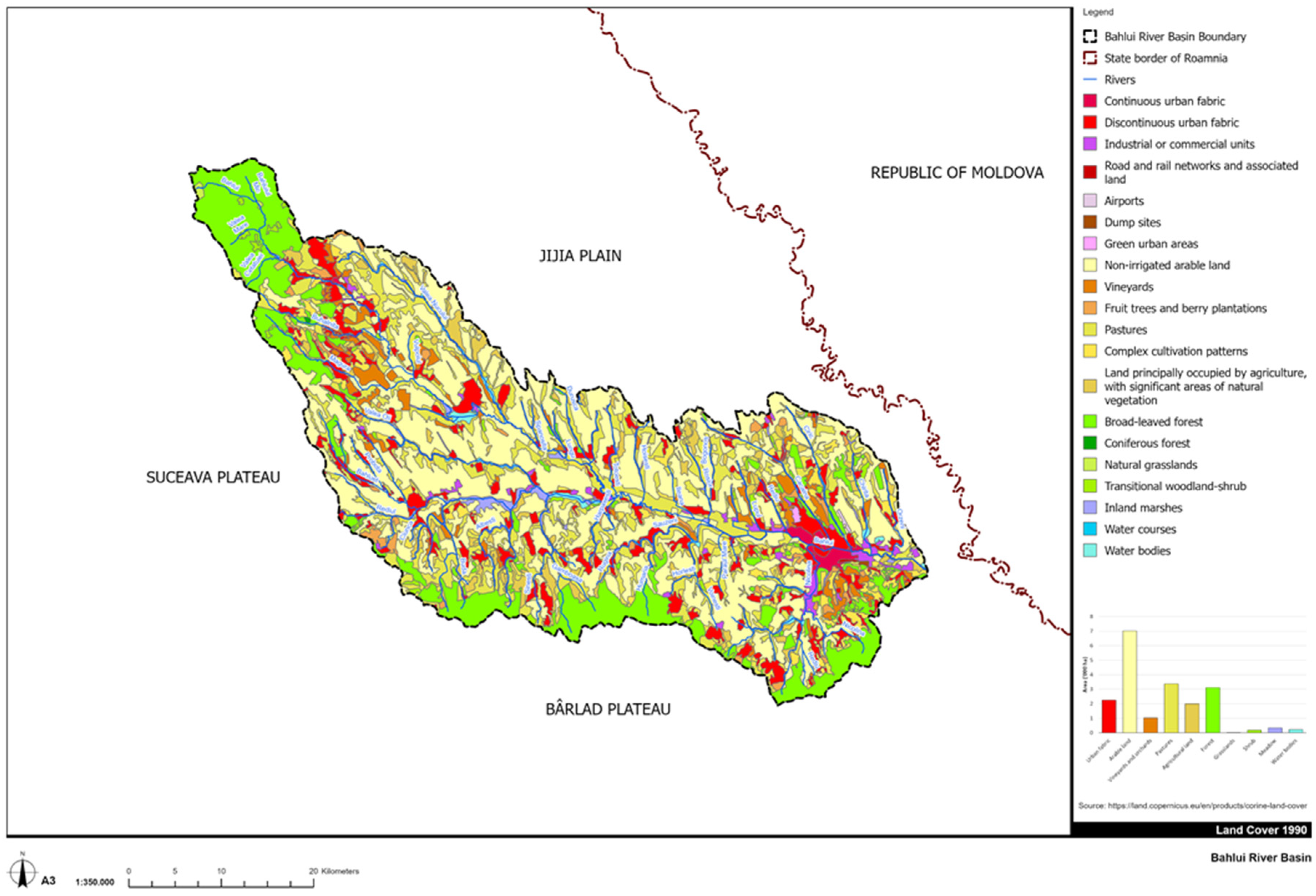
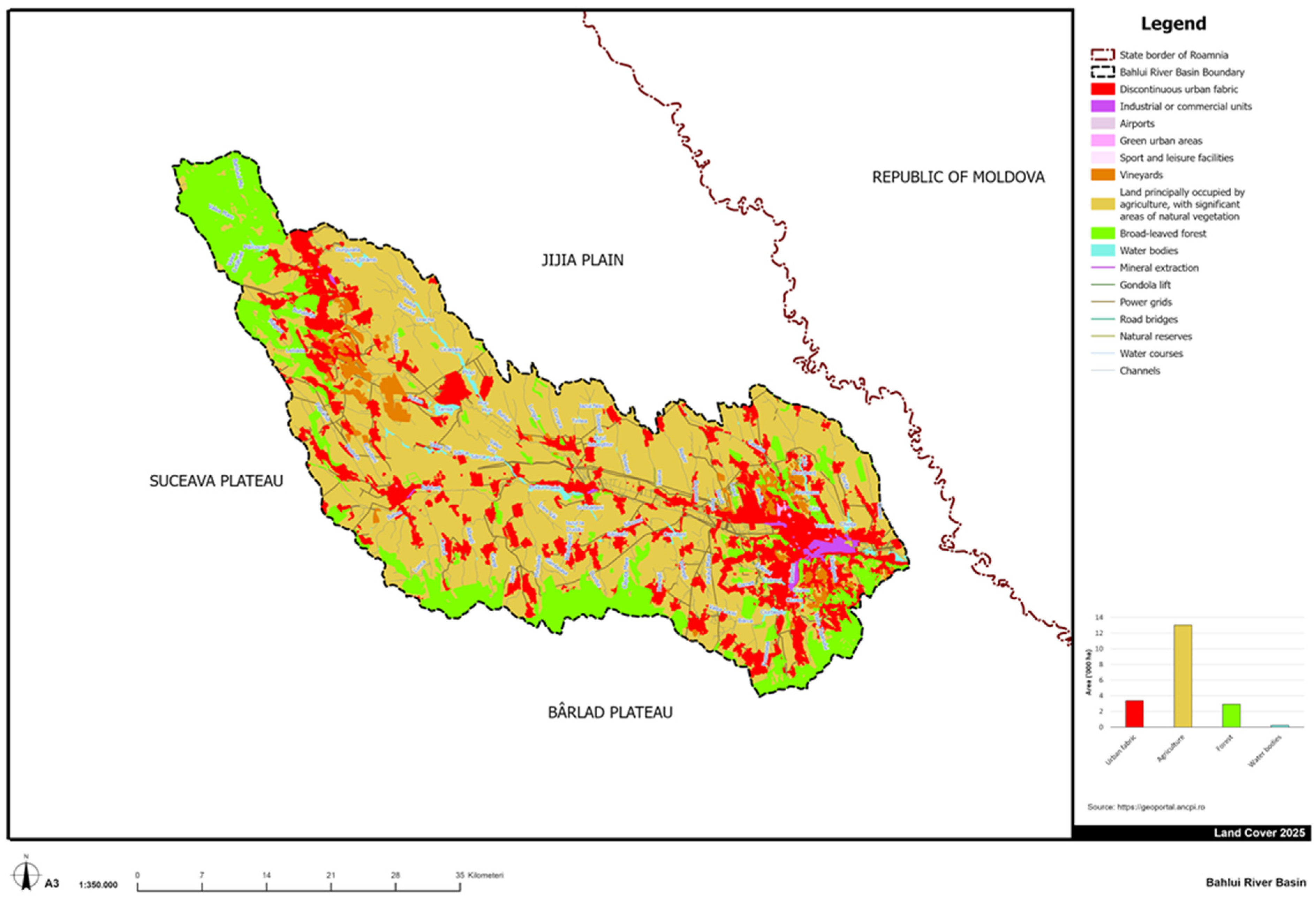
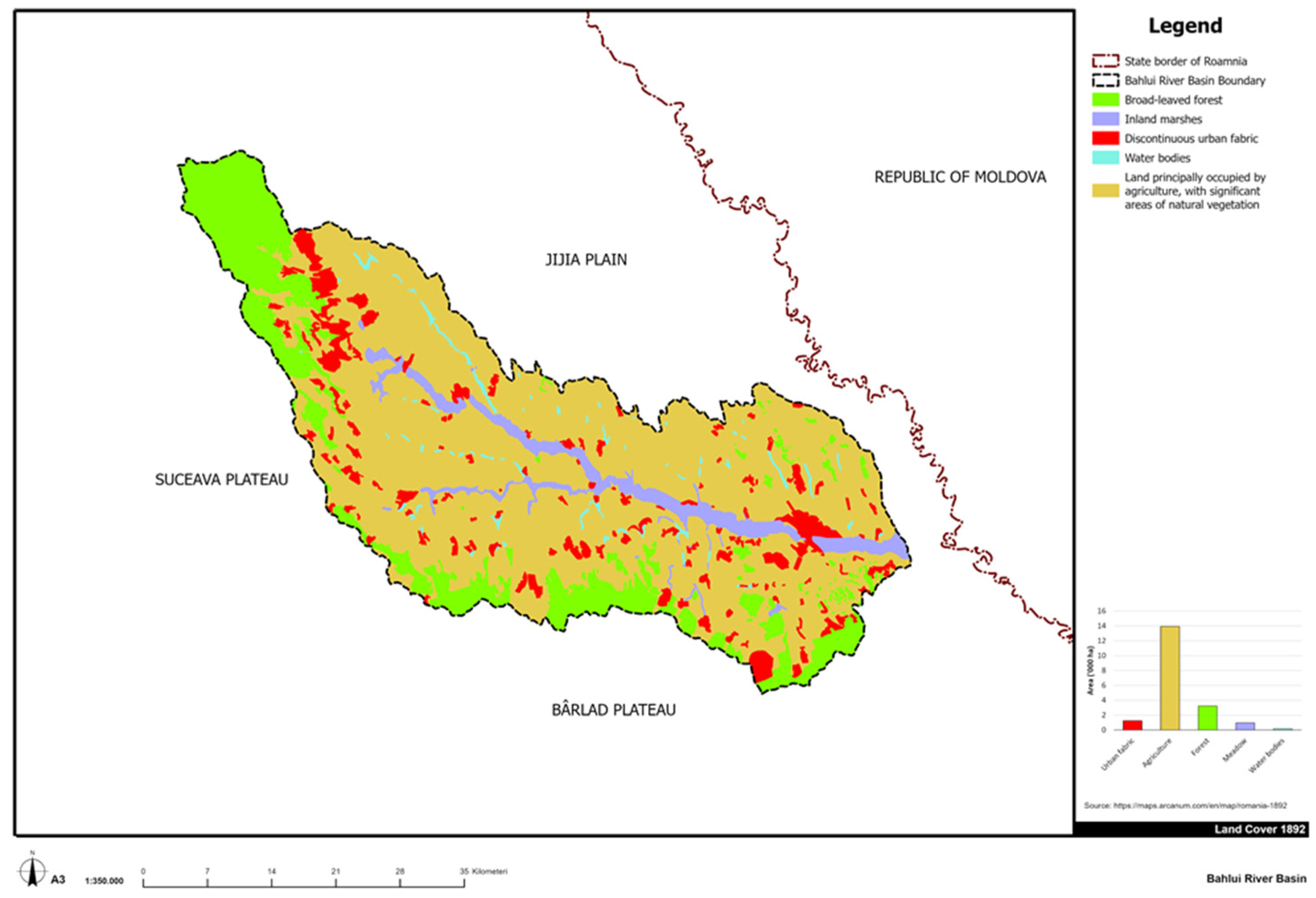
2.2. Historical Evolution of Land Use in the Bahlui Hydrographic System
2.3. Land Use Maps: Graphical Updating and Processing
2.4. Limitations
3. Results and Discussion
3.1. Key Highlights on Bahlui’s River Civil Engineering Infrastructure
3.2. Half-Century Functional Evolution of the Hydrotechnical Infrastructure
- Reservoirs that essentially kept their original purpose. This category includes (i) the non-permanent reservoirs, Bârca, Cârlig, Cornet, Ciurea, and Vânători, that were built with a single function: flood attenuation; (ii) Ciric III and Ciurbești reservoirs, that preserved their main functions of flood attenuation and fish-farming, with recreation added as a new utility; and (iii) Pârcovaci Accumulation that still performs its designed functions: urban/industrial water supply for Hârlău, flood attenuation, ecological flow, and fishery; the only change is that industrial water demand has decreased.
- Reservoirs with partially modified functionalities, where the original multi-purpose concept remains visible, but certain branches, especially irrigation, have faded: (i) Tansa–Belcesti, Podu Iloaiei, and Rediu, which were planned primarily for irrigation, flood control, and fish-farming, are now centered on flood attenuation and fish-farming; (ii) Cucuteni, Sârca, Plopi, that shifted from irrigation as the main function to fish-farming, keeping their flood attenuation status; (iii) Chirița, that shifted from water storage to water supply, preserving the other functions.
- Reservoirs with major functional modifications, where the current function is clearly different from the original design: (i) Aroneanu, that started as a genuinely multipurpose reservoir (irrigation, fishery, partial water supply, and flood defense) but currently functions mainly as a flood-mitigation and recreational/sports lake; and (ii) Ezăreni, initially designed to supply industrial water and irrigation, to support fishery and flood control, that nowadays ensure flood attenuation and present potential for fishery and recreational activities.
3.3. Hybrid Resilience: From Theoretical Concept to Actual Examples
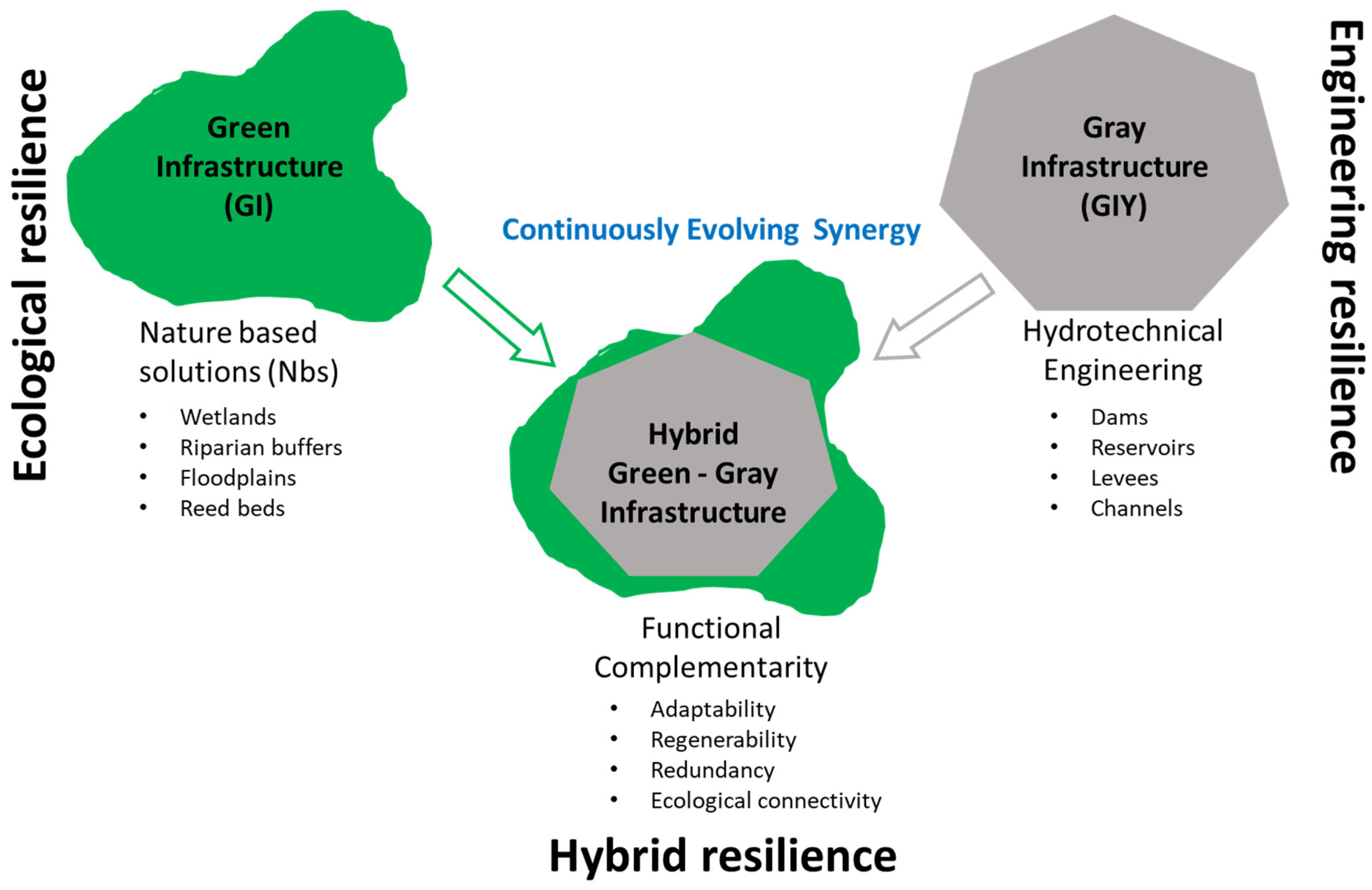
3.3.1. HR: Theoretical Background
- (i)
- GYI—dams, levees, stormwater networks—remain essential for regulating runoff and protecting communities. Yet its effectiveness is limited under extreme future climate scenarios. Evaluations of current levees and dams reveal that engineered systems built to surpass former hydrological standards are becoming more vulnerable to unprecedented floods [25,70].
- (ii)
- GI—wetlands, riparian zones, forests, floodplains—provide functions like infiltration, storage, cooling, and biodiversity support; however, these systems alone cannot always protect densely populated or highly modified landscapes. GI is recognized for multi-functionality, offering climate adaptation, risk reduction, and ecological services, but also requires governance and careful implementation.
3.3.2. Temporal Dynamics of Hybrid Resilience Development
- (i)
- Stage 1: 0–5 years, construction of gray infrastructure, which provides immediate protection; some green elements can be introduced (not yet functional), including grading, planting, and wetland creation.
- (ii)
- Stage 2: 5–20 years, development of green infrastructure, including riparian vegetation, wetlands, reed beds, etc.; ecological functions achieve a certain maturity; green and gray components begin operating together, generating complementarity.
- (iii)
- Stage 3: 20+ years, ecological systems reach functional maturity, providing sustained flood mitigation, water-quality improvements, and biodiversity benefits; the hybrid system becomes a fully integrated socioecological infrastructure; depending on the initial design, the gray infrastructure may require major reinvestment and/or rehabilitation works, enabling redesign toward more nature-based or lighter-gray solutions.
3.3.3. Hybrid Resilience: Can It Be Designed, Anticipated, Accelerated, or Delayed?
3.3.4. Actual Examples of Hybrid Resilience in Bahlui’s River Hydrographic Basin
- (1)
- Green infrastructure (GI) development: the emergence and expansion of wetland areas, marshes and swamps, or reed beds, especially in reservoir tails and shallow margins; riparian vegetation belts and vegetated slopes.
- (2)
- Evidence of functional green-gray integration (e.g., dense vegetation increases hydraulic roughness, which attenuates the peaks of flash floods; wetland plants buffer droughts by acting as sponges, trapping and releasing water gradually).
- (3)
- Institutional and administrative indicators (e.g., the administrative authority’s periodic reports, inclusion in protected natural areas), which are used as supporting, non-deterministic factors.
- (1)
- High HR: Defined by well-developed natural ecosystems that actively interact with gray infrastructure to mitigate floods and droughts.
- (2)
- Moderate HR: Partial or emerging green infrastructure that provides gray infrastructure with complementary ecological support, with clear potential for upgrading the hybridization level.
- (3)
- Low HR: The ecological component is underdeveloped, and the gray infrastructure dominates the system.
4. Conclusions
Author Contributions
Funding
Data Availability Statement
Conflicts of Interest
References
- Rahmani, F.; Fattahi, M.H. Investigation of alterations in droughts and floods patterns induced by climate change. Acta Geophys. 2024, 72, 405–418. [Google Scholar] [CrossRef]
- Xiong, J.; Yang, Y. Climate Change and Hydrological Extremes. Curr. Clim. Change Rep. 2024, 11, 1. [Google Scholar] [CrossRef]
- Hodgkins, G.A.; Renard, B.; Whitfield, P.H.; Laaha, G.; Stahl, K.; Hannaford, J.; Burn, D.H.; Westra, S.; Fleig, A.K.; Araújo Lopes, W.T.; et al. Climate Driven Trends in Historical Extreme Low Streamflows on Four Continents. Water Resour. Res. 2024, 60, e2022WR034326. [Google Scholar] [CrossRef]
- Granata, F.; Zhu, S.; Di Nunno, F. Hydrological extremes in the Mediterranean basin: Interactions, impacts, and adaptation in the face of climate change. Reg. Environ. Change 2025, 25, 100. [Google Scholar] [CrossRef]
- Li, W.; Maharjan, S.; Fisher, J.B.; Piechota, T.; El-Askary, H. Escalating Hydrological Extremes and Whiplashes in the Western U.S.: Challenges for Water Management and Frontline Communities. Earth’s Future 2025, 13, e2024EF005447. [Google Scholar] [CrossRef]
- Newton, B.; Spence, C. James buttle review: A resilience framework for physical hydrology. Hydrol. Process. 2023, 37, e14926. [Google Scholar] [CrossRef]
- Miralles-Wilhelm, F.; Matthews, J.H.; Karres, N.; Abell, R.; Dalton, J.; Kang, S.-T.; Liu, J.; Maendly, R.; Matthews, N.; McDonald, R.; et al. Emerging themes and future directions in watershed resilience research. Water Secur. 2023, 18, 100132. [Google Scholar] [CrossRef]
- Granata, F.; Di Nunno, F. Pathways for Hydrological Resilience: Strategies for Adaptation in a Changing Climate. Earth Syst. Environ. 2025. [Google Scholar] [CrossRef]
- Dinca, L.; Murariu, G.; Lupoae, M. Understanding the Ecosystem Services of Riparian Forests: Patterns, Gaps, and Global Trends. Forests 2025, 16, 947. [Google Scholar] [CrossRef]
- Rockström, J.; Falkenmark, M.; Allan, T.; Folke, C.; Gordon, L.; Jägerskog, A.; Kummu, M.; Lannerstad, M.; Meybeck, M.; Molden, D.; et al. The unfolding water drama in the Anthropocene: Towards a resilience-based perspective on water for global sustainability. Ecohydrology 2014, 7, 1249–1261. [Google Scholar] [CrossRef]
- Di Baldassarre, G.; Martinez, F.; Kalantari, Z.; Viglione, A. Drought and flood in the Anthropocene: Feedback mechanisms in reservoir operation. Earth Syst. Dynam. 2017, 8, 225–233. [Google Scholar] [CrossRef]
- DeFries, R.S.; Rudel, T.; Uriarte, M.; Hansen, M. Deforestation driven by urban population growth and agricultural trade in the twenty-first century. Nat. Geosci. 2010, 3, 178–181. [Google Scholar] [CrossRef]
- Singh, R.; Tiwari, A.K.; Singh, G.S. Managing riparian zones for river health improvement: An integrated approach. Landsc. Ecol. Eng. 2021, 17, 195–223. [Google Scholar] [CrossRef]
- Zhang, J.; Shang, Y. Nexus of dams, reservoirs, climate, and the environment: A systematic perspective. Int. J. Environ. Sci. Technol. 2023, 20, 12707–12716. [Google Scholar] [CrossRef]
- Kellner, E. The controversial debate on the role of water reservoirs in reducing water scarcity. WIREs Water 2021, 8, e1514. [Google Scholar] [CrossRef]
- Połomski, M.; Wiatkowski, M. Impounding Reservoirs, Benefits and Risks: A Review of Environmental and Technical Aspects of Construction and Operation. Sustainability 2023, 15, 16020. [Google Scholar] [CrossRef]
- Contreras, R.J.; Escuder-Bueno, I. Dam Safety History and Practice: Is There Room for Improvement? Infrastructures 2023, 8, 171. [Google Scholar] [CrossRef]
- Erpicum, S.; Crookston, B.M.; Bombardelli, F.; Bung, D.B.; Felder, S.; Mulligan, S.; Oertel, M.; Palermo, M. Hydraulic structures engineering: An evolving science in a changing world. WIREs Water 2021, 8, e1505. [Google Scholar] [CrossRef]
- Kondolf, M.; Yi, J. Dam Renovation to Prolong Reservoir Life and Mitigate Dam Impacts. Water 2022, 14, 1464. [Google Scholar] [CrossRef]
- Angelakis, A.N.; Baba, A.; Valipour, M.; Dietrich, J.; Fallah-Mehdipour, E.; Krasilnikoff, J.; Bilgic, E.; Passchier, C.; Tzanakakis, V.A.; Kumar, R.; et al. Water Dams: From Ancient to Present Times and into the Future. Water 2024, 16, 1889. [Google Scholar] [CrossRef]
- Lu, M.; Merwade, V. From single to multi-purpose reservoir: A framework for optimizing reservoir efficiency. J. Am. Water Resour. Assoc. 2024, 60, 1144–1161. [Google Scholar] [CrossRef]
- Kellner, E.; Brunner, M.I. Reservoir Governance in World’s Water Towers Needs to Anticipate Multi-purpose Use. Earth’s Future 2021, 9, e2020EF001643. [Google Scholar] [CrossRef]
- Karami, S.; Karami, E. Sustainability assessment of dams. Environ. Dev. Sustain. 2020, 22, 2919–2940. [Google Scholar] [CrossRef]
- Meng, Y.; Zhang, H.; Jiang, P.; Guan, X.; Yan, D. Quantitative assessment of safety, society and economy, sustainability benefits from the combined use of reservoirs. J. Clean. Prod. 2021, 324, 129242. [Google Scholar] [CrossRef]
- Wu, Y.; Sun, J.; Hu, B.; Xu, Y.J.; Rousseau, A.N.; Zhang, G. Can the combining of wetlands with reservoir operation reduce the risk of future floods and droughts? Hydrol. Earth Syst. Sci. 2023, 27, 2725–2745. [Google Scholar] [CrossRef]
- Marcoie, N.; Chihaia, Ș.; Hrăniciuc, T.A.; Balan, C.D.; Drăgoi, E.N.; Nechita, M.-T. Linking Nutrient Dynamics with Urbanization Degree and Flood Control Reservoirs on the Bahlui River. Water 2024, 16, 1322. [Google Scholar] [CrossRef]
- Marcoie, N.; Toma, I.O.; Chihaia, Ș.; Hrăniciuc, T.A.; Toma, D.; Balan, C.D.; Drăgoi, E.N.; Nechita, M.-T. Anthropogenic River Segmentation Case Study: Bahlui River from Romania. Hydrology 2025, 12, 224. [Google Scholar] [CrossRef]
- Ionuț, M. Bazinul Hidrografic Bahlui—Studiu Hidrologic; Facultatea de Geografie şi Geologie, Universitatea “Alexandru Ioan Cuza” Iaşi: Iasi, Romania, 2009. [Google Scholar]
- Minea, I. The evaluation of the water chemistry and quality for the lakes from the south of the Hilly Plain of Jijia (Bahlui drainage basin). Lakes Reserv. Ponds 2010, 4, 131–144. [Google Scholar]
- Ludikhuize, D.; Savin, A.; Schropp, M. A Sobek Model for the Bahlui River; Rijksinstituut voor Integraal Zoetwaterbeheer en Afvalwaterbehandeling (RWS, RIZA): Lelystad, The Netherlands, 2004; 49p. [Google Scholar]
- Minea, I. Minimum discharge in Bahlui basin and associated hydrologic risks. Aerul si Apa. Compon. Ale Mediu. 2010, 508–515. [Google Scholar]
- Mediului, M. Atlasul Cadastrului Apelor din România; Editura Romcart SA: București, Romania, 1992; p. 448. [Google Scholar]
- ANPA. Regulament de exploatare: Acumulare Ezăreni. Râul Ezăreni. Bazinul hidrografic Prut. Administraţia Naţională “Apele Române”, Direcţia Apelor Prut 2010.
- ANPA. Regulament de exploatare: Acumulare Ciurbești. Râul Locii. Bazinul hidrografic Prut. Administraţia Naţională “Apele Române”, Direcția Apelor Prut 2010.
- ANPA. Regulament de exploatare: Acumulare Vânători. Râul Cacaina. Bazinul hidrografic Prut. Administraţia Națională “Apele Române”, Direcţia Apelor Prut 2009.
- ANPA. Regulament de exploatare: Acumulare Sârca. Râul Valea Oii. Bazinul hidrografic Prut. Administraţia Națională “Apele Române”, Direcţia Apelor Prut 2009.
- ANPA. Regulament de exploatare: Acumulare Cornet. Râul Cornet. Bazinul hidrografic Prut. Administraţia Națională “Apele Române”, Direcţia Apelor Prut 2009.
- ANPA. Regulament de exploatare: Ciric III. Râul Ciric. Bazinul hidrografic Prut. Administraţia Naţională “Apele Române”, Direcția Apelor Prut 2009.
- ANPA. Regulament de exploatare: Acumulare Cârlig. Râul Cacaina. Bazinul hidrografic Prut—Bârlad. Administraţia Națională “Apele Române”, Directia Apelor Prut 2009.
- ANPA. Regulament de exploatare: Acumularea Pârcovaci, Râul Bahlui, Bazinul hidrografic Prut. Administraţia Națională “Apele Române”, Direcția Apelor Prut 2009.
- ANPA. Regulament de exploatare: Acumularea Rediu. Râul Rediu. Bazinul hidrografic Prut. Administrația Națională “Apele Române”, Direcţia Apelor Pru42 2009.
- Societatea de Construcții, Asamblări, Sarcini și Acoperișuri. Regulament de Exploatare: Amenajare Hidrotehnică Chirița; Râul Chirița, Bazinul hidrografic Prut: Iași, Romania, 2023. [Google Scholar]
- ANPA. Regulament de exploatare: Acumularea Tansa Belcesti. Râul Bahlui. Districtul de bazin hidrografic Prut—Bârlad. Administrația Națională Apele Române, Administrația Bazinală de Apă Prut—Bârlad 2021.
- ANPA. Regulament de exploatare: Acumularea Plopi. Râul Gurguiata. Bazinul hidrografic Prut. Administrația Națională “Apele Române”, Administraţia Bazinală de Apă Prut Bârlad 2017.
- ANPA. Regulament de exploatare: Acumulare Podu Iloaiei. Curs de apă Bahlueț. Bazinul hidrografic Prut. Administrația Națională “Apele Române”, Administraţia Bazinală de Apă Prut Bârlad 2014.
- ANPA. Regulament de exploatare Aroneanu. Râul Ciric. Bazin hidrografic Prut. Administrația Națională “Apele Române”, Administrația Bazinală de Apă Prut—Bârlad 2013.
- ANPA. Regulament de exploatare: Acumularea Cucuteni. Râul Voinești. Districtul de bazin hidrografic Prut—Bârlad. Administrația Națională “Apele Române”, Administraţia Bazinală de Apă Prut—Bârlad 2012.
- ANPA. Regulament de exploatare: Aculumarea Ciurea. Râul Nicolina. Districtul de bazin hidrografic Prut—Bârlad. Administrația Națională “Apele Române”, Administrația Bazinală de Apă Prut—Bârlad 2010.
- ANPA. Regulament de exploatare acumularea Bârca. Râul Locii. Bazinul hidrografic Prut. Administrația Națională “Apele Române”, Administraţia Bazinală de Apă Prut—Bârlad 2010.
- Dumitrache, L.; Zamfir, D.; Nae, M.; Simion, G.; Stoica, I.-V. The Urban Nexus: Contradictions and Dilemmas of (Post) Communist (Sub) Urbanization in Romania. Hum. Geogr. J. Stud. Res. Hum. Geogr. 2016, 10, 38–50. [Google Scholar] [CrossRef]
- Vincze, E. Deindustrialization and the real-estate–development–driven housing regime. The case of Romania in global context. Stud. Univ. Babes-Bolyai-Sociol. 2023, 68, 25–73. [Google Scholar] [CrossRef]
- Ubay-Anongphouth, I.O.; Alfaro, M. Delayed instabilities of water-retaining earth structures. Front. Built Environ. 2022, 8, 927137. [Google Scholar] [CrossRef]
- Mitchell, R.J. Earth dams. In Earth Structures Engineering; Mitchell, R.J., Ed.; Springer: Dordrecht, The Netherlands, 1983; pp. 163–218. [Google Scholar]
- Pytharouli, S.; Michalis, P.; Raftopoulos, S. From Theory to Field Evidence: Observations on the Evolution of the Settlements of an Earthfill Dam, over Long Time Scales. Infrastructures 2019, 4, 65. [Google Scholar] [CrossRef]
- Agarwal, B.; Dobay, K.M.; Sabates-Wheeler, R. Revisiting group farming in a post-socialist economy: The case of Romania. J. Rural Stud. 2021, 81, 148–158. [Google Scholar] [CrossRef]
- Deacu, C. The collapse of the state industry in Romania: Between political and economic drivers. Hum. Geogr. J. Stud. Res. Hum. Geogr. 2016, 10, 116–127. [Google Scholar]
- EU. EU Water Framework Directive (2000/60/EC); EU: Brussels, Belgium, 2000. [Google Scholar]
- European Parliament and the Council of the European Union. Directive 2007/60/EC on the assessment and management of flood risks. Off. J. Eur. Union 2007, L288, 27–34. [Google Scholar]
- Council of the European Union. Council Directive 92/43/EEC on the conservation of natural habitats and of wild fauna and flora (Habitats Directive). Off. J. Eur. Communities 1992, L206, 7. [Google Scholar]
- Bâra, A.; Văduva, A.G.; Oprea, S.-V. Anomaly Detection in Weather Phenomena: News and Numerical Data-Driven Insights into the Climate Change in Romania’s Historical Regions. Int. J. Comput. Intell. Syst. 2024, 17, 134. [Google Scholar] [CrossRef]
- Nagavciuc, V.; Scholz, P.; Ionita, M. Hotspots for warm and dry summers in Romania. Nat. Hazards Earth Syst. Sci. 2022, 22, 1347–1369. [Google Scholar] [CrossRef]
- Adamo, N.; Al-Ansari, N.; Sissakian, V.; Laue, J.; Knutsson, S. Dams safety: Inspections, safety reviews, and legislations. J. Earth Sci. Geotech. Eng. 2021, 11, 109–143. [Google Scholar] [CrossRef]
- Holling, C. Resilience and Stability of Ecological Systems. Annu. Rev. Ecol. Syst. 1973, 4, 1–23. [Google Scholar] [CrossRef]
- Holling, C. Engineering Resilience Versus Ecological Resilience; Engineering Within Ecological Constraints/National Academy Press: Washington, DC, USA, 1996. [Google Scholar]
- Folke, C. Resilience: The emergence of a perspective for social–ecological systems analyses. Glob. Environ. Change 2006, 16, 253–267. [Google Scholar] [CrossRef]
- Gunderson, L.H. Ecological Resilience—In Theory and Application. Annu. Rev. Ecol. Evol. Syst. 2000, 31, 425–439. [Google Scholar] [CrossRef]
- Mayar, K.; Carmichael, D.G.; Shen, X. Resilience and Systems—A Review. Sustainability 2022, 14, 8327. [Google Scholar] [CrossRef]
- Walker, B.; Holling, C.S.; Carpenter, S.R.; Kinzig, A. Resilience, adaptability and transformability in social–ecological systems. Ecol. Soc. 2004, 9, 5. [Google Scholar] [CrossRef]
- Folke, C.; Carpenter, S.R.; Walker, B.; Scheffer, M.; Chapin, T.; Rockström, J. Resilience thinking: Integrating resilience, adaptability and transformability. Ecol. Soc. 2010, 15, 20. [Google Scholar] [CrossRef]
- Nakamura, F. Concept and application of green and hybrid infrastructure. In Green Infrastructure and Climate Change Adaptation: Function, Implementation and Governance; Springer Nature: Singapore, 2022; pp. 11–30. [Google Scholar]
- Hendricks, M.D.; Dowtin, A.L. Come hybrid or high water: Making the case for a Green–Gray approach toward resilient urban stormwater management. J. Am. Water Resour. Assoc. 2023, 59, 885–893. [Google Scholar] [CrossRef]
- ANMAP, Romania’s Protected Natural Areas. National Agency for Protected Natural Areas. 2025. Available online: https://ananp.gov.ro/ariile-naturale-protejate-ale-romaniei/# (accessed on 10 November 2025).
- Paliament, R. The Emergency Ordinance for the Amendment of Law no. 5/2000 Regarding the Approval of the National Territorial Planning Plan—Section IIl—Protected Areas, Official Monitor; Emergency Ordinance no. 49 of 31 August 2016 (689); Romania Government: Bucharest, Romania, 2016.
- Parliament, R. Law on the Approval of the National Territory Planning Plan—Section III—Protected areas, Official Monitor; Law no.5 of 6 March 2000 (152/12 April); Romania Government: Bucharest, Romania, 2000.
- Romania Government. Decision no. 663 of 14 September 2016 on the Establishment of the Protected Natural Area Regime and the Declaration of the Special Avifauna Protection Areas as an Integral Part of the European Ecological Network Natura 2000 in Romania, Official Monitor, (743); Romania Government: Bucharest, Romania, 2016.
- EEA. Acumularile Belcesti, Natura 2000 Site, Code ROSPA0109; European Environment Agency: Copenhagen, Denmark, 2025. Available online: https://ananp.gov.ro/ariile-naturale-protejate-ale-romaniei/# (accessed on 10 November 2025).




| Category | Main Technical Parameters |
|---|---|
| Dam characteristics | Homogeneous earth dam • trapezoidal cross-section • length of the dam crest: 290 m • maximum height: 25 m • crest width: 6.75 m • crest elevation: 178.70 m. d. M. N. |
| Characteristic levels (m. d. M. N.) | Riverbed: 154.00 • NRL: 171.00 • Maximum design level (1%): 177.23 • Dam crest: 178.70 |
| Storage volumes (million m3) | Total storage: 8.75 • Useful: 2.36 • Gross at NRL: 2.75 |
| Hydrology | Q1% = 240 m3/s → attenuated to 114.9 m3/s • Q0.1% = 454 m3/s (natural) • permanent minimum sanitation discharge of 0.017 m3/s |
| Category | Main Technical Parameters |
|---|---|
| Dam characteristics | Earth dam (non-homogeneous) with clay core • Trapezoidal cross-section• Length of dam body: 980 m • Total impoundment front: 4873 m • Maximum height: 14.2 m • Crest width: 4.5–5.0 m |
| Characteristic levels (m. d. M. N.) | Dead storage level: 82.31 • Minimum operational level: 84.82 • NRL: 87.32 • Design flood level (0.1%): 91.68 • Maximum (0.01%): 92.38 • Crest: 93.31 |
| Storage volumes (million m3) | Total at crest: 25.131 • At design level: 18.750 • Total at maximum level: 21.451 • Gross at NRL: 4.720 • Useful: 4.250 • Dead: 0.001 • Attenuation volume (between design level and NRL): 14.030 |
| Hydrology | Q1% = 285 m3/s → attenuated to 134.05 m3/s • permanent minimum sanitation discharge of 0.050 m3/s |
| Category | Main Technical Parameters |
|---|---|
| Dam characteristics | Earth dam built from local loess-type clays, essentially homogeneous • Maximum height: 14.2 m • Dam body length: 980 m (total impoundment front ≈ 4873 m) • Crest width: 4.5–5.0 m |
| Characteristic levels (m. d. M. N.) | Spillway crest: 65.33 • Dam crest (earth fill): 68.50 • Concrete parapet: 69.15 • Dead storage level: 60.00 • NRL: 62.00 |
| Storage volumes (million m3) | Total at maximum verification level (1.2 × 0.01%): 28.098 • Total at 0.01% level: 26.144 • Total at design level 0.1%: 23.114 • Theoretical gross at spillway crest: 15.674 • Gross at NRL: 3.699 • Dead storage: 0.572 • Useful storage: 3.127 |
| Hydrology | Q1% reduced from 280 m3/s to 15 m3/s • permanent minimum sanitation discharge of 0.021 m3/s |
| Category | Bârca Temporary Reservoir | Ciurbești Reservoir |
|---|---|---|
| Dam characteristics | Homogeneous earth dam • Length: 400 m • Maximum height: 12.7 m • Crest width: 6.0 m • Foundation depth: 0.5 m | Homogeneous earth dam • Length: 427 m Crown elevation: 69.00 m • Maximum height: ~14–15 m • Crest width: 9.3 m |
| Characteristic levels (m. d. M. N.) | Riverbed: 65.10 • Bottom-outlet axis: 65.35 • Spillway crest: 74.00 • Dam crest: 77.00 | Maximum flood level: 67.113 • Dam crest: 69.00 • Bottom outlet axis: 54.95 |
| Storage volumes (million m3) | Total at verification level: 3.94 • Upstream fishpond volumes (can be absorbed in failure scenario): 0.65 • Total attenuation: 7.90 | Attention: 4.608 • Alert: 6.733 • Danger: 8.229 • Attenuation capacity: 5.707 • Total volume at max level: ~14.75 • Total at dam crest: 16.56 |
| Hydrology | Q1%: 100 m3/s → 14.750 m3/s (85% reduction) • Q0.1%: 172 m3/s → 17.031 m3/s (90% reduction) | Q0.1% = 250 m3/s → attenuated to ~33.047 m3/s • Q0.01% ~154 m3/s → attenuated to ~16.608 m3/s • permanent minimum sanitation discharge of 0.02 m3/s |
| Category | Aroneanu Reservoir | Ciric III Reservoir |
|---|---|---|
| Dam characteristics | Homogeneous earth dam, local loess-type clay materials • Length: 280 m • Maximum height: 9.3 m (original) • Crest width: 5 m | Homogeneous earth dam, trapezoidal section • Length: 258 m • Crest width: 5 m • Maximum height: 11.5 m • Foundation depth: min. 0.85 m |
| Characteristic levels (m. d. M. N.) | Dead storage level 56.52 • Minimum operating level: 58.00 • NRL: 58.80 • Spillway crest: 60.55 • Earthfill crest: 64.32 | Bottom outlet axis: 42.45 • Water intake axis: 45.50 • NRL: 46.50 • Spillway crest: 51.00 • Dam crest: 53.60 |
| Storage volumes (million m3) | Dead storage: 0.362 • Gross at NRL: 1.480 • At spillway crest: 2.410 • Global at earthfill crest: 6.602 | Total at dam crest: 1.960 (designed)/1.600 (current) • Gross at spillway crest: 1.000 (designed)/0.911 (current) • Gross at NRL: 0.250 (designed)/0.248 (current) |
| Hydrology | Q5% = 54 m3/s • Q2% = 80 m3/s • Q1% = 100 m3/s • Q0.1% = 172 m3/s • Q0.01% = 244 m3/s • Q1.2×0.01% = 292.8 m3/s • permanent minimum sanitation discharge of 0.010 m3/s | Q0.1% = 180 m3/s • Q0.01% = 333 m3/s • Q1.2×0.01% = 399.6 m3/s • permanent minimum sanitation discharge of 0.010 m3/s |
| Category | Cârlig Reservoir | Vânători Reservoir |
|---|---|---|
| Dam characteristics | Earthfill homogeneous dam • Material: local clay soils • Length: 225 m • Crest width: 4.0 m • Maximum height: 7.67 m | Homogeneous earthfill dam built from local clayey soils • Crest length: 360.0 m • Foundation width (base width): 92.20 m • Crest width: 5.0 m • Maximum height: 12.85 m |
| Characteristic levels (m. d. M. N.) | Thalweg: 54.15 (projected)/54.44 (current) • Bottom outlet axis: 54.95/55.24 • Spillway crest: 60.05 (projected)/59.68 (current) • Dam crest: 62.55 (projected)/62.11 current | Thalwheg: 63.10 • Bottom outlet axis: 63.50 • Spillway crest: 72.35 • Dam crest: 74.60 (projected)/74.55 (current) |
| Storage volumes (million m3) | Dead storage: 0.01 (projected)/0.004 (current) • Volume at spillway crest: ~1.02 (projected)/1.069 (current) • Total at verification level 0.01%: 2.640 • Total at dam crest: 3.20 (projected)/3.076 (current) | Global at dam crest: 3.675 • Theoretical gross volume (from valley morphology): 2.201 • Total at maximum verification level (0.1%): 2.993 • Dead volume: 0.010 • Dead storage: 0.010 • Useful/active flood storage: 3.665 |
| Hydrology | Q1.2×0.01%: 294 → 227.17 m3/s (77%) • Q0.01%: 245 → 146.79 m3/s (59%) • Q0.1% (design): 170 → 115.88 m3/s (68%) • Minimum required downstream flow: the natural flow of the Cacaina River | Q1%: 80 → 11.973 m3/s • Q0.1%: 151 → 54.338 m3/s • Q1.2×0.1%: 181.20 → 78.956 m3/s • Minimum required downstream flow: the natural flow of the Cacaina River |
| Category | Main Technical Parameters |
|---|---|
| Dam characteristics | Homogeneous earthfill dam • Crest elevation: 82.75–83.86 m. d. M. N. • Crest length: 369.12 m (design 330 m) • Crest width: 4.55–5.11 m (design 5.0 m) • Maximum height: 11.36 m (design 10.5 m) |
| Characteristic levels (m. d. M. N.) | Bottom outlet invert: 72.50 • Bottom outlet axis: 73.35 • Dead storage level (design): 73.60 • Minimum operating level: 75.10 • NRL: 78.24 (design 77.70) • Spillway crest: 82.22 (design 81.80) |
| Storage volumes (million m3) | Gross at NRL: 4.3296 • Theoretical gross at spillway crest: 10.352 • Global at earthfill crest: 11.293 • Useful storage at NRL: 4.30 |
| Hydrology | Q0.1% = 205 m3/s → attenuated to 90.21 m3/s • Q1% = 120 m3/s → attenuated to 18.24 m3/s. • Ecological downstream flow: = 0.010 m3/s |
| Category | Main Technical Parameters |
|---|---|
| Dam characteristics | Homogeneous earthfill dam, trapezoidal section • Crest length: 334 m • Crest width: 6 m • Maximum height: 16.5 m • Minimum foundation depth: 2.1 m • Crest elevation: 82.50 m. d. M. N. |
| Characteristic levels (m. d. M. N.) | Thalweg: 65.50 • Bottom outlet axis: 66.30 • Water intake axis (lower): 67.00 • Upper intake axis: 71.50 • Spillway crest: 81.00 • Frontal dam crest: 82.50 • Minimum operating level: 68.50 • NRL: 73.50 |
| Storage volumes (million m3) | Global at dam crest: 21.130 • Total at maximum verification: 13.974 • Theoretical gross at spillway crest: 16.865 • Gross at NRL: 3.300 • Useful storage: 3.000 • Dead (inactive) storage: 0.100 |
| Hydrology | Q1% = 110 m3/s V = 6.18 million m3 • Q0.1% = 190 m3/s, V = 10.67 million m3 • (verification) → Q1.2×0.1% = 228 m3/s, V = 12.80 million m3 • Ecological downstream flow: = 0.010 m3/s |
| Category | Main Technical Parameters |
|---|---|
| Dam characteristics | Homogeneous earthfill dam built from local loess-like clays and silty clays • constructed in two bodies (old embankment “A” and raised body “B”). • Crest length: 377 m • Maximum base width: 66 m • Crest width: 8 m • Maximum height: 13.75 m |
| Characteristic levels (m. d. M. N.) | Lake bed: 53.00 • Bottom outlet invert: 51.00 • Bottom outlet axis: 51.75 • Spillway) sill/tower weir 58.48 • Spillway crest (large floods): 61.85 • Dam crest (frontal embankment): 64.78 • Dead storage level 54.95 • Minimum operating level: 56.50 • NRL: 58.48 |
| Storage volumes (million m3) | Dead/silted volume: 1.616 • Gross at NRL: 1.734 • Theoretical gross at spillway crest: 6.373 • Gross at design level: 7.033 • Global at dam crest: 12.541 |
| Hydrology | Q1%: 140 → 26.86 m3/s (level 62.57 m. d. M. N.) • Q0.1%: 240 → 90.90 m3/s (63.46 m. d. M. N.) • Q1.2×0.1%: 288 → 122.63 m3/s (63.82 m. d. M. N.) • Q2%: 110 → 9.27 m3/s • Q5%: 75 → 0 m3/s • Ecological flow upgraded from 0.010 m3/s to 0.023 m3/s to support water quality in Bahlui. |
| Category | Main Technical Parameters |
|---|---|
| Dam characteristics | Earthfill homogeneous dam • Crest elevation: 81.20 m • Crest width: 4 m • Length: 750 m • Maximum height: 18 m |
| Characteristic levels (m. d. M. N.) | Thalweg: 64.41 • Bottom outlet axis: 65.28 • Upstream pond level: 73.35 • Spillway crest: 79.70 • Dam crest: 81.20 • Freeboard (crest—spillway): 1.96 m |
| Storage volumes (million m3) | Total at dam crest: 7.20 • Gross at spillway crest: 5.24 • Upstream pond volume: 0.21 • Dead storage: 0.35 • Volume at verification level: 6.23 |
| Hydrology | Natural vs. attenuated peak flows: Q0.1%: 175 → 56.3 m3/s • Q0.01%: 245 → 58.0 m3/s • Q1.2×0.01%: 294 → 109 m3/s |
| Category | Main Technical Parameters |
|---|---|
| Dam characteristics | Homogeneous earthfill dam • Length at crest: 250 m • Base width: 77 m • Crest width: 4.0 m • Maximum height: 11.5 m • Minimum founding depth: 0.50 m |
| Characteristic levels (m. d. M. N.) | Thalweg: 60.00 (project/current) • Bottom outlet axis: 59.50 • Spillway crest: 68.50 • Dam crest: 71.50 • Maximum design level: 68.05 (project)/66.73 current • Maximum verification level: 70.20 (project)/69.44 current |
| Storage volumes (million m3) | Global at dam crest: 3.90 • Upstream pond volumes: 0.08 • Total at spillway crest: 1.95 • Theoretical flood storage above crest (to crest): 1.95 • At verification level: 2.96 (project)/2.464 (current) • Dead volume: 0.07 |
| Hydrology | Q1.2×0.01% (verification): natural 192.0 m3/s → attenuated 39.768 m3/s • Q0.01% (verification): 160.0 → 24.30 m3/s • Q0.1% (design): 115.0 → 19.484 m3/s |
| Category | Main Technical Parameters |
|---|---|
| Dam characteristics | Homogeneous earthfill dam built from local clayey materials. • Crest length: 273 m • Base width: ~60 m • Crest width: 4.60 m • Maximum height: 8.60 m • Minimum foundation level: 54.50 m. d. M. N. |
| Characteristic levels (m. d. M. N.) | Thalweg: 50.60 • Bottom outlet axis: 55.00 • Spillway crest: 60.20 • Dam crest (frontal embankment): 63.10 • Minimum operating level: 56.80 • NRL: 58.40 |
| Storage volumes (million m3) | Global at dam crest: 4.300 • Total at maximum verification level: 3.312 • Gross at spillway crest: 1.862 • Gross at NRL: 0.780 • Dead storage: 0.080 |
| Hydrology | • Q0.1%: 150 → 17.338 m3/s at level 61.28 m. d. M. N. • Q0.01%: 210 → 25.324 m3/s at 61.72 m. d. M. N. • Q1.2×0.01%: 252 → 32.245 m3/s at 62.07 m. d. M. N. • Ecological downstream flow: = 0.007 m3/s |
| Category | Main Technical Parameters |
|---|---|
| Dam characteristics | Earthfill homogeneous dam (trapezoidal section) constructed from local clayey soils. • Crest length: 253 m • Base width: 48 m • Crest width: 5 m • Maximum height: 10 m • Minimum foundation depth: 5 m • Minimum foundation level: 54.30 m. d. M. N. |
| Characteristic levels (m. d. M. N.) | Thalweg: 58.50 • Bottom outlet axis: 55.10 • Water intake axis: 59.25 • Spillway crest: 63.21 • Dam crest (frontal embankment): 64.65 • NRL: 62.95 |
| Storage volumes (million m3) | Global at dam crest: 0.675 • Gross at spillway crest: 0.408 • Gross at NRL: 0.369 • Useful volume: 0.291 |
| Hydrology | Q2% (design): 31 m3/s → attenuated to 11.4 m3/s • Q1%: 40 m3/s → 15.2 m3/s • Q0.5% (verification): 49 m3/s → 19.3 m3/s • Q5%: 22 m3/s → 6.8 m3/s • Q10%: 15 m3/s → 4.3 m3/s • Ecological downstream flow: 0.001 m3/s |
| Category | Main Technical Parameters |
|---|---|
| Dam characteristics | Earthfill dam • Parapet elevation: 54.90 m. d. M. N. • Upstream slope protected with concrete slabs (recent repairs 2020–2022) |
| Characteristic levels (m. d. M. N.) | Minimum exploitation: 49.70 • Medium: 50.70 • Maximum (NRL-equivalent): 51.70 • Parapet level: 54.90 |
| Storage volumes (million m3) | NRL storage: 3.695 million m3 • Surface at NRL: 92.70 ha |
| Hydrology | Q2%: 72 → 9.93 m3/s; Q0.5%: 111 → 24.83 m3/s • Downstream ecological outflows strictly regulated: = 0.100–0.150 m3/s. |
| Category | Reservoir | Justification | Refs. |
|---|---|---|---|
| High HR | Pârcovaci | The Pârcovaci accumulation has been declared a national protected area since 2000, as per Law No. 5 of 6 March 2000, which was amended by the Emergency Ordinance No. 49 of 31 August 2016. | [73,74] |
| Chirița | Included in the list of Natural Areas of National Interest and Natural Monuments, as per Law No. 5 of 6 March 2000 | [74] | |
| Sârca | Since 2016, the Sârca–Podu Iloaiei accumulations have been declared as Special Avifauna Protection Areas as an Integral Part of the European Ecological Network Natura 2000 in Romania | [75] | |
| Podu Iloaiei | |||
| Tansa-Belcești | Classified as a Special Protection Area, under Natura 2000 since October 2000 | [76] | |
| Plopi | |||
| Moderate HR | Rediu | Although exhibiting moderate HR, the potential for upgrade to a superior level is quite high. Riparian vegetation, reed beds, and grassy marshes are examples of the GI components, typical for these reservoirs. Their proximity to the highly urbanized area of Iași confers multi-functionality, increasing their importance, placing them as emerging urban GIY–GI infrastructure. | [34,38,39,41,48] |
| Ciric III | |||
| Aroneanu | |||
| Ciurea | |||
| Ciurbești | |||
| Cucuteni | |||
| Ezăreni | |||
| Low HR | Vânători | Although specific ecological rehabilitation (small wetlands, grasslands, reed beds) could increase their resilience contribution, these systems are serving mainly to flood-control. The GIY contribution is significantly higher than that of the GI. | [35,37,39,49] |
| Bârca | |||
| Cârlig | |||
| Cornet |
Disclaimer/Publisher’s Note: The statements, opinions and data contained in all publications are solely those of the individual author(s) and contributor(s) and not of MDPI and/or the editor(s). MDPI and/or the editor(s) disclaim responsibility for any injury to people or property resulting from any ideas, methods, instructions or products referred to in the content. |
© 2025 by the authors. Licensee MDPI, Basel, Switzerland. This article is an open access article distributed under the terms and conditions of the Creative Commons Attribution (CC BY) license.
Share and Cite
Marcoie, N.; Chihaia, Ș.; Barta, A.-I.; Toma, D.; Boboc, V.; Balan, M.G.; Balan, C.D.; Nechita, M.-T. Half a Century of Civil Engineering in the Bahlui River Hydrographic System: The Unexpected Journey from Gray Structures to Hybrid Resilience. Hydrology 2026, 13, 15. https://doi.org/10.3390/hydrology13010015
Marcoie N, Chihaia Ș, Barta A-I, Toma D, Boboc V, Balan MG, Balan CD, Nechita M-T. Half a Century of Civil Engineering in the Bahlui River Hydrographic System: The Unexpected Journey from Gray Structures to Hybrid Resilience. Hydrology. 2026; 13(1):15. https://doi.org/10.3390/hydrology13010015
Chicago/Turabian StyleMarcoie, Nicolae, Șerban Chihaia, András-István Barta, Daniel Toma, Valentin Boboc, Mihai Gabriel Balan, Cătălin Dumitrel Balan, and Mircea-Teodor Nechita. 2026. "Half a Century of Civil Engineering in the Bahlui River Hydrographic System: The Unexpected Journey from Gray Structures to Hybrid Resilience" Hydrology 13, no. 1: 15. https://doi.org/10.3390/hydrology13010015
APA StyleMarcoie, N., Chihaia, Ș., Barta, A.-I., Toma, D., Boboc, V., Balan, M. G., Balan, C. D., & Nechita, M.-T. (2026). Half a Century of Civil Engineering in the Bahlui River Hydrographic System: The Unexpected Journey from Gray Structures to Hybrid Resilience. Hydrology, 13(1), 15. https://doi.org/10.3390/hydrology13010015