Review

Bibliometric Analysis of River Erosion Control Measures: Examination of Practices and Barriers in Colombia


by
Nelson Javier Cely Calixto
1,2,*,
Alberto Galvis Castaño
1 and
Jefferson E. Contreras-Ropero
3
1
Grupo de Investigación en Gestión Integrada del Recurso Hídrico (GIRH), Universidad del Valle, Ciudad Universitaria Meléndez, Calle 13 # 100-00, Cali 760015, Colombia
2
Grupo de Investigación en Hidrología y Recursos Hídricos (HYDROS), Universidad Francisco de Paula Santander, Av. Gran Colombia, No. 12E-96, Cucuta 540001, Colombia
3
Department of Environmental Sciences, Universidad Francisco de Paula Santander, Av. Gran Colombia No. 12E-96, Cucuta 540003, Colombia
*
Author to whom correspondence should be addressed.
Hydrology 2024, 11(9), 139; https://doi.org/10.3390/hydrology11090139

Submission received: 6 August 2024 / Revised: 27 August 2024 / Accepted: 2 September 2024 / Published: 4 September 2024
(This article belongs to the Section Water Resources and Risk Management)

Abstract

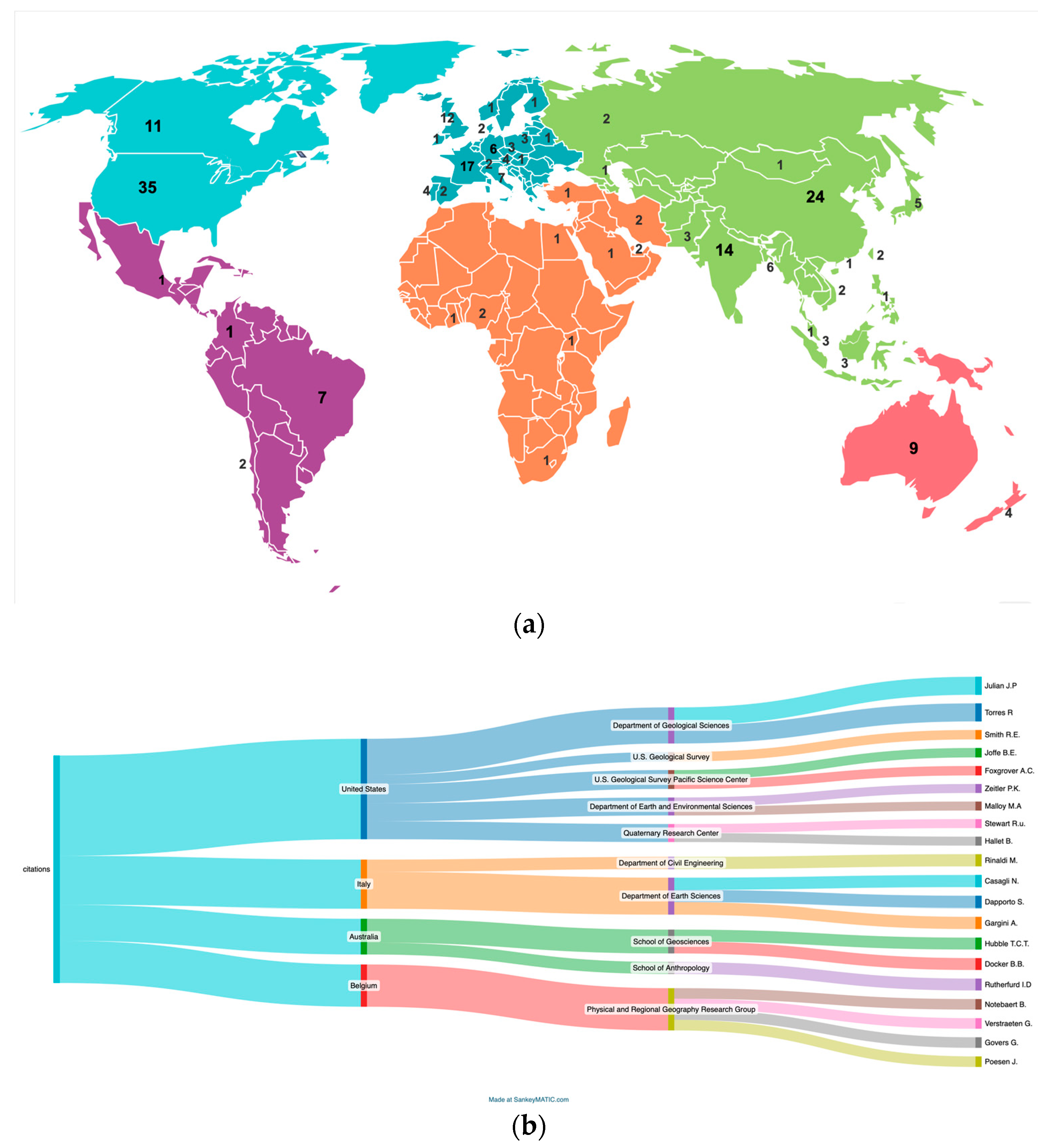
This study presents a comprehensive bibliometric analysis of research on bank erosion and control measures, utilizing the Scopus database and VOSviewer software. Key terms such as “bank”, “erosion”, “control”, and “protection” frequently appear in the literature, underscoring their importance in studies on riverbank erosion. Since 2000, scientific production has steadily increased, particularly in disciplines such as Environmental Sciences and Earth and Planetary Sciences, driven by growing concerns about climate change and sustainable water resource management. Countries with substantial research resources, such as the United States and China, lead in the production of studies, reflecting their commitment to addressing this global issue. In parallel, the evaluation of erosion mitigation practices in Colombia revealed that, although effective techniques such as gabion walls and riparian vegetation exist, 40% of respondents do not implement specific measures. This lack of implementation is attributed to insufficient knowledge, limited resources, and misconceptions about the effectiveness of these techniques. The findings highlight the need to promote proven practices and enhance professional training. Future research should focus on developing more accurate predictive models, integrating interdisciplinary approaches, and assessing the impacts of climate change on bank erosion. Addressing barriers to applying effective techniques at the local level and improving access to resources and knowledge are critical steps to reducing bank erosion and ensuring sustainable water management.
Keywords: riverbank erosion; erosion control; bibliometric analysis; Scopus; VOSviewer riverbank erosion; erosion control; bibliometric analysis; Scopus; VOSviewer