
Abstract
This paper summarizes experimental studies using Nuclear Magnetic Resonance (NMR) to evaluate cement porosity, pore size distribution, and other characteristics such as Calcium Silicate Hydrate (CSH) gel structure and morphology. The first known paper on NMR experiments to investigate cement pastes was published in 1978. Two main NMR parameters, the so-called longitudinal T1 and transverse T2 relaxation times, are commonly measured and analyzed, representing the water response which is trapped in the cement. The hydration process reported in this paper was found to be monitored from as low as 10 min to longer than 365 days. Other studies conducted experiments by using NMR, especially during the 1980s. These studies employed variations in methodologies and frequencies, making data comparison difficult. Additionally, different spectrometers and NMR concepts, as well as operating characteristics, were used. Therefore, it is challenging to reconcile results from previous NMR studies on cement. Other significant hurdles are different cement types, water/cement ratio, and curing conditions. One notable observation is that there has not been any comprehensive laboratory work related to NMR on oilfield cement types, including porosity and hydration. Two recent studies have presented NMR measurements on class G and class H cements.
1. Introduction
Materials such as cement or rock contain pores that are filled with a fluid, typically water. The water contains hydrogen, which possesses a single proton. These protons can be activated and aligned by the application of a magnetic field. The initial alignment strength is directly proportional to the number of hydrogen atoms in the system; this is a measure of porosity in most cases. An oscillating magnetic field is applied to tip the protons away from this alignment. The rate at which these protons realign depends on surface relaxivity, viscosity, and pore size. The realignment analysis produces a spectrum of relaxation times, which represent a distribution of pore bodies in typical cases.
The NMR method is widely used in different oil and gas and geophysical applications such as well logging and hydrogeology [1,2]. An extensive coverage of NMR application to study the porosity and pore size distributions in rocks can be found in the books by Dunn et al. [2] and Coates et al. [3]. The NMR method has long been applied to determine fluid saturation, composition, density, and porosity and wettability [4,5,6,7]. For example, NMR is used to determine the structure of organic molecules in solution or inside porous materials.
Typical NMR data include longitudinal relaxation (T1), transverse relaxation (T2), and the T1–T2 maps which combine the T1 and T2 sequences [3]. A T1 measurement records the buildup of the induced polarization aligned with the applied magnetic field and has no diffusional dependence, while a T2 measurement records the decay of polarization after tipping orthogonal to the applied field. To eliminate the diffusion influence on T2, measurements are made in a homogeneous section of the applied field. The decay times are nominally the same for low viscosity fluids—fluids with short NMR correlation times— but differ as a function of measurement frequency as viscosity increases [8].
The amplitude of NMR time relaxation measurements is correlated with the number of hydrogen atoms detected and can be used to evaluate the specimen porosity [2] since the hydrogen amount correlates with the free water available in the sample. In oil and gas applications for conventional reservoirs, by measuring T2, it is possible to resolve the total porosity, pore size distribution, and estimate permeability [9,10]. T1 acquisition is more time consuming since it requires waiting until hydrogen protons reach full alignment which depends on the size of the pore. Fluids in larger pores require more time for alignment. A T1 measurement is more time consuming because one must pulse long enough to align the fluids in various pores. Thus, T2 data acquisition is generally preferred. In the last two decades, single T2 assessments have been the groundwork for NMR evaluations [11].
Although NMR has been used intensively in the characterization of reservoir rocks, the use of NMR to better understand oilwell cements is rather limited. However, oilwell cements in their hardened phase (cement stone) are similar to rocks, and thus NMR can reveal some of their properties. Oilwell cements are key to achieving good and long-term well integrity, and thus the understanding of their physical properties is critical. In addition to oil and gas well applications, they are critical in geothermal wells, CO2 sequestration, and underground storage applications. Unlike concrete or mortar, oilwell cements do not contain aggregates such as sand or gravel.
Griffin [12] used NMR to understand the effect of nanosilica effects on oilwell cements with respect to CO2 resistance. However, the author focus was on solid-state Si magnetic spinning angle (MAS) NMR, which allows silica polymerization studies within the cement structure rather than H NMR that looks at the water content and pore distribution. Although slightly different from the above methods that focus on the water content, their results focused on the relative volume fraction of major hydration products. Le Saout et al. [13] also proposed the used of solid-state NMR to characterize two cement formulations under different curing conditions.
We also found some new applications of the NMR towards to other cement-related properties. Xin et al. [14] proposed using NMR to measure the polymerization status of cement filtrate. This is very important to understand the cement–rock interaction which affects bonding properties.
Li et al. [15] pointed out that to date, very few authors have published research that focuses on the use of NMR to investigate cement hydration process and other related cement properties. They also proposed the use of NMR to investigate calcium silicate phases and the initial CSHCSH gel product.
Gajewicz et al. [16] proposed the first systematic study of pore size distribution in mature cements using NMR, pointing out that the volume of water in pores larger than 10 nm exceeds that in smaller pores.
Fourmentin et al. [17] showed that using NMR relaxation times and their distributions, the liquid mobility between the cement paste and a porous element (i.e., rock) can be analyzed.
Given the above shortcomings of NMR studies to address oilwell cement investigations, this review was designed to collate published information to help readers understand the importance of NMR in oil well investigations and to highlight the achievements in this area. For example, Korb [18] published a very intensive review of NMR studies for various cement-based materials used in civil engineering, pointing out the importance of this technique.
Oil well cement is defined by extreme low permeability and porosity to achieve its primary function: to fill and isolate the annular space between casing and formation. Given the very small pore space existing within the cement space, computer tomography is not sensitive enough to identify the lower end of the pore size; typically limited to 1 micron resolution. Therefore, we propose the NMR technique as the preferred cement investigation method. NMR has been proven to be the ideal investigation instrument for shale rocks where pore spaces can be in sizes of nanometers.
In this paper, we first present an extensive summary of the significant studies on NMR research on oil well cement. We then focus on porosity measurements. The second part of the paper will show some of the new investigations and importance of NMR in understanding the cement properties. Our main focus is the particular use of NMR as a cement investigation technique; hence, we will report only how cement properties and processes such as porosity or hydration can be investigated through NMR and the outcomes of such investigations.
2. Materials and Methods
Table 1 summarizes significant NMR studies on cement found in the literature. We have outlined further research based on curing condition, type of cement, NMR instrumentation, and frequencies, if reported, and significant observations.
Table 1.
Summary of significant NMR studies on cement.
As reported and summarized in Table 1, most studies measured relaxation of cement pastes. Most measurements were based on either a single component of T1 or T2 relaxation characteristics of the bulk water. Different spectral elements are associated with the various forms in which water exists within the cement structure (CSH water, within capillary pores, gel water, and water bound to solid phases) [22,23,24,25,27,28].
After Blinc’s ground-breaking work on NMR [19], Schreiner et al. [20] used NMR techniques to evaluate the hydration process of Portland cements. The authors were able to characterize the hydration mechanisms of cements cured at various times (7 to 365 days). Their work showed a decrease in T1 as the hydration time increased in all the specimens, indicating that pores were getting smaller. Both Blinc [19] and Schreiner [20] conducted their work at room temperature on different cement types and cement/water ratios. None of these pioneering works reported porosities.
More recent studies as shown in Table 1 [21,23] exploited the NMR technique to investigate the CSH gel structure by addressing the mass of water available in cement over time. This was possible through mass balance and oxide conservation equations with a focus on the CSHCSH chemical composition. The main findings showed that the CSH gel formed quickly during the initial two days of the hydration process, slowing down thereafter. They also pointed out that the CSH gel density increased with hydration time.
Ichim’s [24] work was the most comprehensive NMR work on oilfield cement types. This author used cement slurry mixes: class G-Neat, 4% Bentonite cement, 10% Bentonite cement, 4% Salt cement, and 12% Salt cement. He measured T2 NMR porosity up to 230 days (five different recipes) at three temperature conditions (25 °C, 50 °C, and 75 °C, atmospheric pressure). The main observation was that by increasing the curing temperatures, the initial porosities decreased by up to 25%. NMR porosity changes were reported at curing temperatures of 50 °C and 75 °C.
Furthermore, correlations with UCS development, T1–T2 spectra, and DHK-Sprite measurements helped in understanding hydration. Saleh [25] used similar NMR measurements as [24], conducted from 1 to 21 days. She measured T2 NMR porosity for six types of different mixing methods. Her objective was to determine if mixing conditions change cement properties, such as porosity. She conducted experiments on neat class H cement and found that slurries prepared with increased mixing times showed higher UCS and reduced porosity. Further, her research showed that NMR cement porosity measurements correlated very well with UCS measurement., i.e., the higher the porosity, the lower the UCS.
A recent study by Liu et al., [26] reported porosity data versus hydration time for 720 h of hydration time. They used Class G oilwell cement with added CaCl2 as an additive to control the hydration speed to investigate the effect of the hydration speed on the porosity and pore structure. Three types of cement were tested with the CaCl2 concentration based on mass content (wt.%) over the range of 0 to 1. This study provided a strong argument to use NMR especially in the early hydration stages. A combination of the experimental low-field nuclear magnetic resonance (LF-NMR T2) spectra at a frequency of 11 MHz, nitrogen adsorption data, and SEM images showed that the fresh cement’s porosity slurry was approximately 58%.
3. Results
This section shows the details of the NMR studies investigated herein and points out the pros and cons of their findings.
3.1. Porosity and T2 Relaxation Time Comparison
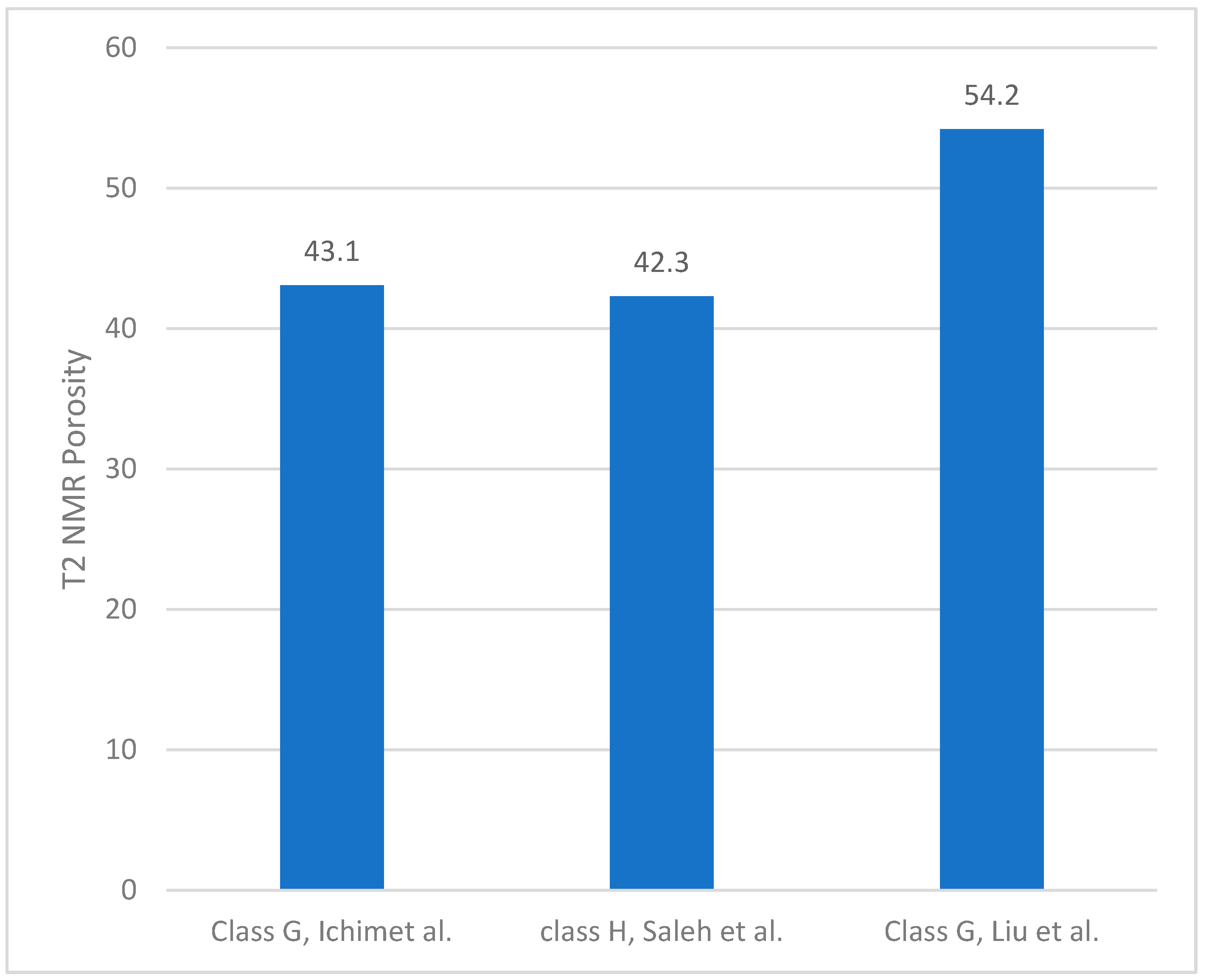
As noted earlier, one of the primary goals of this report is the comparison of T2 NMR porosity from different studies. The reason for this comparison is that T2 is the most commonly measured NMR parameter and is also used to report the so-called NMR porosity. A better cement is a cement with the lowest porosity and permeability. However, permeability cannot be measured through NMR. Figure 1 shows the comparison of porosity measurements from studies conducted recently by Ichim [24] (class G cement), Saleh, [25] (class G), and Liu et al., [26] (class G).
Figure 1.
Comparison of porosity from three studies using NMR for two class G and one class H Portland cement samples at room temperature. Note Liu et al. [26] conducted measurements at 11 MHz while the other two were at 2 MHz.
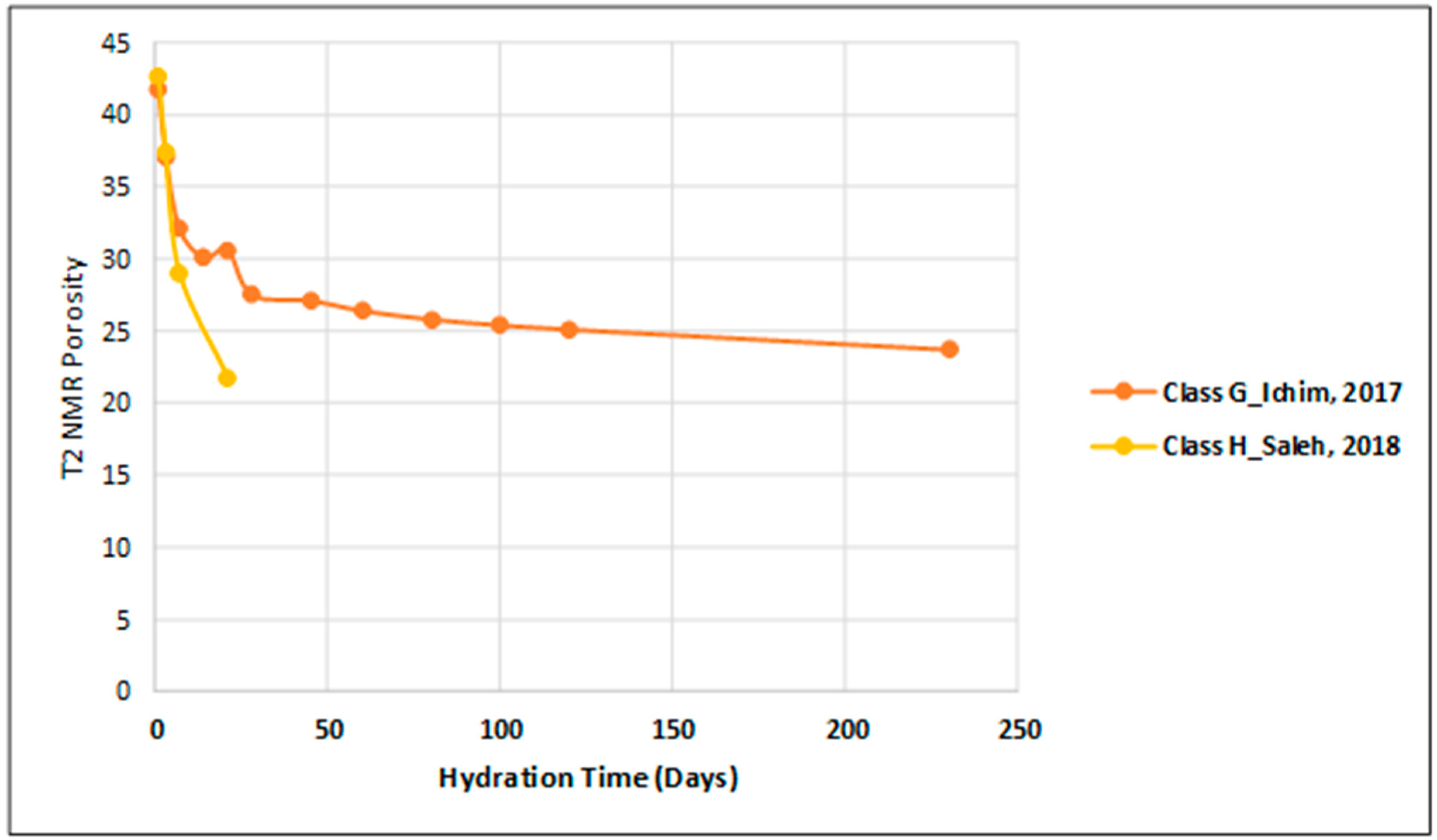
Both [24,25] reported similar values for one-day NMR porosities compared to porosity reported by [26]. This difference can be attributed to using consistent mixing procedures for cement based on API, and perhaps similar NMR set-ups and procedures (both were conducted at the University of Oklahoma laboratories). Even though class G cement was used in these studies [26], different cement/water ratios and mixing procedures resulted in significantly higher porosities, highlighting the effect mixing and curing can have on cement properties. Figure 2 illustrates T2 NMR porosity versus hydration time for two studies on neat class G and class H cement. It shows that porosity values were in close agreement at earlier hydration times until seven days of hydration. At 21 days, there was a very a different trend, which shows lower T2 NMR porosity for class H compared to class G. The ability to perform direct observations of the hydration process is very important, especially because of the leading role played by water inside the cement structure. These observations will also apply for cement microstructure investigations. Since class H cement has a different particle size distribution (PSD) (coarser particles) compared to class G, it will impact water absorption and porosity in the long term (7–21 days). Figure 2 shows that water absorption still exists after seven days of curing.
Figure 2.
T2 NMR porosity versus hydration time for Portland cements Class G and Class H. The cement particle size distribution shows its impact on porosity after seven days of curing (lower porosity for class H cement).
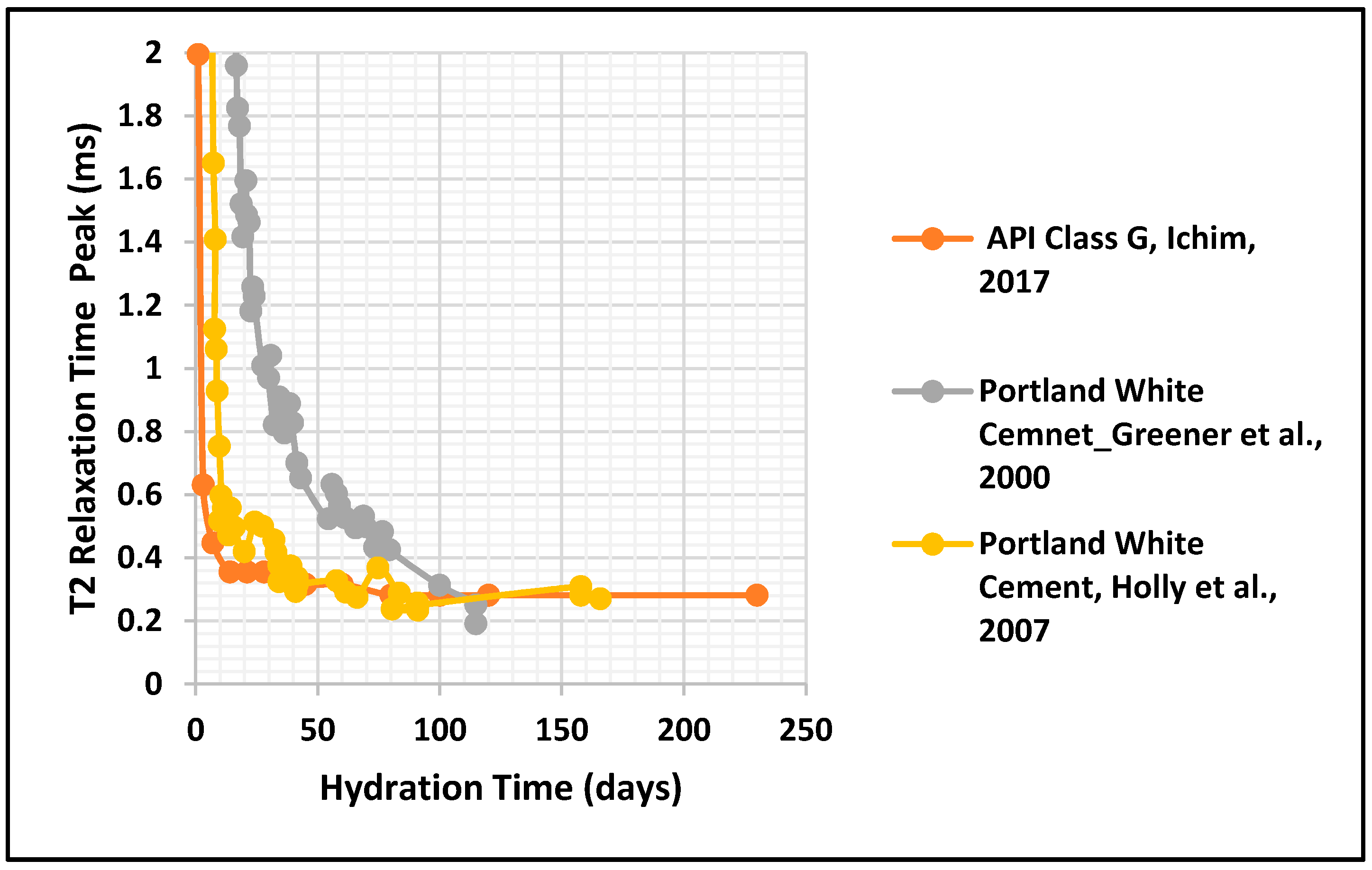
We compared available data for the T2 relaxation time for API Portland cement and white cement as shown in Figure 3. Two of these studies were related to white cement [21,27]. The samples were constructed of Portland cement according to ASTM C150 Type II. The main characteristics of the white cement are its low content of iron and manganese oxides; consequently, the cement has a gray color. Typical white cement applications are used in home decor such as stucco, cement paint, tile grout, and decorative concrete. Table 2 shows the oxide composition of Portland white cement in comparison to API Class G cement. White cement has a higher percentage of calcium and considerably higher silicate percentage than API Portland cement used for oil well applications.
Figure 3.
T2 relaxation time peak versus hydration time for API cement and White cement. The relaxation time peak is related to pore size; we see a decrease in pore size with hydration time.
Table 2.
Oxide composite of Portland white cement and API Class G [29].
We note that T2 relaxation and hydration times show a different trend in which the cement composition, mixing, and curing conditions have an impact. The researchers do not explicitly discuss the curing and mixing conditions for white cement; therefore, making definitive conclusions is impossible. However, the researchers [24,26] implied that “at low curing temperatures, it is known that the cement constituents used to form hydration products have sufficient time to diffuse throughout the cement matrix and precipitate fairly uniformly, filling the interstitial space between cement grains.” All three studies indicate that “water phases play a leading role in the hydration process”; therefore, using NMR observations and characterizations allows a better interpretation of the details involved in the cement hydration process. This is critical to allow accurate monitoring of the effects of cement composition on the microstructure.
3.2. The Effect of the Cement Mixing Process on the NMR Porosity Measurements
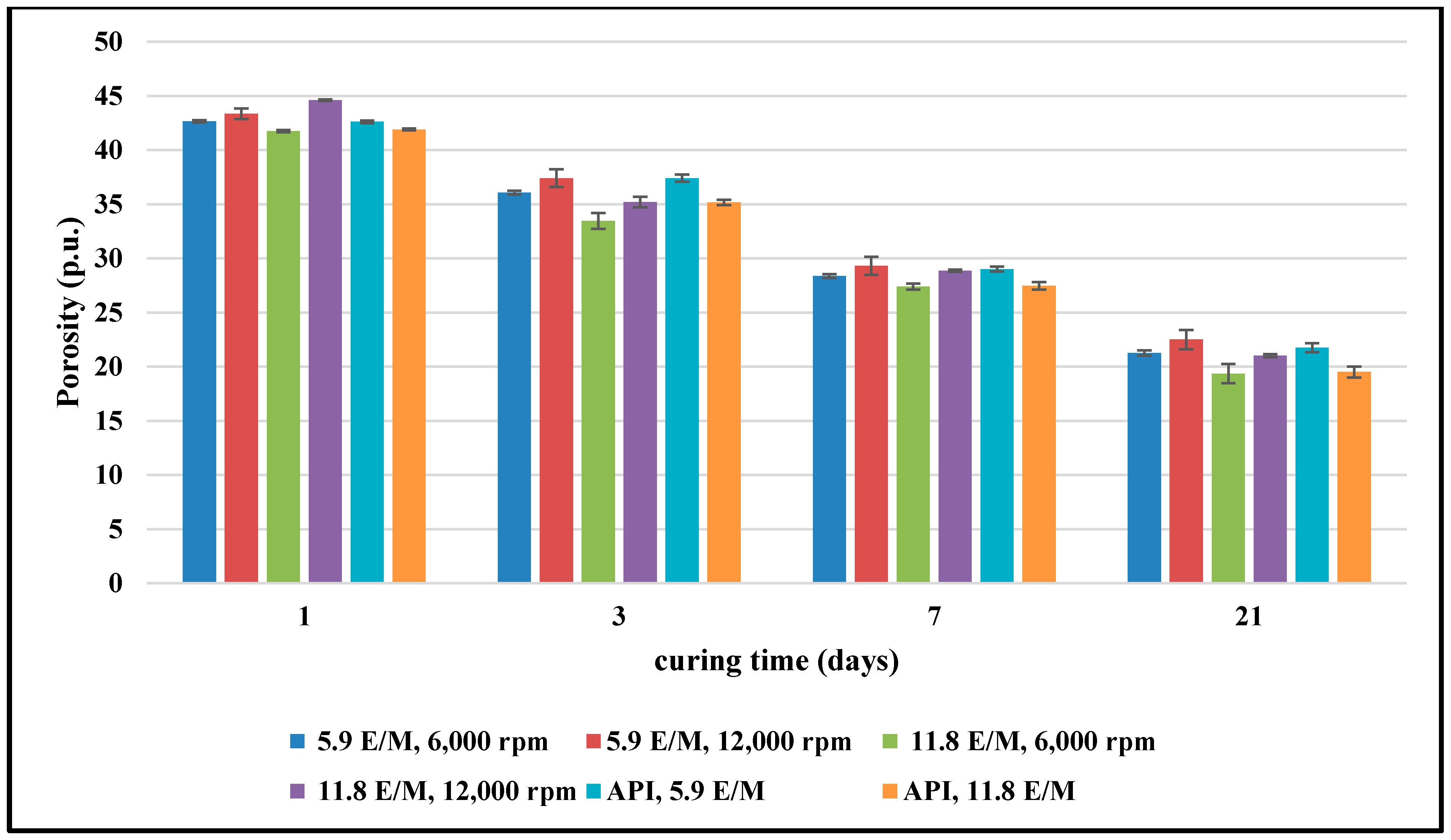
In a study conducted by [25], experimental design was formulated for a series of experiments to evaluate the effect of mixing energy level and shear rate on the cement properties such as mechanical and NMR responses. Figure 4 shows the NMR porosity measurements on cement samples prepared using various mixing procedures and curing time. The results showed that with increasing curing time, the cement porosity decreases. These observations are consistent with data from [24]. In time, the hydration process evolves, resulting in a decrease in the pore size due to water consumption by the hydration process. Peak porosity under 1-day curing was found for the specimen prepared at a mixing energy of 11.8 E/M, achieved at 12,000 rpm (ϕ = 44.6%.). After three days curing time, the highest and lowest porosity values were 37.4%. and 33.4%, respectively, for the specimens mixed at 5.9 E/M and 12,000 rpm and 11.8 E/M and 6000 rpm. Comparable observations at three days were seen for the porosity evaluation at seven and 21 days of curing time. The seven-day cured specimens showed the highest and lowest porosity values of 29.3%. and 27.4%, respectively, for specimens prepared at 5.9 E/M, 12,000 rpm and 11.8 E/M, 6000 rpm. All these findings are consistent with mixing time changes. Specimens prepared at 11.8 E/M and 6000 rpm will be prepared with the longest mixing time (294 s), whereas specimens prepared at 5.9 E/M and 12,000 rpm will be mixed in a shorter time of only 37 s. Increasing the mixing time allows a uniform distribution of solid particles and thus the hydrates and CSH gel precipitation. This will reduce the cement porosity, that can only be revealed through NMR measurements. For example, a cement that develops extremely low permeability in a short time will lead to better well integrity. Our study shows that the mixing of the cement will result in a different NMR response; hence, the low porosity development can be affected by the mixing process.
Figure 4.
Estimated NMR porosity measurements for cement samples exposed to different mixing energy levels as a function of curing time. These results show that by increasing the curing time, the NMR porosity will decrease, with the lowest porosity obtained at 11.8 E/M and 6000 rpm.
4. Discussion
Our paper has shown that NMR is useful in characterizing cement properties that are valuable for well integrity studies, particularly the cement porosity evolution. Although NMR porosity is not equivalent to cement porosity, which is obtained using porosimeters, further NMR investigations can highlight how the free water content changes inside the cement stone. Our recent studies found that the class H, which uses about 38% water for slurry mixing, shows a faster decrease of NMR porosity (see Figure 2) compared with cement class G. Figure 2 shows that NMR can be used to define cement type signatures (such as class H versus class G), and thus could be used for cement sample identification. NMR has documented continuous changes of NMR porosity for up to 200 days, implying that cement hydration continues under the given curing conditions. We further showed that porosity measurements based on the NMR method could be an excellent method to evaluate the effect of mixing conditions, as shown in Figure 4. This review that focuses on oil well cement NMR studies also revealed that the NMR spectra can be used to estimate the water contained in cement at a given time during the hydration process. Further, the process may be used to observe the water invasion processes in cements, which could have a strong implication in the understanding of possible casing corrosion situations. Using the average relaxivity values, the measured T2 times can be developed into the effective pore radii, where short times refer to small pore radii and large times to large radii of the pores. Furthermore, with the spectra comparison of comparable samples cured at different temperatures but identical time duration, the influence of the temperature on the hydration process can be highlighted. The T2 peaks have been accepted to be more stable when compared with the distribution of T2 relaxation times throughout time, hence resulting in a better understanding of hydration dynamics. Excellent reproducibility in T2 peaks was noted for all samples used to measure the NMR porosity.
Unfortunately, our investigations have shown that NMR investigations of oilfield cement are relatively scarce compared with other forms of study such as X-ray and SEM. NMR is an old technique that is irregularly used for rock sample characterization, with more than 40 years of history [30]. The latest NMR developments, especially the availability of such equipment, make the method appropriate for oilwell cement investigations as well.
We also found that two major NMR methods are commonly used today: H NMR, which investigates the hydrogen spin and thus provides information about the water trapped and porosity, and Si MAS NMR, which focuses on identifying the nanostructure of silicate composites. In this regard, one paper stands out as it is the only paper that performed complex NMR studies that cover H but also a wide range of solid-state NMR such as 27Al, 13C, 35Cl,43Ca, 19F, 39K, 23Na, 25Mg, 17O, 31P, 33S, and 29Si nuclei [31]. Their conclusion was that NMR can help us to understand the cement properties to an “unprecedent level of detail.”
Li et al. [32] used NMR techniques for cement pastes used for mine filling process, pointing out the same need of NMR investigations to increase the understanding of cement properties, especially porosity development. Maharidge et al. [33] mentioned in their paper that: “The use of NMR T2 relaxation time data was found to be of great value in understanding the roles that water content, and pore size distribution play in the development of flow and mechanical properties of cement”.
5. Conclusions
A summary of the literature indicates that NMR is a robust methodology for studying cementitious materials, their hydration, and resulting properties. These studies can be classified for areas such as cement hydration, pore volume evolution, as well as porosities.
The literature data presented are quite disparate, using different cement types and various mixing methods as well as recipe design such as cement/water ratios. Regarding API oilfield cement studies, the data are minimal (see [24,25,26]).
This paper demonstrates the necessity of further NMR studies to understand and compare cement properties over time.
There is no doubt that NMR can help us to understand the intimate cement–water interactions, the water content development with time, water mobility and invasion, and pore size distribution. This information will have a strong impact on cement structure and properties, resulting in a strong influence on well integrity with short- and long-term risks.
To achieve the above, there is a strong need to standardize NMR methodology with application to oilwell cements.
Author Contributions
Conceptualization, F.K.S. and C.T.; methodology, F.K.S. and C.T.; formal analysis, F.K.S., C.T., C.S.; investigation, F.K.S. and C.T.; writing—original draft preparation, F.K.S.; writing—review and editing, F.K.S., C.T., C.S.; supervision, C.T. All authors have read and agreed to the published version of the manuscript.
Funding
This research received no external funding.
Institutional Review Board Statement
Not applicable.
Informed Consent Statement
Not applicable.
Data Availability Statement
Not applicable.
Acknowledgments
We recognize the support of the IC3 laboratory facilities and technical support provided by Micaela Langevin.
Conflicts of Interest
The authors declare no conflict of interest.
Nomenclature
| CSHCSH | calcium silicate hydrate |
| NMR | nuclear magnetic resonance |
| LF NMR | Low-frequency nuclear magnetic resonance |
| T1 | longitudinal relaxation time |
| T2 | transversal relaxation time |
| PSD | pore size distribution |
| UCS | unconfined compressive strength |
| CT | computer tomograph |
| SEM | scanning electron microscope |
| API | American Petroleum Institute |
References
- Kleinberg, R.L.; Farooqui, S.A.; Horsfield, M.A. Tl/T2 Ratio and Frequency Dependence of NMR Relaxation in Porous Sedimentary Rocks. J. Colloid Interface Sci. 1993, 158, 195–198. [Google Scholar] [CrossRef]
- Dunn, K.J.; Bergman, D.J.; LaTorraca, G.A. (Eds.) Nuclear Magnetic Resonance: Petrophysical and Logging Applications; Elsevier: Amsterdam, The Netherlands, 2002; Volume 32. [Google Scholar]
- Coates, G.R.; Xiao, L.; Prammer, M.G. NMR Logging Principles and Applications; Elsevier Science: Amsterdam, The Netherlands, 1999. [Google Scholar]
- Bloembergen, N.; Purcell, E.M.; Pound, R.V.; Levenson, M.D.; Mazur, E.; Pershan, P.; Shen, Y.R. Relaxation Effects in Nuclear Magnetic Resonance Absorption. Resonances 1990, 73, 411–444. [Google Scholar] [CrossRef]
- Kenyon, W.E. Nuclear magnetic resonance as a petrophysical measurement. Nucl. Geophys. 1992, 6, 153–171. [Google Scholar]
- Kleinberg, R.; Kenyon, W.; Mitra, P. Mechanism of NMR Relaxation of Fluids in Rock. J. Magn. Reson. Ser. A 1994, 108, 206–214. [Google Scholar] [CrossRef]
- Tinni, A.; Odusina, E.O.; Sulucarnain, I.D.; Sondergeld, C.H.; Rai, C.S. Nuclear-Magnetic-Resonance Response of Brine, Oil, and Methane in Organic-Rich Shales. SPE Reserv. Eval. Eng. 2015, 18, 400–406. [Google Scholar] [CrossRef]
- Cowan, B.P. Nuclear Magnetic Resonance and Relaxation; Cambridge University Press (CUP): Cambridge, UK, 1997. [Google Scholar]
- Sondergeld, C.; Tinni, A.; Rai, C.; Besov, A. NMR Considerations in Shale Evaluation; Society of Petrophysicists and Well-Log Analysts: Reykjawik, Iceland, 2016. [Google Scholar]
- Timur, A. Pulsed Nuclear Magnetic Resonance Studies of Porosity, Movable Fluid, and Permeability of Sandstones. J. Pet. Technol. 1969, 21, 775–786. [Google Scholar] [CrossRef]
- Kenyon, W.; Howard, J.; Sezginer, A.; Straley, C.; Matteson, A.; Horkowitz, K.; Ehrlich, R. Pore-Size Distribution and NMR in Microporous Cherty Sandstones Paper LL Trans. In Proceedings of the SPWLA, 30th Annual Logging Symposium, Denver, CO, USA, 11–14 June 1989. [Google Scholar]
- Sulucarnain, I.D.; Sondergeld, C.H.; Rai, C.S. An NMR Study of Shale Wettability and Effective Surface Relaxivity. In Proceedings of the All Days; Society of Petroleum Engineers (SPE), Calgary, AB, Canada, 20 October 2012. [Google Scholar]
- Le Saoût, G.; Lécolier, E.; Rivereau, A.; Zanni, H. Study of oilwell cements by solid-state NMR. Comptes Rendus Chim. 2004, 7, 383–388. [Google Scholar] [CrossRef]
- Griffin, A. Significance of Nanosilica Incorporation in Type G Oil Well Cement Pastes. 2013. Available online: https://digitalrepository.unm.edu/ce_etds/84 (accessed on 31 March 2021).
- Li, Q.; Hurt, A.P.; Coleman, N.J. The Application of 29Si NMR Spectroscopy to the Analysis of Calcium Silicate-Based Cement using Biodentine™ as an Example. J. Funct. Biomater. 2019, 10, 25. [Google Scholar] [CrossRef]
- Gajewicz, A.; Gartner, E.; Kang, K.; McDonald, P.; Yermakou, V. A 1H NMR relaxometry investigation of gel-pore drying shrinkage in cement pastes. Cem. Concr. Res. 2016, 86, 12–19. [Google Scholar] [CrossRef]
- Fourmentin, M.; Faure, P.; Rodts, S.; Peter, U.; Lesueur, D.; Daviller, D.; Coussot, P. NMR Observation of Water Transfer between a Cement Paste and a Porous Medium, Cement and Concrete Research; Elsevier: Amsterdam, The Netherlands, 2017; Volume 95. [Google Scholar]
- Korb, J.-P. NMR and nuclear spin relaxation of cement and concrete materials. Curr. Opin. Colloid Interface Sci. 2009, 14, 192–202. [Google Scholar] [CrossRef]
- Blinc, R.; Burgar, M.; Lahajnar, G.; Rožmarin, M.; Rutar, V.; Kocuvan, I.; Ursic, J. NMR Relaxation Study of Adsorbed Water in Cement and C3S Pastes. J. Am. Ceram. Soc. 1978, 61, 35–37. [Google Scholar] [CrossRef]
- Schreiner, L.J.; MacTavish, J.C.; Miljković, L.; Pintar, M.; Blinc, R.; Lahajnar, G.; Lasic, D.; Reeves, L.W. NMR Line Shape-Spin-Lattice Relaxation Correlation Study of Portland Cement Hydration. J. Am. Ceram. Soc. 1985, 68, 10–16. [Google Scholar] [CrossRef]
- Greener, J.; Peemoeller, H.; Choi, C.; Holly, R.; Reardon, E.J.; Hansson, C.M.; Pintak, M.M. Monitoring of Hydra-tion of White Cement Paste with Proton NMR. J. Am. Ceram. Soc. 2000, 83, 623–627. [Google Scholar] [CrossRef]
- Valori, A.; McDonald, P.; Scrivener, K. The morphology of C–S–H: Lessons from 1H nuclear magnetic resonance relaxometry. Cem. Concr. Res. 2013, 49, 65–81. [Google Scholar] [CrossRef]
- Muller, A.C.A.; Scrivener, K.L.; Gajewicz, A.M.; McDonald, P.J. Densification of C–S–H Measured by 1H NMR Relaxometry. J. Phys. Chem. C 2013, 117, 403–412. [Google Scholar] [CrossRef]
- Ichim, A.C. Experimental Determination of Oilfield Cement Properties and Their Influence on Well Integrity. Master’s Thesis, University of Oklahoma, Norman, Oklahoma, 2017. [Google Scholar]
- Saleh, F.K. Investigation of Oilwell Cement Mixing: Experimental Studies and Implications or Mixing Energy Theory. Ph.D. Dissertation, University of Oklahoma, Norman, Oklahoma, 2018. [Google Scholar]
- Liu, K.; Cheng, X.; Zhang, C.; Gao, X.; Zhuang, J.; Guo, X. Evolution of pore structure of oil well cement slurry in suspension–solid transition stage. Constr. Build. Mater. 2019, 214, 382–398. [Google Scholar] [CrossRef]
- Holly, R.; Reardon, E.J.; Hansson, C.M.; Peemoeller, H. Proton spin–spin relaxation study of the effect of tempera-ture on white cement hydration. J. Am. Ceram. Soc. 2007, 90, 570–577. [Google Scholar] [CrossRef]
- Anand, V.; Ali, M.R.; Al-Adani, N.; Willis, D.; Freedman, R.; Hamichi, F.; Abubakar, A.; Grover, R.; Neto, O.; Aboud, M.; et al. New Generation NMR Tool for Robust, Continuous T1 and T2 Measurements. In Proceedings of the SPWLA 56th Annual Logging Symposium, Society of Petrophysicists and Well-Log Analysts, Long Beach, CA, USA, 18–22 August 2015. [Google Scholar]
- Bourgoyne, A.T., Jr.; Millheim, K.K.; Chenevert, M.E.; Young, F.S., Jr. Applied Drilling Engineering; SPE: Houston, TX, USA, 1991. [Google Scholar]
- Straley, C.; Rossini, D.; Vinegar, H.; Morris, C. Core Analysis by Low Field NMR, SCA-9404. Log Anal. 1994, 38, SPWLA-1997-v38n2a3. [Google Scholar]
- Walkley, B.; Provis, J. Solid-state nuclear magnetic resonance spectroscopy of cements. Mater. Today Adv. 2019, 1, 100007. [Google Scholar] [CrossRef]
- Li, J.; Liu, H.; Ai, K.; Zhu, L. An NMR-Based Experimental Study on the Pore Structure of the Hydration Process of Mine Filling Slurry. Adv. Civ. Eng. 2018, 2018, 1–12. [Google Scholar] [CrossRef]
- Maharidge, R.; Bottiglieri, A.; Dighe, S.S.; Holley, A.; Zhang, H.; Koch, A. Development of Permeability and Mechanical Properties of Class G Cement from Slurry to Set. SPE Annu. Tech. Conf. Exhib. 2016. [Google Scholar] [CrossRef]
Publisher’s Note: MDPI stays neutral with regard to jurisdictional claims in published maps and institutional affiliations. |
© 2021 by the authors. Licensee MDPI, Basel, Switzerland. This article is an open access article distributed under the terms and conditions of the Creative Commons Attribution (CC BY) license (https://creativecommons.org/licenses/by/4.0/).