4.1. Thermodynamic and Kinetic Modeling of Scale Formation
Mathematical modeling has become an indispensable component of modern oilfield scale management because it enables prediction of mineral precipitation before severe deposition occurs [
194,
195]. Experimental investigations provide valuable information regarding crystallization mechanisms and inhibitor performance; however, laboratory experiments are often time-consuming, expensive, and incapable of representing the complex physicochemical conditions encountered in petroleum reservoirs and production facilities. Thermodynamic and kinetic models therefore provide an efficient framework for predicting scale formation, evaluating operational risks, optimizing inhibitor dosage, and supporting field decision-making. Over the past several decades, these models have evolved from relatively simple equilibrium calculations to sophisticated computational approaches that integrate chemical reactions, transport phenomena, crystallization kinetics, and multiphase flow [
195,
196].
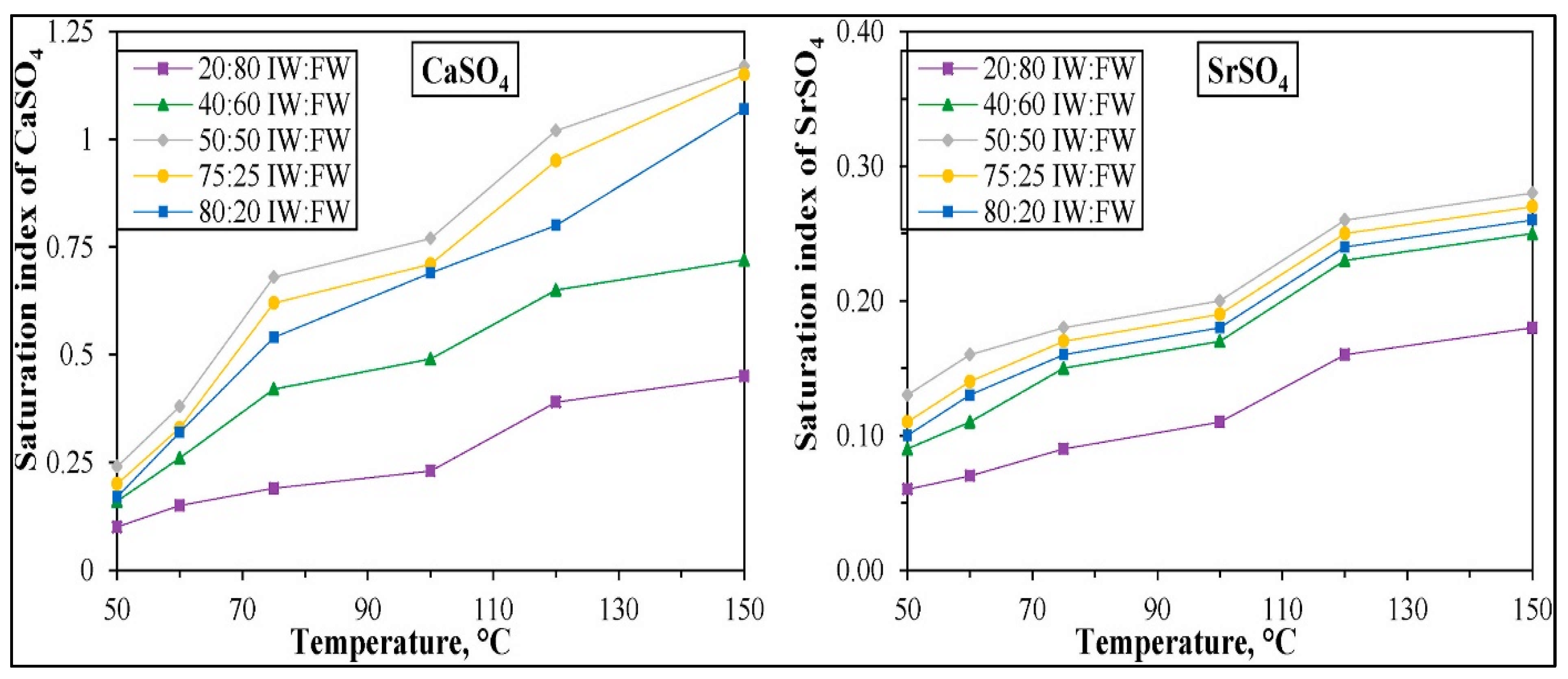
Thermodynamic modeling is based on the principle that scale precipitation occurs when the concentration of dissolved ions exceeds their equilibrium solubility under specific temperature, pressure, and chemical conditions. The tendency of a mineral to precipitate is commonly evaluated using the relationship between the ionic activity product and the solubility product constant [
64,
197]. When the ionic activity product is lower than the solubility product, the solution remains undersaturated and mineral precipitation is thermodynamically unfavorable. When both quantities are equal, the solution is at equilibrium. Conversely, when the ionic activity product exceeds the solubility product, the solution becomes supersaturated, providing the thermodynamic driving force for crystal nucleation and growth [
71,
198].
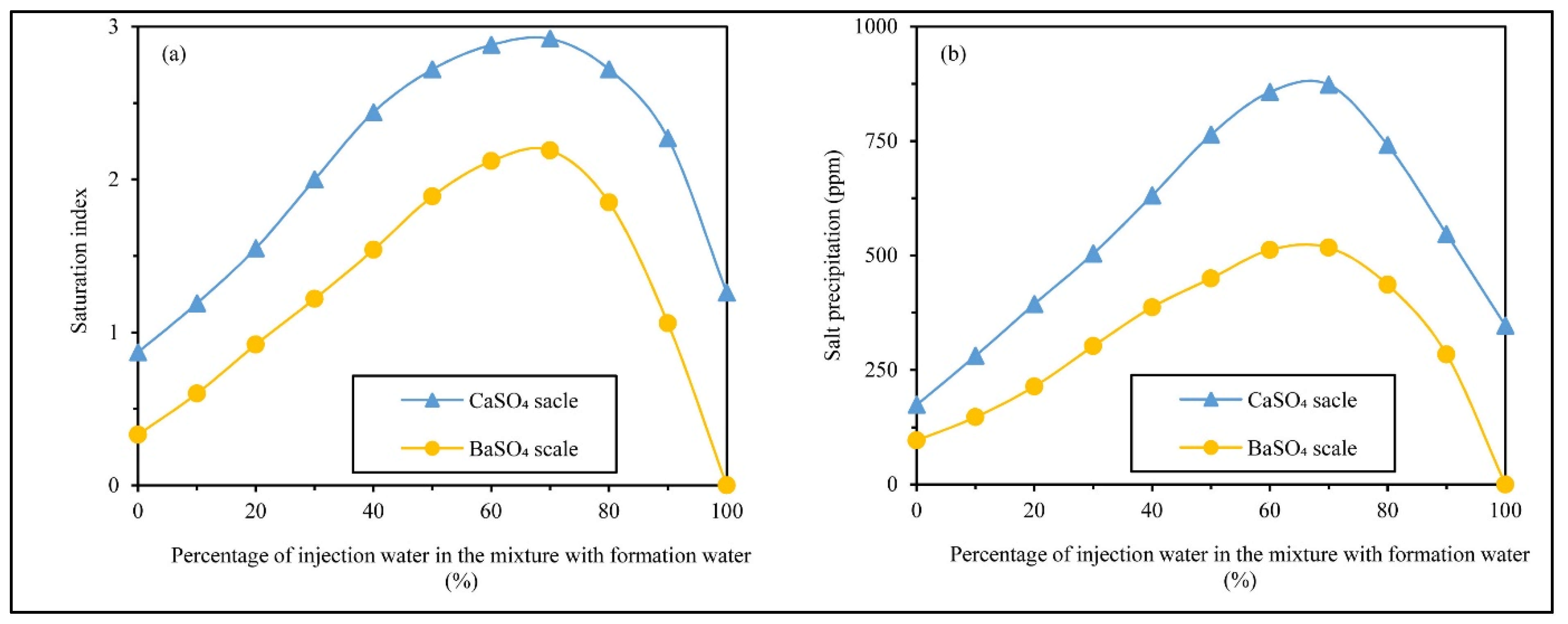
A widely used parameter for evaluating scaling tendency is the saturation index, which is expressed as the logarithmic ratio of the ionic activity product to the solubility product. Positive saturation index values indicate supersaturation and potential scale formation, whereas negative values indicate undersaturated conditions in which existing mineral deposits tend to dissolve. Because the saturation index directly reflects the thermodynamic state of the solution, it has become one of the most important indicators used in industrial scale prediction software and production chemistry programs [
199].
Accurate thermodynamic prediction requires calculation of ionic activities rather than simple ion concentrations because dissolved ions interact strongly in concentrated oilfield brines. Activity coefficients account for electrostatic interactions among ions and become increasingly important as salinity increases. Several theoretical models have therefore been developed to estimate activity coefficients under different solution conditions. The Debye–Hückel model provides satisfactory predictions for dilute electrolyte solutions but becomes less reliable in highly concentrated formation waters commonly encountered in petroleum reservoirs [
200]. For these complex brines, the Pitzer ion-interaction model has become the preferred approach because it accurately describes ion activities over a broad range of ionic strengths and temperatures. Consequently, many commercial geochemical simulators employ modified Pitzer formulations for predicting carbonate and sulfate scale formation in hypersaline reservoir fluids [
201].
Thermodynamic calculations also require detailed aqueous speciation analysis because dissolved ions exist in multiple chemical forms depending on temperature, pressure, pH, dissolved gases, and overall water composition. Carbonate systems illustrate this complexity clearly. Dissolved carbon dioxide participates in a sequence of equilibrium reactions producing carbonic acid, bicarbonate, and carbonate ions [
202]. Changes in pressure during production shift these equilibria, altering carbonate ion concentration and significantly influencing calcium carbonate precipitation. Similar equilibrium relationships govern sulfate, phosphate, silica, and iron-containing systems, demonstrating the importance of comprehensive chemical speciation during scale prediction [
197].
Although thermodynamic models determine whether precipitation is energetically favorable, they cannot predict how rapidly scale will form. Many production systems remain supersaturated for extended periods before measurable precipitation occurs because crystal nucleation requires overcoming an activation energy barrier. Kinetic modeling therefore complements thermodynamic analysis by describing the rates of nucleation, crystal growth, aggregation, and deposition [
196].
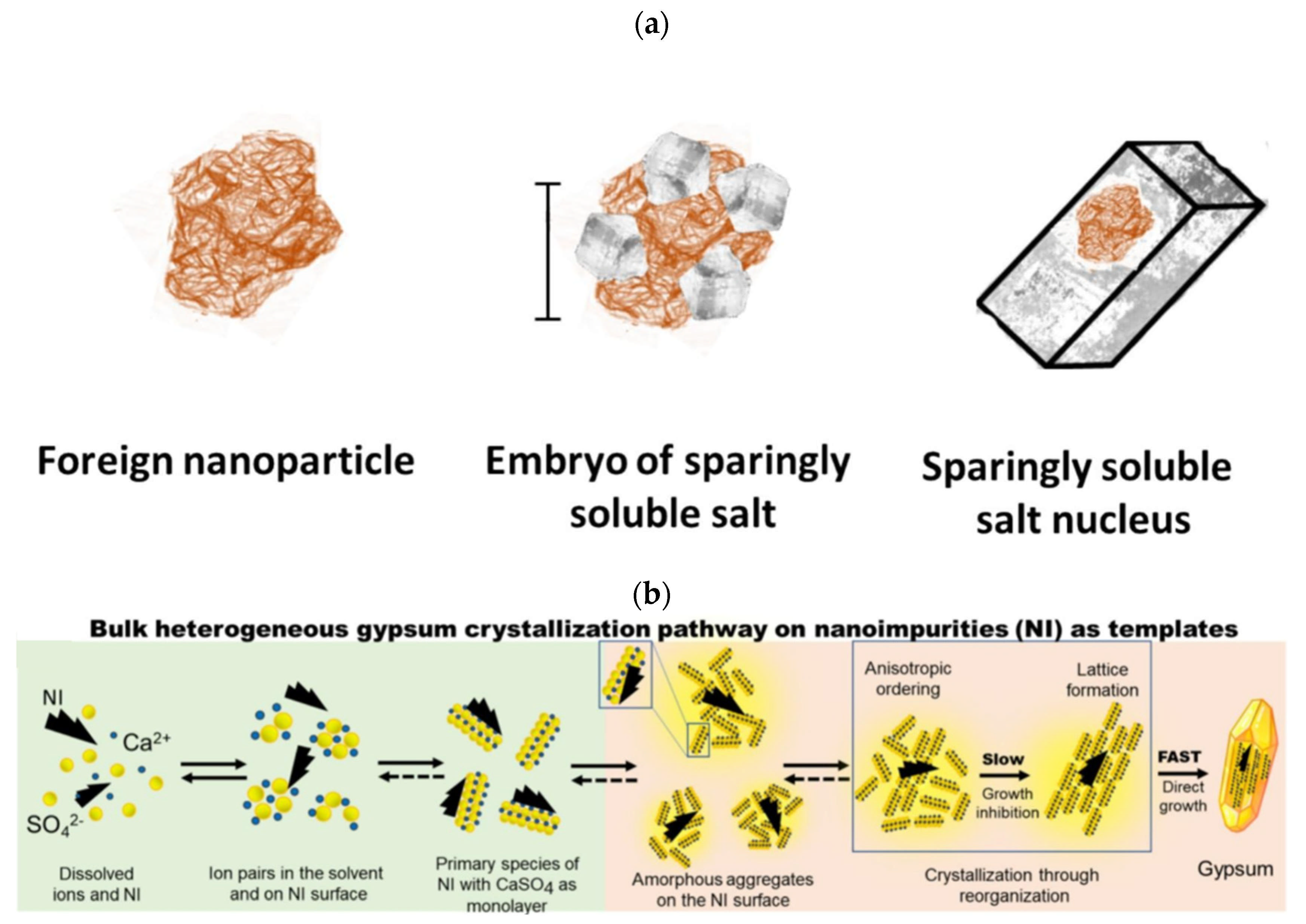
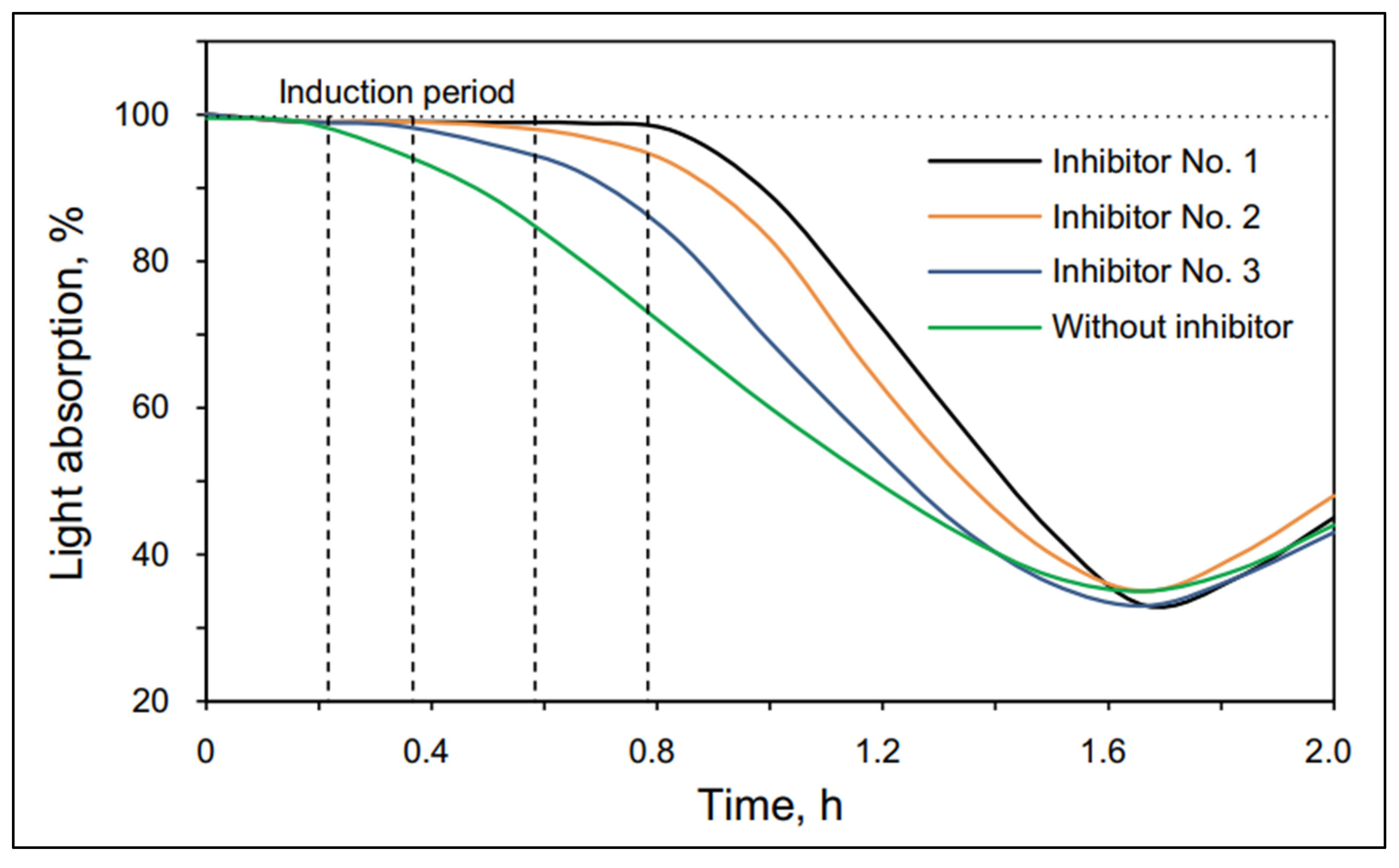
Classical nucleation theory explains that microscopic clusters of dissolved ions continuously form and dissolve within supersaturated solutions. Only clusters exceeding a critical size become stable nuclei capable of continued growth. The magnitude of this critical nucleus depends upon supersaturation, interfacial energy, temperature, and solution chemistry. Increasing supersaturation generally reduces the nucleation energy barrier, resulting in shorter induction times and more rapid precipitation. Conversely, effective scale inhibitors increase the apparent activation energy for nucleation by adsorbing onto prenucleation clusters and crystal embryos, thereby delaying the formation of stable nuclei [
112,
203].
Following nucleation, crystal growth proceeds through diffusion of dissolved ions from the bulk solution toward the crystal surface and their incorporation into energetically favorable lattice sites. Growth kinetics therefore depend simultaneously on mass transfer, surface reaction rates, hydrodynamic conditions, and crystal morphology [
15,
197]. Under stagnant conditions, diffusion frequently controls crystal growth, whereas turbulent flow enhances mass transport and may significantly accelerate precipitation. Temperature also influences kinetic behavior by increasing ion mobility, modifying reaction rates, and altering mineral solubility.
Modern thermodynamic and kinetic models increasingly integrate chemical equilibrium, transport phenomena, crystallization kinetics, and operational parameters within unified computational frameworks. Such coupled models provide substantially more realistic predictions than equilibrium calculations alone and have become valuable tools for optimizing inhibitor selection, chemical dosage, water management strategies, and production operations. Nevertheless, uncertainties associated with reservoir heterogeneity, complex water chemistry, multiphase flow, and mixed mineral precipitation remain important challenges. Consequently, current research focuses on combining mechanistic models with computational chemistry, machine learning, and real-time field monitoring to improve prediction accuracy and enable intelligent, data-driven scale management throughout the life of petroleum production systems [
204,
205].
4.3. Molecular Modeling and Computational Chemistry
Molecular modeling and computational chemistry have become powerful tools for understanding the fundamental mechanisms of scale inhibition at the atomic and molecular levels. Unlike conventional experimental techniques, which primarily evaluate the macroscopic performance of scale inhibitors, computational approaches provide detailed insight into the interactions between inhibitor molecules, dissolved ions, crystal surfaces, and surrounding water molecules [
123,
206]. These methods enable researchers to investigate adsorption mechanisms, molecular conformations, intermolecular forces, and reaction energetics that are often difficult or impossible to observe experimentally. Consequently, molecular modeling has become an indispensable component of modern inhibitor development, significantly reducing the time and cost associated with experimental screening while facilitating the rational design of highly efficient scale inhibitors [
207].
Among computational techniques, Density Functional Theory is one of the most widely applied quantum mechanical methods for investigating inhibitor–mineral interactions. DFT describes the electronic structure of atoms and molecules by calculating electron density rather than solving the many-electron wave function directly, thereby providing an efficient balance between computational accuracy and cost [
208,
209]. In scale inhibition studies, DFT calculations are commonly used to determine molecular geometry, charge distribution, frontier molecular orbitals, dipole moments, electrostatic potential maps, and adsorption energies. These parameters provide valuable information regarding the affinity of inhibitor molecules toward crystal surfaces and dissolved metal ions. Molecules containing oxygen-, nitrogen-, phosphorus-, or sulfur-containing functional groups may exhibit strong interactions with Ca
2+, Ba
2+, Sr
2+, and Mg
2+; however, strong metal coordination in the bulk solution should not by itself be interpreted as evidence of effective scale inhibition. The inhibition mechanism depends on the balance between aqueous complexation, ion availability, inhibitor transport, surface adsorption, and interactions with active crystal-growth sites. Therefore, the dominant chemical species predicted by equilibrium speciation should be considered when interpreting quantum-chemical descriptors and molecular adsorption calculations.
Adsorption energy represents one of the most important parameters obtained from DFT calculations. A more negative adsorption energy indicates stronger interaction between the inhibitor and the mineral surface, suggesting greater ability to block crystal growth sites and suppress precipitation. DFT has therefore become an effective tool for comparing candidate inhibitor molecules before synthesis and experimental evaluation. Furthermore, quantum chemical descriptors such as the energies of the highest occupied molecular orbital (HOMO), lowest unoccupied molecular orbital (LUMO), HOMO–LUMO energy gap, chemical hardness, softness, electronegativity, and electrophilicity provide useful indicators of molecular reactivity and adsorption capability. These descriptors have been successfully correlated with laboratory inhibition efficiencies for numerous phosphonate-, polymer-, amino acid-, and plant-derived inhibitors [
208,
210].
A critical consideration in molecular simulations of scale inhibitors is the identity of the molecular species selected for simulation. Many antiscalants, particularly phosphonates and aminopolycarboxylic or polymeric compounds, contain multiple ionizable functional groups and can form complexes with divalent and multivalent cations in aqueous solution. Therefore, the free ligand (H
nL) or its highly deprotonated form (L
n−) may represent only a fraction of the inhibitor population under realistic oilfield conditions. Depending on pH, ionic strength, and cation concentrations, the aqueous phase may contain a distribution of protonated, deprotonated, and metal-complexed species, including Ca-, Mg-, Fe-, Ba-, and Sr-associated inhibitor complexes. These species may exhibit substantially different hydration structures, molecular conformations, electrostatic characteristics, and affinities toward mineral surfaces. Consequently, MD simulations performed using only an isolated free inhibitor molecule should be regarded as simplified mechanistic models rather than direct representations of the complete reservoir system. A more rigorous strategy is to couple equilibrium speciation calculations with molecular simulations and identify the dominant inhibitor species before constructing the simulation system. The relevant species can then be investigated individually or, where computationally feasible, as a representative ensemble. This approach is particularly important for highly saline brines containing excess divalent cations, where complex formation can substantially modify the concentration and properties of the free inhibitor. It is also important to distinguish aqueous complexation from surface inhibition. Formation of a stable metal–inhibitor complex in the bulk solution may alter the activity and transport of scale-forming ions, but it does not necessarily demonstrate that the complex will strongly adsorb onto a mineral surface or block crystal-growth sites. Effective scale inhibition may involve a combination of bulk complexation, interfacial adsorption, surface-site blocking, crystal-growth disruption, and modification of nucleation processes. Therefore, MD results should be interpreted together with equilibrium speciation, adsorption measurements, and inhibition experiments rather than being considered independently [
25,
117].
Molecular Dynamics simulation complements DFT by describing the time-dependent behavior of molecular systems under realistic temperature and pressure conditions. Whereas DFT provides static electronic information, MD simulations reveal how inhibitor molecules diffuse through solution, interact with water molecules, adsorb onto crystal surfaces, and undergo conformational changes over time. By solving Newton’s equations of motion for thousands or even millions of atoms, MD enables direct observation of dynamic adsorption processes and molecular organization at solid–liquid interfaces [
211,
212,
213]. For realistic oilfield applications, MD simulations should account for the chemical form of the inhibitor predicted under the relevant brine conditions. Simulating only the neutral or fully deprotonated inhibitor molecule may provide useful fundamental information but may not represent its actual aqueous state. Where computationally feasible, the dominant protonation states and metal–inhibitor complexes identified from equilibrium speciation should be incorporated into the simulation system together with representative competing ions and explicit water molecules. This is particularly important for mixed-ion systems, in which inhibitor species may compete simultaneously between bulk complexation and adsorption onto mineral surfaces. Such an approach allows MD to address not only whether an inhibitor can adsorb onto a scale surface, but also which chemical species are responsible for the adsorption and how aqueous complexation influences surface availability.
The choice of inhibitor species represents one of the major sources of uncertainty in current molecular-dynamics studies of scale inhibition. A simulation may produce a favorable adsorption configuration for a selected (HnL) or (Ln−) species, yet this result may have limited relevance if that species is not abundant under the experimental conditions. In realistic brines, the inhibitor exists as an equilibrium distribution of protonation states and metal complexes, and each species may exhibit different surface affinity. Therefore, adsorption energy obtained from a single arbitrarily selected molecular form should not be interpreted as a universal measure of inhibitor efficiency. Future studies should report the protonation state, complexation state, ionic composition, pH, and thermodynamic conditions used to construct the simulation system. Whenever possible, molecular simulations should be based on species identified through prior equilibrium-speciation calculations and subsequently validated against experimental adsorption and inhibition data.
The mechanistic significance of DFT calculations arises from their ability to connect inhibitor molecular structure with the surface processes responsible for scale inhibition. For example, an optimized adsorption configuration can identify which functional groups preferentially interact with active sites on CaCO3, CaSO4, BaSO4, or SrSO4 surfaces. Adsorption energy provides a measure of the energetic favorability of these interactions, while charge-density-difference and charge-transfer analyses can reveal whether adsorption is dominated by electrostatic interactions, hydrogen bonding, ion coordination, or stronger chemical interactions. These molecular-level characteristics help explain why inhibitors containing carboxylate, phosphonate, hydroxyl, amino, or other polar groups can interfere with the attachment of scale-forming ions to growing crystal surfaces. When an inhibitor occupies energetically favorable active sites, it can hinder the incorporation of Ca2+, Ba2+, Sr2+, carbonate, or sulfate species into the developing lattice. Consequently, the molecular adsorption process can be directly related to experimentally observed reductions in precipitation and crystal growth, changes in crystal morphology, and extension of the induction period.
MD simulations have significantly improved understanding of inhibitor adsorption on calcite, aragonite, barite, gypsum, and other scale-forming minerals. MD simulations can provide valuable information on inhibitor adsorption onto calcite, aragonite, barite, gypsum, and other mineral surfaces; however, the predicted adsorption behavior is highly dependent on the molecular species, protonation state, mineral surface, ionic composition, and simulation conditions. Adsorption may involve electrostatic interactions, hydrogen bonding, van der Waals forces, and coordination with surface metal ions. Because metal complexation can substantially modify the charge and conformation of an inhibitor, the adsorption behavior of a metal–inhibitor complex may differ from that of the corresponding free ligand. Therefore, molecular configurations and adsorption energies should be interpreted in conjunction with equilibrium speciation and experimental evidence [
71,
206]. The adsorption configuration, orientation, and surface coverage strongly influence inhibition efficiency. Flexible polymeric inhibitors often exhibit multiple adsorption sites that enhance surface coverage, whereas rigid molecules may bind strongly to specific crystal faces but provide less comprehensive protection.
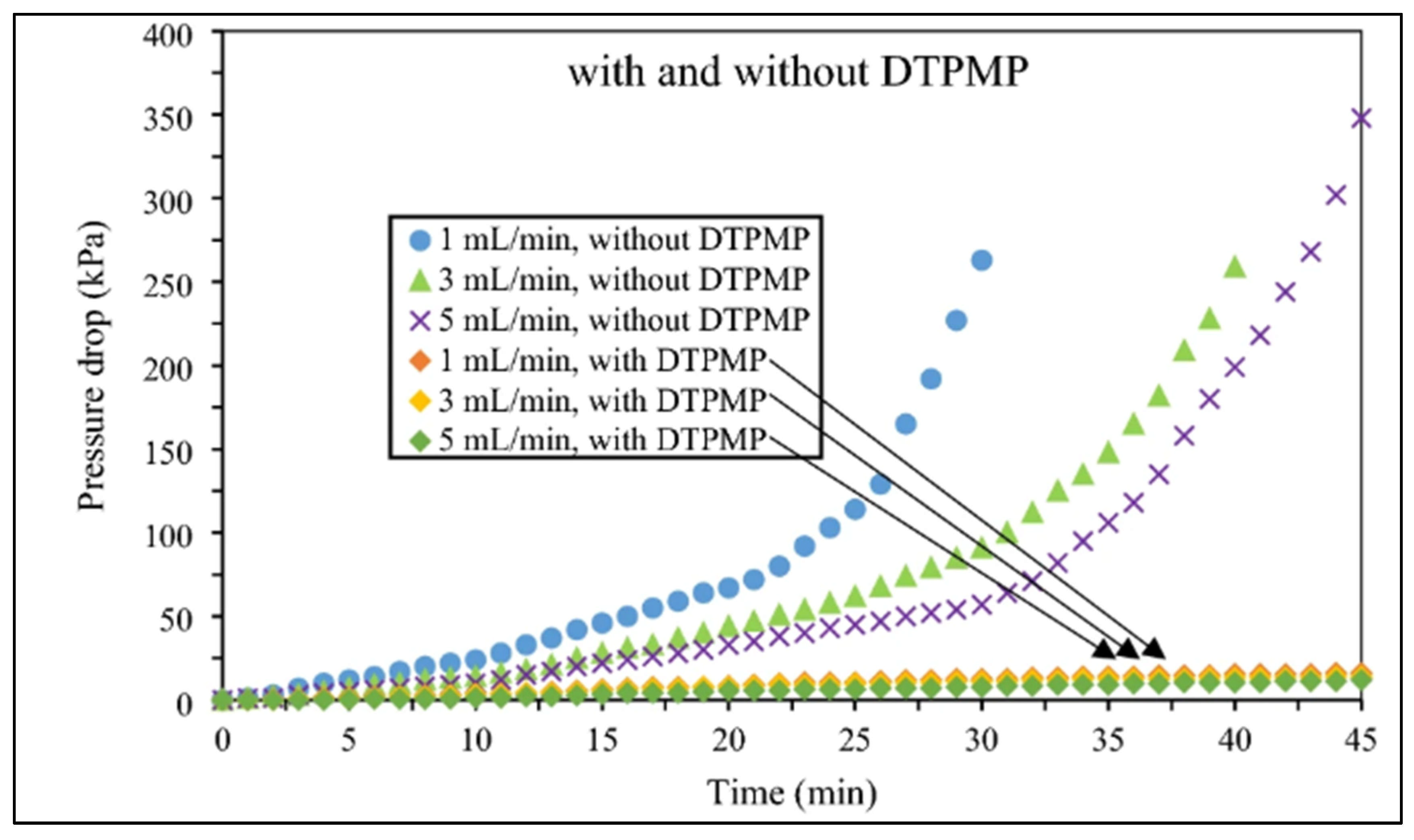
The dynamic information obtained from MD simulations provides an additional link between molecular adsorption and macroscopic inhibition performance. An inhibitor that exhibits strong and persistent interaction with a mineral surface is more likely to maintain surface coverage and continuously block active crystal-growth sites. Interaction energy, adsorption configuration, surface coverage, residence time, radial distribution functions, hydrogen-bonding behavior, and inhibitor diffusion can therefore be used to assess the stability of the adsorbed layer. This is particularly important in oilfield brines, where Na+, Ca2+, Mg2+, Ba2+, Sr2+, and sulfate ions compete with inhibitor molecules for surface sites. MD simulations can determine whether the inhibitor remains associated with the mineral surface under such competitive conditions and whether increasing temperature or ionic strength changes its molecular configuration or promotes desorption. Thus, DFT provides information about the energetically preferred inhibitor–surface interaction, whereas MD evaluates whether this interaction remains stable under dynamic aqueous conditions. Together, these approaches provide a molecular explanation for experimental observations such as higher adsorption capacity, longer induction time, reduced precipitation, delayed pressure increase in dynamic tube-blocking tests, and improved permeability retention.
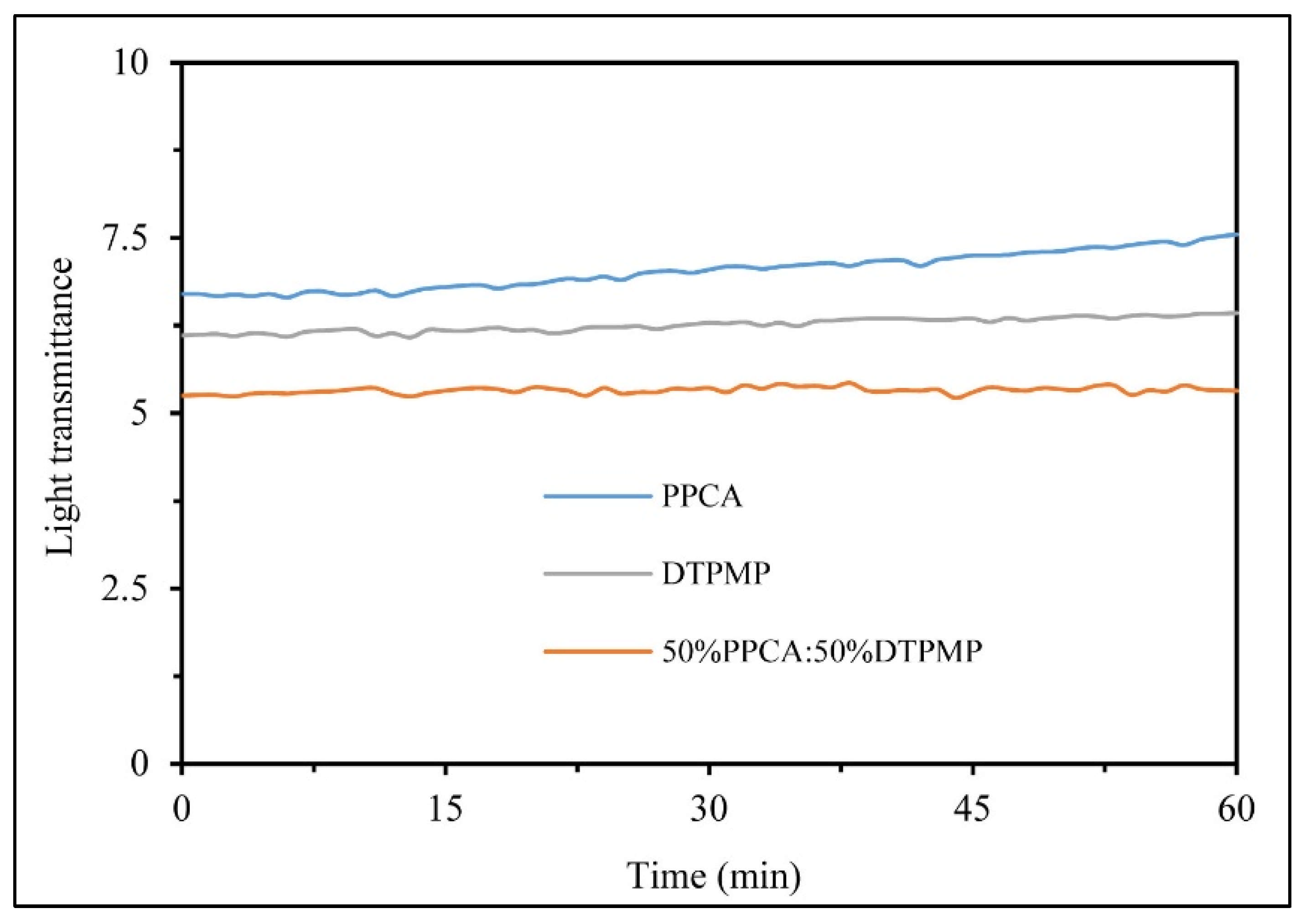
The integration of molecular modeling with experimental scale-inhibition measurements provides a multiscale interpretation of inhibitor performance. At the molecular scale, favorable adsorption energy and strong charge redistribution indicate a high affinity between an inhibitor and the mineral surface. At the interfacial scale, stable adsorption, high surface coverage, and long residence time indicate effective occupation of crystal-growth sites. At the macroscopic scale, these interactions are expected to manifest as delayed induction time, lower precipitation, more stable light-transmittance or turbidity profiles, lower pressure development during dynamic tube-blocking tests, and reduced permeability impairment during coreflood experiments. Therefore, computational descriptors should not be considered independent measures of inhibitor performance; rather, they should be correlated with experimental observations to establish a structure–adsorption–inhibition relationship. Such integration can explain why inhibitors with similar chemical compositions may exhibit different efficiencies under different mineralogical, temperature, salinity, and flow conditions.
Monte Carlo simulation constitutes another valuable computational technique for investigating adsorption phenomena. Rather than describing molecular motion over time, Monte Carlo methods statistically sample large numbers of possible molecular configurations to identify the most energetically favorable adsorption states [
214,
215]. These simulations are particularly useful for predicting equilibrium adsorption behavior, estimating surface coverage, and evaluating the influence of temperature and chemical composition on inhibitor performance. Combined Monte Carlo and MD simulations provide complementary information regarding both equilibrium structure and dynamic behavior.
Computational chemistry has also expanded through the application of COSMO-RS (Conductor-like Screening Model for Real Solvents), which predicts molecular solubility, intermolecular interactions, partition coefficients, and solvent effects based on quantum chemical calculations. Because oilfield scale inhibition occurs within highly complex aqueous electrolyte systems, accurate description of solvent effects is essential for predicting inhibitor behavior under realistic reservoir conditions. COSMO-RS therefore provides valuable insight into inhibitor solubility, compatibility, and interaction with highly saline formation waters [
216,
217].
An important application of computational chemistry is the establishment of quantitative structure–activity relationships. QSAR models correlate experimentally measured inhibition efficiency with molecular descriptors obtained from quantum chemical calculations. Parameters such as molecular volume, polar surface area, dipole moment, charge distribution, molecular flexibility, and hydrophobicity are statistically related to inhibition performance using regression analysis or machine learning techniques. Once validated, QSAR models enable rapid prediction of inhibitor performance for newly designed molecules without requiring extensive laboratory experimentation [
209,
218].
The integration of molecular modeling with artificial intelligence has further accelerated inhibitor discovery. Machine learning algorithms can analyze thousands of molecular descriptors simultaneously, identify complex nonlinear relationships, and recommend promising inhibitor structures with enhanced adsorption capacity, thermal stability, and environmental compatibility. High-throughput virtual screening based on DFT calculations and machine learning significantly reduces the number of compounds requiring synthesis and experimental testing, thereby shortening the development cycle for novel inhibitors.
Despite their considerable advantages, computational methods possess several limitations. DFT calculations are computationally intensive for large polymeric systems, while MD simulations require accurate force fields capable of describing complex mineral–solution interactions [
219]. Moreover, computational predictions must be validated experimentally because simplified models may not fully capture reservoir heterogeneity, multiphase flow, mixed-mineral precipitation, and chemical incompatibilities encountered in actual oilfield operations. Nevertheless, continuous advances in computational power, quantum chemistry, multiscale modeling, and artificial intelligence are steadily improving simulation accuracy and expanding the role of computational chemistry in modern scale inhibitor development.
For realistic oilfield systems, the same computational framework can be extended to mixed-mineral interfaces. Instead of modeling an isolated CaCO3 or BaSO4 surface, future DFT and MD studies can construct heterogeneous surfaces containing combinations of carbonate, sulfate, sulfide, and silica phases. Such models can evaluate competitive adsorption of inhibitor molecules on different mineral phases and determine whether the presence of FeS or SiO2 changes surface charge, adsorption energy, charge redistribution, or preferred inhibitor orientation. Competitive interactions between inhibitor molecules and scale-forming ions can also be evaluated to determine whether an inhibitor remains preferentially adsorbed or is displaced by dissolved species. These calculations would provide a molecular explanation for differences between single-scale laboratory results and mixed-scale behavior in field-produced waters.
Overall, molecular modeling has transformed scale inhibition research from empirical chemical screening to rational molecular design. The combination of DFT, molecular dynamics, Monte Carlo simulations, COSMO-RS, QSAR analysis, and machine learning provides unprecedented insight into molecular interactions governing scale inhibition. These computational techniques complement laboratory investigations and are expected to play an increasingly important role in developing high-performance, environmentally sustainable, and economically efficient scale inhibitors for future petroleum production systems.
4.4. Reservoir Simulation and Artificial Intelligence
Reservoir simulation has become an essential tool for predicting, monitoring, and mitigating mineral scale formation throughout the life cycle of oil and gas production. Unlike laboratory-scale studies that investigate isolated physicochemical processes, reservoir simulation integrates geological characteristics, fluid flow, heat transfer, geochemical reactions, and production operations within a unified computational framework. Such integration enables engineers to evaluate scaling risks before field development, optimize chemical treatment strategies, and assess the long-term effectiveness of scale management programs [
220,
221]. As petroleum reservoirs become increasingly complex, particularly in deepwater, high-pressure/high-temperature (HPHT), and unconventional environments, reservoir-scale simulation has become indispensable for maintaining production integrity and minimizing operational costs [
222].
Modern reservoir simulators incorporate reactive transport models that couple fluid flow with aqueous geochemistry and mineral precipitation. These models simultaneously solve conservation equations for mass, momentum, and chemical species while accounting for dissolution, precipitation, adsorption, and ion transport. As injection water mixes with formation water, changes in pressure, temperature, pH, and ionic composition alter mineral saturation states, allowing the simulator to identify regions susceptible to scale formation. Consequently, operators can predict whether carbonate, sulfate, silica, or mixed-mineral scales are likely to precipitate during water injection, enhanced oil recovery, production, or produced-water reinjection [
22,
66].
Reactive transport simulation is particularly valuable for evaluating seawater injection projects. Mixing sulfate-rich seawater with formation water containing high concentrations of barium, strontium, or calcium frequently results in precipitation of sparingly soluble sulfate minerals. Reservoir simulation enables engineers to determine the spatial and temporal distribution of these reactions, estimate permeability impairment, and evaluate alternative water-management strategies before field implementation. Similar approaches are applied to carbon capture and storage, geothermal energy production, and hydrogen storage projects, where mineral precipitation may significantly influence injectivity and reservoir performance [
22,
183].
Scale prediction is equally important within production tubing, wellbores, pipelines, separators, and surface processing facilities. As produced fluids travel from reservoir conditions to surface facilities, continuous reductions in pressure and temperature alter gas solubility, carbonate equilibria, and ionic activity, thereby increasing the likelihood of mineral precipitation. Wellbore and pipeline simulation models incorporate fluid flow, heat transfer, pressure gradients, and chemical equilibrium calculations to predict the location and severity of scale deposition. These models support the optimization of inhibitor injection points, chemical dosage, and maintenance schedules while minimizing production interruptions [
195].
The rapid growth of artificial intelligence (AI) has further transformed scale prediction by enabling analysis of large and complex datasets generated during laboratory experiments and field operations. Unlike conventional mechanistic models that require explicit mathematical descriptions of physicochemical processes, AI algorithms learn relationships directly from historical data. Consequently, they can capture highly nonlinear interactions among operational variables that are often difficult to represent using traditional equations [
223,
224].
Artificial Neural Networks (ANNs) are among the most widely applied machine learning techniques for predicting oilfield scale formation. Inspired by the structure of biological neural systems, ANNs consist of interconnected computational neurons capable of learning complex relationships between multiple input and output variables. Inputs typically include temperature, pressure, pH, ionic composition, total dissolved solids, flow rate, inhibitor concentration, and production history, whereas outputs may include saturation index, scaling tendency, inhibition efficiency, or deposition rate. After appropriate training using experimental or field datasets, ANN models frequently demonstrate excellent prediction accuracy while requiring relatively short computational time [
175].
Support Vector Machines (SVMs) provide another powerful approach for scale prediction, particularly when available datasets are relatively small. SVM algorithms identify optimal decision boundaries that maximize separation between different classes or regression responses, thereby providing robust prediction with good generalization capability. Compared with ANN models, SVMs are often less susceptible to overfitting and may achieve superior performance when experimental data are limited [
225].
Ensemble learning methods, including Random Forest (RF) and Extreme Gradient Boosting (XGBoost), have gained considerable attention because they combine predictions from multiple decision trees to improve accuracy and robustness. These algorithms effectively identify nonlinear interactions among chemical composition, operational parameters, and reservoir characteristics while simultaneously providing information regarding variable importance. Such feature-ranking capability enables engineers to identify the operational factors that exert the greatest influence on scale formation, thereby supporting more efficient chemical treatment strategies [
223].
Deep learning techniques have further expanded the capabilities of artificial intelligence by employing multiple hidden neural network layers to analyze highly complex datasets. Deep neural networks are particularly useful for integrating laboratory measurements, geological information, production history, sensor data, and simulation results into comprehensive predictive models. As digital oilfield infrastructure continues to expand, deep learning is expected to play an increasingly important role in autonomous scale prediction and production optimization.
An emerging concept closely associated with artificial intelligence is the digital twin. A digital twin represents a continuously updated virtual replica of an actual production system that integrates reservoir simulation, operational data, sensor measurements, and machine learning models. Through continuous comparison between predicted and observed system behavior, digital twins enable early detection of scaling events, optimization of inhibitor dosage, prediction of squeeze treatment lifetime, and evaluation of alternative operational scenarios. Such intelligent systems represent a significant step toward predictive and autonomous flow assurance.
Despite these remarkable advances, several challenges remain. High-quality datasets are essential for developing reliable AI models, yet field data are often incomplete, inconsistent, or affected by measurement uncertainty. Furthermore, purely data-driven models may exhibit limited extrapolation capability beyond the conditions represented in the training dataset. Consequently, current research increasingly focuses on hybrid approaches that combine mechanistic thermodynamic models with machine learning algorithms, thereby integrating the interpretability of physical models with the predictive power of artificial intelligence. These hybrid frameworks are expected to become the foundation of next-generation intelligent scale management systems for modern petroleum production [
226].
4.5. Process Optimization and Future Perspectives
The increasing complexity of modern petroleum production systems has made process optimization an essential component of scale management. While thermodynamic modeling, molecular simulations, reservoir simulation, and artificial intelligence provide valuable predictions regarding scale formation and inhibitor performance, optimization techniques determine the operating conditions that maximize production efficiency while minimizing scaling risk, chemical consumption, operational cost, and environmental impact. Consequently, optimization has evolved from a supplementary engineering tool into a fundamental element of integrated flow assurance strategies [
20,
227].
One of the most widely applied optimization techniques in petroleum engineering is Response Surface Methodology (RSM). RSM combines statistical experimental design with regression analysis to establish mathematical relationships between operational variables and system responses. In scale inhibition studies, independent variables commonly include inhibitor concentration, temperature, pressure, pH, salinity, calcium concentration, sulfate concentration, flow velocity, and residence time, whereas responses may include inhibition efficiency, scale deposition rate, crystal size, adsorption capacity, or squeeze lifetime. Once a predictive model has been established, response surface analysis enables identification of optimum operating conditions while significantly reducing the number of experiments required compared with conventional one-factor-at-a-time approaches [
107].
The success of RSM depends largely on an appropriate Design of Experiments (DoE). Experimental designs such as Central Composite Design (CCD), Box–Behnken Design (BBD), and Full or Fractional Factorial Designs allow researchers to investigate the individual and interactive effects of multiple variables simultaneously. Compared with traditional experimental methods, DoE provides greater statistical reliability, improved understanding of variable interactions, and reduced experimental cost. Numerous studies have demonstrated that RSM-based optimization can substantially reduce inhibitor dosage while maintaining or even improving scale inhibition efficiency under laboratory and field conditions [
176,
228].
Another widely used metaheuristic technique is Particle Swarm Optimization (PSO). PSO simulates the collective behavior of biological populations such as bird flocks or fish schools, allowing candidate solutions to move cooperatively toward optimal regions of the search space. Compared with GA, PSO often converges more rapidly and requires fewer adjustable parameters. Applications in oilfield scale control include optimization of inhibitor concentration, well injection rates, water chemistry, and operating conditions under varying production scenarios [
20,
107].
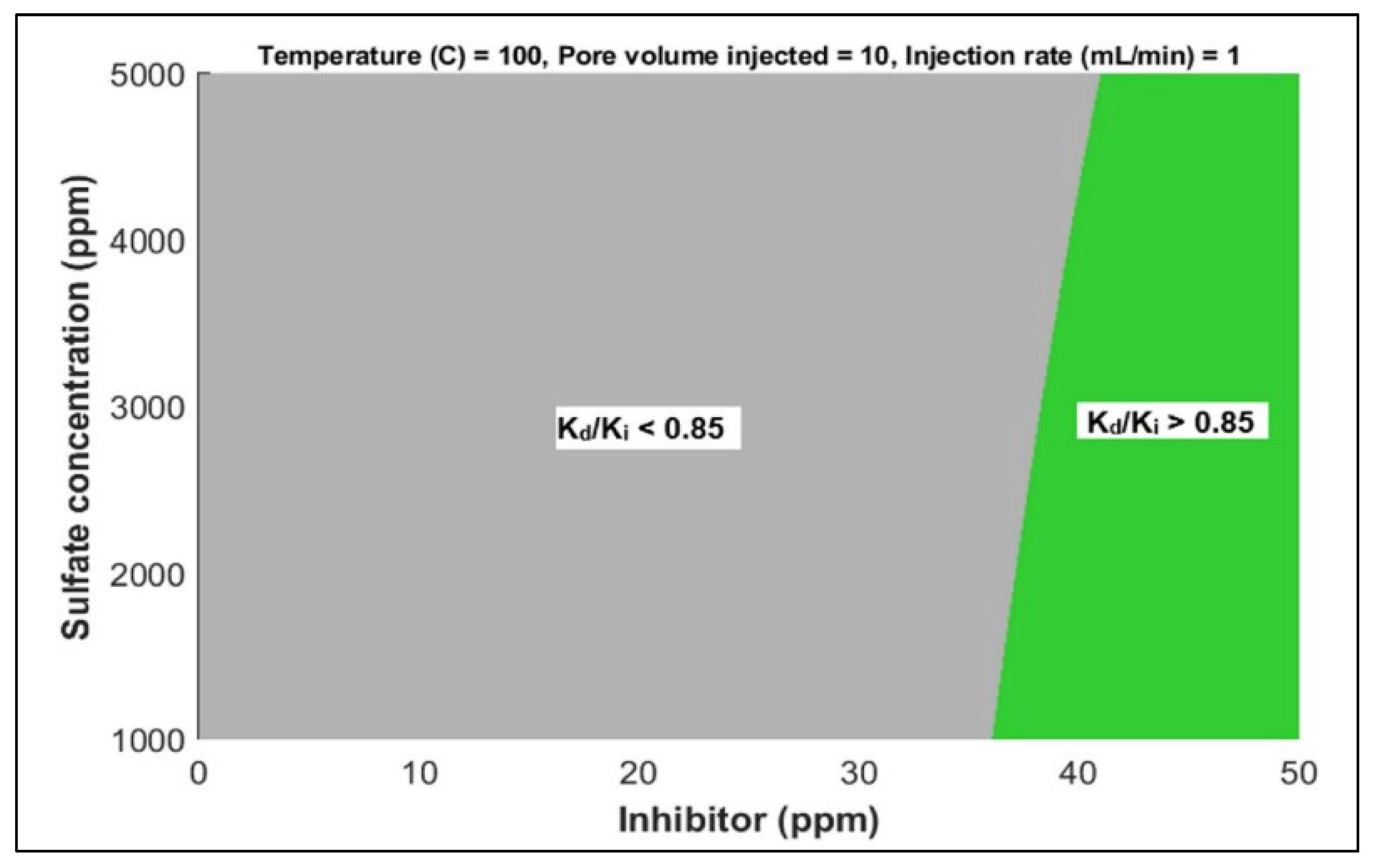
Ahmadi et al. developed a hybrid Particle Swarm Optimization–Machine Learning Gaussian Process Regression (PSO–MLGPR) framework to optimize scale inhibitor application under dynamic coreflooding conditions in carbonate reservoirs, as shown in
Figure 10 [
107]. The optimization identified the operating conditions that maximized permeability retention (Kd/Ki) while minimizing inhibitor consumption under severe scaling scenarios. Results showed that a permeability ratio of 0.97 could be achieved using 50 ppm inhibitor at 50 °C, 1000 ppm sulfate concentration, and an injection rate of 5 mL/min. Under worst-case conditions, PSO successfully determined the minimum inhibitor dosage required to maintain Kd/Ki > 0.85, demonstrating that intelligent optimization techniques can significantly improve dynamic scale management, reduce formation damage, and enhance waterflooding performance.
More recently, Bayesian optimization has emerged as a powerful method for optimizing expensive experimental or computational processes. Bayesian approaches construct probabilistic surrogate models that predict system performance while explicitly accounting for uncertainty. Consequently, they require relatively few experiments to identify optimal operating conditions, making them particularly attractive for laboratory investigations involving costly chemicals or time-consuming experimental procedures [
225].
Many practical engineering problems involve several conflicting objectives that must be optimized simultaneously. For example, increasing inhibitor concentration may improve scale protection but also increase operating cost and environmental impact. Multi-objective optimization techniques address such challenges by identifying a set of Pareto-optimal solutions representing different trade-offs among competing objectives. These approaches enable engineers to select operating conditions that best satisfy technical, economic, and environmental requirements according to specific field priorities [
229].
The rapid expansion of artificial intelligence has significantly enhanced optimization capabilities. Machine learning algorithms can continuously update predictive models using newly acquired production data, allowing optimization strategies to evolve throughout field operation. Reinforcement learning, in particular, enables intelligent systems to learn optimal chemical injection policies through repeated interaction with production environments. Rather than relying on fixed operating conditions, reinforcement learning continuously adjusts inhibitor dosage according to changing reservoir conditions, water chemistry, and production rates, thereby improving chemical utilization and reducing operational costs.
Future developments in oilfield scale management are expected to emphasize the integration of mechanistic modeling, artificial intelligence, optimization algorithms, and digital monitoring systems. Explainable artificial intelligence is becoming increasingly important because it improves transparency and interpretability of machine learning predictions, thereby increasing confidence in automated operational decisions. At the same time, physics-informed machine learning combines established thermodynamic and kinetic principles with data-driven algorithms, producing predictive models that are both physically consistent and computationally efficient.
Another important future direction is the development of autonomous chemical management systems. By integrating downhole sensors, online water chemistry analyzers, digital twins, and intelligent optimization algorithms, future production facilities will be capable of automatically detecting changing scaling conditions, predicting inhibitor demand, adjusting injection rates, and evaluating treatment effectiveness without continuous human intervention. Such smart production systems are expected to reduce chemical consumption, minimize production downtime, and significantly improve operational reliability [
230].
Sustainability will also play an increasingly important role in future optimization strategies. Environmental regulations are encouraging the replacement of conventional phosphorus-containing inhibitors with biodegradable alternatives, while optimization algorithms are being used to minimize chemical usage and reduce carbon emissions associated with production operations. Integration of life-cycle assessment, environmental impact analysis, and economic optimization will support the development of more sustainable scale management programs that balance operational efficiency with environmental responsibility.
In summary, process optimization has become a cornerstone of intelligent oilfield scale management. The combination of statistical experimental design, advanced optimization algorithms, artificial intelligence, digital twins, and real-time monitoring enables operators to move beyond reactive maintenance toward predictive and autonomous production management. Continued advances in computational power, sensor technologies, cloud computing, and interdisciplinary research will further accelerate the development of highly efficient, environmentally sustainable, and economically optimized scale control strategies, ensuring reliable hydrocarbon production under the increasingly demanding conditions of future petroleum reservoirs.
Table 7 provides a comprehensive comparison of the principal computational approaches employed for predicting mineral scale formation, understanding inhibition mechanisms, and optimizing scale management in oilfield production systems. The listed methods encompass physics-based, molecular-scale, data-driven, and optimization techniques, reflecting the multidisciplinary nature of modern scale management. Conventional thermodynamic and kinetic models establish the theoretical foundation for evaluating mineral solubility, supersaturation, nucleation, and crystal growth, enabling the assessment of scaling tendency under varying production conditions. Reactive transport modeling and reservoir simulation extend these capabilities by integrating fluid flow, geochemical reactions, and reservoir properties to predict the spatial and temporal evolution of scale deposition throughout the reservoir, wellbore, and surface facilities. At the molecular level, computational chemistry methods, including Density Functional Theory, Molecular Dynamics, Monte Carlo simulation, and Quantitative Structure–Activity Relationship modeling, provide detailed insights into inhibitor–crystal interactions, adsorption mechanisms, and molecular structure–performance relationships. These techniques facilitate the rational design and virtual screening of high-performance scale inhibitors prior to experimental validation. Recent advances in artificial intelligence have introduced powerful data-driven approaches such as Artificial Neural Networks, Support Vector Machines, Random Forest, and Extreme Gradient Boosting, which effectively capture complex nonlinear relationships among operational variables and accurately predict scaling tendency and inhibitor performance. Furthermore, Digital Twin technology integrates real-time monitoring, numerical simulation, and machine learning to support continuous decision-making and predictive flow assurance. Finally, statistical and metaheuristic optimization methods, including Response Surface Methodology, Genetic Algorithms, and Particle Swarm Optimization, enable the determination of optimum operating conditions and inhibitor dosage while minimizing operational costs and maximizing production efficiency. Collectively, these complementary modeling approaches constitute the foundation of next-generation intelligent scale management strategies in the petroleum industry.