Review

Scale Management Technologies for Production Enhancement in Oilfields: Mechanisms, Inhibitor Chemistry, Modeling, and Future Perspectives

by
Soroush Ahmadi
1 and
Azizollah Khormali
2,*
1
Department of Chemical Engineering, Faculty of Petroleum, Gas, and Petrochemical Engineering, Persian Gulf University, Bushehr P.O. Box 7516913817, Iran
2
Department of Chemistry, Faculty of Basic Sciences and Engineering, Gonbad Kavous University, Gonbad Kavous P.O. Box 4971799151, Iran
*
Author to whom correspondence should be addressed.
ChemEngineering 2026, 10(9), 112; https://doi.org/10.3390/chemengineering10090112 (registering DOI)
Submission received: 15 August 2026 / Revised: 11 September 2026 / Accepted: 15 September 2026 / Published: 18 September 2026

Abstract

Mineral scale deposition is one of the most persistent flow assurance challenges in the oil and gas industry, causing formation damage, reduced injectivity and productivity, equipment fouling, pipeline blockage, and substantial economic losses. The increasing application of seawater injection, produced-water reinjection, and enhanced oil recovery (EOR) techniques has intensified scaling problems by promoting the mixing of incompatible waters and altering reservoir geochemistry. Consequently, the development of efficient scale management strategies has become essential for maintaining production performance and ensuring the long-term integrity of oilfield assets. This review comprehensively examines the mechanisms of scale formation, the physicochemical and operational factors governing mineral precipitation, and recent advances in scale inhibition technologies for production enhancement. The review discusses the characteristics and formation mechanisms of the major oilfield scales, including carbonate, sulfate, silica, iron-containing, and mixed mineral deposits, together with their effects on reservoir permeability and production facilities. Conventional phosphonate- and polymer-based inhibitors are critically evaluated alongside emerging environmentally friendly inhibitors, nanotechnology-assisted formulations, and controlled-release squeeze treatment systems. Furthermore, laboratory evaluation techniques, adsorption and coreflooding studies, thermodynamic and kinetic modeling, molecular simulations, and artificial intelligence-based predictive methods are reviewed to demonstrate their roles in improving inhibitor design, scale prediction, and treatment optimization. Recent developments in machine learning, digital twins, and intelligent optimization algorithms are also highlighted as enabling technologies for next-generation scale management. Finally, current research challenges and future perspectives are discussed, emphasizing sustainable inhibitor development, integrated experimental and computational approaches, and real-time predictive monitoring systems. By integrating advances in chemistry, materials science, computational modeling, and petroleum engineering, this review provides a comprehensive framework for understanding and implementing effective scale management strategies to enhance hydrocarbon production, reduce operational costs, and improve the sustainability of oilfield operations.

1. Introduction and Methodology

1.1. Introduction

Mineral scale deposition is one of the most persistent and economically significant flow assurance problems encountered throughout the oil and gas industry. During hydrocarbon production, dissolved inorganic ions present in formation water, injection water, or produced water may become supersaturated because of changes in pressure, temperature, pH, ionic composition, or fluid mixing. Under these conditions, sparingly soluble mineral salts precipitate from solution, forming deposits on reservoir pore surfaces, production tubing, downhole equipment, pipelines, valves, separators, heat exchangers, and water injection facilities [1,2]. Progressive accumulation of these deposits restricts fluid flow, decreases reservoir permeability, reduces well injectivity and productivity, increases pumping power requirements, accelerates under-deposit corrosion, and ultimately leads to substantial production losses and increased operating costs. The widespread occurrence of scaling in both conventional and unconventional reservoirs has therefore established scale management as a critical component of production optimization and flow assurance programs across the upstream petroleum sector [3,4].
The severity of scale formation has increased considerably as oil and gas production has expanded toward deepwater fields, high-pressure/high-temperature (HPHT) reservoirs, EOR projects, and mature fields with increasing water production. Modern production systems frequently involve seawater injection, low-salinity waterflooding, produced-water reinjection, carbon dioxide injection, and other advanced recovery techniques that significantly alter reservoir geochemistry [5,6]. Mixing chemically incompatible waters often produces highly supersaturated environments that promote the precipitation of carbonate, sulfate, silica, and mixed-mineral scales. Furthermore, continuous reductions in pressure and temperature as reservoir fluids travel from the formation to surface facilities change gas solubility, ionic activity, and chemical equilibria, creating favorable conditions for mineral crystallization at multiple locations throughout the production system [7,8]. Consequently, scale management has evolved from a localized maintenance issue into a multidisciplinary challenge involving reservoir engineering, production chemistry, materials science, geochemistry, computational modeling, and environmental engineering [9].
Among the various scale-forming minerals, calcium carbonate, barium sulfate, strontium sulfate, calcium sulfate, magnesium hydroxide, silica, iron sulfide, and mixed inorganic deposits are the most frequently encountered in petroleum operations. Each mineral exhibits distinct precipitation mechanisms, thermodynamic stability, crystal morphology, and response to chemical treatment [10,11]. Carbonate scales are commonly associated with pressure depletion and carbon dioxide degassing, whereas sulfate scales frequently result from the mixing of sulfate-rich injection water with formation brines containing high concentrations of calcium, barium, or strontium ions [12,13]. Silica scaling becomes particularly important in geothermal systems and certain high-temperature reservoirs, while iron-containing scales are often associated with corrosion processes and sour production environments. The coexistence of multiple mineral phases further complicates prediction and mitigation because mixed deposits frequently exhibit physicochemical properties that differ substantially from those of individual minerals.
Chemical inhibition remains the most widely implemented and economically attractive approach for controlling mineral scale in oilfield operations [14,15]. Conventional phosphonate- and polymer-based inhibitors suppress scale formation through several complementary mechanisms, including threshold inhibition, crystal growth modification, lattice distortion, dispersion of precipitated particles, and adsorption onto crystal surfaces. Over the past several decades, these chemicals have demonstrated excellent field performance in continuous injection and squeeze treatment applications. However, increasingly stringent environmental regulations, particularly for offshore developments, together with the growing demand for sustainable production practices, have stimulated extensive research into biodegradable polymers, amino acid derivatives, naturally derived compounds, plant extracts, and nanostructured inhibitor systems [10,16,17]. At the same time, advances in controlled-release technologies have improved inhibitor placement efficiency and extended squeeze treatment lifetime, thereby reducing chemical consumption and operational costs.
Alongside developments in inhibitor chemistry, remarkable progress has been achieved in understanding the fundamental mechanisms governing mineral precipitation. Modern analytical techniques, including scanning electron microscopy, transmission electron microscopy, atomic force microscopy, X-ray diffraction, Fourier-transform infrared spectroscopy, Raman spectroscopy, and X-ray photoelectron spectroscopy, have provided unprecedented insight into crystal nucleation, crystal growth, inhibitor adsorption, and surface interactions [18,19]. These experimental advances have been complemented by molecular simulations, quantum chemical calculations, and multiscale computational modeling, allowing researchers to investigate inhibitor performance from the electronic scale to field-scale production systems. More recently, artificial intelligence, machine learning, and digital oilfield technologies have emerged as powerful tools for predicting scaling tendency, optimizing inhibitor dosage, estimating squeeze treatment lifetime, and supporting real-time operational decision-making [20,21].
Despite the rapid development of oilfield scale-control technologies, the recent literature remains characterized by several specialized review perspectives. For example, Nassar et al. recently reviewed environmentally friendly scale-inhibition strategies for produced-water management in enhanced oil recovery, with particular emphasis on biodegradable polymers, plant-derived additives, nanostructured materials, hybrid formulations, and environmental sustainability [22]. Luo et al. focused on the recent development of thermodynamic prediction of oilfield scale, particularly the transition from mechanistic models toward machine-learning-based prediction [23]. More recently, Liu et al. reviewed next-generation green scale inhibitors for ultra-deep and high-salinity oilfields, emphasizing molecular design, structure–activity relationships, thermal and salt tolerance, and molecular-dynamics-based interpretation of inhibition mechanisms [24]. These studies provide important advances; however, their primary emphases remain on specific components of scale management rather than on the integration of scale chemistry, inhibitor technologies, experimental evaluation, computational modeling, intelligent prediction, and production optimization within one framework.
To clarify the specific contribution of the present review, Table 1 compares its scope with several recent reviews addressing oilfield scale formation and inhibition. Recent studies have provided valuable and specialized perspectives on environmentally sustainable inhibitors, thermodynamic prediction, and next-generation green inhibitor design. However, these contributions generally emphasize specific dimensions of scale management rather than connecting the complete chain from scale-forming mechanisms and inhibitor–mineral interactions to laboratory validation, predictive modeling, optimization, digital monitoring, and production performance. The present review therefore focuses on the integration of these complementary domains and evaluates how advances at each scale can contribute to more predictive and production-oriented scale management.
The present review is therefore differentiated by its production-oriented, multiscale integration of oilfield scale management. Rather than treating scale formation, inhibitor development, laboratory testing, computational prediction, and field application as independent topics, this review establishes connections among them. The framework begins with the physicochemical mechanisms controlling mineral precipitation, including incompatible-water mixing, supersaturation, temperature, pressure, ionic composition, and mineral–fluid interactions [25,26]. These mechanisms are then linked to the selection and molecular design of conventional, polymeric, phosphonate-based, green, nano-enabled, and hybrid inhibitors. Particular attention is given to adsorption, desorption, crystal-growth inhibition, induction-time modification, and the influence of inhibitor structure on mineral-surface interactions.
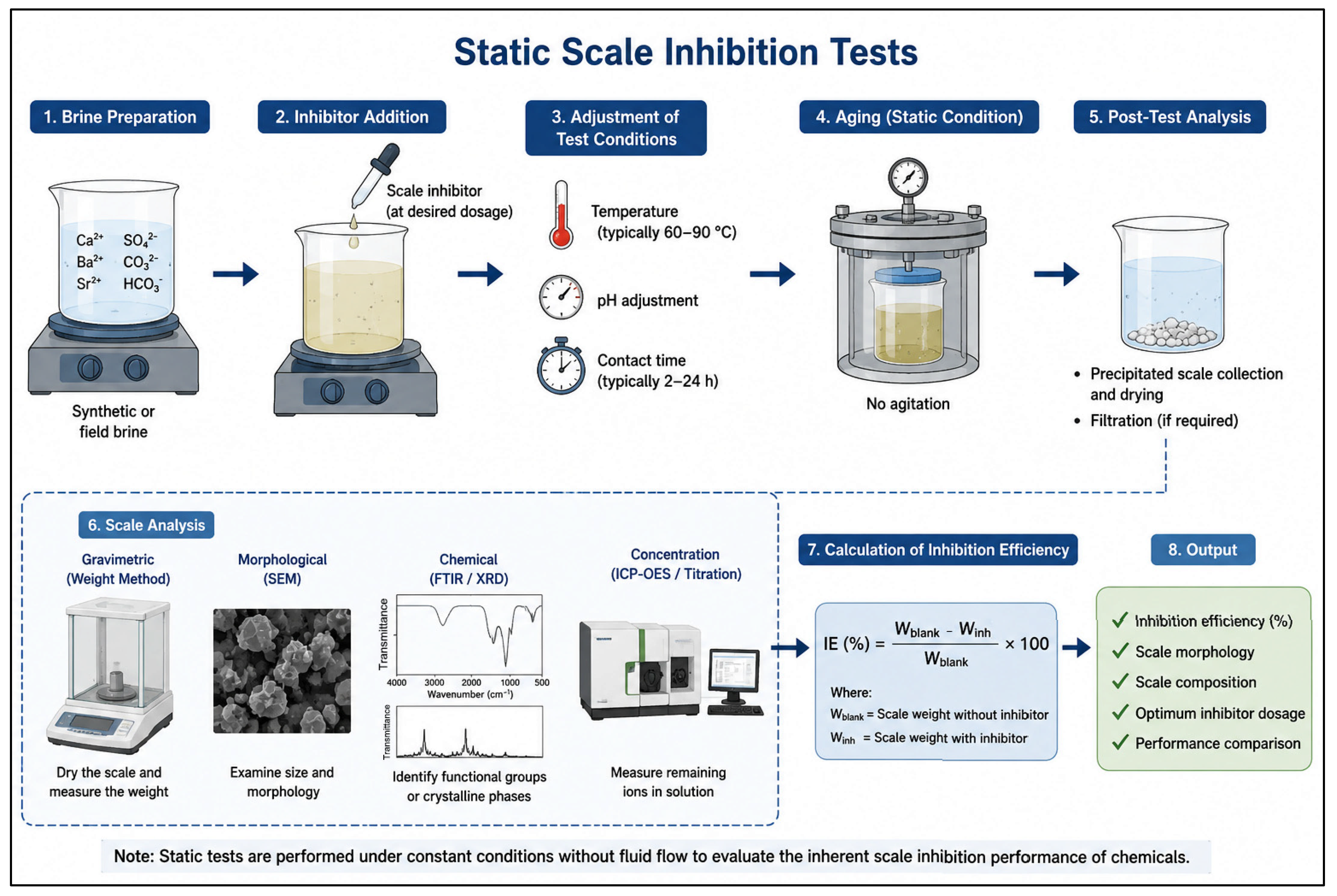
A further distinguishing feature is the integration of static and dynamic evaluation with predictive and optimization tools. Laboratory methods such as jar tests, turbidity/light-transmission measurements, induction-time analysis, dynamic tube-blocking tests, scale-loop experiments, adsorption/desorption studies, and coreflooding are considered not merely as individual testing methods but as complementary levels of validation. Their results provide the experimental basis for thermodynamic, kinetic, reactive-transport, reservoir, molecular, and data-driven models. This connection is important because laboratory inhibition efficiency does not necessarily translate directly into field-scale performance when flow rate, residence time, mineral heterogeneity, competitive adsorption, multiphase flow, and permeability alteration are considered.
The review further extends the conventional inhibitor-focused perspective by examining the emerging transition toward intelligent and predictive scale management. Molecular approaches such as DFT, molecular dynamics, Monte Carlo simulations, COSMO-RS, and QSAR are discussed in terms of their ability to explain inhibitor adsorption and crystal-growth inhibition at the molecular scale. At larger scales, thermodynamic and kinetic models predict precipitation tendency and scaling rates, while reactive-transport and reservoir models provide information regarding the spatial evolution of scale and its influence on flow. Artificial intelligence, machine learning, response surface methodology, evolutionary optimization, and digital-twin concepts are subsequently considered as tools for integrating these outputs with operational data and identifying optimized inhibitor dosage and production conditions.
Accordingly, the principal novelty of this review is not the individual discussion of a particular inhibitor, computational method, or monitoring technology. Instead, its contribution lies in establishing a scale-formation–inhibition–prediction–optimization–production framework that connects molecular-scale interactions with laboratory performance, reservoir-scale formation damage, and production enhancement. This perspective enables the performance of scale-control technologies to be evaluated not only according to their ability to reduce mineral precipitation but also according to their capacity to preserve permeability, maintain injectivity, extend treatment lifetime, reduce operational interruptions, and ultimately support reliable hydrocarbon production. The framework also identifies the major knowledge gaps that must be addressed to transfer laboratory-scale advances into heterogeneous, high-temperature, high-salinity, and dynamically operated oilfield systems.

1.2. Methodology

A structured literature-search and selection strategy was adopted to provide a transparent and reproducible basis for this critical review. The search was designed to capture both established knowledge and recent developments in oilfield scale management, with particular emphasis on the relationship between scale formation, inhibitor performance, predictive modeling, and production optimization. Literature searches were conducted using major multidisciplinary and engineering-oriented bibliographic databases, including Scopus, Web of Science Core Collection, and ScienceDirect, with additional searches of Google Scholar used to identify relevant publications, recently published articles, and seminal studies that were not readily identified through the primary database searches. The search was conducted in 2005, and publications from approximately the last two decades were emphasized, while earlier seminal studies were retained when they established fundamental theories, experimental methods, or modeling approaches that remain relevant to contemporary scale-management research.
The search strategy employed combinations of keywords related to the major themes of the review. Representative search strings included: (“oilfield scale” OR “oilfield scaling” OR “mineral scale”) AND (“scale inhibition” OR “scale inhibitor”); (“calcium carbonate” OR “calcium sulfate” OR “barium sulfate” OR “strontium sulfate”) AND (“oilfield” OR “reservoir” OR “water flooding”); (“scale inhibitor” AND adsorption AND desorption); (“scale inhibition” AND “dynamic tube blocking” OR “scale loop” OR coreflood); (“scale inhibition” AND DFT OR “molecular dynamics” OR Monte Carlo OR QSAR); and (“oilfield scale” AND “machine learning” OR “artificial intelligence” OR optimization OR “digital twin”). Additional combinations involving green inhibitors, polymers, phosphonates, nanoparticles, thermodynamic modeling, kinetic modeling, reactive transport, and reservoir simulation were used to identify literature associated with specific sections of the review.
The inclusion criteria were defined to prioritize publications that (i) addressed mineral scale formation, prediction, inhibition, or management in petroleum-production, waterflooding, EOR, or reservoir environments; (ii) reported experimental, computational, modeling, field, or technically relevant evidence; (iii) provided sufficient methodological or mechanistic information to support interpretation; and/or (iv) addressed emerging technologies relevant to future scale-management systems. Peer-reviewed research articles and review papers were prioritized, while selected conference papers, technical publications, and authoritative reports were considered when they provided important industrial or methodological information not available in journal publications. Recent studies were preferentially included when evaluating emerging technologies, whereas older seminal publications were retained when they provided foundational knowledge.
Publications were excluded when they (i) were unrelated to petroleum or reservoir scale management, (ii) focused exclusively on non-scale-related water-treatment applications without transferable relevance to oilfield systems, (iii) lacked sufficient technical information for meaningful interpretation, (iv) were duplicate records, or (v) provided information substantially overlapping with higher-quality or more comprehensive sources. Where multiple publications reported similar findings, preference was given to studies with stronger experimental validation, clearer mechanistic interpretation, broader operating conditions, or greater relevance to field-scale applications.
The screening process consisted of sequential title/keyword screening, abstract screening, and full-text assessment. Initially identified records were examined for relevance to the predefined themes of the review. Duplicate records retrieved from different databases were removed before detailed screening. Potentially relevant publications were then evaluated using their abstracts and, where necessary, full texts. During the final selection stage, publications were classified according to the major themes of the review, including scale-formation mechanisms, physicochemical and operational factors, conventional and emerging inhibitors, adsorption/desorption, static and dynamic testing, molecular modeling, thermodynamic and kinetic prediction, reservoir simulation, artificial intelligence, optimization, nanotechnology, and digital scale-management technologies.
Because this study is intended as a critical integrative review rather than a formal systematic review or meta-analysis, no quantitative meta-analysis was performed and no attempt was made to identify every publication on oilfield scaling. Instead, the selected literature was critically synthesized to identify relationships, technological developments, methodological limitations, and unresolved research. The diagram of stages is shown in Figure 1.

2. Fundamentals of Oilfield Scale Formation

2.1. Physicochemical Principles of Scale Formation

Mineral scale formation is fundamentally a physicochemical process involving the precipitation of sparingly soluble inorganic salts from aqueous solutions when thermodynamic equilibrium is disturbed. In oilfield production systems, produced water commonly contains high concentrations of dissolved ions that remain stable under reservoir conditions because the fluid is in chemical equilibrium with the surrounding geological formation. However, during hydrocarbon production, fluids experience continuous changes in pressure, temperature, chemical composition, gas content, and flow conditions. These changes alter the solubility of dissolved minerals and may drive the system toward supersaturation, ultimately resulting in nucleation, crystal growth, and deposition of mineral scales on solid surfaces [27,28]. A comprehensive understanding of these physicochemical principles is essential for predicting scaling tendencies and designing effective inhibition strategies.
The precipitation of mineral scales is governed primarily by the balance between the ionic activity product (IAP) of dissolved species and the thermodynamic solubility product (Ksp) of the corresponding mineral. The solubility product represents the equilibrium constant for the dissolution reaction of a sparingly soluble mineral under specified temperature and pressure conditions [29,30,31]. When the ionic activity product equals the solubility product (IAP = Ksp), the solution is in equilibrium, and neither precipitation nor dissolution is thermodynamically favored. If the ionic activity product remains below the solubility product (IAP < Ksp), the solution is undersaturated, and existing mineral deposits tend to dissolve. Conversely, when the ionic activity product exceeds the solubility product (IAP > Ksp), the solution becomes supersaturated, providing the thermodynamic driving force necessary for mineral precipitation [32,33,34].
The degree of supersaturation is one of the most important parameters controlling scale formation. It determines not only whether precipitation is thermodynamically possible but also influences the rate of nucleation and crystal growth. Higher supersaturation generally results in faster nucleation rates, greater numbers of crystal nuclei, and accelerated deposition [35,36]. In practical oilfield operations, supersaturation may develop through several mechanisms, including pressure depletion, temperature variation, evaporation, gas liberation, pH changes, water evaporation in surface facilities, and, most importantly, the mixing of incompatible formation and injection waters. For example, seawater injected for pressure maintenance contains relatively high sulfate concentrations, whereas formation waters often contain dissolved barium, strontium, and calcium ions. Mixing these waters frequently produces severe supersaturation with respect to sulfate minerals, leading to rapid precipitation of barite (BaSO4) or celestite (SrSO4) [37,38].
Thermodynamic stability is commonly evaluated using the saturation index (SI), which is defined as:
SI = log (IAP/Ksp)
A saturation index equal to zero indicates equilibrium, whereas negative values indicate undersaturation and positive values indicate supersaturation. The magnitude of the saturation index provides an indication of the scaling tendency, although it should be recognized that thermodynamic favorability alone does not guarantee immediate precipitation. Kinetic limitations may delay scale formation even under highly supersaturated conditions, particularly in systems lacking suitable nucleation sites [39].
Although the saturation index is commonly expressed as (SI = log (IAP/Ksp)), its accurate determination in oilfield brines requires consideration of ionic strength and ion activities. In concentrated injection and formation waters, the activity of each dissolved ion differs from its analytical concentration because of electrostatic interactions among ions. Consequently, both the ion activity product (IAP) and the effective solubility equilibrium are influenced by the ionic strength and chemical composition of the aqueous phase. Assuming a constant ionic strength, such as approximately 0.7 mol/dm3 for seawater, provides only a simplified approximation because the salinity and ionic composition of seawater vary among locations and may differ substantially from those of formation waters. Similarly, tabulated (Ksp) values reported for ideal dilute solutions or infinite dilution (I is about zero) should not be directly applied to highly saline oilfield brines without appropriate activity corrections. Therefore, reliable scale prediction should employ thermodynamic equilibrium models that calculate ion activity coefficients as functions of ionic strength, temperature, pressure, and brine composition. This consideration becomes particularly important when evaluating the mixing of incompatible injection and formation waters, where changes in ionic strength can substantially modify mineral saturation and precipitation predictions. Accordingly, SI values should be interpreted as condition-dependent thermodynamic indicators rather than universal constants, and the assumptions and thermodynamic databases used for their calculation should be clearly specified.
The thermodynamic driving force for mineral precipitation can also be described in terms of Gibbs free energy. A spontaneous precipitation process occurs when the change in Gibbs free energy (ΔG) is negative, indicating that the system lowers its overall free energy through crystal formation. The relationship between supersaturation and Gibbs free energy explains why even small changes in pressure, temperature, or ionic composition may dramatically influence scaling behavior [40]. As supersaturation increases, the free-energy barrier associated with crystal formation decreases, making nucleation increasingly favorable. Consequently, oilfield operations involving rapid depressurization, flashing, or extensive mixing of incompatible waters often experience severe scaling because these processes significantly increase the thermodynamic driving force for precipitation [41,42].
Although thermodynamics determines whether precipitation is possible, scale formation also depends strongly on reaction kinetics. Numerous oilfield fluids remain supersaturated for extended periods without observable precipitation because crystal nucleation requires overcoming an activation energy barrier [43,44]. This metastable condition is particularly important in petroleum production systems, where fluids may travel considerable distances before nucleation occurs. The presence of suspended particles, corrosion products, microorganisms, pipe roughness, or previously deposited mineral crystals can substantially reduce the activation energy required for nucleation, thereby accelerating scale formation. Consequently, both thermodynamic equilibrium and kinetic factors must be considered when evaluating scaling risk [45].
Nucleation represents the initial stage of crystal formation and may occur through homogeneous or heterogeneous mechanisms. Homogeneous nucleation takes place within the bulk solution without assistance from foreign surfaces and generally requires very high degrees of supersaturation because of the substantial energy barrier associated with forming stable crystal embryos [46,47]. In contrast, heterogeneous nucleation occurs on existing solid surfaces such as pipe walls, corrosion products, sand grains, clay minerals, suspended particles, or previously deposited scale. Since most oilfield production systems contain abundant solid interfaces, heterogeneous nucleation is the dominant mechanism responsible for industrial scale formation. Surface imperfections, weld joints, roughness, and corrosion layers provide energetically favorable sites that significantly reduce the critical nucleus size and promote crystal formation [48,49].
Following nucleation, crystal growth proceeds through the adsorption of dissolved ions onto energetically favorable lattice positions. The growth rate depends on several factors, including supersaturation, temperature, ion diffusion, solution chemistry, and hydrodynamic conditions. As crystals enlarge, they may aggregate with neighboring particles to form larger clusters that eventually settle or adhere to equipment surfaces [50,51]. Crystal morphology, size distribution, and mechanical strength are influenced by the surrounding chemical environment and determine the adhesion characteristics of the resulting scale deposits. Compact crystalline layers typically exhibit strong adhesion and are difficult to remove, whereas porous or loosely packed deposits are generally more susceptible to mechanical cleaning or chemical dissolution [52,53].
Fluid hydrodynamics also play a critical role in controlling scale deposition. Flow velocity influences mass transfer of dissolved ions to crystal surfaces, while turbulence affects particle transport and attachment efficiency. High flow velocities may reduce deposition by increasing shear stress, although they simultaneously enhance ion transport to growing crystals. Conversely, stagnant regions, dead zones, and low-velocity sections of production equipment frequently become preferential sites for scale accumulation because particles have sufficient residence time to settle and attach to surfaces. Understanding these interactions between thermodynamics, reaction kinetics, crystallization, and fluid dynamics is essential for accurately predicting scale behavior under field conditions [54,55].
Scale nucleation in oilfield systems should not be considered exclusively within the framework of homogeneous nucleation in the bulk aqueous phase. Three conceptually distinct pathways can occur: homogeneous nucleation within the supersaturated solution, heterogeneous nucleation on suspended solid nano/micro-impurities present in the aqueous phase, and heterogeneous nucleation directly on reservoir rock or equipment surfaces. The second pathway is particularly relevant because aqueous systems may contain suspended particles, colloids, corrosion products, mineral fragments, clay particles, iron oxides, or other solid impurities that can provide favorable templates for the initial accumulation of scale-forming ions. Adsorption of dissolved ions onto these surfaces can reduce the energetic barrier for crystal formation and promote the development of solid embryos at lower effective nucleation barriers than those required for homogeneous nucleation. Similarly, mineral and metallic surfaces in porous media, pipelines, valves, heat exchangers, and production equipment can provide additional heterogeneous nucleation sites. Therefore, the actual scaling process may involve simultaneous contributions from bulk solution chemistry, suspended solid impurities, and stationary solid interfaces. In this context, the term “critical nucleus” should be used carefully because the classical critical-size concept is most directly associated with homogeneous nucleation, whereas heterogeneous nucleation is strongly influenced by substrate surface energy, wettability, interfacial interactions, surface defects, and the geometry of the nucleation site. The revised conceptual framework therefore distinguishes these pathways while emphasizing that heterogeneous nucleation can be particularly important under realistic oilfield conditions characterized by abundant solid interfaces and suspended impurities.
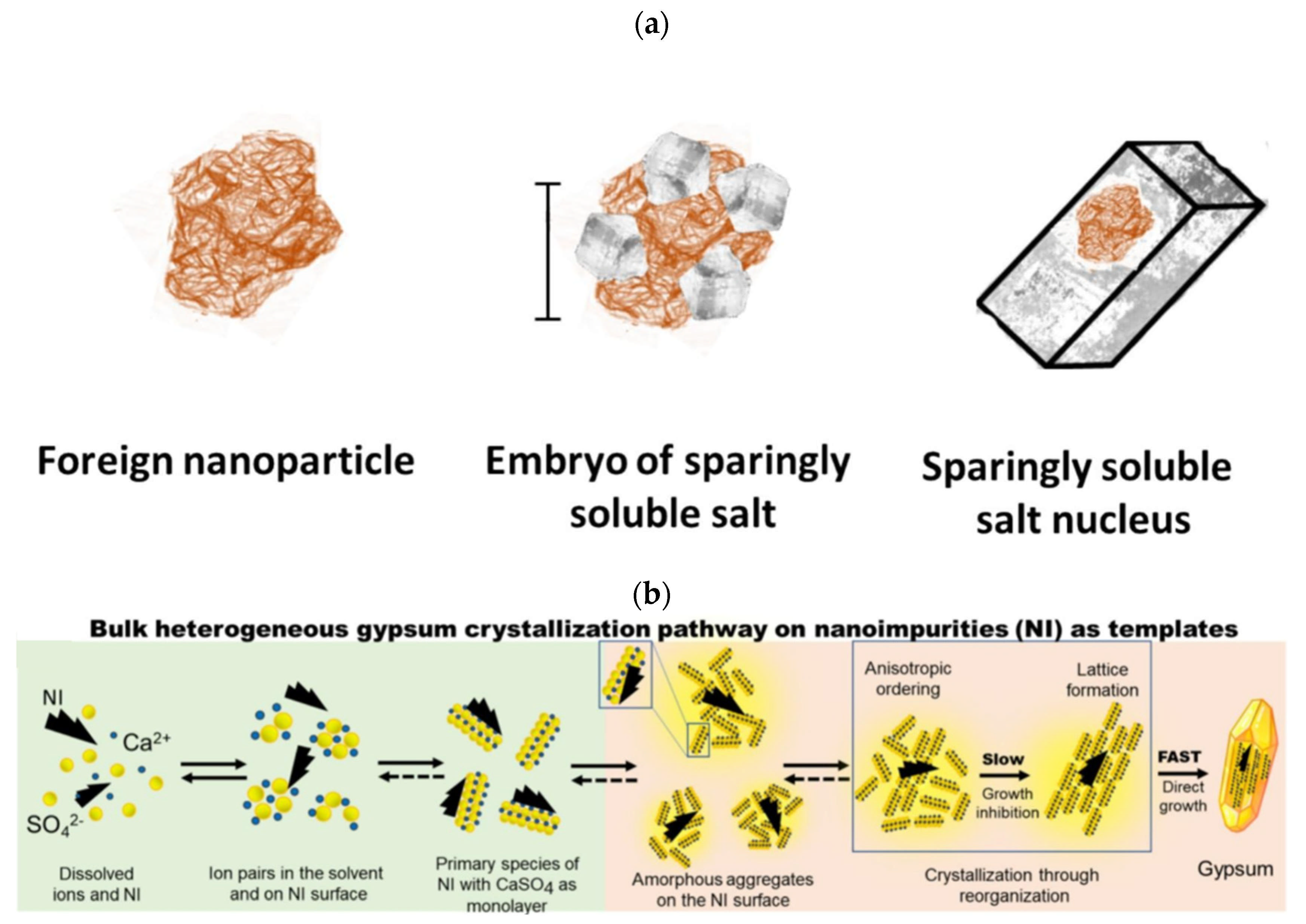
Solid nano- and micro-impurities can act as natural templates for heterogeneous scale nucleation by providing surfaces onto which scale-forming ions and neutral species, such as CaCO3 and BaSO4 precursors, can preferentially adsorb. Adsorption on these surfaces is energetically favorable and can promote the accumulation and organization of scale-forming species at the solid–water interface. In particular, concave or high-energy regions of impurity surfaces may provide favorable sites for ion attachment and reduce the energetic barrier associated with the formation of a stable solid phase. Progressive surface coverage can generate one or more layers of scale-forming material, producing an interfacial pre-nucleation solid that subsequently develops into a stable crystal nucleus. Thus, the solid impurity and its associated scale-forming layer can provide a pathway for crystal formation without requiring the formation of a sufficiently large homogeneous cluster in the bulk solution. This mechanism highlights the potential importance of naturally occurring suspended particles and other solid interfaces in initiating heterogeneous scale formation in oilfield systems. (as shown in Figure 2a).
Solid nano/micro-impurities can provide favorable templates for heterogeneous scale nucleation in Figure 2b. Scale-forming ions and neutral species adsorb onto these surfaces, particularly at high-energy or concave sites, forming successive interfacial layers. The continued accumulation and organization of the adsorbed species produces a stable pre-nucleation solid, which subsequently develops into a crystal nucleus. This surface-assisted pathway lowers the energetic barrier for scale formation and demonstrates the potential importance of naturally occurring solid impurities as nucleation centers in oilfield systems.
An emerging perspective on heterogeneous scale formation involves the possible role of naturally occurring solid nano- and micro-impurities, sometimes referred to as the “nanodust” concept. Injection waters and formation brines may contain dispersed mineral particles, colloids, corrosion products, clay fragments, and other nanoscale or microscale solid species that provide high-energy surfaces for the initial accumulation of scale-forming ions. Adsorption of Ca2+, Ba2+, Sr2+, sulfate, carbonate, or corresponding aqueous complexes onto these surfaces can locally increase the concentration of scale-forming species and facilitate the development of mineral embryos. In this framework, heterogeneous nucleation does not necessarily require the spontaneous formation of an isolated critical nucleus in the bulk solution; instead, a solid nanoimpurity can act as a pre-existing template on which scale-forming species accumulate and subsequently organize into a crystalline phase.
This concept also provides an alternative perspective for understanding the action of antiscalants during the earliest stages of precipitation. If nanoimpurities participate in heterogeneous nucleation, inhibitor molecules may interact with these particles before or simultaneously with their interaction with the developing mineral phase. Such interactions could modify particle surface charge, adsorption behavior, interfacial energy, colloidal stability, and the availability of active nucleation sites. Consequently, the apparent inhibition of scale formation may involve not only direct interference with crystal growth but also modification of the solid templates responsible for heterogeneous nucleation. This possibility is particularly relevant when interpreting synergistic effects between chemically different inhibitors, because different molecules may preferentially interact with distinct surfaces or species within the nanoimpurity–brine system.
Nevertheless, the nanodust concept should currently be regarded as an emerging mechanistic hypothesis rather than a universally established explanation of oilfield scaling. Direct identification and quantification of naturally occurring nanoimpurities in injection and formation waters remain challenging. Future studies should therefore combine particle-size analysis, electron microscopy, elemental and surface-chemical characterization, zeta-potential measurements, and solution-phase chemical analysis to determine the abundance and composition of these particles. Molecular modeling and controlled laboratory experiments should subsequently be used to investigate how different antiscalant species interact with nanoimpurities and whether such interactions measurably alter heterogeneous nucleation. Establishing this relationship could provide a new mechanistic basis for understanding scale formation and inhibitor synergism under realistic oilfield conditions [56].

2.2. Types and Mineralogy of Oilfield Scales

Oilfield scales comprise a diverse group of inorganic crystalline minerals that precipitate when produced water becomes supersaturated with dissolved ions. The mineralogical composition of these deposits depends primarily on reservoir geology, formation-water chemistry, injected-water composition, production conditions, and thermodynamic equilibrium. Although numerous minerals have been identified in oilfield operations, the majority of scaling problems are associated with carbonate, sulfate, sulfide, silica, and iron-containing minerals [57]. Each scale type exhibits distinct physicochemical characteristics, precipitation mechanisms, crystal structures, and removal challenges, making accurate mineral identification an essential prerequisite for selecting effective prevention and remediation strategies [58,59].

2.2.1. Carbonate Scales

Carbonate scales are the most frequently encountered mineral deposits in oil and gas production systems, accounting for a significant proportion of scaling incidents worldwide. The predominant carbonate minerals include calcite (CaCO3), aragonite (CaCO3), vaterite (CaCO3), dolomite (CaMg(CO3)2), magnesite (MgCO3), siderite (FeCO3), and, less commonly, mixed carbonate phases. Among these polymorphs, calcite is thermodynamically the most stable and therefore the dominant crystalline phase under most oilfield conditions [17,60].
Carbonate precipitation is strongly influenced by the carbonate equilibrium system involving dissolved carbon dioxide, carbonic acid, bicarbonate, and carbonate ions. Under reservoir conditions, elevated pressure maintains relatively high concentrations of dissolved carbon dioxide, which stabilizes calcium and magnesium ions in solution. During production, pressure depletion and gas liberation decrease carbon dioxide solubility, shifting the carbonate equilibrium toward carbonate ion formation [10,61]. The increased carbonate concentration reacts with dissolved calcium ions, producing calcium carbonate according to:
Ca2+ + CO32− → CaCO3(s)
This reaction is further promoted by increasing temperature, rising pH, and decreasing carbon dioxide partial pressure. Consequently, carbonate scales commonly develop in production tubing, wellheads, choke valves, separators, and surface pipelines where rapid pressure reductions occur.
The morphology of calcium carbonate crystals varies considerably depending on solution chemistry and operating conditions. Calcite generally forms dense rhombohedral crystals with high mechanical strength and strong adhesion to metallic surfaces. Aragonite develops needle-like or columnar crystals, whereas vaterite forms spherical or irregular particles and is considered the least thermodynamically stable polymorph. Temperature, magnesium concentration, dissolved organic compounds, and the presence of scale inhibitors significantly influence polymorphic transformation and crystal morphology [62,63].
Carbonate scales are generally easier to remove than sulfate scales because they readily dissolve in mineral acids such as hydrochloric acid. Acid stimulation therefore represents a common remediation technique for carbonate deposition. Nevertheless, repeated acid treatments increase operational costs, accelerate equipment corrosion, and generate large volumes of acidic waste. Consequently, preventive inhibition remains the preferred approach for long-term carbonate scale management [64].

2.2.2. Sulfate Scales

Sulfate scales represent one of the most challenging categories of oilfield mineral deposits because of their exceptionally low solubility and remarkable chemical stability. The most important sulfate minerals include barite (BaSO4), celestite (SrSO4), anhydrite (CaSO4), and gypsum (CaSO4·2H2O). Among these minerals, barite is widely regarded as the most problematic owing to its extremely low-solubility product and high resistance to conventional chemical dissolution [64,65,66].
Sulfate scale formation most frequently occurs during secondary recovery operations involving seawater injection. Seawater typically contains high concentrations of sulfate ions, whereas formation waters in many petroleum reservoirs are enriched in barium and strontium ions. Mixing these chemically incompatible waters results in rapid supersaturation and precipitation according to reactions such as
Ba2+ + SO42− → BaSO4(s)
and
Sr2+ + SO42− → SrSO4(s)
Unlike carbonate precipitation, sulfate scaling is relatively insensitive to carbon dioxide equilibrium but is highly dependent on ionic composition, mixing ratio, temperature, and pressure. Because the solubility of barite is extremely low, even trace concentrations of dissolved barium can generate severe scaling when sulfate-rich injection water is introduced into the reservoir [67,68].
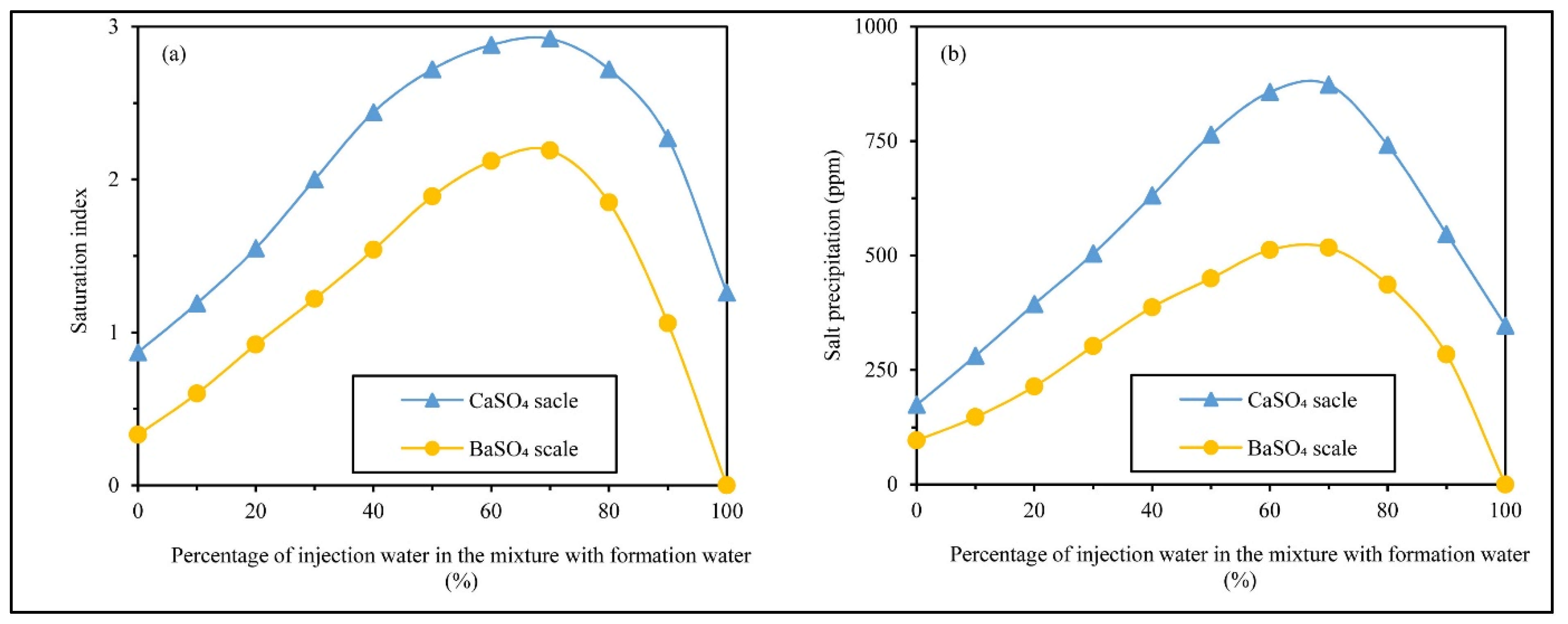
Khormali et al. demonstrated (Figure 3) that water incompatibility between formation water and injection water is the primary driving force for sulfate scale formation during waterflooding operations [69]. Using thermodynamic scale prediction software, they evaluated the effect of different mixing ratios on the saturation index and precipitation of calcium sulfate and barium sulfate under reservoir conditions. Both the saturation index (Figure 3a) and the amount of precipitated scale (Figure 3b) increased with increasing injection water fraction, reaching maximum values at a 70:30 injection water to formation water ratio, before declining at higher injection water contents. These findings indicate that sulfate scale formation is highly dependent on the mixing ratio of incompatible waters, emphasizing the importance of compatibility assessment prior to water injection.
Sulfate crystals typically exhibit compact structures with excellent mechanical strength and strong adhesion to steel surfaces. These properties make sulfate scales significantly more difficult to remove than carbonate deposits. Conventional mineral acids are generally ineffective for dissolving barite or celestite, requiring specialized chelating agents or proprietary dissolution formulations. Consequently, prevention through effective scale inhibition is considered the most economical strategy for sulfate scale control, particularly in offshore and subsea production systems where mechanical intervention is extremely costly [70,71].

2.2.3. Sulfide Scales

Metal sulfide scales constitute another important class of mineral deposits encountered in oilfield production systems, particularly in sour reservoirs containing hydrogen sulfide (H2S) or in fields affected by sulfate-reducing bacteria (SRB). The most common sulfide minerals include iron sulfide (FeS), pyrite (FeS2), pyrrhotite (Fe1−xS), mackinawite (FeS), greigite (Fe3S4), galena (PbS), and zinc sulfide (ZnS), although iron sulfide phases account for the vast majority of sulfide scale deposits encountered during petroleum production [61].
Iron sulfide formation is closely associated with corrosion processes. Iron released from carbon steel equipment reacts readily with dissolved sulfide ions generated either from naturally occurring hydrogen sulfide or through the metabolic activity of sulfate-reducing microorganisms [61]. The simplified precipitation reaction can be expressed as:
Fe2+ + S2− → FeS(s)
Unlike carbonate and sulfate scales, sulfide deposits are often directly linked to corrosion, resulting in simultaneous deterioration of equipment integrity and flow assurance. Iron sulfide scales are electrically conductive and may promote localized corrosion, under-deposit corrosion, and pitting, thereby increasing the risk of equipment failure. Their dark color and layered morphology frequently distinguish them from carbonate and sulfate deposits during field inspections [65,72].
The mineralogy of iron sulfides is highly dependent on temperature, pH, redox potential, and exposure time. Mackinawite generally forms as the initial metastable phase before gradually transforming into more stable minerals such as pyrite or pyrrhotite. This continuous mineral transformation influences deposit hardness, adhesion, and chemical stability, complicating removal procedures. Effective management therefore often requires a combination of corrosion inhibitors, biocides, sulfide scavengers, and scale inhibitors rather than relying on a single treatment method [73].

2.2.4. Silica and Silicate Scales

Silica and silicate scales are less common than carbonate or sulfate deposits but present considerable operational challenges because of their exceptional hardness and chemical resistance. These scales typically occur in geothermal systems, steam-assisted oil recovery operations, high-temperature reservoirs, and fields producing silica-rich formation water. The principal mineral phases include amorphous silica (SiO2·nH2O), quartz (SiO2), cristobalite, tridymite, and various metal silicates containing calcium, magnesium, aluminum, or iron [74].
Silica precipitation is fundamentally different from carbonate and sulfate crystallization. Instead of simple ionic precipitation, dissolved monosilicic acid undergoes polymerization reactions that gradually produce colloidal silica particles and eventually form solid deposits. The process is strongly influenced by temperature, pH, dissolved salts, evaporation, and residence time. Cooling of silica-rich water during production frequently reduces silica solubility, promoting polymerization and subsequent deposition [75].
Silica scales are particularly problematic because they exhibit extremely low solubility over a broad range of operating conditions. Conventional mineral acids, including hydrochloric acid, are generally ineffective for their removal. Mechanical cleaning is often difficult because silica deposits possess high hardness and strong adhesion to metal surfaces. Consequently, prevention through careful control of production conditions and optimized inhibitor selection remains the preferred strategy for silica scale management.

2.2.5. Iron Oxide and Mixed Scales

Iron oxide and mixed mineral scales commonly develop in aging production facilities where corrosion products interact with naturally occurring mineral precipitates. Typical iron oxides include hematite (Fe2O3), magnetite (Fe3O4), goethite (FeOOH), and lepidocrocite (γ-FeOOH). These compounds originate primarily from electrochemical corrosion of steel equipment and may subsequently become incorporated into carbonate, sulfate, or sulfide deposits [76,77].
Mixed scales frequently consist of multiple mineral phases deposited simultaneously or sequentially under changing production conditions. For example, a carbonate scale layer may initially form on pipe surfaces and subsequently become coated with iron sulfide generated through corrosion reactions. Likewise, corrosion products often serve as heterogeneous nucleation sites that accelerate precipitation of calcium carbonate or barium sulfate. Such composite deposits exhibit greater structural complexity than single-phase scales and often require multiple analytical techniques for accurate characterization [47,57].
The coexistence of corrosion products and mineral scales creates important operational challenges. Mixed deposits generally possess higher mechanical strength, lower porosity, and stronger adhesion than individual mineral phases. Moreover, their heterogeneous composition complicates chemical dissolution because reagents effective against one mineral may have little effect on another. Consequently, integrated treatment programs combining corrosion control, microbiological management, and scale inhibition are frequently required to achieve satisfactory long-term performance [43,74,78].

2.2.6. Comparative Characteristics of Oilfield Scales

The various categories of oilfield scales exhibit substantial differences in precipitation behavior, crystal structure, chemical stability, and ease of removal. Carbonate scales generally precipitate rapidly following pressure reduction or carbon dioxide degassing and can usually be dissolved effectively using hydrochloric acid. In contrast, sulfate scales exhibit much lower solubility, exceptional chemical stability, and greater resistance to conventional acid treatments, making prevention considerably more economical than remediation [57].
Sulfide scales differ from carbonate and sulfate deposits because their formation is closely associated with corrosion processes and microbial activity. Their occurrence therefore often indicates underlying integrity issues in addition to flow assurance problems. Silica scales represent another unique category because their precipitation involves polymerization reactions rather than simple ionic crystallization, resulting in extremely hard deposits that are resistant to both mechanical and chemical removal [79].
Accurate identification of scale mineralogy is therefore essential for successful scale management. Modern characterization techniques, including X-ray diffraction (XRD), scanning electron microscopy (SEM), energy-dispersive X-ray spectroscopy (EDS), Fourier-transform infrared spectroscopy (FTIR), Raman spectroscopy, X-ray photoelectron spectroscopy (XPS), and thermogravimetric analysis (TGA), are routinely employed to determine mineral composition, crystal morphology, elemental distribution, and structural properties. These analytical methods not only facilitate selection of appropriate remediation strategies but also provide valuable insight into precipitation mechanisms and inhibitor performance [80].
A detailed understanding of the mineralogical diversity of oilfield scales forms the foundation for predictive modeling and inhibitor development. Since each mineral responds differently to variations in temperature, pressure, fluid composition, and chemical treatment, scale control strategies must be specifically tailored to the dominant scaling species and the operating conditions of individual reservoirs. The following section examines the mechanisms governing nucleation, crystal growth, and deposition, together with the operational parameters that control scale formation in petroleum production systems [54,81].
The comparison tables summarize the principal inorganic scales encountered in oilfield production systems and highlight the major differences in their formation mechanisms, physicochemical characteristics, operational impacts, and mitigation strategies. Table 2 presents the most common scale types, including carbonate, sulfate, silica, iron-containing, phosphate, and mixed mineral scales, together with their chemical formulas, primary sources of ions, typical formation conditions, common locations within production facilities, relative solubility, removal difficulty, and preferred prevention methods. The table illustrates that sulfate scales such as barium sulfate (BaSO4) and strontium sulfate (SrSO4) are among the most problematic deposits because of their extremely low solubility and high resistance to chemical removal, whereas carbonate scales are generally easier to dissolve using acid treatments.

2.3. Factors Affecting Scale Formation

2.3.1. Physicochemical Factors Governing Scale Formation

Mineral scale formation in oilfield production systems is fundamentally governed by a series of interconnected physicochemical processes that determine the stability of dissolved ions and their tendency to precipitate as solid crystalline phases. The precipitation of sparingly soluble salts occurs when changes in thermodynamic equilibrium and reaction kinetics create conditions favorable for nucleation and crystal growth. These processes are influenced by several intrinsic variables, including supersaturation, solubility, temperature, pressure, pH, ionic strength, salinity, dissolved gases, and water chemistry. Understanding the influence of these physicochemical parameters is essential for accurately predicting scaling tendency, designing effective mitigation strategies, and optimizing production operations [37,82,83].
The primary driving force for scale formation is supersaturation, which occurs when the concentration of dissolved ions exceeds their equilibrium solubility under specific environmental conditions. Supersaturation is commonly evaluated using the ionic activity product and the solubility product constant. When the ionic activity product is lower than the solubility product, the solution remains undersaturated and mineral precipitation is thermodynamically unfavorable [35,68]. At equilibrium, the ionic activity product equals the solubility product, whereas supersaturation develops when the ionic activity product exceeds the equilibrium constant. Under these conditions, dissolved ions become thermodynamically unstable and tend to precipitate through nucleation and subsequent crystal growth. The degree of supersaturation directly determines the likelihood and rate of mineral precipitation, making it one of the most important indicators used in scale prediction models [33].
Temperature exerts a profound influence on scale formation because it simultaneously affects mineral solubility, reaction kinetics, diffusion coefficients, and crystal growth rates. However, its effect differs among mineral systems. The solubility of calcium carbonate generally decreases with increasing temperature, making carbonate precipitation more likely in high-temperature reservoirs and production equipment. In contrast, the solubility behavior of calcium sulfate depends on the specific hydrate phase and operating conditions, while silica exhibits complex temperature-dependent polymerization reactions [84]. Elevated temperatures also accelerate molecular diffusion and chemical reaction rates, reducing induction time for nucleation and promoting faster crystal growth. Consequently, high-temperature production environments frequently experience more rapid scale deposition than low-temperature systems, particularly when combined with pressure depletion and changes in fluid composition [85,86].
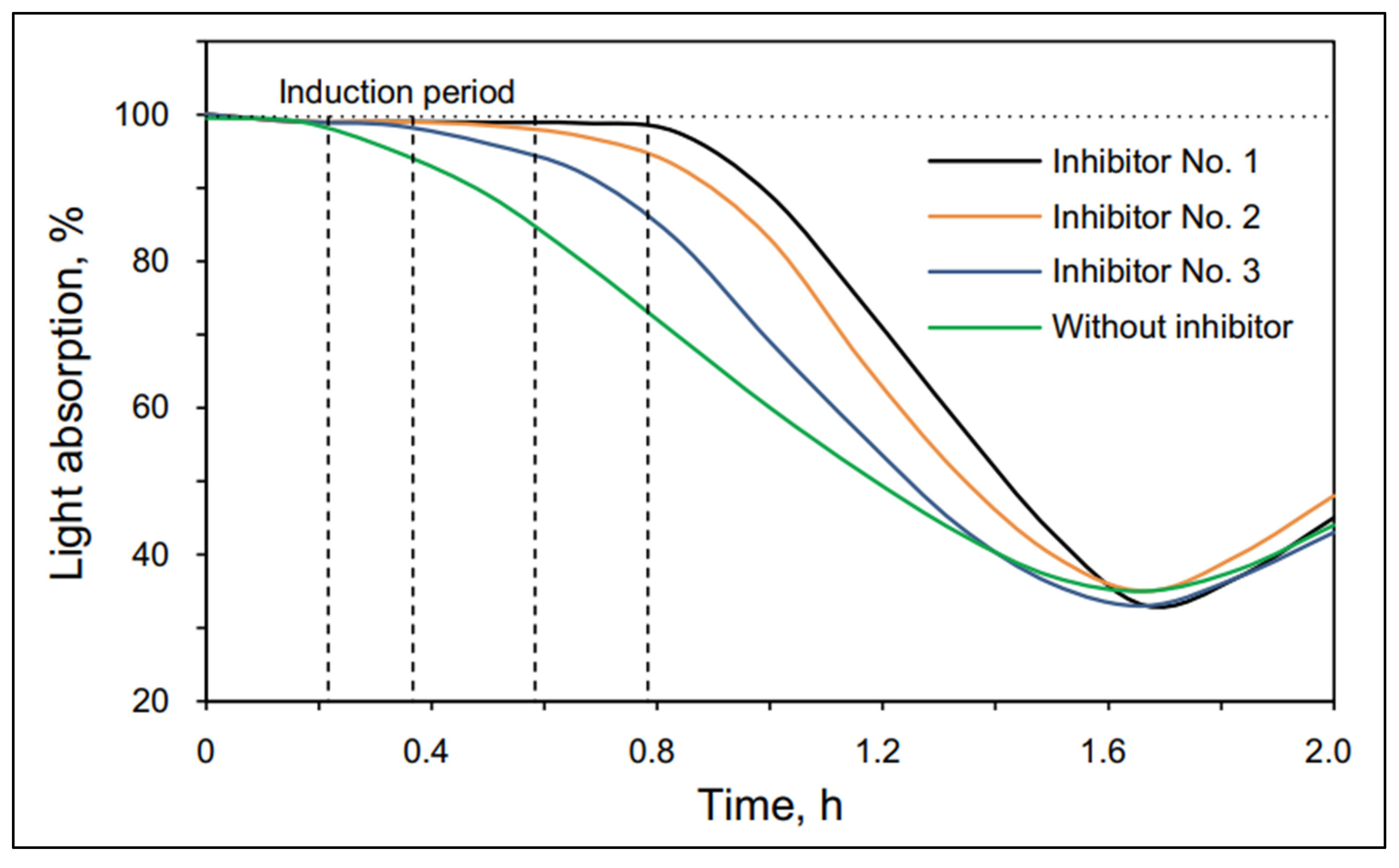
Khormali and Petrakov (Figure 4) employed a light transmittance technique to investigate the effect of scale inhibitors on the induction time of calcium carbonate crystallization under supersaturated conditions [80]. The induction time, defined as the interval between the start of the experiment and the onset of scale precipitation, was determined from changes in light transmittance. In the absence of precipitation, light transmission remained constant, whereas crystal formation caused a progressive decrease in transmittance. The results demonstrated that the presence of scale inhibitors significantly prolonged the induction time, delaying nucleation and crystal growth. Among the evaluated formulations, Inhibitor No. 1 exhibited the longest induction period, indicating the highest inhibition performance.
Pressure is another critical parameter controlling mineral precipitation, especially for carbonate scales. During reservoir production, fluids experience continuous pressure reduction as they flow toward the surface. The decrease in pressure lowers the solubility of dissolved gases, particularly carbon dioxide, causing gas liberation from the aqueous phase. Carbon dioxide degassing shifts the carbonate equilibrium toward increased carbonate ion concentration while simultaneously increasing solution pH [60,87]. This sequence of reactions significantly enhances calcium carbonate supersaturation and promotes rapid precipitation in production tubing, wellbores, chokes, and separators. Sulfate scales are generally less sensitive to pressure changes because their precipitation is governed primarily by ionic composition rather than gas equilibrium, although pressure indirectly influences their formation through changes in fluid properties and transport behavior [60].
Solution pH strongly affects the speciation of dissolved ions and therefore plays a major role in determining scaling tendency. Carbonate systems are particularly sensitive because bicarbonate and carbonate ions exist in dynamic equilibrium with dissolved carbon dioxide. As pH increases, bicarbonate ions are progressively converted into carbonate ions, increasing the probability of calcium carbonate precipitation. Similarly, elevated pH promotes the precipitation of magnesium hydroxide and certain phosphate minerals. Silica polymerization is likewise influenced by pH, with alkaline conditions generally accelerating condensation reactions and the formation of insoluble silica deposits. Therefore, even relatively small changes in pH may substantially alter mineral stability and precipitation behavior in production systems [88,89].
Salinity and ionic strength further influence scale formation by modifying ion activities and electrostatic interactions in aqueous solutions. Oilfield formation waters commonly contain extremely high concentrations of dissolved salts, making ideal-solution assumptions inappropriate. Under such conditions, activity coefficients differ significantly from unity, requiring the use of advanced thermodynamic models to describe mineral equilibrium accurately. Increasing salinity generally enhances the probability of scale formation by increasing the concentration of scale-forming ions and modifying their effective activities. However, highly concentrated electrolytes may also produce complex ion-pairing phenomena that alter mineral solubility. Consequently, accurate prediction of scaling in hypersaline reservoirs requires consideration of both ion concentration and ionic activity rather than concentration alone [90,91].
The chemical composition of formation water and injected water represents another fundamental factor controlling mineral precipitation. Oilfield brines contain varying concentrations of calcium, barium, strontium, magnesium, sulfate, bicarbonate, carbonate, chloride, silica, and iron ions depending on reservoir geology and production history. Variations in these ion concentrations directly influence supersaturation and determine the dominant scale mineral likely to precipitate. Water composition also affects competing chemical equilibria, complexation reactions, and adsorption processes that collectively govern nucleation and crystal growth. As summarized in Table 3, elevated concentrations of calcium favor both carbonate and sulfate scale formation, whereas high concentrations of barium or strontium substantially increase the likelihood of barite and celestite precipitation, respectively. Table 3 provides a comparative evaluation of the major scale categories with respect to pressure sensitivity, temperature sensitivity, pH dependence, response to seawater injection, crystal hardness, acid solubility, ease of removal, and overall risk to production. The comparison demonstrates that carbonate scales are strongly influenced by pressure depletion and CO2 degassing, sulfate scales are primarily associated with the mixing of incompatible waters, silica scales exhibit exceptionally high hardness and removal difficulty, and iron scales are closely linked to corrosion and sour production environments. Overall, the tables emphasize that effective scale management requires scale-specific treatment strategies based on the dominant mineralogy, reservoir conditions, water chemistry, and production operations.
Dissolved gases play an equally important role in scale formation. Carbon dioxide is the most influential gas because it controls carbonate equilibrium through the formation of carbonic acid, bicarbonate, and carbonate ions. Pressure depletion during production reduces carbon dioxide solubility, causing degassing and increasing carbonate supersaturation. Hydrogen sulfide may also influence mineral precipitation through reactions with dissolved iron, producing highly insoluble iron sulfide deposits that frequently coexist with corrosion products in sour production environments. Oxygen ingress during water handling operations may further promote corrosion, indirectly increasing iron concentrations available for precipitation [92,93].
Heterogeneous impurities and solid surfaces are also important factors governing the nucleation and subsequent growth of mineral scales. In contrast to homogeneous nucleation, which occurs spontaneously within the bulk aqueous phase, heterogeneous nucleation takes place preferentially on pre-existing solid surfaces that reduce the interfacial energy and the activation barrier required for formation of a stable nucleus. In oilfield production systems, potential heterogeneous nucleation sites include formation-rock minerals such as calcite, dolomite, quartz, and clay minerals; suspended sand and formation fines; corrosion products such as iron oxides, iron sulfides, and iron carbonates; and previously deposited scale crystals. The nature and mineralogical composition of these impurities are particularly important because their surface chemistry, surface charge, wettability, roughness, crystallographic structure, and chemical compatibility with the precipitating phase determine their ability to act as nucleation substrates. For example, surfaces with favorable chemical or structural compatibility with a precipitating mineral can facilitate ion adsorption and the formation of stable critical nuclei, thereby promoting scale deposition at lower supersaturation levels. The concentration and available surface area of heterogeneous impurities can also substantially influence scale formation kinetics. Increasing the concentration of suspended particles or the number of available solid surfaces generally increases the number of potential nucleation sites and can shorten the induction period by providing more favorable locations for crystal formation. However, the effect is not necessarily proportional to impurity concentration because nucleation efficiency depends on the physicochemical characteristics of the surfaces rather than simply their abundance. Very fine particles may provide a large specific surface area and consequently a high density of nucleation sites, whereas chemically inert or poorly compatible particles may have a limited effect even at relatively high concentrations. In addition, deposited scale and corrosion products can act as self-nucleation substrates, allowing newly formed crystals to grow preferentially on existing deposits and thereby accelerating scale accumulation. Therefore, heterogeneous impurities should be considered together with supersaturation, temperature, pH, ionic strength, and water composition when evaluating the kinetics and location of scale formation in oilfield systems [94].
The kinetics of nucleation and crystal growth determine whether thermodynamically favorable precipitation actually occurs. Even highly supersaturated solutions may remain metastable for extended periods before crystal nuclei form. Once stable nuclei are generated, crystal growth proceeds through diffusion of dissolved ions toward crystal surfaces and their incorporation into the crystal lattice. The induction period, nucleation rate, and crystal growth rate are therefore influenced by supersaturation, temperature, solution chemistry, and interfacial energy. The kinetics of nucleation and crystal growth determine whether thermodynamically favorable precipitation actually occurs. Even highly supersaturated solutions may remain metastable for extended periods before stable crystal nuclei form. Nucleation may occur homogeneously within the bulk solution or heterogeneously on pre-existing solid surfaces. Once stable nuclei are generated, crystal growth proceeds through diffusion of dissolved ions toward crystal surfaces and their incorporation into the crystal lattice. The induction period, nucleation rate, and crystal growth rate are therefore influenced by supersaturation, temperature, solution chemistry, interfacial energy, and the availability of suitable nucleation surfaces. Higher supersaturation generally shortens the induction period and accelerates precipitation, whereas suitable heterogeneous surfaces can further reduce the energetic barrier for nucleation and promote crystal formation at lower supersaturation levels. Conversely, some impurities may interfere with crystal growth or block active nucleation sites, depending on their surface chemistry and interaction with the precipitating mineral. Chemical scale inhibitors can also modify these processes by adsorbing onto active crystal or substrate surfaces, interfering with ion attachment, and increasing the effective barrier to nucleation and crystal growth [52,95].
Overall, scale formation results from the combined influence of multiple physicochemical factors rather than any single variable acting independently. Temperature, pressure, pH, salinity, dissolved gases, ionic composition, and supersaturation interact continuously throughout petroleum production, creating highly dynamic chemical environments in which mineral precipitation may occur rapidly. As illustrated in Table 3, the relative importance of these parameters varies among different scale types, emphasizing the need for mineral-specific prediction models and integrated scale management strategies. A comprehensive understanding of these governing physicochemical processes forms the foundation for developing accurate thermodynamic models, selecting appropriate inhibitors, and designing effective production practices that minimize scale-related damage and maximize hydrocarbon recovery [51,96,97].

2.3.2. Operational and Reservoir Factors Influencing Scale Formation

It is important to distinguish operational and reservoir factors from the intrinsic physicochemical parameters discussed in Section 2.3.1, although the two groups are strongly coupled in actual oilfield systems. In this review, physicochemical factors refer to the fundamental chemical and thermodynamic variables that directly control mineral stability and precipitation, such as supersaturation, solubility, temperature, pressure, pH, ionic strength, salinity, and ionic composition. Operational and reservoir factors, in contrast, describe field practices and geological characteristics that modify the magnitude, spatial distribution, or temporal evolution of these physicochemical conditions. For example, temperature is fundamentally a physicochemical parameter because it influences solubility and crystallization kinetics; however, changes in temperature caused by reservoir depth, fluid production, heat transfer, or surface processing represent operational or reservoir effects. Similarly, water-mixing ratio is thermodynamically important because it determines the resulting ionic composition and supersaturation, but the injection strategy, water breakthrough, and contact between injection and formation waters are operational processes that create the mixing conditions. Therefore, the present subsection emphasizes how field operations and reservoir characteristics modify the physicochemical scaling environment rather than repeating the underlying precipitation mechanisms described previously.
In addition to the intrinsic physicochemical parameters governing mineral precipitation, several operational and reservoir-related factors significantly influence the occurrence, severity, and distribution of scale deposition throughout oilfield production systems. Unlike laboratory environments, petroleum reservoirs are highly dynamic systems in which fluid composition, production conditions, reservoir characteristics, and operational practices continuously evolve over time. These changes alter thermodynamic equilibrium, transport phenomena, and crystallization kinetics, making scale prediction considerably more complex. Therefore, understanding the influence of operational and reservoir parameters is essential for designing effective scale management strategies and maintaining long-term production performance [98,99].
Among operational practices, injection of chemically incompatible water represents one of the most important mechanisms initiating scale formation during waterflooding and pressure-maintenance operations. Seawater, treated injection water, or other injected brines may come into contact with formation water containing substantially different concentrations of scale-forming ions. The operational introduction and movement of these fluids determine where and when mixing occurs within the reservoir, near-wellbore region, and production system. The resulting change in ionic composition and supersaturation is the physicochemical consequence of this operational process and was discussed in Section 2.3.1. In practice, the severity and location of scaling depend on the injection strategy, water breakthrough, residence time, flow distribution, and reservoir heterogeneity. Thus, incompatible-water injection should be considered an operational trigger that modifies the local chemical environment and creates conditions favorable for sulfate or carbonate precipitation. This distinction is particularly important for waterflooding because scale risk can change spatially and temporally as the injected-water front propagates through the reservoir [99,100].
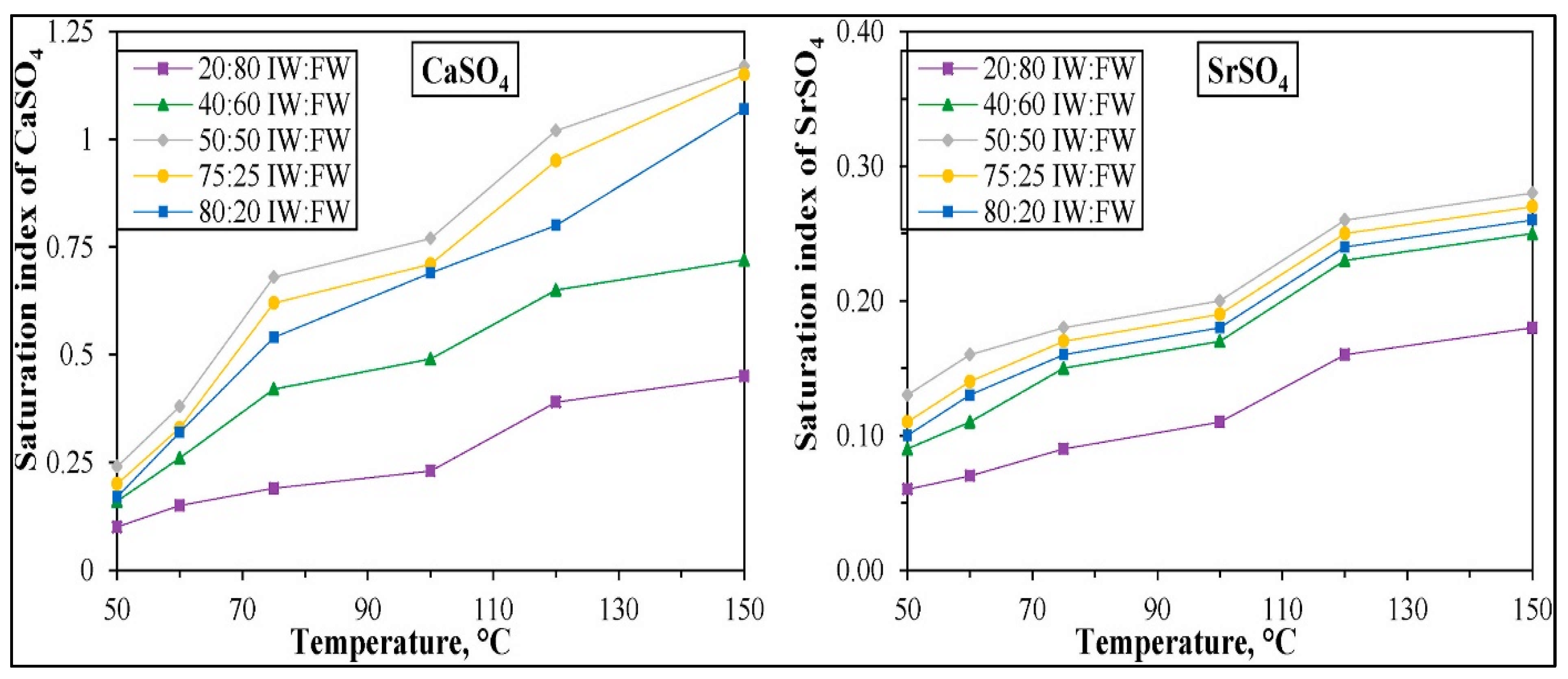
The prediction results by Khormali et al., shown in Figure 5, demonstrate that the formation of simultaneous calcium sulfate (CaSO4) and strontium sulfate (SrSO4) scales is strongly influenced by the mixing ratio of incompatible formation water (FW) and injection water (IW), as well as reservoir temperature and pressure [47]. Scale precipitation occurred under all investigated conditions because the saturation index remained positive, indicating supersaturation. The amount of precipitated scale increased with increasing temperature and reached its maximum at a 50:50 mixing ratio of formation and injection waters, representing the most severe incompatibility condition. This finding highlights that water incompatibility is a primary driving force for sulfate scale formation and should be carefully evaluated during waterflooding design and scale management planning.
Zojaji et al. investigated scale formation resulting from the incompatibility of seawater and formation water during waterflooding in carbonate reservoirs [101]. Using PHREEQC geochemical modeling, static precipitation experiments, ICP-OES elemental analysis, and coreflooding tests, they demonstrated that the type and quantity of inorganic scales are primarily governed by the ionic composition of the mixed waters. The study showed that mixing sulfate-rich seawater with calcium-rich formation water promoted substantial mineral precipitation, leading to permeability reduction and formation damage. PHREEQC accurately predicted the dominant scale types and precipitation trends, with only a slight overestimation compared with experimental observations, confirming its applicability for assessing scaling risks associated with incompatible water injection.
Water injection practices also exert a substantial influence on scale formation. Conventional seawater injection, produced-water reinjection, low-salinity waterflooding, and chemical enhanced oil recovery operations modify reservoir geochemistry and fluid flow patterns. Produced-water reinjection may recycle dissolved scale-forming ions, while low-salinity flooding alters ion exchange reactions between reservoir rock and injected water, potentially affecting mineral stability. Similarly, alkaline, polymer, and surfactant flooding processes may increase solution pH or modify ionic composition, thereby changing the precipitation behavior of carbonate and hydroxide minerals. These operational changes demonstrate that enhanced recovery techniques should always be evaluated together with comprehensive scale prediction studies to minimize formation damage and maintain production efficiency [102,103].
HPHT conditions provide an important example of the interaction between operational and physicochemical controls. Rather than representing an independent precipitation mechanism, HPHT conditions define an operating environment in which the physicochemical parameters discussed in Section 2.3.1 may change substantially. High temperature can alter mineral solubility and accelerate crystallization kinetics, while pressure variations during production can modify fluid properties and, particularly for carbonate systems, dissolved-gas equilibria. In addition, temperature and pressure may vary along the flow path from the reservoir to the wellbore and surface facilities, producing localized changes in scaling tendency. Therefore, HPHT conditions should be evaluated as a coupled reservoir and operating scenario rather than as a separate physicochemical mechanism. Accurate scale prediction under such conditions requires integration of thermodynamic calculations with reservoir temperature and pressure profiles and actual production conditions.
Reservoir heterogeneity represents another critical factor controlling scale deposition. Petroleum reservoirs exhibit significant spatial variations in porosity, permeability, mineral composition, fracture distribution, and fluid saturation. These heterogeneities influence fluid movement, mixing efficiency, residence time, and local chemical equilibrium, resulting in non-uniform scale distribution. High-permeability zones generally experience greater fluid flux and increased water mixing, whereas low-permeability regions may retain supersaturated fluids for longer periods, allowing gradual crystal growth. Natural fractures and fault systems further complicate scale prediction by creating preferential flow pathways that enhance chemical interaction between injected and formation waters. Consequently, scale deposition frequently occurs as localized rather than uniformly distributed mineral accumulations [104,105].
Production rate has a direct impact on scale formation by controlling fluid residence time, pressure depletion, and transport of dissolved ions. High production rates accelerate pressure decline around the wellbore, increasing carbon dioxide degassing and promoting calcium carbonate precipitation. Rapid fluid movement also enhances convective transport of ions toward crystal surfaces, potentially increasing crystal growth rates. Conversely, very high flow velocities may reduce crystal attachment to equipment surfaces by increasing shear stress, thereby limiting deposit accumulation despite continued precipitation. At lower production rates, longer residence times allow supersaturated solutions to remain in contact with solid surfaces for extended periods, facilitating crystal growth and deposition. Therefore, production rate influences both precipitation kinetics and deposition behavior [106,107].
Hydrodynamic conditions, including flow velocity, turbulence, and shear stress, play a significant role in determining where mineral deposits accumulate. Under laminar flow conditions, diffusion dominates ion transport toward crystal surfaces, favoring gradual deposition on pipe walls and equipment surfaces. Turbulent flow increases mass transfer rates and accelerates crystal growth by supplying fresh ions to growing crystals. However, excessive turbulence may also remove weakly attached crystals from surfaces, reducing deposit thickness while increasing suspended particle concentration. The balance between deposition and particle removal therefore depends on local hydrodynamic conditions, pipeline geometry, and crystal adhesion strength.
Residence time is another important operational parameter affecting scale formation. Longer residence times allow dissolved ions to remain under supersaturated conditions for extended periods, increasing the probability of nucleation and crystal growth. This effect is particularly important in separators, storage tanks, dead legs, and low-flow sections of pipelines where fluid movement is relatively slow. In contrast, rapid transit through production tubing may reduce the time available for precipitation, although scale may subsequently form in downstream equipment where flow conditions become more favorable [83,106].
The mineralogical composition of reservoir rocks also influences scaling behavior through rock–fluid interactions. Carbonate reservoirs may release additional calcium ions during acid stimulation or natural mineral dissolution, thereby increasing carbonate supersaturation. Sandstone reservoirs containing clay minerals may undergo ion exchange reactions that modify produced-water composition. Furthermore, dissolution of reservoir minerals during production can introduce trace metals and additional scale-forming ions into produced fluids. These geochemical interactions continuously alter water chemistry throughout the production life of the reservoir, emphasizing the importance of integrating reservoir mineralogy into scale prediction models [103,108,109].
Well completion design and production equipment configuration further affect the location and severity of scale deposition. Pressure drops across perforations, safety valves, chokes, pumps, and production tubing create localized changes in temperature, pressure, and fluid velocity that frequently initiate mineral precipitation. Electric submersible pumps (ESPs), gas lift valves, and downhole safety valves are particularly susceptible because rapid pressure fluctuations and turbulent flow enhance carbonate supersaturation and crystal deposition. Surface facilities, including separators, heat exchangers, and pipelines, are similarly vulnerable due to cooling, gas separation, and changes in fluid chemistry during processing [1,88].
Time-dependent changes in reservoir conditions represent another challenge for scale prediction. As reservoirs mature, increasing water cut, declining reservoir pressure, changing production rates, and progressive seawater breakthrough continuously modify produced-water composition and scaling tendency. Consequently, scale risk is not constant throughout field life but evolves as reservoir depletion progresses. Periodic updating of geochemical models using current production data is therefore necessary to maintain reliable predictions and optimize inhibitor treatment strategies [109,110].
It is important to recognize that operational factors rarely act independently. Instead, scale formation typically results from the interaction of multiple variables operating simultaneously. For example, seawater injection may alter water chemistry, while pressure depletion promotes carbon dioxide degassing and increasing temperature accelerates crystallization kinetics. Reservoir heterogeneity then determines where incompatible fluids mix, and hydrodynamic conditions control the final location of deposit accumulation. Because these variables are strongly coupled, accurate prediction of field-scale scaling requires integrated approaches combining laboratory experiments, thermodynamic calculations, reactive transport simulation, reservoir modeling, and continuous field monitoring [80].
Overall, operational practices and reservoir characteristics play a decisive role in determining the occurrence and severity of mineral scale deposition in petroleum production systems. Water injection strategy, reservoir heterogeneity, production rate, hydrodynamic conditions, residence time, well completion design, and long-term reservoir evolution all influence scaling behavior in conjunction with the physicochemical parameters discussed in the previous subsection. Their complex interactions highlight the limitations of simple equilibrium calculations and underscore the need for multidisciplinary scale management strategies that integrate geochemistry, reservoir engineering, computational modeling, and real-time production data to ensure sustained hydrocarbon production and minimize flow assurance problems [87,103,111].
The understanding of oilfield scale formation provides the fundamental basis for the selection and design of appropriate scale inhibitor technologies. As discussed throughout this section, the mixing of incompatible injection and formation waters can substantially alter ionic equilibria and increase supersaturation, thereby promoting precipitation of carbonate and sulfate minerals. The resulting scaling tendency is further controlled by temperature, pressure, pH, ionic strength, water composition, flow conditions, and the specific mineral phase involved. These factors determine not only the amount and rate of precipitation but also crystal morphology, surface deposition, and the severity and location of formation damage. Consequently, effective scale control requires inhibitor characteristics that are compatible with the prevailing scaling environment. Highly supersaturated systems may require inhibitors with strong threshold inhibition and crystal-growth control, whereas long-term near-wellbore protection requires sufficient adsorption and retention within the porous medium. Similarly, differences in the crystallization behavior of CaCO3, CaSO4, BaSO4, SrSO4, and silica necessitate different interactions between inhibitor functional groups and mineral surfaces or dissolved ions. These requirements directly influence inhibitor molecular design, including the selection of phosphonate, polymeric, or hybrid structures, functional-group density, molecular mass, adsorption affinity, and resistance to high temperature and salinity. Therefore, the scale formation mechanisms and risk factors established in Section 2 provide the scientific foundation for understanding the inhibitor technologies, inhibition mechanisms, molecular characteristics, and application strategies discussed in Section 3.

3. Scale Inhibitor Technologies

The selection of an appropriate scale inhibitor is closely related to the type, severity, and physicochemical conditions of scale formation. The preceding section demonstrated that incompatible-water mixing, supersaturation, temperature, pressure, pH, ionic composition, and flow conditions govern the precipitation tendency, kinetics, and deposition behavior of oilfield scales. These factors consequently define the performance requirements of scale inhibitors and determine the most appropriate inhibition mechanisms and chemical structures. Depending on the scaling environment, an effective inhibitor may need to suppress nucleation, retard crystal growth, modify crystal morphology, complex scale-forming ions, or provide sustained adsorption and release from reservoir rock surfaces. Accordingly, the molecular structure of the inhibitor plays a central role in determining its performance under oilfield conditions. Phosphonate-based, polymeric, and hybrid inhibitors contain different functional groups and exhibit different levels of threshold inhibition, surface adsorption, thermal stability, and tolerance to high salinity. This section therefore reviews the major scale inhibitor technologies in relation to the scale formation mechanisms and operating conditions identified in Section 2, with particular emphasis on inhibitor chemistry, molecular structure, inhibition mechanisms, adsorption behavior, and field applicability.

3.1. Fundamentals of Scale Inhibition

Scale inhibition is a preventive strategy designed to interfere with the physicochemical processes responsible for mineral nucleation, crystal growth, particle aggregation, and deposition in oilfield production systems. Although scale precipitation is thermodynamically controlled by supersaturation, the location and rate of precipitation are strongly influenced by nucleation kinetics and the availability of solid surfaces. In industrial production systems, mineral precipitation frequently occurs preferentially through heterogeneous nucleation on pre-existing surfaces, including formation-rock minerals, suspended formation fines, corrosion products, previously deposited scale, and other solid impurities. Consequently, an important objective of chemical scale inhibition is to modify or passivate these heterogeneous nucleation sites and prevent the formation and stabilization of scale nuclei on surfaces where deposition can subsequently develop. The effectiveness of a scale inhibitor should therefore not be interpreted solely in terms of its ability to bind dissolved scale-forming ions or interact with growing crystals. A more comprehensive description considers the inhibitor–water–solid interface as a central element of the inhibition process. Inhibitor molecules may adsorb onto active sites of mineral or impurity surfaces, occupy favorable nucleation locations, modify surface charge and interfacial energy, and form an adsorbed layer that reduces the probability of attachment and stabilization of newly formed mineral nuclei. By decreasing the availability or reactivity of heterogeneous nucleation sites, inhibitors can increase the effective nucleation barrier and prolong the induction period, thereby delaying the onset of scale formation. The extent of this effect depends strongly on the chemical nature, surface properties, concentration, and specific mineralogy of the heterogeneous substrates as well as on inhibitor structure and dosage. The interaction between scale inhibitors and heterogeneous nucleation substrates is particularly important because oilfield fluids contain numerous potential solid surfaces. Carbonate formation rocks, silicate and clay minerals, suspended fines, iron-containing corrosion products, and pre-existing scale deposits can provide chemically active sites for mineral nucleation. Their surface charge, surface energy, roughness, wettability, crystallographic characteristics, and chemical composition determine their ability to promote precipitation. An inhibitor capable of preferentially adsorbing onto these sites can isolate or passivate them and thereby suppress heterogeneous nucleation. In this context, inhibitor adsorption should not be regarded solely as a reservoir-retention mechanism; it can also constitute a direct surface-passivation mechanism for controlling scale nucleation. The concentration and specific surface area of heterogeneous impurities can further influence inhibitor performance. A high concentration of suspended particles or a large available solid surface area increases the number of potential nucleation sites and may increase the amount of inhibitor required to achieve adequate surface coverage. Conversely, efficient adsorption of an inhibitor onto highly reactive surfaces may substantially reduce the number of available active sites even at relatively low chemical concentrations. Thus, inhibitor dosage should ideally be evaluated not only relative to the concentration of dissolved scale-forming ions but also in relation to the amount, surface area, and reactivity of potential heterogeneous nucleation substrates. This consideration is particularly relevant for systems containing formation fines, corrosion products, or pre-existing deposits.
In addition to heterogeneous nucleation control, scale inhibitors can operate through interactions with dissolved ions, nascent nuclei, and active crystal-growth sites. Many commercial inhibitors contain phosphonate, phosphinate, carboxylate, sulfonate, hydroxyl, amide, or amino functional groups that can interact with multivalent ions such as Ca2+, Ba2+, Sr2+, Mg2+, and Fe2+/Fe3+. These interactions may modify the activity and availability of scale-forming species, interfere with ion incorporation into developing crystal structures, or alter the interfacial properties of growing mineral phases. Such mechanisms are particularly important in the phenomenon of threshold inhibition, in which very small concentrations of inhibitor can substantially delay precipitation without requiring stoichiometric sequestration of the scaling ions. The distinction between nucleation inhibition and crystal-growth inhibition is therefore important. During the early stages of precipitation, an inhibitor may prevent or delay the formation of stable nuclei by modifying heterogeneous substrates or interacting with incipient clusters. After nuclei have formed, inhibitor adsorption onto active crystal-growth sites may interfere with the attachment and incorporation of additional ions, resulting in reduced growth rates and changes in crystal morphology. Consequently, scale inhibition may involve a sequence of coupled processes rather than a single molecular mechanism: passivation of heterogeneous nucleation sites, modification of interfacial nucleation, inhibition of crystal growth, and stabilization or dispersion of fine precipitated particles. An effective scale inhibitor should possess sufficient chemical stability to operate over the temperature, pressure, salinity, and pH ranges encountered in the target reservoir. High-temperature and high-salinity environments can alter inhibitor speciation, adsorption, solubility, and interactions with scale-forming minerals. Inhibitor performance must therefore be evaluated under realistic brine compositions and operating conditions rather than using simplified laboratory solutions alone. Compatibility with formation water, injection water, corrosion inhibitors, demulsifiers, polymers, surfactants, and other production chemicals is also essential because incompatible components may themselves generate precipitates or reduce inhibitor availability. Adsorption is particularly important in squeeze-treatment applications but has a dual role in scale control. Following placement in the formation, inhibitor molecules may adsorb onto reservoir rock surfaces and subsequently desorb gradually during production, providing sustained inhibitor release. At the same time, adsorption onto mineral or impurity surfaces can modify the availability and reactivity of heterogeneous nucleation sites. The desired adsorption behavior therefore represents a balance between sufficient surface interaction for nucleation-site passivation and controlled desorption for sustained treatment lifetime. Excessively weak adsorption may result in rapid chemical loss, whereas excessively strong adsorption may reduce inhibitor return concentrations below the level required for continued precipitation control [112].
The environmental performance of scale inhibitors has also become an increasingly important consideration. Conventional phosphonate-based inhibitors often provide high technical performance but may exhibit limited biodegradability and environmental persistence. Increasing regulatory requirements for chemical discharge have consequently encouraged the development of biodegradable polymers, naturally derived macromolecules, amino-acid-based compounds, and other environmentally acceptable inhibitors. Importantly, environmentally preferable materials must retain sufficient surface affinity, thermal stability, water compatibility, and inhibition performance under realistic oilfield conditions [48,95].
Economic considerations further influence inhibitor selection and treatment design. Chemical dosage, treatment frequency, squeeze lifetime, compatibility, equipment protection, and environmental compliance must be considered simultaneously. Because inhibitor performance depends on both solution chemistry and the availability of heterogeneous nucleation surfaces, dosage optimization should account for the concentration of scaling ions as well as the mineralogy, surface area, and reactivity of solids present in the production system. Laboratory bottle tests, dynamic flow experiments, coreflood studies, and field monitoring can therefore provide complementary information for determining the minimum effective inhibitor concentration [111,113].
The performance of a scale inhibitor is consequently controlled by the coupled characteristics of the aqueous phase, precipitating mineral, heterogeneous substrate, and inhibitor molecule. Reservoir mineralogy, formation- and injection-water composition, supersaturation, temperature, pressure, pH, ionic strength, flow conditions, residence time, impurity concentration, and surface properties can all modify inhibition efficiency. An inhibitor that performs effectively for calcium carbonate may not provide equivalent protection against barium sulfate or silica because these minerals differ in surface chemistry, nucleation behavior, lattice structure, and affinity for inhibitor functional groups. Therefore, inhibitor selection should be based on the dominant mineral, the characteristics of available heterogeneous nucleation sites, and the specific physicochemical conditions of the production system rather than on inhibitor chemistry alone [89,114].
Recent advances in molecular modeling provide new opportunities to investigate these coupled processes. Molecular dynamics simulations can be used to examine inhibitor adsorption and interfacial organization on mineral surfaces, while density functional theory can provide information on adsorption configurations and interaction energies at specific surface sites. These approaches can help determine whether an inhibitor preferentially occupies reactive heterogeneous nucleation sites, modifies the interfacial environment, or interacts directly with ions and developing crystal surfaces. QSAR and machine-learning approaches can further relate molecular descriptors and surface-interaction characteristics to experimental inhibition performance. Thus, computational approaches can complement experiments by providing molecular-level insight into both surface passivation and solution/crystal interactions [56,94,112,115].
Overall, the fundamental concept of scale inhibition should be viewed as a multistage interfacial and solution-phase process rather than as a single mechanism. Because heterogeneous nucleation provides favorable sites for mineral precipitation in many industrial environments, the ability of an inhibitor to adsorb onto and passivate reactive solid surfaces represents an important component of inhibition performance. This mechanism can operate together with threshold inhibition, ion–inhibitor interactions, crystal-growth inhibition, morphology modification, and particle dispersion. A mechanistically balanced understanding of these processes is essential for rational inhibitor selection and molecular design, particularly under high-salinity, high-temperature, and chemically complex oilfield conditions. The following sections therefore examine the major classes of scale inhibitors and their molecular characteristics in relation to these inhibition mechanisms [116].

3.2. Mechanisms of Scale Inhibition

The molecular mechanism of scale inhibition should be distinguished carefully from mechanistic interpretations that are frequently proposed on the basis of inhibitor molecular structure alone. The presence of phosphonate, carboxylate, sulfonate, amino, hydroxyl, or other functional groups capable of interacting with metal ions does not, by itself, establish that complex formation with dissolved Ca2+, Ba2+, Sr2+, Mg2+, or Fe ions is the controlling mechanism of scale inhibition. In concentrated oilfield brines, numerous competing equilibria, ion pairs, complexes, and changes in activity coefficients can occur simultaneously. Consequently, claims concerning ion–inhibitor complexation should ideally be supported by appropriate equilibrium, speciation, spectroscopic, or other direct experimental evidence obtained under conditions representative of the scaling environment. A similar caution is required when describing inhibitor adsorption onto actively growing crystal surfaces. Although adsorption at mineral interfaces is physically plausible and may contribute to inhibition, the actual location, orientation, surface coverage, and chemical state of an antiscalant on a growing crystal cannot be established solely from its chemical structure or from a reduction in precipitation. Direct evidence, such as surface-sensitive spectroscopy, microscopy coupled with chemical analysis, adsorption measurements, or molecular-scale simulations validated against experimental observations, is required to establish a specific surface-adsorption mechanism. Therefore, the present review distinguishes experimentally demonstrated interfacial effects from mechanisms that remain mechanistic hypotheses for particular inhibitor–mineral systems.
Because heterogeneous nucleation is particularly important in industrial scale formation, modification and passivation of heterogeneous nucleation sites should be considered a central possible pathway of inhibition. Antiscalant molecules may adsorb preferentially onto reactive sites of formation minerals, suspended fines, corrosion products, or pre-existing scale surfaces. Such adsorption can alter the interfacial environment and reduce the probability that scale-forming species will form stable nuclei on these substrates. The effectiveness of this process depends on the mineralogical nature, surface chemistry, available surface area, and concentration of the heterogeneous substrates, as well as on the affinity and surface coverage of the inhibitor. Importantly, the extent of site blocking should be demonstrated experimentally rather than inferred solely from inhibitor structure. The frequently proposed dispersion mechanism based on electrostatic repulsion should likewise be treated cautiously. A decrease in scale-crystal size in the presence of an antiscalant does not necessarily demonstrate electrostatic stabilization of the precipitated particles. Electrostatic stabilization requires sufficiently strong and persistent repulsive interactions between particles, and therefore cannot be established simply from the presence of charged functional groups in an inhibitor. Direct measurements of particle zeta potential under the relevant brine composition, pH, temperature, and inhibitor concentration are necessary before changes in electrostatic stabilization can be invoked as the dominant dispersion mechanism. In highly saline oilfield waters, electrostatic interactions may also be strongly screened by the high ionic strength of the solution. Consequently, the observation of smaller crystals in the presence of an antiscalant may instead result from changes in nucleation rate, crystal-growth kinetics, crystal-face poisoning, surface adsorption, or other interfacial processes. Accordingly, crystal-size reduction should not be equated automatically with electrostatic dispersion. Antiscalants can produce smaller or morphologically different crystals by changing the relative rates of nucleation and crystal growth, blocking or modifying active sites, or interfering with the incorporation of scale-forming species into specific crystal faces. Distinguishing among these mechanisms requires complementary measurements of induction time, precipitation kinetics, crystal morphology, particle-size distribution, surface chemistry, adsorption behavior, and, where an electrostatic mechanism is proposed, zeta potential [117].
The overall mechanism of scale inhibition is therefore best considered as a coupled interfacial and crystallization process rather than being attributed universally to a single molecular interaction. Depending on the inhibitor, mineral, brine composition, and operating conditions, inhibition may involve modification of heterogeneous nucleation sites, changes in interfacial free energy, retardation of crystal growth, alteration of crystal morphology, interactions with dissolved species, or stabilization of fine precipitates. The relative contribution of each mechanism must be evaluated using direct experimental evidence rather than inferred solely from functional-group chemistry or from the observation of reduced scale deposition.

3.2.1. Threshold Inhibition

Threshold inhibition is the defining characteristic of modern scale inhibitors and distinguishes them from conventional stoichiometric precipitation-control chemicals. In this mechanism, inhibitor molecules suppress mineral precipitation even though they are present at concentrations several orders of magnitude lower than those of the dissolved scaling ions. Rather than reacting stoichiometrically with calcium, barium, or strontium ions, inhibitors adsorb selectively onto embryonic crystal nuclei, preventing their development into stable crystals [118].
The effectiveness of threshold inhibition depends strongly on solution supersaturation. At moderate supersaturation levels, inhibitor molecules effectively stabilize prenucleation clusters and delay the formation of critical crystal nuclei. However, extremely high supersaturation may overwhelm inhibitor activity, allowing precipitation to proceed despite chemical treatment. Consequently, accurate prediction of scaling tendency and appropriate inhibitor dosage remain essential for successful field applications [119,120].

3.2.2. Crystal Growth Inhibition

Once mineral embryos or stable crystal nuclei have developed, further scale formation involves the addition and organization of dissolved or interfacial species into the growing mineral phase. Scale inhibitors can substantially reduce the rate of crystal growth, as demonstrated by changes in precipitation kinetics, crystal size, and final mineral morphology. Traditionally, this effect has been attributed to adsorption of inhibitor molecules at energetically favorable growth regions, such as crystal edges, kinks, corners, and surface defects, thereby interfering with the incorporation of scale-forming species into the crystal lattice. This site-blocking mechanism remains an important working hypothesis; however, recent experimental observations indicate that the relationship between inhibitor location and inhibition efficiency is considerably more complex than previously assumed. In particular, fluorescence-tagging techniques have provided direct information about the spatial distribution of antiscalant molecules during their interaction with scale-forming minerals. These observations indicate that inhibitor molecules are not necessarily concentrated at the crystal edges, kinks, or distorted regions traditionally considered the principal growth sites. Moreover, changes in crystal morphology or distortion may occur even when a significant inhibitor signal is not detected at the corresponding region of the crystal surface. Therefore, the occurrence of crystal-growth inhibition cannot be interpreted solely from the assumption that inhibitor molecules physically block individual growth centers. The observed reduction in crystal-growth rate may instead involve multiple simultaneous processes, including modification of interfacial chemistry, perturbation of ion or molecular transport, interaction with precursor species, alteration of surface charge and hydration, stabilization of dispersed mineral particles, and changes in the structure or energetics of the solid–liquid interface. The relative contribution of these mechanisms is expected to depend on inhibitor chemistry, mineral phase, solution composition, temperature, and hydrodynamic conditions.
Consequently, the spatial localization of an inhibitor should not by itself be considered a direct measure of its inhibition efficiency. Combining fluorescence imaging with surface characterization, solution-phase chemical analysis, crystallization kinetics, and molecular-level simulations may provide a more reliable basis for establishing causal relationships between inhibitor–mineral interactions and scale suppression. Future studies should therefore distinguish between experimentally demonstrated effects and mechanistic interpretations based on assumed adsorption at specific crystal-growth sites.

3.2.3. Crystal Lattice Distortion and Morphology Modification

Crystal morphology modification is one of the most frequently observed consequences of scale-inhibitor treatment. Compared with untreated systems, inhibitor-containing solutions can produce crystals with different sizes, shapes, surface textures, aggregation states, and degrees of structural order. For calcium carbonate, for example, changes from well-defined rhombohedral crystals toward irregular, elongated, dendritic, plate-like, or highly dispersed structures have been reported. Similar modifications have been observed for sulfate minerals, including calcium sulfate, barium sulfate, and strontium sulfate. Historically, such morphological changes have often been interpreted as evidence that inhibitor molecules adsorb preferentially onto particular crystal faces, edges, kinks, or defects and consequently modify the local crystal-growth rate. However, recent fluorescence-based investigations provide an important qualification to this interpretation. Fluorescently tagged antiscalants have shown that their actual spatial distribution on mineral surfaces may differ substantially from the locations traditionally assumed to control crystal growth. Furthermore, crystal distortion can occur in regions where no significant inhibitor localization is observed. These findings indicate that morphological modification should not automatically be interpreted as direct evidence of inhibitor occupation of a specific growth site. Instead, crystal distortion may result from changes in local interfacial chemistry, precursor organization, ion transport, surface hydration, particle interactions, or other indirect effects induced by the inhibitor. In some systems, interactions between inhibitors and dissolved scale-forming species may modify the pathway through which the solid phase develops without requiring extensive adsorption onto the final crystal surface. Similarly, interactions with colloidal or nano/micro-scale solid impurities may alter heterogeneous nucleation and subsequent crystal development [25].
Therefore, crystal morphology should be considered an important experimental indicator of altered crystallization behavior, rather than a standalone proof of a specific molecular inhibition mechanism. Reliable mechanistic interpretation requires complementary evidence from fluorescence imaging, microscopy, spectroscopy, surface analysis, solution chemistry, and molecular simulations. In particular, correlating the experimentally observed location of inhibitor molecules with crystal-growth kinetics and structural changes represents an important direction for future scale-inhibition research.

3.2.4. Particle Dispersion

Not all precipitated crystals necessarily form adherent deposits. Many commercial inhibitors also function as dispersants by preventing suspended particles from aggregating into larger clusters. Adsorption of negatively charged inhibitor molecules onto particle surfaces increases electrostatic repulsion between neighboring crystals, thereby reducing agglomeration and sedimentation [41,42].
Polymeric inhibitors are particularly effective dispersants because their long molecular chains generate both electrostatic and steric stabilization. As a result, precipitated particles remain suspended within the flowing fluid and are transported through the production system instead of accumulating on equipment surfaces. This dual functionality significantly enhances the overall effectiveness of many commercial formulations [20,121].

3.2.5. Adsorption Mechanisms

Adsorption governs nearly every aspect of inhibitor performance and is particularly important during squeeze treatments. Inhibitor molecules adsorb onto mineral surfaces, corrosion products, and reservoir rock through electrostatic attraction, hydrogen bonding, van der Waals forces, ligand exchange, and chemical coordination. The strength and reversibility of adsorption determine inhibitor retention within the formation and its gradual release during production [43,122].
Adsorption behavior is influenced by mineralogy, pH, ionic strength, temperature, and competing ions in solution. Carbonate reservoirs generally exhibit different adsorption characteristics from sandstone formations because of differences in surface charge and mineral composition. Understanding these interactions is therefore essential for optimizing squeeze lifetime and designing inhibitors with controlled release characteristics [44].

3.2.6. Synergistic Mechanisms

In practical oilfield applications, no single inhibition mechanism acts independently. A phosphonate inhibitor, for example, may simultaneously complex calcium ions, adsorb onto crystal nuclei, block active growth sites, distort crystal morphology, and disperse suspended particles. Polymeric inhibitors similarly combine threshold inhibition with dispersion and surface adsorption, while hybrid formulations exploit synergistic interactions among multiple functional groups to maximize inhibition efficiency [74,123].
Recent advances in molecular simulation, density functional theory (DFT), molecular dynamics (MD), and machine learning have demonstrated that inhibitor performance depends strongly on molecular geometry, charge distribution, hydration behavior, and adsorption energy. These computational techniques are increasingly being integrated with laboratory experiments to guide the rational design of next-generation inhibitors possessing improved thermal stability, higher adsorption capacity, longer squeeze lifetimes, and superior environmental compatibility [124].
Understanding the molecular mechanisms governing scale inhibition provides the scientific foundation for selecting appropriate inhibitor chemistries and optimizing treatment strategies under diverse reservoir conditions. The following section reviews the major classes of conventional scale inhibitors, their chemical structures, advantages, limitations, and field applications in modern petroleum production systems [125,126].
The integrated mechanisms involve in oilfield scale inhibition, emphasizing the interactions between dissolved ions, inhibitor molecules, and crystal surfaces during the crystallization process. Initially, scale-forming ions such as Ca2+, Ba2+, Sr2+, SO42−, HCO3, and CO32− are uniformly dispersed in the produced or injected water. Variations in temperature, pressure, pH, salinity, and water composition increase the degree of supersaturation, creating favorable conditions for nucleation and crystal growth. In the absence of inhibitors, these ions combine to form stable crystal nuclei that subsequently grow into larger mineral deposits, leading to scale accumulation on reservoir rocks, production tubing, pipelines, and surface processing equipment. The figure demonstrates that scale inhibitors interfere with this process through several complementary mechanisms. One of the primary mechanisms is threshold inhibition, whereby small concentrations of inhibitor molecules delay nucleation even under supersaturated conditions. Inhibitors also adsorb onto active crystal growth sites, blocking the incorporation of scale-forming ions into the crystal lattice and significantly reducing crystal growth rates. Another important mechanism is crystal distortion or lattice modification, in which adsorbed inhibitor molecules alter crystal morphology, producing irregular, fragile crystals with poor adhesion to solid surfaces. In addition, many inhibitors function as dispersants by preventing the aggregation of fine crystals, allowing suspended particles to remain dispersed and be transported by the flowing fluid rather than depositing on equipment surfaces. Certain inhibitors also chelate or complex dissolved metal ions, decreasing the concentration of free calcium, barium, or strontium ions available for precipitation. Overall, the schematic highlights that effective scale inhibition is achieved through the simultaneous action of multiple physicochemical mechanisms rather than a single process. These complementary mechanisms collectively reduce nucleation, suppress crystal growth, minimize surface deposition, and maintain uninterrupted fluid flow, thereby enhancing production efficiency, extending equipment service life, and reducing maintenance and chemical treatment costs in oilfield operations.

3.3. Conventional Scale Inhibitors

Chemical scale inhibitors used in the petroleum industry can be broadly classified into conventional synthetic inhibitors and emerging environmentally friendly formulations. Despite the rapid development of green inhibitor technologies, conventional inhibitors continue to dominate field applications because of their high inhibition efficiency, proven long-term performance, and compatibility with diverse production environments. These products have been extensively optimized through decades of laboratory investigations and field experience, making them the benchmark against which newly developed inhibitors are evaluated. The principal categories include phosphonates, phosphinates, polyphosphates, synthetic polymeric inhibitors, and hybrid formulations containing multiple functional groups [110,127].

3.3.1. Phosphonate-Based Scale Inhibitors

Organophosphonates represent the most widely used class of commercial scale inhibitors in oilfield operations. Their widespread application is primarily attributed to their excellent thermal stability, strong adsorption on crystal surfaces, high inhibition efficiency at low concentrations, and suitability for squeeze treatment applications. The presence of phosphonic acid (-PO3H2) functional groups enables these compounds to interact strongly with multivalent metal ions such as calcium, barium, strontium, magnesium, and iron, thereby suppressing nucleation and crystal growth [45,50].
Common commercial phosphonate inhibitors include aminotris(methylenephosphonic acid) (ATMP), hydroxyethylidenebis(phosphonic acid) (HEDP), diethylenetriaminepentakis(methylenephosphonic acid) (DTPMP), and ethylenediamine tetrakis(methylenephosphonic acid) (EDTMP). These compounds exhibit excellent inhibition performance against calcium carbonate, calcium sulfate, barium sulfate, and strontium sulfate under a broad range of operating conditions. Their effectiveness is largely attributed to strong adsorption on crystal growth sites and their ability to modify crystal morphology while simultaneously delaying nucleation.
Among these compounds, DTPMP is particularly valued in high-temperature reservoirs because of its superior thermal stability and excellent adsorption on sandstone and carbonate formations during squeeze treatments. ATMP, on the other hand, is frequently employed in moderate-temperature operations because of its relatively low cost and broad compatibility with production chemicals. HEDP has found widespread application in industrial water treatment and oilfield operations owing to its excellent calcium tolerance and resistance to hydrolysis [100,128].
Despite their technical advantages, phosphonate inhibitors exhibit several limitations. Their biodegradability is generally poor, and phosphorus-containing compounds may contribute to eutrophication if discharged into aquatic environments. Furthermore, some phosphonates may precipitate with calcium ions under extremely high salinity or elevated pH conditions, reducing inhibition efficiency. These environmental and operational concerns have motivated the development of phosphorus-free alternatives [129].

3.3.2. Polyphosphate Inhibitors

Polyphosphates were among the earliest chemicals employed for industrial scale control. These inorganic polymers inhibit precipitation primarily through sequestration of calcium ions and interference with crystal nucleation. Although polyphosphates demonstrated satisfactory performance in low-temperature industrial water systems, their application in oilfield environments has become increasingly limited [130,131].
The principal disadvantage of polyphosphates is their susceptibility to hydrolysis at elevated temperatures. Hydrolytic degradation converts polyphosphates into orthophosphate species that readily react with calcium ions to form insoluble calcium phosphate deposits. Consequently, their effectiveness decreases significantly under the high-temperature conditions encountered in many petroleum reservoirs. Modern oilfield operations therefore rely predominantly on organophosphonate derivatives rather than conventional inorganic polyphosphates [132].

3.3.3. Polymeric Scale Inhibitors

Synthetic polymeric inhibitors constitute the second major class of commercial oilfield scale inhibitors. Unlike phosphonates, which rely primarily on strong coordination with metal ions, polymeric inhibitors combine threshold inhibition, crystal growth suppression, particle dispersion, and steric stabilization. Their molecular structures generally contain repeating carboxylate, sulfonate, phosphinate, hydroxyl, or amide functional groups distributed along flexible polymer chains [132].
Polyacrylic acid (PAA), polymaleic acid (PMA), polyaspartic acid (PASP), phosphino-polycarboxylic acid (PPCA), acrylic acid–maleic acid copolymers, and acrylic acid–sulfonate copolymers are among the most extensively investigated polymeric inhibitors. These materials exhibit excellent dispersion properties by adsorbing onto suspended crystal particles and preventing agglomeration through electrostatic repulsion and steric hindrance. Consequently, precipitated particles remain suspended within the flowing fluid rather than adhering to production equipment [79,133].
One of the greatest advantages of polymeric inhibitors is the ability to tailor molecular architecture through controlled synthesis. Molecular mass, charge density, chain flexibility, and functional group composition can be optimized according to specific reservoir conditions. High-molecular-mass polymers generally provide superior dispersion, whereas lower-molecular-mass polymers often exhibit better transport and adsorption characteristics during squeeze treatments. Copolymerization further enables simultaneous incorporation of multiple functional groups, allowing inhibition performance to be optimized for complex production environments [134,135].
Compared with conventional phosphonates, polymeric inhibitors frequently demonstrate improved calcium tolerance and reduced precipitation under high-salinity conditions. Nevertheless, some polymers undergo thermal degradation at temperatures exceeding approximately 180 °C, limiting their application in ultra-high-temperature reservoirs. Their adsorption behavior also differs considerably depending on reservoir mineralogy, requiring careful laboratory evaluation before field implementation.

3.3.4. Phosphinate and Phosphino-Polycarboxylic Acid (PPCA) Inhibitors

Phosphinate-containing inhibitors and phosphino-polycarboxylic acids (PPCAs) represent an important advancement in conventional scale inhibitor technology. These compounds combine the excellent metal-binding characteristics of phosphorus-containing functional groups with the superior dispersion properties of polymeric backbones. Consequently, they exhibit high inhibition efficiency against both carbonate and sulfate scales while maintaining good thermal stability and compatibility with a wide range of production chemicals [57,136].
PPCAs generally consist of polycarboxylic acid chains containing phosphinate functional groups distributed along the polymer backbone. This molecular architecture enables simultaneous threshold inhibition, crystal growth suppression, particle dispersion, and adsorption onto mineral surfaces. Compared with traditional phosphonates, PPCAs often demonstrate superior resistance to calcium-induced precipitation and improved performance in high-salinity brines. Their excellent thermal stability has also made them attractive for high-pressure/high-temperature reservoirs where conventional polymers may undergo degradation [137,138].
Several laboratory investigations have shown that PPCAs effectively modify the morphology of calcium carbonate and barium sulfate crystals, producing smaller, irregular, and weakly adherent particles. The combination of crystal distortion and particle dispersion substantially reduces deposit accumulation within production tubing and surface facilities. Furthermore, PPCAs generally exhibit favorable compatibility with corrosion inhibitors, oxygen scavengers, and demulsifiers, allowing simultaneous application within integrated production chemistry programs [46,139].

3.3.5. Copolymer and Hybrid Scale Inhibitors

Increasing reservoir complexity has stimulated the development of multifunctional copolymer and hybrid inhibitor systems capable of operating under increasingly harsh production environments. Copolymerization allows incorporation of multiple functional groups—including carboxylate, sulfonate, phosphinate, phosphonate, hydroxyl, and amide moieties—within a single macromolecule. The resulting synergistic interactions frequently produce higher inhibition efficiency than individual homopolymers [105,140].
Acrylic acid–maleic acid, acrylic acid–acrylamide, acrylic acid–2-acrylamido-2-methylpropane sulfonic acid (AMPS), and maleic acid–sulfonate copolymers are among the most extensively studied formulations. Sulfonate-containing copolymers generally exhibit superior salt tolerance because sulfonate groups remain ionized even under highly saline conditions, maintaining molecular solubility and adsorption capacity. Likewise, amide-containing copolymers frequently possess enhanced thermal stability and improved compatibility with divalent cations [51].
Hybrid inhibitor systems combine different classes of chemicals to exploit complementary inhibition mechanisms. For example, phosphonates may be blended with polymeric dispersants to simultaneously inhibit nucleation and stabilize suspended particles. Similarly, phosphonate–polymer mixtures often provide longer squeeze lifetimes than individual chemicals because adsorption behavior and release characteristics can be optimized through synergistic interactions. Recent developments have also incorporated nanoparticles, surfactants, and biodegradable polymers into hybrid formulations to improve controlled release, adsorption, and environmental performance [48,81].

3.3.6. Comparative Performance of Conventional Scale Inhibitors

Selection of an appropriate inhibitor depends on reservoir conditions, scaling mineralogy, operational requirements, and economic considerations. Phosphonate inhibitors generally provide outstanding inhibition efficiency for calcium carbonate and sulfate scales while exhibiting excellent thermal stability and strong adsorption during squeeze treatments. However, their environmental persistence and phosphorus content have become important concerns in environmentally sensitive offshore operations [52].
Polymeric inhibitors offer greater flexibility because their molecular structures can be tailored to specific applications. Their excellent particle dispersion, calcium tolerance, and compatibility with complex brines make them particularly suitable for water treatment and continuous injection systems. Nevertheless, some polymeric formulations exhibit reduced thermal stability under extreme HPHT conditions, limiting their application in deep geothermal and ultra-deep petroleum reservoirs [93].
PPCAs and multifunctional copolymers occupy an intermediate position by combining many of the advantages of phosphonates and synthetic polymers. These materials often exhibit improved resistance to precipitation, superior crystal modification capability, and longer operational lifetime. However, their relatively complex synthesis and higher production costs may restrict widespread application in certain mature fields where treatment economics remain a primary consideration [81,91].
The choice between continuous injection and squeeze treatment also influences inhibitor selection. Molecules exhibiting strong yet reversible adsorption on reservoir rock are generally preferred for squeeze applications because gradual desorption maintains effective inhibitor concentrations over extended production periods. Conversely, continuous injection systems prioritize excellent chemical stability, compatibility with production fluids, and resistance to degradation during prolonged circulation.
A critical comparison of reported scale inhibitors indicates that inhibition performance cannot be evaluated solely on the basis of the maximum inhibition efficiency reported under a single experimental condition. The effectiveness of an inhibitor is strongly dependent on scale mineralogy, inhibitor concentration, temperature, pressure, brine composition, ionic strength, pH, flow regime, and contact time. Consequently, direct comparison between different studies should be performed cautiously because experimental conditions and evaluation methods are often substantially different. Static jar tests may provide high apparent inhibition efficiencies but do not necessarily represent adsorption, transport, residence time, and deposition processes under dynamic reservoir conditions. Similarly, increasing inhibitor concentration does not always produce a proportional improvement in performance because adsorption saturation, precipitation of inhibitor–ion complexes, competitive adsorption, or changes in crystal morphology may occur. Therefore, the practical value of an inhibitor should be assessed using multiple criteria, including inhibition efficiency, minimum effective concentration, thermal and salinity tolerance, adsorption/desorption behavior, compatibility with reservoir fluids, environmental characteristics, and performance under dynamic flow. The comparative table (Table 4) presented in this section summarize these parameters and highlight not only the reported advantages of each inhibitor but also its principal limitations and technological maturity.

3.3.7. Advantages and Limitations of Conventional Inhibitors

Conventional scale inhibitors have contributed significantly to improving production reliability throughout the petroleum industry. Their principal advantages include high inhibition efficiency at low dosage, well-established field performance, availability of commercial formulations, compatibility with existing production infrastructure, and extensive operational experience accumulated over several decades. Continuous improvements in synthesis, purification, and formulation have further enhanced their effectiveness under diverse reservoir conditions [53,141].
Despite these advantages, several limitations continue to motivate research into next-generation inhibitor technologies. Environmental concerns associated with phosphorus-containing compounds, limited biodegradability, increasing regulatory restrictions, thermal degradation under extremely high temperatures, adsorption variability among different reservoir lithologies, and reduced effectiveness in highly complex brine systems remain significant challenges. Furthermore, increasing operational complexity associated with deepwater developments, unconventional reservoirs, and produced-water reinjection requires inhibitors capable of maintaining long-term performance under increasingly demanding chemical and physical conditions [54].
These challenges have stimulated intensive research into sustainable alternatives based on renewable resources, biodegradable polymers, amino acid derivatives, polysaccharides, and plant-derived compounds. Simultaneously, nanotechnology, molecular simulation, and artificial intelligence are enabling the rational design of multifunctional inhibitor systems with enhanced adsorption, controlled release, improved thermal stability, and reduced environmental impact. Consequently, although conventional inhibitors remain indispensable in current oilfield operations, future developments are expected to increasingly integrate green chemistry and advanced materials science into commercial scale management programs [27,142].
The next section reviews these emerging environmentally friendly scale inhibitors, highlighting recent advances in biodegradable polymers, natural products, bio-based materials, and sustainable chemical technologies designed to meet the environmental and operational requirements of modern petroleum production.

3.4. Green and Environmentally Friendly Scale Inhibitors

Growing environmental awareness and increasingly stringent regulations governing chemical discharge have fundamentally changed the development strategy of oilfield production chemicals. Conventional phosphonate- and polymer-based scale inhibitors have demonstrated excellent technical performance for several decades; however, many exhibit limited biodegradability, long environmental persistence, and potential ecological impacts when released with produced water. Consequently, the petroleum industry has increasingly focused on developing environmentally friendly scale inhibitors that combine high inhibition efficiency with low toxicity, rapid biodegradation, and minimal environmental footprint. Green scale inhibitors have therefore become one of the fastest-growing research areas in production chemistry and sustainable flow assurance [41,80,143].
The concept of green scale inhibition is closely aligned with the principles of green chemistry, which emphasize the design of chemicals that minimize environmental hazards while maintaining technical performance. An ideal environmentally friendly inhibitor should be derived from renewable or sustainable resources, possess low aquatic toxicity, exhibit high biodegradability, and remain effective under the harsh conditions encountered in oilfield production systems. At the same time, these inhibitors must maintain compatibility with high-salinity brines, elevated temperatures, production chemicals, and reservoir minerals, presenting a significant scientific and engineering challenge [10,17,52,70,144].
The performance of green scale inhibitors is governed fundamentally by their molecular functionality rather than simply by their natural origin. Natural polymers, plant-derived compounds, amino acids, and biopolymers contain functional groups such as hydroxyl (–OH), carboxyl (–COOH/–COO), amino (–NH2/–NH3+), sulfate, and phosphate groups that can interact with dissolved scale-forming ions and mineral crystal surfaces. These interactions determine the extent and stability of inhibitor adsorption and consequently influence nucleation, crystal growth, crystal morphology, and particle aggregation. However, the presence of a particular functional group alone does not define inhibitor performance. Adsorption is also controlled by functional-group density, molecular conformation, charge state, accessibility, hydration, neighboring functional groups, and the chemical nature of the mineral surface. For example, carboxylate and phosphate groups can provide strong interactions with Ca2+ and other divalent ions, whereas hydroxyl groups generally contribute through weaker surface interactions and hydrogen bonding; amino groups can participate in electrostatic interactions and metal-ion coordination depending on pH. Consequently, multifunctional molecules containing several interacting groups may exhibit cooperative or multidentate adsorption that differs substantially from that of molecules containing a single functional group. This structure–surface relationship provides a more general basis for comparing green inhibitors than their source material alone.
Table 5 summarizes the principal functional groups responsible for the scale-inhibition behavior of green and environmentally friendly inhibitors and links their molecular interactions with expected surface effects and inhibition mechanisms. Hydroxyl groups mainly contribute through hydrogen bonding and polar interactions, whereas carboxylate, amino, phosphonate, and sulfate groups can provide stronger electrostatic interactions and coordination with divalent scale-forming ions. The presence of multiple functional groups may promote multidentate or cooperative adsorption, resulting in greater surface coverage and disruption of active crystal-growth sites. Importantly, inhibition performance depends not only on functional-group identity but also on molecular charge, accessibility, conformation, and the surrounding solution chemistry. Molecular descriptors such as adsorption energy, interaction energy, coordination number, and residence time can therefore provide a quantitative basis for comparing inhibitor–mineral interactions and guiding the rational design of green scale inhibitors.
The comparative data as shown in Table 4 and Table 6 demonstrate that no single scale inhibitor can be considered universally optimal for all oilfield conditions. Phosphonate-based inhibitors generally provide reliable performance against carbonate and sulfate scales because of their strong interactions with multivalent cations and active crystal-growth sites; however, their performance can be influenced by temperature, calcium concentration, compatibility, and environmental considerations. Polymeric inhibitors can provide effective surface adsorption and crystal-growth modification, particularly under dynamic conditions, but their performance may vary with molecular mass, functional-group density, salinity, and rock–fluid interactions. Green and bio-derived inhibitors offer advantages in terms of renewable feedstocks and potential environmental compatibility, although their chemical variability, thermal stability, and long-term reservoir performance remain less extensively validated. Nanotechnology-assisted systems can improve inhibitor delivery and surface interaction but introduce additional concerns related to nanoparticle aggregation, transport through porous media, and formation damage. These comparisons indicate that inhibitor selection should therefore be based on a combination of mineral-specific inhibition efficiency, operating-condition tolerance, adsorption behavior, environmental compatibility, and dynamic performance rather than on inhibition efficiency alone.

3.4.1. Polymeric and Polycarboxylate Scale Inhibitors

Natural polymers have attracted considerable attention because their renewable origin and diverse functional chemistry provide multiple opportunities for controlling mineral precipitation. Their scale-inhibition performance is primarily associated with the density, accessibility, and spatial distribution of functional groups along the polymer backbone. Hydroxyl, carboxyl, amino, sulfate, and other polar groups can interact with dissolved metal ions and active sites on growing mineral surfaces. When several functional groups are present within the same polymer chain, simultaneous interactions may produce multidentate adsorption and increase surface coverage. The resulting adsorbed layer can block active crystal-growth sites, disturb the arrangement of lattice ions, modify crystal morphology, and provide steric stabilization against particle aggregation. Thus, molecular architecture, including molecular mass, branching, flexibility, functional-group spacing, and charge density, can be as important as the chemical identity of an individual functional group [17,68].
From a molecular-design perspective, carboxylate- and phosphate-containing groups generally provide strong coordination sites for divalent scale-forming ions, whereas hydroxyl groups can contribute through hydrogen bonding and weaker surface interactions. Amino groups may provide metal coordination and electrostatic interactions, with their contribution strongly dependent on solution pH and protonation state. Therefore, increasing the number of functional groups does not necessarily produce a proportional improvement in inhibition efficiency. Excessive charge density can modify polymer conformation, hydration, and compatibility with highly saline brines, while strong complexation may influence inhibitor transport and retention. The most effective natural polymer structures are consequently expected to provide a balance between mineral-surface affinity, aqueous solubility, molecular mobility, and resistance to temperature and salinity [63,145].
Among natural polymers, chitosan provides a representative example of this structure–function relationship. Its amino and hydroxyl groups provide multiple potential interaction sites with divalent ions and mineral surfaces, while chemical modification through carboxymethylation, phosphorylation, or graft copolymerization changes the type and density of active functional groups. These modifications can alter adsorption strength, water solubility, molecular conformation, and ultimately scale-inhibition performance. Cellulose derivatives provide another example in which hydroxyl and introduced carboxyl groups contribute to surface adsorption and crystal-growth modification. Similarly, modified starch can acquire improved adsorption characteristics through oxidation, phosphorylation, or carboxymethylation. These examples demonstrate that the effectiveness of green polymers should be interpreted in terms of their molecular functionality and surface interactions rather than solely their biological source [146].
Molecular simulation provides a quantitative framework for comparing these interactions. DFT calculations can be used to determine the adsorption energy of representative functional groups or inhibitor fragments on specific mineral surfaces, while Molecular Dynamics simulations can evaluate adsorption stability, interaction energy, surface coverage, molecular orientation, and residence time under hydrated and saline conditions. In general, a more favorable adsorption energy indicates stronger thermodynamic affinity between an inhibitor and the modeled mineral surface; however, adsorption energy should not be interpreted as a universal ranking of functional groups because its magnitude depends strongly on the crystal face, surface termination, hydration state, pH, ionic composition, and computational methodology. Therefore, meaningful comparisons require identical mineral models and environmental conditions. Rather than assuming that –OH, –NH2, or –COOH always provides the strongest adsorption, future studies should systematically calculate and compare their adsorption energies on representative CaCO3, CaSO4, BaSO4, and SrSO4 surfaces. Combining these molecular descriptors with experimental inhibition efficiency and adsorption measurements could establish quantitative structure–activity relationships and provide general molecular-design rules for next-generation green scale inhibitors.
Polyaspartic acid represents one of the most successful biodegradable polymeric inhibitors developed to date. Owing to its excellent biodegradability, calcium tolerance, and strong crystal growth inhibition, PASP has attracted widespread attention for industrial water treatment and petroleum production applications. Chemical modification through copolymerization or grafting with additional functional groups has further improved its thermal stability and inhibition efficiency under challenging oilfield conditions [10,67].
In addition to amino acid derivatives, researchers have investigated proteins, peptides, alginates, lignin, pectin, xanthan gum, guar gum, and other naturally occurring biopolymers as sustainable inhibitor candidates. Many of these materials exhibit multifunctional behavior, combining scale inhibition with dispersion, corrosion inhibition, or rheological modification [31]. Such multifunctionality is particularly attractive for integrated production chemistry programs because a single chemical may perform several operational functions simultaneously.
Despite their considerable promise, green inhibitors continue to face several technical challenges. Their thermal stability is often lower than that of conventional phosphonates, and some natural materials undergo degradation under HPHT conditions. Furthermore, adsorption characteristics, squeeze lifetime, compatibility with high-salinity brines, and long-term storage stability require further optimization before widespread field implementation. Consequently, current research increasingly focuses on chemical modification, nanostructuring, and hybridization of bio-based materials to enhance performance while preserving environmental compatibility.

3.4.2. Bio-Based and Natural Scale Inhibitors

Plant extracts represent another rapidly expanding category of green scale inhibitors. Numerous plants contain naturally occurring polyphenols, tannins, flavonoids, alkaloids, polysaccharides, proteins, and organic acids capable of interacting with crystal surfaces and dissolved metal ions [14,17,147]. These phytochemicals possess abundant oxygen- and nitrogen-containing functional groups that adsorb onto mineral nuclei, alter crystal morphology, and suppress crystal growth.
Extracts obtained from agricultural by-products, fruit peels, leaves, seeds, bark, and medicinal plants have demonstrated promising inhibition efficiencies against calcium carbonate and calcium sulfate precipitation. In many cases, the inhibition mechanism involves synergistic interactions among multiple bioactive compounds rather than the action of a single molecule. The structural diversity of plant metabolites therefore provides a rich source of naturally occurring inhibitor candidates.
An additional advantage of plant-derived inhibitors is their contribution to waste valorization. Agricultural residues that would otherwise be discarded can be converted into valuable production chemicals, reducing both environmental impact and raw material costs. Nevertheless, variability in chemical composition due to plant species, cultivation conditions, extraction procedures, and seasonal effects remains an important challenge for large-scale industrial application. Standardization of extraction methods and identification of active compounds are therefore essential for commercial development [147,148,149].
Amino acids and peptide-based materials have emerged as another promising class of environmentally acceptable inhibitors. Functional groups including amino, carboxyl, and hydroxyl moieties provide multiple adsorption sites for interaction with crystal nuclei and metal ions. Individual amino acids such as glutamic acid, aspartic acid, glycine, and serine have demonstrated varying degrees of inhibition against calcium carbonate and sulfate scales, while synthetic polypeptides frequently exhibit enhanced performance because of their greater molecular complexity [150,151].

3.4.3. Environmental Assessment and Sustainability

Environmental compatibility has become a primary criterion in the selection of production chemicals, particularly for offshore developments where produced water is discharged directly into marine environments. Modern environmental regulations increasingly require chemicals to demonstrate low aquatic toxicity, rapid biodegradation, minimal bioaccumulation, and acceptable ecotoxicological profiles before field approval [70].
The environmental performance of scale inhibitors is generally evaluated through standardized biodegradation tests, aquatic toxicity assessments, bioaccumulation studies, and environmental risk analyses. Readily biodegradable compounds are preferred because they undergo microbial decomposition into relatively harmless products after release into the environment. Likewise, inhibitors exhibiting low toxicity toward algae, crustaceans, fish, and other aquatic organisms are favored for environmentally sensitive operations [152,153].
Life-cycle assessment (LCA) has emerged as an increasingly valuable tool for evaluating the overall sustainability of inhibitor technologies. Rather than focusing solely on chemical toxicity, LCA considers the complete environmental impact associated with raw material extraction, chemical synthesis, transportation, field application, and eventual disposal. Renewable feedstocks, energy-efficient manufacturing processes, reduced greenhouse gas emissions, and waste minimization therefore contribute significantly to the overall sustainability of green inhibitor technologies [154].
Economic sustainability is equally important. Although environmentally friendly inhibitors may initially possess higher production costs than conventional phosphonates, reduced environmental liabilities, improved regulatory compliance, lower waste treatment expenses, and enhanced corporate sustainability objectives often compensate for these additional costs over the operational lifetime of a field [155].

3.4.4. Comparative Performance and Future Perspectives

Extensive laboratory investigations have demonstrated that many environmentally friendly inhibitors achieve inhibition efficiencies comparable to those of conventional commercial products under moderate operating conditions. Polyaspartic acid, modified chitosan, cellulose derivatives, lignin-based polymers, amino acid derivatives, and several plant extracts have exhibited excellent inhibition performance against calcium carbonate and calcium sulfate precipitation. Furthermore, numerous green inhibitors effectively modify crystal morphology, suppress particle agglomeration, and reduce deposit adhesion through mechanisms analogous to those of phosphonate-based inhibitors [156].
Nevertheless, conventional inhibitors generally continue to outperform most bio-based alternatives under extremely harsh oilfield environments characterized by very high temperatures, elevated pressures, hypersaline formation waters, and prolonged exposure periods [157]. Improving thermal stability, adsorption characteristics, squeeze lifetime, and compatibility with complex production fluids therefore remains a major research priority. Chemical modification, graft copolymerization, crosslinking, and incorporation of functional nanoparticles have already demonstrated considerable success in overcoming many of these limitations.
Future research is expected to focus increasingly on multifunctional inhibitor systems capable of simultaneously controlling scale, corrosion, microbial growth, and emulsion stability while maintaining excellent environmental compatibility. Advances in molecular dynamics simulations, density functional theory, quantitative structure–activity relationship analysis, and machine learning are enabling researchers to predict inhibitor performance before synthesis, thereby accelerating the discovery of highly efficient bio-based molecules. Artificial intelligence is also expected to optimize molecular design, predict adsorption behavior, and identify synergistic combinations of natural compounds with unprecedented efficiency.
Another promising direction involves the utilization of agricultural residues, forestry by-products, food-processing waste, and industrial biomass as renewable feedstocks for inhibitor production. Such approaches not only reduce manufacturing costs but also contribute to circular economy principles by transforming waste materials into value-added production chemicals. Combined with advances in nanotechnology and controlled-release delivery systems, these developments are expected to significantly expand the practical applicability of environmentally friendly scale inhibitors during the coming decade.
Although conventional phosphonate and polymeric inhibitors continue to dominate commercial oilfield operations, the transition toward sustainable production chemistry is becoming increasingly evident [10,65]. Continued collaboration among chemists, materials scientists, petroleum engineers, computational modelers, and environmental researchers will be essential for developing next-generation inhibitor technologies that simultaneously satisfy technical, economic, and environmental requirements. The following section examines the rapidly growing role of nanotechnology in scale inhibition, with particular emphasis on functional nanoparticles, nanocomposite materials, and smart controlled-release inhibitor systems for advanced oilfield applications.

3.5. Nanotechnology-Based Scale Inhibitors

Nanotechnology has attracted increasing attention in oilfield scale management because nanomaterials possess high specific surface area, tunable surface chemistry, and the ability to interact with dissolved ions and mineral particles. Silica nanoparticles, metal oxides, graphene-based materials, carbon nanomaterials, nanoclays, layered materials, and polymeric nanocomposites have therefore been investigated as potential components of scale-control systems. However, the mechanism by which nanomaterials influence scale formation should be interpreted cautiously. High inhibition efficiency or modification of crystal morphology alone does not demonstrate that nanoparticles directly adsorb onto nucleation sites or growing crystal surfaces. In many studies, the actual spatial distribution of the nanomaterial during precipitation has not been sufficiently established [158].
Several mechanisms have been proposed for nanoparticle-assisted scale control. These include interaction with scale-forming ions, adsorption at mineral surfaces, modification of nucleation and crystal-growth processes, dispersion of precipitated particles, and alteration of the interfacial properties of the aqueous system. Functional groups introduced onto nanoparticle surfaces, including hydroxyl, carboxylate, sulfonate, and phosphonate groups, may interact with divalent or multivalent ions and thereby modify their local chemical environment. Nevertheless, these interactions should not automatically be interpreted as direct crystal-surface inhibition. A nanoparticle may interact primarily with dissolved species, remain dispersed in the aqueous phase, aggregate into a separate phase, or become incorporated into the precipitated material. Each situation may produce different effects on precipitation and crystal morphology [63,159].
This distinction is particularly important when interpreting microscopic observations of modified scale crystals. Changes in crystal size, morphology, or surface roughness in the presence of a nanomaterial demonstrate that precipitation behavior has changed, but they do not by themselves establish the location of the active nanomaterial or identify the dominant inhibition mechanism. For example, distorted gypsum crystals observed in the presence of a nanoscale additive cannot be taken as direct evidence of strong adsorption of the additive onto the gypsum surface unless its spatial distribution and interfacial association are independently demonstrated. Therefore, morphological evidence should preferably be combined with elemental or chemical mapping and surface-sensitive measurements to determine whether the nanomaterial is actually concentrated at the mineral interface.
Direct characterization of nanoparticle location is consequently an important requirement for mechanistic interpretation. SEM or TEM coupled with elemental mapping can provide information about the spatial distribution of inorganic nanoparticles, whereas XPS can identify chemical species present at the outermost surface. AFM can provide information regarding surface morphology and interaction forces, while zeta-potential measurements can help evaluate changes in particle or crystal surface charge. Adsorption experiments and solution-phase elemental analysis can further distinguish between material retained at the mineral surface and material remaining in the bulk solution. Combining these methods with precipitation kinetics and crystal-growth measurements can provide stronger evidence for the proposed mechanism [160,161].
Nanomaterials may also influence scale formation indirectly through colloidal and transport effects. Their presence can alter particle aggregation, dispersion, and sedimentation, potentially changing the probability that precipitated crystals deposit within porous media or production equipment. In porous reservoirs, these effects may be as important as direct crystal-growth inhibition. However, nanoparticle aggregation under high-salinity conditions can reduce the effective surface area and change transport behavior. Therefore, apparent inhibition in a static system may not necessarily translate into improved performance under dynamic reservoir conditions.
Another important application of nanotechnology is controlled-release delivery of conventional scale inhibitors. In such systems, the nanoparticle or nanostructured material functions primarily as a carrier rather than as the active inhibitor itself. Mesoporous silica, polymeric particles, nanocomposites, and other structured carriers can potentially retain an inhibitor and release it gradually during a squeeze treatment. This approach may extend inhibitor residence time and reduce the frequency of chemical treatment. However, release kinetics, adsorption–desorption behavior, particle transport, aggregation, injectivity, and compatibility with reservoir fluids must be established before claims of improved field performance can be made [63,162,163].
The interaction between nanomaterials and reservoir minerals is also strongly dependent on water chemistry. Salinity, pH, divalent-ion concentration, temperature, and the presence of competing minerals can modify nanoparticle surface charge, aggregation behavior, and adsorption. Consequently, mechanisms established in simplified laboratory solutions may not remain valid in highly saline formation waters or mixed-mineral systems. This limitation is particularly relevant for carbonate reservoirs, where surface charge and mineral reactivity can differ substantially from those of silica-rich or other mineral surfaces [164,165].
Overall, nanotechnology provides promising opportunities for scale management, but its mechanisms should not be generalized solely from inhibition efficiency or crystal-morphology observations. A rigorous assessment should distinguish direct surface adsorption from bulk-phase interactions, particle dispersion, ion complexation, and controlled-release effects. Future studies should therefore combine precipitation experiments with spatially resolved characterization, adsorption measurements, chemical speciation, and dynamic coreflood testing. Such an evidence-based approach will help determine whether a nanomaterial acts as an active scale inhibitor, a crystal-growth modifier, a dispersant, a carrier for conventional inhibitors, or a combination of these functions. This distinction is essential for translating nanotechnology-based scale-control concepts from laboratory observations to reliable oilfield applications.
Khormali et al. evaluated the performance of hybrid polymer–phosphonate scale inhibitors using a dynamic light transmittance (turbidity) technique, which enables continuous, real-time monitoring of scale particle formation, as shown in Figure 6 [69]. The method is based on measuring changes in solution transparency, where lower and more stable light transmittance indicates greater turbidity caused by suspended fine particles and, consequently, more effective inhibition of scale deposition. Among the tested formulations, the 50:50 PPCA–DTPMP mixture exhibited the lowest and nearly constant light transmittance throughout the 60-min test, demonstrating superior inhibition performance and stable suppression of crystal growth. These findings confirm that dynamic light scattering/transmittance measurements provide a rapid and sensitive approach for screening and comparing scale inhibitor formulations.
Overall, nanotechnology has introduced a new generation of intelligent scale inhibition strategies that combine high inhibition efficiency with controlled release, improved thermal stability, enhanced adsorption, and reduced chemical consumption. Although additional research is required to address challenges related to cost, environmental safety, and field-scale implementation, nanomaterials are expected to play an increasingly important role in future oilfield scale management systems. Their integration with biodegradable polymers, molecular simulation, artificial intelligence, and digital monitoring technologies represents a significant step toward sustainable and highly efficient flow assurance solutions for next-generation petroleum production.

3.6. Laboratory Evaluation of Scale Inhibitors

Reliable laboratory evaluation is essential for the development, selection, and optimization of scale inhibitors prior to field implementation. Because oilfield conditions vary considerably with respect to temperature, pressure, brine composition, mineralogy, and production chemistry, laboratory investigations are designed to simulate reservoir and production environments as closely as possible. Comprehensive evaluation typically combines precipitation experiments, dynamic flow tests, adsorption measurements, core-flooding studies, thermal stability analyses, compatibility tests, and advanced surface characterization techniques. The integration of these experimental methods provides a detailed understanding of inhibitor performance and facilitates the selection of suitable chemicals for specific oilfield applications.

3.6.1. Static Scale Inhibition Tests

Static bottle tests are widely used for the preliminary evaluation and screening of scale inhibitors because they are relatively simple, inexpensive, require limited quantities of chemicals, and allow multiple inhibitor formulations and concentrations to be compared under controlled laboratory conditions. In a typical experiment, solutions containing the relevant scale-forming ions are prepared and mixed with predetermined concentrations of antiscalant. The solutions are then maintained under controlled temperature, pressure, pH, and aging conditions for a specified period. Following the test period, the remaining concentrations of relevant dissolved ions are determined using analytical techniques such as inductively coupled plasma optical emission spectroscopy (ICP-OES), atomic absorption spectroscopy (AAS), ion chromatography (IC), or complexometric titration. Inhibition performance is subsequently determined by comparison with an appropriate inhibitor-free reference system [132,166,167].
For oil and gas applications, static testing should be distinguished from generic precipitation experiments because standardized procedures have been developed specifically for evaluating the performance of oilfield scale inhibitors. NACE TM0374 provides a widely used standardized approach for laboratory evaluation of scale-inhibitor performance against important oilfield scales, including calcium carbonate, calcium sulfate/gypsum, and barium sulfate/barite. The use of a standardized methodology is important because inhibitor performance can be strongly affected by brine composition, mixing procedure, temperature, aging time, inhibitor concentration, and analytical endpoint. Standardized testing therefore facilitates more meaningful comparison among inhibitor formulations and reduces variability associated with individually designed bottle-test protocols [168,169,170].
NACE-type static tests generally involve preparation of appropriate scale-forming solutions, addition of the inhibitor at controlled concentrations, controlled mixing and aging, and quantitative determination of precipitation relative to an uninhibited reference. Depending on the scale system, the analytical endpoint may involve measurement of residual dissolved calcium, barium, sulfate, or other relevant ions. The resulting inhibition efficiency can then be used to establish the concentration range over which the inhibitor provides effective precipitation control. Such tests are particularly useful for preliminary screening, comparison of inhibitor chemistries, and determination of the minimum effective inhibitor concentration under standardized conditions [115].
Static tests are also useful for investigating the effects of temperature, pH, salinity, water composition, supersaturation, inhibitor concentration, and aging time. However, their interpretation requires caution because the experiments are generally performed under quiescent or weakly mixed conditions and therefore do not fully reproduce the hydrodynamic, mass-transfer, pressure-gradient, and surface-deposition conditions encountered in flowing production systems. Consequently, high performance in a static bottle test should not by itself be interpreted as evidence of equivalent performance under dynamic flow, porous-media, or field conditions.
An additional advantage of standardized static testing is that it can be combined with complementary measurements designed to investigate the mechanism of inhibition. For example, particle-size analysis, microscopy, X-ray diffraction, spectroscopy, surface characterization, and zeta-potential measurements can provide additional information concerning changes in the precipitation process. However, these measurements should be interpreted independently from the inhibition-efficiency measurement. In particular, a change in crystal size, morphology, or particle charge does not by itself establish the molecular mechanism responsible for inhibition.
This point is particularly important for zeta-potential measurements. Studies performed using standard methodology reported that phosphonate antiscalants, including ATMP and HEDP, and polycarboxylate antiscalants, including PAA, PESA, and PASP, did not substantially increase the zeta potential of the investigated scale particles. Moreover, the reported zeta-potential values showed no consistent correlation with measured scale-inhibition efficiency. These observations challenge the widespread assumption that antiscalant-induced electrostatic repulsion is necessarily responsible for the reduction in scale-particle aggregation or crystal size [94].
Therefore, zeta potential should be regarded as a complementary characterization parameter rather than a direct measure of antiscalant effectiveness or proof of an electrostatic-dispersion mechanism. Where electrostatic stabilization is proposed, direct zeta-potential measurements should be performed under the actual brine composition, pH, temperature, and inhibitor concentration of interest, and the magnitude and direction of the measured change should be evaluated together with independent evidence of colloidal stability. In high-ionic-strength oilfield brines, electrostatic interactions may also be strongly screened, further limiting the validity of assuming that changes in particle charge necessarily control precipitation behavior [117,171,172].
The schematic in Figure 7 illustrates the general workflow of a static scale-inhibition test. Synthetic or field-representative brines containing the relevant scale-forming ions are first prepared, followed by addition of a predetermined inhibitor concentration. Temperature, pH, pressure where applicable, mixing conditions, and aging time are controlled according to the selected test protocol. After the aging period, the aqueous phase and, where appropriate, the precipitated solids are analyzed to quantify scale formation. Dissolved-ion measurements can be complemented by gravimetric analysis, SEM, FTIR, XRD, particle-size analysis, or other characterization techniques. Inhibition efficiency is then determined relative to the corresponding uninhibited control.
Overall, static bottle tests, particularly when performed according to standardized NACE methodology, provide an important first-stage tool for antiscalant screening and comparative evaluation. Nevertheless, their results should be interpreted primarily as performance measurements under defined experimental conditions, rather than as direct proof of a particular inhibition mechanism. Mechanistic conclusions require complementary measurements capable of independently testing proposed processes such as heterogeneous nucleation, surface interactions, crystal-growth modification, solution speciation, or electrostatic stabilization.

3.6.2. Dynamic Evaluation Methods

Dynamic testing provides a more realistic assessment of scale-inhibitor performance under flowing conditions and can provide information that is not accessible from static bottle tests. Unlike quiescent systems, flowing experiments incorporate fluid transport, residence time, mixing, mass transfer, particle movement, surface contact, deposition, and flow restriction. Several dynamic approaches are used for this purpose, including time-dependent conductivity measurements, turbidity measurements, tube-blocking tests, and dynamic scale-loop experiments. These methods should not be considered equivalent because they monitor different aspects of the precipitation and deposition process [171].
Time-dependent conductivity measurements provide a relatively simple approach for monitoring the progress of precipitation in flowing or continuously mixed systems. As scale-forming ions are removed from the aqueous phase through precipitation, the ionic composition and therefore the electrical conductivity of the solution change. Continuous conductivity monitoring can consequently provide information on the onset and rate of precipitation and can be used to compare inhibited and uninhibited systems. The time required for a measurable conductivity change, the magnitude of the change, and the subsequent temporal profile can be used to evaluate the effect of an antiscalant on the precipitation process. However, conductivity is a bulk solution property and is not a direct measurement of surface deposition or hydraulic blockage. Its response can also be affected by changes in temperature, ionic strength, and the concentrations of multiple ionic species; therefore, appropriate controls and calibration are required when quantitative interpretation is attempted [173].
Turbidity measurements provide complementary information because they respond primarily to the formation and accumulation of suspended particles. Continuous or time-resolved turbidity measurements can be used to identify the onset of precipitation, compare particle formation rates, and monitor changes in the amount of suspended particulate material during the experiment. In contrast to conductivity, which reflects changes in the dissolved ionic phase, turbidity is strongly influenced by the concentration, size, morphology, and optical properties of suspended particles. Consequently, turbidity can provide useful information on the particulate phase but should not be interpreted directly as a quantitative measure of scale mass without appropriate calibration.
An important advantage of conductivity and turbidity measurements is that they can provide time-resolved information about precipitation behavior. The resulting curves can be compared between inhibited and uninhibited systems to determine whether an antiscalant delays the onset of precipitation, changes the rate of particle formation, or modifies the subsequent evolution of the particulate phase. Nevertheless, these measurements primarily characterize the precipitation process in the fluid phase. They do not necessarily indicate whether the resulting particles will attach strongly to a surface, form a compact deposit, or cause severe flow restriction.
The tube-blocking test provides a fundamentally different type of information. In this method, scaling solutions are continuously pumped through a narrow capillary or tube under controlled temperature, pressure, and flow conditions. As precipitated material forms and deposits within the flow path, the hydraulic resistance increases, producing a measurable increase in differential pressure or reduction in flow rate. The time required to reach a predefined pressure increase or flow restriction is then used as an indicator of the tendency of the system to produce a hydraulically significant deposit. Compared with conductivity and turbidity measurements, tube-blocking tests therefore incorporate not only precipitation but also particle transport, surface attachment, deposit accumulation, deposit structure, and permeability/flow-path restriction [174].
This distinction is critical when comparing antiscalants. Tube-blocking response should not automatically be equated with intrinsic scale-inhibition efficiency. Two inhibitors may produce substantially different relationships between the amount of precipitated material and the resulting hydraulic restriction. For example, a relatively ineffective inhibitor may allow a considerable quantity of precipitation but produce a loose, porous, weakly adherent sediment that remains relatively permeable and causes limited tube blockage. Conversely, a more effective inhibitor may substantially reduce the total amount of precipitation but, under particular conditions, the remaining precipitate may form a denser or more adherent deposit that produces a greater hydraulic restriction. Thus, the inhibitor producing the lowest tube-blocking response is not necessarily the inhibitor producing the lowest amount of scale.
Consequently, a meaningful assessment of antiscalant performance may require comparison of both types of measurements. Conductivity or turbidity measurements can indicate how strongly an inhibitor modifies precipitation in the bulk fluid, while tube-blocking experiments can determine whether the resulting particulate material ultimately produces a hydraulically significant deposit. Agreement between the two methods provides stronger evidence for effective overall scale control, whereas disagreement can reveal important differences between precipitation inhibition and deposition behavior.
Dynamic scale-loop systems extend the tube-blocking concept by incorporating longer flow paths, controlled heating, heat exchangers, production-tubing materials, and, where appropriate, more representative pressure and flow conditions. Such systems can continuously monitor pressure drop, temperature, flow rate, and other parameters over extended periods. They can therefore provide information on the combined effects of precipitation kinetics, particle transport, surface deposition, and inhibitor performance under more complex dynamic conditions [175,176,177,178]. However, dynamic-loop results remain strongly dependent on the specific geometry, surface material, flow regime, residence time, temperature distribution, and brine composition and should not automatically be extrapolated to every region of an oilfield production system.
Flow rate is particularly important because it simultaneously affects residence time, mixing, mass transfer, particle transport, surface contact, and hydrodynamic shear. Increasing flow rate may reduce the residence time available for precipitation and alter the frequency and duration of particle–surface interactions. At the same time, higher flow rates increase wall shear and may detach weakly adhered particles or modify the structure of an accumulating deposit. Consequently, the measured pressure response in a tube-blocking test represents the combined result of precipitation and hydrodynamic deposition processes rather than precipitation alone.
This distinction is particularly important when comparing laboratory measurements with field behavior. Flow velocity is spatially nonuniform in production systems, and low-flow regions, completion components, dead zones, porous-media restrictions, and localized permeability-reduced regions can provide substantially different conditions from those encountered in a laboratory capillary. An inhibitor that performs effectively at a particular laboratory flow rate may therefore not provide equivalent protection under lower-flow or different deposition conditions [179].
For this reason, dynamic evaluation should ideally employ more than one diagnostic measurement. A combination of time-dependent conductivity and/or turbidity with tube-blocking or dynamic-loop measurements can distinguish the effect of an inhibitor on bulk precipitation from its effect on deposition and hydraulic restriction. Additional measurements of deposited mass, particle-size distribution, deposit morphology, permeability, and surface adhesion can further improve interpretation [180].
Overall, dynamic tests should be regarded as complementary tools rather than as interchangeable measures of scale-inhibitor efficiency. Conductivity and turbidity measurements primarily characterize the temporal evolution of precipitation and suspended particles, whereas tube-blocking measurements additionally characterize the hydraulic consequences of particle deposition and deposit formation. Using both approaches can therefore provide a more complete assessment of antiscalant performance and can prevent the erroneous conclusion that low tube blockage necessarily corresponds to high intrinsic inhibition efficiency [171,181]
Khormali and Ahmadi (Figure 8) employed the dynamic tube-blocking test, also referred to as the dynamic scale-loop test, to evaluate scale-inhibitor performance and determine the minimum inhibitor concentration required to prevent barium sulfate precipitation under dynamic flow conditions [176]. The technique monitors the pressure drop across a narrow tube during continuous mixing of incompatible brines at constant temperature. Rapid increases in pressure indicate scale deposition and progressive tube blockage, whereas relatively stable pressure profiles indicate effective control of deposition. Their study demonstrated that increasing injection rate delayed barite precipitation, which was attributed to reduced ion contact time under higher flow conditions. However, the influence of flow-induced shear on crystal adhesion should also be considered when interpreting such results. Accordingly, dynamic tube-blocking data are most reliable for comparative evaluation under controlled conditions, while extrapolation to field-scale deposition requires consideration of local velocity, shear stress, residence time, mineral surface characteristics, and spatially variable flow conditions.

3.6.3. Adsorption and Core-Flooding Experiments

Adsorption behavior is particularly important for squeeze treatment applications because inhibitor retention within the reservoir determines treatment lifetime. Batch adsorption experiments quantify the amount of inhibitor adsorbed onto crushed reservoir rock under controlled chemical conditions, whereas dynamic core-flooding experiments provide more realistic information regarding inhibitor placement, transport, adsorption, and desorption within porous media [44,88,182].
Khormali et al. investigated the adsorption/desorption behavior and coreflooding performance of a newly developed scale inhibitor package for mitigating calcium carbonate deposition during water injection in carbonate reservoirs [82]. Dynamic tube-blocking experiments, and coreflooding tests using carbonate, quartz sand, and quartz glass cores were conducted to evaluate inhibitor performance under reservoir-relevant conditions. The inhibitor package, consisting of HEDP, DTPMP, PPNMP, and selected additives, achieved high inhibition efficiency at a relatively low concentration of 25–30 mg/L through a synergistic inhibition mechanism. Coreflooding results showed that adsorption equilibrium was reached most rapidly in carbonate cores, indicating favorable retention for squeeze treatments, while desorption studies demonstrated that increasing the HCl concentration to 10% significantly prolonged inhibitor release. Additionally, the inhibitor package reduced crude oil viscosity and interfacial tension, suggesting potential benefits beyond scale control by improving fluid mobility and oil displacement efficiency during waterflooding operations.
Core-flooding studies generally employ sandstone or carbonate core plugs saturated with synthetic formation brine. After inhibitor injection and overflush, produced fluids are collected periodically and analyzed to determine inhibitor return concentration. The resulting return profile provides valuable information regarding squeeze lifetime, adsorption capacity, and desorption kinetics. Such experiments are indispensable for optimizing squeeze treatment design before field implementation [101,183,184,185].
Khormali investigated (Figure 9) the adsorption and desorption behavior of the phosphonate-containing inhibitor package dynamic coreflooding conditions to evaluate its suitability for long-term scale control in porous media [186]. Adsorption was quantified by monitoring phosphate ion concentrations at the core outlet during inhibitor injection, followed by desorption during inhibitor-free brine injection. The results showed significantly greater adsorption and slower desorption in carbonate cores than in sandstone cores, indicating stronger inhibitor retention and prolonged release in carbonate formations. The sustained desorption profile suggests that the inhibitor can provide long-lasting protection against calcium carbonate, calcium sulfate, and barium sulfate scale precipitation, making it well suited for squeeze treatment applications in carbonate reservoirs.

3.6.4. Compatibility, Thermal Stability, and Advanced Characterization

Commercial scale inhibitors must remain chemically stable and compatible with production fluids throughout their operational lifetime. Compatibility studies therefore evaluate interactions between inhibitors and formation water, injection water, corrosion inhibitors, demulsifiers, polymers, and other production chemicals. Visual observations, turbidity measurements, particle-size analysis, and chemical analyses are commonly employed to detect precipitation or incompatibility [187,188].
Thermal stability is evaluated by aging inhibitor solutions under elevated temperatures for prolonged periods followed by chemical and performance analyses. High-performance liquid chromatography, nuclear magnetic resonance, and mass spectrometry are frequently used to identify degradation products and assess chemical stability [153,189,190,191].
Advanced analytical techniques provide detailed insight into inhibition mechanisms and crystal modification. Scanning electron microscopy and transmission electron microscopy reveal crystal morphology and particle size, while X-ray diffraction identifies mineral phases and polymorphic transformations. Fourier-transform infrared spectroscopy, Raman spectroscopy, X-ray photoelectron spectroscopy, and energy-dispersive X-ray spectroscopy characterize chemical composition, surface functional groups, and elemental distribution. Atomic force microscopy further enables direct observation of inhibitor adsorption and crystal growth at the nanoscale [192,193].

4. Modeling, Simulation, and Artificial Intelligence in Oilfield Scale Inhibition

4.1. Thermodynamic and Kinetic Modeling of Scale Formation

Mathematical modeling has become an indispensable component of modern oilfield scale management because it enables prediction of mineral precipitation before severe deposition occurs [194,195]. Experimental investigations provide valuable information regarding crystallization mechanisms and inhibitor performance; however, laboratory experiments are often time-consuming, expensive, and incapable of representing the complex physicochemical conditions encountered in petroleum reservoirs and production facilities. Thermodynamic and kinetic models therefore provide an efficient framework for predicting scale formation, evaluating operational risks, optimizing inhibitor dosage, and supporting field decision-making. Over the past several decades, these models have evolved from relatively simple equilibrium calculations to sophisticated computational approaches that integrate chemical reactions, transport phenomena, crystallization kinetics, and multiphase flow [195,196].
Thermodynamic modeling is based on the principle that scale precipitation occurs when the concentration of dissolved ions exceeds their equilibrium solubility under specific temperature, pressure, and chemical conditions. The tendency of a mineral to precipitate is commonly evaluated using the relationship between the ionic activity product and the solubility product constant [64,197]. When the ionic activity product is lower than the solubility product, the solution remains undersaturated and mineral precipitation is thermodynamically unfavorable. When both quantities are equal, the solution is at equilibrium. Conversely, when the ionic activity product exceeds the solubility product, the solution becomes supersaturated, providing the thermodynamic driving force for crystal nucleation and growth [71,198].
A widely used parameter for evaluating scaling tendency is the saturation index, which is expressed as the logarithmic ratio of the ionic activity product to the solubility product. Positive saturation index values indicate supersaturation and potential scale formation, whereas negative values indicate undersaturated conditions in which existing mineral deposits tend to dissolve. Because the saturation index directly reflects the thermodynamic state of the solution, it has become one of the most important indicators used in industrial scale prediction software and production chemistry programs [199].
Accurate thermodynamic prediction requires calculation of ionic activities rather than simple ion concentrations because dissolved ions interact strongly in concentrated oilfield brines. Activity coefficients account for electrostatic interactions among ions and become increasingly important as salinity increases. Several theoretical models have therefore been developed to estimate activity coefficients under different solution conditions. The Debye–Hückel model provides satisfactory predictions for dilute electrolyte solutions but becomes less reliable in highly concentrated formation waters commonly encountered in petroleum reservoirs [200]. For these complex brines, the Pitzer ion-interaction model has become the preferred approach because it accurately describes ion activities over a broad range of ionic strengths and temperatures. Consequently, many commercial geochemical simulators employ modified Pitzer formulations for predicting carbonate and sulfate scale formation in hypersaline reservoir fluids [201].
Thermodynamic calculations also require detailed aqueous speciation analysis because dissolved ions exist in multiple chemical forms depending on temperature, pressure, pH, dissolved gases, and overall water composition. Carbonate systems illustrate this complexity clearly. Dissolved carbon dioxide participates in a sequence of equilibrium reactions producing carbonic acid, bicarbonate, and carbonate ions [202]. Changes in pressure during production shift these equilibria, altering carbonate ion concentration and significantly influencing calcium carbonate precipitation. Similar equilibrium relationships govern sulfate, phosphate, silica, and iron-containing systems, demonstrating the importance of comprehensive chemical speciation during scale prediction [197].
Although thermodynamic models determine whether precipitation is energetically favorable, they cannot predict how rapidly scale will form. Many production systems remain supersaturated for extended periods before measurable precipitation occurs because crystal nucleation requires overcoming an activation energy barrier. Kinetic modeling therefore complements thermodynamic analysis by describing the rates of nucleation, crystal growth, aggregation, and deposition [196].
Classical nucleation theory explains that microscopic clusters of dissolved ions continuously form and dissolve within supersaturated solutions. Only clusters exceeding a critical size become stable nuclei capable of continued growth. The magnitude of this critical nucleus depends upon supersaturation, interfacial energy, temperature, and solution chemistry. Increasing supersaturation generally reduces the nucleation energy barrier, resulting in shorter induction times and more rapid precipitation. Conversely, effective scale inhibitors increase the apparent activation energy for nucleation by adsorbing onto prenucleation clusters and crystal embryos, thereby delaying the formation of stable nuclei [112,203].
Following nucleation, crystal growth proceeds through diffusion of dissolved ions from the bulk solution toward the crystal surface and their incorporation into energetically favorable lattice sites. Growth kinetics therefore depend simultaneously on mass transfer, surface reaction rates, hydrodynamic conditions, and crystal morphology [15,197]. Under stagnant conditions, diffusion frequently controls crystal growth, whereas turbulent flow enhances mass transport and may significantly accelerate precipitation. Temperature also influences kinetic behavior by increasing ion mobility, modifying reaction rates, and altering mineral solubility.
Modern thermodynamic and kinetic models increasingly integrate chemical equilibrium, transport phenomena, crystallization kinetics, and operational parameters within unified computational frameworks. Such coupled models provide substantially more realistic predictions than equilibrium calculations alone and have become valuable tools for optimizing inhibitor selection, chemical dosage, water management strategies, and production operations. Nevertheless, uncertainties associated with reservoir heterogeneity, complex water chemistry, multiphase flow, and mixed mineral precipitation remain important challenges. Consequently, current research focuses on combining mechanistic models with computational chemistry, machine learning, and real-time field monitoring to improve prediction accuracy and enable intelligent, data-driven scale management throughout the life of petroleum production systems [204,205].

4.2. Chemical Speciation as a Prerequisite for Molecular Modeling

Before applying molecular simulation to oilfield scale inhibition, the chemical speciation of both scale-forming ions and inhibitor molecules should be established under the relevant aqueous conditions. Oilfield brines commonly contain high concentrations of Ca2+, Ba2+, Sr2+, Mg2+, SO42−, HCO3, CO32−, and other competing ions. In addition, phosphonate and polymeric inhibitors can undergo multiple protonation, deprotonation, metal-complexation, and ion-pairing reactions. Consequently, the inhibitor introduced into a reservoir should not necessarily be regarded as a single molecular species. Its actual chemical form depends on pH, temperature, ionic strength, mineral composition, and the concentrations of competing metal ions. Equilibrium-based chemical speciation modeling provides an important link between bulk-water chemistry and molecular-scale simulation. By solving the relevant acid–base and metal–ligand equilibrium reactions, speciation calculations can identify the predominant free and complexed forms of an inhibitor under specified reservoir conditions. This information is particularly important for phosphonate inhibitors containing multiple phosphonic acid groups, because these functional groups can strongly interact with divalent and multivalent cations. The formation of aqueous metal–inhibitor complexes may substantially reduce the concentration of the free inhibitor species available for interaction with a mineral surface. Importantly, aqueous chelation or complexation should not automatically be considered equivalent to scale inhibition. Bulk complex formation can influence the availability and activity of scale-forming ions, but effective inhibition additionally requires interactions with crystal surfaces, active growth sites, nuclei, or developing mineral phases. Therefore, distinguishing bulk-solution complexation from surface adsorption and crystal-growth inhibition is essential when interpreting inhibitor mechanisms. An inhibitor may exhibit strong metal-binding ability while its actual surface adsorption, crystal-face blocking, or ability to interfere with crystal growth depends on the chemical species that reach and interact with the mineral interface. Accordingly, chemical speciation should precede DFT and MD calculations whenever possible. The dominant inhibitor species predicted under the experimental or reservoir conditions can then be used as molecular models for surface-interaction calculations. This approach avoids selecting an arbitrary protonation state or free inhibitor molecule that may not represent the species present in the actual brine. Speciation modeling can therefore provide a chemically realistic basis for selecting molecular structures, protonation states, metal complexes, and competing ions for subsequent computational simulations [115].
The proposed multiscale workflow is consequently: (i) characterization of brine composition and operating conditions; (ii) equilibrium speciation of scale-forming ions and inhibitor species; (iii) identification of dominant aqueous species; (iv) DFT calculation of their interaction with representative mineral surfaces; (v) MD simulation of adsorption, orientation, surface coverage, and competitive interactions under aqueous conditions; and (vi) comparison with experimental inhibition and adsorption measurements. Such integration provides a more rigorous connection between reservoir chemistry, molecular interactions, and experimentally observed scale inhibition.

4.3. Molecular Modeling and Computational Chemistry

Molecular modeling and computational chemistry have become powerful tools for understanding the fundamental mechanisms of scale inhibition at the atomic and molecular levels. Unlike conventional experimental techniques, which primarily evaluate the macroscopic performance of scale inhibitors, computational approaches provide detailed insight into the interactions between inhibitor molecules, dissolved ions, crystal surfaces, and surrounding water molecules [123,206]. These methods enable researchers to investigate adsorption mechanisms, molecular conformations, intermolecular forces, and reaction energetics that are often difficult or impossible to observe experimentally. Consequently, molecular modeling has become an indispensable component of modern inhibitor development, significantly reducing the time and cost associated with experimental screening while facilitating the rational design of highly efficient scale inhibitors [207].
Among computational techniques, Density Functional Theory is one of the most widely applied quantum mechanical methods for investigating inhibitor–mineral interactions. DFT describes the electronic structure of atoms and molecules by calculating electron density rather than solving the many-electron wave function directly, thereby providing an efficient balance between computational accuracy and cost [208,209]. In scale inhibition studies, DFT calculations are commonly used to determine molecular geometry, charge distribution, frontier molecular orbitals, dipole moments, electrostatic potential maps, and adsorption energies. These parameters provide valuable information regarding the affinity of inhibitor molecules toward crystal surfaces and dissolved metal ions. Molecules containing oxygen-, nitrogen-, phosphorus-, or sulfur-containing functional groups may exhibit strong interactions with Ca2+, Ba2+, Sr2+, and Mg2+; however, strong metal coordination in the bulk solution should not by itself be interpreted as evidence of effective scale inhibition. The inhibition mechanism depends on the balance between aqueous complexation, ion availability, inhibitor transport, surface adsorption, and interactions with active crystal-growth sites. Therefore, the dominant chemical species predicted by equilibrium speciation should be considered when interpreting quantum-chemical descriptors and molecular adsorption calculations.
Adsorption energy represents one of the most important parameters obtained from DFT calculations. A more negative adsorption energy indicates stronger interaction between the inhibitor and the mineral surface, suggesting greater ability to block crystal growth sites and suppress precipitation. DFT has therefore become an effective tool for comparing candidate inhibitor molecules before synthesis and experimental evaluation. Furthermore, quantum chemical descriptors such as the energies of the highest occupied molecular orbital (HOMO), lowest unoccupied molecular orbital (LUMO), HOMO–LUMO energy gap, chemical hardness, softness, electronegativity, and electrophilicity provide useful indicators of molecular reactivity and adsorption capability. These descriptors have been successfully correlated with laboratory inhibition efficiencies for numerous phosphonate-, polymer-, amino acid-, and plant-derived inhibitors [208,210].
A critical consideration in molecular simulations of scale inhibitors is the identity of the molecular species selected for simulation. Many antiscalants, particularly phosphonates and aminopolycarboxylic or polymeric compounds, contain multiple ionizable functional groups and can form complexes with divalent and multivalent cations in aqueous solution. Therefore, the free ligand (HnL) or its highly deprotonated form (Ln−) may represent only a fraction of the inhibitor population under realistic oilfield conditions. Depending on pH, ionic strength, and cation concentrations, the aqueous phase may contain a distribution of protonated, deprotonated, and metal-complexed species, including Ca-, Mg-, Fe-, Ba-, and Sr-associated inhibitor complexes. These species may exhibit substantially different hydration structures, molecular conformations, electrostatic characteristics, and affinities toward mineral surfaces. Consequently, MD simulations performed using only an isolated free inhibitor molecule should be regarded as simplified mechanistic models rather than direct representations of the complete reservoir system. A more rigorous strategy is to couple equilibrium speciation calculations with molecular simulations and identify the dominant inhibitor species before constructing the simulation system. The relevant species can then be investigated individually or, where computationally feasible, as a representative ensemble. This approach is particularly important for highly saline brines containing excess divalent cations, where complex formation can substantially modify the concentration and properties of the free inhibitor. It is also important to distinguish aqueous complexation from surface inhibition. Formation of a stable metal–inhibitor complex in the bulk solution may alter the activity and transport of scale-forming ions, but it does not necessarily demonstrate that the complex will strongly adsorb onto a mineral surface or block crystal-growth sites. Effective scale inhibition may involve a combination of bulk complexation, interfacial adsorption, surface-site blocking, crystal-growth disruption, and modification of nucleation processes. Therefore, MD results should be interpreted together with equilibrium speciation, adsorption measurements, and inhibition experiments rather than being considered independently [25,117].
Molecular Dynamics simulation complements DFT by describing the time-dependent behavior of molecular systems under realistic temperature and pressure conditions. Whereas DFT provides static electronic information, MD simulations reveal how inhibitor molecules diffuse through solution, interact with water molecules, adsorb onto crystal surfaces, and undergo conformational changes over time. By solving Newton’s equations of motion for thousands or even millions of atoms, MD enables direct observation of dynamic adsorption processes and molecular organization at solid–liquid interfaces [211,212,213]. For realistic oilfield applications, MD simulations should account for the chemical form of the inhibitor predicted under the relevant brine conditions. Simulating only the neutral or fully deprotonated inhibitor molecule may provide useful fundamental information but may not represent its actual aqueous state. Where computationally feasible, the dominant protonation states and metal–inhibitor complexes identified from equilibrium speciation should be incorporated into the simulation system together with representative competing ions and explicit water molecules. This is particularly important for mixed-ion systems, in which inhibitor species may compete simultaneously between bulk complexation and adsorption onto mineral surfaces. Such an approach allows MD to address not only whether an inhibitor can adsorb onto a scale surface, but also which chemical species are responsible for the adsorption and how aqueous complexation influences surface availability.
The choice of inhibitor species represents one of the major sources of uncertainty in current molecular-dynamics studies of scale inhibition. A simulation may produce a favorable adsorption configuration for a selected (HnL) or (Ln−) species, yet this result may have limited relevance if that species is not abundant under the experimental conditions. In realistic brines, the inhibitor exists as an equilibrium distribution of protonation states and metal complexes, and each species may exhibit different surface affinity. Therefore, adsorption energy obtained from a single arbitrarily selected molecular form should not be interpreted as a universal measure of inhibitor efficiency. Future studies should report the protonation state, complexation state, ionic composition, pH, and thermodynamic conditions used to construct the simulation system. Whenever possible, molecular simulations should be based on species identified through prior equilibrium-speciation calculations and subsequently validated against experimental adsorption and inhibition data.
The mechanistic significance of DFT calculations arises from their ability to connect inhibitor molecular structure with the surface processes responsible for scale inhibition. For example, an optimized adsorption configuration can identify which functional groups preferentially interact with active sites on CaCO3, CaSO4, BaSO4, or SrSO4 surfaces. Adsorption energy provides a measure of the energetic favorability of these interactions, while charge-density-difference and charge-transfer analyses can reveal whether adsorption is dominated by electrostatic interactions, hydrogen bonding, ion coordination, or stronger chemical interactions. These molecular-level characteristics help explain why inhibitors containing carboxylate, phosphonate, hydroxyl, amino, or other polar groups can interfere with the attachment of scale-forming ions to growing crystal surfaces. When an inhibitor occupies energetically favorable active sites, it can hinder the incorporation of Ca2+, Ba2+, Sr2+, carbonate, or sulfate species into the developing lattice. Consequently, the molecular adsorption process can be directly related to experimentally observed reductions in precipitation and crystal growth, changes in crystal morphology, and extension of the induction period.
MD simulations have significantly improved understanding of inhibitor adsorption on calcite, aragonite, barite, gypsum, and other scale-forming minerals. MD simulations can provide valuable information on inhibitor adsorption onto calcite, aragonite, barite, gypsum, and other mineral surfaces; however, the predicted adsorption behavior is highly dependent on the molecular species, protonation state, mineral surface, ionic composition, and simulation conditions. Adsorption may involve electrostatic interactions, hydrogen bonding, van der Waals forces, and coordination with surface metal ions. Because metal complexation can substantially modify the charge and conformation of an inhibitor, the adsorption behavior of a metal–inhibitor complex may differ from that of the corresponding free ligand. Therefore, molecular configurations and adsorption energies should be interpreted in conjunction with equilibrium speciation and experimental evidence [71,206]. The adsorption configuration, orientation, and surface coverage strongly influence inhibition efficiency. Flexible polymeric inhibitors often exhibit multiple adsorption sites that enhance surface coverage, whereas rigid molecules may bind strongly to specific crystal faces but provide less comprehensive protection.
The dynamic information obtained from MD simulations provides an additional link between molecular adsorption and macroscopic inhibition performance. An inhibitor that exhibits strong and persistent interaction with a mineral surface is more likely to maintain surface coverage and continuously block active crystal-growth sites. Interaction energy, adsorption configuration, surface coverage, residence time, radial distribution functions, hydrogen-bonding behavior, and inhibitor diffusion can therefore be used to assess the stability of the adsorbed layer. This is particularly important in oilfield brines, where Na+, Ca2+, Mg2+, Ba2+, Sr2+, and sulfate ions compete with inhibitor molecules for surface sites. MD simulations can determine whether the inhibitor remains associated with the mineral surface under such competitive conditions and whether increasing temperature or ionic strength changes its molecular configuration or promotes desorption. Thus, DFT provides information about the energetically preferred inhibitor–surface interaction, whereas MD evaluates whether this interaction remains stable under dynamic aqueous conditions. Together, these approaches provide a molecular explanation for experimental observations such as higher adsorption capacity, longer induction time, reduced precipitation, delayed pressure increase in dynamic tube-blocking tests, and improved permeability retention.
The integration of molecular modeling with experimental scale-inhibition measurements provides a multiscale interpretation of inhibitor performance. At the molecular scale, favorable adsorption energy and strong charge redistribution indicate a high affinity between an inhibitor and the mineral surface. At the interfacial scale, stable adsorption, high surface coverage, and long residence time indicate effective occupation of crystal-growth sites. At the macroscopic scale, these interactions are expected to manifest as delayed induction time, lower precipitation, more stable light-transmittance or turbidity profiles, lower pressure development during dynamic tube-blocking tests, and reduced permeability impairment during coreflood experiments. Therefore, computational descriptors should not be considered independent measures of inhibitor performance; rather, they should be correlated with experimental observations to establish a structure–adsorption–inhibition relationship. Such integration can explain why inhibitors with similar chemical compositions may exhibit different efficiencies under different mineralogical, temperature, salinity, and flow conditions.
Monte Carlo simulation constitutes another valuable computational technique for investigating adsorption phenomena. Rather than describing molecular motion over time, Monte Carlo methods statistically sample large numbers of possible molecular configurations to identify the most energetically favorable adsorption states [214,215]. These simulations are particularly useful for predicting equilibrium adsorption behavior, estimating surface coverage, and evaluating the influence of temperature and chemical composition on inhibitor performance. Combined Monte Carlo and MD simulations provide complementary information regarding both equilibrium structure and dynamic behavior.
Computational chemistry has also expanded through the application of COSMO-RS (Conductor-like Screening Model for Real Solvents), which predicts molecular solubility, intermolecular interactions, partition coefficients, and solvent effects based on quantum chemical calculations. Because oilfield scale inhibition occurs within highly complex aqueous electrolyte systems, accurate description of solvent effects is essential for predicting inhibitor behavior under realistic reservoir conditions. COSMO-RS therefore provides valuable insight into inhibitor solubility, compatibility, and interaction with highly saline formation waters [216,217].
An important application of computational chemistry is the establishment of quantitative structure–activity relationships. QSAR models correlate experimentally measured inhibition efficiency with molecular descriptors obtained from quantum chemical calculations. Parameters such as molecular volume, polar surface area, dipole moment, charge distribution, molecular flexibility, and hydrophobicity are statistically related to inhibition performance using regression analysis or machine learning techniques. Once validated, QSAR models enable rapid prediction of inhibitor performance for newly designed molecules without requiring extensive laboratory experimentation [209,218].
The integration of molecular modeling with artificial intelligence has further accelerated inhibitor discovery. Machine learning algorithms can analyze thousands of molecular descriptors simultaneously, identify complex nonlinear relationships, and recommend promising inhibitor structures with enhanced adsorption capacity, thermal stability, and environmental compatibility. High-throughput virtual screening based on DFT calculations and machine learning significantly reduces the number of compounds requiring synthesis and experimental testing, thereby shortening the development cycle for novel inhibitors.
Despite their considerable advantages, computational methods possess several limitations. DFT calculations are computationally intensive for large polymeric systems, while MD simulations require accurate force fields capable of describing complex mineral–solution interactions [219]. Moreover, computational predictions must be validated experimentally because simplified models may not fully capture reservoir heterogeneity, multiphase flow, mixed-mineral precipitation, and chemical incompatibilities encountered in actual oilfield operations. Nevertheless, continuous advances in computational power, quantum chemistry, multiscale modeling, and artificial intelligence are steadily improving simulation accuracy and expanding the role of computational chemistry in modern scale inhibitor development.
For realistic oilfield systems, the same computational framework can be extended to mixed-mineral interfaces. Instead of modeling an isolated CaCO3 or BaSO4 surface, future DFT and MD studies can construct heterogeneous surfaces containing combinations of carbonate, sulfate, sulfide, and silica phases. Such models can evaluate competitive adsorption of inhibitor molecules on different mineral phases and determine whether the presence of FeS or SiO2 changes surface charge, adsorption energy, charge redistribution, or preferred inhibitor orientation. Competitive interactions between inhibitor molecules and scale-forming ions can also be evaluated to determine whether an inhibitor remains preferentially adsorbed or is displaced by dissolved species. These calculations would provide a molecular explanation for differences between single-scale laboratory results and mixed-scale behavior in field-produced waters.
Overall, molecular modeling has transformed scale inhibition research from empirical chemical screening to rational molecular design. The combination of DFT, molecular dynamics, Monte Carlo simulations, COSMO-RS, QSAR analysis, and machine learning provides unprecedented insight into molecular interactions governing scale inhibition. These computational techniques complement laboratory investigations and are expected to play an increasingly important role in developing high-performance, environmentally sustainable, and economically efficient scale inhibitors for future petroleum production systems.

4.4. Reservoir Simulation and Artificial Intelligence

Reservoir simulation has become an essential tool for predicting, monitoring, and mitigating mineral scale formation throughout the life cycle of oil and gas production. Unlike laboratory-scale studies that investigate isolated physicochemical processes, reservoir simulation integrates geological characteristics, fluid flow, heat transfer, geochemical reactions, and production operations within a unified computational framework. Such integration enables engineers to evaluate scaling risks before field development, optimize chemical treatment strategies, and assess the long-term effectiveness of scale management programs [220,221]. As petroleum reservoirs become increasingly complex, particularly in deepwater, high-pressure/high-temperature (HPHT), and unconventional environments, reservoir-scale simulation has become indispensable for maintaining production integrity and minimizing operational costs [222].
Modern reservoir simulators incorporate reactive transport models that couple fluid flow with aqueous geochemistry and mineral precipitation. These models simultaneously solve conservation equations for mass, momentum, and chemical species while accounting for dissolution, precipitation, adsorption, and ion transport. As injection water mixes with formation water, changes in pressure, temperature, pH, and ionic composition alter mineral saturation states, allowing the simulator to identify regions susceptible to scale formation. Consequently, operators can predict whether carbonate, sulfate, silica, or mixed-mineral scales are likely to precipitate during water injection, enhanced oil recovery, production, or produced-water reinjection [22,66].
Reactive transport simulation is particularly valuable for evaluating seawater injection projects. Mixing sulfate-rich seawater with formation water containing high concentrations of barium, strontium, or calcium frequently results in precipitation of sparingly soluble sulfate minerals. Reservoir simulation enables engineers to determine the spatial and temporal distribution of these reactions, estimate permeability impairment, and evaluate alternative water-management strategies before field implementation. Similar approaches are applied to carbon capture and storage, geothermal energy production, and hydrogen storage projects, where mineral precipitation may significantly influence injectivity and reservoir performance [22,183].
Scale prediction is equally important within production tubing, wellbores, pipelines, separators, and surface processing facilities. As produced fluids travel from reservoir conditions to surface facilities, continuous reductions in pressure and temperature alter gas solubility, carbonate equilibria, and ionic activity, thereby increasing the likelihood of mineral precipitation. Wellbore and pipeline simulation models incorporate fluid flow, heat transfer, pressure gradients, and chemical equilibrium calculations to predict the location and severity of scale deposition. These models support the optimization of inhibitor injection points, chemical dosage, and maintenance schedules while minimizing production interruptions [195].
The rapid growth of artificial intelligence (AI) has further transformed scale prediction by enabling analysis of large and complex datasets generated during laboratory experiments and field operations. Unlike conventional mechanistic models that require explicit mathematical descriptions of physicochemical processes, AI algorithms learn relationships directly from historical data. Consequently, they can capture highly nonlinear interactions among operational variables that are often difficult to represent using traditional equations [223,224].
Artificial Neural Networks (ANNs) are among the most widely applied machine learning techniques for predicting oilfield scale formation. Inspired by the structure of biological neural systems, ANNs consist of interconnected computational neurons capable of learning complex relationships between multiple input and output variables. Inputs typically include temperature, pressure, pH, ionic composition, total dissolved solids, flow rate, inhibitor concentration, and production history, whereas outputs may include saturation index, scaling tendency, inhibition efficiency, or deposition rate. After appropriate training using experimental or field datasets, ANN models frequently demonstrate excellent prediction accuracy while requiring relatively short computational time [175].
Support Vector Machines (SVMs) provide another powerful approach for scale prediction, particularly when available datasets are relatively small. SVM algorithms identify optimal decision boundaries that maximize separation between different classes or regression responses, thereby providing robust prediction with good generalization capability. Compared with ANN models, SVMs are often less susceptible to overfitting and may achieve superior performance when experimental data are limited [225].
Ensemble learning methods, including Random Forest (RF) and Extreme Gradient Boosting (XGBoost), have gained considerable attention because they combine predictions from multiple decision trees to improve accuracy and robustness. These algorithms effectively identify nonlinear interactions among chemical composition, operational parameters, and reservoir characteristics while simultaneously providing information regarding variable importance. Such feature-ranking capability enables engineers to identify the operational factors that exert the greatest influence on scale formation, thereby supporting more efficient chemical treatment strategies [223].
Deep learning techniques have further expanded the capabilities of artificial intelligence by employing multiple hidden neural network layers to analyze highly complex datasets. Deep neural networks are particularly useful for integrating laboratory measurements, geological information, production history, sensor data, and simulation results into comprehensive predictive models. As digital oilfield infrastructure continues to expand, deep learning is expected to play an increasingly important role in autonomous scale prediction and production optimization.
An emerging concept closely associated with artificial intelligence is the digital twin. A digital twin represents a continuously updated virtual replica of an actual production system that integrates reservoir simulation, operational data, sensor measurements, and machine learning models. Through continuous comparison between predicted and observed system behavior, digital twins enable early detection of scaling events, optimization of inhibitor dosage, prediction of squeeze treatment lifetime, and evaluation of alternative operational scenarios. Such intelligent systems represent a significant step toward predictive and autonomous flow assurance.
Despite these remarkable advances, several challenges remain. High-quality datasets are essential for developing reliable AI models, yet field data are often incomplete, inconsistent, or affected by measurement uncertainty. Furthermore, purely data-driven models may exhibit limited extrapolation capability beyond the conditions represented in the training dataset. Consequently, current research increasingly focuses on hybrid approaches that combine mechanistic thermodynamic models with machine learning algorithms, thereby integrating the interpretability of physical models with the predictive power of artificial intelligence. These hybrid frameworks are expected to become the foundation of next-generation intelligent scale management systems for modern petroleum production [226].

4.5. Process Optimization and Future Perspectives

The increasing complexity of modern petroleum production systems has made process optimization an essential component of scale management. While thermodynamic modeling, molecular simulations, reservoir simulation, and artificial intelligence provide valuable predictions regarding scale formation and inhibitor performance, optimization techniques determine the operating conditions that maximize production efficiency while minimizing scaling risk, chemical consumption, operational cost, and environmental impact. Consequently, optimization has evolved from a supplementary engineering tool into a fundamental element of integrated flow assurance strategies [20,227].
One of the most widely applied optimization techniques in petroleum engineering is Response Surface Methodology (RSM). RSM combines statistical experimental design with regression analysis to establish mathematical relationships between operational variables and system responses. In scale inhibition studies, independent variables commonly include inhibitor concentration, temperature, pressure, pH, salinity, calcium concentration, sulfate concentration, flow velocity, and residence time, whereas responses may include inhibition efficiency, scale deposition rate, crystal size, adsorption capacity, or squeeze lifetime. Once a predictive model has been established, response surface analysis enables identification of optimum operating conditions while significantly reducing the number of experiments required compared with conventional one-factor-at-a-time approaches [107].
The success of RSM depends largely on an appropriate Design of Experiments (DoE). Experimental designs such as Central Composite Design (CCD), Box–Behnken Design (BBD), and Full or Fractional Factorial Designs allow researchers to investigate the individual and interactive effects of multiple variables simultaneously. Compared with traditional experimental methods, DoE provides greater statistical reliability, improved understanding of variable interactions, and reduced experimental cost. Numerous studies have demonstrated that RSM-based optimization can substantially reduce inhibitor dosage while maintaining or even improving scale inhibition efficiency under laboratory and field conditions [176,228].
Another widely used metaheuristic technique is Particle Swarm Optimization (PSO). PSO simulates the collective behavior of biological populations such as bird flocks or fish schools, allowing candidate solutions to move cooperatively toward optimal regions of the search space. Compared with GA, PSO often converges more rapidly and requires fewer adjustable parameters. Applications in oilfield scale control include optimization of inhibitor concentration, well injection rates, water chemistry, and operating conditions under varying production scenarios [20,107].
Ahmadi et al. developed a hybrid Particle Swarm Optimization–Machine Learning Gaussian Process Regression (PSO–MLGPR) framework to optimize scale inhibitor application under dynamic coreflooding conditions in carbonate reservoirs, as shown in Figure 10 [107]. The optimization identified the operating conditions that maximized permeability retention (Kd/Ki) while minimizing inhibitor consumption under severe scaling scenarios. Results showed that a permeability ratio of 0.97 could be achieved using 50 ppm inhibitor at 50 °C, 1000 ppm sulfate concentration, and an injection rate of 5 mL/min. Under worst-case conditions, PSO successfully determined the minimum inhibitor dosage required to maintain Kd/Ki > 0.85, demonstrating that intelligent optimization techniques can significantly improve dynamic scale management, reduce formation damage, and enhance waterflooding performance.
More recently, Bayesian optimization has emerged as a powerful method for optimizing expensive experimental or computational processes. Bayesian approaches construct probabilistic surrogate models that predict system performance while explicitly accounting for uncertainty. Consequently, they require relatively few experiments to identify optimal operating conditions, making them particularly attractive for laboratory investigations involving costly chemicals or time-consuming experimental procedures [225].
Many practical engineering problems involve several conflicting objectives that must be optimized simultaneously. For example, increasing inhibitor concentration may improve scale protection but also increase operating cost and environmental impact. Multi-objective optimization techniques address such challenges by identifying a set of Pareto-optimal solutions representing different trade-offs among competing objectives. These approaches enable engineers to select operating conditions that best satisfy technical, economic, and environmental requirements according to specific field priorities [229].
The rapid expansion of artificial intelligence has significantly enhanced optimization capabilities. Machine learning algorithms can continuously update predictive models using newly acquired production data, allowing optimization strategies to evolve throughout field operation. Reinforcement learning, in particular, enables intelligent systems to learn optimal chemical injection policies through repeated interaction with production environments. Rather than relying on fixed operating conditions, reinforcement learning continuously adjusts inhibitor dosage according to changing reservoir conditions, water chemistry, and production rates, thereby improving chemical utilization and reducing operational costs.
Future developments in oilfield scale management are expected to emphasize the integration of mechanistic modeling, artificial intelligence, optimization algorithms, and digital monitoring systems. Explainable artificial intelligence is becoming increasingly important because it improves transparency and interpretability of machine learning predictions, thereby increasing confidence in automated operational decisions. At the same time, physics-informed machine learning combines established thermodynamic and kinetic principles with data-driven algorithms, producing predictive models that are both physically consistent and computationally efficient.
Another important future direction is the development of autonomous chemical management systems. By integrating downhole sensors, online water chemistry analyzers, digital twins, and intelligent optimization algorithms, future production facilities will be capable of automatically detecting changing scaling conditions, predicting inhibitor demand, adjusting injection rates, and evaluating treatment effectiveness without continuous human intervention. Such smart production systems are expected to reduce chemical consumption, minimize production downtime, and significantly improve operational reliability [230].
Sustainability will also play an increasingly important role in future optimization strategies. Environmental regulations are encouraging the replacement of conventional phosphorus-containing inhibitors with biodegradable alternatives, while optimization algorithms are being used to minimize chemical usage and reduce carbon emissions associated with production operations. Integration of life-cycle assessment, environmental impact analysis, and economic optimization will support the development of more sustainable scale management programs that balance operational efficiency with environmental responsibility.
In summary, process optimization has become a cornerstone of intelligent oilfield scale management. The combination of statistical experimental design, advanced optimization algorithms, artificial intelligence, digital twins, and real-time monitoring enables operators to move beyond reactive maintenance toward predictive and autonomous production management. Continued advances in computational power, sensor technologies, cloud computing, and interdisciplinary research will further accelerate the development of highly efficient, environmentally sustainable, and economically optimized scale control strategies, ensuring reliable hydrocarbon production under the increasingly demanding conditions of future petroleum reservoirs.
Table 7 provides a comprehensive comparison of the principal computational approaches employed for predicting mineral scale formation, understanding inhibition mechanisms, and optimizing scale management in oilfield production systems. The listed methods encompass physics-based, molecular-scale, data-driven, and optimization techniques, reflecting the multidisciplinary nature of modern scale management. Conventional thermodynamic and kinetic models establish the theoretical foundation for evaluating mineral solubility, supersaturation, nucleation, and crystal growth, enabling the assessment of scaling tendency under varying production conditions. Reactive transport modeling and reservoir simulation extend these capabilities by integrating fluid flow, geochemical reactions, and reservoir properties to predict the spatial and temporal evolution of scale deposition throughout the reservoir, wellbore, and surface facilities. At the molecular level, computational chemistry methods, including Density Functional Theory, Molecular Dynamics, Monte Carlo simulation, and Quantitative Structure–Activity Relationship modeling, provide detailed insights into inhibitor–crystal interactions, adsorption mechanisms, and molecular structure–performance relationships. These techniques facilitate the rational design and virtual screening of high-performance scale inhibitors prior to experimental validation. Recent advances in artificial intelligence have introduced powerful data-driven approaches such as Artificial Neural Networks, Support Vector Machines, Random Forest, and Extreme Gradient Boosting, which effectively capture complex nonlinear relationships among operational variables and accurately predict scaling tendency and inhibitor performance. Furthermore, Digital Twin technology integrates real-time monitoring, numerical simulation, and machine learning to support continuous decision-making and predictive flow assurance. Finally, statistical and metaheuristic optimization methods, including Response Surface Methodology, Genetic Algorithms, and Particle Swarm Optimization, enable the determination of optimum operating conditions and inhibitor dosage while minimizing operational costs and maximizing production efficiency. Collectively, these complementary modeling approaches constitute the foundation of next-generation intelligent scale management strategies in the petroleum industry.


5. Challenges, and Future Directions

Despite remarkable progress in understanding scale formation mechanisms and developing highly effective inhibitor technologies, mineral scale deposition continues to represent one of the most persistent flow assurance challenges in the petroleum industry. Increasing energy demand has driven hydrocarbon production toward deeper reservoirs, high-pressure/high-temperature environments, offshore developments, unconventional resources, and chemically complex formations, all of which present conditions far more challenging than those encountered in conventional oilfields. Consequently, future scale management requires not only improved inhibitor chemistry but also the integration of advanced computational modeling, digital technologies, environmentally sustainable materials, and intelligent production systems.
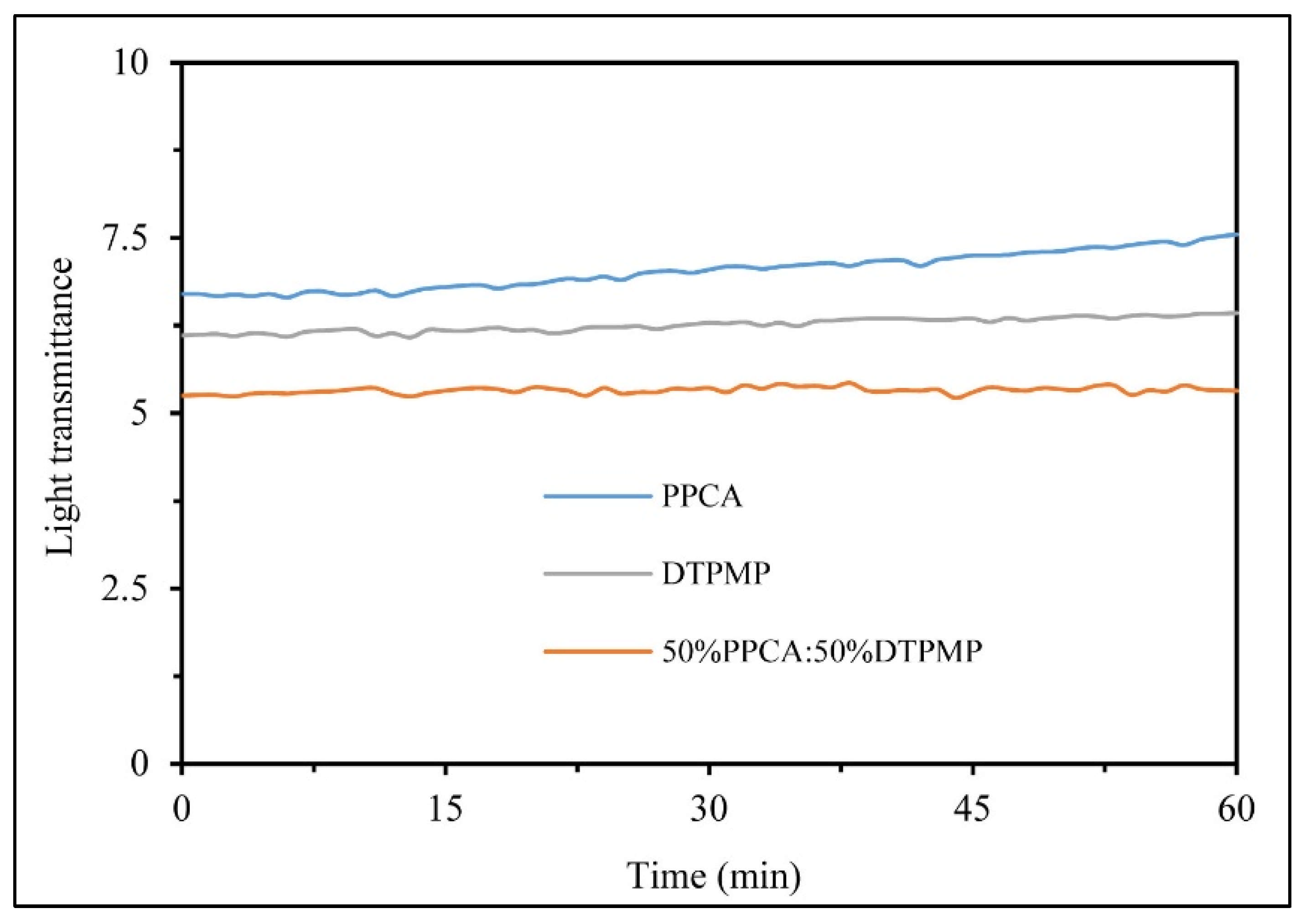
One of the most significant scientific challenges is the limited understanding of mixed-scale formation under realistic reservoir conditions. Most laboratory investigations evaluate single minerals such as calcium carbonate or barium sulfate independently, whereas field deposits frequently consist of complex mixtures of carbonate, sulfate, silica, iron sulfide, and organic materials. Interactions among these mineral phases influence nucleation, crystal growth, morphology, and inhibitor adsorption in ways that remain poorly understood. Future studies should therefore focus on mixed-mineral crystallization under representative reservoir conditions using advanced analytical techniques and multiscale computational modeling.
Nanoimpurity characterization and interfacial chemistry represent an important future direction for oilfield scale management. Although heterogeneous nucleation on solid surfaces is widely recognized as relevant to production systems, the identity, concentration, size distribution, and surface chemistry of naturally occurring nano/micro-impurities in injection water and formation brines remain insufficiently characterized. Future research should systematically determine whether these particles act as nucleation templates and how their surfaces interact with antiscalant molecules and scale-forming species. Particular attention should be given to competitive adsorption between antiscalants and Ca2+, Ba2+, Sr2+, sulfate, and carbonate species on nanoimpurity surfaces. Combining advanced particle characterization with chemical speciation, DFT/MD simulations, and dynamic precipitation experiments could establish whether nanoimpurity–antiscalant interactions contribute to heterogeneous nucleation control and inhibitor synergism. Such studies would provide an important bridge between molecular-scale interfacial chemistry and macroscopic scale-inhibition performance [56].
Another important limitation concerns the performance of scale inhibitors under extreme environmental conditions. Conventional phosphonate and polymeric inhibitors generally provide excellent protection at moderate temperatures; however, their effectiveness may decline in reservoirs exceeding 150–200 °C, extremely high salinity, or high concentrations of divalent cations. Developing thermally stable, salt-tolerant, and chemically robust inhibitors capable of maintaining long-term performance under these conditions remains a major research priority. Advances in polymer chemistry, nanotechnology, and molecular design are expected to contribute significantly to overcoming these limitations.
Environmental sustainability has become another critical driver of innovation. Increasingly stringent environmental regulations require production chemicals to exhibit low toxicity, high biodegradability, and minimal ecological persistence. Although several biodegradable polymers and plant-derived inhibitors have demonstrated encouraging laboratory performance, relatively few have undergone comprehensive field validation. Future research should emphasize renewable feedstocks, biomass-derived inhibitors, biodegradable polymers, and multifunctional green chemicals that simultaneously provide scale inhibition, corrosion protection, and dispersion while satisfying international environmental standards.
Nanotechnology represents another promising research direction. Functional nanoparticles, nanocomposites, mesoporous carriers, and stimuli-responsive delivery systems have demonstrated significant potential for extending squeeze treatment lifetime and improving inhibitor stability. Nevertheless, uncertainties regarding nanoparticle transport, adsorption, aggregation, environmental behavior, and large-scale economic feasibility remain obstacles to commercial implementation. Comprehensive laboratory and field investigations are required before these technologies can be routinely adopted in industrial applications.
The rapid development of computational chemistry has transformed inhibitor discovery from empirical chemical screening to rational molecular design. Density Functional Theory, Molecular Dynamics, Monte Carlo simulations, and Quantitative Structure–Activity Relationship models provide unprecedented insight into inhibitor–crystal interactions at the molecular level. However, stronger integration between computational predictions and laboratory validation is still required. High-throughput virtual screening combined with automated synthesis and experimental verification could substantially accelerate the discovery of next-generation inhibitor molecules.
Artificial intelligence is expected to become a central component of future scale management systems. Machine learning algorithms have already demonstrated excellent capability for predicting scaling tendency, optimizing inhibitor dosage, estimating squeeze lifetime, and identifying complex relationships among operational variables. Future developments are likely to involve explainable artificial intelligence, reinforcement learning, hybrid physics-informed machine learning, and autonomous optimization systems capable of continuously adapting to changing reservoir conditions. Such intelligent frameworks will significantly improve prediction accuracy while reducing operational uncertainty.
Another emerging research area involves digital twins and smart oilfield technologies. Continuous acquisition of real-time production data through distributed sensors, fiber-optic monitoring, online water chemistry analyzers, and cloud-based databases enables dynamic updating of reservoir simulation models. Digital twins can integrate mechanistic modeling with artificial intelligence to predict scale formation before deposition occurs, automatically adjust inhibitor injection rates, and optimize production strategies with minimal human intervention. As sensing technologies continue to improve, digital flow assurance systems are expected to become standard practice in modern petroleum production.
Economic considerations also remain an important aspect of future research. While highly sophisticated inhibitors and intelligent monitoring systems offer substantial technical benefits, their widespread adoption depends upon economic feasibility. Future investigations should therefore incorporate techno-economic analysis, life-cycle assessment, environmental impact evaluation, and risk assessment alongside laboratory performance testing. Such multidisciplinary approaches will facilitate balanced decision-making that considers both operational efficiency and long-term sustainability.
Finally, successful future scale management will require stronger collaboration among chemists, materials scientists, computational modelers, petroleum engineers, environmental specialists, and data scientists. The integration of advanced materials, molecular simulations, reservoir modeling, artificial intelligence, optimization algorithms, and real-time monitoring will enable the development of intelligent, adaptive, and environmentally responsible scale control strategies. These multidisciplinary efforts will support more reliable hydrocarbon production while reducing operational costs, minimizing environmental impacts, and improving the sustainability of future oil and gas developments.
Overall, the evolution of oilfield scale inhibition is moving from conventional chemical treatment toward intelligent and predictive flow assurance systems. The convergence of green chemistry, nanotechnology, computational modeling, artificial intelligence, and digital oilfield technologies is expected to redefine the future of scale management, providing more efficient, economical, and sustainable solutions for increasingly challenging petroleum production environments.

6. Conclusions

Mineral scale deposition remains one of the most significant flow assurance challenges in the petroleum industry, affecting reservoir productivity, well integrity, production efficiency, and operational economics. The formation of carbonate, sulfate, silica, and mixed-mineral scales is governed by complex interactions among fluid chemistry, temperature, pressure, hydrodynamic conditions, and reservoir characteristics. Consequently, effective scale management requires a multidisciplinary approach that integrates chemistry, petroleum engineering, materials science, computational modeling, and data analytics.
This review has summarized the fundamental mechanisms of scale formation, including nucleation, crystal growth, agglomeration, and surface deposition, and discussed the major factors controlling mineral precipitation in oilfield systems. Conventional phosphonate- and polymer-based inhibitors continue to provide reliable performance in many applications; however, increasing environmental regulations and harsher production environments have accelerated the development of biodegradable polymers, plant-derived inhibitors, amino acid derivatives, nanocomposite materials, and controlled-release formulations. These emerging technologies offer promising opportunities to improve inhibitor efficiency while reducing environmental impacts.
Recent advances in molecular modeling, thermodynamic calculations, reservoir simulation, and artificial intelligence have transformed scale management from a predominantly empirical practice into a predictive and data-driven discipline. Quantum chemical calculations, molecular dynamics simulations, and reactive transport models provide detailed understanding of inhibitor–crystal interactions and scale evolution, while machine learning and digital twin technologies enable real-time prediction of scaling risks and optimization of chemical treatment programs. Furthermore, statistical and metaheuristic optimization techniques, including Response Surface Methodology, Genetic Algorithms, and Particle Swarm Optimization, have significantly improved the design of inhibitor formulations and field treatment strategies.
Despite these advances, several challenges remain. Mixed-scale deposition, extreme high-pressure/high-temperature environments, hypersaline formation waters, long-term inhibitor stability, and uncertainties associated with reservoir heterogeneity continue to limit prediction accuracy and treatment effectiveness. Addressing these challenges will require closer integration of laboratory experiments, field validation, multiscale modeling, and intelligent monitoring systems. In addition, future research should prioritize environmentally sustainable inhibitors derived from renewable resources, multifunctional production chemicals, and hybrid physics-informed artificial intelligence models capable of combining mechanistic understanding with large-scale operational data.
Overall, the future of oilfield scale inhibition lies in the convergence of green chemistry, nanotechnology, computational science, artificial intelligence, and digital oilfield technologies. Such integrated approaches will enable more accurate prediction of scale formation, more efficient chemical utilization, reduced operational costs, and improved environmental performance. Continued interdisciplinary collaboration between academia and industry will be essential for developing next-generation scale management strategies that ensure safe, reliable, and sustainable hydrocarbon production under increasingly demanding operating conditions.

Author Contributions

Conceptualization, S.A. and A.K.; methodology, S.A. and A.K.; validation, S.A. and A.K.; investigation, S.A. and A.K.; writing—original draft preparation, S.A. and A.K.; writing—review and editing, S.A. and A.K.; visualization, S.A. and A.K.; supervision, A.K. All authors have read and agreed to the published version of the manuscript.

Funding

This research received no external funding.

Data Availability Statement

No new data were used.

Acknowledgments

The authors acknowledge the use of OpenAI ChatGPT (GPT-5.6 Luna) to assist in generating selected schematic illustrations included in this manuscript. The AI tool was used exclusively for graphical illustration and visualization purposes. The scientific concepts, interpretation, verification, and final content of all figures were determined and reviewed by the authors. The prompts used to generate the AI-assisted figures are provided below for transparency.
FigurePrompt used for image generation
Figure 7.“Create a publication-quality schematic of a static scale inhibition test for oilfield scale inhibitors. Show preparation of synthetic or field brine, addition of scale inhibitor, controlled temperature and pH, static aging, scale precipitation, filtration or separation of precipitates, and subsequent analysis using gravimetric analysis, SEM, XRD, FTIR, and elemental analysis. Include an inhibited and uninhibited comparison. Use a clean scientific flowchart style with arrows and concise labels on a white background.”

Conflicts of Interest

The authors declare no conflicts of interest.

References

  1. Zahedzadeh, M.; Karambeigi, M.; Roayaei, E.; Emadi, M.; Radmehr, M.; Gholamianpour, H.; Ashoori, S.; Shokrollahzadeh, S. Comprehensive management of mineral scale deposition in carbonate oil fields—A case study. Chem. Eng. Res. Des. 2014, 92, 2264–2272. [Google Scholar] [CrossRef] [Scilit]
  2. Ahmadi, M.A.; Mohammadzadeh, O.; Zendehboudi, S. A cutting edge solution to monitor formation damage due to scale deposition: Application to oil recovery. Can. J. Chem. Eng. 2017, 95, 991–1003. [Google Scholar] [CrossRef] [Scilit]
  3. Tahmasebi, H.A.; Kharrat, R.; Soltanieh, M. Dimensionless correlation for the prediction of permeability reduction rate due to calcium sulphate scale deposition in carbonate grain packed column. J. Taiwan Inst. Chem. Eng. 2010, 41, 268–278. [Google Scholar] [CrossRef] [Scilit]
  4. Ghasemian, J.; Riahi, S.; Ayatollahi, S.; Mokhtari, R. Effect of salinity and ion type on formation damage due to inorganic scale deposition and introducing optimum salinity. J. Pet. Sci. Eng. 2019, 177, 270–281. [Google Scholar] [CrossRef] [Scilit]
  5. Daniels, J.K.; Littlehales, I.; Lau, L.; Linares-Samaniego, S. Laboratory Methods for Scale Inhibitor Selection for HP/HT Fields. In Proceedings of the SPE International Oilfield Scale Conference and Exhibition, Aberdeen, Scotland, 14–15 May 2014. [Google Scholar]
  6. Guraieb, P.; Wang, Q. 18—Corrosion and scale at high pressure high temperature. In Trends in Oil and Gas Corrosion Research and Technologies; El-Sherik, A.M., Ed.; Woodhead Publishing: Boston, MA, USA, 2017; pp. 431–451. [Google Scholar]
  7. Gal, J.-Y.; Fovet, Y.; Gache, N. Mechanisms of scale formation and carbon dioxide partial pressure influence. Part I. Elaboration of an experimental method and a scaling model. Water Res. 2002, 36, 755–763. [Google Scholar] [CrossRef] [Scilit]
  8. Rolf, J.; Cao, T.; Huang, X.; Boo, C.; Li, Q.; Elimelech, M. Inorganic Scaling in Membrane Desalination: Models, Mechanisms, and Characterization Methods. Environ. Sci. Technol. 2022, 56, 7484–7511. [Google Scholar] [CrossRef] [Scilit]
  9. Khormali, A.; Petrakov, D.G.; Farmanzade, A.R. Prediction and inhibition of inorganic salt formation under static and dynamic conditions—Effect of pressure, temperature, and mixing ratio. Int. J. Technol. 2016, 7, 943. [Google Scholar] [CrossRef] [Scilit]
  10. Jafar Mazumder, M.A. A review of green scale inhibitors: Process, types, mechanism and properties. Coatings 2020, 10, 928. [Google Scholar] [CrossRef] [Scilit]
  11. Hassani, K.; Zheng, W. A review of recent advances in mineral scaling in geothermal energy systems: Mechanisms, mitigation, and case studies. Environ. Earth Sci. 2025, 84, 418. [Google Scholar] [CrossRef] [Scilit]
  12. Köhl, B.; Elsner, M.; Baumann, T. Hydrochemical and operational parameters driving carbonate scale kinetics at geothermal facilities in the Bavarian Molasse Basin. Geotherm. Energy 2020, 8, 26. [Google Scholar] [CrossRef] [Scilit]
  13. Maciel, R.S.; Pereira, F.A.R.; Soares, E.J.; Scandian, C.; Proveti, J.; Cosmo, R.; Fejoli, R.; Schluter, H.; Martins, A. Unraveling the hydrodynamic effects on calcium carbonate scaling behavior under high-temperature and high-pressure CO2 degassing. Pet. Sci. 2026, 23, 434–446. [Google Scholar] [CrossRef] [Scilit]
  14. Chaussemier, M.; Pourmohtasham, E.; Gelus, D.; Pécoul, N.; Perrot, H.; Lédion, J.; Cheap-Charpentier, H.; Horner, O. State of art of natural inhibitors of calcium carbonate scaling. A review article. Desalination 2015, 356, 47–55. [Google Scholar] [CrossRef] [Scilit]
  15. Paukert Vankeuren, A.N.; Hakala, J.A.; Jarvis, K.; Moore, J.E. Mineral Reactions in Shale Gas Reservoirs: Barite Scale Formation from Reusing Produced Water As Hydraulic Fracturing Fluid. Environ. Sci. Technol. 2017, 51, 9391–9402. [Google Scholar] [CrossRef] [Scilit]
  16. Xinyu, G.; Joy, J.S.C.; Cheng, Y.; Zhao, X.; Liu, Z.; Xu, Y. Scale Inhibitors for Industrial Circulating Water Systems: A Review. J. Water Chem. Technol. 2021, 43, 517–525. [Google Scholar] [CrossRef] [Scilit]
  17. Xu, J.; Jing, G.; Liu, T.; Liu, Y.; Yanheng, L.; Yang, Y. Research progress of green scale inhibitors: A mini review. Pet. Sci. Technol. 2022, 40, 59–72. [Google Scholar] [CrossRef] [Scilit]
  18. Yu, N.; Liu, Q.; Hu, J.; Liu, H.; Kuai, L. Overview of the characterization technique groups for submicroscopic structures from the micro-nano to atomic scale. Chem. Commun. 2025, 61, 18064–18091. [Google Scholar] [CrossRef] [Scilit]
  19. Alqaheem, Y.; Alomair, A.A. Microscopy and Spectroscopy Techniques for Characterization of Polymeric Membranes. Membranes 2020, 10, 33. [Google Scholar] [CrossRef] [Scilit]
  20. Vazquez, O.; Fursov, I.; Mackay, E. Automatic optimization of oilfield scale inhibitor squeeze treatment designs. J. Pet. Sci. Eng. 2016, 147, 302–307. [Google Scholar] [CrossRef] [Scilit]
  21. Kan, A.T.; Dai, Z.; Tomson, M.B. The state of the art in scale inhibitor squeeze treatment. Pet. Sci. 2020, 17, 1579–1601. [Google Scholar] [CrossRef] [Scilit]
  22. Nassar, A.A.; El-Sawaf, A.K.; Mubarak, M.F.; Hosny, R. Eco-Friendly Scale Inhibition Strategies for Produced Water Management in Enhanced Oil Recovery: A Comprehensive Review. ACS ES&T Water 2026, 6, 563–576. [Google Scholar] [CrossRef] [Scilit]
  23. Luo, X.; Hu, Z.; Zhang, Q.; Pang, Y. Recent development in thermodynamic prediction of oilfield scale: From mechanistic models to machine learning. Sustain. Energy Technol. Assess. 2025, 84, 104744. [Google Scholar] [CrossRef] [Scilit]
  24. Liu, P.; Zuo, C.; Du, J.; Chen, X.; Liu, J.; Zhao, R.; Yu, Z.; Tang, Z. A critical review of next-generation green scale inhibitors for ultra-deep high-salinity oilfields: From kinetic mechanisms to multifunctional molecular design. Desalination 2026, 628, 120012. [Google Scholar] [CrossRef] [Scilit]
  25. Popov, K.I.; Kovaleva, N.E.; Rudakova, G.Y.; Kombarova, S.P.; Larchenko, V.E. Recent state-of-the-art of biodegradable scale inhibitors for cooling-water treatment applications (Review). Therm. Eng. 2016, 63, 122–129. [Google Scholar] [CrossRef] [Scilit]
  26. Mady, M.F.; Kelland, M.A. Overview of the Synthesis of Salts of Organophosphonic Acids and Their Application to the Management of Oilfield Scale. Energy Fuels 2017, 31, 4603–4615. [Google Scholar] [CrossRef] [Scilit]
  27. Zhang, P.; Liu, Y.; Kan, A.T.; Tomson, M.B. Laboratory evaluation of synergistic effect of transition metals with mineral scale inhibitor in controlling halite scale deposition. J. Pet. Sci. Eng. 2019, 175, 120–128. [Google Scholar] [CrossRef] [Scilit]
  28. Ahmadi, M.; Chen, Z. Machine learning-based models for predicting permeability impairment due to scale deposition. J. Pet. Explor. Prod. Technol. 2020, 10, 2873–2884. [Google Scholar] [CrossRef] [Scilit]
  29. Jamialahmadi, M.; Muller-Steinhagen, H. Mechanisms of scale deposition and scale removal in porous media. Int. J. Oil Gas Coal Technol. 2008, 1, 81–108. [Google Scholar] [CrossRef] [Scilit]
  30. Bijani, M.; Khamehchi, E.; Shabani, M. Optimization of salinity and composition of injected low salinity water into sandstone reservoirs with minimum scale deposition. Sci. Rep. 2023, 13, 12991. [Google Scholar] [CrossRef] [Scilit]
  31. Fakhreeva, A.V.; Nosov, V.V.; Voloshin, A.I.; Dokichev, V.A. Polysaccharides as effective and environmentally friendly inhibitors of scale deposition from aqueous solutions in technological processes. Polymers 2023, 15, 1478. [Google Scholar] [CrossRef] [Scilit]
  32. Khodabakhshi, M.J.; Bijani, M. Predicting scale deposition in oil reservoirs using machine learning optimization algorithms. Results Eng. 2024, 22, 102263. [Google Scholar] [CrossRef] [Scilit]
  33. Shabani, A.; Sisakhti, H.; Sheikhi, S.; Barzegar, F. A reactive transport approach for modeling scale formation and deposition in water injection wells. J. Pet. Sci. Eng. 2020, 190, 107031. [Google Scholar] [CrossRef] [Scilit]
  34. Khormali, A.; Sharifov, A.R.; Torba, D.I. Experimental and modeling analysis of asphaltene precipitation in the near wellbore region of oil wells. Pet. Sci. Technol. 2018, 36, 1030–1036. [Google Scholar] [CrossRef] [Scilit]
  35. Zolfagharroshan, M.; Khamehchi, E. A rigorous approach to scale formation and deposition modelling in geothermal wellbores. Geothermics 2020, 87, 101841. [Google Scholar] [CrossRef] [Scilit]
  36. Shokrollahi, A.; Safari, H.; Esmaeili-Jaghdan, Z.; Ghazanfari, M.H.; Mohammadi, A.H. Rigorous modeling of permeability impairment due to inorganic scale deposition in porous media. J. Pet. Sci. Eng. 2015, 130, 26–36. [Google Scholar] [CrossRef] [Scilit]
  37. Vazirian, M.M.; Charpentier, T.V.; de Oliveira Penna, M.; Neville, A. Surface inorganic scale formation in oil and gas industry: As adhesion and deposition processes. J. Pet. Sci. Eng. 2016, 137, 22–32. [Google Scholar] [CrossRef] [Scilit]
  38. Doubra, P.; Kamran-Pirzaman, A.; Mohammadi, A.H.; Hassanalizadeh, R. Thermodynamic modelling of scale (Calcite, Barite, Anhydrite and Gypsum) deposition from brine. J. Mol. Liq. 2017, 230, 96–103. [Google Scholar] [CrossRef] [Scilit]
  39. Quilló, G.L.; Bhonsale, S.; Gielen, B.; Van Impe, J.F.; Collas, A.; Xiouras, C. Crystal growth kinetics of an industrial active pharmaceutical ingredient: Implications of different representations of supersaturation and simultaneous growth mechanisms. Cryst. Growth Des. 2021, 21, 5403–5420. [Google Scholar] [CrossRef] [Scilit]
  40. Ma, M.; Wang, Y.; Cao, X.; Lu, W.; Guo, Y. Temperature and supersaturation as key parameters controlling the spontaneous precipitation of calcium carbonate with distinct physicochemical properties from pure aqueous solutions. Cryst. Growth Des. 2019, 19, 6972–6988. [Google Scholar] [CrossRef] [Scilit]
  41. Mahmoodi, L.; Malayeri, M.R.; Tabrizi, F.F. Abatement of scale precipitation in oilfields using green scale inhibitors. J. Pet. Sci. Eng. 2022, 208, 109237. [Google Scholar] [CrossRef] [Scilit]
  42. Yan, F.; Zhang, F.; Bhandari, N.; Wang, L.; Dai, Z.; Zhang, Z.; Liu, Y.; Ruan, G.; Kan, A.; Tomson, M. Adsorption and precipitation of scale inhibitors on shale formations. J. Pet. Sci. Eng. 2015, 136, 32–40. [Google Scholar] [CrossRef] [Scilit]
  43. Andrei, M.; Malandrino, A. Comparative coreflood studies for precipitation and adsorption squeeze with PPCA as the scales inhibitor. Pet. Sci. Technol. 2003, 21, 1295–1315. [Google Scholar] [CrossRef] [Scilit]
  44. Kahrwad, M.; Sorbie, K.S.; Boak, L.S. Coupled adsorption/precipitation of scale inhibitors: Experimental results and modeling. SPE Prod. Oper. 2009, 24, 481–491. [Google Scholar] [CrossRef] [Scilit]
  45. Li, X.; Gao, B.; Yue, Q.; Ma, D.; Rong, H.; Zhao, P.; Teng, P. Effect of six kinds of scale inhibitors on calcium carbonate precipitation in high salinity wastewater at high temperatures. J. Environ. Sci. 2015, 29, 124–130. [Google Scholar] [CrossRef] [Scilit]
  46. Sorbie, K.S. A general coupled kinetic adsorption/precipitation transport model for scale inhibitor retention in porous media: I. Model formulation. In Proceedings of the SPE International Conference on Oilfield Scale; OnePetro: Richardson, TX, USA, 2010. [Google Scholar]
  47. Khormali, A.; Bahlakeh, G.; Struchkov, I.; Kazemzadeh, Y. Increasing inhibition performance of simultaneous precipitation of calcium and strontium sulfate scales using a new inhibitor—Laboratory and field application. J. Pet. Sci. Eng. 2021, 202, 108589. [Google Scholar] [CrossRef] [Scilit]
  48. Khormali, A.; Ahmadi, S.; Kazemzadeh, Y. Inhibition of Barium Sulfate Precipitation During Water Injection into Oil Reservoirs Using Various Scale Inhibitors. Arab. J. Sci. Eng. 2023, 48, 9383–9399. [Google Scholar] [CrossRef] [Scilit]
  49. Yousefzadeh, R.; Bemani, A.; Kazemi, A.; Ahmadi, M. An Insight into the Prediction of Scale Precipitation in Harsh Conditions Using Different Machine Learning Algorithms. SPE Prod. Oper. 2023, 38, 286–304. [Google Scholar] [CrossRef] [Scilit]
  50. Lages, V.P.; Gonçalves, R.; Medeiros, F.; Bisatto, R.; Rossi, A.L.; Junior, A.G.B. Effect of scale inhibitors on the nucleation and crystallization of calcium carbonate. Minerals 2025, 15, 947. [Google Scholar] [CrossRef] [Scilit]
  51. Li, C.; Zhang, C.; Zhang, W. The inhibition effect mechanisms of four scale inhibitors on the formation and crystal growth of CaCO3 in solution. Sci. Rep. 2019, 9, 13366. [Google Scholar] [CrossRef] [Scilit]
  52. Ansari, S.Z.; Pandit, A.B. Inhibitory effect of novel green polymer (Aspartic-citric acid) on the process of nucleation during gypsum scale formation. J. Cryst. Growth 2022, 581, 126472. [Google Scholar] [CrossRef] [Scilit]
  53. Kelland, M.A.; Mady, M.F.; Lima-Eriksen, R. Kidney stone prevention: Dynamic testing of edible calcium oxalate scale inhibitors. Cryst. Growth Des. 2018, 18, 7441–7450. [Google Scholar] [CrossRef] [Scilit]
  54. Tantayakom, V.; Fogler, H.; Charoensirithavorn, P.; Chavadej, S. Kinetic study of scale inhibitor precipitation in squeeze treatment. Cryst. Growth Des. 2005, 5, 329–335. [Google Scholar] [CrossRef] [Scilit]
  55. Jarrahian, K.; Singleton, M.; Boak, L.; Sorbie, K.S. Surface chemistry of phosphonate scale inhibitor retention mechanisms in carbonate reservoirs. Cryst. Growth Des. 2020, 20, 5356–5372. [Google Scholar] [CrossRef] [Scilit]
  56. Popov, K.; Oshchepkov, M.; Afanas’eva, E.; Koltinova, E.; Dikareva, Y.; Rönkkömäki, H. A new insight into the mechanism of the scale inhibition: DLS study of gypsum nucleation in presence of phosphonates using nanosilver dispersion as an internal light scattering intensity reference. Colloids Surf. A Physicochem. Eng. Asp. 2019, 560, 122–129. [Google Scholar] [CrossRef] [Scilit]
  57. Mady, M.F.; Ortega, R.; Kelland, M.A. Exploring Modified Alendronic Acid as a New Inhibitor for Calcium-Based Oilfield Scales. Energy Fuels 2022, 36, 1863–1873. [Google Scholar] [CrossRef] [Scilit]
  58. Mohammed, I.; Svenningsen, S.W.; Kamounah, F.S.; Chen, T.; Pittelkow, M.; Sølling, T.I.; Mahmoud, M. Calcium sulfate scale: A review of state-of-the-art. Geoenergy Sci. Eng. 2024, 242, 213228. [Google Scholar] [CrossRef] [Scilit]
  59. Kumar, S.; Naiya, T.K.; Kumar, T. Developments in oilfield scale handling towards green technology—A review. J. Pet. Sci. Eng. 2018, 169, 428–444. [Google Scholar] [CrossRef] [Scilit]
  60. Kamal, M.S.; Hussein, I.; Mahmoud, M.; Sultan, A.S.; Saad, M.A. Oilfield scale formation and chemical removal: A review. J. Pet. Sci. Eng. 2018, 171, 127–139. [Google Scholar] [CrossRef] [Scilit]
  61. Hamza, A.; Hussein, I.A.; Jalab, R.; Saad, M.; Mahmoud, M. Review of iron sulfide scale removal and inhibition in oil and gas wells: Current status and perspectives. Energy Fuels 2021, 35, 14401–14421. [Google Scholar] [CrossRef] [Scilit]
  62. Gooneie, A.; Schuschnigg, S.; Holzer, C. A review of multiscale computational methods in polymeric materials. Polymers 2017, 9, 16. [Google Scholar] [CrossRef] [Scilit]
  63. Mady, M.F.; Kelland, M.A. Review of nanotechnology impacts on oilfield scale management. ACS Appl. Nano Mater. 2020, 3, 7343–7364. [Google Scholar] [CrossRef] [Scilit]
  64. Olajire, A.A. A review of oilfield scale management technology for oil and gas production. J. Pet. Sci. Eng. 2015, 135, 723–737. [Google Scholar] [CrossRef] [Scilit]
  65. Liu, Y.; Zhang, P. Review of phosphorus-based polymers for mineral scale and corrosion control in oilfield. Polymers 2022, 14, 2673. [Google Scholar] [CrossRef] [Scilit]
  66. Ardakani, S.F.G.; Hosseini, S.T.; Kazemzadeh, Y. A review of scale inhibitor methods during modified smart water injection. Can. J. Chem. Eng. 2024, 102, 3922–3952. [Google Scholar] [CrossRef] [Scilit]
  67. Husna, U.Z.; Elraies, K.A.; Shuhili, J.A.B.; Elryes, A.A. A review: The utilization potency of biopolymer as an eco-friendly scale inhibitors. J. Pet. Explor. Prod. Technol. 2022, 12, 1075–1094. [Google Scholar] [CrossRef] [Scilit]
  68. Li, J.; Tang, M.; Ye, Z.; Chen, L.; Zhou, Y. Scale formation and control in oil and gas fields: A review. J. Dispers. Sci. Technol. 2017, 38, 661–670. [Google Scholar] [CrossRef] [Scilit]
  69. Khormali, A.; Ahmadi, S.; Kazemzadeh, Y. Performance evaluation of hybrid polymer-phosphonate scale inhibitors in oilfield water flooding operations. Pet. Res. 2026; in press. [CrossRef] [Scilit]
  70. Hasson, D.; Shemer, H.; Sher, A. State of the art of friendly “green” scale control inhibitors: A review article. Ind. Eng. Chem. Res. 2011, 50, 7601–7607. [Google Scholar] [CrossRef] [Scilit]
  71. Mpelwa, M.; Tang, S.-F. State of the art of synthetic threshold scale inhibitors for mineral scaling in the petroleum industry: A review. Pet. Sci. 2019, 16, 830–849. [Google Scholar] [CrossRef] [Scilit]
  72. De Motte, R.; Barker, R.; Burkle, D.; Vargas, S.; Neville, A. The early stages of FeCO3 scale formation kinetics in CO2 corrosion. Mater. Chem. Phys. 2018, 216, 102–111. [Google Scholar] [CrossRef] [Scilit]
  73. Liu, H.; Gou, X.; Pan, K.; Huang, R.; Lang, Z.; Ye, D.; Wang, X.; Wang, H. Thermodynamics and inhibition mechanism of imidazolium-based ionic liquids for inhibiting spontaneous combustion of iron sulfide. Fuel 2023, 338, 127335. [Google Scholar] [CrossRef] [Scilit]
  74. Mahat, S.Q.A.; Saaid, I.M. Development of anionic-cationic inhibitors for mitigating silicate scales during ASP flooding. J. Pet. Sci. Eng. 2017, 149, 701–706. [Google Scholar] [CrossRef] [Scilit]
  75. Arensdorf, J.; Hoster, D.; McDougall, D.; Yuan, M. Static and dynamic testing of silicate scale inhibitors. In International Oil and Gas Conference and Exhibition in China; OnePetro: Richardson, TX, USA, 2010. [Google Scholar]
  76. Zhang, P.; Kan, A.T.; Tomson, M.B. Oil field mineral scale control. In Mineral Scales and Deposits; Elsevier: Amsterdam, The Netherlands, 2015; pp. 603–617. [Google Scholar]
  77. Taheri-Shakib, J.; Naderi, H.; Salimidelshad, Y.; Teymouri, A.; Shekarifard, A. Using ultrasonic as a new approach for elimination of inorganic scales (NaCl): An experimental study. J. Pet. Explor. Prod. Technol. 2018, 8, 553–564. [Google Scholar] [CrossRef] [Scilit]
  78. Khormali, A. Increasing the Efficiency of Demulsification Treatment in Petroleum Industry Using a Multicomponent Demulsifier Package. Pet. Chem. 2023, 63, 539–552. [Google Scholar] [CrossRef] [Scilit]
  79. Farooqui, N.M.; Sorbie, K.S. The use of PPCA in scale-inhibitor precipitation squeezes: Solubility, inhibition efficiency, and molecular-weight effects. SPE Prod. Oper. 2016, 31, 258–269. [Google Scholar] [CrossRef] [Scilit]
  80. Khormali, A.; Petrakov, D. Laboratory investigation of a new scale inhibitor for preventing calcium carbonate precipitation in oil reservoirs and production equipment. Pet. Sci. 2016, 13, 320–327. [Google Scholar] [CrossRef] [Scilit]
  81. Khormali, A.; Sharifov, A.; Torba, D. Investigation of barium sulfate precipitation and prevention using different scale inhibitors under reservoir conditions. Int. J. Eng. 2018, 31, 1796–1802. [Google Scholar] [CrossRef] [Scilit]
  82. Khormali, A.; Petrakov, D.G.; Moghaddam, R.N. Study of adsorption/desorption properties of a new scale inhibitor package to prevent calcium carbonate formation during water injection in oil reservoirs. J. Pet. Sci. Eng. 2017, 153, 257–267. [Google Scholar] [CrossRef] [Scilit]
  83. Hajirezaie, S.; Wu, X.; Peters, C.A. Scale formation in porous media and its impact on reservoir performance during water flooding. J. Nat. Gas Sci. Eng. 2017, 39, 188–202. [Google Scholar] [CrossRef] [Scilit]
  84. Haghtalab, A.; Kamali, M.J.; Shahrabadi, A. Prediction mineral scale formation in oil reservoirs during water injection. Fluid Phase Equilib. 2014, 373, 43–54. [Google Scholar] [CrossRef] [Scilit]
  85. Hamid, S.; De Jesús, O.; Jacinto, C.; Izetti, R.; Pinto, H.; Droguett, E.; Edwards, C.; Cassidy, J.; Zhang, H.; Dagenais, P.; et al. A practical method of predicting calcium carbonate scale formation in well completions. SPE Prod. Oper. 2016, 31, 1–11. [Google Scholar] [CrossRef] [Scilit]
  86. Bijani, M.; Khamehchi, E. Optimization and treatment of wastewater of crude oil desalting unit and prediction of scale formation. Environ. Sci. Pollut. Res. 2019, 26, 25621–25640. [Google Scholar] [CrossRef] [Scilit]
  87. Nikoo, A.H.; Malayeri, M.R. On the affinity of carbonate and sandstone reservoir rocks to scale formation–Impact of rock roughness. Colloids Surf. A Physicochem. Eng. Asp. 2021, 610, 125699. [Google Scholar] [CrossRef] [Scilit]
  88. Jarrahian, K.; Sorbie, K.S. Mechanistic Investigation of Adsorption Behavior of Two Scale Inhibitors on Carbonate Formations for Application in Squeeze Treatments. Energy Fuels 2020, 34, 4484–4496. [Google Scholar] [CrossRef] [Scilit]
  89. Hoang, T.A. Mechanisms of scale formation and inhibition. In Water-Formed Deposits; Demadis, Z.A.a.K.D., Ed.; Elsevier: Amsterdam, The Netherlands, 2022; pp. 13–47. [Google Scholar]
  90. Tayyebi, A.; Alshami, A.; Tayyebi, E.; Owoade, A.; Talukder, M.; Ismail, N.; Rabiei, Z.; Yu, X.; Tikeri, G. Machine Learning-Based Prediction of Scale Formation in Produced Water as a Tool for Environmental Monitoring. Results Eng. 2025, 26, 105223. [Google Scholar] [CrossRef] [Scilit]
  91. Hoang, T.A.; Ang, H.M.; Rohl, A.L. Investigation into the effects of phosphonic inhibitors on the formation of calcium sulfate scales. Desalin. Water Treat. 2011, 29, 294–301. [Google Scholar] [CrossRef] [Scilit]
  92. Mahmoodi, A.; Nick, H. The interplay between microbial reservoir souring and barite scale formation in hydrocarbon reservoirs. J. Clean. Prod. 2022, 377, 134234. [Google Scholar] [CrossRef] [Scilit]
  93. Liu, Y.; Kan, A.T.; Tomson, M.B.; Zhang, P. Interactions of common scale inhibitors and formation mineral (calcium carbonate): Sorption and transportability investigations under equilibrium and dynamic conditions. J. Pet. Sci. Eng. 2022, 215, 110696. [Google Scholar] [CrossRef] [Scilit]
  94. Popov, K.; Rudakova, G.; Larchenko, V.; Tusheva, M.; Afanas’eva, E.; Kombarova, S.; Kamagurov, S.; Kovaleva, N. A comparative performance ranking of some phosphonates and environmentally friendly polymers on CaCO3 scaling inhibition by NACE protocol. Desalin. Water Treat. 2017, 69, 163–172. [Google Scholar] [CrossRef] [Scilit]
  95. BinMerdhah, A.B. Inhibition of barium sulfate scale at high-barium formation water. J. Pet. Sci. Eng. 2012, 90, 124–130. [Google Scholar] [CrossRef] [Scilit]
  96. Sundramoorthy, J.D.; Ibrahim, M.F.; Nordin, N.F.; Abd Rahim, M.A.; Ismail, W.A.W. Holistic approach for a successful scale squeeze treatment using core flood data from other reservoir. In Proceedings of the SPE International Conference and Exhibition on Formation Damage Control; SPE: Richardson, TX, USA, 2020. [Google Scholar]
  97. Moghadasi, J.; Jamialahmadi, M.; Müller-Steinhagen, H.; Sharif, A. Formation damage due to scale formation in porous media resulting from water injection. In Proceedings of the SPE International Conference and Exhibition on Formation Damage Control; SPE: Richardson, TX, USA, 2004. [Google Scholar]
  98. Fernandes, R.S.; Beserra, N.L.; Souza, M.A.; Lima, D.F.; Castro, B.B.; Balaban, R.C. Experimental and theoretical investigation of a copolymer combined with surfactant for preventing scale formation in oil wells. J. Mol. Liq. 2020, 318, 114036. [Google Scholar] [CrossRef] [Scilit]
  99. Hussein, M.F.; Mubarak, M.F.; Al-Sirhani, A.M.; Hosny, R. Examining the factors that impact the formation of barite scale in water injection operations: Experimental study and quantification of scale formation. Discov. Appl. Sci. 2024, 6, 519. [Google Scholar] [CrossRef] [Scilit]
  100. Kelland, M.A. Effect of various cations on the formation of calcium carbonate and barium sulfate scale with and without scale inhibitors. Ind. Eng. Chem. Res. 2011, 50, 5852–5861. [Google Scholar] [CrossRef] [Scilit]
  101. Zojaji, I.; Madadizadeh, A.; Riahi, S. Elemental analysis of scale inhibitors’ effect on water incompatibility in carbonate reservoirs: Modeling, bulk and core scales studies. J. Pet. Sci. Eng. 2022, 208, 109580. [Google Scholar] [CrossRef] [Scilit]
  102. Song, W.; Kovscek, A.R. Direct visualization of pore-scale fines migration and formation damage during low-salinity waterflooding. J. Nat. Gas Sci. Eng. 2016, 34, 1276–1283. [Google Scholar] [CrossRef] [Scilit]
  103. Srivastava, V.R.; Thapliyal, A. Enhancing Oil Recovery in Carbonate Reservoirs Through Low Salinity Waterflooding: Laboratory Insights, Smart Brine Optimization, and Field-Scale Validation. In Proceedings of the Offshore Technology Conference; OTC: Houston, TX, USA, 2026. [Google Scholar]
  104. Mohammadi, S.; Mahani, H.; Ayatollahi, S.; Niasar, V. Impact of oil polarity on the mixing time at the pore scale in low salinity waterflooding. Energy Fuels 2020, 34, 12247–12259. [Google Scholar] [CrossRef] [Scilit]
  105. Khormali, A.; Sharifov, A.R.; Torba, D.I. Increasing efficiency of calcium sulfate scale prevention using a new mixture of phosphonate scale inhibitors during waterflooding. J. Pet. Sci. Eng. 2018, 164, 245–258. [Google Scholar] [CrossRef] [Scilit]
  106. Ayirala, S.; Alghamdi, A.; Gmira, A.; Cha, D.K.; Abu Alsaud, M.; Yousef, A. Linking pore scale mechanisms with macroscopic to core scale effects in controlled ionic composition low salinity waterflooding processes. Fuel 2020, 264, 116798. [Google Scholar] [CrossRef] [Scilit]
  107. Ahmadi, S.; Khormali, A.; Kazemzadeh, Y.; Dehghani, M.R. A novel hybrid CCD-ML approach for predicting permeability alterations in carbonate reservoir rocks during waterflooding under scale inhibitor treatment. Sci. Rep. 2026, 16, 18321. [Google Scholar] [CrossRef] [Scilit]
  108. Jarrahian, K.; Aminnaji, M.; Graham, A.; Sorbie, K. Experimental analysis of scale inhibitors retention in carbonate formations for application in squeeze treatments. Energy Fuels 2022, 36, 1776–1791. [Google Scholar] [CrossRef] [Scilit]
  109. Ji, Y.; Chen, Y.; Le, J.; Qian, M.; Huan, Y.; Yang, W.; Yin, X.; Liu, Y.; Wang, X.; Chen, Y. Highly effective scale inhibition performance of amino trimethylenephosphonic acid on calcium carbonate. Desalination 2017, 422, 165–173. [Google Scholar] [CrossRef] [Scilit]
  110. Jarrahian, K.; Sorbie, K.S.; Singleton, M.A.; Boak, L.S.; Graham, A.J. The effect of pH and mineralogy on the retention of polymeric scale inhibitors on carbonate rocks for application in squeeze treatments. SPE Prod. Oper. 2019, 34, 344–360. [Google Scholar] [CrossRef] [Scilit]
  111. Wang, Q.; Chen, T. Inhibition of calcium carbonate scale under severe conditions. Pet. Sci. Technol. 2022, 42, 2234–2249. [Google Scholar] [CrossRef] [Scilit]
  112. Popov, K.; Trukhina, M.; Tkachenko, S.; Oshchepkov, M. A Critical Review of Relative Scale Inhibition Performance of Different Alternatives. In Industrial Scale Inhibition; John Wiley & Sons: Hoboken, NJ, USA, 2024; pp. 72–101. [Google Scholar]
  113. Tang, Y.; Yang, W.; Yin, X.; Liu, Y.; Yin, P.; Wang, J. Investigation of CaCO3 scale inhibition by PAA, ATMP and PAPEMP. Desalination 2008, 228, 55–60. [Google Scholar] [CrossRef] [Scilit]
  114. Sheikhi, A.; Li, N.; Van De Ven, T.G.; Kakkar, A. Macromolecule-based platforms for developing tailor-made formulations for scale inhibition. Environ. Sci. Water Res. Technol. 2016, 2, 71–84. [Google Scholar] [CrossRef] [Scilit]
  115. Popov, S.P.K.; Vishnikina, E.; Afans’eva, E.; Ovchinnikova, E.; Trukhina, M.; Oshchepkov, M.; Yegoshina, O. On the role of sequestration and chelation in scale inhibition. Int. J. Corr. Scale Inhib. 2026, 15, 1–39. [Google Scholar]
  116. Li, L.; Wang, Y.; Sun, Y.; Yang, W.; Yin, X.; Chen, Y.; Liu, Y. Novel and green hydroxyperylene imide based fluorescent polymer for calcium sulfate scale inhibition. J. Mol. Liq. 2021, 344, 117730. [Google Scholar] [CrossRef] [Scilit]
  117. Popov, K.; Rudakova, G.; Larchenko, V.; Tusheva, M.; Kamagurov, S.; Dikareva, J.; Kovaleva, N. A comparative performance evaluation of some novel “green” and traditional antiscalants in calcium sulfate scaling. Adv. Mater. Sci. Eng. 2016, 2016, 7635329. [Google Scholar] [CrossRef] [Scilit]
  118. Sun, Y.; Li, L.; Chen, Z.; Yin, X.; Yang, W.; Chen, Y.; Liu, Y. Scale inhibition performance of calcium sulfate by 1, 6-diaminohexane-contained polyaminoamide dendrimers: Static experiment and MD simulation. J. Ind. Eng. Chem. 2022, 115, 12–19. [Google Scholar] [CrossRef] [Scilit]
  119. Tantayakom, V.; Sreethawong, T.; Fogler, H.S.; De Moraes, F.; Chavadej, S. Scale inhibition study by turbidity measurement. J. Colloid Interface Sci. 2005, 284, 57–65. [Google Scholar] [CrossRef] [Scilit]
  120. Zhang, P.; Kan, A.T.; Fan, C.; Work, S.N.; Yu, J.; Lu, H.; Al-Saiari, H.A.; Tomson, M.B. Silica-templated synthesis of novel zinc-DTPMP nanomaterials: Their transport in carbonate and sandstone media during scale inhibition. SPE J. 2011, 16, 662–671. [Google Scholar] [CrossRef] [Scilit]
  121. Ghorbani, N.; Wilson, M.; Kapur, N.; Fleming, N.; Tjomsland, T.; Neville, A. Adsorption of polyphosphinocarboxylic acid (PPCA) scale inhibitor on carbon nanotubes (CNTs): A prospective method for enhanced oilfield scale prevention. J. Pet. Sci. Eng. 2017, 150, 305–311. [Google Scholar] [CrossRef] [Scilit]
  122. Al-Hamzah, A.A.; Fellows, C.M. A comparative study of novel scale inhibitors with commercial scale inhibitors used in seawater desalination. Desalination 2015, 359, 22–25. [Google Scholar] [CrossRef] [Scilit]
  123. Fang, J.; Ye, Z.; Dou, Z.; Zhang, Y.; Wu, W.; Hu, Y.; Wang, B.; Li, H. Design of molecular scale inhibitors for high temperature industrial cooling water systems based on group synergistic effects. Chem. Eng. J. 2024, 494, 153164. [Google Scholar] [CrossRef] [Scilit]
  124. Ulhaq, I.; Wang, Q.; Alanazi, N.; Aleisa, R. Dual-Functional Corrosion and Scale Inhibitors for Oil and Gas Industry. In Industrial Scale Inhibition: Principles, Design, and Applications; John Wiley & Sons: Hoboken, NJ, USA, 2024; pp. 399–457. [Google Scholar]
  125. Azizi, J.; Shadizadeh, S.R.; Manshad, A.K.; Mohammadi, A.H. A dynamic method for experimental assessment of scale inhibitor efficiency in oil recovery process by water flooding. Petroleum 2019, 5, 303–314. [Google Scholar] [CrossRef] [Scilit]
  126. Talebi, S.; Riahi, S.; Rostami, B. The Effect of Blending Polymeric and Phosphonate Scale Inhibitors on Fluid/Fluid and Rock/Fluid Interactions: A Comprehensive Experimental and Theoretical Study. SPE J. 2022, 27, 3611–3629. [Google Scholar] [CrossRef] [Scilit]
  127. Sorbie, K.; Yuan, M.D.; Chen, P.; Todd, A.; Wat, R.M.S. The effect of pH on the adsorption and transport of phosphonate scale inhibitor through porous media. In Proceedings of the SPE International Symposium on Oilfield Chemistry; OnePetro: Richardson, TX, USA, 1993. [Google Scholar]
  128. Ghosh, B.; Li, X. Effect of surfactant composition on reservoir wettability and scale inhibitor squeeze lifetime in oil wet carbonate reservoir. J. Pet. Sci. Eng. 2013, 108, 250–258. [Google Scholar] [CrossRef] [Scilit]
  129. Zhang, L.; Kim, D.; Jun, Y.-S. The effects of phosphonate-based scale inhibitor on brine–biotite interactions under subsurface conditions. Environ. Sci. Technol. 2018, 52, 6042–6049. [Google Scholar] [CrossRef] [Scilit]
  130. Kan, A.T.; Fu, G.; Al-Saiari, H.A.; Tomson, M.B.; Shen, D. Enhanced scale-inhibitor treatments with the addition of zinc. SPE J. 2009, 14, 617–626. [Google Scholar] [CrossRef] [Scilit]
  131. Al Helal, A.; Soames, A.; Iglauer, S.; Gubner, R.; Barifcani, A. Evaluating chemical-scale-inhibitor performance in external magnetic fields using a dynamic scale loop. J. Pet. Sci. Eng. 2019, 179, 1063–1077. [Google Scholar] [CrossRef] [Scilit]
  132. Bisatto, R.; Picoli, V.M.; Petzhold, C.L. Evaluation of different polymeric scale inhibitors for oilfield application. J. Pet. Sci. Eng. 2022, 213, 110331. [Google Scholar] [CrossRef] [Scilit]
  133. Ramzi, M.; Hosny, R.; El-Sayed, M.; Fathy, M.; Moghny, T.A. Evaluation of scale inhibitors performance under simulated flowing field conditions using dynamic tube blocking test. Int. J. Chem. Sci. 2016, 14, 16–28. [Google Scholar]
  134. Zhao, Y.; Dai, Z.; Wang, X.; Dai, C.; Paudyal, S.; Ko, S.; Kan, A.T.; Tomson, M. Evaluation of Silica and Related Matrix Ion Effects on Common Scale Inhibitors. Energy Fuels 2021, 35, 2144–2152. [Google Scholar] [CrossRef] [Scilit]
  135. Graham, G.M.; Boak, L.S.; Hobden, C. Examination of the effect of generically different scale inhibitor species (PPCA and DETPMP) on the adherence and growth of barium sulphate scale on metal surfaces. In Proceedings of the International Symposium on Oilfield Scale; OnePetro: Richardson, TX, USA, 2001. [Google Scholar]
  136. Khormali, A.; Koochi, M.R.; Varfolomeev, M.A.; Ahmadi, S. Experimental study of the low salinity water injection process in the presence of scale inhibitor and various nanoparticles. J. Pet. Explor. Prod. Technol. 2022, 13, 903–916. [Google Scholar] [CrossRef] [Scilit]
  137. Sousa, M.F.; Signorelli, F.; Bertran, C.A. Fast evaluation of inhibitors for calcium carbonate scale based on pH continuous measurements in jar test at high salinity condition. J. Pet. Sci. Eng. 2016, 147, 468–473. [Google Scholar] [CrossRef] [Scilit]
  138. Cheremisov, K.; Oussoltsev, D.; Butula, K.K.; Gaifullin, A.; Faizullin, I.; Senchenko, D. First application of scale inhibitor during hydraulic fracturing treatments in Western Siberia. In Proceedings of the SPE International Oilfield Scale Conference; OnePetro: Richardson, TX, USA, 2008. [Google Scholar]
  139. Senthilmurugan, B.; Ghosh, B.; Sanker, S. High performance maleic acid based oil well scale inhibitors—Development and comparative evaluation. J. Ind. Eng. Chem. 2011, 17, 415–420. [Google Scholar] [CrossRef] [Scilit]
  140. Wu, D.; Liu, D.; Wang, J.; Zhao, H.; Dong, Y.; Wang, X. High-Performance Barium Sulfate Scale Inhibitors: Monomer Design and Molecular Dynamics Studies. Processes 2025, 13, 660. [Google Scholar] [CrossRef] [Scilit]
  141. Zhang, P.; Zhang, Z.; Liu, Y.; Kan, A.T.; Tomson, M.B. Investigation of the impact of ferrous species on the performance of common oilfield scale inhibitors for mineral scale control. J. Pet. Sci. Eng. 2019, 172, 288–296. [Google Scholar] [CrossRef] [Scilit]
  142. Zhang, Z.; Zhang, P.; Li, Z.; Kan, A.T.; Tomson, M.B. Laboratory evaluation and mechanistic understanding of the impact of ferric species on oilfield scale inhibitor performance. Energy Fuels 2018, 32, 8348–8357. [Google Scholar] [CrossRef] [Scilit]
  143. Mady, M.F.; Rehman, A.; Kelland, M.A. Synthesis and study of modified polyaspartic acid coupled phosphonate and sulfonate moieties as green oilfield scale inhibitors. Ind. Eng. Chem. Res. 2021, 60, 8331–8339. [Google Scholar] [CrossRef] [Scilit]
  144. Dehghani, A.; Bahlakeh, G.; Ramezanzadeh, B.; Ramezanzadeh, M. Potential role of a novel green eco-friendly inhibitor in corrosion inhibition of mild steel in HCl solution: Detailed macro/micro-scale experimental and computational explorations. Constr. Build. Mater. 2020, 245, 118464. [Google Scholar] [CrossRef] [Scilit]
  145. Shen, D.; Zhang, P.; Kan, A.T.; Fu, G.; Farrell, J.; Tomson, M.B.; Alsaiari, H.A. Control placement of scale inhibitors in the formation with stable Ca-DTPMP nanoparticle suspension and its transport porous media. In Proceedings of the SPE International Oilfield Scale Conference and Exhibition; SPE: Richardson, TX, USA, 2008. [Google Scholar]
  146. Zhao, H.; Huang, Y.; Deng, S.; Wang, L.; Peng, H.; Shen, X.; Ling, D.; Liu, L.; Liu, Y. Research progress on scaling mechanism and anti-scaling technology of geothermal well system. J. Dispers. Sci. Technol. 2023, 44, 1657–1670. [Google Scholar] [CrossRef] [Scilit]
  147. Orjiocha, S.I.; Eze, F.C.; Salem, M.A.; Bhat, A.S.; Mehndi, R.; Abugu, H.O.; Onwujogu, V.C. Plant-derived extracts for mitigating scale formation in pipelines and industrial systems: A review of status. Discov. Mater. 2025, 5, 201. [Google Scholar] [CrossRef] [Scilit]
  148. Khamis, E.; Abd-El-Khalek, D.; Fawzy, M.; Essam, H.M.; Abdel-Gaber, A.M.; Anwar, J.M. Enhancing the shelf life of natural scale inhibitors using bio preservatives. Sci. Rep. 2025, 15, 8115. [Google Scholar] [CrossRef] [Scilit]
  149. El Housse, M.; Hadfi, A.; Alossaimi, M.A.; Karmal, I.; Ibrahimi, B.E.L.; Ben-Aazza, S.; Belattar, M.; Abd-El-Khalek, D.; Riadi, Y.; Iberache, N.; et al. Green and sustainable strategies to control scaling in industrial plants: Investigation of the efficacy of Rosmarinus officinalis L. Extract against CaCO3 scale using experimental and theoretical approaches. Environ. Technol. 2025, 46, 1454–1467. [Google Scholar] [CrossRef] [Scilit]
  150. Bahrami, S.; Van Driessche, A.E.; Mady, M.F.; Panahi, R. A synergistic approach to develop sustainable scale inhibitors combining amino acids and polyphosphates. Water Air Soil Pollut. 2024, 235, 456. [Google Scholar] [CrossRef] [Scilit]
  151. Kumar, T.; Vishwanatham, S.; Kundu, S. A laboratory study on pteroyl-L-glutamic acid as a scale prevention inhibitor of calcium carbonate in aqueous solution of synthetic produced water. J. Pet. Sci. Eng. 2010, 71, 1–7. [Google Scholar] [CrossRef] [Scilit]
  152. Macedo, R.G.M.d.A.; Marques, N.D.N.; Paulucci, L.C.; Cunha, J.V.M.; Villetti, M.A.; Castro, B.B.; Balaban, R.d.C. Water-soluble carboxymethylchitosan as green scale inhibitor in oil wells. Carbohydr. Polym. 2019, 215, 137–142. [Google Scholar] [CrossRef] [Scilit]
  153. Mady, M.F.; Bayat, P.; Kelland, M.A. Environmentally Friendly Phosphonated Polyetheramine Scale Inhibitors—Excellent Calcium Compatibility for Oilfield Applications. Ind. Eng. Chem. Res. 2020, 59, 9808–9818. [Google Scholar] [CrossRef] [Scilit]
  154. Jordan, M.; Sjuraether, K.; Collins, I.; Feasey, N.; Emmons, D. Life cycle management of scale control within subsea fields and its impact on flow assurance, Gulf of Mexico and the North Sea Basin. In Proceedings of the SPE Annual Technical Conference and Exhibition? SPE: Richardson, TX, USA, 2001. [Google Scholar]
  155. Riadi, Y.; Souiad, F.; Geesi, M.; Altharawi, A. Harnessing agricultural and agro-industrial waste for eco-friendly scale inhibitors: A review. Int. J. Environ. Sci. Technol. 2026, 23, 5. [Google Scholar] [CrossRef] [Scilit]
  156. El-Sawaf, A.; Ahmed, S.; El Aziz Elfiky, A.; Nassar, A.; Mubarak, M.M.F. Novel polymeric anti-scaling agents derived from herbaceous plant residues: Synthesis, characterization, and efficacy against carbonate scaling via static assessment. Int. J. Environ. Sci. Technol. 2025, 22, 3479–3494. [Google Scholar] [CrossRef] [Scilit]
  157. Khamis, E.; Abd-El-Khalek, D.; Fawzy, M.; Soliman, K.A.; Abdel-Gaber, A.M.; Anwar, J.M. Innovative application of green surfactants as eco-friendly scale inhibitors in industrial water systems. Sci. Rep. 2024, 14, 28073. [Google Scholar] [CrossRef] [Scilit]
  158. Abdelaal, A.T.; Kelland, M.A.; Castro, D.L.Q.; Mady, M.F. Nano-engineered polyaspartate-coated magnetite scale inhibitor: A sustainable solution for efficient gypsum scale control in oilfield operations. ACS Appl. Eng. Mater. 2024, 2, 1131–1140. [Google Scholar] [CrossRef] [Scilit]
  159. Sheikhi, A.; Kakkar, A.; Ven, T.G.V.D. Nanoengineering colloidal and polymeric celluloses for threshold scale inhibition: Towards universal biomass-based crystal modification. Mater. Horiz. 2018, 5, 248–255. [Google Scholar] [CrossRef] [Scilit]
  160. Kopeć, M.; Szczepanowicz, K.; Mordarski, G.; Podgórna, K.; Socha, R.; Nowak, P.; Warszyński, P.; Hack, T. Self-healing epoxy coatings loaded with inhibitor-containing polyelectrolyte nanocapsules. Prog. Org. Coat. 2015, 84, 97–106. [Google Scholar] [CrossRef] [Scilit]
  161. Nazari, M.H.; Shi, X. Polymer-based nanocomposite coatings for anticorrosion applications. In Industrial Applications for Intelligent Polymers and Coatings; Springer: Cham, Switzerland, 2016; pp. 373–398. [Google Scholar]
  162. Alzanam, A.A.A.; Muhsan, A.S.; Abdulelah, H.; Mohamed, D.; Iglauer, S. Novel nanocomposite coated proppants for enhanced scale inhibition lifetime in tight shale formations. Energy Fuels 2022, 36, 14136–14147. [Google Scholar] [CrossRef] [Scilit]
  163. Quadri, T.W.; Elugoke, S.E.; Verma, C.; Ebenso, E.E. Nanomaterials as Scale Inhibitors. In Industrial Scale Inhibition: Principles, Design, and Applications; John Wiley & Sons: Hoboken, NJ, USA, 2024; pp. 304–326. [Google Scholar]
  164. Chen, J.; Zhang, X.; Lin, H.; Chen, G.; Zhang, W.; Yang, D.-P. A new strategy of fruit preservation: Photoinduced hydrogen evolution technology combined with fish scale gelatin/chitosan-based bio-nanocomposite film. Chem. Eng. J. 2025, 511, 162184. [Google Scholar] [CrossRef] [Scilit]
  165. Bairagi, H.; Vashishth, P.; Sehrawat, R.; Mangla, B. Advanced applications of chitosan and derivative based bioinspired, sustainable corrosion inhibitor for metal surface protection. Can. Metall. Q. 2025, 64, 1999–2038. [Google Scholar] [CrossRef] [Scilit]
  166. Wang, Q.; Liang, F.; Al-Nasser, W.; Al-Dawood, F.; Al-Shafai, T.; Al-Badairy, H.; Shen, S.; Al-Ajwad, H. Laboratory study on efficiency of three calcium carbonate scale inhibitors in the presence of EOR chemicals. Petroleum 2018, 4, 375–384. [Google Scholar] [CrossRef] [Scilit]
  167. Zeng, D.; Liu, Z.; Yi, Y.; Han, X.; Dong, B.; Tong, H.; Yu, Z.; Tian, G.; Yu, H. Optimizing the performance of a composite corrosion/scale inhibitor for CO2 flooding wells. J. Nat. Gas Sci. Eng. 2022, 102, 104555. [Google Scholar] [CrossRef] [Scilit]
  168. Shen, D.; Shcolnik, D.; Perkins, R.; Taylor, G.; Brown, M. Evaluation of Scale Inhibitors in Marcellus High-Iron Waters. Oil Gas Facil. 2012, 1, 34–42. [Google Scholar] [CrossRef] [Scilit]
  169. Baugh, T.D.; Lee, J.; Winters, K.; Waters, J.; Wilcher, J. A Fast and Information-Rich Test Method for Scale Inhibitor Performance. In Proceedings of the Offshore Technology Conference; OTC: Houston, TX, USA, 2012. [Google Scholar]
  170. Ahmed, M.A.; Mohamed, A.A. Evaluation and optimization of antiscalant substances for enhanced reverse osmosis performance. J. Saudi Chem. Soc. 2024, 28, 101923. [Google Scholar] [CrossRef] [Scilit]
  171. Popov, K.; Oshchepkov, A.; Oshchepkov, M.; Ryabova, A.; Trukhina, M.; Tkachenko, S. Some misconceptions about scale inhibition mechanisms: A review. Desalination 2026, 631, 120221. [Google Scholar] [CrossRef] [Scilit]
  172. Yao, Y.; Park, S.; Jun, Y.-S.; Wang, Y.; Wang, Z.; Lee, H.K.; Tong, T. Unveiling the influence of antiscalants on the crystallization of highly soluble salts in reverse osmosis concentrate. Desalination 2026, 639, 120715. [Google Scholar] [CrossRef] [Scilit]
  173. Reiss, A.G.; Wang, X.; Ye, Y.; Kan, A.T.; Tomson, M.B. An experimental and modeling study of CaCO3 nucleation and inhibition by PAPEMP under a regime of increasing oversaturation with implications for crystallization and scale formation. Appl. Geochem. 2025, 183, 106322. [Google Scholar] [CrossRef] [Scilit]
  174. Han, T.; Liu, Z.; Wang, J.; Wang, X.; Zou, Z.; Wang, X.; Hou, Y.; Lu, C. Dual-role effects of humic acid on low-supersaturation gypsum fouling in nanofiltration: Impurity-templated inhibition and Ca-HA fouling-layer buildup. Sep. Purif. Technol. 2026, 394, 137595. [Google Scholar] [CrossRef] [Scilit]
  175. Ferreira, B.X.; Barbosa, C.R.H.; Cajaiba, J.; Kartnaller, V.; Santos, B.F. Development of Artificial Neural Network Models for the Simulation of a CaCO3 Scale Formation Process in the Presence of Monoethylene Glycol (MEG) in Dynamic Tube Blocking Test Equipment. Energy Fuels 2022, 36, 2288–2299. [Google Scholar] [CrossRef] [Scilit]
  176. Khormali, A.; Ahmadi, S. Prediction of barium sulfate precipitation in dynamic tube blocking tests and its inhibition for waterflooding application using response surface methodology. J. Pet. Explor. Prod. Technol. 2023, 13, 2267–2281. [Google Scholar] [CrossRef] [Scilit]
  177. Bazin, B.; Kohler, N.; Zaitoun, A. Some Insights into the Tube Blocking Test Method to Evaluate the Efficiency of Mineral Scale Inhibitors. In Proceedings of the SPE Annual Technical Conference and Exhibition; SPE: Richardson, TX, USA, 2005. [Google Scholar]
  178. BinMerdhah, A.B.; Yassin, A.A.M.; Muherei, M.A. Laboratory and prediction of barium sulfate scaling at high-barium formation water. J. Pet. Sci. Eng. 2010, 70, 79–88. [Google Scholar] [CrossRef] [Scilit]
  179. Zhang, J.; Chen, Y.; Hu, Z.; Jiang, X.; Yang, J. Functionalisation of polysuccinimide with aminoethylpiperazine for enhanced biodegradable scale inhibition: Synthesis, performance, and mechanisms. J. Environ. Chem. Eng. 2025, 13, 119966. [Google Scholar] [CrossRef] [Scilit]
  180. Zhang, H.; Dong, M.; Ni, J.; Li, B.; Mao, H.; Chen, G.; Tang, Y. A comprehensive study of impact of solid particles on scaling formation and inhibition in oilfield water. Desalin. Water Treat. 2025, 323, 101331. [Google Scholar] [CrossRef] [Scilit]
  181. Wang, J.; Shi, G.; Zhu, H. Synergistic effect of ATMP, EDTMPS and PESA on the scale inhibition in the reinjected sewage. Desalin. Water Treat. 2020, 179, 38–44. [Google Scholar] [CrossRef] [Scilit]
  182. Li, A.; Zhang, H.; Liu, Q.; Zeng, H. Effects of chemical inhibitors on the scaling behaviors of calcite and the associated surface interaction mechanisms. J. Colloid Interface Sci. 2022, 618, 507–517. [Google Scholar] [CrossRef] [Scilit]
  183. Ahmadi, S.; Khormali, A. Polymer-Based Scale Inhibition and Desorption Behavior in Carbonate Reservoirs: Core Flooding Investigation and Statistical Modeling. Polymers 2026, 18, 1336. [Google Scholar] [CrossRef] [Scilit]
  184. Razman Shah, N.B.B.; Sazali, R.A.B.; Sorbie, K.S.; Khalil, M.; Azizi, A. Nanomaterials for scaling prevention in alkaline–surfactant–polymer flooding: A review. Appl. Nanosci. 2023, 13, 3945–3974. [Google Scholar] [CrossRef] [Scilit]
  185. Zhou, S.; Han, L.; Ai, W.; Hu, H.; Ma, L.; Qu, C. Scaling behavior of mixed waters during the reinjection of fracturing flowback water and its impact on formation damage in the presence of scale inhibitors. Braz. J. Chem. Eng. 2026; in press. [CrossRef] [Scilit]
  186. Khormali, A. Using a New Mixture of Reagents for Effective Inhibition of Corrosion and Salt Precipitation in the Petroleum Industry. J. Chem. Pet. Eng. 2021, 55, 257–276. [Google Scholar]
  187. Rosa, K.R.S.A.d.; Fontes, R.A.; Rosário, F.F.D.; Freitas, T.C.; de Oliveira Penna, M.; Castro, B.B.; da Silva, M.G.F.; da Silva, G.M.L.L.; Silva, J.M.; Figueiredo, M.R. Improved Protocol for Scale Inhibitor Evaluation: A Meaningful Step on Scale Management. In Proceedings of the Offshore Technology Conference Brasil; OTC: Houston, TX, USA, 2019. [Google Scholar]
  188. Mady, M.F.; Kelland, M.A. Study on Various Readily Available Proteins as New Green Scale Inhibitors for Oilfield Scale Control. Energy Fuels 2017, 31, 5940–5947. [Google Scholar] [CrossRef] [Scilit]
  189. Dyer, S.J.; Anderson, C.E.; Graham, G.M. Thermal stability of amine methyl phosphonate scale inhibitors. J. Pet. Sci. Eng. 2004, 43, 259–270. [Google Scholar] [CrossRef] [Scilit]
  190. Baig, M.T.; Abdel-Azeim, S.; Ganie, S.A.; Warsame, M.; Mady, M.F. Phosphonated Inulin as an Eco-Friendly Thermally Stable Scale Inhibitor for the Oil and Gas Industry: Synthesis, Characterization, Efficacy, and Molecular Insights. ACS Sustain. Chem. Eng. 2025, 13, 1762–1774. [Google Scholar] [CrossRef] [Scilit]
  191. Ganguly, S.; Kelland, M.A.; Ellis, R.J.; Andresen, M.; Subramanian, S.; Theodossiou, A. Sustainable Calcite Scale Inhibitors via Oxidation of Lignosulfonates. ACS Omega 2024, 9, 25162–25171. [Google Scholar] [CrossRef] [Scilit]
  192. Haas-Nüesch, R.; Heberling, F.; Schild, D.; Rothe, J.; Dardenne, K.; Jähnichen, S.; Eiche, E.; Marquardt, C.; Metz, V.; Schäfer, T. Mineralogical characterization of scalings formed in geothermal sites in the Upper Rhine Graben before and after the application of sulfate inhibitors. Geothermics 2018, 71, 264–273. [Google Scholar] [CrossRef] [Scilit]
  193. Araujo, P.F.F.; Fernandes, R.S.; Neto, O.F.M.; Flauzino, E.; de Souza, M.A.; Balaban, R.C. A new SERS substrate: Ag-nanoparticles immobilized on glass for rapid scale inhibitor determination—Theoretical and experimental approach. Spectrochim. Acta Part A Mol. Biomol. Spectrosc. 2025, 341, 126442. [Google Scholar] [CrossRef] [Scilit]
  194. Kalantari Meybodi, M.; Sorbie, K.S.; Vazquez, O.; Mackay, E.J. An integrated model of scale inhibitor (DETPMP) transport, coupled adsorption/precipitation (Γ/Π) and reaction in carbonate systems. Adv. Water Resour. 2025, 204, 105042. [Google Scholar] [CrossRef] [Scilit]
  195. Al-Roomi, Y.M.; Hussain, K.F. Potential kinetic model for scaling and scale inhibition mechanism. Desalination 2016, 393, 186–195. [Google Scholar] [CrossRef] [Scilit]
  196. Ferguson, R.J.; Ferguson, B.R.; Stancavage, R.F. Modeling Scale Formation and Optimizing Scale-Inhibitor Dosages. IDA J. Desalin. Water Reuse 2011, 3, 30–39. [Google Scholar] [CrossRef] [Scilit]
  197. Kan, A.T.; Tomson, M.B. Scale Prediction for Oil and Gas Production. SPE J. 2012, 17, 362–378. [Google Scholar] [CrossRef] [Scilit]
  198. Chung, J.; Granja, I.; Taylor, M.G.; Mpourmpakis, G.; Asplin, J.R.; Rimer, J.D. Molecular modifiers reveal a mechanism of pathological crystal growth inhibition. Nature 2016, 536, 446–450. [Google Scholar] [CrossRef] [Scilit]
  199. Cui, C.; Zhang, S. Synthesis, characterization and performance evaluation of an environmentally benign scale inhibitor IA/AMPS co-polymer. New J. Chem. 2019, 43, 9472–9482. [Google Scholar] [CrossRef] [Scilit]
  200. Wu, H.; Zhang, B.; Yang, Y.; Sun, T.; Zhang, S.; Yang, Z.; Huang, K.; Tang, J.; Xiang, G. Unraveling the Effects of Concentration and Temperature on the Molecular Dynamics Adsorption of a Phosphonic Acid Scale Inhibitor. Coatings 2026, 16, 42. [Google Scholar] [CrossRef] [Scilit]
  201. Fan, C.; Kan, A.T.; Zhang, P.; Lu, H.; Work, S.; Yu, J.; Tomson, M.B. Scale Prediction and Inhibition for Oil and Gas Production at High Temperature/High Pressure. SPE J. 2012, 17, 379–392. [Google Scholar] [CrossRef] [Scilit]
  202. Karazincir, O.; Thach, S.; Wei, W.; Prukop, G.; Malik, T.; Dwarakanath, V. Scale Formation Prevention During ASP Flooding. In Proceedings of the SPE International Symposium on Oilfield Chemistry; SPE: Richardson, TX, USA, 2011. [Google Scholar]
  203. Zhang, Y.; Li, B.; Liu, J.; Han, D.; Rohani, S.; Gao, Z.; Gong, J. Inhibition of Crystal Nucleation and Growth: A Review. Cryst. Growth Des. 2024, 24, 2645–2665. [Google Scholar] [CrossRef] [Scilit]
  204. Mohammadi, M.; Riahi, S. Experimental Investigation of Water Incompatibility and Rock/Fluid and Fluid/Fluid Interactions in the Absence and Presence of Scale Inhibitors. SPE J. 2020, 25, 2615–2631. [Google Scholar] [CrossRef] [Scilit]
  205. Keogh, W.; Neville, A.; Huggan, M.; Eroini, V.; Olsen, J.H.; Nielsen, F.M.; Baraka-Lokmane, S.; Bourdelet, E.; Ellingsen, J.A.; Bache, O.; et al. Deposition of Inorganic Carbonate, Sulfate, and Sulfide Scales on Antifouling Surfaces in Multiphase Flow. Energy Fuels 2017, 31, 11838–11851. [Google Scholar] [CrossRef] [Scilit]
  206. Alsaif, B.; Abdel-Azeim, S. Molecular Insights into Scale Inhibition: A Molecular Dynamics Study of Phosphonate-Based Inhibitors on a Calcite Surface. Langmuir 2025, 41, 10271–10281. [Google Scholar] [CrossRef] [Scilit]
  207. Xiao, Y.; Ren, D.; Liu, T.; Wang, Z.; Ruan, M.; Xu, J.; Zhang, S.; Zhang, X.; Gong, X.; Chen, W.; et al. Research on the Mechanism of Scale Inhibitors and Development of Enhanced Scale Inhibition Technology. J. Appl. Polym. Sci. 2025, 142, e57652. [Google Scholar] [CrossRef] [Scilit]
  208. Jalab, R.; Saad, M.A.; Hussein, I.A.; Onawole, A.T. Calcite Scale Inhibition Using Environmental-Friendly Amino Acid Inhibitors: DFT Investigation. ACS Omega 2021, 6, 32120–32132. [Google Scholar] [CrossRef] [Scilit]
  209. Al Hamad, M.; Al-Sobhi, S.A.; Onawole, A.T.; Hussein, I.A.; Khraisheh, M. Density-Functional Theory Investigation of Barite Scale Inhibition Using Phosphonate and Carboxyl-Based Inhibitors. ACS Omega 2020, 5, 33323–33328. [Google Scholar] [CrossRef] [Scilit]
  210. Chen, X.; Chen, Y.; Cui, J.; Li, Y.; Liang, Y.; Cao, G. Molecular dynamics simulation and DFT calculation of “green” scale and corrosion inhibitor. Comput. Mater. Sci. 2021, 188, 110229. [Google Scholar] [CrossRef] [Scilit]
  211. Zhang, H.; Wang, M.; Xu, Z.; Zhao, Y.; Wang, Y. Scale inhibition mechanism of calcium sulfate by gum Arabic: Experimental testing, quantum chemical calculations, and molecular dynamics simulations. J. Mol. Struct. 2025, 1319, 139516. [Google Scholar] [CrossRef] [Scilit]
  212. Wang, Y.; Zhang, Y.; Cao, S.; Wang, G.; Li, C. Scale inhibition performance of an electric field on a heat transfer surface: Experiments and molecular dynamics simulation. Int. J. Therm. Sci. 2022, 176, 107492. [Google Scholar] [CrossRef] [Scilit]
  213. Wei, L.; Lin, Y.; Li, C.; Wang, S.; Gong, C.; Jiang, Y.; Li, Z. Performance and mechanism study of PESA-IA as a green oilfield scale inhibitor: Experimental and molecular dynamics simulation. J. Polym. Res. 2022, 29, 525. [Google Scholar] [CrossRef] [Scilit]
  214. Elkholy, A.E.; Heakal, F.E.-T.; Rashad, A.M.; Zakaria, K. Monte Carlo simulation for guar and xanthan gums as green scale inhibitors. J. Pet. Sci. Eng. 2018, 166, 263–273. [Google Scholar] [CrossRef] [Scilit]
  215. Elgendy, A.; Elkholy, A.E.; El Basiony, N.M.; Migahed, M.A. Monte Carlo simulation for the antiscaling performance of Gemini ionic liquids. J. Mol. Liq. 2019, 285, 408–415. [Google Scholar] [CrossRef] [Scilit]
  216. González-Miquel, M.; Díaz, I. Green solvent screening using modeling and simulation. Curr. Opin. Green Sustain. Chem. 2021, 29, 100469. [Google Scholar] [CrossRef] [Scilit]
  217. Kumar, N.; Mohan, M.; Smith, J.C.; Simmons, B.A.; Singh, S.; Banerjee, T. Inhibition of asphaltene aggregation using deep eutectic solvents: COSMO-RS calculations and experimental validation. J. Mol. Liq. 2024, 400, 124471. [Google Scholar] [CrossRef] [Scilit]
  218. Yuan, S.; Zhang, N.; Yuan, S.; Wang, Z. Insights into the silica scaling behaviors in membrane distillation and anti-scaling mechanism of functional polymers. Water Res. 2024, 261, 122006. [Google Scholar] [CrossRef] [Scilit]
  219. Guo, L.; Qi, C.; Zheng, X.; Zhang, R.; Shen, X.; Kaya, S. Toward understanding the adsorption mechanism of large size organic corrosion inhibitors on an Fe(110) surface using the DFTB method. RSC Adv. 2017, 7, 29042–29050. [Google Scholar] [CrossRef] [Scilit]
  220. Li, N.; Kang, J.; Zhang, H.; Tao, W.; Ren, Y. Numerical Simulation of Scale Formation for Injection–Production Units in Oil Reservoirs. Arab. J. Sci. Eng. 2019, 44, 10537–10545. [Google Scholar] [CrossRef] [Scilit]
  221. Mackay, E.J.; Jordan, M.M.; Ishkov, O.; Vazquez, O. Reservoir Simulation, Ion Reactions, and Near-Wellbore Modeling To Aid Scale Management in a Subsea Gulf of Mexico Field. SPE Prod. Oper. 2014, 29, 172–182. [Google Scholar] [CrossRef] [Scilit]
  222. Khormali, A.; Petrakov, D.G.; Lamidi, A.-L.B.; Rastegar, R. Prevention of calcium carbonate precipitation during water injection into high-pressure high-temperature wells. In Proceedings of the SPE European Formation Damage Conference and Exhibition; SPE: Richardson, TX, USA, 2015. [Google Scholar]
  223. Hashemi, S.H.; Torabi, F. Machine Learning-Based Prediction of Scale Inhibitor Efficiency in Oilfield Operations. Processes 2025, 13, 1964. [Google Scholar] [CrossRef] [Scilit]
  224. Al-Hajri, N.M.; AlGhamdi, A. Scale Prediction and Inhibition Design Using Machine Learning Techniques. In Proceedings of the SPE Gas & Oil Technology Showcase and Conference; SPE: Richardson, TX, USA, 2019. [Google Scholar]
  225. Al-Hajri, N.M.; Al-Ghamdi, A.; Tariq, Z.; Mahmoud, M. Scale-Prediction/Inhibition Design Using Machine-Learning Techniques and Probabilistic Approach. SPE Prod. Oper. 2020, 35, 0987–1009. [Google Scholar] [CrossRef] [Scilit]
  226. Toor, I. Artificial intelligence and machine learning in corrosion inhibitor design & development: Advances, challenges, and future perspectives. Int. J. Electrochem. Sci. 2026, 21, 101274. [Google Scholar] [CrossRef] [Scilit]
  227. Li, G.; Guo, S.; Zhang, J.; Liu, Y. Inhibition of scale buildup during produced-water reuse: Optimization of inhibitors and application in the field. Desalination 2014, 351, 213–219. [Google Scholar] [CrossRef] [Scilit]
  228. Wang, W.; Cui, J. Research on scale inhibition law of high sulfate mine water based on response surface methodology. Environ. Prog. Sustain. Energy 2023, 42, e14067. [Google Scholar] [CrossRef] [Scilit]
  229. Vazquez, O.; Ross, G.; Jordan, M.; Baskoro, D.A.; Mackay, E.; Johnson, C.; Strachan, A. Automatic Optimisation of Oilfield Scale Inhibitor Squeeze Treatments Delivered by DSV. In Proceedings of the SPE International Conference on Oilfield Chemistry; SPE: Richardson, TX, USA, 2017. [Google Scholar]
  230. Van Spankeren, M.H.; Hernandez, M.A. Autonomous Corrosion and Scale Management in Electric Submersible Pump Wells. In Proceedings of the Abu Dhabi International Petroleum Exhibition & Conference; OnePetro: Richardson, TX, USA, 2021. [Google Scholar]
Figure 1. The diagram of the research stages, databases, inclusion and exclusion criteria, and so on.
Chemengineering 10 00112 g001
Figure 2. Tentative scheme of pre-nucleation solid (PNS) formation on a solid nanoimpurity in aqueous media (a) and heterogeneous scale nucleation and crystal growth on a solid nano/micro-impurity (b) [56].
Chemengineering 10 00112 g002
Figure 3. Effect of injection water-formation water mixing ratio on the saturation index and predicted precipitation of calcium sulfate and barium sulfate scales [69].
Chemengineering 10 00112 g003
Figure 4. Effect of scale inhibitors on the induction time of calcium carbonate crystallization determined by the light transmittance method [80].
Chemengineering 10 00112 g004
Figure 5. Variation in the saturation index of sulfate scales as a function of temperature and the mixing ratio of incompatible formation and injection waters, Reprinted with permission from ref. [47]. Copyright 2021 Journal of Petroleum Science and Engineering, Elsevier.
Chemengineering 10 00112 g005
Figure 6. Dynamic light transmittance profiles for evaluating the performance of scale inhibitors during turbidity tests under static scaling conditions.
Chemengineering 10 00112 g006
Figure 7. Schematic illustration of the static scale inhibition test procedure for evaluating the performance of scale inhibitors under controlled laboratory conditions.
Chemengineering 10 00112 g007
Figure 8. Schematic of the dynamic scale loop test for inhibitor performance evaluation [176].
Chemengineering 10 00112 g008
Figure 9. Dynamic adsorption and desorption profiles of a phosphonate-based scale inhibitor in carbonate and sandstone coreflooding experiments [186].
Chemengineering 10 00112 g009
Figure 10. PSO-based optimization map showing the optimum scale inhibitor dosage required to maintain permeability ratio (Kd/Ki) above 0.85 under dynamic coreflooding conditions [107].
Chemengineering 10 00112 g010
Table 1. Comparison of the scope and contributions of recent reviews on oilfield scale management with the present review.
ReviewMain EmphasisMajor StrengthsMain Focus/Gap Relative to Present Review
Nassar et al. [22]Eco-friendly scale inhibition and produced-water/EOR managementGreen inhibitors, biodegradable materials, nanotechnology, environmental sustainabilityLess emphasis on the complete integration of scale mechanisms, dynamic testing, reservoir-scale modeling, AI/optimization, and production enhancement
Luo et al. [23]Thermodynamic prediction of oilfield scaleMechanistic thermodynamics, scale prediction, transition toward MLPrimarily centered on prediction rather than inhibitor chemistry, laboratory evaluation, molecular modeling, digital technologies, and production-oriented optimization
Liu et al.
[24]
Green inhibitors for ultra-deep/high-salinity oilfieldsMolecular design, SAR, green inhibitors, MD, harsh reservoir conditionsStrong molecular/inhibitor focus but less comprehensive integration with dynamic evaluation, reservoir simulation, AI, digital twins, and production optimization
Present reviewIntegrated scale management for production enhancementScale mechanisms + inhibitor technologies + dynamic evaluation + molecular modeling + predictive modeling + AI + optimization + digital technologiesProvides a cross-scale framework linking scale formation and inhibition to permeability preservation, formation-damage mitigation, and production enhancement
Table 2. Comparison of major scale types encountered in oilfield production systems.
Scale TypeChemical FormulaPrimary Source of IonsTypical Formation ConditionsCommon LocationsRelative SolubilityRemoval DifficultyPrimary Prevention Strategy
Calcium carbonate (Calcite/Aragonite)CaCO3Formation waterPressure depletion, CO2 degassing, pH increase, temperature changesReservoir, tubing, wellbore, separators, pipelinesModerateModeratePhosphonate/polymer inhibitors, pH control, squeeze treatment
Barium sulfate (Barite)BaSO4Formation water + sulfate-rich injection/seawaterMixing incompatible waters, seawater injectionNear-wellbore, reservoir, production tubing, injection wellsVery lowVery highContinuous inhibitor injection, water compatibility management
Strontium sulfate (Celestite)SrSO4Formation water + injected seawaterWater incompatibility, high sulfate concentrationReservoir, tubing, flowlinesVery lowHighSulfate-control strategies and chemical inhibitors
Calcium sulfate (Gypsum/Anhydrite)CaSO4·2H2O/CaSO4Formation and injection watersHigh calcium and sulfate concentrations, evaporation, temperature variationInjection systems, pipelines, surface equipmentLowHighWater treatment, continuous inhibitor dosing
Silica scaleSiO2Dissolved silica in formation waterHigh temperature followed by cooling, pH increase, evaporationHPHT wells, geothermal wells, heat exchangersVery lowVery highpH management, silica inhibitors, water treatment
Iron sulfideFeSCorrosion products and H2SSour production, corrosion, anaerobic conditionsTubing, pipelines, separatorsVery lowHighCorrosion control, H2S management, compatible inhibitors
Iron carbonate (Siderite)FeCO3Corrosion productsElevated temperature, carbonate-rich environmentsCarbon steel production equipmentLowModerateCorrosion inhibitors and water chemistry control
Magnesium hydroxideMg(OH)2Formation or injection waterHigh pH (>9.5), elevated temperatureWater treatment and injection facilitiesModerateModeratepH adjustment and chemical treatment
Calcium phosphateCa3(PO4)2Phosphate-containing watersAlkaline conditions, high calcium concentrationWater injection systemsLowModerateWater conditioning and phosphate control
Mixed mineral scalesMixed compositionMultiple incompatible watersSimultaneous precipitation under dynamic production conditionsEntire production systemVariableVery highIntegrated scale management and multifunctional inhibitors
Table 3. Comparative characteristics of major oilfield scales.
PropertyCarbonate ScaleSulfate ScaleSilica ScaleIron Scale
Principal mineralsCalcite, AragoniteBarite, Celestite, GypsumAmorphous and crystalline silicaIron sulfide, Iron carbonate
Main formation mechanismCO2 degassing and supersaturationMixing incompatible watersSilica polymerizationCorrosion and H2S reactions
Pressure sensitivityVery highLowLowModerate
Temperature sensitivityHighModerateVery highHigh
pH sensitivityVery highModerateHighHigh
Effect of seawater injectionModerateVery highLowLow
Crystal hardnessModerateVery highVery highHigh
Solubility in acidsHighVery lowNegligibleVariable
Ease of mechanical removalModerateDifficultVery difficultDifficult
Ease of chemical dissolutionEasyVery difficultExtremely difficultModerate
Risk to productionHighVery highHighModerate–High
Most effective control methodChemical inhibitors and pH controlContinuous inhibition and water compatibility managementSilica-specific inhibitors and water chemistry controlCorrosion mitigation combined with scale inhibition
Table 4. Comparative performance of conventional and polymeric scale inhibitors.
InhibitorScale TypeWater SystemTest MethodMain MechanismKey Limitation
HEDPCaCO3Formation/injection waterStatic/DynamicCrystal-growth inhibition/complexationPerformance affected by high Ca2+
DTPMPCaCO3/CaSO4/BaSO4Synthetic/field brineStatic/DynamicComplexation and surface adsorptionEnvironmental persistence
PPCACaSO4/BaSO4Mixed brineDynamicAdsorption and crystal-growth inhibitionPerformance depends on dosage and salinity
PBTCCarbonate/sulfateFormation/seawater mixtureStatic/DynamicSurface interactionConcentration-dependent performance
Table 5. General relationships between functional groups, mineral-surface interactions, and scale-inhibition mechanisms of green inhibitors.
Functional GroupMain Molecular InteractionExpected Effect on Mineral SurfaceKey Molecular DescriptorsPotential Contribution to Scale Inhibition
–OHHydrogen bonding and polar interactionsSurface interaction and hydrationAdsorption energy, H-bond numberCrystal-growth modification
–COOH/–COOMetal-ion coordination and electrostatic interactionStrong interaction with Ca2+/other divalent ionsAdsorption energy, coordination numberThreshold inhibition and crystal-growth inhibition
–NH2/–NH3+Metal coordination/electrostatic interactionSurface adsorption depending on pHBinding energy, charge densityNucleation and crystal-growth control
–PO3H2/–PO32−Strong metal coordinationHigh-affinity adsorption on mineral surfacesAdsorption energy, charge transferStrong threshold inhibition
–SO3Electrostatic interaction and ion coordinationSurface coverage and hydrationInteraction energy, surface coverageCrystal-growth inhibition
Multiple functional groupsMultidentate/cooperative adsorptionIncreased surface coverageTotal interaction energy, residence timeEnhanced inhibition and crystal modification
Hydrophobic segmentsSteric and conformational effectsModification of adsorbed-layer structureRadius of gyration, surface densityParticle stabilization/dispersion
Table 6. Emerging and environmentally friendly scale-control materials.
MaterialTarget ScaleMethodMajor AdvantageMajor Limitation
Chitosan-based materialCarbonate/sulfateStatic/DynamicBiodegradabilityThermal stability
Lignin-based materialCarbonate/sulfateStaticRenewable originVariable composition
Polyaspartic acidCarbonate/sulfateStatic/DynamicBiodegradable polymerPerformance under HPHT
Nanoparticle-assisted systemsCarbonate/sulfateCorefloodImproved transport/deliveryAggregation and formation damage
Table 7. Comparison of modeling, simulation, and optimization approaches for predicting, evaluating, and optimizing scale formation and inhibition in oilfield production systems.
Modeling ApproachPrincipleTypical InputsTypical OutputsAdvantagesLimitationsCommon Applications
Thermodynamic ModelingChemical equilibrium and mineral solubilityTemperature, pressure, brine composition, pH, ionic strengthSaturation index (SI), supersaturation, precipitation tendencyFast, reliable, widely validatedDoes not predict precipitation rateScale risk assessment, water compatibility analysis
Kinetic ModelingNucleation and crystal growth kineticsSupersaturation, temperature, reaction rate constants, flow conditionsInduction time, crystal growth rate, deposition ratePredicts precipitation dynamicsRequires kinetic parametersCrystal growth prediction, inhibitor evaluation
Reactive Transport ModelingCoupled fluid flow, mass transport, and geochemical reactionsReservoir properties, permeability, porosity, water chemistry, production dataSpatial and temporal scale distributionRealistic reservoir predictionComputationally intensiveReservoir and wellbore scale prediction
Reservoir SimulationNumerical simulation of multiphase flow and geochemistryGeological model, fluid properties, operating conditionsScale location, production impact, injectivity changesSupports field development planningRequires extensive field dataWaterflooding, EOR, squeeze treatment design
Density Functional Theory (DFT)Quantum mechanical calculation of electronic structureMolecular structure, crystal surface, atomic coordinatesAdsorption energy, electronic properties, molecular descriptorsExplains inhibition mechanism at atomic levelHigh computational costMolecular design of scale inhibitors
Molecular Dynamics (MD)Atomistic simulation of molecular motionMolecular force fields, temperature, pressureAdsorption behavior, diffusion, molecular interactionsDynamic visualization of inhibitor–surface interactionsLimited simulation timescaleCrystal growth inhibition studies
Monte Carlo (MC) SimulationStatistical sampling of molecular configurationsCrystal surface, inhibitor structure, interaction energiesPreferred adsorption configuration, surface coverageEfficient equilibrium calculationsLimited kinetic informationAdsorption and crystal surface studies
QSAR ModelingStatistical relationship between molecular descriptors and inhibitor performanceMolecular descriptors, experimental inhibition efficiencyPredictive equations for inhibitor activityRapid virtual screeningDepends on quality of training dataRational inhibitor design
Artificial Neural Network (ANN)Machine learning using interconnected neuronsTemperature, pressure, pH, ion concentrations, inhibitor dosageScaling tendency, inhibition efficiencyExcellent nonlinear predictionRequires large datasetsScale prediction and process optimization
Support Vector Machine (SVM)Statistical learning using optimal hyperplanesExperimental and field operational parametersScale prediction and classificationHigh accuracy with limited dataKernel selection affects performanceScaling risk prediction
Random Forest (RF)Ensemble decision-tree learningChemical and operational variablesVariable importance, scale predictionRobust and resistant to overfittingLess interpretable than regressionProduction data analysis
Extreme Gradient Boosting (XGBoost)Gradient-boosted ensemble learningLarge operational datasetsHighly accurate predictive modelsExcellent predictive performanceRequires parameter tuningIntelligent scale prediction
Digital TwinReal-time integration of simulation, monitoring, and AISensor data, production history, simulation resultsReal-time scale forecasting, treatment optimizationContinuous monitoring and decision supportRequires advanced digital infrastructureSmart oilfield management
Response Surface Methodology (RSM)Statistical optimization using regression modelsExperimental factors and responsesOptimum operating conditionsEfficient experimental optimizationLimited to selected variable rangesInhibitor formulation and dosage optimization
Genetic Algorithm (GA)/Particle Swarm Optimization (PSO)Evolutionary and swarm-based optimizationObjective function, design variablesOptimal inhibitor dosage and operating parametersGlobal optimization capabilityComputational effortMulti-objective production optimization
Disclaimer/Publisher’s Note: The statements, opinions and data contained in all publications are solely those of the individual author(s) and contributor(s) and not of MDPI and/or the editor(s). MDPI and/or the editor(s) disclaim responsibility for any injury to people or property resulting from any ideas, methods, instructions or products referred to in the content.