This is an early access version, the complete PDF, HTML, and XML versions will be available soon.
Open AccessReview
State of the Art in the Use of Lignite and Its Processing Products for the Sorption of Heavy Metals and Organic Pollutants: A Review
by
Serhiy Pyshyev
 Serhiy Pyshyev
 ,
,
Mariia Shved
 Mariia Shved
Yurii Lypko
Yurii Lypko
Anatolii Hordiienko
Anatolii Hordiienko
1
Department of Chemical Technology of Oil and Gas Processing, Lviv Polytechnic National University, 12 Bandera Street, 79013 Lviv, Ukraine
2
The Department of Information Security, Lviv Polytechnic National University, 12 Bandera Street, 79013 Lviv, Ukraine
*
Author to whom correspondence should be addressed.
ChemEngineering 2026, 10(6), 73; https://doi.org/10.3390/chemengineering10060073 (registering DOI)
Submission received: 19 March 2026
/
Revised: 15 May 2026
/
Accepted: 5 June 2026
/
Published: 12 June 2026
Abstract
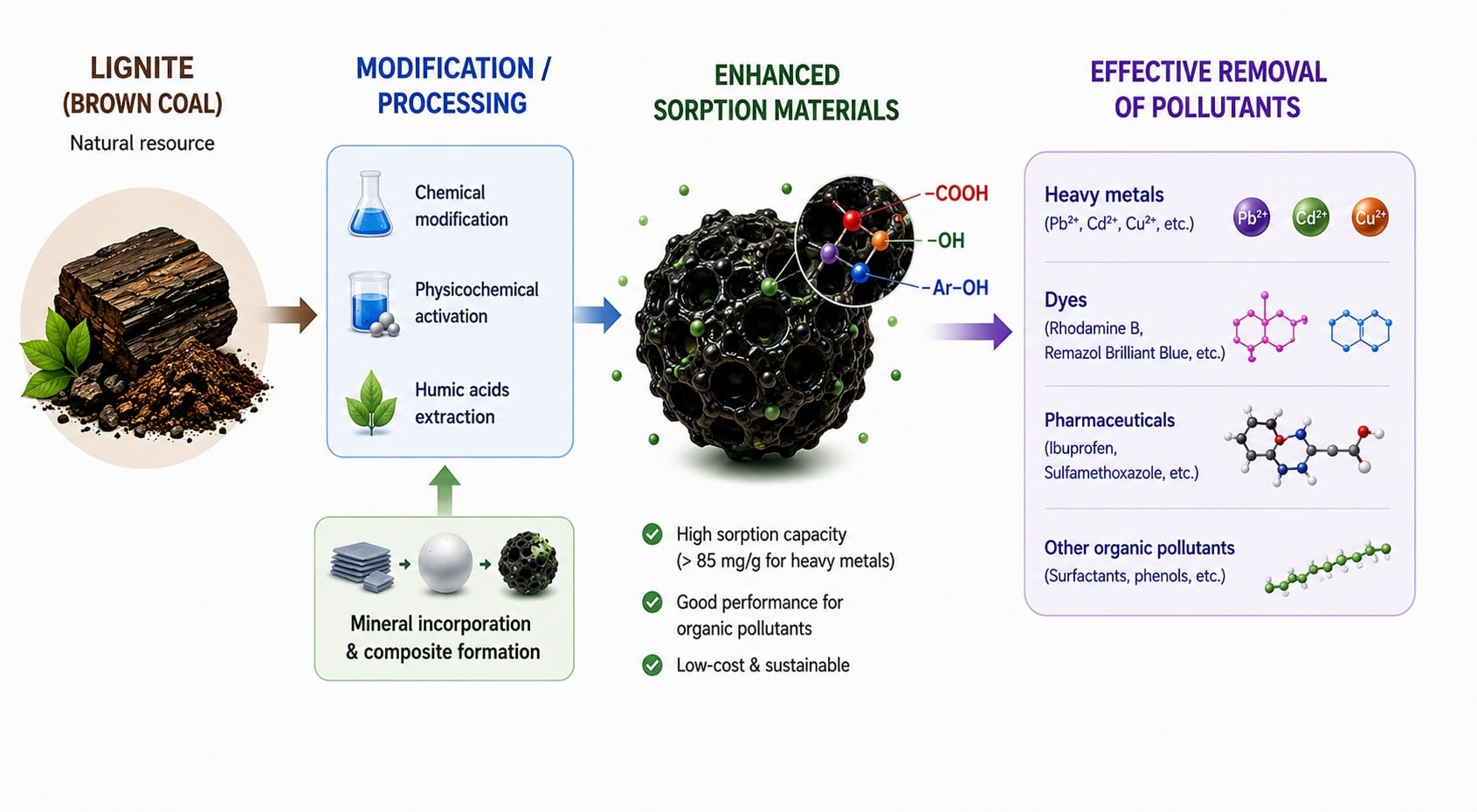
The production of inexpensive, effective sorbents from natural materials for the purification of water bodies and/or soils is a pressing problem. Therefore, the purpose of this manuscript is to summarize current approaches to the use of brown coal (lignite) and its processing products (humic acids, HAs) as sorbents for the purification of aqueous and soil environments from heavy metal ions and other pollutants. Modification of lignite (chemical, biological, physicochemical) or the creation of lignite–mineral composites significantly increases its sorption capacity and stability: after modification, the sorption capacity can reach more than 85 mg of heavy metals per g of sorbent, which is only 3 times lower than that of specialized, expensive sorbents. Also, good results are achieved in the case of sorption of water-soluble organic drugs, dyes, etc. Humic acids obtained from brown coal have better selectivity and efficiency than the original lignite, and slightly worse than the modified one, in terms of removing cadmium, lead, copper, and other toxic elements; and also, can complex with organic xenobiotics. Current research trends indicate growing interest in multifunctional composite sorbents, environmentally friendly extraction technologies, and the development of materials with enhanced selectivity and regeneration ability. Future studies should focus on improving the understanding of sorption mechanisms, optimizing modification strategies, scaling up lignite-based technologies for practical environmental applications, and developing waste-free technologies to produce sorbents from lignite.
Share and Cite
MDPI and ACS Style
Pyshyev, S.; Shved, M.; Lypko, Y.; Hordiienko, A.
State of the Art in the Use of Lignite and Its Processing Products for the Sorption of Heavy Metals and Organic Pollutants: A Review. ChemEngineering 2026, 10, 73.
https://doi.org/10.3390/chemengineering10060073
AMA Style
Pyshyev S, Shved M, Lypko Y, Hordiienko A.
State of the Art in the Use of Lignite and Its Processing Products for the Sorption of Heavy Metals and Organic Pollutants: A Review. ChemEngineering. 2026; 10(6):73.
https://doi.org/10.3390/chemengineering10060073
Chicago/Turabian Style
Pyshyev, Serhiy, Mariia Shved, Yurii Lypko, and Anatolii Hordiienko.
2026. "State of the Art in the Use of Lignite and Its Processing Products for the Sorption of Heavy Metals and Organic Pollutants: A Review" ChemEngineering 10, no. 6: 73.
https://doi.org/10.3390/chemengineering10060073
APA Style
Pyshyev, S., Shved, M., Lypko, Y., & Hordiienko, A.
(2026). State of the Art in the Use of Lignite and Its Processing Products for the Sorption of Heavy Metals and Organic Pollutants: A Review. ChemEngineering, 10(6), 73.
https://doi.org/10.3390/chemengineering10060073
Article Metrics
Article Access Statistics
For more information on the journal statistics, click
here.
Multiple requests from the same IP address are counted as one view.