Article

Thermodynamic Origin of the Elusive Orthorhombic Phase of PrP5O14: A First-Principles Study

1
DCITIMAC, MALTA Consolider Team, Universidad de Cantabria, 39005 Santander, Spain
2
Departamento de Física, MALTA Consolider Team, Universidad de La Laguna, 38205 San Cristóbal de La Laguna, Spain
*
Authors to whom correspondence should be addressed.
ChemEngineering 2026, 10(5), 60; https://doi.org/10.3390/chemengineering10050060
Submission received: 27 March 2026 / Revised: 28 April 2026 / Accepted: 9 May 2026 / Published: 12 May 2026
(This article belongs to the Topic Advanced Materials in Chemical Engineering)

Abstract

The stability of the competing orthorhombic Pnma and monoclinic P21/c phases of Praseodymium pentaphosphate (PrP5O14) have been studied using density functional theory (DFT). At 0 K, the Pnma structure is found to be preferred over the P21/c one with the enthalpy change with pressure of both phases highlighting a shift in phase preference from Pnma to P21/c at ∼2.5 GPa. Independently of the predicted high-pressure structural phase transition at 0 K, our computed elastic properties and phonon dispersion bands as a function of pressure indicate a phonon instability at ∼4.5 GPa due to the appearance of imaginary frequencies, followed by a dynamical instability at 8.5 GPa due to the violation of the Born criteria on the Pnma structure of PrP5O14. These results eliminate the orthorhombic structure as a possible high-pressure candidate for the monoclinic P21/c polymorph. Furthermore, the relative stability of the orthorhombic and monoclinic polymorphs has been evaluated at ambient pressure and as a function of temperature by means of vibrational free-energy calculations. The results indicate a free-energy crossing at 42 K, with the Pnma phase being energetically favored from 0 K to 42 K, after which the P21/c phase becomes preferred. These results demonstrate why PrP5O14 can only be obtained at ambient pressure in the monoclicnic P21/c polymorph, different to other rare earth pentaphosphates.

1. Introduction

Lanthanide pentaphosphates (LnP5O14) exhibit diverse structural symmetries and functional properties, including luminescence, ferroelasticity, and nonlinear optical behavior [1,2,3,4,5,6]. Their stability is significantly influenced by the lanthanide contraction [7], in which the ionic radius [8] decreases from 1.16 Å for La3+ to 0.977 Å for Lu3+ in an eight-fold coordination. This progressive reduction in ionic size drives a distinct structural bifurcation at ambient conditions between the available stable polymorphs of each compound [9]. Previous studies revealed a strong correlation between ionic radius and crystal symmetry in the lanthanide ultraphosphate series [10]. Lanthanides with smaller radii, typically from Dy3+ (1.027 Å in eightfold coordination) to Lu3+ (0.977 Å), stabilize in the orthorhombic (Pnma) phase at room temperature. However, those with larger radii from La3+ (1.160 Å) to Gd3+ (1.053 Å), preferentially adopt the monoclinic symmetry P21/c. Interestingly, despite their large ionic radii, La3+ (1.160 Å) and Ce3+ (1.143 Å) can crystallize in the orthorhombic structure under ambient conditions. Experimental studies employing high-temperature solid-state and solution methods have reported the orthorhombic polymorph for both LaP5O14 [11] and CeP5O14 [12] at room temperature, despite presenting the largest ionic radii of the series. The orthorhombic polymorph of lanthanide pentaphosphates is particularly attractive for optical applications because of its more robust framework compared to the monoclinic polymorph, which is more favorable for low-expansion optical materials, as has been revealed by previous thermal and thermogravimetric analyses [2].
Within this context, praseodymium (Pr3+ with 1.126 Å) occupies a particularly intriguing position. Although it has an ionic radius comparable to that of La3+ and Ce3+, PrP5O14 only stabilizes in the monoclinic phase at ambient temperature [13]. X-ray diffraction experiments have shown that PrP5O14 undergoes a reversible ferroelelastic [14] monoclinic P21/c to orthorhombic Pnma transition at about 403 K, underscoring the delicate energetic balance between polymorphs [15]. Under high pressure, Raman spectroscopy reveals a pressure-induced phase transition at around 7.5 GPa to an unknown structure, highlighting its sensitivity to external perturbations [16]. This structural behavior makes PrP5O14 interesting for examining its polymorphs, especially the orthorhombic phase at ambient and high pressures to determine the conditions under which it can be stabilized, and is essential for interpreting the pressure-induced structural evolution in these lanthanide ultraphosphates.
In this work, we carry out first-principles calculations to investigate the structural behavior of PrP5O14 in its orthorhombic Pnma and monoclinic P21/c phases under high-pressure conditions. Our calculations demonstrate that the orthorhombic phase is energetically favored at ambient conditions, yet becomes unstable under compression on the basis of structural, mechanical, and vibrational properties. Furthermore, the stability of the orthorhombic phase across a temperature range was examined using phonon-based free energy calculations. These findings provide new insight into the interplay between ionic radius, lattice distortion, and phase stability in LnP5O14 compounds, with implications for tuning of the structure–property relationships in complex phosphates.

2. Computational Methods

All of the calculations have been performed utilizing density functional theory (DFT) [17,18]. Previous studies on rare-earth oxides under pressure using DFT demonstrate that this approach provides accurate structural, elastic, and phonon properties, supporting its suitability for the present investigation [19,20,21]. The VASP package [22] has been used to do computations using the pseudopotential technique and the projector augmented wave scheme (PAW) [23]. The exchange-correlation energy was taken in the generalized gradient approximation (GGA) with the PBEsol (Perdew–Berke–Ernzerhof for solids) [24]. The valence electronic configurations of Pr, P, and O are [Xe] 4f36s2, [Ne] 3s23p3, and [He] 2s22p4, respectively. The energy cutoff of 520 eV was chosen to achieve highly converged results. Integrations along the Brillouin zone (BZ), were carried out with k-special points sampling of 4 × 4 × 2 using a dense Monkhorst–Pack grid of k-points [25]. For each defined volume, the structures were fully optimized to equilibrium by evaluating both the atomic forces and the stress tensor. In the relaxed configurations, the force tolerance was less than 0.006 eV/Å. Also, the stress tensor deviates below 0.1 GPa from a diagonal hydrostatic form. For elastic properties, the elastic constants C i j were obtained by using the stress–strain method [26]. The vibrational properties and thermal free energies were calculated within the harmonic approximation using Phonopy [27] at the Γ point of the BZ. To obtain the phonon dispersion and check the dynamical stability of the analyzed structures a 2 × 2 × 2 supercell was used. The force constant approach [28] was used to get highly converged results for the calculation of the dynamical matrix.

3. Results and Discussion

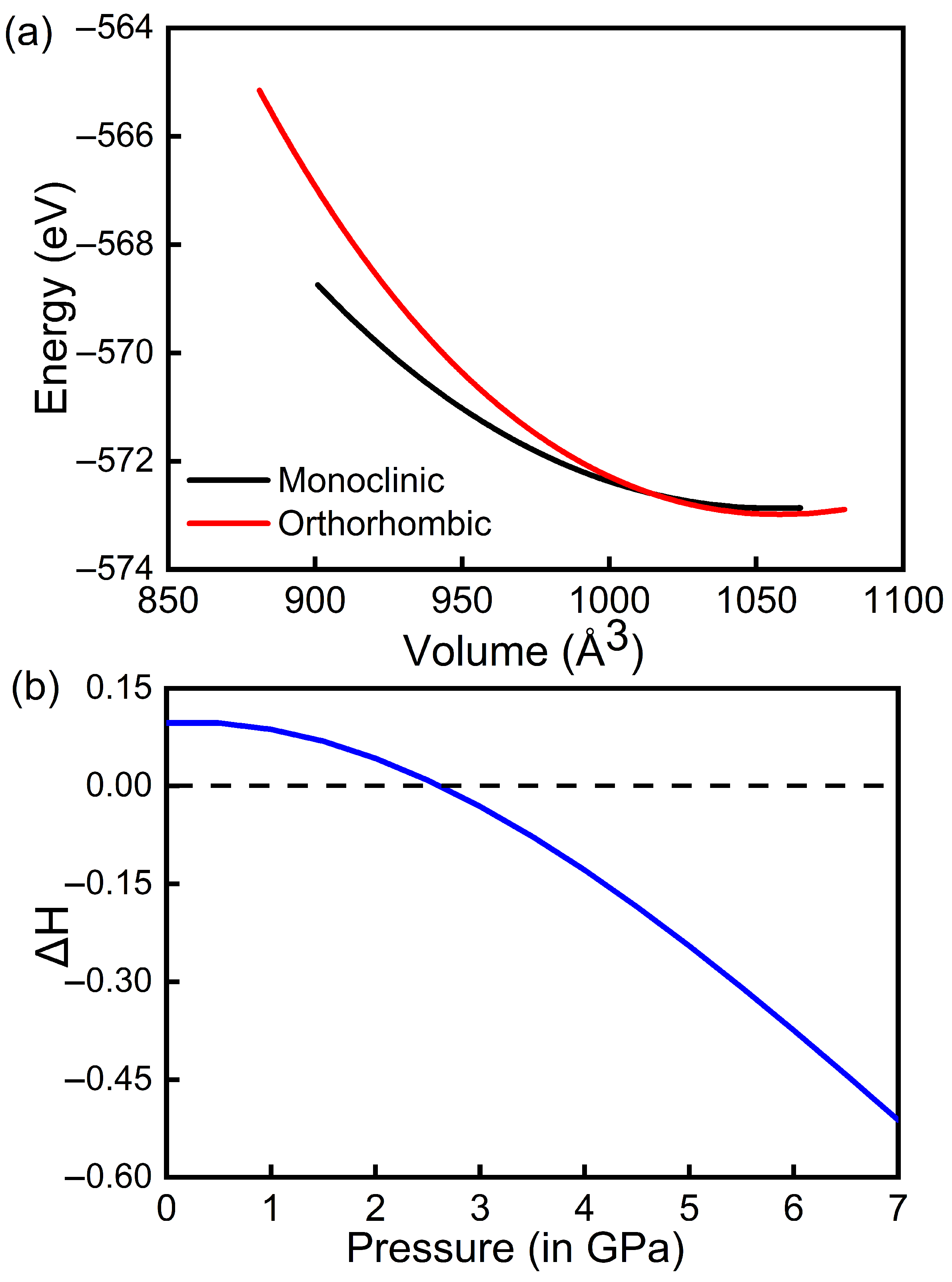
The two possible low-energy orthorhombic Pnma (space group 62) and monoclinic P21/c (space group 14) configurations of PrP5O14 have been studied. The optimized lattice parameters and corresponding primitive-cell volumes obtained at ambient pressure for both structures are summarized in Table 1. These values agree well with previous experimental results [13], and are also similar to those reported for other LnP5O14, presenting the orthorhombic structure such as NdP5O14 [29] and ErP5O14 [30]. The change in the unit-cell volume as a function of energy along with the enthalpy variation with pressure is depicted in Figure 1. The energy-volume data have been analyzed for both phases using a third-order Birch–Murnaghan equation of state (EOS) [31] obtaining a bulk modulus of K 0 = 65.64 GPa and K 0 = 48.93 GPa for the orthorhombic and the monoclinic structures, respectively. At ambient pressure, the equilibrium unit-cell volume V 0 is calculated to be 1057 Å3 for the monoclinic and 1058 Å3 for the orthorhombic phase. It can be seen that a lower total energy of about −573 eV is obtained for the orthorhombic structure relative to the monoclinic one, which is around −572.8 eV, confirming it as the energetically favored structure at 0 K. At reduced volumes, which represent higher pressures, the EV curve of the Pnma phase intersects that of the P21/c one.
Based on the behavior of the energy–volume curves, we further estimated the variation of the difference in enthalpy Δ H = H m o n o H o r t h o with pressure at T = 0 K. At low pressures, Δ H remains positive, indicating that the orthorhombic phase is thermodynamically favored. However, with increasing compression, the Δ H decreases steadily, reflecting the greater enthalpy stabilization of the monoclinic lattice under pressure. The plot reveals a crossover, where the Δ H approaches zero at around 2.5 GPa, which would mark the onset of the Pnma to P21/c phase transition. Hence, according to the calculated total energies and enthalpy, the orthorhombic polymorph should be stable at ambient pressure and, in fact, it should remain more stable than the monoclinic polymorph up to 2.5 GPa.
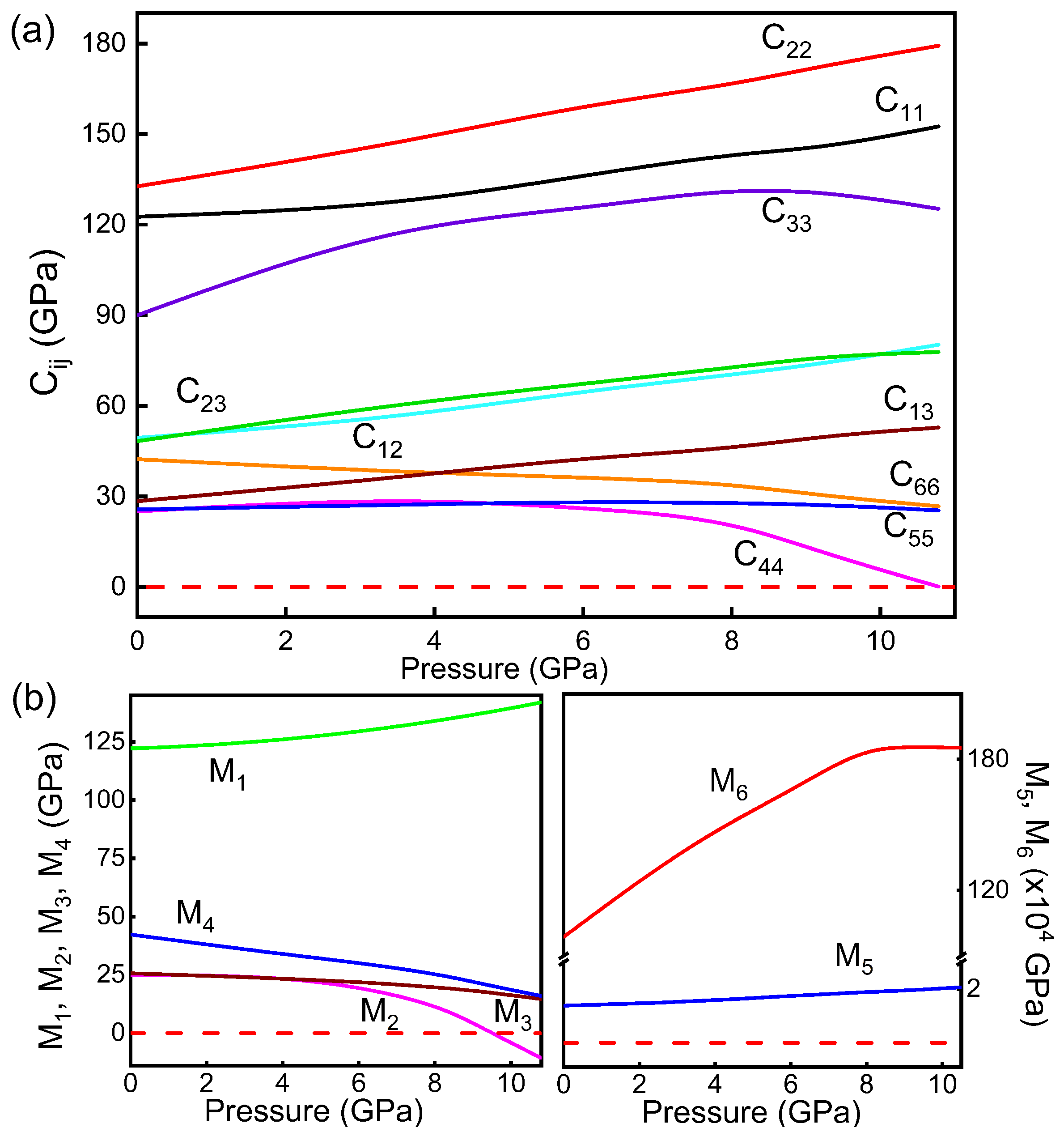
However, we know that experimentally, the Pnma phase does not form at ambient pressure. Therefore, the possible reason should be either a mechanical or a dynamic instability or both occurring at ambient pressure. To investigate this possibility, the elastic properties were evaluated at ambient as well as under varying pressure. The monoclinic structure contains thirteen independent elastic constants, whereas the orthorhombic structure has nine ( C 11 , C 22 , C 33 , C 44 , C 55 , C 66 , C 12 , C 13 , C 23 ). Their pressure evolution for the orthorhombic phase are shown in Figure 2a. At ambient pressure, both symmetries satisfy their corresponding Born stability criteria [32,33], confirming their mechanical robustness. Upon compression, the monoclinic phase continues to exhibit positive elastic constants throughout the entire investigated pressure range and satisfies the generalized Born criteria for monoclinic symmetry. However, the orthorhombic phase does not preserve this behavior. Under hydrostatic pressure, the generalized Born mechanical stability criteria for an orthorhombic crystal at any applied stress [32,33] are given by:
M 1 = C 11 > 0 , M 2 = C 44 > 0 , M 3 = C 55 > 0 , M 4 = C 66 > 0 , M 5 = C 11 C 22 C 12 2 > 0 , M 6 = C 11 C 22 C 33 C 11 C 23 2 C 22 C 13 2 C 33 C 12 2 + 2 C 12 C 13 C 23 > 0
With increasing pressure, the orthorhombic phase no longer fulfills all these stability conditions and becomes unstable at approximately 9 GPa, as illustrated in Figure 2b. This value is 6.5 GPa above the pressure at which the structural instability occurs. In particular, the M2 > 0 criterion is violated, causing the onset of pressure induced mechanical instability associated with shear softening. Therefore, the orthorhombic structure is also mechanically stable at ambient pressure and becomes mechanically unstable only at around 6.5 GPa above the predicted structural Pnma to P21/c phase transition.
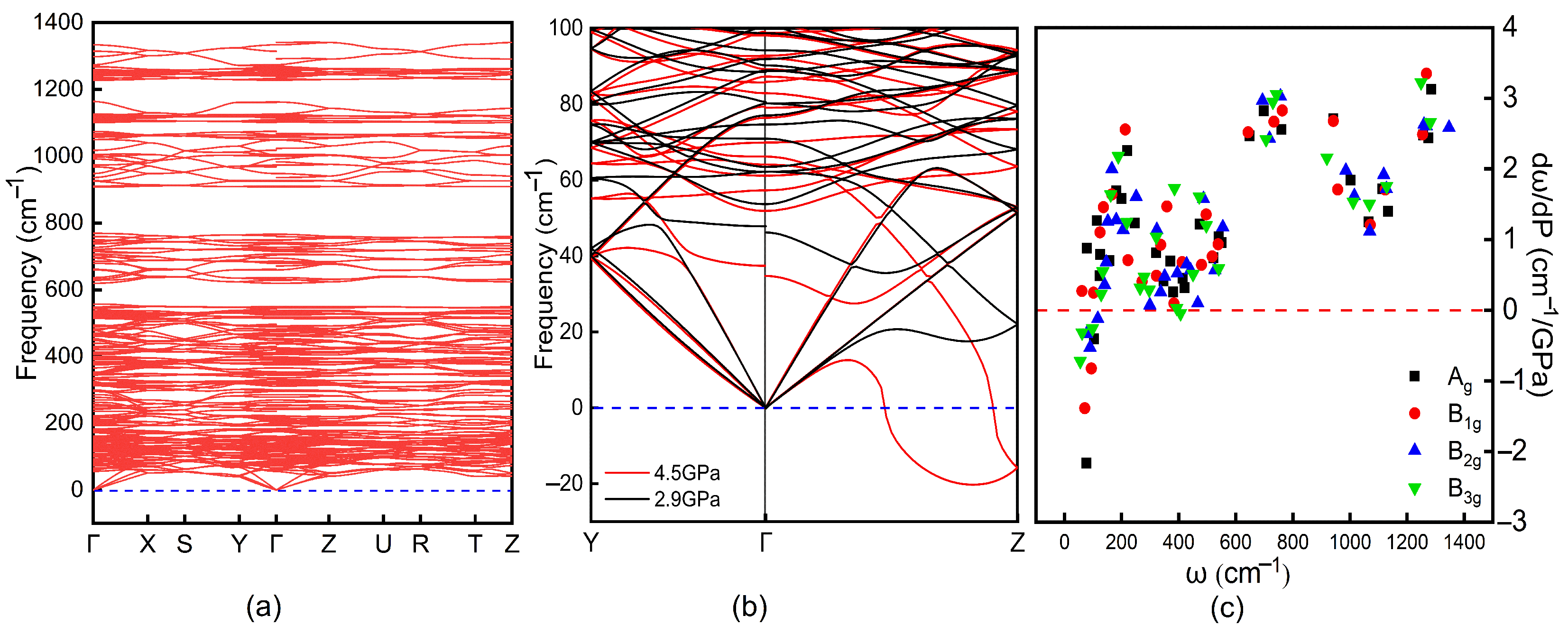
In order to test the dynamical stability, we show in Figure 3a the phonon dispersion relation of the Pnma polymorph of PrP5O14 at 0 GPa. It exhibits real frequencies, consistent with thermodynamic stability. In Figure 3b, the calculated phonon spectra at 2.9 GPa show the same qualitative behavior where all phonon branches are positive throughout the entire BZ. However, as the external pressure is increased to 4.5 GPa, a notable change emerges, as shown in Figure 3b. Imaginary phonon modes appear along the Γ -Z direction, indicating pressure-induced dynamical instability. This suggests that PrP5O14 may undergo a structural phase transition, likely associated with the softening of an acoustic phonon mode along the Γ -Z direction.
Although the appearance of imaginary frequencies occurs outside the zone center, the fast softening of some of the modes can also be observed for the orthorhombic phase in Figure 3c. The orthorhombic, Pnma, phase of PrP5O14 contains four formula units per unit cell (80 atoms). According to theoretical group considerations, it has 240 vibrational modes from which 120 modes are Raman-active modes ( Γ R ), 89 infrared-active modes ( Γ I R ), 28 silent modes ( Γ S ), and 3 acoustic ( Γ A ) modes:
Γ R I = 32 A g + 28 B 1 g + 32 B 2 g + 28 B 3 g , Γ I R = 31 B 1 u + 27 B 2 u + 31 B 3 u , Γ S I = 28 A u , Γ A I = B 1 u + B 2 u + B 3 u
The pressure coefficients (d ω /dP) of Raman-active phonons as a function of their zero-pressure frequencies ( ω o ) of the orthorhombic phase are shown in Figure 3c. The high frequency region (above 600 cm−1) shows the largest d ω /dP values, indicating that the internal P–O stretching vibrations stiffen strongly under pressure. Meanwhile, the cluster of low frequency modes exhibits much smaller d ω /dP values, reflecting their weaker sensitivity to pressure. There are a considerable number of negative pressure coefficients, implying that several low energy vibrations (those involving the lattice) undergo softening, consistent with the pressure induced instabilities observed in the phonon dispersion curves. The frequency-dependent behavior of our calculated pressure coefficients agrees well with the experimental observations [16], particularly the strong pressure response of the high frequency vibrations.
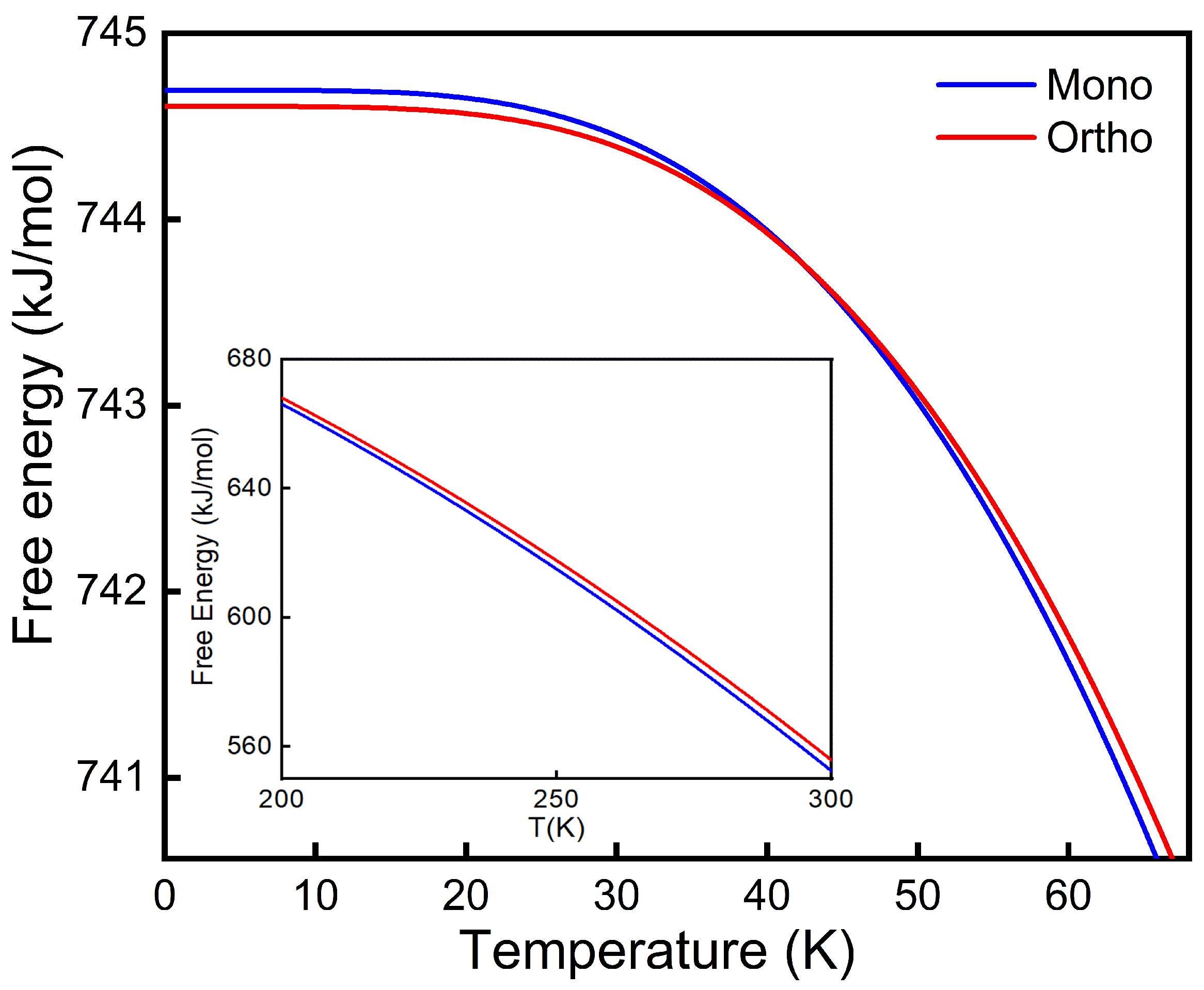
So far, our calculations demonstrated that the Pnma polymorph is stable at ambient pressure and undergoes a structural phase transition at 2.5 GPa. This transition occurs about 2 GPa before undergoing a dynamical instability and around 6.5 GPa, before the phase becomes mechanically unstable. However, there is an important point that must be addressed. All our calculations have been performed at 0 K, but the synthesis of PrP5O14 is performed above ambient temperature. In order to evaluate the stability of the orthorhombic PrP5O14 polymorph under thermal effects, we have computed the free energy for both P21/c and Pnma structures as a function of temperature. The temperature-dependent Helmholtz free-energy curves for the orthorhombic and monoclinic phases at zero pressure can be derived from the phonon density of states as shown in Figure 4. At 0 K, the orthorhombic phase exhibits the lowest free energy and is therefore the thermodynamically stable configuration. This stability persists until the temperature reaches approximately 42 K. Beyond this point, the monoclinic phase becomes energetically preferred due to its decrease in free energy with temperature. This behavior reflects the higher vibrational entropy of the monoclinic structure. An inset showing the free-energy evolution up to 300 K is included to highlight that the monoclinic phase continues to possess the lower free energy at room temperature, and therefore is the only stable polymorph at ambient conditions for PrP5O14.

4. Conclusions

The combined analysis of the structural, mechanical, and lattice dynamics sheds light on the behavior of orthorhombic and monoclinic phases of PrP5O14 at ambient conditions and under compression. Our theoretical analysis demonstrates why the orthorhombic phase of PrP5O14 is not stable at ambient conditions, unlike its neighboring compounds LaP5O14 and CeP5O14, which have been successfully synthesized experimentally at room temperature. This outcome is particularly notable because the ionic radius of Pr3+ in the lanthanide series is very close to that of Ce3+ and La3+, yet the corresponding phase does not appear to form. Additionally, earlier experimental Raman spectra suggest a pressure-induced phase transition near 7.5 GPa, which our calculations show that the emerging phase corresponds to a configuration distinct from orthorhombic Pnma structure. Overall, these results provide valuable insight into the structural behavior of lanthanide pentaphosphates and can guide future experimental and theoretical exploration.

Author Contributions

Conceptualization, S.F.L.-L., A.M., J.R.-F. and V.M.; methodology, A.M., J.R.-F. and V.M.; Software, M.S.L.M., A.M., P.R.-H. and V.M.; Validation, A.M. and V.M.; Formal analysis, A.M. and V.M.; Investigation, M.S.L.M., A.M., P.R.-H., J.R.-F. and V.M.; Resources, J.R.-F. and V.M.; Data curation, M.S.L.M., A.M. and V.M.; Writing—original draft, M.S.L.M. and J.R.-F.; Writing—review and editing, M.S.L.M., S.F.L.-L., A.M., P.R.-H., J.R.-F. and V.M.; Visualization, M.S.L.M., A.M. and V.M.; Supervision, J.R.-F. and V.M.; Project administration, J.R.-F. and V.M.; Funding acquisition, J.R.-F. and V.M. All authors have read and agreed to the published version of the manuscript.

Funding

This research was funded by the Spanish Ministerio de Ciencia e Innovación and the Agencia Estatal de Investigación (MICIU/AEI/10.13039/501100011033) and FEDER under I+D+i projects PID2021-125927NA-C22, PID2022-138076NB-C44, and CNS2024-154508.

Data Availability Statement

The original contributions presented in this study are included in the article. Further inquiries can be directed to the corresponding authors.

Acknowledgments

M.S.L.M. thanks the Universidad de Cantabria for a predoctoral Concepción Arenal fellowship.

Conflicts of Interest

The authors declare no conflicts of interest.

References

  1. Marciniak, L.; Strek, W.; Guyot, Y.; Hreniak, D. Synthesis and luminescent properties of La1−x NdxP5O14 nanocrystals. Phys. Chem. Chem. Phys. 2014, 16, 18004–18009. [Google Scholar] [CrossRef] [PubMed]
  2. Mbarek, A.; Chadeyron, G.; Avignant, D.; Boyer, D.; Fourati, M.; Zambon, D. Structural and optical characterizations of rare earth pentaphosphates LnP5O14 (Ln = La, Gd) synthesized by the sol–gel process. J. Sol-Gel Sci. Technol. 2013, 68, 193–203. [Google Scholar] [CrossRef]
  3. Ting, C.; Guang-Yan, H. Raman-spectroscopic study of ferroelastic phase transition in lanthanide pentaphosphates. Chin. Phys. 1987, 7, 422–429. [Google Scholar]
  4. Kobayashi, T.; Sawada, T.; Ikeo, H.; Muto, K.; Kai, J. Ferroelasticity in ReP5O14 (Re: La–Tb). J. Phys. Soc. Jpn. 1976, 40, 595–596. [Google Scholar]
  5. Katsumata, T.; Saito, K.; Honda, T.; Sakaguchi, A.; Komuro, S.; Aizawa, H. X-ray excited optical luminescence from TbP5O14 and EuP5O14. ECS Solid State Lett. 2014, 3, R26. [Google Scholar] [CrossRef]
  6. Aucoin, T.R.; Schwartz, A.; Wade, M.J.; Gualtieri, J.G. Rare-Earth Pentaphosphates for Miniaturized Laser Applications; Technical Report; US Army Electronics Command Fort Monmoutn: Fort Monmouth, NJ, USA, 1977. [Google Scholar]
  7. Wilharm, R.K.; Huang, S.Y.; Gugger, I.J.; Pierre, V.C. A walk across the lanthanide series: Trend in affinity for phosphate and stability of lanthanide receptors from La (III) to Lu (III). Inorg. Chem. 2021, 60, 15808–15817. [Google Scholar] [CrossRef] [PubMed]
  8. Shannon, R.D. Revised effective ionic radii and systematic studies of interatomic distances in halides and chalcogenides. Found. Crystallogr. 1976, 32, 751–767. [Google Scholar] [CrossRef]
  9. Cai, Q.R.; Lan, G.X.; Wang, H.F.; Hong, G.Y. The effect of pressure on the ferroelastic phase transition in LnP5O14. J. Phys. Chem. Solids 1990, 51, 279–282. [Google Scholar] [CrossRef]
  10. Bagieu-Beucher, M.; Tranqui, D. Les ultraphosphates de terres rares et d’yttrium du type TP5O14. Bull. Minéral. 1970, 93, 505–508. [Google Scholar] [CrossRef]
  11. Zhu, J.; Chen, H.; Wang, Y.D.; Zhang, S.; Cheng, W.D.; Guan, H.T. An Orthorhombic Polymorph of Lanthanum Ultraphosphate LaP5O14: Synthesis, Structure and Density Functional Study. Chin. J. Struct. Chem. 2011, 30, 648–653. [Google Scholar]
  12. Zhu, J.; Cheng, W.D.; Zhang, H. An orthorhombic polymorph of cerium (III) ultraphosphate, CeP5O14. Struct. Rep. 2008, 64, i74. [Google Scholar] [CrossRef]
  13. Borkowski, B.; Grzesiak, E.; Kaczmarek, F.; Ka, Z.; Karolczak, J.; Szymański, M. Chemical synthesis and crystal growth of laser quality praseodymium pentaphosphate. J. Cryst. Growth 1978, 44, 320–324. [Google Scholar] [CrossRef]
  14. Weber, H.; Tofield, B.; Liao, P. Ferroelastic behavior and the monoclinic-to-orthorhombic phase transition in MP5O14 (M = La − Tb). Phys. Rev. B 1975, 11, 1152. [Google Scholar]
  15. Liu, S.Z.; Hong, G.Y.; Hu, N.H. Crystal structure and ferroelastic domain of PrP5O14. ACTA Phys. Sin. 1991, 40, 64–69. [Google Scholar]
  16. Lan, G.X.; Cai, Q.R.; Wang, H.F.; Hong, G.Y. High-pressure Raman spectra of LnP5O14 crystals. J. Phys. Chem. Solids 1990, 51, 273–278. [Google Scholar] [CrossRef]
  17. Hohenberg, P.; Kohn, W. Inhomogeneous electron gas. Phys. Rev. 1964, 136, B864. [Google Scholar] [CrossRef]
  18. Kohn, W.; Sham, L.J. Self-consistent equations including exchange and correlation effects. Phys. Rev. 1965, 140, A1133. [Google Scholar] [CrossRef]
  19. Sans, J.A.; Monteseguro, V.; Garbarino, G.; Gich, M.; Cerantola, V.; Cuartero, V.; Monte, M.; Irifune, T.; Muñoz, A.; Popescu, C. Stability and nature of the volume collapse of ε-Fe2O3 under extreme conditions. Nat. Commun. 2018, 9, 4554. [Google Scholar] [CrossRef] [PubMed]
  20. Monteseguro, V.; Rodríguez-Hernández, P.; Ortiz, H.; Venkatramu, V.; Manjón, F.; Jayasankar, C.; Lavín, V.; Muñoz, A. Structural, elastic and vibrational properties of nanocrystalline lutetium gallium garnet under high pressure. Phys. Chem. Chem. Phys. 2015, 17, 9454–9464. [Google Scholar] [CrossRef] [PubMed]
  21. Monteseguro, V.; Rodríguez-Hernández, P.; Vilaplana, R.; Manjón, F.; Venkatramu, V.; Errandonea, D.; Lavín, V.; Munoz, A. Lattice dynamics study of nanocrystalline yttrium gallium garnet at high pressure. J. Phys. Chem. C 2014, 118, 13177–13185. [Google Scholar] [CrossRef]
  22. Kresse, G.; Furthmüller, J. Efficient iterative schemes for ab initio total-energy calculations using a plane-wave basis set. Phys. Rev. B 1996, 54, 11169. [Google Scholar] [CrossRef]
  23. Kresse, G.; Joubert, D. From ultrasoft pseudopotentials to the projector augmented-wave method. Phys. Rev. B 1999, 59, 1758. [Google Scholar] [CrossRef]
  24. Perdew, J.P.; Ruzsinszky, A.; Csonka, G.I.; Vydrov, O.A.; Scuseria, G.E.; Constantin, L.A.; Zhou, X.; Burke, K. Restoring the density-gradient expansion for exchange in solids and surfaces. Phys. Rev. Lett. 2008, 100, 136406. [Google Scholar] [CrossRef]
  25. Monkhorst, H.J.; Pack, J.D. Special points for Brillouin-zone integrations. Phys. Rev. B 1976, 13, 5188. [Google Scholar] [CrossRef]
  26. Milman, V.; Warren, M. Elastic properties of TiB2 and MgB2. J. Phys. Condens. Matter 2001, 13, 5585. [Google Scholar] [CrossRef]
  27. Togo, A.; Tanaka, I. First principles phonon calculations in materials science. Scr. Mater. 2015, 108, 1–5. [Google Scholar] [CrossRef]
  28. Parlinski, K.; Li, Z.; Kawazoe, Y. First-principles determination of the soft mode in cubic ZrO2. Phys. Rev. Lett. 1997, 78, 4063. [Google Scholar] [CrossRef]
  29. Albrand, K.R.; Attig, R.; Fenner, J.; Jeser, J.; Mootz, D. Crystal structure of the laser material NdP5O14. Mater. Res. Bull. 1974, 9, 129–140. [Google Scholar] [CrossRef]
  30. Katrusiak, A.; Kaczmarek, F. Orthorhombic polymorph of ErP5O14, crystal structure and characterization. Cryst. Res. Technol. 1995, 30, 501–507. [Google Scholar] [CrossRef]
  31. Murnaghan, F.D. The compressibility of media under extreme pressures. Proc. Natl. Acad. Sci. USA 1944, 30, 244–247. [Google Scholar] [CrossRef]
  32. Born, M.; Huang, K. Dynamical Theory of Crystal Lattices; Oxford University Press: Oxford, UK, 1996. [Google Scholar]
  33. Nye, J.F. Physical Properties of Crystals: Their Representation by Tensors and Matrices; Oxford University Press: Oxford, UK, 1985. [Google Scholar]
Figure 1. (a) Calculated total energy versus unit cell volume and (b) change in enthalpy versus pressure per primitive cell in both monoclinic and orthorhombic phases of PrP5O14 crystal.
Chemengineering 10 00060 g001
Figure 2. (a) Pressure dependence of elastic constants C i j and (b) pressure evolution of stability criteria in the orthorhombic Pnma phase of PrP5O14 crystal.
Chemengineering 10 00060 g002
Figure 3. (a) Phonon dispersion at 0 GPa pressure for orthorhombic Pnma phase, (b) phonon dispersion at pressures 2.9 GPa (black) and 4.5 GPa (red) along the Y- Γ -Z direction, and (c) pressure coefficients (d ω /dP) of Raman-active vibrational modes plotted as a function of their ambient frequencies ω o for the orthorhombic phase of PrP5O14.
Chemengineering 10 00060 g003
Figure 4. Calculated free-energy variation with temperature at 0 GPa for both monoclinic and orthorhombic polymorphs PrP5O14. (Inset) Free-energy variation with temperature up to 300 K, showing the onset of thermodynamic stabilization at ambient conditions.
Chemengineering 10 00060 g004
Table 1. Calculated lattice parameters and unit cell volume along with experimental values of PrP5O14 at ambient pressure for orthorhombic and monoclinic phases.
PhaseParameterExperiment [13]This Work
Orthorhombic (Pnma)a (Å)-8.819
b (Å)-13.033
c (Å)-9.136
V (Å3)-1058
K0 (in GPa)-65.64
K’-3.32
Monoclinic (P21/c)a(Å)8.78 ± 0.038.832
b (Å)9.02 ± 0.019.078
c (Å)13.02 ± 0.0313.096
β 90.5°90.55°
V (Å3)1031.11057
K0 (in GPa)-48.93
K’-2.20
Disclaimer/Publisher’s Note: The statements, opinions and data contained in all publications are solely those of the individual author(s) and contributor(s) and not of MDPI and/or the editor(s). MDPI and/or the editor(s) disclaim responsibility for any injury to people or property resulting from any ideas, methods, instructions or products referred to in the content.