Article

Effect of Cone Length on Separation Efficiency and Flow Characteristics in a Hydrocyclone

1
Department of Chemical and Materials Engineering, Tamkang University, 151 Ying-chuan Road, Tamsui, Taipei County 25137, Taiwan
2
Department of Safety Health and Environmental Engineering, Ming Chi University of Technology, Taishan, New Taipei City 24301, Taiwan
*
Author to whom correspondence should be addressed.
ChemEngineering 2026, 10(4), 55; https://doi.org/10.3390/chemengineering10040055
Submission received: 19 January 2026 / Revised: 28 February 2026 / Accepted: 14 April 2026 / Published: 21 April 2026

Abstract

In this work, hydrocyclones with a diameter of 45 mm and cone lengths of 85 mm and 110 mm were employed to investigate the classification behavior of silicon carbide particles. Numerical simulations were carried out using FLUENT based on computational fluid dynamics (CFD). The internal flow characteristics were modeled using the Volume of Fluid (VOF) approach for multiphase flow, coupled with the Large Eddy Simulation (LES) turbulence model. Furthermore, the Discrete Phase Model (DPM) was applied to track particle trajectories and analyze their dynamic behavior within the hydrocyclone. The experimental results showed that, under identical inlet pressure conditions, the hydrocyclone with a cone length of 110 mm achieved superior separation efficiency. Increasing the cone length leads to a reduction in cone angle, which contributes to improved classification performance. However, practical design constraints limit the extent to which the cone length can be increased. To further explore this effect, an extended cone geometry of 150 mm was investigated through numerical simulation. The CFD results indicate that a longer cone structure enhances air core stability, prolongs particle residence time, and decreases the probability of particle misclassification. These findings suggest that optimizing cone length is an effective strategy for improving hydrocyclone performance. The novelty of this study lies in the integration of experimental validation and numerical simulation to systematically evaluate both practical and extended cone designs, thereby providing deeper insights into the relationship between structural parameters and separation efficiency.

1. Introduction

Environmental and sustainability considerations increasingly drive the development of efficient separation technologies that enhance product quality while enabling the recovery of valuable resources. Across a wide range of industries—including mineral metallurgy [1], water treatment [2,3], chemical engineering [4,5], and the rapidly advancing green energy sector [6]—effective separation processes are essential for increasing added value while minimizing environmental impact and degradation. Within these applications, hydrocyclones have attracted significant attention due to their durable construction, strong mechanical properties, stable flow dynamics, and high separation efficiency. Their compact configuration makes them particularly suitable for solid–liquid separation in systems that require portability, straightforward installation, or efficient storage. As a result, hydrocyclones remain a critical component in modern industrial separation systems.
A substantial body of work has focused on elucidating the internal flow mechanisms that govern hydrocyclone performance. Chu et al. [7,8,9] conducted a series of investigations examining particle motion behavior and energy consumption characteristics. Their results revealed that particle size decreases progressively from the outer wall toward the core region, while peak particle concentration occurs near the loci of zero vertical velocity (LZVV) rather than directly at the wall. They further identified that the majority of energy dissipation occurs in the central region below the vortex finder, suggesting that controlling axial flow structures is key to reducing energy loss. Complementary research by Zhao and Xia [10] separated total pressure drop into dissipated and effective components, providing a theoretical framework that links pressure conversion to separation performance. The dissipated pressure drop represents the irreversible energy loss mainly caused by turbulence dissipation and viscous effects, which does not directly contribute to particle separation. In contrast, the effective pressure drop refers to the energy represented by the conversion of static pressure into kinetic pressure within the main separation region, which governs separation efficiency. Martinez et al. [11] expanded this understanding by analyzing pressure distribution asymmetry and vortex finder influence, demonstrating that geometric adjustments can significantly stabilize flow structures and air-core behavior.
Recent research on multiphase pre-separation systems has emphasized the role of flow stability and pressure regulation in enhancing separation efficiency. For example, a spiral multiphase pre-separator (SMPPS) has been developed to improve gas–liquid–solid separation in oilfield recovery fluids [12]. Numerical simulations indicated that the introduction of a helical flow structure can mitigate turbulent energy dissipation and facilitate the migration of solid particles toward the wall region, while maintaining a relatively low pressure drop of less than 0.025 MPa.
Under optimized conditions, including a gas fraction of 35–40%, particle sizes ranging from 0.2 to 0.3 mm, and fluid viscosity between 1 and 3 mPa·s, the system achieved gas and solid separation efficiencies exceeding 91% and 73%, respectively. These results demonstrate that well-organized multiphase flow patterns, controlled pressure distribution, and appropriate structural design play key roles in determining separation performance.
Overall, these findings highlight the importance of correlating internal flow characteristics with particle classification behavior, providing valuable insight for the design and optimization of hydrocyclone-based separation systems.
Beyond macroscopic flow behavior, microscale interaction mechanisms also influence separation efficiency. Kraipech et al. [13] showed that particle–particle interactions are primarily significant near hydrocyclone walls and the air core, while particle–fluid interactions dominate elsewhere. Schubert’s theoretical model [14] describing the fishhook effect proposed that shear-induced forces surrounding coarse particles attract finer particles, leading to swarm formation within specific Reynolds number regimes. These findings emphasize that particle interactions, coupled with local flow gradients, contribute to classification performance in complex ways.
Parallel research has investigated structural modifications aimed at improving hydrocyclone efficiency. The Barrozo group [15,16,17,18] replaced conventional conical sections with filtering walls, achieving increased throughput and reduced cut size. Subsequent work demonstrated that combining centrifugal separation with filtration can simultaneously improve efficiency and reduce energy consumption [19]. Additional studies explored cylinder-to-cone ratios, alternative cone geometries, and vortex finder configurations, showing that geometric parameters strongly affect pressure gradients, tangential velocity, air-core stability, and classification sharpness [20,21,22,23,24]. These investigations collectively confirm that hydrocyclone geometry is a dominant factor governing flow organization and separation behavior.
Advances in computational fluid dynamics (CFD) have enabled increasingly detailed analysis of hydrocyclone multiphase flow. Reviews and comparative modeling studies highlight the effectiveness of Reynolds-Averaged Navier–Stokes (RANS) approaches—particularly the Reynolds Stress Model (RSM)—for capturing rotational curvature effects, vortex formation, and shear-layer dynamics [25,26]. CFD investigations have examined cone angle variation, inlet design optimization, convex and reverse geometries, and transient disturbances, providing insights into velocity fields, particle trajectories, and efficiency trends [27,28,29,30,31,32,33]. More advanced approaches, such as the Combined Continuum and Discrete Method (CCDM), allow realistic simulation of particle–fluid interactions in complex geometries [34], further extending predictive capabilities.
Despite these extensive efforts, the specific role of cone length in determining hydrocyclone classification behavior remains insufficiently characterized. Most prior studies emphasize cone angle, geometric ratios, or structural innovations, while cone length is often treated as a secondary parameter. However, cone length directly influences particle residence time, vortex development, pressure evolution, and migration pathways, suggesting a potentially significant impact on separation performance. Experimental investigation of extended cone geometries is frequently constrained by manufacturing limitations, leaving an incomplete understanding of how cone length variation affects internal flow and classification efficiency.
To address this gap, the present study combines controlled laboratory experiments with CFD simulations to systematically evaluate hydrocyclones with different cone lengths. Silicon carbide powder classification experiments were conducted using hydrocyclones with cone lengths of 85 mm and 110 mm, which can be fabricated with high dimensional accuracy for reliable validation. A longer cone configuration of 150 mm—corresponding to a much smaller cone angle and therefore difficult to manufacture precisely—was examined numerically to explore potential performance enhancements beyond experimentally realizable designs. Simulations performed using FLUENT provide detailed insight into flow structures and separation behavior across these configurations.
The novelty of this work lies in establishing an experimentally validated framework that connects manufacturable hydrocyclone geometries with extended simulation-based design exploration. By clarifying how cone length influences internal flow organization and classification efficiency, this study contributes practical guidance for hydrocyclone optimization under real manufacturing constraints. The combined experimental–numerical methodology offers a systematic pathway for improving separation performance in industrial applications.

2. Numerical Methods

In this study, the fluid flow behavior within the flow field is described based on the principle of mass conservation. The continuity condition ensures that the distribution of fluid density and velocity satisfies the law of mass conservation throughout the domain. Assuming the fluid behaves as a Newtonian fluid, the governing equations for momentum conservation are based on the Navier–Stokes framework. These equations take into account the contributions of inertial forces, viscous effects, pressure gradients, and gravitational forces. The inertial term represents the effect of fluid acceleration, while the remaining terms correspond respectively to viscous resistance, pressure forces, and body forces due to gravity.
The numerical simulations were performed using the FLUENT CFD package, incorporating two primary modeling approaches: the Large Eddy Simulation (LES) turbulence model and the Volume of Fluid (VOF) multiphase model. The LES framework is particularly suitable for resolving dominant vortex structures in complex flows. By applying a spatial filtering procedure, turbulent motions smaller than the grid scale are filtered out, while larger eddies are directly resolved. The influence of unresolved small-scale turbulence is accounted for through subgrid-scale modeling, enabling accurate representation of flow dynamics.
Pressure plays a fundamental role in both the continuity and momentum equations, and an appropriate treatment of pressure–velocity coupling is crucial for obtaining reliable numerical results. In this study, the Semi-Implicit Method for Pressure-Linked Equations (SIMPLE) algorithm was adopted to handle this coupling within the FLUENT environment. Solution convergence was assessed based on residual values. The convergence criterion for velocity was set to a relative error of 10−3, whereas more stringent thresholds of 10−6 were imposed on the continuity and energy equations to ensure numerical stability and accuracy.
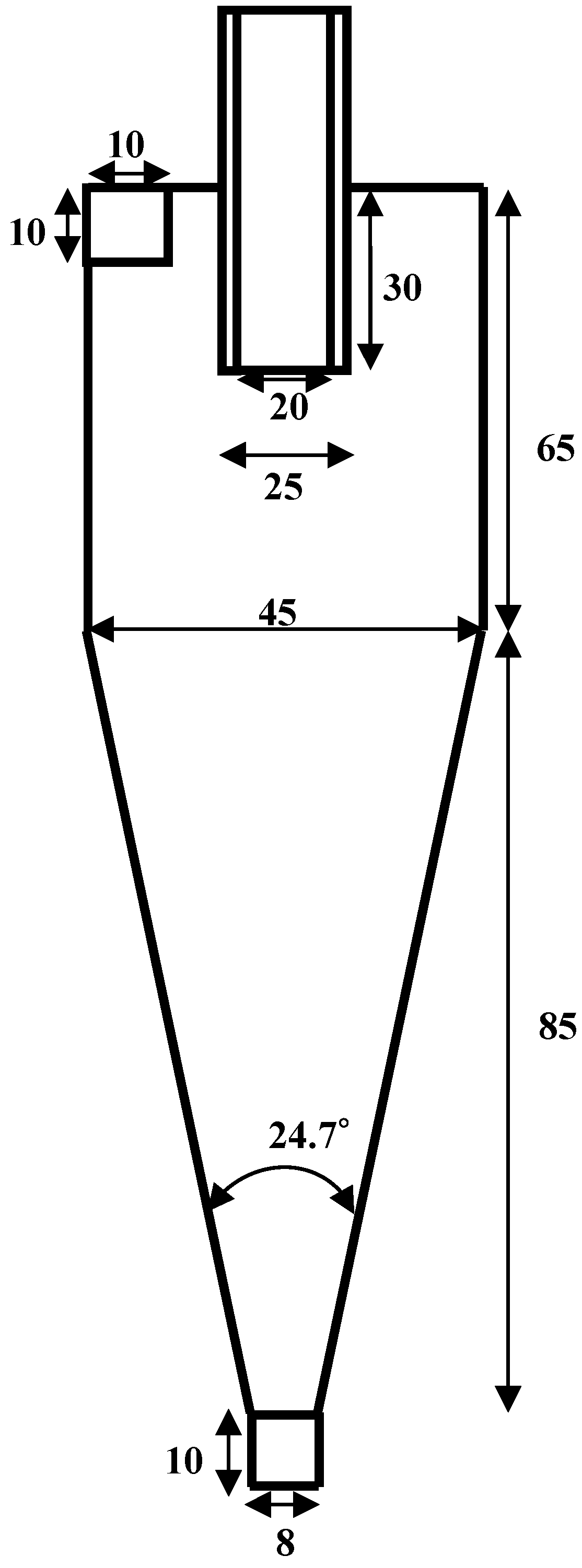
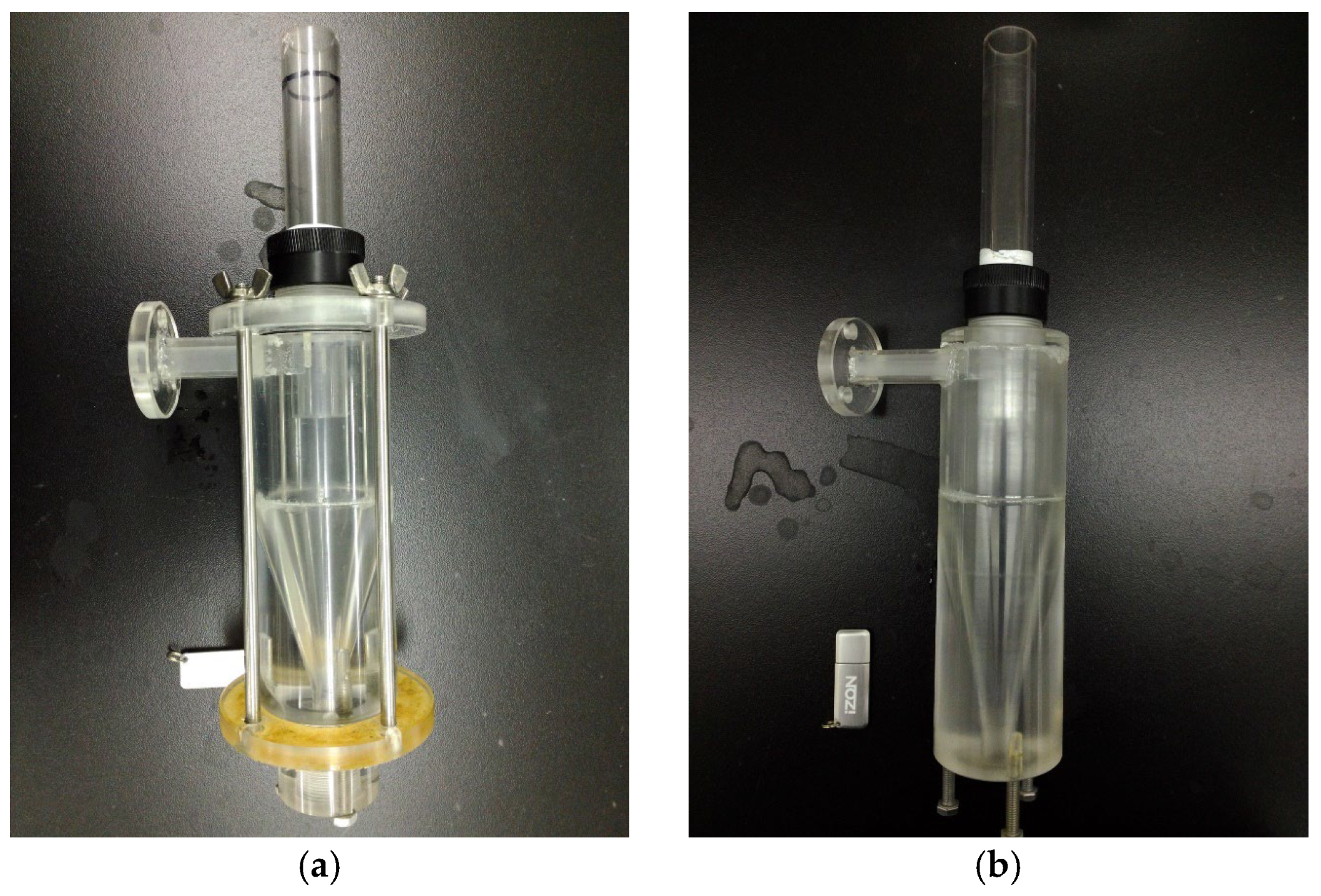
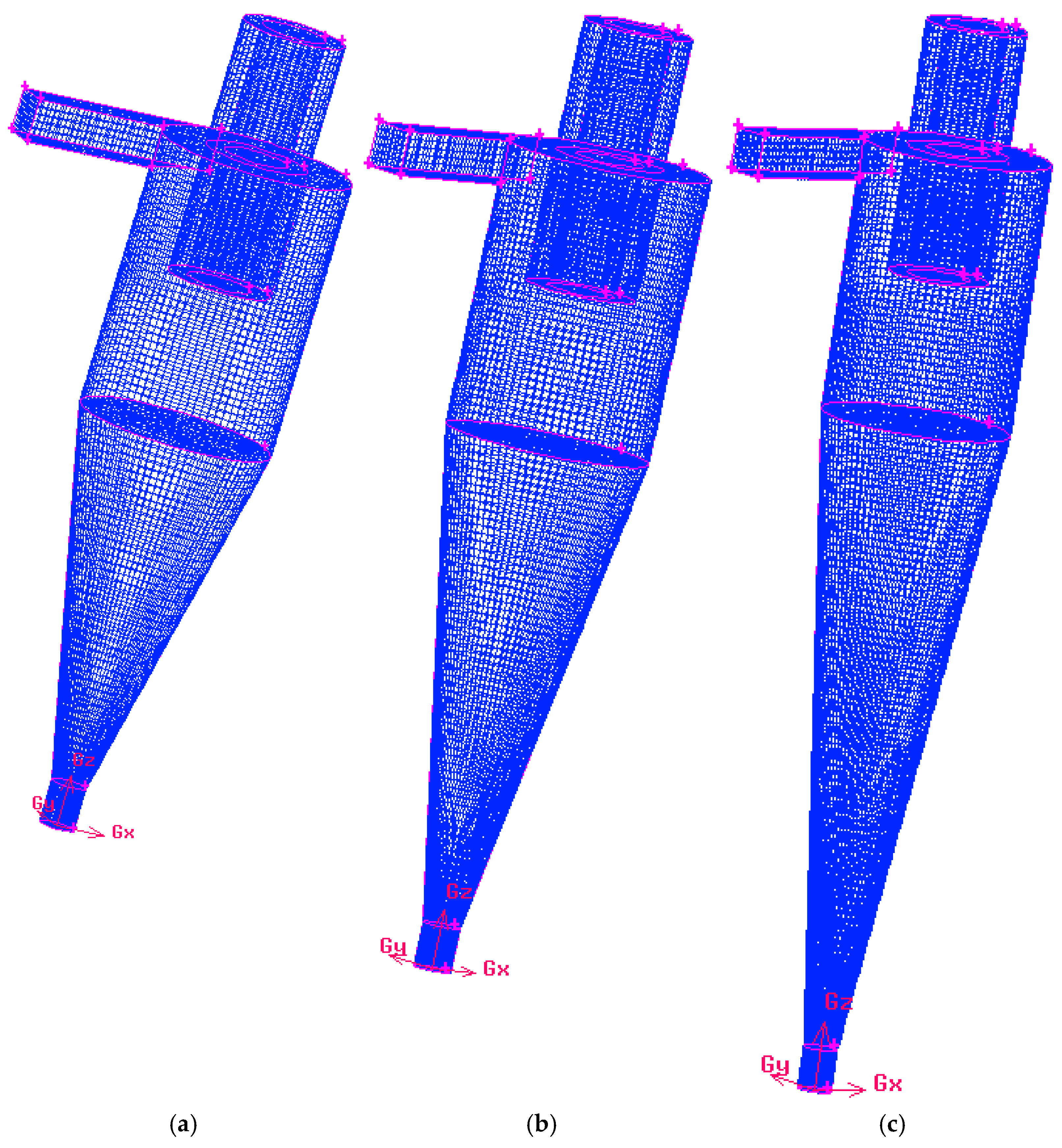
The geometry adopted in this study is illustrated in Figure 1. The key difference lies in the cone length, which in this study can be either 110 mm or 150 mm, as opposed to the standard 85 mm. The hydrocyclone, constructed from acrylic (Figure 2), has a main body diameter of 45 mm. The inlet is a square channel measuring 10 mm × 10 mm. The underflow outlet is a cylindrical pipe with a 8 mm diameter, while the overflow outlet features an inner diameter of 20 mm, an outer diameter of 25 mm, and extends 50 mm in length. The section leading into the hydrocyclone is 30 mm long, all fabricated from solid acrylic. The computational mesh is depicted in Figure 3.
After several simulation trials, it was determined that a uniform mesh of about 80,000–100,000 hexahedral cells provides sufficient accuracy while optimizing computational efficiency.
The simulations were conducted using FLUENT (version 6.2) with a fixed time step of 10−4 s to ensure numerical stability and adequate temporal resolution. A structured hexahedral mesh was generated using GAMBIT meshing tools. An inflation layer was applied near the wall region, and the near-wall mesh resolution was designed appropriately for LES-based simulations. To ensure the reliability of our CFD results, we conducted preliminary mesh independence tests using three different hexahedral mesh densities: approximately 80,000, 100,000, and 120,000 cells. Key flow indicators, including tangential velocity profiles and predicted separation efficiency, were compared across these meshes. The results showed negligible variation (<6%) in both velocity distribution and separation performance between the 100,000- and 120,000-cell meshes, indicating that the solution is essentially independent of mesh density.

3. Experimental Works

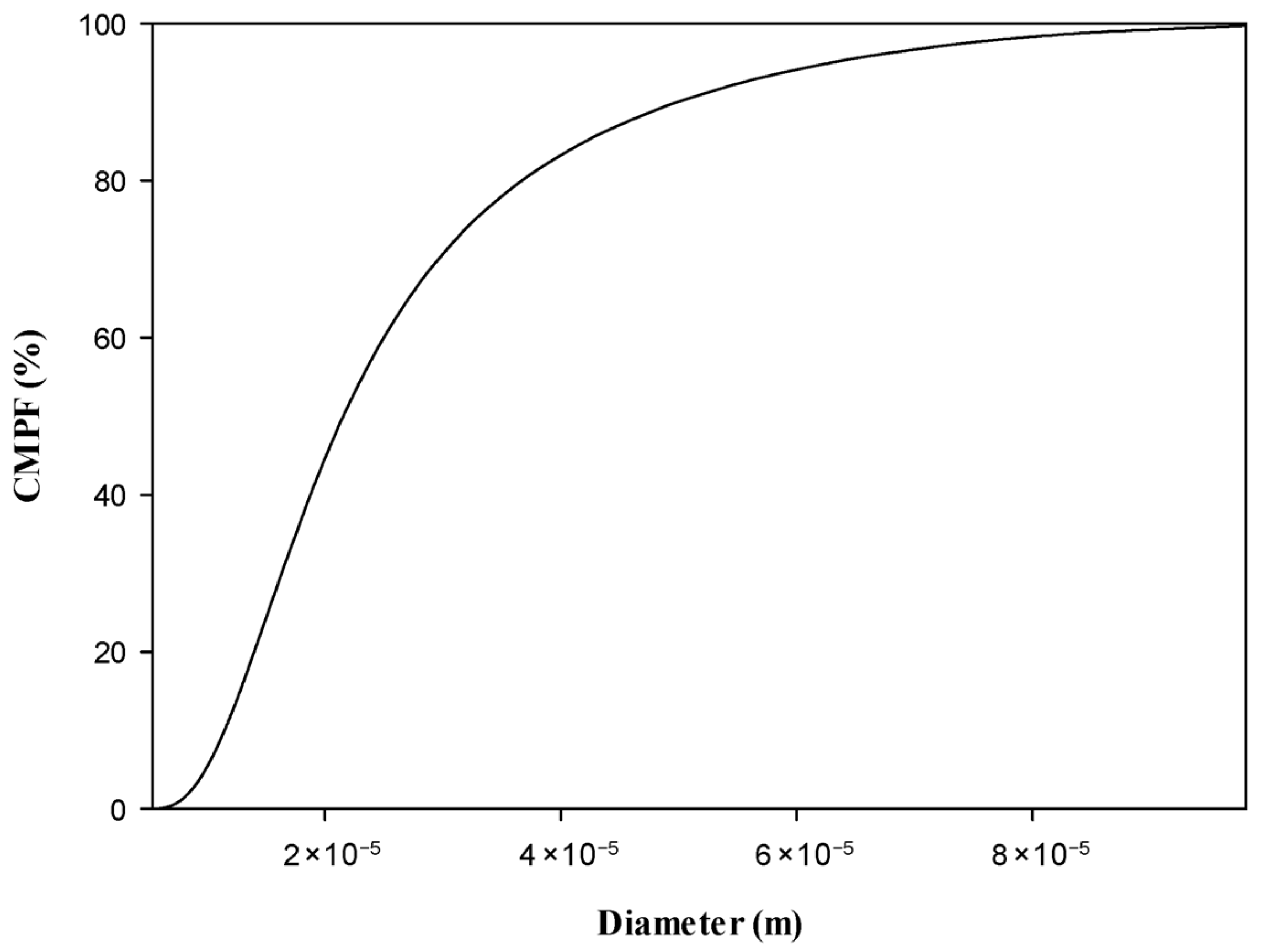
The powder used in this study is black silicon carbide (Black SiC), manufactured by Chilin Wang Enterprise Co., Ltd., Taipei, Taiwan. It appears as a blackish-gray powder with a density of 3220 kg/m3. Since silicon carbide with a single mesh number does not provide a sufficiently broad particle size distribution—which may lead to observational errors during experiments—the powder used in this study was prepared by mixing two particle size ranges in a 1:1 weight ratio. The selected size ranges were 13–18 μm and 37–44 μm, resulting in a combined silicon carbide powder with an average particle size of 19 μm. Figure 4 shows the cumulative particle size distribution of the silicon carbide powder used in the experiments.
Specifically, particle size distribution and zeta potential were measured using a Malvern Zetasizer Nano ZS (Malvern Panalytical, Malvern, UK), and density measurements were conducted according to the standard ASTM D792 method. These details ensure the reproducibility and reliability of the experimental results.
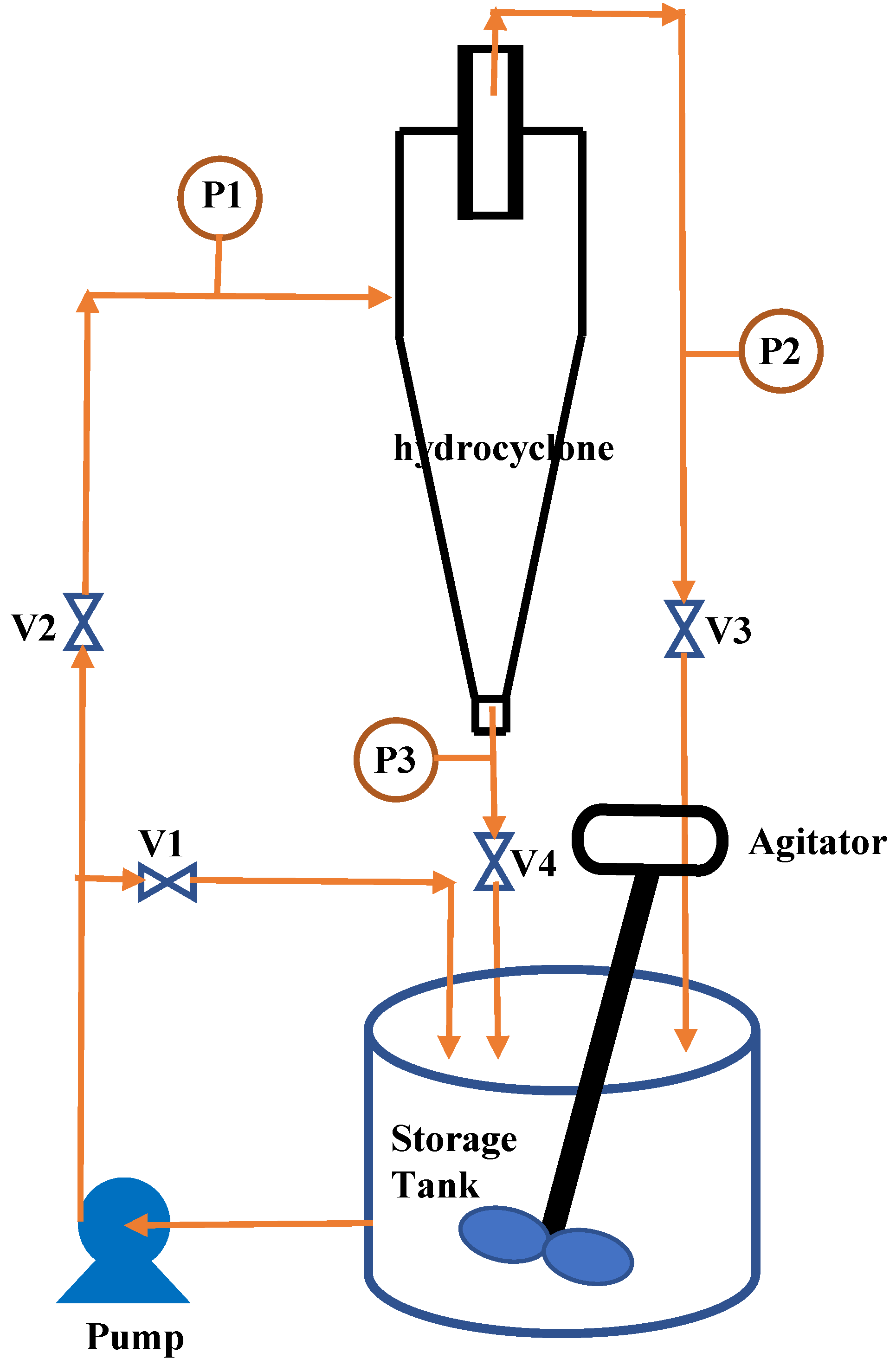
The experimental setup is illustrated in Figure 5. The procedure was conducted as follows. Initially, 40 L of clean water was introduced into the storage tank, followed by the addition of 120 g of silicon carbide powder. The mixture was agitated using a mechanical stirrer operating at a constant speed of approximately 1800 rpm to ensure uniform dispersion.
Prior to initiating the circulation, the reflux valve (V1) was fully opened and the flow pathway was checked to ensure no blockage was present. The pump was then activated, with both the overflow valve (V3) and underflow valve (V4) kept fully open. The feed valve (V2) was gradually adjusted while monitoring the inlet pressure gauge (P1) until the target operating pressure was achieved.
During operation, pressure values at the inlet (P1), overflow (P2), and underflow (P3) were recorded. Samples of the overflow (clarified liquid) and underflow (concentrated slurry) streams were collected separately. These samples were subsequently dried and weighed to determine solid concentrations, followed by particle size distribution analysis.

4. Results and Discussion

4.1. Experimental Separation Efficiency

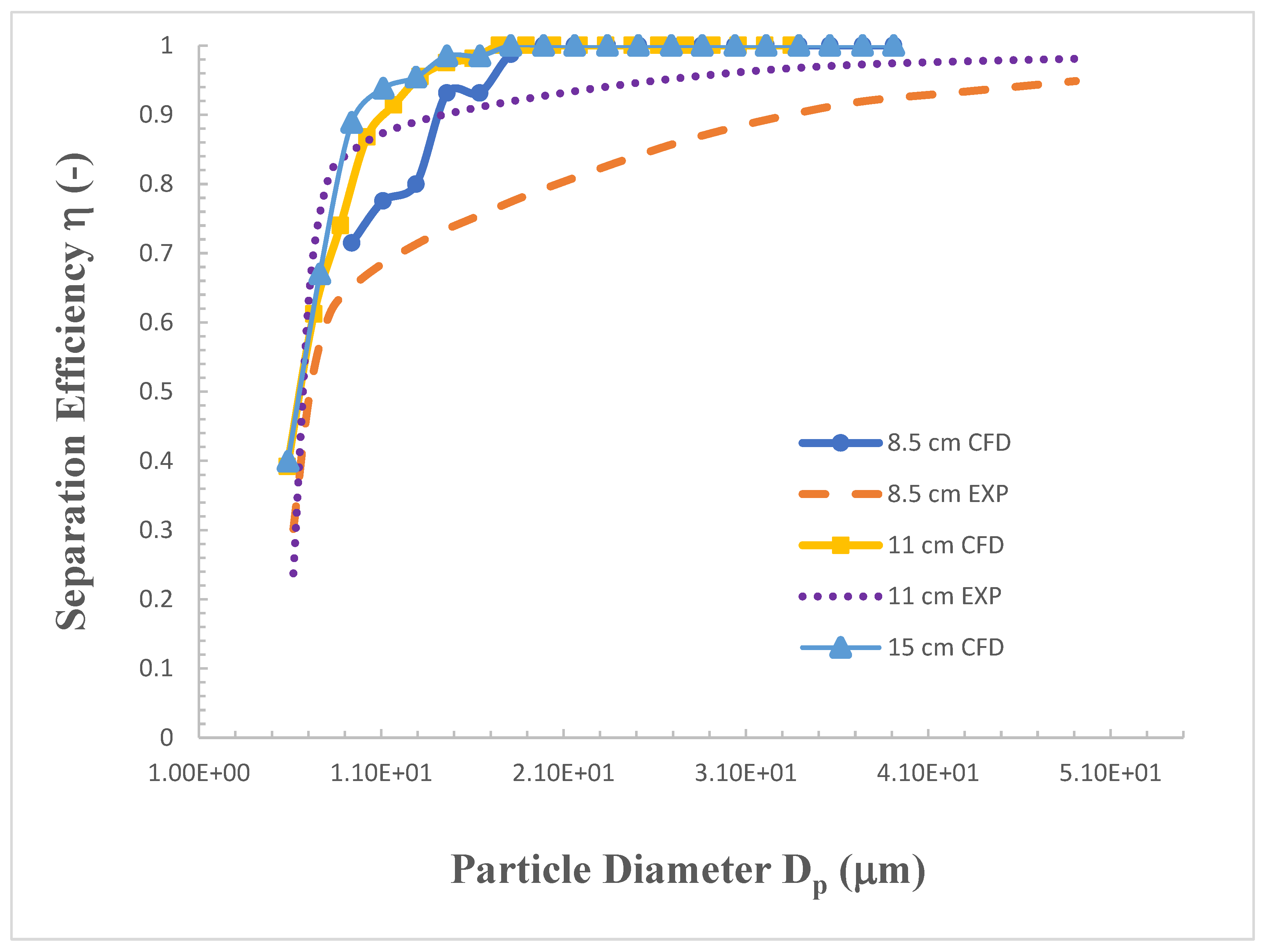
In Figure 6, the red dashed line and the purple dotted line represent the separation efficiency curves of hydrocyclones with cone lengths of 85 mm and 110 mm, respectively. When the particle size is between 7 μm and 9 μm, the probability of particles reporting to the underflow in the 110 mm cone length hydrocyclone approaches 85%, which is higher than that of the 85 mm cone length hydrocyclone. This indicates that the 110 mm cone length hydrocyclone has a higher separation precision. Regarding d85, defined as the particle size with an 85% probability of reporting to the underflow, the d85 of the 110 mm cone length hydrocyclone is approximately 8 μm, whereas that of the 85 mm cone length hydrocyclone is around 20 μm. These results show that cone length affects particle classification—longer cone lengths enhance the separation between particles of different sizes.
Table 1 shows the weight percent concentrations at the overflow and underflow of hydrocyclones with cone lengths of 85 mm and 110 mm. The liquid collected at the overflow of the 110 mm cone length hydrocyclone has a lower weight percent concentration than that of the 85 mm cone length hydrocyclone, indicating that the collected particles are smaller and lighter. On the other hand, the liquid collected at the underflow has a higher weight percent concentration, suggesting that the particles are larger and heavier. These results also demonstrate that increasing the cone length improves the particle classification efficiency of the hydrocyclone.

4.2. Comparison of Separation Efficiency Between Simulation and Experiment

In Figure 6, the solid lines with circular, square, and triangular markers represent the simulated separation efficiency curves for hydrocyclones with cone lengths of 85 mm, 110 mm, and 150 mm, respectively. The figure shows that the simulation and experimental trends are consistent—namely, as particle size increases, the probability of particles moving to the underflow also increases, resulting in an upward shift of the curve. Additionally, for particles larger than 14 μm, the simulated grade efficiency tends to be higher than the experimental results. This discrepancy arises because the simulation cannot account for all resistance forces, such as inter-particle interactions or friction between particles and the cyclone wall. These unmodeled factors may lead to the simulation overestimating the grade efficiency compared to the experiment.

4.3. Air Core Simulation

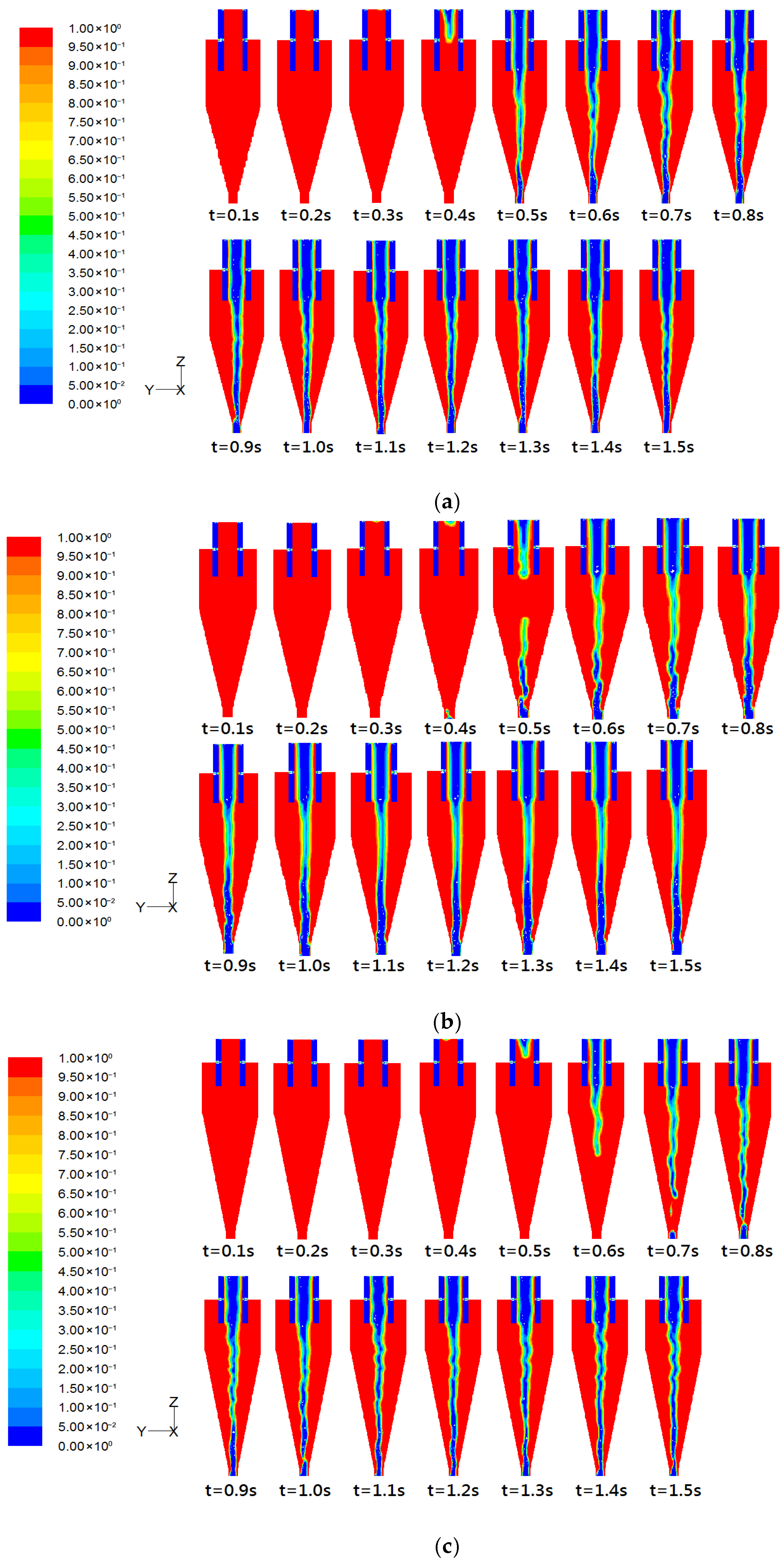
Figure 7 shows the simulated air distribution at the center cross-section (X = 0) of each hydrocyclone within 1.5 s.
The results indicate that an air core forms inside all three hydrocyclones, with formation times of 0.5, 0.6, and 0.8 s, respectively. As the cone length increases, the overall length of the hydrocyclone also increases, leading to a longer development time for the air core to fully form.
Figure 7 illustrates the transient air distribution along the central cross-section (X = 0) during the first 1.5 s. At early times (0.1–0.4 s), the flow is mainly liquid-dominated with intermittent air entrainment near the overflow. As swirl intensity increases, a low-pressure vortex core forms, initiating downward air penetration along the axis, accompanied by discontinuities and oscillations indicative of unstable vortex development.
Between 0.5 and 0.8 s, the air core elongates toward the apex. The shortest cone forms a continuous air column earlier, while longer cones exhibit delayed penetration and stronger transient waviness due to extended axial development distance. After ~0.9 s, a nearly continuous air core is established in all cases, acting as a stable low-pressure channel. Overall, cone length mainly affects the formation dynamics and stabilization time of the air core rather than its final structure.

4.4. Particle Trajectories Simulation

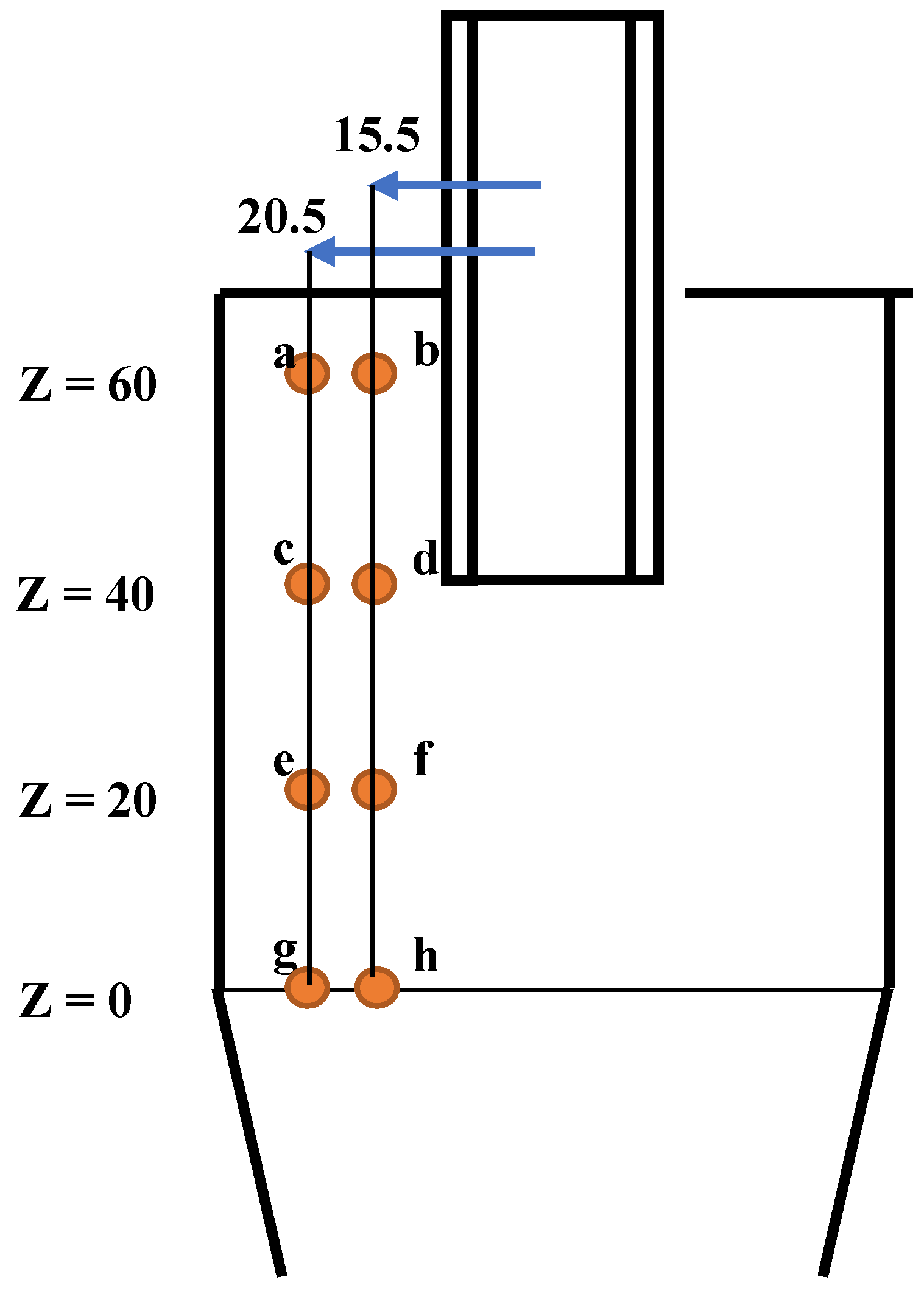
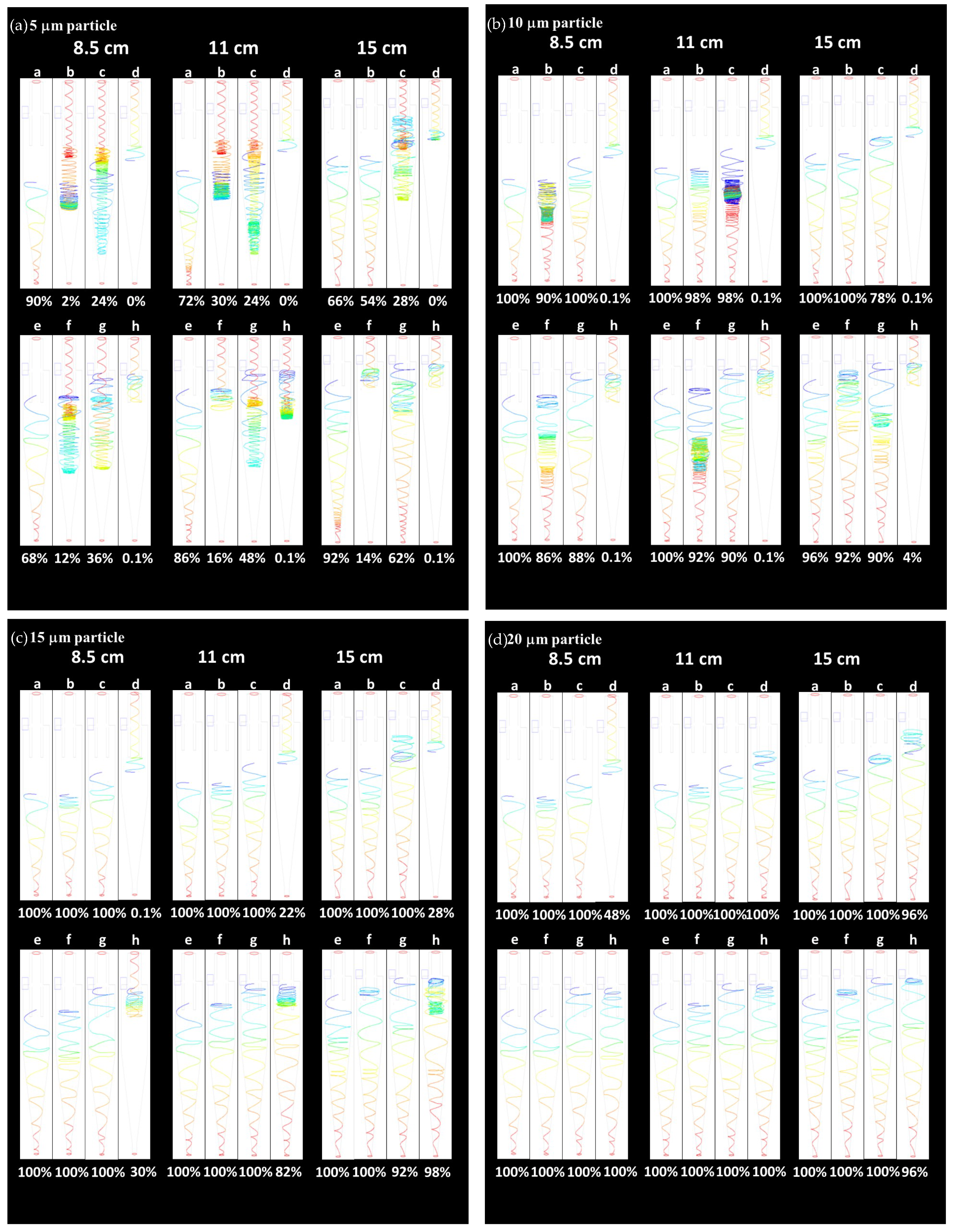
As shown in Figure 8, to understand the motion of particles inside the hydrocyclone, particles were released from eight different positions. Taking point b as an example, it is located 15.5 mm from the hydrocyclone axis in the horizontal direction and 60 mm above the junction between the cylindrical and conical sections in the vertical direction; the other positions are defined similarly. The particle sizes released were 5, 10, 15, and 20 μm. For each of the three hydrocyclone designs, 50 particle tracks were simulated at each of the eight points to observe the particle motion and trajectories. The differences in particle behavior among hydrocyclones with different cone lengths were compared, and the probabilities of particles exiting through the overflow or underflow were statistically analyzed.
Overall, as shown in Figure 9, at positions a, c, e, and g—located near the outer region of the hydrocyclone—particles have a higher probability of moving toward the underflow.
Additionally, particles larger than 15 μm tend to move toward the underflow due to the stronger centrifugal force acting on them. For 5 μm particles, at position b, which is near the top of the hydrocyclone, particles require more time to exit; they clearly spiral around the hydrocyclone multiple times before eventually exiting through the overflow. In contrast, at position d, which is close to the overflow outlet, particles can easily exit through the overflow. In summary, as particle size increases, particles are more strongly influenced by centrifugal force, causing them to migrate toward the wall and be carried by the outer vortex flow to the underflow outlet. Compared to the 150 mm cone length hydrocyclone, particles in shorter cone length designs exhibit longer residence times and more pronounced spiral trajectories, whereas the 150 mm design shows shorter retention time and lacks noticeable spiraling behavior.

5. Conclusions

This study combined laboratory experiments and CFD simulations to investigate how cone length influences hydrocyclone separation behavior using a 45 mm diameter cyclone and black silicon carbide particles. Experimental results demonstrated that cone geometry directly affects particle classification by modifying the internal flow structure. The shorter cone (85 mm) promotes faster axial transport and reduced particle residence time, resulting in an effective classification range of 14–17 μm. In contrast, the longer cone (110 mm) increases particle residence time and centrifugal exposure, shifting the effective classification range to smaller particles (8–11 μm).
Transient CFD analysis revealed that air core formation is governed by vortex development and pressure redistribution. Longer cones require additional time for the swirling flow to stabilize, explaining the delayed formation of a continuous air core. Once stabilized, the air core organizes the internal flow field and enhances particle migration toward equilibrium trajectories, which contributes to improved separation consistency.
The agreement between experimental and numerical classification trends confirms that cone length influences separation performance primarily through its control of centrifugal force distribution, residence time, and air-core stability. For particles larger than 10 μm, the longer cone configuration exhibits higher classification efficiency because extended vortex development strengthens outward particle migration. These findings clarify the physical mechanisms underlying geometric effects and provide guidance for hydrocyclone design optimization.
This study is subject to several limitations. The CFD simulations assume an incompressible Newtonian fluid and neglect particle–particle interactions, wall roughness, and fouling effects. These simplifications may cause minor deviations between numerical and experimental results. Future work will incorporate more realistic multiphase interactions to improve predictive accuracy.

Author Contributions

Conceptualization, R.-M.W.; methodology, D.-H.W.; software, D.-H.W.; validation, R.-M.W.; investigation, R.-M.W.; data curation, D.-H.W.; writing—original draft preparation, D.-H.W.; writing—review and editing, R.-M.W.; supervision, R.-M.W. All authors have read and agreed to the published version of the manuscript.

Funding

This work is supported by the National Science Council of Taiwan (110-2221-E-131-029-MY3).

Data Availability Statement

The original contributions presented in this study are included in the article. Further inquiries can be directed to the corresponding author.

Conflicts of Interest

The authors declare no conflicts of interest.

Abbreviations

The following abbreviations are used in this manuscript:
CFDComputational Fluid Dynamics
VOFVolume of Fluid
LESLarge Eddy Simulation
DPMDiscrete Phase Model
LZVVLoci of Zero Vertical Velocity
CCRCylinder-to-Cone Ratio
RANSReynolds-Averaged Navier–Stokes
RNG k–εRenormalization Group k–ε
RSMReynolds Stress Model
CCDMCombined Continuum and Discrete Method
DEMDiscrete Element Method
SIMPLESemi-Implicit Method for Pressure-Linked Equations

References

  1. Carrasqueira, J.; Afonso, C.; Gil, M.M.; Bernardino, R.; Gamboa, R.; Barroso, S.D.; Bernardino, S. Digging Deeper: Assessing the Impact of Limestone Exploitation and Use Worldwide. Environments 2024, 11, 283. [Google Scholar] [CrossRef]
  2. Dobre, T.; Isopencu, G.O.; Bdaiwi Ahmed, S.; Deleanu, I.M. Heavy Metal Pollution and Solutions for Its Control: General Aspects with a Focus on Cobalt Removal and Recovery from Aqueous Systems. ChemEngineering 2024, 8, 118. [Google Scholar] [CrossRef]
  3. Zouari, A.; Manich, A.; Marti, M.; Gargoubi, S.; Boudokhane, C. Nanobubble Technology for A Water-Repellent Treatment on Cotton Fabrics: A Comparative Study. ChemEngineering 2023, 7, 47. [Google Scholar] [CrossRef]
  4. Friebel, J.M.; Neuber, D.; Buchwald, T.; Ditscherlein, R.; Peuker, U.A. Quantitative Analysis of Separated Impurities inside Filter Cakes with Phantom-Aided X-ray Tomography. ChemEngineering 2023, 7, 40. [Google Scholar] [CrossRef]
  5. Al-Otaibi, F.; Xiao, H.; Berrouk, A.S.; Polychronopoulou, K. Numerical Study of Dry Reforming of Methane in Packed and Fluidized Beds: Effects of Key Operating Parameters. ChemEngineering 2023, 7, 57. [Google Scholar] [CrossRef]
  6. Guedes, M.; Carrasqueira, J.; Seixas, T.; Afonso, C.; Gil, M.M.; Bernardino, R.; Gamboa, R.; Bernardino, S. Limestone Processing Sludge: From Waste to Sustainable Resource. Environments 2025, 12, 405. [Google Scholar] [CrossRef]
  7. Chu, L.-Y.; Chen, W.-M. Research on the Motion of Solid Particles in a Hydrocyclone. Sep. Sci. Technol. 1993, 28, 1875–1886. [Google Scholar] [CrossRef]
  8. Chu, L.-Y.; Qin, J.-J.; Chen, W.-M.; Lee, X.-Z. Energy Consumption and Its Reduction in the Hydrocyclone Separation Process II. Time-Averaged and Fluctuating Characteristics of the Turbulent Pressure in a Hydrocyclone. Sep. Sci. Technol. 2000, 35, 2543–2560. [Google Scholar] [CrossRef]
  9. Chu, L.-Y.; Qin, J.-J.; Chen, W.-M.; Lee, X.-Z. Energy Consumption and Its Reduction in the Hydrocyclone Separation Process III. Effect of the Structure of Flow Field on Energy Consumption and Energy Saving Principles. Sep. Sci. Technol. 2000, 35, 2679–2705. [Google Scholar] [CrossRef]
  10. Zhao, Q.G.; Xia, G.D. A Theoretical Model for Calculating Pressure Drop in the Cone Area of Light Dispersion Hydrocyclones. Chem. Eng. J. 2006, 117, 231–238. [Google Scholar] [CrossRef]
  11. Martinez, L.F.; Lavin, A.G.; Mahamud, M.M.; Bueno, J.L. Improvements in Hydrocyclone Design Flow Lines Stabilization. Powder Technol. 2007, 176, 1–8. [Google Scholar] [CrossRef]
  12. Wu, H.; Xu, Y.; Yin, Z.; Yan, Y.; Li, S.; Zhang, J.; Wang, J. Study on the performance of gas-liquid-solid multi-phase spiral separator for oilfield recovery fluids separation. J. Water Process Eng. 2025, 78, 108764. [Google Scholar] [CrossRef]
  13. Kraipech, W.; Nowakowski, A.; Dyakowski, T.; Suksangpanomrung, A. An Investigation of the Effect of the Particle-Fluid and Particle-Particle Interactions on the Flow within a Hydrocyclone. Chem. Eng. J. 2005, 111, 189–197. [Google Scholar] [CrossRef]
  14. Schubert, H. On the Origin of “Anomalous” Shapes of the Separation Curve in Hydrocyclone Separation of Fine Particles. Part. Sci. Technol. 2004, 22, 219–234. [Google Scholar] [CrossRef]
  15. Souza, F.J.; Vieira, L.G.M.; Damasceno, J.J.R.; Barrozo, M.A.S. Analysis of the Influence of the Filtering Medium on the Behaviour of the Filtering Hydrocyclone. Powder Technol. 2000, 107, 259–267. [Google Scholar] [CrossRef]
  16. Vieira, L.G.M.; Barbosa, E.A.; Damasceno, J.J.R.; Barrozo, M.A.S. Performance Analysis and Design of Filtering Hydrocyclones. Braz. J. Chem. Eng. 2005, 22, 143–152. [Google Scholar] [CrossRef]
  17. Morimoto, M.G.; Silva, D.P.S.; Silva, D.O.; Barrozo, M.A.S.; Vieira, L.G.M. Filtering Hydrocyclone Performance: A Review of Literature. Miner. Process. Extr. Metall. Rev. 2025, 47, 278–291. [Google Scholar] [CrossRef]
  18. Vieira, L.G.M.; Silva, C.A., Jr.; Damasceno, J.J.R.; Barrozo, M.A.S. A Study of the Fluid Dynamic Behaviour of Filtering Hydrocyclones. Sep. Purif. Technol. 2007, 58, 282–287. [Google Scholar] [CrossRef]
  19. Salvador, F.F.; Barrozo, M.A.S.; Vieira, L.G.M. Filtering Cylindrical–Conical Hydrocyclone. Particuology 2019, 47, 54–62. [Google Scholar] [CrossRef]
  20. Dianyu, E.; Hu, H.; Tan, C.; Zhang, Y.; Xu, G.; Cui, J.; Zou, R.; Yu, A.; Kuang, S. Numerical Study of the Effect of Cylinder–to–Cone Ratio on the Classification Performance in Hydrocyclones. Powder Technol. 2025, 454, 120736. [Google Scholar]
  21. Hamdy, O.; Bassily, M.A.; El-Batsh, H.M.; Mekhail, T.A. Numerical Study of the Effect of Changing the Cyclone Cone Length on the Gas Flow Field. Appl. Math. Model. 2017, 46, 81–97. [Google Scholar] [CrossRef]
  22. Han, T.; Liu, H.; Xiao, H.; Chen, A.; Huang, Q. Experimental Study of the Effects of Apex Section Internals and Conical Section Length on the Performance of Solid–Liquid Hydrocyclone. Chem. Eng. Res. Des. 2019, 145, 12–18. [Google Scholar] [CrossRef]
  23. Liu, P.; Sun, H.; Chen, B.; Jiang, L.; Han, Z.; Wang, T.; Liu, J.; Gao, Y.; Liu, G. Research on the Classification Performance of a Self-Aspirating Three-Product Hydrocyclone. Powder Technol. 2025, 455, 121388. [Google Scholar] [CrossRef]
  24. Wasilewski, M. Analysis of the Effect of Counter-Cone Location on Cyclone Separator Efficiency. Sep. Purif. Technol. 2017, 179, 236–247. [Google Scholar] [CrossRef]
  25. Oliveira, J.P.S.; Medronho, R.A.; Santos, F.P.; Klein, T.S. CFD Multiphase Modeling of Liquid–Liquid Hydrocyclones: A Review. J. Ind. Eng. Chem. 2025, 145, 33–62. [Google Scholar] [CrossRef]
  26. Bhaskar, K.U.; Murthy, Y.R.; Raju, M.R.; Tiwari, S.; Srivastava, J.K.; Ramakrishnan, N. CFD Simulation and Experimental Validation Studies on Hydrocyclone. Miner. Eng. 2007, 20, 60–71. [Google Scholar] [CrossRef]
  27. Fu, S.; Qian, Y.; Yuan, H.; Fang, Y. Effect of Cone Angles of a Hydrocyclone for the Separation of Waste Plastics with Low Value of Density Difference. Waste Manag. 2022, 140, 183–192. [Google Scholar] [CrossRef]
  28. Li, F.; Liu, P.; Yang, X.; Zhang, Y.; Li, X.; Jiang, L.; Wang, H.; Fu, W. Purification of Granular Sediments from Wastewater Using a Novel Hydrocyclone. Powder Technol. 2021, 393, 751–763. [Google Scholar] [CrossRef]
  29. Pukkella, A.K.; Vega-Garcia, D.; Hadler, K.; Cilliers, J. Influence of Conic Shape on Bypass and Cut-Size in Hydrocyclones. Sep. Purif. Technol. 2025, 361, 131224. [Google Scholar] [CrossRef]
  30. Ramezani, H.; Khodadadi, S.; Maddahian, R. Investigation of Unsteady Flow in Liquid–Liquid Hydrocyclone Using Eulerian-Lagrangian Approach. Chem. Eng. Sci. 2025, 316, 121936. [Google Scholar] [CrossRef]
  31. Li, F.; Li, P.; Wang, Y.; Guo, D.; Yang, H.; Han, H.; Liang, R. Numerical Analysis and Experimental Research on the Influence of Column Structure on the Classification Performance of Hydrocyclone. Alex. Eng. J. 2025, 120, 271–286. [Google Scholar] [CrossRef]
  32. Wang, B.; Chu, K.W.; Yu, A.B. Numerical Study of Particle–Fluid Flow in a Hydrocyclone. Ind. Eng. Chem. Res. 2007, 46, 4695–4705. [Google Scholar] [CrossRef]
  33. Wang, B.; Yu, A.B. Numerical Study of the Gas–Liquid–Solid Flow in Hydrocyclones with Different Configuration of Vortex Finder. Chem. Eng. J. 2008, 135, 33–42. [Google Scholar] [CrossRef]
  34. Chu, K.W.; Yu, A.B. Numerical Simulation of Complex Particle–Fluid Flows. Powder Technol. 2008, 179, 104–114. [Google Scholar] [CrossRef]
Figure 1. Basic Structural Diagram of a Hydrocyclone. (unit: mm).
Chemengineering 10 00055 g001
Figure 2. Hydrocyclone Used in the Experiment. (a) 85 mm; (b) 110 mm.
Chemengineering 10 00055 g002
Figure 3. Mesh of the Hydrocyclone Used for Simulation. (a) 85 mm; (b) 110 mm; (c) 150 mm.
Chemengineering 10 00055 g003
Figure 4. The cumulative particle size distribution (CMPF) of the silicon carbide powder.
Chemengineering 10 00055 g004
Figure 5. Experimental system setup.
Chemengineering 10 00055 g005
Figure 6. The experimental separation efficiency curves for different cone lengths.
Chemengineering 10 00055 g006
Figure 7. Time-Resolved Distribution of Air Volume Fraction Inside the Hydrocyclone. (a) 85 mm (b) 110 mm; (c) 150 mm.
Chemengineering 10 00055 g007
Figure 8. Eight particle release points for single-particle trajectory analysis.
Chemengineering 10 00055 g008
Figure 9. Particle trajectory released from eight positions. (a) illustrates the trajectory tracking of 5 μm particles released from eight designated positions (a–h), as defined in Figure 8. (bd) show the corresponding particle trajectories for 10 μm, 15 μm, and 20 μm particles, respectively.
Chemengineering 10 00055 g009
Table 1. Weight percent concentrations at the Inlet and outlets.
Cone LengthInletOverflowUnderflow
85 mm0.27%0.10%0.32%
110 mm0.27%0.05%0.34%
Disclaimer/Publisher’s Note: The statements, opinions and data contained in all publications are solely those of the individual author(s) and contributor(s) and not of MDPI and/or the editor(s). MDPI and/or the editor(s) disclaim responsibility for any injury to people or property resulting from any ideas, methods, instructions or products referred to in the content.