1. Introduction
Agent-based model (ABMs), or individual-based model (IBMs), refers to the set of computational techniques adopted for simulating interactions among autonomous agents (or individuals) within certain conditions, including potential changes in personal characteristics, preferences, attitudes, and behaviors, and diverse possibilities of scenarios (e.g., environmental challenges, social and economic features, etc.). The use of ABMs for research in social sciences has been explored for some decades since the seminal study on segregation by Schelling published in 1969 [
1,
2]; however, its usefulness for investigation of sensitive phenomena in social sciences has been recently highlighted in several studies, considering the practicality and versatility for adoption of simulations in sociology, economics, public policies, public health, and geography, among others [
3,
4,
5] (with [
4] co-authored by some of the present authors).
ABMs allow researchers to study the emergence of macroscopic social phenomena from micro-level behaviors by simulating interactions of autonomous, heterogeneous agents within given environments and conditions [
3,
4,
5,
6]. Unlike traditional analytical models that generally rely on representative agents, ad hoc assumptions, and other controversial or unrealistic conditions, ABMs may be designed to incorporate bounded rationality, direct interactions, and complex feedback loops [
3].
However, the generative power of ABMs also poses important methodological challenges, especially regarding their conceptualization and operationalization [
7]. ABM implementation requires consideration of explicit rules and numerical inputs, imposing critical decisions about parameter values and probability distributions in their design [
8]. Stochasticity comprises a core component of ABMs, particularly representing variability in environmental conditions, agents’ initial attributes, decision-making processes, and susceptibility to changes. Examples in the social sciences literature include choices on the patterns of agents’ wealth distribution in the model, or features linked to the probability of occurrence of specific behaviors [
8].
The decision-making processes involved in selecting parameters and probability distributions for constructing ABMs entail sensitive choices due to the degrees of freedom, posing a risk of bias or arbitrariness [
7]. The lack of rigorous empirical grounding or theoretical justification of parameters may reduce the ABMs to ad hoc exercises with inputs simply designed to produce desired outputs, rather than accurately representing the target system structure [
7,
8]. Whilst there are methods for parameterization and calibration of models (e.g., pattern-oriented modeling, POM [
9]), in addition to the use of genetic algorithms for estimation [
3], the current literature suggests the absence of standardized guidelines for reporting and justifying specific choices in social science applications of ABMs [
7]. Furthermore, the inadequate or incomplete documentation on the selection and parametrization procedures applied to probability distributions adopted within ABMs may hinder the replicability of simulation studies, undermining their scientific status [
8].
The literature on strategies for parameter selection is likely fragmented given the diverse and interdisciplinary nature of ABM research, encompassing multiple fields of knowledge within the social sciences [
3,
10]. Recent studies focus on general guidelines for ABM construction, theory incorporation and development within ABMs, or adoption of protocols for documentation and reporting of ABM research [
11,
12,
13]. A preliminary report on the subject indicates that certain studies discuss characteristics of specific calibration techniques [
14]; yet, the literature lacks a comprehensive synthesis to guide researchers through the ‘decision ecosystem’ linked to the definition of stochastic and parametric foundations of their simulations.
Therefore, the present paper contributes to the literature by synthesizing the current state of the art through a scoping literature review on ABMs applied to social sciences, synthesizing the main categories of modeling choices adopted in the field of knowledge. The analysis ranges from empirical data calibration and theoretical derivation to arbitrary selection, generating a visual evidence map based on the scoping literature review to propose best practices and guidelines for the decision-making processes involved in the definition of two key elements in the construction of functional ABMs, i.e., parameters and probability distributions. The scoping review addresses the evidence gap identified in the heterogeneous body of knowledge on standards for decision-making processes in ABMs, covering diverse methods and disciplines, and aiming at the identification of techniques for reducing uncertainty and arbitrariness in computational modeling [
15,
16,
17,
18].
3. Materials and Methods
3.1. Study Design
The present study comprises a methodological investigation on the decision-making processes involved in the definition of two key elements in the construction of functional ABMs applied to social sciences, i.e., parameters and probability distributions. The study presents a synthesis of evidence based on a scoping literature review, followed by qualitative and quantitative analyses to support the proposal of best practices and research guidelines for researchers focusing on the application of computational simulations in the field of knowledge.
3.2. Scoping Review
The scoping review follows the Joanna Briggs Institute (JBI) methodology for scoping reviews, and reports findings through the guideline Preferred Reporting Items for Systematic reviews and Meta-Analyses extension for Scoping Reviews (PRISMA-ScR) [
16,
18]. The focus of the review refers to the synthesis of the state of the art on methodological choices in computational simulations in the social sciences, through systematic mapping of current studies using agent-based models (ABMs).
3.2.1. Review Question
The research question guiding the scoping review was based on the Population, Concept, and Context (PCC) framework recommended for scoping reviews [
15,
18]:
Population: agent-based models (ABMs) and multi-agent systems (MAS) applied in social science research focusing on human interactions (e.g., economics, sociology, political science, etc.);
Concept: decision-making strategies, methodological justifications, protocols, and techniques used for the selection of data sources for the definition of parameters and probability distributions within the model design and sensitivity analysis;
Context: academic literature published in peer-reviewed journals and literature reviews, without geographical restrictions.
Thus, the primary question of the review is: What strategies and protocols have been adopted by social science researchers to select and justify parameters and probability distributions in their computational simulation models?
3.2.2. Eligibility Criteria
The eligibility criteria were defined to ensure alignment of the studies with the scope of the review. The review includes original research articles and literature reviews published in English between 2015 and 2025. Articles with applications of ABMs within social sciences (i.e., economics, sociology, public policy contexts) explicitly focusing on human interactions with detailed explanation on the procedures for parameter selection, calibration, validation, or sensitivity analysis.
The exclusion criteria refer to: studies lacking details on the logic of parameterization or probability distributions adopted in the models; ABM applications in purely biological, physical, and engineering fields without interface with social sciences; studies published at conferences; editorials, short commentaries, or opinion pieces.
3.2.3. Search Strategy
A comprehensive literature search was conducted across three major electronic databases: Scopus (Elsevier), Web of Science—Principal collection (Clarivate Analytics), and IEEE Xplore. The search strategy combined multiple terms related to the population (e.g., “agent-based model*”, “social simulation”), the concept (e.g., “parameter*”, “calibration”, “sensitivity analysis”, “ODD protocol”), and the context (e.g., “social science*”, “sociology”, “public policy”) (
Table 2). The exact search strings were tailored to the syntax requirements of the electronic databases to ensure maximum sensitivity and specificity (
Table 2).
3.2.4. Study Selection
Records retrieved using the search strategy were uploaded to Rayyan [
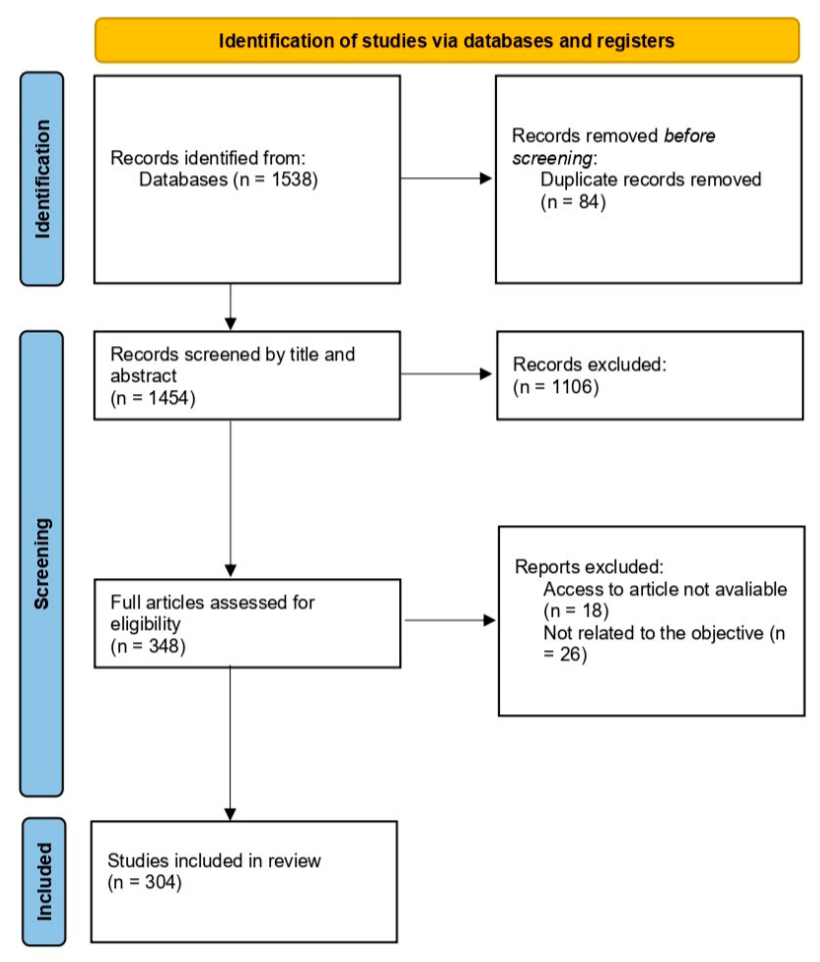
42], a free online software application with blinding in reviewer collaboration. Following the removal of duplicates, two independent reviewers performed blinded screening of titles and abstracts against eligibility criteria in Rayyan. A third independent reviewer resolved any disagreements in classification. Finally, full texts selected in the screening were assessed by the same two independent reviewers for inclusion or exclusion in the scoping review.
Inter-reviewer reliability for the title-and-abstract screening was computed retrospectively from the Rayyan decision log. Across the 1.454 independently double-screened records, the two primary reviewers reached 73.2% raw agreement, with a linear-weighted Cohen’s κ of 0.44 and a Krippendorff’s α of 0.45 (moderate agreement), consistent with the inherently interpretive nature of relevance screening at the title-and-abstract stage. Because the protocol was designed to resolve disagreement rather than merely to quantify it, these coefficients should be read as pre-adjudication agreement: every conflicting record was subsequently settled by the third independent reviewer or by consensus discussion, and it is this consensus mechanism that determined the final corpus. The full reviewer decision counts and the conflict-resolution breakdown are reported in the accompanying reproduction notebook (04_rayyan_interrater_analysis.ipynb).
3.2.5. Data Extraction
Information extracted from the final sample of studies was organized into a structured matrix addressing the research question of our investigation, focusing on three core methodological issues defined in our theoretical framework:
Model objective, categorized into: exploratory, explanatory, predictive, descriptive/phenomena-based, or decision support/policy evaluation;
Data source for parameterization, categorized into: theoretical, empirical-micro, empirical-macro, expert-based, hybrid, or synthetic/AI;
Method for sensitivity analysis, categorized into: local (OAT/OFAT), global (variance-based), global (screening), metamodeling/surrogates, exploratory/scenario-based, or regression/statistical inference.
3.3. Data Analysis
Data extracted from studies were aggregated into a single dataset containing features of studies included in the scoping review. The quantitative synthesis of information allowed the construction of our comprehensive evidence map with the visual representation of the decision ecosystem for ABM design, using three analytical approaches:
Keyword Co-occurrence Network (KCN): bibliometric network analysis based on the keywords of the studies to map the conceptual landscape and identify thematic clusters within the fragmented literature, using VOSviewer software 1.2.4 [
43];
Methodological Heatmap: cross-tabulation of the three core features extracted from the literature (model objective, data source, and method for sensitivity analysis) for identification of prevailing trends and critical gaps in the literature, generating heatmaps of absolute and relative frequencies of their intersections through Python 3.12 [
44];
Decision Matrix (Sankey Diagram): decision matrix cross-referencing methodological patterns based on quantitative findings from the heatmaps to structure a practical flowchart for researchers, using Python 3.13 [
44]. The matrix focuses on recommendations of robust combinations of methods for parameterization and sensitivity analysis according to the model objective, whilst remaining flexible to account for real-world constraints (e.g., data availability).
Additionally, network-based analyses were conducted to deepen the understanding of both the conceptual structure of the literature and the relationships between methodological choices. First, a keyword co-occurrence network was constructed using authors’ keywords extracted from the selected studies [
45,
46]. The network was processed and visualized to identify dominant research clusters and thematic proximities [
43], enabling the detection of major conceptual domains within the field. The analysis particularly focused on identifying recurring clusters associated with parameterization strategies, validation practices, and applications of ABMs in policy-oriented contexts, which later informed the interpretation of thematic fragmentation and convergence in the literature.
Prior to network construction, a keyword harmonization protocol was applied to consolidate morphological, orthographic, and lexical variants of the same concept into canonical forms, following standard practice in bibliometric network analysis [
46]. The protocol comprised four sequential steps: (i) lowercase normalization to eliminate case-based duplicates; (ii) whitespace and punctuation trimming to standardize delimiters; (iii) synonym merging via a manually curated controlled vocabulary (thesaurus); and (iv) post-merge deduplication of variants within the same article. The thesaurus comprised 19 mapping rules organized into five categories: hyphenation normalization (e.g., agent-based model → agent-based modeling), spelling variant normalization between British and American English (e.g., modelling → modeling), singular/plural and inflectional unification (e.g., agent-based models → agent-based modeling), abbreviation expansion (e.g., ABM → agent-based modeling), and scope unification for semantically equivalent terms (e.g., decision making → decision-making). The harmonization was intentionally conservative, targeting only unambiguous lexical variants while preserving conceptually distinct terms. This procedure reduced the vocabulary from 1217 raw unique keywords to 1203 harmonized terms (1.15% reduction, with 14 variants effectively merged and 5 additional rules retained as preventive mappings for reproducibility). Although the reduction in unique terms is modest, the impact on network topology was substantive: the canonical term agent-based modeling consolidated 10 orthographic and morphological variants, increasing its observed frequency from 65 to 214 and preventing artificial fragmentation of the network’s central hub. The complete thesaurus is provided in
Supplementary Table S10.
Second, a methodological classification network was developed to map the relationships between core analytical dimensions, namely model objective, data source for parameterization, and sensitivity analysis techniques. This network structure enabled the identification of dominant methodological pathways, with emphasis on the prevalence of theory-driven parameterization in exploratory models and the limited adoption of advanced global sensitivity analysis techniques in predictive or policy-oriented applications. The analysis also allowed the detection of weakly connected or underexplored combinations, supporting the identification of methodological gaps.
Both network analyses were implemented in Python, using standard libraries for network construction and visualization [
47,
48], ensuring reproducibility and consistency with quantitative synthesis. Thematic clusters were identified through community detection based on modularity optimization [
49,
50], and the network layout was computed using the Fruchterman-Reingold force-directed algorithm [
51]. These approaches complement the heatmap analysis by providing a structural perspective on how concepts and methodological choices are interconnected across studies, forming the empirical basis for the decision matrix proposed in this study and directly supporting the interpretation of the patterns and gaps in the analyses. An extended version of the bibliometric and network analysis can be found in the repository and
Supplementary Materials.
3.4. Data Synthesis
For analyses requiring a single value per study per dimension, multi-valued codings were resolved by the dominance orderings described below; for descriptive frequency analyses and network edges, all declared values were retained. Temporal trends were examined by dividing the corpus into four periods (2015–2017, 2018–2020, 2021–2023, 2024–2025), defined to yield comparable stratum sizes while preserving the natural breakpoints in ABM publication growth identified in the exploratory analysis. A Cochran–Armitage trend test was applied to assess monotonic change in the proportion of studies using machine-learning-based calibration across periods.
To quantify the alignment between declared model objectives and the methodological choices observed in the corpus, we computed a Methodological Alignment Index (MAI) for each study. The MAI operationalizes, at the study level, whether the combination of parameterization source and sensitivity-analysis method falls within the set of pathways recommended by the framework for the study’s dominant objective. The dominant objective was determined by a pre-specified precedence ordering (Decision Support/Policy Evaluation > Predictive > Explanatory > Exploratory > Theoretical > Descriptive > Communication), such that a study declaring multiple objectives is evaluated against the most demanding applicable standard.
A study is counted as aligned when its sensitivity-analysis method belongs to the recommended set for its objective; for Theoretical/Illustrative and Descriptive objectives, the absence of a formal sensitivity analysis is itself treated as aligned, since the framework does not require variance-based SA when the model makes no policy-facing or predictive claim.
Full operational definition, alignment criteria by objective tier, and a robustness analysis under an alternative specification are provided in
Supplementary Materials and accompanying Jupyter notebooks.
4. Results
The search returned 1538 articles. After removing 84 duplicates, 1454 documents remained for screening. During the screening process, 1106 documents were excluded based on title and abstract screening, and 44 in the full-text review phase due to inaccessibility of full-text or discrepancies with the inclusion criteria (
Figure 1).
The final sample comprised 304 peer-reviewed articles published between 2015 and 2025. The results of the scoping review are presented through a sequence of visual analyses (
Figure 1) designed to progressively uncover patterns in the methodological choices of ABM studies.
Our findings are structured to first describe the overall distribution of key features in the literature, followed by the identification of relationships between core dimensions, and finally the integration of these patterns into a unified decision framework. We believe this approach allows a gradual transition from descriptive evidence to analytical synthesis, supporting the development of standardized guidelines for ABM design.
4.1. Distribution of Core Methodological Features
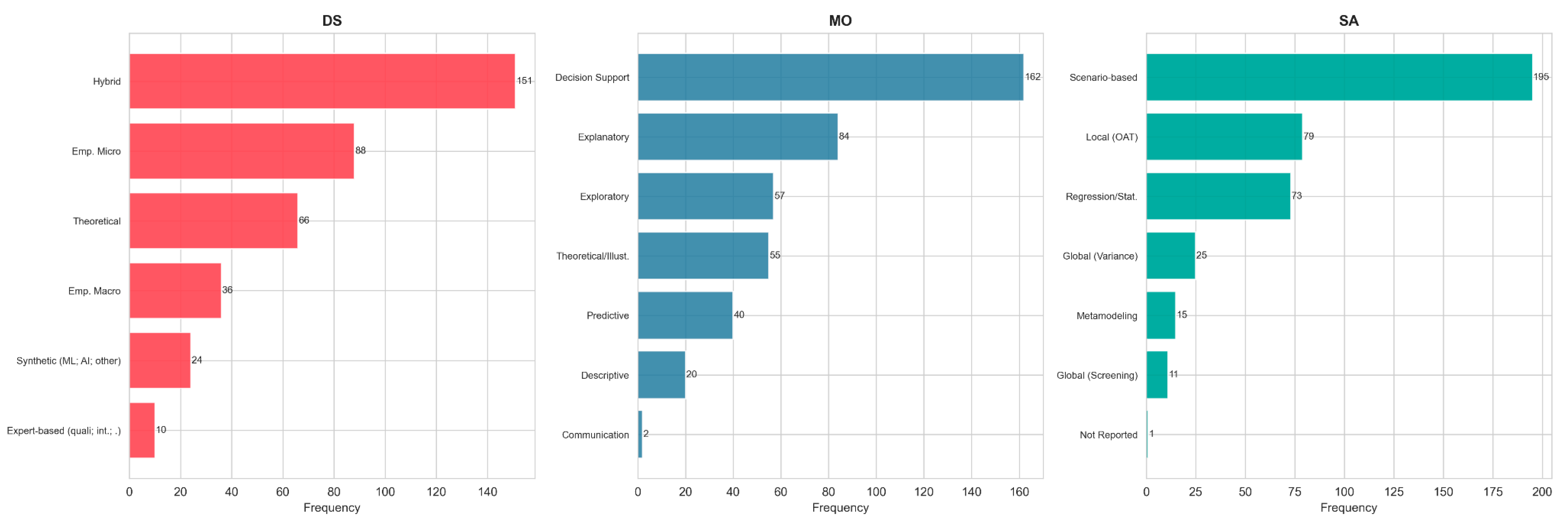
The distribution of core methodological features across the reviewed studies is presented in
Figure 1, encompassing model objectives (MO), data sources for parameterization (DS), and sensitivity analysis methods (SA).
The results indicate a predominance of decision-support and explanatory models, followed by exploratory and theoretical applications, while predictive and descriptive models appear less frequently. This distribution suggests that a significant portion of the literature is oriented toward applied or policy-relevant contexts, although not necessarily supported by corresponding levels of methodological rigor.
Regarding parameterization strategies, hybrid approaches combining multiple data sources are the most prevalent, followed by empirical micro-level and theoretical approaches. In contrast, empirical macro-level, synthetic, and expert-based strategies are less frequently adopted. This pattern reflects an increasing effort to incorporate empirical grounding, albeit often in combination with theoretical assumptions rather than through fully data-driven approaches.
In terms of sensitivity analysis, scenario-based methods are dominant, followed by local approaches (OAT) and regression-based techniques. In contrast, global sensitivity analysis methods—both variance-based and screening—as well as metamodeling techniques remain comparatively underutilized. This finding highlights a persistent limitation in the exploration of high-dimensional parameter spaces and interaction effects in ABMs applied to social systems.
The distributions reveal an asymmetry between model objectives and methodological choices, suggesting that more applied modeling purposes are not consistently matched by more rigorous parameterization and validation strategies.
4.2. Relationships Between Model Objectives, Parameterization, and Sensitivity Analysis
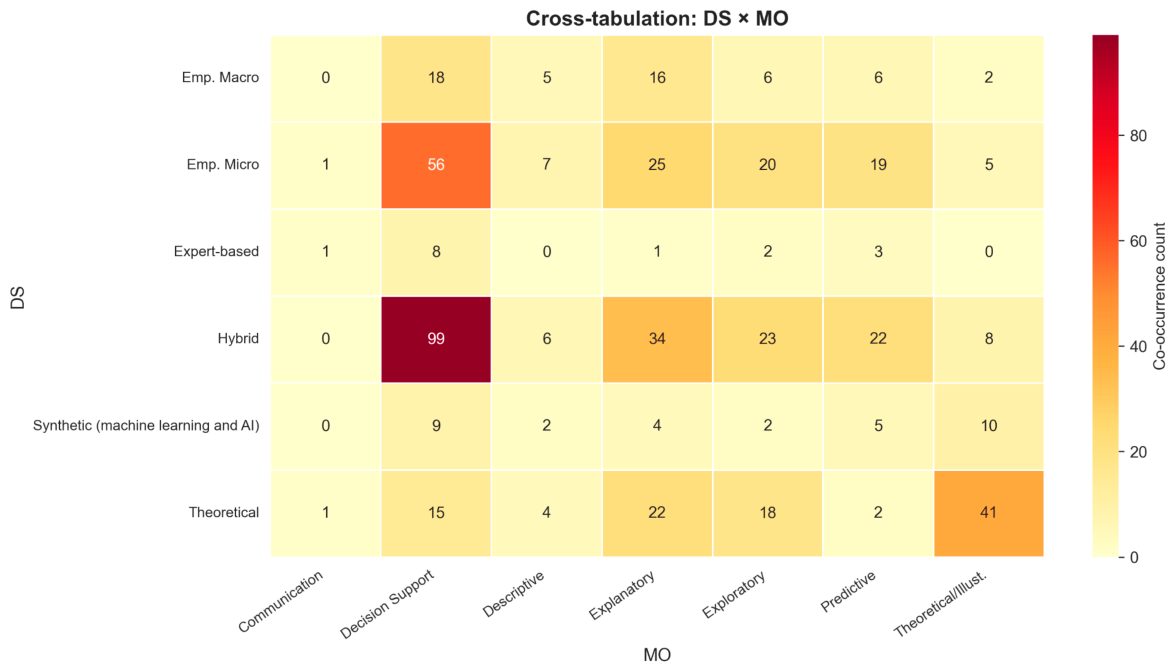
The relationships between model objectives (MO), data sources for parameterization (DS), and sensitivity analysis methods (SA) are presented through cross-tabulated heatmaps. These visualizations reveal structured patterns in methodological choices across the literature, rather than purely fragmented practices. The association between model objectives and parameterization strategies (DS × MO) (
Figure 2) indicates a strong concentration of hybrid and empirical micro-level approaches in decision-support and explanatory models. In particular, hybrid parameterization dominates decision-support applications, suggesting an attempt to balance empirical grounding with theoretical assumptions. However, theoretical approaches remain significantly present across exploratory and explanatory models, indicating persistent reliance on conceptual parameterization even in contexts that may require empirical rigor.
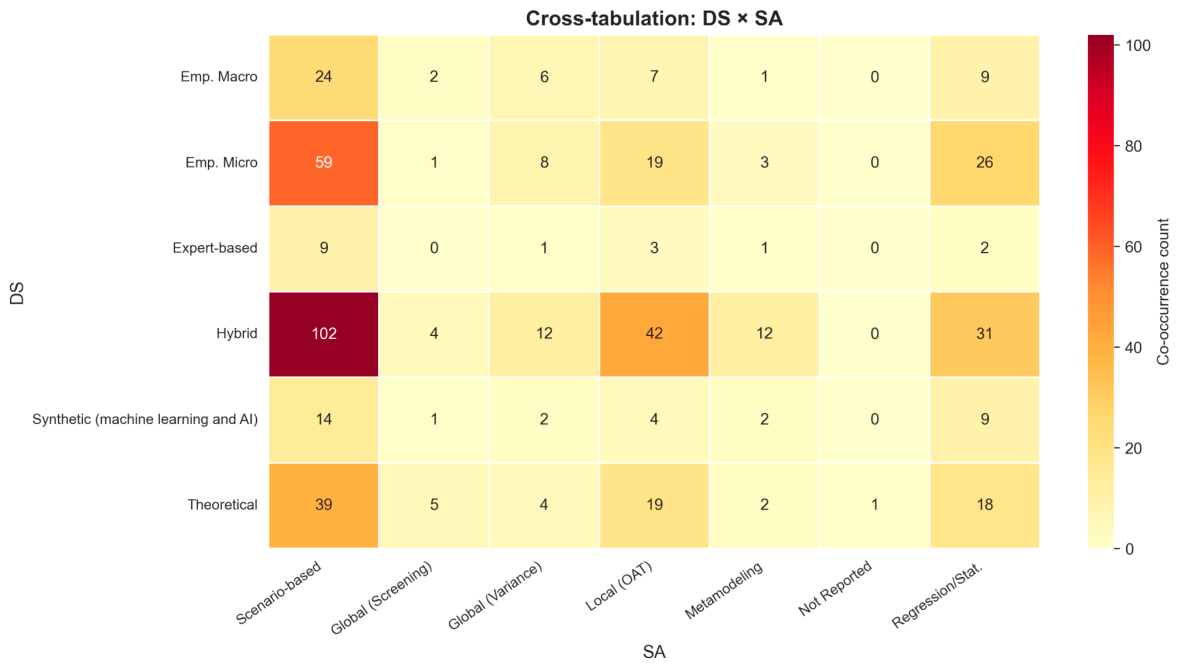
The relationship between parameterization strategies and sensitivity analysis methods (DS × SA) (
Figure 3) reveals a clear dominance of scenario-based approaches across all data sources, particularly for hybrid and empirical micro-level models. Local sensitivity analysis (OAT) also appears frequently, especially in combination with empirical approaches. In contrast, global sensitivity analysis methods along with metamodeling techniques are sparsely represented across all parameterization strategies, indicating limited exploration of complex parameter interactions regardless of data source.
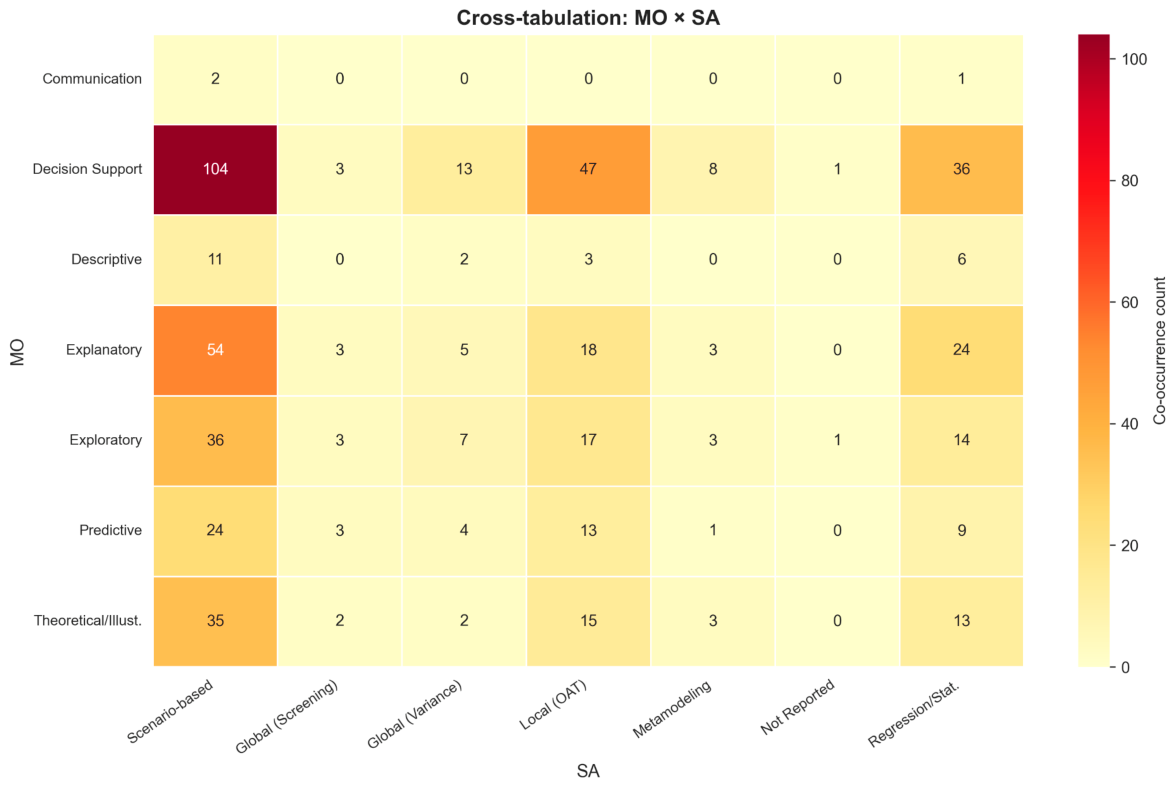
Finally, the relationship between model objectives and sensitivity analysis (MO × SA) highlights a substantial concentration of scenario-based methods in decision-support, explanatory, and exploratory models (
Figure 4). Although potentially reflecting the practical orientation of the studies, it also suggests a lack of systematic adoption of rigorous techniques for uncertainty quantification in applied contexts. The limited use of global sensitivity analysis in predictive and decision-support models is particularly noteworthy, as these applications require higher levels of robustness and validation.
To quantify the methodological alignment suggested by the heatmaps, we operationalize Hoadley’s [
52] concept of methodological alignment, originally introduced for design-based research and defined as the requirement that research methods actually test what they purport to test, as a quantitative Methodological Alignment Index (MAI) for the ABM literature. The MAI is the proportion of studies whose combination of model objective, parameterization source, and sensitivity-analysis method falls within the set recommended by the framework. Construction follows the standard protocol for composite indicators [
53]; the full operational definition, alignment criteria, and a robustness analysis are detailed in
Supplementary Materials.
Across the 304 coded studies, the overall MAI is 32.9%. This aggregate masks a pronounced gradient by model objective (χ2(5) = 50.7, p < 0.001, Cramér’s V = 0.408), with alignment systematically declining as the evidential burden of the objective rises. Decision Support and Predictive models reached MAIs of only 18.5% (30 of 162 studies) and 7.1% (1 of 14 studies), respectively. Lower-rigor categories showed intermediate to substantial alignment: Exploratory at 65.0%, Theoretical at 62.1%, Descriptive at 70.0%, and Explanatory at 44.9%, reflecting that scenario-based and local methods are recognized as adequate for exploratory and pedagogical objectives but not for policy-facing claims.
To verify that this gradient is not an artifact of aggregating a changing literature, the corpus was stratified into four periods (2015–2017, 2018–2020, 2021–2023, 2024–2025) and the MAI was recomputed within each. Alignment was highest in the earliest period (0.43) and stabilized at approximately 0.33 thereafter; no period exceeded an MAI of 0.44, and Decision Support and Predictive models remained the least-aligned categories throughout. A targeted test of whether machine-learning-based calibration has become more prevalent found no significant monotonic trend (Cochran–Armitage T = 0.91, p = 0.34). The misalignment is therefore a persistent structural feature of the field rather than a transient effect; full period-stratified results are reported in the reproduction notebook 3 (03_framework_operationalization.ipynb).
This pattern echoes recent observations in adjacent studies. Auchincloss and Garcia [
54] discussed that calibration strategy qualitatively in ABMs should be aligned with the nature of the research question, and Larooij and Törnberg [
38], in a systematic review of large-language-model-based ABMs, categorized validation practices and assessed their alignment with stated modeling goals, finding similarly that practice often departs from what stated objectives require. The MAI extends this line of inquiry by providing a quantitative metric applicable to ABM scoping and systematic reviews.
The results reveal a structural misalignment between model purpose and methodological rigor, concentrated in the categories where the evidential burden is highest. Decision Support and Predictive models are prominent in the literature, yet their sensitivity analysis practices frequently fall short of what their stated objectives require. This gap is not a matter of data scarcity: 91.4% of Decision Support studies draw on empirical or hybrid sources, yet only 18.5% apply a global SA method capable of quantifying the parameter-induced uncertainty on which policy-ranking conclusions depend. This mismatch reinforces the need for standardized guidelines that align methodological choices with declared model objectives—the basis of the decision framework proposed in this study.
4.3. Integrated Methodological Pathways
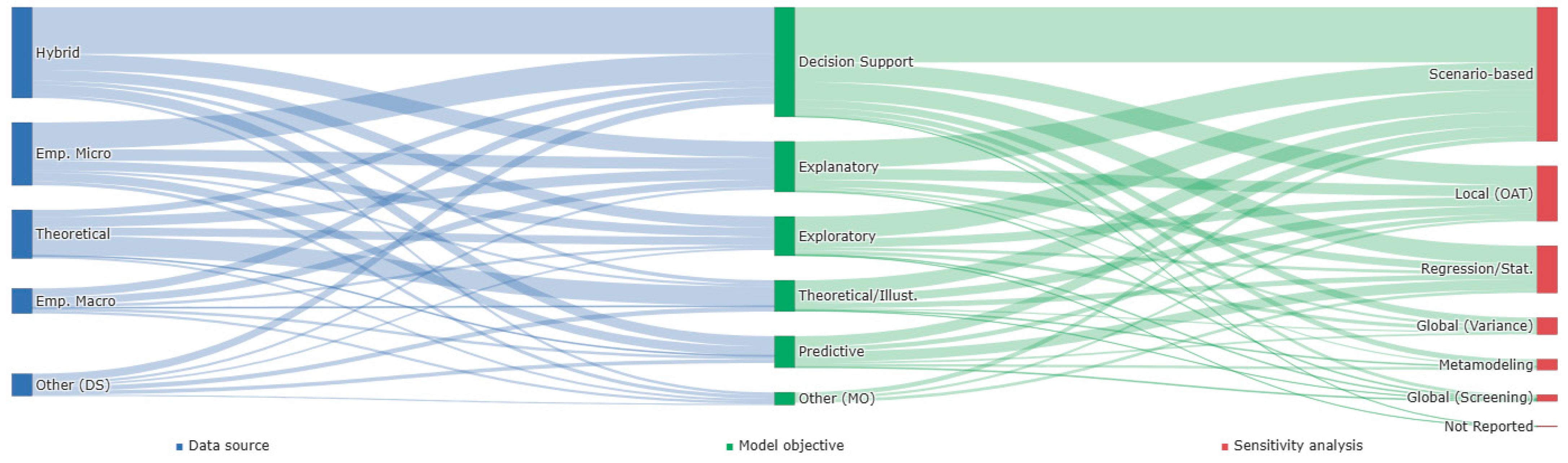
To integrate the relationships identified in previous analyses, a Sankey diagram was constructed to represent the flow of methodological choices across the three core dimensions: model objective, data source for parameterization, and sensitivity analysis method (
Figure 5). This visualization enables the identification of dominant pathways and recurrent combinations, transforming cross-sectional associations into structured decision trajectories.
The Sankey diagram (
Figure 6) reveals a concentration of flows originating from decision-support and explanatory models, which are predominantly associated with hybrid and empirical micro-level parameterization strategies. These flows indicate that applied models tend to incorporate multiple data sources, suggesting an effort to balance empirical grounding with theoretical assumptions.
However, a convergence emerges in the transition from model objectives to sensitivity analysis methods. Regardless of the diversity observed in parameterization strategies, the majority of flows are directed toward scenario-based approaches and, to a lesser extent, local sensitivity analysis (OAT). This pattern indicates a structural bottleneck in methodological choices, where diverse modeling inputs lead to a limited set of validation strategies. In contrast, pathways involving global sensitivity analysis methods (variance-based and screening), as well as metamodeling techniques, remain consistently weak across all model objectives and data sources. This suggests that advanced approaches for exploring high-dimensional parameter spaces and interaction effects are not systematically integrated into current modeling practices.
Additionally, theoretical parameterization is mainly associated with explanatory and illustrative models, often combined with scenario-based analysis. While this configuration aligns with the goals of conceptual modeling, its presence in explanatory and applied contexts reinforces the persistence of less rigorous validation practices beyond their most appropriate scope.
Overall, the Sankey representation highlights a limited diversification of methodological pathways, characterized by a combination of heterogeneous parameterization strategies and convergent validation approaches. This asymmetry reinforces the structural misalignment identified in the heatmap analysis: models with higher practical relevance, particularly decision-support applications, are not consistently associated with more rigorous sensitivity analysis techniques.
These dominant pathways can be interpreted as de facto standards emerging from practice, albeit without formal justification, suggesting that methodological choices in ABMs follow implicit but unformalized patterns. By making these pathways explicit, the present study provides the empirical basis for the development of standardized decision-making guidelines in ABM design for the applied social sciences that integrate human agent behavior and interactions.
4.4. Network Analysis of Conceptual and Methodological Structures
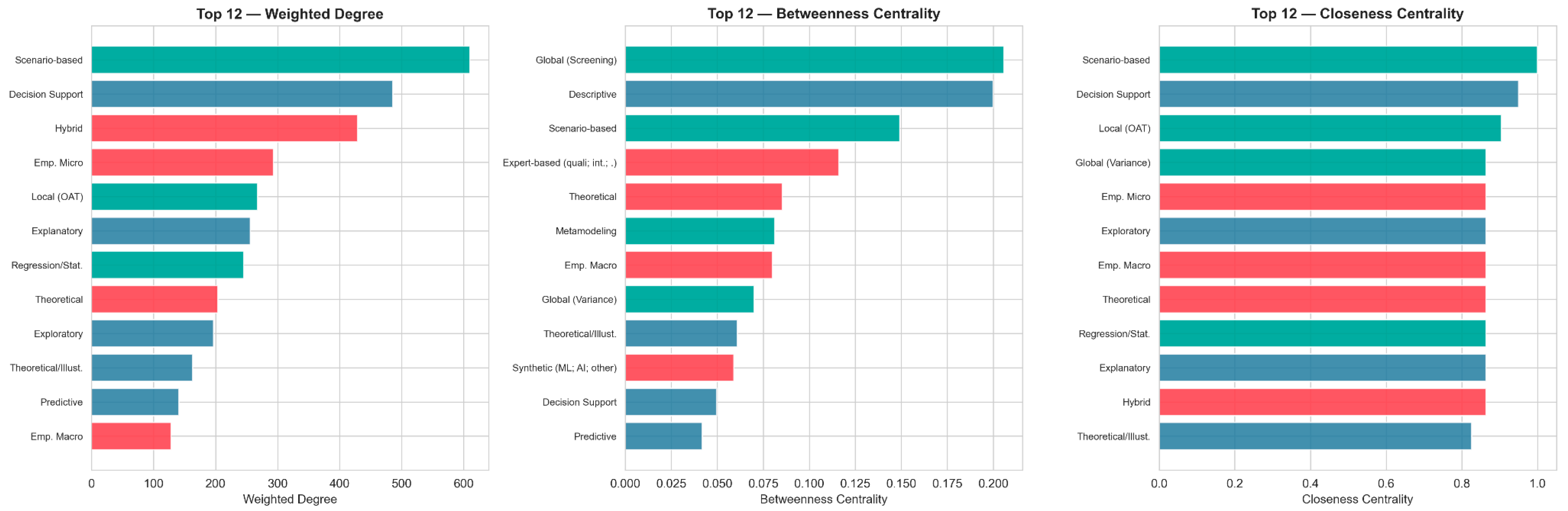
To further examine the structural organization of the field, a keyword co-occurrence network was constructed based on 304 articles, comprising 1203 harmonized keywords and 3839 edges in the full network. After filtering (minimum co-occurrence ≥ 2), the resulting network retained 90 nodes and 104 edges, forming a single connected component with low density (0.026) and low clustering coefficient (0.050), indicating sparse connectivity among concepts despite overall cohesion.
Centrality analyses reveal a highly concentrated structure dominated by a small set of core concepts. In particular, agent-based modeling emerges as the most influential node across all centrality measures (degree, betweenness, closeness, and eigenvector), confirming its role as the central organizing concept of the field. Surrounding this core, concepts such as decision-making, simulation, complex systems, and sensitivity analysis occupy secondary but structurally relevant positions, indicating their role in connecting different thematic areas.
The distribution of betweenness centrality highlights a limited number of bridging concepts that connect otherwise weakly linked subdomains. However, the overall low density and clustering suggest that these connections are not sufficient to produce a highly integrated methodological discourse.
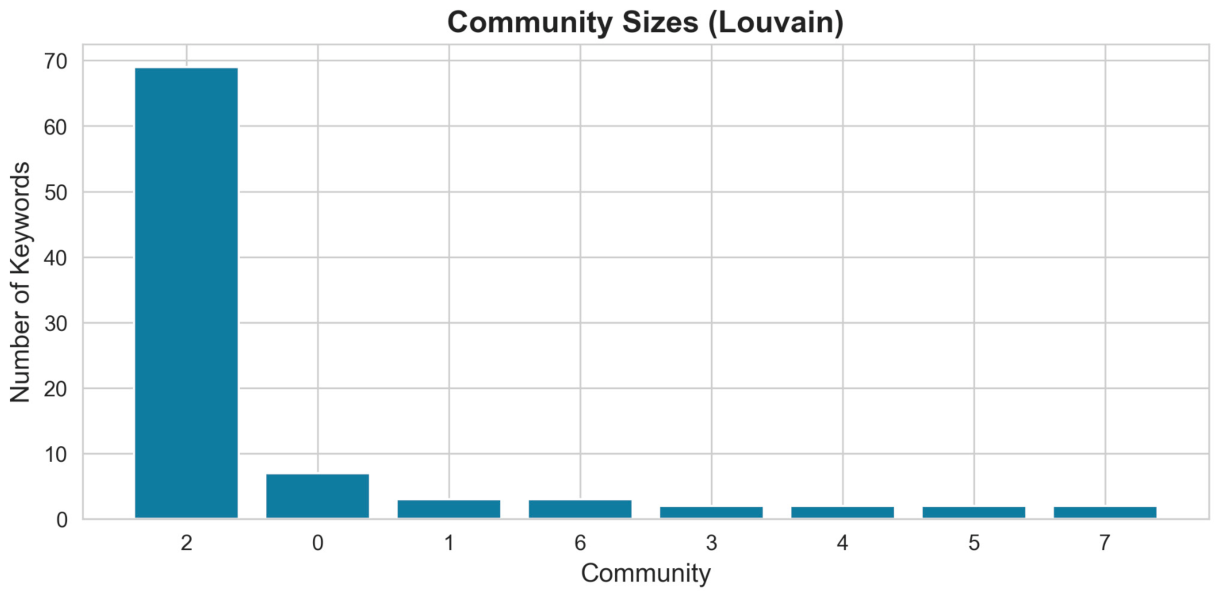
Community detection using the Louvain algorithm [
55] (
Figure 7) identified seven communities, with a highly uneven distribution of nodes: one dominant community concentrates the majority of keywords, while the remaining communities are smaller and topically specialized. The partition yielded an observed modularity of
= 0.2208. To evaluate whether this value reflects genuine community structure,
was compared against a null ensemble of 1000 random networks generated via the configuration model, which preserves the original degree sequence while randomizing edge placement [
55]. The null distribution yielded a mean modularity of
= 0.6169 (
= 0.0482), placing the observed value 7.83 standard deviations below the null mean (
= −8.22). This indicates that the network is significantly less modular than expected from its degree distribution alone—a pattern consistent with the structural properties of keyword co-occurrence networks, in which high-frequency terms act as hubs that co-occur broadly across thematic areas and suppress modular separation. Rather than reflecting “weak community structure,” the low relative modularity is now understood as a substantive structural feature of the network: high-frequency terms act as hubs that co-occur broadly across thematic areas, producing a hub-dominated, low-modularity topology in which Louvain communities should be read as relative groupings of keywords into the most cohesive subsets available, rather than as evidence of sharply delineated thematic clusters.
Inter-community co-occurrence analysis further illustrates this structural pattern, showing that most edges are absorbed by the dominant community, while the smaller peripheral communities maintain only sparse connections among themselves. This is consistent with the hub-dominated topology identified above: a broad conceptual core integrates the majority of keywords, while small, specialized communities operate as topical niches that branch off from this central structure. The Louvain partition (
Figure 8) therefore should not be read as evidence of fragmented or weakly defined research streams, but as a relative grouping that highlights specialization within an otherwise integrated field.
Complementary analyses of methodological co-occurrence networks across the three core dimensions (DS, MO, and SA) reinforce this hub-dominated pattern at the methodological level. Within-dimension networks show strong co-occurrence between hybrid and empirical parameterization strategies, as well as between decision-support and explanatory models. In contrast, the sensitivity analysis network is highly centralized around scenario-based methods, with weaker connections to global and advanced techniques, confirming the convergence identified in the Sankey analysis.
The unified methodological network further illustrates this structure, revealing a dense core composed of hybrid parameterization, decision-support models, and scenario-based analysis, surrounded by peripheral nodes such as metamodeling, global sensitivity methods, and expert-based parameterization. These peripheral nodes exhibit low connectivity and limited integration into dominant methodological pathways.
Overall, the network analyses reveal a field that is globally connected but locally sparse, with a strong conceptual core and weak methodological integration. While researchers share a common conceptual foundation centered on agent-based modeling, the connections between methodological practices remain limited and uneven. This structural configuration reinforces the presence of implicit but non-formalized methodological pathways, as previously identified, and highlights the need for systematic guidelines to enhance coherence and rigor in ABM design. This topology resembles core–periphery structures commonly observed in complex systems, where a dense conceptual core coexists with loosely connected methodological peripheries.
5. Discussion
The present study provides a comprehensive synthesis of methodological choices in ABM literature applied to the social sciences, revealing consistent patterns across multiple analytical layers. Rather than a fully fragmented landscape, the findings indicate a structured but imbalanced field, characterized by convergence in application domains and divergence in methodological rigor.
Across the distributional, relational, and network-based analyses, a central pattern emerged: while decision-support and predictive models dominate the literature, they are not consistently associated with more robust parameterization strategies or advanced sensitivity analysis techniques. This misalignment suggests that the increasing practical relevance of ABMs has not been accompanied by an equivalent evolution in methodological standards.
One of the most notable findings is the presence of a structural bottleneck in sensitivity analysis. Despite the diversity of parameterization strategies, which range from theoretical to hybrid and empirical approaches, the majority of models converge toward scenario-based and local sensitivity analysis methods [
56,
57]. This convergence limits the exploration of high-dimensional parameter spaces and constrains the ability to capture interaction effects, which are fundamental to complex social systems. A minority of studies demonstrate that this limitation is surmountable: variance-based global approaches have been used to decompose spatial and temporal sensitivities in complex spatial ABMs [
58] and to analyze policy-relevant dynamics in coupled human–environment systems [
59]. As a result, the robustness and reliability of model outcomes may be systematically underestimated.
The Sankey representation and the methodological network further reinforce the existence of dominant pathways in ABM design. These pathways can be interpreted as de facto standards emerging from practice. However, their widespread adoption does not necessarily imply methodological adequacy, particularly in contexts that require predictive accuracy or policy relevance.
From a structural perspective, the keyword co-occurrence network reveals a field organized around a dense conceptual core, centered on agent-based modeling and its immediate theoretical extensions, surrounded by weakly connected methodological and application-specific clusters. This core–periphery configuration suggests that while the field shares a common conceptual language, methodological practices evolve in a more fragmented and uneven manner. The limited integration of concepts related to calibration, validation, and sensitivity analysis further highlights the absence of a consolidated methodological framework [
56,
60].
Taken together, these findings point to a relevant gap between the conceptual maturity and methodological standardization of ABMs in the social sciences. While the field has advanced significantly in terms of applications and theoretical exploration, it still lacks widely adopted guidelines for key modeling decisions, particularly regarding parameterization and uncertainty analysis.
This gap has important implications for both research and practice. For researchers, the absence of standardized decision-making processes increases the risk of arbitrariness and reduces reproducibility. For practitioners and policymakers, it raises concerns about the reliability and interpretability of model-based insights used to support decision-making.
In response to these challenges, the present study contributes by making explicit the implicit decision pathways currently embedded in the literature. By identifying dominant patterns and structural limitations, the study provides the empirical foundation for the development of a decision-oriented framework to guide methodological choices in ABM design [
56]. Such a framework should align model objectives with appropriate levels of empirical grounding and analytical rigor, ensuring that methodological complexity is commensurate with the intended use of the model.
Several limitations should be considered when interpreting these findings. The search was restricted to three databases (SCOPUS, Web of Science, and IEEE Xplore) and to peer-reviewed publications in English, which may have excluded relevant work disseminated in other languages or through other venues; the corpus is therefore subject to the indexing and publication biases inherent to bibliographic databases. The temporal window (2015–2025) was chosen to capture contemporary practice but necessarily omits earlier methodological contributions that may still inform current standards. These boundaries delimit the empirical scope of the synthesis rather than the applicability of the proposed framework.
A further limitation concerns the classification procedure. The categorization of each study along the three methodological dimensions: model objective, data source, and sensitivity analysis method, was performed by two reviewers and reconciled by consensus. Because the per-reviewer decisions were recorded as a single reconciled coding sheet rather than as independent parallel codings, a formal inter-coder reliability coefficient cannot be computed retrospectively for this stage in a methodologically defensible way. The category counts on which the distributional, relational, and alignment analyses rest therefore carry a residual subjectivity that the consensus mechanism reduces but does not eliminate, particularly at the boundaries between adjacent categories—for instance, between explanatory and decision-support objectives, or between local and scenario-based sensitivity analysis. Reported counts and the Methodological Alignment Index should be read with this interpretive margin in mind.
Finally, the findings also suggest directions for future research. Advancing the field will require not only the adoption of more sophisticated techniques but also their integration into coherent and accessible methodological standards. Bridging the gap between conceptual development and methodological rigor remains a central challenge for the maturation of agent-based modeling in the social sciences.
A Decision-Oriented Framework for ABM Design in Social Sciences
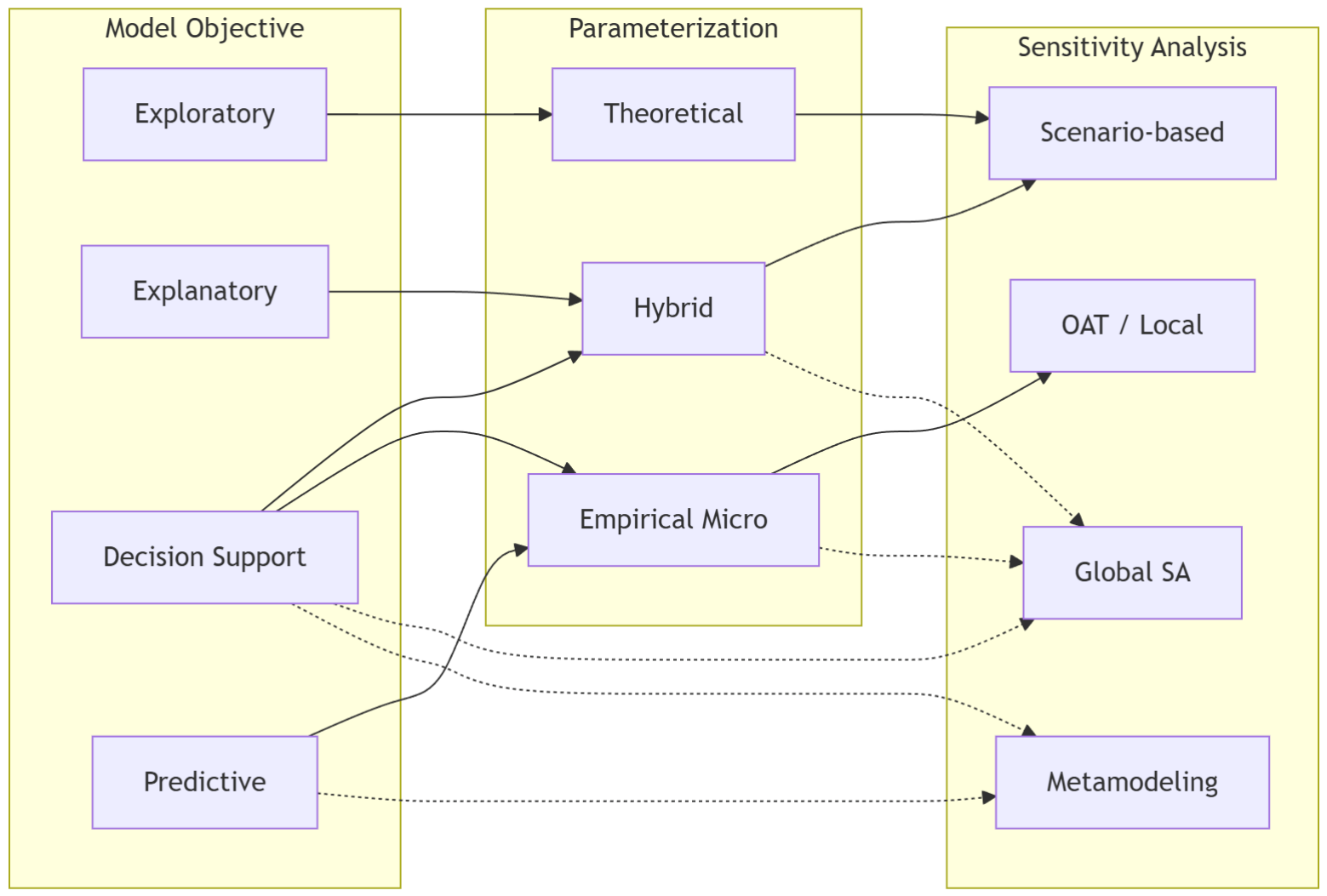
Building on the patterns identified across distributional, relational, and network-based analyses, this study therefore proposes a decision-oriented framework (
Figure 9) to support methodological choices in agent-based modeling within social simulations and human agent behavior. Rather than prescribing fixed rules, the framework formalizes the implicit pathways observed in the literature and addresses the misalignments between model objectives and methodological rigor identified in the results.
The framework is structured around the sequential relationship between three core dimensions: model objective, data source for parameterization, and sensitivity analysis method. This sequence reflects the empirical structure observed in the Sankey representation, where methodological choices follow a directional flow rather than independent selection.
At the first level, the model objective acts as the primary driver of methodological decisions. The results indicate that exploratory and theoretical models are predominantly associated with theory-driven parameterization and simpler validation strategies, which is consistent with their purpose of investigating abstract mechanisms. In contrast, explanatory and decision-support models require stronger empirical grounding, typically combining micro-level data with theoretical assumptions through hybrid approaches.
At the second level, the choice of data source constrains the space of appropriate sensitivity analysis methods. Empirical and hybrid parameterizations introduce higher dimensionality and uncertainty, requiring more robust exploration of parameter interactions. However, the results show that this increased complexity is not consistently matched by the adoption of advanced sensitivity analysis techniques, revealing a structural gap in current practices.
At the third level, the framework highlights the need to align sensitivity analysis methods with both the model objective and the complexity introduced by parameterization. While scenario-based and local methods are widely used, their adequacy depends on the purpose of the model. For exploratory applications, such approaches may be sufficient to illustrate mechanisms. However, for predictive and decision-support models, more comprehensive techniques (e.g., global sensitivity analysis and metamodeling) appear necessary to ensure robustness and reliability [
56,
57,
61,
62].
The framework therefore emphasizes that methodological choices in ABMs should not be made independently, but as part of an integrated decision process in which each component constrains and informs the others. The empirical evidence suggests that current practices often fail to maintain this alignment, particularly in applied contexts. This gap is not a transient phenomenon: stratifying the corpus by publication period shows that the misalignment between model objective and methodological rigor has persisted, without systematic narrowing, across the full 2015–2025 window.
To address this issue, the proposed framework can be operationalized as a structured decision-support protocol that guides researchers through a structured sequence of choices. Starting from the model objective, the framework suggests appropriate parameterization strategies and corresponding levels of analytical rigor in sensitivity analysis, while remaining flexible to accommodate practical constraints such as data availability and computational resources.
Importantly, the present framework is intended to comprise an evidence-informed standard to guide decision-making processes within ABM research in the social sciences, derived from observed patterns and gaps in the literature; therefore, it is not intended to be a prescriptive structure. Its purpose is to enhance transparency, consistency, and methodological rigor in ABM design, contributing to the broader effort of standardizing practices in computational social science.




 ,
,