Review

Standards on Corporate and Public Sustainability Reporting

by
Peter Glavič
Faculty of Chemistry and Chemical Engineering, University of Maribor, Smetanova 17, 2000 Maribor, Slovenia
Standards 2026, 6(1), 8; https://doi.org/10.3390/standards6010008
Submission received: 24 September 2025 / Revised: 28 January 2026 / Accepted: 6 February 2026 / Published: 13 February 2026
(This article belongs to the Special Issue Sustainable Development Standards)

Abstract

Sustainable development, with its three pillars (environmental, social, and governance, ESG), is crucial for human well-being. Climate change is occurring faster than expected. In 2015, 193 countries signed the United Nations’ Agenda 2030, which must be achieved by 2030 along with the 17 Sustainable Development Goals. In the PDCA (Plan, Do, Check, Act) cycle, the Check phase is crucial—sustainability reporting (SR) is essential. This article provides an overview of existing SR standards (SRSs) and their future development but does not conduct a systematic review of the relevant scientific literature on the application of SRSs. The information review methodology shows that SRSs are already well-developed in large companies. The different standards are described, including voluntary ISO (International Organization for Standardization) standards, the Global Reporting Initiative (GRI) standards, the mandatory European Sustainability Reporting Standards (ESRS), and the International Financial Reporting Standards (IFRS). National SRSs are often aligned with the IFRS Sustainability Disclosure Standards. Besides the corporate SRSs, public SRSs covering governmental and non-governmental institutions, universities, and associations are described. Public SRSs should be adapted to the needs of public institutions. Finally, the SRSs for individuals and communities is discussed to cover these important parts of humanity. The social and governance sustainability reports could be extended with annual personal or community Carbon or Ecological Footprint reports.

1. Introduction

Human historical development is composed of the number of people living (population growth), their life expectancy (mortality), biodiversity and infectious diseases, unsustainable resource consumption (energy, materials, water, and air), etc. The world population is not increasing at an exponential rate anymore (except in Africa and some countries in Asia) but it is still growing. The world population growth rate peaked in 1962 and 1963 with an annual growth rate of 2.2%; however, since then, world population growth has halved [1]. Global life expectancy is increasing rapidly, too; it was less than 30 a (years) before 1800, and it grew to 73 a (years) in 2023 [1]. Also, global child mortality, which was around 50% before 1800, fell to 27% by 1950 and to 4.3% by 2022 (Norway, Japan, Estonia and Slovenia have the lowest mortality rates—0.3%) [2].

1.1. Exponential Growth of Human Needs

This growth is positive for the human species but not for other living creatures—biodiversity is being lost. The world’s largest threats to biodiversity are (1) changes in land use (e.g., deforestation, intensive monoculture, and urbanization), (2) direct exploitation, such as hunting and over-fishing, (3) climate change, (4) pollution, and (5) invasive alien species [3]. They are due to human activities.
Global extraction of four main material groups—biomass, fossil fuels, metal ores, and non-metallic minerals—reached 31.1 Gt/a (billion tons per year) in 1970 [4], or 8.42 t/a per person. By 2024, global extraction from the earth had increased to 107 Gt/a, or 13.11 t/a per person (55.7% more). The number of cars reached 1.5 G (billion) globally in 2025 (5.5 inhabitants per car) and is expected to grow to 2.0 G by 2040 (4.6 inhabitants per car) [5]. In the same period, the number of trucks will increase from 507 M (million) to 790 M, and the air travel distance, measured as passenger distance (km), will increase from 12 T (trillion) to 20 T.
Because of the increased extraction of materials and production of goods, global primary energy and food production (and consumption) increased from 5.6 PW h/a in 1800 (using traditional biomass and only 1.7% from coal) to 12.1 PW h in 1900 (47.7% from coal) and to 181.9 PW h in 2024 (24.9% from coal, 30.2% from oil, 22.1% from natural gas, 5.7% from hydropower, 6.1% from traditional biomass, 7.4% from other renewables, and 3.8% from nuclear) [6].
The most worrying results of the increased extraction of materials, production, and consumption of energy and goods are the greenhouse gas (GHG) emissions. GHGs include carbon dioxide, methane, and nitrous oxide from all sources, including land-use change; they are measured as a mass flow rate (qm, t/a, tons per year) in “carbon dioxide-equivalents” (CO2e). Globally, we emit more than 50 Gt/a of GHGs. In 1850, 4.2 Gt/a were emitted, increasing to 8.7 Gt/a in 1900, 16.7 Gt/a in 1950, 40.7 Gt/a in 2000, and 53.8 Gt/a in 2023 [7], or 6.65 t/a per capita (2.05 t/a from electricity and heat production, 0.98 t/a from transport, 0.74 t/a from agriculture, 0.41 t/a from industry, 0.41 t/a from fugitive emissions, 0.38 t/a from buildings, 0.21 t/a from waste, etc.) [8].

1.2. Human Agreements

To slow down the dangerous development of climate change, 154 member states of the United Nations (UN) signed the United Nations Framework Convention on Climate Change (UNFCCC) in 1992 at the Earth Summit in Rio de Janeiro [9]. In 1997, 192 parties signed the Kyoto Protocol, which entered into force in 2005, committing themselves to reducing GHG emissions until 2020. The Paris Agreement was agreed by 196 parties at the 2015 UNFCCC conference and signed in 2016.
To realize the Paris Agreement and keep the global temperature rise below 2.0 °C (the 1.5 °C goal has been already missed), the additional GHG emissions could sum to 1050 Gt, i.e., 18 a (years) of current emissions with a 50% chance of succeeding or 12 a (years) with an 85% chance (updated from [10]). The higher the mass reached, the greater the damage expected. Categories of climate impacts include: (1) agriculture (changes in land and aquaculture productivity, and livestock mortality and morbidity from heat and cold exposure), (2) coastal zones (loss of land and capital from sea level rises and non-market impacts), (3) extreme events (mortality, land and capital damages from hurricanes, floods, heat waves, etc.), (4) health (mortality and morbidity from heat and cold exposure, infections and other diseases), (5) energy demand (changes for cooling and heating), (6) tourism demand (changes in tourism flows and services), (7) water stress (changes in energy supply and availability of drinking water), (8) human security (civil conflicts and wars, and human migration), and (9) tipping points (large-scale disruptive events) [11]. The global annual average GDP (Gross Domestic Product) loss in 2060 is estimated at 2.0% (3.3% for the Middle East and North Africa, 3.7% for South and Southeast Asia, and 3.8% for Sub-Saharan Africa, respectively).
Environmental concerns are not the only problematic dimension of sustainability. A social dimension has been developed by the UN; first, the eight Millennium Development Goals (MDGs) for the year 2015, followed by the 17 Sustainable Development Goals, SDGs [12]. The 2030 Agenda is a plan of action for people, the planet, and prosperity. It also seeks to promote universal peace and foster partnerships. The Paris Agreement followed in the same year [13]. In 2019, the EU (European Union) accepted the European Green Deal to transform the EU into a modern, resource-efficient, and competitive economy, ensuring: (a) no net emissions of greenhouse gases by 2050, (b) economic growth decoupled from resource use, and (c) no person and no place left behind [14].
In 2013, fewer than 10% of the largest EU companies regularly disclosed their non-financial information. Therefore, the EU accepted a Non-Financial Reporting Directive (NFRD) for large companies with more than 500 employees [15]. Companies concerned were required to disclose in their management report and material information on: (a) policies, (b) outcomes and risks, including due diligence that they implemented, (c) relevant non-financial key performance indicators (KPIs) concerning environmental aspects, (d) social- and employee-related matters, (e) respect for human rights, (f) anti-corruption and bribery issues, and (g) diversity on the boards of directors.
In 2022, the NFRD was updated with the Corporate Sustainability Reporting Directive (CSRD) to modernize and strengthen the rules on social and environmental information that companies must report [16]. A broader set of companies required to report on sustainability in the EU was directed, approximately 50,000 companies, compared with 11,700 in the NFRD. Large companies (regardless of their capital market orientation) that met at least two of the following three requirements—250 or more employees; 50 MEUR (million EUR) in net turnover; and/or 25 MEUR in assets—were to report according to the Directive.
Current policies are not aligning with the Paris Agreement—they are leading to around 2.5 °C of warming. Lack of government regulations does not support faster and more profound adaptation and mitigation. In addition, in January 2026, the United States of America (US) withdrew from the Paris Agreement. Fortunately, many US states will continue to respect and fulfill their commitments under the Paris Agreement.
The EU also reduced the requirements for the CSRD by lowering the number of participating companies below that of the NFRD to corporations with more than 1000 employees. The EU reduced the content of the reports and the time limits to start reporting (Omnibus package) [17]. In July 2025, the Commission adopted targeted “quick fix” amendments to the first set of European Sustainability Reporting Standards (ESRS) [18]. This will reduce the burden on and the number of companies that have to start reporting for the 2024 financial year (commonly referred to as “wave one” companies) by 80%. The “quick fix” amendment, which takes effect from the 2025 financial year, will allow them to omit that same information for the 2025 and 2026 financial years. For large companies with 250 or more employees and listed small- and medium-sized enterprises (SMEs) in waves 2 and 3, the start will be postponed by 2 years [19]. For companies no longer in the scope of the CSRD, the Commission plans to adopt a voluntary reporting standard for SMEs (VSME), developed by the European Financial Reporting Advisory Group (EFRAG).
The slowdown of CSR in the EU and the US withdrawal is endangering the fulfillment of UN Paris Agreement by 2050 and the realization of the SDGs by 2030. Voluntary reporting using available sustainability reporting standards (SRSs) will become more important. It is encouraging that the voluntary ISO (International Organization for Standardization) and GRI (Global Reporting Initiative) standards are already widely adopted globally.

1.3. Sustainability Reporting

Environmental, social, and governance (ESG) reporting discloses information covering an organization’s operations and risks in three areas: environmental stewardship, social responsibility, and corporate governance. As sustainability and ethical governance become increasingly critical for businesses, ESG reporting enables organizations to showcase their commitment to addressing societal challenges, reducing environmental impact, and maintaining strong governance practices [20]. By consistently communicating ESG performance, companies can enhance their reputation.
KPIs help businesses measure progress in the three ESG areas: (1) environmental metrics (carbon emissions, water usage, and waste management); (2) social metrics (labor practices; diversity, equity, and inclusion, DEI; and human rights); (3) governance metrics (board diversity, executive compensation, shareholder rights, and anti-corruption efforts). Best practices for successful ESG reporting require companies to: (1) identify and manage key ESG risks; (2) improve data collection; (3) align ESG reporting with business strategy; (4) engage stakeholders; (5) include ESG initiatives and sustainability efforts; (6) report on climate change efforts and environmental impact; (7) report on social responsibility and community impact; and (8) report on corporate governance practices.
Sustainability and ESG are widely used yet distinct concepts; however, their differences are not always well understood. While ESG and sustainability both focus on the environmental and social impacts of business, they have distinct goals and priorities [21]. ESG is a framework for evaluating companies’ performance across specific areas, such as carbon emissions, diversity and inclusion, and executive pay. It is used to identify and manage specific risks and opportunities associated with a company or investment. Conversely, sustainability offers a broader, holistic approach to long-term value creation that encompasses a range of responsible and ethical business practices across areas such as supply chain management, stakeholder engagement, and community development.
Current sustainability reporting is a set of four methods: CSRD, Corporate Sustainability Due Diligence Directive (CSDDD), EU Taxonomy Regulation, and Carbon Border Adjustment Mechanism (CBAM) [22]. In more detail:
(1)
The CSRD described above includes the development of ESRS; companies within the CSRD will have to report on double materiality—financial and impact materiality.
(2)
The aim of the CSDDD is to foster sustainable and responsible corporate behavior in companies’ operations and across their global value chains; it limits the information large companies can request from SMEs and small mid-cap business partners to that laid out in the CSRD’s VSME.
(3)
The EU taxonomy helps direct investments to the economic activities most needed for the transition, in line with the European Green Deal objectives. The taxonomy is a classification system that defines criteria for economic activities aligned with a net-zero trajectory by 2050 and broader environmental goals, encompassing aspects beyond the climate.
(4)
The CBAM is the EU’s tool to put a fair price on carbon emitted during the production of carbon-intensive goods that are entering the EU and to encourage cleaner industrial production in non-EU countries.

1.4. The Aim of This Overview

This narrative overview presents the development and status of international and national sustainability reporting standards for companies in the last decade, which are available on open access. This article does not deal with a systematic review of the scientific literature on the application, adoption, and impact of SRSs. Highlighting gaps in sustainability reporting in the public sector broadens the responsibility for sustainable development to governments, public administrations, cities, universities, agencies, and other public services. Additional efforts are needed to address the diverse range of responsibilities related to material and energy usage, pollution reduction, and degrowth across the population. The results are followed by a discussion and conclusions.

2. Methods

Sustainability reporting is a relatively young discipline; the number of papers started to grow recently, in 2022 [23]. It was preceded by non-financial reporting, integrated reporting, and financial reporting. Mandatory reporting started in 2014 for large companies with more than 500 employees and was substituted by the CSRD in 2021 for corporations with more than 250 employees. Therefore, the literature overview should not include many published scientific articles on the application of standards but should primarily focus on publications from standardization organizations, as well as the website literature from legislative bodies, standard developers, consulting organizations, and other relevant sources.
A literature search was conducted using open sources from the past five to ten years. It included standards descriptions, practical experiences of companies and consultants, scientific articles, and conference proceedings. Experience from the Erasmus+ project “Smart Education for Corporate Sustainability Reporting” (SECuRe [24]) greatly aided in selecting the appropriate methods for conducting a literature search and understanding the problem.

3. Results Approach

3.1. GRI Standards

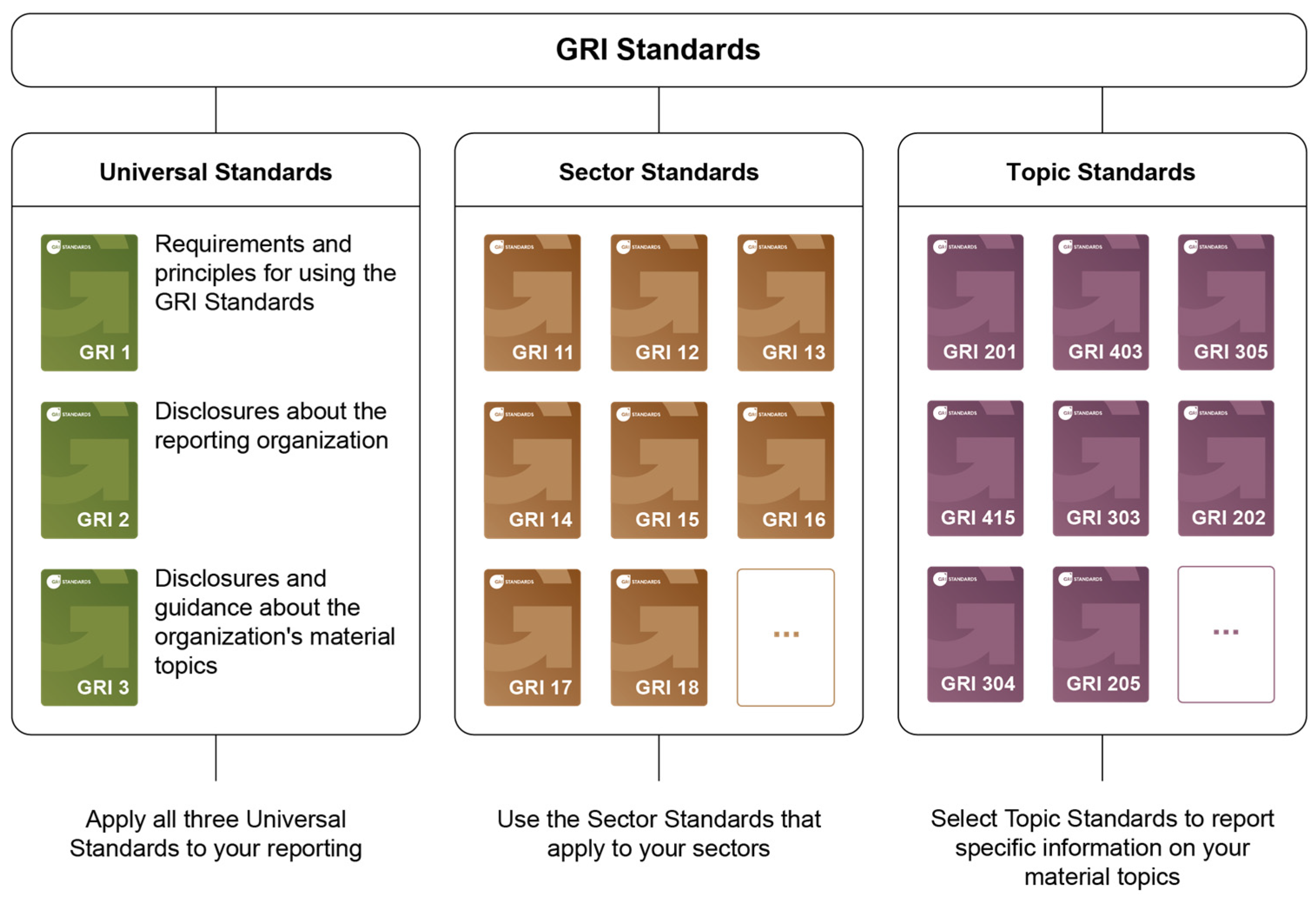
GRI (Global Reporting Initiative) standards are the world’s most widely used standards for sustainability reporting [25]. The original standards are in English, with authorized translations in ten other languages. They are regularly updated. The Global Sustainability Standards Board (GSSB) sets out a new work program every three years. The GSSB work program includes projects to review existing GRI standards and develop new ones. Standards can be utilized by both small and large organizations to serve the interests of investors, policymakers, capital markets, and civil society. The standards are organized in three groups: (1) universal standards, (2) sector standards, and (3) topic standards (Figure 1) [26].
The three universal standards cover essential information about an organization or company; they report on human rights and environmental due diligence:
  • GRI 1, Foundation 2021, explains the purpose of the GRI standards, their critical concepts, and usage. It outlines the requirements an organization must fulfill to report under the GRI standards. It must adhere to the fundamental principles of good-quality reporting, such as accuracy, balance, and verifiability.
  • GRI 2, General Disclosures 2021, includes disclosures of the organization: structure and reporting practices, activities and workers, governance, strategy, policies, practices, and stakeholder engagement. The organization’s profile and scale are presented to provide context for understanding.
  • GRI 3, Material Topics 2021, gives the steps that help the organization to determine the most relevant topics, their impacts, materials, and how the sector standards are used in this process. It also discloses the list of material topics, the process used to determine them, and how it manages each topic.
The 40 sector standards deal with the sector-specific impacts on the economy, the environment, and society. The sectors belong to four groups [27]:
  • Basic materials and needs (oil and gas, coal, agriculture and aquaculture with fishing, mining, food and beverages, textiles and apparel, banking, insurance, capital markets, utilities, renewable energy, forestry, and metal processing).
  • Industry (construction materials, aerospace and defense, automotive, construction, chemicals, machinery and equipment, pharmaceuticals, and electronics).
  • Transport, infrastructure, and tourism (media and communication, software, real estate, transportation infrastructure, shipping, trucking, airlines, trading with distribution and logistics, packaging, and hotels).
  • Other services and light manufacturing (educational services, household durables, managed healthcare, medical equipment and services, retail, security services, restaurants, commercial services, and non-profit organizations).
The 31 topic standards deal with 19 categories, covering: (a) all themes (1 category), (b) business integrity and prosperity (7 categories), (c) environment (6 categories), and (d) people (5 categories). They contain 19 topics (with exemplary sub-topics) [28]:
(a) Supply chain sustainability and responsible sourcing: supplier engagement; supplier selection, screening, and auditing; sustainable materials; supply chain impacts; and supply chain management.
  • Governance and leadership: corporate management, sustainability program leadership, board structure and independence, risk management and business continuity, executive compensation, and accountability.
  • Customer satisfaction and engagement: customer satisfaction and engagement and the provision of information to customers and consumers.
  • Economic performance: direct economic value generated and distributed and other disclosures related to economic performance.
  • Ethical business conduct: prevention of anti-competitive practices, anti-corruption/anti-bribery practices, human rights, data security and privacy, responsible marketing and product labeling, transparency, regulatory compliance, animal welfare, and clinical trials.
  • Innovation and R&D: research in unmet needs, developing new technologies, innovative solutions, and intellectual property.
  • Market presence and pricing: growth strategy in emerging/developed markets, pricing, and affordability of products and solutions.
  • Product safety and quality: product responsibility, product safety design, quality management, and customer health and safety.
(1)
Air quality and other emissions: ozone-depleting substances, NOX and SOX, and other (non-GHG) emissions.
(2)
Chemicals and hazardous materials: management of toxic substances, hazardous materials, chemicals, and restricted substances.
(3)
Climate change and energy-related GHG emissions: climate change strategy, carbon footprint reductions (Scopes 1, 2, and 3), energy consumption and efficiency, and renewable energy.
(4)
Sustainable products and solutions: Life Cycle Assessment, sustainable design, product take-back, resource efficiency, and product energy efficiency.
(5)
Waste management: waste generation and recycling, electronic and hazardous waste, and packaging waste.
(6)
Water and effluents: water consumption, effluents and wastewater management, and water scarcity.
  • Community and donations: volunteerism, philanthropy, local development, engagement and dialog with local communities, non-governmental organizations, local governments, academia, etc.
  • Diversity and inclusion: employee diversity and inclusion, equal opportunity, non-discrimination, and gender equality.
  • Labor practices: employment practices, labor management relations, freedom of association and collective bargaining, forced or compulsory labor, and child labor.
  • Occupational health and safety (OHS): hazard minimization precautions; employee health, safety, and well-being; emergency response plans; occupational accidents; biosafety and laboratory biosecurity; and OHS management system.
  • Talent attraction, development, and retention: training and development, recruitment, career management and promotion, compensation, and benefits.
Each topic and its sub-topics are considered by several GRI standards, e.g., the first one on supply chain sustainability and responsible sourcing is dealt with in seven standards: GRI 102—General Disclosures, GRI 103—Management Approach, GRI 204—Procurement Practices, GRI 307—Environmental Compliance, GRI 308—Supplier Environmental Assessment, and GRI 414—Supplier Social Assessment. GRIs 201–207 deal with economic topics, GRIs 301–307 with environmental ones, and GRIs 401–419 with social topics. More information can be found in [29].

3.2. ESRS

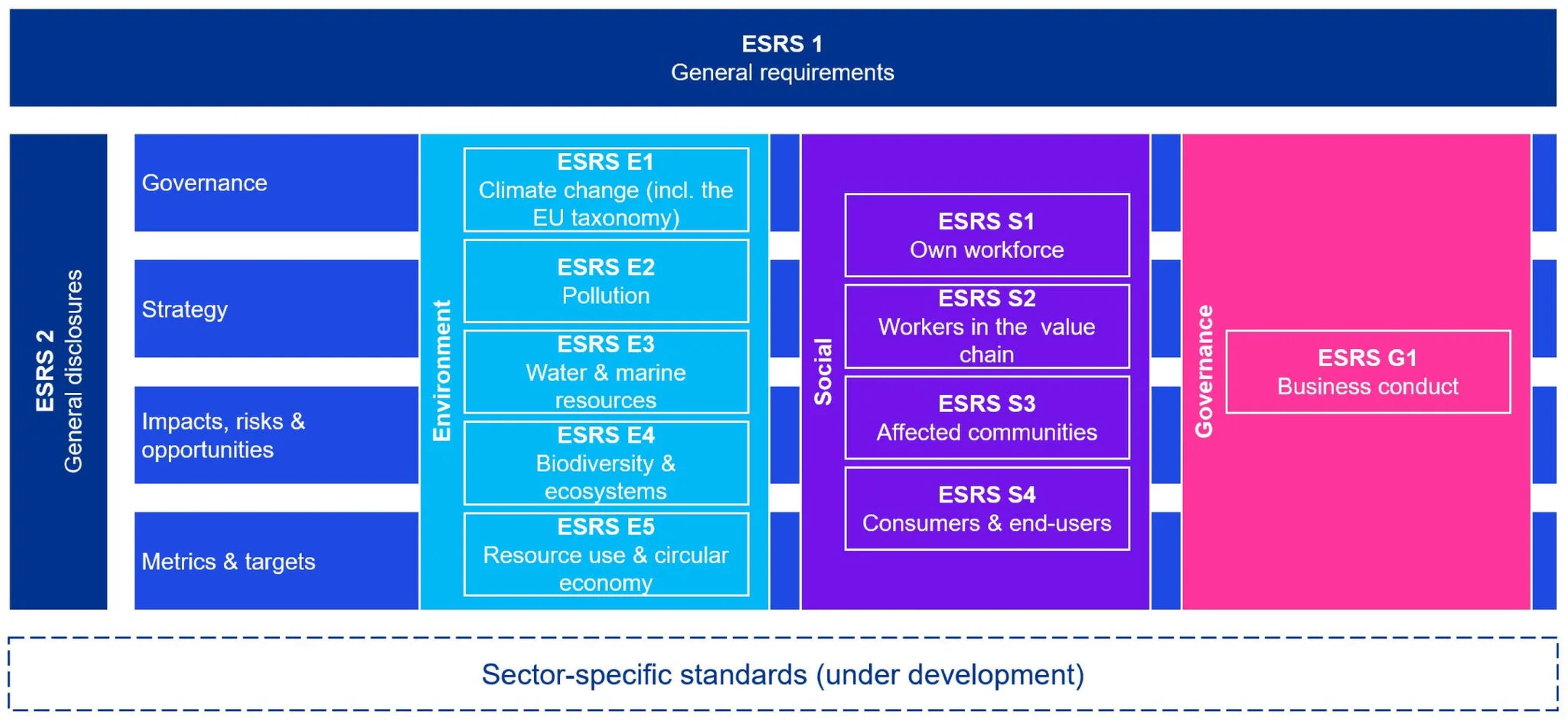
The ESRS are a substantial part of the CSRD: they define how companies in the EU must report on their sustainability performance [30,31]. The ESRS are intended to enable uniform, transparent, and comparable sustainability reporting. They are divided into different categories to ensure comprehensive and transparent reporting. They consist of (1) general requirements, (2) topic-specific standards for: (a) environment (E), (b) society (S), and (c) governance (G), and (3) sector- and company-specific regulations (Figure 2).
Each of the ESRS covers the four central reporting areas: strategy, policies, actions, and targets. Strategy encompasses relevance, risks, and opportunities, as well as double materiality, its impact on long-term value creation, and the inclusion of stakeholder expectations. Policies must adopt internal guidelines and codes of conduct to respect official sustainability guidelines, establish effective governance structures, comply with relevant regulatory requirements, and commit to adhering to the selected international standards. Actions embrace operational measures to reduce environmental impact, programs for social sustainability (e.g., diversity and working conditions), management of supply chain and ESG risk, and investments in sustainable technologies or processes. Targets demonstrate the company’s specific goals and KPIs, with clearly defined ESG targets and indicators, a methodology for reviewing progress (e.g., reporting frequency), and a link to remuneration models or internal incentives.
The overarching standards ESRS 1 and ESRS 2 set out the basic principles and general disclosure requirements: ESRS 1—General requirements (structure, concepts, preparation and presentation of information, reporting principles, double materiality, and coherence with other standards) and ESRS 2—General information (requirements for information on governance, strategy and governance, impacts, risks and opportunities (IROs), key figures and targets, reporting obligations, and structure of the report). The thematic European Sustainability Reporting Standards cover the three sustainability dimensions: environment (E), social (S), and governance (G):
The Environmental ESRS are: E1—Climate change (impact on climate change, Paris Agreement, adaptation strategies, GHG emissions Scope 1–3, energy consumption and energy mix), E2—Pollution (actual and potential impacts on air, water and soil pollution; substances of concern; and strategies and finance to prevent and mitigate them), E3—Water and marine resources (use and impacts on water and marine resources, their protection, mitigation of negative impacts, and risks and opportunities), E4—Biodiversity and Ecosystems (impacts on biodiversity and ecosystems, material risks and opportunities, measures to mitigate them, and financial implications), and E5—Circular economy (resource efficiency, waste minimization, use of renewable resources, prevention of non-renewable resource depletion, decoupling of economic growth from the use of resources, and their reuse and recycling).
The Social ESRS are: S1—Own workforce (positive and negative influences, financial risks and opportunities, working conditions, equal treatment and opportunities for all, child and forced labor, and addressing these factors), S2—Workforce in the value chain (impact on workers, labor-related rights, transparency, equal treatment and opportunities, and approach to assessing and addressing impacts on working conditions), S3—Affected communities (IROs on economic, social and cultural, civil and political rights of communities, people, and indigenous peoples in its value chain), and S4—Consumers and end users (privacy and freedom of expression), (ii) personal safety (e.g., health and safety, personal security and child protection, non-discrimination, access to products and services and responsible marketing practices).
The Governance ESRS is: G1—Business conduct (corporate ethics and culture, anti-corruption, protection of whistleblowers, supplier relationships, political influence and obligations, including lobbying).
EFRAG has published two other standards:
  • ESRS LSME (ESRS for Listed Small- and Medium-sized Enterprises): The standard offers simplified and proportionally adjusted reporting for small- and medium-sized listed companies, while the comprehensive ESRS requires detailed and in-depth disclosure of all relevant sustainability aspects in accordance with the CSRD.
  • ESRS VSME (Voluntary Sustainability Reporting Standard for non-listed SMEs): The standard offers a voluntary and greatly reduced reporting scheme that is geared to the limited resources of very small companies. A helpful Word report template for the VSME standard is available, which also compiles all report requirements in a clear list of VSME data points.
The ESRS require companies to implement a (double) materiality assessment, conduct an inventory and gap analysis, optimize data management and internal processes, integrate information into the annual report, and prepare for an external audit. To enable external auditing, the ESRS data must be published in a machine-readable format (Extensible HyperText Markup Language, XHTML, or European Single Electronic Format, ESEF) suitable for digital evaluation.
Compared to voluntary reporting standards, the ESRS are mandatory for all companies subject to the CSRD. They require the usage of double materiality between the company, society, and environment. The reporting framework is legally binding within the EU; therefore, it eliminates the need for multiple reporting. The ESRS are coordinated with the International Financial Reporting Standards (IFRS) Foundation and the International Sustainability Standards Board (ISSB), GRI standards, and the Task Force on Climate-related Financial Disclosures (TCFD).

3.3. ISO Standards

ESG reporting has a direct impact on revenue and costs, market share, and a company’s reputation. The 2022 report from the Governance & Accountability Institute found that 96% of companies in the S&P 500 index had published an ESG report [33]. ISO standards were front runners in ESG reporting. They are supporting ESG goals by increasing credibility, measuring impact and its reduction, improving cost efficiency, and enhancing stakeholder confidence (including investor, customer, and employee expectations) [34].
The most important ISO voluntary standards that support ESG in connection with environmental impact are: ISO 1400—Environmental management systems [35], ISO 14064-1—Greenhouse gas emissions quantification and reporting [36], ISO 14046—Water footprint [37], ISO 46001—Water efficiency management systems [38], ISO 50001—Energy management [39], ISO 14008 —Monetary valuation of environmental impacts [40], and 14007 Guidelines for determining environmental costs and benefits [41]. The most used standards of the social component are ISO 26000—Social responsibility with the seven core principles (Accountability, Transparency, Ethical behavior, Respect for stakeholder interests, Respect for the rule of law, Respect for international norms of behavior, and Respect for human rights) [42], ISO 45001—Occupational health and safety [43], and ISO 20400—Sustainable procurement [44]. Regarding governance items, ISO 37301—Compliance Management Systems [45], ISO 27001—Information Security Management [46], and ISO 37001—Anti-Bribery Management Systems [47] are the most popular.
Some experts also include the new ISO 53001 (Management Systems for the UN Sustainable Development Goals) [48] and ISO 30415 (Human Resource Management—Diversity and Inclusion [49]) among the 10 most important ISO standards [50].

3.4. Other International Sustainability Reporting Standards

The Voluntary GRI sustainability reporting standards were the most widely used in 2024 [51]. An investigation of 5800 companies (the largest 100 in 58 countries) showed that 71% used GRI standards (3% more than in 2022), while among the 250 largest multinationals (the G250), GRI standards were adopted by 77%. Approximately 14,000 organizations worldwide reported according to the GRI standards [52].
The Omnibus package of the EU’s CSRD reduced the number of potential users of mandatory ESRS from the forecasted 500,000 to about 10,000. EFRAG is planning to simplify the ESRS by reducing companies’ reporting burden [53]. The simplifications will streamline the double materiality assessment, reduce overlaps across standards, clarify language and structure, and remove all voluntary disclosures.
The CDP (formerly the Carbon Disclosure Project) manages a global environmental disclosure system used by more than 23,000 companies. Companies disclose by completing any or all three CDP questionnaires on climate change, forests, and water security. CDP also includes an optional (4th) supply chain reporting module. CDP publishes the list of companies’ reporting scores on its website [54].
The TCFD guides companies on disclosing climate-related financial risks to investors, lenders, insurers, and other stakeholders. The TCFD is primarily a theme- or pillar-based recommendation framework, one that is increasingly being used throughout the finance and banking sectors. It is used by more than 2600 organizations, mainly in the US, UK, and Singapore.
The IFRS Sustainability Disclosure Standards, established in 2022 by the International Sustainability Standards Board (ISSB), provide a global framework for sustainability and climate reporting that meets the needs of Chief Financial Officers (CFOs) and investors. The first IFRS (S1 and S2) were released in June 2023. Companies were advised to begin following the ISSB standards and making the relevant disclosures in 2025. The ISSB has assumed responsibility for the Sustainability Accounting Standards Board (SASB) and is integrating it into the development of new ISSB (IFRS) sustainability reporting standards.
Table 1 compares the characteristics of the main sustainability reporting standards.
Key Differences and Notes regarding the items in Table 1:
Materiality Lens: the GRI and ESRS use a double-materiality lens, focusing on both how companies affect the environment and society (impact) and how sustainability factors affect business performance. The ISSB/IFRS focus on financial materiality (the impact of sustainability on financial performance), often used in financial reporting. The ISO varies by standard but typically focuses on operational standards, including quality management and environmental impact. The IPSASB focuses more on financial materiality, particularly for government entities.
Assurance: Most of these standards require third-party assurance for credibility, especially for sustainability or financial data. The ESRS and ISSB/IFRS are increasingly emphasizing assurance, as is the GRI. The ISO typically requires third-party certification for specific standards (like ISO 14001 for environmental management), but assurance is not universal.
Digital Tagging: ESEF (for ESRS) and XBRL (for GRI, ISSB/IFRS, and ISO) are commonly used for digital tagging in financial and sustainability reports, facilitating easier data analysis. The ISO has some tools for environmental- or quality-related reporting, but it is not as focused on digital tagging as financial standards.
Sector Coverage: the GRI and ISO have a broad global reach across sectors, while the ESRS and ISSB are more focused on large corporations (with ESRS being EU-centric). The IPSASB is used exclusively for the public sector (government agencies and municipalities).
SMEs and Public Applicability: GRI and ISO standards are applicable to SMEs as voluntary frameworks, although they are more commonly used in larger companies. ESRS apply to large companies under the CSRD (EU directive), with SMEs generally exempt unless they exceed certain thresholds. The ISSB/IFRS are designed for large companies, particularly those that report financial information, although smaller companies may adopt relevant standards on a voluntary basis.
Each of these frameworks and standards serves different reporting and transparency needs. The GRI and ESRS focus on sustainability reporting and double materiality, with the GRI being more widely applicable across sectors and ESRS tied to EU legislation. The ISSB/IFRS focus on integrating sustainability with financial reporting for large corporations. The ISO offers a wide range of global standards applicable to various industries, including environmental and quality standards. Lastly, the IPSASB is dedicated to financial reporting for public sector entities, emphasizing transparency and accountability in government finances.

3.5. National Sustainability Reporting Standards

Many countries have issued their own national sustainability reporting standards. Most of them are aligned with the IFRS Sustainability Disclosure Standards.
The Canadian Sustainability Disclosure Standards are a set of national ESG reporting standards aligned with the global IFRS S1 and S2 frameworks but tailored for the Canadian context by the Canadian Sustainability Standards Board (CSSB) [55]. PwC Indonesia has developed a guide for the National Sustainability Reporting Framework (NSRF), aligning sustainability reporting with IFRS Sustainability Disclosure Standards as issued by the ISSB [56].
In March 2024, the United States Securities and Exchange Commission (SEC) issued final rules requiring issuers (domestic public companies or foreign private issuers) to disclose their climate-related risks and impacts [57]. Companies must report climate-related disclosures, including sustainability governance, targets and goals, strategy and risk management, and materiality.
The Australian Accounting Standards Board (AASB) met on 20 September 2024 to approve the final Australian Sustainability Reporting Standards (ASRSs) [58]. The final version of the ASRSs is broadly aligned with the IFRS Sustainability Disclosure Standards.
In December 2024, China took a significant step forward in corporate sustainability reporting by publishing the first draft of its Corporate Sustainability Reporting Standards (CSRS); the Basic Standards were developed using the ISSB Standards—specifically IFRS S1—as a base [59].
In March 2025, the Sustainability Standards Board of Japan (SSBJ) announced the release of its finalized sustainability disclosure standards, based on standards developed by the IFRS Foundation’s ISSB and anticipated to form the basis of mandatory reporting by listed Japanese companies on sustainability- and climate-related information [60].
The UK government is now consulting on the exposure drafts of the UK versions of IFRS S1 and IFRS S2—respectively called UK SRS S1 and UK SRS S2 [61].

3.6. Reporting Sustainability in the Public Sector

The International Public Sector Accounting Standards Board (IPSASB) is developing and publishing sustainability reporting standards for public sector entities: (a) national, regional, state and local governments; (b) government ministries, departments, programs, boards, commissions, and agencies; (c) public sector social security funds, trusts and statutory authorities; and (d) international governmental organizations [62]. The World Bank’s 2022 report, “Sovereign Climate and Nature Reporting,” highlighted the need to advance sustainability reporting in the public sector. The IPSASB prioritized the General Requirements for Disclosure of Sustainability-Related Financial Information, Climate-Related Disclosures, and Non–Financial Disclosures of Natural Resources. In 2023, the IPSASB published a brief Climate-Related Disclosures project.

Sustainability Reporting in the Higher Education Sector

The first reports date back to 2007, involving collaborations between the Leuphana University of Lüneburg and the University of Michigan [63]. In 2015, the 2030 Agenda for Sustainable Development and its 17 Sustainable Development Goals (SDGs) accelerated the introduction of sustainability reporting at universities. The annual average of publications on university sustainability increased from 2 in the period 2011–2014 to 7 in 2015–2017 and to 11 in 2018–2024 [64].
The leading sustainability reporting tool for higher education is the GRI (39 studies), the only one based on established standards, followed by the STARS (Sustainability Tracking, Assessment and Rating System, 33 studies), the Global Compact (20 studies), and GreenMetric (15 studies) [65]. Many other rankings of universities exist.
The STARS is a self-reporting framework for colleges and universities to measure their sustainability performance; rated institutions are featured in AASHE’s annual Sustainable Campus Index (SCI), which highlights best practices and top performers by impact area and institution type, and they are included in the STARS Benchmarking Tool, which allows AASHE members to compare institutions on the basis of their sustainability performance [66]. As of March 2023, STARS reports were submitted by over 595 institutions in 21 countries, primarily covering the 49 US states and the District of Columbia (83.5%) and eight Canadian provinces (11.5%). Their sustainability performance is evaluated in five categories: (1) Academics (curriculum and research), (2) Operations (air and climate, buildings, energy, food and dining, grounds, purchasing, transportation, waste, and water); (3) Engagement (on campus and in public), (4) Planning and Administration (coordination and planning, diversity and affordability, investment and finance, well-being and work), and (5) Innovation and Leadership (exemplary practice and innovation).
The Ten Principles of the UN Global Compact, widely adopted in the business sector, address fundamental responsibilities in the areas of human rights, labor, environment, and anti-corruption. It is a voluntary initiative and the institution’s responsibility [67]. The Ten Principles include:
(a)
Human Rights: (1) Businesses should support and respect the protection of internationally proclaimed human rights and (2) make sure that they are not complicit in human rights abuses.
(b)
Labor: (3) Businesses should uphold the freedom of association and the effective recognition of the right to collective bargaining; (4) the elimination of all forms of forced and compulsory labor; (5) the effective abolition of child labor; and (6) the elimination of discrimination in respect of employment and occupation.
(c)
Environment: (7) Businesses should support a precautionary approach to environmental challenges; (8) undertake initiatives to promote greater environmental responsibility; and (9) encourage the development and diffusion of environmentally friendly technologies.
(d)
Anti-Corruption: (10) Businesses should work against corruption in all its forms, including extortion and bribery.
The UI GreenMetric World University Ranking is based on universities’ annual sustainability performance and has been conducted by Universitas Indonesia since 2010 [68]. Using 39 indicators across six criteria, it ranks 1477 institutions in 95 countries based on universities’ environmental commitments and initiatives. In 2018, they incorporated the SDGs to become more socially and governance-oriented.

4. Discussion

4.1. Corporate Sustainability Reporting Standards

Results from the literature and practice of corporate sustainability reporting standards indicate that the ISO and GRI standards remain the most widespread and vital. The GRI standards are voluntary and comprise the most extensive set, with 74 items: 3 general standards, 40 sector-specific standards, and 31 topic-specific standards. To keep the GRI standards relevant and up to date, the Global Sustainability Standards Board (GSSB) sets out a new work program every three years. The GSSB work program includes projects to review existing GRI standards and develop new ones [27]. The GRI is actively collaborating with other standard setters, such as EFRAG, ISSB, and IFRS [69,70,71].
The ESRS are mandatory and had the opportunity to overtake the GRI ones in prevalence with the CSRD, which was accepted in December 2022, with the ESRS being published in December 2023. In contrast to the GRI, which is focused on impact materiality but not on the financial materiality dimension, the ESRS are based on double materiality. But in February 2024, the EU decided to postpone the deadline for the sector-specific standards from mid-2024 to mid-2026. For companies with fewer than 1000 employees, voluntary use of the ESRS is recommended. EFRAG developed a voluntary sustainability reporting standard even for non-listed micro, small, and medium enterprises (VSME) [72].
In the US, the new government has made a strong pushback on the concept of ESG, and federal US laws will not follow the planned sustainability disclosure [73]. Yet, some US states, such as California, will continue to introduce their own mandatory state regulations. The California Senate Bills SB 253: The Climate Corporate Data Accountability Act (CCDAA), SB 261: The Climate-Related Financial Risk Act (CRFRA), and SB 219: Amendments to California’s Climate Disclosure Laws will require thousands of companies to disclose their carbon emissions [74]. Companies are preparing for their 2026 disclosures on 2025 operations. Decisions of the largest subnational economy in the world will have a significant impact on large companies and other states in the US.
The latest data indicate a continued trend favoring voluntary over mandatory measures: specifically, voluntary frameworks now account for 58% of policies worldwide. However, to drive meaningful progress, a transition to robust mandatory policies is essential [75]. Companies worldwide are preparing for the introduction of mandatory sustainability reporting [36]. A global map of countries adopting sustainability due diligence laws and the development of ESG regulations over time is available [76].

4.2. Public Sustainability Reporting Standards

While the private sector already has sustainability reporting rules through various standards, the public sector faces unique challenges in implementing comparable frameworks: its governance structure for sustainability reporting is particularly complex, with commitments derived from international treaties and national plans and implemented through multiple governmental entities [77]. The introduction of new reporting standards, like those used in the private sector, is now being considered, incorporating key lessons from past reforms. Key steps to assist public organizations in planning and preparing their reports and developing a strategy for further improvements in their reporting were published by the Chartered Institute of Public Finance and Accountancy, CIPFA [78].
Universities are expected to lead the way in sustainability reporting within the public sector. Abello-Romero et al. concluded that, although higher education institutions (HEIs) have begun to adopt sustainability reporting, this practice remains in its early stages. Universities shall play a key role in global sustainability, but the quality, frequency, and scope of reporting must be improved [64]. There is a need to standardize reporting through a framework specifically adapted to HEIs, addressing social, cultural, and economic dimensions in addition to the environmental one. GRI guidelines and the STARS Tool must be tailored to reflect the unique characteristics of the higher education sector to facilitate the effective institutionalization of reporting. The sustainability report shall align with the report on the SDGs.
Finally, there is the personal level of sustainability. Individuals have a dual role—to act on individual-level change while simultaneously influencing system-level change [79]. We live in an interconnected world, playing different roles: as individuals, we consume goods and services; as employees, we design and implement organizational policies; and as citizens, we elect governments. Our choices and consumption patterns determine our social and environmental impact. We are accountable for our actions and their impacts. A system-level change is needed, but it requires individuals to understand the need for change and a well-defined understanding of the problem [80]. We must work hard to understand the varied cultures, values, and perceptions that can contribute to the transition to an environmentally sustainable global economy [81].

4.3. Personal and Community Sustainability Reporting

This discussion leads us to the question of what sustainable reporting should entail for individuals or communities (municipal, provincial, regional, state, national, or international). Social and governance components are well-covered, but environmental reporting is not. It could be done with the Carbon Footprint (CF) or, even better, the Ecological Footprint (EF) of an individual, city, country, or region [82]. CF evaluates the GHG emissions of a person, event, organization, or product in a given period, e.g., in t/a (tons per year); for an individual, it includes energy used (electricity, heat and cooling, transportation, etc.), production of goods and use of services, and agriculture (food and drinks). The global average CF per capita is 4 t/a, and it must drop below 2 t/a by 2050 to keep the temperature rise below 2 °C.
EF measures the rate of consumption of natural resources and the rate of waste production relative to how quickly nature can replenish these resources and absorb the waste [83]. It includes CF (which amounts to about 60% of the EF), agricultural and forest land (food and wood), water (for irrigation, drinking and industry), biodiversity, waste management (to absorb CO2 and CH4 emissions, etc.), and urban infrastructure; it is measured in global hectares (ha), the globally available area of equivalent productivity. A state or nation’s biocapacity represents the productivity of its ecological assets (including cropland, grazing land, forest land, fishing grounds, and built-up land). As the world population increases, per capita biocapacity decreases. In 2024, the biocapacity per person was 1.5 ha, and the EF per person was 2.6 ha, resulting in a deficit per person of 1.1 ha (the first deficit was recorded in 1973).
Today, CF and EF calculations using several available calculators are voluntary, but in the future, they shall be mandatory. Students’ experience with calculations is good; they are surprised by the high personal deficit and attempt to reduce it from 4–6 ha to 3–4 ha, but they are unable to reach the biocapacity area. Achieving it requires profound changes in their lifestyle—no car, no flights, insulated buildings, renewable energy, no meat, zero packaging, and so on. Laws on spending for and control of measurements, calculations, and reporting will be needed.
Another possibility for a personal environmental sustainability reporting standard is individual mass (weight): if someone is overweight or even obese, they may need to pay an additional health insurance premium. Energy-intensive activities could be taxed more heavily. Personal and community social sustainability reporting covers various protected characteristics, including age, disability, gender reassignment, race, religion or belief, sex, and sexual orientation. Community reporting does not differ significantly from public reporting, but personal reporting is more challenging to control and report. Education and lifelong learning, social life, and cooperation are very important for enabling it.
In terms of sustainability, wars pose the greatest problem. They cause (a) a large, unnecessary environmental burden through the destruction of buildings and infrastructure, and air, soil, and water pollution; (b) human rights violations through killing, wounding, and destruction of property; and (c) the economic devastation of warring parties. As a continuation of the UN Agenda 2030 with the 17 SDGs [12] and the Pact for the Future [84], the UN should adopt international agreements with standards for mutual problem-solving through diplomacy and stop further armaments for warfare.
The article does not aim to present and discuss the actual effects of these standards on their implementation in business and public life, such as the extent to which they were realized or the prevalence of greenwashing. Some results have been published on the earlier NFRD experience [85] and others on the recent CSRD one: evolution [86], distinct approaches to sustainability in academia and industry [87], compliance with the ESRS [88], adoption of double materiality [89], digitalization path [90], and reporting practices [91].

5. Conclusions

Profound changes and dangers are threatening humanity. Climate change is accelerating, and human efforts to keep the temperature rise below 1.5 °C, or at least 2 °C, must be intensified. The European Union followed this trend by adopting the Green Deal, the CSRD, and the mandatory ESRS. The two-year delay is understandable in the present geostrategic situation, but the planned corporate sustainability reporting must be carried out within the planned scope and by the agreed deadlines.
Extending the mandatory reporting of the public sector from the municipal to the national and international (UN, EU, US, BRICS, etc.) level is urgent: from state bodies and local community administrations, agencies, and funds to institutions, public economic institutions, universities, research institutes, schools, healthcare, culture, police, military and other public law entities with more than 250 employees. Smaller entities must cooperate within the value chains. Sustainability reporting standards must be adapted to the needs and capabilities of public institutions.
Achieving net zero will not be possible without the participation of individual citizens worldwide. Their habits and actions must be adapted to the available resources and the Earth’s biocapacity. It is necessary to adopt appropriate legislation, personal standards, action plans, and individual or family reports (such as tax revenue reports) to track the gradual achievement of CF/EF changes in individuals’ habits, behaviors, and actions.

Funding

This research received no external funding.

Institutional Review Board Statement

Not applicable.

Informed Consent Statement

Not applicable.

Data Availability Statement

No new data were created or analyzed in this study. Data sharing is not applicable to this article.

Conflicts of Interest

The author declares no conflicts of interest.

Abbreviations

The following abbreviations are used in this manuscript:
AASBAustralian Accounting Standards Board
AASHEAssociation for the Advancement of Sustainability in Higher Education
ASRSAustralian Sustainability Reporting Standard
CBAMCarbon Border Adjustment Mechanism
CCDAAClimate Corporate Data Accountability Act
CIPFAChartered Institute of Public Finance and Accountancy
CDPCarbon Disclosure Project
CFCarbon Footprint
CFOChief Financial Officers
CSDDDCorporate Sustainability Due Diligence Directive
CSRDCorporate Sustainability Reporting Directive
CSRCorporate Social Responsibility
CSRSCorporate Sustainability Reporting Standards
CSSBCanadian Sustainability Standards Board
DEIDiversity, Equity, and Inclusion
EFEcological Footprint
EFRAGEuropean Financial Reporting Advisory Group
ESGEnvironmental, Social, and Governance
ESRSEuropean Sustainability Reporting Standards
EUEuropean Union
GHGGreenhouse Gas
GRIGlobal Reporting Initiative
GSSBGlobal Sustainability Standards Board
HEIHigher Education Institution
IFRSInternational Financial Reporting Standards
IPSASBInternational Public Sector Accounting Standards Board
ISSBInternational Sustainability Standards Board
ISOInternational Organization for Standardization
KPIKey Performance Indicator
NFRDNon-Financial Reporting Directive
OHSOccupational Health and Safety
SASBSustainability Accounting Standards Board
SDGSustainable Development Goal
SMESmall and Medium-sized Enterprise
TCFDTask Force on Climate-related Financial Disclosures
UNUnited Nations
USUnited States (of America)
VSMEVoluntary Reporting Standard for SMEs

References

  1. Roser, M. Mortality in the Past: Every Second Child Died. Our World in Data, November 2024. Available online: https://ourworldindata.org/child-mortality-in-the-past (accessed on 19 July 2025).
  2. Roser, M.; Ritchie, H. How Has World Population Growth Changed over Time? Our World in Data, 1 June 2023. Available online: https://ourworldindata.org/population-growth-over-time (accessed on 19 July 2025).
  3. European Parliament. Biodiversity Loss: What Is Causing It and Why Is It a Concern? Available online: https://www.europarl.europa.eu/topics/en/article/20200109STO69929/biodiversity-loss-what-is-causing-it-and-why-is-it-a-concern (accessed on 19 January 2026).
  4. Fleck, A. A History of Resource Extraction and Acceleration. Statista, 31 July 2024. Available online: https://www.statista.com/chart/32750/global-extraction-of-the-four-main-material-groups/ (accessed on 27 July 2025).
  5. WEF. The Number of Cars Worldwide Is Set to Double by 2040. World Economic Forum, 22 April 2016. Available online: https://www.weforum.org/stories/2016/04/the-number-of-cars-worldwide-is-set-to-double-by-2040/ (accessed on 27 July 2025).
  6. Ritchie, H.; Rosado, P.; Roser, M. Energy Production and Consumption. Our World in Data, January 2024. Available online: https://ourworldindata.org/energy-production-consumption#article-citation (accessed on 27 July 2025).
  7. Ritchie, H.; Rosado, P.; Roser, M. Greenhouse Gas Emissions. Our World in Data, January 2024. Available online: https://ourworldindata.org/greenhouse-gas-emissions (accessed on 27 July 2025).
  8. Ritchie, H.; Rosado, P.; Roser, M. Breakdown of Carbon Dioxide, Methane and Nitrous Oxide Emissions by Sector. Our World in Data, January 2024. Available online: https://ourworldindata.org/emissions-by-sector (accessed on 27 July 2025).
  9. Climate Change—United Nations. Process and Meetings. Available online: https://unfccc.int/ (accessed on 7 September 2025).
  10. Ritchie, H. How Much CO2 Can the World Emit While Keeping Warming Below 1.5 °C and 2 °C? Our World in Data, 29 September 2023. Available online: https://ourworldindata.org/how-much-co2-can-the-world-emit-while-keeping-warming-below-15c-and-2c (accessed on 27 July 2025).
  11. OECD. The Economic Consequences of Climate Change; OECD Publishing: Paris, France, 2015. [CrossRef]
  12. United Nations. Transforming Our World: The 2030 Agenda for Sustainable Development. 25 September 2015. Available online: https://sdgs.un.org/2030agenda (accessed on 28 July 2025).
  13. United Nations. The Paris Agreement. 12 December 2015. Available online: https://www.un.org/en/climatechange/paris-agreement (accessed on 28 July 2025).
  14. European Commission. The European Green Deal. Available online: https://commission.europa.eu/strategy-and-policy/priorities-2019-2024/european-green-deal_en (accessed on 28 July 2025).
  15. European Union. Directive 2014/95/EU of the European Parliament and of the Council amending Directive 2013/34/EU as regards disclosure of non-financial and diversity information by certain large undertakings and groups. Off. J. Eur. Union 2014, 330, 1–9. Available online: http://data.europa.eu/eli/dir/2014/95/oj (accessed on 28 July 2025).
  16. European Union. Directive 2022/2464/EU of the European Parliament and of the Council amending Regulation 537/2014, Directive 2004/109/EC, Directive 2006/43/EC, and Directive 2013/34/EU, as regards corporate sustainability reporting. Off. J. Eur. Union 2022, 322, 15–80. Available online: http://data.europa.eu/eli/dir/2022/2464/oj (accessed on 28 July 2025).
  17. European Commission. Simplification: Council Gives Final Green Light on the ‘Stop-the-Clock’ Mechanism to Boost EU Competitiveness and Provide Legal Certainty to Businesses. 14 April 2025. Available online: https://www.consilium.europa.eu/en/press/press-releases/2025/04/14/simplification-council-gives-final-green-light-on-the-stop-the-clock-mechanism-to-boost-eu-competitiveness-and-provide-legal-certainty-to-businesses/ (accessed on 29 July 2025).
  18. Commission Adopts “Quick Fix” for Companies Already Conducting Corporate Sustainability Reporting. 11 July 2025. Available online: https://finance.ec.europa.eu/publications/commission-adopts-quick-fix-companies-already-conducting-corporate-sustainability-reporting_en (accessed on 29 July 2025).
  19. Reuter, A.S. EU Omnibus Proposal: Essential Insights and How to Navigate the Upcoming Changes. Sphera, 27 February 2025. Available online: https://www.sphera.com (accessed on 2 August 2025).
  20. IMD. Best Practices in ESG Reporting: Enhancing Corporate Responsibility. August 2025. Available online: https://www.imd.org/blog/sustainability/esg-reporting/ (accessed on 2 August 2025).
  21. Institute of Directors. Sustainability and ESG—What’s the Difference? 17 July 2024. Available online: https://www.iod.com/resources/sustainable-business/sustainability-and-esg-whats-the-difference/ (accessed on 3 August 2025).
  22. European Commission. Questions and Answers on Simplification Omnibus I and II. 26 February 2025. Available online: https://ec.europa.eu/commission/presscorner/detail/en/qanda_25_615 (accessed on 3 August 2025).
  23. Shygun, M.; Bezverkhyi, K. Sustainability reporting as a tool for corporate social responsibility. Eur. J. Sustain. Dev. Res. 2026, 10, em0337. [Google Scholar] [CrossRef] [PubMed]
  24. Glavič, P.; Levičnik, H.; Szilagyi, A.; Zugasti, I.; Rosicki, M.; Hajná, V. Smart Education for Corporate Sustainability Reporting. Standards 2025, 5, 3. [Google Scholar] [CrossRef]
  25. Global Reporting Initiative, GRI. Continuous Improvement. Available online: https://www.globalreporting.org/standards/ (accessed on 8 August 2025).
  26. GRI Standards. A Short Introduction to the GRI Standards. Available online: https://www.globalreporting.org/media/wtaf14tw/a-short-introduction-to-the-gri-standards.pdf (accessed on 9 August 2025).
  27. Global Sustainability Standards Board (GSSB). GRI Sector Program—List of Prioritized Sectors, Revision 3. 19 October 2021. Available online: https://www.globalreporting.org/media/mqznr5mz/gri-sector-program-list-of-prioritized-sectors.pdf (accessed on 9 August 2025).
  28. Agilent. Final List of Topics, Example Sub-Topics and GRI Standards to Consider. Available online: https://www.agilent.com/environment/Material%20Topics%20and%20Sub%20topic%202019.pdf (accessed on 9 August 2025).
  29. The GRI Standards: A Guide for Policy Makers. Available online: https://www.globalreporting.org/media/nmmnwfsm/gri-policymakers-guide.pdf (accessed on 9 August 2025).
  30. European Union. Commission Delegated Regulation (EU) 2023/2772 of 31 July 2023 supplementing Directive 2013/34/EU of the European Parliament and of the Council as regards sustainability reporting standards, C/2023/5303. Off. J. Eur. Union 2023, 2772, 1–284. Available online: http://data.europa.eu/eli/reg_del/2023/2772/oj (accessed on 9 August 2025).
  31. CSR Tools. ESRS—Short and Compact. Available online: https://csr-tools.com/en/esrs/ (accessed on 9 August 2025).
  32. KPMG. ESRS. Available online: https://kpmg.com/se/en/services/esg-sustainability/esrs.html (accessed on 9 August 2025).
  33. ISO (International Organization for Standardization). Building a Sustainable Path to ESG Reporting. Available online: https://www.iso.org/climate-change/esg-reporting (accessed on 10 August 2025).
  34. Duvernay, G. All ISO Standards for ESG and Sustainability. planA, 27 May 2025. Available online: https://plana.earth/academy/iso-esg (accessed on 10 August 2025).
  35. ISO 14001; Environmental Management Systems—Requirements with Guidance for Use. International Organization for Standardization: Vernier, Switzerland, 2015.
  36. ISO 14064-1; Greenhouse Gases, Part 1: Specification with Guidance at the Organization Level for Quantification and Reporting of Greenhouse Gas Emissions and Removals. International Organization for Standardization: Vernier, Switzerland, 2018.
  37. ISO 14046; Environmental Management—Water Footprint—Principles, Requirements and Guidelines. International Organization for Standardization: Vernier, Switzerland, 2014.
  38. ISO 46001; Water Efficiency Management Systems—Requirements with Guidance for Use. International Organization for Standardization: Vernier, Switzerland, 2019.
  39. ISO 50001; Energy Management Systems—Requirements with Guidance for Use. International Organization for Standardization: Vernier, Switzerland, 2018.
  40. ISO 14008; Monetary Valuation of Environmental Impacts and Related Environmental Aspects. International Organization for Standardization: Vernier, Switzerland, 2019.
  41. ISO 14007; Environmental Management—Guidelines for Determining Environmental Costs and Benefits. International Organization for Standardization: Vernier, Switzerland, 2019.
  42. ISO 26000; Guidance on Social Responsibility. International Organization for Standardization: Vernier, Switzerland, 2010.
  43. ISO 45001; Occupational Health and Safety Management Systems—Requirements with Guidance for Use. International Organization for Standardization: Vernier, Switzerland, 2018.
  44. ISO 20400; Sustainable Procurement—Guidance. International Organization for Standardization: Vernier, Switzerland, 2017.
  45. ISO 37301; Compliance Management Systems—Requirements with Guidance for Use. International Organization for Standardization: Vernier, Switzerland, 2021.
  46. ISO 27001; Information Security, Cybersecurity and Privacy Protection—Information Security Management Systems—Requirements. International Organization for Standardization: Vernier, Switzerland, 2022.
  47. ISO 37001; Anti-Bribery Management Systems—Requirements with Guidance for Use. International Organization for Standardization: Vernier, Switzerland, 2025.
  48. ISO/UNDP DIS 53001; Management Systems for United Nations Sustainable Development Goals (SDGs)—Requirements. Draft International Standard. International Organization for Standardization and The United Nations Development Program: Vernier, Switzerland, 2025.
  49. ISO 30415; Human Resource Management—Diversity and Inclusion. International Organization for Standardization: Vernier, Switzerland, 2021.
  50. Poirmeur, P. Top 10 ISO Sustainability Standards. Available online: https://www.trustditto.com/en/resources/blog/top-10-iso-sustainability-standards#iso-14001-environmental-management-system (accessed on 15 August 2025).
  51. KPMG. The Move to Mandatory Reporting: Survey of Sustainability Reporting 2024. Available online: https://kpmg.com/xx/en/our-insights/esg/the-move-to-mandatory-reporting.html#accordion-57530f0dfc-item-b09872126f (accessed on 15 August 2025).
  52. GRI. Available online: https://www.globalreporting.org/media/d4faazel/gri-and-the-esrs-qa-final.pdf (accessed on 15 August 2025).
  53. EFRAG. Amended ESRS Exposure Draft. July 2025. Available online: https://www.efrag.org/sites/default/files/media/document/2025-07/Amended_ESRS_Exposure_Draft_July_2025_ESRS_1.pdf (accessed on 15 August 2025).
  54. Brightest. The Top 7 Sustainability Reporting Standards in 2024. Available online: https://www.brightest.io/sustainability-reporting-standards#issb (accessed on 15 August 2025).
  55. EcoActive. Canadian Sustainability Disclosure Standards: Timeline, Scope and What’s Next. 4 August 2025. Available online: https://ecoactivetech.com/csds-1-2-esg-reporting-canada/ (accessed on 15 August 2025).
  56. PwC (PricewaterhouseCoopers) Indonesia. Spotlight on Sustainability: National Sustainability Reporting Framework. October 2024. Available online: https://www.pwc.com/my/en/publications/2024/national-sustainability-reporting-framework.html (accessed on 15 August 2025).
  57. Keslio. Sustainability Reporting Requirements in the United States. 2 January 2025. Available online: https://www.keslio.com/kesliox/sustainability-reporting-requirements-in-the-united-states (accessed on 15 August 2025).
  58. PwC. Sustainability Reporting Standards and Legislation Finalized: Mandatory Sustainability Reporting Begins. Available online: https://www.pwc.com.au/assurance/sustainability-reporting-and-assurance/australian-sustainability-reporting-standards.html (accessed on 15 August 2025).
  59. China Briefing. China Unveils Its First Set of Basic Standards for Corporate Sustainability (ESG) Disclosure. Available online: https://www.china-briefing.com/news/china-unveils-basic-standards-for-corporate-sustainability-esg-disclosure/ (accessed on 15 August 2025).
  60. ESG Today. Japan Releases Inaugural IFRS-Aligned Sustainability Reporting Standards. Disclosure. 6 March 2025. Available online: https://www.esgtoday.com/japan-releases-inaugural-ifrs-aligned-sustainability-reporting-standards/ (accessed on 15 August 2025).
  61. UK Government. Guidance—UK Sustainability Reporting Standards. 25 June 2025. Available online: https://www.gov.uk/guidance/uk-sustainability-reporting-standards (accessed on 15 August 2025).
  62. IPSASB. Advancing Public Sector Sustainability Reporting. Available online: https://www.ipsasb.org/focus-areas/sustainability-reporting (accessed on 15 August 2025).
  63. Leal Filho, W.; Coronado-Marín, A.; Salvia, A.L.; Silva, F.F.; Wolf, F.; LeVasseur, T.; Kirrane, M.J.; Doni, F.; Paço, A.; Blicharska, M.; et al. International Trends and Practices on Sustainability Reporting in Higher Education Institutions. Sustainability 2022, 14, 12238. [Google Scholar] [CrossRef]
  64. Abello-Romero, J.; Mancilla, C.; Restrepo, K.; Sáez, W.; Durán-Seguel, I.; Ganga-Contreras, F. Sustainability Reporting in the University Context—A Review and Analysis of the Literature. Sustainability 2024, 16, 10888. [Google Scholar] [CrossRef]
  65. Moggi, S. Sustainability reporting, universities and global reporting initiative applicability: A still open issue. Sustain. Account. Manag. Policy J. 2023, 14, 699–742. [Google Scholar] [CrossRef]
  66. Association for the Advancement of Sustainability in Higher Education (AASHE). STARS, The Sustainability Tracking, Assessment and Rating System. Available online: https://stars.aashe.org/about-stars/ (accessed on 17 August 2025).
  67. United Nations Global Compact. The Power of Principles. Available online: https://unglobalcompact.org/what-is-gc/mission/principles (accessed on 17 August 2025).
  68. University of Indonesia. UI GreenMetric World University Ranking. Available online: https://greenmetric.ui.ac.id/ (accessed on 17 August 2025).
  69. GRI; EFRAG. GRI-ESRS Interoperability Index, Version 1. 22 November 2024. Available online: https://www.globalreporting.org/media/qzmoeixv/esrs-gri-interoperability-index-november-2024.pdf (accessed on 17 August 2025).
  70. IFRS. GRI and IFRS Foundation Collaboration to Deliver Full Interoperability That Enables Seamless Sustainability Reporting. Available online: https://www.ifrs.org/news-and-events/news/2024/05/gri-and-ifrs-foundation-collaboration-to-deliver-full-interoperability/ (accessed on 17 August 2025).
  71. EFRAG; IFRS. ESRS–ISSB Standards Interoperability Guidance. Available online: https://www.efrag.org/sites/default/files/sites/webpublishing/SiteAssets/ESRS-ISSB%20Standards%20Interoperability%20Guidance.pdf (accessed on 17 August 2025).
  72. EFRAG. Voluntary Reporting Standard for SMEs (VSME). Available online: https://www.efrag.org/en/projects/voluntary-reporting-standard-for-smes-vsme/concluded (accessed on 23 August 2025).
  73. Buchanan, R. Trump 2.0: Potential Impact on Sustainability Regulations and Reporting. Jupiter, 29 January 2025. Available online: https://www.jupiteram.com/global/en/corporate/insights/trump-potential-impact-sustainability-regulations-reporting/ (accessed on 23 August 2025).
  74. Salesforce, Net Zero. California’s Climate Disclosure Laws: A Guide for Companies. Available online: https://www.salesforce.com/net-zero/california-climate-disclosure-laws/ (accessed on 23 August 2025).
  75. GRI. Sustainability Disclosure Still Driven by Voluntary Policies. 18 November 2024. Available online: https://www.globalreporting.org/news/news-center/sustainability-disclosure-still-driven-by-voluntary-policies/ (accessed on 23 August 2025).
  76. Worldfavor Guide. The Sustainability Reporting Playbook; Worldfavor: Stockholm, Sweden, 2024; pp. 8–9. Available online: https://content.worldfavor.com/the-sustainability-reporting-playbook (accessed on 23 August 2025).
  77. OECD. Advancing Public Sector Sustainability Reporting. OECD Papers on Budgeting. Volume 2025/05. Available online: https://www.oecd.org/content/dam/oecd/en/publications/reports/2025/06/advancing-public-sector-sustainability-reporting_6f80aa9d/ad5fb10f-en.pdf (accessed on 24 August 2025).
  78. Adams, C.A. Public Sector Sustainability Reporting: Time to Step It up. CIPFA. April 2023. Available online: https://www.cipfa.org/protecting-place-and-planet/sustainability-reporting (accessed on 24 August 2025).
  79. Mantzikopoulou, N. The Power of Individual and Systemic Action in Driving Sustainability. AIMS International, 23 April 2025. Available online: https://www.aimsinternational.com/news/the-power-of-individual-and-systemic-action-in-driving-sustainability (accessed on 30 August 2025).
  80. Levermann, A. Individuals Can’t Solve the Climate Crisis. Governments Need to Step Up. The Guardian, 10 July 2019. Available online: https://www.theguardian.com/commentisfree/2019/jul/10/individuals-climate-crisis-government-planet-priority (accessed on 30 August 2025).
  81. Cohen, S. Responsibility in the Transition to Environmental Sustainability. Columbia Climate School, 10 May 2021. Available online: https://news.climate.columbia.edu/2021/05/10/the-role-of-individual-responsibility-in-the-transition-to-environmental-sustainability/ (accessed on 30 August 2025).
  82. Global Footprint Network. How Ecological Footprint Accounting Helps Us Recognize That Engaging in Meaningful Climate Action Is Critical for Our Own Success. 9 November 2017. Available online: https://www.footprintnetwork.org/2017/11/09/ecological-footprint-climate-change/ (accessed on 31 August 2025).
  83. CO2NEWS. Carbon Footprint vs. Ecological Footprint: What’s the Difference and Why Does It Matter? 9 November 2024. Available online: https://www.co2news.sk/en/2024/11/09/carbon-footprint-versus-ecological-footprint-what-is-the-difference-and-why-does-it-matter/ (accessed on 31 August 2025).
  84. UN. Pact for the Future: A Vision for Global Collaboration. 28 November 2024. Available online: https://unric.org/en/pact-for-the-future/ (accessed on 31 August 2025).
  85. Fiechter, P.; Hitz, J.M.; Lehmann, N. Real Effects of a Widespread CSR Reporting Mandate: Evidence from the European Union’s CSR Directive. J. Account. Res. 2022, 60, 1499–1549. [Google Scholar] [CrossRef]
  86. Mangiuc, M.D.; Kagitci, M. CSRD as a Paradigm Shift in Sustainability Reporting: From Voluntary Practice to Legal Requirement. Amfiteatru Econ. 2025, 27, 1193–1208. [Google Scholar] [CrossRef]
  87. Operato, L.; Gallo, A.; Marino, E.A.E.; Mattioli, A. Navigating CSRD reporting: Turning compliance into sustainable development with science-based metrics. J. Environ. Dev. 2025, 54, 101138. [Google Scholar] [CrossRef]
  88. Raimo, N.; L’Abate, V.; Sica, D.; Vitolla, F. Integrated reporting and the Corporate Sustainability Reporting Directive: Bridging the gap or growing apart? Manag. Decis. 2025; ahead of print. [Google Scholar] [CrossRef]
  89. Dunfjäll, M. Materiality in Transition: Challenges and Opportunities in Corporate Sustainability Reporting under the CSRD. Eur. J. Risk Regul. 2025, 16, 927–941. [Google Scholar] [CrossRef]
  90. Novicka, J.; Volkova, T. Regulation of Sustainability Reporting Requirements—Digitalization Path. Sustainability 2025, 17, 138. [Google Scholar] [CrossRef]
  91. Sharma, R. Unveiling the effects of the Corporate Sustainability Reporting Directive (CSRD) on company sustainability reporting practices: A case of German companies. Sustain. Account. Manag. Policy J. 2025; ahead of print. [Google Scholar] [CrossRef]
Figure 1. The structure of the GRI standards.
Standards 06 00008 g001
Figure 2. The 12 current ESRS and the common areas of reporting [32].
Standards 06 00008 g002
Table 1. Characteristics of the main sustainability reporting standards: GRI, ESRS, ISSB/IFRS, ISO, and IPSASB.
Framework/StandardScope/AuthorityMateriality LensAssuranceDigital TaggingSector CoverageSMEs/Public Applicability
GRI (Global Reporting Initiative)Global, widely used across industriesFocus on impact materiality (how the organization impacts society/environment)Requires third-party assurance (optional but recommended)Supports XBRL (extensible Business Reporting Language) for digital taggingBroad sector coverage (public and private sectors)Generally, it applies to large organizations, but SMEs can use it as a framework for voluntary reporting
ESRS (European Sustainability Reporting Standards)EU-based, mandatory for EU companies under the CSRD (Corporate Sustainability Reporting Directive)Double materiality (financial materiality and sustainability impacts)Assurance is required for financial and non-financial dataSupports ESEF (European Single Electronic Format) for digital taggingPrimarily EU-focused but covers all sectors, particularly those within the EUTargets large companies; SMEs are excluded from mandatory requirements but may adopt them voluntarily
ISSB/IFRS (International Sustainability Standards Board)Global, under the IFRS FoundationFocus on financial materiality (how sustainability impacts financial performance)Assurance encouraged, third-party assurance increasingly expectedSupports XBRL for digital reportingCovers public and private companies globally, with strong alignment with financial reportingPrimarily focused on large companies; not directly applicable to SMEs, but SMEs may adopt certain disclosures voluntarily
ISO (International Organization for Standardization)Global, wide range of standards across industriesVaries by standard (both sustainability and quality focus)Some ISO standards require third-party certification, while others are voluntarySupports digital tools for environmental impact and quality managementBroad sector coverage, especially manufacturing, environmental, and quality managementISO standards are widely applicable across large and small businesses globally
IPSASB (International Public Sector Accounting Standards Board)Global, primarily for public sector entitiesPrimarily financial materiality (focused on public sector finances and accountability)Assurance is generally required for public sector financial reportsNo specific digital tagging requirements, but supports XBRL for financial statementsFocus on public sector entities (governments, municipalities, and NGOs)Exclusively for the public sector, with a focus on financial transparency; not directly aimed at SMEs
Disclaimer/Publisher’s Note: The statements, opinions and data contained in all publications are solely those of the individual author(s) and contributor(s) and not of MDPI and/or the editor(s). MDPI and/or the editor(s) disclaim responsibility for any injury to people or property resulting from any ideas, methods, instructions or products referred to in the content.