Regulatory Innovation and Sustainable Growth Strategies in the Wine Industry: The Case of an Italian Sparkling Wine Designation of Origin


Abstract
1. Introduction
2. Managing Sustainability-Related Issues in PDO Definition and Development
3. Sparkling Wine Production in Lombardy, the “Dual Cluster” Market Configuration
4. The Rise and Evolution of the Prosecco Denomination, the Largest Wine PDO in the Global Market
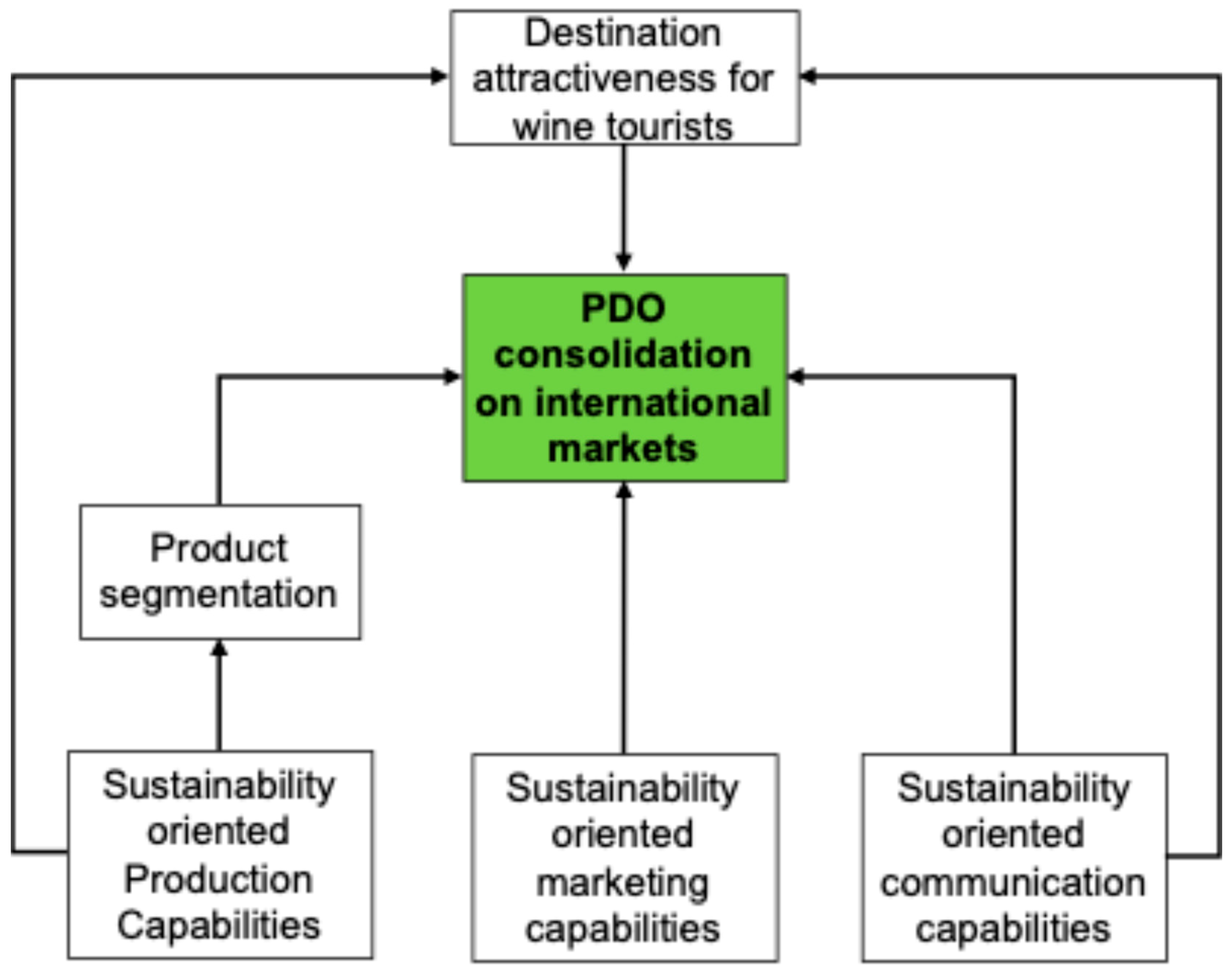
5. A Sustainability-Oriented PDO Growth Strategy
6. Managerial Implications
7. Future Research Agenda
Author Contributions
Funding
Data Availability Statement
Conflicts of Interest
References
- Wagner, M.; Stanbury, P.; Dietrich, T.; Döring, J.; Ewert, J.; Foerster, C.; Freund, M.; Friedel, M.; Kammann, C.; Koch, M.; et al. Developing a sustainability vision for the global wine industry. Sustainability 2023, 15, 10487. [Google Scholar] [CrossRef]
- Martínez-Falcó, J.; Sánchez-García, E.; Marco-Lajara, B.; Claver-Cortés, E.; Úbeda-García, M. The interplay between competitive advantage and sustainability in the wine industry: A bibliometric and systematic review. Discov. Sustain. 2024, 5, 13. [Google Scholar] [CrossRef]
- Giacopelli, F.; Rossi, L.; Challita, C.; Bacenetti, J. Environmental sustainability of wine sector: A focus on pesticide management. Environ. Impact Assess. Rev. 2025, 115, 108022. [Google Scholar] [CrossRef]
- Foerster, F.C.; Döring, J.; Koch, M.; Kauer, R.; Stoll, M.; Wohlfahrt, Y.; Wagner, M. Comparative life cycle assessment of integrated and organic viticulture based on a long-term field trial in Germany. Sustain. Prod. Consum. 2024, 52, 487–497. [Google Scholar] [CrossRef]
- Trigo, A.; Marta-Costa, A.; Fragoso, R. Enhancing wine industry sustainability: An empirical test of the sustainable wine assessment tool. J. Clean. Prod. 2024, 472, 143480. [Google Scholar] [CrossRef]
- Marques, A.; Teixeira, C.A. Vine and wine sustainability in a cooperative ecosystem—A review. Agronomy 2023, 13, 2644. [Google Scholar] [CrossRef]
- Gastaldello, G.; Bošnjak, M.; Schäufele-Elbers, I.; Schamel, G. Are consumers willing to pay more for sustainable wine? A pre-registered systematic review and meta-analysis. Food Qual. Prefer. 2025, 134, 105655. [Google Scholar] [CrossRef]
- Gutierrez, E. Geographical Indicators: A unique European perspective on intellectual property. Hastings Int. Comp. Law Rev. 2005, 29, 29–50. [Google Scholar]
- Organisation Internationale de la Vigne et du Vin (OIV). State of the World Vine and Wine Sector 2024. 2024. Available online: https://www.oiv.int/sites/default/files/2025-04/OIV-State_of_the_World_Vine-and-Wine-Sector-in-2024.pdf (accessed on 6 December 2025).
- Available online: https://ec.europa.eu/agriculture/eambrosia/geographical-indications-register/ (accessed on 6 December 2025).
- Regulation (EU) 2024/1143 of the European Parliament and of the Council of 11 April 2024 on Geographical Indications for Wine, Spirit Drinks and Agricultural Products, as Well as Traditional Specialities Guaranteed and Optional Quality Terms for Agricultural Products. Available online: https://eur-lex.europa.eu/legal-content/EN/TXT/?uri=CELEX:32024R1143 (accessed on 6 December 2025).
- Alston, J.M.; Gaeta, D. Reflections on the political economy of European wine appellations. Ital. Econ. J. 2021, 7, 219–258. [Google Scholar] [CrossRef]
- Di Chiara, V.; Battistella, A.; Boatto, V.; Furlan, S.; Giavi, L.; Liggieri, S.; Paiola, A.; Pomarici, E.; Stefanucci, S. Collaborative approach for achieving ambitious sustainability goals: The Prosecco sustainability project. Sustainability 2024, 16, 583. [Google Scholar] [CrossRef]
- Luchian, C.E.; Grosaru, D.; Scutarașu, E.C.; Colibaba, L.C.; Scutarașu, A.; Cotea, V.V. Advancing sparkling wine in the 21st century: From traditional methods to modern innovations and market trends. Fermentation 2025, 11, 174. [Google Scholar] [CrossRef]
- Ruggeri, G.; Mazzocchi, C.; Corsi, S. Drinking biodiversity: A choice experiment on Franciacorta sparkling wines. Br. Food J. 2020, 122, 2531–2549. [Google Scholar] [CrossRef]
- Available online: https://www.trentodoc.com/it/vini-del-trentino/ (accessed on 6 December 2025).
- Available online: https://franciacorta.wine/it/consorzio/dati/ (accessed on 6 December 2025).
- Available online: https://www.valoritalia.it/wp-content/uploads/dati-2024/oltrepo-pavese-metodo-classico-docg.jpg (accessed on 6 December 2025).
- Available online: https://www.valoritalia.it/wp-content/uploads/2025/07/VI-Annual-Report-2025-Schede-Consorzi-DO-EVO-22x22-02b_99-scaled.jpg (accessed on 6 December 2025).
- Corsi, A.; Mazzarino, S.; Pomarici, E. The Italian wine industry. In The Palgrave Handbook of Wine Industry Economics; Springer International Publishing: Cham, Switzerland, 2019; pp. 47–76. [Google Scholar] [CrossRef]
- Reinhardt, T.; Ambrogio, Y. Geographical indications and sustainable viticulture: Empirical and theoretical perspectives. Sustainability 2023, 15, 16318. [Google Scholar] [CrossRef]
- Available online: https://www.consorziovinioltrepo.it/5193/un-grande-evento-per-eccellenti-espressioni-di-pinot-nero-doltrepo-pavese (accessed on 6 December 2025).
- Ouvrard, S.; Jasimuddin, S.; Spiga, A. Does sustainability push to reshape business models? Evidence from the European wine industry. Sustainability 2020, 12, 2561. [Google Scholar] [CrossRef]
- Sogari, G.; Mora, C.; Menozzi, D. Factors driving sustainable choice: The case of wine. Br. Food J. 2016, 118, 632–646. [Google Scholar] [CrossRef]
- Carrasco, I.; Valero, J.; Fuentes, C.; Carchano, M. Greening wine exports? Changes in the carbon footprint of Spanish wine exports. Int. J. Environ. Res. Public Health 2021, 18, 9035. [Google Scholar] [CrossRef] [PubMed]
- Thiollet-Scholtus, M.; Müller, A.; Bailly, C.; Köller, R.; Ley, L.; Nassr, N.; Weissbart, J. Success of organic and biodynamic system experiment to produce high quality wines. BIO Web Conf. 2019, 15, 01032. [Google Scholar] [CrossRef]
- Valenzuela, L.; Blu, R.; Moscovici, D.; Gow, J.; Ugaglia, A.; Mihăilescu, R. Consumer willingness to pay for sustainable wine—The Chilean case. Sustainability 2022, 14, 10910. [Google Scholar] [CrossRef]
- Forbes, S.; Cohen, D.; Cullen, R.; Wratten, S.; Fountain, J. Consumer attitudes regarding environmentally sustainable wine: An exploratory study of the New Zealand marketplace. J. Clean. Prod. 2009, 17, 1195–1199. [Google Scholar] [CrossRef]
- Borrello, M.; Cembalo, L.; Vecchio, R. Role of information in consumers’ preferences for eco-sustainable genetic improvements in plant breeding. PLoS ONE 2021, 16, e0255130. [Google Scholar] [CrossRef]
- Espinoza, A.; Hubert, A.; Raineau, Y.; Franc, C.; Giraud-Heraud, E. Resistant grape varieties and market acceptance: An evaluation based on experimental economics. OENO One 2018, 52, 3. [Google Scholar] [CrossRef]
- Belfiore, N.; Amato, A.; Gardiman, M.; Gaiotti, F.; Zenoni, S.; Tornielli, G.B.; Fasoli, M.; Bavaresco, L. The role of terroir on the ripening traits of V. vinifera cv ‘Glera’ in the Prosecco area. Plants 2024, 13, 816. [Google Scholar] [CrossRef]
- Hervé, M.; Boudes, P.; Cieslik, C.; Montembault, D.; Jung, V.; Burel, F.; Nicolaï, A. Landscape complexity perception and representation in a wine-growing region with the designation of origin in the Loire Valley (France): A cultural ecosystem service? Renew. Agric. Food Syst. 2018, 35, 77–89. [Google Scholar] [CrossRef]
- Arias-Navarro, I.; Gomis, F.; Agulló-Torres, A.; Poveda, Á. Environmental sustainability in vineyards under a protected designation of origin in view of the implementation of photovoltaic solar energy plants. Land 2023, 12, 1871. [Google Scholar] [CrossRef]
- Vlahos, G. Farming system transformation impacts on landscape: A case study on quality wine production in a highly contested agricultural landscape. Land 2020, 9, 120. [Google Scholar] [CrossRef]
- Arnáiz, M.; Rodríguez, E.; Luque, D. Multifunctional territorialized agri-food systems, geographical quality marks and agricultural landscapes: The case of vineyards. Land 2022, 11, 457. [Google Scholar] [CrossRef]
- Bidegain, Í.; López, C.; González, J.; Martínez-Sastre, R.; Ravera, F.; Cerda, C. Social valuation of Mediterranean cultural landscapes: Exploring landscape preferences and ecosystem services perceptions through a visual approach. Land 2020, 9, 390. [Google Scholar] [CrossRef]
- Flinzberger, L.; Cebrián-Piqueras, M.; Peppler-Lisbach, C.; Zinngrebe, Y. Why geographical indications can support sustainable development in European agri-food landscapes. Front. Conserv. Sci. 2022, 2, 752377. [Google Scholar] [CrossRef]
- Ducman, A.; Dıaconıța, V.; Botha, I.; Velicanu, A.; Corbea, A. Government oversight and economic impacts: Sustainability in the vineyard and the evolution of wine regulations, trade and production. Agronomy 2023, 13, 2991. [Google Scholar] [CrossRef]
- Taranto, L.; Rodrigues, I.; Santos, S.; Villa, M.; Pereira, J. Intermediate fragmentation surrounding vineyards favours the Coleoptera community within the crop. Agric. For. Entomol. 2022, 25, 9–19. [Google Scholar] [CrossRef]
- Tedeschi, P. The improvement of the production and quality: The case of wine production in eastern Lombardy during the nineteenth and twentieth centuries (Provinces of Bergamo and Brescia). In A History of Wine in Europe, 19th to 20th Centuries, Volume I: Winegrowing and Regional Features; Springer: Cham, Switzerland, 2019; pp. 197–225. [Google Scholar]
- Beverland, M. Crafting brand authenticity: The case of luxury wines. J. Manag. Stud. 2005, 42, 1003–1029. [Google Scholar] [CrossRef]
- Charters, S.; Spielmann, N.; Babin, B.J. The nature and value of terroir products. Eur. J. Mark. 2017, 51, 748–771. [Google Scholar] [CrossRef]
- Cei, L.; Rossetto, L. The demand for sparkling wine: Insights on a diversified European market. Int. J. Wine Bus. Res. 2024, 36, 505–527. [Google Scholar] [CrossRef]
- Pomarici, E.; Vecchio, R. Will sustainability shape the future wine market? Wine Econ. Policy 2019, 8, 1–4. [Google Scholar] [CrossRef]
- Hall, C.M.; Mitchell, R. Wine Marketing: A Practical Guide; Routledge: London, UK, 2008. [Google Scholar] [CrossRef]
- Tassi, E.; Cavicchi, A.; Santini, C. Place-based strategies for sustainable wine tourism. Sustainability 2022, 14, 2331. [Google Scholar] [CrossRef]
- Marescotti, A.; Belletti, G.; Touzard, J.-M. Geographical indications and local agri-food systems. World Dev. 2020, 135, 105073. [Google Scholar] [CrossRef]
- Schamel, G. Quality, reputation, and price in the sparkling wine market. J. Wine Econ. 2018, 13, 52–62. [Google Scholar] [CrossRef]
- Dal Bianco, A.; Boatto, V.; Trestini, S.; Caracciolo, F. Understanding consumption choice of Prosecco wine: An empirical analysis using Italian and German Homescan data. J. Wine Res. 2018, 29, 190–203. [Google Scholar] [CrossRef]
- Borrello, M.; Vecchio, R.; Barisan, L.; Franceschi, D.; Pomarici, E.; Galletto, L. Is wine perception influenced by sustainability information? Insights from a consumer experiment with fungus resistant grape and organic wines. Food Res. Int. 2024, 190, 114580. [Google Scholar] [CrossRef]
- Galati, A.; Crescimanno, M.; Tinervia, S.; Iliopoulos, C.; Theodorakopoulou, I. Internal resources as tools to increase the global competition: The Italian wine industry case. Br. Food J. 2017, 119, 2406–2420. [Google Scholar] [CrossRef]
- Mariani, A.; Vastola, A. Sustainability transitions in premium wine regions: A comparative analysis. Sustainability 2022, 14, 3512. [Google Scholar] [CrossRef]
- Christ, K.L.; Burritt, R. Accounting for sustainable wine production. J. Clean. Prod. 2020, 256, 120390. [Google Scholar] [CrossRef]
- Begalli, D.; Codurri, S.; Gaeta, D. Land-use change and landscape transformation in wine-producing regions: Evidence from Italy. Land Use Policy 2020, 92, 104441. [Google Scholar] [CrossRef]
- Demossier, M. Wine and Culture: Vineyard to Glass; Bloomsbury Academic: London, UK, 2018. [Google Scholar]
- Tanguay, L.; Bissonnette, J.F.; Calmé, S.; Koutouki, K.; Turgeon, K. Avoiding an anticipated social-ecological trap in biodiversity conservation on private lands in Quebec Province, Canada. Environ. Sci. Policy 2025, 170, 104095. [Google Scholar] [CrossRef]
- Baltazar, M.; Castro, I.; Gonçalves, B. Adaptation to climate change in viticulture: The role of varietal selection—A review. Plants 2025, 14, 104. [Google Scholar] [CrossRef]
- Ferrara, C.; Nuti, M.; Rossi, F.; Orlandini, S. Biodiversity and environmental sustainability in viticulture: A review. Sustainability 2023, 15, 3102. [Google Scholar] [CrossRef]
- Capitello, R.; Sirieix, L. What does ‘sustainable wine’ mean? An investigation of French and Italian wine consumers. In Social Sustainability in the Global Wine Industry: Concepts and Cases; Springer: Cham, Switzerland, 2019; pp. 137–154. [Google Scholar]
- Szolnoki, G.; Hoffmann, D. Consumer segmentation based on sustainability and value perception. J. Wine Res. 2014, 25, 247–262. [Google Scholar] [CrossRef]
- Alonso, A.D.; Liu, Y. Geographical indications, sustainability, and rural development: A systematic review. Sustainability 2022, 14, 1294. [Google Scholar] [CrossRef]
- La Porta, V.; Migheli, M. Grapes grow better in the backyard: The effect of organic growth strategies on Italian wineries’ profits. Int. J. Wine Bus. Res. 2019, 31, 243–259. [Google Scholar] [CrossRef]
- Cavicchi, A.; Santini, C. Wine, Sustainability and Territorial Development; Routledge: London, UK, 2022. [Google Scholar]
- De Roest, K.; Menghi, A. Geographical indications and sustainability in European agri-food systems. Sustainability 2020, 12, 3910. [Google Scholar] [CrossRef]
- Dal Bianco, A.; Boatto, V. Premiumization strategies in sparkling wine: Evidence from Italy. J. Wine Econ. 2019, 14, 104–121. [Google Scholar] [CrossRef]
- Savelli, E.; Bravi, L.; Francioni, B.; Murmura, F.; Pencarelli, T. PDO labels and food preferences: Results from a sensory analysis. Br. Food J. 2021, 123, 1170–1189. [Google Scholar] [CrossRef]
- Vandecandelaere, E.; Samper, L.F.; Rey, A.; Daza, A.; Mejía, P.; Tartanac, F.; Vittori, M. The geographical indication pathway to sustainability: A framework to assess and monitor the contributions of geographical indications to sustainability through a participatory process. Sustainability 2021, 13, 7535. [Google Scholar] [CrossRef]
- Gergaud, O.; Ginsburgh, V.; Moreno-Ternero, J.D. Wine ratings: Seeking a consensus among tasters via normalization, approval, and aggregation. J. Wine Econ. 2021, 16, 321–342. [Google Scholar] [CrossRef]
- Pomarici, E.; Lerro, M.; Chiodo, E. Wine tourism, sustainability, and territorial pressure. Sustainability 2020, 12, 4958. [Google Scholar] [CrossRef]
- Orth, U.R.; Krŝka, P. Estimating optimal prices for wine exhibition awards using comparative judgements. J. Food Prod. Mark. 2001, 7, 81–95. [Google Scholar] [CrossRef]
- Galletto, L.; Caracciolo, F.; Boatto, V.L.; Barisan, L.; Franceschi, D.; Lillo, M. Do consumers really recognise a distinct quality hierarchy amongst PDO sparkling wines? The answer from experimental auctions. Br. Food J. 2020, 123, 1478–1493. [Google Scholar] [CrossRef]
- Sedita, S.; Hoffmann, V.; Guarnieri, P.; Carraro, E. Prosecco has another story to tell: The coexistence of multiple knowledge networks in the same value chain. Int. J. Wine Bus. Res. 2021, 33, 502–522. [Google Scholar] [CrossRef]
- Erling, U.; Pater, J. Prosit to Prosecco! On sparkling wine and geographical indications. Monash Univ. Law Rev. 2022, 48, 65–112. [Google Scholar]
- Gordon, S.H. The Story of Prosecco Superiore; Rowman & Littlefield: Lanham, MD, USA, 2024; ISBN 978153819126. [Google Scholar]
- Garzia, C.; Slerca, E.; Gentile, F.M. Dominant business model in the Prosecco industry: A resource-based analysis. Int. J. Wine Bus. Res. 2025. ahead-of-print. [Google Scholar] [CrossRef]
- Available online: https://policy.trade.ec.europa.eu/eu-trade-relationships-country-and-region/countries-and-regions/australia/eu-australia-agreement_en (accessed on 6 December 2025).
- Tariku, G.; Ghiglieno, I.; Sanchez Morchio, A.; Facciano, L.; Birolleau, C.; Simonetto, A.; Serina, I.; Gilioli, G. Deep learning based land cover mapping in Franciacorta wine growing Area. Appl. Sci. 2025, 15, 871. [Google Scholar] [CrossRef]
- Ponte, S.; Marchi, V.; Bettiol, M.; Maria, E. The horizontal governance of environmental upgrading: Lessons from the Prosecco and Valpolicella wine value chains in Italy. Environ. Plan. A 2023, 55, 1884–1905. [Google Scholar] [CrossRef]
- Barisan, L.; Lucchetta, M.; Bolzonella, C.; Boatto, V. How does carbon footprint create shared values in the wine industry? Empirical evidence from Prosecco Superiore PDO’s wine district. Sustainability 2019, 11, 3037. [Google Scholar] [CrossRef]
- Visentin, F.; Vallerani, F. A countryside to sip: Venice inland and the Prosecco’s uneasy relationship with wine tourism and rural exploitation. Sustainability 2018, 10, 2195. [Google Scholar] [CrossRef]
- Bonadio, E.; Contardi, M. The geographic indication prosecco battle between Italy and Australia: Some lessons from the history and geography of the most famous Italian wine. J. World Investig. Trade 2022, 23, 260–292. [Google Scholar] [CrossRef]
- Ponte, S. Bursting the Bubble? The hidden costs and visible conflicts behind the Prosecco wine ‘miracle’. J. Rural Stud. 2021, 86, 542–553. [Google Scholar] [CrossRef]
- Regione del Veneto, ULSS 2, La salute Nei Territori ad Alto Sviluppo Vitivinicolo Della Provincia di Treviso. 2019. Available online: https://www.aulss2.veneto.it/mys/apridoc/iddoc/6950 (accessed on 6 December 2025).
- Basso, M.; Fregolent, L. Fighting against monocultures: Wine-growing and tourism in the Veneto Region. In Social Movements and Public Policies in Southern European Cities; Springer: Cham, Switzerland, 2021; pp. 151–165. [Google Scholar] [CrossRef]
- Basso, M. Land-use changes triggered by the expansion of wine-growing areas: A study on the municipalities in the Prosecco’s production zone (Italy). Land Use Policy 2019, 83, 390–402. [Google Scholar] [CrossRef]
- Martínez-Salvador, L.E.; Reyes-Jaime, A. Sustainability in protected designations of origin (PDO) in the European Union: An approach from a systematic literature review. Siembra 2021, 8, 2. [Google Scholar]
- Bollettino Ufficiale Della Regione del Veneto, 18 Luglio 2025. Available online: https://bur.regione.veneto.it/BurvServices/Pubblica/DettaglioAvviso.aspx?id=560676 (accessed on 6 December 2025).
- Wolikow, C. La Champagne Viticole, Banc d’Essai de la Délimitation (1903–1927): Territoires du Vin (1). Territ. Du Vin 2009. [Google Scholar] [CrossRef]
- Martínez-Falcó, J.; Marco-Lajara, B.; Zaragoza-Sáez, P.; Millán-Tudela, L. Wine tourism as a catalyst for green innovation: Evidence from the Spanish wine industry. Br. Food J. 2023, 126, 1904–1922. [Google Scholar] [CrossRef]
- Tempere, S.; Pérès, S.; Espinoza, A.F.; Darriet, P.; Giraud-Héraud, E.; Pons, A. Consumer preferences for different red wine styles and repeated exposure effects. Food Qual. Prefer. 2019, 73, 110–116. [Google Scholar] [CrossRef]
- Lozano, R. Sustainable business models: Providing a more holistic perspective. Bus. Strateg. Environ. 2018, 27, 1159–1166. [Google Scholar] [CrossRef]
- Martínez-Falcó, J.; Sánchez-García, E.; Marco-Lajara, B.; Millán-Tudela, L. Do organizational commitment and consumer satisfaction mediate the relationship corporate social responsibility-sustainable performance? Assessing happiness management in Spanish wineries. Manag. Decis. 2024, 62, 643–664. [Google Scholar] [CrossRef]
- Bowen, S.; Zapata, A.V. Geographical indications, terroir, and socioeconomic and ecological sustainability: The case of Tequila. J. Rural Stud. 2009, 25, 108–119. [Google Scholar] [CrossRef]
- Lozano, R.; Carpenter, A.; Huisingh, D. A review of ‘theories of the firm’ and their contributions to corporate sustainability. J. Clean. Prod. 2015, 106, 430–442. [Google Scholar] [CrossRef]
- Teece, D.J. Business models and dynamic capabilities. Long Range Plan. 2018, 51, 40–49. [Google Scholar] [CrossRef]
- Foss, N.J.; Saebi, T. Fifteen years of research on business model innovation: How far have we come, and where should we go? J. Manag. 2017, 43, 200–227. [Google Scholar] [CrossRef]
- Bassi, F.; Pennoni, F.; Rossetto, L. Market segmentation and dynamic analysis of sparkling wine purchases in Italy. J. Wine Econ. 2021, 16, 283–304. [Google Scholar] [CrossRef]
- Eisenhardt, K.M.; Martin, J.A. Dynamic capabilities: What are they? In The SMS Blackwell Handbook of Organizational Capabilities; Blackwell: Oxford, UK, 2017; pp. 341–363. [Google Scholar]
- Barisan, L.; Galletto, L. How do sparkling wine producers adopt a sub-appellation? Evidence from an exploratory study on heroic Prosecco Superiore Rive. Wine Econ. Policy 2021, 10, 140–149. [Google Scholar] [CrossRef]
- Olabisi, M.; Saweda OLiverpool-Tasie, L.; Badiane, O.; Olaniyan, O. Female earnings and dietary diversity: Evidence from an inflationary economic crisis. Food Policy 2026, 134, 103037. [Google Scholar] [CrossRef]
- del Campo-Villares, J.L.; Fuentes-Fernández, R. Wine tourism in Galicia: Sustainability, circular economy and unique experiences, the future for the wine sector. Sustainability 2025, 17, 5335. [Google Scholar] [CrossRef]
- Ašonja, A.; Vještica, S.; Bošković, A.; Živković Radeta, S.; Ćeranić, M.; Jovanović, Z.; Škrbić, S. Research into the Energy Potential of Vine Pruning Residues in Western Serbia. Energies 2025, 18, 6384. [Google Scholar] [CrossRef]
- Tregear, A.; Gorton, M. The challenges of sharing: Brands as club goods. Eur. J. Mark. 2009, 43, 826–842. [Google Scholar] [CrossRef]
- Grechi, D.; Pavione, E.; Gazzola, P.; Cardini, F. Tradition and innovation in the Italian wine industry: The best practices of Casa Paladin. Sustainability 2024, 16, 2857. [Google Scholar] [CrossRef]


| Total Franciacorta Surface Area (km2) | 266.72 |
|---|---|
| Total vineyards installments in Franciacorta (km2) | 33.90 |
| Vineyard density (%) | 12.7% |
| Franciacorta DOC Production Area Population (Inhabitants) | 150.189 |
|---|---|
| Franciacorta DOC production area population density (inhabitants/km2) | 652 |
| Lombardy region population density (inhabitants/km2) | 420 |
| Italy population density (inhabitants/km2) | 200 |
| 2022-Number of Declarations | % | 2023-Number of Declarations | % | 2024-Number of Declarations | % | |
|---|---|---|---|---|---|---|
| Oltrepò Pavese Metodo Classico DOCG | 3 | 1.5% | 5 | 1.6% | 4 | 1.6% |
| Oltrepò Pavese Metodo Classico Pinot Nero DOCG | 141 | 71.6% | 210 | 69.1% | 204 | 79.1% |
| Oltrepò Pavese Metodo Classico Pinot Nero Rosè DOCG | 52 | 26.4% | 88 | 28.9% | 49 | 19.0% |
| Oltrepò Pavese Metodo Classico Rosè DOCG | 0.5% | 0.3% | 0.4% | |||
| Total | 197 | 100% | 304 | 100% | 258 | 100% |
| 2023 | 2024 | 2025 | ||||
|---|---|---|---|---|---|---|
| Number of Bottles | % | Number of Bottles | % | Number of Bottles | % | |
| Oltrepò Pavese Metodo Classico DOCG | 7300 | 1% | 4555 | 0.4% | 5485 | 0.2% |
| Oltrepò Pavese Metodo Classico Pinot Nero Rosè DOCG | 170,808 | 18% | 149,057 | 14% | 172,449 | 6% |
| Oltrepò Pavese Metodo Classico Pinot Nero DOCG | 728,508 | 78% | 920,994 | 84% | 2,611,012 | 93% |
| Oltrepò Pavese Metodo Classico Pinot Nero Rosè Vigna | 7333 | 1% | ||||
| Oltrepò Pavese Metodo Classico Pinot Nero Vigna DOCG | 23,113 | 2% | 13,833 | 1% | 3760 | 0% |
| Oltrepò Pavese Metodo Classico Rosè DOCG | 5.400 | 1% | 6600 | 1% | 24 | 0% |
| Total | 935,129 | 100% | 1,102,372 | 100% | 2,792,731 | 100% |
| Year | Total | Sparkling | Rosé Sparkling | “Frizzante” Light Sparkling | “Tranquillo” Very Light Sparkling |
|---|---|---|---|---|---|
| 2012 | 1,458,452 | 914,148 | 566,348 | 2801 | |
| 2013 | 1,811,764 | 1,186,578 | 622,654 | 2531 | |
| 2014 | 2,300,157 | 1,664,389 | 633,423 | 2345 | |
| 2015 | 2,664,238 | 2,041,198 | 620,972 | 2068 | |
| 2016 | 3,081,700 | 2,488,453 | 591,861 | 1386 | |
| 2017 | 3,297,757 | 2,703,471 | 592,676 | 1610 | |
| 2018 | 3,481,892 | 2,901,065 | 579,259 | 1569 | |
| 2019 | 3,650,743 | 3,051,007 | 598,523 | 1213 | |
| 2020 | 3,753,008 | 2,998,095 | 126,375 | 627,339 | 1199 |
| 2021 | 4,706,417 | 3,537,824 | 537,334 | 630,292 | 966 |
| 2022 | 4,789,254 | 3,733,956 | 469,462 | 584,753 | 1083 |
| 2023 | 4,621,109 | 3,546,384 | 383,603 | 690,177 | 945 |
| 2024 | 4,948,375 | 3,800,251 | 462,798 | 681,829 | 3497 |
| District | ha (Hectares) Glera Vineyards |
|---|---|
| Treviso | 14,019 |
| Vicenza | 1527 |
| Venezia | 2312 |
| Belluno | 48 |
| Padova | 2016 |
| Pordenone | 2881 |
| Udine | 1485 |
| Gorizia | 150 |
| Trieste | 12 |
Disclaimer/Publisher’s Note: The statements, opinions and data contained in all publications are solely those of the individual author(s) and contributor(s) and not of MDPI and/or the editor(s). MDPI and/or the editor(s) disclaim responsibility for any injury to people or property resulting from any ideas, methods, instructions or products referred to in the content. |
© 2026 by the authors. Licensee MDPI, Basel, Switzerland. This article is an open access article distributed under the terms and conditions of the Creative Commons Attribution (CC BY) license.
Share and Cite
Fino, M.A.; Garzia, C. Regulatory Innovation and Sustainable Growth Strategies in the Wine Industry: The Case of an Italian Sparkling Wine Designation of Origin. Standards 2026, 6, 7. https://doi.org/10.3390/standards6010007
Fino MA, Garzia C. Regulatory Innovation and Sustainable Growth Strategies in the Wine Industry: The Case of an Italian Sparkling Wine Designation of Origin. Standards. 2026; 6(1):7. https://doi.org/10.3390/standards6010007
Chicago/Turabian StyleFino, Michele Antonio, and Carmine Garzia. 2026. "Regulatory Innovation and Sustainable Growth Strategies in the Wine Industry: The Case of an Italian Sparkling Wine Designation of Origin" Standards 6, no. 1: 7. https://doi.org/10.3390/standards6010007
APA StyleFino, M. A., & Garzia, C. (2026). Regulatory Innovation and Sustainable Growth Strategies in the Wine Industry: The Case of an Italian Sparkling Wine Designation of Origin. Standards, 6(1), 7. https://doi.org/10.3390/standards6010007