

Perspective

Neuropathological Mechanisms Associated with Pesticides in Alzheimer’s Disease


1
Department of Biochemistry, Yong Loo Lin School of Medicine, National University of Singapore, Singapore 117596, Singapore
2
NUS Graduate School for Integrative Sciences and Engineering, National University of Singapore, Singapore 119077, Singapore
Toxics 2020, 8(2), 21; https://doi.org/10.3390/toxics8020021
Submission received: 25 February 2020 / Revised: 14 March 2020 / Accepted: 22 March 2020 / Published: 25 March 2020
(This article belongs to the Section Toxicology)

Abstract

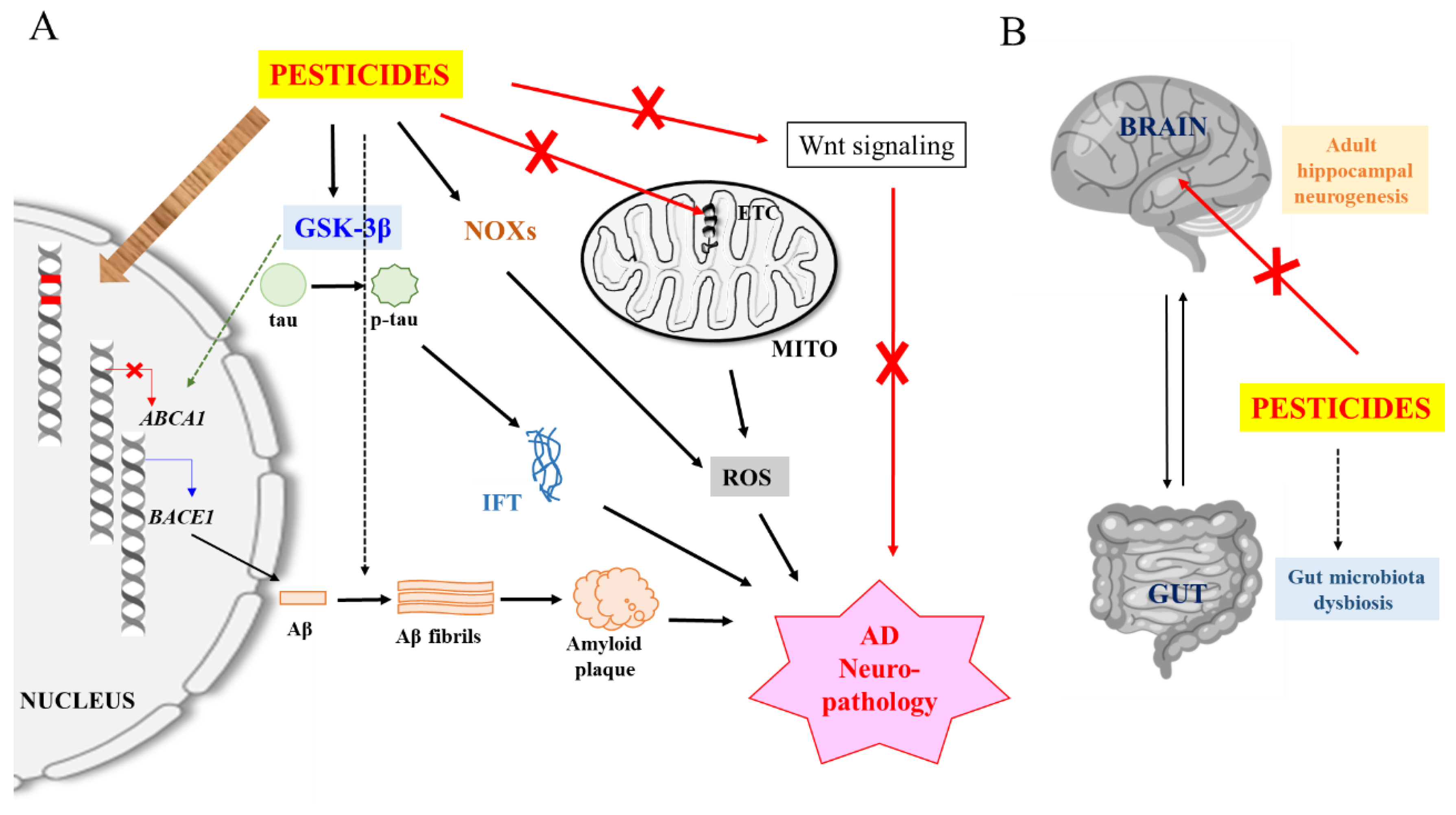
Environmental toxicants have been implicated in neurodegenerative diseases, and pesticide exposure is a suspected environmental risk factor for Alzheimer’s disease (AD). Several epidemiological analyses have affirmed a link between pesticides and incidence of sporadic AD. Meanwhile, in vitro and animal models of AD have shed light on potential neuropathological mechanisms. In this paper, a perspective on neuropathological mechanisms underlying pesticides’ induction of AD is provided. Proposed mechanisms range from generic oxidative stress induction in neurons to more AD-specific processes involving amyloid-beta (Aβ) and hyperphosphorylated tau (p-tau). Mechanisms that are more speculative or indirect in nature, including somatic mutation, epigenetic modulation, impairment of adult neurogenesis, and microbiota dysbiosis, are also discussed. Chronic toxicity mechanisms of environmental pesticide exposure crosstalks in complex ways and could potentially be mutually enhancing, thus making the deciphering of simplistic causal relationships difficult.
Keywords: Alzheimer’s disease; amyloid beta (Aβ); fungicide; Glycogen synthase kinase-3; pesticide; tau Alzheimer’s disease; amyloid beta (Aβ); fungicide; Glycogen synthase kinase-3; pesticide; tau

