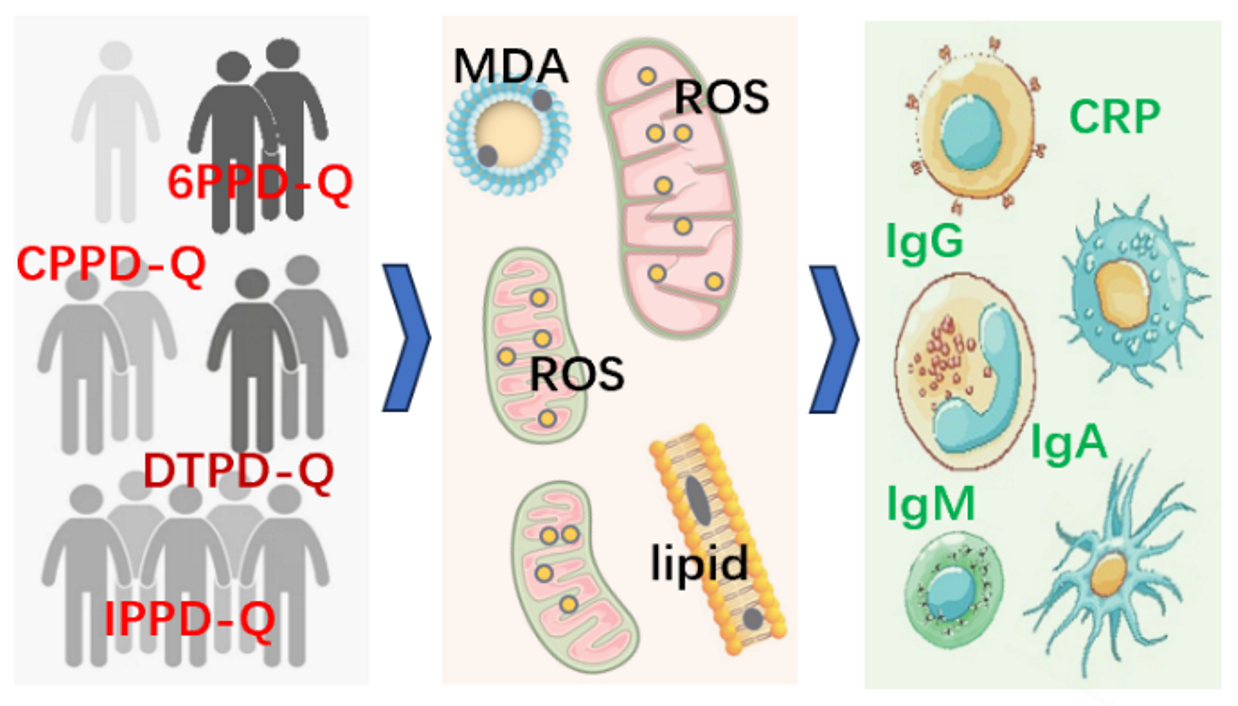
Associations of Serum Substituted p-Phenylenediamine-Derived Quinone Levels with Oxidative Stress and Immune Function Biomarkers in a General Adult Population

Abstract
1. Introduction
2. Materials and Methods
2.1. Standard Chemicals
2.2. Recruitment of Study Subjects and Serum Sample Preparation
2.3. PPD-Q Analysis in Human Serum
2.4. Analysis of MDA and Immune Function Biomarkers in Human Serum
2.5. Statistical Analysis
3. Results
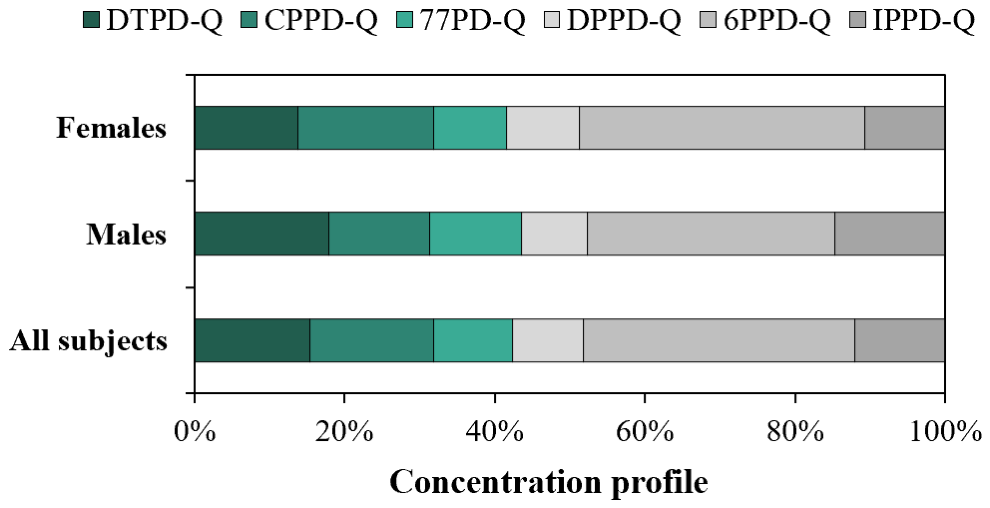
3.1. Detection of Human Serum PPD-Qs
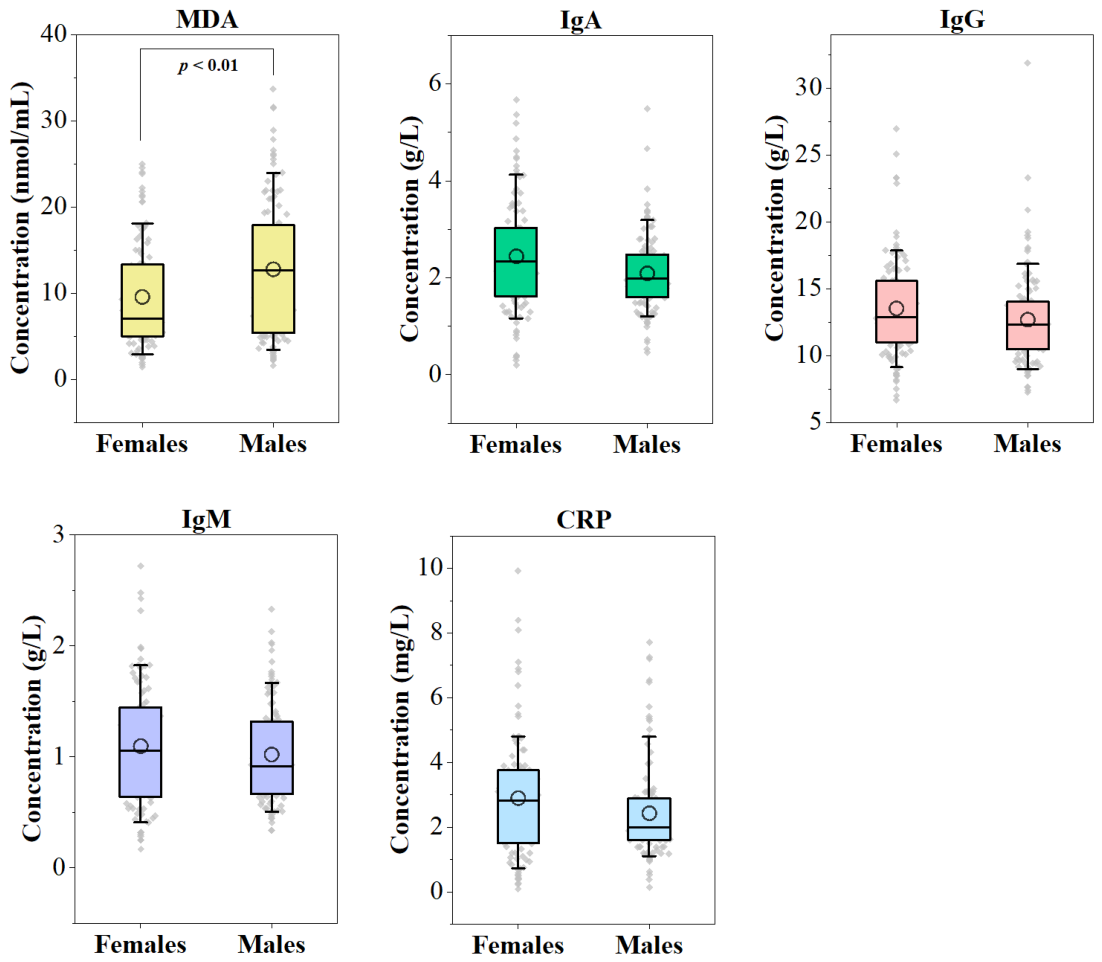
3.2. Oxidative Stress and Immune Markers in Humans
3.3. Associations Between PPD-Q Exposure and Oxidative Stress
3.4. Associations Between PPD-Q Levels and Immune Interference
4. Discussion
5. Conclusions
Supplementary Materials
Author Contributions
Funding
Institutional Review Board Statement
Informed Consent Statement
Data Availability Statement
Conflicts of Interest
Abbreviations
| PPD-Q | p-Phenylenediamine-quinone |
| MDA | Malondialdehyde |
| CRP | C-reactive protein |
| IgA | Immunoglobulin A |
| IgG | Immunoglobulin G |
| IgM | Immunoglobulin M |
| LOD | Limits of detection |
References
- Dauvergne, P. Incremental progress or dangerous incrementalism? The case of tire wear pollution in global environmental governance. Environ. Politics 2025, 34, 1091–1113. [Google Scholar]
- Krishnakumar, J.; Subbian, J. Revolutionizing electric mobility: The latest breakthroughs in tyre design. In International Conference on Advances in Design, Materials, Manufacturing and Surface Engineering for Mobility, Chennai, India, 27 October 2023; SAE Technical Paper; SAE: Atlanta, GA, USA, 2023. [Google Scholar]
- Zaino, R.; Ahmed, V.; Alhammadi, A.M.; Alghoush, M. Electric vehicle adoption: A comprehensive systematic review of technological, environmental, organizational and policy impacts. World Electr. Veh. J. 2024, 15, 375. [Google Scholar] [CrossRef]
- Demir, E.; Gerengi, H.; Savcı, K.; Altundal, G.; Yü, C. Exploration of green alternatives to 6PPD (p-phenylenediamine) used as antiozonant and antioxidant in the rubber industry. Mat. Sci. Appl. 2024, 15, 87–100. [Google Scholar] [CrossRef]
- Klein, E.; Cibulková, Z.; Lukeš, V. A study of the energetics of antioxidant action of p-phenylenediamines. Polym. Degrad. Stabil. 2005, 88, 548–554. [Google Scholar] [CrossRef]
- Mao, T.; Liu, W.; Deng, J.; Chen, C.; Jia, T.; Li, H.; Yin, F. p-Phenylenediamines and p-phenylenediamine quinone derivatives in rubber consumer products and typical urban dust: Sources, transformation profiles, and health risks. Environ. Int. 2024, 192, 109042. [Google Scholar] [CrossRef] [PubMed]
- Zhao, H.N.; Hu, X.; Gonzalez, M.; Rideout, C.A.; Hobby, G.C.; Fisher, M.F.; McCormick, C.J.; Dodd, M.C.; Kim, K.E.; Tian, Z. Screening p-Phenylenediamine antioxidants, their transformation products, and industrial chemical additives in crumb rubber and elastomeric consumer products. Environ. Sci. Technol. 2023, 57, 2779–2791. [Google Scholar] [CrossRef] [PubMed]
- Babaei, S.; Reguyal, F.; Sarmah, A.K. A bibliometric analysis of global research hotspots and progress on emerging environmental pollutants 6PPD and 6PPD-quinone from 2004 to 2024. Environ. Pollut. 2024, 362, 124969. [Google Scholar] [CrossRef] [PubMed]
- Hua, X.; Wang, D. Tire-rubber related pollutant 6-PPD quinone: A review of its transformation, environmental distribution, bioavailability, and toxicity. J. Hazard. Mater. 2023, 459, 132265. [Google Scholar] [CrossRef] [PubMed]
- Cao, G.; Wang, W.; Zhang, J.; Wu, P.; Qiao, H.; Li, H.; Huang, G.; Yang, Z.; Cai, Z. Occurrence and fate of substituted p-phenylenediamine-derived quinones in Hong Kong wastewater treatment plants. Environ. Sci. Technol. 2023, 57, 15635–15643. [Google Scholar] [CrossRef] [PubMed]
- Ihenetu, S.C.; Xu, Q.; Khan, Z.H.; Kazmi, S.; Ding, J.; Sun, Q.; Li, G. Environmental fate of tire-rubber related pollutants 6PPD and 6PPD-Q: A review. Environ. Res. 2024, 258, 119492. [Google Scholar] [CrossRef] [PubMed]
- Seiwert, B.; Nihemaiti, M.; Troussier, M.; Weyrauch, S.; Reemtsma, T. Abiotic oxidative transformation of 6-PPD and 6-PPD quinone from tires and occurrence of their products in snow from urban roads and in municipal wastewater. Water Res. 2022, 212, 118122. [Google Scholar] [CrossRef] [PubMed]
- Liang, Y.; Zhu, F.; Li, J.; Wan, X.; Ge, Y.; Liang, G.; Zhou, Y. P-phenylenediamine antioxidants and their quinone derivatives: A review of their environmental occurrence, accessibility, potential toxicity, and human exposure. Sci. Total Environ. 2024, 948, 174449. [Google Scholar] [CrossRef] [PubMed]
- Hiki, K.; Yamamoto, H. Concentration and leachability of N-(1, 3-dimethylbutyl)-N′-phenyl-p-phenylenediamine (6PPD) and its quinone transformation product (6PPD-Q) in road dust collected in Tokyo, Japan. Environ. Pollut. 2022, 302, 119082. [Google Scholar] [CrossRef] [PubMed]
- Chen, H.; Jin, H.; Ren, F.; Guo, R.; Zhu, J.; Huang, K. Enantioselectivity in human urinary excretion of N-(1, 3-dimethylbutyl)-N’-phenyl-1, 4-benzenediamine (6PPD) and 6PPD-quinone. Environ. Pollut. 2025, 378, 126489. [Google Scholar] [CrossRef] [PubMed]
- Han, M.; Xia, K.; Xue, Y.; Yue, F.; Li, J.; Kang, F.; Zhu, B.; Hu, L.; Liu, Q.; Xie, Z. Emergence of more potent PPD-Qs beyond 6PPD-Q in human blood and cerebrospinal fluid. Environ. Sci. Technol. Lett. 2025, 12, 496–502. [Google Scholar] [CrossRef]
- Weng, Y.; Fang, Z.; Wang, X.; Mao, S.; Xiao, F.; Zhang, L.; Fan, W.; Zhang, C.; Lan, P.; Zhan, R. Enantioselectivity in blood-cerebrospinal fluid barrier permeability of substituted p-phenylenediamine quinones in patients with leptomeningeal metastasis. Ecotoxicol. Environ. Saf. 2026, 311, 119895. [Google Scholar] [CrossRef] [PubMed]
- Geng, N.; Hou, S.; Sun, S.; Cao, R.; Zhang, H.; Lu, X.; Zhang, S.; Chen, J.; Zhang, Y. A nationwide investigation of substituted p-phenylenediamines (PPDs) and PPD-quinones in the riverine waters of China. Environ. Sci. Technol. 2025, 59, 3183–3192. [Google Scholar] [CrossRef] [PubMed]
- Nair, P.; Sun, J.; Xie, L.; Kennedy, L.; Kozakiewicz, D.; Kleywegt, S.M.; Hao, C.; Byun, H.; Barrett, H.; Baker, J. Synthesis and toxicity evaluation of p-phenylenediamine-quinones. Environ. Sci. Technol. 2025, 59, 7485–7494. [Google Scholar] [CrossRef] [PubMed]
- Fang, J.; Wang, X.; Cao, G.; Wang, F.; Ru, Y.; Wang, B.; Zhang, Y.; Zhang, D.; Yan, J.; Xu, J. 6PPD-quinone exposure induces neuronal mitochondrial dysfunction to exacerbate Lewy neurites formation induced by α-synuclein preformed fibrils seeding. J. Hazard. Mater. 2024, 465, 133312. [Google Scholar] [CrossRef] [PubMed]
- Zhang, Z.; Xu, X.; Qian, Z.; Zhong, Q.; Wang, Q.; Hylkema, M.N.; Snieder, H.; Huo, X. Association between 6PPD-quinone exposure and BMI, influenza, and diarrhea in children. Environ. Res. 2024, 247, 118201. [Google Scholar] [CrossRef] [PubMed]
- Lauridsen, C. From oxidative stress to inflammation: Redox balance and immune system. Poult. Sci. 2019, 98, 4240–4246. [Google Scholar] [CrossRef] [PubMed]
- Zhang, Z.; Zhao, L.; Zhou, X.; Meng, X.; Zhou, X. Role of inflammation, immunity, and oxidative stress in hypertension: New insights and potential therapeutic targets. Front. Immunol. 2023, 13, 1098725. [Google Scholar] [CrossRef] [PubMed]
- Gill, R.; Tsung, A.; Billiar, T. Linking oxidative stress to inflammation: Toll-like receptors. Free Radic. Biol. Med. 2010, 48, 1121–1132. [Google Scholar] [CrossRef] [PubMed]
- Kobayashi, S.; Inoue, N.; Ohashi, Y.; Terashima, M.; Matsui, K.; Mori, T.; Fujita, H.; Awano, K.; Kobayashi, K.; Azumi, H. Interaction of oxidative stress and inflammatory response in coronary plaque instability: Important role of C-reactive protein. Arterioscler. Thromb. Vasc. Biol. 2003, 23, 1398–1404. [Google Scholar] [PubMed]
- Cordiano, R.; Di Gioacchino, M.; Mangifesta, R.; Panzera, C.; Gangemi, S.; Minciullo, P.L. Malondialdehyde as a potential oxidative stress marker for allergy-oriented diseases: An update. Molecules 2023, 28, 5979. [Google Scholar] [CrossRef] [PubMed]
- Jadoon, S.; Malik, A. A review article on the formation, mechanism and biochemistry of MDA and MDA as a biomarker of oxidative stress. Int. J. Adv. Res. 2017, 5, 811–818. [Google Scholar] [CrossRef] [PubMed]
- Olson, M.E.; Hornick, M.G.; Stefanski, A.; Albanna, H.R.; Gjoni, A.; Hall, G.D.; Hart, P.C.; Rajab, I.M.; Potempa, L.A. A biofunctional review of C-reactive protein (CRP) as a mediator of inflammatory and immune responses: Differentiating pentameric and modified CRP isoform effects. Front. Immunol. 2023, 14, 1264383. [Google Scholar] [CrossRef] [PubMed]
- Salazar, J.; Martínez, M.S.; Chávez Castillo, M.; Núñez, V.; Añez, R.; Torres, Y.; Toledo, A.; Chacín, M.; Silva, C.; Pacheco, E. C-reactive protein: An in-depth look into structure, function, and regulation. Int. Sch. Res. Not. 2014, 2014, 653045. [Google Scholar] [CrossRef] [PubMed]
- Schroeder, H.W., Jr.; Cavacini, L. Structure and function of immunoglobulins. J. Allergy Clin. Immun. 2010, 125, S41–S52. [Google Scholar] [CrossRef] [PubMed]
- Sun, Y.; Huang, T.; Hammarström, L.; Zhao, Y. The immunoglobulins: New insights, implications, and applications. Annu. Rev. Anim. Biosci. 2020, 8, 145–169. [Google Scholar] [CrossRef] [PubMed]
- Gubkina, L.; Samodova, A. The influence of elevated concentrations of secretory IgA on the level of immunocompetent cells, cytokines, reagins, circulating immune complexes, and C-reactive protein in the blood of practically healthy residents of Murmansk Oblast. Biochem. Mosc. Suppl. Ser. B 2024, 18, 340–344. [Google Scholar] [CrossRef]
- Khan, S.R.; Chaker, L.; Ikram, M.A.; Peeters, R.P.; van Hagen, P.M.; Dalm, V.A.S.H. Determinants and reference ranges of serum immunoglobulins in middle-aged and elderly individuals: A population-based study. J. Clin. Immunol. 2021, 41, 1902–1914. [Google Scholar] [CrossRef] [PubMed]
- Yang, Y.; Meng, W.; Zhang, Y.; Meng, W.; Li, J.; Liu, W.; Su, G. Characterizing the metabolism of tire rubber-derived p-phenylenediamine quinones to identify potential exposure biomarkers in humans. Environ. Sci. Technol. 2024, 58, 18098–18108. [Google Scholar] [CrossRef] [PubMed]
- Liu, C.; Zhao, X.; Guo, L.; Yu, Q.; Zhang, W.; Peng, Z.; Gao, Y.; Gong, X.; Li, P.; Jiao, H. Emerging N-(1, 3-dimethylbutyl)-N′-phenyl-p-phenylenediamine (6PPD) and 6PPD quinone in paired human plasma and urine from Tianjin, China: Preliminary assessment with demographic factors. J. Hazard. Mater. 2024, 476, 134818. [Google Scholar] [CrossRef] [PubMed]
- Qin, Z.; Li, Y.; Qin, Y.; Chen, Z.; Guo, J.; Fang, F.; Schäffer, A.; Hollert, H.; Shao, Y. Correlation between 6PPD-Q and immune along with metabolic dysregulation induced liver lesions in outdoor workers. Environ. Int. 2025, 199, 109455. [Google Scholar] [CrossRef] [PubMed]
- Mas-Bargues, C.; Escriva, C.; Dromant, M.; Borras, C.; Vina, J. Lipid peroxidation as measured by chromatographic determination of malondialdehyde. Human plasma reference values in health and disease. Arch. Biochem. Biophys. 2021, 709, 108941. [Google Scholar] [CrossRef] [PubMed]
- Mohideen, K.; Chandrasekar, K.; Ramsridhar, S.; Rajkumar, C.; Ghosh, S.; Dhungel, S. Assessment of oxidative stress by the estimation of lipid peroxidation marker malondialdehyde (MDA) in patients with chronic periodontitis: A systematic review and meta-analysis. Int. J. Dent. 2023, 2023, 6014706. [Google Scholar] [CrossRef] [PubMed]
- Anderson Bain, K.; Roberts, C.; Kohlman, E.; Ji, X.; Alcaraz, A.J.; Miller, J.; Gangur Powell, T.; Weber, L.; Janz, D.; Hecker, M. Apical and mechanistic effects of 6PPD-quinone on different life-stages of the fathead minnow (Pimephales promelas). Comp. Biochem. Phys. C 2023, 271, 109697. [Google Scholar] [CrossRef] [PubMed]
- Fang, L.; Fang, C.; Di, S.; Yu, Y.; Wang, C.; Wang, X.; Jin, Y. Oral exposure to tire rubber-derived contaminant 6PPD and 6PPD-quinone induce hepatotoxicity in mice. Sci. Total Environ. 2023, 869, 161836. [Google Scholar] [CrossRef] [PubMed]
- Wang, Q.N.; Wang, C.; Wang, Y. Inhalation exposure to tire rubber particle-sourced pollutant 6PPD-quinone involving basolateral amygdala impairment in male ICR mice. J. Adv. Res. 2026, 79, 293–311. [Google Scholar] [CrossRef] [PubMed]
- Hua, X.; Feng, X.; Liang, G.; Chao, J.; Wang, D. Long-term exposure to tire-derived 6-PPD quinone causes intestinal toxicity by affecting functional state of intestinal barrier in Caenorhabditis elegans. Sci. Total Environ. 2023, 861, 160591. [Google Scholar] [CrossRef] [PubMed]
- Wang, W.; Chen, Y.; Fang, J.; Zhang, F.; Qu, G.; Cai, Z. Toxicity of substituted p-phenylenediamine antioxidants and their derived novel quinones on aquatic bacterium: Acute effects and mechanistic insights. J. Hazard. Mater. 2024, 469, 133900. [Google Scholar] [CrossRef] [PubMed]
- He, W.; Gu, A.; Wang, D. Four-week repeated exposure to tire-derived 6-PPD quinone causes multiple organ injury in male BALB/c mice. Sci. Total Environ. 2023, 894, 164842. [Google Scholar] [CrossRef] [PubMed]
- Zou, H.; Tan, Y.; Ren, X.; Li, Z.; Liu, Y. Network toxicology and molecular docking to elucidate the mechanisms of intestinal toxicity induced by p-phenylenediamine antioxidants and their quinone derivatives. Toxics 2025, 13, 480. [Google Scholar] [CrossRef] [PubMed]


| Males (n = 104) | Females (n = 101) | p-Value | |||
|---|---|---|---|---|---|
| n | Percentage | n | Percentage | ||
| Age (years) | 0.25 | ||||
| 30–40 | 28 | 27% | 34 | 34% | |
| 41–50 | 29 | 28% | 33 | 33% | |
| 51–60 | 28 | 27% | 20 | 20% | |
| 61–70 | 19 | 18% | 14 | 14% | |
| Body mass index (kg/m2) | 0.17 | ||||
| <18.5 | 15 | 14% | 22 | 22% | |
| 18.5–24.5 | 76 | 73% | 67 | 66% | |
| >24.5 | 13 | 13% | 12 | 12% | |
| Educational level | 0.28 | ||||
| Lower than high school | 30 | 29% | 38 | 38% | |
| High school | 54 | 52% | 49 | 49% | |
| College | 20 | 19% | 14 | 14% | |
| Occupational status | 0.30 | ||||
| Employed | 74 | 71% | 70 | 69% | |
| Unemployed | 30 | 29% | 31 | 31% | |
| Marital status | 0.44 | ||||
| Married | 82 | 79% | 79 | 78% | |
| Unmarried | 22 | 21% | 22 | 22% | |
| Residence | 0.74 | ||||
| Urban region | 77 | 74% | 75 | 74% | |
| Rural region | 27 | 26% | 26 | 26% | |
| Alcohol consumption | <0.01 | ||||
| No | 38 | 37% | 89 | 88% | |
| Yes | 66 | 63% | 12 | 12% | |
| Spicy food consumption | 0.029 | ||||
| No | 60 | 58% | 86 | 85% | |
| Yes | 44 | 42% | 15 | 15% | |
| Tobacco smoking | <0.01 | ||||
| No | 40 | 38% | 92 | 91% | |
| Yes | 64 | 62% | 9 | 8.9% | |
| Detection Frequency | Mean | Median | Concentration Percentile | ||||
|---|---|---|---|---|---|---|---|
| Min | 25th | 75th | Max | ||||
| Females | |||||||
| DTPD-Q | 81% | 0.68 | 0.47 | <LOD | 0.13 | 0.78 | 3.74 |
| CPPD-Q | 81% | 0.89 | 0.69 | <LOD | 0.32 | 1.26 | 3.37 |
| 77PD-Q | 87% | 0.48 | 0.30 | <LOD | 0.092 | 0.48 | 5.64 |
| DPPD-Q | 84% | 0.48 | 0.19 | <LOD | 0.078 | 0.42 | 4.47 |
| 6PPD-Q | 94% | 1.87 | 1.44 | <LOD | 0.62 | 2.93 | 5.46 |
| IPPD-Q | 71% | 0.53 | 0.23 | <LOD | <LOD | 0.61 | 3.24 |
| Males | |||||||
| DTPD-Q | 86% | 0.82 | 0.47 | <LOD | 0.21 | 1.17 | 3.85 |
| CPPD-Q | 84% | 0.61 | 0.24 | <LOD | 0.075 | 0.88 | 3.26 |
| 77PD-Q | 88% | 0.56 | 0.44 | <LOD | 0.073 | 0.68 | 4.39 |
| DPPD-Q | 81% | 0.40 | 0.13 | <LOD | 0.086 | 0.47 | 2.71 |
| 6PPD-Q | 90% | 1.51 | 0.72 | <LOD | 0.58 | 2.95 | 5.37 |
| IPPD-Q | 72% | 0.67 | 0.38 | <LOD | <LOD | 0.88 | 3.11 |
| β, (95% CI), | p-Value | |
|---|---|---|
| DTPD-Q | 0.35 (0.13, 0.60) | <0.01 |
| CPPD-Q | 0.15 (−0.14, 0.31) | 0.28 |
| 77PD-Q | 0.030 (−0.15, 0.18) | 0.40 |
| DPPD-Q | 0.16 (0.041, 0.28) | 0.039 |
| 6PPD-Q | 0.24 (0.17, 0.31) | 0.022 |
| IPPD-Q | 0.073 (−0.36, 0.41) | 0.74 |
| ∑PPD-Qs | 0.19 (0.094, 0.30) | 0.025 |
| β, (95% CI) | ||||
|---|---|---|---|---|
| CRP | IgA | IgG | IgM | |
| DTPD-Q | 0.45 (0.20, 0.63) | −0.064 (−0.29, 0.18) | 0.30 (0.034, 0.67) | 0.097 (−0.28, 0.35) |
| p < 0.01 | p = 0.59 | p = 0.12 | p = 0.69 | |
| CPPD-Q | 0.12 (−0.045, 0.22) | −0.28 (−0.42, −0.14) | −0.15 (−0.29, −0.062) | 0.024 (−0.11, 0.16) |
| p = 0.44 | p < 0.01 | p = 0.066 | p = 0.73 | |
| 77PD-Q | 0.26 (0.12, 0.42) | 0.17 (0.065, 0.29) | −0.16 (−0.41, 0.11) | 0.31 (0.074, 0.63) |
| p = 0.045 | p = 0.080 | p = 0.40 | p = 0.037 | |
| DPPD-Q | 0.24 (0.12, 0.36) | 0.089 (−0.19, 0.30) | 0.17 (−0.032, 0.38) | −0.25 (−0.38, −0.14) |
| p = 0.030 | p = 0.29 | p = 0.35 | p = 0.033 | |
| 6PPD-Q | 0.16 (−0.083, 0.28) | −0.35 (−0.54, −0.16) | 0.027 (−0.22, 0.29) | −0.50 (−0.69, −0.43) |
| p = 0.46 | p < 0.01 | p = 0.50 | p < 0.01 | |
| IPPD-Q | 0.082 (0.18, 0.25) | 0.27 (0.18, 0.31) | −0.10 (−0.45, 0.27) | 0.093 (−0.21, 0.36) |
| p = 0.28 | p < 0.01 | p = 0.20 | p = 0.42 | |
| ∑PPD-Qs | 0.17 (0.054, 0.29) | 0.22 (0.050, 0.41) | 0.087 (−0.14, 0.20) | 0.27 (0.10, 0.45) |
| p < 0.01 | p = 0.036 | p = 0.29 | p = 0.029 | |
Disclaimer/Publisher’s Note: The statements, opinions and data contained in all publications are solely those of the individual author(s) and contributor(s) and not of MDPI and/or the editor(s). MDPI and/or the editor(s) disclaim responsibility for any injury to people or property resulting from any ideas, methods, instructions or products referred to in the content. |
© 2026 by the authors. Licensee MDPI, Basel, Switzerland. This article is an open access article distributed under the terms and conditions of the Creative Commons Attribution (CC BY) license.
Share and Cite
Zhou, D.; Pan, L.; Wu, X.; Wang, T.; Noel, W.C.; Atchike, D.W.; Mao, W.; Zhao, D.; Zhu, J. Associations of Serum Substituted p-Phenylenediamine-Derived Quinone Levels with Oxidative Stress and Immune Function Biomarkers in a General Adult Population. Toxics 2026, 14, 703. https://doi.org/10.3390/toxics14080703
Zhou D, Pan L, Wu X, Wang T, Noel WC, Atchike DW, Mao W, Zhao D, Zhu J. Associations of Serum Substituted p-Phenylenediamine-Derived Quinone Levels with Oxidative Stress and Immune Function Biomarkers in a General Adult Population. Toxics. 2026; 14(8):703. https://doi.org/10.3390/toxics14080703
Chicago/Turabian StyleZhou, Dandan, Lingzhen Pan, Xingxing Wu, Taoxiang Wang, Worou Chabi Noel, Desire Wade Atchike, Weili Mao, Danxia Zhao, and Jianqiang Zhu. 2026. "Associations of Serum Substituted p-Phenylenediamine-Derived Quinone Levels with Oxidative Stress and Immune Function Biomarkers in a General Adult Population" Toxics 14, no. 8: 703. https://doi.org/10.3390/toxics14080703
APA StyleZhou, D., Pan, L., Wu, X., Wang, T., Noel, W. C., Atchike, D. W., Mao, W., Zhao, D., & Zhu, J. (2026). Associations of Serum Substituted p-Phenylenediamine-Derived Quinone Levels with Oxidative Stress and Immune Function Biomarkers in a General Adult Population. Toxics, 14(8), 703. https://doi.org/10.3390/toxics14080703