
Investigation of Odor, Volatile Organic Compounds (VOC), and Total Organic Carbon (TOC) Parameters Originating from Textile Industry Stenter Stack

 , ,
, ,  and
and
Abstract
1. Introduction
2. Materials and Methods
2.1. Sampling Collection
2.2. Method
2.2.1. Odor Analyses
2.2.2. VOC Analyses
2.2.3. TOC Analyses
2.3. Quality Control (QC)/Quality Assurance (QA)
3. Results and Discussions
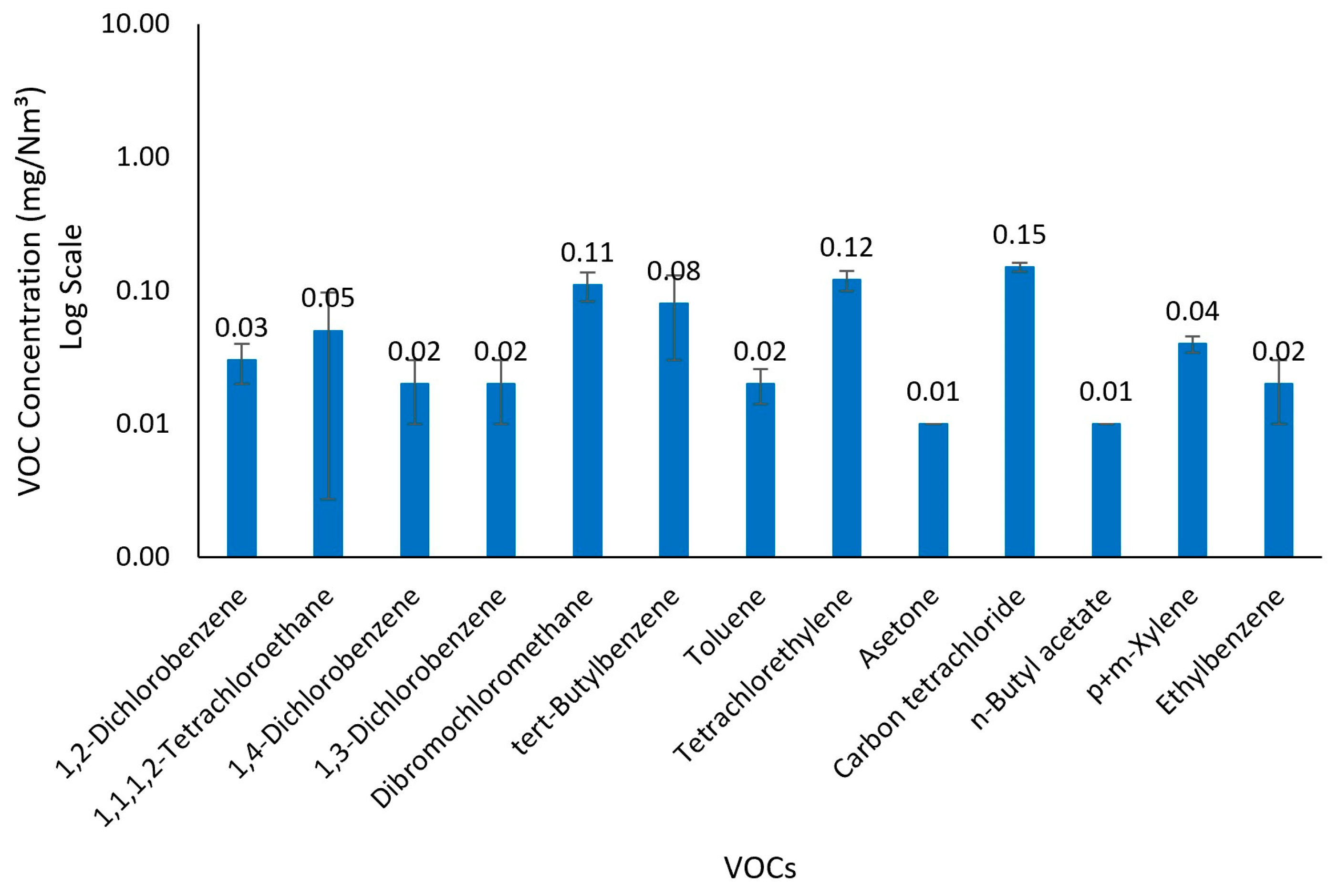
3.1. Concentration and Species of VOCs Originating from Stenter Machine Stack
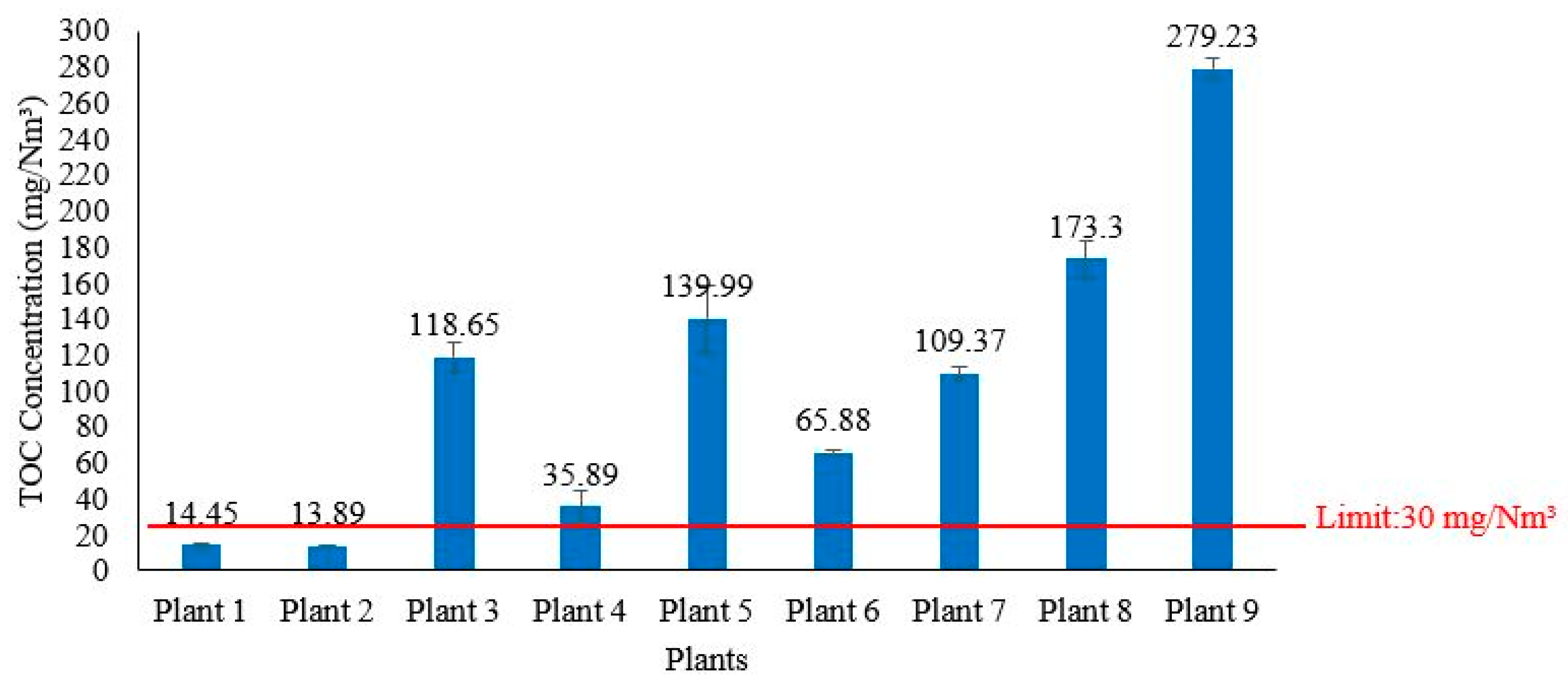
3.2. Concentration of TOC Originating from Stenter Machine Stack
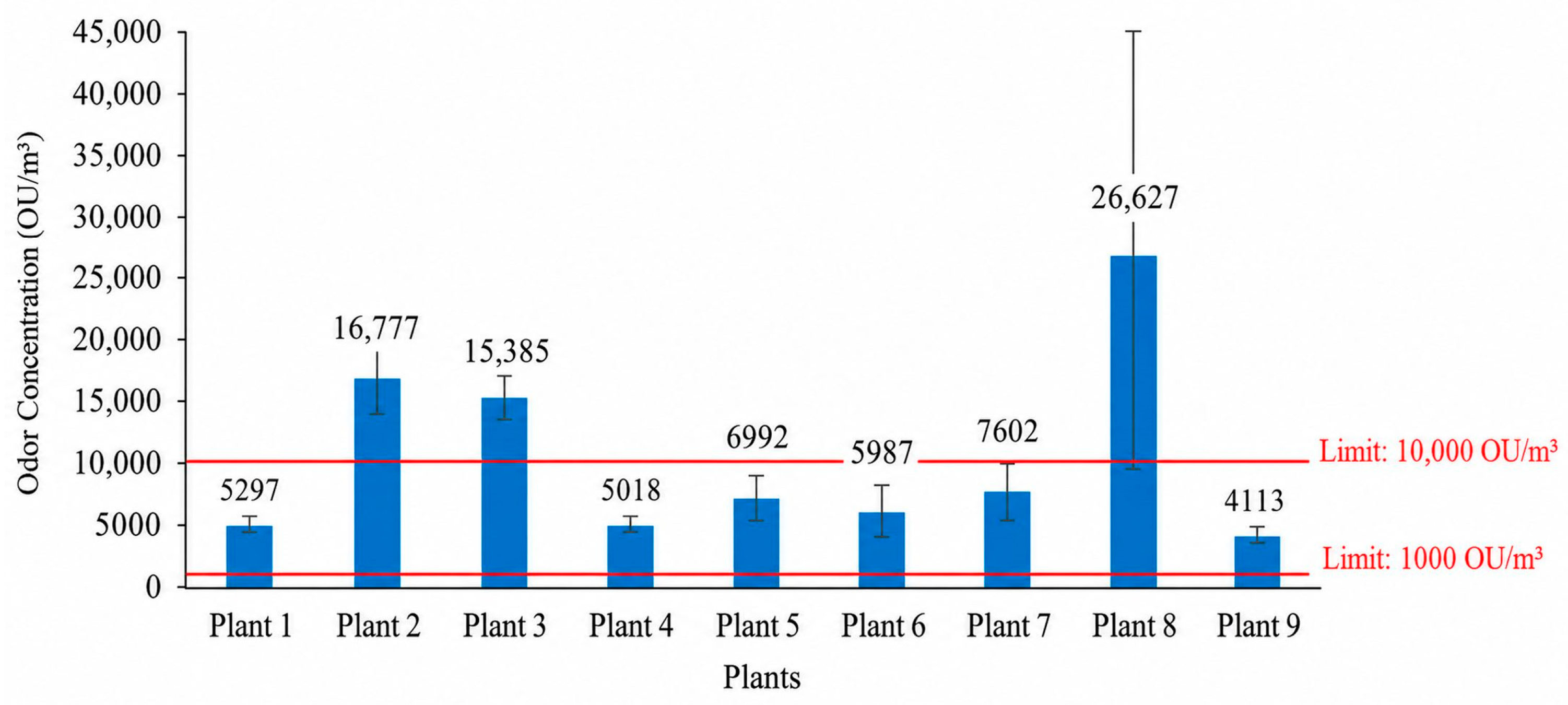
3.3. Concentration of Odor Originating from Stenter Machine Stack
3.4. The Relationship Between Odor, VOC, and TOC
4. Conclusions
Supplementary Materials
Author Contributions
Funding
Institutional Review Board Statement
Informed Consent Statement
Data Availability Statement
Conflicts of Interest
Abbreviations
| BAT | The best available techniques |
| BAT-AELs | Emission levels associated with the best available techniques |
| BTEX | Benzene, ethylbenzene, toluene, and xylene |
| VOC | Volatile organic compounds |
| TOC | Total organic carbon |
References
- Farhana, K.; Kadirgama, K.; Mahamude, A.S.F.; Mica, M.T. Energy Consumption, Environmental Impact, and Implementation of Renewable Energy Resources in Global Textile Industries: An Overview towards Circularity and Sustainability. Mater. Circ. Econ. 2022, 4, 15. [Google Scholar] [CrossRef]
- Rovira, J.; Domingo, J.L. Human Health Risks Due to Exposure to Inorganic and Organic Chemicals from Textiles: A Review. Environ. Res. 2019, 168, 62–69. [Google Scholar] [CrossRef] [PubMed]
- Gabriela, K.; Jiří, M. Changes in Hairiness of Woven Fabrics at the Production and Finishing Stages. Sci. Rep. 2025, 15, 2930. [Google Scholar] [CrossRef] [PubMed]
- Chen, Z.; Liu, J.; Li, J.; Yuan, M.; Yu, G. Leveraging Multi-Output Modelling for CIELAB Using Colour Difference Formula towards Sustainable Textile Dyeing. Auton. Intell. Syst. 2024, 4, 19. [Google Scholar] [CrossRef]
- Ara, M.A.; Tamanna, M.S.; Ali, M.; Amin, A.; Shabur, M.A. A Hybrid AHP and Statistical Validation Approach for Sustainable Supplier Selection in Apparel Industry. Discov. Sustain. 2025, 6, 538. [Google Scholar] [CrossRef]
- Hussein, A.; Scholz, M. Treatment of Artificial Wastewater Containing Two Azo Textile Dyes by Vertical-Flow Constructed Wetlands. Environ. Sci. Pollut. Res. 2018, 25, 6870–6889. [Google Scholar] [CrossRef] [PubMed]
- Yaseen, D.A.; Scholz, M. Treatment of Synthetic Textile Wastewater Containing Dye Mixtures with Microcosms. Environ. Sci. Pollut. Res. 2018, 25, 1980–1997. [Google Scholar] [CrossRef] [PubMed]
- Khan, M.I.; Islam, M.T.; Wang, L.; Padhye, R. Comparative Energy Demand and Carbon Footprint Analysis of Textile Waste Management Systems in Australia. Environ. Sci. Pollut. Res. 2025, 32, 8529–8546. [Google Scholar] [CrossRef] [PubMed]
- Leenders, N.; Moerbeek, R.M.; Puijk, M.J.; Bronkhorst, R.J.A.; Bueno Morón, J.; van Klink, G.P.M.; Gruter, G.-J.M. Polycotton Waste Textile Recycling by Sequential Hydrolysis and Glycolysis. Nat. Commun. 2025, 16, 738. [Google Scholar] [CrossRef] [PubMed]
- Hasanbeigi, A.; Price, L. A Technical Review of Emerging Technologies for Energy and Water Efficiency and Pollution Reduction in the Textile Industry. J. Clean. Prod. 2015, 95, 30–44. [Google Scholar] [CrossRef]
- Stanescu, M.D. State of the Art of Post-Consumer Textile Waste Upcycling to Reach the Zero Waste Milestone. Environ. Sci. Pollut. Res. 2021, 28, 14253–14270. [Google Scholar] [CrossRef] [PubMed]
- Mishra, P.K.; Izrayeel, A.M.D.; Mahur, B.K.; Ahuja, A.; Rastogi, V.K. A Comprehensive Review on Textile Waste Valorization Techniques and Their Applications. Environ. Sci. Pollut. Res. 2022, 29, 65962–65977. [Google Scholar] [CrossRef] [PubMed]
- Qian, W.; Guo, Y.; Wang, X.; Qiu, X.; Ji, X.; Wang, L.; Li, Y. Quantification and Assessment of Chemical Footprint of VOCs in Polyester Fabric Production. J. Clean. Prod. 2022, 339, 130628. [Google Scholar] [CrossRef]
- Toprak, T.; Anis, P. Textile Industry’s Environmental Effects and Approaching Cleaner Production and Sustainability: An Overview. J. Text. Eng. Fash. Technol. 2017, 2, 429–442. [Google Scholar] [CrossRef]
- Ghaly, A.E.; Ananthashankar, R.; Alhattap, M.T.; Ramakrishnan, V.V. Production, Characterization and Treatment of Textile Effluents: A Critical Review. J. Chem. Eng. Process Technol. 2013, 5, 182. [Google Scholar] [CrossRef]
- Ntuli, F.; Ikhu-Omoregbe, D.; Kuipa, P.K.; Muzenda, E.; Belaid, M. Characterization of Effluent from Textile Wet Finishing Operations. In Proceedings of the World Congress on Engineering and Computer Science (WCECS), San Francisco, CA, USA, 20–22 October 2009. [Google Scholar]
- Madhav, S.; Ahamad, A.; Singh, P.; Mishra, P.K. A Review of Textile Industry: Wet Processing, Environmental Impacts, and Effluent Treatment Methods. Environ. Qual. Manag. 2018, 27, 31–41. [Google Scholar] [CrossRef]
- Hasanuzzaman; Bhar, C. Indian Textile Industry and Its Impact on the Environment and Health. Int. J. Inf. Syst. Serv. Sect. 2016, 8, 33–46. [Google Scholar] [CrossRef]
- Kant, R. Textile Dyeing Industry an Environmental Hazard. Nat. Sci. 2012, 4, 22–26. [Google Scholar] [CrossRef]
- International Finance Corporation (IFC); World Bank Group. Environmental, Health, and Safety Guidelines for Textile Manufacturing; World Bank Group: Washington, DC, USA, 2007. [Google Scholar]
- Beckwith, W.F.; Beard, J.N. A Scheme to Assist in the Evaluation of Tenter Frame Dryer Performance. J. Eng. Ind. 1979, 101, 80–84. [Google Scholar] [CrossRef]
- Islam, M.T.; Islam, T.; Islam, T.; Repon, M.R. Synthetic Dyes for Textile Colouration: Process, Factors and Environmental Impact. Text. Leather Rev. 2022, 5, 327–373. [Google Scholar] [CrossRef]
- European Commission. The European Green Deal. Communication from the Commission to the European Parliament, the European Council, the Council, the European Economic and Social Committee and the Committee of the Regions; Document No:52019DC0640; European Commission: Brussels, Belgium, 2019. [Google Scholar]
- European Commission. EU Strategy for Sustainable and Circular Textiles. In Communication from the Commission to the European Parliament, Communication from the Commission to the European Parliament, the Council, the European Economic and Social Committee and the Committee of the Regions; Document No: 52022DC0141; European Commission: Brussels, Belgium, 2022. [Google Scholar]
- European Commission. A New Circular Economy Action Plan for a Cleaner and More Competitive Europe. In Communication from the Commission to the European Parliament, the Council, the European Economic and Social Committee and the Committee of the Regions; European Commission: Brussels, Belgium, 2020. [Google Scholar]
- European Commission. Regulation (EU) 2024/1781 of the European Parliament and of the Council of 13 June 2024. In Establishing a framework for the setting of ecodesign requirements for sustainable products, amending Directive (EU) 2020/1828 and Regulation (EU) 2023/1542 and repealing Directive 2009/125/EC; Document No:32024R1781; European Commission: Brussels, Belgium, 2024. [Google Scholar]
- Zhang, Y.; Li, C.; Yan, Q.; Han, S.; Zhao, Q.; Yang, L.; Liu, Y.; Zhang, R. Typical Industrial Sector-Based Volatile Organic Compounds Source Profiles and Ozone Formation Potentials in Zhengzhou, China. Atmos. Pollut. Res. 2020, 11, 841–850. [Google Scholar] [CrossRef]
- Alam, S.M.M.; Kibria, M.G. Sustainable Heat-Setting Process in Stenter for Textile Industry. Mater. Today Proc. 2022, 59, 847–851. [Google Scholar] [CrossRef]
- Choudhury, A.K.R. Principles of Textile Finishing; Woodhead Publishing: Duxford, UK, 2017. [Google Scholar] [CrossRef]
- Abdel-Dayem, A.M.; Mohamad, M.A. Potential of Solar Energy Utilization in the Textile Industry—A Case Study. Renew. Energy 2001, 23, 685–694. [Google Scholar] [CrossRef]
- EN 13725:2022; Stationary Source Emissions—Determination of Odour Concentration by Dynamic Olfactometry and Odour Emission Rate. Turkish Standards Institute: Ankara, Türkiye, 2022.
- TS CEN/TS 13649:2014; Stationary Source Emissions—Determination of the Mass Concentration of Individual Gaseous Organic Compounds—Sorptive Sampling Method Followed by Solvent Extraction or Thermal Desorption. Turkish Standards Institute: Ankara, Türkiye, 2014.
- EN 12619; Stationary Source Emissions-Determination of the Mass Concentration of Total Gaseous Organic Carbon-Continuous Flame Ionisation Detector Method. European Standard: Brussels, Belgium, 2013.
- Republic of Türkiye Ministry of Environment, Urbanization and Climate Change. Regulation on Control of Industrial Air Pollution. Official Gazette No. 27277, 3 July 2009. Available online: https://www.mevzuat.gov.tr/mevzuat?MevzuatNo=13184&MevzuatTur=7&MevzuatTertip=5 (accessed on 10 November 2025).
- European Commission. Commission Implementing Decision (EU) 2022/2508 of 9 December 2022 Establishing the Best Available Techniques (BAT) Conclusions, under Directive 2010/75/EU of the European Parliament and of the Council on Industrial Emissions, for the Textiles Industry. 2022. Available online: https://eur-lex.europa.eu/eli/dec_impl/2022/2508/oj/eng/ (accessed on 30 May 2026).
- Tahiroglu, Y. Investigation of Sources and Control Methods of Volatile Organic Compounds Emitted from Textile Stenter Stacks. Master’s Thesis, Namık Kemal University, Tekirdağ, Türkiye, 2019. [Google Scholar]
- Yang, Z.; Li, J.; Liu, J.; Cao, J.; Sheng, D.; Cai, T. Evaluation of a Pilot-Scale Bio-Trickling Filter as a VOCs Control Technology for the Chemical Fibre Wastewater Treatment Plant. J. Environ. Manag. 2019, 246, 71–76. [Google Scholar] [CrossRef] [PubMed]
- Müezzinoglu, A. Air Pollutant Emission Potentials of Cotton Textile Manufacturing Industry. J. Clean. Prod. 1998, 6, 339–347. [Google Scholar] [CrossRef]
- IARC. Monographs on the Identification of Carcinogenic Hazards to Humans—List of Classifications. Available online: https://monographs.iarc.who.int/list-of-classifications/ (accessed on 30 May 2026).
- Saeedi, M.; Malekmohammadi, B.; Tajalli, S. Interaction of Benzene, Toluene, Ethylbenzene, and Xylene with Human’s Body: Insights into Characteristics, Sources and Health Risks. J. Hazard. Mater. Adv. 2024, 16, 100459. [Google Scholar] [CrossRef]
- Republic of Türkiye Ministry of Environment, Urbanization and Climate Change. Regulation on Control of Emissions that Contribute to Odor. Official Gazette No. 28712, 19 July 2013. Available online: https://www.mevzuat.gov.tr/mevzuat?MevzuatNo=18607&MevzuatTur=7&MevzuatTertip=5 (accessed on 10 November 2025).



| Plant | Fabric Type | Stenter Operating Temperature | Emission Control System Type | Stack Gas Temperature |
|---|---|---|---|---|
| 1 | 93% Viscose/7% Elastane | 200 °C | Electrostatic filter | 59.43 °C |
| 2 | 89% Viscose/11% Polyamide | 160 °C | Electrostatic filter | 63.93 °C |
| 3 | 90% Viscose/10% Elastane | 160 °C | Wet scrubber | 41.57 °C |
| 4 | 99% Polyester/1% Elastane | 160 °C | Electrostatic filter | 48.69 °C |
| 5 | Polyester Bi-Stretch Fabric | 190 °C | Wet scrubber | 59.65 °C |
| 6 | 50% Polyester/50% Cotton | 160 °C | Electrostatic filter | 57.19 °C |
| 7 | 100% Polyester | 190 °C | Wet scrubber | 44.64 °C |
| 8 | 80% Polyester/20% Elastane | 190 °C | Electrostatic filter | 57.05 °C |
| 9 | 86% Polyamide 66/14% Elastane | 160 °C | Electrostatic filter | 56.70 °C |
| VOC Species | VOC Sources | Reference |
|---|---|---|
| Toluene, xylene, n-Hexane, n-Heptane, Isopropyl alcohol | Stenter stack | [36] |
| Ethanol, Methanol, Benzene, Methyl Acetate, Xylene, Cyclohexane, Trichloroethylene | Wastewater treatment plant | [37] |
| Butyl Acetate | Workplace ambient air | [38] |
| Ethyl Acetate, Toluene, 1-Hexene, 2-Methylpentane, n-Hexane, 3-Methylpentane, Methyl tert-butyl ether (MTBE) | Textile printing and dyeing | [27] |
| Isoprene, Dichloromethane, Methyl tert-butyl ether, n-Hexane, 1,2-Dichloroethane, Ethylcyclohexane, Toluene, p-Xylene, n-Decane, n-Nonane, n-Undecane, n-Dodecane, Acetone, Acrolein, Isopropanol, Ethyl Acetate, Ethylene, Acetic Acid, Acetaldehyde, p-Xylene, castor oil polyoxyethylene ether, Pentane, Hexane, Heptane, Octane, 2, 6-di-tert-butyl para-cresol, Tridecyl Polyoxyethylene Ether, Hexylene Glycol, Simethicone | Polyester fabric production in the textile industry | [13] |
| Odor (OU/m3) | TOC (mg/Nm3) | VOC (mg/Nm3) | |
|---|---|---|---|
| Odor (OU/m3) | 1 | ||
| TOC (mg/Nm3) | 0.071636197 | 1 | |
| VOC (mg/Nm3) | 0.646253715 | 0.286037401 | 1 |
| Source of Variance | SS | df | MS | F | p-Value | F Criterion |
|---|---|---|---|---|---|---|
| Between groups | 6.449 × 10⁸ | 2 | 322,456,756.13203 | 16.73901 | 0.00003 | 3.40283 |
| Within groups | 4.623 × 10⁸ | 24 | 19,263,791.89 | |||
| Total | 1.107 × 10⁹ | 26 |
| Odor (OU/m3) | TOC (mg/Nm3) | |
|---|---|---|
| Mean | 10,421.8542 | 105.6277778 |
| Variance | 57,783,955.79 | 7406.757069 |
| Cumulative Variance | 28,895,681.27 | |
| Predicted Mean Difference | 0 | |
| df (Degrees of Freedom) | 16 | |
| t Stat | 4.071089531 | |
| P(T ≤ t) one-tailed | 0.000444433 | |
| t Critical one-tailed | 1.745883676 | |
| P(T ≤ t) two-tailed | 0.000888866 | |
| t Critical two-tailed | 2.119905299 |
| Odor (OU/m3) | VOC (mg/Nm3) | |
|---|---|---|
| Mean | 10,421.8542 | 3.78 |
| Variance | 57,783,955.79 | 13.135675 |
| Cumulative Variance | 28,891,984.46 | |
| Predicted Mean Difference | 0 | |
| df (Degrees of Freedom) | 16 | |
| t Stat | 4.111544707 | |
| P(T ≤ t) one-tailed | 0.000408274 | |
| t Critical one-tailed | 1.745883676 | |
| P(T ≤ t) two-tailed | 0.000816548 | |
| t Critical two-tailed | 2.119905299 |
| TOC (mg/Nm3) | VOC (mg/Nm3) | |
|---|---|---|
| Mean | 105.6277778 | 3.78 |
| Variance | 7406.757069 | 13.135675 |
| Cumulative Variance | 3709.946372 | |
| Predicted Mean Difference | 0 | |
| df (Degrees of Freedom) | 16 | |
| t Stat | 3.547104624 | |
| P(T ≤ t) one-tailed | 0.001341435 | |
| t Critical one-tailed | 1.745883676 | |
| P(T ≤ t) two-tailed | 0.002682871 | |
| t Critical two-tailed | 2.119905299 |
Disclaimer/Publisher’s Note: The statements, opinions and data contained in all publications are solely those of the individual author(s) and contributor(s) and not of MDPI and/or the editor(s). MDPI and/or the editor(s) disclaim responsibility for any injury to people or property resulting from any ideas, methods, instructions or products referred to in the content. |
© 2026 by the authors. Licensee MDPI, Basel, Switzerland. This article is an open access article distributed under the terms and conditions of the Creative Commons Attribution (CC BY) license.
Share and Cite
Karabacak, E.; Çelik, G.; Esen, F.; Salihoğlu, N.K.; Yonar, T.; Örüç, F.; Çağlar, S.; Mert, B.K. Investigation of Odor, Volatile Organic Compounds (VOC), and Total Organic Carbon (TOC) Parameters Originating from Textile Industry Stenter Stack. Toxics 2026, 14, 560. https://doi.org/10.3390/toxics14070560
Karabacak E, Çelik G, Esen F, Salihoğlu NK, Yonar T, Örüç F, Çağlar S, Mert BK. Investigation of Odor, Volatile Organic Compounds (VOC), and Total Organic Carbon (TOC) Parameters Originating from Textile Industry Stenter Stack. Toxics. 2026; 14(7):560. https://doi.org/10.3390/toxics14070560
Chicago/Turabian StyleKarabacak, Ezgi, Güray Çelik, Fatma Esen, Nezih Kamil Salihoğlu, Taner Yonar, Feza Örüç, Simge Çağlar, and Berna Kırıl Mert. 2026. "Investigation of Odor, Volatile Organic Compounds (VOC), and Total Organic Carbon (TOC) Parameters Originating from Textile Industry Stenter Stack" Toxics 14, no. 7: 560. https://doi.org/10.3390/toxics14070560
APA StyleKarabacak, E., Çelik, G., Esen, F., Salihoğlu, N. K., Yonar, T., Örüç, F., Çağlar, S., & Mert, B. K. (2026). Investigation of Odor, Volatile Organic Compounds (VOC), and Total Organic Carbon (TOC) Parameters Originating from Textile Industry Stenter Stack. Toxics, 14(7), 560. https://doi.org/10.3390/toxics14070560