This is an early access version, the complete PDF, HTML, and XML versions will be available soon.
Review

Applications of Stem Cells and Modern Toxicological Analytical Methods in the Toxicity of Microplastics

1
State Key Laboratory of Pathogenesis, Prevention and Treatment of High Incidence Diseases in Central Asia, Xinjiang Key Laboratory of Molecular Biology for Endemic Diseases, Department of Biochemistry and Molecular Biology, School of Basic Medical Sciences, Xinjiang Medical University, Urumqi 830017, China
2
Physiology, School of Basic Medical Sciences, Xinjiang Medical University, Urumqi 830017, China
*
Authors to whom correspondence should be addressed.
Toxics 2026, 14(7), 545; https://doi.org/10.3390/toxics14070545 (registering DOI)

Submission received: 19 May 2026 / Revised: 17 June 2026 / Accepted: 21 June 2026 / Published: 23 June 2026
(This article belongs to the Section Ecotoxicology)

Abstract

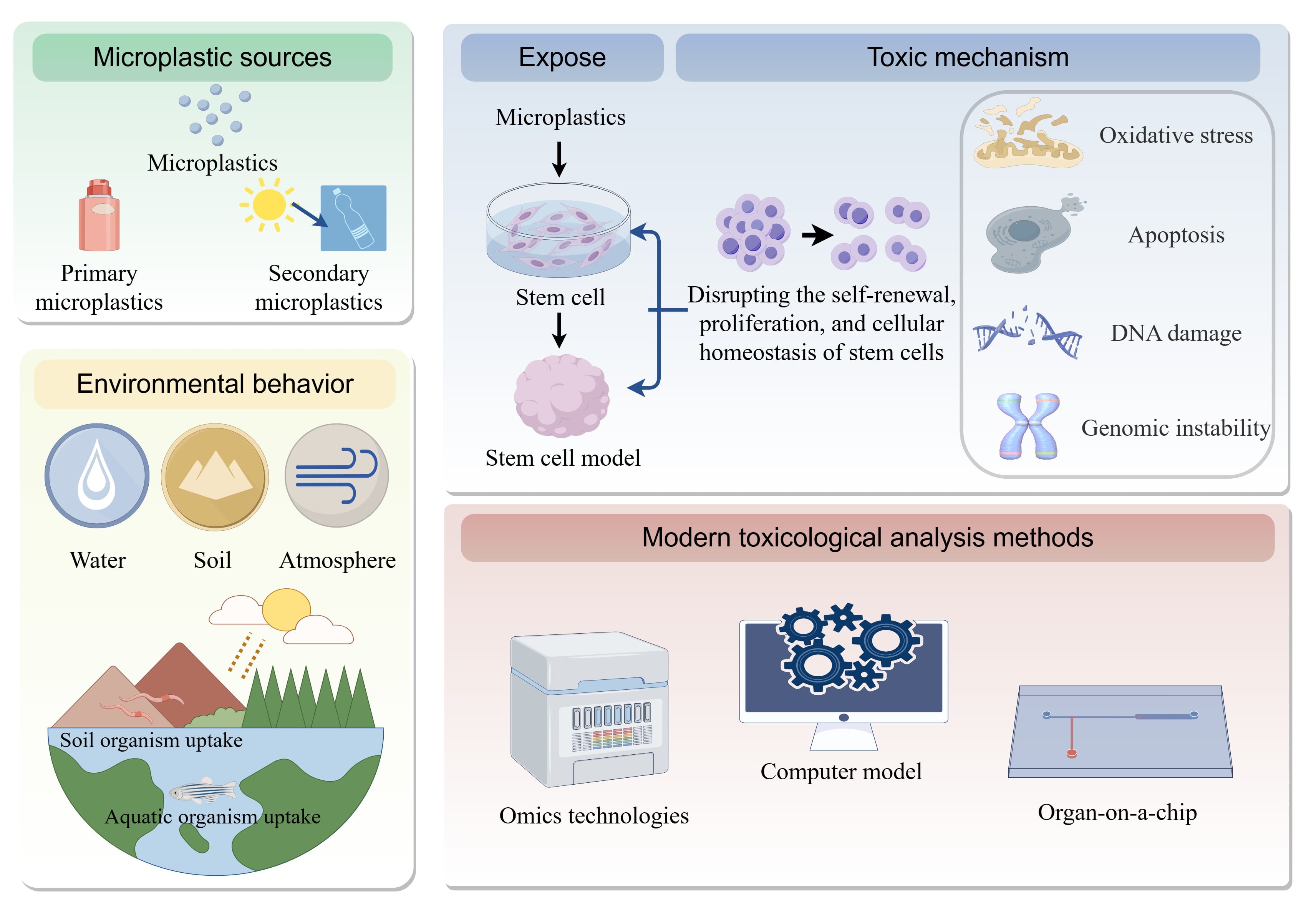
Microplastics (MPs) are an emerging environmental pollutant, and their contamination has emerged as a pressing global environmental concern. Developmental processes exhibit heightened sensitivity to environmental perturbations, and MP exposure can induce long-term adverse effects on organismal health by disrupting fundamental cellular processes. This review focuses on the toxicity and developmental toxicity risks of microplastics investigated using stem cell models. The core section comprehensively summarizes the primary mechanisms through which MP exposure interferes with the biological functions of stem cells, including the impairment of self-renewal capacity and lineage specification, as well as the inhibition of tissue-specific differentiation and organogenesis. Finally, the integration and application of modern toxicological methods in deepening research and improving risk assessment capabilities are synthesized. This review aims to provide a systematic perspective to understand the developmental hazards of MPs and look forward to future risk studies based on stem cell modeling, providing theoretical basis and fundamental support.
Keywords: microplastics; developmental toxicity; stem cell models; toxicological approaches microplastics; developmental toxicity; stem cell models; toxicological approaches
Graphical Abstract