
Sludge Retention Time Governs Ectoine Synthesis and Pollutant Removal in Halophilic Activated Sludge Treating High-Salinity Wastewater

 ,
,  ,
, 
Abstract
1. Introduction
2. Materials and Methods
2.1. Seed Sludge and Synthetic Wastewater
2.2. Reactor Setup and Operating Conditions
2.3. Analytical Items and Methods
2.4. Data Acquisition and Statistical Analysis
3. Results and Discussion
3.1. Effect of SRT on Nitrogen Removal Performance and Related Nitrogen Transformation
3.1.1. Ammonia Nitrogen Removal Efficiency Under Different SRTs
3.1.2. Elimination of Nitrite and Nitrate Nitrogen and Short-Cut Heterotrophic Nitrification Mechanism
3.1.3. Correlation Analysis Between SRT and Nitrogen Removal Stability
3.2. Effect of SRT on Organic Matter (TOC) and Total Phosphorus Removal
3.2.1. TOC Removal Efficiency and Effluent Concentration Variation
3.2.2. TP Removal Performance and the Negligible Effect of SRT
3.2.3. Long-Term vs. Short-Term Performance Comparison Under Different SRTs
3.3. Response of Sludge Characteristics to SRT Regulation
3.3.1. MLSS and MLVSS Variation and Biomass Accumulation
3.3.2. SV30 and SVI Changes and Sludge Settleability
3.3.3. VSS/SS Ratio and Microbial Activity Evaluation
3.4. Effect of SRT on Ectoine Synthesis and Accumulation
3.4.1. Ectoine Production Under Different SRTs
3.4.2. Distinction Between Ectoine Yield and Utilization Efficiency
3.4.3. Coupling Relationship Between Ectoine Synthesis and Microbial Metabolism
3.5. Comprehensive Discussion on the Trade-Off Mechanism
3.5.1. Low SRT (5 d) Favors Pollutant Removal and Ectoine Utilization
3.5.2. High SRT (22 d) Benefits Ectoine Accumulation but Weakens Degradation
3.5.3. Key Role of Thauera in Ectoine Synthesis and Nitrogen Removal
3.5.4. Engineering Implication for High-Salinity Wastewater Resource Recovery
4. Conclusions
- (1)
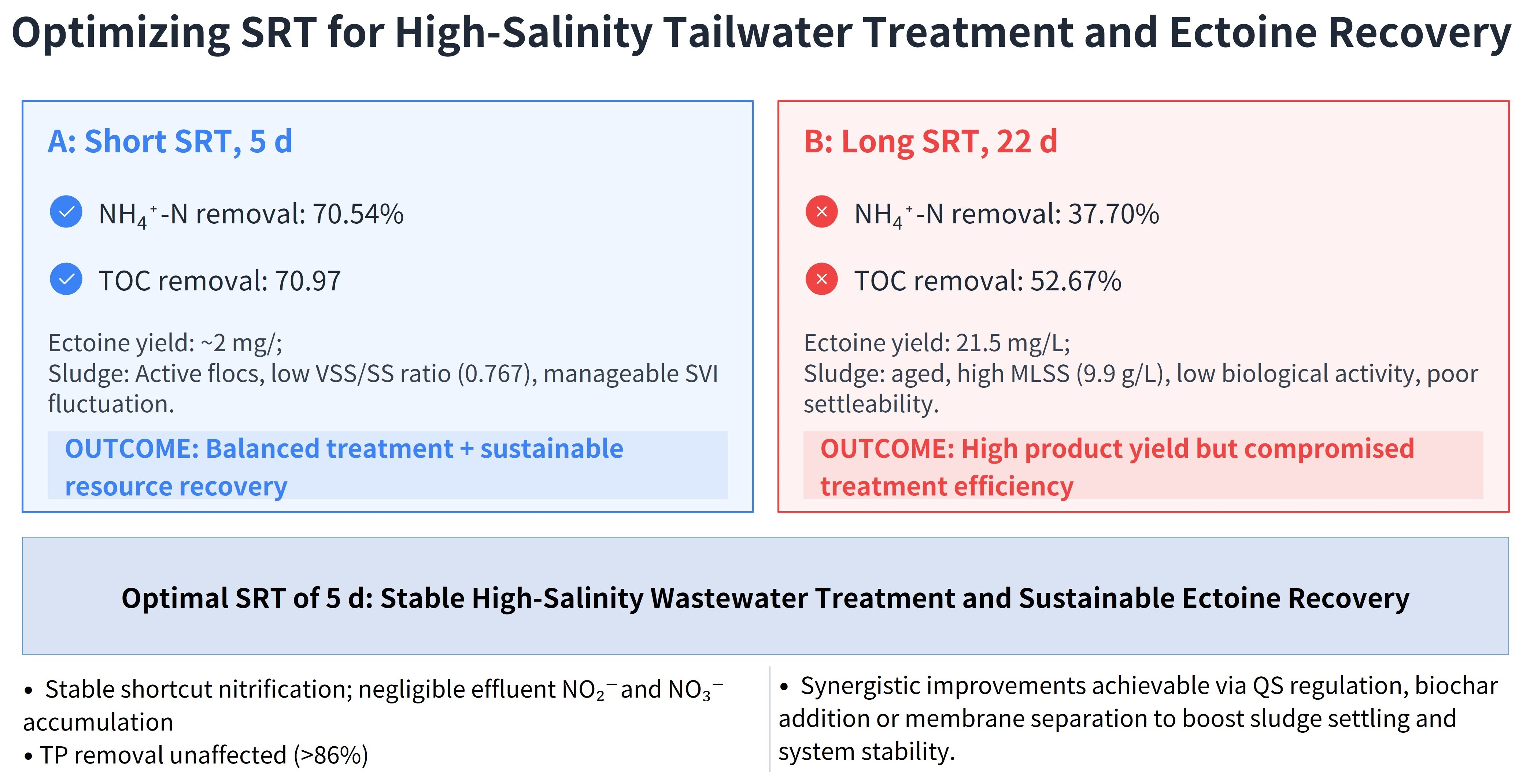
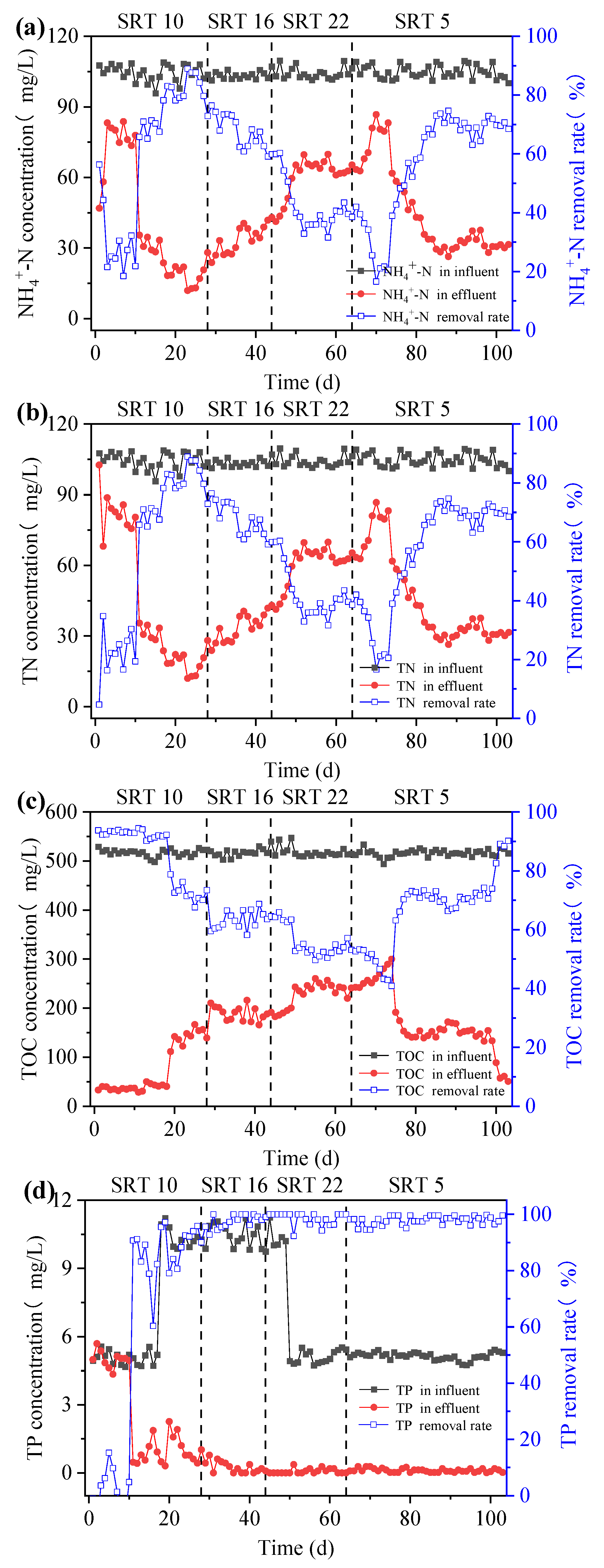
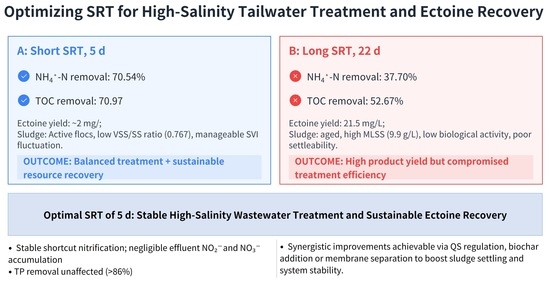
- SRT significantly regulated contaminant removal. Ammonia nitrogen removal efficiencies were 70.54% (5 d), 77.67% (10 d), 68.15% (16 d), and 37.70% (22 d). TOC removal efficiencies were 70.97% (5 d), 72.51% (10 d), 63.87% (16 d), and 52.67% (22 d). Total phosphorus removal remained stable above 86.79% under all SRTs, with effluent TP below 0.20 mg/L.
- (2)
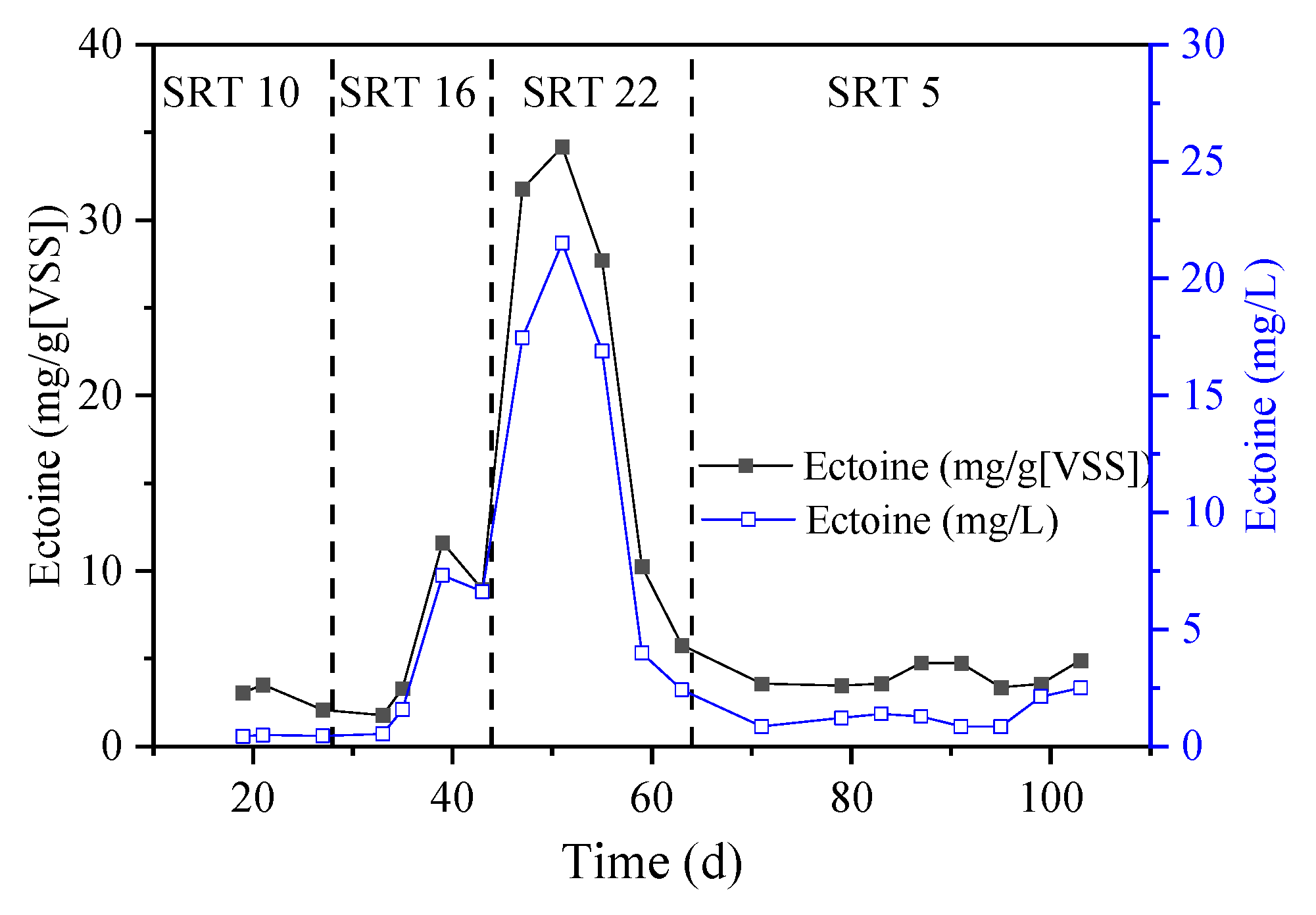
- Ectoine synthesis and accumulation were highly sensitive to SRT. Volumetric ectoine concentration reached ~2 mg/L at 5 d SRT, was nearly undetectable at 10 d SRT, attained ~10 mg/L at 16 d SRT, and maximized at 21.5 mg/L at 22 d SRT. A short SRT (5 d) supported efficient ectoine utilization coupled with salt tolerance and pollutant degradation, whereas a long SRT (22 d) caused uncoupled ectoine accumulation without functional benefits.
- (3)
- Stable short-cut heterotrophic nitrification was sustained across all SRTs, with no effluent nitrite or nitrate accumulation after start-up. Thauera served as the keystone genus enabling simultaneous heterotrophic nitrification–aerobic denitrification and ectoine biosynthesis.
- (4)
- SRT is a core parameter balancing wastewater treatment and ectoine-oriented resource recovery. For engineering application, SRT = 5 d is recommended to achieve stable effluent quality and sustainable ectoine utilization, supporting an integrated paradigm for high-salinity wastewater treatment and valorization.
Author Contributions
Funding
Institutional Review Board Statement
Informed Consent Statement
Data Availability Statement
Conflicts of Interest
References
- Lu, C.-S.; Qiu, J.-M.; Yang, Y.; Hu, Y.; Li, Y.-Y.; Kobayashi, T.; Zhang, Y.-J. A review of anaerobic granulation under high-salinity conditions: Mechanisms, influencing factors and enhancement strategies. J. Water Process Eng. 2023, 55, 104227. [Google Scholar] [CrossRef]
- Huang, Z.; Yi, G.; Wang, Q.; Wang, S.; Xu, Q.; Huan, C.; Wang, Y.; Zhang, W.; Wang, A.; Liu, W. Improving microbial activity in high-salt wastewater: A review of innovative approaches. Sci. Total Environ. 2024, 954, 176278. [Google Scholar] [CrossRef] [PubMed]
- Wang, Y.; Wang, M.; An, C.; Zhang, H.; Jia, H.; Wang, J. Microorganisms in high-salinity mariculture wastewater treatment: Roles and mechanisms. J. Water Process Eng. 2026, 86, 109846. [Google Scholar] [CrossRef]
- Li, R.; Hou, Y.-N.; Li, H.; Han, Y.; Zhang, D.; Song, Y.; Huang, C.; Guo, J.; Liu, Z.; Wei, W.; et al. Salinity responsive mechanisms of sulfur-based mixotrophic denitrification and ectoine induced tolerance enhancement. Chem. Eng. J. 2024, 496, 154266. [Google Scholar] [CrossRef]
- Ren, T.; Chi, Y.; Wang, Y.; Shi, X.; Jin, X.; Jin, P. Diversified metabolism makes novel Thauera strain highly competitive in low carbon wastewater treatment. Water Res. 2021, 206, 117742. [Google Scholar] [CrossRef] [PubMed]
- Li, W.; Zhang, Q.; Li, J.; Gao, R.; Kao, C.; Li, X.; Peng, Y. Nitrogen removal from high-saline municipal wastewater via anammox-based process driven by both nitritation and denitratation. Chem. Eng. J. 2023, 462, 142269. [Google Scholar] [CrossRef]
- Sauer, T.; Galinski, E.A. Bacterial milking: A novel bioprocess for production of compatible solutes. Biotechnol. Bioeng. 1998, 57, 306–313. [Google Scholar] [CrossRef]
- Hu, X.; Li, D.; Qiao, Y.; Song, Q.; Guan, Z.; Qiu, K.; Cao, J.; Huang, L. Salt tolerance mechanism of a hydrocarbon-degrading strain: Salt tolerance mediated by accumulated betaine in cells. J. Hazard. Mater. 2020, 392, 122326. [Google Scholar] [CrossRef] [PubMed]
- Huang, M.; Zhang, H.; Ren, M.; Ji, B.; Sun, K. The synthesis of ectoine enhance the assimilation of ammonia nitrogen in hypersaline wastewater by the salt-tolerant assimilation bacteria sludge. Sci. Total Environ. 2024, 913, 169694. [Google Scholar] [CrossRef] [PubMed]
- Ismail, A.; Elbeshbishy, E.; Nakhla, G. Thermal hydrolysis pretreatment of wastewater biosolids: Modelling the impact of the aerobic sludge age. J. Water Process Eng. 2024, 60, 105114. [Google Scholar] [CrossRef]
- Ji, B.; Qian, Y.; Zhang, H.; Al-Gabr, H.M.; Xu, M.; Zhang, K.; Zhang, D. Optimizing heterotrophic nitrification process: The significance of demand-driven aeration and organic matter concentration. Bioresour. Technol. 2023, 376, 128907. [Google Scholar] [CrossRef] [PubMed]
- Miao, Q.; Xie, Y.; Ismail, S.; Wang, Z.-B.; Ni, S.-Q. Salt-tolerant marine sludge is more suitable for stable and efficient high-salinity wastewater treatment than activated sludge. Chem. Eng. J. 2025, 505, 159404. [Google Scholar] [CrossRef]
- Song, K.; Gao, Y.; Yang, Y.; Guo, B.-Q.; Wang, Y.-Z. Performance of simultaneous carbon and nitrogen removal of high-salinity wastewater in heterotrophic nitrification-aerobic denitrification mode. J. Environ. Chem. Eng. 2023, 11, 109682. [Google Scholar] [CrossRef]
- Chen, Y.J.; He, H.J.; Liu, H.Y.; Li, H.R.; Zeng, G.M.; Xia, X.; Yang, C.P. Effect of salinity on removal performance and activated sludge characteristics in sequencing batch reactors. Bioresour. Technol. 2018, 249, 890–899. [Google Scholar] [CrossRef] [PubMed]
- Rice, E.W.; Bridgewater, L.; Association, A.P.H. Standard Methods for the Examination of Water and Wastewater; American Public Health Association: Washington, DC, USA, 2012; Volume 10. [Google Scholar]
- Ismail, S.; de La Parra, C.; Temmink, H.; Van Lier, J. Extracellular polymeric substances (EPS) in upflow anaerobic sludge blanket (UASB) reactors operated under high salinity conditions. Water Res. 2010, 44, 1909–1917. [Google Scholar] [CrossRef] [PubMed]
- Chen, W.; Qin, S.M.; Yang, C.X.; Long, K.; Liang, S.Y.; Liu, H.; Tan, S.W.; Zhang, Q. Bioaugmentation using salt-tolerant bacteria in a dual-stage process for high-salinity wastewater treatment: Performance, microbial community, and salt-tolerance mechanism. J. Water Process Eng. 2024, 57, 104620. [Google Scholar] [CrossRef]
- Xu, H.; Chen, Y.; Huang, J.; Tao, Y.; Ke, C.; Yang, X. Advances in ectione biosynthesis and biochemical characteristics of key enzymes. Chin. J. Biotechnol. 2024, 40, 1620–1643. [Google Scholar] [CrossRef] [PubMed]
- Li, Y.; Xin, J.; Lu, X.; Song, W.; Xia, C. Research progress on the protective effect of ectoine on biological macromolecules. Appl. Chem. Ind. 2023, 52, 1231–1236. [Google Scholar] [CrossRef]
- Chen, L.; Zhou, L.-T.; Ding, Y.-C.; Wu, D.; Feng, H.-J. Enhancing microbial salt tolerance through low-voltage stimulation for improved p-chloronitrobenzene (p-CNB) removal in high-salinity wastewater. Sci. Total Environ. 2023, 905, 167164. [Google Scholar] [CrossRef] [PubMed]
- Zhou, S.F.; An, W.W.; Zhao, K.X.; Lin, L.Z.; Yang, S.; Zhang, Y.F.; Xu, M.Y. Protection of electroactive biofilms against hypersaline shock by quorum sensing. Water Res. 2023, 233, 119823. [Google Scholar] [CrossRef] [PubMed]
- Gagliano, M.; Ismail, S.B.; Stams, A.J.; Plugge, C.M.; Temmink, H.; Van Lier, J. Biofilm formation and granule properties in anaerobic digestion at high salinity. Water Res. 2017, 121, 61–71. [Google Scholar] [CrossRef] [PubMed]
- Wang, C.; Liu, Y.; Gao, X.; Chen, H.; Xu, X.; Zhu, L. Role of biochar in the granulation of anaerobic sludge and improvement of electron transfer characteristics. Bioresour. Technol. 2018, 268, 28–35. [Google Scholar] [CrossRef] [PubMed]


Disclaimer/Publisher’s Note: The statements, opinions and data contained in all publications are solely those of the individual author(s) and contributor(s) and not of MDPI and/or the editor(s). MDPI and/or the editor(s) disclaim responsibility for any injury to people or property resulting from any ideas, methods, instructions or products referred to in the content. |
© 2026 by the authors. Licensee MDPI, Basel, Switzerland. This article is an open access article distributed under the terms and conditions of the Creative Commons Attribution (CC BY) license.
Share and Cite
Ren, M.; Liu, S.; Zhang, H.; Zhang, K.; Hu, B.; Zhang, C.; Ji, B.; Li, Y.; Ma, J. Sludge Retention Time Governs Ectoine Synthesis and Pollutant Removal in Halophilic Activated Sludge Treating High-Salinity Wastewater. Toxics 2026, 14, 538. https://doi.org/10.3390/toxics14060538
Ren M, Liu S, Zhang H, Zhang K, Hu B, Zhang C, Ji B, Li Y, Ma J. Sludge Retention Time Governs Ectoine Synthesis and Pollutant Removal in Halophilic Activated Sludge Treating High-Salinity Wastewater. Toxics. 2026; 14(6):538. https://doi.org/10.3390/toxics14060538
Chicago/Turabian StyleRen, Min, Sifan Liu, Huining Zhang, Kefeng Zhang, Baolan Hu, Chenhao Zhang, Bixiao Ji, Yan Li, and Jianqing Ma. 2026. "Sludge Retention Time Governs Ectoine Synthesis and Pollutant Removal in Halophilic Activated Sludge Treating High-Salinity Wastewater" Toxics 14, no. 6: 538. https://doi.org/10.3390/toxics14060538
APA StyleRen, M., Liu, S., Zhang, H., Zhang, K., Hu, B., Zhang, C., Ji, B., Li, Y., & Ma, J. (2026). Sludge Retention Time Governs Ectoine Synthesis and Pollutant Removal in Halophilic Activated Sludge Treating High-Salinity Wastewater. Toxics, 14(6), 538. https://doi.org/10.3390/toxics14060538