
Bioaugmented Phytoremediation of Heavy Metals in Petrochemical Wastewater Using Eichhornia crassipes

 ,
,  , ,
, ,  and
and
Abstract
1. Introduction
2. Materials and Methods
2.1. Water Sampling and Quality Analysis
2.2. Physicochemical Parameters
2.3. Bacterial Isolation and Characterization
2.4. Phytoremediation Preparation
2.5. Experimental Design
3. Results and Discussion
3.1. Characterization of Indigenous Oil Field Bacterial Isolates
3.2. Biochemical Characterization
3.3. Bacterial Isolates
3.4. Effect of Petroleum Concentration on Bacterial Growth
3.5. Microbial-Assisted Phytoremediation
3.6. Comparative Analysis of Shoot and Root Length
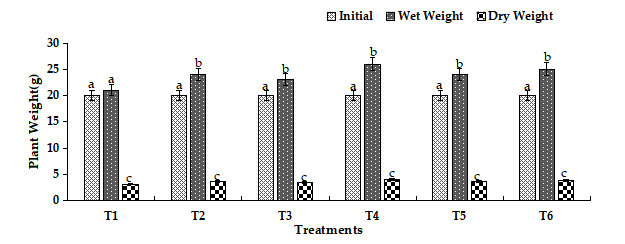
3.7. Wet and Dry Weight of Water Hyacinth After Treatment
3.8. Percentage Removal of Heavy Metals in Produced Wastewater
3.9. Limitations of This Study
4. Conclusions
Author Contributions
Funding
Institutional Review Board Statement
Informed Consent Statement
Data Availability Statement
Acknowledgments
Conflicts of Interest
References
- Liu, J.; Wang, Y.; Li, Y.; Peñuelas, J.; Zhao, Y.; Sardans i Galobart, J.; Tetzlaff, D.; Liu, J.; Liu, X.; Yuan, H.; et al. Soil ecological stoichiometry synchronously regulates stream nitrogen and phosphorus concentrations and ratios. CATENA 2023, 231, 107357. [Google Scholar] [CrossRef]
- Al-Ghouti, M.A.; Al-Kaabi, M.A.; Ashfaq, M.Y.; Da’na, D.A. Produced water characteristics treatment and reuse: A review. J. Water Process Eng. 2019, 28, 222–239. [Google Scholar] [CrossRef]
- Ghazi, H.H.; Aljeboree, A.M. Synthetic Water-Gel Crystals (Orbeez Balls) as Environmentally Friendly Adsorbent for Removal of Toxic Brilliant Green Dye from Aqueous Solutions. Asian J. Water Environ. Pollut. 2024, 21, 53–60. [Google Scholar] [CrossRef]
- Rajbongshi, A.; Gogoi, S.B. A review on oilfield produced water and its treatment technologies. Pet. Res. 2024, 2024, 640–656. [Google Scholar] [CrossRef]
- Rosa, L.; Davis, K.F.; Rulli, M.C.; D’Odorico, P. Environmental consequences of oil production from oil sands. Earth’s Future 2017, 5, 158–170. [Google Scholar] [CrossRef]
- Da Silva Medeiros, D.C.C.; Usman, M.; Chelme-Ayala, P.; Gamal El-Din, M. Biochar-enhanced removal of naphthenic acids from oil sands process water: Influence of feedstock and chemical activation. Energy Environ. Sustain. 2025, 1, 100028. [Google Scholar] [CrossRef]
- Zeng, Y.; Wang, H.; Hu, J.; Zhang, J.; Wang, F.; Wang, T.; Zhou, Q.; Dahlgren, R.A.; Gao, M.; Gao, H.; et al. Illuminated fulvic acid stimulates denitrification and As(III) immobilization in flooded paddy soils via an enhanced biophotoelectrochemical pathway. Sci. Total Environ. 2024, 912, 169670. [Google Scholar] [CrossRef]
- Lee, Y.-Y.; Cho, K.-S.; Yun, J. Phytoremediaton Strategies for Co-Contaminated Soils: Overcoming Challenges, Enhancing Efficiency, and Exploring Future Advancements and Innovations. Processes 2025, 13, 132. [Google Scholar] [CrossRef]
- Tang, H.; Xiang, G.; Xiao, W.; Yang, Z.; Zhao, B. Microbial mediated remediation of heavy metals toxicity: Mechanisms and future prospects. Front. Plant Sci. 2024, 15, 1420408. [Google Scholar] [CrossRef]
- Abdelhamid, H.N. Nanocellulose-based materials for water pollutant removal: A review. Int. J. Mol. Sci. 2024, 25, 8529. [Google Scholar] [CrossRef] [PubMed]
- Muhammad, H.M.D.; Naz, S.; Ahmad, R.; Ali, E.; Anwar, M.; Altaf, M.A.; Alansi, S.; Alsahli, A.A.; Fayssal, S.A. Melatonin triggers salinity tolerance in pansy (Viola tricolor) by regulation of defense system. J. King Saud. Univ.-Sci. 2024, 36, 103286. [Google Scholar] [CrossRef]
- Ayub, A.; Wani, A.K.; Malik, S.M.; Ayub, M.; Chopra, C.; Singh, R.; Malik, T. Harnessing microbes and plants for bioremediation of heavy metal contaminants: Current paradigms and future perspectives. Environ. Chall. 2025, 20, 101220. [Google Scholar] [CrossRef]
- Wang, A.; Fu, W.; Feng, Y.; Liu, Z.; Song, D. Synergetic effects of microbial-phytoremediation reshape microbial communities and improve degradation of petroleum contaminants. J. Hazard. Mater. 2022, 429, 128396. [Google Scholar] [CrossRef]
- Khan, A.L.; Mithöfer, A. Microbe-mediated Regulation of Plant Growth and Stress Physiology. J. Plant Growth Regul. 2025, 44, 6711–6715. [Google Scholar] [CrossRef]
- American Public Health Association. Standard Methods for the Examination of Water and Wastewater, 23rd ed.; American Public Health Association: Washington, DC, USA, 2017. [Google Scholar]
- Bergey, D.H. Bergey’s Manual of Determinative Bacteriology, 9th ed.; Williams & Wilkins: Baltimore, MD, USA, 1994. [Google Scholar]
- Maroof, L.; Khan, I.; Yoo, H.S.; Kim, S.; Park, H.T.; Ahmad, B.; Azam, S. Identification and characterization of low density polyethylene-degrading bacteria isolated from soils of waste disposal sites. Environ. Eng. Res. 2021, 26, 200167. [Google Scholar] [CrossRef]
- Abbas, Z.; Arooj, F.; Ali, S.; Zaheer, I.E.; Rizwan, M.; Riaz, M.A. Phytoremediation of landfill leachate waste contaminants through floating bed technique using water hyacinth and water lettuce. Int. J. Phytoremediation 2019, 21, 1356–1367. [Google Scholar] [CrossRef] [PubMed]
- Saha, P.; Shinde, O.; Sarkar, S. Phytoremediation of industrial mines wastewater using water hyacinth. Int. J. Phytoremediation 2017, 19, 87–96. [Google Scholar] [CrossRef]
- Tan, B.; Li, Y.; Liu, T.; Tan, X.; He, Y.; You, X.; Leong, K.H.; Liu, C.; Li, L. Response of Plant Rhizosphere Microenvironment to Water Management in Soil- and Substrate-Based Controlled Environment Agriculture (CEA) Systems: A Review. Front. Plant Sci. 2021, 12, 691651. [Google Scholar] [CrossRef]
- Dave, J.; Patel, A.; Raval, H. Towards Precise Water Quality Assessment: A Deep Learning Approach with Feature Selection in Smart Monitoring Systems. Int. J. Sci. Res. Comput. Sci. Eng. Inf. Technol. 2024, 10, 100–114. [Google Scholar] [CrossRef]
- Halshoy, H.S.; Braim, S.A.; Hama, J.R. Phytohormonal regulation of root exudation: Mechanisms and rhizosphere function. Plant Signal. Behav. 2025, 20, 2587486. [Google Scholar] [CrossRef]
- Oria-Usifo, E.; Enuma, I.; Edward, I.; Okafor, D.; Segun, B.; Ukpai, U.; Ajayi, A. Removal of Hydrocarbon from Produced Water by Phytoremediation Method, Using Water Hyacinth (Eichhornia Crassipes). Int. J. Sci. Res. Civ. Eng. 2025, 9, 17–25. [Google Scholar] [CrossRef]
- Hardestyariki, A.D.; Fitria, S. Effectiveness and adaptability of water hyacinth (Eichornia crassipes) Mart. Solm in its Role in Reducing COD and BOD Levels in Petroleum Liquid Waste. J. Ecol. Eng. 2022, 23, 26–29. [Google Scholar] [CrossRef] [PubMed]
- Hong, Y.; Zhu, Z.; Liao, W.; Yan, Z.; Feng, C.; Xu, D. Freshwater Water-Quality Criteria for Chloride and Guidance for the Revision of the Water-Quality Standard in China. Int. J. Environ. Res. Public Health 2023, 20, 2875. [Google Scholar] [CrossRef] [PubMed]
- Haritash, A.K.; Kaushik, C.P. Biodegradation aspects of polycyclic aromatic hydrocarbons (PAHs): A review. J. Hazard. Mater. 2009, 169, 1–15. [Google Scholar] [CrossRef]
- Farhami, N.; Derakhshandeh, M.; Hakki, H.K. Exploring COD and BOD removal from industrial wastewater using a moving bed biofilm reactor (MBBR). Desalin. Water Treat. 2025, 322, 101177. [Google Scholar] [CrossRef]
- Agarwal, P.; Vibhandik, R.; Agrahari, R.; Daverey, A.; Rani, R. Role of Root Exudates on the Soil Microbial Diversity and Biogeochemistry of Heavy Metals. Appl. Biochem. Biotechnol. 2023, 196, 2673–2693. [Google Scholar] [CrossRef]
- Saadoun, I. Isolation and characterization of bacteria from crude petroleum oil contaminated soil and their potential to degrade diesel fuel. J. Basic Microbiol. 2002, 42, 420–428. [Google Scholar] [CrossRef]
- Mujahid, T.Y.; Wahab, A.; Padhiar, S.H.; Subhan, S.A.; Baloch, M.N.; Pirzada, Z.A. Isolation and characterization of hydrocarbon degrading bacteria from petrol contaminated soil. J. Basic Appl. Sci. 2015, 11, 223–231. [Google Scholar] [CrossRef]
- Kaida, N.; Habib, S.; Yasid, N.A.; Shukor, M.Y. Biodegradation of Petroleum hydrocarbons by Bacillus spp.: A review. Bioremediation Sci. Technol. Res. 2018, 6, 14–21. [Google Scholar] [CrossRef]
- Das, A.; Das, N.; Rajkumari; Pandey, J.; Pandey, P. Exploring the bioremediation potential of Bacillus spp. for sustainable mitigation of hydrocarbon contaminants. Environ. Sustain. 2024, 7, 135–156. [Google Scholar] [CrossRef]
- Zhang, D.; Hu, Q.; Wang, B.; Wang, J.; Li, C.; You, P.; Zhou, R.; Zeng, W.; Liu, X.; Li, Q. Effects of single and combined contamination of total petroleum hydrocarbons and heavy metals on soil microecosystems: Insights into bacterial diversity, assembly, and ecological function. Chemosphere 2023, 345, 140288. [Google Scholar] [CrossRef]
- Zhu, H.; Ren, L.; Yang, H.; Zhang, J. Leveraging indigenous Bacillus consortia for heavy oil biodegradation and soil bioremediation. Environ. Technol. Innov. 2025, 40, 104415. [Google Scholar] [CrossRef]
- Rabani, M.S.; Hameed, I.; Mir, T.A.; Wani, B.A.; Gupta, M.K.; Habib, A.; Jan, M.; Hussain, M.; Tripathi, S.; Pathak, A.; et al. Microbial-assisted phytoremediation. In Phytoremediation; Academic Press: Cambridge, MA, USA, 2022; pp. 91–114. [Google Scholar] [CrossRef]
- Elhamrouni, I.A.; Ishak, M.Y.; Kadhum, S.A.; Johari, W.L.W.; Halimoon, N.; Jaber, S.M.; Alhammadi, E. Optimization and modeling of used engine oil hydrocarbons degradation by Ochrobacterium intermedium LMG 3301 using response surface methodology. Total Environ. Adv. 2025, 13, 200121. [Google Scholar] [CrossRef]
- Kuzina, E.; Rafikova, G.; Vysotskaya, L.; Arkhipova, T.; Bakaeva, M.; Chetverikova, D.Y.; Kudoyarova, G.; Korshunova, T.; Chetverikov, S. Influence of hydrocarbon-oxidizing bacteria on the growth, biochemical characteristics, and hormonal status of barley plants and the content of petroleum hydrocarbons in the soil. Plants 2021, 10, 1745. [Google Scholar] [CrossRef] [PubMed]
- Balasubramaniyam, A. The influence of plants in the remediation of petroleum hydrocarbon-contaminated sites. Pharm. Anal. Chem. Open Access 2015, 1, 1000105. [Google Scholar] [CrossRef]
- Al-Marri, S.; Eldos, H.I.; Ashfaq, M.Y.; Saeed, S.; Skariah, S.; Varghese, L.; Mohamoud, Y.A.; Sultan, A.A.; Raja, M.M. Isolation, identification, and screening of biosurfactant-producing and hydrocarbon-degrading bacteria from oil and gas industrial waste. Biotechnol. Rep. 2023, 39, e00804. [Google Scholar] [CrossRef]
- Ekperusi, A.O.; Nwachukwu, E.O.; Sikoki, F.D. Assessing and modelling the efficacy of Lemna paucicostata for the phytoremediation of petroleum hydrocarbons in crude oil-contaminated wetlands. Sci. Rep. 2020, 10, 8489. [Google Scholar] [CrossRef]
- Cui, X.; Cao, X.; Xue, W.; Xu, L.; Cui, Z.; Zhao, R.; Ni, S.Q. Integrative effects of microbial inoculation and amendments on improved crop safety in industrial soils co-contaminated with organic and inorganic pollutants. Sci. Total Environ. 2023, 873, 162202. [Google Scholar] [CrossRef]
- Mandal, A.; Thakur, J.K.; Sahu, A.; Bhattacharjya, S.; Manna, M.C.; Patra, A.K. Plant–microbe interaction for the removal of heavy metal from contaminated site. In Plant-Microbe Interaction: An Approach to Sustainable Agriculture; Springer Singapore: Singapore, 2017; pp. 227–247. [Google Scholar] [CrossRef]
- Raj, D.; Maiti, S.K. Sources, toxicity, and remediation of mercury: An essence review. Environ. Monit. Assess. 2019, 191, 566. [Google Scholar] [CrossRef]
- Darsa, K.V.; Thatheyus, A.J.; Ramya, D. Biodegradation of petroleum compound using the bacterium Bacillus subtilis. Sci. Int. 2014, 2, 20–25. [Google Scholar] [CrossRef]




| No. of Strains | Shapes | Gram Staining | Catalase Test | Urease Test | Indole Test | Coagulase Test | Oxidase Test |
|---|---|---|---|---|---|---|---|
| 1 | Spiral-shaped | + | + | − | + | + | − |
| 2 | Rod-shaped | + | + | − | + | + | − |
| 3 | Spherical | + | + | − | + | + | − |
| 4 | Comma-shaped | + | + | − | + | + | − |
| Samples | Ag % | As % | Co % | Cr% | Fe% | Hg% | Ni% |
|---|---|---|---|---|---|---|---|
| T1 | 79.2 ± 0.02 | 70.1 ± 0.01 | 60 ± 0.01 | 50 ± 0.01 | 34.3 ± 0.01 | 33.3 ± 0.03 | 64 ± 0.01 |
| T2 | 62.2 ± 0.01 | 60 ± 0.01 | 60 ± 0.01 | 49 ± 0.01 | 53.1 ± 0.01 | 31.1 ± 0.02 | 60 ± 0.01 |
| T3 | 67 ± 0.01 | 35 ± 0.01 | 79 ± 0.01 | 50 ± 0.01 | 46.8 ± 0.01 | 40 ± 0.02 | 54 ± 0.01 |
| T4 | 11.1 ± 0.01 | 31.2 ± 0.01 | 49 ± 0.01 | 42 ± 0.01 | 28.1 ± 0.01 | 18.5 ± 0.02 | 32 ± 0.02 |
| T5 | 66.6 ± 0.01 | 45 ± 0.01 | 49 ± 0.01 | 44 ± 0.01 | 59 ± 0.01 | 22 ± 0.03 | 37 ± 0.02 |
| T6 | 60 ± 0.01 | 66.6 ± 0.01 | 60 ± 0.01 | 43.5 ± 0.01 | 58 ± 0.01 | 23 ± 0.02 | 54 ± 0.02 |
Disclaimer/Publisher’s Note: The statements, opinions and data contained in all publications are solely those of the individual author(s) and contributor(s) and not of MDPI and/or the editor(s). MDPI and/or the editor(s) disclaim responsibility for any injury to people or property resulting from any ideas, methods, instructions or products referred to in the content. |
© 2026 by the authors. Licensee MDPI, Basel, Switzerland. This article is an open access article distributed under the terms and conditions of the Creative Commons Attribution (CC BY) license.
Share and Cite
Lan, X.; Sheraz, R.; Waqar-Un-Nisa; Zhang, S.; Ouyang, J.; Saleem, A.R.; Abid, J.; Ullah, H.; Bai, Y.; Ma, R.; et al. Bioaugmented Phytoremediation of Heavy Metals in Petrochemical Wastewater Using Eichhornia crassipes. Toxics 2026, 14, 493. https://doi.org/10.3390/toxics14060493
Lan X, Sheraz R, Waqar-Un-Nisa, Zhang S, Ouyang J, Saleem AR, Abid J, Ullah H, Bai Y, Ma R, et al. Bioaugmented Phytoremediation of Heavy Metals in Petrochemical Wastewater Using Eichhornia crassipes. Toxics. 2026; 14(6):493. https://doi.org/10.3390/toxics14060493
Chicago/Turabian StyleLan, Xudong, Rabiya Sheraz, Waqar-Un-Nisa, Songhao Zhang, Jia Ouyang, Aansa Rukya Saleem, Jawaria Abid, Habib Ullah, Yilina Bai, Rui Ma, and et al. 2026. "Bioaugmented Phytoremediation of Heavy Metals in Petrochemical Wastewater Using Eichhornia crassipes" Toxics 14, no. 6: 493. https://doi.org/10.3390/toxics14060493
APA StyleLan, X., Sheraz, R., Waqar-Un-Nisa, Zhang, S., Ouyang, J., Saleem, A. R., Abid, J., Ullah, H., Bai, Y., Ma, R., You, S., Idris, A. M., & Yu, G. (2026). Bioaugmented Phytoremediation of Heavy Metals in Petrochemical Wastewater Using Eichhornia crassipes. Toxics, 14(6), 493. https://doi.org/10.3390/toxics14060493