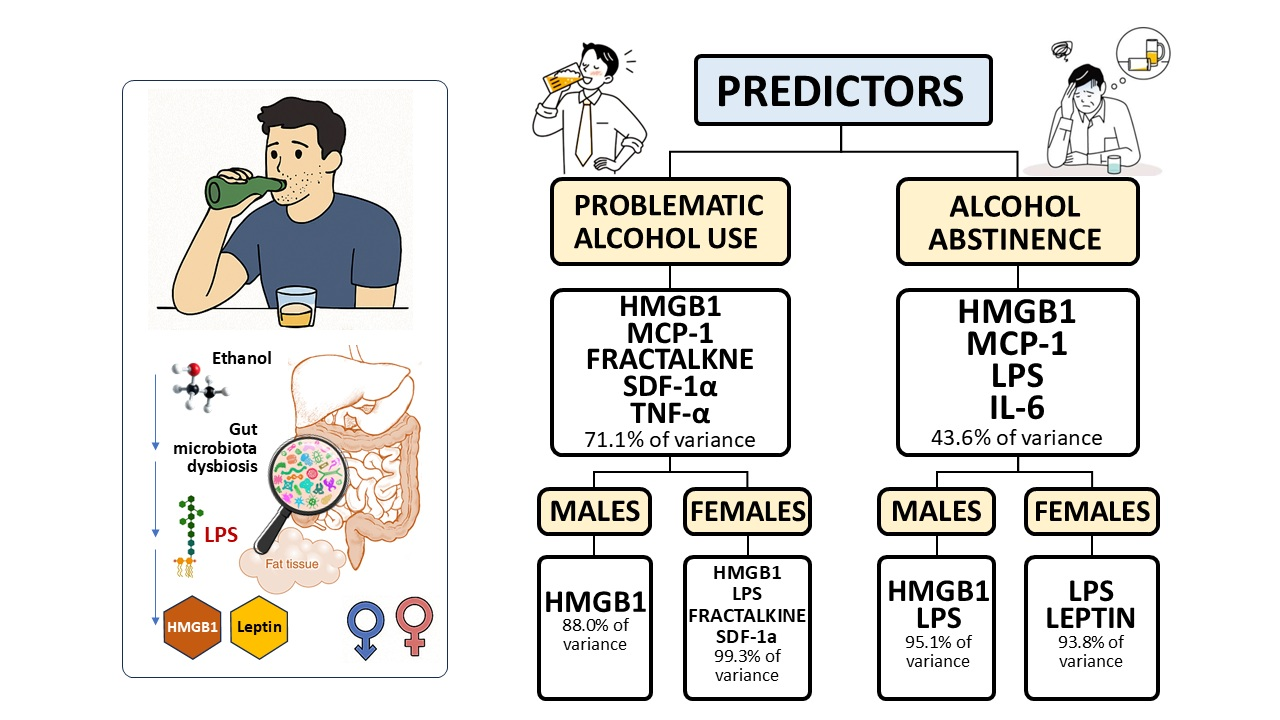


Plasma Concentrations of Endotoxin Lipopolysaccharide and High-Mobility Group Box 1 Protein Are Consistent Sex-Specific Biomarkers of Alcohol Abstinence Associated with Alcohol Use Disorder
 , , , , ,
  ,
,  , ,
, ,  ,
,  , , and
Abstract
1. Introduction
2. Materials and Methods
2.1. Ethics Statements
2.2. Participants and Recruitment
2.3. Eligibility Criteria
2.4. Clinical Evaluations
2.5. Collection and Processing of Plasma Samples
2.6. Determination of Endotoxin Lipopolysaccharide (LPS)
2.7. Determination of Inflammatory Factors
2.8. Determination of Leptin
2.9. Multiplexed Bead Immunoassay
2.10. Biochemical Analysis
2.11. Statistical Analysis
3. Results
3.1. Sociodemographic and Clinical Characteristics of AUD and Control Groups
3.2. Plasma Concentrations of Inflammation-Related Factors in Abstinent AUD and Control Subjects
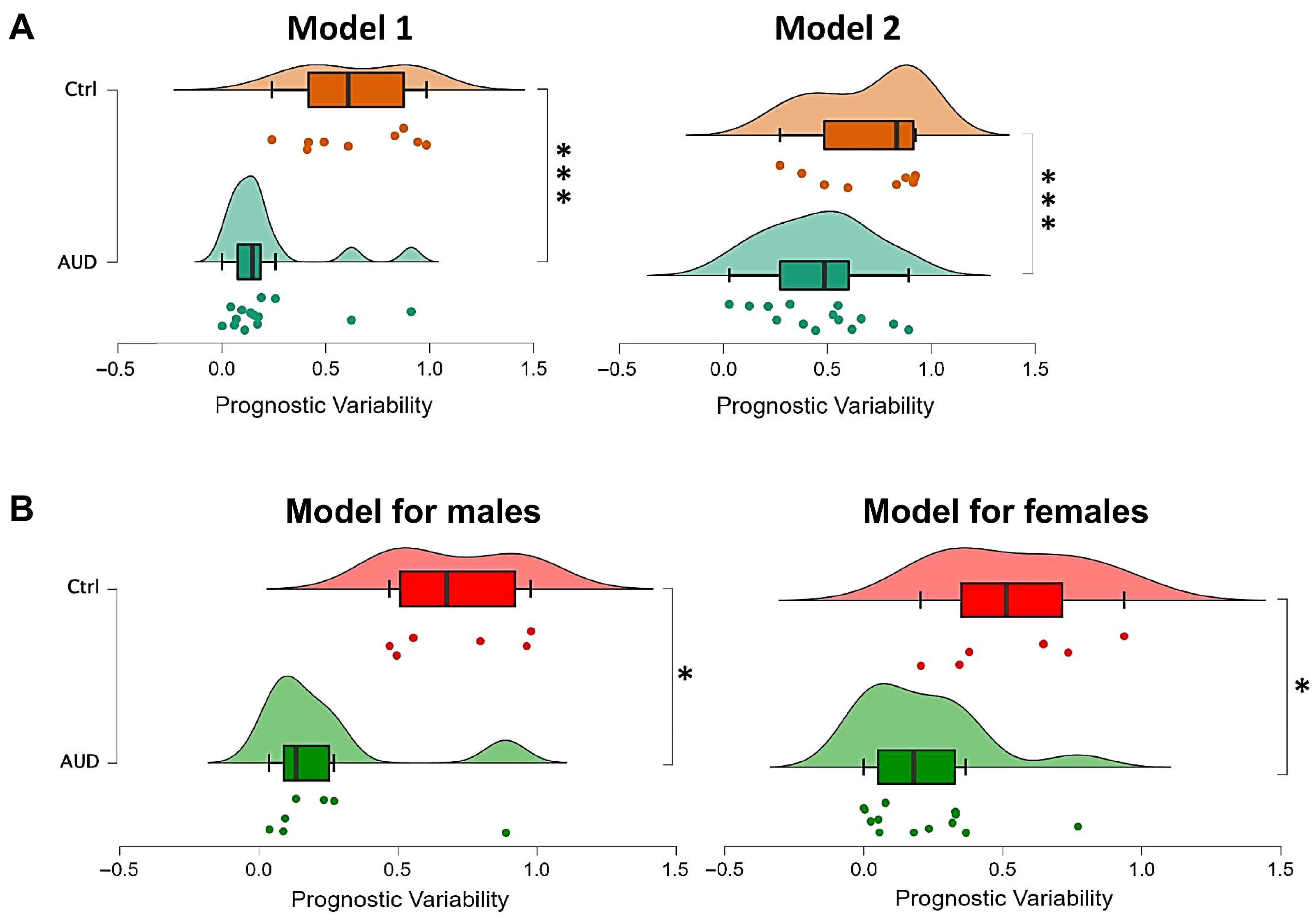
3.3. Inflammation-Related Factors as Predictors of Abstinent AUD
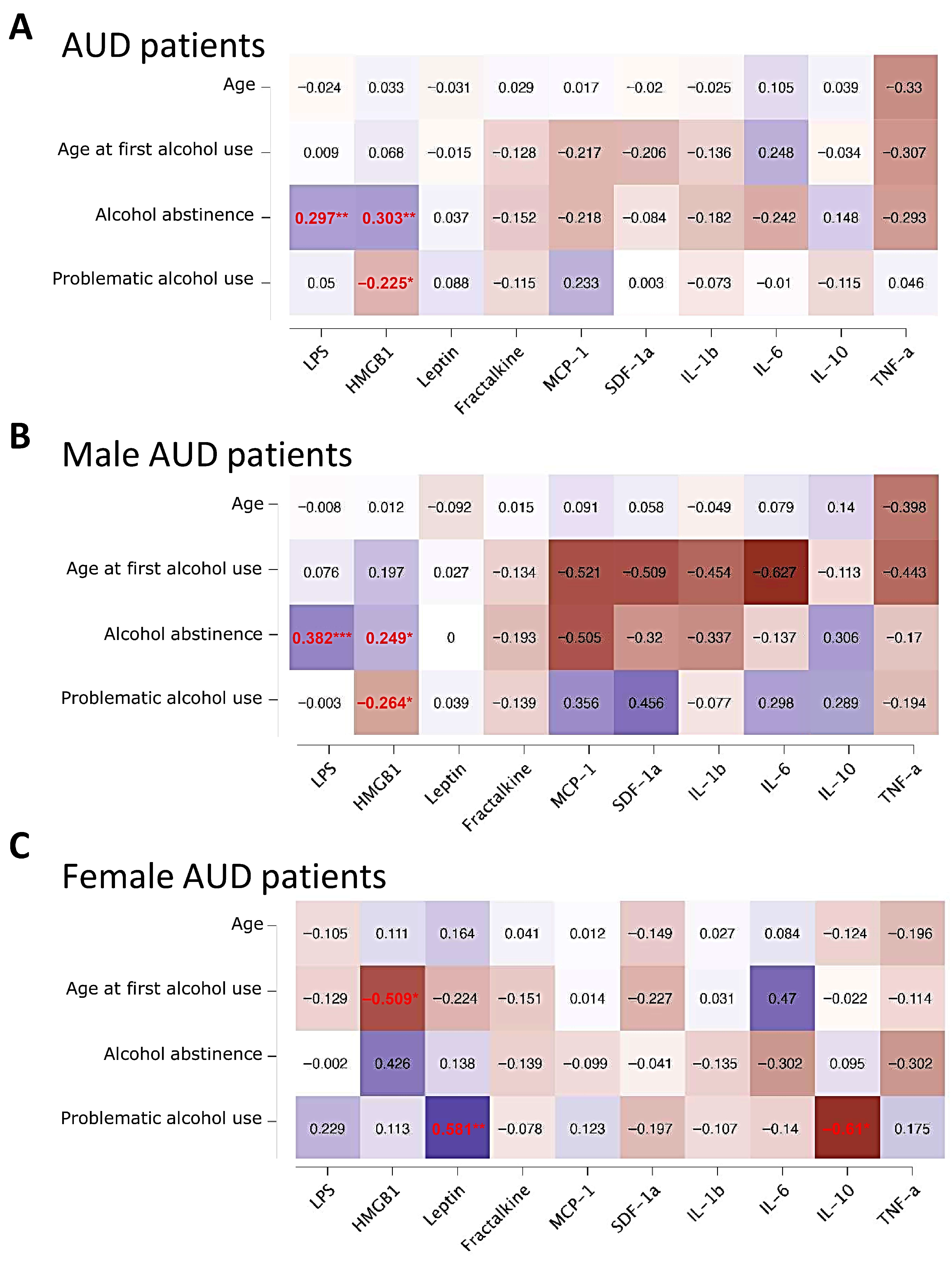
3.4. Correlations Between the AUD Defining Variables and Plasma Concentrations of Inflammation-Related Factors
4. Discussion
5. Conclusions
6. Limitations
Author Contributions
Funding
Institutional Review Board Statement
Informed Consent Statement
Data Availability Statement
Acknowledgments
Conflicts of Interest
References
- Glantz, M.D.; Bharat, C.; Degenhardt, L.; Sampson, N.A.; Scott, K.M.; Lim, C.C.W.; WHO World Mental Health Survey Collaborators. The epidemiology of alcohol use disorders cross-nationally: Findings from the World Mental Health Surveys. Addict. Behav. 2020, 102, 106128. [Google Scholar] [CrossRef] [Scilit] [PubMed]
- World Health Organization. Global Status Report on Alcohol and Health and Treatment of Substance Use Disorders; Licence: CC BY-NC-SA 3.0 IGO; World Health Organization: Geneva, Switzerland, 2024; Available online: https://www.who.int/publications/i/item/9789240096745 (accessed on 8 April 2026).
- GBD 2019 Risk Factors Collaborators. Global burden of 87 risk factors in 204 countries and territories, 1990–2019: A systematic analysis for the Global Burden of Disease Study 2019. Lancet 2020, 396, 1223–1249. [Google Scholar] [CrossRef] [Scilit]
- GBD 2021 Forecasting Collaborators. Burden of disease scenarios for 204 countries and territories, 2022–2050: A forecasting analysis for the Global Burden of Disease Study 2021. Lancet 2024, 403, 2204–2256. [Google Scholar] [CrossRef] [Scilit]
- Simon, L.; Souza-Smith, F.M.; Molina, P.E. Alcohol-Associated Tissue Injury: Current Views on Pathophysiological Mechanisms. Annu. Rev. Physiol. 2022, 84, 87–112. [Google Scholar] [CrossRef] [Scilit] [PubMed]
- Fairfield, B.; Schnabl, B. Gut dysbiosis as a driver in alcohol-induced liver injury. JHEP Rep. 2021, 3, 100220. [Google Scholar] [CrossRef] [Scilit]
- Engen, P.A.; Green, S.J.; Voigt, R.M.; Forsyth, C.B.; Keshavarzian, A. The Gastrointestinal Microbiome: Alcohol Effects on the Composition of Intestinal Microbiota. Alcohol Res. 2015, 37, 223–236. [Google Scholar] [CrossRef] [Scilit]
- Bishehsari, F.; Magno, E.; Swanson, G.; Desai, V.; Voigt, R.M.; Forsyth, C.B.; Keshavarzian, A. Alcohol and Gut-Derived Inflammation. Alcohol Res. 2017, 38, 163–171. [Google Scholar] [CrossRef] [Scilit]
- Antón, M.; Rodríguez-González, A.; Ballesta, A.; González, N.; Del Pozo, A.; de Fonseca, F.R.; Gómez-Lus, M.L.; Leza, J.C.; García-Bueno, B.; Caso, J.R.; et al. Alcohol binge disrupts the rat intestinal barrier: The partial protective role of oleoylethanolamide. Br. J. Pharmacol. 2018, 175, 4464–4479. [Google Scholar] [CrossRef] [Scilit] [PubMed]
- Orio, L.; Antón, M.; Rodríguez-Rojo, I.C.; Correas, Á.; García-Bueno, B.; Corral, M.; de Fonseca, F.R.; García-Moreno, L.M.; Maestú, F.; Cadaveira, F. Young alcohol binge drinkers have elevated blood endotoxin, peripheral inflammation and low cortisol levels: Neuropsychological correlations in women. Addict. Biol. 2018, 23, 1130–1144. [Google Scholar] [CrossRef] [Scilit] [PubMed]
- Segovia-Rodríguez, L.; Echeverry-Alzate, V.; Rincón-Pérez, I.; Calleja-Conde, J.; Bühler, K.M.; Giné, E.; Albert, J.; Hinojosa, J.A.; Huertas, E.; Gómez-Gallego, F.; et al. Gut microbiota and voluntary alcohol consumption. Transl. Psychiatry 2022, 12, 146. [Google Scholar] [CrossRef] [Scilit]
- Bajaj, J.S.; Gavis, E.A.; Fagan, A.; Wade, J.B.; Thacker, L.R.; Fuchs, M.; Patel, S.; Davis, B.; Meador, J.; Puri, P.; et al. A Randomized Clinical Trial of Fecal Microbiota Transplant for Alcohol Use Disorder. Hepatology 2021, 73, 1688–1700. [Google Scholar] [CrossRef] [Scilit] [PubMed]
- Wolstenholme, J.T.; Duong, N.K.; Brocato, E.R.; Bajaj, J.S. Gut-Liver-Brain Axis and Alcohol Use Disorder: Treatment Potential of Fecal Microbiota Transplantation. Alcohol Res. 2024, 44, 1. [Google Scholar] [CrossRef] [Scilit]
- Wolstenholme, J.T.; Saunders, J.M.; Smith, M.; Kang, J.D.; Hylemon, P.B.; González-Maeso, J.; Fagan, A.; Zhao, D.; Sikaroodi, M.; Herzog, J.; et al. Reduced alcohol preference and intake after fecal transplant in patients with alcohol use disorder is transmissible to germ-free mice. Nat. Commun. 2022, 13, 6198. [Google Scholar] [CrossRef] [Scilit]
- de Timary, P.; Stärkel, P.; Delzenne, N.M.; Leclercq, S. A role for the peripheral immune system in the development of alcohol use disorders? Neuropharmacology 2017, 122, 148–160. [Google Scholar] [CrossRef] [Scilit] [PubMed]
- Johnson, K.V.A.; Foster, K.R. Why does the microbiome affect behaviour? Nat. Rev. Microbiol. 2018, 16, 647–655. [Google Scholar] [CrossRef] [Scilit] [PubMed]
- Salavrakos, M.; Leclercq, S.; De Timary, P.; Dom, G. Microbiome and substances of abuse. Prog. Neuropsychopharmacol. Biol. Psychiatry 2021, 105, 110113. [Google Scholar] [CrossRef] [Scilit]
- Wrzosek, L.; Ciocan, D.; Hugot, C.; Spatz, M.; Dupeux, M.; Houron, C.; Lievin-Le Moal, V.; Puchois, V.; Ferrere, G.; Trainel, N.; et al. Microbiota tryptophan metabolism induces aryl hydrocarbon receptor activation and improves alcohol-induced liver injury. Gut 2021, 70, 1299–1308. [Google Scholar] [CrossRef] [Scilit]
- Klein, S.L.; Flanagan, K.L. Sex differences in immune responses. Nat. Rev. Immunol. 2016, 16, 626–638. [Google Scholar] [CrossRef] [Scilit]
- Agabio, R.; Pisanu, C.; Gessa, G.L.; Franconi, F. Sex Differences in Alcohol Use Disorder. Curr. Med. Chem. 2017, 24, 2661–2670. [Google Scholar] [CrossRef] [Scilit]
- Flores-Bonilla, A.; Richardson, H.N. Sex Differences in the Neurobiology of Alcohol Use Disorder. Alcohol Res. 2020, 40, 4. [Google Scholar] [CrossRef] [Scilit]
- Roth, M.J.; Baer, D.J.; Albert, P.S.; Castonguay, T.W.; Dorgan, J.F.; Dawsey, S.M.; Brown, E.D.; Hartman, T.J.; Campbell, W.S.; Giffen, C.A.; et al. Relationship between serum leptin levels and alcohol consumption in a controlled feeding and alcohol ingestion study. J. Natl. Cancer Inst. 2003, 95, 1722–1725. [Google Scholar] [CrossRef] [Scilit]
- Bach, P.; Bumb, J.M.; Schuster, R.; Vollstädt-Klein, S.; Reinhard, I.; Rietschel, M.; Witt, S.H.; Wiedemann, K.; Kiefer, F.; Koopmann, A. Effects of leptin and ghrelin on neural cue-reactivity in alcohol addiction: Two streams merge to one river? Psychoneuroendocrinology 2019, 100, 1–9. [Google Scholar] [CrossRef] [Scilit] [PubMed]
- Bach, P.; Koopmann, A.; Kiefer, F. The Impact of Appetite-Regulating Neuropeptide Leptin on Alcohol Use, Alcohol Craving and Addictive Behavior: A Systematic Review of Preclinical and Clinical Data. Alcohol Alcohol. 2021, 56, 149–165. [Google Scholar] [CrossRef] [Scilit] [PubMed]
- Cardoso Fernandes Toffolo, M.; Aparecida Marliére, C.; Nascimento de Freitas, S.; Silva de Aguiar Nemer, A. Increasing leptin level in abstaining alcohol-dependent women. Nutr. Hosp. 2012, 27, 781–788. [Google Scholar] [CrossRef] [Scilit] [PubMed]
- Xu, Y.Y.; Ge, J.F.; Chen, J.; Liang, J.; Pang, L.J.; Gao, W.F.; Cao, Y.; Shan, F.; Liu, Y.; Yan, C.Y.; et al. Evidence of a Relationship Between Plasma Leptin, Not Nesfatin-1, and Craving in Male Alcohol-Dependent Patients After Abstinence. Front. Endocrinol. 2020, 11, 159. [Google Scholar] [CrossRef] [Scilit]
- Browning, B.D.; Schwandt, M.L.; Farokhnia, M.; Deschaine, S.L.; Hodgkinson, C.A.; Leggio, L. Leptin Gene and Leptin Receptor Gene Polymorphisms in Alcohol Use Disorder: Findings Related to Psychopathology. Front. Psychiatry 2021, 12, 723059. [Google Scholar] [CrossRef] [Scilit]
- Waller, T.C.; Ho, A.M.; Batzler, A.; Geske, J.R.; Karpyak, V.M.; Biernacka, J.M.; Winham, S.J. Genetic correlations of alcohol consumption and alcohol use disorder with sex hormone levels in females and males. Front. Psychiatry 2025, 16, 1589688. [Google Scholar] [CrossRef] [Scilit]
- Antón, M.; Rodríguez-González, A.; Rodríguez-Rojo, I.C.; Pastor, A.; Correas, Á.; Serrano, A.; Ballesta, A.; Alén, F.; Gómez de Heras, R.; de la Torre, R.; et al. Increased plasma oleoylethanolamide and palmitoleoylethanolamide levels correlate with inflammatory changes in alcohol binge drinkers: The case of HMGB1 in women. Addict. Biol. 2018, 23, 1242–1250. [Google Scholar] [CrossRef] [Scilit]
- Torrens, M.; Serrano, D.; Astals, M.; Perez-Dominguez, G.; Martin-Santos, R. Diagnosing comorbid psychiatric disorders in substance abusers: Validity of the Spanish versions of the Psychiatric Research Interview for Substance and Mental Disorders and the Structured Clinical Interview for DSM-IV. Am. J. Psychiatry 2004, 161, 1231–1237. [Google Scholar] [CrossRef] [Scilit]
- Hasin, D.; Samet, S.; Nunes, E.; Meydan, J.; Matseoane, K.; Waxman, R. Diagnosis of comorbid psychiatric disorders in substance users assessed with the Psychiatric Research Interview for Substance and Mental Disorders for DSM-IV. Am. J. Psychiatry 2006, 163, 689–696. [Google Scholar] [CrossRef]
- García-Marchena, N.; Araos, P.; Pavón, F.J.; Ponce, G.; Pedraz, M.; Serrano, A.; Arias, F.; Romero-Sanchiz, P.; Suárez, J.; Pastor, A.; et al. Psychiatric comorbidity and plasma levels of 2-acyl-glycerols in outpatient treatment alcohol users. Analysis of gender differences. Adicciones 2016, 29, 83–96. [Google Scholar] [CrossRef] [Scilit]
- García-Marchena, N.; Araos, P.F.; Barrios, V.; Sánchez-Marín, L.; Chowen, J.A.; Pedraz, M.; Castilla-Ortega, E.; Romero-Sanchiz, P.; Ponce, G.; Gavito, A.L.; et al. Plasma Chemokines in Patients with Alcohol Use Disorders: Association of CCL11 (Eotaxin-1) with Psychiatric Comorbidity. Front. Psychiatry 2017, 7, 214. [Google Scholar] [CrossRef] [Scilit]
- Robins, L.N.; Wing, J.; Wittchen, H.U.; Helzer, J.E.; Babor, T.F.; Burke, J.; Farmer, A.; Jablenski, A.; Pickens, R.; Regier, D.A.; et al. The Composite International Diagnostic Interview. An epidemiologic Instrument suitable for use in conjunction with different diagnostic systems and in different cultures. Arch. Gen. Psychiatry 1988, 45, 1069–1077. [Google Scholar] [CrossRef] [Scilit] [PubMed]
- Flores-López, M.; García-Marchena, N.; Pavón, F.J.; Lara, E.; Porras-Perales, O.; Araos, P.; Requena-Ocana, N.; Torres-Galván, S.; Manas-Padilla, M.C.; Rubio, G.; et al. Plasma Concentrations of Lysophosphatidic Acid and Autotaxin in Abstinent Patients with Alcohol Use Disorder and Comorbid Liver Disease. Biomedicines 2021, 9, 1207. [Google Scholar] [CrossRef] [Scilit] [PubMed]
- Leclercq, S.; Cani, P.D.; Neyrinck, A.M.; Stärkel, P.; Jamar, F.; Mikolajczak, M.; Delzenne, N.M.; de Timary, P. Role of intestinal permeability and inflammation in the biological and behavioral control of alcohol-dependent subjects. Brain Behav. Immun. 2012, 26, 911–918. [Google Scholar] [CrossRef] [Scilit]
- Leclercq, S.; Matamoros, S.; Cani, P.D.; Neyrinck, A.M.; Jamar, F.; Stärkel, P.; Windey, K.; Tremaroli, V.; Bäckhed, F.; Verbeke, K.; et al. Intestinal permeability, gut-bacterial dysbiosis, and behavioral markers of alcohol-dependence severity. Proc. Natl. Acad. Sci. USA 2014, 111, E4485–E4493. [Google Scholar] [CrossRef] [Scilit]
- Erickson, E.K.; Grantham, E.K.; Warden, A.S.; Harris, R.A. Neuroimmune signaling in alcohol use disorder. Pharmacol. Biochem. Behav. 2019, 177, 34–60. [Google Scholar] [CrossRef] [Scilit] [PubMed]
- Vannier, A.G.L.; Wardwell, B.; Fomin, V.; PeBenito, A.; Wolczynski, N.; Piaker, S.; Kedrin, D.; Chung, R.T.; Schaefer, E.; Goodman, R.; et al. Serum HMGB1 associates with liver disease and predicts readmission and mortality in patients with alcohol use disorder. Alcohol 2021, 95, 37–43. [Google Scholar] [CrossRef] [Scilit]
- Coppens, V.; Morrens, M.; Destoop, M.; Dom, G. The Interplay of Inflammatory Processes and Cognition in Alcohol Use Disorders—A Systematic Review. Front. Psychiatry 2019, 10, 632. [Google Scholar] [CrossRef] [Scilit]
- García-Marchena, N.; Maza-Quiroga, R.; Serrano, A.; Barrios, V.; Requena-Ocaña, N.; Suárez, J.; Chowen, J.A.; Argente, J.; Rubio, G.; Torrens, M.; et al. Abstinent patients with alcohol use disorders show an altered plasma cytokine profile: Identification of both interleukin 6 and interleukin 17A as potential biomarkers of consumption and comorbid liver and pancreatic diseases. J. Psychopharmacol. 2020, 34, 1250–1260. [Google Scholar] [CrossRef] [Scilit]
- Shukla, S.; Hsu, C.L. Alcohol Use Disorder and the Gut-Brain Axis: A Narrative Review of the Role of Gut Microbiota and Implications for Treatment. Microorganisms 2025, 13, 67. [Google Scholar] [CrossRef] [Scilit]
- Tolmacheva, A.S.; Bobrik, D.V.; Melamud, M.M.; Efremov, I.S.; Nevinsky, G.A.; Buneva, V.N.; Akhmetova, E.A.; Asadullin, A.R.; Ermakov, E.A. High-mobility group protein B1 (HMGB1) level in plasma of alcohol use disorder patients in withdrawal state. Middle East Curr. Psychiatry 2025, 32, 41. [Google Scholar] [CrossRef] [Scilit]
- Haass-Koffler, C.L.; Aoun, E.G.; Swift, R.M.; de la Monte, S.M.; Kenna, G.A.; Leggio, L. Leptin levels are reduced by intravenous ghrelin administration and correlated with cue-induced alcohol craving. Transl. Psychiatry 2015, 5, e646. [Google Scholar] [CrossRef] [Scilit] [PubMed]
- Unlu, H.; Macaron, M.M.; Ayraler Taner, H.; Kaba, D.; Akin Sari, B.; Schneekloth, T.D.; Leggio, L.; Abulseoud, O.A. Sex difference in alcohol withdrawal syndrome: A scoping review of clinical studies. Front. Psychiatry 2023, 14, 1266424. [Google Scholar] [CrossRef] [Scilit] [PubMed]
- Weinland, C.; Tanovska, P.; Kornhuber, J.; Mühle, C.; Lenz, B. Serum lipids, leptin, and soluble leptin receptor in alcohol dependence: A cross-sectional and longitudinal study. Drug Alcohol Depend. 2020, 209, 107898. [Google Scholar] [CrossRef] [Scilit] [PubMed]



| Total Sample N = 185 | ||||
|---|---|---|---|---|
| Variables | Control Group N = 63 | AUD Group N = 122 | p-Value | |
| Age (Mean ± SD) | Years | 36.12 ± 13.18 | 50.77 ± 7.62 | ˂0.001 a |
| BMI (Mean ± SD) | Kg/m2 | 23.70 ± 4.17 | 26.26 ± 4.23 | 0.672 a |
| Sex [N (%)] | Men | 45 (65.2) | 95 (79.2) | 0.781 b |
| Women | 18 (26.1) | 25 (20.8) | ||
| Marital status c [N (%)] | Single | 30 (43.5) | 30 (25) | ˂0.001 b |
| Cohabiting | 24 (34.8) | 45 (37.5) | ||
| Separated | 5 (7.2) | 41 (34.2) | ||
| Widow | - | 4 (3.3) | ||
| Education degree c [N (%)] | Unschooled | - | 5 (4.2) | ˂0.001 b |
| Elementary | - | 44 (36.7) | ||
| Secondary | 24 (34.8) | 55 (45) | ||
| University | 35 (50.7) | 16 (13.3) | ||
| Occupation c [N (%)] | Employed | 48 (69.6) | 29 (24.2) | ˂0.001 b |
| Unemployed | - | 20 (16.7) | ||
| Disability | 8 (11.6) | 56 (45.8) | ||
| Housework | - | 15 (12.5) | ||
| Variables [N (%)] | AUD N = 122 | Male N = 97 | Female N = 25 | p-Value | |
|---|---|---|---|---|---|
| Medical problems | No | 8 (6.5) | 7 (7.1) | 1 (4) | 0.041 a |
| Tumors | 53 (43.1) | 37 (37.8) | 16 (64) | ||
| Endocrine/autoimmune | 7 (5.7) | 4 (4.1) | 3 (12) | ||
| Circulatory/Cardiac | 21 (17.1) | 18 (18.4) | 3 (12) | ||
| Digestive | 30 (24.4) | 29 (29.6) | 1 (4) | ||
| Others | 4 (3.3) | 3 (3.1) | 1 (4) | ||
| Comorbid psychiatric disorders | No | 41 (33.6) | 38 (39.2) | 3 (12) | 0.092 a |
| Mood | 26 (21.3) | 18 (18.6) | 8 (32) | ||
| Mood & Anxiety | 12 (9.8) | 9 (9.3) | 3 (12) | ||
| Mood & ADHD | 4 (3.3) | 4 (4.1) | 0 | ||
| Mood & BP | 4 (3.3) | 2 (2.1) | 2 (8.8) | ||
| Mood & Psychotic or AP | 3 (2.5) | 1(1.0) | 2 (8.0) | ||
| Mood & ADHD & Others | 5 (4.1) | 3 (3.1) | 2(8.0) | ||
| Anxiety | 6 (4.9) | 6 (6.2) | 0 | ||
| Anxiety & AP | 3 (2.5) | 2 (2.1) | 1 (4.0) | ||
| Anxiety & ADHD & Others | 4 (3.1) | 4 (4.1) | 0 | ||
| ADHD | 6 (4.9) | 5(5.2) | 1 (4.0) | ||
| ADHD & AP or Psychotic | 3 (2.5) | 2 (2.1) | 1 (4.0) | ||
| BP or BP & AP & Psychotic | 5 (4.1) | 3 (3.1) | 2(8.0) | ||
| Lifespan psychiatric or psychological treatment | No | 1 (0.8) | 1 (1.0) | 0 | 0.535 a |
| Yes/hospitalization | 7 (5.7) | 7 (7.1) | 0 | ||
| Yes/outpatient | 64 (52.0) | 50 (51.0) | 14 (56.0) | ||
| Yes/both | 51 (41.5) | 40 (40.8) | 11 (44.0) | ||
| Psychiatric medication | No | 28 (22.8) | 27 (27.6) | 1 (4.0) | 0.012 a |
| Yes | 95 (77.2) | 71 (72.4) | 24 (96.0) | ||
| Variables [N (%)] | AUD N = 122 | Male N = 97 | Female N = 25 | p-Value a | |
|---|---|---|---|---|---|
| Mood disorders | No | 68 (56.7) | 61 (62.9) | 8 (32) | 0.003 |
| Primary | 24 (20) | 18 (18.6) | 7 (28) | ||
| Inducted | 18 (15) | 14 (14.4) | 4 (16) | ||
| Both | 9 (7.5) | 4 (4.1) | 6 (24) | ||
| Psychotic disorders | No | 112 (92.6) | 91 (94.8) | 21 (84) | 0.158 |
| Primary | 3 (2.5) | 2 (2.1) | 1 (4) | ||
| Inducted | 6 (5) | 3 (3.1) | 3 (12) | ||
| Both | - | - | - | ||
| Anxiety | No | 94 (77.7) | 74 (77.1) | 20 (80) | 0.404 |
| Primary | 18 (14.9) | 13 (13.5) | 5 (20) | ||
| Inducted | 8 (6.6) | 8 (8.3) | - | ||
| Both | 1 (0.8) | 1 (1.0) | - | ||
| Antisocial personality | No | 116 (95.9) | 92 (95.8) | 24 (96) | 0.970 |
| Yes | 5 (4.1) | 4 (4.2) | 1 (4) | ||
| Borderline personality | No | 104 (85.9) | 85 (88.5) | 19 (76) | 0.108 |
| Yes | 17 (14.1) | 11 (11.5) | 6 (24) | ||
| ADHD | No | 100 (82.7) | 79 (82.3) | 21 (84) | 0.841 |
| Yes | 21 (17.3) | 17 (17.7) | 4 (16) | ||
| Variables | Alcohol (N = 122) | Male (N = 97) | Female (N = 25) | p-Value | |
|---|---|---|---|---|---|
| Age at first alcohol use (Mean ± SD) | Years | 30.51 ± 11.16 | 29.28 ± 10.91 | 35.24 ± 11.05 | 0.016 a |
| Alcohol abstinence (Mean ± SD) | Month | 10.83 ± 18.10 | 10.50 ± 18.40 | 11 ± 16.37 | 0.310 a |
| Problematic alcohol use (Mean ± SD) | Years | 16.38 ± 11.43 | 17.34 ± 12.13 | 12.88 ± 7.14 | 0.065 a |
| DSM-IV-TR criteria for AUD (Mean ± SD) | Years | 7.34 ± 2.0 | 7.56 ± 2.06 | 6.48 ± 1.33 | 0.015 a |
| Number of abstinence periods (minimum 6 month) [N (%)] | 0 | 39 (35.2) | 30 (31.6) | 9 (36) | 0.864 b |
| 1 | 49 (40.8) | 40 (42.1) | 10 (40) | ||
| 2 | 20 (16.7) | 16 (21.1) | 4 (16) | ||
| 3 | 7 (5.8) | 6 (7.4) | 1 (4.0) | ||
| 4 | 2 (1.7) | 1 (1.1) | 1 (4.0) | ||
| 5 | 2 (1.7) | 2 (2.1) | 0 (0) | ||
| AUD diagnosis throughout life [N (%)] | No | - | - | - | 0.698 b |
| Abuse | 2 (1.6) | 2 (2.1) | 0 (0) | ||
| Dependency | 7 (5.7) | 6 (6.2) | 1 (4) | ||
| Abuse & Dependency | 113 (92.6) | 89 (91.7) | 24 (96) | ||
| AUD diagnosis in prior last 12 months [N (%)] | No | 1 (0.8) | 1 (1.0) | 0 (0) | 0.717 b |
| Abuse | 4 (3.3) | 4 (4.1) | 0 (0) | ||
| Dependency | 5 (4.1) | 4 (4.1) | 1 (4.0) | ||
| Abuse & Dependency | 112 (91.8) | 88 (90.7) | 24 (96.0) | ||
| AUD diagnosis in last year [N (%)] | No | 26 (21.3) | 21 (21.6) | 5 (20.0) | 0.996 b |
| Abuse | 9 (7.4) | 7 (7.2) | 2 (8.0) | ||
| Dependency | 23 (18.9) | 18 (18.6) | 5 (20.0) | ||
| Abuse & Dependency | 64 (52.5) | 51 (52.6) | 13 (52.0) | ||
| Cocaine [N (%)] | No | 83 (68.0) | 61 (62.9) | 22 (88.0) | 0.032 b |
| Abuse | 19 (15.6) | 19 (19.6) | 0 (0) | ||
| Dependency | 2 (1.6) | 1 (1.0) | 1 (4.0) | ||
| Abuse & Dependency | 18 (14.8) | 16 (16.5) | 2 (8.0) | ||
| Cannabis [N (%)] | No | 104 (85.2) | 82 (84.5) | 22 (88.0) | 0.669 b |
| Yes | 18 (14.8) | 15 (15.5) | 3 (12.0) | ||
| Sedative [N (%)] | No | 114 (93.4) | 92 (94.8) | 22 (88.0) | 0.459 b |
| Yes | 8 (6.5) | 5 (5.2) | 3 (12.0) | ||
| Stimulants [N (%)] | No | 118 (96.7) | 94 (96.9) | 24 (96.0) | 0.820 b |
| Yes | 4 (3.3) | 3 (3.1) | 4 (3.3) | ||
| Variables | Control Mean ± SD | AUD Mean ± SD | U | p-Value a | |
|---|---|---|---|---|---|
| LPS | EU/mL b | 0.47 ± 0.44 | 0.68 ± 0.67 | 3289 | 0.013 |
| HMGB1 | ng/mL | 83.96 ± 15.98 | 107.48 ± 27.41 | 4987 | ˂0.001 |
| Leptin | ng/mL | 5.59 ± 4.71 | 3.86 ± 3.83 | 1922 | 0.003 |
| Fractalkine | pg/mL | 4.99 ± 3.21 | 4.21 ± 2.61 | 129 | 0.405 |
| MCP-1 | pg/mL | 43.49 ± 17.99 | 49.37 ± 20.15 | 183 | 0.411 |
| SDF-1α | pg/mL | 345.86 ± 163.75 | 273.75 ± 113.49 | 131 | 0.447 |
| IL-1β | pg/mL | 2.46 ± 1.00 | 3.17 ± 1.33 | 190 | 0.112 |
| IL-6 | pg/mL | 3.59 ± 6.90 | 5.37 ± 6.30 | 217 | 0.012 |
| IL-10 | pg/mL | 2.43 ± 5.61 | 0.93 ± 0.57 | 131.5 | 0.707 |
| TNF-α | pg/mL | 10.88 ± 4.32 | 13.21 ± 4.36 | 192 | 0.098 |
| GGT | IU/L | 14.43 ± 3.99 | 43.85 ± 40.58 | 433.5 | ˂0.001 |
| GOT | IU/L | 24.00 ± 5.03 | 29.46 ± 30.47 | 248.0 | 0.810 |
| GPT | IU/L | 22.43 ± 2.64 | 39.82 ± 55.80 | 316.0 | 0.134 |
| Variables | Male Control Mean ± SD | Male AUD Mean ± SD | U | p-Value a | |
|---|---|---|---|---|---|
| LPS | EU/mL b | 0.73 ± 0.57 | 0.73 ± 0.71 | 596 | 0.623 |
| HMGB1 | ng/mL | 84.37 ± 16.28 | 108.91 ± 23.86 | 1098 | ˂0.001 |
| Leptin | ng/mL | 2.92± 2.19 | 3.09 ± 2.76 | 431 | 0.898 |
| Fractalkine | pg/mL | 3.29 ± 1.9 | 4.08 ± 2.88 | 37 | 0.964 |
| MCP-1 | pg/mL | 35.01± 13.29 | 50.48 ± 18.03 | 52 | 0.151 |
| SDF-1α | pg/mL | 281.16 ± 119.55 | 266.28 ± 96.39 | 39 | 0.820 |
| IL-1β | pg/mL | 2.29 ± 1.16 | 3.28 ± 1.11 | 49 | 0.045 |
| IL-6 | pg/mL | 1.12 ± 0.96 | 4.57 ± 3.81 | 54 | 0.007 |
| IL-10 | pg/mL | 0.80 ± 0.36 | 1.01 ± 0.56 | 38 | 0.428 |
| TNF-α | pg/mL | 9.89 ± 3.00 | 14.48 ± 3.88 | 49 | 0.045 |
| Variables | Female Control Mean ± SD | Female AUD Mean ± SD | U | p-Value a | |
|---|---|---|---|---|---|
| LPS | EU/mL b | 0.35 ± 0.32 | 0.54 ± 0.46 | 567 | 0.012 |
| HMGB1 | ng/mL | 83.79 ± 16.06 | 101.69 ± 37.71 | 577 | 0.017 |
| Leptin | ng/mL | 6.51 ± 5.01 | 6.07 ± 5.42 | 407.5 | 0.535 |
| Fractalkine | pg/mL | 4.99 ± 3.21 | 4.21 ± 2.61 | 23 | 0.127 |
| MCP-1 | pg/mL | 51.98 ± 19.05 | 48.42 ± 22.45 | 37 | 0.718 |
| SDF-1α | pg/mL | 410.56 ± 186.16 | 280.16 ± 129.65 | 26 | 0.207 |
| IL-1β | pg/mL | 2.6 ± 0.93 | 3.09 ± 1.53 | 49 | 0.592 |
| IL-6 | pg/mL | 5.71 ± 9.12 | 6.04 ± 7.93 | 54 | 0.340 |
| IL-10 | pg/mL | 3.84 ± 7.61 | 0.87 ± 0.60 | 29 | 0.290 |
| TNF-α | pg/mL | 11.72 ± 5.29 | 12.14 ± 4.61 | 47 | 0.711 |
| Variables | Cutoff Point a | Prognostic Probability (%) b | AUC (%) c | Sensitivity (%) | Specificity (%) |
|---|---|---|---|---|---|
| LPS | >0.294 EU/mL | 53 | 62.2 | 61.2 | 61.1 |
| HMGB1 | >95.94 ng/mL | 71 | 78 | 71.3 | 72.1 |
| Leptin | <3.79 ng/mL | 55 | 64.4 | 68.9 | 60 |
| SDF-1α | <373.4 pg/mL | 35 | 58 | 92.3 | 50 |
| Model 1 | 78 | 90.4 | 86.7 | 88.9 | |
| Model 2 | 79 | 86.1 | 84.1 | 71.1 | |
| Model 1 + GGT c | 90 | 96.7 | 83.3 | 93.3 | |
| Model 2 + GGT | 91 | 97.4 | 71.4 | 94.9 | |
| Model for males | 72 | 90.5 | 100 | 85.7 | |
| Model for females | 68 | 85.9 | 83.3 | 84.6 |
Disclaimer/Publisher’s Note: The statements, opinions and data contained in all publications are solely those of the individual author(s) and contributor(s) and not of MDPI and/or the editor(s). MDPI and/or the editor(s) disclaim responsibility for any injury to people or property resulting from any ideas, methods, instructions or products referred to in the content. |
© 2026 by the authors. Licensee MDPI, Basel, Switzerland. This article is an open access article distributed under the terms and conditions of the Creative Commons Attribution (CC BY) license.
Share and Cite
Hurtado-Guerrero, I.; García-Marchena, N.; Martín-Martín, J.; Flores-López, M.; Requena-Ocaña, N.; Fernández-Arjona, M.d.M.; López-Gambero, A.J.; Rivera, P.; Rubio, L.; Rubio, G.; et al. Plasma Concentrations of Endotoxin Lipopolysaccharide and High-Mobility Group Box 1 Protein Are Consistent Sex-Specific Biomarkers of Alcohol Abstinence Associated with Alcohol Use Disorder. Toxics 2026, 14, 440. https://doi.org/10.3390/toxics14050440
Hurtado-Guerrero I, García-Marchena N, Martín-Martín J, Flores-López M, Requena-Ocaña N, Fernández-Arjona MdM, López-Gambero AJ, Rivera P, Rubio L, Rubio G, et al. Plasma Concentrations of Endotoxin Lipopolysaccharide and High-Mobility Group Box 1 Protein Are Consistent Sex-Specific Biomarkers of Alcohol Abstinence Associated with Alcohol Use Disorder. Toxics. 2026; 14(5):440. https://doi.org/10.3390/toxics14050440
Chicago/Turabian StyleHurtado-Guerrero, Isaac, Nuria García-Marchena, Jaime Martín-Martín, María Flores-López, Nerea Requena-Ocaña, María del Mar Fernández-Arjona, Antonio J. López-Gambero, Patricia Rivera, Leticia Rubio, Gabriel Rubio, and et al. 2026. "Plasma Concentrations of Endotoxin Lipopolysaccharide and High-Mobility Group Box 1 Protein Are Consistent Sex-Specific Biomarkers of Alcohol Abstinence Associated with Alcohol Use Disorder" Toxics 14, no. 5: 440. https://doi.org/10.3390/toxics14050440
APA StyleHurtado-Guerrero, I., García-Marchena, N., Martín-Martín, J., Flores-López, M., Requena-Ocaña, N., Fernández-Arjona, M. d. M., López-Gambero, A. J., Rivera, P., Rubio, L., Rubio, G., Serrano, A., Rodríguez de Fonseca, F., & Suarez, J. (2026). Plasma Concentrations of Endotoxin Lipopolysaccharide and High-Mobility Group Box 1 Protein Are Consistent Sex-Specific Biomarkers of Alcohol Abstinence Associated with Alcohol Use Disorder. Toxics, 14(5), 440. https://doi.org/10.3390/toxics14050440