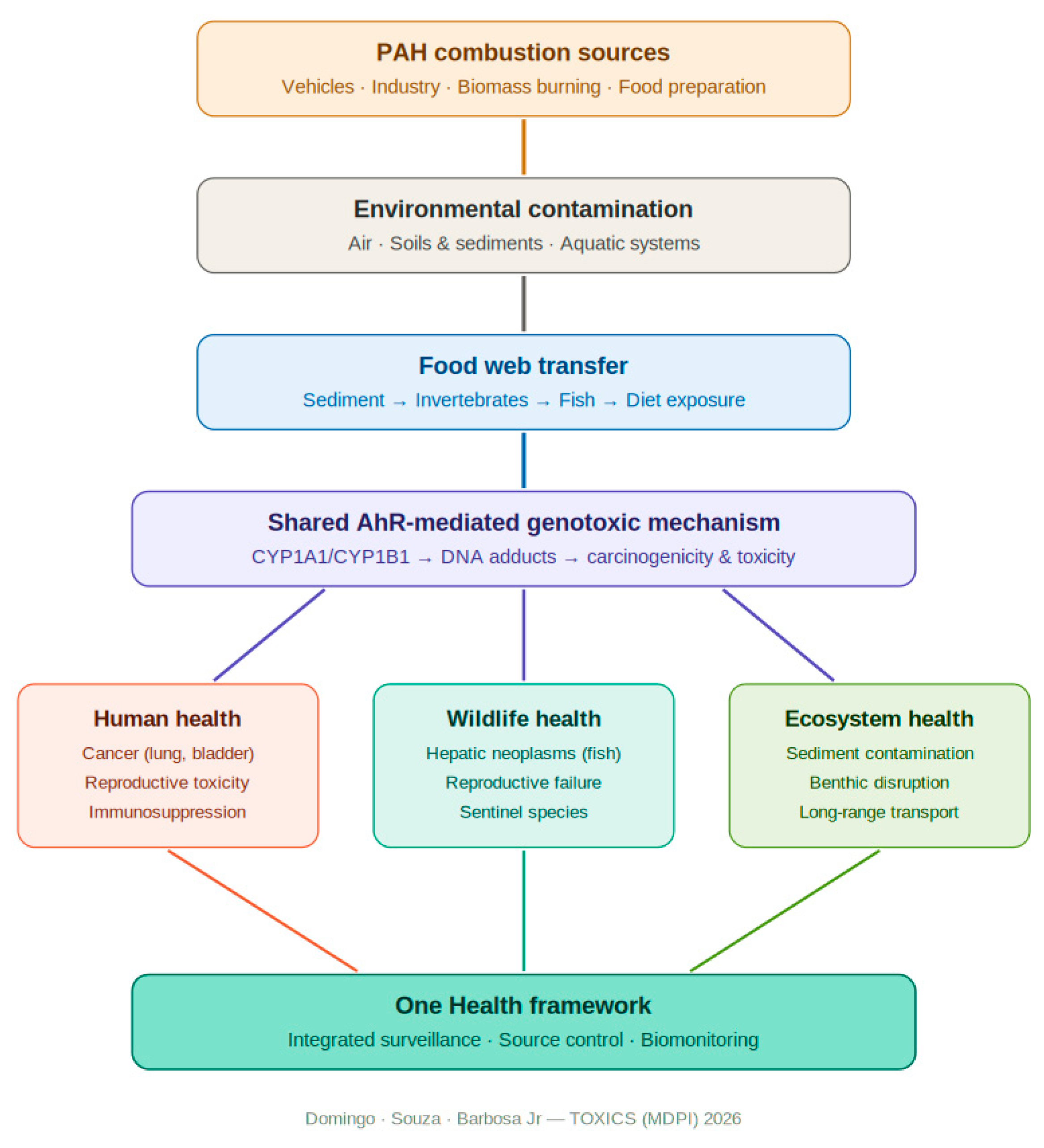
Polycyclic Aromatic Hydrocarbons Through the One Health Lens: Integrating Human, Animal, and Environmental Health Perspectives



Abstract
1. Introduction
1.1. Polycyclic Aromatic Hydrocarbons
1.2. The Case for a One Health Approach
1.3. Objectives
2. Methods
Search Strategy
3. Results
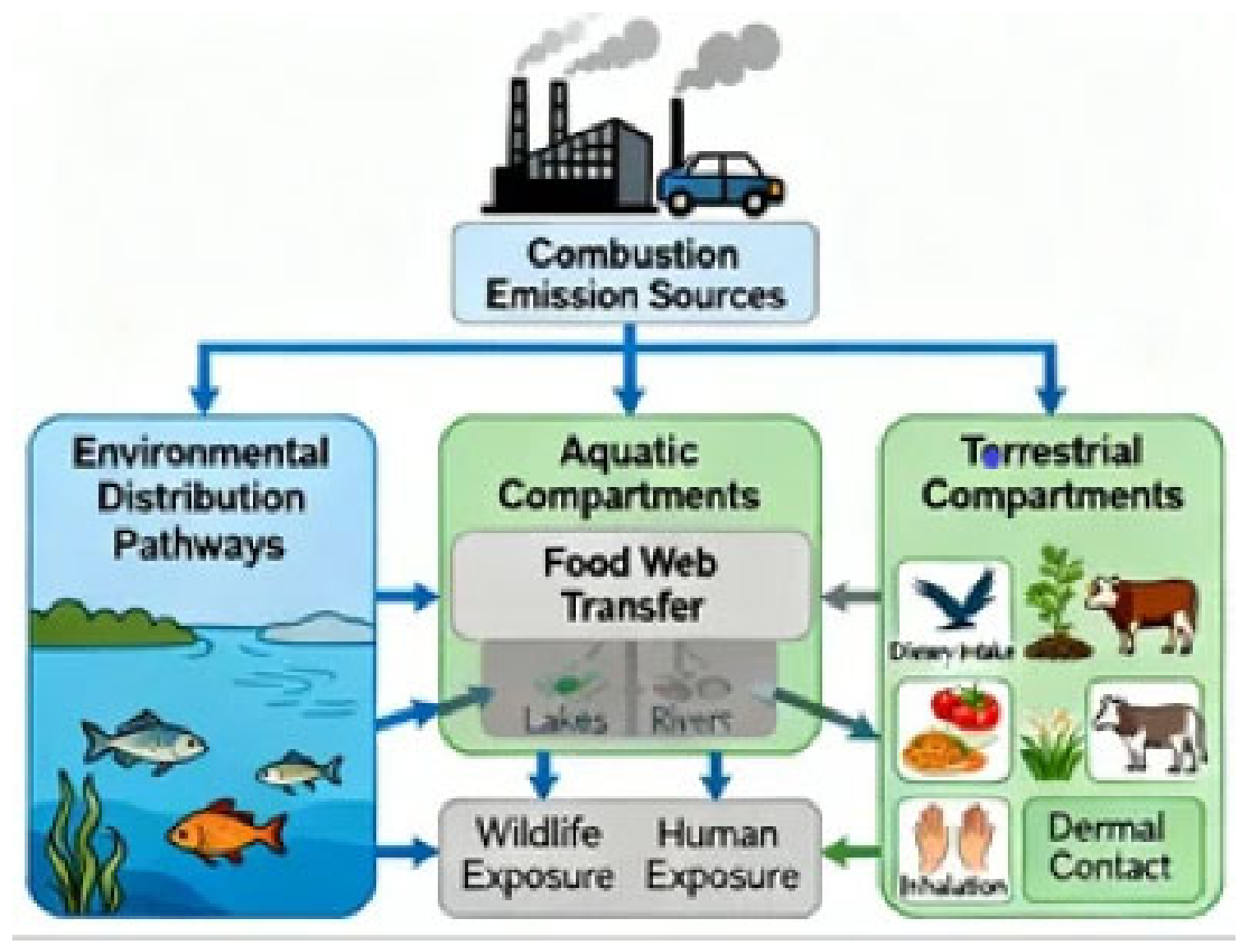
3.1. PAH Sources, Environmental Fate, and Shared Exposure Pathways
3.1.1. Combustion Sources and Environmental Release
3.1.2. Environmental Fate and Persistence
3.1.3. Food Web Transfer and Bioaccumulation
3.2. Human Health Impacts: Pathways and Effects
3.2.1. Exposure Pathways
3.2.2. Human Health Effects
3.2.3. Vulnerable Populations and Health Disparities
3.3. Wildlife Health Impacts: Sentinels and Shared Vulnerabilities
3.3.1. Exposure Pathways and Bioaccumulation in Aquatic Species
3.3.2. Wildlife Health Effects
3.3.3. Wildlife as Sentinels for Human Health
4. Discussion
4.1. One Health Integration: Connecting the Three Domains
4.2. Knowledge Gaps and Research Needs
4.3. Policy Implications and Intervention Strategies
5. Conclusions
Author Contributions
Funding
Institutional Review Board Statement
Informed Consent Statement
Data Availability Statement
Acknowledgments
Conflicts of Interest
References
- Altarawneh, M.; Ali, L. Formation of polycyclic aromatic hydrocarbons (PAHs) in thermal systems: A comprehensive mechanistic review. Energy Fuels 2024, 38, 21735–21792. [Google Scholar] [CrossRef]
- Kim, K.H.; Jahan, S.A.; Kabir, E.; Brown, R.J.C. A review of airborne polycyclic aromatic hydrocarbons (PAHs) and their human health effects. Environ. Int. 2013, 60, 71–80. [Google Scholar] [CrossRef] [PubMed]
- Sekar, M.; Praveenkumar, T.R. Critical review on the formations and exposure of polycyclic aromatic hydrocarbons (PAHs) in the conventional hydrocarbon-based fuels: Prevention and control strategies. Chemosphere 2024, 350, 141005. [Google Scholar] [CrossRef]
- Abdel-Shafy, H.I.; Mansour, M.S.M. A review on polycyclic aromatic hydrocarbons: Source, environmental impact, effect on human health and remediation. Egypt. J. Pet. 2016, 25, 107–123. [Google Scholar] [CrossRef]
- Wilson, L.B.; Moran, I.L.; Anderson, K.A.; Tanguay, R.L. Advances in PAH mixture toxicology enabled by zebrafish. Curr. Opin. Toxicol. 2023, 34, 100392. [Google Scholar] [CrossRef] [PubMed]
- IARC (International Agency for Research on Cancer). Some Non-Heterocyclic Polycyclic Aromatic Hydrocarbons and Some Related Exposures. In IARC Monographs on the Evaluation of Carcinogenic Risks to Humans; IARC: Lyon, France, 2010; Volume 92, pp. 1–853. [Google Scholar]
- EFSA Panel on Contaminants in the Food Chain (CONTAM). Polycyclic aromatic hydrocarbons in food. Scientific opinion of the Panel on Contaminants in the Food Chain. EFSA J. 2008, 6, 724. [Google Scholar] [CrossRef]
- Feng, Y.; Li, Z.; Li, W. Polycyclic aromatic hydrocarbons (PAHs): Environmental persistence and human health risks. Nat. Prod. Commun. 2025, 20, 1934578X241311451. [Google Scholar] [CrossRef]
- Ravindra, K.; Wauters, E.; Van Grieken, R. Variation in particulate PAHs levels and their relation with the transboundary movement of the air masses. Sci. Total Environ. 2008, 396, 100–110. [Google Scholar] [CrossRef] [PubMed]
- Jesus, F.; Pereira, J.L.; Campos, I.; Santos, M.; Ré, A.; Keizer, J.; Nogueira, A.; Gonçalves, F.J.M.; Abrantes, N.; Serpa, D. A review on polycyclic aromatic hydrocarbons distribution in freshwater ecosystems and their toxicity to benthic fauna. Sci. Total Environ. 2022, 820, 153282. [Google Scholar] [CrossRef]
- Samburova, V.; Connolly, J.; Gyawali, M.; Yatavelli, R.L.N.; Watts, A.C.; Chakrabarty, R.K.; Zielinska, B.; Moosmüller, H.; Khlystov, A. Polycyclic aromatic hydrocarbons in biomass-burning emissions and their contribution to light absorption and aerosol toxicity. Sci. Total Environ. 2017, 607–608, 391–401. [Google Scholar] [CrossRef]
- Lhotka, R.; Pokorná, P.; Zíková, N. Long-Term Trends in PAH Concentrations and Sources at Rural Background Site in Central Europe. Atmosphere 2019, 10, 687. [Google Scholar] [CrossRef]
- Fernández, P.; Grimalt, J.O.; Vilanova, R.M. Atmospheric gas–particle partitioning of polycyclic aromatic hydrocarbons in high mountain regions of Europe. Environ. Sci. Technol. 2002, 36, 1162–1168. [Google Scholar] [CrossRef]
- Ukalska-Jaruga, A.; Smreczak, B. The impact of organic matter on polycyclic aromatic hydrocarbon (PAH) availability and persistence in soils. Molecules 2020, 25, 2470. [Google Scholar] [CrossRef]
- Patel, A.B.; Shaikh, S.; Jain, K.R.; Desai, C.; Madamwar, D. Polycyclic aromatic hydrocarbons: Sources, toxicity, and remediation approaches. Front. Microbiol. 2020, 11, 562813. [Google Scholar] [CrossRef]
- Penning, T.M. Human aldo-keto reductases and the metabolic activation of polycyclic aromatic hydrocarbons. Chem. Res. Toxicol. 2014, 27, 1901–1917. [Google Scholar] [CrossRef]
- Shimada, T. Xenobiotic-metabolizing enzymes involved in activation and detoxification of carcinogenic polycyclic aromatic hydrocarbons. Drug Metab. Pharmacokinet. 2006, 21, 257–276. [Google Scholar] [CrossRef] [PubMed]
- Alexandrov, K.; Rojas, M.; Satarug, S. The critical DNA damage by benzo(a)pyrene in the lungs of smokers and approaches to preventing its formation. Toxicol. Lett. 2010, 198, 63–68. [Google Scholar] [CrossRef] [PubMed]
- Pfeifer, G.P.; Denissenko, M.F.; Olivier, M.; Tretyakova, N.; Hecht, S.S.; Hainaut, P. Tobacco smoke carcinogens, DNA damage and p53 mutations in smoking-associated cancers. Oncogene 2002, 21, 7435–7451. [Google Scholar] [CrossRef]
- Rechkoblit, O.; Kolbanovskiy, A.; Landes, H.; Geacintov, N.E.; Aggarwal, A.K. Mechanism of error-free replication across benzo[a]pyrene stereoisomers by Rev1 DNA polymerase. Nat. Commun. 2017, 8, 965. [Google Scholar] [CrossRef]
- Honda, M.; Suzuki, N. Toxicities of polycyclic aromatic hydrocarbons for aquatic animals. Int. J. Environ. Res. Public Health 2020, 17, 1363. [Google Scholar] [CrossRef] [PubMed]
- CDC (Centers for Disease Control and Prevention). About One Health. 2024. Available online: https://www.cdc.gov/onehealth/index.html (accessed on 28 February 2026).
- Zinsstag, J.; Schelling, E.; Waltner-Toews, D.; Tanner, M. From “one medicine” to “one health” and systemic approaches to health and well-being. Prev. Vet. Med. 2011, 101, 148–156. [Google Scholar] [CrossRef] [PubMed]
- Destoumieux-Garzón, D.; Mavingui, P.; Boetsch, G.; Boissier, J.; Darriet, F.; Duboz, P.; Fritsch, C.; Giraudoux, P.; Le Roux, F.; Morand, S.; et al. The One Health concept: 10 years old and a long road ahead. Front. Vet. Sci. 2018, 5, 14. [Google Scholar] [CrossRef]
- Lerner, H.; Berg, C. A comparison of three holistic approaches to health: One Health, EcoHealth, and Planetary Health. Front. Vet. Sci. 2017, 4, 163. [Google Scholar] [CrossRef]
- Wang, F.; Xiang, L.; Sze-Yin Leung, K.; Elsner, M.; Zhang, Y.; Guo, Y.; Pan, B.; Sun, H.; An, T.; Ying, G.; et al. Emerging Contaminants: A One Health Perspective. Innovation 2024, 5, 100612. [Google Scholar] [CrossRef]
- Coumoul, X.; Barouki, R.; Esser, C.; Haarmann-Stemmann, T.; Lawrence, B.P.; Lehmann, J.; Moura-Alves, P.; Murray, I.A.; Opitz, C.A.; Perdew, G.H.; et al. The aryl hydrocarbon receptor: Structure, signaling, physiology and pathology. Signal Transduct. Target. Ther. 2026, 11, 20. [Google Scholar] [CrossRef]
- Hahn, M.E. Aryl hydrocarbon receptors: Diversity and evolution. Chem. Biol. Interact. 2002, 141, 131–160. [Google Scholar] [CrossRef]
- Nguyen, L.P.; Bradfield, C.A. The search for endogenous activators of the aryl hydrocarbon receptor. Chem. Res. Toxicol. 2008, 21, 102–116. [Google Scholar] [CrossRef]
- Domingo, J.L.; Souza, M.C.O.; Nadal, M.; Barbosa, F. A One Health approach to polybrominated diphenyl ethers (PBDEs): Integrating human, animal, and environmental health perspectives. Chemosphere 2025, 386, 144644. [Google Scholar] [CrossRef] [PubMed]
- Domingo, J.L. Polychlorinated naphthalenes through the One Health lens: Unmasking a global threat to humans, wildlife, and ecosystems. Environ. Pollut. 2026, 392, 127678. [Google Scholar] [CrossRef] [PubMed]
- Souza, M.C.O.; Domingo, J.L. Dioxins and the One Health paradigm: An interdisciplinary challenge in environmental toxicology. Toxics 2025, 13, 964. [Google Scholar] [CrossRef]
- Stogiannidis, E.; Laane, R. Source characterization of polycyclic aromatic hydrocarbons by using their molecular indices: An overview of possibilities. Rev. Environ. Contam. Toxicol. 2015, 234, 49–133. [Google Scholar] [CrossRef]
- Boström, C.E.; Gerde, P.; Hanberg, A.; Jernström, B.; Johansson, C.; Kyrklund, T.; Rannug, A.; Törnqvist, M.; Victorin, K.; Westerholm, R. Cancer risk assessment, indicators, and guidelines for polycyclic aromatic hydrocarbons in the ambient air. Environ. Health Perspect. 2002, 110, 451–488. [Google Scholar] [CrossRef]
- Rajput, P.; Sarin, M.M.; Sharma, D.; Singh, S. Atmospheric polycyclic aromatic hydrocarbons and isomer ratios as tracers of biomass burning emissions in Northern India. Environ. Sci. Pollut. Res. Int. 2014, 21, 5724–5729. [Google Scholar] [CrossRef]
- Lovrić, M.; Račić, N.; Pehnec, G.; Horvat, T.; Lovrić Štefiček, M.J.; Jakovljević, I. Indoor polycyclic aromatic hydrocarbons—Relationship to ambient air, risk estimation, and source apportionment based on household measurements. Atmosphere 2024, 15, 1525. [Google Scholar] [CrossRef]
- Farhadian, A.; Jinap, S.; Abas, F.; Sakar, Z.I. Determination of polycyclic aromatic hydrocarbons in grilled meat. Food Control 2010, 21, 606–610. [Google Scholar] [CrossRef]
- Savietto, G.H.; Lima, A.A.V.; da Silva, A.B.C.; Martins, I.; Rocha, B.A.; Kim, U.J.; Karthikraj, R.; Domingo, J.L.; Barbosa, F., Jr.; Souza, M.C.O. Polycyclic aromatic hydrocarbons in Brazilian food: A critical review of levels, human health risk assessment, and potential gaps in the recent literature. Food Addit. Contam. Part A 2025, 42, 1297–1320. [Google Scholar] [CrossRef]
- Alves, C.A.; Vicente, A.M.; Custódio, D.; Cerqueira, M.; Nunes, T.; Pio, C.; Lucarelli, F.; Calzolai, G.; Nava, S.; Diapouli, E.; et al. Polycyclic aromatic hydrocarbons and their derivatives (nitro-PAHs, oxygenated PAHs, and azaarenes) in PM2.5 from Southern European cities. Sci. Total Environ. 2017, 595, 494–504. [Google Scholar] [CrossRef]
- Silva, R.A.; Lima, A.A.V.; Caixeta, R.S.; Savietto, G.H.; Barbosa Junior, F.; Souza, M.C.O.; Paiva, M.J.N.; Martins, I. Association between oxidative DNA damage and PAH exposure in Brazilian wildland firefighters. Environ. Pollut. 2026, 390, 127527. [Google Scholar] [CrossRef] [PubMed]
- Montano, L.; Baldini, G.M.; Piscopo, M.; Liguori, G.; Lombardi, R.; Ricciardi, M.; Esposito, G.; Pinto, G.; Fontanarosa, C.; Spinelli, M.; et al. Polycyclic Aromatic Hydrocarbons (PAHs) in the Environment: Occupational Exposure, Health Risks and Fertility Implications. Toxics 2025, 13, 151. [Google Scholar] [CrossRef]
- Barbosa, F., Jr.; Rocha, B.A.; Souza, M.C.O.; Bocato, M.Z.; Azevedo, L.F.; Adeyemi, J.A.; Santana, A.; Campiglia, A.D. Polycyclic aromatic hydrocarbons (PAHs): Updated aspects of their determination, kinetics in the human body, and toxicity. J. Toxicol. Environ. Health Part B 2023, 26, 28–65. [Google Scholar] [CrossRef] [PubMed]
- Chen, T.; Ma, Y. Enhanced anaerobic biodegradation of PAHs by rhamnolipid and earthworm casts in contaminated soil. Sustainability 2025, 17, 5417. [Google Scholar] [CrossRef]
- Masoner, J.R.; Kolpin, D.W.; Cozzarelli, I.M.; Barber, L.B.; Burden, D.S.; Foreman, W.T.; Forshay, K.J.; Furlong, E.T.; Groves, J.F.; Hladik, M.L.; et al. Urban stormwater: An overlooked pathway of extensive mixed contaminants to surface and groundwaters in the United States. Environ. Sci. Technol. 2019, 53, 10070–10081. [Google Scholar] [CrossRef] [PubMed]
- Chen, A.; Wu, X.; Simonich, S.L.M.; Kang, H.; Xie, Z. Volatilization of polycyclic aromatic hydrocarbons (PAHs) over the North Pacific and adjacent Arctic Ocean: The impact of offshore oil drilling. Environ. Pollut. 2021, 268, 115963. [Google Scholar] [CrossRef]
- Ghosal, D.; Ghosh, S.; Dutta, T.K.; Ahn, Y. Current state of knowledge in microbial degradation of polycyclic aromatic hydrocarbons (PAHs): A review. Front. Microbiol. 2016, 7, 1369. [Google Scholar] [CrossRef]
- Haritash, A.K.; Kaushik, C.P. Biodegradation aspects of polycyclic aromatic hydrocarbons (PAHs): A review. J. Hazard. Mater. 2009, 169, 1–15. [Google Scholar] [CrossRef]
- Zhou, H.; Gao, X.; Wang, S.; Zhang, Y.; Coulon, F.; Cai, C. Enhanced bioremediation of aged polycyclic aromatic hydrocarbons in soil using immobilized microbial consortia combined with strengthening remediation strategies. Int. J. Environ. Res. Public Health 2023, 20, 1766. [Google Scholar] [CrossRef] [PubMed]
- Simarro, R.; González, N.; Bautista, L.F.; Molina, M.C. Biodegradation of high-molecular-weight polycyclic aromatic hydrocarbons by a wood-degrading consortium at low temperatures. FEMS Microbiol. Ecol. 2013, 83, 438–449. [Google Scholar] [CrossRef]
- Ravindra, K.; Sokhi, R.; Van Grieken, R. Atmospheric polycyclic aromatic hydrocarbons: Source attribution, emission factors and regulation. Atmos. Environ. 2008, 42, 2895–2921. [Google Scholar] [CrossRef]
- Hylland, K. Polycyclic aromatic hydrocarbon (PAH) ecotoxicology in marine ecosystems. J. Toxicol. Environ. Health Part A 2006, 69, 109–123. [Google Scholar] [CrossRef]
- Takeuchi, I.; Miyoshi, N.; Mizukawa, K.; Takada, H.; Ikemoto, T.; Omori, K.; Tsuchiya, K. Biomagnification profiles of polycyclic aromatic hydrocarbons, alkylphenols and polychlorinated biphenyls in Tokyo Bay elucidated by delta13C and delta15N isotope ratios as guides to trophic web structure. Mar. Pollut. Bull. 2009, 58, 663–671. [Google Scholar] [CrossRef]
- Cheng, J.O.; Chu, C.H.; Chang, C.W.; Chen, T.H.; Hsieh, C.Y.; Ko, F.C. Bioaccumulation and Trophic Transfer of Polycyclic Aromatic Hydrocarbons (PAHs) in the Planktonic Base of the Aquatic Food Web. Arch. Environ. Contam. Toxicol. 2025, 89, 528–537. [Google Scholar] [CrossRef]
- Liu, B.; Gao, L.; Ding, L.; Lv, L.; Yu, Y. Trophodynamics and bioaccumulation of polycyclic aromatic hydrocarbons (PAHs) in marine food web from Laizhou Bay, China. Mar. Pollut. Bull. 2023, 194, 115307. [Google Scholar] [CrossRef]
- Monteiro, V.; Dias da Silva, D.; Martins, M.; Guedes de Pinho, P.; Pinto, J. Metabolomics perspectives of the ecotoxicological risks of polycyclic aromatic hydrocarbons: A scoping review. Environ. Res. 2024, 249, 118394. [Google Scholar] [CrossRef] [PubMed]
- Zhang, F.; Fu, H.; Zhang, D.; Lou, H.; Sun, X.; Sun, P.; Wang, X.; Bao, M. Co-pollution risk of petroleum hydrocarbons and heavy metals in typically polluted estuarine wetlands: Insights from the Xiaoqing River. Sci. Total Environ. 2024, 948, 174694. [Google Scholar] [CrossRef]
- Meador, J.P. Bioaccumulation of PAHs in marine invertebrates. In PAHs: An Ecotoxicological Perspective; Douben, P.E.T., Ed.; John Wiley & Sons: Chichester, UK, 2003; pp. 147–171. [Google Scholar] [CrossRef]
- Pozzan, R.; de Almeida Roque, A.; Iwamoto, H.; de Campos Guerreiro, F.; da Silva, A.P.; Rubio-Vargas, D.A.; de Marchi, M.; de Oliveira, F.; Martínez-Burgos, W.J.; Prodocimo, M.M.; et al. Polycyclic aromatic hydrocarbons in marine environments affect fish reproduction—A critical review. Toxics 2025, 13, 747. [Google Scholar] [CrossRef]
- Pampanin, D.M.; Brooks, S.J.; Grøsvik, B.E.; Le Goff, J.; Meier, S.; Sydnes, M.O. DNA adducts in marine fish as biological marker of genotoxicity in environmental monitoring: The way forward. Mar. Environ. Res. 2017, 125, 49–62. [Google Scholar] [CrossRef] [PubMed]
- Stehr, C.M.; Myers, M.S.; Johnson, L.L.; Spencer, S.; Stein, J.E. Toxicopathic liver lesions in English sole and chemical contaminant exposure in Vancouver, B.C., Canada and Puget Sound, WA, USA: A comparison. Mar. Environ. Res. 2004, 57, 55–74. [Google Scholar] [CrossRef]
- Helm, R.C.; Costa, D.P.; DeBruyn, T.D.; O’Shea, T.J.; Wells, R.S.; Williams, T.M. Overview of effects of oil spills on marine mammals. In Handbook of Oil Spill Science and Technology; Fingas, M., Ed.; John Wiley & Sons: Hoboken, NJ, USA, 2014; pp. 455–475. [Google Scholar] [CrossRef]
- Martineau, D.; Lemberger, K.; Dallaire, A.; Labelle, P.; Lipscomb, T.P.; Michel, P.; Mikaelian, I. Cancer in wildlife, a case study: Beluga whales from the St. Lawrence estuary, Québec, Canada. Environ. Health Perspect. 2002, 110, 285–292. [Google Scholar] [CrossRef] [PubMed]
- Barron, M.G. Ecological impacts of the Deepwater Horizon oil spill: Implications for immunotoxicity. Toxicol. Pathol. 2012, 40, 315–320. [Google Scholar] [CrossRef]
- Incardona, J.P.; Gardner, L.D.; Linbo, T.L.; Brown, T.L.; Esbaugh, A.J.; Mager, E.M.; Stieglitz, J.D.; French, B.L.; Labenia, J.S.; Laetz, C.A.; et al. Deepwater Horizon crude oil impacts the developing hearts of large predatory pelagic fish. Proc. Natl. Acad. Sci. USA 2014, 111, E1510–E1518. [Google Scholar] [CrossRef]
- Peterson, C.H.; Rice, S.D.; Short, J.W.; Esler, D.; Bodkin, J.L.; Ballachey, B.E.; Irons, D.B. Long-term ecosystem response to the Exxon Valdez oil spill. Science 2003, 302, 2082–2086. [Google Scholar] [CrossRef]
- Domingo, J.L.; Nadal, M. Human dietary exposure to polycyclic aromatic hydrocarbons: A review of the scientific literature. Food Chem. Toxicol. 2015, 86, 144–153. [Google Scholar] [CrossRef]
- Souza, M.C.O.; Rocha, B.A.; Adeyemi, J.A.; Nadal, M.; Domingo, J.L.; Barbosa, F., Jr. Legacy and emerging pollutants in Latin America: A critical review of occurrence and levels in environmental and food samples. Sci. Total Environ. 2022, 848, 157774. [Google Scholar] [CrossRef]
- Okoye, E.A.; Bocca, B.; Ruggieri, F.; Ezejiofor, A.N.; Nwaogazie, I.L.; Domingo, J.L.; Rovira, J.; Frazzoli, C.; Orisakwe, O.E. Concentrations of polycyclic aromatic hydrocarbons in samples of soil, feed and food collected in the Niger Delta region, Nigeria: A probabilistic human health risk assessment. Environ. Res. 2021, 202, 111619. [Google Scholar] [CrossRef] [PubMed]
- Souza, M.C.O.; Rocha, B.A.; Cruz, J.C.; Palir, N.; Campiglia, A.D.; Domingo, J.L.; Barbosa, F. Risk characterization of human exposure to polycyclic aromatic hydrocarbons in vulnerable groups. Sci. Total Environ. 2023, 892, 164219. [Google Scholar] [CrossRef] [PubMed]
- Lee, S.J.; Lee, H.Y.; Kim, S.J.; Kim, S.H.; Noh, S.; Choi, S.D. Pollution characteristics and cancer risk of PAHs in a petrochemical industrial city: Insights from passive air sampling and three-dimensional dispersion modeling. J. Hazard. Mater. 2025, 500, 140423. [Google Scholar] [CrossRef]
- Burstyn, I.; Kromhout, H.; Partanen, T.; Svane, O.; Langård, S.; Ahrens, W.; Kauppinen, T.; Stücker, I.; Shaham, J.; Heederik, D.; et al. Polycyclic aromatic hydrocarbons and fatal ischemic heart disease. Epidemiology 2005, 16, 744–750. [Google Scholar] [CrossRef] [PubMed]
- Hwang, J.; Xu, C.; Agnew, R.J.; Clifton, S.; Malone, T.R. Health risks of structural firefighters from exposure to polycyclic aromatic hydrocarbons: A systematic review and meta-analysis. Int. J. Environ. Res. Public Health 2021, 18, 4209. [Google Scholar] [CrossRef] [PubMed]
- Stec, A.A.; Dickens, K.E.; Salden, M.; Hewitt, F.E.; Watts, D.P.; Houldsworth, P.E.; Martin, F.L. Occupational exposure to polycyclic aromatic hydrocarbons and elevated cancer incidence in firefighters. Sci. Rep. 2018, 8, 2476. [Google Scholar] [CrossRef]
- Wang, Y.; Geng, S.; Wang, W.; Yuan, L.; Nie, J.; Zhang, H.; Pan, B.; Niu, Q. Occupational polycyclic aromatic hydrocarbons (PAHs) exposure is associated with accelerated aging trajectories in Chinese coke oven workers. Sci. Rep. 2026, 16, 6852. [Google Scholar] [CrossRef]
- Jongeneelen, F.J. Benchmark guideline for urinary 1-hydroxypyrene as biomarker of occupational exposure to polycyclic aromatic hydrocarbons. Ann. Occup. Hyg. 2001, 45, 3–13. [Google Scholar] [CrossRef]
- Luo, K.; Zeng, D.; Kang, Y.; Lin, X.; Sun, N.; Li, C.; Zhu, M.; Chen, Z.; Man, Y.B.; Li, H. Dermal bioaccessibility and absorption of polycyclic aromatic hydrocarbons (PAHs) in indoor dust and its implication in risk assessment. Environ. Pollut. 2020, 264, 114829. [Google Scholar] [CrossRef]
- Ruby, M.V.; Lowney, Y.W.; Bunge, A.L.; Roberts, S.M.; Gomez-Eyles, J.L.; Ghosh, U.; Kissel, J.C.; Tomlinson, P.; Menzie, C. Oral bioavailability, bioaccessibility, and dermal absorption of PAHs from soil—State of the science. Environ. Sci. Technol. 2016, 50, 2151–2164. [Google Scholar] [CrossRef]
- Serreau, R.; Terbeche, Y.; Rigourd, V. Pollutants in breast milk: A scoping review of the most recent data in 2024. Healthcare 2024, 12, 680. [Google Scholar] [CrossRef]
- Cesila, C.A.; Souza, M.C.O.; Cruz, J.C.; Bocato, M.Z.; Campiglia, A.D.; Barbosa, F. Biomonitoring of polycyclic aromatic hydrocarbons in Brazilian pregnant women: Urinary levels and health risk assessment. Environ. Res. 2023, 235, 116571. [Google Scholar] [CrossRef] [PubMed]
- Souza, M.C.O.; Cruz, J.C.; Rocha, B.A.; Souza, J.M.O.; Devóz, P.P.; Santana, A.; Campiglia, A.D.; Barbosa, F. The influence of the co-exposure to polycyclic aromatic hydrocarbons and toxic metals on DNA damage in Brazilian lactating women and their infants: A cross-sectional study using machine learning approaches. Chemosphere 2023, 334, 138975. [Google Scholar] [CrossRef]
- Perera, F.P.; Li, Z.; Whyatt, R.; Hoepner, L.; Wang, S.; Camann, D.; Rauh, V. Prenatal airborne polycyclic aromatic hydrocarbon exposure and child IQ at age 5 years. Pediatrics 2009, 124, e195–e202. [Google Scholar] [CrossRef] [PubMed]
- Tang, D.; Li, T.Y.; Liu, J.J.; Zhou, Z.J.; Yuan, T.; Chen, Y.H.; Rauh, V.A.; Xie, J.; Perera, F. Effects of prenatal exposure to coal-burning pollutants on children’s development in China. Environ. Health Perspect. 2008, 116, 674–679. [Google Scholar] [CrossRef]
- Yuan, H.; Wang, Y.; Duan, H. Risk of lung cancer and occupational exposure to polycyclic aromatic hydrocarbons among workers cohorts—Worldwide, 1969–2022. China CDC Wkly. 2022, 4, 364–369. [Google Scholar] [CrossRef]
- Hussain, S.P.; Amstad, P.; Raja, K.; Sawyer, M.; Hofseth, L.; Shields, P.G.; Harris, C.C. Mutability of p53 hotspot codons to benzo(a)pyrene diol epoxide (BPDE) and the frequency of p53 mutations in nontumorous human lung. Cancer Res. 2001, 61, 6350–6355. [Google Scholar] [PubMed]
- Sopian, N.A.; Jalaludin, J.; Abu Bakar, S.; Hamedon, T.R.; Latif, M.T. Exposure to particulate PAHs on potential genotoxicity and cancer risk among school children living near the petrochemical industry. Int. J. Environ. Res. Public Health 2021, 18, 2575. [Google Scholar] [CrossRef]
- Ferreira-Azevedo, L.; de Souza Rocha, C.C.; Souza, M.C.O.; Machado, A.R.T.; Devóz, P.P.; Rocha, B.A.; Antunes, L.M.G.; Uribe-Romo, F.J.; Campiglia, A.D.; Barbosa, F., Jr. High molecular weight polycyclic aromatic hydrocarbon (HMW-PAH) isomers: Unveiling distinct toxic effects from cytotoxicity to oxidative stress-induced DNA damage. Arch. Toxicol. 2025, 99, 679–687. [Google Scholar] [CrossRef]
- Rota, M.; Bosetti, C.; Boccia, S.; Boffetta, P.; La Vecchia, C. Occupational exposures to polycyclic aromatic hydrocarbons and respiratory and urinary tract cancers: An updated systematic review and a meta-analysis to 2014. Arch. Toxicol. 2014, 88, 1479–1490. [Google Scholar] [CrossRef]
- Rafiee, A.; Hoseini, M.; Akbari, S.; Mahabee-Gittens, E.M. Exposure to polycyclic aromatic hydrocarbons and adverse reproductive outcomes in women: Current status and future perspectives. Rev. Environ. Health 2023, 39, 305–311. [Google Scholar] [CrossRef]
- Burchiel, S.W. Polycyclic Aromatic Hydrocarbons (PAHs) and the immune system. In Encyclopedic Reference of Immunotoxicology; Vohr, H.W., Ed.; Springer: Berlin/Heidelberg, Germany, 2005. [Google Scholar] [CrossRef]
- Mallah, M.A.; Mallah, M.A.; Liu, Y.; Xi, H.; Wang, W.; Feng, F.; Zhang, Q. Relationship Between Polycyclic Aromatic Hydrocarbons and Cardiovascular Diseases: A Systematic Review. Front. Public Health 2021, 9, 763706. [Google Scholar] [CrossRef]
- Sansom, G.T.; Kirsch, K.R.; Stone, K.W.; McDonald, T.J.; Horney, J.A. Domestic exposures to polycyclic aromatic hydrocarbons in a Houston, Texas, environmental justice neighborhood. Environ. Justice 2018, 11, 183–191. [Google Scholar] [CrossRef]
- Van Horne, Y.O.; Alcala, C.S.; Peltier, R.E.; Quintana, P.J.E.; Seto, E.; Gonzales, M.; Johnston, J.E.; Montoya, L.D.; Quirós-Alcalá, L.; Beamer, P.I. An applied environmental justice framework for exposure science. J. Expo. Sci. Environ. Epidemiol. 2023, 33, 1–11. [Google Scholar] [CrossRef] [PubMed]
- de Paula Nunes, E.; Abou Dehn Pestana, B.; Pereira, B.B. Human biomonitoring and environmental health: A critical review of global exposure patterns, methodological challenges and research gaps. J. Toxicol. Environ. Health Part B 2026, 29, 109–127. [Google Scholar] [CrossRef] [PubMed]
- Berríos-Rolón, P.J.; Cotto, M.C.; Márquez, F. Polycyclic Aromatic Hydrocarbons (PAHs) in Freshwater Systems: A Comprehensive Review of Sources, Distribution, and Ecotoxicological Impacts. Toxics 2025, 13, 321. [Google Scholar] [CrossRef]
- Diop, E.H.M.; Ndiaye, B.; Sow, A.; Sambe, F.M.; Sall, M.; Thiam, M.S. Polycyclic aromatic hydrocarbon (PAH) contents of four species of smoked fish from different sites in Senegal. Int. J. Anal. Chem. 2023, 2023, 2931615. [Google Scholar] [CrossRef] [PubMed]
- González, N.; Souza, M.C.O.; Cezarette, G.N.; Rocha, B.A.; Devoz, P.P.; Dos Santos, L.C.; Barcelos, G.R.M.; Nadal, M.; Domingo, J.L.; Barbosa, F., Jr. Evaluation of exposure to multiple organic pollutants in riparian communities of the Brazilian Amazon: Screening levels and potential health risks. Sci. Total Environ. 2024, 908, 168294. [Google Scholar] [CrossRef]
- Oliveira, M.; Slezakova, K.; Delerue-Matos, C.; Pereira, M.C.; Morais, S. Children environmental exposure to particulate matter and polycyclic aromatic hydrocarbons and biomonitoring in school environments: A review on indoor and outdoor exposure levels, major sources and health impacts. Environ. Int. 2019, 124, 180–204. [Google Scholar] [CrossRef]
- Peter, M.; Němcová, B.; Twietmeyer, S.; Schumacher, N.; Klamm, A.; Luckas, V.; Henrich, M.; Puffpaff, S.; Rönitz, T.; Schneider, A.; et al. Deer as sentinels of emerging environmental pollution: Assessing contamination patterns and seasonal variations. Sci. Total Environ. 2026, 1015, 181415. [Google Scholar] [CrossRef]
- Teixeira, J.; Delerue-Matos, C.; Morais, S.; Oliveira, M. Environmental contamination with polycyclic aromatic hydrocarbons and contribution from biomonitoring studies to the surveillance of global health. Environ. Sci. Pollut. Res. Int. 2024, 31, 54339–54362. [Google Scholar] [CrossRef]
- Gan, N.; Martin, L.; Xu, W. Impact of polycyclic aromatic hydrocarbon accumulation on oyster health. Front. Physiol. 2021, 12, 734463. [Google Scholar] [CrossRef]
- Sundt, R.C.; Pampanin, D.M.; Grung, M.; Baršienė, J.; Ruus, A. PAH body burden and biomarker responses in mussels (Mytilus edulis) exposed to produced water from a North Sea oil field: Laboratory and field assessments. Mar. Pollut. Bull. 2011, 62, 1498–1505. [Google Scholar] [CrossRef] [PubMed]
- Meier, S.; Karlsen, O.; Le Goff, J.; Sørensen, L.; Sørhus, E.; Pampanin, D.M.; Donald, C.E.; Fjelldal, P.G.; Dunaevskaya, E.; Romano, M.; et al. DNA damage and health effects in juvenile haddock (Melanogrammus aeglefinus) exposed to PAHs associated with oil-polluted sediment or produced water. PLoS ONE 2020, 15, e0240307. [Google Scholar] [CrossRef]
- Myers, M.S.; Stehr, C.M.; Olson, O.P.; Johnson, L.L.; McCain, B.B.; Chan, S.L.; Varanasi, U. Relationships between toxicopathic hepatic lesions and exposure to chemical contaminants in English sole (Pleuronectes vetulus), starry flounder (Platichthys stellatus), and white croaker (Genyonemus lineatus) from selected urban areas of the US West Coast. Environ. Health Perspect. 1994, 102, 200–215. [Google Scholar] [CrossRef] [PubMed]
- Drventić, I.; Glumac, M.; Carev, I.; Kroflič, A. Seasonality of Polyaromatic Hydrocarbons (PAHs) and Their Derivatives in PM2.5 from Ljubljana, Combustion Aerosol Source Apportionment, and Cytotoxicity of Selected Nitrated Polyaromatic Hydrocarbons (NPAHs). Toxics 2023, 11, 518. [Google Scholar] [CrossRef] [PubMed]
- Jakovljević, I.; Dvoršćak, M.; Jagić, K.; Klinčić, D. Polycyclic Aromatic Hydrocarbons in Indoor Dust in Croatia: Levels, Sources, and Human Health Risks. Int. J. Environ. Res. Public Health 2022, 19, 11848. [Google Scholar] [CrossRef]
- Erhart, C.; Nahrgang, J.; Odei, D.K.; Frantzen, M.; Sørensen, L.; Creese, M.E.; Puvanendran, V.; Hansen, O.J.; Hansen, B.H.; Meador, J.P.; et al. Maternal and paternal crude oil exposure differentially shapes early developmental transcriptomes and survival outcomes in Atlantic cod (Gadus morhua). Mar. Pollut. Bull. 2026, 226, 119374. [Google Scholar] [CrossRef]
- Reynaud, S.; Deschaux, P. The effects of polycyclic aromatic hydrocarbons on the immune system of fish: A review. Aquat. Toxicol. 2006, 77, 229–238. [Google Scholar] [CrossRef]
- Waszak, I.; Jonko-Sobus, K.; Ozarowska, A.; Zaniewicz, G. Estimation of native and alkylated polycyclic aromatic hydrocarbons (PAHs) in seabirds from the south coast of the Baltic Sea. Environ. Sci. Pollut. Res. Int. 2021, 28, 4366–4376. [Google Scholar] [CrossRef] [PubMed]
- Troisi, G.; Barton, S.; Bexton, S. Impacts of oil spills on seabirds: Unsustainable impacts of non-renewable energy. Int. J. Hydrogen Energy 2016, 41, 16549–16555. [Google Scholar] [CrossRef]
- Hur, S.; Kim, D.W.; Park, J.G.; Lee, H.R.; Kim, Y.J.; Lee, B.K.; Nam, D.H. Wintering loons in South Korea face an ongoing threat from polycyclic aromatic hydrocarbons: Shifting sources and potential DNA damage. Environ. Pollut. 2025, 367, 125659. [Google Scholar] [CrossRef]
- López-Berenguer, G.; Acosta-Dacal, A.; Luzardo, O.P.; Peñalver, J.; Martínez-López, E. Assessment of polycyclic aromatic hydrocarbons (PAHs) in Mediterranean top marine predators stranded in SE Spain. Chemosphere 2023, 336, 139306. [Google Scholar] [CrossRef]
- Fogaça, F.H.d.S.; Melo, P.T.d.S.; Massone, C.G.; Carreira, R.d.S.; Ramos, L.R.V.; Torres, J.P.M. Polycyclic aromatic hydrocarbons in seafood: Occurrence, trophic bioaccumulation, and human health risks. Fishes 2025, 10, 591. [Google Scholar] [CrossRef]
- Domingo, J.L. Mixture toxicity revisited: A translational review of experimental evidence from animal models to human health risk assessment. Toxicology 2026, 520, 154372. [Google Scholar] [CrossRef]
- Lynggaard, C.; Gogarten, J.F.; Jokelainen, P. Integrating environment into One Health approaches: Embracing the complexity. One Health 2025, 20, 101021. [Google Scholar] [CrossRef] [PubMed]
- Jehu-Appiah, D.; Obeng-Gyasi, E. Uncovering exposure patterns of metals, PFAS, phthalates, and PAHs and their combined effect on liver injury markers. J. Xenobiotics 2025, 15, 178. [Google Scholar] [CrossRef]
- Colvin, V.C.; Bramer, L.M.; Rivera, B.N.; Pennington, J.M.; Waters, K.M.; Tilton, S.C. Modeling PAH mixture interactions in a human in vitro organotypic respiratory model. Int. J. Mol. Sci. 2024, 25, 4326. [Google Scholar] [CrossRef]
- Friedman, C.L.; Zhang, Y.; Selin, N.E. Climate change and emissions impacts on atmospheric PAH transport to the Arctic. Environ. Sci. Technol. 2014, 48, 429–437. [Google Scholar] [CrossRef]
- Marquès, M.; Mari, M.; Audí-Miró, C.; Sierra, J.; Soler, A.; Nadal, M.; Domingo, J.L. Climate change impact on the PAH photodegradation in soils: Characterization and metabolites identification. Environ. Int. 2016, 89–90, 155–165. [Google Scholar] [CrossRef] [PubMed]
- Dutta, K.; Shityakov, S.; Zhu, W.; Khalifa, I. High-risk meat and fish cooking methods of polycyclic aromatic hydrocarbons formation and its avoidance strategies. Food Control 2022, 142, 109253. [Google Scholar] [CrossRef]
- Abhishek; Chakkaravarthi, S.; Agarwal, T. Fish consumption patterns and health risk assessment of polycyclic aromatic hydrocarbons and polychlorinated biphenyls in fried and grilled fish products and mitigation strategies. Toxicol. Rep. 2025, 14, 101953. [Google Scholar] [CrossRef] [PubMed]
- Domingo, J.L. Influence of cooking processes on the concentrations of toxic metals and various organic environmental pollutants in food: A review of the published literature. Crit. Rev. Food Sci. Nutr. 2011, 51, 29–37. [Google Scholar] [CrossRef]
- Colmo, C.; Tegelaar, M.; Ayres, P. Bioremediation of polycyclic aromatic hydrocarbons (PAHs) in aqueous environments: A review of biofiltration, biosorption, and biodegradation strategies using living fungal mycelium. Fermentation 2025, 11, 573. [Google Scholar] [CrossRef]


| Domain | Primary Sources | Exposure Pathways | Adverse Effects |
|---|---|---|---|
| Environmental | Fossil fuel combustion (vehicular exhaust, power generation); Biomass burning (wildfires, agricultural burning); Industrial processes (coking, aluminum smelting, petroleum refining); Oil spills and runoff; Residential heating (wood and coal burning) | Atmospheric deposition to soil, water, and vegetation; Stormwater and urban runoff; Sediment accumulation in aquatic environments; Long-range atmospheric transport | Persistent soil and sediment contamination; Ecosystem disruption and degradation; Alteration of microbial communities; Phytotoxicity in contaminated soils; Aquatic ecosystem impairment |
| Wildlife/Animal | Contaminated aquatic sediments; Atmospheric deposition on terrestrial habitats; Food web bioaccumulation in lower trophic species; Oil spills (marine and freshwater) | Dietary intake of contaminated prey; Direct contact with contaminated water/sediment; Dermal absorption (aquatic species); Maternal transfer (eggs, placenta, lactation); Inhalation near combustion sources | Immunosuppression; Genotoxicity and carcinogenesis; Reproductive and developmental toxicity; Endocrine disruption (AhR-mediated); Hepatotoxicity; Population decline in sensitive species |
| Human | Grilled, smoked, and charbroiled foods; Air pollution (urban and indoor combustion); Occupational exposures (coke ovens, firefighting, asphalt); Contaminated soil near industrial sites; Drinking water (near contaminated groundwater) | Dietary intake (primary route); Inhalation of ambient and indoor air; Dermal absorption; Occupational inhalation and dermal contact; Maternal-fetal transfer and breast milk | Lung cancer and other malignancies; Genotoxicity (DNA adducts via CYP1A1/1B1 activation); Immunotoxicity; Reproductive and developmental toxicity; Cardiovascular effects; Neurodevelopmental effects in children |
| Key Interconnections | Food webs create direct linkage: environmental contamination → benthic organisms → aquatic consumers → human dietary exposure; Shared AhR-mediated toxicity produces convergent carcinogenic and immunotoxic effects across species; Wildlife (especially fish and marine mammals) serve as sentinels of PAH contamination predating human health impacts; High-temperature combustion links air quality, wildlife inhalation exposure, and human respiratory risk simultaneously |
| Research Area | Critical Knowledge Gaps | One Health Implications and Priorities |
|---|---|---|
| Toxicology and Mixture Risk Assessment | Poor characterization of interactive effects; limitations of single-compound models; non-linear dose–response uncertainties. | Develop realistic mixture models; cross-species integration for risk characterization. |
| Long-term and Multigenerational Effects | Limited longitudinal data; unclear epigenetic mechanisms; insufficient developmental data. | Establish long-term cohorts; clarify lifetime risks. |
| Trophodynamics and Bioaccumulation | Contradictory trophic transfer findings; metabolism uncertainties; limited congener data. | Conduct congener-specific food web studies. |
| Climate Change Interactions | Uncertain wildfire impacts; volatilization changes; marine partitioning gaps. | Model climate–PAH scenarios for adaptive management. |
| Global Biomonitoring and Environmental Justice | Regional data gaps; insufficient vulnerable population biomonitoring; indoor air data scarcity; limited data on nursing mothers and school children in LMICs. | Expand harmonized global biomonitoring; prioritize nursing mothers, infants, and children in under-monitored regions. |
| Wildlife Population and Ecosystem Impacts | Limited demographic linkage; understudied cumulative stressors; scarce terrestrial monitoring. | Link exposure to population outcomes; strengthen sentinel systems. |
| Intervention Category | Specific Strategies | Cross-Domain Co-Benefits | Implementation Challenges |
|---|---|---|---|
| Source Control and Emission Reduction | Stricter vehicle emission standards; transitioning to cleaner energy; industrial BAT; regulation of biomass burning; improved heating technologies. | Environmental, wildlife, and human co-benefits through reduced deposition and exposure; co-reduction in co-emitted pollutants. | Economic costs; technological gaps; enforcement limitations; energy transition constraints. |
| Dietary Exposure Reduction | Cooking advisories; maximum residue levels; improved smoked food standards; dietary guidance for vulnerable groups. | Direct reduction in dietary exposure; awareness raising. | Cultural practices; regulatory variability. |
| Remediation of Contaminated Sites | Bioremediation; phytoremediation; chemical oxidation; sediment capping/dredging; monitored natural attenuation. | Habitat restoration; reduced benthic exposure; community protection. | High costs; technical limitations; redistribution risks. |
| Integrated Surveillance and Monitoring | Environmental monitoring; wildlife biomonitoring; human biomonitoring; food monitoring. | Early detection; sentinel systems; targeted intervention. | High analytical costs; harmonization needs; sustained funding. |
| Occupational Protection | Enhanced PPE; engineering controls; biomonitoring (1-OHP, PAH-DNA adducts); strengthened occupational exposure limits (OELs) and biological exposure indices (BEIs) reviewed against current toxicological evidence. | Protection of high-risk workers; reduced emissions. | Enforcement variability; cost burdens. |
| Regulatory Frameworks | Harmonized standards; mixture inclusion; transboundary cooperation; environmental justice integration. | Coordinated global protection across domains. | Jurisdictional complexity; political constraints. |
Disclaimer/Publisher’s Note: The statements, opinions and data contained in all publications are solely those of the individual author(s) and contributor(s) and not of MDPI and/or the editor(s). MDPI and/or the editor(s) disclaim responsibility for any injury to people or property resulting from any ideas, methods, instructions or products referred to in the content. |
© 2026 by the authors. Licensee MDPI, Basel, Switzerland. This article is an open access article distributed under the terms and conditions of the Creative Commons Attribution (CC BY) license.
Share and Cite
Domingo, J.L.; Souza, M.C.O.; Barbosa, F., Jr. Polycyclic Aromatic Hydrocarbons Through the One Health Lens: Integrating Human, Animal, and Environmental Health Perspectives. Toxics 2026, 14, 417. https://doi.org/10.3390/toxics14050417
Domingo JL, Souza MCO, Barbosa F Jr. Polycyclic Aromatic Hydrocarbons Through the One Health Lens: Integrating Human, Animal, and Environmental Health Perspectives. Toxics. 2026; 14(5):417. https://doi.org/10.3390/toxics14050417
Chicago/Turabian StyleDomingo, Jose L., Marília Cristina Oliveira Souza, and Fernando Barbosa, Jr. 2026. "Polycyclic Aromatic Hydrocarbons Through the One Health Lens: Integrating Human, Animal, and Environmental Health Perspectives" Toxics 14, no. 5: 417. https://doi.org/10.3390/toxics14050417
APA StyleDomingo, J. L., Souza, M. C. O., & Barbosa, F., Jr. (2026). Polycyclic Aromatic Hydrocarbons Through the One Health Lens: Integrating Human, Animal, and Environmental Health Perspectives. Toxics, 14(5), 417. https://doi.org/10.3390/toxics14050417