Article

Heavy Metals Risk Assessment and Source Apportionment in Agricultural Soils of the Central Yunnan Dry-Hot Valley

1
Kunming General Survey of Natural Resources Center, China Geological Survey, Kunming 650100, China
2
Innovation Base for Eco-Geological Evolution, Protection and Restoration of Southwest Mountainous Areas, Geological Society of China, Kunming 650100, China
3
College of Resources and Environment, Yunnan Agricultural University, Kunming 650201, China
*
Author to whom correspondence should be addressed.
These authors contributed equally to this work.
Toxics 2026, 14(5), 366; https://doi.org/10.3390/toxics14050366
Submission received: 10 March 2026 / Revised: 15 April 2026 / Accepted: 22 April 2026 / Published: 24 April 2026

Highlights

What are the main findings?
  • In this study, Cu and Cd are the primary pollutants, with Cd and Hg contributing significantly to ecological risks.
  • Key factors influencing heavy metal accumulation within the study area include geological time, parent material, pH, and N and P levels.
  • The dominant sources are industrial hybrid sources (32.87%, 55.21%) and natural background sources (28.64%, 23.66%) in the study area.
What is the implication of the main finding?
  • The combined use of APCS-MLR and PMF can effectively identify the sources of heavy metals in soil.
  • For areas with a high geological pollution background, long-term monitoring is required, along with enhanced preventive management measures for heavy metal contamination.

Abstract

Heavy metal contamination in agricultural soils threatens ecosystem safety and sustainable land use, particularly in geologically sensitive areas. This study aimed to assess the pollution status, ecological risks and source contributions of eight heavy metals (Hg, Cd, Pb, As, Cr, Cu, Ni and Zn) in soils from a dry-hot agricultural region of central Yunnan, China. To improve source apportionment, this study applied and compared three models: APCS-MLR, PMF, and Random Forest. Analysis of 1790 soil samples showed mean concentrations (mg/kg) of 0.03 for Hg, 0.17 for Cd, 25.01 for Pb, 7.46 for As, 85.91 for Cr, 36.20 for Cu, 31.75 for Ni, and 69.24 for Zn. Pollution assessment indicated that Cu and Cd were the main pollutants, while ecological risk assessment identified Cd and Hg as the dominant ecological risk factors. Four major sources were identified: industrial hybrid sources, natural background, atmospheric deposition and agricultural activities, with industrial hybrid sources contributing the largest share. These results indicate that integrating APCS-MLR, PMF, and Random Forest provides a more reliable framework for source identification and supports targeted soil pollution control in regions affected by both natural and anthropogenic inputs.

1. Introduction

Soil, as the foundation for the growth of terrestrial plants on the Earth’s surface, is an important part of the Earth’s ecosystem. It participates in coordinating the atmosphere, lithosphere, hydrosphere, and biosphere, and is closely related to human survival [1]. At present, soil pollution problems of varying degrees exist in countries around the world [2]. In particular, heavy metal pollution has become a global focus [3,4]. According to the National Soil Survey Bulletin, Heavy metals such as mercury (Hg), cadmium (Cd), arsenic (As), lead (Pb), and chromium (Cr) in Chinese soil are the main elements exceeding the standard, which pose an increasing threat to agricultural production [5]. Although zinc, iron, and other elements can promote plant growth to a certain extent [6,7,8], most of the heavy metals exceeding the standard in the soil have strong biological toxicity, which will greatly affect soil fertility and microbial activity in the long term, leading to the decline of crop yield and quality [9]. Meanwhile, due to the heavy metals’ high persistence and mobility in the environment, they can enter organisms through the food chain, accumulate and amplify, thus directly threatening human health [10].
The heavy metals in the soil accumulate under the action of both artificial and natural factors. Natural factors are mainly related to geological movements, while human activities include industrial emissions, agricultural fertilization, vehicle exhaust, etc. [11,12,13]. These factors together affect the accumulation and diffusion of heavy metals in soil, forming a complex pollution chain. For long-term cultivated land, although the content of soil organic matter has increased, its heavy metal content and migration will also increase with time, further increasing its ecological risk [14]. For the karst landform area in southwest China, its special geological structure makes the migration of heavy metals in soil stronger than other regions [15]. Yunnan Province is located in this area and is relatively fragile in ecology due to the influence of geological causes and climate factors [16]. At the same time, Yunnan province is located in the upper reaches of the Yangtze River Basin, and its soil quality directly affects the ecological security of the whole basin [17,18]. Therefore, performing risk assessment and source apportionment of heavy metals in the soils of typical agricultural zones in central Yunnan Province not only facilitates the revelation of the current soil quality status in this region, but also furnishes critical foundations for formulating scientifically rigorous and practically effective prevention and control strategies. This endeavor is of paramount significance for safeguarding agricultural production safety and maintaining ecological environmental health.
The methods of geological statistics and multivariate statistical analysis can be used to evaluate the soil quality and potential ecological risk assessment in the study area [19]. The absolute principal component linear regression model is a simple calculation method for source apportionment based on principal component scores [20]. The Positive Matrix Factorization (PMF) model is a mature source–receptor model proposed by the U.S. Environmental Protection Agency (U.S.EPA). It can accommodate datasets containing missing values and discrete values [21]. These two receptor models have emerged as pivotal methodologies for environmental pollution source attribution, leveraging their capabilities in identifying contamination sources and quantifying their contribution proportions [22,23]. It is widely applied to the source apportionment of pollutants in environmental media such as the atmosphere, water, and soil. Existing research shows that it has high accuracy and reliability, and can effectively identify the sources of pollutants in the environment and quantify their contribution rates [24,25,26,27]. However, these two models exhibit inherent limitations in addressing complex pollution source scenarios, particularly regarding their suboptimal analytical performance for specific elements [28]. The Random Forest model is a machine learning algorithm based on the binary split of variables for prediction, which has the characteristics of simplicity and efficiency [29]. It is widely used to predict the impact of various factors on the content of environmental pollutants and exhibits good accuracy and stability [30,31,32]. For the karst landscape area in southwestern China, some studies have used Enrichment Factor, Geoaccumulation Index, and Potential Ecological Risk Index to conduct environmental pollution assessments and pollution source apportionment for abandoned metal mines, special crop production areas, and typical watersheds, with results demonstrating good applicability [33,34,35]. However, there are widespread regional limitations, small sample sizes, and the use of a single model for analysis. By combining the advantages of multiple models and comprehensively analyzing the main factors affecting the soil heavy metal content in the region, the sources of heavy metals can be identified more accurately, and their environmental and ecological risks can be evaluated.
The primary goal of this study is to comprehensively assess heavy metal contamination in soils of typical agricultural areas in central Yunnan. To achieve this goal, the study focuses on the following specific objectives: (1) To investigate the concentrations and spatial distribution characteristics of eight heavy metals (Hg, Cd, Pb, As, Cr, Cu, Ni, Zn) in soils within typical agricultural areas of central Yunnan. (2) To analyze soil quality and environmental risk levels in the study area based on assessment methods including the Enrichment Factor (EF), Geo-accumulation Index (Igeo), Single Factor Pollution Index (Pi), Nemerow Integrated Pollution Index (PN), individual heavy metal Environmental Risk Index (Ei), and Potential Ecological Risk Index (RI). (3) To identify the influencing factors, primary sources and contribution rates of heavy metals in farmland soils through multivariate statistical analysis, Absolute Principal Component Score-Linear Regression (APCS-MLR), Positive Definite Matrix Factorization (PMF), and Random Forest (RF) analysis.

2. Materials and Methods

2.1. Study Area Establishment and Sample Collection

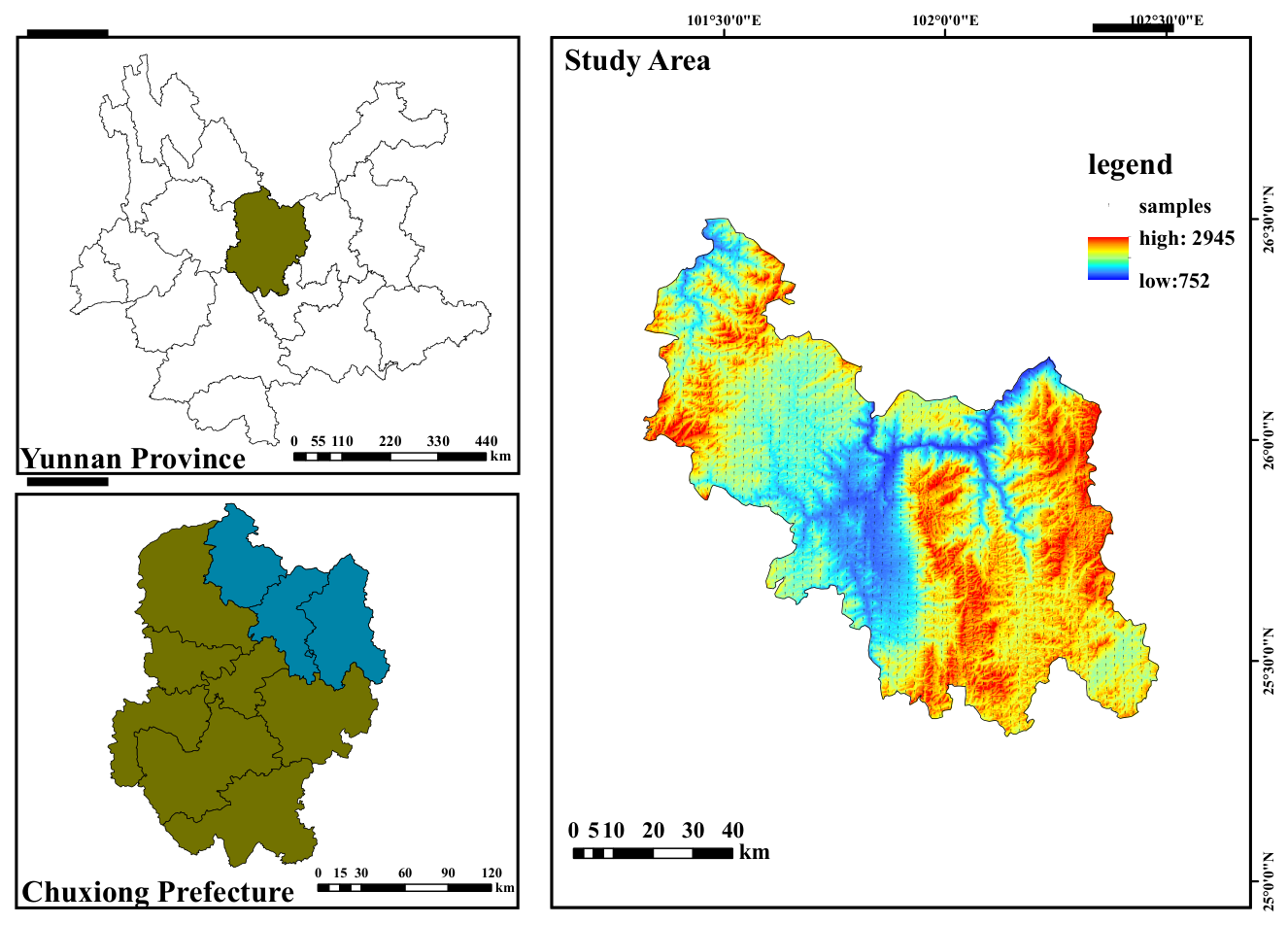
The study area is located in the northern part of the Chuxiong Yi Autonomous Prefecture, Yunnan Province, China, with geographical coordinates ranging from 101°19′8.4″ E to 102°30′50.4″ E longitude and 25°19′40.8″ N to 26°29′56.4″ N latitude (Figure 1). It features a subtropical low-latitude plateau monsoon climate, with an average annual temperature of 17.9 °C. The region experiences large diurnal temperature variations but small annual temperature fluctuations. Rainfall and heat periods coincide, with approximately 90% of the precipitation concentrated between May and October. The average annual precipitation is 809.1 mm, while the average annual evaporation reaches 2432 mm, making it a typical arid area in central Yunnan. The terrain is higher in the center and lower in the north and south, with elevations ranging from 752 m to 2945 m. Mountainous and hilly landscapes dominate, exhibiting significant vertical climatic variation. Within Chuxiong Prefecture, cultivated land is the primary land use type, totaling 334,206.88 hectares, of which dryland accounts for 64.28%. The remaining land is predominantly used for forestry and pasture, with scattered residential areas. This diverse terrain supports a variety of agricultural activities, from lowland crops to highland livestock farming, reflecting the region’s adaptability to its natural environment.

2.2. Sample Collection and Analysis

During 2020–2022, a total of 1790 surface soil samples (0–20 cm depth) were collected from farmland, woodland, and orchards. Sampling avoided areas with severe soil erosion or where the topsoil had been disturbed. A kilometer-grid sampling approach was employed, with 4 km2 as a sampling unit and central points spaced at 2 km intervals. At each central point, one core sample and three subsamples within a 50 m radius were collected. Subsamples were homogenized in equal proportions to form a composite sample (≥1.4 kg). To ensure quality control, duplicate samples were collected by different inspectors at different times, comprising 2% of the total samples, and were inserted into each batch in a coded manner. After collection, all samples were placed in labeled polyethylene bags and naturally air-dried for one week in a ventilated indoor area before being preserved in the laboratory for subsequent analysis. During the sampling process, the accuracy of sampling points was ensured through GPS track monitoring. In the laboratory, the quality of soil sample analysis was controlled using a combination of external and internal quality control measures. Certified reference materials (GWB) were included to ensure the accuracy, compliance rate, and precision of the analytical methods.
The chromium (Cr) content was determined in accordance with Chinese Industry Standard DZ/T 0279.1-2016 Analysis methods for regional geochemical sample-Part 1: Determination of 24 components including aluminum oxide, etc., by pressed power pellets-X-ray fluorescence spectrometry [36]. Nickel (Ni), zinc (Zn), and phosphorus (P) were determined according to DZ/T 0279.2-2016 Analysis methods for regional geochemical sample-Part 2: Determination of 27 components including calcium oxide, etc., by inductively coupled plasma atomic emission spectrometry [37]. Copper (Cu) and lead (Pb) were analyzed following DZ/T 0279.3-2016 Analysis methods for regional geochemical sample-Part 3: Determination of 15 elements including barium, beryllium, bismuth, etc., by inductively coupled plasma mass spectrometry [38]. Cadmium (Cd) quantification was performed in accordance with DZ/T 0279.5-2016 Analysis methods for regional geochemical sample-Part 5: Determination of cadmium contents by inductively coupled plasma mass spectrometry [39]. Arsenic (As) was determined according to Chinese Industry Standard DZ/T 0279.13-2016 Analysis methods for regional geochemical sample-Part 13: Determination of arsenic, antimony and bismuth contents by hydride generation-atomic fluorescence spectrometry [40]. Mercury (Hg) analysis followed DZ/T 0279.17-2016 Analysis methods for regional geochemical sample-Part 17: Determination of mercury by vapor generation-cold atomic fluorescence spectrometry [41]. Nitrogen (N) content was quantified using DZ/T 0279.29-2016 Analysis methods for regional geochemical sample-Part 29: Determination of nitrogen contents by Kjeldahl distillation-volumetric method [42]. Soil pH was measured in accordance with DZ/T 0279.34-2016 Analysis methods for regional geochemical sample-Part 34: Determination of pH by ion selective electrode method [43]. Organic carbon content was determined by the potassium dichromate oxidation method with oil-bath heating.

2.3. Assessment Indicators for Heavy Metal Pollution

2.3.1. Enrichment Factor (EF)

The Enrichment Factor (EF), initially proposed by Chester and Gladney during their investigation of lead content in atmospheric particulates [44], serves as a quantitative metric for assessing pollution levels and identifying contamination sources. This method evaluates anthropogenic impacts on heavy metal concentrations in environmental media [45]. It typically employs conservative elements characterized by crustal abundance, minimal anthropogenic influence, and geochemical stability as reference elements. In this study, titanium (Ti) was selected as the reference element. The computational methodology is detailed in Equation (1).
E F = C i j C r e f s a m p l e B i B r e f b a c k g r o u n d
where (Cij/Cref)sample represents the ratio of the target metal element i to the reference metal element in the sample j, and (Bi/Bref)sample denotes the background ratio of the target metal element to the reference metal element. This study employs the soil element background values of Yunnan Province for assessment [46]. EF values are classified into six enrichment levels: not enriched (EF < 1), mildly enriched (1 ≤ EF < 2), moderately enriched (2 ≤ EF < 5), highly enriched (5 ≤ EF < 20), intensely enriched (20 ≤ EF < 40), and very highly enriched (EF ≥ 40) [47,48].

2.3.2. Geoaccumulation Index (Igeo)

The Geoaccumulation Index (Igeo), initially proposed by Müller (1969), quantifies sediment contamination intensity through comparative analysis with pre-industrial background levels [49]. The computational methodology is presented in Equation (2).
I g e o = log 2 [ C i j / ( C i b × 1.5 ) ]
Based on the Geoaccumulation Index, soil contamination intensity is classified into seven grades: practically unpolluted (Igeo < 0), unpolluted to moderately (0 ≤ Igeo < 1), moderately polluted (1 ≤ Igeo < 2), moderately to strongly (2 ≤ Igeo < 3), strongly polluted (3 ≤ Igeo < 4), strong to very strong (4 ≤ Igeo < 5), very strong pollution (Igeo ≥ 5).

2.3.3. Nemerow Integrated Pollution Index (PN)

The Nemerow Integrated Pollution Index (PN) is a multi-factor environmental quality assessment method originally developed by Nemerow (1974) for water pollution evaluation, subsequently adopted extensively for soil contamination assessment [50,51,52]. Computational procedures are detailed in Equations (3) and (4).
p i = C i j C i b
where Pi represents the Single Factor Pollution Index, Cij denotes the measured concentration of the heavy metal element i in the sample j, and Cib corresponds to the background value for the respective heavy metal. Based on the Single Factor Pollution Index (Pi) values, soil pollution levels are classified into five grades: unpolluted (Pi < 1), mild pollution (1 ≤ Pi < 2), low pollution (2 ≤ Pi < 3), moderate pollution (3 ≤ Pi < 5), severe pollution (Pi ≥ 5).
P N = ( P i , m a x ) 2 + ( P i , a v g ) 2 2
where PN represents the Nemerow Integrated Pollution Index, Pi,max denotes the maximum measured concentration of the same element, and Pi,avg signifies the arithmetic mean concentration of the same element. Soil pollution levels are classified into five grades based on PN values: unpolluted (PN < 0.7), mild pollution (0.7 ≤ PN < 1), low pollution (1 ≤ PN < 2), moderate pollution (2 ≤ PN < 3), severe pollution (PN ≥ 3).

2.3.4. Potential Ecological Risk Index (RI)

The Potential Ecological Risk Index (RI) was proposed by Hakanson in 1980, based on the theory of aquatic sedimentology [53]. This index quantifies the potential threat of pollution to ecosystems by incorporating heavy metal concentrations, toxicity levels, environmental sensitivity, and pollutant types. It has subsequently been extended to assess pollution in soils, the atmosphere, and other environmental media. The specific calculation method is presented in Equation (5).
R I = E i = ( T i × C i j ) = ( T i × C i j / C i b )
where Ei represents the Environmental Risk Index for heavy metals, Ti denotes the toxicity response coefficient for heavy metals (Hg = 40, Cd = 30, Pb = 5, As = 10, Cr = 2, Cu = 5, Ni = 5, Zn = 1). Based on the RI value, the degree of soil ecological risk can be classified into four levels: low risk (RI < 150), moderate risk (150 ≤ RI < 300), high risk (300 ≤ RI < 600), and very high risk (RI ≥ 600).

2.4. Methods for Source Apportionment of Heavy Metals in Soils

2.4.1. Absolute Principal Component Scores-Multiple Linear Regression (APCS-MLR)

The APCS-MLR model quantifies the contribution rates of individual pollution sources through multivariate linear regression based on Principal Component Analysis. This approach shows enhanced flexibility and computational efficiency compared to conventional receptor modeling methods [54]. The specific computational procedures are detailed in Equations (6)–(8).
Z i j = C i j C a v g σ i
z 0 i = 0 C i , a v g σ i = C i , a v g σ i
X i = b 0 + k = 1 m b k × A P C S k
where Zij denotes the standardized concentration of heavy metal i in sample j, Cij represents the measured concentration of heavy metal i in sample j. Cavg is the mean concentration of heavy metals across all samples. σi signifies the standard deviation of heavy metal elements. bk indicates the regression coefficient of heavy metal elements. m corresponds to the number of pollution sources. APCSk refers to the source-adjusted absolute factor score for source k.

2.4.2. Positive Matrix Factorization (PMF)

The EPA PMF 5.0 model, developed by the United States Environmental Protection Agency (US EPA), is a multivariate factor analysis tool. It employs weighted least-squares minimization to decompose the original data matrix into factor contribution matrices and factor profile matrices [55]. This approach enables robust apportionment of pollution sources. The calculation method is shown in Equations (9)–(11).
x i j = k = 1 p g j k × f k i + e i j
xij denotes the concentration of heavy metal i in sample j. gjk represents the contribution of pollution source k to sample j. fki signifies the compositional profile of heavy metal i in source k. eij indicates the residual error for metal i in sample j.
Q = i = 1 n j = 1 m x i j k = 1 p g j k × f k i u i j 2
where uij represents the measurement uncertainty of heavy metal i in sample j.
U i j = 5 6 × M D L ,   c i j     M D L σ × c i j 2 + 0.5 × M D L 2
σ denotes the error fraction, Cij represents the measured concentration of heavy metal i in sample j. MDL signifies the method detection limit for heavy metal elements. Concentrations below the detection limit are calculated according to Equation (12) [56]:
x i j = M D L 2 , σ i j = 5 M D L 6
For concentrations exceeding the detection limit, the uncertainty is calculated according to Equations (13) and (14):
σ i j = M D L 3 + 0.2 × c i j , x i j 3 M D L
σ i j = M D L 3 + 0.1 × c i j , x i j > 3 M D L

2.4.3. Random Forest

Random Forest, a Bootstrap Aggregating (Bagging) ensemble method, reduces variance and mitigates overfitting risk by training multiple decision trees in parallel and aggregating their predictions. It is characterized by both sample randomness and feature randomness. The model constructs regression trees using bootstrap samples (random sampling with replacement) from the dataset. The final prediction for the dependent variable is determined by averaging the outputs of the individual regression trees. To reduce inter-feature correlations, the data is randomly partitioned into a training set for model calibration and a test set for model evaluation [57]. Model performance can be optimized during training by tuning key hyperparameters, including the number of trees, the number of candidate features considered at each split (mtry), and the minimum node size [58].

2.5. Statistical Analysis

Data preprocessing was performed using Excel 2021. Graphical representations were generated with Origin 2022 and spatial distribution maps were created using ArcGIS 10.8. Spatial modeling and prediction of the random field were conducted via the Kriging method based on covariance functions. Positive Matrix Factorization (PMF) analysis was implemented using EPA PMF 5.0, while Absolute Principal Component Score (APCS) linear regression analysis was performed with SPSS 27.0.1. Random Forest modeling was executed in R 4.4.2. Heavy metal sources in soils were subsequently determined by synthesizing the results from the above analyses.

3. Results

3.1. Characteristics of Soil Heavy Metal Concentrations in the Study Area

3.1.1. Descriptive Statistics

Table 1 presents the statistical summary of concentrations for eight heavy metals (Hg, Cd, Pb, As, Cr, Cu, Ni, and Zn) in soils within the study area. The mean concentrations of Hg, Cd, Pb, As, Cr, Cu, Ni, and Zn were 0.03, 0.17, 25.01, 7.46, 85.91, 36.20, 31.75, and 69.24 mg/kg, respectively. Among these, the mean concentrations of all seven heavy metals except Cr were lower than the soil background values for Yunnan Province. The proportions of sampling sites exceeding Yunnan Province’s background values for each of the eight heavy metals were 5.70%, 18.10%, 4.75%, 2.68%, 87.54%, 11.01%, 10.45%, and 12.63%, respectively. Furthermore, the proportions exceeding soil screening values were all below 2%. Within the study area, soil Hg, Cd, Pb, As, and Cd concentrations were lower than the risk intervention thresholds stipulated by China’s soil environmental quality risk control standard for soil contamination of agricultural land (GB 15618-2018) [59]. The standards do not specify thresholds for Cu, Ni, and Zn. The coefficient of variation (CV) indicates the degree of influence from external sources on heavy metal concentrations in soils. Higher CV values suggest greater anthropogenic or external impacts. According to conventional classification, CV values are categorized into three levels: low variation (0–15%), moderate variation (15–35%), and high variation (>35%) [60]. In the study area, the coefficients of variation (CV) for all eight soil heavy metals, except Cr, exceeded 35%, indicating high variation. This suggests relatively strong external influences on their sources. Collectively, these results demonstrate generally favorable soil quality across the region. However, localized areas exhibit significant heavy metal enrichment, presenting elevated risks of point-source pollution that merit further investigation into their origins.

3.1.2. Spatial Distribution of Heavy Metals

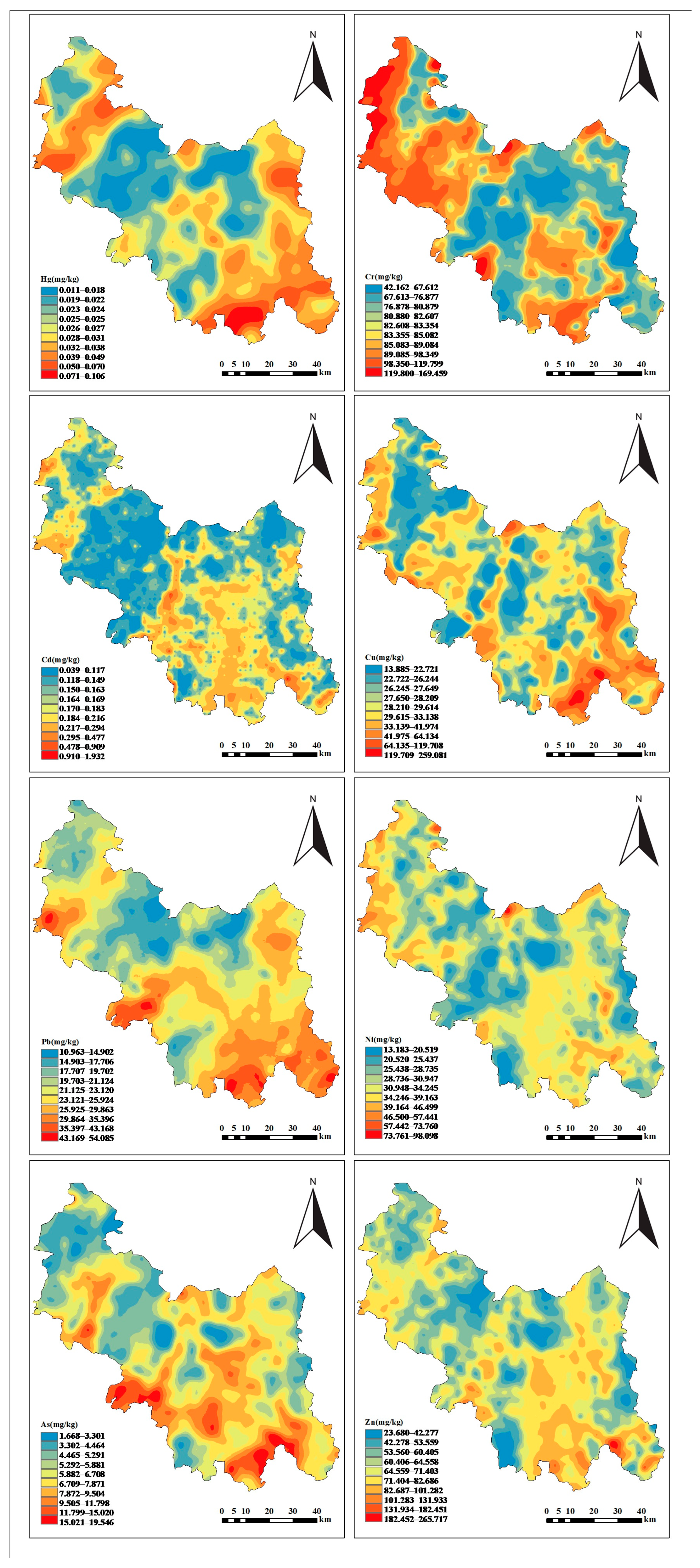
Figure 2 illustrates the spatial distribution of heavy metal concentrations across the study area. The Jinsha River Basin in the area follows a north–south structural trend, with tributaries exhibiting a fan-shaped distribution extending from the northeast. The distribution of all heavy metal elements showed similar patterns.
Within the study area, Cd, As, Cu, Ni, and Zn exhibit spatially extensive distributions. Their high-concentration zones predominantly demonstrate linear patterns that broadly align with regional hydrological networks, exhibiting outward dispersion trends. In contrast, Hg, Pb, and Cr display more localized distributions, with high-concentration zones primarily characterized by areal clustering patterns concentrated in the eastern and western sectors of the region. The high-concentration zones of all eight heavy metals exhibit significant spatial overlap. Within the southern sector of the study area, these zones display a characteristic pattern of radiation outward from river channels. Hydrological dynamics, particularly the flow directions of rivers and their tributaries, govern heavy metals’ migration. This fluvial influence is most pronounced in the southern river network corridors.
Soil pH within the study area exhibits a pronounced north–south dichotomy, with acidic soils dominating the southern sector and alkaline soils prevailing in the northern sector. This marked pH gradient contributes significantly to the spatial heterogeneity of Hg, Cd, Pb, and Cr, generating complex distribution patterns. In Yunnan’s characteristic karst terrain, heavy metals inputs demonstrate seasonal source alternation: natural sources dominate during the wet season, while anthropogenic sources prevail in the dry season [61]. Based on the dual sources of regional heavy metals and the regulatory influence of surface water on their migration in soil, the complexity of regional environmental remediation is further intensified. Concurrently, under the combined effects of topography and hydrological flow, soil heavy metals concentrations in downstream river areas and river valleys are often notably elevated relative to other regions [62,63]. Based on the above research, significant spatial heterogeneity in soil heavy metal concentrations has been identified across the study area.

3.2. Regional Soil Quality Assessment

3.2.1. Heavy Metal Pollution Assessment

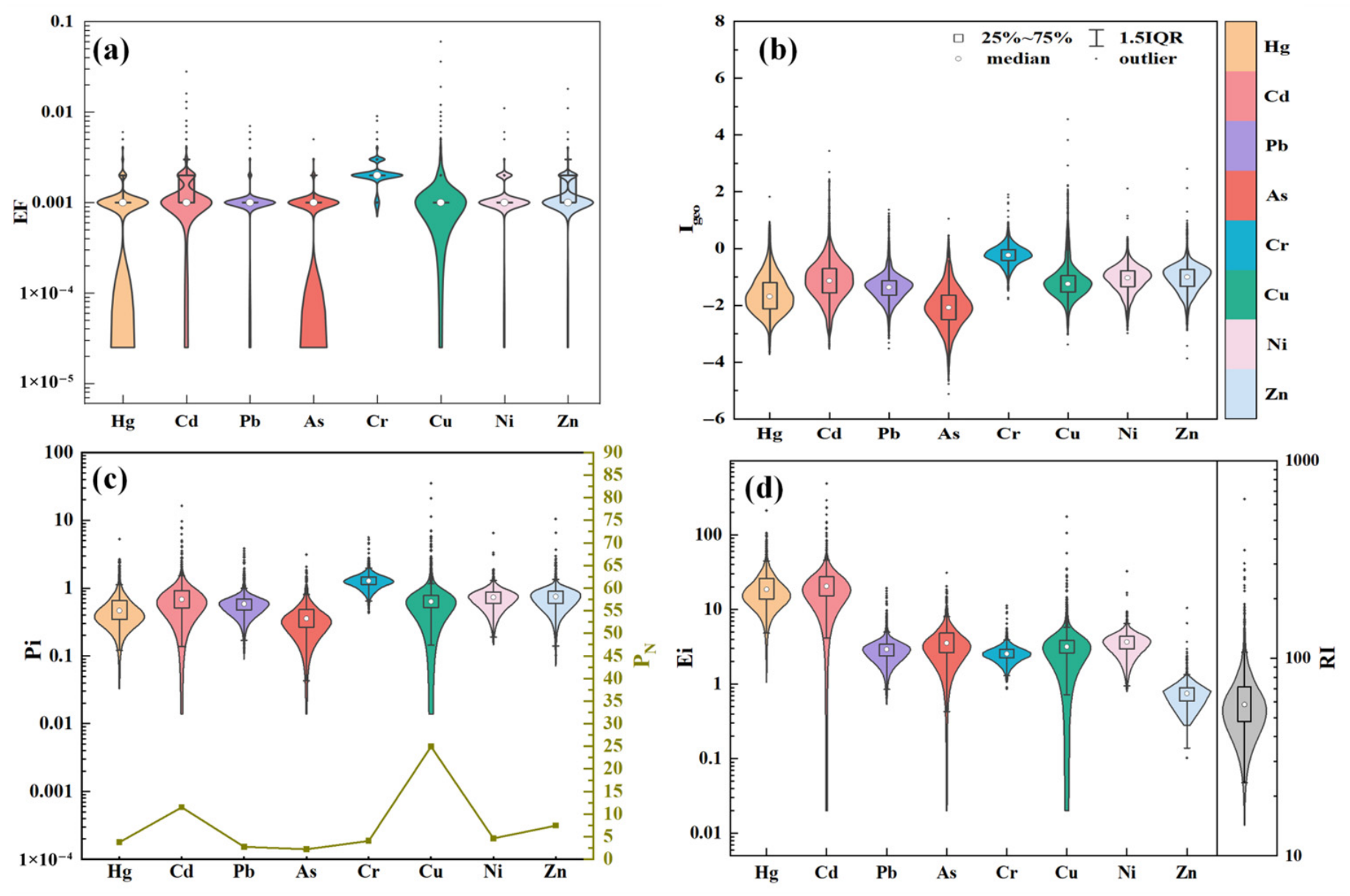
The statistical results of EF, Igeo, and PN for assessing heavy metal pollution levels in the study area are presented in Table 2, Figure 3a–c, respectively. The results demonstrate that the EF for all eight heavy metals at all sites within the study area are less than 1, indicating the absence of significant enrichment.
The mean Geoaccumulation Index values for all eight heavy metals were negative, with the following order: Cr (−0.23) > Zn (−1.05) > Ni (−1.08) > Cd (−1.13) > Cu (−1.17) > Pb (−1.38) > Hg (−1.62) > As (−2.07). The proportion of sampling points reaching moderately polluted level or above is Cu (0.95%), Cd (0.73%), Cr (0.34%), Pb (0.22%), Zn (0.17%), Ni (0.17%), As (0.06%), Hg (0.06%). The statistical analysis reveals that a limited number of sampling sites reached strongly polluted levels, specifically Cd (0.06%) and Cu (0.06%). This indicates that while the overall heavy metal pollution status remains relatively low across the study area, localized contamination hotspots exist, primarily driven by Cd and Cu.
The Nemerow Integrated Pollution Index (PN) results further elucidate the overall status of soil heavy metal contamination. The proportions of sampling sites where Single Factor Pollution Index Pi reached moderate or higher pollution levels are quantified as follows: Cu (0.95%), Cd (0.73%), Cr (0.34%), Pb (0.22%), Ni (0.17%), Zn (0.17%), As (0.06%), Hg (0.06%). Based on the mean values of Single Factor Pollution Index Pi, the heavy metals are ranked in ascending order as follows: Cr (1.32) > Cd (0.79) > Cu (0.78) > Zn (0.77) > Ni (0.75) > Pb (0.62) > Hg (0.55) > As (0.41). Based on the PN, the heavy metals are ranked in descending order of contamination severity: Cu (24.95) > Cd (11.50) > Zn (7.45) > Ni (4.62) > Cr (4.07) > Hg (3.77) > Pb (2.77) > As (2.22). All elements except Pb and As exhibited severe pollution levels (PN ≥ 3), while Cu displayed the most catastrophic contamination level (PN = 24.95).
The comprehensive index assessments collectively indicate that the overall soil quality in the study area remains acceptable, with heavy metal contamination generally within manageable levels. However, sporadic contamination hotspots exhibit anomalously elevated concentrations, necessitating targeted focus on high-concentration distribution zones of Cu, Cd, and Cr. Implementing effective risk mitigation strategies is critical to prevent further dispersion and environmental degradation.

3.2.2. Potential Ecological Risk Assessment

As shown in Figure 3d, the Potential Ecological Risk Index (RI) reveals the ecological hazards of heavy metals in the study area. The single environmental risk factors were ranked by descending mean values: Cd (23.56) > Hg (21.88) > As (4.05) > Cu (3.91) > Ni (3.74) > Pb (3.08) > Cr (2.64) > Zn (0.77). The study area demonstrates predominantly low ecological risk, with 1762 sampling sites (98.44%) registering low risk levels (RI < 150). Moderate risk (150 ≤ RI < 300) occurs at 25 sites (1.40%), while significantly elevated risk manifests at high-risk locations (300 ≤ RI < 600, two sites, 0.11%) and very-high-risk sites (RI ≥ 600, one site, 0.06%). These findings indicate predominantly low potential ecological risks from heavy metals across the study area, though discernibly higher risks manifest in localized zones, with Cd and Hg identified as primary contributing factors.

3.3. Sources of Soil Heavy Metals

3.3.1. Main Factors Influencing Heavy Metals Accumulation in Soil

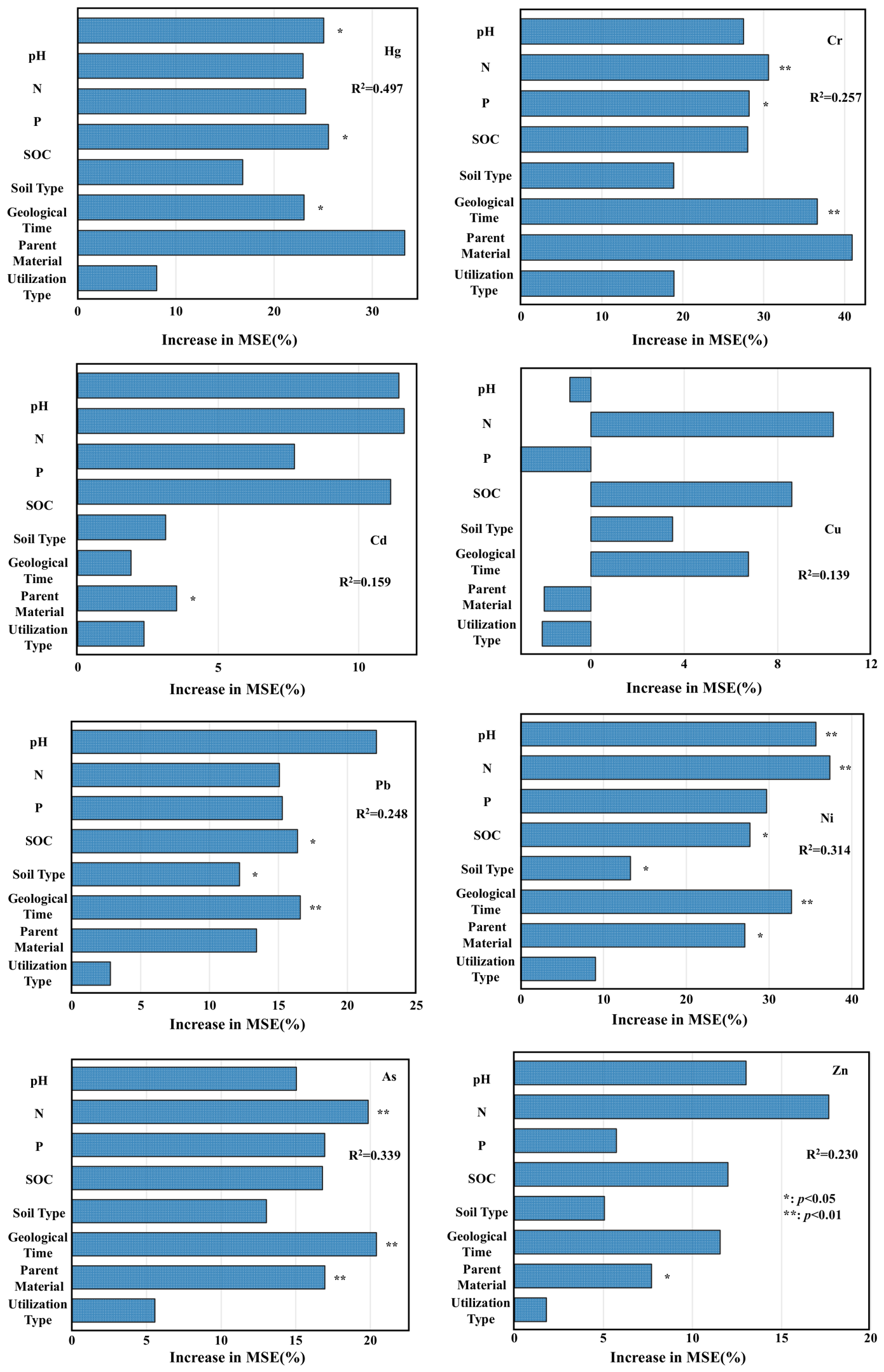
Random Forest models effectively reveal the multivariate sources of heavy metals in soils, complementing results from Positive Matrix Factorization (PMF) and Absolute Principal Component Score-Multiple Linear Regression (APCS-MLR) analyses. This study employed Random Forest modeling to analyze the impacts of soil pH, phosphorus content, nitrogen content, organic carbon content, soil type, geological time, parent material, and land utilization type on the concentrations of eight heavy metals in regional soils. Bayesian optimization was employed to predict Random Forest model performance, identify optimal hyperparameters, and evaluate model reliability, with results summarized in Table 3. Through cross-validation, the associations between key factors and the eight heavy metals were further validated, ensuring precision in source apportionment. Considering significant predictors and variable importance, the analytical results of factor-heavy metal relationships are visualized in Figure 4. Based on a 15% change in Mean Squared Error (MSE) of perturbed soil heavy metal concentrations as the importance criterion, soil pH, N, P, SOC, geological time, and parent material primarily influence Hg, Cr, and Ni. Soil pH and organic carbon content dominate Hg accumulation; soil pH, N, and organic carbon content governs Cd distribution; geological time and parent material control As and Pb; geological time combined with nitrogen phosphorus inputs jointly regulate Cr, Cu, and Ni, while soil pH and organic carbon govern Zn. The interactions among these factors further elucidate the complexity of regional heavy metal distribution patterns.
Based on Random Forest modeling results, soil heavy metal sources can be categorized into natural and anthropogenic origins. The accumulation of Hg, Cd, Pb, As, and Cu exhibits significant compound influences from both sources, while Cr, Ni, and Zn demonstrate analogous trends in inter-group analysis, though no single dominant factor exclusively governs their accumulation patterns.

3.3.2. Source Apportionment via APCS-MLR

The standardized dataset underwent Kaiser-Meyer-Olkin (KMO) and Bartlett’s sphericity tests, yielding values of 0.652 and <0.001, respectively, confirming suitability for principal component analysis (PCA). PCA extracted three principal components (PCs) that cumulatively explained 68.68% of the total variance in eight heavy metals. The variance contributions were as follows: PC1 (36.41%), PC2 (19.28%), and PC3 (12.98%), with detailed loadings presented in Table 4. Principal component 1 (PC1) exhibited high loadings for Zn (0.87), Cd (0.82) and Pb (0.67); PC2 showed elevated loadings for Cr (0.93) and Ni (0.90); PC3 was dominated by Cu (0.82), Hg (0.61) and As (0.51).
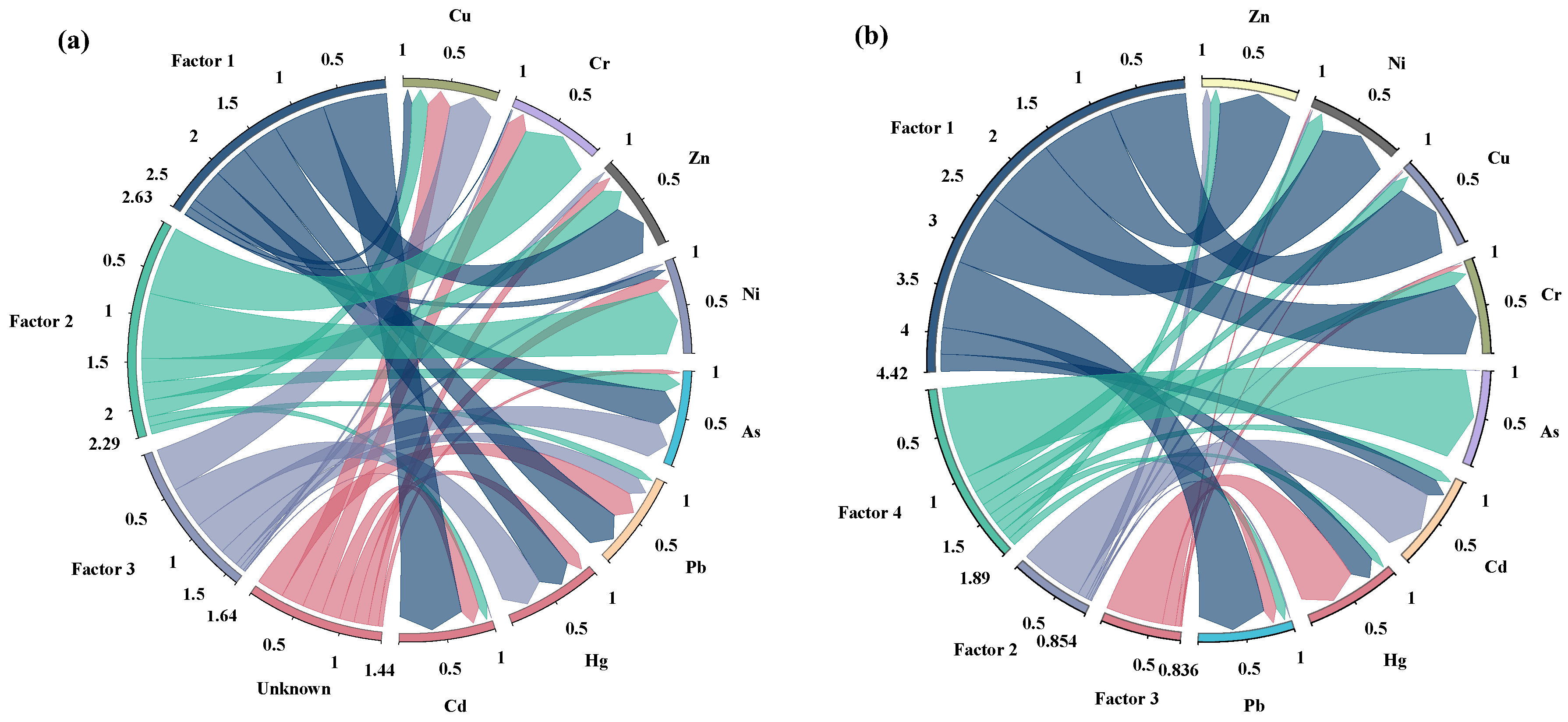
To further clarify the sources and quantitative contributions of eight heavy metals in the study area, the APCS-MLR model was employed to analyze measured heavy metal concentrations. The results demonstrate adjusted R2 values ranging from 0.55 to 0.95, indicating satisfactory model fit. For all eight heavy metals, p-values from the F-test were below 0.01, confirming statistically significant correlations between soil metals and their identified sources. Source apportionment analysis resolved three identified sources and one unknown source, with relative contributions of 32.87%, 28.64%, 20.51%, and 17.98%, respectively. The contribution magnitude of each factor to soil heavy metals is visualized in Figure 5a. Factor 1 exhibited significant contributions (>20%) to Cd (69.72%), Zn (56.49%), Pb (41.37%), Hg (38.09), and As (37.77%). Factor 2 dominated (>20%) Cr (75.15%), Ni (71.19%), and Zn (26.35%). Factor 3 primarily contributed to Cu (47.29%), Hg (45.93%), As (38.06%), and Pb (20.13%), with all other elements showing contributions below 20%. The unknown factor exhibited substantial contributions (>20%) to Pb (29.57%), Cu (24.92%), and Cr (22.05%), while contributions to all other elements remained below 20%. Comparative analysis indicated that Hg, Pb, Cu and Zn showed significant contributions across multiple factors, indicating diverse sources and complex enrichment pathways.

3.3.3. Source Apportionment via PMF

This study employed the Positive Matrix Factorization (PMF) model for quantitative source apportionment of soil heavy metals, while simultaneously validating the accuracy of the APCS-MLR model. Analysis was performed using EPA PMF 5.0 software, with 100 bootstrap runs conducted for factor numbers ranging from 3 to 6. The consistent Qrobust/Qtrue ratio of 1.0 across all models indicates minimal influence of data outliers on the model results. As the factor number increased, the Q value progressively stabilized and model fit improved, albeit with rising overfitting risks. At four factors, a marked decrease in Q was observed, indicating that this configuration optimally resolves heavy metal source characteristics. The contribution rates of each factor to soil heavy metals are presented in Figure 5b. PMF modeling supported four factors with relative contributions of 55.21%, 10.67%, 10.45%, and 23.66%, respectively. Factor 1 was primarily associated with Cu (83.74%), Zn (80.19%), Cr (78.69%), Ni (77.72%), and Pb (73.51%), Factor 2 dominated Cd (69.18%), Factor 3 showed the strongest association with Hg (62.36%), while Factor 4 predominantly influenced As (99.99%).
Comparative analysis of APCS-MLR and PMF results indicated high consistency between both models in resolving soil heavy metal sources. Based on comparative model performance, A-M1 (Absolute principal component linear regression analytical factor 1) and PMF1 (Positive Matrix Factorization analysis Factor 1) are identified as source 1, while A-M2 and PMF4 form source 2. Source 3 consists of A-M3 and PMF3, with A-M Unknown and PMF2 constituting source 4. Source 1 is primarily associated with Cd, Pb, As, Cu, Ni, and Zn. According to publicly available reports, the study area has a long history of limestone mining activities, which explains its classification as an industrial hybrid source. Source 2 mainly relates to Cr, Ni, and As, which are closely associated with parent material and geogenic background in many studies [64,65]. Therefore, source 2 is classified as a natural background source. Source 3 involves Hg and Pb, frequently associated with atmospheric transport and deposition processes, identified as atmospheric deposition sources [66]. Given that Cd is commonly influenced by agricultural practices such as fertilizer and agrochemical application, this factor was classified as an agricultural source. The dominant sources are industrial hybrid sources (32.87%, 55.21%) and natural background sources (28.64%, 23.66%).

4. Discussion

4.1. Cross-Validation of Pollution Assessment Results and Ecological Implications

Comparing pollution classification results from the Enrichment Factor (EF) and Geoaccumulation Index (Igeo) supported high consistency between these assessment methods. This agreement not only shows their strong indicative capacity for pollution evaluation but also empirically corroborates their reliability. Tiered classification based on mean values of the Enrichment Factor (EF) and Geoaccumulation Index (Igeo) consistently identified Cr as exhibiting significantly higher enrichment levels than other elements. As both indices are calculated from single-element concentrations relative to background values, this pattern strongly indicates substantial anthropogenic influence on Cr accumulation [67]. Simultaneously, Cd, Zn, and Ni exhibited elevated pollution evaluation values, indicating substantial anthropogenic influences on their accumulation in soils. Regions with higher contamination levels displayed largely consistent spatial distributions and concentration characteristics, revealing a pattern of discrete hotspots superimposed on diffuse contamination. This spatial congruence proves the complexity and multiplicity of their emission pathways.
In numerous studies on the characteristics of soil pollution in river valleys and arid regions, indices such as EF and Igeo are widely used to represent the characteristics of soil heavy metal pollution [68,69,70]. However, in the process of conducting more in-depth investigations into the underlying mechanisms, these indices still exhibit certain limitations. Additionally, their calculation process is heavily dependent on reference elements. Considering the influence of different regional characteristics and human activities, it is important not to overly rely on the performance of EF and Igeo when evaluating soil pollution. A more comprehensive and systematic evaluation approach should be combined for a more thorough investigation.
Analysis using the Nemerow Integrated Pollution Index (PN) provides comprehensive assessment of regional heavy metal contamination levels, while Single Factor Pollution Index (Pi) characterizes site-specific elemental pollution. Their integration enables a multi-angled evaluation of soil quality across the study area. For the Single Factor Pollution Index (Pi), Cu exhibited the highest proportion of sites reaching moderate pollution levels, albeit at a minimal 0.95%. In contrast, the Nemerow Integrated Pollution Index (PN) demonstrated that all heavy metals collectively attained moderate pollution status across the study area, with Cu, Cd, and Zn being particularly pronounced. Due to their distinct computational emphases, the Single Factor Index (Pi) better characterizes the spatial heterogeneity of heavy metals, while the Nemerow Integrated Pollution Index (PN) integrates mean and extreme values to assess regional soil quality holistically. However, in areas with pronounced spatial variability, PN’s susceptibility to extreme values may compromise assessment accuracy. Both the individual Environmental Risk Index (Ei) and the Potential Ecological Risk Index (RI) are calculated based on site-specific heavy metal concentrations, with Cd and Hg identified as the most prominent risk drivers. In summary, the Enrichment Factor (EF), Geoaccumulation Index (Igeo), Single Factor Pollution Index and individual Environmental Risk Index indicates the spatial distribution patterns of soil quality within the study area. Meanwhile, the Nemerow Integrated Pollution Index and the Potential Ecological Risk Index provide a robust assessment of the overall soil quality level across the region. Notably, both categories of indices demonstrate high consistency in their findings within this study. Cd and Hg are highly toxic heavy metals that, after entering the environment through both natural and anthropogenic activities, can accumulate in ecosystems over long periods and magnify along the food chain. Once Cd enters the human body, it interferes with calcium metabolism, leading to osteoporosis and renal tubular dysfunction. The oxidative stress caused by Cd in the body can also induce DNA damage. Hg primarily affects the nervous and reproductive systems. In particular, methylmercury can cross the blood–brain barrier and accumulate in the central nervous system, causing ataxia, speech disorders, and cognitive decline. Therefore, for areas severely contaminated by Cd and Hg, comprehensive measures such as long-term ecological monitoring and source control should be implemented alongside pollution remediation to mitigate ecological risks.
Through the calculation of the Enrichment Factor (EF), Geoaccumulation Index (Igeo) and Nemerow Integrated Pollution Index (PN), the soil quality within the study area can be quantitatively characterized and assessed from multiple perspectives. Meanwhile, the Potential Ecological Risk Index (RI) effectively reflects the ecological effects of heavy metals in the soil. The combined application of these indices enables the accurate identification of high-risk heavy metal elements within the region. Notably, the RI values for Cd and Hg in the study area strongly exceeded those of other elements. Elevated RI values for specific elements are primarily attributed to their high accumulation levels in the soil and inherent high toxicity.

4.2. Joint Validation of APCS-MLR and PMF Models and Analysis of Driving Mechanisms

The analysis results from both models indicate that in identifying the sources of heavy metal elements, the APCS-MLR model indicated a greater number of distinct contribution factors. In contrast, the PMF model demonstrated a stronger focus on contributions from individual sources. This discrepancy arises because the orthogonality constraint and linear assumptions inherent in APCS-MLR impair its ability to effectively resolve composite sources. Conversely, the non-negative decomposition and error weighting scheme employed by the PMF model enable it to more effectively resolve mixed sources [71]. This also indicates that while the APCS-MLR model can identify a greater number of potential sources when dealing with elements influenced by complex interactions, the accuracy of its source resolution may be compromised. Conversely, although the PMF model exhibits higher sensitivity to contributions from individual sources, it shows superior capability in resolving multi-source mixtures. In studies related to mining sites, PMF identified that heavy metals like Pb, Cd, Cu, and Zn were predominantly influenced by smelter activities (slags, wastewater discharge), while metals such as Cr and Mn were attributed to natural sources [72]. A study on agricultural soil pollution source apportionment across multiple regions in South Korea attributed As, Cd, Cr, and Ni to anthropogenic pollution sources, while attributing the contamination of Cu, Hg, Pb, and Zn to the combined effects of anthropogenic and natural sources [73]. The observed discrepancies in results are largely attributable to variations in land use patterns across regions. For diverse ecosystems such as agricultural and industrial zones, adequate and precise sample sizes are essential to ensure the accuracy of pollution source APCS-MLR and PMF analyses during source apportionment [74,75]. In practical applications, the integrated application of both models leverages their respective strengths, enabling a more refined and comprehensive source apportionment of soil heavy metal contamination. This integrated approach provides a scientific basis for guiding the remediation of contaminated soils [76].
The concentration of heavy metals in soil is influenced by multiple factors, including, but not limited to, soil type, pedogenesis (soil evolution), and anthropogenic activities, representing the collective influence of both natural and anthropogenic processes [77]. The complex interplay of these factors shapes the spatial distribution patterns of heavy metal concentrations in soils [78]. The parent material determines the background levels of heavy metals, with their initial release occurring through bedrock weathering. Particularly in karst terrain, variations in parent materials exert a pronounced influence on the distribution of heavy metals in soils. The elements most notably influenced by this are Hg, Cd, Pb, Ni, and Zn [79]. Soil pH and soil type ultimately determine heavy metal concentrations in soils by governing two key processes: their bioavailability and their migration/accumulation behavior. Specifically, pH significantly influences the activity and solubility of heavy metals, typically exhibiting a negative correlation with pH [80]. Conversely, the properties of the parent material and clay minerals govern the adsorption capacity for heavy metals within the soil matrix [81]. Furthermore, climatic conditions, such as precipitation and temperature, also influence the migration and transformation of heavy metals in soils [82]. Precipitation alters the pH of surface soil layers and directly or indirectly affects their accumulation processes through hydraulic transport, with Cd, As, and Cr being the most significantly impacted elements [83]. Vegetation type and associated root activity similarly play critical roles in the immobilization and release of heavy metals. Root exudates modify the soil microenvironment, thereby influencing heavy metal bioavailability [84].
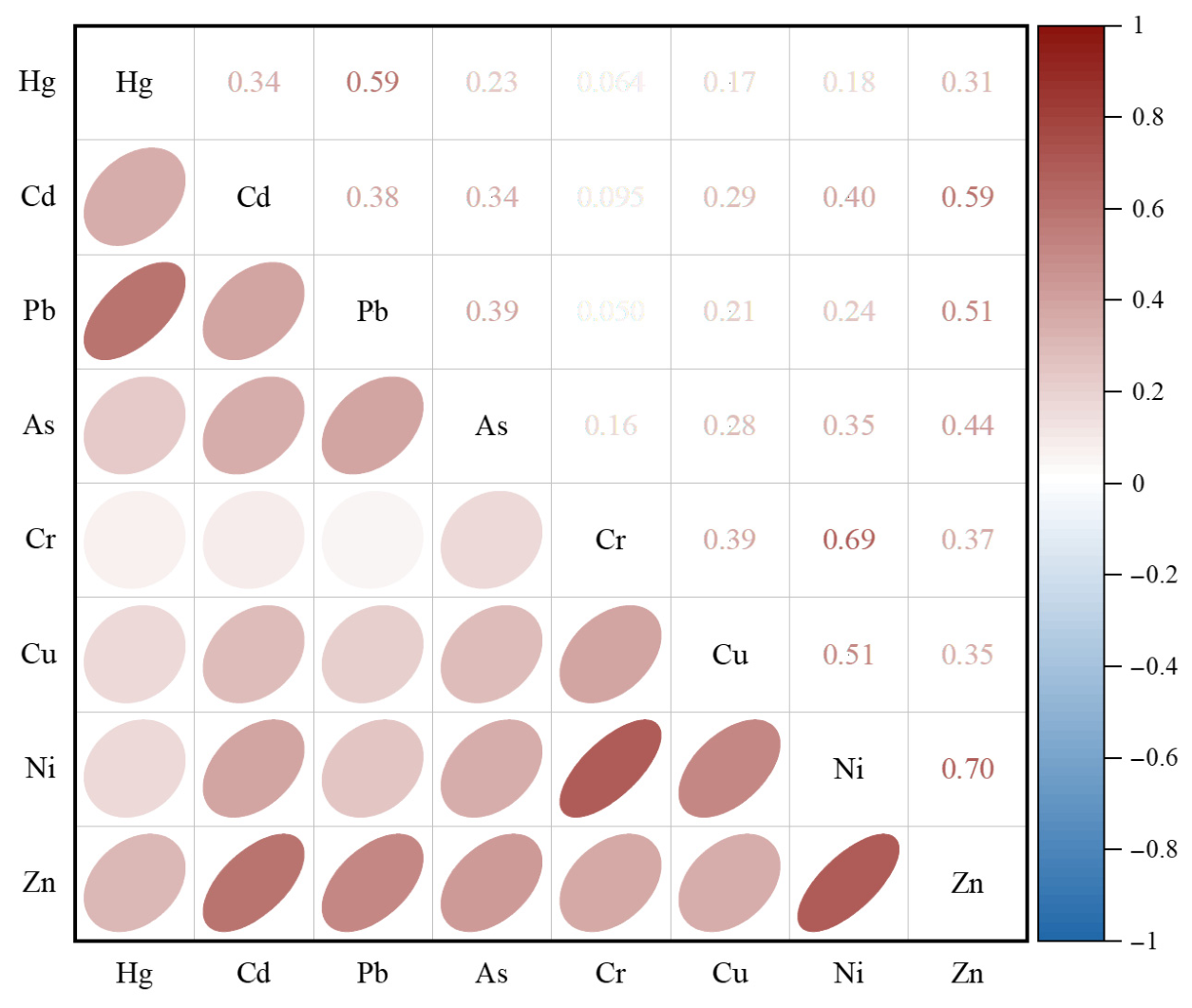
Simultaneously, human activities significantly influence heavy metal migration and accumulation through pathways such as altering soil properties and increasing external inputs. In this study, Hg, Cr, Pb, and Zn exhibited significant correlations with natural and anthropogenic factors including soil N and P concentrations and parent material. Correlation analysis (Figure 6) further indicated common sources among these heavy metal elements. This indicates that, within the study area, elevated geogenic background levels contribute to heavy metal presence, with natural weathering processes promoting their release [85]. Anthropogenic activities, notably agricultural fertilization and mining operations, have significantly enhanced the migration and accumulation of these heavy metals in the soil [86,87]. In agricultural soils under long-term cultivation, while fertilizer application and straw returning may marginally elevate heavy metal contents, the predominant enrichment is primarily attributed to atmospheric deposition [88]. Current research commonly attributes elevated Cr concentrations primarily to local background levels, whereas the enrichment of Hg, Pb, and As is predominantly influenced by anthropogenic activities [89]. This spatial pattern is further evidenced by the predominant distribution of their high-value zones within industrial clusters and high-traffic areas of the study region.

5. Conclusions

The study indicated elevated exceedance rates for Cr, Cd, Zn, Cu, and Ni. Furthermore, heavy metal concentrations exhibited significant geographical heterogeneity, with high-value zones demonstrating a distinct mixed linear and areal distribution pattern. Enrichment Factor (EF) and Geoaccumulation Index (Igeo) indicated slight contamination by Cr, Cd, and Cu. In contrast, the Nemerow Integrated Pollution Index (PN) and Potential Ecological Risk Index (RI) identified Hg, Cd, and Cu as predominant contaminants, with Cd and Hg posing substantial environmental and ecological risks. Utilizing the Random Forest model to assess the influence of environmental factors on eight heavy metals indicated that the accumulation of Hg, Pb, As, Cr, Ni, and Zn in soils is subject to significant combined influences from both natural and anthropogenic sources. Key contributing factors include geological time, parent material, pH, N, and P levels. Four primary heavy metal sources were apportioned using APCS-MLR and PMF: industrial hybrid sources (32.87%, 55.21%), natural background sources (28.64%, 23.66%), atmospheric deposition sources (20.51%, 10.45%), and agricultural sources (17.98%, 10.67%). Among these, the industrial hybrid sources and natural background sources were identified as the predominant contributors.
The results obtained from APCS-MLR and PMF exhibited broad consistency. Their combined application proved effective in resolving heavy metal sources in agricultural soils. For geogenic high-background regions like the Yunnan Province, enhanced long-term monitoring of agricultural soils and the implementation of preventative management measures against heavy metal pollution are recommended. These findings have significant scientific and practical value for subsequent regional pollution control and ecological restoration, especially in karst regions and similar areas.

Author Contributions

Data curation, investigation, visualization, writing—original draft preparation, L.S.; conceptualization, data curation, formal analysis, writing—original draft, T.Z.; validation, supervision, H.Y.; investigation, resources, J.X.; resources, methodology, W.C.; data curation, visualization, Y.B.; supervision, investigation, H.W. and K.Q.; project administration, investigation, Y.L. and W.W.; funding acquisition, writing—review and editing, Y.Z. All authors have read and agreed to the published version of the manuscript.

Funding

This research was funded by the National Natural Science Foundation of China (No. 42307058) and the Geological Survey Project of China Geological Survey (No. DD20208070).

Institutional Review Board Statement

Not applicable.

Informed Consent Statement

Not applicable.

Data Availability Statement

The original contributions presented in this study are included in this article. Further inquiries can be directed to the corresponding authors.

Acknowledgments

We thank the editors and reviewers for reading the manuscript with their busy schedules, and we would like to thank all participants of this study for their great cooperation.

Conflicts of Interest

The authors declare no conflicts of interest.

References

  1. Wang, H.; Wang, J.; Zhou, W.; Ma, R.; Wang, J.; Dong, T. Inversion of heavy metal elements in characteristic agricultural areas of Shanxi Province: Application of the airborne multimodular imaging spectrometer. Ecol. Indic. 2025, 173, 113393. [Google Scholar] [CrossRef]
  2. Xu, J.; Liu, C.; Hsu, P.-C.; Zhao, J.; Wu, T.; Tang, J.; Liu, K.; Cui, Y. Remediation of heavy metal contaminated soil by asymmetrical alternating current electrochemistry. Nat. Commun. 2019, 10, 2440. [Google Scholar] [CrossRef] [PubMed]
  3. Xia, F.; Zhao, Z.F.; Niu, X.; Wang, Z.F. Integrated pollution analysis, pollution area identification and source apportionment of heavy metal contamination in agricultural soil. J. Hazard. Mater. 2024, 465, 133215. [Google Scholar] [CrossRef] [PubMed]
  4. Chen, J.H.; Yeh, M.F.; Wang, J.P.; Wei, H.H. Predicting increments in heavy metal contamination in farmland soil. Environ. Dev. Sustain. 2024. [Google Scholar] [CrossRef]
  5. Ye, L.M.; Gao, G.K.; Li, F.Y.; Sun, Y.F.; Yang, S.Y.; Qin, Q.; Wang, J.; Bai, N.L.; Xue, Y.; Sun, L.J. A comprehensive review on biochar-based materials for the safe utilization and remediation of heavy metal-contaminated agricultural soil and associated mechanisms. J. Environ. Chem. Eng. 2025, 13, 116179. [Google Scholar] [CrossRef]
  6. Orellana, D.; Machuca, D.; Ibeas, M.A.; Estevez, J.M.; Poupin, M.J. Plant-growth promotion by proteobacterial strains depends on the availability of phosphorus and iron in plants. Front. Microbiol. 2022, 13, 1083270. [Google Scholar] [CrossRef]
  7. Guan, Y.F.; Lu, L.; Liu, J.Q.; Lyu, M.; Xu, X.X.; Xing, Y.; Feng, Z.Q.; Liu, C.L.; Xie, H.M.; Ni, W.; et al. Zinc promotes nitrogen uptake and plant growth by regulating the antioxidant system and carbon-nitrogen metabolism under drought condition in apple plants. Plant Physiol. Bioch. 2025, 221, 109619. [Google Scholar] [CrossRef]
  8. Fan, J.L.; Zhu, C.L.; Si, X.R.; Xu, W.J.; Yang, L.; Wang, K.T.; Zhang, N.; Si, H.J. StZIP2 promotes root growth by improving the transport efficiency of zinc in potato (Solanum tuberosum L.). Physiol. Plant. 2025, 177, e70153. [Google Scholar] [CrossRef]
  9. Tang, H.Y.; Xiang, G.H.; Xiao, W.; Yang, Z.L.; Zhao, B.Y. Microbial mediated remediation of heavy metals toxicity: Mechanisms and future prospects. Front. Plant Sci. 2024, 15, 1420408. [Google Scholar] [CrossRef]
  10. Zhang, L.Z.; Xing, S.P.; Huang, F.Y.; Xiu, W.; Rensing, C.; Zhao, Y.; Guo, H.M. Metabolic coupling of arsenic, carbon, nitrogen, and sulfur in high arsenic geothermal groundwater: Evidence from molecular mechanisms to community ecology. Water Res. 2024, 249, 120953. [Google Scholar] [CrossRef]
  11. More, S.; Dhakate, R. Geogenic and anthropogenic sources of heavy metals in soil: An ecological and health risk assessment in the granitic terrain of South India. Catena 2025, 254, 108960. [Google Scholar] [CrossRef]
  12. Wang, P.; Yu, F.; Lv, H.; Wu, L.; Zhou, H. Potential risk of heavy metals release in sediments and soils of the Yellow River Basin (Henan section): A perspective on bioavailability and bioaccessibility. Ecotoxicol. Environ. Saf. 2025, 291, 117799. [Google Scholar] [CrossRef] [PubMed]
  13. Hoang, H.G.; Hadi, M.; Nguyen, M.K.; Nguyen, N.S.H.; Le, P.Q.H.; Nguyen, K.N.; Tran, H.T.; Mishra, U. Assessing heavy metal pollution levels and associated ecological risks in peatland areas in the Mekong Delta region. Environ. Res. 2025, 274, 121319. [Google Scholar] [CrossRef] [PubMed]
  14. Jia, J.; Bai, J.; Xiao, R.; Tian, S.; Wang, D.; Wang, W.; Zhang, G.; Cui, H.; Zhao, Q. Fractionation, source, and ecological risk assessment of heavy metals in cropland soils across a 100-year reclamation chronosequence in an estuary, South China. Sci. Total Environ. 2022, 807, 151725. [Google Scholar] [CrossRef]
  15. Liu, M.; Han, G.L.; Zhang, Q. Effects of agricultural abandonment on soil aggregation, soil organic carbon storage and stabilization: Results from observation in a small karst catchment, Southwest China. Agric. Ecosyst. Environ. 2020, 288, 106719. [Google Scholar] [CrossRef]
  16. He, S.L.; Nong, L.P.; Wang, J.L.; Zhong, X.Z.; Ma, J. Revealing various change characteristics and drivers of ecological vulnerability in the mountains of southwest China. Ecol. Indic. 2024, 167, 112680. [Google Scholar] [CrossRef]
  17. Wang, X.H.; Ji, X.M.; Xu, Y.J.; Mao, B.Y.; Jia, S.Q.; Wang, C.; Liu, Z.J.; Lv, Q.Y. Multi-machine learning methods to predict spatial variation characteristics of total nitrogen at watershed scale: Evidences from the largest watershed (Yangtze River Watershed), Asian. Sci. Total Environ. 2024, 949, 175144. [Google Scholar] [CrossRef]
  18. He, S.T.; Wang, D.J.; Zhao, P.; Li, Y.; Lan, H.J.; Chen, W.L.; Chen, X.Q. Quantification of basin-scale multiple ecosystem services in ecologically fragile areas. Catena 2021, 202, 105247. [Google Scholar] [CrossRef]
  19. Shi, T.Z.; He, L.; Wang, R.; Li, Z.J.; Hu, Z.W.; Wu, G.F. Digital mapping of heavy metals in urban soils: A review and research challenges. Catena 2023, 228, 107183. [Google Scholar] [CrossRef]
  20. Yu, L.; Zheng, T.; Yuan, R.; Zheng, X. APCS-MLR model: A convenient and fast method for quantitative identification of nitrate pollution sources in groundwater. J. Environ. Manag. 2022, 314, 115101. [Google Scholar] [CrossRef]
  21. Magesh, N.S.; Tiwari, A.; Botsa, S.M.; da Lima Leitao, T. Hazardous heavy metals in the pristine lacustrine systems of Antarctica: Insights from PMF model and ERA techniques. J. Hazard. Mater. 2021, 412, 125263. [Google Scholar] [CrossRef] [PubMed]
  22. Guan, Q.; Zhao, R.; Pan, N.; Wang, F.; Yang, Y.; Luo, H. Source apportionment of heavy metals in farmland soil of Wuwei, China: Comparison of three receptor models. J. Clean. Prod. 2019, 237, 117792. [Google Scholar] [CrossRef]
  23. Haque, M.M.; Reza, A.H.M.S.; Hoyanagi, K. Anthropogenic and natural contribution of potentially toxic elements in southwestern Ganges–Brahmaputra–Meghna delta, Bangladesh. Mar. Pollut. Bull. 2023, 192, 115103. [Google Scholar] [CrossRef]
  24. Ashayeri, S.Y.; Keshavarzi, B.; Moore, F.; Ahmadi, A.; Hooda, P.S. Risk assessment, geochemical speciation, and source apportionment of heavy metals in sediments of an urban river draining into a coastal wetland. Mar. Pollut. Bull. 2023, 186, 114389. [Google Scholar] [CrossRef]
  25. Lu, X.H.; Fan, Y.M.; Hu, Y.S.; Zhang, H.T.; Wei, Y.T.; Yan, Z.H. Spatial distribution characteristics and source analysis of shallow groundwater pollution in typical areas of Yangtze River Delta. Sci. Total Environ. 2024, 906, 167369. [Google Scholar] [CrossRef]
  26. Liu, X.; Chi, H.J.; Tan, Z.Q.; Yang, X.F.; Sun, Y.P.; Li, Z.T.; Hu, K.; Hao, F.F.; Liu, Y.; Yang, S.C.; et al. Heavy metals distribution characteristics, source analysis, and risk evaluation of soils around mines, quarries, and other special areas in a region of northwestern Yunnan, China. J. Hazard. Mater. 2023, 458, 132050. [Google Scholar] [CrossRef]
  27. Zhang, X.; Wang, J.F.; Zhao, J.W.; He, J.L.; Lei, Y.L.; Meng, K.; Wei, R.; Zhang, X.; Zhang, M.M.; Ni, S.Y.; et al. Chemical characteristics and sources apportionment of volatile organic compounds in the primary urban area of Shijiazhuang, North China Plain. J. Environ. Sci. 2025, 149, 465–475. [Google Scholar] [CrossRef]
  28. Sakizadeh, M.; Zhang, C. Source identification and contribution of land uses to the observed values of heavy metals in soil samples of the border between the Northern Ireland and Republic of Ireland by receptor models and redundancy analysis. Geoderma 2021, 404, 115313. [Google Scholar] [CrossRef]
  29. Speiser, J.L.; Miller, M.E.; Tooze, J.; Ip, E. A comparison of random forest variable selection methods for classification prediction modeling. Expert Syst. Appl. 2019, 134, 93–101. [Google Scholar] [CrossRef]
  30. Nickel, S.; Schröder, W.; Wosniok, W.; Harmens, H.; Frontasyeva, M.V.; Alber, R.; Aleksiayenak, J.; Barandovski, L.; Blum, O.; Danielsson, H.; et al. Modelling and mapping heavy metal and nitrogen concentrations in moss in 2010 throughout Europe by applying Random Forests models. Atmos. Environ. 2017, 156, 146–159. [Google Scholar] [CrossRef]
  31. Chen, D.; Wang, X.H.; Luo, X.M.; Huang, G.X.; Tian, Z.; Li, W.Y.; Liu, F. Delineating and identifying risk zones of soil heavy metal pollution in an industrialized region using machine learning. Environ. Pollut. 2023, 318, 120932. [Google Scholar] [CrossRef]
  32. Moradpour, S.; Entezari, M.; Ayoubi, S.; Karimi, A.; Naimi, S. Digital exploration of selected heavy metals using Random Forest and a set of environmental covariates at the watershed scale. J. Hazard. Mater. 2023, 455, 131609. [Google Scholar] [CrossRef]
  33. Huang, W.; Liu, Y.; Bi, X.; Wang, Y.; Li, H.; Qin, J.; Chen, J.; Ruan, Z.; Chen, G.; Qiu, R. Source-specific soil heavy metal risk assessment in arsenic waste mine site of Yunnan: Integrating environmental and biological factors. J. Hazard. Mater. 2025, 486, 136902. [Google Scholar] [CrossRef]
  34. Mu, D.; Meng, J.; Wang, S.; Xiao, S.; Wang, H.; Sun, X.; Wu, P. Source apportionment, source-specific health risks, and control factors of heavy metals in water bodies of a typical karst basin in southwestern China. PLoS ONE 2024, 19, e0309142. [Google Scholar] [CrossRef] [PubMed]
  35. Qian, X.; Luo, Y.; Yang, H.; Wang, J.; Zhang, H.; Shi, H.; Li, Q.; Song, Z.; Hao, B.; Fan, W. Assessment and analysis of heavy metal pollution in key production areas of Gastrodia elata in Yunnan, China. Front. Environ. Sci. 2025, 13, 1602385. [Google Scholar] [CrossRef]
  36. DZ/T 0279.1-2016; Analysis Methods for Regional Geochemical Sample-Part 1: Determination of 24 Components Including Aluminum Oxide, etc., by Pressed Power Pellets-X-ray Fluorescence Spectrometry. Geological Publishing House: Beijing, China, 2016.
  37. DZ/T 0279.2-2016; Analysis Methods for Regional Geochemical Sample-Part 2: Determination of 27 Components Including Calcium Oxide, etc., by Inductively Coupled Plasma Atomic Emission Spectrometry. Geological Publishing House: Beijing, China, 2016.
  38. DZ/T 0279.3-2016; Analysis Methods for Regional Geochemical Sample-Part 3: Determination of 15 Elements Including Barium, Beryllium, Bismuth, etc., by Inductively Coupled Plasma Mass Spectrometry. Geological Publishing House: Beijing, China, 2016.
  39. DZ/T 0279.5-2016; Analysis Methods for Regional Geochemical Sample-Part 5: Determination of Cadmium Contents by Inductively Coupled Plasma Mass Spectrometry. Geological Publishing House: Beijing, China, 2016.
  40. DZ/T 0279.13-2016; Analysis Methods for Regional Geochemical Sample-Part 13: Determination of Arsenic, Antimony and Bismuth Contents by Hydride Generation-Atomic Fluorescence Spectrometry. Geological Publishing House: Beijing, China, 2016.
  41. DZ/T 0279.17-2016; Analysis Methods for Regional Geochemical Sample-Part 17: Determination of Mercury by Vapor Generation-Cold Atomic Fluorescence Spectrometry. Geological Publishing House: Beijing, China, 2016.
  42. DZ/T 0279.29-2016; Analysis Methods for Regional Geochemical Sample-Part 29: Determination of Nitrogen Contents by Kjeldahl Distillation-Volumetric Method. Geological Publishing House: Beijing, China, 2016.
  43. DZ/T 0279.34-2016; Analysis Methods for Regional Geochemical Sample-Part 34: Determination of pH by Ion Selective Electrode Method. Geological Publishing House: Beijing, China, 2016.
  44. Chester, R.; Stoner, J.H. Pb in Particulates from the Lower Atmosphere of the Eastern Atlantic. Nature 1973, 245, 27–28. [Google Scholar] [CrossRef]
  45. Zoller, W.H.; Gladney, E.S.; Duce, R.A. Atmospheric Concentrations and Sources of Trace Metals at the South Pole. Science 1974, 183, 198–200. [Google Scholar] [CrossRef] [PubMed]
  46. CNEMC. Background Values of Soil Elements in China; China Environmental Science Press: Beijing, China, 1990. [Google Scholar]
  47. Liu, J.; Chen, Y.; Shang, Y.; Li, H.; Ma, Q.; Gao, F. Contamination Characteristics and Source Apportionment of Heavy Metal in the Topsoil of a Small Watershed in South Taihang. Land 2024, 13, 1068. [Google Scholar] [CrossRef]
  48. Tanaskovski, B.; Petrovic, M.; Kljajic, Z.; Degetto, S.; Stankovic, S. Analysis of Major, Minor and Trace Elements in Surface Sediments by X-Ray Fluorescence Spectrometry for Assessment of Possible Contamination of Boka Kotorska Bay, Montenegro. Maced. J. Chem. Chem. Eng. 2014, 33, 137–148. [Google Scholar] [CrossRef]
  49. Castro, L.N.; Rendina, A.E.; Orgeira, M.J. Assessment of toxic metal contamination using a regional lithogenic geochemical background, Pampean area river basin, Argentina. Sci. Total Environ. 2018, 627, 125–133. [Google Scholar] [CrossRef]
  50. Eyankware, M.O.; Akakuru, O.C.; Igwe, E.O.; Olajuwon, W.O.; Ukor, K.P. Pollution Indices, Potential Ecological Risks and Spatial distribution of Heavy Metals in soils around Delta State, Nigeria. Water Air Soil Pollut. 2024, 235, 452. [Google Scholar] [CrossRef]
  51. Jin, X.H.; Tong, X.R.; Hua, S.H.; Xu, Y. Ecological and Health Risk Assessment of Soil Heavy Metal Contamination Along National Highway 107 in China. Ecol. Chem. Eng. S Chem. I Inz. Ekol. S 2024, 31, 155–175. [Google Scholar] [CrossRef]
  52. Xu, H.T.; Dai, Z.Y.; Sun, Z.H.; Li, X.Y.; Jie, Y.B. Investigating the heavy-metal concentrations in soils from rainwater-harvesting green spaces in Beijing. Landsc. Ecol. Eng. 2024, 20, 581–588. [Google Scholar] [CrossRef]
  53. Hakanson, L. An ecological risk index for aquatic pollution control.a sedimentological approach. Water Res. 1980, 14, 975–1001. [Google Scholar] [CrossRef]
  54. Gong, C.; Xia, X.; Lan, M.; Shi, Y.; Lu, H.; Wang, S.; Chen, Y. Source identification and driving factor apportionment for soil potentially toxic elements via combining APCS-MLR, UNMIX, PMF and GDM. Sci. Rep. 2024, 14, 10918. [Google Scholar] [CrossRef]
  55. Paatero, P.; Tapper, U. Positive matrix factorization: A non-negative factor model with optimal utilization of error estimates of data values. Environmetrics 2006, 5, 111–126. [Google Scholar] [CrossRef]
  56. Zhang, J.; Zhou, X.; Wang, Z.; Yang, L.; Wang, J.; Wang, W. Trace elements in PM2.5 in Shandong Province: Source identification and health risk assessment. Sci. Total Environ. 2018, 621, 558–577. [Google Scholar] [CrossRef] [PubMed]
  57. Xu, X.; Xu, Z.; Liang, L.; Han, J.; Wu, G.; Lu, Q.; Liu, L.; Li, P.; Han, Q.; Wang, L.; et al. Risk hotspots and influencing factors identification of heavy metal(loid)s in agricultural soils using spatial bivariate analysis and random forest. Sci. Total Environ. 2024, 954, 176359. [Google Scholar] [CrossRef]
  58. Zha, X.; Deng, L.; Jiang, W.; An, J.; Wang, H.; Tian, Y. Source analysis and distribution prediction of soil heavy metals in a typical area of the Qinghai-Tibet Plateau. Ecol. Indic. 2024, 166, 112460. [Google Scholar] [CrossRef]
  59. GB 15618—2018; Soil Environmental Quality Risk Control Standard for Soil Contamination of Agricultural Land. Environment Publishing Group: Beijing, China, 2018.
  60. Ji, Z.H.; Long, Z.W.; Zhang, Y.; Wang, Y.K.; Qi, X.Y.; Xia, X.H.; Pei, Y.S. Enrichment differences and source apportionment of nutrients, stable isotopes, and trace metal elements in sediments of complex and fragmented wetland systems. Environ. Pollut. 2021, 289, 117852. [Google Scholar] [CrossRef]
  61. Miao, X.Y.; Chen, L.L.; Hao, Y.P.; An, J.; Xu, T.T.; Bao, W.; Chen, X.Y.; Liao, X.E.; Xie, Y.C. The variations of heavy metals sources varied their aggregated concentration and health risk in sediments of karst rivers—A case study in Liujiang River Basin, Southwest China. Mar. Pollut. Bull. 2024, 201, 116171. [Google Scholar] [CrossRef]
  62. Liu, Q.Z.; Xu, X.; Lin, L.H.; Bai, L.; Yang, M.R.; Wang, W.Q.; Wu, X.H.; Wang, D.H. A retrospective analysis of heavy metals and multi elements in the Yangtze River Basin: Distribution characteristics, migration tendencies and ecological risk assessment. Water Res. 2024, 254, 121385. [Google Scholar] [CrossRef]
  63. Liu, M.D.; He, Y.P.; Baumann, Z.; Zhang, Q.R.; Jing, X.; Mason, R.P.; Xie, H.; Shen, H.Z.; Chen, L.; Zhang, W.; et al. The impact of the Three Gorges Dam on the fate of metal contaminants across the river-ocean continuum. Water Res. 2020, 185, 116295. [Google Scholar] [CrossRef] [PubMed]
  64. Hu, Z.; Wu, Z.; Luo, W.; Liu, S.; Tu, C. Characteristics of soil heavy metal content, enrichment, and migration in a typical karst county. Environ. Res. 2025, 285, 122298. [Google Scholar] [CrossRef]
  65. Li, M.; Qin, H.-B.; Zhu, Y.; Yao, L.; Ai, X.; Qiu, L.; Zheng, D. Ecological risk of selenium, cadmium, and arsenic in high-background sedimentary terranes: Insights from element enrichment and speciation in rocks. Geosci. Front. 2026, 17, 102191. [Google Scholar] [CrossRef]
  66. Pelletier, N.; Chételat, J.; Palmer, M.J.; Vermaire, J.C. Bog and lake sediment archives reveal a lagged response of subarctic lakes to diminishing atmospheric Hg and Pb deposition. Sci. Total Environ. 2021, 775, 145521. [Google Scholar] [CrossRef]
  67. Liao, J.; Cui, X.; Feng, H.; Yan, S. Environmental Background Values and Ecological Risk Assessment of Heavy Metals in Watershed Sediments: A Comparison of Assessment Methods. Water 2021, 14, 51. [Google Scholar] [CrossRef]
  68. Al-Dabbagh, A.H.; Al-Youzbakey, K.T. The environmental impact of heavy metals in sediments of main valleys in the eastern side of Mosul City, Iraq. Environ. Monit. Assess. 2024, 196, 216. [Google Scholar] [CrossRef] [PubMed]
  69. El Behairy, R.; El Baroudy, A.; Ibrahim, M.; Mohamed, E.; Rebouh, N.; Shokr, M. Combination of GIS and Multivariate Analysis to Assess the Soil Heavy Metal Contamination in Some Arid Zones. Agronomy 2022, 12, 2871. [Google Scholar] [CrossRef]
  70. Dutta, N.; Dutta, S.; Bhupenchandra, I.; Karmakar, R.M.; Das, K.N.; Singh, L.K.; Bordoloi, A.; Sarmah, T. Assessment of heavy metal status and identification of source in soils under intensive vegetable growing areas of Brahmaputra valley, North East India. Environ. Monit. Assess. 2021, 193, 376. [Google Scholar] [CrossRef]
  71. Liu, L.; Tang, Z.; Kong, M.; Chen, X.; Zhou, C.; Huang, K.; Wang, Z. Tracing the potential pollution sources of the coastal water in Hong Kong with statistical models combining APCS-MLR. J. Environ. Manag. 2019, 245, 143–150. [Google Scholar] [CrossRef]
  72. Anaman, R.; Peng, C.; Jiang, Z.; Amanze, C.; Fosua, B.A. Distinguishing the contributions of different smelting emissions to the spatial risk footprints of toxic elements in soil using PMF, Bayesian isotope mixing models, and distance-based regression. Sci. Total Environ. 2024, 933, 173153. [Google Scholar] [CrossRef]
  73. In Kim, K.; Khan, A.; Ali, A. APCS–MLR-based source and ecological risk assessment of potentially toxic elements in farmland soils of Republic of Korea. Appl. Soil. Ecol. 2026, 217, 106635. [Google Scholar] [CrossRef]
  74. Thabethe, N.D.L.; Makonese, T.N.; Masekameni, M.D.; Brouwer, D. Bulk sampling and source apportionment of heavy metals within a gold mine area, South Africa. Environ. Monit. Assess. 2025, 197, 1250. [Google Scholar] [CrossRef] [PubMed]
  75. Singh, S.; Maiti, S.K.; Raj, D. An approach to quantify heavy metals and their source apportionment in coal mine soil: A study through PMF model. Environ. Monit. Assess. 2023, 195, 306. [Google Scholar] [CrossRef]
  76. Ma, J.; Lanwang, K.; Liao, S.; Zhong, B.; Chen, Z.; Ye, Z.; Liu, D. Source Apportionment and Model Applicability of Heavy Metal Pollution in Farmland Soil Based on Three Receptor Models. Toxics 2023, 11, 265. [Google Scholar] [CrossRef] [PubMed]
  77. Tang, H.; Zhou, F.; Xian, Y.; Wang, H.; Zhao, H.; Chen, J. Spatial distribution characteristics and comprehensive assessment of environmental and health risks of heavy metal contaminated soil around an industrial area. Environ. Dev. Sustain. 2025. [Google Scholar] [CrossRef]
  78. Huang, S.; Xiao, L.S.; Zhang, Y.C.; Wang, L.; Tang, L.N. Interactive effects of natural and anthropogenic factors on heterogenetic accumulations of heavy metals in surface soils through geodetector analysis. Sci. Total Environ. 2021, 789, 147937. [Google Scholar] [CrossRef] [PubMed]
  79. Duan, D.Y.; Wang, P.; Rao, X.; Zhong, J.H.; Xiao, M.H.; Huang, F.; Xiao, R.B. Identifying interactive effects of spatial drivers in soil heavy metal pollutants using interpretable machine learning models. Sci. Total Environ. 2024, 934, 173284. [Google Scholar] [CrossRef]
  80. Kicińska, A.; Pomykała, R.; Izquierdo-Diaz, M. Changes in soil pH and mobility of heavy metals in contaminated soils. Eur. J. Soil. Sci. 2021, 73, e13203. [Google Scholar] [CrossRef]
  81. Liu, Z.Y.; Fei, Y.; Shi, H.D.; Mo, L.; Qi, J.X. Prediction of high-risk areas of soil heavy metal pollution with multiple factors on a large scale in industrial agglomeration areas. Sci. Total Environ. 2022, 808, 151874. [Google Scholar] [CrossRef] [PubMed]
  82. He, Y.; Zhang, Q.; Wang, W.; Hua, J.; Li, H. The multi-media environmental behavior of heavy metals around tailings under the influence of precipitation. Ecotoxicol. Environ. Saf. 2023, 266, 115541. [Google Scholar] [CrossRef]
  83. Zhang, L.W.; Wang, B.B.; Wu, W.Y.; Wang, C.; Cheng, H.G.; Duan, X.L. Enhanced health risk of soil heavy metal exposure following an extreme rainstorm under climate change. Sci. Total Environ. 2024, 954, 176409. [Google Scholar] [CrossRef]
  84. Jin, J.; Lin, T.; Liu, D.; Wang, Y.; Xu, X.; Xu, Y.; Siemann, E.; Li, B. Changes in Soil Microbiome Mediated by Root Volatiles Enhanced Manganese Tolerance of an Invasive Plant Species. Plant Cell Environ. 2025, 48, 6605–6617. [Google Scholar] [CrossRef]
  85. Zeng, S.; Li, X.; Yang, L.; Wang, D. Understanding heavy metal distribution in timberline vegetations: A case from the Gongga Mountain, eastern Tibetan Plateau. Sci. Total Environ. 2023, 874, 162523. [Google Scholar] [CrossRef] [PubMed]
  86. Adhikari, T.; Gowda, R.C.; Wanjari, R.H.; Singh, M. Impact of Continuous Fertilization on Heavy Metals Content in Soil and Food Grains under 25 Years of Long-Term Fertilizer Experiment. Commun. Soil Sci. Plant Anal. 2021, 52, 389–405. [Google Scholar] [CrossRef]
  87. Zhang, J.; Liu, Y.; Wen, M.; Zheng, C.; Chai, S.; Huang, L.; Liu, P. Distribution Characteristics and Ecological Risk Assessment of Nitrogen, Phosphorus, and Some Heavy Metals in the Sediments of Yueliang Lake in Western Jilin Province, Northeast China. Water 2022, 14, 3306. [Google Scholar] [CrossRef]
  88. Liu, Z.; Bai, Y.; Gao, J.; Li, J. Driving factors on accumulation of cadmium, lead, copper, zinc in agricultural soil and products of the North China Plain. Sci. Rep. 2023, 13, 7429. [Google Scholar] [CrossRef]
  89. Duan, X.C.; Yu, H.H.; Ye, T.R.; Huang, Y.; Li, J.; Yuan, G.L.; Albanese, S. Geostatistical mapping and quantitative source apportionment of potentially toxic elements in top- and sub-soils: A case of suburban area in Beijing, China. Ecol. Indic. 2020, 112, 106085. [Google Scholar] [CrossRef]
Figure 1. Study area.
Toxics 14 00366 g001
Figure 2. Spatial distribution of soil heavy metal concentrations.
Toxics 14 00366 g002
Figure 3. Soil heavy metal indices in the study area: EF (a), Igeo (b), PN (c), RI (d).
Toxics 14 00366 g003
Figure 4. Factors influencing concentrations of eight heavy metals in soils.
Toxics 14 00366 g004
Figure 5. Source factor contributions from APCS-MLR (a) and PMF (b) analyses.
Toxics 14 00366 g005
Figure 6. Correlation analysis of various heavy metals.
Toxics 14 00366 g006
Table 1. Soil heavy metal concentration characteristics.
HgCdPbAsCrCuNiZn
Maximum (mg/kg)0.313.54157.0057.20365.001633.00276.00942.00
Minimum (mg/kg)0.010.035.300.7928.406.678.079.20
Average (mg/kg)0.030.1725.017.4685.9136.2031.7569.24
Standard deviation0.020.1411.034.2922.7751.4611.6934.11
Coefficient of variation (%)58.9282.4244.0957.5826.51142.1536.8149.26
Background value of soil in Yunnan Province (mg/kg)0.060.2240.6018.4065.2046.3042.5089.70
Proportion higher than the background value of soil in Yunnan Province (%)5.7018.104.752.6887.5411.0110.4512.63
Screening value of agricultural land (mg/kg)0.500.40100.0030.00250.00150.0070.00200.00
Proportion higher than agricultural land screening value (%)01.960.390.390.220.950.560.56
Agricultural land control value (mg/kg)2.502.00500.00150.00850.00---
Proportion higher than Agricultural land control value (%)00000---
“-”: Not available.
Table 2. Soil heavy metal pollution assessment characteristics.
HgCdPbAsCrCuNiZn
Mean of EF0.0010.0010.0010.0010.0020.0010.0010.001
Mean of Igeo−1.62−1.13−1.38−2.07−0.23−1.17−1.08−1.05
0 ≤ Igeo < 11.68%3.52%1.12%0.39%21.06%4.47%0.50%1.17%
1 ≤ Igeo < 20.06%0.45%0.22%0.06%0.34%0.67%0.11%0.06%
2 ≤ Igeo < 30.00%0.22%0.00%0.00%0.00%0.17%0.06%0.11%
3 ≤ Igeo < 40.00%0.06%0.00%0.00%0.00%0.06%0.00%0.00%
4 ≤ Igeo < 50.00%0.00%0.00%0.00%0.00%0.06%0.00%0.00%
Igeo ≥ 50.00%0.00%0.00%0.00%0.00%0.00%0.00%0.00%
Mean of Pi0.550.790.620.411.320.780.750.77
Pi < 10.06%0.73%0.22%0.06%0.34%0.95%0.17%0.17%
1 ≤ Pi < 26.15%17.43%4.19%2.57%84.97%8.21%10.56%11.90%
2 ≤ Pi < 30.73%0.84%0.34%0.06%2.29%1.84%0.00%0.67%
3 ≤ Pi < 50.00%0.39%0.22%0.06%0.22%0.45%0.11%0.06%
Pi ≥ 50.06%0.34%0.00%0.00%0.11%0.50%0.06%0.11%
PN3.7711.502.772.224.0724.954.627.45
Table 3. Optimized Random Forest parameters via Bayesian optimization.
Dependent VariableOptimal Model ParametersPredicted R2
MtryNodesizeNtree
Hg1714610.781
Cd11510820.476
Pb1111310.784
As223020.891
Cr3217700.886
Cu2118370.875
Ni2139540.665
Zn21610350.589
Table 4. Principal component analysis results.
Total Variance Explained
ComponentInitial EigenvaluesExtraction Sums of Squared LoadingsRotation Sums of Squared Loadings
TotalVariance/%Cumulative/%TotalVariance/%Cumulative/%TotalVariance/%Cumulative/%
12.9136.4136.412.9136.4136.412.2227.6927.69
21.5419.2855.691.5419.2855.691.7822.1849.87
31.0412.9868.681.0412.9868.681.5118.8168.68
40.8110.1278.80------
50.739.1387.93------
60.485.9993.92------
70.293.5797.48------
80.202.52100.00------
“-”: Not available.
Disclaimer/Publisher’s Note: The statements, opinions and data contained in all publications are solely those of the individual author(s) and contributor(s) and not of MDPI and/or the editor(s). MDPI and/or the editor(s) disclaim responsibility for any injury to people or property resulting from any ideas, methods, instructions or products referred to in the content.