
Lime and Fly Ash Co-Solidification Treatment of Oil-Contaminated Soil: Characteristics in Different Water Environments and Evaluation of Engineering Reuse


Abstract
1. Introduction
2. Materials and Methods
2.1. Test Materials
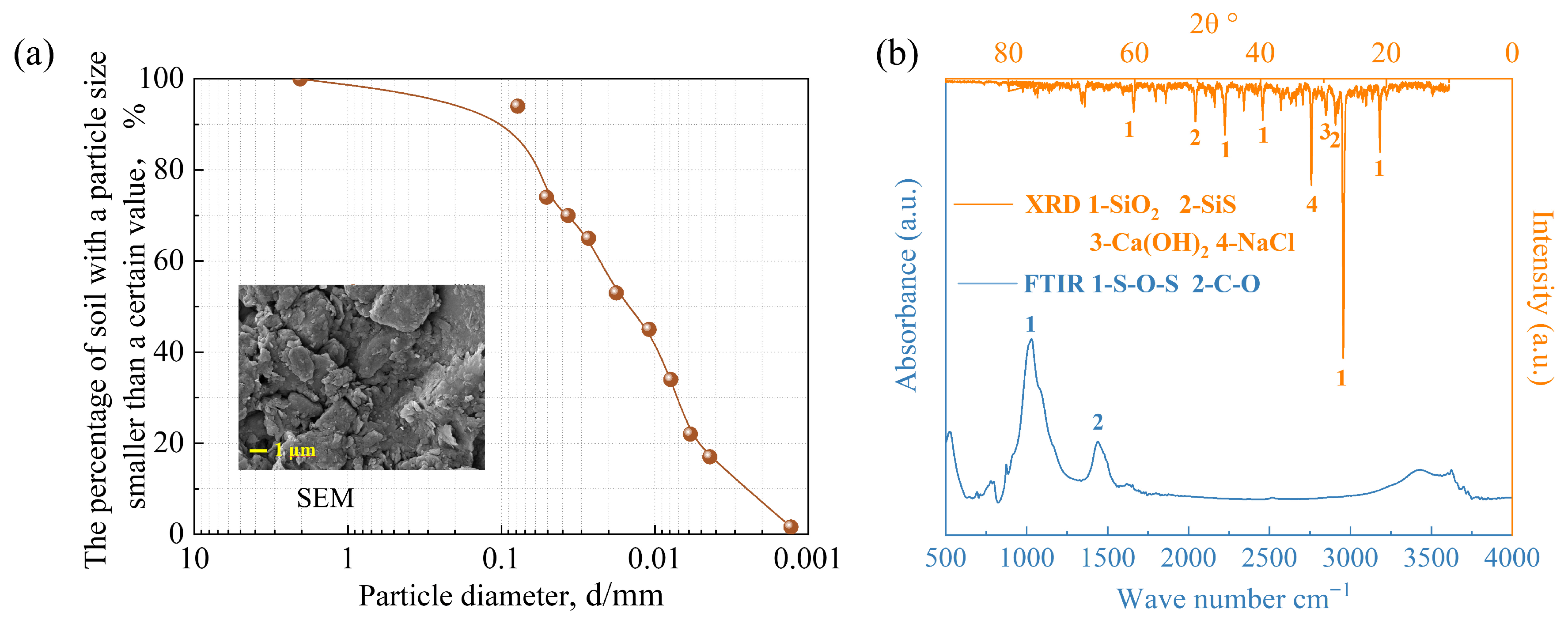
2.1.1. Soil
2.1.2. Oil
2.1.3. Solidified Materials
2.2. Specimen Preparation
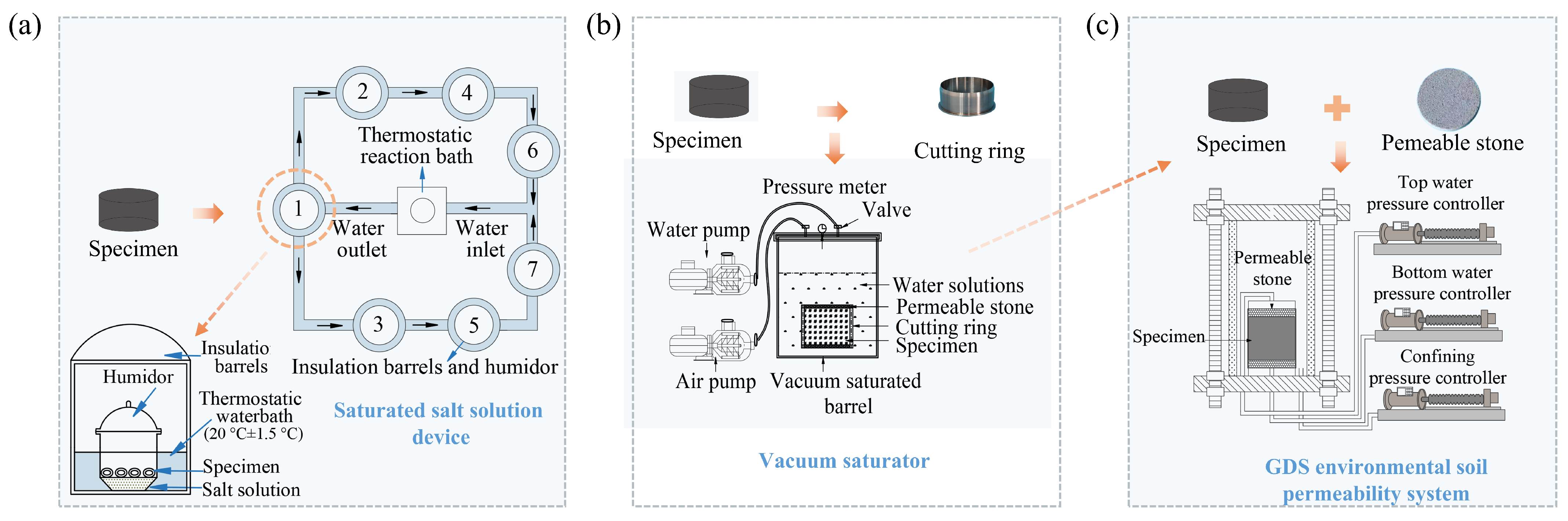
2.3. Test Method
2.3.1. Humidity Injection Test
2.3.2. Water Injection Test
2.3.3. Permeability Test
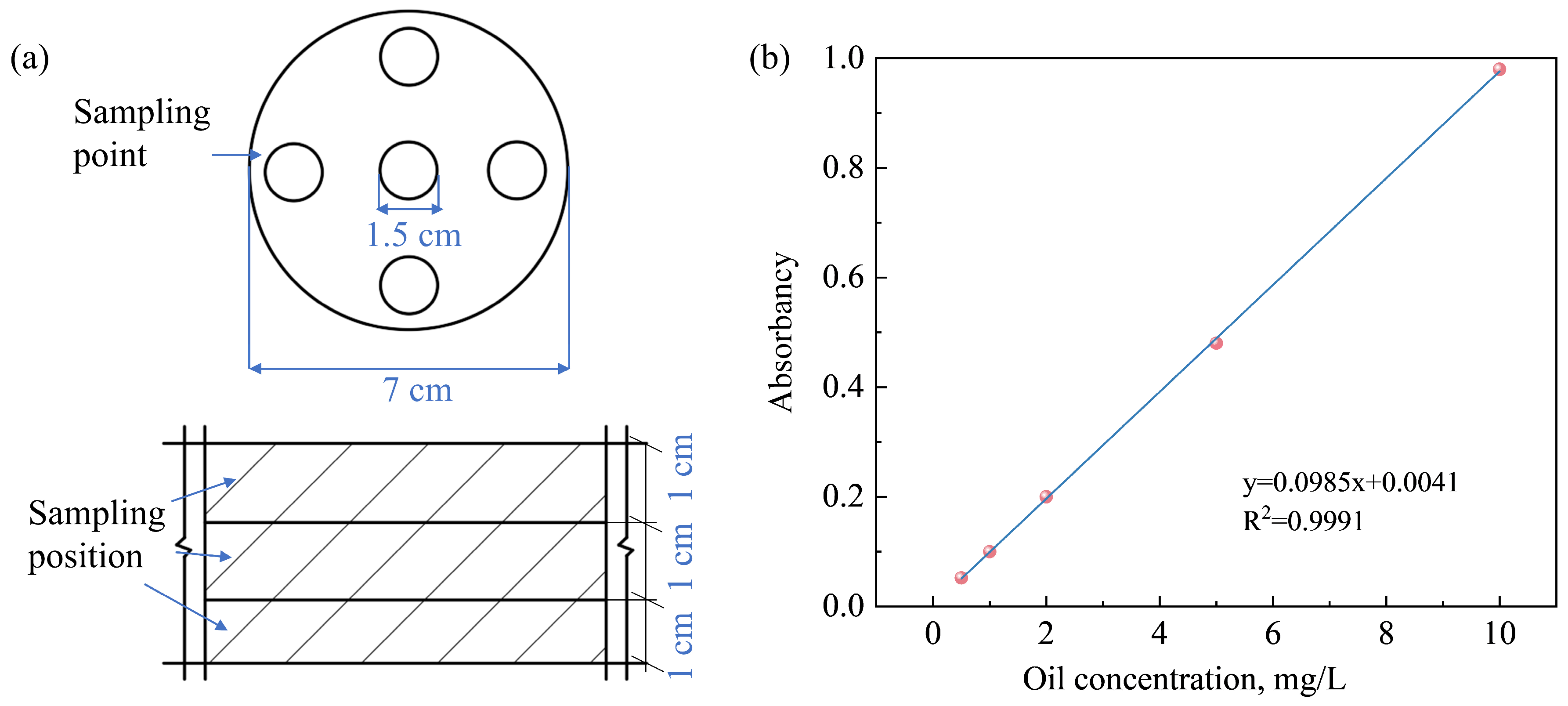
2.3.4. Determination of Oil in the Soil
2.3.5. Fitting of the Van Genuchten Model
3. Results and Discussion
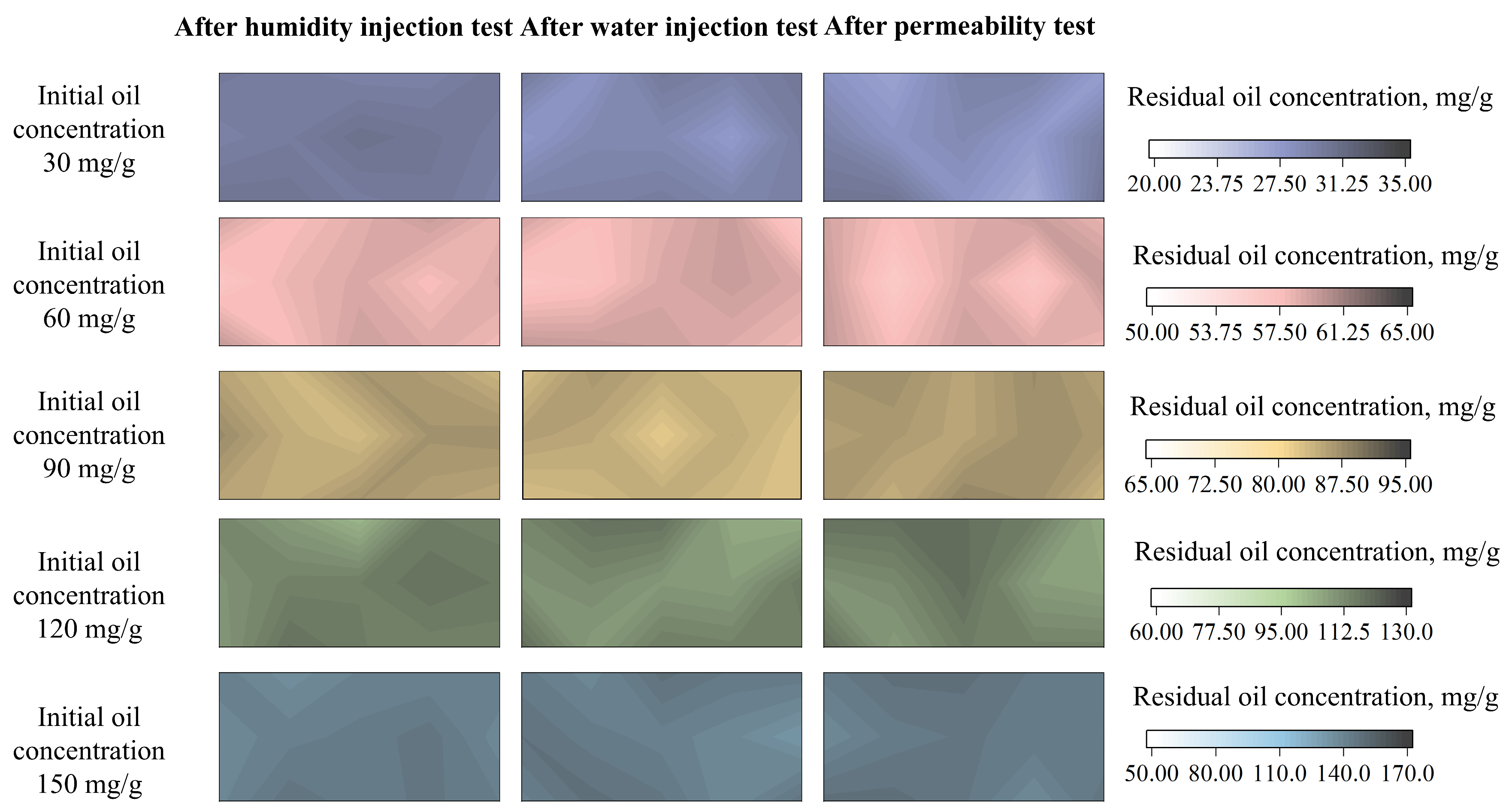
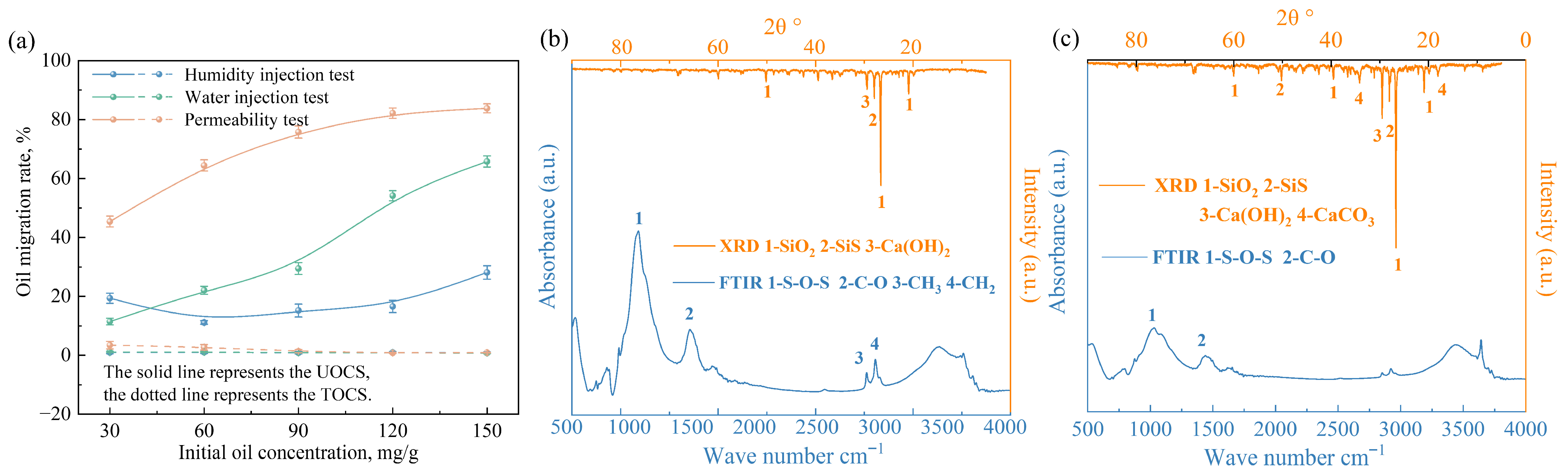
3.1. Migration of Oil in the UOCS/TOCS Under the Different Water Environments
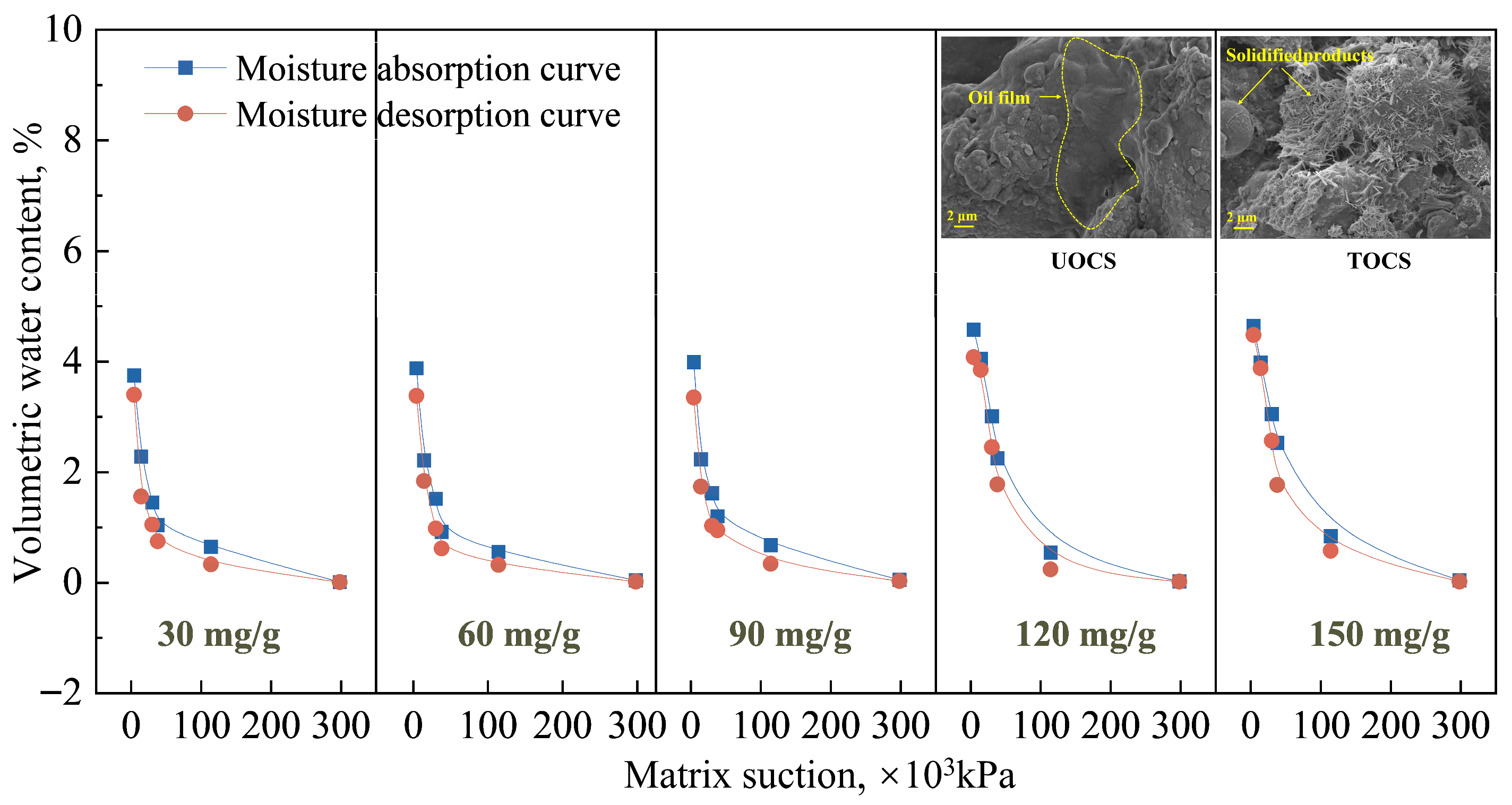
3.2. Water-Holding Capacity of the UOCS/TOCS Under the Humidity Injection
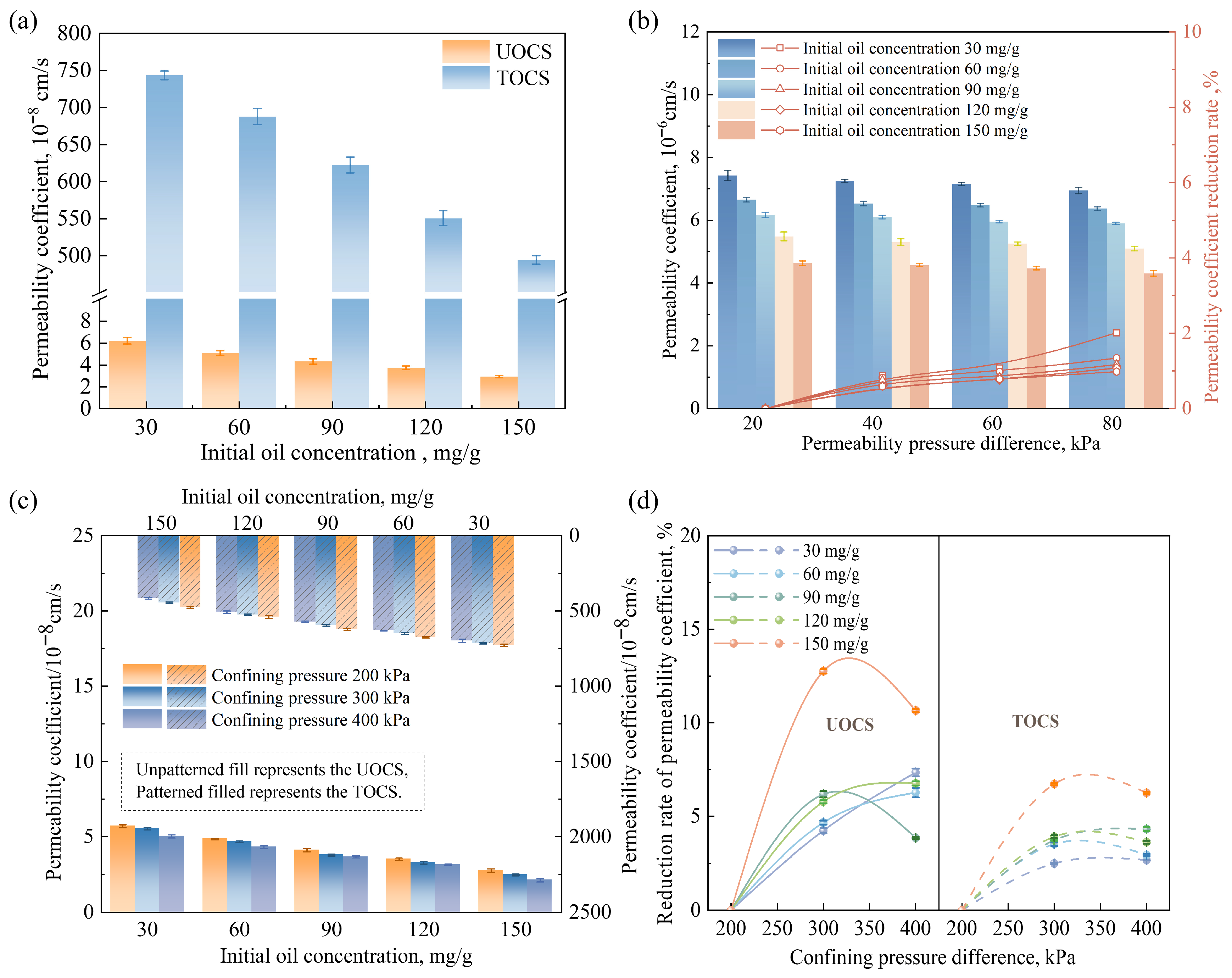
3.3. Permeability Characteristics of the UOCS/TOCS
4. Engineering Reusability and Environmental Safety Assessment
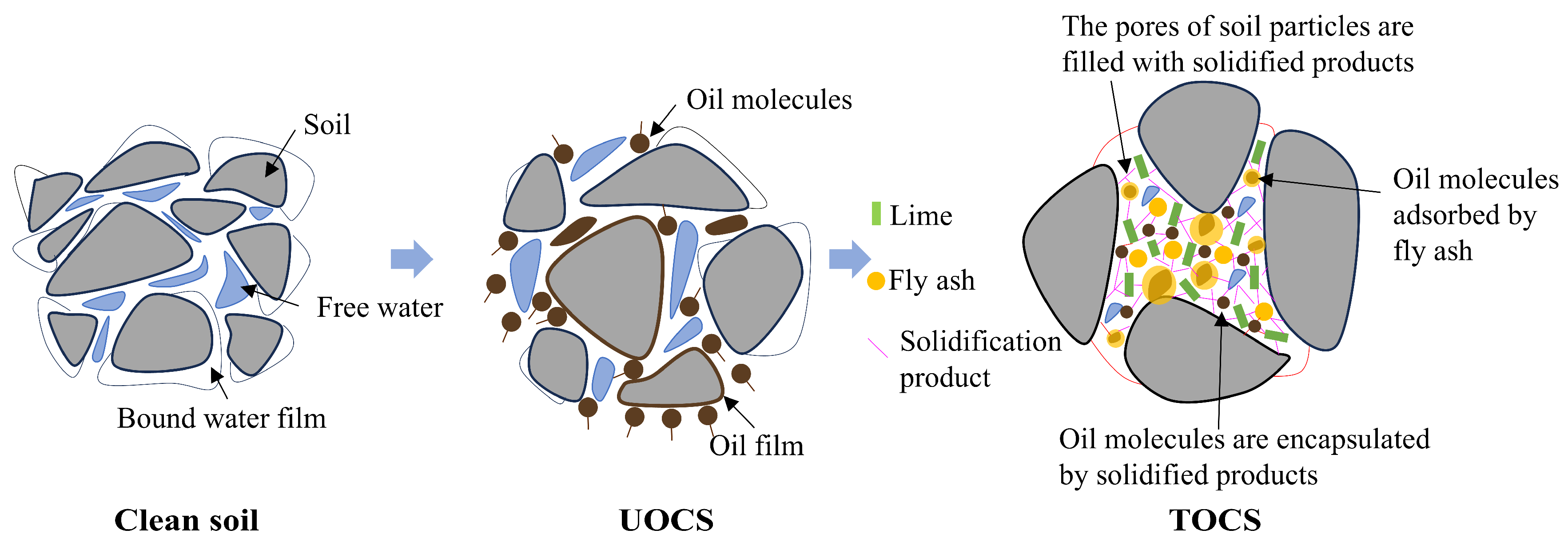
4.1. Synergistic Immobilization Mechanisms
4.2. Oil Migration
4.3. Comparative Performance and Regulatory Compliance
5. Conclusions
Supplementary Materials
Author Contributions
Funding
Institutional Review Board Statement
Informed Consent Statement
Data Availability Statement
Acknowledgments
Conflicts of Interest
Abbreviations
| C-A-H | Calcium aluminate hydrate |
| C-S-H | Calcium silicate hydrate |
| FTIR | Fourier transform infrared spectrum |
| S/S | Solidification/stabilization |
| TCLP | Toxicity characteristic leaching procedure |
| TOCS | Treated oil-contaminated soil |
| UCS | Unconfined compressive strength |
| UOCS | Untreated oil-contaminated soil |
| VG | Van Genuchten |
| XRD | X-ray diffraction |
References
- Al-Mebayedh, H.; Niu, A.; Lin, C. Strategies for cost-effective remediation of widespread oil-contaminated soils in Kuwait, an environmental legacy of the first Gulf War. J. Environ. Manag. 2023, 344, 118601. [Google Scholar] [CrossRef] [Scilit]
- Dike, C.C.; Khudur, L.S.; Hakeem, I.G.; Rani, A.; Shahsavari, E.; Surapaneni, A.; Shah, K.L.; Ball, A.S. Biosolids-derived biochar enhances the bioremediation of diesel-contaminated soil. J. Environ. Chem. Eng. 2022, 10, 108633. [Google Scholar] [CrossRef] [Scilit]
- Lv, Y.; Bao, J.; Zhu, L. A comprehensive review of recent and perspective technologies and challenges for the remediation of oil-contaminated sites. Energy Rep. 2022, 8, 7976–7988. [Google Scholar] [CrossRef] [Scilit]
- Ostovar, M.; Ghiassi, R.; Mehdizadeh, M.J.; Shariatmadari, N. Effects of crude oil on geotechnical specification of sandy soils. Soil Sediment Contam. 2021, 30, 58–73. [Google Scholar] [CrossRef] [Scilit]
- Wang, Y.; Chen, Y.; Chen, Y.; Chen, D.; Li, Y.; Qin, J. Microemulsion phase behavior based on biodiesel and its performance in treating oil-contaminated soil. J. Environ. Chem. Eng. 2024, 12, 112552. [Google Scholar] [CrossRef] [Scilit]
- Park, J. Evaluation of changes in the permeability characteristics of a geotextile-polynorbornene liner for the prevention of pollutant diffusion in oil-contaminated soils. Sustainability 2021, 13, 4797. [Google Scholar] [CrossRef] [Scilit]
- Fang, X.; Zhang, M.; Zheng, P.F.; Wang, H.M.; Wang, K.F.; Lv, J.; Shi, F.C. Biochar-bacteria-plant combined potential for remediation of oil-contaminated soil. Front. Microbiol. 2024, 15, 1343366. [Google Scholar] [CrossRef] [Scilit] [PubMed]
- Zhao, Y.X.; Sun, Y.H.; Sun, H.H.; Zuo, F.; Kuang, S.P.; Zhang, S.; Wang, F.Y. Surfactant-based chemical washing to remediate oil-contaminated soil: The state of knowledge. Toxics 2024, 12, 648. [Google Scholar] [CrossRef] [Scilit]
- An, S.; Woo, H.; Kim, S.H.; Yun, S.-T.; Chung, J.; Lee, S. Complex behavior of petroleum hydrocarbons in vadose zone: A holistic analysis using unsaturated soil columns. Chemosphere 2023, 326, 138417. [Google Scholar] [CrossRef] [Scilit]
- Chen, H.; Hao, Y.; Zhang, S.; Pan, J.R.; Lang, M.; Guo, X. Vertical migration and variation of crude oil in soil around typical oilfields under natural leaching. Int. J. Environ. Sci. Technol. 2023, 21, 3073–3086. [Google Scholar] [CrossRef] [Scilit]
- Luo, Z.; Tang, C.; Hao, Y.; Wang, Z.; Yang, G.; Wang, Y.; Mu, Y. Solidification/stabilization of heavy metals and its efficiency in lead-zinc tailings using different chemical agents. Environ. Technol. 2022, 43, 1613–1623. [Google Scholar] [CrossRef] [Scilit]
- Ma, F.; Wu, B.; Zhang, Q.; Cui, D.; Liu, Q.; Peng, C.; Li, F.; Gu, Q. An innovative method for the solidification/stabilization of PAHs-contaminated soil using sulfonated oil. J. Hazard. Mater. 2018, 344, 742–748. [Google Scholar] [CrossRef] [Scilit]
- Giordano, F.G.; Etcheverry, J.M.; Brunin, M.; Boon, N.; Rodriguez-Navarro, C.; De Belie, N. Evaluating the self-healing capacity of lime and lime-based Mortars: Effects of age, curing conditions, formulation and testing methods. J. Build. Eng. 2025, 111, 113234. [Google Scholar] [CrossRef] [Scilit]
- Silva, B.A.; Guerreiro, E.; Duarte, A.P.C. Comparative study of lime-based mortars for conservation and restoration interventions. Constr. Build. Mater. 2025, 499, 143956. [Google Scholar] [CrossRef] [Scilit]
- Shirin, S.; Jamal, A.; Emmanouil, C.; Singh, V.P.; Yadav, A.K. Assessment and characterization of waste material used as backfilling in an abandoned mine. Int. J. Coal Prep. Util. 2023, 43, 1402–1410. [Google Scholar] [CrossRef] [Scilit]
- Suwan, T.; Fan, M.Z.; Wong, H.S.; Jitsangiam, P.; Hansapinyo, C.; Chindaprasirt, P. Influence of ammonia-contaminated fly ash from selective catalytic reduction process on the properties of Portland-fly ash blended cement and geopolymer composites. Case Stud. Constr. Mater. 2025, 22, e04563. [Google Scholar] [CrossRef] [Scilit]
- Krishnan, A.K.; Wong, Y.C.; Zhang, Z.P.; Arulrajah, A. A transition towards circular economy with the utilisation of recycled fly ash and waste materials in clay, concrete and fly ash bricks: A review. J. Build. Eng. 2024, 98, 111210. [Google Scholar] [CrossRef] [Scilit]
- Ezeokpube, G.C.; Ahaneku, I.E.; Alaneme, G.U.; Attah, I.C.; Etim, R.K.; Olaiya, B.C.; Udousoro, I.M. Assessment of mechanical properties of soil-lime-crude oil-contaminated soil blend using regression model for sustainable pavement foundation construction. Adv. Mater. Sci. Eng. 2022, 2022, 7207842. [Google Scholar] [CrossRef] [Scilit]
- Li, M.; Ma, C.; Sun, Z.; Yao, X. Mechanical properties distribution of lime-fly ash solidified oil contaminated soil in a coastal environment. Eur. J. Environ. Civ. Eng. 2022, 26, 3027–3042. [Google Scholar] [CrossRef] [Scilit]
- USEPA. Solidification/Stabilization Resource Guide; USEPA: Washington, DC, USA, 1999.
- Li, Y.; Zeng, X.; Zhou, J.; Liu, H.; Gu, Y.; Pan, Z.; Zeng, Y.; Zeng, Y. Incorporation of disposed oil-contaminated soil in cement-based materials. Resour. Conserv. Recycl. 2020, 160, 104838. [Google Scholar] [CrossRef] [Scilit]
- Na, S.Y.; Jeong, H.; Kim, I.; Hong, S.M.; Shim, J.; Yoon, I.H.; Cho, K.H. Distribution coefficient prediction using multimodal machine learning based on soil adsorption factors, XRF, and XRD spectrum data. J. Hazard. Mater. 2024, 478, 135285. [Google Scholar] [CrossRef] [Scilit]
- Rathikannu, S.; Gautam, S.; Joshi, S.K.; Katharine, P.; Mithra, K.E.; Banusaranya, P.; Amudhavarshini, V.M.; Gayatri, R.; Ho, C.H. FTIR based assessment of microplastic contamination in soil water and insect ecosystems reveals environmental and ecological risks. Sci. Rep. 2025, 15, 28615. [Google Scholar] [CrossRef] [Scilit]
- Balkaya, M. A parametric study on numerical simulation of crude oil contaminated site capping. Desalin. Water Treat. 2019, 172, 46–53. [Google Scholar] [CrossRef] [Scilit]
- Mustafa, Y.M.H.; Al-Amoudi, O.S.B.; Ahmad, S.; Maslehuddin, M.; Al-Malack, M.H. Utilization of Portland cement with limestone powder and cement kiln dust for stabilization/solidification of oil-contaminated marl soil. Environ. Sci. Pollut. Res. 2021, 28, 3196–3216. [Google Scholar] [CrossRef] [Scilit]
- Kogbara, R.B.; Al-Tabbaa, A.; Yi, Y.; Stegemann, J.A. Cement-fly ash stabilisation/solidification of contaminated soil: Performance properties and initiation of operating envelopes. Appl. Geochem. 2013, 33, 64–75. [Google Scholar] [CrossRef] [Scilit]
- Lei, X.; Yang, M.; Qin, B.; Jiang, J.L.; Shen, Y.T.; Qiao, F.L. Performance and mechanism of enhanced washing of crude oil-contaminated soil using sophorolipid and its esterified derivative. J. Environ. Chem. Eng. 2025, 13, 115776. [Google Scholar] [CrossRef] [Scilit]
- Jiang, S.; Wang, L.; Wang, S.; Liang, J.L.; Lu, G.; Li, L.; Zhang, Y.; Wang, Q.H.; Zhang, L.Q. Kinetics and solid effect investigations during oil droplet desorption from oil-contaminated soil using the chemical cleaning method. Molecules 2025, 30, 2502. [Google Scholar] [CrossRef] [Scilit]
- Zheng, Y.P.; Zhang, X.D.; Zhang, J.C.; Liu, H.C. A polyimide-coated fiber bragg grating sensor for multidepth soil humidity measurement. IEEE Sens. J. 2024, 24, 7912–7920. [Google Scholar] [CrossRef] [Scilit]
- Fiastru-Irimescu, M.; Ene, D.; Margina, D. Characterization of some plant extracts by ultrasound-assisted extraction in sunflower oil using thin layer chromatography and spectrophotometry UV-vis. Stud. Univ. Babes-Bolyai Chem. 2024, 69, 67–80. [Google Scholar] [CrossRef] [Scilit]
- Ghorbani, A.; Babaeian, E.; Sadeghi, M.; Durner, W.; Jones, S.B.; van Genuchten, M.T. An improved van Genuchten soil water characteristic model to account for surface adsorptive forces. J. Hydrol. 2025, 661, 133692. [Google Scholar] [CrossRef] [Scilit]
- Shoormasti, N.H.; Tabatabaei-Nezhad, S.A. A novel mechanistic anion exclusion model to investigate partially water-saturated transport in soils and shales: A case study of nitrate solution flow. Eur. J. Soil Sci. 2022, 73, 13194. [Google Scholar] [CrossRef] [Scilit]
- Aakula, M.; Kedare, M.M.; Patra, S.; Gangar, T.; Singha, S.; Meher, S.; Sahoo, L.; Rao, S.; Radhakrishnanand, P. Restoration of crude oil-contaminated soil using microbes with degradative and plant-growth-promoting abilities. J. Microbiol. Methods 2026, 241, 107377. [Google Scholar] [CrossRef] [Scilit] [PubMed]
- Arabani, M.; Ranjbar, P.Z.; Haghsheno, H. Controlling compressibility in oil-contaminated soils using alkali-activated slag: A sustainable approach. Int. J. Environ. Sci. Technol. 2025, 22, 12363–12384. [Google Scholar] [CrossRef] [Scilit]
- Petrillo, A.; Fraternali, F.; Acampora, A.; Di Chiara, G.; Colangelo, F.; Farina, I. Innovative solidification and stabilization techniques using industrial by-products for soil remediation. Appl. Sci. 2025, 15, 4002. [Google Scholar] [CrossRef] [Scilit]
- Nasiri, H.; Khayat, N.; Nazarpour, A. Utilization of the oil-contaminated soil as a sustainable resource in rural road construction and rehabilitation in oil-producing countries. J. Clean. Prod. 2024, 483, 144175. [Google Scholar] [CrossRef] [Scilit]
- He, L.; Wang, Z.; Gu, W. Evolution of freeze-thaw properties of cement-lime solidified contaminated soil. Environ. Technol. Innov. 2021, 21, 101189. [Google Scholar] [CrossRef] [Scilit]
- Wang, T.; Medepalli, S.; Zheng, Y.Q.; Krishnan, S.; Li, N.; Ishida, T.; Zhang, Z.H.; Bishnoi, S.; Zhang, K. An efficient method for determining the pozzolanic reaction degrees of low-calcium supplementary cementitious materials in blended cement pastes. Cem. Concr. Compos. 2024, 151, 105595. [Google Scholar] [CrossRef] [Scilit]
- Pei, W.S.; Ye, Z.L.; Zhang, M.Y.; Lu, J.G.; Zhou, J.Z.; Liu, W.B. Experimental and numerical investigations on spilled oil migration and contamination characteristics in freezing soils. Geoderma 2025, 457, 117300. [Google Scholar] [CrossRef] [Scilit]
- Wang, T.; Medepalli, S.; Zheng, Y.Q.; Zhang, W.; Ishida, T.; Bishnoi, S.; Hou, D.S.; Shi, Z.G. Retardation effect of the pozzolanic reaction of low-calcium supplementary cementitious materials on clinker hydration at later age: Effects of pore solution, foreign ions, and pH. Cem. Concr. Res. 2024, 177, 107416. [Google Scholar] [CrossRef] [Scilit]
- Zimparov, V.D.; Petkov, V.M.; Hristov, H.N. Optimal spacings for channels with hagen-poiseuille fluid-flow and mass transfer-the role of the bejan number. Therm. Sci. 2021, 25, S259–S301. [Google Scholar] [CrossRef] [Scilit]
- Wang, S.Y.; Ling, F.L.; Hu, Q.X.; Qu, T.M.; Shang, J.L. Effect of water pressure on time-dependent permeability characteristics of sand conditioned with foam and bentonite slurry. Can. Geotech. J. 2025, 62, 24. [Google Scholar] [CrossRef] [Scilit]
- Li, M.; Yu, H.; Zheng, D.; Klemes, J.J.; Wang, J. Effects of salt and solidification treatment on the oil-contaminated soil: A case study in the coastal region of Tianjin, China. J. Clean. Prod. 2021, 312, 127619. [Google Scholar] [CrossRef] [Scilit]
- Long, H.; Liao, Y.; Cui, C.H.; Liu, M.J.; Liu, Z.W.; Li, L.; Hu, W.Z.; Yan, D.H. Assessment of popular techniques for co-processing municipal solid waste in Chinese cement kilns. Front. Environ. Sci. Eng. 2022, 16, 51. [Google Scholar] [CrossRef] [Scilit]
- Cohen, M.; Berkowitz, B. Exploring asymptotically-Fickian chemical transport in porous media. J. Contam. Hydrol. 2026, 278, 104884. [Google Scholar] [CrossRef] [Scilit]
- USEPA. EPA Method 1311; USEPA: Washington, DC, USA, 1990.
- USEPA. Method 8015C: Nonhalogenated Organics by Gas Chromatography; USEPA: Washington, DC, USA, 2007.
- Abdulhamid, S.N.; Hasan, A.M.; Aziz, S.Q. Solidification/stabilization of contaminated soil in a south station of the khurmala oil field in Kurdistan Region. Iraq. Appl. Sci. 2021, 11, 7474. [Google Scholar] [CrossRef] [Scilit]
- Abdelhalim, R.A.; Selamat, M.R.; Ramli, H. Evaluation of strength properties of oil-contaminated sands upon stabilisation with laterite soil. Int. J. Pavement Eng. 2022, 23, 2981–2997. [Google Scholar] [CrossRef] [Scilit]
- Ahmad, S.; Al-Amoudi, O.S.B.; Mustafa, Y.M.H.; Maslehuddin, M.; Al-Malack, M.H. Stabilization and solidification of oil-contaminated sandy soil using portland cement and supplementary cementitious materials. J. Mater. Civil Eng. 2020, 32, 04020220. [Google Scholar] [CrossRef] [Scilit]
- Ahmad, S.; Ba-Naimoon, M.S.M.; Bahraq, A.A.; Al-Amoudi, O.S.B.; Maslehuddin, M.; Al-Malack, M.H. Stabilization/solidification of petroleum oil-contaminated soil using different sabilizers to deliver a pavement subbase material. Arab. J. Sci. Eng. 2022, 47, 13687–13697. [Google Scholar] [CrossRef] [Scilit]



| Air Dry Moisture Content % | Consistency Index | Compaction Characteristics | |||
|---|---|---|---|---|---|
| Liquid Limit % | Plastic Limit % | Plasticity Index | Optimal Moisture Content, % | Maximum Dry Density, g/cm3 | |
| 2.4 | 30.6 | 18.8 | 11.8 | 1.87 | 14.41 |
| Category | Standard Density, kg/m3 | State | The Content of Each Component, % | |||
|---|---|---|---|---|---|---|
| Saturated Hydrocarbon | Aromatic Hydrocarbon | Nonhydrocarbon | Asphaltene | |||
| Value | 858 | Semifluid | 52.21 | 29.18 | 8.00 | 16.62 |
| Component | SiO2 | Al2O3 | Fe2O3 | CaO | MgO | TiO2 | P2O5 | SO3 |
|---|---|---|---|---|---|---|---|---|
| Lime | 1.08 | - | - | 95.32 | 0.68 | - | - | 0.01 |
| Fly ash | 52.58 | 30.32 | 8.73 | 2.33 | 0.73 | 1.52 | 0.84 | - |
| TCLP ppm | UCS kPa | Permeability Coefficient, cm/s | |||||||
|---|---|---|---|---|---|---|---|---|---|
| As | Ba | Cd | Cr | Pb | Se | V | |||
| TOCS | <0.01 | 0.247 | <0.01 | <0.01 | <0.01 | <0.02 | <0.01 | 570.2–938.5 | 4.28 × 10⁻⁶–7.39 × 10⁻⁶ |
| USEPA requirement | 5 | 100 | 1 | 5 | 5 | 1 | 25 | 350 | 10−4–10−8 |
Disclaimer/Publisher’s Note: The statements, opinions and data contained in all publications are solely those of the individual author(s) and contributor(s) and not of MDPI and/or the editor(s). MDPI and/or the editor(s) disclaim responsibility for any injury to people or property resulting from any ideas, methods, instructions or products referred to in the content. |
© 2026 by the authors. Licensee MDPI, Basel, Switzerland. This article is an open access article distributed under the terms and conditions of the Creative Commons Attribution (CC BY) license.
Share and Cite
Yu, H.; Gao, P.; Li, H.; Li, M. Lime and Fly Ash Co-Solidification Treatment of Oil-Contaminated Soil: Characteristics in Different Water Environments and Evaluation of Engineering Reuse. Toxics 2026, 14, 357. https://doi.org/10.3390/toxics14050357
Yu H, Gao P, Li H, Li M. Lime and Fly Ash Co-Solidification Treatment of Oil-Contaminated Soil: Characteristics in Different Water Environments and Evaluation of Engineering Reuse. Toxics. 2026; 14(5):357. https://doi.org/10.3390/toxics14050357
Chicago/Turabian StyleYu, Hemiao, Pei Gao, Hui Li, and Min Li. 2026. "Lime and Fly Ash Co-Solidification Treatment of Oil-Contaminated Soil: Characteristics in Different Water Environments and Evaluation of Engineering Reuse" Toxics 14, no. 5: 357. https://doi.org/10.3390/toxics14050357
APA StyleYu, H., Gao, P., Li, H., & Li, M. (2026). Lime and Fly Ash Co-Solidification Treatment of Oil-Contaminated Soil: Characteristics in Different Water Environments and Evaluation of Engineering Reuse. Toxics, 14(5), 357. https://doi.org/10.3390/toxics14050357