The Long-Term Dynamics of the Particulate 137Cs Supply from Eroded Arable Slopes During the Post-Chernobyl Period

 ,
, 
Abstract
1. Introduction
2. Materials and Methods

2.1. Radiocaesium Depth Increment Study
2.2. Erosion Modeling
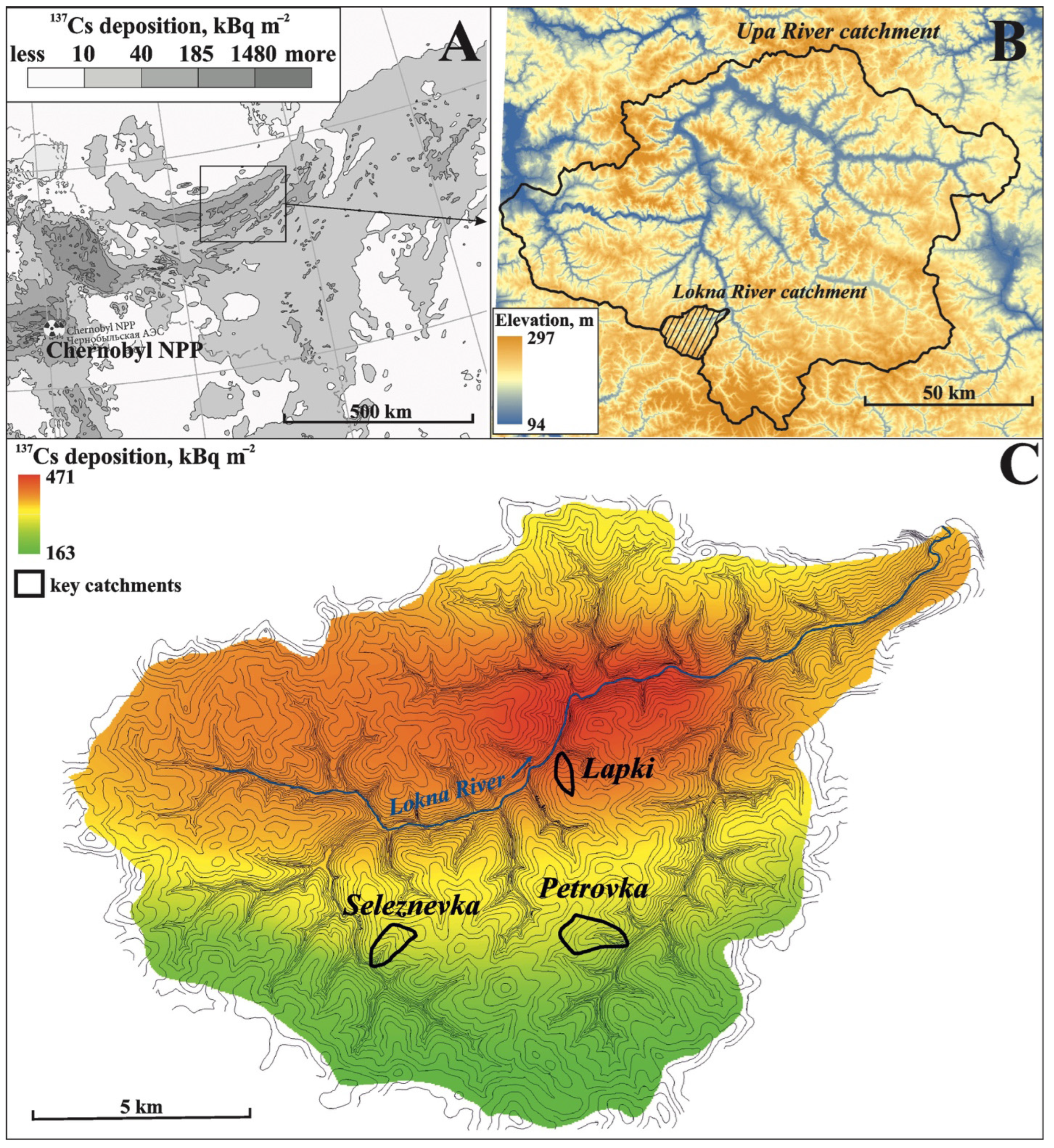
2.3. Key Catchments
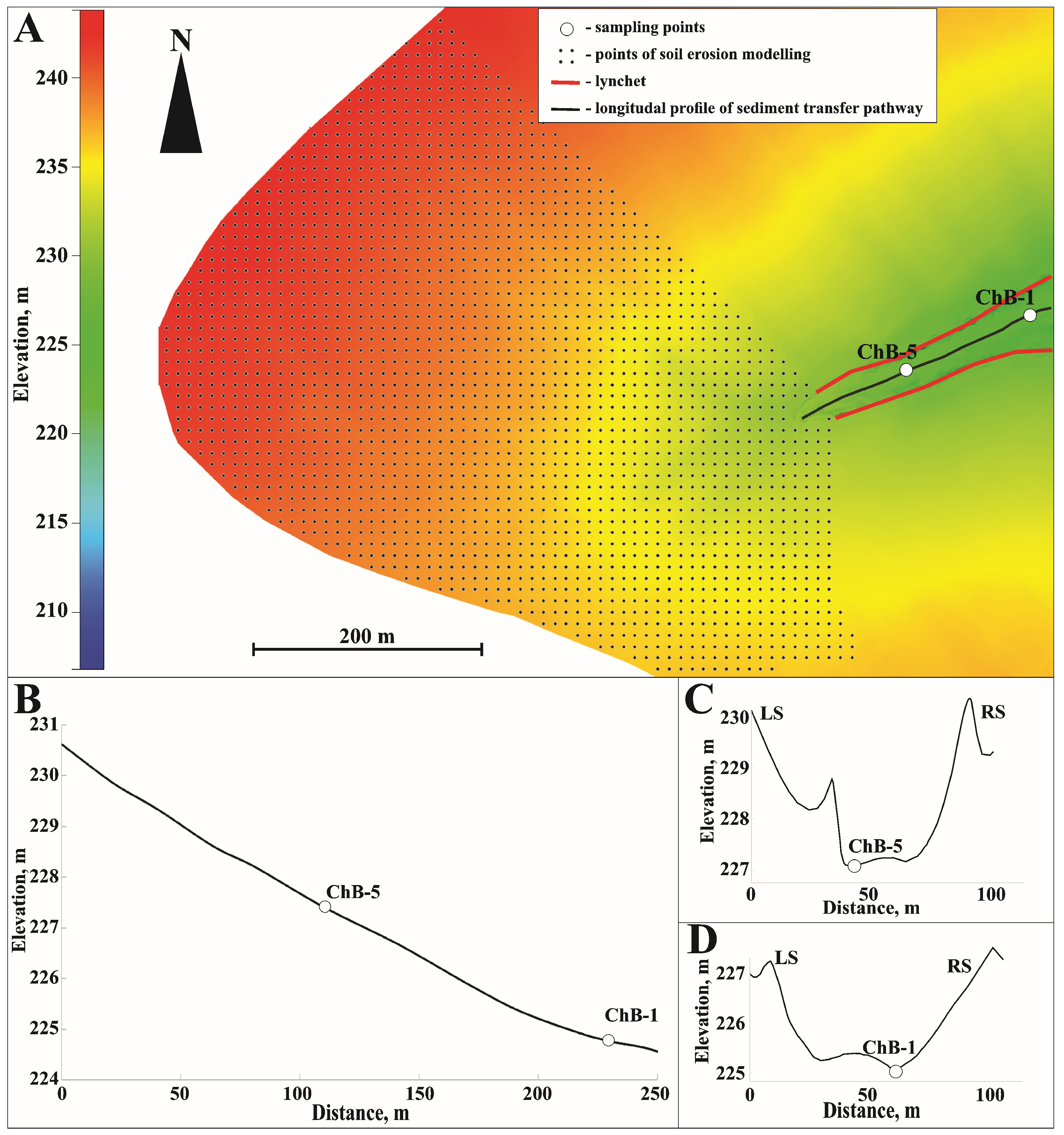
2.3.1. Petrovka Catchment
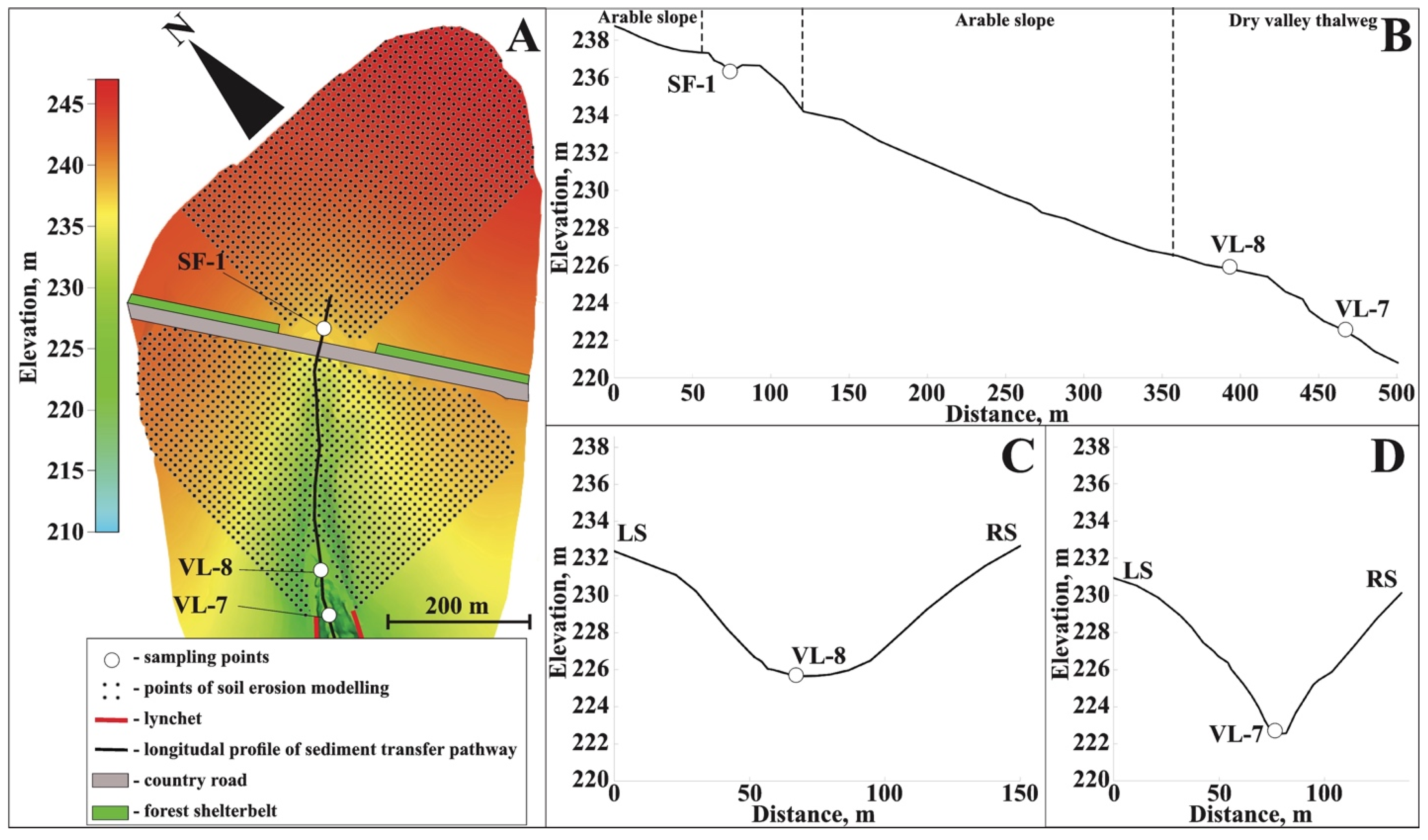
2.3.2. Seleznevka Catchment
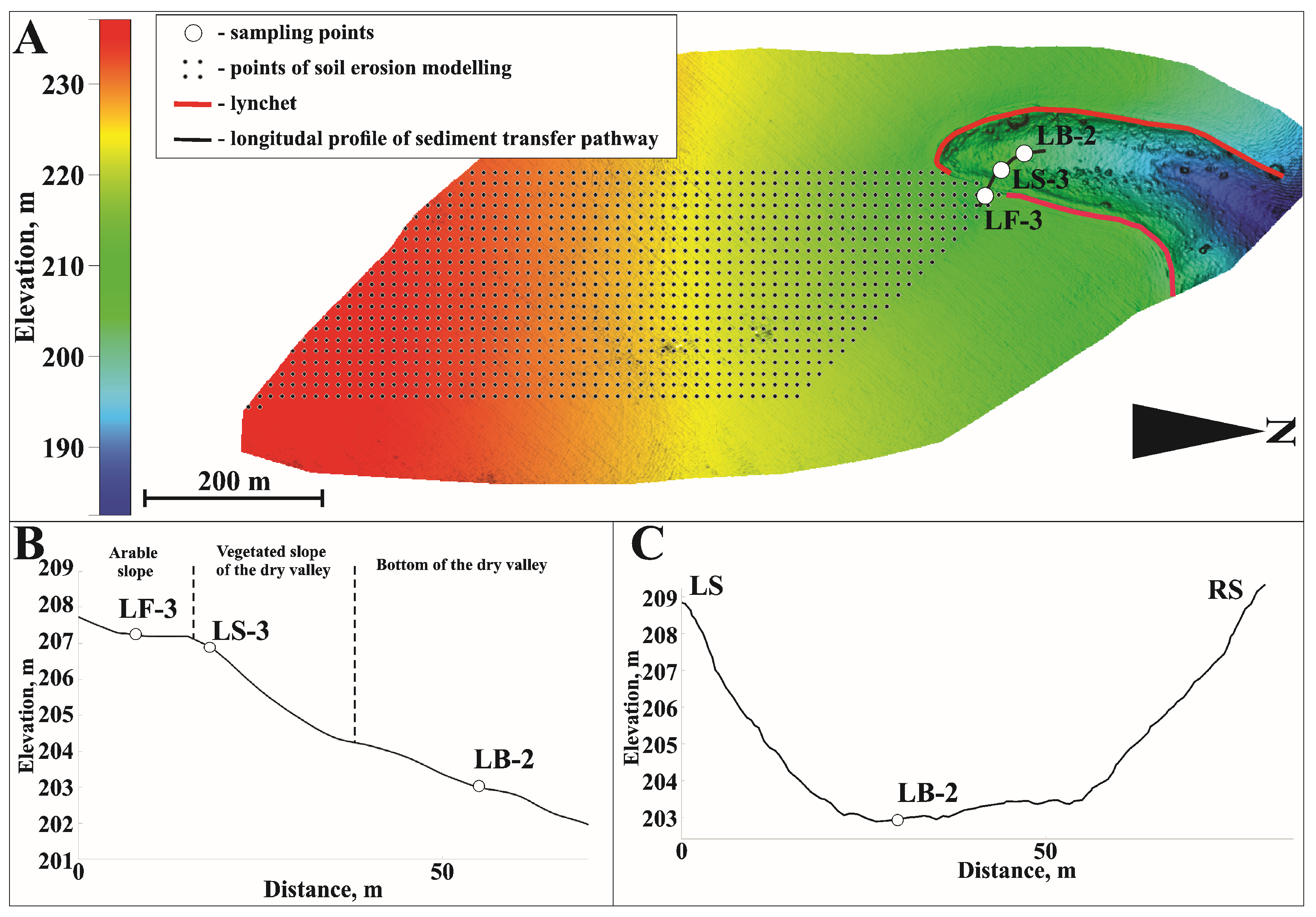
2.3.3. Lapki Catchment
3. Results
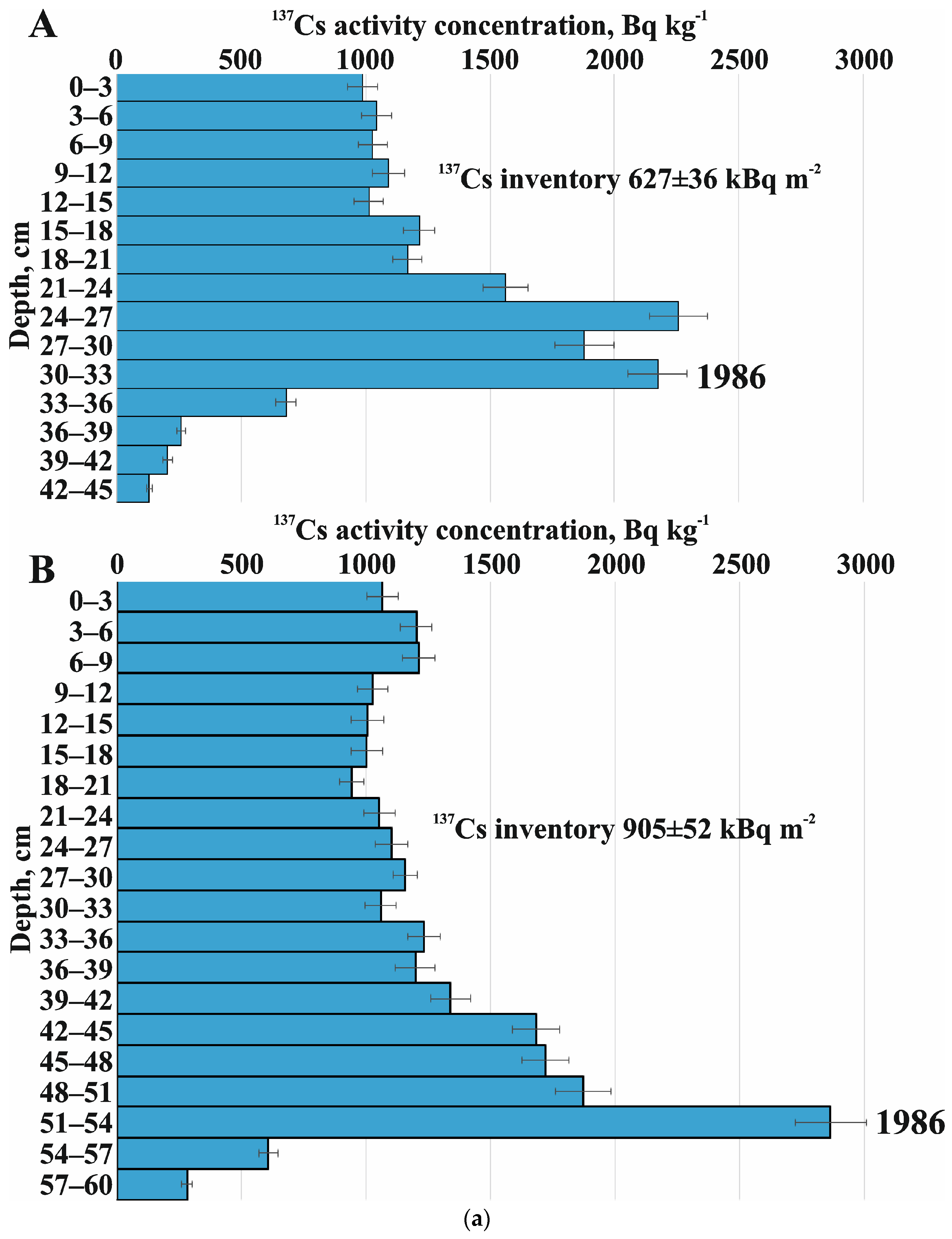
- The mixing of material before it leaves the source is adequate. This assumption can be indirectly supported by three facts. The first is the constant mixing of the material during tillage, which occurs in different directions from year to year. Second, given the microtopography of the explored area, slope runoff must be concentrated to overcome the lower boundary of cultivated fields [28]. This, in turn, leads to intensive mixing within the compact areas of the slope hollows and a limited number of sediment delivery paths [29]. The latter suggests that the desired samples may be collected at a few points near the lower boundary of the cultivated field.
- There are no significant changes in the sediment during transportation due to sorting and selective conveyance. The sorting of material by grain size is a common process that may occur during the delivery of the material. This process may seriously affect the concentration and inventory of radionuclides by altering the proportion of particles that have a greater or lesser ability to bind to radionuclides [41]. Clearly, the shorter the transportation distance, the lower the probability of the material being sorted. Hence, the proximity of the sampling point to the field is an important factor. However, examinations of the mechanical composition in the Lapki catchment area revealed no significant differences between eroded soil and deposited sediments [28,39,42].
- The sediment trap efficiency at the selected depositional sites should remain stable over the observation period to provide a homogeneous reflection of concentration variations in the depth distribution. This requirement is nearly impossible to fulfill because numerous factors influence the accumulation process, which may change over time. Even seemingly stable factors such as topography are expected to be altered as a result of the accumulation and uplift of the surface. To some extent, the only way to manage this issue is to collect and compare samples from different locations based on geomorphic features.
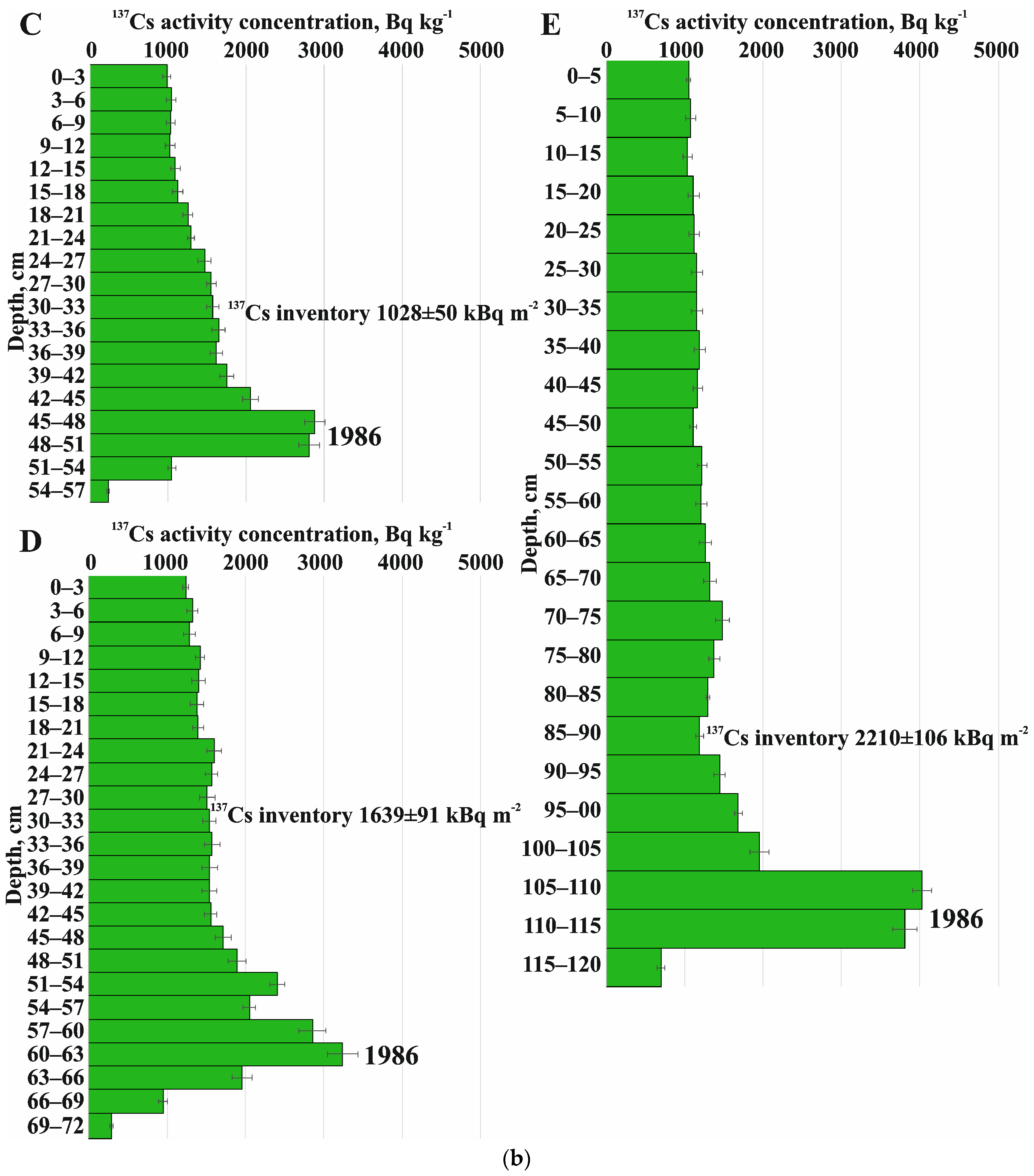
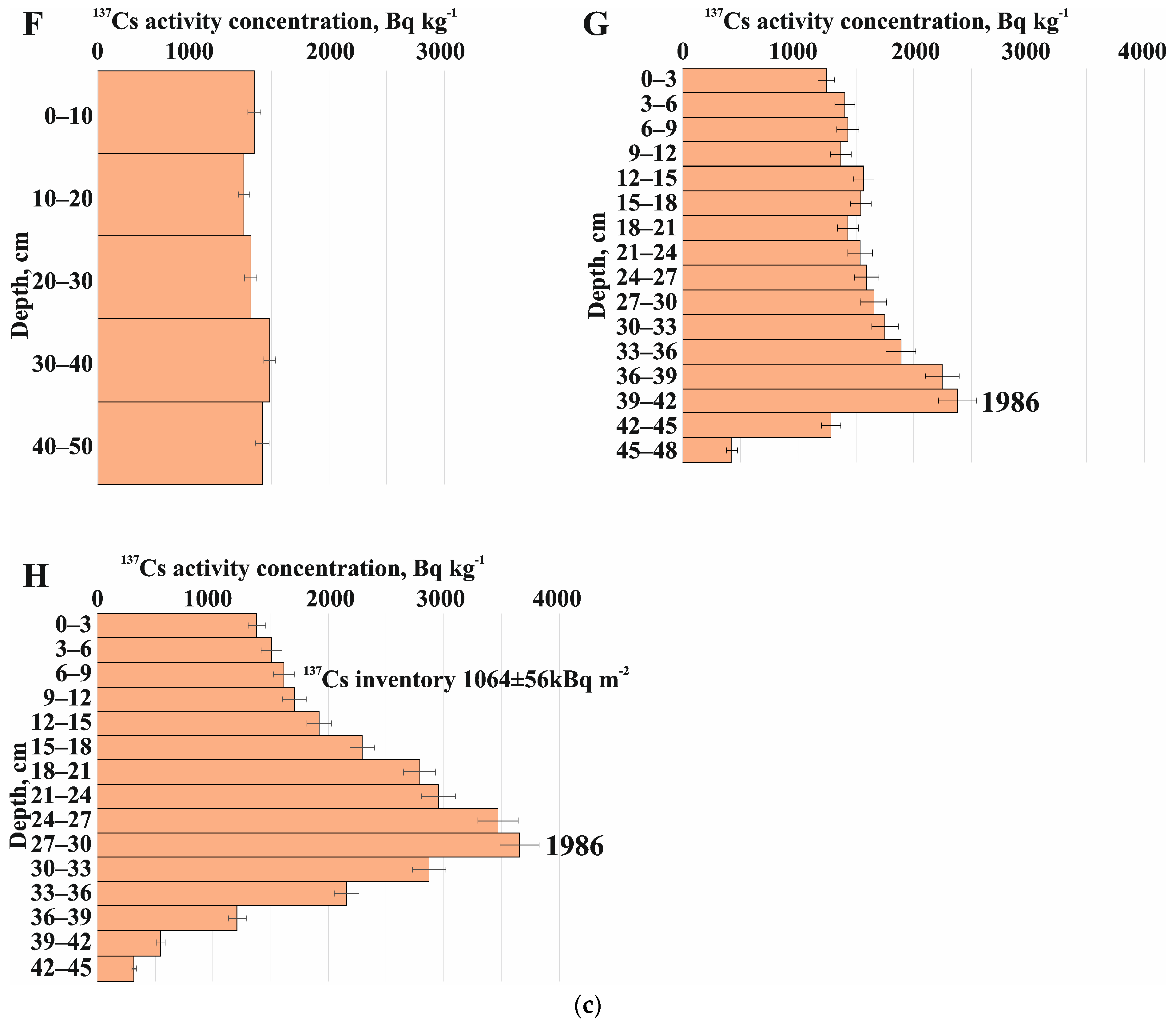
- After sediments are deposited, the depth distribution of 137Cs should not be altered to preserve the natural record of radionuclide migration. The main mechanisms of disturbance are the leaching and migration of radionuclides through the soil profile, bioturbation, and erosion. Repeated depth incremental sampling conducted in the Lapki catchment in 1997 and 2024 revealed that, after 27 years, the distribution smoothed [39]. Despite the high pH values of the chernozem and chernozem-like soils, the leaching of 137Cs was minor, and radionuclides migrated mostly in a bound form. This circumstance indicates that the interpretation of the obtained data may be biased, resulting in a slight decrease in the contrast of the original distribution. However, younger sediments are less affected than older sediments. The bioturbation process can be considered via detailed observation of the soil section before sampling. The obvious tracks of biota influence, such as mole holes or roots, serve as indicators for selecting the correct position for sampling. In addition, the presence of subhorizontal textures, which are typical of the sequential accumulation of sediments, can be used as evidence of a lack of mixing. The erosion of deposited sediments occurs mainly in the form of a linear incision into the bottom surface and is usually well defined morphologically. The most intense form of erosion is the incision of bottom gullies, which can result in the complete displacement of contaminated layers. Consequently, thoroughly examining the morphological features of the deposition site after a fallout event before determining the location of the sampling site is essential.
- Finally, the size of the samples during the depth incremental procedure is set arbitrarily (3–5 cm thick); therefore, the averaging of activity concentrations within selected depth intervals may affect the representation of the true distribution.
4. Discussion
4.1. Assumptions and Expectations
4.2. Interpretation of the 137Cs Depth Distribution
4.3. Long-Term Modeling of Particulate 137Cs Migration
5. Conclusions
- Depth incremental studies of accumulated products of accelerated erosion can be instrumental in understanding long-term trends in the transport of radionuclides in the environment. However, several factors may affect the depth distribution of 137Cs; thus, they should be carefully considered during planning, sampling, and interpretation. The consideration of geomorphic conditions at the sampling site is critical, as topography is the main factor that controls spatial heterogeneity in sediment displacement and accumulation processes.
- Soil tillage including deep plowing is the dominant factor in determining the decrease in the activity concentration of 137Cs in sediment runoff from agricultural slopes. However, owing to the lack of immediate remediation measures after the Chernobyl accident in areas distant from the power plant, the 137Cs content in the top layer of soil subjected to erosion is expected to remain relatively high. This led to intensive migration of particulate radionuclides shortly after fallout. During ordinary plowing, the downward trend became less significant, and further changes in activity concentration were primarily influenced by erosion.
- The thickness of the eroded upper soil has become large enough to allow the involvement of soil material from deeper layers during ordinary plowing. This may lead to a subsequent reduction in the 137Cs activity concentration. Future forecasts should be based on an understanding of accelerated erosion and its contributing factors, including climatic change and land use conversion.
Supplementary Materials
Author Contributions
Funding
Institutional Review Board Statement
Informed Consent Statement
Data Availability Statement
Acknowledgments
Conflicts of Interest
References
- Lal, R. Soil degradation by erosion. Land Deg. Dev. 2001, 12, 519–539. [Google Scholar] [CrossRef]
- García-Ruiz, J.M. The effects of land uses on soil erosion in Spain: A review. Catena 2010, 81, 1–11. [Google Scholar] [CrossRef]
- Haregeweyn, N.; Tsunekawa, A.; Nyssen, J.; Poesen, J.; Tsubo, M.; Tsegaye Meshesha, D.; Schütt, B.; Adgo, E.; Tegegne, F. Soil erosion and conservation in Ethiopia: A review. Progr. Phys. Geogr. 2015, 39, 750–774. [Google Scholar] [CrossRef]
- Hossini, H.; Karimi, H.; Mustafa, Y.T.; Al-Quraishi, A.M.F. Role of effective factors on soil erosion and land degradation: A review. In Environmental Degradation in Asia: Land Degradation, Environmental Contamination, and Human Activities; Springer Nature: Cham, Switzerland, 2022; pp. 221–235. [Google Scholar] [CrossRef]
- Quinton, J.N.; Fiener, P. Soil erosion on arable land: An unresolved global environmental threat. Prog. Phys. Geogr. Earth Env. 2024, 48, 136–161. [Google Scholar] [CrossRef]
- Van der Perk, M.; Jetten, V.G. The use of a simple sediment budget model to estimate long-term contaminant export from small catchments. Geomorphology 2006, 79, 3–12. [Google Scholar] [CrossRef]
- Rashmi, I.; Karthika, K.S.; Roy, T.; Shinoji, K.C.; Kumawat, A.; Kala, S.; Pal, R. Soil Erosion and sediments: A source of contamination and impact on agriculture productivity. In Agrochemicals in Soil and Environment: Impacts and Remediation; Springer Nature: Singapore, 2022; pp. 313–345. [Google Scholar] [CrossRef]
- Sharma, K.; Rajan, S.; Nayak, S.K. Water pollution: Primary sources and associated human health hazards with special emphasis on rural areas. In Water Resources Management for Rural Development; Elsevier: Amsterdam, The Netherlands, 2024; pp. 3–14. [Google Scholar] [CrossRef]
- International Atomic Energy Agency. Guidelines for Agricultural Countermeasures Following an Accidental Release of Radionuclides: A Joint Undertaking by the IAEA and FAO; International Atomic Energy Agency: Vienna, Austria, 1994. [Google Scholar]
- Howard, B.J.; Fesenko, S.; Balonov, M.; Pröhl, G.; Nakayama, S. A comparison of remediation after the Chernobyl and Fukushima Daiichi accidents. Rad. Protect. Dos. 2017, 173, 170–176. [Google Scholar] [CrossRef]
- Beresford, N.A.; Fesenko, S.; Konoplev, A.; Skuterud, L.; Smith, J.T.; Voigt, G. Thirty years after the Chernobyl accident: What lessons have we learnt? J. Environ. Radioact. 2016, 157, 77–89. [Google Scholar] [CrossRef]
- Konoplev, A.; Golosov, V.; Laptev, G.; Nanba, K.; Onda, Y.; Takase, T.; Wakiyama, Y.; Yoshimura, K. Behavior of accidentally released radiocesium in soil–water environment: Looking at Fukushima from a Chernobyl perspective. J. Environ. Radioact. 2016, 151, 568–578. [Google Scholar] [CrossRef]
- Evrard, O.; Laceby, J.P.; Nakao, A. Effectiveness of landscape decontamination following the Fukushima nuclear accident: A review. Soil 2019, 5, 333–350. [Google Scholar] [CrossRef]
- Fan, S.; Nasu, K.; Takeuchi, Y.; Fukuda, M.; Arai, H.; Taniguchi, K.; Onda, Y. Transport of radioactive materials from terrestrial to marine environments in Fukushima over the past decade. Pure Appl. Chem. 2024, 96, 987–1004. [Google Scholar] [CrossRef]
- Krishnaswamy, S.; Lal, D.; Martin, J.M.; Meybeck, M. Geochronology of lake sediments. Earth Planet. Sci. Let. 1971, 11, 407–414. [Google Scholar] [CrossRef]
- Walling, D.E. Use of 137Cs and Other Fallout Radionuclide in Soil Erosion Investigations: Progress, Problems and Prospects; №. IAEA-TECDOC—1028; University of Exeter: Exeter, UK, 1998; pp. 39–62. [Google Scholar]
- Zapata, F. The use of environmental radionuclides as tracers in soil erosion and sedimentation investigations: Recent advances and future developments. Soil Till. Res. 2003, 69, 3–13. [Google Scholar] [CrossRef]
- Foucher, A.; Chaboche, P.A.; Sabatier, P.; Evrard, O. A worldwide meta-analysis (1977–2020) of sediment core dating using fallout radionuclides including 137Cs and 210Pbxs. Earth Sys. Sci. Data Discuss. 2021, 13, 4951–4966. [Google Scholar] [CrossRef]
- Kurikami, H.; Kitamura, A.; Yokuda, S.T.; Onishi, Y. Sediment and 137Cs behaviors in the Ogaki Dam Reservoir during a heavy rainfall event. J. Environ. Radioact. 2014, 137, 10–17. [Google Scholar] [CrossRef] [PubMed]
- Funaki, H.; Yoshimura, K.; Sakuma, K.; Iri, S.; Oda, Y. Evaluation of particulate 137Cs discharge from a mountainous forested catchment using reservoir sediments and sinking particles. J. Environ. Radioact. 2019, 210, 105814. [Google Scholar] [CrossRef]
- Konoplev, A.V.; Ivanov, M.M.; Golosov, V.N.; Konstantinov, E.A. Reconstruction of long-term dynamics of Chernobyl-derived 137Cs in the Upa River using bottom sediments in the Scheckino reservoir and semi-empirical modelling. PIAHS 2019, 381, 95–99. [Google Scholar] [CrossRef]
- Ivanov, M.M.; Golosov, V.; Konoplev, A.; Ivanova, N. Floodplain contamination as a proxy for long-term changes in Chernobyl-derived 137Cs in river basin. J. Environ. Manag. 2025, 391, 126558. [Google Scholar] [CrossRef]
- Ivanov, M.M.; Golosov, V.N.; Ivanova, N.N.; Fominykh, P.I. Geochemical Indication of Sediment Fluxes Using Chernobyl-Derived 137Cs: The Case Study of a Small Agricultural Catchment in the Tula Region, Central Russia. Geogr. Environ. Sustain. 2025, 18, 59–67. [Google Scholar] [CrossRef]
- Peel, M.C.; Finlayson, B.L.; McMahon, T.A. Updated world map of the Köppen-Geiger climate classification. Hydr. Earth Sys. Sci. 2007, 11, 1633–1644. [Google Scholar] [CrossRef]
- Barabanov, A.T. Regularities in the formation of surface flow of snowmelt water from plowed lands of different types in the forest-steppe and steppe parts of the don and Volga basins. Water Res. 2020, 47, 968–976. [Google Scholar] [CrossRef]
- Ivanov, M.M.; Ivanova, N.; Golosov, V. Sediment and particulate 137Cs budget studies in Upa River basin: History, results, and prospects. Land 2023, 12, 175. [Google Scholar] [CrossRef]
- Izrael, Y.A.; De Cort, M.; Jones, A.R.; Nazarov, I.M.; Fridman, S.D.; Kvasnikova, E.V.; Stukin, E.D.; Kelly, G.N.; Matveenko, I.I.; Pokumeiko, Y.M.; et al. The atlas of cesium-137 contamination of Europe after the Chernobyl accident. In Proceedings of the First International Conference the Radiological Consequences of the Chernobyl Accident, Minsk, Belarus, 18–22 March 1996. [Google Scholar]
- Panin, A.V.; Walling, D.E.; Golosov, V.N. The role of soil erosion and fluvial processes in the post-fallout redistribution of Chernobyl-derived caesium-137: A case study of the Lapki catchment, Central Russia. Geomorphology 2001, 40, 185–204. [Google Scholar] [CrossRef]
- Ivanov, M.M.; Ivanova, N.N.; Krasnov, S.F. The role of lynchets in the redistribution of products of anthropogenic soil erosion. Mos. Univers. Soil Sci. Bull. 2024, 79, 298–305. [Google Scholar] [CrossRef]
- Curwen, E.C. The plough and the origin of strip-lynchets. Antiquity 1939, 13, 45–52. [Google Scholar] [CrossRef]
- Sillar, B. West Dean 2008: Excavation of Bronze Age lynchets on Little Combes Hill. Arch. Internat. 2007, 11, 54–57. [Google Scholar] [CrossRef]
- Froehlicher, L.; Schwartz, D.; Ertlen, D.; Trautmann, M. Hedges, colluvium and lynchets along a reference toposequence (Habsheim, Alsace, France): History of erosion in a loess area. Quaternaire. Rev. De L’association Française Pour L’étude Du Quat. 2016, 27, 173–185. [Google Scholar] [CrossRef]
- Brown, A.; Walsh, K.; Fallu, D.; Cucchiaro, S.; Tarolli, P. European agricultural terraces and lynchets: From archaeological theory to heritage management. World Archaeol. 2020, 52, 566–588. [Google Scholar] [CrossRef] [PubMed]
- Koshovskii, T.S.; Zhidkin, A.P.; Gennadiev, A.N.; Ivanova, N.N. Diagnostics, genesis, and localization of pedosediments within a small catchment (Central Russian Upland). Euras. Soil Sci. 2019, 52, 481–493. [Google Scholar] [CrossRef]
- Svetlichnyi, A.A.; Pyatkova, A.V.; Plotnitskii, S.V.; Golosov, V.N.; Zhilkin, A.V. Problem of verification of spatially distributed mathematical models of water erosion of soils. Visn. Odes. Nats. Univ. Ser. Geogr. Geol. Nauki 2013, 18, 38–49. [Google Scholar] [CrossRef]
- Svetlitchnyi, A.A.; Piatkova, A.V. Spatially distributed GIS-realized mathematical model of rainstorm erosion losses of soil. J. Geol. Geogr. Geoecol. 2019, 28, 562–571. [Google Scholar] [CrossRef] [PubMed]
- Wischmeier, W.H.; Smith, D.D. Predicting rainfall erosion losses. In Agricultural Handbook; US Department of Agriculture: Washington, DC, USA, 1978. [Google Scholar]
- Larionov, G.A. Soil Erosion and Deflation; MSU: Moscow, Russia, 1993; p. 198. (In Russian) [Google Scholar]
- Ivanov, M.M.; Usacheva, A.; Ivanova, N.; Golosov, V. Long-term changes in Chernobyl 137Cs inventories in a small agricultural catchment explored from complex resampling campaign. Environ. Res. 2025, 285, 122370. [Google Scholar] [CrossRef]
- Walling, D.E.; Golosov, V.N.; Panin, A.V.; He, Q. Use of radiocaesium to investigate erosion and sedimentation in areas with high levels of Chernobyl fallout. In Tracers in Geomorphology; John Wiley & Sons: Hoboken, NJ, USA, 2000; pp. 183–200. [Google Scholar]
- He, Q.; Walling, D.E. Interpreting particle size effects in the adsorption of 137Cs and unsupported 210Pb by mineral soils and sediments. J. Environ. Radioact. 1996, 30, 117–137. [Google Scholar] [CrossRef]
- Golosov, V.; Walling, D.; Panin, A. Post-fallout redistribution of Chernobyl-derived. In Proceedings of a Symposium “The Role of Erosion and Sediment Transport in Nutrient and Contaminant Transfer“, Held at Waterloo, ON, Canada, 10–14 July 2000; IAHS Publishing: Wallingford, UK, 2000; Volume 263, pp. 49–57. [Google Scholar]
- Konoplev, A.V.; Bobovnikova, T.I. Comparative analysis of chemical forms of long-lived radionuclides and their migration and transformation in the environment following the Kyshtym and Chernobyl accidents. In Seminar on Comparative Assessment of the Environmental Impact of Radionuclides Released During Three Major Nuclear Accidents: Kyshtym, Windscale, Chernobyl; No. EUR--13574 (V. 1); Institute of Experimental Meteorology ’Typhoon’ Science and Production Organization: Obninsk, USSR, 1991; Volume 1, pp. 371–396. [Google Scholar]
- Alexakhin, R.M. Countermeasures in agricultural production as an effective means of mitigating the radiological consequences of the Chernobyl accident. Sci. of Tot. Envir. 1993, 137, 9–20. [Google Scholar] [CrossRef]
- Alexakhin, R.M.; Sanzharova, N.I.; Fesenko, S.V.; Spiridonov, S.I.; Panov, A.V. Chernobyl radionuclide distribution, migration, and environmental and agricultural impacts. Health Phys. 2007, 93, 418–426. [Google Scholar] [CrossRef]
- Izrael, J.A. Chernobyl: The past and forecast for the future [Chernobyl’: Proshloe i prognoz na budushhee]. Pravda March 1989, 20. (In Russian) [Google Scholar]
- Golosov, V.N. Special considerations for areas affected by Chernobyl fallout. In Handbook for the Assessment of Soil Erosion and Sedimentation Using Environmental Radionuclides; Springer: Dordrecht, The Netherlands, 2002; pp. 165–183. [Google Scholar] [CrossRef]
- He, Q.; Walling, D.E. The distribution of fallout 137Cs and 210Pb in undisturbed and cultivated soils. Appl. Rad. Isotop. 1997, 48, 677–690. [Google Scholar] [CrossRef]
- Arata, L.; Meusburger, K.; Frenkel, E.; A’Campo-Neuen, A.; Iurian, A.R.; Ketterer, M.E.; Mabit, L.; Alewell, C. Modelling Deposition and Erosion rates with RadioNuclides (MODERN)–Part 1: A new conversion model to derive soil redistribution rates from inventories of fallout radionuclides. J. Environ. Radioact. 2016, 162, 45–55. [Google Scholar] [CrossRef]
- Barabanov, A.T.; Dolgov, S.V.; Koronkevich, N.I.; Panov, V.I.; Petel’ko, A.I. Surface runoff and snowmelt infiltration into the soil on plowlands in the forest-steppe and steppe zones of the east European plain. Eur. Soil Sci. 2018, 51, 66–72. [Google Scholar] [CrossRef]
- Khanbilvardi, R.; Shestopalov, V.; Onishchenko, I.; Bublyas, V.; Gudzenko, V. Role of Erosion Processes in Transfer of Radionuclides: Results of Field Experiments. J. Am. Water Resour. Assoc. 1999, 35, 887–898. [Google Scholar] [CrossRef]
- Garcia-Sanchez, L.; Konoplev, A.; Bulgakov, A. Radionuclide entrainment coefficients by wash-off derived from plot experiments near Chernobyl. Radioprotection 2005, 40, 519–524. [Google Scholar] [CrossRef]
- Bulgakov, A.A.; Konoplev, A.V.; Popov, V.Y.; Shcherbak, A.V. Removal of long-lived radionuclides from the soil by surface runoff near the Chernobyl Nuclear Power Station. Sov. Soil Sci. Pochvovedeniye 1991, 23, 124–131. [Google Scholar]
- Bulgakov, A.A.; Konoplev, A.V.; Shveikin, Y.V.; Scherbak, A.V. Experimental Study and Prediction of Dissolved Radionuclide Wash-off by Surface Runoff from Nonagricultural Watersheds Contaminated Forests; Springer: Dordrecht, The Netherlands, 1999; pp. 103–112. [Google Scholar] [CrossRef]
- Konoplev, A.V.; Bulgakov, A.A.; Popov, V.E.; Popov, O.F.; Scherbak, A.V.; Shveikin, Y.V.; Hoffman, F.O. Model testing using Chernobyl data: I. Wash-off of 90Sr and 137Cs from two experimental plots established in the vicinity of the Chernobyl reactor. Health Phys. 1996, 70, 8–12. [Google Scholar] [CrossRef]
- Wakiyama, Y.; Onda, Y.; Yoshimura, K.; Igarashi, Y.; Kato, H. Land use types control solid wash-off rate and entrainment coefficient of Fukushima-derived 137Cs, and their time dependence. J. Environ. Radioact. 2019, 210, 105990. [Google Scholar] [CrossRef]
- Onda, Y.; Hayashi, S.; Nagao, S. Catchments and Rivers Chapter 6; No. IAEA-TECDOC—1927; International Atomic Energy Agency (IAEA): Vienna, Austria, 2020; pp. 179–227. [Google Scholar]
- Igarashi, Y.; Onda, Y.; Wakiyama, Y.; Yoshimura, K.; Kato, H.; Kozuka, S.; Manome, R. Impacts of freeze—Thaw processes and subsequent runoff on 137Cs washoff from bare land in Fukushima. Sci. Total Environ. 2021, 769, 144706. [Google Scholar] [CrossRef]
- Yoshimura, K.; Onda, Y.; Kato, H. Evaluation of radiocaesium wash-off by soil erosion from various land uses using USLE plots. J. Environ. Radioact. 2015, 139, 362–369. [Google Scholar] [CrossRef]
- Bulgakov, A.A.; Konoplev, A.V.; Kanivets, V.V.; Voitsekhovich, O.V. Modeling the long-term dynamics of radionuclides in rivers. Radioprotection 2002, 37, 649–654. [Google Scholar] [CrossRef]
- Garcia-Sanchez, L.; Konoplev, A.V. Watershed wash-off of atmospherically deposited radionuclides: A review of normalized entrainment coefficients. J. Environ. Radioact. 2009, 100, 774–778. [Google Scholar] [CrossRef]
- Iwasaki, T.; Nabi, M.; Shimizu, Y.; Kimura, I. Computational modeling of 137Cs contaminant transfer associated with sediment transport in Abukuma River. J. Environ. Radioact. 2015, 139, 416–426. [Google Scholar] [CrossRef]
- Konoplev, A.; Kanivets, V.; Zhukova, O.; Germenchuk, M.; Derkach, H. Mid-to long-term radiocesium wash-off from contaminated catchments at Chernobyl and Fukushima. Wat. Res. 2021, 188, 116514. [Google Scholar] [CrossRef] [PubMed]
- Vetrov, V.A.; Alexeenko, V.A.; Poslovin, A.L.; Chereminisov, A.A.; Nikitin, A.A.; Bovkun, L.A. Radionuclide washout from natural catchments in the Dnieper River basin. J. Hydrol. Meteorol. 1990, 2, 120–123. [Google Scholar]
- Evrard, O.; Laceby, J.P.; Lepage, H.; Onda, Y.; Cerdan, O.; Ayrault, S. Radiocesium transfer from hillslopes to the Pacific Ocean after the Fukushima Nuclear Power Plant accident: A review. J. Environ. Radioact. 2015, 148, 92–110. [Google Scholar] [CrossRef] [PubMed]
- Lepage, H.; Laceby, J.P.; Bonté, P.; Joron, J.L.; Onda, Y.; Lefèvre, I.; Ayrault, S.; Evrard, O. Investigating the source of radiocesium contaminated sediment in two Fukushima coastal catchments with sediment tracing techniques. Anthropocene 2016, 13, 57–68. [Google Scholar] [CrossRef]
- Iwagami, S.; Onda, Y.; Tsujimura, M.; Abe, Y. Contribution of radioactive 137Cs discharge by suspended sediment, coarse organic matter, and dissolved fraction from a headwater catchment in Fukushima after the Fukushima Dai-ichi Nuclear Power Plant accident. J. Environ. Radioact. 2017, 166, 66–474. [Google Scholar] [CrossRef]
- Kuznetsov, V.K.; Sanzharova, N.I.; Knyazeva, E.P.; Grunskaya, V.P.; Krechetnikova, E.O. Migration of 137Cs in soils of erosional agricultural landscapes in the northern part of the forest-steppe zone. Euras. Soil Sci. 2025, 58, 37. [Google Scholar] [CrossRef]
- Mouri, G.; Golosov, V.; Shiiba, M.; Hori, T. Assessment of the caesium-137 flux adsorbed to suspended sediment in a reservoir in the contaminated Fukushima region in Japan. Environ. Pollut. 2014, 187, 31–41. [Google Scholar] [CrossRef]
- Kinouchi, T.; Yoshimura, K.; Omata, T. Modeling radiocesium transport from a river catchment based on a physically based distributed hydrological and sediment erosion model. J. Environ. Radioact. 2015, 139, 407–415. [Google Scholar] [CrossRef]
- Delmas, M.; Garcia-Sanchez, L.; Nicoulaud-Gouin, V.; Onda, Y. Improving transfer functions to describe radiocesium wash-off fluxes for the Niida River by a Bayesian approach. J. Envir. Radioact. 2017, 167, 100–109. [Google Scholar] [CrossRef] [PubMed]
- Ikenoue, T.; Shimadera, H.; Nakanishi, T.; Kondo, A. Thirty-year simulation of environmental fate of 137Cs in the Abukuma River basin considering the characteristics of 137Cs behavior in land uses. Sci. Total Environ. 2023, 876, 162846. [Google Scholar] [CrossRef] [PubMed]
- Guillory, F.; Lepage, H.; Sauvage, S.; Sánchez, J.M.; Fabre, C.; Boyer, P.; Mourrier, D. Soil-to-river Cesium-137 transfer in a catchment coupling the SWAT model and a mass balance equation. J. Environ. Radioact. 2026, 291, 107849. [Google Scholar] [CrossRef]



| Sampling Point | Slope Angle in Sampling Point * | Distance from the Cultivated Field, m | Upslope Catchment Area, 103 m2 |
|---|---|---|---|
| ChB-5 | 1.5 | 105 | 271.2 |
| ChB-1 | 0.7 | 223 | |
| SF-1 | 0.4 | 20 | 133.6 |
| VL-8 | 0.9 | 94 | 266.8 ** |
| VL-7 | 2.6 | 193 | |
| LF-3 | 0.5 | 0 | 102.2 |
| LS-3 | 6.9 | 8 | |
| LB-2 | 4.2 | 55 |
| Section | Mean Rate of Erosion Upslope | 137Cs Activity Concentration, Bq kg−1 | >1986/ 2022–2025 | ||
|---|---|---|---|---|---|
| Shortly After Fallout (>1986) | Surface Layer (<2022–2025) | Range | |||
| ChB-5 | 3.6 | 1878.9 | 987.9 | 1268.4 | 1.9 |
| ChB-1 | 3.6 | 1871.7 | 1065.7 | 930.5 | 1.76 |
| SF-1 | >2.6 | 2883.8 | 991.5 | 1892.3 | 2.91 |
| VL-8 | >7.6 | 2858.7 | 1243.3 | 1615.4 | 2.3 |
| VL-7 | >7.6 | 4031 | 1053 | 2978 | 3.83 |
| LS-3 | 15.5 | 2246.1 | 1241.8 | 1004.3 | 1.81 |
| LB-2 | 15.5 | 3469.5 | 1380.3 | 2089.2 | 2.51 |
Disclaimer/Publisher’s Note: The statements, opinions and data contained in all publications are solely those of the individual author(s) and contributor(s) and not of MDPI and/or the editor(s). MDPI and/or the editor(s) disclaim responsibility for any injury to people or property resulting from any ideas, methods, instructions or products referred to in the content. |
© 2026 by the authors. Licensee MDPI, Basel, Switzerland. This article is an open access article distributed under the terms and conditions of the Creative Commons Attribution (CC BY) license.
Share and Cite
Ivanov, M.M.; Fominykh, P.; Ivanova, N.; Krasnov, S.; Golosov, V. The Long-Term Dynamics of the Particulate 137Cs Supply from Eroded Arable Slopes During the Post-Chernobyl Period. Toxics 2026, 14, 344. https://doi.org/10.3390/toxics14040344
Ivanov MM, Fominykh P, Ivanova N, Krasnov S, Golosov V. The Long-Term Dynamics of the Particulate 137Cs Supply from Eroded Arable Slopes During the Post-Chernobyl Period. Toxics. 2026; 14(4):344. https://doi.org/10.3390/toxics14040344
Chicago/Turabian StyleIvanov, Maksim M., Polina Fominykh, Nadezhda Ivanova, Sergei Krasnov, and Valentin Golosov. 2026. "The Long-Term Dynamics of the Particulate 137Cs Supply from Eroded Arable Slopes During the Post-Chernobyl Period" Toxics 14, no. 4: 344. https://doi.org/10.3390/toxics14040344
APA StyleIvanov, M. M., Fominykh, P., Ivanova, N., Krasnov, S., & Golosov, V. (2026). The Long-Term Dynamics of the Particulate 137Cs Supply from Eroded Arable Slopes During the Post-Chernobyl Period. Toxics, 14(4), 344. https://doi.org/10.3390/toxics14040344