
From Analysis to Assessment: Machine Learning for Non-Target Screening of Pollutants Using Chromatography Coupled with (Ion Mobility) Mass Spectrometry


Abstract
1. Introduction
2. Machine Learning Workflow Currently Used in NTS
2.1. Common Learning Algorithms Used in NTS
2.1.1. Supervised Learning Algorithms
2.1.2. Unsupervised Learning Algorithms
2.1.3. Semi-Supervised Learning Algorithms
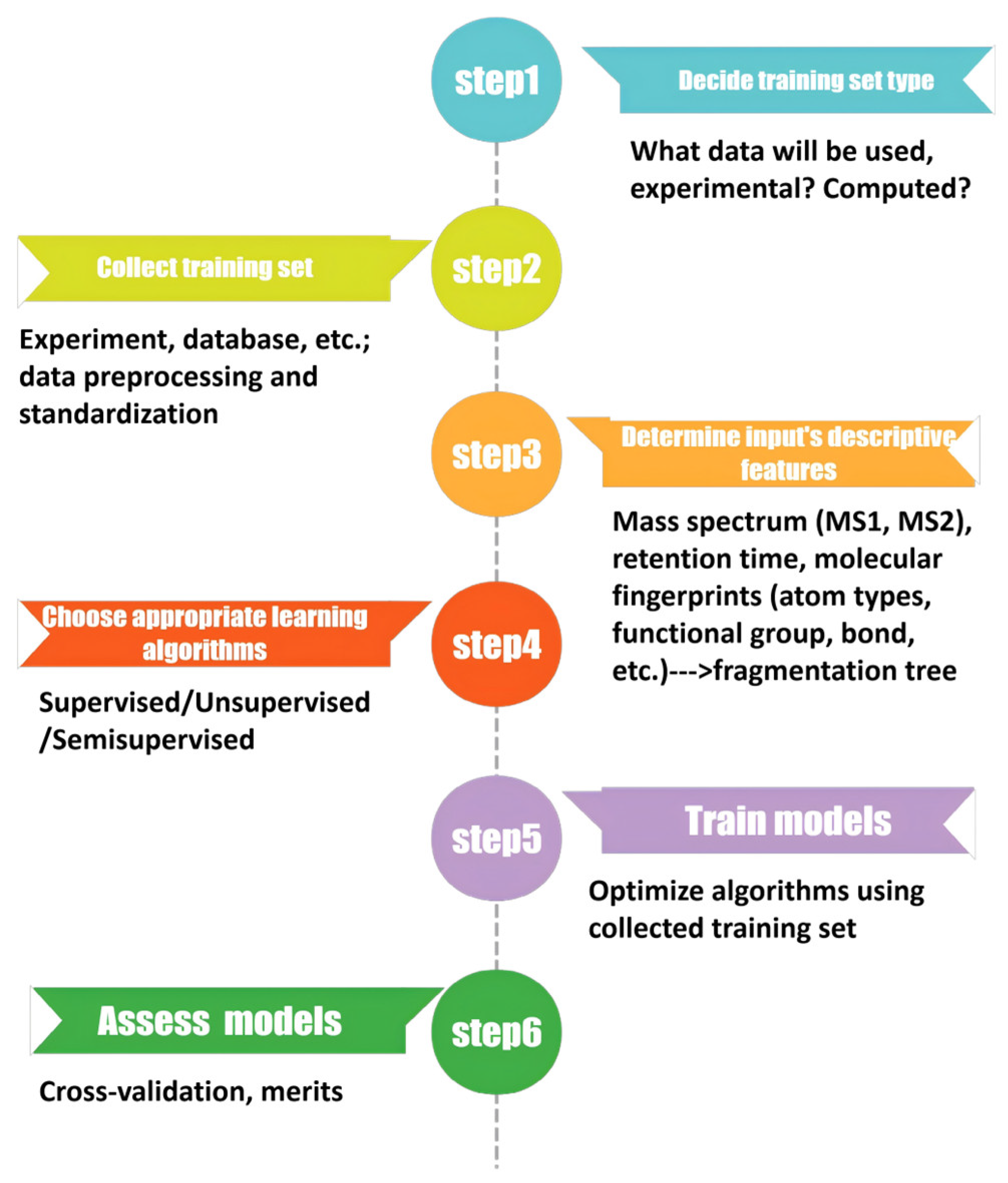
2.2. Workflow of NTS with Machine Learning Involved
2.2.1. Defining the Learning Objective and Data Type
2.2.2. Collecting and Preprocessing the Data
2.2.3. Selecting and Constructing Meaningful Descriptors or Features
2.2.4. Choosing Appropriate Learning Algorithms
2.2.5. Training and Validating the Model
2.2.6. Evaluating Model Performance
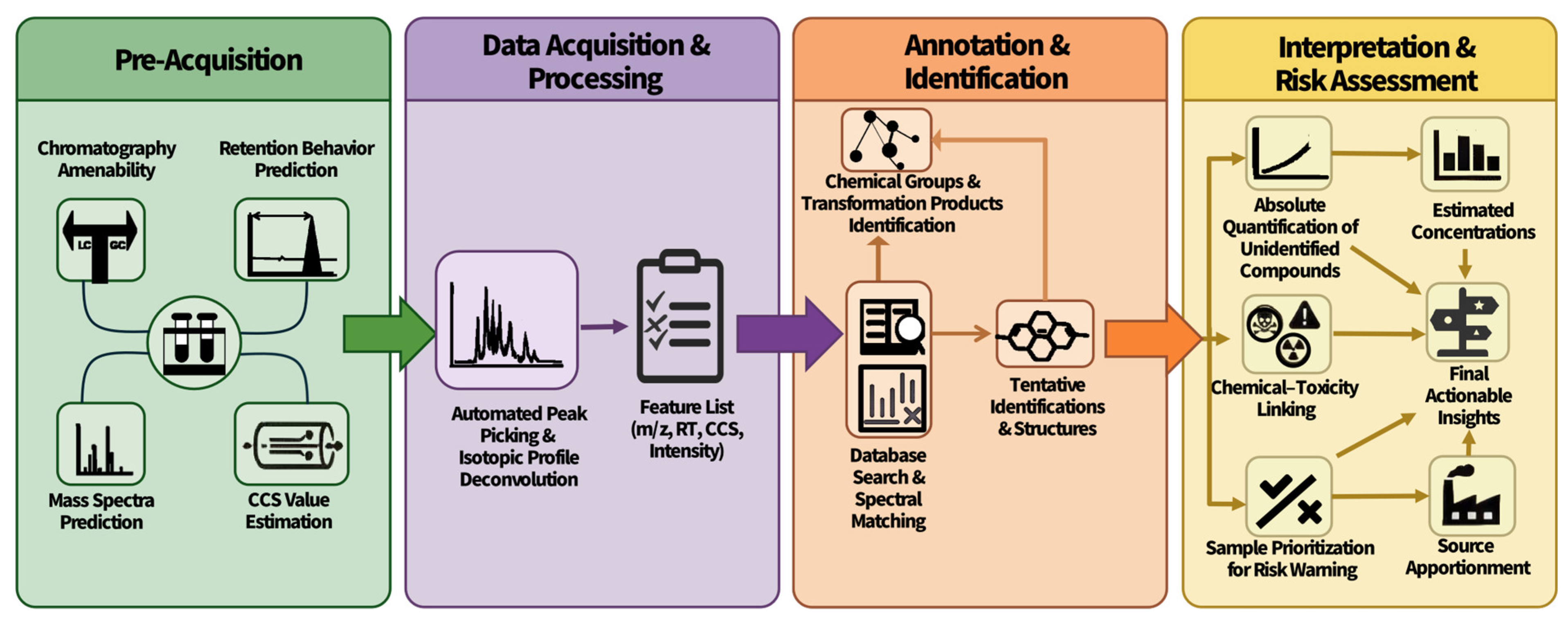
3. Machine Learning Functions Currently Used in NTS
3.1. Chromatography Amenability Prediction
3.2. Prediction of Chromatographic Retention Behavior
3.3. Mass Spectral Prediction and Structure Annotation
3.4. CCS Value Estimation
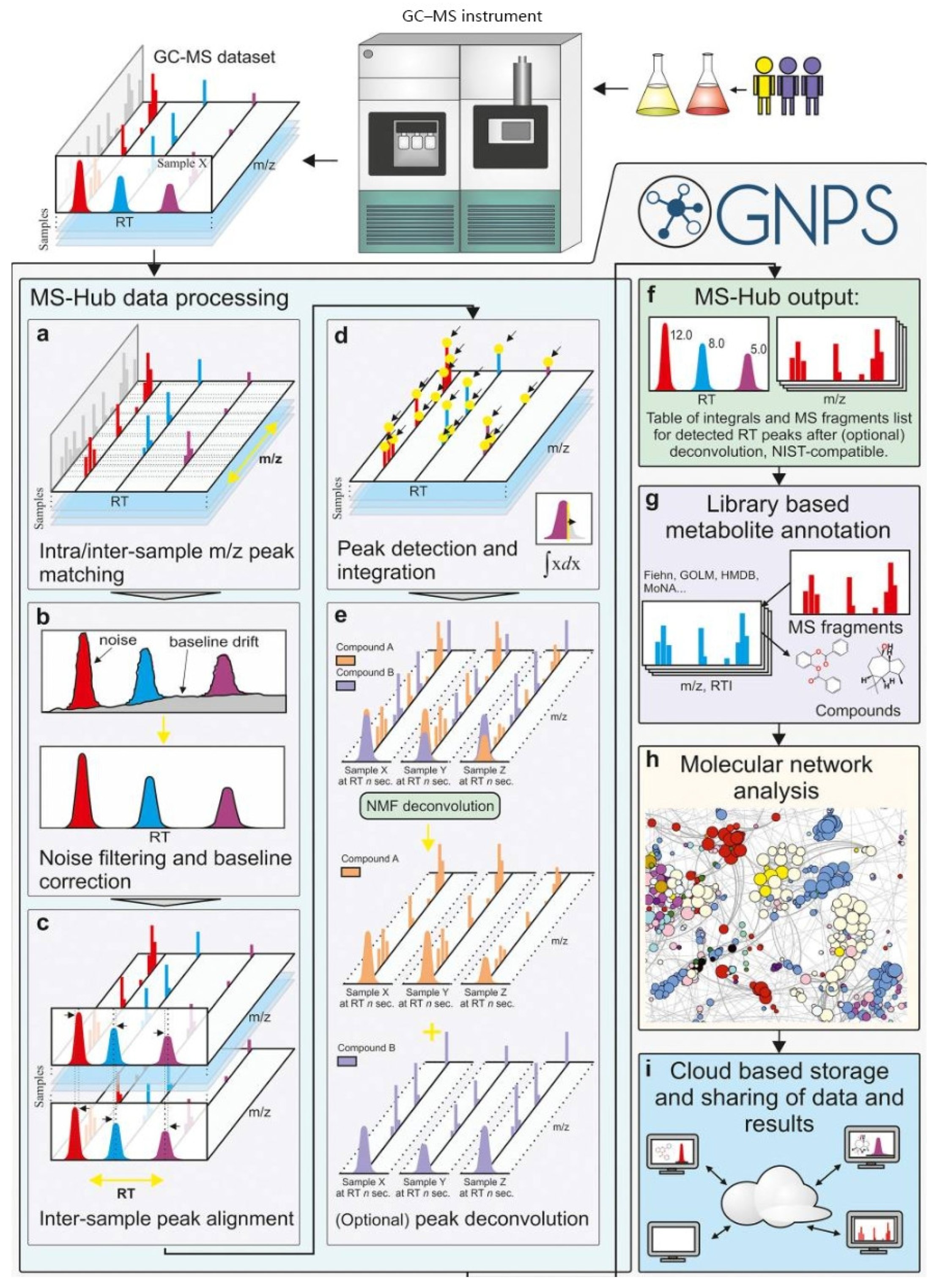
3.5. Automated Peak Picking and Isotopic Profile Deconvolution
3.6. Absolute Quantification of Unidentified Compounds
3.7. Chemical Groups and Transformation Products Identification
3.8. Chemicals and Their Toxicity Correlations
3.9. Sample Types for Risk Warning Discrimination
3.10. Chemical Source Recognition
4. Limitations and Challenges
5. Conclusions
Author Contributions
Funding
Institutional Review Board Statement
Informed Consent Statement
Data Availability Statement
Conflicts of Interest
References
- United States Environmental Protection Agency. The Toxic Substances Control Act (TSCA) Chemical Substance Inventory. Available online: https://www.epa.gov/tsca-inventory (accessed on 17 May 2022).
- Stockholm Convention. All POPs Listed in the Stockholm Convention. Available online: http://chm.pops.int/TheConvention/ThePOPs/ListingofPOPs/tabid/2509/Default.aspx (accessed on 17 March 2026).
- Rorije, E.; Emj, V.; Hollander, A.; Tp, T.; Mpm, J. Identifying Potential POP and PBT Substances: Development of a New Persistence/Bioaccumulation-Score; Rijksinstituut voor Volksgezondheid en Milieu RIVM: Bilthoven, The Netherlands, 2011. [Google Scholar]
- Howard, P.H.; Muir, D.C.G. Identifying New Persistent and Bioaccumulative Organics Among Chemicals in Commerce. Environ. Sci. Technol. 2010, 44, 2277–2285. [Google Scholar] [CrossRef]
- Hites, R.A.; Jobst, K.J. Is Nontargeted Screening Reproducible? Environ. Sci. Technol. 2018, 52, 11975–11976. [Google Scholar] [CrossRef]
- Kern, S.; Fenner, K.; Singer, H.P.; Schwarzenbach, R.P.; Hollender, J. Identification of Transformation Products of Organic Contaminants in Natural Waters by Computer-Aided Prediction and High-Resolution Mass Spectrometry. Environ. Sci. Technol. 2009, 43, 7039–7046. [Google Scholar] [CrossRef]
- Megson, D.; Reiner, E.J.; Jobst, K.J.; Dorman, F.L.; Robson, M.; Focant, J.F. A Review of the Determination of Persistent Organic Pollutants for Environmental Forensics Investigations. Anal. Chim. Acta 2016, 941, 10–25. [Google Scholar] [CrossRef]
- Macneil, A.; Li, X.; Amiri, R.; Muir, D.C.G.; Simpson, A.; Simpson, M.J.; Dorman, F.L.; Jobst, K.J. Gas Chromatography-(Cyclic) Ion Mobility Mass Spectrometry: A Novel Platform for the Discovery of Unknown Per-/Polyfluoroalkyl Substances. Anal. Chem. 2022, 94, 11096–11103. [Google Scholar] [CrossRef]
- Du, B.; Tian, Z.; Peter, K.T.; Kolodziej, E.P.; Wong, C.S. Developing Unique Nontarget High-Resolution Mass Spectrometry Signatures to Track Contaminant Sources in Urban Waters. Environ. Sci. Technol. Lett. 2020, 7, 923–930. [Google Scholar] [CrossRef]
- Chambers, M.C.; Maclean, B.; Burke, R.; Amodei, D.; Ruderman, D.L.; Neumann, S.; Gatto, L.; Fischer, B.; Pratt, B.; Egertson, J.; et al. A Cross-Platform Toolkit for Mass Spectrometry and Proteomics. Nat. Biotechnol. 2012, 30, 918–920. [Google Scholar] [CrossRef]
- Smith, C.A.; Want, E.J.; O’Maille, G.; Abagyan, R.; Siuzdak, G. XCMS: Processing Mass Spectrometry Data for Metabolite Profiling Using Nonlinear Peak Alignment, Matching, and Identification. Anal. Chem. 2006, 78, 779–787. [Google Scholar] [CrossRef]
- Tsugawa, H.; Cajka, T.; Kind, T.; Ma, Y.; Higgins, B.; Ikeda, K.; Kanazawa, M.; VanderGheynst, J.; Fiehn, O.; Arita, M. MS-DIAL: Data-Independent MS/MS Deconvolution for Comprehensive Metabolome Analysis. Nat. Methods 2015, 12, 523–526. [Google Scholar] [CrossRef]
- Katajamaa, M.; Miettinen, J.; Orešič, M. MZmine: Toolbox for Processing and Visualization of Mass Spectrometry Based Molecular Profile Data. Bioinformatics 2006, 22, 634–636. [Google Scholar] [CrossRef]
- Pluskal, T.; Castillo, S.; Villar-Briones, A.; Orešič, M. MZmine 2: Modular Framework for Processing, Visualizing, and Analyzing Mass Spectrometry-Based Molecular Profile Data. BMC Bioinform. 2010, 11, 395. [Google Scholar] [CrossRef]
- Kiers, H.A.L.; ten Berge, J.M.F.; Bro, R. PARAFAC2—Part I. A Direct Fitting Algorithm for the PARAFAC2 Model. J. Chemom. 1999, 13, 275–294. [Google Scholar] [CrossRef]
- Smilde, A.; Bro, R.; Geladi, P. Three-Way Component and Regression Models. In Multi-Way Analysis with Applications in the Chemical Sciences; John Wiley & Sons Ltd.: Hoboken, NJ, USA, 2004; pp. 57–87. [Google Scholar] [CrossRef]
- Johnsen, L.G.; Skou, P.B.; Khakimov, B.; Bro, R. Gas Chromatography–Mass Spectrometry Data Processing Made Easy. J. Chromatogr. A 2017, 1503, 57–64. [Google Scholar] [CrossRef]
- de Juan, A.; Jaumot, J.; Tauler, R. Multivariate Curve Resolution (MCR). Solving the Mixture Analysis Problem. Anal. Methods 2014, 6, 4964–4976. [Google Scholar] [CrossRef]
- Tauler, R. Multivariate Curve Resolution of Multiway Data Using the Multilinearity Constraint. J. Chemom. 2021, 35, e3279. [Google Scholar] [CrossRef]
- Yamamoto, F.Y.; Pérez-López, C.; Lopez-Antia, A.; Lacorte, S.; de Souza Abessa, D.M.; Tauler, R. Linking MS1 and MS2 Signals in Positive and Negative Modes of LC-HRMS in Untargeted Metabolomics Using the ROIMCR Approach. Anal. Bioanal. Chem. 2023, 415, 6213–6225. [Google Scholar] [CrossRef]
- Jordan, M.I.; Mitchell, T.M. Machine Learning: Trends, Perspectives, and Prospects. Science 2015, 349, 255–260. [Google Scholar] [CrossRef]
- Stuart, J.; Russell, P.N. Artificial Intelligence: A Modern Approach, 4th ed.; Prentice Hall: Upper Saddle River, NJ, USA, 2020. [Google Scholar]
- Christopoulos, C.D.; Garimella, S.; Zawadowicz, M.A.; Möhler, O.; Cziczo, D.J. A Machine Learning Approach to Aerosol Classification for Single-Particle Mass Spectrometry. Atmos. Meas. Tech. 2018, 11, 5687–5699. [Google Scholar] [CrossRef]
- Noble, W.S. What Is a Support Vector Machine? Nat. Biotechnol. 2006, 24, 1565–1567. [Google Scholar] [CrossRef] [PubMed]
- Samanipour, S.; Kaserzon, S.; Vijayasarathy, S.; Jiang, H.; Choi, P.; Reid, M.J.; Mueller, J.F.; Thomas, K.V. Machine Learning Combined with Non-Targeted LC-HRMS Analysis for a Risk Warning System of Chemical Hazards in Drinking Water: A Proof of Concept. Talanta 2019, 195, 426–432. [Google Scholar] [CrossRef]
- Alygizakis, N.; Konstantakos, V.; Bouziotopoulos, G.; Kormentzas, E.; Slobodnik, J.; Thomaidis, N.S. A Multi-Label Classifier for Predicting the Most Appropriate Instrumental Method for the Analysis of Contaminants of Emerging Concern. Metabolites 2022, 12, 199. [Google Scholar] [CrossRef] [PubMed]
- Charest, N.; Lowe, C.N.; Ramsland, C.; Meyer, B.; Samano, V.; Williams, A.J. Improving Predictions of Compound Amenability for Liquid Chromatography–Mass Spectrometry to Enhance Non-Targeted Analysis. Anal. Bioanal. Chem. 2024, 416, 2565–2579. [Google Scholar] [CrossRef]
- Bouwmeester, R.; Martens, L.; Degroeve, S. Comprehensive and Empirical Evaluation of Machine Learning Algorithms for Small Molecule LC Retention Time Prediction. Anal. Chem. 2019, 91, 3694–3703. [Google Scholar] [CrossRef]
- Domingo-Almenara, X.; Guijas, C.; Billings, E.; Montenegro-Burke, J.R.; Uritboonthai, W.; Aisporna, A.E.; Chen, E.; Benton, H.P.; Siuzdak, G. The METLIN Small Molecule Dataset for Machine Learning-Based Retention Time Prediction. Nat. Commun. 2019, 10, 5811. [Google Scholar] [CrossRef]
- Feng, C.; Xu, Q.; Qiu, X.; Jin, Y.; Ji, J.; Lin, Y.; Le, S.; She, J.; Lu, D.; Wang, G. Evaluation and Application of Machine Learning-Based Retention Time Prediction for Suspect Screening of Pesticides and Pesticide Transformation Products in LC-HRMS. Chemosphere 2021, 271, 129447. [Google Scholar] [CrossRef] [PubMed]
- McCarthy, R.A.; Gupta, A.S. Employing and Interpreting a Machine Learning Target-Cognizant Technique for Analysis of Unknown Signals in Multiple Reaction Monitoring. IEEE Access 2021, 9, 24727–24737. [Google Scholar] [CrossRef]
- Zhao, T.; Shen, Q.; Li, X.F.; Huan, T. IodoFinder: Machine Learning-Guided Recognition of Iodinated Chemicals in Nontargeted LC-MS/MS Analysis. Environ. Sci. Technol. 2025, 59, 4530–4539. [Google Scholar] [CrossRef] [PubMed]
- Bendik, J.; Kalia, R.; Sukumaran, J.; Richardot, W.H.; Hoh, E.; Kelley, S.T. Automated High Confidence Compound Identification of Electron Ionization Mass Spectra for Nontargeted Analysis. J. Chromatogr. A 2021, 1660, 462656. [Google Scholar] [CrossRef]
- Yu, T.; Jones, D.P. Improving Peak Detection in High-Resolution LC/MS Metabolomics Data Using Preexisting Knowledge and Machine Learning Approach. Bioinformatics 2014, 30, 2941–2948. [Google Scholar] [CrossRef] [PubMed]
- Palm, E.; Kruve, A. Machine Learning for Absolute Quantification of Unidentified Compounds in Non-Targeted LC/HRMS. Molecules 2022, 27, 1013. [Google Scholar] [CrossRef]
- Baek, S.S.; Choi, Y.; Jeon, J.; Pyo, J.C.; Park, J.; Cho, K.H. Replacing the Internal Standard to Estimate Micropollutants Using Deep and Machine Learning. Water Res. 2021, 188, 116535. [Google Scholar] [CrossRef]
- Sun, Y.; Wu, B.; Dong, H.; Zhu, J.; Ren, N.; Ma, J.; You, S. Machine Learning-Powered Pseudo-Target Screening of Emerging Contaminants in Water: A Case Study on Tetracyclines. Water Res. 2025, 274, 123039. [Google Scholar] [CrossRef]
- Hu, S.; Liu, G.; Zhang, J.; Yan, J.; Zhou, H.; Yan, X. Linking Electron Ionization Mass Spectra of Organic Chemicals to Toxicity Endpoints through Machine Learning and Experimentation. J. Hazard. Mater. 2022, 431, 128558. [Google Scholar] [CrossRef]
- Huang, Y.; Bu, L.; Huang, K.; Zhang, H.; Zhou, S. Predicting Odor Sensory Attributes of Unidentified Chemicals in Water Using Fragmentation Mass Spectra with Machine Learning Models. Environ. Sci. Technol. 2024, 58, 11504–11513. [Google Scholar] [CrossRef]
- Zhang, X.; Han, X.; Xiang, T.; Liu, Y.; Pan, W.; Xue, Q.; Liu, X.; Fu, J.; Zhang, A.; Qu, G.; et al. From High Resolution Tandem Mass Spectrometry to Pollutant Toxicity AI-Based Prediction: A Case Study of 7 Endocrine Disruptors Endpoints. Environ. Sci. Technol. 2025, 59, 4505–4517. [Google Scholar] [CrossRef] [PubMed]
- Arturi, K.; Hollender, J. Machine Learning-Based Hazard-Driven Prioritization of Features in Nontarget Screening of Environmental High-Resolution Mass Spectrometry Data. Environ. Sci. Technol. 2023, 57, 18067–18079. [Google Scholar] [CrossRef]
- Erban, A.; Fehrle, I.; Martinez-Seidel, F.; Brigante, F.; Más, A.L.; Baroni, V.; Wunderlin, D.; Kopka, J. Discovery of Food Identity Markers by Metabolomics and Machine Learning Technology. Sci. Rep. 2019, 9, 9697. [Google Scholar] [CrossRef]
- Ngan, H.-L.; Turkina, V.; van Herwerden, D.; Yan, H.; Cai, Z.; Samanipour, S. Machine Learning for Enhanced Identification Probability in RPLC/HRMS Nontargeted Workflows. Anal. Chem. 2025, 97, 18028–18035. [Google Scholar] [CrossRef] [PubMed]
- Han, Y.; Hu, L.X.; Liu, T.; Dong, L.L.; Liu, Y.S.; Zhao, J.L.; Ying, G.G. Discovering Transformation Products of Pharmaceuticals in Domestic Wastewaters and Receiving Rivers by Using Non-Target Screening and Machine Learning Approaches. Sci. Total Environ. 2024, 948, 174715. [Google Scholar] [CrossRef]
- Ji, H.; Deng, H.; Lu, H.; Zhang, Z. Predicting a Molecular Fingerprint from an Electron Ionization Mass Spectrum with Deep Neural Networks. Anal. Chem. 2020, 92, 8649–8653. [Google Scholar] [CrossRef] [PubMed]
- Broeckling, C.D.; Yao, L.; Isaac, G.; Gioioso, M.; Ianchis, V.; Vissers, J.P.C. Application of Predicted Collisional Cross Section to Metabolome Databases to Probabilistically Describe the Current and Future Ion Mobility Mass Spectrometry. J. Am. Soc. Mass Spectrom. 2021, 32, 661–669. [Google Scholar] [CrossRef] [PubMed]
- Mullin, L.; Jobst, K.; DiLorenzo, R.A.; Plumb, R.; Reiner, E.J.; Yeung, L.W.Y.; Jogsten, I.E. Liquid Chromatography-Ion Mobility-High Resolution Mass Spectrometry for Analysis of Pollutants in Indoor Dust: Identification and Predictive Capabilities. Anal. Chim. Acta 2020, 1125, 29–40. [Google Scholar] [CrossRef]
- Fakouri Baygi, S.; Fernando, S.; Hopke, P.K.; Holsen, T.M.; Crimmins, B.S. Automated Isotopic Profile Deconvolution for High Resolution Mass Spectrometric Data (APGC-QToF) from Biological Matrices. Anal. Chem. 2019, 91, 15509–15517. [Google Scholar] [CrossRef] [PubMed]
- Han, Y.; Hu, L.X.; Chen, C.E.; Liu, S.; Gao, F.Z.; Zhao, J.H.; Liu, Y.S.; Zhao, J.L.; Ying, G.G. Identification and Risk Assessment of Antibiotics and Their Transformation Products in a Large-Scale River Using Suspect and Nontarget Screening and Machine Learning. ACS ES&T Water 2025, 5, 953–964. [Google Scholar] [CrossRef]
- Wang, H.; Feng, X.; Su, W.; Zhong, L.; Liu, Y.; Liang, Y.; Ruan, T.; Jiang, G. Identifying Organic Chemicals with Acetylcholinesterase Inhibition in Nationwide Estuarine Waters by Machine Learning-Assisted Mass Spectrometric Screening. Environ. Sci. Technol. 2024, 58, 22379–22390. [Google Scholar] [CrossRef]
- Matta, K.; Vigneau, E.; Cariou, V.; Mouret, D.; Ploteau, S.; Le Bizec, B.; Antignac, J.P.; Cano-Sancho, G. Associations between Persistent Organic Pollutants and Endometriosis: A Multipollutant Assessment Using Machine Learning Algorithms. Environ. Pollut. 2020, 260, 114066. [Google Scholar] [CrossRef]
- Li, C.; Yang, L.; Wu, J.; Yang, Y.; Li, Y.; Zhang, Q.; Sun, Y.; Li, D.; Shi, M.; Liu, G. Identification of Emerging Organic Pollutants from Solid Waste Incinerations by FT-ICR-MS and GC/Q-TOF-MS and Their Potential Toxicities. J. Hazard. Mater. 2022, 428, 128220. [Google Scholar] [CrossRef]
- Piazza, I.; Beaton, N.; Bruderer, R.; Knobloch, T.; Barbisan, C.; Chandat, L.; Sudau, A.; Siepe, I.; Rinner, O.; de Souza, N.; et al. A Machine Learning-Based Chemoproteomic Approach to Identify Drug Targets and Binding Sites in Complex Proteomes. Nat. Commun. 2020, 11, 4200. [Google Scholar] [CrossRef]
- Alesio, J.L.; Slitt, A.; Bothun, G.D. Critical New Insights into the Binding of Poly- and Perfluoroalkyl Substances (PFAS) to Albumin Protein. Chemosphere 2022, 287, 131979. [Google Scholar] [CrossRef] [PubMed]
- Beyramysoltan, S.; Chambers, M.I.; Osborne, A.M.; Ventura, M.I.; Musah, R.A. Introducing “DoPP”: A Graphical User-Friendly Application for the Rapid Species Identification of Psychoactive Plant Materials and Quantification of Psychoactive Small Molecules Using DART-MS Data. Anal. Chem. 2022, 94, 16570–16578. [Google Scholar] [CrossRef] [PubMed]
- Li, H.; Wu, X.; Wu, S.; Chen, L.; Kou, X.; Zeng, Y.; Li, D.; Lin, Q.; Zhong, H.; Hao, T.; et al. Machine Learning Directed Discrimination of Virgin and Recycled Poly (Ethylene Terephthalate) Based on Non-Targeted Analysis of Volatile Organic Compounds. J. Hazard. Mater. 2022, 436, 129116. [Google Scholar] [CrossRef] [PubMed]
- Pelta, R.; Carmon, N.; Ben-Dor, E. A Machine Learning Approach to Detect Crude Oil Contamination in a Real Scenario Using Hyperspectral Remote Sensing. Int. J. Appl. Earth Obs. Geoinf. 2019, 82, 101901. [Google Scholar] [CrossRef]
- Ekpe, O.D.; Choo, G.; Kang, J.K.; Yun, S.T.; Oh, J.E. Identification of Organic Chemical Indicators for Tracking Pollution Sources in Groundwater by Machine Learning from GC-HRMS-Based Suspect and Non-Target Screening Data. Water Res. 2024, 252, 121130. [Google Scholar] [CrossRef]
- Huang, Y.S.; An, Y.L.; Zheng, Y.Y.; Zhao, W.J.; Song, C.Q.; Zhang, L.J.; Chen, J.T.; Tang, Z.J.; Feng, L.; Li, Z.W.; et al. A Holistic Strategy for the In-Depth Discrimination and Authentication of 16 Citrus Herbs and Associated Commercial Products Based on Machine Learning Techniques and Non-Targeted Metabolomics. J. Chromatogr. A 2025, 1745, 465747. [Google Scholar] [CrossRef]
- de Cripan, S.M.; Cereto-Massagué, A.; Herrero, P.; Barcaru, A.; Canela, N.; Domingo-Almenara, X. Machine Learning-Based Retention Time Prediction of Trimethylsilyl Derivatives of Metabolites. Biomedicines 2022, 10, 879. [Google Scholar] [CrossRef]
- Brendel, R.; Schwolow, S.; Rohn, S.; Weller, P. Volatilomic Profiling of Citrus Juices by Dual-Detection HS-GC-MS-IMS and Machine Learning—An Alternative Authentication Approach. J. Agric. Food Chem. 2021, 69, 1727–1738. [Google Scholar] [CrossRef]
- Abrahamsson, D.; Brueck, C.L.; Prasse, C.; Lambropoulou, D.A.; Koronaiou, L.A.; Wang, M.; Park, J.S.; Woodruff, T.J. Extracting Structural Information from Physicochemical Property Measurements Using Machine Learning—A New Approach for Structure Elucidation in Non-Targeted Analysis. Environ. Sci. Technol. 2023, 57, 14827–14838. [Google Scholar] [CrossRef]
- Mollerup, C.B.; Mardal, M.; Dalsgaard, P.W.; Linnet, K.; Barron, L.P. Prediction of Collision Cross Section and Retention Time for Broad Scope Screening in Gradient Reversed-Phase Liquid Chromatography-Ion Mobility-High Resolution Accurate Mass Spectrometry. J. Chromatogr. A 2018, 1542, 82–88. [Google Scholar] [CrossRef] [PubMed]
- Bade, R.; Bijlsma, L.; Miller, T.H.; Barron, L.P.; Sancho, J.V.; Hernández, F. Suspect Screening of Large Numbers of Emerging Contaminants in Environmental Waters Using Artificial Neural Networks for Chromatographic Retention Time Prediction and High Resolution Mass Spectrometry Data Analysis. Sci. Total Environ. 2015, 538, 934–941. [Google Scholar] [CrossRef] [PubMed]
- Wei, J.N.; Belanger, D.; Adams, R.P.; Sculley, D. Rapid Prediction of Electron–Ionization Mass Spectrometry Using Neural Networks. ACS Cent. Sci. 2019, 5, 700–708. [Google Scholar] [CrossRef]
- Munro, K.; Miller, T.H.; Martins, C.P.B.; Edge, A.M.; Cowan, D.A.; Barron, L.P. Artificial Neural Network Modelling of Pharmaceutical Residue Retention Times in Wastewater Extracts Using Gradient Liquid Chromatography-High Resolution Mass Spectrometry Data. J. Chromatogr. A 2015, 1396, 34–44. [Google Scholar] [CrossRef]
- Richardson, A.K.; Chadha, M.; Rapp-Wright, H.; Mills, G.A.; Fones, G.R.; Gravell, A.; Stürzenbaum, S.; Cowan, D.A.; Neep, D.J.; Barron, L.P. Rapid Direct Analysis of River Water and Machine Learning Assisted Suspect Screening of Emerging Contaminants in Passive Sampler Extracts. Anal. Methods 2021, 13, 595–606. [Google Scholar] [CrossRef]
- Dávila-Santiago, E.; Shi, C.; Mahadwar, G.; Medeghini, B.; Insinga, L.; Hutchinson, R.; Good, S.; Jones, G.D. Machine Learning Applications for Chemical Fingerprinting and Environmental Source Tracking Using Non-Target Chemical Data. Environ. Sci. Technol. 2022, 56, 4080–4090. [Google Scholar] [CrossRef] [PubMed]
- Melnikov, A.D.; Tsentalovich, Y.P.; Yanshole, V.V. Deep Learning for the Precise Peak Detection in High-Resolution LC-MS Data. Anal. Chem. 2020, 92, 588–592. [Google Scholar] [CrossRef] [PubMed]
- Guo, J.; Shen, S.; Xing, S.; Chen, Y.; Chen, F.; Porter, E.M.; Yu, H.; Huan, T. EVA: Evaluation of Metabolic Feature Fidelity Using a Deep Learning Model Trained with over 25000 Extracted Ion Chromatograms. Anal. Chem. 2021, 93, 12181–12186. [Google Scholar] [CrossRef]
- Plante, P.L.; Francovic-Fontaine, É.; May, J.C.; McLean, J.A.; Baker, E.S.; Laviolette, F.; Marchand, M.; Corbeil, J. Predicting Ion Mobility Collision Cross-Sections Using a Deep Neural Network: DeepCCS. Anal. Chem. 2019, 91, 5191–5199. [Google Scholar] [CrossRef] [PubMed]
- Zhou, Z.; Luo, M.; Chen, X.; Yin, Y.; Xiong, X.; Wang, R.; Zhu, Z.J. Ion Mobility Collision Cross-Section Atlas for Known and Unknown Metabolite Annotation in Untargeted Metabolomics. Nat. Commun. 2020, 11, 4334. [Google Scholar] [CrossRef]
- Gruber, L.; Schmidt, S.; Enzlein, T.; Vo, H.G.; Bausbacher, T.; Cairns, J.L.; Ucal, Y.; Keller, F.; Kerndl, M.; Sammour, D.A.; et al. Deep MALDI-MS Spatial Omics Guided by Quantum Cascade Laser Mid-Infrared Imaging Microscopy. Nat. Commun. 2025, 16, 4759. [Google Scholar] [CrossRef]
- Cao, D.-S.; Zeng, M.-M.; Yi, L.-Z.; Wang, B.; Xu, Q.-S.; Hu, Q.-N.; Zhang, L.-X.; Lu, H.-M.; Liang, Y.-Z. A Novel Kernel Fisher Discriminant Analysis: Constructing Informative Kernel by Decision Tree Ensemble for Metabolomics Data Analysis. Anal. Chim. Acta 2011, 706, 97–104. [Google Scholar] [CrossRef]
- Broeckling, C.D.; Afsar, F.A.; Neumann, S.; Ben-Hur, A.; Prenni, J.E. RAMClust: A Novel Feature Clustering Method Enables Spectral-Matching-Based Annotation for Metabolomics Data. Anal. Chem. 2014, 86, 6812–6817. [Google Scholar] [CrossRef]
- Chen, J.; Si, Y.-W.; Un, C.-W.; Siu, S.W.I. Chemical Toxicity Prediction Based on Semi-Supervised Learning and Graph Convolutional Neural Network. J. Cheminform. 2021, 13, 93. [Google Scholar] [CrossRef]
- Lin, J.; Liu, H.; Zhang, J. Recent Advances in the Application of Machine Learning Methods to Improve Identification of the Microplastics in Environment. Chemosphere 2022, 307, 136092. [Google Scholar] [CrossRef]
- Hirohara, M.; Saito, Y.; Koda, Y.; Sato, K.; Sakakibara, Y. Convolutional Neural Network Based on SMILES Representation of Compounds for Detecting Chemical Motif. BMC Bioinform. 2018, 19, 526. [Google Scholar] [CrossRef]
- Huang, B.; von Lilienfeld, O.A. Ab Initio Machine Learning in Chemical Compound Space. Chem. Rev. 2021, 121, 10001–10036. [Google Scholar] [CrossRef]
- Wang, J.; Liao, Y.; Xie, T.; Chen, R.; Lai, J.; Zhang, Z.; Lu, H. Accurate and Rational Collision Cross Section Prediction Using Voxel-Projected Area and Deep Learning. J. Chemom. 2025, 39, e70040. [Google Scholar] [CrossRef]
- Guo, R.; Zhang, Y.; Liao, Y.; Yang, Q.; Xie, T.; Fan, X.; Lin, Z.; Chen, Y.; Lu, H.; Zhang, Z. Highly Accurate and Large-Scale Collision Cross Sections Prediction with Graph Neural Networks. Commun. Chem. 2023, 6, 139. [Google Scholar] [CrossRef]
- Russo, F.F.; Nowatzky, Y.; Jaeger, C.; Parr, M.K.; Benner, P.; Muth, T.; Lisec, J. Machine Learning Methods for Compound Annotation in Non-Targeted Mass Spectrometry—A Brief Overview of Fingerprinting, in Silico Fragmentation and de Novo Methods. Rapid Commun. Mass Spectrom. 2024, 38, e9876. [Google Scholar] [CrossRef]
- Schratz, P.; Muenchow, J.; Iturritxa, E.; Richter, J.; Brenning, A. Performance Evaluation and Hyperparameter Tuning of Statistical and Machine-Learning Models Using Spatial Data. arXiv 2018, arXiv:1803.11266. [Google Scholar] [CrossRef]
- Fitch, W.L.; Khojasteh, C.; Aliagas, I.; Johnson, K. Using LC Retention Times in Organic Structure Determination: Drug Metabolite Identification. Drug Metab. Lett. 2018, 12, 93–100. [Google Scholar] [CrossRef] [PubMed]
- Dossin, E.; Martin, E.; Diana, P.; Castellon, A.; Monge, A.; Pospisil, P.; Bentley, M.; Guy, P.A. Prediction Models of Retention Indices for Increased Confidence in Structural Elucidation during Complex Matrix Analysis: Application to Gas Chromatography Coupled with High-Resolution Mass Spectrometry. Anal. Chem. 2016, 88, 7539–7547. [Google Scholar] [CrossRef] [PubMed]
- Allen, F.; Pon, A.; Wilson, M.; Greiner, R.; Wishart, D. CFM-ID: A Web Server for Annotation, Spectrum Prediction and Metabolite Identification from Tandem Mass Spectra. Nucleic Acids Res. 2014, 42, W94–W99. [Google Scholar] [CrossRef]
- Kai, D.; Huibin, S.; Marvin, M.; Juho, R.; Sebastian, B. Searching Molecular Structure Databases with Tandem Mass Spectra Using CSI:FingerID. Proc. Natl. Acad. Sci. USA 2015, 112, 12580–12585. [Google Scholar] [CrossRef]
- Shrivastava, A.D.; Swainston, N.; Samanta, S.; Roberts, I.; Muelas, M.W.; Kell, D.B. Massgenie: A Transformer-Based Deep Learning Method for Identifying Small Molecules from Their Mass Spectra. Biomolecules 2021, 11, 1793. [Google Scholar] [CrossRef]
- Laponogov, I.; Sadawi, N.; Galea, D.; Mirnezami, R.; Veselkov, K.A. ChemDistiller: An Engine for Metabolite Annotation in Mass Spectrometry. Bioinformatics 2018, 34, 2096–2102. [Google Scholar] [CrossRef] [PubMed]
- Zhou, Z.; Shen, X.; Tu, J.; Zhu, Z.J. Large-Scale Prediction of Collision Cross-Section Values for Metabolites in Ion Mobility-Mass Spectrometry. Anal. Chem. 2016, 88, 11084–11091. [Google Scholar] [CrossRef] [PubMed]
- Zhou, Z.; Tu, J.; Xiong, X.; Shen, X.; Zhu, Z.J. LipidCCS: Prediction of Collision Cross-Section Values for Lipids with High Precision to Support Ion Mobility-Mass Spectrometry-Based Lipidomics. Anal. Chem. 2017, 89, 9559–9566. [Google Scholar] [CrossRef] [PubMed]
- Zhou, Z.; Xiong, X.; Zhu, Z.-J. MetCCS Predictor: A Web Server for Predicting Collision Cross-Section Values of Metabolites in Ion Mobility-Mass Spectrometry Based Metabolomics. Bioinformatics 2017, 33, 2235–2237. [Google Scholar] [CrossRef] [PubMed]
- Foster, M.; Rainey, M.; Watson, C.; Dodds, J.N.; Fernández, F.M.; Baker, E.S. Uncovering Xenobiotics in the Dark Metabolome Using Ion Mobility Spectrometry, Mass Defect Analysis and Machine Learning. bioRxiv 2021. [Google Scholar] [CrossRef]
- Song, X.-C.; Canellas, E.; Dreolin, N.; Goshawk, J.; Lv, M.; Qu, G.; Nerin, C.; Jiang, G. Application of Ion Mobility Spectrometry and the Derived Collision Cross Section in the Analysis of Environmental Organic Micropollutants. Environ. Sci. Technol. 2023, 57, 21485–21502. [Google Scholar] [CrossRef]
- Borgsmüller, N.; Gloaguen, Y.; Opialla, T.; Blanc, E.; Sicard, E.; Royer, A.L.; Le Bizec, B.; Durand, S.; Migné, C.; Pétéra, M.; et al. WiPP: Workflow for Improved Peak Picking for Gas Chromatography-Mass Spectrometry (GC-MS) Data. Metabolites 2019, 9, 171. [Google Scholar] [CrossRef]
- Goldman, S.; Li, J.; Coley, C.W. Generating Molecular Fragmentation Graphs with Autoregressive Neural Networks. Anal. Chem. 2024, 96, 3419–3428. [Google Scholar] [CrossRef]
- Aksenov, A.A.; Laponogov, I.; Zhang, Z.; Doran, S.L.F.; Belluomo, I.; Veselkov, D.; Bittremieux, W.; Nothias, L.F.; Nothias-Esposito, M.; Maloney, K.N.; et al. Auto-Deconvolution and Molecular Networking of Gas Chromatography–Mass Spectrometry Data. Nat. Biotechnol. 2021, 39, 169–173. [Google Scholar] [CrossRef]
- Li, Y.; Yang, Y.; Wang, X. Identification, Annotation and Toxicity Estimation of Organic Pollutants in Human Serum via Non-Target Analysis. Environ. Pollut. 2025, 367, 125577. [Google Scholar] [CrossRef]
- Zwiener, C.; Frimmel, F.H. LC-MS Analysis in the Aquatic Environment and in Water Treatment—A Critical Review. Anal. Bioanal. Chem. 2004, 378, 851–861. [Google Scholar] [CrossRef]
- Schymanski, E.L.; Singer, H.P.; Slobodnik, J.; Ipolyi, I.M.; Oswald, P.; Krauss, M.; Schulze, T.; Haglund, P.; Letzel, T.; Grosse, S.; et al. Non-Target Screening with High-Resolution Mass Spectrometry: Critical Review Using a Collaborative Trial on Water Analysis. Anal. Bioanal. Chem. 2015, 407, 6237–6255. [Google Scholar] [CrossRef]
- Burel, A.; Vaccaro, M.; Cartigny, Y.; Tisse, S.; Coquerel, G.; Cardinael, P. Retention Modeling and Retention Time Prediction in Gas Chromatography and Flow-Modulation Comprehensive Two-Dimensional Gas Chromatography: The Contribution of Pressure on Solute Partition. J. Chromatogr. A 2017, 1485, 101–119. [Google Scholar] [CrossRef]
- Vrzal, T.; Malečková, M.; Olšovská, J. DeepReI: Deep Learning-Based Gas Chromatographic Retention Index Predictor. Anal. Chim. Acta 2021, 1147, 64–71. [Google Scholar] [CrossRef] [PubMed]
- Song, D.; Tang, T.; Wang, R.; Liu, H.; Xie, D.; Zhao, B.; Dang, Z.; Lu, G. Enhancing Compound Confidence in Suspect and Non-Target Screening through Machine Learning-Based Retention Time Prediction. Environ. Pollut. 2024, 347, 123763. [Google Scholar] [CrossRef] [PubMed]
- Park, S.; Kemelbekova, G.; Cho, S.; Kwon, K.; Im, T. Study on the Ion Mobility Spectrometry Data Classification and Application of Port Container Narcotics Using Machine Learning Algorithm. Appl. Sci. 2023, 13, 12769. [Google Scholar] [CrossRef]
- Teri, D.; Aly, N.A.; Dodds, J.N.; Zhang, J.; Thiessen, P.A.; Bolton, E.E.; Joseph, K.M.; Williams, A.J.; Schymanski, E.L.; Rusyn, I.; et al. Reference Library for Suspect Screening of Environmental Toxicants Using Ion Mobility Spectrometry-Mass Spectrometry. Commun. Chem. 2025, 8, 224. [Google Scholar] [CrossRef]
- Stow, S.M.; Causon, T.J.; Zheng, X.; Kurulugama, R.T.; Mairinger, T.; May, J.C.; Rennie, E.E.; Baker, E.S.; Smith, R.D.; McLean, J.A.; et al. An Interlaboratory Evaluation of Drift Tube Ion Mobility-Mass Spectrometry Collision Cross Section Measurements. Anal. Chem. 2017, 89, 9048–9055. [Google Scholar] [CrossRef]
- Joseph, K.M.; Boatman, A.K.; Dodds, J.N.; Kirkwood-Donelson, K.I.; Ryan, J.P.; Zhang, J.; Thiessen, P.A.; Bolton, E.E.; Valdiviezo, A.; Sapozhnikova, Y.; et al. Multidimensional Library for the Improved Identification of Per- and Polyfluoroalkyl Substances (PFAS). Sci. Data 2025, 12, 150. [Google Scholar] [CrossRef]
- Li, X.; Chevez, T.; De Silva, A.O.; Muir, D.C.G.; Kleywegt, S.; Simpson, A.; Simpson, M.J.; Jobst, K.J. Which of the (Mixed) Halogenated n-Alkanes Are Likely To Be Persistent Organic Pollutants? Environ. Sci. Technol. 2021, 55, 15912–15920. [Google Scholar] [CrossRef] [PubMed]
- Zhang, X.; Di Lorenzo, R.A.; Helm, P.A.; Reiner, E.J.; Howard, P.H.; Muir, D.C.G.; Sled, J.G.; Jobst, K.J. Compositional Space: A Guide for Environmental Chemists on the Identification of Persistent and Bioaccumulative Organics Using Mass Spectrometry. Environ. Int. 2019, 132, 104808. [Google Scholar] [CrossRef] [PubMed]
- Li, X.; Dorman, F.L.; Helm, P.A.; Kleywegt, S.; Simpson, A.; Simpson, M.J.; Jobst, K.J. Nontargeted Screening Using Gas Chromatography–Atmospheric Pressure Ionization Mass Spectrometry: Recent Trends and Emerging Potential. Molecules 2021, 26, 6911. [Google Scholar] [CrossRef]
- Mu, H.; Yang, Z.; Chen, L.; Gu, C.; Ren, H.; Wu, B. Suspect and Nontarget Screening of Per-and Polyfluoroalkyl Substances Based on Ion Mobility Mass Spectrometry and Machine Learning Techniques. J. Hazard. Mater. 2024, 461, 132669. [Google Scholar] [CrossRef]
- Hamra, G.B.; Buckley, J.P. Environmental Exposure Mixtures: Questions and Methods to Address Them. Curr. Epidemiol. Rep. 2018, 5, 160–165. [Google Scholar] [CrossRef]
- Duez, Q.; Lefebvre, C.; De Winter, J.; Cornil, J.; Gerbaux, P. Classifying Host–Guest Topology with Ion Mobility-Mass Spectrometry and Machine Learning. J. Phys. Chem. Lett. 2025, 16, 7551–7559. [Google Scholar] [CrossRef]
- Calle, J.L.P.; de las Mercedes Vázquez Espinosa, M.; Sepúlveda, M.B.; Ruiz-Rodríguez, A.; González, M.F.; Lovillo, M.P. Novel Method Based on Ion Mobility Spectrometry Combined with Machine Learning for the Discrimination of Fruit Juices. Foods 2023, 12, 2536. [Google Scholar] [CrossRef] [PubMed]
- Rodríguez-Gutiérrez, A.I.; Barea-Sepúlveda, M.; Boutoub, O.; Aliaño-González, M.J.; Palma, M.; Carrera, C. Integrating Ion Mobility Spectrometry and Machine Learning for Geographical Authentication of Olive Oils. Food Control 2026, 184, 112022. [Google Scholar] [CrossRef]
- Botalova, O.; Schwarzbauer, J.; Al Sandouk, N. Identification and Chemical Characterization of Specific Organic Indicators in the Effluents from Chemical Production Sites. Water Res. 2011, 45, 3653–3664. [Google Scholar] [CrossRef]
- Nikolopoulou, V.; Aalizadeh, R.; Nika, M.C.; Thomaidis, N.S. TrendProbe: Time Profile Analysis of Emerging Contaminants by LC-HRMS Non-Target Screening and Deep Learning Convolutional Neural Network. J. Hazard. Mater. 2022, 428, 128194. [Google Scholar] [CrossRef] [PubMed]
- De Bruyne, K.; Slabbinck, B.; Waegeman, W.; Vauterin, P.; De Baets, B.; Vandamme, P. Bacterial Species Identification from MALDI-TOF Mass Spectra through Data Analysis and Machine Learning. Syst. Appl. Microbiol. 2011, 34, 20–29. [Google Scholar] [CrossRef] [PubMed]
- Calle, J.L.P.; Falatová, B.; González, M.J.A.; González, M.F.; Lovillo, M.P. Machine Learning Approaches over Ion Mobility Spectra for the Discrimination of Ignitable Liquids Residues from Interfering Substrates. Talanta Open 2022, 6, 100125. [Google Scholar] [CrossRef]



| Algorithm | Usage | Frequency of Occurrence | Optimal Algorithm Frequency | Refs. |
|---|---|---|---|---|
| RF | Source tracking; Retention-time prediction; Toxicity prediction; Method selection; Retention-time prediction; Automatic peak selection; isotope profile deconvolution; Absolute quantification of unidentified compounds; End-to-end linkage of HRMS features to bioactivity; Toxicant or drug classification | 30 | 10 | [23,25,26,27,28,29,30,31,32,33,34,35,36,37,38,39,40,41,42,43,44] |
| Boost | Toxicity prediction; Retention-time prediction; Mass spectra; CCS value prediction; Automatic peak selection; and isotope profile deconvolution; End-to-end linkage of HRMS features to bioactivity; Non-target identification of parent compounds and prediction of transformation product | 18 | 9 | [28,30,34,37,38,40,41,45,46,47,48,49] |
| PLS | Source tracking; Toxicity prediction; Risk early warning; Mass spectra; End-to-end linkage of HRMS features to bioactivity | 10 | 2 | [38,39,40,41,43,45,50,51,52,53,54,55,56,57,58] |
| SVM | Source tracking; Toxicity prediction; Retention-time prediction; Automatic peak selection; isotope profile deconvolution; Absolute quantification of unidentified compounds; End-to-end linkage of HRMS features to bioactivity; Non-target identification of parent compounds and prediction of transformation products | 14 | 2 | [25,45,50,51,57,58,59] |
| kNN | Toxicity prediction; Retention-time prediction; End-to-end linkage of HRMS features to bioactivity; Non-target identification of precursor compounds and prediction of transformation products | 10 | 1 | [29,37,38,39,43,60,61] |
| ANN | Source tracking; Toxicity prediction, Retention-time prediction; CCS value prediction; Absolute quantification of unidentified compounds; End-to-end linkage of HRMS features to bioactivity; Non-target identification of precursor compounds and prediction of transformation products | 12 | 1 | [28,36,37,47,50,51,60,62,63,64] |
| MLP | Toxicity prediction; Mass spectra; End-to-end linkage of HRMS features to bioactivity; Retention-time prediction | 6 | 2 | [39,40,64,65,66,67] |
| PCA | Source tracking; Risk early warning; End-to-end linkage of HRMS features to bioactivity; ML methods within ensemble modeling | 6 | 0 | [25,42,60,68] |
| LDA | Source tracking | 3 | 2 | [53,57,61] |
| CNN | Toxicity prediction; Retention-time prediction; CCS value prediction; Automatic peak selection and isotope profile deconvolution; End-to-end linkage of HRMS features to bioactivity | 10 | 1 | [38,60,69,70,71] |
| Analytical Task | Representative Applications | Typical Input | Typical Output | Commonly Used Algorithms | Aim | Best-Use Scenario | Main Limitations |
|---|---|---|---|---|---|---|---|
| Precursor/transformation-product prediction | Predicting likely TPs of antibiotics [49] or other contaminants [44] | Precursor structure, descriptor, fragmentation, or spectral features | Candidate TPs or TP-related properties | XGBoost, RF, ANN | Expands suspect lists and prioritizes likely TPs when standards are unavailable | Best when TP space is large and reference standards are scarce | Depends strongly on training chemistry; transferability to novel classes may be limited (generalization issue) |
| Source apportionment | Distinguishing runoff, wastewater, and manure [21], aerosols [23], VOC [25], food [42], cells [53], crude oil [57], groundwater sources [58], and herbs [59] | Feature fingerprint, peak intensities, chemical profiles | Source class or source contribution | PCA, PLS-DA, SVM, RF, LDA | Links chemical fingerprints to likely pollution sources | Useful for mixture classification and source discrimination in monitoring studies | Interpretation can be dataset-specific, and source categories may overlap; lack of interpretability |
| Toxicity prediction | Predicting liver injury [38], endocrine activity [40], AChE inhibition [50], highly toxic organochlorine pollutants [51], or in vitro toxicity [41] | Molecular descriptor, fingerprint, spectra, HRMS- derived features | Toxicity class or toxicity score | XGBoost, RF, SVM, MLP, kNN, ANN, CNN | Prioritizes hazardous unknowns for follow-up testing | Useful when toxicological testing capacity is limited | Predicted toxicity is screening-level only and still requires experimental confirmation due to data availability |
| Method selection | Choosing LC-HRMS vs. GC-HRMS or selecting a data-analysis route for CECs [26]; Organic small molecules [27] | Chemical properties, platform metadata, feature sets | Guided analytical method or workflow | DT, RF, rule-based classifiers | Helps match analyte classes to analytical platforms | Useful during workflow design and screening strategy selection | Decision rules may not transfer across instruments or laboratories (generalization) |
| Retention behavior prediction | Metabolites [29,84], pesticides [30,64,67], pharmaceuticals [64,66,60], tobacco-related compounds [85], and large datasets [28] | Molecular descriptor, fingerprint, chromatographic conditions | Predicted RT or RI | SVR, XGBoost, RF, ANN, kNN, SVM, MLP, GNN | Improves annotation confidence and filters implausible candidates | Especially useful for suspect screening and candidate ranking | Highly method-specific; cross-transferability may be limited (generalization) |
| Early risk warning | Drinking water directly from six treatment plants [25] | HRMS feature profiles, peak intensities, and chemical fingerprint | Warning classification of abnormal samples | PLS-DA, PCA | Ensemble model detected all spiked analytes with high accuracy and precision | Useful for high-confidence early warning in monitoring | Performance under routine real-world conditions may be lower than under controlled spiking experiments (overfitting) |
| Mass spectral interpretation /annotation | EI-MS [45,65] or MS/MS library matching [86], fragmentation prediction, and structure ranking (VOC) [61]; iodized chemicals [32]; and small molecules [46,62,87,88,89]) | Spectra, molecular finger- prints, structure encodings | Candidate structures, fingerprint, or predicted spectra | DNN, MLP, SVM, XGBoost, SVR, GNN | Improves structural annotation and ranking of unknowns | Best for large candidate spaces and library -assisted identification | Performance drops for compounds outside the training or library space (generalization issue) |
| CCS prediction | Metabolites [71,90], lipids [91], pollutants [47,92,93,94] | Molecular descriptor, finger- prints, structures | Predicted CCS | SVR, CNN, ANN, XGBoost | Adds an orthogonal filter for candidate screening | Especially useful in IMS- enabled workflows | Large difference across platforms (data quality issue); accuracy depends on compound class, adduct, and domain coverage (generalization) |
| Automatic peak selection/isotope deconvolution | Peak-noise classification [69], isotope pattern recognition, false-positive reduction (metabolites) [34,70,95,96], pollutants [32,33,43,48,31,97,98] | Raw or processed chromato- graphic and spectral signals | Peak class, isotope grouping, cleaned feature list | CNN, RF, SVM, RUSBoost, NMF, Adaboost | Improves data quality and reduces manual inspection burden | Useful for large HRMS and GC-HRMS datasets | Performance depends on preprocessing, labeling quality, and class balance (data quality, overfitting) |
| Quantification/classification without standards | Estimating concentration or classifying toxicants or drugs without authentic standards [35,36,37] | Spectral features, descriptor, response patterns | Estimated concentration or chemical class | RF, regularized RF, ResNet, XGBoost, ANN | Supports semi- quantification and rapid prioritization | Useful where standards are missing or too many compounds are present | Uncertainty can remain high, and matrix effects may limit accuracy (data quality, interpretability) |
| End-to-end linkage to bioactivity | Linking unknown features or mixtures to toxicological activity [38,39,84] | HRMS features, spectra, bioassay -linked data | Bioactivity score or activity class | XGBoost, RF, SVM, CNN, DNN, BRR | Bridges chemical data and effect-based screening | Useful for prioritizing unknowns in effect- directed analysis | Biological interpretation remains indirect and requires follow-up validation (overfitting, interpretability) |
Disclaimer/Publisher’s Note: The statements, opinions and data contained in all publications are solely those of the individual author(s) and contributor(s) and not of MDPI and/or the editor(s). MDPI and/or the editor(s) disclaim responsibility for any injury to people or property resulting from any ideas, methods, instructions or products referred to in the content. |
© 2026 by the authors. Licensee MDPI, Basel, Switzerland. This article is an open access article distributed under the terms and conditions of the Creative Commons Attribution (CC BY) license.
Share and Cite
Lin, D.; Wang, Z.; Liao, J.; Li, N.; Li, X. From Analysis to Assessment: Machine Learning for Non-Target Screening of Pollutants Using Chromatography Coupled with (Ion Mobility) Mass Spectrometry. Toxics 2026, 14, 322. https://doi.org/10.3390/toxics14040322
Lin D, Wang Z, Liao J, Li N, Li X. From Analysis to Assessment: Machine Learning for Non-Target Screening of Pollutants Using Chromatography Coupled with (Ion Mobility) Mass Spectrometry. Toxics. 2026; 14(4):322. https://doi.org/10.3390/toxics14040322
Chicago/Turabian StyleLin, Dongshan, Zhenyue Wang, Jiaqi Liao, Nan Li, and Xiaolei Li. 2026. "From Analysis to Assessment: Machine Learning for Non-Target Screening of Pollutants Using Chromatography Coupled with (Ion Mobility) Mass Spectrometry" Toxics 14, no. 4: 322. https://doi.org/10.3390/toxics14040322
APA StyleLin, D., Wang, Z., Liao, J., Li, N., & Li, X. (2026). From Analysis to Assessment: Machine Learning for Non-Target Screening of Pollutants Using Chromatography Coupled with (Ion Mobility) Mass Spectrometry. Toxics, 14(4), 322. https://doi.org/10.3390/toxics14040322