
Synchronous Immobilization of Arsenic and Cadmium in Agricultural Soils by Sepiolite-Supported Nanoscale Zero-Valent Iron


Abstract
1. Introduction
2. Materials and Methods
3. Results
3.1. Material Characterization
3.2. Effects on Soil pH and Redox Potential
3.3. Effects on the Availability of Cd and As in the Soil
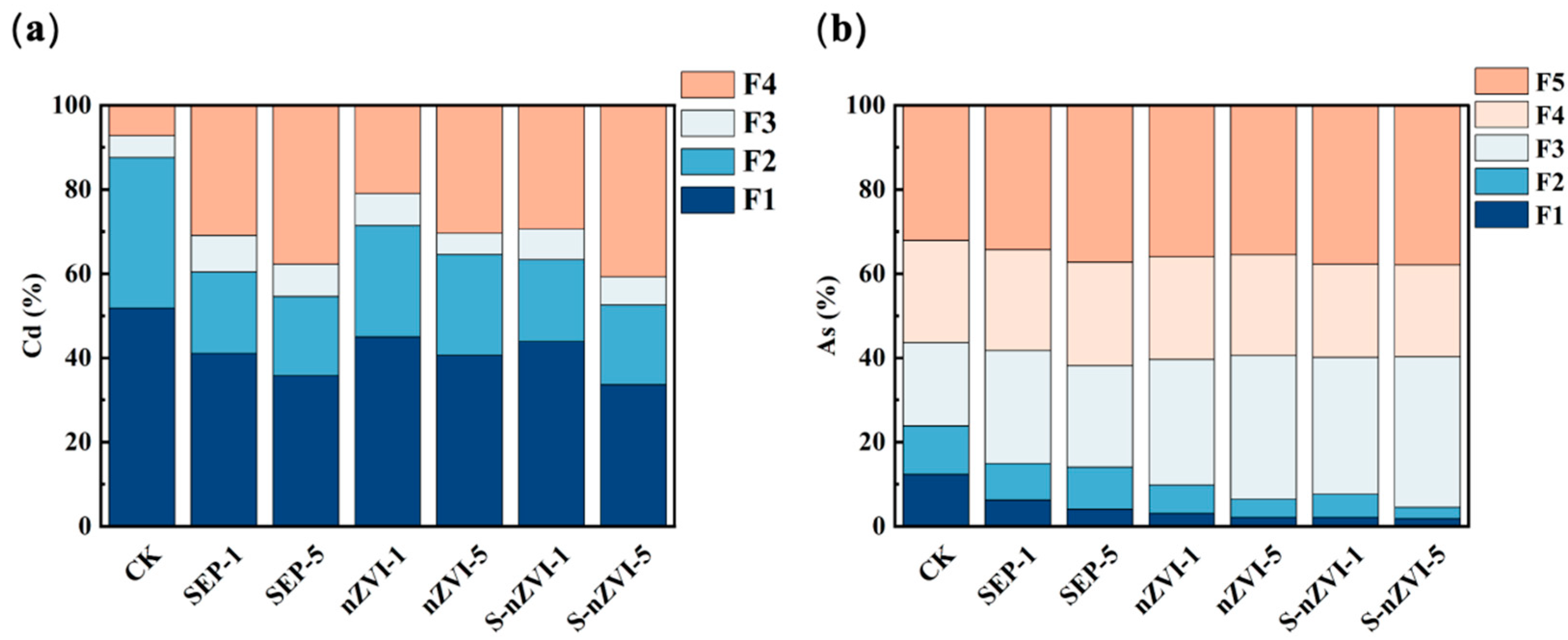
3.4. Effects on the Fractions of Cd and As in the Soil
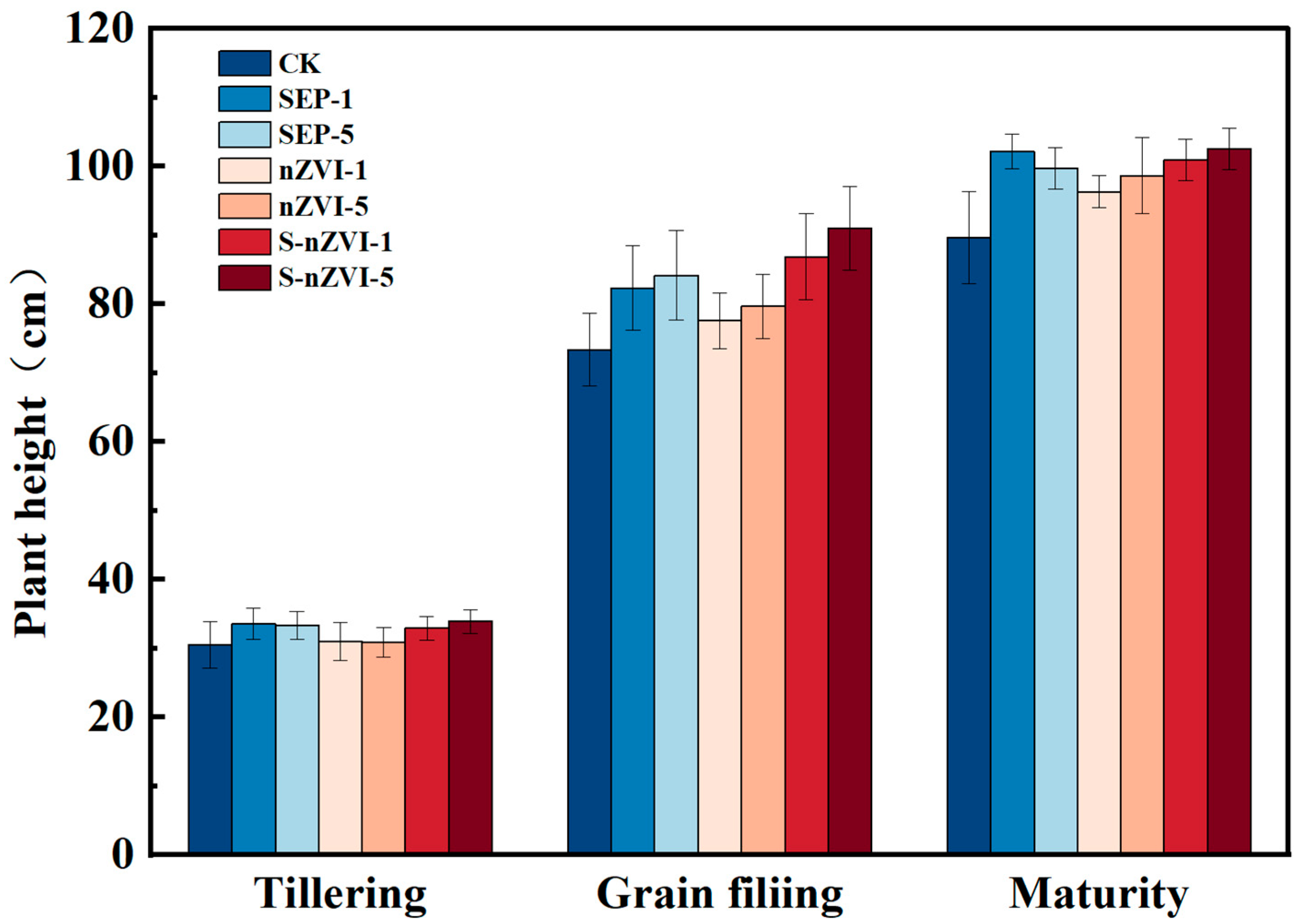
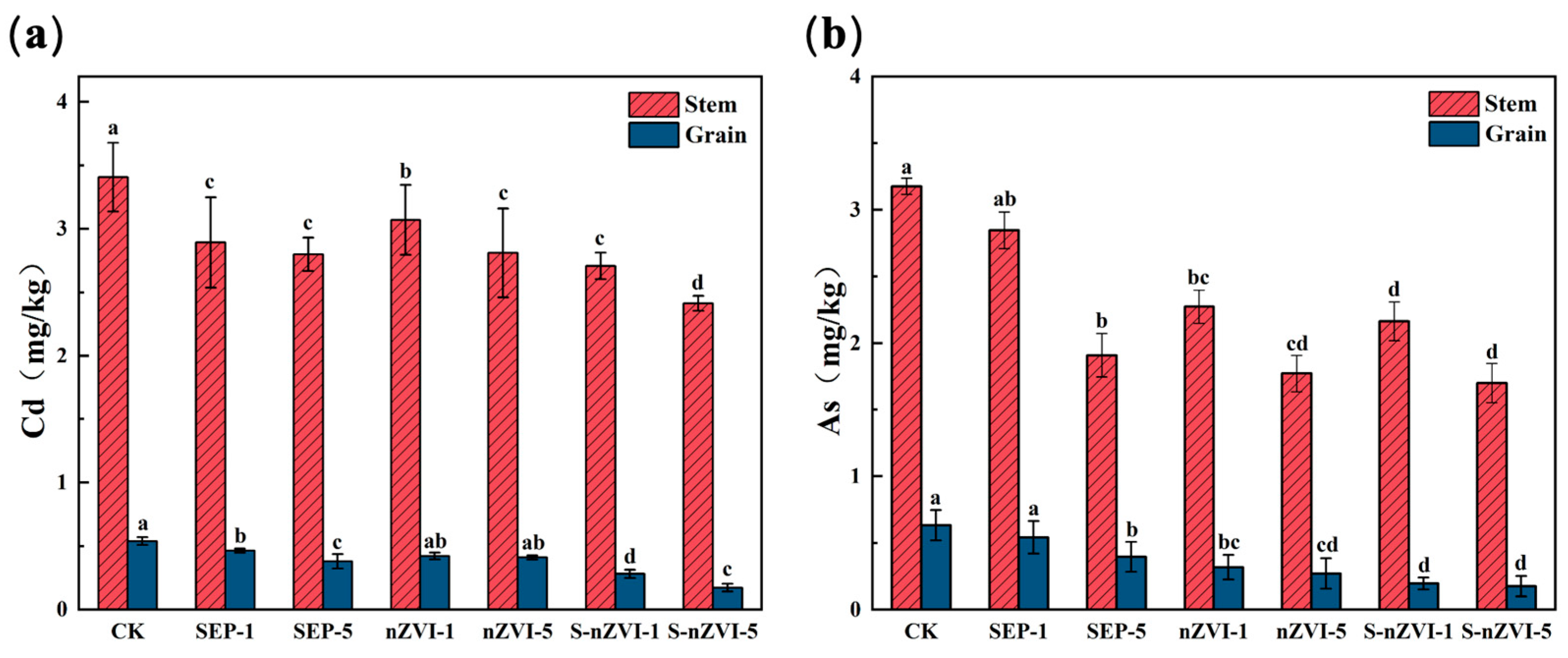
3.5. Effects on Rice Growth and Heavy Metal Accumulation
4. Discussion
4.1. Material Structural Characteristics and Their Effects on Repair Performance
4.2. Proposed Immobilization Mechanisms of Cd and As in Soil by S-nZVI
4.3. Limitations and Future Prospects
5. Conclusions
Supplementary Materials
Author Contributions
Funding
Institutional Review Board Statement
Informed Consent Statement
Data Availability Statement
Conflicts of Interest
References
- Bai, X.; Jiang, Y.; Jiang, Z.; Zhu, L.; Feng, J. Nutrient potentiate the responses of plankton community structure and metabolites to cadmium: A microcosm study. J. Hazard. Mater. 2022, 430, 128506. [Google Scholar] [CrossRef]
- Ma, J.; Jiang, Y.; Shen, Z.; Zhang, B.; Zhao, H.; Yang, X.; Feng, X.; Sun, D. A perspective on heavy metal(loid)s traceability in soil surrounding coal gangue areas: Combined application of multiple source analysis methods. Front. Environ. Sci. 2025, 13, 1582799. [Google Scholar] [CrossRef]
- Yang, Z.; Yu, J.; Yang, K.; Zhang, Q.; Chen, Y.; Qiao, S. Source Apportionment and Risk Assessment of Potentially Toxic Elements Based on PCA and PMF Model in Black Soil Area of Hailun City, Northeast China. Toxics 2024, 12, 683. [Google Scholar] [CrossRef] [PubMed]
- Deng, X.; Yang, Y.; Zeng, H.; Chen, Y.; Zeng, Q. Variations in iron plaque, root morphology and metal bioavailability response to seedling establishment methods and their impacts on Cd and Pb accumulation and translocation in rice (Oryza sativa L.). J. Hazard. Mater. 2020, 384, 121343. [Google Scholar] [CrossRef] [PubMed]
- Mi, B.; Liu, F.; Xie, L.; Zhou, H.; Wu, F.; Dai, X. Evaluation of the uptake capacities of heavy metals in Chinese cabbage. Ecotoxicol. Environ. Saf. 2019, 171, 511–517. [Google Scholar] [CrossRef] [PubMed]
- Wei, L. Responses of Wheat/Corn and Microorganisms in Rhizosphere to Cadmium/Arsenic-Contaminated Soil. Master’s Thesis, Hebei Agricultural University, Baoding, China, 2021. [Google Scholar] [CrossRef]
- Wang, M.; Zhang, Q.; Yang, Z.; Zhang, A.; Xie, X.; Xi, J. Dynamic Change and Influence Factors of Soil Ehin the Paddy Field During the Drying and Rewetting Cycles in Yellow River Irrigation Area of Ningxia Autonomous Region. J. Irrig. Drain. 2014, 33, 47–51. [Google Scholar] [CrossRef]
- Huang, R. Effects of Different Inorganic Fertilizer on Immobilization Remediation of Cd Polluted Paddy Soil Using Sepiolite. J. Ecol. Rural. Environ. 2018, 34, 547–553. [Google Scholar] [CrossRef]
- Padilla-Ortega, E.; Leyva-Ramos, R.; Flores-Cano, J.V. Binary adsorption of heavy metals from aqueous solution onto natural clays. Chem. Eng. J. 2013, 225, 535–546. [Google Scholar] [CrossRef]
- Lin, X.; Huang, Y.; She, Z.; Xu, Z. Advance in Research on Mechanism of Phosphorus Cycle Affecting Arsenic Migration and Transformation in Paddy-field System: A Review. Environ. Sci. Technol. 2025, 48, 214–221. [Google Scholar] [CrossRef]
- Sun, D.; Chen, C.; Gong, Y.; Ma, Y.; Zhang, X.; Zhang, B. Research Progress of Sepiolite in Remediation of Heavy Metal Pollution in Agricultural Products and Water Bodies. Life Sci. Res. 2024, 28, 83–94. [Google Scholar] [CrossRef]
- Yang, X.; Ren, G.; Pan, Y. Study on remediation effect of sepiolite on Pb, Zn and Cd compound contaminated soil. J. Heilongjiang Univ. Sci. Technol. 2011, 21, 268–272. [Google Scholar] [CrossRef]
- Yu, S. Research on the Characteristic and Mechanism of Arsenic(III/V) Removal in Water by Modified Sepiolite. Master’s Thesis, Wuhan University of Technology, Wuhan, China, 2021. [Google Scholar] [CrossRef]
- Liu, M. Stabilization Effect of Nano-Zero-Valentiron (nZVI) on Cd Pollution in Soiland Its Mechanism. Ph.D. Thesis, Zhejiang University, Hangzhou, China, 2022. [Google Scholar] [CrossRef]
- Gao, Y.; Zhou, Q. Application of Nanoscale Zero-valent Iron to Contaminated Soil Remediation: A Review. J. Agro-Environ. Sci. 2013, 32, 418–425. [Google Scholar] [CrossRef]
- Stefaniuk, M.; Oleszczuk, P.; Ok, Y.S. Review on nano zerovalent iron (nZVI): From synthesis to environmental applications. Chem. Eng. J. 2016, 287, 618–632. [Google Scholar] [CrossRef]
- Yang, M.; Peng, J.; Liu, J. Effects of Cadmium on the Growth of Rice Seedlings Under Different pH Conditions. J. Anhui Agric. Sci. 2025, 53, 19–21. [Google Scholar] [CrossRef]
- Liu, Q.; Yan, X.; Liao, X.; Lin, L.; Yang, J. Effects of Soil Moisture on Phytoremediation of As-Contaminated Soils Using As Hyperaccumulator Pteris vittata L. Environ. Sci. 2015, 36, 3056–3061. [Google Scholar] [CrossRef]
- Zhao, F.-J.; Wang, P. Arsenic and cadmium accumulation in rice and mitigation strategies. Plant Soil 2020, 446, 1–21. [Google Scholar] [CrossRef]
- Zhou, K.; Qin, Q.; Duan, G.; Fu, Q.; Yang, H.; Han, X.; Zhang, C.; He, S.; Jiang, S. Preparation, modification and applications of sepiolite nanofibers: A review. Inorganica Chim. Acta 2025, 579, 122567. [Google Scholar] [CrossRef]
- Meihagul, A.; Yang, Z.; Luo, Y.; Zhou, J.; Zhu, X.; Jia, H. Modified nZVI for remediation of As/Cd combined pollution: A review. J. Agro-Environ. Sci. 2024, 43, 2220–2228. [Google Scholar]
- Zou, Y.; Wang, X.; Khan, A.; Wang, P.; Liu, Y.; Alsaedi, A.; Hayat, T.; Wang, X. Environmental Remediation and Application of Nanoscale Zero-Valent Iron and Its Composites for the Removal of Heavy Metal Ions: A Review. Environ. Sci. Technol. 2016, 50, 7290–7304. [Google Scholar] [CrossRef]
- Zhang, B.; Zhu, B.; Wang, X.; You, S.; Wang, B. Removal of nickel from the actual electrolytic wastewater by bentonite supported nanoscale zero valent iron. Desalination Water Treat. 2021, 220, 159–167. [Google Scholar] [CrossRef]
- Sheng, G.; Ma, X.; Linghu, W.; Chen, Z.; Hu, J.; Alsaedi, A.; Shammakh, W.; Monaquel, S.; Sheng, J. Enhanced trapping of Ni(II) ions by diatomite-supported nanoscale zerovalent iron from aqueous solution. Desalination Water Treat. 2017, 70, 183–189. [Google Scholar] [CrossRef]
- Cao, X.; Wang, H.; Yang, C.; Cheng, L.; Fu, K.; Qiu, F. Nanoscale zero-valent iron supported on carbon nanotubes for polychlorinated biphenyls removal. Desalination Water Treat. 2020, 201, 173–186. [Google Scholar] [CrossRef]
- Dermawan, D.; Satriavi, A.D.; Nurhidayati, D.I.; Firnandi, R.; Mayangsari, N.E.; Ramadani, T.A.; Widiana, D.R.; Juniani, A.I.; Mujiyanti, D.R.; Wang, Y.-F. Composite adsorbent from sugarcane (Saccharum officinarum) bagasse biochar generated from atmospheric pressure microwave plasma pyrolysis process and nano zero valent iron (nZVI) for rapid and highly efficient Cr(VI) adsorption. Case Stud. Chem. Environ. Eng. 2025, 11, 101123. [Google Scholar] [CrossRef]
- Ainiwaer, M.; Zeng, X.; Yin, X.; Wen, J.; Su, S.; Wang, Y.; Zhang, Y.; Zhang, T.; Zhang, N. Thermodynamics, Kinetics, and Mechanisms of the Co-Removal of Arsenate and Arsenite by Sepiolite-Supported Nanoscale Zero-Valent Iron in Aqueous Solution. Int. J. Environ. Res. Public Health 2022, 19, 11401. [Google Scholar] [CrossRef]
- GB 15618-2018; Environmental Quality Standard for Soils: Risk Control Standard for Soil Contamination of Agricultural Land (Trial). China Environmental Science Press: Beijing, China, 2018.
- Cassel, D.K.; Nielsen, D.R. Field Capacity and Available Water Capacity. In Methods of Soil Analysis; Klute, A., Ed.; American Society of Agronomy-Soil Science Society of America: Madison, WI, USA, 1986. [Google Scholar] [CrossRef]
- GB 2762-2022; National Food Safety Standard—Limits of Contaminants in Foods. China Standard Press: Beijing, China, 2022.
- Antony, J.; Meera, V.; Raphael, V.P.; Vinod, P. Facile encapsulation of nano zero-valent iron with calcium carbonate: Synthesis, characterization and application for iron remediation. J. Environ. Health Sci. Eng. 2022, 20, 915–930. [Google Scholar] [CrossRef]
- Taha, M.R.; Ibrahim, A.H. Characterization of nano zero-valent iron (nZVI) and its application in sono-Fenton process to remove COD in palm oil mill effluent. J. Environ. Chem. Eng. 2014, 2, 1–8. [Google Scholar] [CrossRef]
- Yang, H. Using Clay to Modify NZVI Apply for Chromium Remediation and Its Co-transport Mechanism. Master’s Thesis, Suzhou University of Science and Technology, Suzhou, China, 2021. [Google Scholar] [CrossRef]
- Arancibia-Miranda, N.; Baltazar, S.E.; García, A.; Muñoz-Lira, D.; Sepúlveda, P.; Rubio, M.A.; Altbir, D. Nanoscale zero valent supported by Zeolite and Montmorillonite: Template effect of the removal of lead ion from an aqueous solution. J. Hazard. Mater. 2016, 301, 371–380. [Google Scholar] [CrossRef]
- Li, Z.; Wang, L.; Meng, J.; Liu, X.; Xu, J.; Wang, F.; Brookes, P. Zeolite-supported nanoscale zero-valent iron: New findings on simultaneous adsorption of Cd(II), Pb(II), and As(III) in aqueous solution and soil. J. Hazard. Mater. 2018, 344, 1–11. [Google Scholar] [CrossRef]
- Suárez, M.; García-Rivas, J.; García-Romero, E.; Jara, N. Mineralogical characterisation and surface properties of sepiolite from Polatli (Turkey). Appl. Clay Sci. 2016, 131, 124–130. [Google Scholar] [CrossRef]
- Bastida, J.; Kojdecki, M.A.; Pardo, P.; Amorós, P. X-ray diffraction line broadening on vibrating dry-milled two crows sepiolite. Clays Clay Miner. 2006, 54, 390–401. [Google Scholar] [CrossRef]
- Tang, Q.; Wang, F.; Tang, M.; Liang, J.; Ren, C. Study on pore distribution and formation rule of sepiolite mineral nanomaterials. J. Nanomater. 2012, 2012, 382603. [Google Scholar] [CrossRef]
- Malakootian, M.; Daneshkhah, M.; Hossaini, H. Removal of phosphates from aqueous solution by sepiolite-nano zero valent iron composite optimization with response surface methodology. Int. J. Environ. Sci. Technol. 2018, 15, 2129–2140. [Google Scholar] [CrossRef]
- Mendez, J.C.; Hiemstra, T. Ternary Complex Formation of Phosphate with Ca and Mg Ions Binding to Ferrihydrite: Experiments and Mechanisms. ACS Earth Space Chem. 2020, 4, 545–557. [Google Scholar] [CrossRef]
- Xie, L.; Giammar, D.E. Chapter 13 Influence of Phosphate on Adsorption and Surface Precipitation of Lead on Iron Oxide Surfaces. In Developments in Earth and Environmental Sciences; Barnett, M.O., Kent, D.B., Eds.; Elsevier: Amsterdam, The Netherlands, 2007; pp. 349–373. [Google Scholar] [CrossRef]
- Deng, S.Y.; Ren, B.Z.; Cheng, S.C. Study on the adsorption performance of carbon-magnetic modified sepiolite nanocomposite for Sb(V), Cd(II), Pb(II), and Zn(II): Optimal conditions, mechanisms, and practical applications in mining areas. J. Hazard. Mater. 2025, 487, 137129. [Google Scholar] [CrossRef]
- Liu, L.; Wang, H.; Fu, Y.; Gao, L.; Yang, Z.; Zheng, X.; Chen, Y.; Huang, Y.; Wang, X.; Yi, X.; et al. Application of a superior magnetic hydroxy iron material for As removal from soil. Environ. Res. 2025, 274, 121046. [Google Scholar] [CrossRef]
- Zhang, Y.; Zheng, Q.; Zhou, J.; Ren, H.; Chen, H. Characterization of fresh and corroded nano zero-valent iron (nZVI) to remove Cr (VI) in soil environment. Environ. Monit. Assess. 2025, 197, 620. [Google Scholar] [CrossRef] [PubMed]
- Gao, J.; Han, H.; Gao, C.; Wang, Y.; Dong, B.; Xu, Z. Organic amendments for in situ immobilization of heavy metals in soil: A review. Chemosphere 2023, 335, 139088. [Google Scholar] [CrossRef] [PubMed]
- Chen, S.; Zhang, S.; Zhao, Y.; Cao, C. In-situ immobilization remediation of Cd-polluted soil by clay minerals. Chem. Eng. 2022, 36, 45–48+66. [Google Scholar] [CrossRef]
- Ainiwaer, M.; Zhang, T.; Zhang, N.; Yin, X.; Su, S.; Wang, Y.; Zhang, Y.; Zeng, X. Synergistic removal of As(III) and Cd(II) by sepiolite-modified nanoscale zero-valent iron and a related mechanistic study. J. Environ. Manag. 2022, 319, 115658. [Google Scholar] [CrossRef]
- Ainiwaer, M.; Zhang, T.; Yin, X.; Zhang, N.; Peng, L.; Li, H.; Zeng, X. Adsorption effect of Cd(II) by sepiolite-modified nanoscale zero-valent iron and mechanistic study. Environ. Chem. 2025, 44, 322–333. [Google Scholar] [CrossRef]
- Tessier, A.; Campbell, P.G.C.; Bisson, M. Sequential extraction procedure for the speciation of particulate trace metals. Anal. Chem. 1979, 51, 844–851. [Google Scholar] [CrossRef]
- Wenzel, W.W.; Kirchbaumer, N.; Prohaska, T.; Stingeder, G.; Lombi, E.; Adriano, D.C. Arsenic fractionation in soils using an improved sequential extraction procedure. Anal. Chim. Acta 2001, 436, 309–323. [Google Scholar] [CrossRef]
- Dixit, S.; Hering, J.G. Comparison of Arsenic (V) and Arsenic (III) Sorption onto Iron Oxide Minerals: Implications for Arsenic Mobility. Environ. Sci. Technol. 2003, 37, 4182–4189. [Google Scholar] [CrossRef] [PubMed]
- Kumpiene, J.; Lagerkvist, A.; Maurice, C. Stabilization of As, Cr, Cu, Pb and Zn in soil using amendments—A review. Waste Manag. 2008, 28, 215–225. [Google Scholar] [CrossRef] [PubMed]
- Bolan, N.; Kunhikrishnan, A.; Thangarajan, R.; Kumpiene, J.; Park, J.; Makino, T.; Kirkham, M.B.; Scheckel, K. Remediation of heavy metal(loid)s contaminated soils—To mobilize or to immobilize? J. Hazard. Mater. 2014, 266, 141–166. [Google Scholar] [CrossRef] [PubMed]
- Wei, Y.; Zheng, N.; An, Q.; Chen, C.; Pan, J.; Wang, S.; Peng, L.; Qin, Y. Cr(VI) stress-driven enrichment of rhizosphere microbial functions and metabolic regulation synergistically reduce chromium bioavailability. J. Hazard. Mater. 2026, 501, 140786. [Google Scholar] [CrossRef]



| pH | SOC | Total Content (mg/kg) | Clay (%) | Silt (%) | Total Content (g/kg) | ||||
|---|---|---|---|---|---|---|---|---|---|
| As | Cd | N | P | K | |||||
| Tested soil | 5.65 | 11.51 | 132.31 | 3.2 | 12.8 | 75.45 | 0.82 | 0.76 | 13.49 |
| Treatment | Stem Cd Enrichment Coefficient | Grain Cd Enrichment Coefficient | Stem As Enrichment Coefficient | Grain Cd Enrichment Coefficient |
|---|---|---|---|---|
| CK | 5.245 | 0.829 | 0.278 | 0.055 |
| SEP-1 | 5.579 | 0.895 | 0.399 | 0.076 |
| SEP-5 | 6.850 | 0.928 | 0.321 | 0.067 |
| nZVI-1 | 5.933 | 0.814 | 0.431 | 0.060 |
| nZVI-5 | 7.267 | 1.062 | 0.463 | 0.071 |
| S-nZVI-1 | 7.123 | 0.739 | 0.432 | 0.039 |
| S-nZVI-5 | 7.792 | 0.558 | 0.556 | 0.058 |
Disclaimer/Publisher’s Note: The statements, opinions and data contained in all publications are solely those of the individual author(s) and contributor(s) and not of MDPI and/or the editor(s). MDPI and/or the editor(s) disclaim responsibility for any injury to people or property resulting from any ideas, methods, instructions or products referred to in the content. |
© 2026 by the authors. Licensee MDPI, Basel, Switzerland. This article is an open access article distributed under the terms and conditions of the Creative Commons Attribution (CC BY) license.
Share and Cite
Li, K.; He, T.; Wang, Y.; Wang, X.; Lei, D.; Li, L. Synchronous Immobilization of Arsenic and Cadmium in Agricultural Soils by Sepiolite-Supported Nanoscale Zero-Valent Iron. Toxics 2026, 14, 301. https://doi.org/10.3390/toxics14040301
Li K, He T, Wang Y, Wang X, Lei D, Li L. Synchronous Immobilization of Arsenic and Cadmium in Agricultural Soils by Sepiolite-Supported Nanoscale Zero-Valent Iron. Toxics. 2026; 14(4):301. https://doi.org/10.3390/toxics14040301
Chicago/Turabian StyleLi, Kuiru, Tieguang He, Yan Wang, Xinru Wang, Donghuan Lei, and Lijuan Li. 2026. "Synchronous Immobilization of Arsenic and Cadmium in Agricultural Soils by Sepiolite-Supported Nanoscale Zero-Valent Iron" Toxics 14, no. 4: 301. https://doi.org/10.3390/toxics14040301
APA StyleLi, K., He, T., Wang, Y., Wang, X., Lei, D., & Li, L. (2026). Synchronous Immobilization of Arsenic and Cadmium in Agricultural Soils by Sepiolite-Supported Nanoscale Zero-Valent Iron. Toxics, 14(4), 301. https://doi.org/10.3390/toxics14040301