Article

Identification and Translocation of Potentially Toxic Elements in Sorghum Plants Grown in Central Mexico


by
Luis Eduardo Herrera-Figueroa
1,
Francisco Rodríguez-González
1,*,
Rodolfo Figueroa-Brito
1,
Santos Margarito Herrera-Cadena
1,
Silvia Viridiana Vargas-Solano
1,
Alex Osorio-Ruiz
2,
Miguel Mauricio Correa-Ramírez
3,
Carlos Enrique Ail-Catzim
4,
Pedro Joaquín Gutiérrez-Yurrita
5 and
Juan Alberto Alcántara-Cárdenas
5
1
Centro de Desarrollo de Productos Bióticos, Instituto Politécnico Nacional, Carretera Yautepec-Jojutla Km. 6, Calle CEPROBI No. 8, San Isidro, Yautepec 62739, Morelos, Mexico
2
Estancia Posdoctoral SECIHTI, Centro de Desarrollo de Productos Bióticos, Instituto Politécnico Nacional, Carretera Yautepec-Jojutla Km. 6, Calle CEPROBI No. 8, San Isidro, Yautepec 62739, Morelos, Mexico
3
Centro Interdisciplinario de Investigación para el Desarrollo Integral Regional Durango, Instituto Politécnico Nacional, Sigma 119, 20 de Noviembre II, Durango 34220, Durango, Mexico
4
Instituto de Ciencias Agrarias, Universidad Autónoma de Baja California, Carretera a Delta s/n, Mexicali 21705, Baja California, Mexico
5
Centro Interdisciplinario de Investigaciones y Estudios Sobre Medio Ambiente y Desarrollo, Instituto Politécnico Nacional, Calle 30 de Junio de 1520 s/n, Barrio la Laguna Ticomán, Alcaldía Gustavo A. Madero, Mexico City 07340, Mexico
*
Author to whom correspondence should be addressed.
Toxics 2026, 14(4), 290; https://doi.org/10.3390/toxics14040290
Submission received: 19 February 2026 / Revised: 23 March 2026 / Accepted: 26 March 2026 / Published: 28 March 2026
(This article belongs to the Special Issue Assessment and Remediation of Heavy Metal Contamination in Soil)

Abstract

Contamination of agricultural soil by potentially toxic elements (PTEs) can be caused by volcanic emissions and the use of agrochemicals; this threatens human food security, as PTEs can be transferred from the soil to plant tissues. Sorghum is the fifth most important cereal crop worldwide, and Mexico is one of the countries with the highest sorghum production. However, these crops are vulnerable to pests; thus, agrochemicals are applied to eliminate them. In this study, the identification and translocation of PTEs into sorghum plants grown in urban and volcanic areas of central Mexico were evaluated. Sorghum plants and soil samples were collected at four sites (S1, S2, S3, and S4) in these areas. The concentrations of PTEs in the soil samples and in the different tissues of the sorghum plants were determined by inductively coupled plasma optical emission spectroscopy. It was found that these sites are contaminated with PTEs, which were attributed to volcanic emissions and anthropogenic activities. In addition, the translocation factor values for zinc, nickel, and manganese showed that these PTEs were retained in the roots of the sorghum plants; however, the average concentrations of these PTEs in the grains of the plants were higher than the translocation factor values. This result indicates that the aerial parts of the sorghum plants could have been contaminated with PTEs from the air, which could then enter humans throughout the food chain.

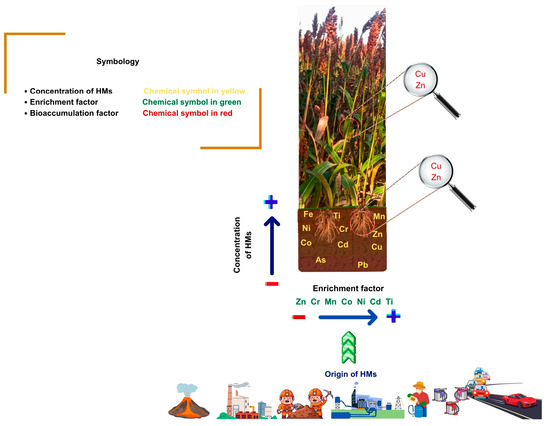
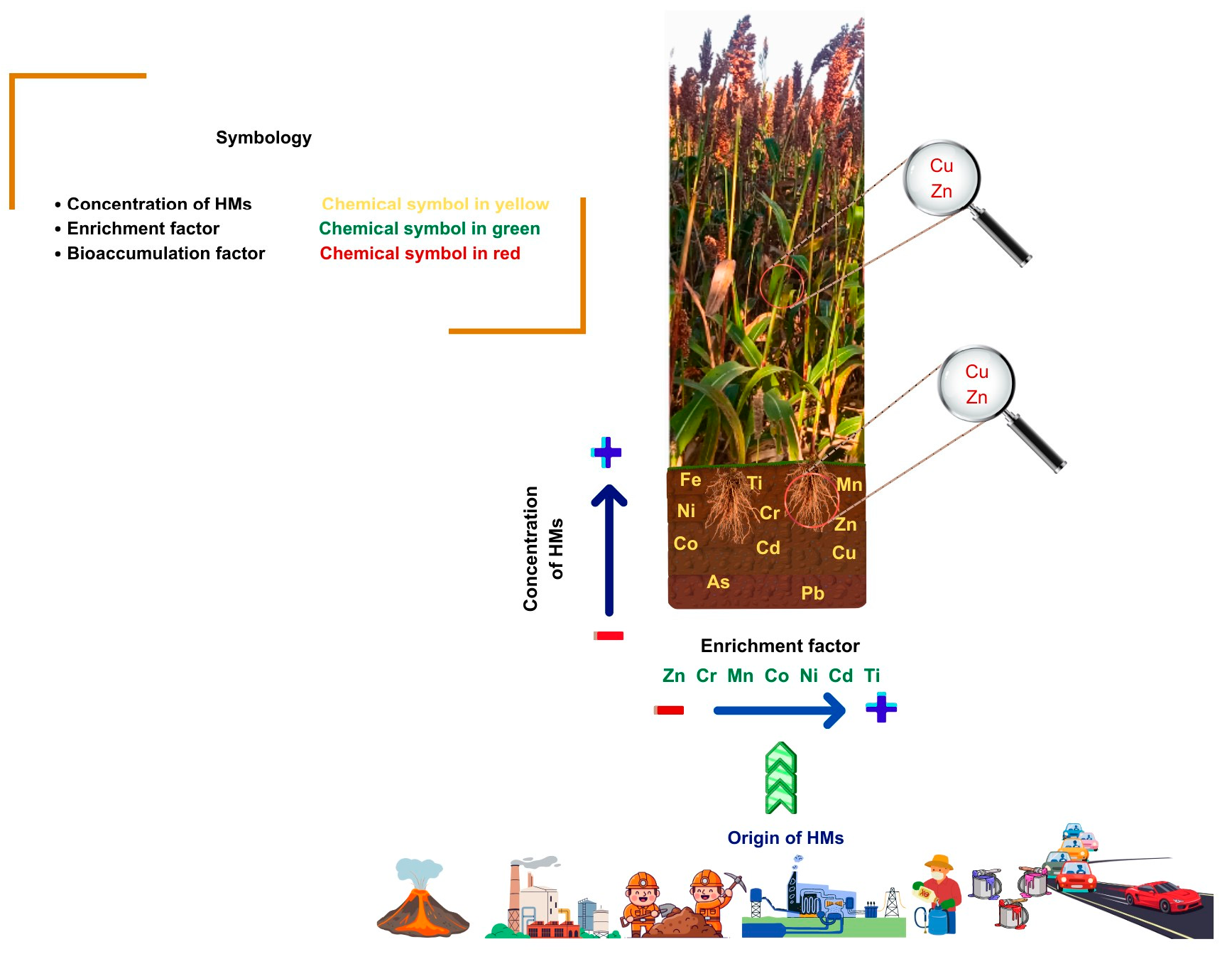
Graphical Abstract

1. Introduction

Contamination of agricultural soils plays a key role in sustainability and food security [1]. This contamination is caused by natural and anthropogenic sources, with the former including forest fires, volcanic eruptions, and acid rain, and the latter including sewage and industrial waste discharges, as well as poor agricultural practices [2,3,4,5,6,7]. In addition, these sources of contamination can affect trace element concentrations and incorporate potentially toxic elements (PTEs) into soils [8,9]. PTEs are chemical elements composed of metals, metalloids, and non-metals, and can therefore be grouped as pollutants with a high level of toxicity to living organisms, as they can persist in the environment because they are not degradable. Some elements are considered essential for the growth and metabolism of living beings, such as calcium (Ca), copper (Cu), iron (Fe), magnesium (Mg), manganese (Mn), and zinc (Zn); however, in high concentrations, they could have harmful effects on human health, which is why some authors classify them as PTEs. On the other hand, PTEs such as arsenic (As), cadmium (Cd), lead (Pb), chromium (Cr), cobalt (Co), nickel (Ni), and titanium (Ti), among others, are considered non-essential due to their high toxicity, even at low concentrations in the environment [10,11,12]. These PTEs, when present in soil and water, can accumulate in plant and animal tissues, contaminating food and, when consumed, can cause irreversible damage to human health [13].
The agricultural sector is essential for human survival and is of great importance to the economy of countries. The success of the agricultural sector depends entirely on soil quality, physiological conditions, and total production [3,5]. However, continuous changes in agricultural soils due to the use of synthetic agrochemicals and the discharged wastewater from mines and factories can alter the system, leading to increased soil contamination and decreased soil quality [3,13,14]. Moreover, the combustion of fuels by cars also contributes to the accumulation of PTEs in agricultural soils near roads and highways [3,8]. In general, this environmental stress creates a critical need to safeguard the quality of the soil in agricultural fields. In addition, non-essential PTEs represent an environmental threat due to their ability to cause poisoning in food and agricultural crops [3,5,8]. Daily food consumption is one of the main routes of entry of PTEs into human tissues as they tend to be transferred from the soil to plants where they accumulate before entering humans through food supply chains, causing immediate or indirect damage to human health [3,5,8,13].
One commonly consumed crop is sorghum, which is the fifth most important cereal crop worldwide. It is of African origin according to reports from Ethiopia around the year 5000 B.C, from India in 4000 B.C, and from China and southern Africa in approximately 1500 B.C [15,16]. This crop is characterized by its C4 metabolism, which allows it to withstand hot, arid, or semi-arid climatic conditions. Mexico is the fourth largest sorghum producer in the world, accounting for 7% of the total production. It is the third most important crop in Mexico, with 4200 MT produced annually [17,18]. Sorghum is considered a dual-purpose crop, since the grain is highly valued and the stubble is used in livestock feed and, in some cases, in the poultry industry [19]. In West Africa, the fodder is used for roofing [15]. The sorghum industry in Mexico is divided into two sectors: modern large-scale agriculture (used industrially in livestock feed and bioethanol production) and small-scale, traditional agriculture (self-consumption) [20], with the latter being the predominant sector in Mexico. Nevertheless, its production has faced challenges worldwide due to biotic stress factors such as the presence of pests and diseases, as well as land-use changes [15].
The state of Morelos, located in central Mexico and considered one of the main sorghum-producing states in the country, has been affected in terms of yield and crop quality due to the sugarcane aphid plague “Melanaphis sacchari Zetner”, one of the most common pests in sorghum crops worldwide, since 2015 [21]. In Mexico, the sugarcane aphid has caused sorghum crop losses of more than 60%, leading producers to resort to conventional management, such as synthetic agrochemicals (phosphate fertilizers and pesticides based on neonicotinoids, dimethoate, cypermethrin, and glyphosate, among others), to mitigate the impact of this pest and stabilize production [5,22,23]. Furthermore, it has been reported that PTEs in crop fields could come from volcanic ash, fossil fuel combustion, the mining industry, as well as the excessive use of agrochemicals, among other sources [12,24,25,26,27,28]. Therefore, the objective of this study was to identify and quantify PTEs in sorghum plants grown in urban-volcanic areas of central Mexico, and their translocation into different tissues (roots, stems, and grains).

2. Materials and Methods

2.1. Study Area

The state of Morelos is located in central Mexico (latitude: 19°07′54″ N, 18°19′57″ S; longitude: 98°37′59″ E, 99°29′40″ W); it is bordered by the state of Mexico and Mexico City to the north, the Sierra Neovolcanica (Iztaccihuatl and Popocatepetl volcanoes, the latter of which is an active volcano) to the northeast, Puebla state to the east, Guerrero and Puebla states to the south, and Guerrero state and the state of Mexico to the west [29]. It has an area of 4879 km2 and represents 0.2% of the Mexican territory [30]. It has a warm sub-humid climate with an average annual temperature of 21.5 °C and an annual rainfall of 900 mm. It contains 11 soil types, with leptosol being the predominant type [30,31]. The state of Morelos possesses great natural and mineral wealth, which has allowed for the establishment and development of various industries in recent years [32]. According to the SGM [33], the state has more than 100 mines and a thermoelectric plant, as well as high agricultural activity. The highest sorghum production in the state of Morelos was achieved in the municipalities of Yecapixtla and Tepalcingo at 4350 ha and 3216 ha, respectively, while Tepoztlan had an average production of 26 ha and Xoxocotla had the lowest production, according to SIAP [17]. These municipalities were selected to carry out the present study.

2.2. Soil and Sorghum Plant Sample Collection

The municipalities selected for the study were Tepoztlan (S1), Yecapixtla (S2), Tepalcingo (S3), and Xoxocotla (S4). In each municipality, a sorghum crop with an area of 0.5 hectares, and under conventional management was chosen (Figure 1). At each site, soil and sorghum plant samples were collected at maturity (3 months after agricultural inputs were applied to the crops) between the summer and fall of 2022. The collection of the samples was carried out using a five-hole scheme [34], which consisted of selecting five surfaces or areas of 1 × 1 m2 distributed throughout the crop, and from each area, five samples of 0.2 kg (wet weight) of soil were collected from a depth of 15 to 20 cm. Subsequently, these were mixed to obtain 1 kg of a homogeneous soil sample per area and a total of 5 kg of soil was collected for each site [35] (see Supplementary Materials). In addition, three sorghum plants were randomly collected from each area (1 × 1 m2) of each site, thus obtaining 15 plants per site. The plants were stored in polyethylene bags and transported to the laboratory, where they were stored in a cold chamber (4 °C) until analysis.

2.3. Sample Analysis

Sorghum plants from each of the studied municipalities were washed with running water and then with deionized water to remove surface impurities. The sorghum plants and the soil samples were placed in plastic containers and then covered with a cloth (pore size of 0.042 mm); subsequently, all samples were dried in the open air (average temperature: 34 °C) for 10 days. After this time, the plant samples were divided into root, stem, and grain samples for further analysis. Next, each part of the plant was ground using a conventional electric grinder (model 1000A, LEJIEYIN, Wuhan, China) and sieved through a 10-mesh (2 mm) screen. The soil samples were also sieved using the same mesh to homogenize the particle size of all samples.

Physicochemical Analysis of Soil Samples

The determination of the collected soil samples’ pH, organic matter (OM) content, and cation exchange capacity (CEC) was carried out using methods AS-02, AS-07, and AS-12 of NOM-021-RECNAT-2000 [36], respectively. The concentration of PTEs (As, Cd, Co, Cr, Cu, Fe, Mn, Ni, Pb, Ti, and Zn) in the soil samples and the different parts of sorghum plants was measured according to EPA Method 6010D [37]. To a Berzelius beaker (Pyrex, Corning, Steuben County, NY, USA), 1 g of sample was added along with 2 mL of ultrapure nitric acid (HNO3, 67–70% w/w, J.T. Baker, Avantor, Radnor, PA, USA), 0.5 mL of ultrapure hydrochloric acid (HCl, 33–36% w/w, J.T. Baker, Avantor, Radnor, PA, USA), and 5 mL of ultrapure hydrogen peroxide (H2O2, 30% w/w, J.T. Baker, Avantor, Radnor, PA, USA) and pre-digestion was performed for 24 h; then, 5 mL of hydrogen peroxide was added and plate digestion (Cimarec, Thermo Scientific, Waltman, MA, USA) was performed at 90 °C for 4 h. Subsequently, the samples were cooled to room temperature, filtered (Grade 44, Whatman, Maidstone, Kent, UK), and brought to a final volume of 50 mL with Milli Q ultrapure water (Merck Millipore, Burlington, MA, USA) in a volumetric flask (Pyrex, Corning, New York, NY, USA). The concentration of PTEs in the samples was determined using an ICP-OES (inductively coupled plasma optical emission spectroscopy) instrument (ICP-OES 8300 DV, Perkin Elmer, Waltman, MA, USA). The operating conditions for this method are presented in Table S1 (Supplementary Materials). The precision of the analysis was maintained by using a certified high-purity standard with 21 elements at a concentration of 100 µg mL−1 in 4% HNO3 + Tr HF (SRM 3100, NIST, Gaithersburg, MD, USA); the reliability of the analysis was ensured by testing blank samples (water and the ultrapure reagents used in the determination) every 10 readings. The recovery rate for the studied elements was between 89 and 101%; each determination was performed in triplicate. The limit of detection and limit of quantification for each element are presented in Table S2 (Supplementary Materials).

2.4. Determination of Contamination Factors

The contamination factor (CF), enrichment factor (EF), bioaccumulation factor (BAF), and translocation factor (TF) were used to quantitatively describe the variation in PTEs contamination in the soils and different parts of the collected sorghum plants. The references used in the study were the average background values (BV) of PTEs concentrations in uncontaminated soils from the United States of America, Spain, and other parts of the world [38,39].

2.4.1. Contamination Factor

The contamination factor (CF) is commonly employed to assess soil PTE contamination [40]. The CF is calculated using the following equation:
C F = M S M B V
where MS is the measured PTEs concentration in the sample, and MBV is the background PTEs concentration. Based on the contamination factor, soils are classified as Class I (CF ˂ 1, pristine), Class II (1 ≤ CF ˂ 3; moderately contaminated), Class III (3 ≤ CF ˂ 6; considerably contaminated), and Class IV (CF > 6, highly contaminated) [39,40].

2.4.2. Enrichment Factor

The enrichment factor (EF) is commonly used to determine soil’s degree of contamination with PTEs of interest and can be used to infer the origin of the PTEs [41]. In addition, it considers naturally occurring and abundant elements, such as iron, which is used for normalization as its distribution has not been associated with that of other PTEs [42]. Therefore, in this study, Fe was used for the normalization of the PTEs levels in the soil samples and the different plant parts to calculate the EF:
E F = ( M s ) ( F e B V ) ( M B V ) ( F e s )
where FeBV and FeS represent the background value and the concentration of Fe in the soil sample, respectively. If EF < 1, it indicates that the analyzed PTEs may be of natural origin, whereas values between 1 < EF ≤ 1.5 indicate that they may be of anthropogenic origin, and values of 1.5 < EF ≤ 3, 3 < EF ≤ 5, 5 < EF ≤ 10, and EF > 10 are considered evidence of minor, moderate, severe, and very severe anthropogenic modification, respectively [39,40].

2.4.3. Bioaccumulation Factor

The bioaccumulation factor (BAF) is defined as the capacity of a plant to absorb and store PTEs from the soil in its different tissues [1,43]. It is calculated as follows:
B A F = M p l a n t M s o i l
where Mplant represents the concentration of a specific metal ion in the whole plant or in a specific plant tissue, and Msoil is the concentration of PTEs present in the soil. BAF values < 0.1 indicate that the plant cannot absorb PTEs. BAF values ≤ 1 indicate that the plant is suitable for phytostabilization, and has the capacity to absorb PTEs, but they are not stored in the plant’s tissues. BAF values > 1 indicate that there is uptake and storage of PTEs in plant tissues, which can be employed for phytoremediation [44].

2.4.4. Translocation Factor

The translocation factor (TF) reflects the efficiency of the plant in transporting PTEs from underground tissues (root) to aerial tissues [1,13]. It is calculated using the following equation:
T F = M h e i g h t M r o o t
where Mheight is the concentration of a specific PTE in one aerial part (stem or grains) of the plant, and Mroot is the concentration of the PTE in the underground part (roots) of the plant. TF values < 0.5 indicate that the plant accumulates PTEs in its roots, while TF values > 1 indicate that the plant can transport PTEs from its underground tissues to its aerial tissues [45].

2.5. Statistical Analysis

Statistical analysis of soil physicochemical characteristics and total PTEs concentrations in the crop fields was performed to calculate mean values and standard deviations. Statistically significant differences were examined using one-way ANOVA and Statistica software, version 12.0 (2013) (StatSoft Inc., Tulsa, OK, USA). When a statistically significant difference was found, a Tukey post hoc test (p < 0.05) was performed for pairwise comparisons of the mean values of the data.

3. Results and Discussion

3.1. Physicochemical Parameters of Sorghum Growing Soils

The physicochemical parameters (pH, organic matter content, and cation exchange capacity) of the soil samples collected from the different sorghum fields are presented in Table 1. The samples presented pH values between 4.9 and 6.6, indicating that they are strongly acidic (<5.0), moderately acidic (5.1 to 6.5), and neutral (6.6 to 7.3) [36]. These pH values may be related to the application of agricultural inputs to the crop fields for soil nutrition [3]; for example, ammonia nutrition induces soil acidification, which is mediated by plant roots [46]. Crop soils with acidic pH values can cause cultivated plants to increase uptake of PTEs compared to alkaline soils (pH ~7.9) [46,47] since PTEs have lower solubility and mobility in alkaline soils [40]. Thus, our result indicates that the studied sorghum plants came from sites with strongly acidic soils, allowing them to absorb PTEs.
The percentage of organic matter (OM) in the collected soil samples ranged between 1.75 and 4.09%; this result may be related to the lack of organic inputs (compost, organic manures, and earthworm humus) to the sorghum crops [13] as these percentages are considered low (OM ˂ 6.0%) [13]. In a similar context, do Nacimiento et al. [47] found that maize plants collected from different cultivation sites with acidic soils and low organic matter percentages (less than 6.0%) contained a higher amount of PTEs than the amounts in cultivated soils.
The soil samples showed cation exchange capacities of 10.4–17.2 Cmol/kg, indicating that negative charges are present on the surface of the minerals and organic components of the soils, and that the soils can retain cations, which are nutrients required by plants [48]. The CEC values were between 10 and 14 Cmol/kg, which are considered low and indicate a weak ability to retain nutrients and a low percentage of organic matter according to the classification of NOM-021-RENACT-2002 [36,48]. This is consistent with the OM percentages determined for the sorghum crop soils.

3.2. PTEs Identified in Sorghum Crop Soils

3.2.1. Identification and Concentration of PTEs

The concentration of each PTE identified, and the total PTE concentration in the different soils of the sorghum crops, as well as the safe values and permissible limits for each of PTEs, are presented in Table 2. The concentrations of As, Cd, Co, Cr, Mn, Ni, Ti, and Zn were lower than the values reported in the literature for safe soils for humans and the environment [38,49]. Some PTEs, namely Cd, Co, Cu, Fe, Mn, Ni, and Zn, are available in soil and are essential as micronutrients, but excess uptake by plants may result in toxic effects and could reach humans and animals through the food chain [13,50,51].
The concentration of these PTEs may have been influenced by the irregular application of inorganic fertilizers to sorghum crops (more than twice per year). Tóth et al. [52] suggested that the application of synthetic agrochemicals to agricultural fields promotes the presence of Cd, Cr, Ni, Pb, and Zn in varying concentrations in crop soils. Furthermore, the frequent use of these agrochemicals in agricultural systems can increase the levels of trace metals, namely Cd and Pb, in crop soils [53]. On the other hand, the application of animal manure has been reported to enrich crop soil by incorporating Co, Cu, Mn, and Zn. Thus, the PTEs contamination level of agricultural soils will depend on the frequency of application of agrochemicals and the physicochemical characteristics of the soil [54].
It is not known whether Ti influences plant growth, but at high concentrations, it has been reported to be phytotoxic to plants [55]. Some authors have reported that the incorporation of Ti into crop soils through the application of various agrochemicals can increase the concentration of PTEs in soils over years of application [56,57]. The different sorghum crop sites (S1, S2, S3, and S4) showed Fe concentrations that exceeded the upper permissible limit, but lower Cu and Pb concentrations that were below the permissible limits established in the literature [54]. The high Fe concentrations may be from a natural source, such as the ashes and volcanic emissions expelled from the Popocatepetl volcano in recent years, or the incineration of municipal waste and in the mining area of the state of Morelos [54,58,59]. In addition, it has been reported that other chemical elements, such as Cd, Co, Cu, Mn, Ni and Zn, considered soil contaminants, are generated from mining and metallurgical activities near crops [52,53,60]. Coal, lead, and Zn mines are believed to be major sources of Fe, As, Cd, and Pb generation, which can contaminate soils adjacent to mines [60]. Both Mn and Fe are essential PTEs in agricultural fields, but at high concentrations, they can become contaminants in the surrounding soil and consequently cause health problems [58].
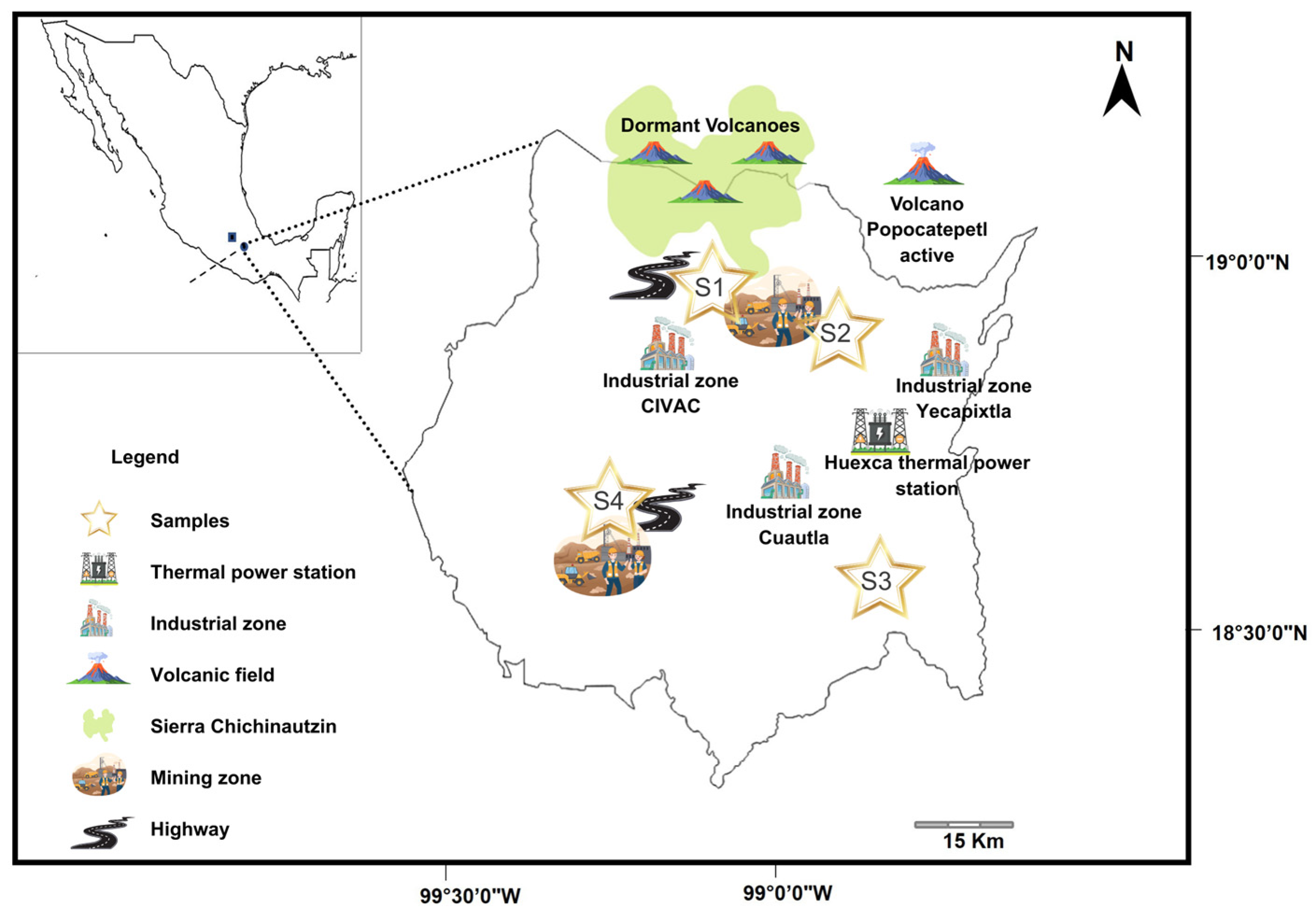
Regarding total PTEs concentration, the Tepoztlan crop site (S1) exhibited the highest concentration, followed by Yecapixtla (S2) and Tepalcingo (S3), and finally Xoxocotla (S4). These PTE concentrations were significantly different (p < 0.05): site S1 showed differences compared to sites S3 and S4, while site S2 showed differences compared to site S4. These results could be due to different sources of pollution, both anthropogenic and natural, namely, mining, thermoelectric plants, industrial zones, urban roads and highways, the use of agrochemicals, weathering and erosion phenomena, and volcanic ash. These sources of contamination are found close to the different sorghum cultivation sites in the state of Morelos (Figure 1) and could have varying effects on the different sites. For example, Tepoztlán (S1) is a town located near one of the busiest highways in Mexico, especially during weekends and holiday periods. The MEX-095D CDMX–Cuernavaca–Acapulco highway connects the capital of the country (Mexico City) with the state of Guerrero, passing right by Tepoztlán [61]. According to Gupta [62], in urban areas, vehicles emit PTEs through the combustion of diesel and gasoline, as well as through the wear of tires, brake pads, and engines, as well as corrosion of metal parts and paint. Furthermore, Tepoztlán is composed of various primary volcanic rocks, including lava, pyroclastic flows, and lahars [63], and weathering and erosion of these materials could occur and release potentially toxic compounds. In addition, although Tepoztlán and Yecapixtla are located a short distance from the high-risk zone of the Popocatepetl volcano, it is the latter locality that usually receives the largest amount of volcanic ash, which has been reported to be composed of PTEs such as As, Cd, Cr, Cu, Mn, Ni, Pb, and Zn [64]. Additionally, site S2 is located near an industrial area and a thermoelectric plant, which could contribute to the increased PTE levels at this site. Site S3, Tepalcingo, is located 10 km from the Siglo XXI highway, which connects the states of Puebla and Guerrero (MEX-095D highway) via the state of Morelos [65]. This highway is also one of the most important and heavily trafficked in the country, especially during holiday periods. Although less affected than sites S1 and S2, site S3 is also susceptible to volcanic ashfall. Site S4, on the other hand, is a connection point for the MEX-095D and Siglo XXI highways [66]. Furthermore, an industrial zone located 35 min from Xoxocotla and S4 it is also susceptible to volcanic ashfall, though to a lesser degree than the other sites.
Our results are consistent with those reported by Antoniadis et al. [40], who quantified traces of PTEs in soils collected in an industrial and volcanic area of Volos, Greece. They concluded that natural and anthropogenic sources can considerably affect soil contamination levels and consequently cause health risks.
If we only look at the top eight PTEs in terms of concentration, Fe showed the highest concentration in all the sites studied, followed by Mn and/or Ti. The rankings of the different PTEs are presented in Table 3.
The rankings in Table 3 are consistent with the results reported by Hossen et al. [43], who identified and quantified PTEs in 20 soil samples near a coal mining area in Barapukuria, Bangladesh. Their ranking was Fe (18,879 ± 8724 mg/kg) > Mn (226.12 ± 34.3 mg/kg) > Zn (101.96 ± 4.79 mg/kg) > Cr (82.37 ± 37.72 mg/kg) > Ni (56.54 ± 26.08 mg/kg) > Co (31.66 ± 9.86 mg/kg). The high concentrations and spatial differences between sampling sites were attributed to irrigation of the soils with water drained from the coal mine and their proximity to roads. However, the results obtained by these authors differ from those of the present study with respect to the high concentrations of the different PTEs. In this study, the different PTEs were present at concentrations within the limits established in the literature and do not represent a risk to the environment [67]. However, they can accumulate in soils and in the different tissues of sorghum plants and thus enter the food chain of humans and animals [2,13,68].

3.2.2. Assessment of Soil Contamination Indices

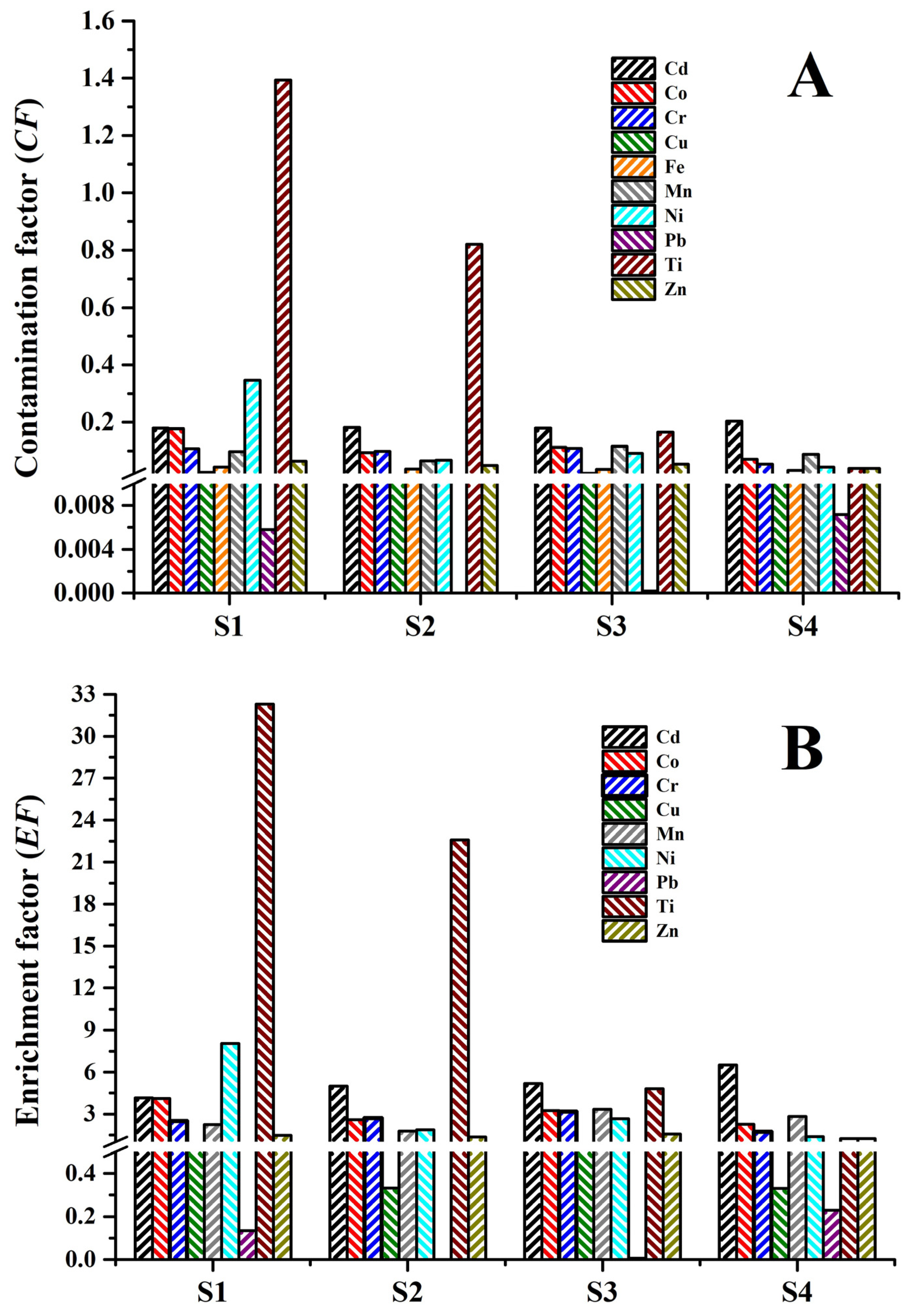
The contamination factor (CF) and enrichment factor (EF) values obtained for the different sorghum cultivation sites studied are presented in Figure 2A,B. Only some PTEs were used to calculate the CF and EF values, namely Cd, Co, Cr, Cu, Mn, Ni, Pb, Ti, and Zn, because As presented CF and EF values close to 0, and Fe was used as a reference element [69]. The CF values were used to evaluate the level of PTE contamination in the soils. The PTEs can be ranked based on their average CF values as follows: Ti (0.61) > Cd (0.19) > Ni (0.14) > Co (0.12) > Cr (0.09) > Mn (0.09) > Zn (0.05) > Fe (0.04) > Cu (0.017) > Pb (0.003). According to the results, the soil of site S1 can be classified as moderately contaminated with Ti (CF value of 1.40), while sites S2, S3, and S4 exhibited values of 0.82, 0.17, and 0.04, respectively (Figure 2A). This result may be related to the incorporation of Ti into the crop soil due to the use of fertilizers for sorghum plant growth [56,57] or emissions from industries that produce paints and coatings with Ti and metallic materials containing titanium alloys [38]. Most soil samples showed values of CF ˂ 1 for all the PTEs evaluated, classifying them as pristine soils [39,40].
Figure 2B, which presents the EF values for the PTEs in the evaluated soils, shows that all the sorghum fields had EF values greater than 1. The PTEs can be ranked as follows: Ti (15.24) > Cd (5.22) > Ni (3.48) > Co (3.06) > Mn (2.56) > Cr (2.52) > Zn (1.51). These results indicate that these sorghum crop soils in Morelos are enriched with PTEs of anthropogenic origin. According to the classification based on EF, there is extreme (EF > 10) and severe enrichment (5 ≤ EF < 10) of Ti and Cd, respectively; there is moderate enrichment of Ni and Co (3 ≤ EF < 5) and there is lower enrichment of Mn, Cr, and Zn (1.5 ≤ EF < 3) [40,43,51]. These results indicate that the PTEs identified in the crop sites may be due to the use of fertilizers and pesticides on the crops, the industries that are near the sites, urban and industrial waste, as well as vehicle emissions [56,57,59].
Cu and Pb presented EF values ˂ 1 at all the crop sites (between 0.33 and 0.63, and 0 and 0.29, respectively), classifying the soils as standard soils (EF ˂ 1.5) for Cu and Pb. The presence of Cu and Pb at the different sites (Table 2) may be related to emissions from the active Popocatepetl volcano, industrial and mining activity, as well as highways in urban areas [3,6,59].

3.3. Accumulation of PTEs in Sorghum Plant Tissues

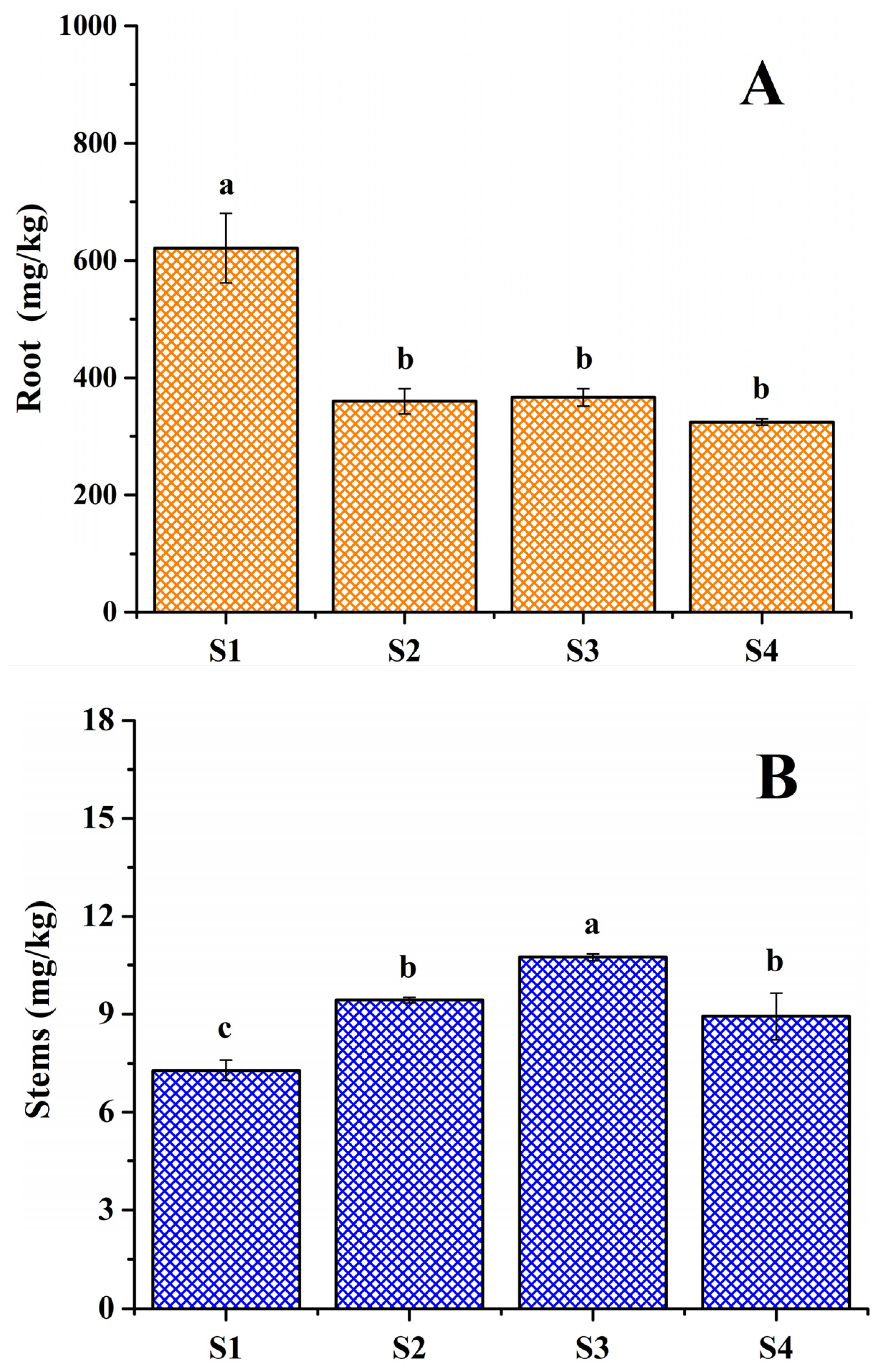
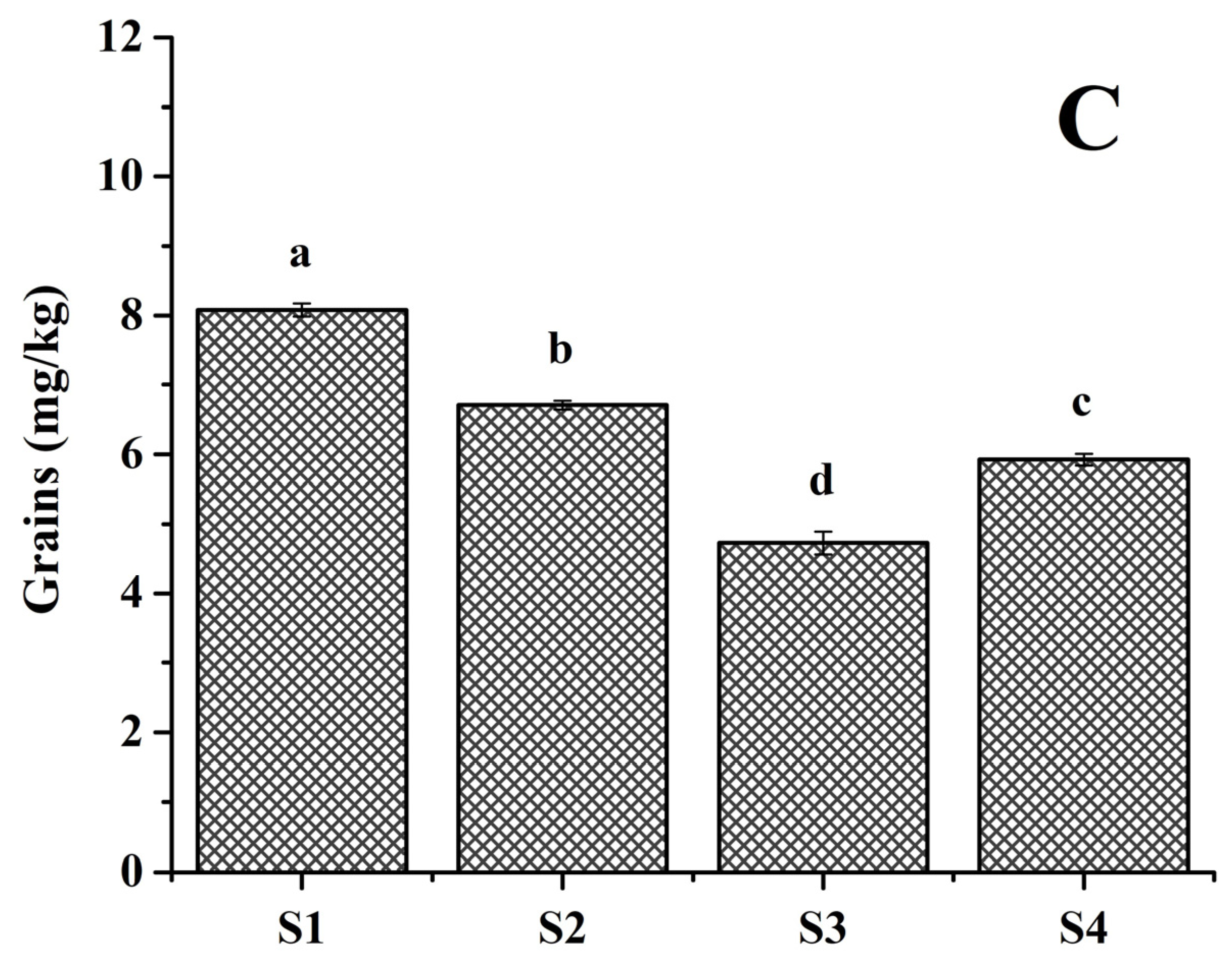
Among the sorghum plants collected at the four sites, roots presented the highest PTE concentrations, while stems and grains showed lower concentrations (Figure 3A–C). Generally, when soils contain high concentrations of PTEs, a higher concentration of PTEs is found in the root compared to other plant tissues [2,13,54,68,70]. In this study, the average total PTEs concentrations in the soils at sites S1, S2, S3, and S4 were 1441.7 ± 379, 1173.7 ± 320, 1098.2 ± 304, and 975.4 ± 276 mg/kg, respectively (Table 2), while the PTEs concentrations in the roots of sorghum plants collected at these sites were 620.9 ± 59, 360.1 ± 21, 366.8 ± 14, and 324.4 ± 5 mg/kg, respectively (Figure 3A). Site S1 showed the highest PTEs concentration compared to the other sites. The only significant differences in PTEs concentration (p < 0.05) were between site S1 and sites S2, S3, and S4. This result is consistent with those shown in Section 3.2.1 and agrees with the results reported in the literature [2,13,54,68,70].
In the root of the sorghum plants, the PTEs with the highest concentrations were Fe (295.8–557.4 mg/kg), Ti (1.8–34.1 mg/kg), Mn (9.6–18.3 mg/kg), Zn (1.9–5.3 mg/kg), and Cr (1.7–3.5 mg/kg). The PTEs with the lowest concentrations were Co (0.14–0.68 mg/kg), Cu (0.54–0.82 mg/kg), Ni (0.59–4.51 mg/kg), and Pb (0–0.023 mg/kg). According to the normal or phytotoxic PTE concentrations reported for trees and plants [71,72,73], the concentrations of Fe, Ti, and Ni in the roots of the sorghum plants exceeded the permissible limits for phytotoxicity. This result reveals that these plants showed more tolerance to Fe, Ti, and Ni compared to Mn, Zn, Cr, Co, Cu, and Pb. These results are consistent with the findings of Yuan et al. [13], who studied tissues the roots, stems, leaves, and grains of sweet sorghum plants, and they found the highest concentrations of Pb, Zn and Cd in the roots, while the stem presented the lowest concentrations. Likewise, they found that the concentrations of Pb and Zn were higher than those of Cd in most of the sweet sorghum plants studied; however, Pb and Zn concentrations were found to be at normal or permissible levels, while Cd showed a concentration higher than the reported phytotoxic level. Yuan et al. [13] concluded that sweet sorghum plants were more tolerant to Cd present in soils.
The total PTE concentration in the stems and grains of the sorghum plants is presented in Figure 3B,C, respectively. These concentrations in plants from the different crop sites showed significant differences (p ˂ 0.05) and were lower than those in the roots. For ease of interpretation, the percentages of the PTE concentrations transferred from the root to the stem of the sorghum plants were calculated: 1.2%, 2.6%, 2.9%, and 2.7% for sites S1, S2, S3, and S4, respectively. These results revealed that more than 97% of the PTEs remained in the roots of the sorghum plants, indicating that they cannot hyperaccumulate metals such as Co, Pb, Ni, and Ti [2]. The high percentage of PTEs in the roots of the sorghum plants can be attributed to their immobilization in the cell walls that make up the root tissues, or to the binding of PTEs by organic compounds present in the roots [2,70,73]. Our results are consistent with those reported by Pinto et al. [70], who studied the absorption and distribution of Cd in sorghum plants under controlled conditions. They found that Cd was retained mainly in the roots of sorghum plants, which was attributed to the immobilization of the metal by the cell walls in the roots.
The PTE levels in the grains of the sorghum plants from the different cultivation sites are presented in Figure 3C. These concentrations are lower than the concentrations in the stems of the plants but are on the same order of magnitude. The percentages of PTEs transferred from the root to the grains were calculated to be 1.3%, 1.86%, 1.28%, and 1.82% for sites S1, S2, S3, and S4, respectively. The PTEs with the highest concentrations in the stems were Fe (4.565 mg/kg), Zn (2.461 mg/kg), Mn (1.791 mg/kg), and Ni (0.287 mg/kg); the average concentrations of these PTEs in grains were 3.215, 1.441, 1.173, and 0.134 mg/kg, respectively. The percentages of Fe, Zn, Ni, and Mn transferred from the stems to the grains of the sorghum plants were 70.42%, 58.57%, 46.69%, and 65.49%, respectively. These results indicate that most of these PTEs were transferred to the grains (aerial parts) of the plants. Zhuang et al. [46] studied removal of metals by sorghum plants, namely, the Pb, Cd, Zn, and Cu present in contaminated soils; they discovered that these heavy metals were transferred from the root to the stems and aerial parts of the plants, with higher absorption of Pb in the leaves and a higher concentration of Cd, Zn, and Cu in the stems. These findings promoted the use of sorghum plants as an alternative strategy in the development of phytoextraction technology.
In other plants, it has been reported that during the process of uptake and transfer of PTEs (essential and non-essential) by the different plant tissues involves several stages; (1) uptake of metals through the roots and transfer to xylem tissues; (2) transfer of PTEs from the root to the shoots by xylem flow, which can be redirected through intervascular transfer at the nodes; and (3) mobilization of metals from leaf ducts to grains through the phloem [2,74]. These stages are a function of the concentration gradient of PTEs, as well as the diffusion and selective uptake capacity of each metal in the different plant tissues. The level of uptake and transfer of PTEs can differ between different plant species and due to interactions between PTEs and compounds (molecules, fibrils, etc.) present in plant tissues [51,75].

3.4. Contamination Assessment Indices in Sorghum Plants

3.4.1. Bioaccumulation Factor

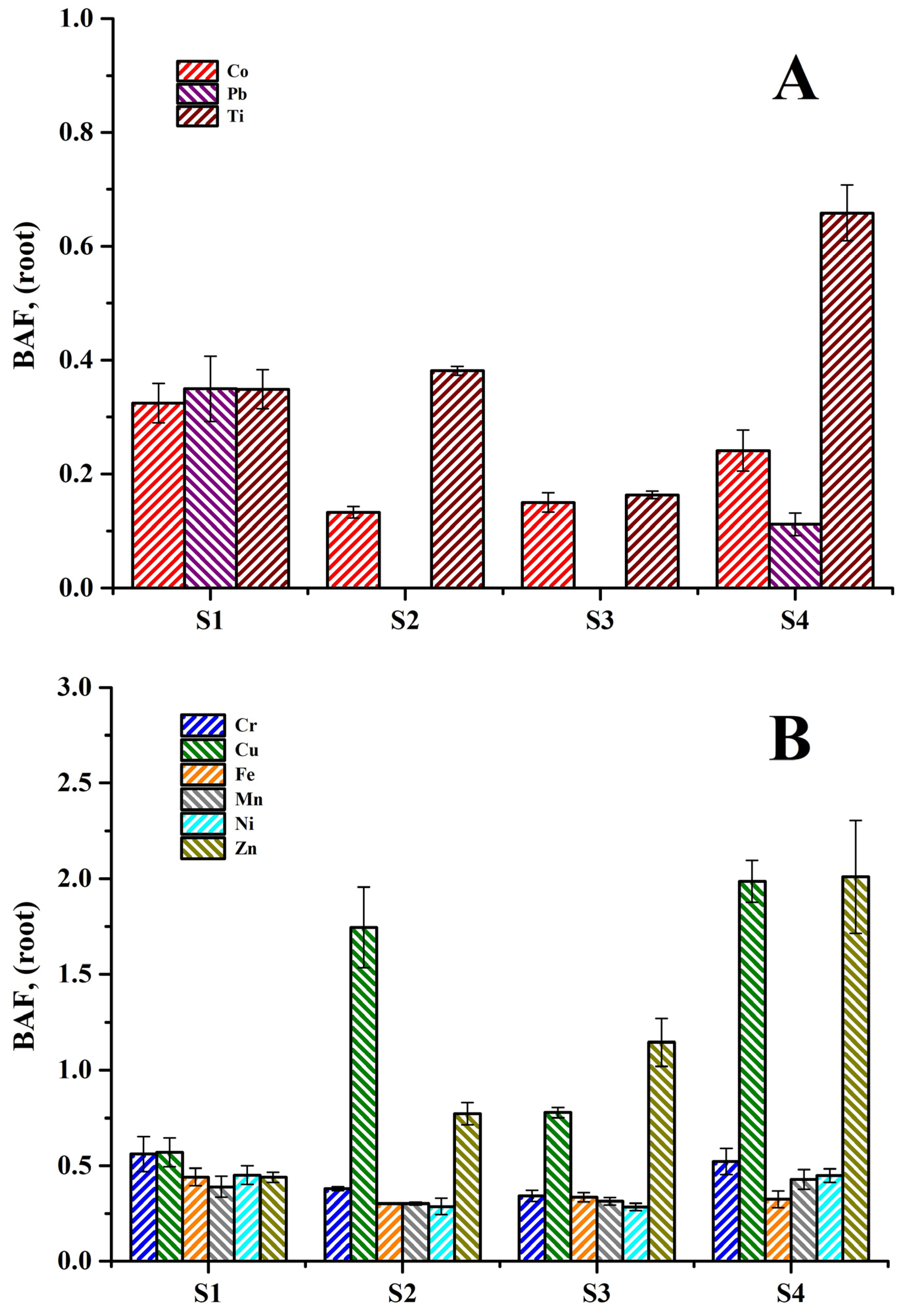
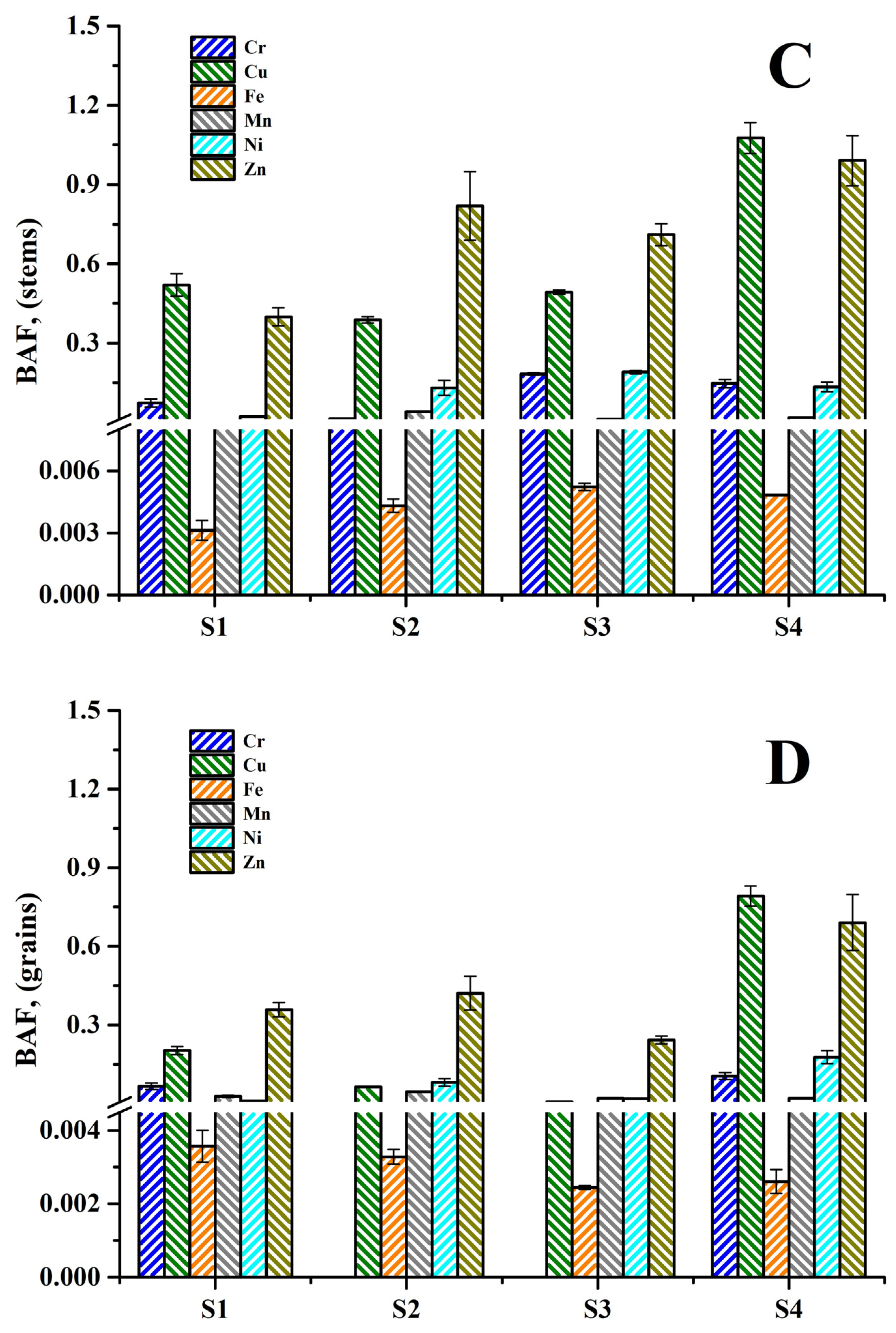
The transfer of PTEs from soil to plant tissues is a key process in the exposure of PTEs to humans and animals through the food chain [46]. Thus, the bioaccumulation factor (BAF) values for the transfer of PTEs from crop soils to the roots, stem, and grains of sorghum plants were calculated and are presented in Figure 4A–D. Figure 4A shows the BAF values for the transfer of Co, Pb, and Ti from the soil to roots, which ranged from 0.13 to 0.33, 0 to 0.35, and 0.16 to 0.66, respectively. Therefore, these PTEs can be ranked as Ti > Co > Pb. It is important to mention that Co, Pb, and Ti were only identified and quantified in the crop soils and roots of the sorghum plants because these PTEs were not transferred to the stems or aerial parts. These PTEs exhibited BAF values ˂ 1, indicating that the plants only absorbed these metals but did not accumulate them [13,44]. The BAF values for the transfer of Cr, Cu, Fe, Mn, Ni, and Zn from the soil to the roots are shown in Figure 4B. Zn (0.44–2.01) and Cu (0.57–1.98) showed high BAF values, while relatively low values were obtained for Cr (0.34–0.56), Ni (0.29–0.45), Fe (0.30–0.45), and Mn (0.31–0.43). Thus, these PTEs can be ranked as Zn > Cu > Cr > Ni > Fe > Mn. A BAF > 1 indicates that the plant accumulates that metal in its tissues [44]. Sites S1, S2, and S3 showed Cu and Zn BAF values greater than one, while the other PTEs showed BAF values less than one (Figure 4B). This result indicates that sorghum plants have a higher root accumulation capacity for Cu and Zn compared to Cr, Ni, Fe, and Mn. Cu and Zn are essential micronutrients for plant growth and development, actively participating in photosynthesis, respiration, and other metabolic processes. Therefore, the BAF values > 1 for Cu and Zn may be due to the different solubilities of these PTEs in soils, which regulate their availability for sorghum plants [41,76].
The BAF values for the transfer of PTEs from soil to stems and from soil to grains of the sorghum plants are presented in Figure 4C,D, respectively. Figure 4C shows that the BAF values for Cu (0.39–1.08) and Zn (0.40–1.00) were higher, while relatively low values were found for Ni (0.02–0.19), Cr (0.015–0.19), Mn (0.009–0.040), and Fe (0.003–0.005). Thus, these PTEs can be ranked as follows: Cu > Zn > Ni > Cr > Mn > Fe. Figure 4C also shows that Cu and Zn showed BAF values greater than one at site S4, while the rest of the PTEs at site S4 as well as all the heavy metals at sites S1, S2, and S3 presented values less than one. According to Satpathy et al. [44], this finding establishes that sorghum plants accumulate Cu and Zn in their stem tissues. This observation may be due to the lower concentration of PTEs in the roots at site S4 compared to the concentrations of PTEs in the roots of plants collected at sites S1, S2, and S3 (Figure 3A).
Finally, Figure 4D shows the values of BAF for PTEs transferred from the soil to the grains of sorghum plants at different cultivation sites. None of the PTEs identified and quantified in the grains exhibited BAF values > 1 at any of the sites. This indicates that the grains only absorbed these PTEs and did not accumulate them.
Regarding toxicity, according to FAO/WHO [48], the maximum permitted level in food is 0.05–0.5 mg/kg for Cu, less than 0.8 mg/kg for Fe, and 0.3–1 mg/kg for Zn. The PTE concentrations found in the grains of sorghum plants in this study were 0.03–0.32 mg/kg for Cu, 2.38–4.49 mg/kg for Fe, and 0.91–1.83 mg/kg for Zn, which are equal to or higher than the permissible limits in international food standards [48].

3.4.2. Translocation Factor

The translocation factor (TF) values of the PTEs for translocation from soil to sorghum roots (TFS-R), roots to stem (TFR-T), and roots to grains (TFR-G) are presented in Table 4. The average TFS-R values can be ranked as follows: Cu (1.27 ± 0.7) > Zn (1.09 ± 0.7) > Cr (0.45 ± 0.1) > Ti (0.39 ± 0.2) > Ni (0.37 ± 0.1) > Mn (0.36 ± 0.06) > Fe (0.35 ± 0.06) > Pb (0.23 ± 0.2) > Co (0.21 ± 0.09). The average TFR-T values can be ranked as follows: Zn (0.77 ± 0.26) > Cu (0.58 ± 0.29) > Ni (0.37 ± 0.26) > Cr (0.25 ± 0.22) > Mn (0.06 ± 0.05) > Fe (0.013 ± 0.004). Co, Pb, and Ti showed TFR-T values close to zero. The TFR-G values can be ranked as follows: Zn (0.48 ± 0.26) > Ni (0.19 ± 0.1) > Mn (0.083 ± 0.04). Almost all the heavy metals showed significant differences in TFS-R values (p < 0.05) between the four sites, except for Mn; the Pb results could not be subjected to a complete analysis of variance since it was only detected in the soil and roots of the plants at S1 and S4.
The translocation factor values of the PTEs for translocation from the soil to plant roots can be used to determine the exposure of humans to these metals through the food chain and reveal the bioavailability of PTEs in the soils. Higher TF values indicate higher mobility and/or availability of PTEs [44,77]. The PTEs can be ranked based on average TFR-G values as follows: Zn (0.48 ± 0.26) > Ni (0.19 ± 0.1) > Mn (0.083 ± 0.04). All these values are less than 1, indicating a low level of translocation of these PTEs, which implies that they were retained in the roots of the sorghum plants. However, the average values for Fe, Zn, Ni and Mn in the grains were, respectively, 4.5, 1.59, 0.11, and 1.29 mg/kg at S1; 3.5, 1.43, 0.16, and 1.44 mg/kg at S2; 2.5, 0.92, 0.05, and 1.12 mg/kg at S3; and 2.38, 1.83, 0.22, and 0.85 at S4. The higher PTEs concentrations in the grains of the sorghum plants compared to their calculated translocation values (TFR-G) could indicate that the sorghum plants were contaminated with PTEs from the air, which could be from volcanic emissions, the use of agrochemicals on crops, industries near the cultivation area, urban and industrial waste, as well as vehicle emissions [56,57,59].

4. Conclusions

In this study, potentially toxic elements (PTEs) present in sorghum soils were quantified at four sites (S1, S2, S3, and S4) in central Mexico, as well as the transfer of PTEs from the soil to the tissues (root, stem, and grains) of the sorghum plants. The following conclusions were drawn. The PTEs with the highest concentrations in the crop soils were Fe (1272.0–921.0 mg/kg) > Mn (56.2–31.6 mg/kg) > Ti (98.1–3.0 mg/kg). The concentrations of Fe present in the soils exceeded the permitted limit, while Mn and Ti showed concentrations below the permitted limits. The high concentrations of Fe, Mn, and Ti are related to volcanic emissions and the proximity to the industrial and mining area of central Mexico. In addition, these PTEs can accumulate in the soil as well as in the different tissues of sorghum plants. Based on enrichment factor (EF) values, the PTEs can be ranked as Ti > Cd > Ni > Co > Mn > Cr > Zn, and the values indicate that the sorghum soils were contaminated with PTEs of anthropogenic origin. Cu and Zn showed bioaccumulation factor (BAF) values > 1 in the roots and stems of sorghum plants collected at sites S1 and S2, indicating that the plants accumulated Cu and Zn in their stems. The PTEs with the highest concentrations in the stems of the sorghum plants were Fe (4.56 mg/kg), Zn (2.46 mg/kg) and Mn (1.79 mg/kg); in the grains, they were Fe (3.22 mg/kg), Zn (1.44 mg/kg), Mn (1.17 mg/kg) and Cu (0.03 to 0.32 mg/kg). According to the FAO, the maximum permitted levels of toxic contaminants in food are 0.05 to 0.5 mg/kg for Cu, ˂0.8 mg/kg for Fe, and 0.3 to 1 mg/kg for Zn. The concentrations of these PTEs in the grains of the sorghum plants were 0.137 ± 0.04, 3.215 ± 0.99, and 1.441 ± 0.38 mg/kg, respectively, which are higher than the permitted limits in international food standards. Finally, Zn, Ni, and Mn showed translocation (TF) values of less than 1, which implies that these PTEs were retained in the roots of the sorghum plants. However, the average Fe, Zn, Ni, and Mn concentrations in the grains were higher than the TFR-G values of these PTEs, indicating that the sorghum plants may have been contaminated with PTEs from the air, which could be attributed to volcanic emissions, the use of agrochemicals on the crops, industries near the cultivation area, urban and industrial waste, and vehicle emissions. To our knowledge, this study constitutes the first report on the identification, quantification, and assessment of PTE translocation in sorghum plants grown under open-field conditions near urban-volcanic contamination sources.

Supplementary Materials

The following supporting information can be downloaded at: https://www.mdpi.com/article/10.3390/toxics14040290/s1, Table S1. ICP OES 8300 DV operating conditions and acquisition parameters. Table S2. LOD/LOQ for examined PTEs.

Author Contributions

Conceptualization, F.R.-G., S.V.V.-S. and P.J.G.-Y.; methodology, F.R.-G., S.M.H.-C., S.V.V.-S., M.M.C.-R., C.E.A.-C. and P.J.G.-Y.; software, F.R.-G. and S.V.V.-S.; validation, L.E.H.-F., F.R.-G., R.F.-B. and A.O.-R.; formal analysis, F.R.-G., S.M.H.-C. and J.A.A.-C.; investigation, L.E.H.-F., F.R.-G., A.O.-R., M.M.C.-R., C.E.A.-C. and P.J.G.-Y.; resources, F.R.-G. and R.F.-B.; data curation, L.E.H.-F., F.R.-G., R.F.-B., A.O.-R. and J.A.A.-C.; writing—original draft preparation, L.E.H.-F. and F.R.-G.; writing—review and editing, F.R.-G., S.V.V.-S. and A.O.-R.; visualization, L.E.H.-F., S.M.H.-C. and F.R.-G.; supervision, F.R.-G.; project administration, F.R.-G.; funding acquisition, F.R.-G. All authors have read and agreed to the published version of the manuscript.

Funding

This research was supported by Secretaria de Investigación y Posgrado del Instituto Politécnico Nacional (SIP-IPN). Projects Nos. 20230817, 20240661 and 20250066.

Institutional Review Board Statement

Not applicable.

Informed Consent Statement

Not applicable.

Data Availability Statement

The original contributions presented in this study are included in the article/Supplementary Materials. Further inquiries can be directed to the corresponding author.

Acknowledgments

L.E.H.-F. wishes to thank SECIHTI (Mexico) for the doctoral fellowship. A.O.-R. wishes to thank SECIHTI (Mexico) for the postdoctoral fellowship. F.R.-G., R.F.-B. and S.V.V.-S. wish to express their gratitude to the Sistema Nacional de Investigadoras e Investigadores (SNII) and SECIHTI (Mexico) and thank EDI and COFAA, IPN, Mexico, for their support. Francisco Rodríguez-González thanks the Instituto Politécnico Nacional for the support and provision of a sabbatical year as the experimental work and writing of this manuscript were completed during this sabbatical year.

Conflicts of Interest

The authors declare no conflicts of interest.

Abbreviations

The following abbreviations are used in this manuscript:
PTEsPotentially toxic elements
CaCalcium
CuCopper
FeIron
MgMagnesium
MnManganese
ZnZinc
AsArsenic
CdCadmium
PbLead
CrChromium
CoCobalt
NiNickel
TiTitanium
OMOrganic matter
CECCation exchange capacity
ICP-OESInductively coupled plasma optical emission spectroscopy
CFContamination factor
EFEnrichment factor
BAFBioaccumulation factor
TFTranslocation factor

References

  1. Wang, S.; Li, B.; Zhu, H.; Liao, W.; Wu, C.; Zhang, Q.; Tang, K.; Cui, H. Energy Sorghum Removal of Soil Cadmium in Chinese Subtropical Farmland: Effects of Variety and Cropping System. Agronomy 2023, 13, 2487. [Google Scholar] [CrossRef]
  2. Soudek, P.; Petrová, S.; Vaňková, R.; Song, J.; Vanek, T. Accumulation of Heavy Metals using Sorghum sp. Chemosphere 2014, 104, 15–24. [Google Scholar] [CrossRef] [PubMed]
  3. Alengebawy, A.; Abdelkek, S.T.; Qureshi, S.R.; Wang, M.Q. Heavy Metals and Pesticides Toxicity in Agricultural Soil and Plants: Ecological Risks and Human Health Implications. Toxics 2021, 9, 42. [Google Scholar] [CrossRef]
  4. Petukhov, A.; Kremleva, T.; Khritokin, N.; Petukhova, G. Heavy Metal Migration in Soil-Plant System in Conditions of Urban Environmental Pollution. Air Soil Water Res. 2023, 16, 11786221231184202. [Google Scholar] [CrossRef]
  5. Rashid, A.; Schutte, B.J.; Ulery, A.; Deyholos, M.K.; Sanogo, S.; Lehnhoff, E.A.; Beck, L. Heavy Metal Contamination in Agri-cultural Soil: Environmental Pollutants Affecting Crop Health. Agronomy 2023, 13, 1521. [Google Scholar] [CrossRef]
  6. Zhang, L.; Zhang, L.; Chen, Y.; Zhang, L.; Tan, C.; Song, R.; Gao, S. Efficient ammonia sequestration by Al-based MOF composites: Synergistic regulation of supports and loading strategies and investigation of the adsorption mechanism. J. Indian Chem. Soc. 2026, 103, 102422. [Google Scholar] [CrossRef]
  7. Jia, H.; Yao, S.; Tang, X.; Zheng, M.; Dong, Y.; Fan, F.; Yang, S.; Zhang, H. Multi-objective machine learning for health-oriented O3 and PM2.5 control: Integrating VOC photochemical consumption and source apportionment. J. Hazard. Mater. 2026, 505, 141483. [Google Scholar] [CrossRef]
  8. Abatemi-Usman, S.; Akindele, O.; Ayanlade, A.; Perez, M.; Attahiru, I.; Norton, G.; Feldman, J.; Krupp, E. Trace elements concentrations in soil contaminate corn in the vicinity of a cement-manufacturing plant: Potential health implications. J. Expo. Sci. Environ. Epidemiol. 2023, 33, 813–823. [Google Scholar] [CrossRef]
  9. Acioly, T.M.d.S.; da Silva, M.F.; Barbosa, L.A.; Iannacone, J.; Viana, D.C. Levels of Potentially Toxic and Essential Elements in Water and Estimation of Human Health Risks in a River Located at the Interface of Brazilian Savanna and Amazon Biomes (Tocantins River). Toxics 2024, 12, 444. [Google Scholar] [CrossRef] [PubMed]
  10. Altıkulaç, A.; Turhan, Ş. Assessment of the Levels of Potentially Toxic Elements Contained in Natural Bentonites Collected from Quarries in Turkey. ACS Omega 2023, 8, 20979–20986. [Google Scholar] [CrossRef] [PubMed]
  11. Krzeszowska, E. Potentially toxic elements (PTEs) in the Carboniferous coal-bearing series of the Lublin Coal Basin (Poland), a case study. Case Stud. Chem. Environ. Eng. 2024, 10, 100984. [Google Scholar] [CrossRef]
  12. Reis, G.A.; Alves, M.V.; Santos, L.M.G.; Neto, V.; Junior, F.B.; Geraldes, M.C.; Bergamaschi, S.; Lopes, F.R.C.; Patinha, C.; da Silva, E.F.; et al. Contamination by Potentially Toxic Elements (PTEs) in Agricultural Products Grown Around Sepetiba Bay, Rio de Janeiro State (SE Brazil). Arch. Environ. Contam. Toxicol. 2025, 89, 195–220. [Google Scholar] [CrossRef] [PubMed]
  13. Yuan, X.; Xiong, T.; Yao, S.; Liu, C.; Yin, Y.; Li, H.; Li, N. A real field phytoremediation of multi-metals contaminated soils by selected hybrid sweet sorghum with high biomass and high accumulation ability. Chemosphere 2019, 237, 124536. [Google Scholar] [CrossRef]
  14. Yu, N.; Zeng, X.; Ma, X.; Sun, Y.; Wand, Y.; Chen, B.; Luo, Z.; Dong, C.; Shen, K.; Wu, J. Preparation of Ce-Fe2O3/Al2O3 catalyst for simultaneous degradation of benzodiacetone and reduction of Cr(VI) by electro-Fenton process: Performance, mechanism, degradation pathways. J. Alloys Compd. 2025, 1045, 184745. [Google Scholar] [CrossRef]
  15. Reddy, P.S.; Reddy, B.V.S. History of Sorghum Improvement, in Breeding Sorghum for Diverse and Uses, 1st ed.; Aruna, C., Visarada, K.B.R.S., Venkatesh, B.B., Tonapi, V.A., Eds.; Woodhead Publishing: Cambridge, UK, 2018; pp. 61–75. [Google Scholar]
  16. Pandian, B.A.; Sexton-Bowser, S.; Vara, P.P.V.; Jugulam, M. Current status and prospects of herbicide-resistant grain sorghum (Sorghum bicolor). Pest Manag. Sci. 2021, 78, 409–415. [Google Scholar] [CrossRef]
  17. SIAP (Servicio de Información Agroalimentaria y Pesquera). Anuario Estadístico de la Producción Agrícola. 2023. Available online: https://nube.agricultura.gob.mx/cierre_agricola/ (accessed on 23 July 2025).
  18. FAS (Foreign Agricultural Service). Sorghum Explorer. 2024. Available online: https://ipad.fas.usda.gov/cropexplorer/cropview/commodityView.aspx?cropid=0459200&sel_year=2024&rankby=Production (accessed on 23 July 2025).
  19. FIRA (Fideicomisos Instituidos en Relación con la Agricultura). 2019. Available online: https://www.fira.gob.mx/Nd/index.jsp (accessed on 24 July 2025).
  20. SAGARPA (Secretaría de Agricultura, Ganadería, Desarrollo Rural, Pesca y Alimentación). Planeación Agrícola Nacional 2017–2030, 1st ed.; SAGARPA: Ciudad de Mexico, Mexico, 2017.
  21. Peña-Martínez, R.; Muñoz-Viveros, A.L.; Ramos-Espinosa, M.G.; Terrón-Sierra, R. Listado de plantas hospedantes del complejo Melanaphis sacchari/sorghi (Hemiptera: Aphididae), registros internacionales y potenciales en Mexico. Entomol. Mex. 2015, 2, 582–587. [Google Scholar]
  22. Cortez-Mondaca, E.; Valenzuela-Escoboza, F.A.; López-Guzmán, J.A.; Pérez-Márquez, J.; Moreno Gallegos, T. Efectividad biológica de aficidas sobre el pulgón amarillo del sorgo Melanaphis sacchari (Zehntner) en el norte de Sinaloa. Rev. Bio Cien. 2018, 5, e482. [Google Scholar] [CrossRef]
  23. Kaleem Ullah, R.M.; Gao, F.; Sikandar, A.; Wu, H. Insights into the Effects of Insecticides on Aphids (Hemiptera: Aphididae): Resistance Mechanisms and Molecular Basis. Int. J. Mol. Sci. 2023, 24, 6750. [Google Scholar] [CrossRef]
  24. Shruti, V.C.; Rodríguez-Espinosa, P.F.; Martinez-Tavera, E.; Hernández-Gonzalez, D. Metal Concentrations in Recent Ash Fall of Popocatepetl Volcano 2016, Central Mexico: Is Human Health at Risk? Ecotoxicol. Environ. Saf. 2018, 162, 324–333. [Google Scholar] [CrossRef]
  25. C-Terán, J.A.; Meza-Figueroa, D.; García-Rico, L. Human health risk assessment of potentially toxic elements in soils from intensive agricultural fields in Northwestern México. Discov. Soil 2026, 3, 26. [Google Scholar] [CrossRef]
  26. Chen, S.; Wang, H.; Han, R. Source Apportionment of Potentially Toxic Elements in Agricultural Soils of Yingtan City, Jiangxi Province, China: A Principal Component Analysis–Positive Matrix Factorization Method. Toxics 2025, 13, 267. [Google Scholar] [CrossRef]
  27. Adeyinka, G.C.; Mketo, N. Occurrence and Human Health Risk Assessment of Neonicotinoid Residues and Essential and Non-Essential Metals in Commercial Honey Obtained from Stores in South Africa. Microchem. J. 2025, 219, 115864. [Google Scholar] [CrossRef]
  28. Wang, L.; Zhang, J.-G.; Sha, H.-Y.; Wang, Y.-R.; Wang, H.-Y.; Zhu, G.-C.; Lu, Y.-Z. Lanthanum-quaternized chitosan-modifid zeolite for long-lasting operation of constructed wetland: A bifunctional strategy for simultaneous phosphorus removal and microbial clogging mitigation. Water Res. 2026, 288, 124688. [Google Scholar] [CrossRef]
  29. Pathak, V.M.; Verma, V.K.; Rawat, B.S.; Kaur, B.; Babu, N.; Sharma, A.; Dewali, S.; Yadav, M.; Kumari, R.; Singh, S.; et al. Current Status of Pesticide Effects on Environment, Human Health and It’s Eco-Friendly Management as Bioremediation: A Comprehensive Review. Front. Microbiol. 2022, 13, 962619. [Google Scholar] [CrossRef]
  30. INEGI (Instituto Nacional de Estadística y Geografía). Aspectos Geográficos de Morelos: Compendio 2022, 1st ed.; Instituto Nacional de Estadística y Geografía: Aguascalientes, Mexico, 2023.
  31. SADER (Secretaría de Agricultura y Desarrollo Rural). ¿Qué se produce en Morelos? 2023. Available online: https://www.gob.mx/agricultura/articulos/que-se-produce-en-morelos (accessed on 3 December 2023).
  32. Agrawal, P.; Mittal, A.; Prakash, R.; Kumar, M.; Singh, T.B.; Tripathi, S.K. Assessment of Contamination of Soil due to Heavy Metals around Coal Fired Thermal Power Plants at Singrauli Region of India. Bull. Environ. Contam. Toxicol. 2010, 85, 219–223. [Google Scholar] [CrossRef]
  33. SGM (Servicio Geológico Mexicano). Panorama Minero del Estado de Morelos, 2021 ed.; Servicio Geológico Mexicano: Aguascalientes, Mexico, 2021.
  34. SADER (Secretaría de Agricultura y Desarrollo Rural). Manual Para el Buen Uso y Manejo de Plaguicidas en Campo, 1st ed.; SADER: Ciudad de Mexico, Mexico, 2019.
  35. Ding, Z.; Li, Y.; Sun, Q.; Zhang, H. Trace Elements in Soils and Selected Agricultural Plants in the Tongling Mining Area of China. Int. J. Environ. Res. Public Health. 2018, 15, 202. [Google Scholar] [CrossRef]
  36. NOM-021-RECNAT-2000; Estudio, Muestreos y Análisis. Diario Oficial de la Federación: Ciudad de Mexico, Mexico, 2002.
  37. U.S. Environmental Protection Agency. Method 6010D (SW-846): Inductively Coupled Plasma-Atomic Emission Spectrometry, Revision 4; U.S. Environmental Protection Agency: Washington, DC, USA, 2014.
  38. Kabata-Pendias, A.; Pendias, H. Trace Elements in Soils and Plants, 3rd ed.; CRC Press: Boca Raton, FL, USA, 2011. [Google Scholar]
  39. Weissmannová, H.D.; Pavlovský, J. Indices of soil contamination by heavy metals—Methodology of calculation for pollution assessment (minireview). Environ. Monit. Assess. 2017, 189, 616. [Google Scholar] [CrossRef]
  40. Antoniadis, V.; Golia, E.E.; Liu, Y.T.; Wang, S.L.; Shaheen, S.M.; Rinklebe, J. Soil and maize contamination by trace elements and associated health risk assessment in the industrial area of Volos, Greece. Environ. Int. 2019, 124, 79–88. [Google Scholar] [CrossRef] [PubMed]
  41. Halim, M.A.; Majumder, R.K.; Zaman, M.N. Paddy soil heavy metal contamination and uptake in rice plants from the adjancent area of Barapukuria coal mine, northwest Bangladesh. Arab. J. Geosci. 2015, 8, 3391–3401. [Google Scholar] [CrossRef]
  42. Deely, J.M.; Fergusson, J.E. Heavy metal and organic matter concentrations and distributions in dated sediments of a small estuary adjacent to a small urban area. Sci. Total Environ. 1994, 153, 97–111. [Google Scholar] [CrossRef]
  43. Hossen, M.A.; Chowdhury, A.I.H.; Mullick, M.R.A.; Hoque, A. Heavy metal pollution status and health risk assessment vicinity to Barapukuria coal mine area of Bangladesh. Environ. Nanotechnol. Mon. Manag. 2021, 16, 100469. [Google Scholar] [CrossRef]
  44. Satpathy, D.; Reddy, M.V.; Dhal, S.P. Risk assessment of heavy metals contamination in paddy soil, plants and grain (Oryza sativa L.) at the East Coast of India. Biomed Res. Int. 2014, 2014, 545473. [Google Scholar] [CrossRef]
  45. Ruiz-Huerta, E.A.; Armienta-Hernández, M.A. Acumulación de arsénico y metales pesados en maíz en suelos cercanos a jales o residuos mineros. Rev. Int. Contam. Ambient. 2012, 28, 103–117. [Google Scholar]
  46. Zhuang, P.; Shu, W.; Li, Z.; Liao, B.; Li, J.; Shao, J. Removal of metals by sorghum plants from contaminated land. J. Environ. Sci. 2009, 21, 1432–1437. [Google Scholar] [CrossRef] [PubMed]
  47. do Nascimento Júnior, A.L.; Paiva, A.Q.; Souza, L.S.; Souza-Filho, L.F.; Souza, L.D.; Fernandes Filho, E.I.; Schaefer, C.E.R.G.; da Silva, E.F.; Fernandes, A.C.O.; Xavier, F.A. Heavy metals distribution in different parts of cultivated and native plants and their relationship with soil content. Int. J. Environ. Sci. Technol. 2021, 18, 225–240. [Google Scholar] [CrossRef]
  48. FAO/WHO (Food and Agriculture Organization & World Health Organization). General Standard for Contaminants and Toxins in Food and Feed CXS 193-1995. 2024. Available online: https://workspace.fao.org/sites/codex/Standards/CXS%20193-1995/CXS_193e.pdf (accessed on 11 September 2025).
  49. Food and Agriculture Organization. Maximum Limits for Dangerous Substances in Soil and Groundwater. 2004. Available online: https://faolex.fao.org/docs/pdf/est97999E.pdf (accessed on 3 March 2026).
  50. Liu, Y.-M.; Liu, D.-Y.; Zhang, W.; Chen, X.-X.; Zhao, Q.-Y.; Chen, X.-P.; Zou, C.-Q. Health risk assessment of heavy metals (Zn, Cu, Cd, Pb, As and Cr) in wheat grain receiving repeated Zn fertilizers. Environ. Pollut. 2020, 257, 113581. [Google Scholar] [CrossRef] [PubMed]
  51. Vasudhevan, P.; Pu, S.; Ayyamperumal, R.; Manikandan, E.; Suresh, B.S.; Singh, S.; Jonathan, M.P.; Dixit, S.; Thangavel, P. Pollution assessment, ecological risk and source identification of heavy metals in paddy soils and rice grains from Salem, South India. JHM Adv. 2025, 17, 100526. [Google Scholar] [CrossRef]
  52. Tóth, G.; Hermann, T.; Da Silva, M.R.; Montanarella, L. Heavy metals in agricultural soils of the European Union with implications for food safety. Environ. Int. 2016, 88, 299–309. [Google Scholar] [CrossRef]
  53. Kumar, S.S.; Kumar, A.; Singh, S.; Malyan, S.K.; Baram, S.; Sharma, J.; Singh, R.; Pugazhendhi, A. Industrial wastes: Fly ash, steel slag and phosphogypsum- potential candidates to mitigate greenhouse gas emissions from paddy fields. Chemosphere 2020, 241, 124824. [Google Scholar] [CrossRef]
  54. Nagajyoti, P.C.; Lee, K.D.; Sreekanth, T.V.M. Heavy metals, ocurrence and toxicity for plants: A review. Environ. Chem. Lett. 2010, 8, 199–216. [Google Scholar] [CrossRef]
  55. Carvajal, M.; Alcaraz, C.F. Why titanium is a beneficial element for plants. J. Plant Nutr. 1998, 21, 655–664. [Google Scholar] [CrossRef]
  56. Hrubý, M.; Cígler, P.; Kuzel, S. Contribution to understanding the mechanism of titanium action in plant. J. Plant Nutr. 2002, 25, 577–598. [Google Scholar] [CrossRef]
  57. Kuzél, S.; Hruby, M.; Cígler, P.; Tlustos, P.; Nguyen Van, P. Mechanism of physiological effects of titanium leaf sprays on plants grown on soil. Biol. Trace Elem. Res. 2003, 91, 179–189. [Google Scholar] [CrossRef]
  58. Maina, D.M.; Ndirangu, D.M.; Mangala, M.M.; Boman, J.; Shepherd, K.; Gatari, M.J. Environmental implications of high metal content in soils of a titanium mining zone in Kenya. Environ. Sci. Pollut. Res. Int. 2016, 23, 21431–21440. [Google Scholar] [CrossRef]
  59. Vargas-Solano, S.V.; Rodríguez-González, F.; Arenas-Ocampo, M.L.; Martínez-Velarde, R.; Sujitha, S.B.; Jonathan, M.P. Heavy metals in the volcanic and peri-urban terrain watershed of the River Yautepec, Mexico. Environ. Monit. Assess. 2019, 191, 187. [Google Scholar] [CrossRef]
  60. Jayakumar, M.; Surendran, U.; Raja, P.; Kumar, A. A review of heavy metals accumulation pathways, sources and managemenet in soils. Arab. J. Geosci. 2021, 14, 2156. [Google Scholar] [CrossRef]
  61. Secretaría de Comunicaciones y Transportes. Manos a la Obra. Autopista México-Cuernavaca. El Mirador. 2026. Available online: https://elmirador.sct.gob.mx/manos-a-la-obra/autopista-mexico-cuernavaca (accessed on 15 March 2026).
  62. Gupta, V. Vehicle-Generated Heavy Metal Pollution in an Urban Environment and Its Distribution into Various Environmental Components. In Environmental Concerns and Sustainable Development; Shukla, V., Kumar, N., Eds.; Springer: Singapore, 2020. [Google Scholar] [CrossRef]
  63. Torres-Alvarado, I.S.; Lenhardt, N.; Arce, J.L.; Hinderer, M. Geochemical and isotopic composition of volcanic rocks of the heterogeneous Miocene (~23–19 Ma) Tepoztlán Formation, early Transmexican Volcanic Belt, Mexico. J. Volcanol. Geotherm. Res. 2016, 316, 72–84. [Google Scholar] [CrossRef]
  64. Schiavo, B.; Meza-Figueroa, D.; Morton-Bermea, O.; Angulo-Molina, A.; González-Grijalva, B.; Armienta-Hernández, M.; Inguaggiato, C.; Berrellez-Reyes, F.; Valera-Fernández, D. Metal(loid) bioaccessibility and risk assessment of ashfall deposit from Popocatépetl volcano, Mexico. Env. Geochem. Health 2024, 46, 354. [Google Scholar] [CrossRef] [PubMed]
  65. Fondo Nacional de Infraestructura/Banco Nacional de Obras y Servicios Públicos. Fondo Nacional de Infraestructura (FONADIN/BANOBRAS). 2025. Available online: https://www.fonadin.gob.mx/fni2/fp45/ (accessed on 15 March 2026).
  66. Consejo Estatal de Población (COESPO-Morelos). Xoxocotla 2025. 2025. Available online: https://coespo.morelos.gob.mx/images/Datos_municipales/2025/XOXOCOTLA2025.pdf (accessed on 15 March 2026).
  67. Dong, H.; Gao, Z.; Liu, J.; Jiang, B. Study on the Accumulation of Heavy Metals in Different Soil-Crop Systems and Ecological Risk Assessment: A Case Study of Jiao River Basin. Agronomy 2023, 13, 2238. [Google Scholar] [CrossRef]
  68. Kaplan, M.; Orman, Ş.; Kadar, I.; Koncz, J. Heavy metal accumulation in calcareous soil and sorghum plants after addition of sulphur-containing waste as a soil amendment in Turkey. Agric. Ecosyst. Environ. 2005, 111, 41–46. [Google Scholar] [CrossRef]
  69. Bravo, S.; García-Ordiales, E.; García-Navarro, F.J.; Amorós, J.A.; Pérez de los Reyes, C.; Jiménez-Ballesta, R.; Esbrí, J.M.; García-Noguero, E.M.; Higueras, P. Geochemical distribution of major and trace elements in agricultural soils of Castilla-La Mancha (central Spain): Finding criteria for baselines and delimiting regional anomalies. Environ. Sci. Pollut. Res. 2019, 26, 3100–3114. [Google Scholar] [CrossRef] [PubMed]
  70. Pinto, A.P.; Mota, A.M.; de Varennes, A.; Pinto, F.C. Influence of organic matter on the uptake of cadmium, zinc, copper and iron by sorghum plants. Sci. Total Environ. 2004, 326, 239–247. [Google Scholar] [CrossRef] [PubMed]
  71. EPA (Environmental Protection Agency). Guide to Site and Soil Description for Hazardous Waste Site Characterization—Volume 1: Metals; US Environmental Protection Agency: Las Vegas, NV, USA, 1992.
  72. Alcalá Jáuregui, J.A.; Rodríguez Ortiz, J.C.; Filippini, M.F.; Martínez Carretero, E.; Hernández Montoya, A.; Rojas Velázquez, A.N.; Méndez Cortés, H.; Beltrán Morales, F.A. Metallic elements in foliar material and fruits of three tree species as bioindicators. Rev. FCA UNCuyo 2022, 54, 61–72. [Google Scholar] [CrossRef]
  73. Zhang, E.; Meng, C.; Qu, J.; Zhu, Z.; Niu, J.; Wang, L.; Song, N.; Yin, Z. Dual Effects of Caragana korshinskii Introduction on Herbaceous Vegetation in Chinese Desert Areas: Short-term Degradation and Long-term Recovery. Plant Soil 2025. [Google Scholar] [CrossRef]
  74. Li, H.; Luo, N.; Li, Y.W.; Cai, Q.Y.; Li, H.Y.; Mo, C.H.; Wong, M.H. Cadmium in rice: Transport mechanisms, influencing factors, and minimizing measures. Environ. Pollut. 2017, 224, 622–630. [Google Scholar] [CrossRef]
  75. Rascio, N.; Navari-Izzo, F. Heavy metal hyperaccumulating plants: How and why do they do it? And what makes them so interesting? Plant Sci. 2011, 180, 169–181. [Google Scholar] [CrossRef]
  76. Aziz, R.A.; Yiwen, M.; Saleh, M.; Salleh, M.N.; Gopinath, S.C.B.; Giap, S.G.E.; Chinni, S.V.; Gobinath, R. Bioaccumulation and Translocation of Heavy Metals in Paddy (Oryza sativa L.) and Soil in Different Land Use Practices. Sustainability 2023, 15, 13426. [Google Scholar] [CrossRef]
  77. Cui, Y.-J.; Zhua, Y.-Z.; Zhai, R.-H.; Chen, D.-Y.; Huang, Y.-Z.; Qiu, Y.; Liang, J.-Z. Transfer of metals from soil to vegetables in an area near a smelter in Nanning, China. Environ. Int. 2004, 30, 785–791. [Google Scholar] [CrossRef]
Figure 1. Map of the state of Morelos showing the main sources of PTEs contamination.
Toxics 14 00290 g001
Figure 2. Soil contamination indices of the different sorghum cultivation sites: (A) contamination factor (CF) and (B) enrichment factor (EF).
Toxics 14 00290 g002
Figure 3. Concentration of PTEs in different parts of sorghum plants collected at the different study sites in the state of Morelos, Mexico: (A) roots, (B) stems, and (C) grains. Different letters above bars indicate significant statistical differences (p ˂ 0.05).
Toxics 14 00290 g003aToxics 14 00290 g003b
Figure 4. Bioaccumulation factor (BAF) values of PTEs for transfer from the soil to different plant tissues: (A) soil to roots for Co, Pb, and Ti; (B) soil to roots; (C) soil to stem; (D) soil to grains.
Toxics 14 00290 g004aToxics 14 00290 g004b
Table 1. Chemical characteristics of different sorghum growing soils in the state of Morelos, Mexico.
ParameterS1S2S3S4
pH4.95.56.65.8
OM (%)1.752.342.344.09
CEC (Cmol/kg)10.414.011.017.2
Table 2. Concentration of PTEs identified in different sorghum crop soils.
PTES1S2S3S4Safe Values *Permissible Limit **
As---0.1 ± 0.020.12 ± 0.010.05 ± 0.04206.83
Cd0.1 ± 0.040.1 ± 0.0070.07 ± 0.0040.1 ± 0.00610.41
Co2.0 ± 0.31.07 ± 0.061.3 ± 0.031.0 ± 0.12011.3
Cr6.4 ± 1.36.0 ± 0.397.0 ± 0.163.21 ± 0.4310059.5
Cu0.95 ± 0.070.5 ± 0.020.1 ± 0.010.4 ± 0.0210038.9
Fe1272.2 ± 164.01071.4 ± 73.01015 ± 40.0921 ± 115.0---425
Mn47.4 ± 7.731.6 ± 1.656.2 ± 2.243.0 ± 5.0---488
Ni10.04 ± 1.51.95 ± 0.362.7 ± 0.11.2 ± 0.15029
Pb0.2 ± 0.01------0.2 ± 0.025027
Ti98.1 ± 11.958.0 ± 2.212.0 ± 0.33.0 ± 0.2---7038
Zn4.4 ± 0.033.1 ± 0.54.0 ± 0.23.0 ± 0.420070
Total1441.7 ± 379 a1173.7 ± 320 ab1098.2 ± 304 bc975.4 ± 276 c
Data are shown as means ± standard deviations (mg/kg). --- The elements were not detected by the measuring equipment. Different letters in the last row indicate significant statistical differences (p ˂ 0.05). * From [48]; ** from Kabata-Pendias and Pendias [38].
Table 3. Ranking of PTEs concentrations in sorghum crop soils.
SitePTEs
S1Fe > Ti > Mn > Ni > Cr > Zn > Co > Cu
S2Fe > Ti > Mn > Cr > Zn > Ni > Co > Cu
S3Fe > Mn > Ti > Cr > Zn > Ni > Co > Cu
S4Fe > Mn > Cr > Ti > Zn > Ni > Co > Cu
Table 4. Translocation factor values for PTEs identified in crop soils compared to different sorghum plant tissues.
CoCrCuFeMnNiPbTiZn
S1TFS-R0.32 ± 0.1 a0.56 ± 0.1 a0.57 ± 0.1 b0.44 ± 0.1 a0.39 ± 0.1 a0.45 ± 0.1 a0.35 ± 0.10.35 ± 0.0 b0.44 ± 0.01 c
TFR-T---0.13 ± 0.010.92 ± 0.050.01 ± 0.010.02 ± 0.010.05 ± 0.01------0.91 ± 0.03
TFR-G---0.12 ± 0.040.36 ± 0.030.01 ± 0.000.07 ± 0.010.02 ± 0.01------0.82 ± 0.05
S2TFS-R0.13 ± 0.0 c0.38 ± 0.0 b1.75 ± 0.2 a0.3 ± 0.0 b0.30 ± 0.01 a0.29 ± 0.1 b---0.38 ± 0.0 b0.77 ± 0.1 bc
TFR-T---0.04 ± 0.010.22 ± 0.020.01 ± 0.010.13 ± 0.010.45 ± 0.04------1.06 ± 0.1
TFR-G------0.04 ± 0.010.01 ± 0.000.15 ± 0.010.29 ± 0.03------0.54 ± 0.05
S3TFS-R0.15 ± 0.02 c0.34 ± 0.03 b0.78 ± 0.03 b0.36 ± 0.03 b0.31 ± 0.02 a0.29 ± 0.02 b---0.16 ± 0.01 c1.15 ± 0.13 b
TFR-T---0.54 ± 0.030.66 ± 0.020.02 ± 0.010.04 ± 0.010.67 ± 0.02------0.62 ± 0.03
TFR-G------0.01 ± 0.000.01 ± 0.000.06 ± 0.000.07 ± 0.01------0.21 ± 0.02
S4TFS-R0.24 ± 0.04 b0.52 ± 0.01 ab1.99 ± 0.11 a0.33 ± 0.04 b0.43 ± 0.05 a0.45 ± 0.04 a0.11 ± 0.10.66 ± 0.03 a2.01 ± 0.3 a
TFR-T---0.28 ± 0.010.54 ± 0.030.02 ± 0.0020.043 ± 0.0010.30 ± 0.02------0.50 ± 0.03
TFR-G---0.20 ± 0.010.40 ± 0.020.14 ± 0.060.05 ± 0.000.40 ± 0.02------0.34 ± 0.02
Different letters in the PTE columns indicate statistically significant differences (p ˂ 0.05) in TFS-R. --- values were not calculated.
Disclaimer/Publisher’s Note: The statements, opinions and data contained in all publications are solely those of the individual author(s) and contributor(s) and not of MDPI and/or the editor(s). MDPI and/or the editor(s) disclaim responsibility for any injury to people or property resulting from any ideas, methods, instructions or products referred to in the content.