

Breast Adipose Tissue’s Xenobiotics and Fatty Acid Profile—A Preliminary Study in Portuguese Women with Breast Cancer
 , , , , ,
  ,
,  , ,
, ,  ,
,  , and
, and
Abstract
1. Introduction
2. Materials and Methods
2.1. Chemical and Reagents
2.2. Study Design and Sampling
2.3. Fatty Acid Profile and Xenobiotic Analysis in Breast Adipose Tissue
2.3.1. Quantification of Endocrine Disruptors in Breast Adipose Tissue
2.3.2. Fatty Acid Analysis in Breast Adipose Tissue
2.4. Method Validation
2.5. Statistical Analysis
3. Results
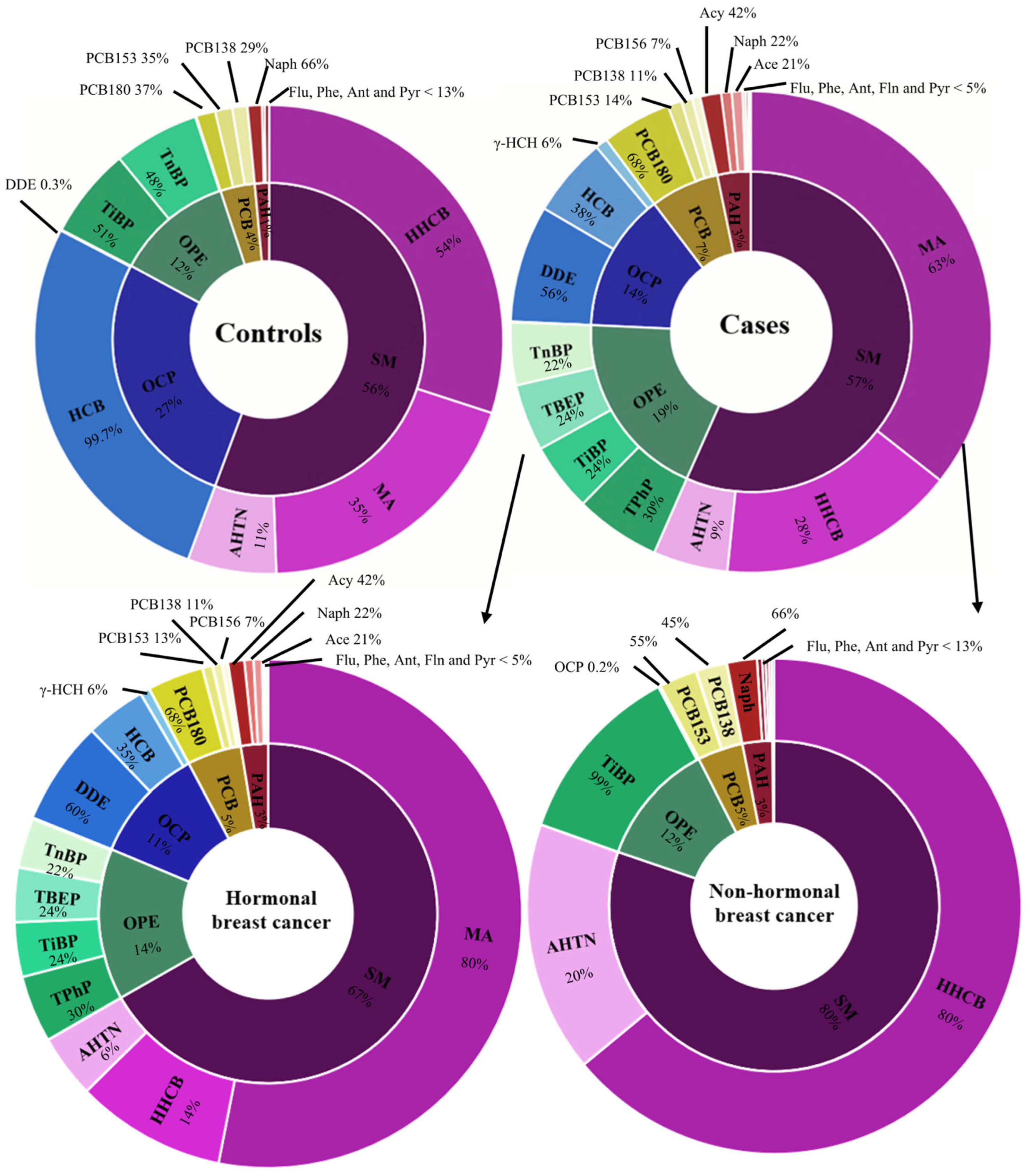
3.1. Distribution of Lipophilic Xenobiotics in Breast Adipose Tissue
3.2. Fatty Acid Profile in Breast Adipose Tissue
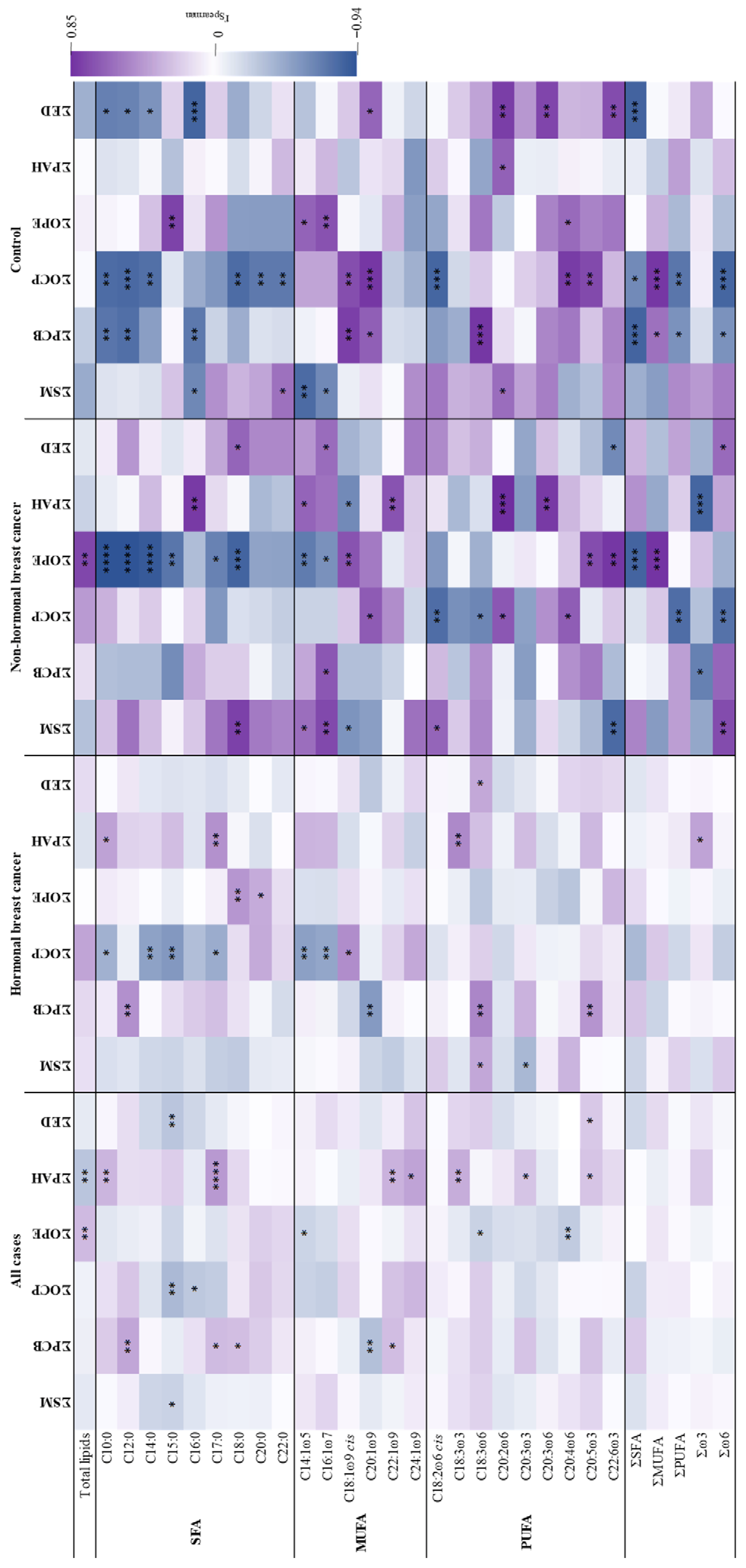
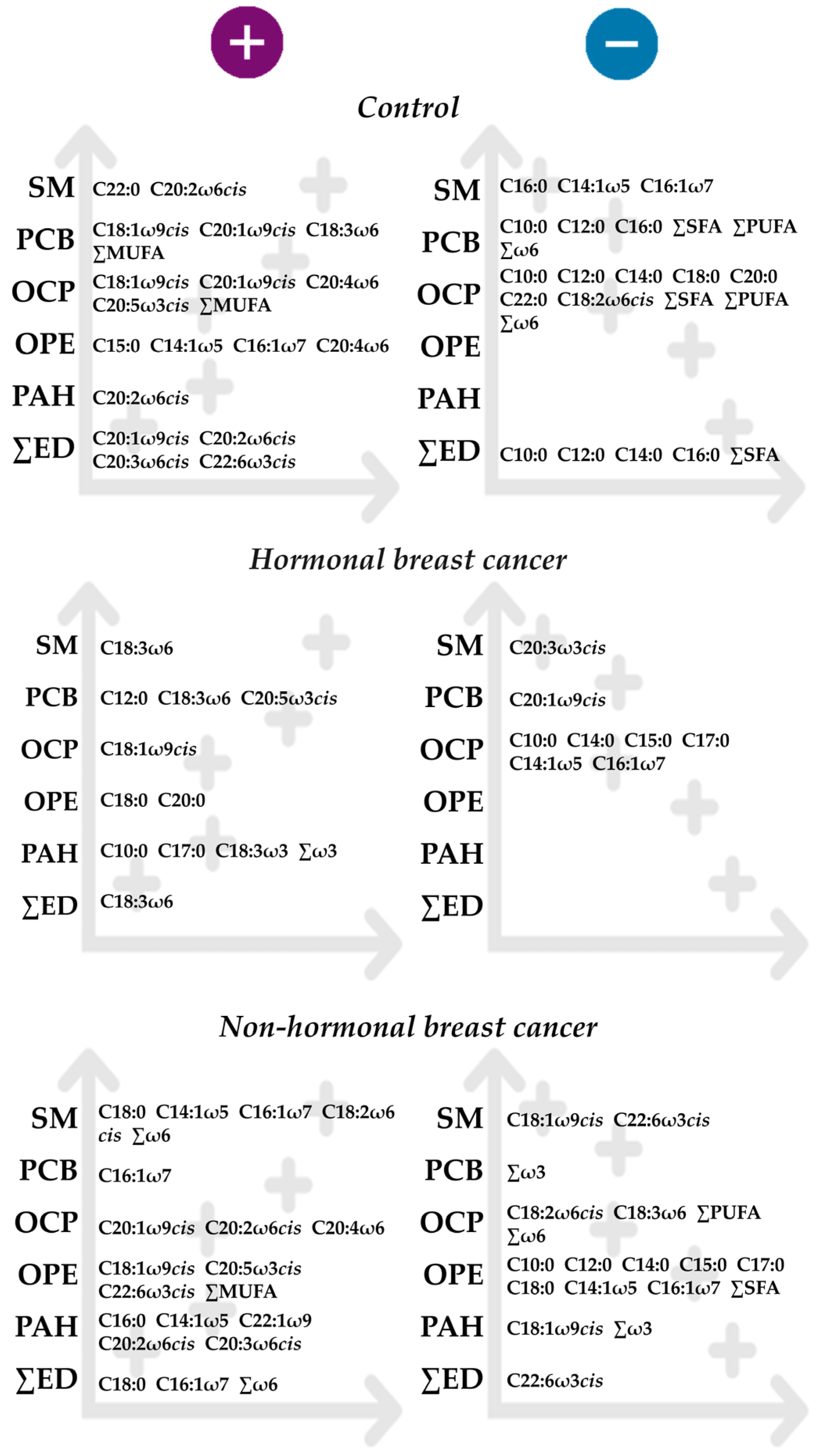
3.3. Associations Between Lipophilic Xenobiotics and Fatty Acid Profile
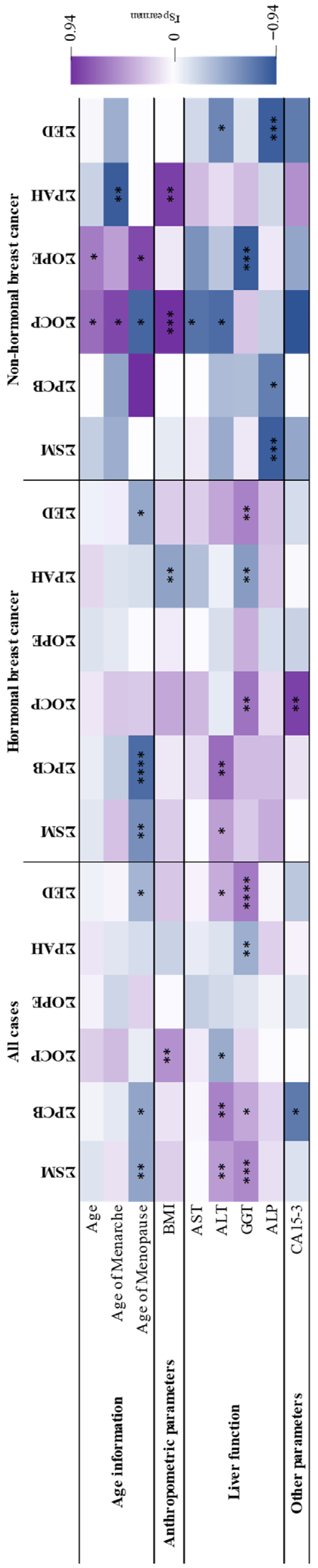
3.4. Associations Between Lipophilic Xenobiotics and Breast Cancer Patients’ Data
4. Discussion
5. Conclusions
Supplementary Materials
Author Contributions
Funding
Institutional Review Board Statement
Informed Consent Statement
Data Availability Statement
Acknowledgments
Conflicts of Interest
Abbreviations
| Ace | acenaphthene |
| ACN | acetonitrile |
| Acy | acenaphthylene |
| ADBI | celestolide |
| AhR | aryl hydrocarbon receptor |
| AHTN d3 | 2,2,2-trideuterio-1-(3,5,5,6,8,8-hexamethyl-6,7-dihydronaphthalen-2-yl)ethanone |
| AHTN | tonalide |
| ALA | α-linolenic |
| ALP | alkaline phosphatase |
| ALT | alanine aminotransferase |
| Ant | anthracene |
| AST | aspartate transferase |
| B[a]A | benz[a]anthracene |
| B[a]P | benzo[a]pyrene |
| B[b]Ft | benzo[b]fluoranthene |
| B[g,h,i]P | benzo[g,h,i]perylene |
| B[k]Ft | benzo[k]fluoranthene |
| BDE | bromodiphenyl ether |
| BF3 | boron trifluoride–methanol |
| BFR | brominated flame retardant |
| BHT | butylated hydroxytoluene |
| BMI | body mass index |
| C18EC | C18 endcapped bulk |
| Chry | chrysene |
| DB[a,h]A | dibenz[a,h]anthracene |
| DB[a,l]P | dibenzo[a,l]pyrene |
| DDD | dichlorodiphenyldichloroethane |
| DDE | 2,2-bis(p-chlorophenyl)-1,1-dichloroethene |
| DDT d8 | 1,1,1-trichloro-2,2-bis(4-chlorophenyl)ethane |
| DDT | dichlorodiphenyltrichloroethane |
| DHA | docosahexaenoic acid |
| ET | excitation time |
| EV | excitation voltage |
| FABP | fatty acid-binding protein |
| FID | flame ionization detection |
| FLD | fluorescence |
| Fln | fluoranthene |
| Flu | fluorene |
| FPD | flame photometric detection |
| FSH | Follicle-stimulating hormone |
| GC | gas chromatography |
| GGT | gamma-glutamyl transferase |
| HCB | hexachlorobenzene |
| HCH | hexachlorocyclohexane |
| HDL | high-density lipoprotein |
| HHCB | galaxolide |
| HPLC | high-performance liquid chromatography |
| InP | indeno [1,2,3-cd]pyrene |
| IQR | interquartile range |
| IS | internal standard |
| IT | isolation time |
| LA | linoleic acid |
| LDL | low-density lipoprotein |
| MA | musk ambrette |
| MDL | method detection limit |
| MK | musk ketone |
| MQL | method quantification limit |
| MS | mass spectrometry |
| MS/MS | tandem MS |
| MUFA | monounsaturated fatty acid |
| MX | musk xylene |
| na | not applicable |
| Naph | naphthalene |
| nd | not detected |
| OCP | organochlorine pesticide |
| OPE | organophosphorus ester |
| OPP | organophosphorus pesticide |
| PAD | photodiode array |
| PAH | polycyclic aromatic hydrocarbon |
| PBEB | pentabromoethylbenzene |
| PBT | pentabromotoluene |
| PCB | polychlorinated biphenyl |
| Phe | phenanthrene |
| PPAR | peroxisome proliferator-activated receptor |
| PUFA | polyunsaturated fatty acid |
| Pyr | pyrene |
| ROS | reactive oxygen species |
| RT | retention time |
| SFA | saturated fatty acid |
| SIM | selected ion monitoring |
| SM | synthetic musk |
| SPE | solid-phase extraction |
| T3 | triiodothyronine |
| T4 | thyroxine |
| TBB | 2-ethylhexyl 2,3,4,5-tetrabromobenzoate |
| TBEP | tris(2-butoxyethyl) phosphate |
| TCEP | tris(2-chloroethyl) phosphate |
| TCP | tri-o-tolyl phosphate or tri-o-cresyl phosphate |
| TEHP | tris(2-ethylhexyl) phosphate |
| TiBP | tri-iso-butyl phosphate |
| TnBP | tri-n-butyl phosphate |
| TPrP | tripropyl phosphate |
| TSH | thyroid-stimulating hormone |
| UAE | ultrasound-assisted extraction |
| Ur,tot | expanded combined uncertainty |
| WHO | World Health Organization |
| Z-Sep+ | Supel QuE Z-Sep + Bulk |
| ω3 | omega 3 |
| ω6 | omega 6 |
References
- WHO. State of the Science of Endocrine Disrupting Chemicals-2012; WHO: Geneva, Switzerland, 2013. [Google Scholar]
- Sousa, S.; Maia, M.L.; Delerue-Matos, C.; Calhau, C.; Domingues, V.F. The Role of Adipose Tissue Analysis on Environmental Pollutants Biomonitoring in Women: The European Scenario. Sci. Total Environ. 2022, 806, 150922. [Google Scholar] [CrossRef] [Scilit]
- Li, A.J.; Feldman, S.M.; McNally, R.K.; Kannan, K. Distribution of Organohalogen and Synthetic Musk Compounds in Breast Adipose Tissue of Breast Cancer Patients in Ulster County, New York, USA. Arch. Environ. Contam. Toxicol. 2019, 77, 68–78. [Google Scholar] [CrossRef] [Scilit]
- Lao, J.-Y.; Ruan, Y.; Leung, K.M.Y.; Zeng, E.Y.; Lam, P.K.S. Review on Age-Specific Exposure to Organophosphate Esters: Multiple Exposure Pathways and Microenvironments. Crit. Rev. Environ. Sci. Technol. 2023, 53, 803–826. [Google Scholar] [CrossRef] [Scilit]
- Sousa, S.; Rede, D.; Cruz Fernandes, V.; Pestana, D.; Faria, G.; Delerue-Matos, C.; Calhau, C.; Fernandes Domingues, V. Accumulation of Organophosphorus Pollutants in Adipose Tissue of Obese Women—Metabolic Alterations. Environ. Res. 2023, 239, 117337. [Google Scholar] [CrossRef] [Scilit]
- Bajard, L.; Negi, C.K.; Mustieles, V.; Melymuk, L.; Jomini, S.; Barthelemy-Berneron, J.; Fernandez, M.F.; Blaha, L. Endocrine Disrupting Potential of Replacement Flame Retardants—Review of Current Knowledge for Nuclear Receptors Associated with Reproductive Outcomes. Environ. Int. 2021, 153, 106550. [Google Scholar] [CrossRef] [Scilit] [PubMed]
- Ajiboye, T.O.; Oladoye, P.O.; Olanrewaju, C.A.; Akinsola, G.O. Organophosphorus Pesticides: Impacts, Detection and Removal Strategies. Environ. Nanotechnol. Monit. Manag. 2022, 17, 100655. [Google Scholar] [CrossRef] [Scilit]
- Sousa, S.; Paíga, P.; Pestana, D.; Faria, G.; Delerue-Matos, C.; Ramalhosa, M.J.; Calhau, C.; Domingues, V.F. Evaluating the Impact of Polycyclic Aromatic Hydrocarbon Bioaccumulation in Adipose Tissue of Obese Women. Chemosphere 2024, 353, 141673. [Google Scholar] [CrossRef] [Scilit]
- Mlyczyńska, E.; Bongrani, A.; Rame, C.; Węgiel, M.; Maślanka, A.; Major, P.; Zarzycki, P.; Ducluzeau, P.-H.; De Luca, A.; Bourbao-Tournois, C.; et al. Concentration of Polycyclic Aromatic Hydrocarbons (PAHs) in Human Serum and Adipose Tissues and Stimulatory Effect of Naphthalene in Adipogenesis in 3T3-L1 Cells. Int. J. Mol. Sci. 2023, 24, 1455. [Google Scholar] [CrossRef] [Scilit] [PubMed]
- Sousa, S.; Pestana, D.; Faria, G.; Vasconcelos, F.; Delerue-Matos, C.; Calhau, C.; Domingues, V.F. Method Development for the Determination of Synthetic Musks and Organophosphorus Pesticides in Human Adipose Tissue. J. Pharm. Biomed. Anal. 2020, 191, 113598. [Google Scholar] [CrossRef] [Scilit]
- Sousa, S.; Maia, M.L.; Pestana, D.; Teixeira, D.; Ângelo-Dias, M.; Martins, C.; Borrego, L.M.; Delerue-Matos, C.; Calhau, C.; Fernandes Domingues, V.; et al. Brominated Flame Retardants Effect in MCF-7 Cells: Impact on Vitamin D Pathway. J. Steroid Biochem. Mol. Biol. 2022, 219, 106079. [Google Scholar] [CrossRef] [Scilit] [PubMed]
- European Union. Regulation (EC) No 1272/2008 of the European Parliament and of the Council of 16 December 2008 on Classification, Labelling and Packaging of Substances and Mixtures, Amending and Repealing Directives 67/548/EEC and 1999/45/EC, and Amending Regulation (EC). Off. J. Eur. Union 2008, 353, 1–1355. [Google Scholar]
- Fernandes, V.C.; Pestana, D.; Monteiro, R.; Faria, G.; Meireles, M.; Correia-Sá, L.; Teixeira, D.; Faria, A.; Calhau, C.; Domingues, V.F.; et al. Optimization and Validation of Organochlorine Compounds in Adipose Tissue by SPE-Gas Chromatography. Biomed. Chromatogr. 2012, 26, 1494–1501. [Google Scholar] [CrossRef] [Scilit]
- He, T.-T.; Zuo, A.-J.; Wang, J.-G.; Zhao, P. Organochlorine Pesticides Accumulation and Breast Cancer: A Hospital-Based Case–Control Study. Tumor Biol. 2017, 39, 101042831769911. [Google Scholar] [CrossRef] [Scilit]
- European Union. REGULATION (EC) No 1107/2009 of the European Parliament and of the Council of 21 October 2009 Concerning the Placing of Plant Protection Products on the Market and Repealing Council Directives 79/117/EEC and 91/414/EEC. Off. J. Eur. Union 2009, 309, 1–50. [Google Scholar]
- Shan, Q.; Li, H.; Chen, N.; Qu, F.; Guo, J. Understanding the Multiple Effects of PCBs on Lipid Metabolism. Diabetes Metab. Syndr. Obes. 2020, 13, 3691–3702. [Google Scholar] [CrossRef] [Scilit]
- He, Y.; Peng, L.; Huang, Y.; Peng, X.; Zheng, S.; Liu, C.; Wu, K. Association of Breast Adipose Tissue Levels of Polychlorinated Biphenyls and Breast Cancer Development in Women from Chaoshan, China. Environ. Sci. Pollut. Res. 2017, 24, 4778–4790. [Google Scholar] [CrossRef] [Scilit]
- IARC. Polychlorinated Biphenyls and Polybrominated Biphenyls: IARC Monographs on the Evaluation of Carcinogenic Risks to Humans; IARC: Lyon, France, 2016. [Google Scholar]
- European Commission. Regulation (EC) No 1223/2009 of the European Parliament and the Council of 30 November 2009 on Cosmetic Products. Off. J. Eur. Union 2009, 342, 59–209. [Google Scholar]
- Ellsworth, R.E.; Kostyniak, P.J.; Chi, L.-H.; Shriver, C.D.; Costantino, N.S.; Ellsworth, D.L. Organochlorine Pesticide Residues in Human Breast Tissue and Their Relationships with Clinical and Pathological Characteristics of Breast Cancer. Environ. Toxicol. 2018, 33, 876–884. [Google Scholar] [CrossRef] [Scilit] [PubMed]
- LPCC. CANCRO DA MAMA. Available online: https://www.ligacontracancro.pt/cancro-da-mama/ (accessed on 29 December 2025).
- WHO. Breast Cancer. Available online: https://www.who.int/news-room/fact-sheets/detail/breast-cancer (accessed on 29 December 2025).
- Qiu, Z.; Xiao, J.; Zheng, S.; Huang, W.; Du, T.; Au, W.W.; Wu, K. Associations between Functional Polychlorinated Biphenyls in Adipose Tissues and Prognostic Biomarkers of Breast Cancer Patients. Environ. Res. 2020, 185, 109441. [Google Scholar] [CrossRef] [Scilit]
- Koual, M.; Cano-Sancho, G.; Bats, A.-S.; Tomkiewicz, C.; Kaddouch-Amar, Y.; Douay-Hauser, N.; Ngo, C.; Bonsang, H.; Deloménie, M.; Lecuru, F.; et al. Associations between Persistent Organic Pollutants and Risk of Breast Cancer Metastasis. Environ. Int. 2019, 132, 105028. [Google Scholar] [CrossRef] [Scilit] [PubMed]
- Huang, W.; He, Y.; Xiao, J.; Huang, Y.; Li, A.; He, M.; Wu, K. Risk of Breast Cancer and Adipose Tissue Concentrations of Polychlorinated Biphenyls and Organochlorine Pesticides: A Hospital-Based Case-Control Study in Chinese Women. Environ. Sci. Pollut. Res. 2019, 26, 32128–32136. [Google Scholar] [CrossRef] [Scilit]
- Arrebola, J.P.; Fernández, M.F.; Martín-Olmedo, P.; Molina-Molina, J.M.; Sánchez-Pérez, M.J.; Sánchez-Cantalejo, E.; Molina-Portillo, E.; Expósito, J.; Bonde, J.P.; Olea, N. Adipose Tissue Concentrations of Persistent Organic Pollutants and Total Cancer Risk in an Adult Cohort from Southern Spain: Preliminary Data from Year 9 of the Follow-Up. Sci. Total Environ. 2014, 500–501, 243–249. [Google Scholar] [CrossRef] [Scilit] [PubMed]
- Chas, M.; Goupille, C.; Arbion, F.; Bougnoux, P.; Pinault, M.; Jourdan, M.L.; Chevalier, S.; Ouldamer, L. Low Eicosapentaenoic Acid and Gamma-Linolenic Acid Levels in Breast Adipose Tissue Are Associated with Inflammatory Breast Cancer. Breast 2019, 45, 113–117. [Google Scholar] [CrossRef] [Scilit]
- Artacho-Cordón, F.; Fernández-Rodríguez, M.; Garde, C.; Salamanca, E.; Iribarne-Durán, L.M.; Torné, P.; Expósito, J.; Papay-Ramírez, L.; Fernández, M.F.; Olea, N.; et al. Serum and Adipose Tissue as Matrices for Assessment of Exposure to Persistent Organic Pollutants in Breast Cancer Patients. Environ. Res. 2015, 142, 633–643. [Google Scholar] [CrossRef] [Scilit] [PubMed]
- Gonçalves, A.M.M.; Rocha, C.P.; Marques, J.C.; Gonçalves, F.J.M. Fatty Acids as Suitable Biomarkers to Assess Pesticide Impacts in Freshwater Biological Scales—A Review. Ecol. Indic. 2021, 122, 107299. [Google Scholar] [CrossRef] [Scilit]
- Ouldamer, L.; Jourdan, M.-L.; Pinault, M.; Arbion, F.; Goupille, C. Accumulation of Arachidonic Acid, Precursor of Pro-Inflammatory Eicosanoids, in Adipose Tissue of Obese Women: Association with Breast Cancer Aggressiveness Indicators. Biomedicines 2022, 10, 995. [Google Scholar] [CrossRef] [Scilit]
- Zhang, A.; Wang, R.; Liu, Q.; Yang, Z.; Lin, X.; Pang, J.; Li, X.; Wang, D.; He, J.; Li, J.; et al. Breast Adipose Metabolites Mediates the Association of Tetrabromobisphenol a with Breast Cancer: A Case-Control Study in Chinese Population. Environ. Pollut. 2023, 316, 120701. [Google Scholar] [CrossRef] [Scilit]
- Kus, K.; Kij, A.; Zakrzewska, A.; Jasztal, A.; Stojak, M.; Walczak, M.; Chlopicki, S. Alterations in Arginine and Energy Metabolism, Structural and Signalling Lipids in Metastatic Breast Cancer in Mice Detected in Plasma by Targeted Metabolomics and Lipidomics. Breast Cancer Res. 2018, 20, 148. [Google Scholar] [CrossRef] [Scilit]
- Sousa, S.; Teixeira, D.; Santos, C.; Delerue-Matos, C.; Calhau, C.; Domingues, V.F. The Relationship of Plasma Fatty Acid Profile and Metabolic Biomarkers among Postmenopausal Obese and Overweight Women. Obes. Med. 2018, 10, 8–15. [Google Scholar] [CrossRef] [Scilit]
- Maradonna, F.; Carnevali, O. Lipid Metabolism Alteration by Endocrine Disruptors in Animal Models: An Overview. Front. Endocrinol. 2018, 9, 654. [Google Scholar] [CrossRef] [Scilit] [PubMed]
- Ding, Y.; Zheng, X.; Yu, L.; Lu, R.; Wu, X.; Luo, X.; Mai, B. Occurrence and Distribution of Persistent Organic Pollutants (POPs) in Amphibian Species: Implications from Biomagnification Factors Based on Quantitative Fatty Acid Signature Analysis. Environ. Sci. Technol. 2022, 56, 3117–3126. [Google Scholar] [CrossRef] [Scilit]
- Zhang, K.; Fu, Q.; Ge, F.; Jin, X.; Guo, R.; Qiao, X.; Zhao, X.; Zheng, X. The Correlation Study between Fatty Acids and Organochlorine Pesticides or Δ15N Values in Fish Tissues from Dongting Lake, China. Ecotoxicol. Environ. Saf. 2019, 182, 109358. [Google Scholar] [CrossRef] [Scilit] [PubMed]
- Huang, Z.; Qadeer, A.; Zheng, S.; Ge, F.; Zhang, K.; Yin, D.; Zheng, B.; Zhao, X. Fatty Acid Profile as an Efficient Bioindicator of PCB Bioaccumulation in a Freshwater Lake Food Web: A Stable Isotope Guided Investigation. J. Hazard. Mater. 2022, 423, 127121. [Google Scholar] [CrossRef] [Scilit]
- Liu, F.; Xie, Q.; Xie, Y.; Liu, Z.; Wu, J.; Wu, Y.; Zhang, X. Fatty Acid Profiles Linked to Organohalogen Exposure in Cetaceans from the Northern South China Sea. Environ. Sci. Technol. 2025, 59, 2378–2388. [Google Scholar] [CrossRef] [Scilit] [PubMed]
- Sun, J.; Zhang, L.; Zhou, F.; Shaw, S.; Roos, A.; Berger, M.; Bäcklin, B.-M.; Huang, Y.; Zheng, X.; Wang, X.; et al. Hepatic Fatty Acid Profiles Associated with Exposure to Emerging and Legacy Halogenated Contaminants in Two Harbor Seal Populations across the North Atlantic. Environ. Sci. Technol. 2022, 56, 1830–1840. [Google Scholar] [CrossRef] [Scilit]
- Sousa, S.; Pestana, D.; Faria, G.; Delerue-Matos, C.; Calhau, C.; Fernandes Domingues, V. Assessment of Synthetic Musks, Polychlorinated Biphenyls and Brominated Flame Retardants in Adipose Tissue of Obese Northern Portuguese Women—Metabolic Implications. Sci. Total Environ. 2023, 894, 165015. [Google Scholar] [CrossRef] [Scilit]
- Paíga, P.; Sousa, S.; Vera, J.; Bitencourt, L.; Vieira, J.; Jorge, S.; Silva, J.G.; Correia, M.; Domingues, V.F.; Delerue-Matos, C. Multi-Residue Analysis of Fifty Pesticides in River Waters and in Wastewaters. Environ. Sci. Pollut. Res. 2021, 28, 66787–66803. [Google Scholar] [CrossRef] [Scilit] [PubMed]
- European Commission. Analytical Quality Control and Method Validation Procedures for Pesticide Residues Analysis in Food and Feed SANTE 11312/2021. SANTE 2021, 11312, 1–51. [Google Scholar]
- Sousa, S.; Pestana, D.; Faria, G.; Delerue-Matos, C.; Calhau, C.; Domingues, V.F. Adipose Tissue Fatty Acids as Biomarkers for Metabolic Dysfunction in Obese Females: Implication of Menopause and Ageing. Prostaglandins Leukot. Essent. Fat. Acids 2023, 195, 102581. [Google Scholar] [CrossRef] [Scilit]
- Nagyová, S.; Tölgyessy, P. Validation Including Uncertainty Estimation of a GC–MS/MS Method for Determination of Selected Halogenated Priority Substances in Fish Using Rapid and Efficient Lipid Removing Sample Preparation. Foods 2019, 8, 101. [Google Scholar] [CrossRef] [Scilit]
- Sousa, S.; Paíga, P.; Pestana, D.; Faria, G.; Delerue-Matos, C.; Ramalhosa, M.J.; Calhau, C.; Domingues, V.F. Optimization of a Simple, Effective, and Greener Methodology for Polycyclic Aromatic Hydrocarbon Extraction from Human Adipose Tissue. Anal. Methods 2023, 15, 1722–1733. [Google Scholar] [CrossRef] [Scilit] [PubMed]
- European Commission. Guidance Document on Pesticide Analytical Methods for Risk Assessment and Post-Approval Control and Monitoring Purposes SANTE/2020/12830. SANTE 2021, 12830, 1–50. [Google Scholar]
- Hornung, R.W.; Reed, L.D. Estimation of Average Concentration in the Presence of Nondetectable Values. Appl. Occup. Environ. Hyg. 1990, 5, 46–51. [Google Scholar] [CrossRef] [Scilit]
- Arrebola, J.P.; Fernández-Rodríguez, M.; Artacho-Cordón, F.; Garde, C.; Perez-Carrascosa, F.; Linares, I.; Tovar, I.; González-Alzaga, B.; Expósito, J.; Torne, P.; et al. Associations of Persistent Organic Pollutants in Serum and Adipose Tissue with Breast Cancer Prognostic Markers. Sci. Total Environ. 2016, 566–567, 41–49. [Google Scholar] [CrossRef] [Scilit]
- Yang, J.Z.; Wang, Z.X.; Ma, L.H.; Shen, X.; Sun, Y.; Hu, D.W.; Sun, L.X. The Organochlorine Pesticides Residues in the Invasive Ductal Breast Cancer Patients. Environ. Toxicol. Pharmacol. 2015, 40, 698–703. [Google Scholar] [CrossRef] [Scilit]
- Ociepa-Zawal, M.; Rubis, B.; Wawrzynczak, D.; Wachowiak, R.; Trzeciak, W.H. Accumulation of Environmental Estrogens in Adipose Tissue of Breast Cancer Patients. J. Environ. Sci. Health A Tox. Hazard. Subst. Environ. Eng. 2010, 45, 305–312. [Google Scholar] [CrossRef] [Scilit]
- Muñoz-de-Toro, M.; Durando, M.; Beldoménico, P.M.; Beldoménico, H.R.; Kass, L.; Garcia, S.R.; Luque, E.H. Estrogenic Microenvironment Generated by Organonchlorine Residues in Adipose Mammary Tissue Modulates Biomarker Expression in ERα-Positive Breast Carcinomas. Breast Cancer Res. 2006, 8, R47. [Google Scholar] [CrossRef] [Scilit]
- Waliszewski, S.M.; Bermudez, M.T.; Infanzon, R.M.; Silva, C.S.; Carvajal, O.; Trujillo, P.; Arroyo, S.G.; Pietrini, R.V.; Saldaña, V.A.; Melo, G.; et al. Persistent Organochlorine Pesticide Levels in Breast Adipose Tissue in Women with Malignant and Benign Breast Tumors. Bull. Environ. Contam. Toxicol. 2005, 75, 752–759. [Google Scholar] [CrossRef] [Scilit]
- Siddiqui, M.K.J.; Anand, M.; Mehrotra, P.K.; Sarangi, R.; Mathur, N. Biomonitoring of Organochlorines in Women with Benign and Malignant Breast Disease. Environ. Res. 2005, 98, 250–257. [Google Scholar] [CrossRef] [Scilit]
- Rusiecki, J.A.; Matthews, A.; Sturgeon, S.; Sinha, R.; Pellizzari, E.; Zheng, T.; Baris, D. A Correlation Study of Organochlorine Levels in Serum, Breast Adipose Tissue, and Gluteal Adipose Tissue among Breast Cancer Cases in India. Cancer Epidemiol. Biomark. Prev. 2005, 14, 1113–1124. [Google Scholar] [CrossRef] [Scilit] [PubMed]
- Raaschou-Nielsen, O.; Pavuk, M.; Leblanc, A.; Dumas, P.; Weber, J.P.; Olsen, A.; Tjønneland, A.; Overvad, K.; Olsen, J.H. Adipose Organochlorine Concentrations and Risk of Breast Cancer Among Postmenopausal Danish Women. Cancer Epidemiol. Biomark. Prev. 2005, 14, 67–74. [Google Scholar] [CrossRef] [Scilit]
- Hérnandez, F.; Portolés, T.; Pitarch, E.; López, F.J.; Beltrá, J.; Vázquez, C. Potential of Gas Chromatography Coupled To Triple Quadrupole Mass Spectrometry for Quantification and Confirmation of Organohalogen Xenoestrogen Compounds in Human Breast Tissues. Anal. Chem. 2005, 77, 7662–7672. [Google Scholar] [CrossRef] [Scilit]
- Petreas, M.; Smith, D.; Hurley, S.; Jeffrey, S.S.; Gilliss, D.; Reynolds, P. Distribution of Persistent, Lipid-Soluble Chemicals in Breast and Abdominal Adipose Tissues: Lessons Learned from a Breast Cancer Study. Cancer Epidemiol. Biomark. Prev. 2004, 13, 416–424. [Google Scholar] [CrossRef] [Scilit]
- Ibarluzea, J.M.; Fernández, M.F.; Santa-Marina, L.; Olea-Serrano, M.F.; Rivas, A.M.; Aurrekoetxea, J.J.; Expósito, J.; Lorenzo, M.; Torné, P.; Villalobos, M.; et al. Breast Cancer Risk and the Combined Effect of Environmental Estrogens. Cancer Causes Control 2004, 15, 591–600. [Google Scholar] [CrossRef] [Scilit] [PubMed]
- Waliszewski, S.M.; Infanzon, R.M.; Hart, M.M. Differences in Persistent Organochlorine Pesticides Concentration between Breast Adipose Tissue and Blood Serum. Bull. Environ. Contam. Toxicol. 2003, 70, 920–926. [Google Scholar] [CrossRef] [Scilit]
- Waliszewski, S.M.; Gomez-Arroyo, S.; Infanzon, R.M.; Villalobos-Pietrini, R.; Hart, M.M. Comparison of Organochlorine Pesticide Levels between Abdominal and Breast Adipose Tissue. Bull. Environ. Contam. Toxicol. 2003, 71, 156–162. [Google Scholar] [CrossRef] [Scilit]
- Woolcott, C.G.; Aronson, K.J.; Hanna, W.M.; SenGupta, S.K.; McCready, D.R.; Sterns, E.E.; Miller, A.B. Organochlorines and Breast Cancer Risk by Receptor Status, Tumor Size, and Grade (Canada). Cancer Causes Control 2001, 12, 395–404. [Google Scholar] [CrossRef] [Scilit]
- Charles, M.J.; Schell, M.J.; Willman, E.; Gross, H.B.; Lin, Y.; Sonnenberg, S.; Graham, M.L. Organochlorines and 8-Hydroxy-2′-Deoxyguanosine (8-OHdG) in Cancerous and Noncancerous Breast Tissue: Do the Data Support the Hypothesis That Oxidative DNA Damage Caused by Organochlorines Affects Breast Cancer? Arch. Environ. Contam. Toxicol. 2001, 41, 386–395. [Google Scholar] [CrossRef] [Scilit] [PubMed]
- Medina, C.M.; Pitarch, E.; Portolés, T.; López, F.J.; Hernández, F. GC-MS/MS Multi-Residue Method for the Determination of Organochlorine Pesticides, Polychlorinated Biphenyls and Polybrominated Diphenyl Ethers in Human Breast Tissues. J. Sep. Sci. 2009, 32, 2090–2102. [Google Scholar] [CrossRef] [Scilit] [PubMed]
- Ueno, D.; Moribe, M.; Inoue, K.; Someya, T.; Ryuda, N.; Ichiba, M.; Miyajima, T.; Kunisue, T.; Maruo, K.; Nakata, H. Synthetic Musk Fragrances in Human Breast Milk and Adipose Tissue from Japan. Interdiscip. Stud. Environ. Chem.—Environ. Res. Asia 2009, 2, 247–252. [Google Scholar]
- Moon, H.-B.; Lee, D.-H.; Lee, Y.S.; Kannan, K. Occurrence and Accumulation Patterns of Polycyclic Aromatic Hydrocarbons and Synthetic Musk Compounds in Adipose Tissues of Korean Females. Chemosphere 2012, 86, 485–490. [Google Scholar] [CrossRef] [Scilit]
- Kannan, K.; Reiner, J.L.; Yun, S.H.; Perrotta, E.E.; Tao, L.; Johnson-Restrepo, B.; Rodan, B.D. Polycyclic Musk Compounds in Higher Trophic Level Aquatic Organisms and Humans from the United States. Chemosphere 2005, 61, 693–700. [Google Scholar] [CrossRef] [Scilit]
- Schiavone, A.; Kannan, K.; Horii, Y.; Focardi, S.; Corsolini, S. Polybrominated Diphenyl Ethers, Polychlorinated Naphthalenes and Polycyclic Musks in Human Fat from Italy: Comparison to Polychlorinated Biphenyls and Organochlorine Pesticides. Environ. Pollut. 2010, 158, 599–606. [Google Scholar] [CrossRef] [Scilit]
- Linkerhägner, M.; Stan, H.-J.; Rimkus, G. Detection of Nitro Musks in Human Fat by Capillarv Gas Chromatography with Atomic Emission Detection (AED) Using Programmed Temperature Vaporization (PTV). J. High Resolut. Chromatogr. 1994, 17, 821–826. [Google Scholar] [CrossRef] [Scilit]
- Rimkus, G.; Rimkus, B.; Wolf, M. Nitro Musks in Human Adipose Tissue and Breast Milk. Chemosphere 1994, 28, 421–432. [Google Scholar] [CrossRef] [Scilit]
- Müller, S.; Schmid, P.; Schlatter, C. Occurrence of Nitro and Non-Nitro Benzenoid Musk Compounds in Human Adipose Tissue. Chemosphere 1996, 33, 17–28. [Google Scholar] [CrossRef] [Scilit] [PubMed]
- Rimkus, G.G.; Wolf, M. Polycyclic Musk Fragrances in Human Adipose Tissue and Human Milk. Chemosphere 1996, 33, 2033–2043. [Google Scholar] [CrossRef] [Scilit] [PubMed]
- Ellsworth, R.E.; Mamula, K.A.; Costantino, N.S.; Deyarmin, B.; Kostyniak, P.J.; Chi, L.H.; Shriver, C.D.; Ellsworth, D.L. Abundance and Distribution of Polychlorinated Biphenyls (PCBs) in Breast Tissue. Environ. Res. 2015, 138, 291–297. [Google Scholar] [CrossRef] [Scilit]
- Petreas, M.; Nelson, D.; Brown, F.R.; Goldberg, D.; Hurley, S.; Reynolds, P. High Concentrations of Polybrominated Diphenylethers (PBDEs) in Breast Adipose Tissue of California Women. Environ. Int. 2011, 37, 190–197. [Google Scholar] [CrossRef] [Scilit] [PubMed]
- Kalantzi, O.I.; Brown, F.R.; Caleffi, M.; Goth-Goldstein, R.; Petreas, M. Polybrominated Diphenyl Ethers and Polychlorinated Biphenyls in Human Breast Adipose Samples from Brazil. Environ. Int. 2009, 35, 113–117. [Google Scholar] [CrossRef] [Scilit]
- Muñoz-de-Toro, M.; Beldoménico, H.R.; García, S.R.; Stoker, C.; De Jesús, J.J.; Beldoménico, P.M.; Ramos, J.G.; Luque, E.H. Organochlorine Levels in Adipose Tissue of Women from a Littoral Region of Argentina. Environ. Res. 2006, 102, 107–112. [Google Scholar] [CrossRef] [Scilit]
- Paris-Pombo, A.; Aronson, K.J.; Woolcott, C.G.; King, W.D. Dietary Predictors of Concentrations of Polychlorinated Biphenyls in Breast Adipose Tissue of Women Living in Ontario, Canada. Arch. Environ. Health 2003, 58, 48–54. [Google Scholar] [CrossRef] [Scilit]
- Shi, X.; Wang, X.; Peng, L.; Chen, Y.; Liu, C.; Yang, Q.; Wu, K. Associations between Polybrominated Diphenyl Ethers (PBDEs) Levels in Adipose Tissues and Female Menstrual Cycle and Menstrual Bleeding Duration in Shantou, China. Environ. Pollut. 2022, 301, 119025. [Google Scholar] [CrossRef] [Scilit]
- Russo, M.V.; Campanella, L.; Avino, P. Determination of Organophosphorus Pesticide Residues in Human Tissues by Capillary Gas Chromatography–Negative Chemical Ionization Mass Spectrometry Analysis. J. Chromatogr. B 2002, 780, 431–441. [Google Scholar] [CrossRef] [Scilit] [PubMed]
- Akgür, S.; Öztürk, P.; Yemişcigil, A.; Ege, B. Rapid Communication: Postmortem Distribution of Organophosphate Insecticides in Human Autopsy Tissues Following Suicide. J. Toxicol. Environ. Health A 2003, 66, 2187–2191. [Google Scholar] [CrossRef] [Scilit]
- LeBel, G.L.; Williams, D.T. Determination of Organic Phosphate Triesters in Human Adipose Tissue. J. AOAC Int. 1983, 66, 691–699. [Google Scholar] [CrossRef] [Scilit]
- Pastor-Belda, M.; Campillo, N.; Arroyo-Manzanares, N.; Torres, C.; Pérez-Cárceles, M.D.; Hernández-Córdoba, M.; Viñas, P. Bioaccumulation of Polycyclic Aromatic Hydrocarbons for Forensic Assessment Using Gas Chromatography–Mass Spectrometry. Chem. Res. Toxicol. 2019, 32, 1680–1688. [Google Scholar] [CrossRef] [Scilit]
- Kim, Y.H.; Lee, Y.S.; Lee, D.H.; Kim, D.S. Polycyclic Aromatic Hydrocarbons Are Associated with Insulin Receptor Substrate 2 Methylation in Adipose Tissues of Korean Women. Environ. Res. 2016, 150, 47–51. [Google Scholar] [CrossRef] [Scilit]
- Lewin, A.A.; Storey, P.; Moccaldi, M.; Moy, L.; Gene Kim, S. Fatty Acid Composition in Mammary Adipose Tissue Measured by Gradient-Echo Spectroscopic MRI and Its Association with Breast Cancers. Eur. J. Radiol. 2019, 116, 205–211. [Google Scholar] [CrossRef] [Scilit]
- Straka, S.; Lester, J.L.; Cole, R.M.; Andridge, R.R.; Puchala, S.; Rose, A.M.; Clinton, S.K.; Belury, M.A.; Yee, L.D. Incorporation of Eicosapentaenioic and Docosahexaenoic Acids into Breast Adipose Tissue of Women at High Risk of Breast Cancer: A Randomized Clinical Trial of Dietary Fish and n-3 Fatty Acid Capsules. Mol. Nutr. Food Res. 2015, 59, 1780–1790. [Google Scholar] [CrossRef] [Scilit] [PubMed]
- Klein, V.; Chajès, V.; Germain, E.; Schulgen, G.; Pinault, M.; Malvy, D.; Lefrancq, T.; Fignon, A.; Le Floch, O.; Lhuillery, C.; et al. Low Alpha-Linolenic Acid Content of Adipose Breast Tissue Is Associated with an Increased Risk of Breast Cancer. Eur. J. Cancer 2000, 36, 335–340. [Google Scholar] [CrossRef] [Scilit] [PubMed]
- De Bree, E.; Mamalakis, G.; Sanidas, E.; Hatzis, C.; Askoxylakis, I.; Daskalakis, M.; Charalampakis, V.; Tsibinos, G.; Tsiftsis, D.D.; Kafatos, A. Adipose Tissue Fatty Acid Composition in Greek Patients with Breast Cancer versus Those with Benign Breast Tumors. Anticancer Res. 2013, 33, 1667–1672. [Google Scholar] [PubMed]
- Pakiet, A.; Ciosek, M.; Lange, O.; Duzowska, K.; Janczy, A.; Kapusta, M.; Razghonova, Y.; Ekman, M.; Abacajew-Chmyłko, A.; Kabata, P.; et al. Very Long-Chain Fatty Acids Accumulate in Breast Cancer Tissue and Serum. Cancer Cell Int. 2025, 25, 296. [Google Scholar] [CrossRef] [Scilit]
- Maia, M.L.; Sousa, S.; Pestana, D.; Faria, A.; Teixeira, D.; Delerue-Matos, C.; Domingues, V.F.; Calhau, C. Impact of Brominated Flame Retardants on Lipid Metabolism: An in Vitro Approach. Environ. Pollut. 2022, 294, 118639. [Google Scholar] [CrossRef] [Scilit] [PubMed]
- Käkelä, R.; Hyvärinen, H. Fatty Acid Alterations Caused by PCBs (Aroclor 1242) and Copper in Adipose Tissue around Lymph Nodes of Mink. Comp. Biochem. Physiol. C Pharmacol. Toxicol. Endocrinol. 1999, 122, 45–53. [Google Scholar] [CrossRef] [Scilit]
- Gupta, R.; Kumar, P.; Fahmi, N.; Garg, B.; Dutta, S.; Sachar, S.; Matharu, A.S.; Vimaleswaran, K.S. Endocrine Disruption and Obesity: A Current Review on Environmental Obesogens. Curr. Res. Green Sustain. Chem. 2020, 3, 100009. [Google Scholar] [CrossRef] [Scilit]
- Reaves, D.K.; Ginsburg, E.; Bang, J.J.; Fleming, J.M. Persistent Organic Pollutants and Obesity: Are They Potential Mechanisms for Breast Cancer Promotion? Endocr. Relat. Cancer 2015, 22, R69–R86. [Google Scholar] [CrossRef] [Scilit]
- Sánchez, E.; Fernández Santiago, M.; López-Aparicio, P.; Recio, M.N.; Pérez-Albarsanz, M.A. Selective Fatty Acid Release from Intracellular Phospholipids Caused by PCBs in Rat Renal Tubular Cell Cultures. Chem. Biol. Interact. 2000, 125, 117–131. [Google Scholar] [CrossRef] [Scilit]
- Grandjean, P.; Weihe, P. Arachidonic Acid Status during Pregnancy Is Associated with Polychlorinated Biphenyl Exposure. Am. J. Clin. Nutr. 2003, 77, 715–719. [Google Scholar] [CrossRef] [Scilit]
- Pestana, D.; Faria, G.; Sá, C.; Fernandes, V.C.; Teixeira, D.; Norberto, S.; Faria, A.; Meireles, M.; Marques, C.; Correia-Sá, L.; et al. Persistent Organic Pollutant Levels in Human Visceral and Subcutaneous Adipose Tissue in Obese Individuals—Depot Differences and Dysmetabolism Implications. Environ. Res. 2014, 133, 170–177. [Google Scholar] [CrossRef] [Scilit]
- Arrebola, J.P.; Fernández, M.F.; Martin-Olmedo, P.; Bonde, J.P.; Martín-Rodriguez, J.L.; Expósito, J.; Rubio-Domínguez, A.; Olea, N. Historical Exposure to Persistent Organic Pollutants and Risk of Incident Hypertension. Environ. Res. 2015, 138, 217–223. [Google Scholar] [CrossRef] [Scilit] [PubMed]
- Mustieles, V.; Fernández, M.F.; Martin-Olmedo, P.; González-Alzaga, B.; Fontalba-Navas, A.; Hauser, R.; Olea, N.; Arrebola, J.P. Human Adipose Tissue Levels of Persistent Organic Pollutants and Metabolic Syndrome Components: Combining a Cross-Sectional with a 10-Year Longitudinal Study Using a Multi-Pollutant Approach. Environ. Int. 2017, 104, 48–57. [Google Scholar] [CrossRef] [Scilit]
- Hu, L.; Yu, M.; Li, Y.; Liu, L.; Li, X.; Song, L.; Wang, Y.; Mei, S. Association of Exposure to Organophosphate Esters with Increased Blood Pressure in Children and Adolescents. Environ. Pollut. 2022, 295, 118685. [Google Scholar] [CrossRef] [Scilit]
- Wang, Q.; Xu, X.; Zeng, Z.; Zheng, X.; Ye, K.; Huo, X. Antioxidant Alterations Link Polycyclic Aromatic Hydrocarbons to Blood Pressure in Children. Sci. Total Environ. 2020, 732, 138944. [Google Scholar] [CrossRef] [Scilit]
- Ledda, C.; Bracci, M.; Lovreglio, P.; Senia, P.; Larrosa, M.; Martínez-Jarreta, B.; Rapisarda, V. Pesticide Exposure and Gender Discrepancy in Breast Cancer. Eur. Rev. Med. Pharmacol. Sci. 2021, 25, 2898–2915. [Google Scholar] [CrossRef] [Scilit] [PubMed]
- Collaborative Group on Hormonal Factors in Breast Cancer. Menarche, Menopause, and Breast Cancer Risk: Individual Participant Meta-Analysis, Including 118 964 Women with Breast Cancer from 117 Epidemiological Studies. Lancet Oncol. 2012, 13, 1141–1151. [Google Scholar] [CrossRef] [Scilit] [PubMed]
- Ghadge, A.G.; Dasari, P.; Stone, J.; Thompson, E.W.; Robker, R.L.; Ingman, W.V. Pubertal Mammary Gland Development Is a Key Determinant of Adult Mammographic Density. Semin. Cell Dev. Biol. 2021, 114, 143–158. [Google Scholar] [CrossRef] [Scilit]
- Ko, S.H.; Kim, H.S. Menopause-Associated Lipid Metabolic Disorders and Foods Beneficial for Postmenopausal Women. Nutrients 2020, 12, 202. [Google Scholar] [CrossRef] [Scilit]
- Hoyer, P.B.; Keating, A.F. Xenobiotic Effects in the Ovary: Temporary versus Permanent Infertility. Expert Opin. Drug Metab. Toxicol. 2014, 10, 511–523. [Google Scholar] [CrossRef] [Scilit]
- Serdar, B.; LeBlanc, W.G.; Norris, J.M.; Miriam Dickinson, L. Potential Effects of Polychlorinated Biphenyls (PCBs) and Selected Organochlorine Pesticides (OCPs) on Immune Cells and Blood Biochemistry Measures: A Cross-Sectional Assessment of the NHANES 2003-2004 Data. Environ. Health 2014, 13, 114. [Google Scholar] [CrossRef] [Scilit]
- Hu, H.; Han, Y.; Cao, C.; He, Y. The Triglyceride Glucose-Body Mass Index: A Non-Invasive Index That Identifies Non-Alcoholic Fatty Liver Disease in the General Japanese Population. J. Transl. Med. 2022, 20, 398. [Google Scholar] [CrossRef] [Scilit]
- Chu, W.G.; Ryu, D.W. Clinical Significance of Serum CA15-3 as a Prognostic Parameter during Follow-up Periods in Patients with Breast Cancer. Ann. Surg. Treat. Res. 2016, 90, 57–63. [Google Scholar] [CrossRef] [Scilit] [PubMed]
- Kumar, V.; Yadav, C.S.; Banerjee, B.D. Xeno-Estrogenic Pesticides and the Risk of Related Human Cancers. J. Xenobiot. 2022, 12, 344–355. [Google Scholar] [CrossRef] [Scilit] [PubMed]
- Rocha, P.R.S.; Oliveira, V.D.; Vasques, C.I.; dos Reis, P.E.D.; Amato, A.A. Exposure to Endocrine Disruptors and Risk of Breast Cancer: A Systematic Review. Crit. Rev. Oncol. Hematol. 2021, 161, 103330. [Google Scholar] [CrossRef] [Scilit] [PubMed]
- Benoit, L.; Koual, M.; Tomkiewicz, C.; Bats, A.-S.; Antignac, J.-P.; Coumoul, X.; Barouki, R.; Cano-Sancho, G. Impact of Mixtures of Persistent Organic Pollutants on Breast Cancer Aggressiveness. Environ. Int. 2022, 170, 107615. [Google Scholar] [CrossRef] [Scilit]
- Roswall, N.; Sørensen, M.; Tjønneland, A.; Raaschou-Nielsen, O. Organochlorine Concentrations in Adipose Tissue and Survival in Postmenopausal, Danish Breast Cancer Patients. Environ. Res. 2018, 163, 237–248. [Google Scholar] [CrossRef] [Scilit]



| All Cases | Hormonal Breast Cancer | Non-Hormonal Breast Cancer | Hormonal vs. Non-Hormonal Breast Cancer | ||||||||
|---|---|---|---|---|---|---|---|---|---|---|---|
| n | Median | IQR | n | Median | IQR | n | Median | IQR | p | ||
| Age information | Age (years) | 26 | 63 | 10 | 20 | 63 | 9 | 6 | 63 | 18 | 0.632 |
| Menarche (years) | 18 | 14 | 2 | 14 | 13 | 2 | 4 | 15 | 1 | 0.001 | |
| Menopause (years) if applicable | 14 | 47 | 26 | 11 | 45 | 14 | 4 | 50 | 12 | 0.910 | |
| Anthropometric parameters | BMI (kg/m2) | 20 | 26 | 6 | 15 | 26 | 6 | 5 | 25 | 3 | 0.168 |
| Liver function | AST (U/L) | 17 | 20 | 7.5 | 12 | 20 | 6 | 5 | 17 | 21 | 0.595 |
| ALT (U/L) | 17 | 17 | 10 | 12 | 15 | 8 | 5 | 24 | 17 | 0.009 | |
| GGT (U/L) | 18 | 25 | 27 | 13 | 24 | 11 | 5 | 48 | 22 | <0.001 | |
| Other parameters | ALP (U/L) | 18 | 78 | 27 | 13 | 78 | 28 | 5 | 78 | 35 | 0.435 |
| CA15-3 (U/mL) | 13 | 18 | 21 | 10 | 17 | 24 | 3 | 18 | 23 | 0.464 | |
| Case | Control | Case vs. Control | |||||||
|---|---|---|---|---|---|---|---|---|---|
| n | Frequency | Median | IQR | n | Frequency | Median | IQR | p | |
| Total Lipids | 42 | 100% | 0.98 | 0.12 | 6 | 100% | 1.00 | 0.05 | 0.071 |
| Fatty acids | |||||||||
| C4:0 | 0 | nd | 0 | nd | |||||
| C6:0 | 0 | nd | 0 | nd | |||||
| C8:0 | 0 | nd | 0 | nd | |||||
| C10:0 | 41 | 98% | 0.02 | 0.02 | 6 | 100% | 0.03 | 0.21 | 0.089 |
| C11:0 | 0 | nd | 0 | nd | |||||
| C12:0 | 42 | 100% | 0.3 | 0.2 | 6 | 100% | 0.4 | 0.4 | 0.240 |
| C14:0 | 42 | 100% | 2.2 | 0.8 | 6 | 100% | 2.1 | 0.5 | 0.723 |
| C15:0 | 42 | 100% | 0.19 | 0.05 | 6 | 100% | 0.18 | 0.08 | 0.184 |
| C16:0 | 42 | 100% | 23 | 3 | 6 | 100% | 22 | 4 | 0.303 |
| C17:0 | 42 | 100% | 0.21 | 0.05 | 6 | 100% | 0.18 | 0.06 | 0.01 |
| C18:0 | 42 | 100% | 4 | 1 | 6 | 100% | 4 | 2 | 0.180 |
| C20:0 | 42 | 100% | 0.10 | 0.06 | 6 | 100% | 0.12 | 0.09 | 0.232 |
| C21:0 | 0 | nd | 0 | nd | |||||
| C22:0 | 42 | 100% | 0.02 | 0.02 | 6 | 100% | 0.03 | 0.03 | 0.042 |
| C23:0 | 0 | nd | 0 | nd | |||||
| C24:0 | 0 | nd | 0 | nd | |||||
| ΣSFA | 42 | 100% | 30 | 4 | 6 | 100% | 28 | 6 | 0.268 |
| C14:1 ω5 | 42 | 100% | 0.13 | 0.09 | 6 | 100% | 0.2 | 0.1 | 0.022 |
| C15:1 ω5 cis | 0 | nd | 0 | nd | |||||
| C16:1 ω7 | 42 | 100% | 3 | 1 | 6 | 100% | 4 | 3 | 0.026 |
| C17:1 ω7 cis | 0 | nd | 0 | nd | |||||
| C18:1 ω9 trans | 0 | nd | 0 | nd | |||||
| C18:1 ω9 cis | 42 | 100% | 46 | 4 | 6 | 100% | 47 | 6 | 0.565 |
| C20:1 ω9 cis | 42 | 100% | 0.6 | 0.1 | 6 | 100% | 0.6 | 0.2 | 0.756 |
| C22:1 ω9 | 42 | 100% | 0.020 | 0.009 | 6 | 100% | 0.030 | 0.003 | <0.001 |
| C24:1 ω9 | 20 | 46% | 0.010 | 0.007 | 6 | 100% | 0.011 | 0.006 | 0.228 |
| ΣMUFA | 42 | 100% | 50 | 4 | 6 | 100% | 52 | 6 | 0.069 |
| C18:2 ω6 trans | 0 | nd | 0 | nd | |||||
| C18:2 ω6 cis | 42 | 100% | 17 | 3 | 6 | 100% | 14 | 8 | 0.166 |
| C18:3 ω3 | 42 | 100% | 0.5 | 0.2 | 6 | 100% | 0.4 | 0.1 | 0.006 |
| C18:3 ω6 | 42 | 100% | 0.04 | 0.02 | 6 | 100% | 0.06 | 0.02 | 0.028 |
| C20:2 ω6 cis | 42 | 100% | 0.26 | 0.09 | 6 | 100% | 0.25 | 0.04 | 0.166 |
| C20:3 ω3 cis | 42 | 100% | 0.016 | 0.008 | 6 | 100% | 0.01 | 0.01 | 0.245 |
| C20:3 ω6 cis | 42 | 100% | 0.4 | 0.3 | 6 | 100% | 0.25 | 0.09 | 0.177 |
| C20:4 ω6 | 42 | 100% | 0.5 | 0.3 | 6 | 100% | 0.7 | 0.4 | 0.121 |
| C20:5 ω3 cis | 42 | 100% | 0.12 | 0.07 | 6 | 100% | 0.09 | 0.08 | 0.223 |
| C22:2 ω6 cis | 0 | nd | 0 | nd | |||||
| C22:6 ω3 cis | 42 | 100% | 0.4 | 0.3 | 6 | 100% | 0.22 | 0.07 | 0.01 |
| ΣPUFA | 42 | 100% | 19 | 3 | 6 | 100% | 16 | 8 | 0.101 |
| Σω3 | 42 | 100% | 1.1 | 0.4 | 6 | 100% | 0.8 | 0.7 | 0.038 |
| Σω6 | 42 | 100% | 18 | 4 | 6 | 100% | 15 | 8 | 0.141 |
| ΣSM | ΣPCB | ΣOCP | ΣOPE | ΣPAH | ΣED | ||||||||
|---|---|---|---|---|---|---|---|---|---|---|---|---|---|
| rS | p | rS | p | rS | p | rS | p | rS | p | rS | p | ||
| All Cases | |||||||||||||
| Age information | Age | −0.14 | 0.322 | −0.05 | 0.743 | 0.22 | 0.199 | 0.05 | 0.703 | 0.11 | 0.442 | −0.07 | 0.636 |
| Age of Menarche | 0.13 | 0.462 | −0.11 | 0.596 | 0.31 | 0.162 | −0.22 | 0.207 | −0.13 | 0.462 | 0.04 | 0.801 | |
| Age of Menopause | −0.49 | 0.008 | −0.49 | 0.021 | −0.09 | 0.701 | 0.20 | 0.310 | −0.18 | 0.371 | −0.40 | 0.033 | |
| Anthropometric parameters | BMI | 0.21 | 0.185 | 0.12 | 0.497 | 0.50 | 0.007 | 0.02 | 0.915 | −0.23 | 0.147 | 0.25 | 0.117 |
| Liver function | AST | −0.01 | 0.966 | 0.03 | 0.872 | 0.09 | 0.683 | −0.26 | 0.142 | −0.09 | 0.605 | 0.05 | 0.774 |
| ALT | 0.45 | 0.008 | 0.57 | 0.003 | −0.45 | 0.027 | −0.19 | 0.276 | −0.15 | 0.414 | 0.37 | 0.029 | |
| GGT | 0.54 | 0.001 | 0.39 | 0.031 | 0.17 | 0.397 | −0.14 | 0.431 | −0.44 | 0.008 | 0.60 | <0.0001 | |
| ALP | 0.14 | 0.433 | 0.19 | 0.327 | −0.01 | 0.977 | −0.05 | 0.783 | 0.21 | 0.229 | 0.05 | 0.788 | |
| Other parameters | CA15-3 | −0.15 | 0.462 | −0.73 | 0.041 | 0.00 | 1.000 | −0.14 | 0.483 | 0.05 | 0.800 | −0.30 | 0.140 |
| Hormonal breast cancer | |||||||||||||
| Age information | Age | −0.12 | 0.458 | −0.09 | 0.639 | 0.11 | 0.604 | −0.14 | 0.376 | 0.17 | 0.280 | −0.06 | 0.708 |
| Age of Menarche | 0.27 | 0.157 | −0.26 | 0.262 | 0.25 | 0.349 | −0.11 | 0.579 | −0.14 | 0.464 | 0.08 | 0.694 | |
| Age of Menopause | −0.61 | 0.003 | −0.81 | <0.0001 | 0.24 | 0.377 | 0.01 | 0.968 | −0.17 | 0.444 | −0.47 | 0.027 | |
| Anthropometric parameters | BMI | 0.23 | 0.230 | 0.10 | 0.630 | 0.39 | 0.085 | 0.08 | 0.656 | −0.50 | 0.005 | 0.22 | 0.234 |
| Liver function | AST | −0.01 | 0.955 | 0.15 | 0.577 | 0.32 | 0.233 | 0.01 | 0.964 | −0.34 | 0.107 | 0.22 | 0.311 |
| ALT | 0.43 | 0.036 | 0.67 | 0.004 | −0.10 | 0.719 | −0.16 | 0.447 | −0.07 | 0.746 | 0.40 | 0.052 | |
| GGT | 0.24 | 0.246 | 0.30 | 0.204 | 0.64 | 0.005 | 0.36 | 0.068 | −0.54 | 0.005 | 0.57 | 0.002 | |
| ALP | 0.37 | 0.060 | 0.30 | 0.203 | 0.16 | 0.513 | −0.18 | 0.390 | 0.26 | 0.198 | 0.29 | 0.144 | |
| Other parameters | CA15-3 | 0.00 | 1.000 | 0.12 | 0.703 | 0.86 | 0.001 | −0.23 | 0.324 | −0.02 | 0.939 | −0.18 | 0.452 |
| Non-hormonal breast cancer | |||||||||||||
| Age information | Age | −0.25 | 0.424 | 0.00 | 1.000 | 0.67 | 0.036 | 0.60 | 0.041 | −0.23 | 0.468 | −0.03 | 0.931 |
| Age of Menarche | −0.44 | 0.276 | −0.49 | 0.324 | 0.84 | 0.036 | 0.44 | 0.280 | −0.89 | 0.003 | −0.44 | 0.280 | |
| Age of Menopause | 0.00 | 1.000 | 0.94 | 0.057 | −0.84 | 0.036 | 0.83 | 0.042 | 0.00 | 1.000 | 0.00 | 1.000 | |
| Anthropometric parameters | BMI | −0.10 | 0.786 | 0.00 | 1.000 | 0.94 | 0.0006 | 0.10 | 0.786 | 0.87 | 0.001 | 0.00 | 1.000 |
| Liver function | AST | 0.10 | 0.787 | 0.00 | 1.000 | −0.77 | 0.026 | −0.59 | 0.071 | 0.30 | 0.400 | −0.20 | 0.586 |
| ALT | −0.45 | 0.187 | −0.36 | 0.306 | −0.81 | 0.015 | −0.30 | 0.393 | 0.15 | 0.671 | −0.66 | 0.039 | |
| GGT | 0.10 | 0.787 | −0.35 | 0.319 | 0.26 | 0.541 | −0.89 | 0.0006 | 0.30 | 0.400 | −0.15 | 0.684 | |
| ALP | −0.89 | 0.0006 | −0.70 | 0.023 | −0.26 | 0.541 | 0.10 | 0.786 | −0.20 | 0.580 | −0.89 | 0.0006 | |
| Other parameters | CA15-3 | −0.48 | 0.338 | 0.00 | 1.000 | −0.94 | 0.057 | −0.49 | 0.329 | 0.50 | 0.312 | −0.72 | 0.109 |
Disclaimer/Publisher’s Note: The statements, opinions and data contained in all publications are solely those of the individual author(s) and contributor(s) and not of MDPI and/or the editor(s). MDPI and/or the editor(s) disclaim responsibility for any injury to people or property resulting from any ideas, methods, instructions or products referred to in the content. |
© 2026 by the authors. Licensee MDPI, Basel, Switzerland. This article is an open access article distributed under the terms and conditions of the Creative Commons Attribution (CC BY) license.
Share and Cite
Sousa, S.; Paíga, P.; Araújo, B.; Coelho, F.; Castela, I.; Vasques, M.; Sampaio, C.; Duarte, M.; Correia, A.; Teixeira, D.; et al. Breast Adipose Tissue’s Xenobiotics and Fatty Acid Profile—A Preliminary Study in Portuguese Women with Breast Cancer. Toxics 2026, 14, 224. https://doi.org/10.3390/toxics14030224
Sousa S, Paíga P, Araújo B, Coelho F, Castela I, Vasques M, Sampaio C, Duarte M, Correia A, Teixeira D, et al. Breast Adipose Tissue’s Xenobiotics and Fatty Acid Profile—A Preliminary Study in Portuguese Women with Breast Cancer. Toxics. 2026; 14(3):224. https://doi.org/10.3390/toxics14030224
Chicago/Turabian StyleSousa, Sara, Paula Paíga, Bárbara Araújo, Francisca Coelho, Inês Castela, Miguel Vasques, Clara Sampaio, Marta Duarte, Ana Correia, Diana Teixeira, and et al. 2026. "Breast Adipose Tissue’s Xenobiotics and Fatty Acid Profile—A Preliminary Study in Portuguese Women with Breast Cancer" Toxics 14, no. 3: 224. https://doi.org/10.3390/toxics14030224
APA StyleSousa, S., Paíga, P., Araújo, B., Coelho, F., Castela, I., Vasques, M., Sampaio, C., Duarte, M., Correia, A., Teixeira, D., Pestana, D., Faria, A., Delerue-Matos, C., Ramalhosa, M. J., Calhau, C., & Fernandes Domingues, V. (2026). Breast Adipose Tissue’s Xenobiotics and Fatty Acid Profile—A Preliminary Study in Portuguese Women with Breast Cancer. Toxics, 14(3), 224. https://doi.org/10.3390/toxics14030224