
Effects of Salinization, Oil Contamination, and Heavy Metals on Soil Biological Activity and Phytoremediants

 ,
,
Abstract
1. Introduction
2. Materials and Methods
2.1. The Number of Soil Microorganisms
2.2. Soil Enzymatic Activity
2.3. Soil Basal Respiration
2.4. Plant Growth Conditions
2.5. Contents of MDA
2.6. Pigment Content and NBI
2.7. Content of Total Petroleum Hydrocarbons
2.8. Phytotoxicity
2.9. Statistical Analysis
3. Results
3.1. The Number of Soil Microorganisms
3.1.1. The Number of Microorganisms in Soil Under Oats
3.1.2. The Number of Microorganisms in Soil Under Lupine
3.2. Soil Enzyme Activity
3.3. Soil Basal Respiration
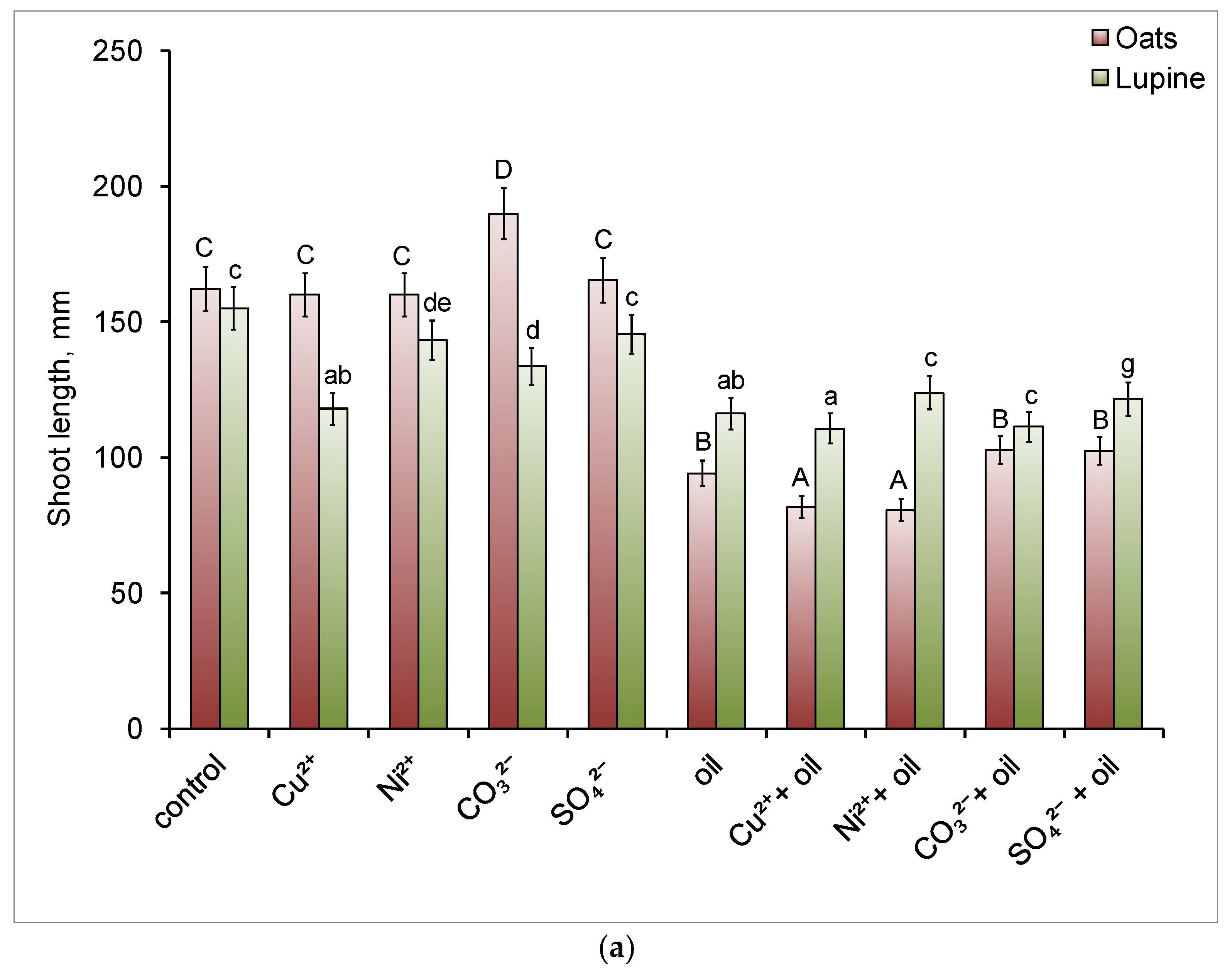
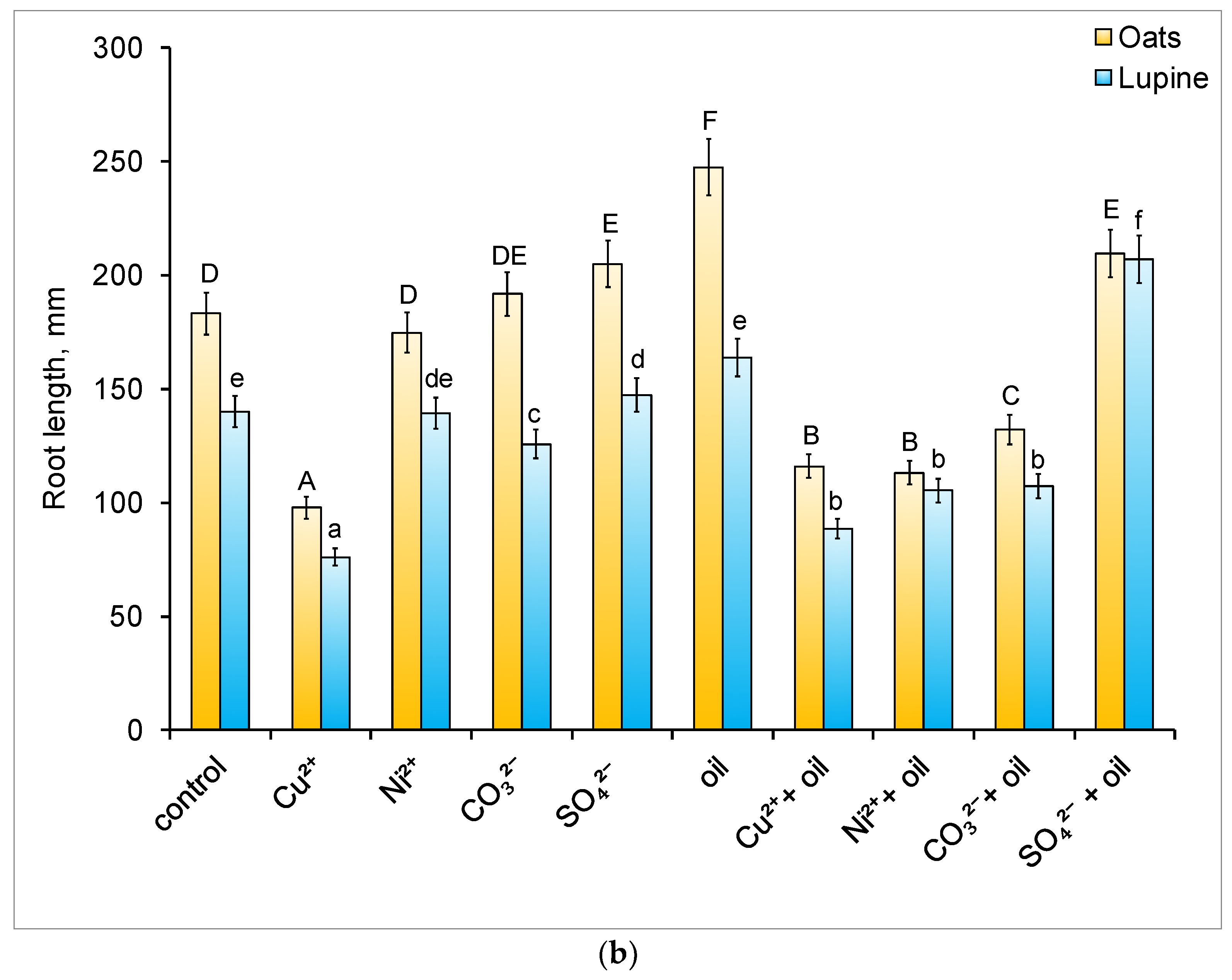
3.4. Morphometric Parameters of Plants
3.4.1. Length of Shoots and Roots of Oat Plants
3.4.2. Length of Shoots and Roots of Lupine Plants
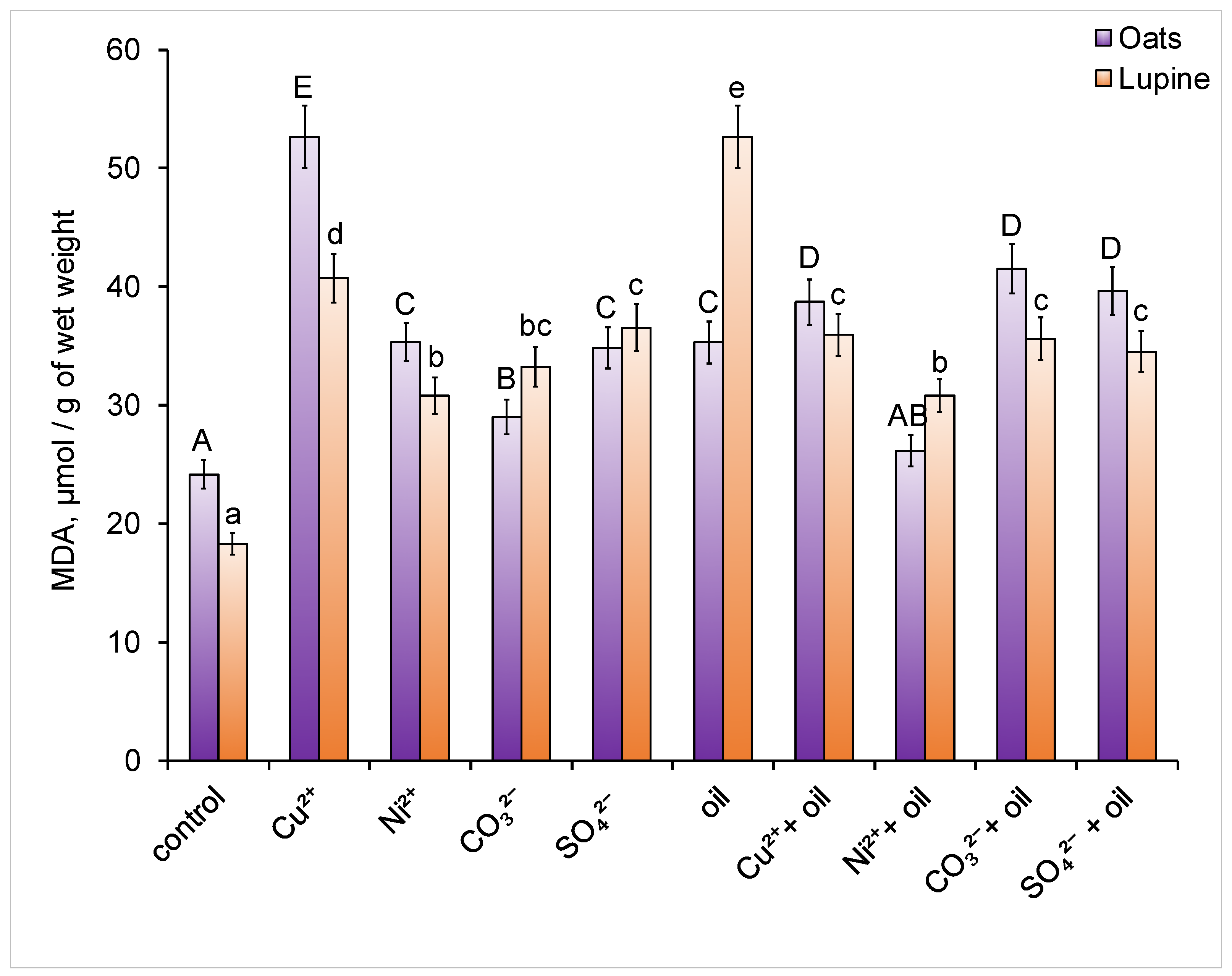
3.5. Malonic Dialdehyde Content
3.6. Pigment Complex and Nitrogen Balance Index
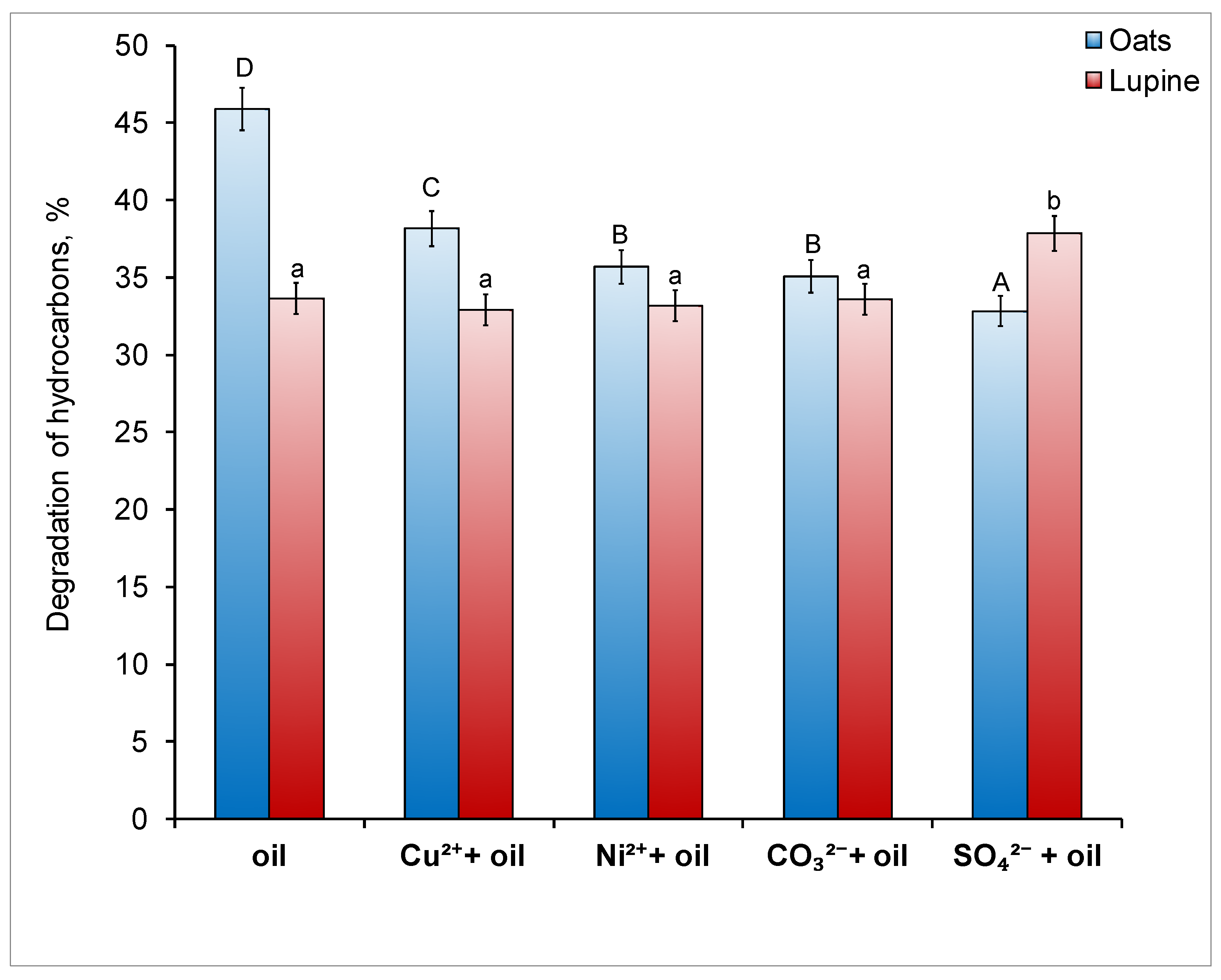
3.7. Total Hydrocarbon Content in Soil
3.8. Phytotoxicity
4. Discussion
5. Conclusions
Author Contributions
Funding
Institutional Review Board Statement
Informed Consent Statement
Data Availability Statement
Conflicts of Interest
References
- Zahermand, S.; Vafaeian, M.; Hosein Bazyar, M. Analysis of the physical and chemical properties of soil contaminated with oil (petroleum) hydrocarbons. Earth Sci. Res. J. 2020, 24, 163–168. [Google Scholar] [CrossRef]
- Minnikova, T.; Kolesnikov, S.; Minkina, T.; Mandzhieva, S. Assessment of ecological condition of haplic chernozem calcic contaminated with petroleum hydrocarbons during application of bioremediation agents of various natures. Land 2021, 10, 169. [Google Scholar] [CrossRef]
- Vysotskaya, L.B.; Kudoyarova, G.R.; Arkhipova, T.N.; Kuzina, E.V.; Rafikova, G.F.; Akhtyamova, Z.A.; Ivanov, R.S.; Chetverikov, S.P.; Chetverikova, D.V.; Bakaeva, M.D.; et al. The influence of the association of barley plants with petroleum degrading bacteria on the hormone content, growth and photosynthesis of barley plants grown in the oil-contaminated soil. Acta Physiol. Plant. 2021, 43, 67. [Google Scholar] [CrossRef]
- Kuzina, E.; Rafikova, G.; Mukhamatdyarova, S.; Sharipova, Y.Y.; Korshunova, T.Y. biological activity of leached chernozem under oil and sodium chloride pollution and the effect of treatment with halotolerant oil-destructing bacteria. Eurasian Soil Sci. 2023, 56, 75–86. [Google Scholar] [CrossRef]
- Yang, L.; Bian, X.; Yang, R.; Zhou, C.; Tang, B. Assessment of organic amendments for improving coastal saline soil. Land Degrad. Dev. 2018, 29, 3204–3211. [Google Scholar] [CrossRef]
- Li, X.; Wang, A.; Wan, W.; Luo, X.; Zheng, L.; He, G.; Huang, D.; Chen, W.; Huang, Q. High salinity inhibits soil bacterial community mediating nitrogen cycling. Appl. Environ. Microbiol. 2021, 87, e0136621. [Google Scholar] [CrossRef] [PubMed]
- Yao, R.J.; Li, H.Q.; Zhu, W.; Yang, J.S.; Wang, X.P.; Yin, C.Y.; Jing, Y.P.; Chen, Q.; Xie, W.P. Biochar and potassium humate shift the migration, transformation and redistribution of urea-N in salt-affected soil under drip fertigation: Soil column and incubation experiments. Irrig. Sci. 2022, 40, 267–282. [Google Scholar] [CrossRef]
- Azadi, N.; Raiesi, F. Salinization depresses soil enzyme activity in metal-polluted soils through increases in metal mobilization and decreases in microbial biomass. Ecotoxicology 2021, 30, 1071–1083. [Google Scholar] [CrossRef]
- Singh, P.; Sharma, S.; Nisar, S.; Choudhary, O.P. Structural stability and organic matter stabilization in soils: Differential impacts of soil salinity and sodicity. J. Soil Sci. Plant Nutr. 2023, 23, 1751–1773. [Google Scholar] [CrossRef]
- Chen, M.; Xu, P.; Zeng, G.; Yang, C.; Huang, D.; Zhang, J. Bioremediation of soils contaminated with polycyclic aromatic hydrocarbons, petroleum, pesticides, chlorophenols and heavy metals by composting: Applications, microbes and future research needs. Biotechnol. Adv. 2015, 33, 745–755. [Google Scholar] [CrossRef]
- Alengebawy, A.; Abdelkhalek, S.T.; Qureshi, S.R.; Wang, M.-Q. Heavy metals and pesticides toxicity in agricultural soil and plants: Ecological risks and human health implications. Toxics 2021, 9, 42. [Google Scholar] [CrossRef]
- Hadia-e-Fatima, A.A. Heavy Metal Pollution—A Mini Review. J. Bacteriol. Mycol. Open Access 2018, 6, 179–181. [Google Scholar] [CrossRef]
- Tang, B.; Xu, H.; Song, F.; Ge, H.; Yue, S. effects of heavy metals on microorganisms and enzymes in soils of lead-zinc tailing ponds. Environ. Res. 2022, 207, 112174. [Google Scholar] [CrossRef] [PubMed]
- Rashid, A.; Schutte, B.J.; Ulery, A.; Deyholos, M.K.; Sanogo, S.; Lehnhoff, E.A.; Beck, L. Heavy metal contamination in agricultural soil: Environmental pollutants affecting crop health. Agronomy 2023, 13, 1521. [Google Scholar] [CrossRef]
- Naz, M.; Dai, Z.C.; Hussain, S.; Tariq, M.; Danish, S.; Khan, I.U.; Qi, S.S.; Du, D.L. The soil pH and heavy metals revealed their impact on soil microbial community. J. Environ. Manag. 2022, 321, 115770. [Google Scholar] [CrossRef] [PubMed]
- Taheri, M.; Motesharezadeh, B.; Zolfaghari, A.A.; Javadzarrin, I. Phytoremediation modeling in soil contaminated by oil-hydrocarbon under salinity stress by eucalyptus (A comparative study). Comput. Electronic. Agric. 2018, 150, 162–169. [Google Scholar] [CrossRef]
- Choden, D.; Pokethitiyook, P.; Poolpak, T.; Kruatrachue, M. Phytoremediation of soil co-contaminated with zinc and crude oil using Ocimum gratissimum (L.) in association with Pseudomonas putida MU02. Int. J. Phytoremediation 2021, 23, 181–189. [Google Scholar] [CrossRef]
- Baghaie, A.H.; Daliri, A. Effect of salicylic acid and root inoculation with P. indica on cd phytoremediation efficiency and degradation of soil fuel oil in the salinity stress. Int. Arch. Health Sci. 2020, 7, 24–30. [Google Scholar] [CrossRef]
- Korshunova, T.; Kuzina, E.; Mukhamatdyarova, S.; Iskuzhina, M.; Kulbaeva, L.; Petrova, S. Effect of herbicide-resistant oil-degrading bacteria on plants in soil contaminated with oil and herbicides. Plants 2024, 13, 3560. [Google Scholar] [CrossRef]
- Netrusov, A.I. Practical Course on Microbiology; Academy: Moscow, Russia, 2005; p. 608. (In Russian) [Google Scholar]
- Raymond, R.L. Microbial oxidation of n-paraffinic hydrocarbons. Develop. Ind. Microbiol. 1961, 2, 23–32. [Google Scholar]
- Khaziev, F.K. Methods of Soil Enzymology; Publishing Nauka: Moscow, Russia, 2005; pp. 1–252. (In Russian) [Google Scholar]
- ISO 14240-1:1997; Soil Quality—Determination of Soil Microbial Biomass. Part 1: Substrate-Induced Respiration Method. International Organization for Standardization: Geneva, Switzerland, 2000; pp. 271–278.
- ISO 16072; Soil Quality–Laboratory Methods for Determination of Microbial Soil Respiration. International Organization for Standardization: Geneva, Switzerland, 2002; pp. 1–19.
- Korshunova, T.Y.; Iskuzina, M.G.; Kuzina, E.V.; Mukhamatdyarova, S.R.; Rameev, T.V. Evaluation of the influence of various pollutants on the growth and development of remediant plants. Ecobiotech 2023, 6, 156–165. [Google Scholar] [CrossRef]
- Abreu, C.M.D.; Carneiro, G.H.F.; Costa, M.R.D.; Barroso, G.M.; Duque, T.S.; Silva, J.M.S.; Santos, J.B.D. Avena sativa as a multifunctional tool for phytoremediation and bioenergy production in sulfentrazone contaminated soils. J. Xenobiot. 2025, 15, 87. [Google Scholar] [CrossRef] [PubMed]
- Krasavtseva, E.; Makarov, D. Changes in morphometric and physiological parameters of oats (Avena sativa L.) caused by fluoride contamination. Int. J. Plant Biol. 2024, 15, 1277–1287. [Google Scholar] [CrossRef]
- Vocciante, M.; Franchi, E.; Fusini, D.; Pedron, F.; Barbafieri, M.; Petruzzelli, G.; Reverberi, A.P. Sustainable recovery of an agricultural area impacted by an oil spill using enhanced phytoremediation. Appl. Sci. 2024, 14, 582. [Google Scholar] [CrossRef]
- Lima, L.; Ndiawar Ly, S.; Tisserand, R.; Jacquet, J.; Echevarria, G.; van der Ent, A.; Williams Araújo do Nascimento, C. Co-cropping of Bornmuellera emarginata, Lupinus albus and Imperata cylindrica: A study of metal uptake interactions and nickel phytoextraction efficiency. Int. J. Phytoremediation 2025, 27, 916–925. [Google Scholar] [CrossRef]
- Uchiyama, M.; Mihara, M. Determination of malonaldehyde precursor in tissues by thiobarbituric acid test. Anal. Biochem. 1978, 86, 271–278. [Google Scholar] [CrossRef]
- Ravindran, B.; Mnkeni, P.N.S. Bio-optimization of the carbon-to-nitrogen ratio for efficient vermicomposting of chicken manure and waste paper using Eisenia fetida. Environ. Sci. Pollut. Res. 2016, 23, 16965–16976. [Google Scholar] [CrossRef]
- Islam, M.M.; Saxena, N.; Sharma, D. Phytoremediation as a green and sustainable prospective method for heavy metal contamination: A review. RSC Sustain. 2024, 2, 1269–1288. [Google Scholar] [CrossRef]
- Ha, N.T.H.; Nga, T.T.H.; Minh, N.N.; Anh, B.T.K.; Hang, N.T.A.; Duc, N.A.; Nhuan, M.T.; Kim, K.W. Uptake of arsenic and heavy metals by native plants growing near Nui Phao multi-metal mine, northern Vietnam. Appl. Geochem. 2019, 108, 104368. [Google Scholar] [CrossRef]
- Sharma, I.; Sharma, S.; Sharma, V.; Singh, A.K.; Sharma, A.; Kumar, A.; Singh, J.; Sharma, A. PGPR-enabled bioremediation of pesticide and heavy metal-contaminated soil: A review of recent advances and emerging challenges. Chemosphere 2024, 362, 142678. [Google Scholar] [CrossRef]
- Wyszkowski, M.; Wyszkowska, J.; Borowik, A.; Kordala, N. Sewage sludge as a tool in limiting the content of trace elements in Avena sativa L. on the soil polluted with diesel oil. Materials 2021, 14, 4003. [Google Scholar] [CrossRef] [PubMed]
- Fresno, T.; Moreno-Jiménez, E.; Zornoza, P.; Peñalosa, J.M. Aided Phytostabilisation of As- and Cu-Contaminated Soils Using White Lupin and Combined Iron and Organic Amendments. J. Environ. Manag. 2018, 205, 142–150. [Google Scholar] [CrossRef] [PubMed]
- Maurya, S.; Abraham, J.S.; Somasundaram, S.; Toteja, R.; Gupta, R.; Makhija, S. Indicators for Assessment of Soil Quality: A Mini-Review. Environ. Monit. Assess. 2020, 192, 604. [Google Scholar] [CrossRef] [PubMed]
- Kolesnikov, S.I.; Gaivoronskii, V.G.; Rotina, E.N.; Kazeev, K.S.; Val’kov, V.F. Assessment of soil tolerance toward contamination with black oil in the south of Russia on the basis of soil biological indices: A model experiment. Eurasian Soil Sci. 2010, 43, 929–934. [Google Scholar] [CrossRef]
- Seth, K.; Kumar, A. Role of soil microflora in phytoremediation of heavy metal contaminated soils. In Phytoremediation for Environmental Sustainability; Prasad, R., Ed.; Springer: Singapore, 2022; pp. 25–46. [Google Scholar] [CrossRef]
- Gutiérrez-Ginés, M.J.; Pastor, J.; Hernández, A.J. Integrated approach to assessing the effects of soils polluted with heavy metals on a plant population. Ecotoxicology 2012, 21, 1965–1978. [Google Scholar] [CrossRef]
- Marastoni, L.; Tauber, P.; Pii, Y.; Valentinuzzi, F.; Astolfi, S.; Simoni, A.; Brunetto, G.; Cesco, S.; Mimmo, T. The potential of two different Avena sativa L. cultivars to alleviate Cu toxicity. Ecotoxicol. Environ. Saf. 2019, 182, 109430. [Google Scholar] [CrossRef]
- Morales, M.E.; Iocoli, G.A.; Allegrini, M.; Villamil, M.B.; Zabaloy, M.C. Response of root exudates and bacterial community to N fertilization and termination methods in Avena sativa L. as a winter cover crop model. Eur. J. Soil Biol. 2023, 114, 103453. [Google Scholar] [CrossRef]
- Heuermann, D.; Gentsch, N.; Boy, J.; Schweneker, D.; Feuerstein, U.; Groß, J.; Bauer, B.; Guggenberger, G.; von Wirén, N. Interspecific competition among catch crops modifies vertical root biomass distribution and nitrate scavenging in soils. Sci. Rep. 2019, 9, 11531. [Google Scholar] [CrossRef]
- Jiao, H.; Xu, W.; Hu, Y.; Tian, R.; Wang, Z. Citric Acid in Rice Root Exudates Enhanced the Colonization and Plant Growth-Promoting Ability of Bacillus altitudinis LZP02. Microbiol. Spectr. 2022, 10, e01002-22. [Google Scholar] [CrossRef]
- He, M.; Dai, S.; Zhu, Q.; Wang, W.; Chen, S.; Meng, L.; Dan, X.; Huang, X.; Cai, Z.; Zhang, J.; et al. Understanding the stimulation of microbial oxidation of organic N to nitrate in plant soil systems. Soil Biol. Biochem. 2024, 190, 109312. [Google Scholar] [CrossRef]
- Macias-Benitez, S.; Garcia-Martinez, A.M.; Caballero Jimenez, P.; Gonzalez, J.M.; Tejada Moral, M.; Parrado Rubio, J. Rhizospheric organic acids as biostimulants: Monitoring feedbacks on soil microorganisms and biochemical properties. Front. Plant Sci. 2020, 11, 633. [Google Scholar] [CrossRef] [PubMed]
- Revina, S.; Minnikova, T.; Ruseva, A.; Kolesnikov, S.; Kutasova, A. Catalase activity as a diagnostic indicator of the health of oil-contaminated soils after remediation. Environ. Monit. Assess. 2024, 196, 449. [Google Scholar] [CrossRef] [PubMed]
- Yuan, F.; Yin, S.; Xu, Y.; Xiang, L.; Wang, H.; Li, Z.; Fan, K.; Pan, G. The Richness and Diversity of Catalases in Bacteria. Front. Microbiol. 2021, 12, 645477. [Google Scholar] [CrossRef] [PubMed]
- Wu, L.; Ma, H.; Zhao, Q.; Zhang, S.; Wei, W.; Ding, X. Changes in soil bacterial community and enzyme activity under five years straw returning in paddy soil. Europ. J. Soil Biol. 2020, 100, 103215. [Google Scholar] [CrossRef]
- Chen, L.Y.; Han, L.F.; Sun, K.; Chen, G.C.; Ma, C.X.; Zhang, B.A.; Cao, Y.N.; Xing, B.S.; Yang, Z.F. Molecular transformation of dissolved organic carbon of rhizosphere soil induced by flooding and copper pollution. Geoderma 2022, 407, 115563. [Google Scholar] [CrossRef]
- Sun, X.; Sun, M.; Chao, Y.; Shang, X.; Wang, H.; Pan, H.; Yang, Q.; Lou, Y.; Zhuge, Y. Effects of lead pollution on soil microbial community diversity and biomass and on invertase activity. Soil Ecol. Lett. 2023, 5, 118–127. [Google Scholar] [CrossRef]
- Ciarkowska, K.; Sołek-Podwika, K.; Wieczorek, J. Enzyme Activity as an Indicator of Soil-Rehabilitation Processes at a Zinc and Lead Ore Mining and Processing Area. J. Environ. Manag. 2014, 132, 250–256. [Google Scholar] [CrossRef]
- Xian, Y.; Wang, M.; Chen, W. Quantitative Assessment on Soil Enzyme Activities of Heavy Metal Contaminated Soils with Various Soil Properties. Chemosphere 2015, 139, 604–608. [Google Scholar] [CrossRef]
- Yuebing, S.; Shunan, Z.; Lin, W.; Xuefeng, L.; Yingming, X. Changes of Enzymatic Activities, Substrate Utilization Pattern, and Microbial Community Diversity in Heavy Metal-Contaminated Soils. Water Air Soil Pollut. 2020, 231, 422. [Google Scholar] [CrossRef]
- Rafikova, G.F.; Kuzina, E.V.; Korshunova, T.Y. The influence of bioremediation on the biological activity of leached chernozem contaminated with oil and lead. Eurasian Soil Sci. 2022, 3, 354–369. [Google Scholar] [CrossRef]
- Prikhodko, V.D.; Kazeev, K.S.; Vilkova, V.V.; Nizhelskiy, M.S.; Kolesnikov, S.I. Changes in enzyme activity in postpyrogenic soils (physical model experiment). Eurasian Soil Sci. 2023, 56, 101–109. [Google Scholar] [CrossRef]
- Moradi, S.; Sarikhani, M.R.; Beheshti Ale-Agha, A.; Hasanpur, K.; Shiri, J. Effects of natural and prolonged crude oil pollution on soil enzyme activities. Geoderma Reg. 2024, 36, e00742. [Google Scholar] [CrossRef]
- Alibakhshi, M.; Khoshgoftarmanesh, A.H. Effects of nickel nutrition in the mineral form and complexed with histidine in the nitrogen metabolism of onion bulb. Plant Growth Regul. 2015, 75, 733–740. [Google Scholar] [CrossRef]
- Meištininkas, R.; Vaškevičienė, I.; Dikšaitytė, A.; Pedišius, N.; Žaltauskaitė, J. Potential of Eight Species of Legumes for Heavy Fuel Oil-Contaminated Soil Phytoremediation. Sustainability 2023, 15, 4281. [Google Scholar] [CrossRef]
- Gong, W.J.; Niu, Z.F.; Wang, X.R.; Zhao, H.P. How the soil microbial communities and activities respond to long-term heavy metal contamination in electroplating contaminated site. Microorganisms 2021, 9, 362. [Google Scholar] [CrossRef]
- Minnikova, T.; Kolesnikov, S.; Khoroshaev, D.; Tsepina, N.; Evstegneeva, N.; Timoshenko, A. Assessment of the Health of Soils Contaminated with Ag, Bi, Tl, and Te by the Intensity of Microbiological Activity. Life 2023, 13, 1592. [Google Scholar] [CrossRef]
- Moore, F.; González, M.E.; Khan, N.; Curaqueo, G.; Sanchez-Monedero, M.; Rilling, J.; Morales, E.; Panichini, M.; Mutis, A.; Jorquera, M.; et al. Copper immobilization by biochar and microbial community abundance in metal-contaminated soils. Sci. Total Environ. 2018, 616, 960–969. [Google Scholar] [CrossRef]
- Zheng, L.; Li, Y.; Shang, W.; Dong, X.; Tang, Q.; Cheng, H. The inhibitory effect of cadmium and/or mercury on soil enzyme activity, basal respiration, and microbial community structure in coal mine–affected agricultural soil Ann. Microbiol. 2019, 69, 849–859. [Google Scholar] [CrossRef]
- Koohkan, H.; Mortazavi, M.S.; Golchin, A.; Najafi-Ghiri, M.; Golkhandan, M.; Akbarzadeh-Chomachaei, G.; Saraji, F. The effect of petroleum levels on some soil biological properties under phytoremediation and bioaugmentation. Environ. Sci. Pollut. Res. 2023, 30, 60618–60637. [Google Scholar] [CrossRef]
- Minnikova, T.; Kolesnikov, S.; Revina, S.; Ruseva, A.; Gaivoronsky, V. Enzymatic assessment of the state of oil-contaminated soils in the south of Russia after bioremediation. Toxics 2023, 11, 355. [Google Scholar] [CrossRef]
- Sushkova, S.; Minkina, T.; Mandzhieva, S.; Zamulina, I.; Bauer, T.; Vasilyeva, G.; Antonenko, E.; Rajput, V.; Kızılkaya, R. Features of accumulation, migration, and transformation of benzo [a] pyrene in soil-plant system in a model condition of soil contamination. J. Soils Sediments 2018, 18, 2361–2367. [Google Scholar] [CrossRef]
- Broniatowski, M.; Binczycka, M.; Wójcik, A.; Flasiński, M.; Wydro, P. Polycyclic aromatic hydrocarbons in model bacterial membranes—Langmuir monolayer studies. Biochim. Biophys. Acta Biomembr. 2017, 1859, 2402–2412. [Google Scholar] [CrossRef] [PubMed]
- Dadach, M.; Ahmed, M.Z.; Bhatt, A.; Radicetti, E.; Mancinelli, R. Effects of Chloride and Sulfate Salts on Seed Germination and Seedling Growth of Ballota Hirsuta Benth. and Myrtus communis L. Plants 2023, 12, 3906. [Google Scholar] [CrossRef] [PubMed]
- Hewelke, E.; Szatyłowicz, J.; Hewelke, P.; Gnatowski, T.; Aghalarov, R. The Impact of Diesel Oil Pollution on the Hydrophobicity and CO2 Efflux of Forest Soils. Water. Air. Soil Pollut. 2018, 229, 51. [Google Scholar] [CrossRef]
- Han, L.; Gao, Y.; Li, D. Ion uptake in tall fescue as affected by carbonate, chloride, and sulfate salinity. PLoS ONE 2014, 9, 250–259. [Google Scholar] [CrossRef]
- Brandal, Ø.; Hanneseth, A.-M.D.; Sjöblom, J. Interactions between synthetic and indigenous naphthenic acids and divalent cations across oil-water interfaces: Effects of addition of oil-soluble non-ionic surfactants. Colloid Polym. Sci. 2005, 284, 124–133. [Google Scholar] [CrossRef]
- Tiodar, E.D.; Văcar, C.L.; Podar, D. Phytoremediation and microorganisms-assisted phytoremediation of mercury-contaminated soils: Challenges and perspectives. Int. J. Environ. Res. Public Health 2021, 18, 2435. [Google Scholar] [CrossRef]
- Montiel-Rozas, M.M.; Madejón, E.; Madejón, P. Effect of heavy metals and organic matter on root exudates (low molecular weight organic acids) of herbaceous species: An assessment in sand and soil conditions under different levels of contamination. Environ. Pollut. 2016, 216, 273–281. [Google Scholar] [CrossRef]
- Ojuederie, O.B.; Babalola, O.O. Microbial and Plant-Assisted Bioremediation of Heavy Metal Polluted Environments: A Review. Int. J. Environ. Res Public Health 2017, 14, 1504. [Google Scholar] [CrossRef]
- Correa-García, S.; Pande, P.; Séguin, A.; St-Arnaud, M.; Yergeau, E. Rhizoremediation of petroleum hydrocarbons: A model system for plant microbiome manipulation. Microb. Biotechnol. 2018, 11, 819–832. [Google Scholar] [CrossRef]
- Devatha, C.P.; Vishnu Vishal, A.; Purna Chandra Rao, J. Investigation of physical and chemical characteristics on soil due to crude oil contamination and its remediation. Appl. Water Sci. 2019, 9, 89. [Google Scholar] [CrossRef]
- Garau, M.; Castaldi, P.; Diquattro, S.; Pinna, M.V.; Senette, C.; Roggero, P.P.; Garau, G. Combining grass and legume species with compost for assisted phytostabilization of contaminated soils. Environ. Technol. Innov. 2021, 22, 101387. [Google Scholar] [CrossRef]
- Meier, S.; Alvear, M.; Borie, F.; Aguilera, P.; Ginocchio, R.; Cornejo, P. Influence of copper on root exudate patterns in some metallophytes and agricultural plants. Ecotoxicol. Environ. Saf. 2012, 75, 8–15. [Google Scholar] [CrossRef] [PubMed]
- Vidal, C.; Ruiz, A.; Ortiz, J.; Larama, G.; Perez, R.; Santander, C.; Ferreira, P.A.A.; Cornejo, P. Antioxidant responses of phenolic compounds and immobilization of copper in imperata cylindrica, a plant with potential use for bioremediation of cu contaminated environments. Plants 2020, 9, 1397. [Google Scholar] [CrossRef]
- Baldi, E.; Miotto, A.; Ceretta, C.A.; Quartieri, M.; Sorrenti, G.; Brunetto, G.; Toselli, M. Soil-applied phosphorous is an effective tool to mitigate the toxicity of copper excess on grapevine grown in rhizobox. Sci. Hortic. 2018, 227, 102–111. [Google Scholar] [CrossRef]
- Rooney, C.P.; Zhao, F.-J.; McGrath, S.P. Phytotoxicity of nickel in a range of European soils: Influence of soil properties, Ni solubility and speciation. Environ. Pollut. 2007, 145, 596–605. [Google Scholar] [CrossRef]
- Li, D.; Wang, L.; Wang, Y.; Li, H.; Chen, G. Soil properties and cultivars determine heavy metal accumulation in rice grain and cultivars respond differently to Cd stress. Environ. Sci. Pollut. Res. 2019, 26, 14638–14648. [Google Scholar] [CrossRef]
- Halliwell, B. Reactive species and antioxidants. Redox biology is a fundamental theme of aerobic life. Plant physiol. 2006, 141, 312–322. [Google Scholar] [CrossRef]
- Emamverdian, A.; Ding, Y.; Mokhberdoran, F.; Ramakrishnan, M.; Ahmad, Z.; Xie, Y. Different Physiological and Biochemical Responses of Bamboo to the Addition of TiO2 NPs under Heavy Metal Toxicity. Forests 2021, 12, 759. [Google Scholar] [CrossRef]
- Odukoya, J.; Lambert, R.; Sakrabani, R. Impact of crude oil on yield and phytochemical composition of selected green leafy vegetables. Int. J. Veg. Sci. 2019, 25, 554–570. [Google Scholar] [CrossRef]
- Bellout, Y.; Khelif, L.; Guivarch, A.; Haouche, L.; Djebbar, R.; Carol, P.; Abrous Belbachir, O. Impact of edaphic hydrocarbon pollution on the morphology and physiology of pea roots (Pisum sativum L.). Appl. Ecol. Environ. Res. 2016, 14, 511–525. [Google Scholar] [CrossRef]
- Adeyemi, O.; Adeyemi, O. Effect of crude oil contaminated soil on Phaseolus vulgaris L. World J. Inter. Res. 2020, 8, 28–33. [Google Scholar] [CrossRef]
- Talebzadeh, F.; Valeo, C. Evaluating the Effects of Environmental Stress on Leaf Chlorophyll Content as an Index for Tree Health. IOP Conf. Ser. Earth Environ. Sci. 2022, 1006, 012007. [Google Scholar] [CrossRef]
- Saeed, M.; Ilyas, N.; Arshad, M.; Sheeraz, M.; Ahmed, I.; Bhattacharya, A. Development of a plant microbiome bioremediation system for crude oil contamination. J. Environ. Chem. Eng. 2021, 9, 105401. [Google Scholar] [CrossRef]
- Kumar, S.; Wang, M.; Liu, Y.; Fahad, S.; Qayyum, A.; Jadoon, S.A.; Zhu, G. Nickel toxicity alters growth patterns and induces oxidative stress response in sweetpotato. Front. Plant Sci. 2022, 13, 1054924. [Google Scholar] [CrossRef]
- Wang, R.H.H.; Zhang, X.C.; Giraldo, J.P.; Shabala, S. Leaf photosynthesis, fluorescence response to salinity and the relevance to chloroplast salt compartmentation and anti-oxidative stress in two poplars. Trees 2007, 21, 581–591. [Google Scholar] [CrossRef]
- Jin, X.; Liu, T.; Xu, J.; Gao, Z.; Hu, X. Exogenous GABA enhances muskmelon tolerance to salinity-alkalinity stress by regulating redox balance and chlorophyll biosynthesis. BMC Plant Biol. 2019, 19, 48. [Google Scholar] [CrossRef]
- Han, G.; Cui, B.X.; Zhang, X.X.; Li, K.R. The effects of petroleum-contaminated soil on photosynthesis of Amorpha fruticosa seedlings. Int. J. Environ. Sci. Technol. 2016, 13, 2383–2392. [Google Scholar] [CrossRef]
- Fourati, E.E.; Vogel-Mikuš, K.; Bettaieb, T.; Kavčič, A.; Kelemen, M.; Vavpetič, P.; Ghnaya, T. Physiological response and mineral elements accumulation pattern in Sesuvium portulacastrum L. subjected in vitro to nickel. Chemosphere 2019, 219, 463–471. [Google Scholar] [CrossRef]
- Wu, H.; Zhang, X.; Giraldo, J.P.; Shabala, S. It is not all about sodium: Revealing tissue specificity and signalling roles of potassium in plant responses to salt stress. Plant Soil 2018, 431, 1–17. [Google Scholar] [CrossRef]
- Okorkov, V.V. On the mechanism and efficiency of the interaction of lime with acidic soils. Agrochemistry 2004, 7, 11–21. [Google Scholar]
- De Souza, A.; Abd Elgawad, H.; Fidalgo, F.; Teixeira, J.; Matos, M.; Tamagnini, P.; Fernandes, R.; Figueiredo, F.; Azenha, M.; Teles, L.O.; et al. Subcellular compartmentalization of aluminum reduced its hazardous impact on rye photosynthesis. Environ. Pollut. 2022, 315, 120313. [Google Scholar] [CrossRef] [PubMed]
- Cristancho, J.Á.R.; Hanafi, M.M.; Omar, S.R.S.; Rafii, Y.M.; Martínez, F.M.; Campos, C.E.C. Alleviation of aluminum in acidic soils and its effect on growth of hybrid and clonal oil palm seedlings. J. Plant Nutr. 2011, 34, 387–401. [Google Scholar] [CrossRef]
- Wu, J.; Lv, S.; Zhao, L.; Gao, T.; Yu, C.; Hu, J.; Ma, F. Advances in the study of the function and mechanism of the action of flavonoids in plants under environmental stresses. Planta 2023, 257, 108. [Google Scholar] [CrossRef]
- Shah, A.; Smith, D.L. Flavonoids in agriculture: Chemistry and roles in, biotic and abiotic stress responses, and microbial associations. Agronomy 2020, 10, 1209. [Google Scholar] [CrossRef]
- Emamverdian, A.; Ding, Y.; Barker, J.; Liu, G.; Li, Y.; Mokhberdoran, F. Sodium Nitroprusside Improves Bamboo Resistance under Mn and Cr Toxicity with Stimulation of Antioxidants Activity, Relative Water Content, and Metal Trans-location and Accumulation. Int. J. Mol. Sci. 2023, 24, 1942. [Google Scholar] [CrossRef]
- Huang, S.; Miao, Y.; Yuan, F.; Cao, Q.; Ye, H.; Lenz-Wiedemann, V.I.; Bareth, G. In-season diagnosis of rice nitrogen status using proximal fluorescence canopy sensor at different growth stages. Remote Sens. 2019, 11, 1847. [Google Scholar] [CrossRef]
- Pinskii, D.L.; Shary, P.A.; Mandzhieva, S.S.; Minkina, T.M.; Perelomov, L.V.; Maltseva, A.N.; Dudnikova, T.S. Effect of composition and properties of soils and soil-sand substrates contaminated with copper on morphometric parameters of barley plants. Eurasian Soil. Sci. 2023, 56, 352–362. [Google Scholar] [CrossRef]



| Oats | Lupine | |||||
|---|---|---|---|---|---|---|
| Variants | Heterotrophic, ×107 | Hydrocarbon- Oxidizing, ×106 | Micromycetes, ×105 | Heterotrophic, ×107 | Hydrocarbon- Oxidizing, ×106 | Micromycetes, ×105 |
| Control | 0.92 ± 0.05 b | 2.02 ± 0.09 e | 0.22 ± 0.01 b | 2.02 ± 0.08 b | 2.06 ± 0.09 a | 0.32 ± 0.01 c |
| Cu2+ | 0.81 ± 0.03 a | 0.11± 0.01 a | 4.01 ± 0.31 d | 1.06 ± 0.05 a | 2.01 ± 0.10 a | 0.12 ± 0.01 a |
| Ni2+ | 0.90 ± 0.04 b | 0.21 ± 0.01 b | 0.12 ± 0.01 a | 5.08 ± 0.26 e | 2.63 ± 0.14 b | 0.15 ± 0.01 a |
| CO32− | 0.83 ± 0.03 a | 1.15 ± 0.04 d | 0.13 ± 0.01 a | 3.04 ± 0.13 c | 9.22 ± 0.44 d | 0.21 ± 0.01 b |
| SO42− | 1.04 ± 0.03 c | 1.03 ± 0.03 c | 0.11 ± 0.01 a | 2.12 ± 0.09 b | 4.36 ± 0.21 c | 0.33 ± 0.02 c |
| oil | 8.92 ± 0.42 g | 10.08 ± 0.52 f | 1.20 ± 0.03 c | 6.06 ± 0.31 f | 10.33 ± 0.45 e | 0.92 ± 0.07 e |
| Cu2+ + oil | 4.85 ± 0.25 d | 1.26 ± 0.06 d | 3.76 ± 0.19 d | 4.29 ± 0.20 d | 21.25 ± 0.12 g | 0.63 ± 0.02 d |
| Ni2+ + oil | 6.07 ± 0.38 e | 10.02 ± 0.55 f | 1.15 ± 0.06 c | 7.11 ± 0.38 g | 32.01 ± 0.16 h | 1.26 ± 0.07 f |
| CO32− + oil | 9.06 ± 0.50 g | 11.08 ± 0.76 f | 1.06 ± 0.05 c | 7.26 ± 0.35 g | 10.34 ± 0.51 e | 0.91± 0.05 e |
| SO42− + oil | 7.03 ± 0.35 f | 10.03 ± 0.48 f | 1.23 ± 0.06 c | 4.14 ± 0.19 d | 12.18 ± 0.70 f | 1.38 ± 0.08 f |
| Oats | Lupine | |||||
|---|---|---|---|---|---|---|
| Options Experience | Chlorophyll (μg/cm2) | Flavonoids (μg/cm2) | NBI (a.e.) | Chlorophyll (μg/cm2) | Flavonoids (μg/cm2) | NBI (a.e.) |
| Control | 20.9 ± 0.3 c | 0.78 ± 0.02 c | 26.8 ± 0.7 c | 49.2 ± 1.2 f | 0.351 ± 0.009 c | 140.8 ± 3.5 de |
| Cu2+ | 20.1 ± 0.3 b | 0.91 ± 0.02 e | 22.1 ± 0.6 a | 48.1 ± 1.2 f | 0.344 ± 0.009 c | 140.4 ± 3.5 de |
| Ni2+ | 19.3 ± 0.3 a | 0.83 ± 0.02 d | 23.4 ± 0.6 b | 43.6 ± 1.1 e | 0.32 ± 0.008 b | 136.3 ± 3.4 d |
| CO32− | 23.1 ± 0.4 d | 0.70 ± 0.01 b | 32.9 ± 0.8 d | 49.1 ± 1.2 f | 0.329 ± 0.008 bc | 148.1 ± 3.7 e |
| SO42− | 21.1 ± 0.3 c | 0.64 ± 0.02 a | 32.4 ± 0.8 d | 49.1 ± 1.2 f | 0.332 ± 0.009 bc | 147.2 ± 3.7 e |
| oil | 19.2 ± 0.3 a | 0.70 ± 0.02 b | 27.7 ± 0.7 c | 28.9 ± 0.7 a | 0.380 ± 0.009 d | 85.1 ± 2.1 a |
| Cu2+ + oil | 23.6 ± 0.4 d | 0.85 ± 0.03 d | 28.0 ± 0.7 c | 34.9 ± 0.9 c | 0.331 ± 0.008 bс | 112.6 ± 2.8 c |
| Ni2+ + oil | 19.1 ± 0.3 a | 0.82 ± 0.02 cd | 23.4 ± 0.6 b | 40.1 ± 1.0 d | 0.294 ± 0.007 a | 138.2 ± 3.5 d |
| CO32− + oil | 21.5 ± 0.3 c | 0.70 ± 0.01 b | 31.3 ± 0.8 d | 39.0 ± 1.0 d | 0.341 ± 0.009 c | 114.9 ± 2.9 c |
| SO42− + oil | 19.4 ± 0.3 a | 0.72 ± 0.02 b | 26.8 ± 0.7 c | 30.7 ± 0.8 b | 0.332 ± 0.008 bc | 94.0 ± 2.4 b |
| Options Experience | Share Sprouted Seeds, % | Elongation Root, % | Index Germination, % | Phytotoxicity |
|---|---|---|---|---|
| Oats | ||||
| Control | 98.3 ± 4.7 b | 98.0 ± 4.7 c | 96.3 ± 4.7 d | Absent |
| Cu2+ | 90.0 ± 4.4 ab | 88.3 ± 4.2 b | 79.5 ± 3.8 bc | Moderate |
| Ni2+ | 93.0 ± 4.5 ab | 93.0 ± 4.4 bc | 86.5 ± 4.2 c | Absent |
| CO32− | 93.0 ± 4.3 ab | 91.2 ± 4.5 bc | 84.8 ± 4.0 c | Absent |
| SO42− | 86.6 ± 4.1 a | 72.6 ± 3.5 a | 62.9 ± 3.2 a | Moderate |
| oil | 91.6 ± 4.5 ab | 94.1 ± 4.6 bc | 86.2 ± 4.5 c | Absent |
| Cu2+ + oil | 90.0 ± 4.1 ab | 91.2 ± 4.2 bc | 79.4 ± 3.8 bc | Moderate |
| Ni2+ + oil | 90.4 ± 4.4 ab | 93.0 ± 4.3 bc | 84.1 ± 4.1 c | Absent |
| CO32− + oil | 88.3 ± 4.2 a | 86.0 ± 4.2 b | 75.9 ± 3.6 b | Moderate |
| SO42− + oil | 91.2 ± 4.5 ab | 86.2 ± 4.3 b | 78.6 ± 3.7 bc | Moderate |
| Lupine | ||||
| Control | 97.2 ± 4.8 c | 98.0 ± 4.5 c | 95.3 ± 4.8 d | Absent |
| Cu2+ | 80.3 ± 4.1 ab | 82.0 ± 4.0 ab | 65.9 ± 3.2 a | Moderate |
| Ni2+ | 85.1 ± 4.2 b | 84.1 ± 4.1 ab | 71.6 ± 3.6 ab | Moderate |
| CO32− | 93.3 ± 4.6 bc | 87.3 ± 4.2 b | 81.5 ± 3.9 c | Absent |
| SO42− | 93.3 ± 4.5 bc | 88.0 ± 4.3 b | 82.1 ± 4.0 c | Absent |
| oil | 76.2 ± 3.5 a | 96.1 ± 4.7 c | 73.2 ± 3.5 b | Moderate |
| Cu2+ + oil | 93.3 ± 4.7 bc | 88.0 ± 4.1 b | 82.1 ± 4.2 c | Absent |
| Ni2+ + oil | 94.2 ± 4.5 c | 96.4 ± 4.6 c | 90.8 ± 4.5 d | Absent |
| CO32− + oil | 90.0 ± 4.5 bc | 88.0 ± 4.2 b | 79.2 ± 3.8 bc | Moderate |
| SO42− + oil | 94.2 ± 4.6 c | 79.6 ± 4.0 a | 75.0 ± 3.7 bc | Moderate |
Disclaimer/Publisher’s Note: The statements, opinions and data contained in all publications are solely those of the individual author(s) and contributor(s) and not of MDPI and/or the editor(s). MDPI and/or the editor(s) disclaim responsibility for any injury to people or property resulting from any ideas, methods, instructions or products referred to in the content. |
© 2026 by the authors. Licensee MDPI, Basel, Switzerland. This article is an open access article distributed under the terms and conditions of the Creative Commons Attribution (CC BY) license.
Share and Cite
Rafikova, G.; Mukhamatdyarova, S.; Kuzina, E.; Kulbaeva, L.; Iskuzhina, M.; Korshunova, T. Effects of Salinization, Oil Contamination, and Heavy Metals on Soil Biological Activity and Phytoremediants. Toxics 2026, 14, 186. https://doi.org/10.3390/toxics14020186
Rafikova G, Mukhamatdyarova S, Kuzina E, Kulbaeva L, Iskuzhina M, Korshunova T. Effects of Salinization, Oil Contamination, and Heavy Metals on Soil Biological Activity and Phytoremediants. Toxics. 2026; 14(2):186. https://doi.org/10.3390/toxics14020186
Chicago/Turabian StyleRafikova, Gulnas, Svetlana Mukhamatdyarova, Elena Kuzina, Liliya Kulbaeva, Milyausha Iskuzhina, and Tatyana Korshunova. 2026. "Effects of Salinization, Oil Contamination, and Heavy Metals on Soil Biological Activity and Phytoremediants" Toxics 14, no. 2: 186. https://doi.org/10.3390/toxics14020186
APA StyleRafikova, G., Mukhamatdyarova, S., Kuzina, E., Kulbaeva, L., Iskuzhina, M., & Korshunova, T. (2026). Effects of Salinization, Oil Contamination, and Heavy Metals on Soil Biological Activity and Phytoremediants. Toxics, 14(2), 186. https://doi.org/10.3390/toxics14020186