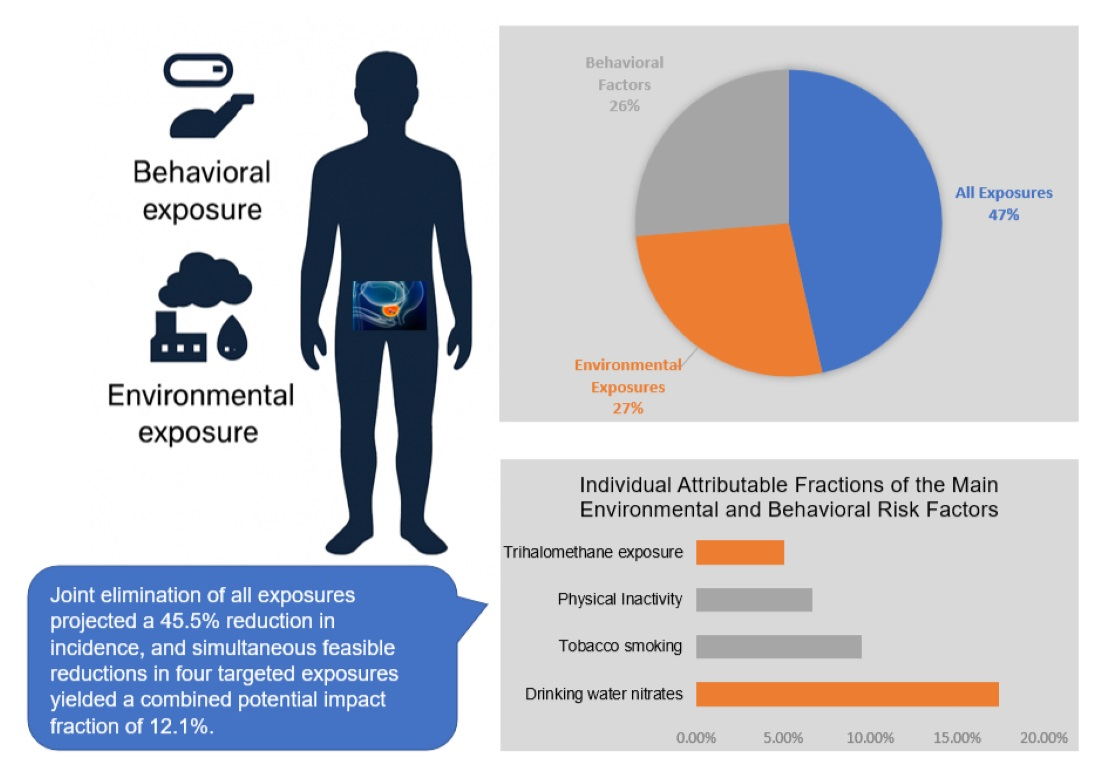
Prostate Cancer in the MENA Region: Attributable Burden of Behavioral and Environmental Exposures



Abstract
1. Introduction
2. Materials and Methods
2.1. Study Design
2.2. Prevalence of Risk Factors
2.3. Relative Risk for Each Risk Factor
2.4. Statistical Methods
2.4.1. PAF Calculation
2.4.2. Synthetic Cohort Simulation
2.4.3. Sensitivity Analysis
2.4.4. Joint PAF
2.4.5. Potential Impact Fraction
3. Results
3.1. Cohort-Based PAF Estimates
3.2. Sensitivity Analysis
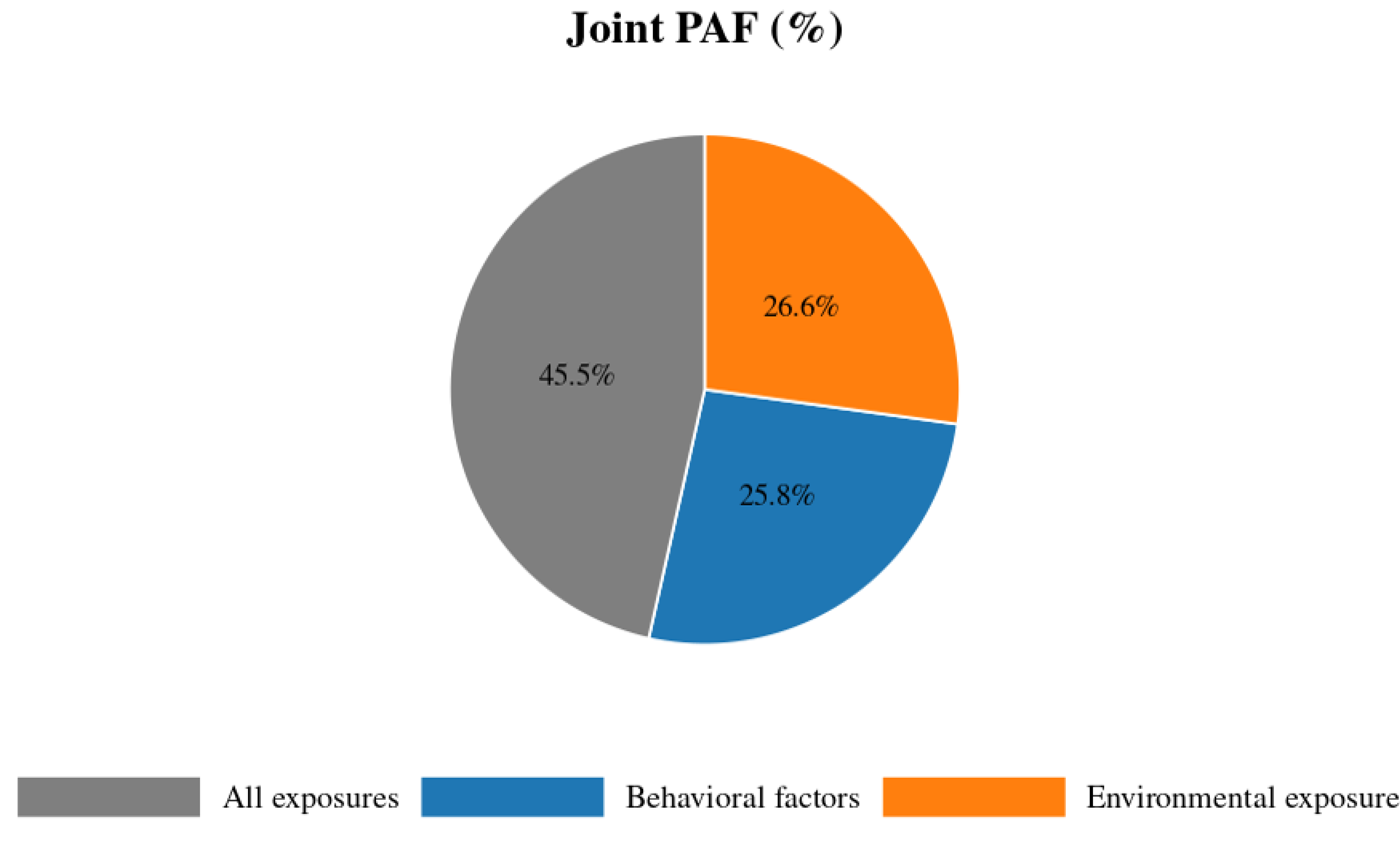
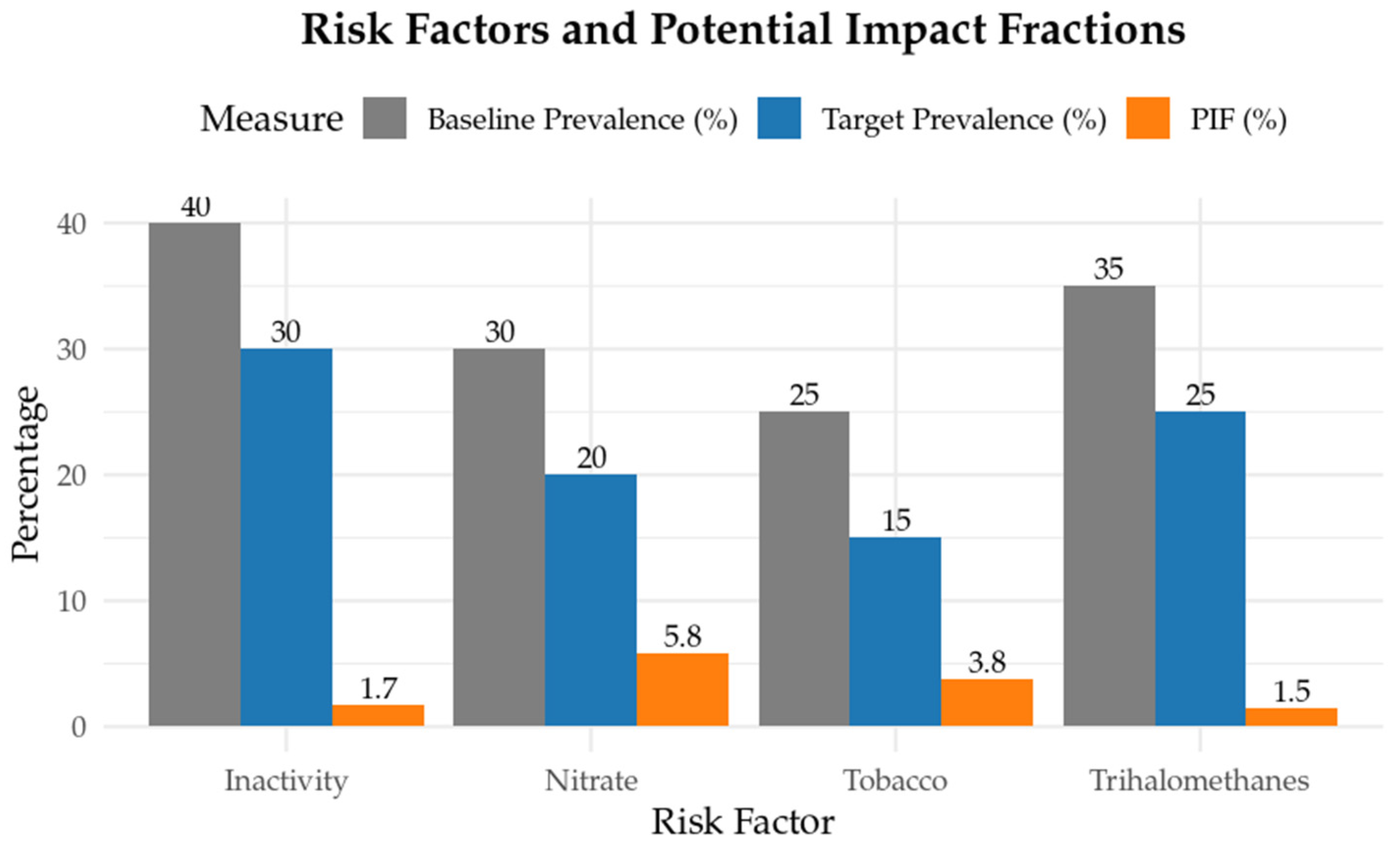
3.3. Joint PAF and PIF
4. Discussion
5. Conclusions
Supplementary Materials
Author Contributions
Funding
Institutional Review Board Statement
Informed Consent Statement
Data Availability Statement
Acknowledgments
Conflicts of Interest
Abbreviations
| FAO | Food and Agriculture Organization |
| GBD | Global Burden of Disease |
| MENA | Middle East and North Africa |
| PAF | Population attributable fraction |
| P0 | Baseline prevalence |
| P1 | Target prevalence |
| Pe | Prevalence of exposure |
| PIF | Potential impact fraction |
| PSA | Prostate-specific antigen |
| RR | Relative risk |
| THM | Trihalomethane |
| WHO | World Health Organization |
References
- Sung, H.; Ferlay, J.; Siegel, R.L.; Laversanne, M.; Soerjomataram, I.; Jemal, A.; Bray, F. Global Cancer Statistics 2020: GLOBOCAN Estimates of Incidence and Mortality Worldwide for 36 Cancers in 185 Countries. CA A Cancer J. Clin. 2021, 71, 209–249. [Google Scholar] [CrossRef]
- Abbasi-Kangevari, M.; Saeedi Moghaddam, S.; Ghamari, S.H.; Azangou-Khyavy, M.; Malekpour, M.R.; Rezaei, N.; Rezaei, N.; Kolahi, A.-A.; GBD 2019 NAME Prostate Cancer Collaborators; Amini, E.; et al. The burden of prostate cancer in North Africa and Middle East, 1990–2019: Findings from the global burden of disease study. Front. Oncol. 2022, 12, 961086. [Google Scholar] [CrossRef] [PubMed]
- Sayan, M.; Langoe, A.; Aynaci, O.; Eren, A.A.; Eren, M.F.; Kazaz, I.O.; Ibrahim, Z.; Al-Akelie, O.T.; Al-Mansouri, L.; Abu-Hijlih, R.; et al. Prostate cancer presentation and management in the Middle East. BMC Urol. 2024, 24, 35. [Google Scholar] [CrossRef]
- Mansour, R.; Al-Ani, A.; Al-Hussaini, M.; Abdel-Razeq, H.; Al-Ibraheem, A.; Mansour, A.H. Modifiable risk factors for cancer in the middle East and North Africa: A scoping review. BMC Public Health 2024, 24, 223. [Google Scholar] [CrossRef]
- Ziglioli, F.; Patera, A.; Isgrò, G.; Campobasso, D.; Guarino, G.; Maestroni, U. Impact of modifiable lifestyle risk factors for prostate cancer prevention: A review of the literature. Front. Oncol. 2023, 13, 1203791. [Google Scholar] [CrossRef]
- Tran, K.B.; Lang, J.J.; Compton, K.; Xu, R.; Acheson, A.R.; Henrikson, H.J.; Kocarnik, J.M.; Penberthy, L.; Aali, A.; Abbas, Q.; et al. The global burden of cancer attributable to risk factors, 2010–2019: A systematic analysis for the Global Burden of Disease Study 2019. Lancet 2022, 400, 563–591. [Google Scholar] [CrossRef]
- Rushton, L.; Bagga, S.; Bevan, R.; Brown, T.P.; Cherrie, J.W.; Holmes, P.; Fortunato, L.; Slack, R.; Van Tongeren, M.; Young, C.; et al. Occupation and cancer in Britain. Br. J. Cancer 2010, 102, 1428–1437. [Google Scholar] [CrossRef]
- Cui, H.; Zhang, W.; Zhang, L.; Qu, Y.; Xu, Z.; Tan, Z.; Yan, P.; Tang, M.; Yang, C.; Wang, Y.; et al. Risk factors for prostate cancer: An umbrella review of prospective observational studies and mendelian randomization analyses. PLoS Med. 2024, 21, e1004362. [Google Scholar] [CrossRef]
- Mukherji, D.; Youssef, B.; Dagher, C.; El-Hajj, A.; Nasr, R.; Geara, F.; Rabah, D.; Al Dousari, S.; Said, R.; Ashou, R.; et al. Management of patients with high-risk and advanced prostate cancer in the Middle East: Resource-stratified consensus recommendations. World J. Urol. 2020, 38, 681–693. [Google Scholar] [CrossRef] [PubMed]
- Global Burden of Disease Collaborative Network. Global Burden of Disease Study 2019 (GBD 2019) Population Estimates 1950–2019; Institute for Health Metrics and Evaluation (IHME): Seattle, WA, USA, 2020; Available online: https://ghdx.healthdata.org/record/ihme-data/gbd-2019-population-estimates-1950-2019 (accessed on 4 April 2025).
- World Health Organization. Noncommunicable Disease Country Profiles 2021; World Health Organization: Geneva, Switzerland, 2018; Available online: https://www.who.int/teams/noncommunicable-diseases/surveillance/data/profiles-ncd (accessed on 4 April 2025).
- Food and Agriculture Organization of the United Nations. FAO Food Balance Sheets 2015–2020; Food and Agriculture Organization of the United Nations: Rome, Italy, 2021; Available online: https://openknowledge.fao.org/handle/20.500.14283/cd1656en (accessed on 4 April 2025).
- World Health Organization. Global Status Report on Alcohol and Health 2018; World Health Organization: Geneva, Switzerland, 2018; Available online: https://www.who.int/publications/i/item/9789241565639/ (accessed on 10 April 2025).
- Food and Agriculture Organization of the United Nations. AQUASTAT: FAO’s Global Information System on Water and Agriculture; Food and Agriculture Organization of the United Nations: Rome, Italy, 2020; Available online: https://www.fao.org/aquastat/en/databases/ (accessed on 10 April 2025).
- World Health Organization. Guidelines for Drinking-Water Quality, 4th Edition, Incorporating the 1st Addendum, 4th ed.; World Health Organization: Geneva, Switzerland, 2017; Available online: https://www.who.int/publications/i/item/9789241549950 (accessed on 10 April 2025).
- WHO/UNICEF Joint Monitoring Programme for Water Supply, Sanitation and Hygiene. Middle East and North Africa Data; World Health Organization (WHO): Geneva, Switzerland; United Nations Children’s Fund (UNICEF): New York, NY, USA, 2023; Available online: https://washdata.org/data/household?geoRegionCode=MEA (accessed on 10 April 2025).
- Semerjian, L.; Dennis, J. Multipathway risk assessment of trihalomethane exposure in drinking water of Lebanon. J. Water Health 2007, 5, 511–522. [Google Scholar] [CrossRef] [PubMed]
- World Health Organization. WHO Ambient Air Quality Database; World Health Organization: Geneva, Switzerland, 2024; Available online: https://www.who.int/data/gho/data/themes/air-pollution/who-air-quality-database (accessed on 1 May 2025).
- Bank, W. Urban Population (% of Total Population)—Middle East & North Africa; The World Bank: Washington, DC, USA, 2023; Available online: https://data.worldbank.org/indicator/SP.URB.TOTL.IN.ZS?locations=ZQ (accessed on 1 May 2025).
- International Labour Organization. ILOSTAT: Employment by Sector and Occupation; International Labour Organization: Geneva, Switzerland, 2023; Available online: https://ilostat.ilo.org/topics/employment/ (accessed on 1 May 2025).
- European Agency for Safety and Health at Work (EU-OSHA). Workplace Exposure to Dusts and Aerosols—Diesel Exhaust; European Agency for Safety and Health at Work (EU-OSHA): Bilbao, Spain, 2021; Available online: https://osha.europa.eu/en/oshwiki/workplace-exposure-dusts-and-aerosols-diesel-exhaust (accessed on 1 May 2025).
- Al-Fayez, S.; El-Metwally, A. Cigarette smoking and prostate cancer: A systematic review and meta-analysis of prospective cohort studies. Tob. Induc. Dis. 2023, 21, 19. [Google Scholar] [CrossRef]
- Rivera-Izquierdo, M.; Pérez de Rojas, J.; Martínez-Ruiz, V.; Pérez-Gómez, B.; Sánchez, M.J.; Khan, K.S.; Jiménez-Moleón, J.J. Obesity as a Risk Factor for Prostate Cancer Mortality: A Systematic Review and Dose-Response Meta-Analysis of 280,199 Patients. Cancers 2021, 13, 4169. [Google Scholar] [CrossRef] [PubMed]
- Benke, I.N.; Leitzmann, M.F.; Behrens, G.; Schmid, D. Physical activity in relation to risk of prostate cancer: A systematic review and meta-analysis. Ann. Oncol. 2018, 29, 1154–1179. [Google Scholar] [CrossRef]
- Zhao, Z.; Wu, D.; Gao, S.; Zhou, D.; Zeng, X.; Yao, Y.; Xu, Y.; Zeng, G. The association between dairy products consumption and prostate cancer risk: A systematic review and meta-analysis. Br. J. Nutr. 2023, 129, 1714–1731. [Google Scholar] [CrossRef]
- Asgari Savadjani, S.; Yadollahi, F.; Maghsoudi, A. Association between calcium intake and prostate neoplasm; a systematic review and meta-analysis. J. Nephropathol. 2024, 13, e21539. [Google Scholar] [CrossRef]
- Zhao, J.; Stockwell, T.; Roemer, A.; Chikritzhs, T. Is alcohol consumption a risk factor for prostate cancer? A systematic review and meta-analysis. BMC Cancer 2016, 16, 845. [Google Scholar] [CrossRef]
- Schmidt, S. Nitrates and Prostate Cancer: Long-Term Drinking Water Exposures Associated with Risk of Tumors. Environ. Health Perspect. 2023, 131, 54003. [Google Scholar] [CrossRef]
- Helte, E.; Söderlund, F.; Säve-Söderbergh, M.; Larsson, S.C.; Åkesson, A. Exposure to Drinking Water Trihalomethanes and Risk of Cancer: A Systematic Review of the Epidemiologic Evidence and Dose-Response Meta-Analysis. Environ. Health Perspect. 2025, 133, 16001. [Google Scholar] [CrossRef]
- Yang, Y.; McDonald, A.C.; Wang, X.; Pan, Y.; Wang, M. Arsenic exposures and prostate cancer risk: A multilevel meta-analysis. J. Trace Elem. Med. Biol. 2022, 72, 126992. [Google Scholar] [CrossRef]
- Zhu, H.; Chen, Y.; Chen, H.; Ye, Y.; Chi, Y. A systematic review and meta-analysis of toxic elements exposure and risk of prostate cancer. Environ. Sci. Eur. 2025, 37, 120. [Google Scholar] [CrossRef]
- Sayehmiri, K.; Azami, M.; Mohammadi, Y.; Soleymani, A.; Tardeh, Z. The association between Selenium and Prostate Cancer: A Systematic Review and Meta-Analysis. Asian Pac. J. Cancer Prev. 2018, 19, 1431–1437. [Google Scholar]
- Li, J.; Deng, Z.; Soerensen, S.J.C.; Kachuri, L.; Cardenas, A.; Graff, R.E.; Leppert, J.T.; Langston, M.E.; Chung, B.I. Ambient air pollution and urological cancer risk: A systematic review and meta-analysis of epidemiological evidence. Nat. Commun. 2024, 15, 5116. [Google Scholar] [CrossRef]
- Barul, C.; Rousseau, M.C.; Parent, M.E. Occupational Exposure to Engine Exhausts and Prostate Cancer Risk. Environ. Health 2025, 24, 51. [Google Scholar] [CrossRef] [PubMed]
- Richardson, S.D.; Plewa, M.J.; Wagner, E.D.; Schoeny, R.; Demarini, D.M. Occurrence, genotoxicity, and carcinogenicity of regulated and emerging disinfection by-products in drinking water: A review and roadmap for research. Mutat. Res. 2007, 636, 178–242. [Google Scholar] [CrossRef]
- Al-Daghri, N.M.; Hussain, S.D.; Alnaami, A.M.; Aljohani, N.; Sabico, S. Dietary Calcium Intake and Osteoporosis Risk in Arab Adults. Nutrients 2023, 15, 2829. [Google Scholar] [CrossRef]
- Alshahrani, F.; Alassafi, M.T.; Owaiwid, L.N.B.; Alageel, N.A.; Alanazi, F.H.; Alsogami, L.S.; AlMujarri, F.M.; AlMalki, M.H. Assessment of calcium intake and recognition of calcium-rich food sources among the Saudi population. Arch. Osteoporos. 2023, 18, 130. [Google Scholar] [CrossRef]
- Gannagé-Yared, M.H.; Chemali, R.; Sfeir, C.; Maalouf, G.; Halaby, G. Dietary calcium and vitamin D intake in an adult Middle Eastern population: Food sources and relation to lifestyle and PTH. Int. J. Vitam. Nutr. Res. 2005, 75, 281–289. [Google Scholar] [CrossRef]
- Wu, H.; Wang, M.; Raman, J.D.; McDonald, A.C. Association between urinary arsenic, blood cadmium, blood lead, and blood mercury levels and serum prostate-specific antigen in a population-based cohort of men in the United States. PLoS ONE 2021, 16, e0250744. [Google Scholar] [CrossRef]
- Jiang, J.; Chen, B.; Tang, B.; Wei, Q. Selenium in Prostate Cancer: Prevention, Progression, and Treatment. Pharmaceuticals 2023, 16, 1250. [Google Scholar] [CrossRef]



| Behavioral Risk Factor | Relative Risk (95% CI) | Reference | Prevalence in MENA Men ≥ 50 Years | Estimated Exposed Population (Millions) |
|---|---|---|---|---|
| Tobacco smoking (ever vs. never) | 1.42 (1.20–1.68) | [22] | 25% of men smoke | 11.75 |
| Obesity (BMI ≥ 30 vs. <25 kg/m2) | 1.12 (1.06–1.19) | [23] | 30% of men are obese | 14.10 |
| Physical inactivity (lowest vs. highest activity) | 1.18 (1.08–1.29) inverse of protective RR 0.85 (0.78–0.94) | [24] | 40% of men insufficiently active | 18.80 |
| High dairy product intake (highest vs. lowest) | 1.09 (1.02–1.16) | [25] | 35% of men consume high amounts of dairy | 16.45 |
| High calcium intake (≥1000 mg/day vs. <500 mg/day) | 1.17 (1.06–1.28) | [26] | 35% of men exceed 1000 mg/day | 16.45 |
| Heavy alcohol consumption (high vs. none) | 1.18 (1.10–1.26) | [27] | 5% of men are heavy drinkers | 2.35 |
| Contaminant | Relative Risk (95% CI) | Reference | Exposure Prevalence (% Men ≥ 50) | Estimated Exposed Men ≥ 50 |
|---|---|---|---|---|
| Nitrate (drinking water) | 1.70 (1.20–2.41) | [28] | 30% | 14.1 million |
| THMs | 1.15 (0.95–1.40) | [29] | 35% | 16.5 million |
| Arsenic | 1.18 (1.06–1.30) | [30] | 18% | 8.5 million |
| Lead | 1.04 (1.02–1.05) per study-specific increment | [31] | 18% | 8.5 million |
| Selenium (protective) | 0.86 (0.78–0.94) per unit increase | [32] | 28% | 13.2 million |
| PM2.5 (ambient air) | 1.06 (1.02–1.10) per 5 µg/m3 increase | [33] | 60% | 28.2 million |
| NO2 (ambient air) | 1.04 (1.01–1.07) per 10 µg/m3 increase | [33] | 60% | 28.2 million |
| Diesel exhaust (occup.) | RR 1.24 (0.96–1.61) † RR 1.27 (0.80–2.01) ‡ | [34] | 2% | 0.94 million |
| Behavioral Risk Factor | PAF (%) |
|---|---|
| Tobacco smoking (ever vs. never) | 9.5 |
| Obesity (BMI ≥ 30 vs. <25 kg/m2) | 3.5 |
| Physical inactivity (lowest vs. highest activity) | 6.7 |
| High dairy product intake (highest vs. lowest) | 3.1 |
| High calcium intake (≥1000 mg/day vs. <500 mg/day) | 5.6 |
| Heavy alcohol consumption (high vs. none) | 0.9 |
| Environmental Contaminant | |
| Nitrate (drinking water) | 17.4 |
| THMs | 5.0 |
| Arsenic | 3.1 |
| Lead | 0.7 |
| Selenium (protective) | −4.1 |
| PM2.5 (ambient air) | 3.5 |
| NO2 (ambient air) | 2.3 |
| Diesel exhaust (25th → 75th percentile) | 0.5 |
| Diesel exhaust (75th → 95th percentile) | 0.5 |
| Behavioral Risk Factor | PAF (%) |
|---|---|
| Tobacco smoking (ever vs. never) | 9.5 |
| Obesity (BMI ≥30 vs. <25 kg/m2) | 3.5 |
| Physical inactivity (lowest vs. highest) | 6.7 |
| High dairy intake (highest vs. lowest) | 3.0 |
| High calcium intake (≥1000 vs. <500 mg/day) | 5.6 |
| Heavy alcohol consumption (high vs. none) | 0.9 |
| Environmental Contaminant | |
| Nitrate (drinking water) | 17.4 |
| THMs | 5.0 |
| Arsenic | 3.1 |
| Lead | 0.7 |
| Selenium (protective) | –4.1 |
| PM2.5 (ambient air) | 3.5 |
| NO2 (ambient air) | 2.4 |
| Diesel exhaust (25th–75th percentile) | 0.5 |
| Diesel exhaust (75th–95th percentile) | 0.5 |
Disclaimer/Publisher’s Note: The statements, opinions and data contained in all publications are solely those of the individual author(s) and contributor(s) and not of MDPI and/or the editor(s). MDPI and/or the editor(s) disclaim responsibility for any injury to people or property resulting from any ideas, methods, instructions or products referred to in the content. |
© 2026 by the authors. Licensee MDPI, Basel, Switzerland. This article is an open access article distributed under the terms and conditions of the Creative Commons Attribution (CC BY) license.
Share and Cite
Tamraz, M.; Al Tartir, R.; Meski, S.E.; Temraz, S. Prostate Cancer in the MENA Region: Attributable Burden of Behavioral and Environmental Exposures. Toxics 2026, 14, 96. https://doi.org/10.3390/toxics14010096
Tamraz M, Al Tartir R, Meski SE, Temraz S. Prostate Cancer in the MENA Region: Attributable Burden of Behavioral and Environmental Exposures. Toxics. 2026; 14(1):96. https://doi.org/10.3390/toxics14010096
Chicago/Turabian StyleTamraz, Magie, Razan Al Tartir, Sara El Meski, and Sally Temraz. 2026. "Prostate Cancer in the MENA Region: Attributable Burden of Behavioral and Environmental Exposures" Toxics 14, no. 1: 96. https://doi.org/10.3390/toxics14010096
APA StyleTamraz, M., Al Tartir, R., Meski, S. E., & Temraz, S. (2026). Prostate Cancer in the MENA Region: Attributable Burden of Behavioral and Environmental Exposures. Toxics, 14(1), 96. https://doi.org/10.3390/toxics14010096