Bio-Based Fertilizers from Waste: Nutrient Recovery, Soil Health, and Circular Economy Impacts

 , ,
, ,  ,
,  and
and 
Abstract
1. Introduction
2. Types of Waste Materials for Bio-Based Fertiliser Production
2.1. Agricultural Residues
Quantitative Assessment of Priority Feedstocks for Bio-Based Fertiliser Production
2.2. Food Waste Characterisation and Processing
2.3. Animal Manure Properties and Optimisation
2.4. Industrial Organic Waste Streams
2.5. Municipal Solid Waste Organic Fractions
2.6. Regional Variations in Feedstock Management: Nordic and Baltic Perspectives

| Feedstock Category | Specific Type | C:N Ratio | N (% Dry) | P2O5 (% Dry) | K2O (% Dry) | Annual Generation (Mt) | Processing Challenges | Optimal Treatment | Refs. |
|---|---|---|---|---|---|---|---|---|---|
| Cereal Residues | |||||||||
| Wheat straw | 80–100 | 0.3–0.5 | 0.1–0.15 | 0.8–1.2 | 750 | Low N content | Co-composting, pyrolysis (500–700 °C) | [13,82,83] | |
| Rice straw | 60–80 | 0.5–0.8 | 0.1–0.2 | 1.5–2.0 | 680 | High lignin content | Pyrolysis, AD | [13,82,84] | |
| Corn stover | 50–60 | 0.6–0.9 | 0.2–0.3 | 1.2–1.5 | 590 | Bulky material | Ensiling + AD | [85] | |
| Barley straw | 70–90 | 0.4–0.6 | 0.12–0.18 | 1.0–1.5 | 180 | Variable composition | Thermophilic composting | [84] | |
| Oilseed Residues | |||||||||
| Sunflower husks | 45–55 | 1.0–1.5 | 0.3–0.5 | 2.5–3.5 | 8 | High oil residues | Composting, Combustion | [35] | |
| Rapeseed stalks | 35–45 | 0.8–1.2 | 0.2–0.4 | 1.8–2.5 | 12 | Waxy cuticle | Co-digestion with manure | [36] | |
| Legume Biomass | |||||||||
| Soybean roots | 20–25 | 2.5–3.8 | 0.4–0.6 | 1.2–1.8 | 45 | Nodule separation | Direct incorporation | [37,86] | |
| Pea residues | 22–28 | 2.2–3.2 | 0.3–0.5 | 1.5–2.2 | 8 | Rapid decomposition | Composting with bulking agent | [86] | |
| Novel Sources | |||||||||
| Insect frass | 8–12 | 2.5–4.8 | 1.2–2.1 | 1.8–3.2 | 0.25 | Variable composition | Direct application, pelletisation | [18,34] | |
| Buckwheat husks | 50–60 | 0.6–0.9 | 0.2–0.3 | 0.8–1.2 | 1.5 | High silica content | Biochar production (450–550 °C) | [38] | |
| Food Waste | |||||||||
| Fruit/vegetable | 15–25 | 2.0–3.5 | 0.5–0.8 | 2.5–3.5 | 510 | High moisture (70–85%) | AD or composting | [87,88] | |
| Kitchen mixed | 12–20 | 2.5–4.0 | 0.8–1.2 | 1.5–2.5 | 350 | Contamination risk | Source separation + AD | [74,89,90] | |
| Animal Manure | |||||||||
| Cattle | 15–25 | 1.5–2.5 | 0.5–1.0 | 1.0–2.0 | 1400 | Pathogen presence | Thermophilic AD (55–60 °C) | [91,92] | |
| Poultry | 8–12 | 3.0–4.5 | 2.5–3.5 | 2.0–3.0 | 450 | High ammonia | Composting + biochar | [56,93] | |
| Swine | 10–15 | 2.0–3.0 | 1.5–2.0 | 1.0–1.5 | 380 | High water content | Solid–liquid separation | [94] | |
| Industrial Organic | |||||||||
| Brewery sludge | 8–12 | 3.5–4.5 | 1.5–2.0 | 0.3–0.5 | 12 | Heavy metals | Co-digestion | [95,96] | |
| Paper mill | 200–400 | 0.2–0.4 | 0.1–0.2 | 0.1–0.2 | 75 | Low nutrients | N supplementation | [97,98] | |
| Sugarcane vinasse | 10–15 | 0.3–0.5 | 0.1–0.2 | 3.5–5.0 | 180 | High salinity | Dilution + fermentation | [22] | |
| Municipal Organic | |||||||||
| Source-separated | 20–30 | 1.5–2.5 | 0.5–1.0 | 1.0–1.5 | 280 | Variable quality | MBT + composting | [99,100,101] | |
| Digestate Fractions | |||||||||
| Liquid digestate | 3–5 | 3.5–5.2 a | 0.8–1.5 a | 2.5–4.0 a | 280 | High water content | Fertigation, concentration | [102,103] | |
| Solid digestate | 15–20 | 1.8–2.5 | 1.2–2.0 | 1.0–1.8 | 120 | Bulky material | Soil amendment, composting | [102,103] | |
2.7. Temporal Trends in Agricultural Waste Generation: A Decadal Assessment (2015–2025)
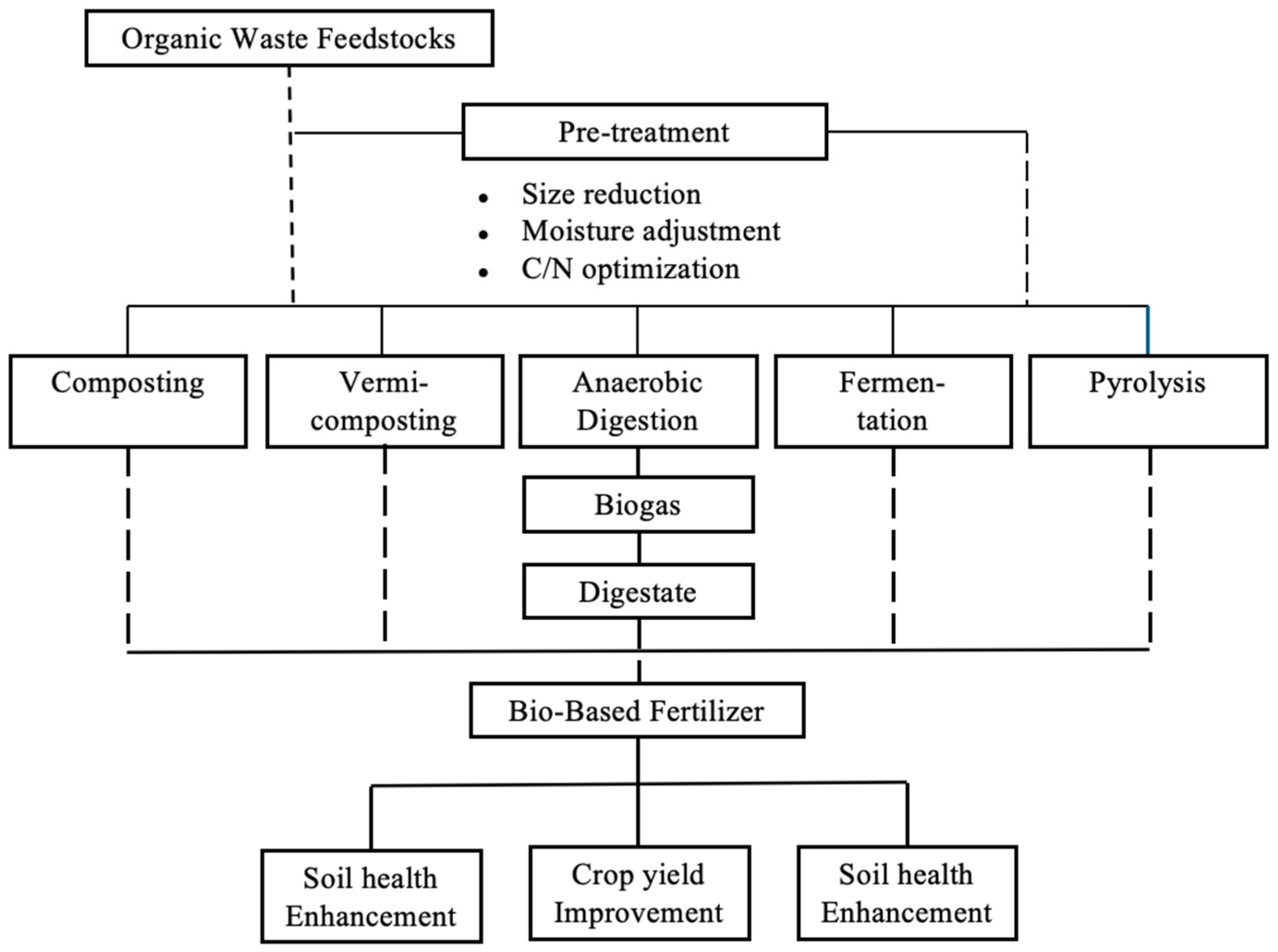
3. Biological Treatment Technologies
3.1. Composting Processes and Parameters
3.2. Vermicomposting Systems and Efficiency
3.3. Anaerobic Digestion for Nutrient Recovery
3.4. Fermentation Technologies and Microbial Enhancement
3.5. Biochar Production: Comprehensive Feedstock Utilisation
3.6. Advanced Processing Technologies for Bio-Based Fertiliser Production
3.6.1. Granulation Technologies for Organic Bulk Fertilisers
3.6.2. Extraction Technologies for Liquid Fertiliser Production
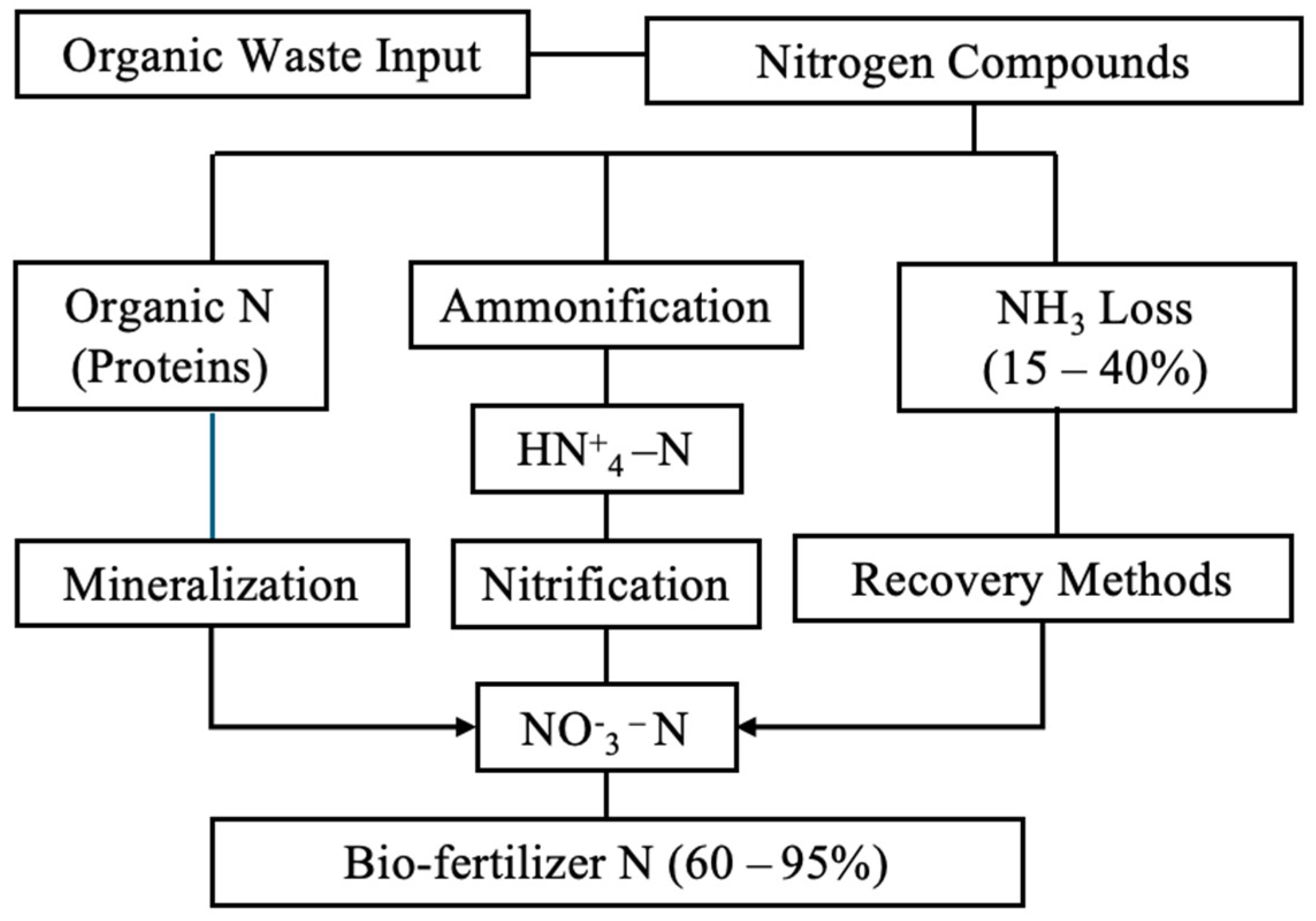
4. Nutrient Recovery Mechanisms and Efficiency
4.1. Nitrogen Recovery and Transformation
4.2. Phosphorus Mobilisation and Bioavailability
4.3. Potassium Retention and Release
4.4. Trace Elements and Micronutrient Conservation
4.5. Pathogen Reduction and Microbiological Safety
4.6. Emerging Contaminants: Microplastics and Pharmaceutical Residues
5. Characterisation of Bio-Based Fertilisers
5.1. Chemical Composition Analysis
5.2. Physical Properties Assessment
5.3. Microbial Community Analysis and Functional Assessment
5.4. Evaluation of BBF Maturity and Stability
5.5. Product Classification: Biological Versus Mineral-from-Waste Categories
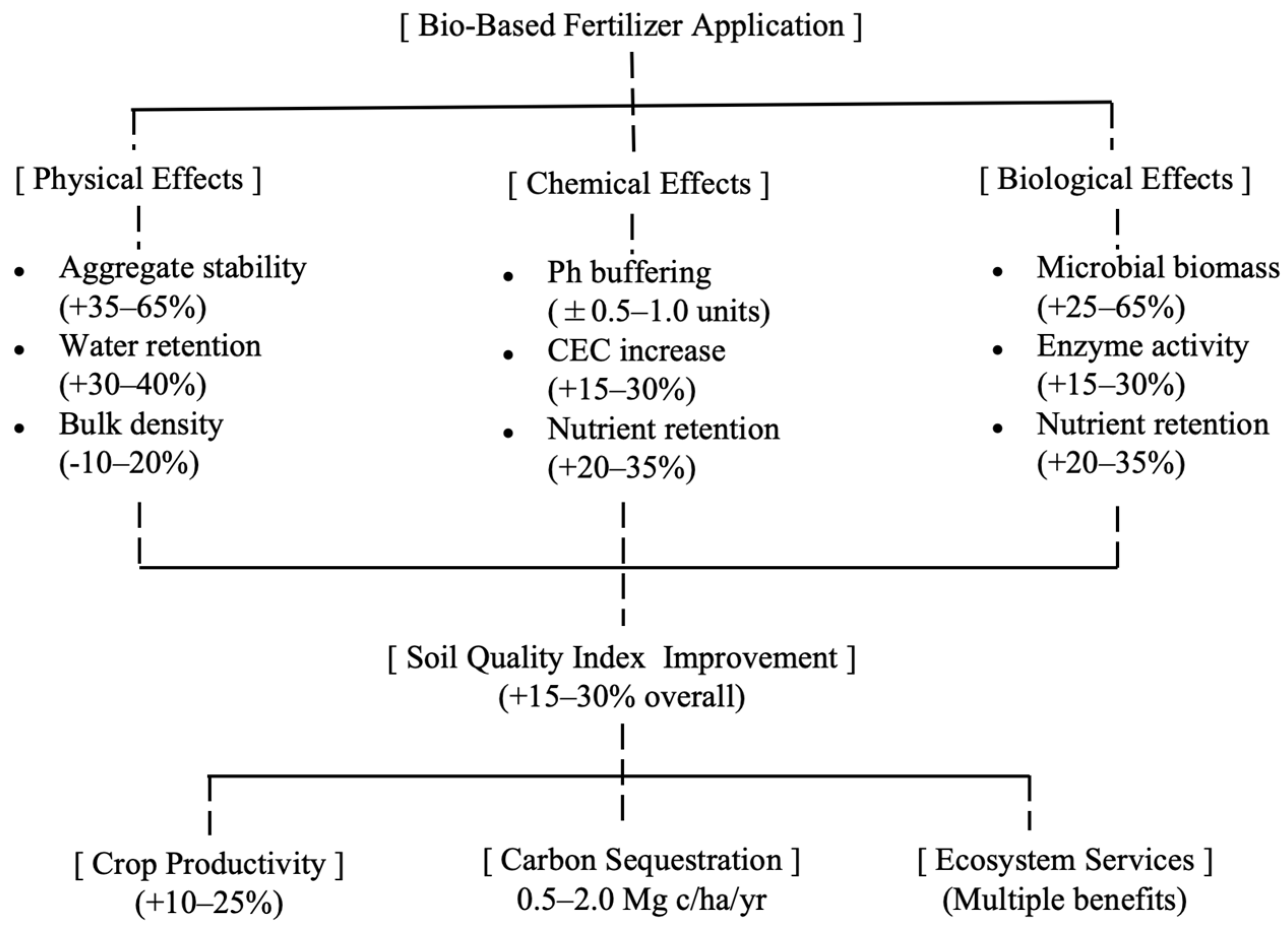
6. Effects on Soil Health
6.1. Physical Property Enhancement
6.2. Chemical Property Improvements
6.3. Biological Property Enhancement
6.4. Long-Term Soil Health Trajectory
6.5. Crop Yield and Quality Responses
| Soil Property | Eff. Size (%) | Ranges | Moderating Factors | Refs. |
|---|---|---|---|---|
| Physical Properties | ||||
| Aggregate stability (MWD) | +42.3 | 35.1–49.5 | Soil texture, application rate (20–40 t ha−1) | [236] |
| Water-holding capacity | +28.6 | 22.3–34.9 | Initial SOM (<2%), climate (arid/semi-arid) | [237,238] |
| Bulk density | −15.2 | −18.7 to −11.7 | Tillage system, time (>3 years) | [236] |
| Infiltration rate | +35.8 | 28.4–43.2 | Soil type (clay), management | [206] |
| Chemical Properties | ||||
| Soil organic carbon | +23.4 | 18.9–27.9 | Climate (temperate), soil type (loamy) | [243,244] |
| Cation exchange capacity | +21.7 | 17.3–26.1 | Clay content (<30%), OM type | [140,240] |
| Available N | +18.5 | 14.2–22.8 | C:N ratio (<20:1), crop type | [241] |
| Available P | +31.2 | 25.8–36.6 | pH (6.5–7.5), P-fixing capacity | [242] |
| pH buffering capacity | +24.3 | 19.8–28.8 | Initial pH, lime content | [261] |
| Biological Properties | ||||
| Microbial biomass C | +45.3 | 38.7–51.9 | Substrate quality, moisture | [245] |
| Bacterial diversity (Shannon) | +8.7 | 6.4–11.0 | Management history, pH | [246] |
| Fungal–Bacterial ratio | −12.4 | −15.8 to −9.0 | pH increase, N availability | [262] |
| β-glucosidase activity | +62.4 | 54.2–70.6 | Temperature (20–30 °C), moisture | [247] |
| Earthworm abundance | +156.2 | 128.4–184.0 | Organic matter quality | [263] |
| Mycorrhizal colonisation | +28.9 | 22.5–35.3 | P availability, pH | [250] |
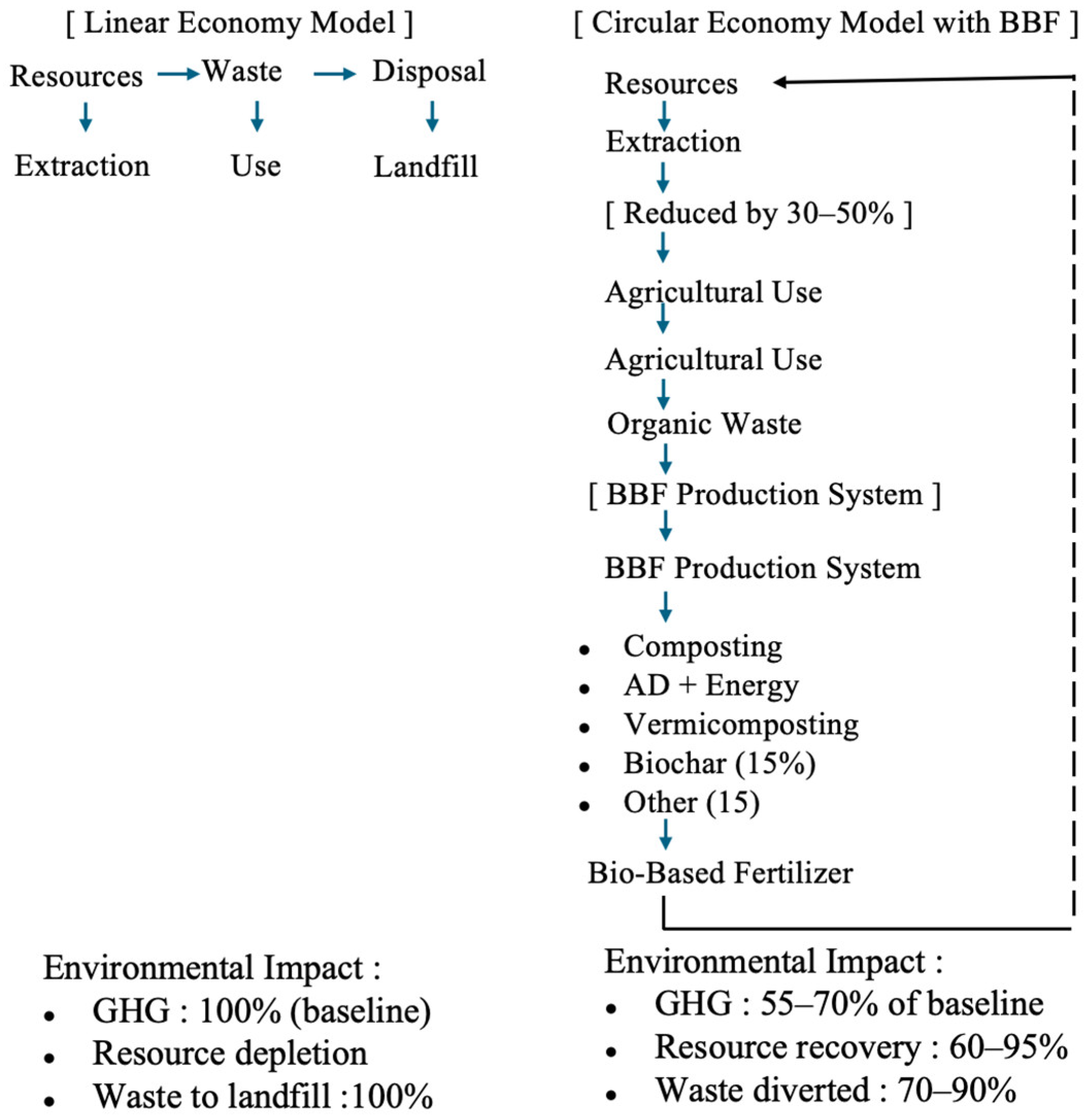
7. Circular Economy Impacts and Sustainability Assessment
7.1. Waste Reduction and Resource Recovery Quantification
7.2. Environmental Risk Mitigation: Nutrient Runoff and Atmospheric Emissions
8. Regulatory Frameworks and Standards
8.1. Global Harmonization Effects
8.2. European Union Research Initiatives and Funding Programmes
| Country/Region | Programme | Funding (Million USD/EUR) | Period | Primary Focus | Key Outputs |
|---|---|---|---|---|---|
| European Union | CBE JU (Bio-based Industries) | €904 (cumulative) | 2014–present | Biorefinery integration | 15+ fertiliser projects, 30+ products |
| EU | FERTIMANURE | €8.36 | 2020–2024 | Manure nutrient recovery | 18 BBF products, 70% regulatory compliant |
| EU | SEA2LAND | €9.0 | 2020–2024 | Aquatic waste valorisation | 15 BBF products, 6 biostimulants |
| EU | Horizon Europe calls | €150+ (fertiliser-relevant) | 2021–2027 | Circular nutrients | Multiple ongoing projects |
| United States | USDA FPEP | $900 | 2022–2025 | Domestic production | 50+ facility grants |
| USA | ARPA-E (various) | $50+ | Ongoing | Advanced biomanufacturing | Next-gen processing |
| China | 14th Five-Year Plan | ¥5000+ (est.) | 2021–2025 | Green agriculture | Straw valorisation, slow-release |
| India | PM-PRANAM | ₹25,000 crore (est.) | 2023–present | Alternative fertiliser adoption | 50% subsidy support |
| Canada | Agricultural Clean Technology | CAD $495.7 | 2021–2028 | GHG reduction | 0.8 Mt CO2 reduction target |
| Brazil | RenovaBio + state programmes | R$500+ | Ongoing | Sugarcane waste integration | Vinasse-biogas-fertiliser systems |
8.3. International Research Programmes and Investments
9. Economic Viability and Market Potential
10. Challenges and Future Perspectives
10.1. Implementation Barriers and Solutions
10.2. Emerging Technologies and Innovations
11. Conclusions
Author Contributions
Funding
Institutional Review Board Statement
Informed Consent Statement
Data Availability Statement
Acknowledgments
Conflicts of Interest
References
- Shi, T.-S.; Collins, S.L.; Yu, K.; Peñuelas, J.; Sardans, J.; Li, H.; Ye, J.-S. A global meta-analysis on the effects of organic and inorganic fertilization on grasslands and croplands. Nat. Commun. 2024, 15, 3411. [Google Scholar] [CrossRef]
- Nattassha, R.; Handayati, Y.; Simatupang, T.M.; Siallagan, M. Understanding circular economy implementation in the agri-food supply chain: The case of an Indonesian organic fertiliser producer. Agric. Food Secur. 2020, 9, 10. [Google Scholar] [CrossRef]
- JVelasco-Muñoz, F.; Aznar-Sánchez, J.A.; López-Felices, B.; Román-Sánchez, I.M. Circular economy in agriculture. An analysis of the state of research based on the life cycle. Sustain. Prod. Consum. 2022, 34, 257–270. [Google Scholar] [CrossRef]
- Salas, M.Á.; Sica, P.; Rydgård, M.; Sitzmann, T.J.; Nyang’au, J.O.; El Mahdi, J.; Moshkin, E.; de Castro e Silva, H.L.; Chrysanthopoulos, S.; Kopp, C.; et al. Current challenges on the widespread adoption of new bio-based fertilizers: Insights to move forward toward more circular food systems. Front. Sustain. Food Syst. 2024, 8, 1386680. [Google Scholar] [CrossRef]
- Macura, B.; Piniewski, M.; Księżniak, M.; Osuch, P.; Haddaway, N.R.; Ek, F.; Andersson, K.; Tattari, S. Effectiveness of ecotechnologies in agriculture for the recovery and reuse of carbon and nutrients in the Baltic and boreo-temperate regions: A systematic map. Environ. Evid. 2019, 8, 39. [Google Scholar] [CrossRef]
- O’Connor, J.; Mickan, B.S.; Gurung, S.K.; Siddique, K.H.M.; Leopold, M.; Bühlmann, C.H.; Bolan, N.S. Transforming waste to wealth: Impact of food waste-derived soil amendments and synthetic nitrogen fertilizer on soil dynamics. Soil Use Manag. 2024, 40, e13093. [Google Scholar] [CrossRef]
- Mago, M.; Gupta, R.; Yadav, A.; Garg, V.K. Sustainable treatment and nutrient recovery from leafy waste through vermicomposting. Bioresour. Technol. 2022, 347, 126390. [Google Scholar] [CrossRef]
- Biofertilizers Market Size, Share and Trends Report, 2030. Available online: https://www.grandviewresearch.com/industry-analysis/biofertilizers-industry (accessed on 6 October 2025).
- Singh, Y.K.; Rakesh, S.; Singh, B.V. Organic Farming for Residue-Free Production. J. Exp. Agric. Int. 2024, 46, 548–564. [Google Scholar] [CrossRef]
- Tang, Q.; Cotton, A.; Wei, Z.; Xia, Y.; Daniell, T.; Yan, X. How does partial substitution of chemical fertiliser with organic forms increase sustainability of agricultural production? Sci. Total Environ. 2022, 803, 149933. [Google Scholar] [CrossRef] [PubMed]
- Singh, A.; Sofian, A.D.A.B.A.; Chan, Y.J.; Chakrabarty, A.; Selvarajoo, A.; Abakr, Y.A.; Show, P.L. Hydrothermal carbonization: Sustainable pathways for waste-to-energy conversion and biocoal production. GCB Bioenergy 2024, 16, e13150. [Google Scholar] [CrossRef]
- Agriculture Nutrient Management and Fertilizer|US EPA. Available online: https://www.epa.gov/agriculture/agriculture-nutrient-management-and-fertilizer (accessed on 3 October 2025).
- Lal, R. World crop residues production and implications of its use as a biofuel. Environ. Int. 2005, 31, 575–584. [Google Scholar] [CrossRef] [PubMed]
- Liu, X.; Wang, X.; Kang, K.; Sun, G.; Zhu, M. Review on extraction, characteristic, and engineering of the Eucommia ulmodies rubber for industrial application. Ind. Crop. Prod. 2022, 180, 114733. [Google Scholar] [CrossRef]
- The State of Food and Agriculture 2023; FAO: Rome, Italy, 2023. [CrossRef]
- World Food and Agriculture—Statistical Yearbook 2024; FAO: Rome, Italy, 2024. [CrossRef]
- Shah, A.M.; Zhang, H.; Shahid, M.; Ghazal, H.; Shah, A.R.; Niaz, M.; Naz, T.; Ghimire, K.; Goswami, N.; Shi, W.; et al. The Vital Roles of Agricultural Crop Residues and Agro-Industrial By-Products to Support Sustainable Livestock Productivity in Subtropical Regions. Animals 2025, 15, 1184. [Google Scholar] [CrossRef]
- Beesigamukama, D.; Mochoge, B.; Korir, N.K.; Fiaboe, K.K.M.; Nakimbugwe, D.; Khamis, F.M.; Subramanian, S.; Dubois, T.; Musyoka, M.W.; Ekesi, S.; et al. Exploring Black Soldier Fly Frass as Novel Fertilizer for Improved Growth, Yield, and Nitrogen Use Efficiency of Maize Under Field Conditions. Front. Plant Sci. 2020, 11, 574592. [Google Scholar] [CrossRef]
- Hiloidhari, M.; Das, D.; Baruah, D.C. Bioenergy potential from crop residue biomass in India. Renew. Sustain. Energy Rev. 2014, 32, 504–512. [Google Scholar] [CrossRef]
- Zhang, H.; Hu, D.; Chen, J.; Ye, X.; Wang, S.X.; Hao, J.M.; Wang, L.; Zhang, R.; An, Z. Particle Size Distribution and Polycyclic Aromatic Hydrocarbons Emissions from Agricultural Crop Residue Burning. Environ. Sci. Technol. 2011, 45, 5477–5482. [Google Scholar] [CrossRef]
- Bonner, I.J.; Muth, D.J.; Koch, J.B.; Karlen, D.L. Modeled Impacts of Cover Crops and Vegetative Barriers on Corn Stover Availability and Soil Quality. Bioenergy Res. 2014, 7, 576–589. [Google Scholar] [CrossRef]
- Christofoletti, C.A.; Escher, J.P.; Correia, J.E.; Marinho, J.F.U.; Fontanetti, C.S. Sugarcane vinasse: Environmental implications of its use. Waste Manag. 2013, 33, 2752–2761. [Google Scholar] [CrossRef] [PubMed]
- Pathways for Brazil to Sustainably Transform Its Sugar Industry. Available online: https://blogs.worldbank.org/en/agfood/pathways-brazil-sustainably-transform-its-sugar-industry (accessed on 1 December 2025).
- Food Waste and Food Waste Prevention—Estimates—Statistics Explained—Eurostat. Available online: https://ec.europa.eu/eurostat/statistics-explained/index.php?title=Food_waste_and_food_waste_prevention_-_estimates (accessed on 1 December 2025).
- Tittonell, P.; Giller, K.E. When yield gaps are poverty traps: The paradigm of ecological intensification in African smallholder agriculture. Field Crops Res. 2013, 143, 76–90. [Google Scholar] [CrossRef]
- Sun, H.; Zhang, H.; Shi, W.; Zhou, M.; Ma, X. Effect of biochar on nitrogen use efficiency, grain yield and amino acid content of wheat cultivated on saline soil. Plant Soil Environ. 2019, 65, 83–89. [Google Scholar] [CrossRef]
- Kaur, T.; Brar, B.S.; Dhillon, N.S. Soil organic matter dynamics as affected by long-term use of organic and inorganic fertilizers under maize–wheat cropping system. Nutr. Cycl. Agroecosyst. 2008, 81, 59–69. [Google Scholar] [CrossRef]
- Wang, J.; Wang, S. Preparation, modification and environmental application of biochar: A review. J. Clean. Prod. 2019, 227, 1002–1022. [Google Scholar] [CrossRef]
- Thomsen, I.K.; Christensen, B.T. Yields of wheat and soil carbon and nitrogen contents following long-term incorporation of barley straw and ryegrass catch crops. Soil Use Manag. 2004, 20, 432–438. [Google Scholar] [CrossRef]
- Singh, B.; Rengel, Z. The Role of Crop Residues in Improving Soil Fertility. In Nutrient Cycling in Terrestrial Ecosystems; Springer: Berlin/Heidelberg, Germany, 2007; pp. 183–214. [Google Scholar] [CrossRef]
- Kumar, K.; Goh, K.M. Crop Residues and Management Practices: Effects on Soil Quality, Soil Nitrogen Dynamics, Crop Yield, and Nitrogen Recovery. Adv. Agron. 1999, 68, 197–319. [Google Scholar] [CrossRef]
- Goyal, S.; Chander, K.; Mundra, M.C.; Kapoor, K.K. Influence of inorganic fertilizers and organic amendments on soil organic matter and soil microbial properties under tropical conditions. Biol. Fertil Soils 1999, 29, 196–200. [Google Scholar] [CrossRef]
- Bernal, M.P.; Alburquerque, J.A.; Moral, R. Composting of animal manures and chemical criteria for compost maturity assessment. A review. Bioresour. Technol. 2009, 100, 5444–5453. [Google Scholar] [CrossRef] [PubMed]
- Poveda, J. Insect frass in the development of sustainable agriculture. A review. Agron. Sustain. Dev. 2021, 41, 5. [Google Scholar] [CrossRef]
- Casini, D.; Barsali, T.; Rizzo, A.M.; Chiaramonti, D. Production and characterization of co-composted biochar and digestate from biomass anaerobic digestion. Biomass Convers. Biorefin. 2021, 11, 2271–2279. [Google Scholar] [CrossRef]
- Kasprzycka, A.; Lalak-Kańczugowska, J.; Tys, J. Flammulina velutipes treatment of non-sterile tall wheat grass for enhancing biodegradability and methane production. Bioresour. Technol. 2018, 263, 660–664. [Google Scholar] [CrossRef]
- Peoples, M.B.; Brockwell, J.; Herridge, D.F.; Rochester, I.J.; Alves, B.J.R.; Urquiaga, S.; Boddey, R.M.; Dakora, F.D.; Bhattarai, S.; Maskey, S.L.; et al. The contributions of nitrogen-fixing crop legumes to the productivity of agricultural systems. Symbiosis 2009, 48, 1–17. [Google Scholar] [CrossRef]
- Cui, B.; Rong, H.; Luo, S.; Chen, Z.; Hu, M.; Yan, W.; He, P.; Guo, D. Pyrolysis characteristics of Camellia oleifera seeds residue in different heating regimes: Products, kinetics, and mechanism. Renew. Energy 2025, 238, 121972. [Google Scholar] [CrossRef]
- Gadde, B.; Bonnet, S.; Menke, C.; Garivait, S. Air pollutant emissions from rice straw open field burning in India, Thailand and the Philippines. Environ. Pollut. 2009, 157, 1554–1558. [Google Scholar] [CrossRef]
- Rice: Balancing Food Security and Environmental Challenges—The Environmental Blog. Available online: https://www.theenvironmentalblog.org/2025/01/rice-balancing-food-security-and-environmental-challenges/ (accessed on 3 December 2025).
- FAOSTAT. Available online: https://www.fao.org/faostat/en/#data/QCL (accessed on 3 December 2025).
- Christa, K.; Soral-Śmietana, M. Buckwheat grains and buckwheat products—Nutritional and prophylactic value of their components—A review. Czech J. Food Sci. 2008, 26, 153–162. [Google Scholar] [CrossRef]
- Pocienė, O.; Šlinkšienė, R. Studies on the Possibilities of Processing Buckwheat Husks and Ash in the Production of Environmentally Friendly Fertilizers. Agriculture 2022, 12, 193. [Google Scholar] [CrossRef]
- Gresta, F.; Wink, M.; Prins, U.; Abberton, M.; Capraro, J.; Scarafoni, A.; Hill, G. Lupins in European cropping systems. In Legumes in Cropping Systems; CABI: Oxfordshire UK, 2017; pp. 88–108. [Google Scholar] [CrossRef]
- Insect Frass as Fertiliser—EU Insect Producer Guidelines—IPIFF. Available online: https://ipiff.org/insects-frass/ (accessed on 3 December 2025).
- Madau, F.A.; Arru, B.; Furesi, R.; Pulina, P. Insect Farming for Feed and Food Production from a Circular Business Model Perspective. Sustainability 2020, 12, 5418. [Google Scholar] [CrossRef]
- Mir, M.A.; Chang, S.K.; Hefni, D. A comprehensive review on challenges and choices of food waste in Saudi Arabia: Exploring environmental and economic impacts. Environ. Syst. Res. 2024, 13, 40. [Google Scholar] [CrossRef]
- Paritosh, K.; Kushwaha, S.K.; Yadav, M.; Pareek, N.; Chawade, A.; Vivekanand, V. Food Waste to Energy: An Overview of Sustainable Approaches for Food Waste Management and Nutrient Recycling. Biomed. Res. Int. 2017, 2017, 2370927. [Google Scholar] [CrossRef] [PubMed]
- Panda, S.K.; Mishra, S.S.; Kayitesi, E.; Ray, R.C. Microbial-processing of fruit and vegetable wastes for production of vital enzymes and organic acids: Biotechnology and scopes. Environ. Res. 2016, 146, 161–172. [Google Scholar] [CrossRef] [PubMed]
- Slorach, P.C.; Jeswani, H.K.; Cuéllar-Franca, R.; Azapagic, A. Environmental sustainability of anaerobic digestion of household food waste. J. Environ. Manag. 2019, 236, 798–814. [Google Scholar] [CrossRef] [PubMed]
- Zhang, C.; Su, H.; Baeyens, J.; Tan, T. Reviewing the anaerobic digestion of food waste for biogas production. Renew. Sustain. Energy Rev. 2014, 38, 383–392. [Google Scholar] [CrossRef]
- Breunig, H.M.; Jin, L.; Robinson, A.; Scown, C.D. Bioenergy Potential from Food Waste in California. Environ. Sci. Technol. 2017, 51, 1120–1128. [Google Scholar] [CrossRef]
- Hagos, K.; Zong, J.; Li, D.; Liu, C.; Lu, X. Anaerobic co-digestion process for biogas production: Progress, challenges and perspectives. Renew. Sustain. Energy Rev. 2017, 76, 1485–1496. [Google Scholar] [CrossRef]
- Mata-Alvarez, J.; Dosta, J.; Romero-Güiza, M.S.; Fonoll, X.; Peces, M.; Astals, S. A critical review on anaerobic co-digestion achievements between 2010 and 2013. Renew. Sustain. Energy Rev. 2014, 36, 412–427. [Google Scholar] [CrossRef]
- Novak, J.M.; Busscher, W.J.; Watts, D.W.; Laird, D.A.; Ahmedna, M.A.; Niandou, M.A.S. Short-term CO2 mineralization after additions of biochar and switchgrass to a Typic Kandiudult. Geoderma 2010, 154, 281–288. [Google Scholar] [CrossRef]
- Vaneeckhaute, C.; Lebuf, V.; Michels, E.; Belia, E.; Vanrolleghem, P.A.; Tack, F.M.G.; Meers, E. Nutrient Recovery from Digestate: Systematic Technology Review and Product Classification. Waste Biomass Valorization 2017, 8, 21–40. [Google Scholar] [CrossRef]
- Montes, F.; Meinen, R.; Dell, C.; Rotz, A.; Hristov, A.N.; Oh, J.; Waghorn, G.; Gerber, P.J.; Henderson, B.; Makkar, H.P.S.; et al. SPECIAL TOPICS—Mitigation of methane and nitrous oxide emissions from animal operations: II. A review of manure management mitigation options. J. Anim. Sci. 2013, 91, 5070–5094. [Google Scholar] [CrossRef] [PubMed]
- Kanagachandran, K.; Jayaratne, R. Utilization Potential of Brewery Waste Water Sludge as an Organic Fertilizer. J. Inst. Brew. 2006, 112, 92–96. [Google Scholar] [CrossRef]
- Bustamante, M.A.; Paredes, C.; Marhuenda-Egea, F.C.; Pérez-Espinosa, A.; Bernal, M.P.; Moral, R. Co-composting of distillery wastes with animal manures: Carbon and nitrogen transformations in the evaluation of compost stability. Chemosphere 2008, 72, 551–557. [Google Scholar] [CrossRef]
- Mussatto, S.I.; Dragone, G.; Roberto, I.C. Brewers’ spent grain: Generation, characteristics and potential applications. J. Cereal Sci. 2006, 43, 1–14. [Google Scholar] [CrossRef]
- Lynch, K.M.; Steffen, E.J.; Arendt, E.K. Brewers’ spent grain: A review with an emphasis on food and health. J. Inst. Brew. 2016, 122, 553–568. [Google Scholar] [CrossRef]
- Monte, M.C.; Fuente, E.; Blanco, A.; Negro, C. Waste management from pulp and paper production in the European Union. Waste Manag. 2009, 29, 293–308. [Google Scholar] [CrossRef]
- Singh, R.P.; Agrawal, M. Potential benefits and risks of land application of sewage sludge. Waste Manag. 2008, 28, 347–358. [Google Scholar] [CrossRef]
- Kaza, S.; Yao, L.C.; Bhada-Tata, P.; Van Woerden, F. What a Waste 2.0: A Global Snapshot of Solid Waste Management to 2050; World Bank: Washington, DC, USA, 2018. [Google Scholar] [CrossRef]
- Hoornweg, D.; Bhada-Tata, P. What a Waste: A Global Review of Solid Waste Management; World Bank: Washington, DC, USA, 2012. [Google Scholar] [CrossRef]
- Adhikari, B.K.; Barrington, S.; Martinez, J.; King, S. Characterization of food waste and bulking agents for composting. Waste Manag. 2008, 28, 795–804. [Google Scholar] [CrossRef]
- Huang, L.; Hou, J.; Liu, H. Machine-learning intervention progress in the field of organic waste composting: Simulation, prediction, optimization, and challenges. Waste Manag. 2024, 178, 155–167. [Google Scholar] [CrossRef]
- Diaz, L.F.; Golueke, C.G.; Savage, G.M.; Eggerth, L.L. Composting and Recycling Municipal Solid Waste; CRC Press: Boca Raton, FL, USA, 2020. [Google Scholar]
- Cimpan, C.; Maul, A.; Jansen, M.; Pretz, T.; Wenzel, H. Central sorting and recovery of MSW recyclable materials: A review of technological state-of-the-art, cases, practice and implications for materials recycling. J. Environ. Manag. 2015, 156, 181–199. [Google Scholar] [CrossRef] [PubMed]
- Ma, S.; Fang, C.; Sun, X.; Han, L.; He, X.; Huang, G. Bacterial community succession during pig manure and wheat straw aerobic composting covered with a semi-permeable membrane under slight positive pressure. Bioresour. Technol. 2018, 259, 221–227. [Google Scholar] [CrossRef] [PubMed]
- Kambo, H.S.; Dutta, A. A comparative review of biochar and hydrochar in terms of production, physico-chemical properties and applications. Renew. Sustain. Energy Rev. 2015, 45, 359–378. [Google Scholar] [CrossRef]
- Schachtman, D.P.; Reid, R.J.; Ayling, S.M. Phosphorus Uptake by Plants: From Soil to Cell. Plant Physiol. 1998, 116, 447–453. [Google Scholar] [CrossRef]
- Wang, M.; Zheng, Q.; Shen, Q.; Guo, S. The Critical Role of Potassium in Plant Stress Response. Int. J. Mol. Sci. 2013, 14, 7370–7390. [Google Scholar] [CrossRef]
- Smith, S.R. A critical review of the bioavailability and impacts of heavy metals in municipal solid waste composts compared to sewage sludge. Environ. Int. 2009, 35, 142–156. [Google Scholar] [CrossRef]
- Li, Z.; Lu, H.; Ren, L.; He, L. Experimental and modeling approaches for food waste composting: A review. Chemosphere 2013, 93, 1247–1257. [Google Scholar] [CrossRef]
- Pöschl, M.; Ward, S.; Owende, P. Evaluation of energy efficiency of various biogas production and utilization pathways. Appl. Energy 2010, 87, 3305–3321. [Google Scholar] [CrossRef]
- Sundberg, C. Low pH as an inhibiting factor in the transition from mesophilic to thermophilic phase in composting. Bioresour. Technol. 2004, 95, 145–150. [Google Scholar] [CrossRef]
- Pradhan, D.; Jaiswal, S.; Tiwari, B.K.; Jaiswal, A.K. Ultrasound-Assisted sequential processing of barley straw using binary acidic and hydrated ternary deep eutectic solvents for nanocellulose production. Ultrason. Sonochem. 2025, 118, 107376. [Google Scholar] [CrossRef] [PubMed]
- Eriksson, T.; Börjesson, J.; Tjerneld, F. Mechanism of surfactant effect in enzymatic hydrolysis of lignocellulose. Enzym. Microb. Technol. 2002, 31, 353–364. [Google Scholar] [CrossRef]
- Nordic Bioeconomy Programme; Nordic Council of Ministers. Nordic Bioeconomy Programme: 15 Action Points for Sustainable Change Responsible Organisation; Nordisk Ministerråd: Copenhagen, Denmark, 2018. [Google Scholar] [CrossRef]
- Dalgaard, T.; Hansen, B.; Hasler, B.; Hertel, O.; Hutchings, N.J.; Jacobsen, B.H.; Jensen, L.S.; Kronvang, B.; Olesen, J.E.; Schjørring, J.K.; et al. Policies for agricultural nitrogen management—Trends, challenges and prospects for improved efficiency in Denmark. Environ. Res. Lett. 2014, 9, 115002. [Google Scholar] [CrossRef]
- Miller, R.; Horneck, D. Determination of Total Nitrogen in Plant Tissue. In Handbook of Reference Methods for Plant Analysis; CRC Press: Boca Raton, FL, USA, 1997. [Google Scholar] [CrossRef]
- Bray, R.H.; Kurtz, L.T. Determination of Total, Organic, and Available Forms of Phosphorus in Soils. Soil Sci. 1945, 59, 39–46. [Google Scholar] [CrossRef]
- Bremner, J.M. Determination of nitrogen in soil by the Kjeldahl method. J. Agric. Sci. 1960, 55, 11–33. [Google Scholar] [CrossRef]
- Braun, M.; Mail, M.; Heyse, R.; Amelung, W. Plastic in compost: Prevalence and potential input into agricultural and horticultural soils. Sci. Total Environ. 2021, 760, 143335. [Google Scholar] [CrossRef]
- Jensen, E.S.; Peoples, M.B.; Boddey, R.M.; Gresshoff, P.M.; Hauggaard-Nielsen, H.; Alves, B.J.R.; Morrison, M.J. Legumes for mitigation of climate change and the provision of feedstock for biofuels and biorefineries. A review. Agron. Sustain. Dev. 2012, 32, 329–364. [Google Scholar] [CrossRef]
- Mitchell, S.M.; Ullman, J.L.; Teel, A.L.; Watts, R.J.; Frear, C. The effects of the antibiotics ampicillin, florfenicol, sulfamethazine, and tylosin on biogas production and their degradation efficiency during anaerobic digestion. Bioresour. Technol. 2013, 149, 244–252. [Google Scholar] [CrossRef]
- Carballa, M.; Omil, F.; Lema, J.M.; Llompart, M.; Garcı, C.; Rodrı, I.; Gómez, M.; Ternes, T. Behavior of pharmaceuticals, cosmetics and hormones in a sewage treatment plant. Water Res. 2004, 38, 2918–2926. [Google Scholar] [CrossRef]
- Ross, A.B.; Anastasakis, K.; Kubacki, M.; Jones, J.M. Investigation of the pyrolysis behaviour of brown algae before and after pre-treatment using PY-GC/MS and TGA. J. Anal. Appl. Pyrolysis 2009, 85, 3–10. [Google Scholar] [CrossRef]
- Wu, C.; Spongberg, A.L.; Witter, J.D.; Fang, M.; Czajkowski, K.P. Uptake of Pharmaceutical and Personal Care Products by Soybean Plants from Soils Applied with Biosolids and Irrigated with Contaminated Water. Environ. Sci. Technol. 2010, 44, 6157–6161. [Google Scholar] [CrossRef]
- McBride, M.B. Toxic metals in sewage sludge-amended soils: Has promotion of beneficial use discounted the risks? Adv. Environ. Res. 2003, 8, 5–19. [Google Scholar] [CrossRef]
- Wang, Q.; Kim, D.; Dionysiou, D.D.; Sorial, G.A.; Timberlake, D. Sources and remediation for mercury contamination in aquatic systems—A literature review. Environ. Pollut. 2004, 131, 323–336. [Google Scholar] [CrossRef]
- Brändli, R.C.; Bucheli, T.D.; Kupper, T.; Furrer, R.; Stahel, W.A.; Stadelmann, F.X.; Tarradellas, J. Organic pollutants in compost and digestate: Part 1. Polychlorinated biphenyls, polycyclic aromatic hydrocarbons and molecular markers. J. Environ. Monit. 2007, 9, 456–464. [Google Scholar] [CrossRef] [PubMed]
- Fangueiro, D.; Hjorth, M.; Gioelli, F. Acidification of animal slurry—A review. J. Environ. Manag. 2015, 149, 46–56. [Google Scholar] [CrossRef]
- Gerba, C.P.; Smith, J.E. Sources of Pathogenic Microorganisms and Their Fate during Land Application of Wastes. J. Environ. Qual. 2005, 34, 42–48. [Google Scholar] [CrossRef] [PubMed]
- Sharpley, A.N.; Smith, S.J. Nitrogen and Phosphorus Forms in Soils Receiving Manure. Soil Sci. 1995, 159, 253–258. [Google Scholar] [CrossRef]
- Kleinman, P.J.A.; Sharpley, A.N.; Wolf, A.M.; Beegle, D.B.; Moore, P.A. Measuring Water-Extractable Phosphorus in Manure as an Indicator of Phosphorus in Runoff. Soil Sci. Soc. Am. J. 2002, 66, 2009–2015. [Google Scholar] [CrossRef]
- Daverede, I.C.; Kravchenko, A.N.; Hoeft, R.G.; Nafziger, E.D.; Bullock, D.G.; Warren, J.J.; Gonzini, L.C. Phosphorus Runoff from Incorporated and Surface-Applied Liquid Swine Manure and Phosphorus Fertilizer. J. Environ. Qual. 2004, 33, 1535–1544. [Google Scholar] [CrossRef]
- Sommer, S.G.; Hutchings, N.J. Ammonia emission from field applied manure and its reduction—Invited paper. Eur. J. Agron. 2001, 15, 1–15. [Google Scholar] [CrossRef]
- Chadwick, D.; Sommer, S.; Thorman, R.; Fangueiro, D.; Cardenas, L.; Amon, B.; Misselbrook, T. Manure management: Implications for greenhouse gas emissions. Anim. Feed Sci. Technol. 2011, 166–167, 514–531. [Google Scholar] [CrossRef]
- Cayuela, M.L.; van Zwieten, L.; Singh, B.P.; Jeffery, S.; Roig, A.; Sánchez-Monedero, M.A. Biochar’s role in mitigating soil nitrous oxide emissions: A review and meta-analysis. Agric. Ecosyst. Environ. 2014, 191, 5–16. [Google Scholar] [CrossRef]
- Möller, K.; Müller, T. Effects of anaerobic digestion on digestate nutrient availability and crop growth: A review. Eng. Life Sci. 2012, 12, 242–257. [Google Scholar] [CrossRef]
- Nkoa, R. Agricultural benefits and environmental risks of soil fertilization with anaerobic digestates: A review. Agron. Sustain. Dev. 2014, 34, 473–492. [Google Scholar] [CrossRef]
- Scarlat, N.; Martinov, M.; Dallemand, J.-F. Assessment of the availability of agricultural crop residues in the European Union: Potential and limitations for bioenergy use. Waste Manag. 2010, 30, 1889–1897. [Google Scholar] [CrossRef] [PubMed]
- Caldeira, C.; De Laurentiis, V.; Corrado, S.; van Holsteijn, F.; Sala, S. Quantification of food waste per product group along the food supply chain in the European Union: A mass flow analysis. Resour. Conserv. Recycl. 2019, 149, 479–488. [Google Scholar] [CrossRef]
- Leverenz, D.; Schneider, F.; Schmidt, T.; Hafner, G.; Nevárez, Z.; Kranert, M. Food Waste Generation in Germany in the Scope of European Legal Requirements for Monitoring and Reporting. Sustainability 2021, 13, 6616. [Google Scholar] [CrossRef]
- Tang, Z.; Zhang, X.; Chen, R.; Ge, C.; Tang, J.; Du, Y.; Jiang, P.; Fang, X.; Zheng, H.; Zhang, C. A Comprehensive Assessment of Rice Straw Returning in China Based on Life Cycle Assessment Method: Implications on Soil. Crops Environ. Agric. 2024, 14, 972. [Google Scholar] [CrossRef]
- Jain, N.; Bhatia, A.; Pathak, H. Emission of Air Pollutants from Crop Residue Burning in India. Aerosol. Air Qual. Res. 2014, 14, 422–430. [Google Scholar] [CrossRef]
- FAOSTAT. Available online: https://www.fao.org/faostat/en/#home (accessed on 3 December 2025).
- Think Eat Save Tracking Progress to Halve Global Food Waste, 2024. Available online: https://www.unep.org/resources/publication/food-waste-index-report-2024 (accessed on 15 December 2025).
- Haug, R.T. The Practical Handbook of Compost Engineering; Routledge: London, UK, 2018. [Google Scholar]
- Debertoldi, M.; Vallini, G.; Pera, A. The biology of composting: A review. Waste Manag. Res. 1983, 1, 157–176. [Google Scholar] [CrossRef]
- Kumar, M.; Ou, Y.-L.; Lin, J.-G. Co-composting of green waste and food waste at low C/N ratio. Waste Manag. 2010, 30, 602–609. [Google Scholar] [CrossRef] [PubMed]
- Epstein, E. The Science of Composting; CRC Press: Boca Raton, FL, USA, 1997. [Google Scholar]
- Lazcano, C.; Gómez-Brandón, M.; Domínguez, J. Comparison of the effectiveness of composting and vermicomposting for the biological stabilization of cattle manure. Chemosphere 2008, 72, 1013–1019. [Google Scholar] [CrossRef]
- Dominguez, J.; Edwards, C.A.; Dominguez, J. The biology and population dynamics of Eudrilus eugeniae (Kinberg) (Oligochaeta) in cattle waste solids. Pedobiologia 2001, 45, 341–353. [Google Scholar] [CrossRef]
- Aira, M.; Monroy, F.; Domínguez, J. C to N ratio strongly affects population structure of Eisenia fetida in vermicomposting systems. Eur. J. Soil Biol. 2006, 42, S127–S131. [Google Scholar] [CrossRef]
- Blouin, M.; Hodson, M.E.; Delgado, E.A.; Baker, G.; Brussaard, L.; Butt, K.R.; Dai, J.; Dendooven, L.; Peres, G.; Tondoh, J.E.; et al. A review of earthworm impact on soil function and ecosystem services. Eur. J. Soil Sci. 2013, 64, 161–182. [Google Scholar] [CrossRef]
- Ganguly, R.K.; Chakraborty, S.K. Eco-management of Industrial Organic Wastes Through the Modified Innovative Vermicomposting Process: A Sustainable Approach in Tropical Countries. In Earthworm Assisted Remediation of Effluents and Wastes; Springer: Singapore, 2020; pp. 161–177. [Google Scholar] [CrossRef]
- Ndegwa, P.M.; Thompson, S.A. Integrating composting and vermicomposting in the treatment and bioconversion of biosolids. Bioresour. Technol. 2001, 76, 107–112. [Google Scholar] [CrossRef]
- Reinecke, A.J.; Viljoen, S.A. A comparison of the biology of Eisenia fetida and Eisenia andrei (Oligochaeta). Biol. Fertil Soils 1991, 11, 295–300. [Google Scholar] [CrossRef]
- Appels, L.; Lauwers, J.; Degrève, J.; Helsen, L.; Lievens, B.; Willems, K.; Van Impe, J.; Dewil, R. Anaerobic digestion in global bio-energy production: Potential and research challenges. Renew. Sustain. Energy Rev. 2011, 15, 4295–4301. [Google Scholar] [CrossRef]
- Chen, Y.; Cheng, J.J.; Creamer, K.S. Inhibition of anaerobic digestion process: A review. Bioresour. Technol. 2008, 99, 4044–4064. [Google Scholar] [CrossRef]
- Batstone, D.J.; Keller, J.; Angelidaki, I.; Kalyuzhnyi, S.V.; Pavlostathis, S.G.; Rozzi, A.; Sanders, W.T.M.; Siegrist, H.; Vavilin, V.A. The IWA Anaerobic Digestion Model No 1 (ADM1). Water Sci. Technol. 2002, 45, 65–73. [Google Scholar] [CrossRef]
- Vaneeckhaute, C.; Meers, E.; Michels, E.; Buysse, J.; Tack, F.M.G. Ecological and economic benefits of the application of bio-based mineral fertilizers in modern agriculture. Biomass Bioenergy 2013, 49, 239–248. [Google Scholar] [CrossRef]
- Konkol, I.; Świerczek, L.; Cenian, A. Chicken Manure Pretreatment for Enhancing Biogas and Methane Production. Energies 2023, 16, 5442. [Google Scholar] [CrossRef]
- Bae, I.; Park, S.; Shin, J.; Triolo, J.M.; Shin, S.G. Country-Specific Modeling of Methane Production and Emission Reduction Utilizing Pig Manure. Energies 2024, 18, 95. [Google Scholar] [CrossRef]
- Monlau, F.; Sambusiti, C.; Ficara, E.; Aboulkas, A.; Barakat, A.; Carrère, H. New opportunities for agricultural digestate valorization: Current situation and perspectives. Energy Environ. Sci. 2015, 8, 2600–2621. [Google Scholar] [CrossRef]
- Tambone, F.; Scaglia, B.; D’Imporzano, G.; Schievano, A.; Orzi, V.; Salati, S.; Adani, F. Assessing amendment and fertilizing properties of digestates from anaerobic digestion through a comparative study with digested sludge and compost. Chemosphere 2010, 81, 577–583. [Google Scholar] [CrossRef]
- Vessey, J.K. Plant growth promoting rhizobacteria as biofertilizers. Plant Soil 2003, 255, 571–586. [Google Scholar] [CrossRef]
- Mukherjee, P.K.; Horwitz, B.A.; Herrera-Estrella, A.; Schmoll, M.; Kenerley, C.M. Trichoderma Research in the Genome Era. Annu. Rev. Phytopathol. 2013, 51, 105–129. [Google Scholar] [CrossRef]
- Seneviratne, G.; Thilakaratne, R.; Jayasekara, A.; Seneviratne, K.; Padmathilake, K.; De Silva, M. Developing Beneficial Microbial Biofilms on Roots of Non legumes: A Novel Biofertilizing Technique. In Microbial Strategies for Crop Improvement; Springer: Berlin/Heidelberg, Germany, 2009; pp. 51–62. [Google Scholar] [CrossRef]
- Hassen, A.I.; Bopape, F.L.; Sanger, L.K. Microbial Inoculants as Agents of Growth Promotion and Abiotic Stress Tolerance in Plants. In Microbial Inoculants in Sustainable Agricultural Productivity; Springer: New Delhi, India, 2016; pp. 23–36. [Google Scholar] [CrossRef]
- Wang, Q.; Awasthi, M.K.; Ren, X.; Zhao, J.; Li, R.; Wang, Z.; Wang, M.; Chen, H.; Zhang, Z. Combining biochar, zeolite and wood vinegar for composting of pig manure: The effect on greenhouse gas emission and nitrogen conservation. Waste Manag. 2018, 74, 221–230. [Google Scholar] [CrossRef]
- Onwosi, C.O.; Igbokwe, V.C.; Odimba, J.N.; Eke, I.E.; Nwankwoala, M.O.; Iroh, I.N.; Ezeogu, L.I. Composting technology in waste stabilization: On the methods, challenges and future prospects. J. Environ. Manag. 2017, 190, 140–157. [Google Scholar] [CrossRef]
- Bridgwater, A.V. Review of fast pyrolysis of biomass and product upgrading. Biomass Bioenergy 2012, 38, 68–94. [Google Scholar] [CrossRef]
- Brewer, C.E.; Schmidt-Rohr, K.; Satrio, J.A.; Brown, R.C. Characterization of biochar from fast pyrolysis and gasification systems. Environ. Prog. Sustain. Energy 2009, 28, 386–396. [Google Scholar] [CrossRef]
- Kloss, S.; Zehetner, F.; Dellantonio, A.; Hamid, R.; Ottner, F.; Liedtke, V.; Schwanninger, M.; Gerzabek, M.H.; Soja, G. Characterization of Slow Pyrolysis Biochars: Effects of Feedstocks and Pyrolysis Temperature on Biochar Properties. J. Environ. Qual. 2012, 41, 990–1000. [Google Scholar] [CrossRef] [PubMed]
- Kameyama, K.; Miyamoto, T.; Shiono, T.; Shinogi, Y. Influence of Sugarcane Bagasse-derived Biochar Application on Nitrate Leaching in Calcaric Dark Red Soil. J. Environ. Qual. 2012, 41, 1131–1137. [Google Scholar] [CrossRef]
- Liang, B.; Lehmann, J.; Solomon, D.; Kinyangi, J.; Grossman, J.; O’Neill, B.; Skjemstad, J.O.; Thies, J.; Luizão, F.J.; Petersen, J.; et al. Black Carbon Increases Cation Exchange Capacity in Soils. Soil Sci. Soc. Am. J. 2006, 70, 1719–1730. [Google Scholar] [CrossRef]
- Uchimiya, M.; Lima, I.M.; Klasson, K.T.; Wartelle, L.H. Contaminant immobilization and nutrient release by biochar soil amendment: Roles of natural organic matter. Chemosphere 2010, 80, 935–940. [Google Scholar] [CrossRef] [PubMed]
- Aborisade, M.A.; Geng, H.; Oba, B.T.; Kumar, A.; Ndudi, E.A.; Battamo, A.Y.; Liu, J.; Chen, D.; Okimiji, O.P.; Ojekunle, O.Z.; et al. Remediation of soil polluted with Pb and Cd and alleviation of oxidative stress in Brassica rapa plant using nanoscale zerovalent iron supported with coconut-husk biochar. J. Plant Physiol. 2023, 287, 154023. [Google Scholar] [CrossRef] [PubMed]
- Mohan, D.; Pittman, C.U.; Steele, P.H. Pyrolysis of Wood/Biomass for Bio-oil: A Critical Review. Energy Fuels 2006, 20, 848–889. [Google Scholar] [CrossRef]
- Cantrell, K.B.; Hunt, P.G.; Uchimiya, M.; Novak, J.M.; Ro, K.S. Impact of pyrolysis temperature and manure source on physicochemical characteristics of biochar. Bioresour. Technol. 2012, 107, 419–428. [Google Scholar] [CrossRef]
- Cross, A.; Sohi, S.P. The priming potential of biochar products in relation to labile carbon contents and soil organic matter status. Soil Biol. Biochem. 2011, 43, 2127–2134. [Google Scholar] [CrossRef]
- Lehmann, J.; Rillig, M.C.; Thies, J.; Masiello, C.A.; Hockaday, W.C.; Crowley, D. Biochar effects on soil biota—A review. Soil Biol. Biochem. 2011, 43, 1812–1836. [Google Scholar] [CrossRef]
- Rousk, J.; Bååth, E.; Brookes, P.C.; Lauber, C.L.; Lozupone, C.; Caporaso, J.G.; Knight, R.; Fierer, N. Soil bacterial and fungal communities across a pH gradient in an arable soil. ISME J. 2010, 4, 1340–1351. [Google Scholar] [CrossRef]
- Aborisade, M.A.; Oba, B.T.; Kumar, A.; Liu, J.; Chen, D.; Okimiji, O.P.; Zhao, L. Remediation of metal toxicity and alleviation of toxic metals-induced oxidative stress in Brassica chinensis L using biochar-iron nanocomposites. Plant Soil 2023, 493, 629–645. [Google Scholar] [CrossRef]
- Ippolito, J.A.; Laird, D.A.; Busscher, W.J. Environmental Benefits of Biochar. J. Environ. Qual. 2012, 41, 967–972. [Google Scholar] [CrossRef]
- Aborisade, M.A.; Oba, B.T.; Kumar, A.; Oladeji, O.A.; Rong, H.; Guo, D. Role of iron-modified biochar in alleviation of toxic-metal-induced oxidative stress in plants. Integr. Environ. Assess. Manag. 2025, 21, 729–730. [Google Scholar] [CrossRef] [PubMed]
- Weber, K.; Quicker, P. Properties of biochar. Fuel 2018, 217, 240–261. [Google Scholar] [CrossRef]
- Zhao, L.; Cao, X.; Mašek, O.; Zimmerman, A. Heterogeneity of biochar properties as a function of feedstock sources and production temperatures. J. Hazard Mater. 2013, 256–257, 1–9. [Google Scholar] [CrossRef]
- Enders, A.; Hanley, K.; Whitman, T.; Joseph, S.; Lehmann, J. Characterization of biochars to evaluate recalcitrance and agronomic performance. Bioresour. Technol. 2012, 114, 644–653. [Google Scholar] [CrossRef] [PubMed]
- Yuan, J.-H.; Xu, R.-K.; Zhang, H. The forms of alkalis in the biochar produced from crop residues at different temperatures. Bioresour. Technol. 2011, 102, 3488–3497. [Google Scholar] [CrossRef]
- Rotary Drum Granulator—Fertilizer Production Line. Available online: https://fertilizerproductionline.org/fertilizer-granulator-machine/rotary-drum-granulator/ (accessed on 3 December 2025).
- Biogas Digestate Fertilizer Granulation Plant 30000 T/Y in Germany. Available online: https://www.granulatedcompostsolutions.com/30000-t-y-biogas-digestate-fertilizer-granulation-plant-in-germany/ (accessed on 3 December 2025).
- Przywara, M.; Dürr, R.; Otto, E.; Kienle, A.; Antos, D. Process Behavior and Product Quality in Fertilizer Manufacturing Using Continuous Hopper Transfer Pan Granulation—Experimental Investigations. Processes 2021, 9, 1439. [Google Scholar] [CrossRef]
- What Is Process of Fertilizer Granulator-Zhengzhou Gofine Machine Equipment Co., Ltd. Available online: https://zzgofine.com/news/what-is-process-of-fertilizer-granulator.html (accessed on 3 December 2025).
- Yu, Z.; Zhao, J.; Hua, Y.; Li, X.; Chen, Q.; Shen, G. Optimization of Granulation Process for Binder-Free Biochar-Based Fertilizer from Digestate and Its Slow-Release Performance. Sustainability 2021, 13, 8573. [Google Scholar] [CrossRef]
- Litster, J.; Ennis, B. The Science and Engineering of Granulation Processes; Springer: Dordrecht, The Netherlands, 2004. [Google Scholar] [CrossRef]
- Pietsch, W. Agglomeration Processes: Phenomena, Technologies, Equipment; Wiley-VCH: Weinheim, Germany, 2002. [Google Scholar]
- Fernández-Delgado, M.; del Amo-Mateos, E.; Lucas, S.; García-Cubero, M.T.; Coca, M. Liquid fertilizer production from organic waste by conventional and microwave-assisted extraction technologies: Techno-economic and environmental assessment. Sci. Total Environ. 2022, 806, 150904. [Google Scholar] [CrossRef]
- Kahiluoto, H.; Kuisma, M.; Ketoja, E.; Salo, T.; Heikkinen, J. Phosphorus in Manure and Sewage Sludge More Recyclable than in Soluble Inorganic Fertilizer. Environ. Sci. Technol. 2015, 49, 2115–2122. [Google Scholar] [CrossRef] [PubMed]
- Edwards, C.A.; Arancon, N.Q.; Sherman, R.L. (Eds.) Vermiculture Technology; CRC Press: Boca Raton, FL, USA, 2010. [Google Scholar] [CrossRef]
- Le Corre, K.S.; Valsami-Jones, E.; Hobbs, P.; Parsons, S.A. Phosphorus Recovery from Wastewater by Struvite Crystallization: A Review. Crit. Rev. Environ. Sci. Technol. 2009, 39, 433–477. [Google Scholar] [CrossRef]
- A Closed-Loop Solution to the Ammonia Problem|Envirotec. Available online: https://envirotecmagazine.com/2024/08/13/a-closed-loop-solution-to-the-ammonia-problem/ (accessed on 3 December 2025).
- Hjorth, M.; Christensen, K.V.; Christensen, M.L.; Sommer, S.G. Solid–Liquid Separation of Animal Slurry in Theory and Practice. In Sustainable Agriculture; Springer: Dordrecht, The, Netherlands, 2011; Volume 2, pp. 953–986. [Google Scholar] [CrossRef]
- Hassan, M.U.; Aamer, M.; Chattha, M.U.; Haiying, T.; Shahzad, B.; Barbanti, L.; Nawaz, M.; Rasheed, A.; Afzal, A.; Liu, Y.; et al. The Critical Role of Zinc in Plants Facing the Drought Stress. Agriculture 2020, 10, 396. [Google Scholar] [CrossRef]
- Bachmann, S.; Uptmoor, R.; Eichler-Löbermann, B. Phosphorus distribution and availability in untreated and mechanically separated biogas digestates. Sci. Agric. 2016, 73, 9–17. [Google Scholar] [CrossRef]
- Graves, D.B.; Bakken, L.B.; Jensen, M.B.; Ingels, R. Plasma Activated Organic Fertilizer. Plasma Chem. Plasma Process. 2019, 39, 1–19. [Google Scholar] [CrossRef]
- Akhtar, S.S.; Andersen, M.N.; Liu, F. Biochar Mitigates Salinity Stress in Potato. J. Agron. Crop. Sci. 2015, 201, 368–378. [Google Scholar] [CrossRef]
- Lemming, C.; Oberson, A.; Magid, J.; Bruun, S.; Scheutz, C.; Frossard, E.; Jensen, L.S. Residual phosphorus availability after long-term soil application of organic waste. Agric. Ecosyst. Environ. 2019, 270–271, 65–75. [Google Scholar] [CrossRef]
- Richardson, A.E.; Simpson, R.J. Soil Microorganisms Mediating Phosphorus Availability Update on Microbial Phosphorus. Plant Physiol. 2011, 156, 989–996. [Google Scholar] [CrossRef]
- Sharma, S.B.; Sayyed, R.Z.; Trivedi, M.H.; Gobi, T.A. Phosphate solubilizing microbes: Sustainable approach for managing phosphorus deficiency in agricultural soils. SpringerPlus 2013, 2, 587. [Google Scholar] [CrossRef]
- Alori, E.T.; Glick, B.R.; Babalola, O.O. Microbial Phosphorus Solubilization and Its Potential for Use in Sustainable Agriculture. Front. Microbiol. 2017, 8, 971. [Google Scholar] [CrossRef] [PubMed]
- Zörb, C.; Senbayram, M.; Peiter, E. Potassium in agriculture—Status and perspectives. J. Plant Physiol. 2014, 171, 656–669. [Google Scholar] [CrossRef]
- Chen, D.; Szostak, P.; Wei, Z.; Xiao, R. Reduction of orthophosphates loss in agricultural soil by nano calcium sulfate. Sci. Total Environ. 2016, 539, 381–387. [Google Scholar] [CrossRef]
- Roy, E.D.; Richards, P.D.; Martinelli, L.A.; Della Coletta, L.; Lins, S.R.M.; Vazquez, F.F.; Willig, E.; Spera, S.A.; VanWey, L.K.; Porder, S. The phosphorus cost of agricultural intensification in the tropics. Nat. Plants 2016, 2, 16043. [Google Scholar] [CrossRef]
- Weil, R.R.; Brady, N.C. The Nature and Properties of Soils; Pearson: Boston, MA, USA, 2017. [Google Scholar]
- Vaneeckhaute, C.; Janda, J.; Vanrolleghem, P.A.; Tack, F.M.G.; Meers, E. Phosphorus Use Efficiency of Bio-Based Fertilizers: Bioavailability and Fractionation. Pedosphere 2016, 26, 310–325. [Google Scholar] [CrossRef]
- Westerman, P.W.; Bicudo, J.R. Management considerations for organic waste use in agriculture. Bioresour. Technol. 2005, 96, 215–221. [Google Scholar] [CrossRef] [PubMed]
- Bhardwaj, D.; Ansari, M.W.; Sahoo, R.K.; Tuteja, N. Biofertilizers function as key player in sustainable agriculture by improving soil fertility, plant tolerance and crop productivity. Microb. Cell Fact. 2014, 13, 66. [Google Scholar] [CrossRef] [PubMed]
- Mahanty, T.; Bhattacharjee, S.; Goswami, M.; Bhattacharyya, P.; Das, B.; Ghosh, A.; Tribedi, P. Biofertilizers: A potential approach for sustainable agriculture development. Environ. Sci. Pollut. Res. 2017, 24, 3315–3335. [Google Scholar] [CrossRef]
- Singh, J.S.; Pandey, V.C.; Singh, D.P. Efficient soil microorganisms: A new dimension for sustainable agriculture and environmental development. Agric. Ecosyst. Environ. 2011, 140, 339–353. [Google Scholar] [CrossRef]
- Gutierrez, A.; Rébufa, C.; Da Silva, A.-M.F.; Davidson, S.; Foli, L.; Combet-Blanc, Y.; Martinez, M.; Christen, P. Biochemical and microbial characterization of a forest litter-based bio-fertilizer produced in batch culture by fermentation under different initial oxygen concentrations. World J. Microbiol. Biotechnol. 2024, 40, 353. [Google Scholar] [CrossRef] [PubMed]
- Sayara, T.; Basheer-Salimia, R.; Hawamde, F.; Sánchez, A. Recycling of Organic Wastes through Composting: Process Performance and Compost Application in Agriculture. Agronomy 2020, 10, 1838. [Google Scholar] [CrossRef]
- Chen, X.; Wu, C.; Li, Q.; Zhou, P.; Chen, Z.; Han, Y.; Shi, J.; Zhao, Z. Effect of Thermophilic Microbial Agents on Antibiotic Resistance Genes and Microbial Communities during Co-Composting of Pig Manure and Tea Stalks. Sustainability 2022, 14, 12593. [Google Scholar] [CrossRef]
- Li, B.; Li, X.; Yan, T. A Quantitative Metagenomic Sequencing Approach for High-Throughput Gene Quantification and Demonstration with Antibiotic Resistance Genes. Appl. Environ. Microbiol. 2021, 87, e00871-21. [Google Scholar] [CrossRef]
- Malorny, B.; Paccassoni, E.; Fach, P.; Bunge, C.; Martin, A.; Helmuth, R. Diagnostic Real-Time PCR for Detection of Salmonella in Food. Appl. Environ. Microbiol. 2004, 70, 7046–7052. [Google Scholar] [CrossRef]
- Klindworth, A.; Pruesse, E.; Schweer, T.; Peplies, J.; Quast, C.; Horn, M.; Glöckner, F.O. Evaluation of general 16S ribosomal RNA gene PCR primers for classical and next-generation sequencing-based diversity studies. Nucleic Acids Res. 2013, 41, e1. [Google Scholar] [CrossRef] [PubMed]
- Stedtfeld, R.D.; Guo, X.; Stedtfeld, T.M.; Sheng, H.; Williams, M.R.; Hauschild, K.; Gunturu, S.; Tift, L.; Wang, F.; Howe, A.; et al. Primer set 2.0 for highly parallel qPCR array targeting antibiotic resistance genes and mobile genetic elements. FEMS Microbiol. Ecol. 2018, 94, fiy130. [Google Scholar] [CrossRef] [PubMed]
- Han, B.; Ma, L.; Yu, Q.; Yang, J.; Su, W.; Hilal, M.G.; Li, X.; Zhang, S.; Li, H. The source, fate and prospect of antibiotic resistance genes in soil: A review. Front. Microbiol. 2022, 13, 976657. [Google Scholar] [CrossRef]
- Martín, I.; Gálvez, L.; Guasch, L.; Palmero, D. Fungal Pathogens and Seed Storage in the Dry State. Plants 2022, 11, 3167. [Google Scholar] [CrossRef]
- Weithmann, N.; Möller, J.N.; Löder, M.G.J.; Piehl, S.; Laforsch, C.; Freitag, R. Organic fertilizer as a vehicle for the entry of microplastic into the environment. Sci. Adv. 2018, 4, eaap8060. [Google Scholar] [CrossRef]
- Zhang, G.S.; Liu, Y.F. The distribution of microplastics in soil aggregate fractions in southwestern China. Sci. Total Environ. 2018, 642, 12–20. [Google Scholar] [CrossRef]
- Nicholson, F.A.; Groves, S.J.; Chambers, B.J. Pathogen survival during livestock manure storage and following land application. Bioresour. Technol. 2005, 96, 135–143. [Google Scholar] [CrossRef]
- Sparks, D.L.; Page, A.L.; Helmke, P.A.; Loeppert, R.H.; Soltanpour, P.N.; Tabatabai, M.A.; Johnston, C.T.; Sumner, M.E. Methods of Soil Analysis. Part 3, Chemical Methods; Soil Science Society of America, Inc.: Madison, WI, USA; American Society of Agronomy, Inc.: Madison, WI, USA, 1996. [Google Scholar]
- Bacon, J.R.; Butler, O.T.; Cairns, W.R.L.; Cook, J.M.; Davidson, C.M.; Cavoura, O.; Mertz-Kraus, R. Atomic spectrometry update—A review of advances in environmental analysis. J. Anal. At. Spectrom. 2020, 35, 9–53. [Google Scholar] [CrossRef]
- Beckhoff, B.; Kanngießer, B.; Langhoff, N.; Wedell, R.; Wolff, H. (Eds.) Handbook of Practical X-Ray Fluorescence Analysis; Springer: Berlin/Heidelberg, Germany, 2006. [Google Scholar] [CrossRef]
- Bisutti, I.; Hilke, I.; Raessler, M. Determination of total organic carbon—An overview of current methods. TrAC Trends Anal. Chem. 2004, 23, 716–726. [Google Scholar] [CrossRef]
- Rayment, G.E.; Lyons, D.J. Soil Chemical Methods: Australasia; CSIRO Pub.: Collingwood, Australia, 2011. [Google Scholar]
- Smidt, E.; Eckhardt, K.; Lechner, P.; Schulten, H.; Leinweber, P. Characterization of different decomposition stages of biowaste using FT-IR spectroscopy and pyrolysis-field ionization mass spectrometry. Biodegradation 2005, 16, 67–79. [Google Scholar] [CrossRef] [PubMed]
- Chen, G.C.; He, Z.L.; Stoffella, P.J.; Yang, X.E.; Yu, S.; Calvert, D. Use of dolomite phosphate rock (DPR) fertilizers to reduce phosphorus leaching from sandy soil. Environ. Pollut. 2006, 139, 176–182. [Google Scholar] [CrossRef] [PubMed]
- Huang, W.E.; Griffiths, R.I.; Thompson, I.P.; Bailey, M.J.; Whiteley, A.S. Raman Microscopic Analysis of Single Microbial Cells. Anal. Chem. 2004, 76, 4452–4458. [Google Scholar] [CrossRef] [PubMed]
- Methods of Soil Analysis, Part 1: Physical and Mineralogical Methods; American Society of Agronomy: Madison, WI, USA, 1986.
- Reynolds, W.D.; Elrick, D.E. Ponded Infiltration from a Single Ring: I. Analysis of Steady Flow. Soil Sci. Soc. Am. J. 1990, 54, 1233–1241. [Google Scholar] [CrossRef]
- Brunauer, S.; Emmett, P.H.; Teller, E. Adsorption of Gases in Multimolecular Layers. J. Am. Chem. Soc. 1938, 60, 309–319. [Google Scholar] [CrossRef]
- Klute, A. Water Retention: Laboratory Methods; American Society of Agronomy: Madison, WI, USA, 1986; pp. 635–662. [Google Scholar] [CrossRef]
- Veihmeyer, F.J.; Hendrickson, A.H. The Moisture Equivalent as a Measure of the Field Capacity of Soils. Soil Sci. 1931, 32, 181–194. [Google Scholar] [CrossRef]
- Hillel, D. Environmental Soil Physics: Fundamentals, Applications, and Environmental Considerations; Elsevier Science: Amsterdam, The Netherlands, 2014. [Google Scholar]
- Caporaso, J.G.; Lauber, C.L.; Walters, W.A.; Berg-Lyons, D.; Lozupone, C.A.; Turnbaugh, P.J.; Fierer, N.; Knight, R. Global patterns of 16S rRNA diversity at a depth of millions of sequences per sample. Proc. Natl. Acad. Sci. USA 2011, 108, 4516–4522. [Google Scholar] [CrossRef]
- Hockett, C.F.; Shannon, C.L.; Weaver, W. The Mathematical Theory of Communication. Language 1953, 29, 69. [Google Scholar] [CrossRef]
- Shannon, C.E. A Mathematical Theory of Communication. Bell Syst. Tech. J. 1948, 27, 379–423. [Google Scholar] [CrossRef]
- Blazewicz, S.J.; Barnard, R.L.; Daly, R.A.; Firestone, M.K. Evaluating rRNA as an indicator of microbial activity in environmental communities: Limitations and uses. ISME J. 2013, 7, 2061–2068. [Google Scholar] [CrossRef]
- Timofeeva, A.M.; Galyamova, M.R.; Sedykh, S.E. Plant Growth-Promoting Soil Bacteria: Nitrogen Fixation, Phosphate Solubilization, Siderophore Production, and Other Biological Activities. Plants 2023, 12, 4074. [Google Scholar] [CrossRef]
- Prosser, J.I.; Nicol, G.W. Archaeal and bacterial ammonia-oxidisers in soil: The quest for niche specialisation and differentiation. Trends Microbiol. 2012, 20, 523–531. [Google Scholar] [CrossRef]
- Bazrafshan, E.; Zarei, A.; Mostafapour, F.K.; Poormollae, N.; Mahmoodi, S.; Zazouli, M.A. Maturity and Stability Evaluation of Composted Municipal Solid Wastes. Health Scope 2016, 5, e33202. [Google Scholar] [CrossRef]
- Dell’Abate, M.T.; Canali, S.; Trinchera, A.; Benedetti, A.; Sequi, P. Thermal analysis in the evaluation of compost stability: A comparison with humification parameters. Nutr. Cycl. Agroecosyst. 1998, 51, 217–224. [Google Scholar] [CrossRef]
- Provenzano, M.R.; Ouatmane, A.; Hafidi, M.; Senesi, N. Differential Scanning Calorimetric Analysis of Composted Materials from Different Sources. J. Therm. Anal. Calorim. 2000, 61, 607–614. [Google Scholar] [CrossRef]
- Garcia, C.; Hernandez, T.; Costa, F. Potential use of dehydrogenase activity as an index of microbial activity in degraded soils. Commun. Soil Sci. Plant Anal. 1997, 28, 123–134. [Google Scholar] [CrossRef]
- Noble, R.; Roberts, S.J. Eradication of plant pathogens and nematodes during composting: A review. Plant Pathol. 2004, 53, 548–568. [Google Scholar] [CrossRef]
- Saveyn, H.; Eder, P. End-of-Waste Criteria for Biodegradable Waste Subjected to Biological Treatment (Compost & Digestate): Technical Proposals; Publications Office: Luxembourg, 2014. [Google Scholar]
- Doyle, J.D.; Parsons, S.A. Struvite formation, control and recovery. Water Res. 2002, 36, 3925–3940. [Google Scholar] [CrossRef]
- Bonmatı, A.; Flotats, X. Air stripping of ammonia from pig slurry: Characterisation and feasibility as a pre- or post-treatment to mesophilic anaerobic digestion. Waste Manag. 2003, 23, 261–272. [Google Scholar] [CrossRef] [PubMed]
- Desmidt, E.; Ghyselbrecht, K.; Zhang, Y.; Pinoy, L.; Van der Bruggen, B.; Verstraete, W.; Rabaey, K.; Meesschaert, B. Global Phosphorus Scarcity and Full-Scale P-Recovery Techniques: A Review. Crit. Rev. Environ. Sci. Technol. 2015, 45, 336–384. [Google Scholar] [CrossRef]
- Regulation (EU). 2019/1009 of the European Parliament and of the Council of 5 June 2019 Laying down Rules on the Making Available on the Market of EU Fertilising Products and Amending Regulations (EC) No 1069/2009 and (EC) No 1107/2009 and Repealing Regulation (EC) No 2003/2003 (Text with EEA Relevance). Available online: https://www.legislation.gov.uk/eur/2019/1009/annexes (accessed on 6 October 2025).
- Huygens, D.; Saveyn, H.G.M. Agronomic efficiency of selected phosphorus fertilisers derived from secondary raw materials for European agriculture. A meta-analysis. Agron. Sustain. Dev. 2018, 38, 52. [Google Scholar] [CrossRef]
- Chojnacka, K.; Moustakas, K.; Witek-Krowiak, A. Bio-based fertilizers: A practical approach towards circular economy. Bioresour. Technol. 2020, 295, 122223. [Google Scholar] [CrossRef]
- Heiri, O.; Lotter, A.F.; Lemcke, G. Loss on ignition as a method for estimating organic and carbonate content in sediments: Reproducibility and comparability of results. J. Paleolimnol. 2001, 25, 101–110. [Google Scholar] [CrossRef]
- Dane, J.H.; Topp, G.C.; Campbell, G.S. Methods of Soil Analysis. Part 4, Physical Methods; Soil Science Society of America: Madison, WI, USA, 2002. [Google Scholar]
- Methods of Soil Enzymology; Wiley: Hoboken, NJ, USA, 2011; ISBN 9780891188544.
- Haberhauer, G.; Rafferty, B.; Strebl, F.; Gerzabek, M. Comparison of the composition of forest soil litter derived from three different sites at various decompositional stages using FTIR spectroscopy. Geoderma 1998, 83, 331–342. [Google Scholar] [CrossRef]
- García-Delgado, M.; Rodríguez-Cruz, M.; Lorenzo, L.; Arienzo, M.; Sánchez-Martín, M. Seasonal and time variability of heavy metal content and of its chemical forms in sewage sludges from different wastewater treatment plants. Sci. Total. Environ. 2007, 382, 82–92. [Google Scholar] [CrossRef]
- Kögel-Knabner, I. 13C and 15N NMR spectroscopy as a tool in soil organic matter studies. Geoderma 1997, 80, 243–270. [Google Scholar] [CrossRef]
- Sun, D.; Li, K.; Bi, Q.; Zhu, J.; Zhang, Q.; Jin, C.; Lu, L.; Lin, X. Effects of organic amendment on soil aggregation and microbial community composition during drying-rewetting alternation. Sci. Total Environ. 2017, 574, 735–743. [Google Scholar] [CrossRef] [PubMed]
- Six, J.; Elliott, E.T.; Paustian, K. Soil macroaggregate turnover and microaggregate formation: A mechanism for C sequestration under no-tillage agriculture. Soil Biol. Biochem. 2000, 32, 2099–2103. [Google Scholar] [CrossRef]
- Celik, I.; Ortas, I.; Kilic, S. Effects of compost, mycorrhiza, manure and fertilizer on some physical properties of a Chromoxerert soil. Soil Tillage Res. 2004, 78, 59–67. [Google Scholar] [CrossRef]
- Aggelides, S.M.; Londra, P.A. Effects of compost produced from town wastes and sewage sludge on the physical properties of a loamy and a clay soil. Bioresour. Technol. 2000, 71, 253–259. [Google Scholar] [CrossRef]
- Blanco-Canqui, H.; Lal, R. No-Tillage and Soil-Profile Carbon Sequestration: An On-Farm Assessment. Soil Sci. Soc. Am. J. 2008, 72, 693–701. [Google Scholar] [CrossRef]
- Whalen, J.K.; Chang, C.; Clayton, G.W.; Carefoot, J.P. Cattle Manure Amendments Can Increase the pH of Acid Soils. Soil Sci. Soc. Am. J. 2000, 64, 962–966. [Google Scholar] [CrossRef]
- Diacono, M.; Montemurro, F. Long-term effects of organic amendments on soil fertility. A review. Agron. Sustain. Dev. 2010, 30, 401–422. [Google Scholar] [CrossRef]
- Eriksen, J. Chapter 2 Soil Sulfur Cycling in Temperate Agricultural Systems. Adv. Agron. 2009, 102, 55–89. [Google Scholar] [CrossRef]
- Maillard, É.; Angers, D.A. Animal manure application and soil organic carbon stocks: A meta-analysis. Glob. Change Biol. 2014, 20, 666–679. [Google Scholar] [CrossRef]
- Schmidt, M.W.I.; Torn, M.S.; Abiven, S.; Dittmar, T.; Guggenberger, G.; Janssens, I.A.; Kleber, M.; Kögel-Knabner, I.; Lehmann, J.; Manning, D.A.C.; et al. Persistence of soil organic matter as an ecosystem property. Nature 2011, 478, 49–56. [Google Scholar] [CrossRef]
- Kallenbach, C.; Grandy, A.S. Controls over soil microbial biomass responses to carbon amendments in agricultural systems: A meta-analysis. Agric. Ecosyst. Environ. 2011, 144, 241–252. [Google Scholar] [CrossRef]
- Lori, M.; Symnaczik, S.; Mäder, P.; De Deyn, G.; Gattinger, A. Organic farming enhances soil microbial abundance and activity—A meta-analysis and meta-regression. PLoS ONE 2017, 12, e0180442. [Google Scholar] [CrossRef]
- Bowles, T.M.; Acosta-Martínez, V.; Calderón, F.; Jackson, L.E. Soil enzyme activities, microbial communities, and carbon and nitrogen availability in organic agroecosystems across an intensively-managed agricultural landscape. Soil Biol. Biochem. 2014, 68, 252–262. [Google Scholar] [CrossRef]
- Zang, H.; Wang, J.; Kuzyakov, Y. N fertilization decreases soil organic matter decomposition in the rhizosphere. Appl. Soil Ecol. 2016, 108, 47–53. [Google Scholar] [CrossRef]
- van Groenigen, J.W.; Lubbers, I.M.; Vos, H.M.J.; Brown, G.G.; De Deyn, G.B.; van Groenigen, K.J. Earthworms increase plant production: A meta-analysis. Sci. Rep. 2014, 4, 6365. [Google Scholar] [CrossRef]
- Rillig, M.C. Arbuscular mycorrhizae, glomalin, and soil aggregation. Can. J. Soil Sci. 2004, 84, 355–363. [Google Scholar] [CrossRef]
- Andrews, S.S.; Karlen, D.L.; Cambardella, C.A. The Soil Management Assessment Framework. Soil Sci. Soc. Am. J. 2004, 68, 1945–1962. [Google Scholar] [CrossRef]
- Paustian, K.; Lehmann, J.; Ogle, S.; Reay, D.; Robertson, G.P.; Smith, P. Climate-smart soils. Nature 2016, 532, 49–57. [Google Scholar] [CrossRef]
- Power, A.G. Ecosystem services and agriculture: Tradeoffs and synergies. Philos. Trans. R. Soc. B Biol. Sci. 2010, 365, 2959–2971. [Google Scholar] [CrossRef]
- Palm, C.; Blanco-Canqui, H.; DeClerck, F.; Gatere, L.; Grace, P. Conservation agriculture and ecosystem services: An overview. Agric. Ecosyst. Environ. 2014, 187, 87–105. [Google Scholar] [CrossRef]
- Wang, J.; Sun, L.; Sun, Y.; Yang, S.; Qin, Q.; Xue, Y. Integrated enzyme activities and untargeted metabolome to reveal the mechanism that allow long-term biochar-based fertilizer substitution improves soil quality and maize yield. Environ. Res. 2025, 270, 120935. [Google Scholar] [CrossRef]
- Li, L.; Tong, L.; Lv, Y. Influence of Bio-Fertilizer Type and Amount Jointly on Microbial Community Composition, Crop Production and Soil Health. Agronomy 2023, 13, 1775. [Google Scholar] [CrossRef]
- Steffens, M.; Bünemann, E.K. Quality of bio-based fertilizers is decisive for improving soil quality in Europe—A meta-analysis. Soil Use Manag. 2025, 41, e70012. [Google Scholar] [CrossRef]
- Feng, W.; Sánchez-Rodríguez, A.R.; Bilyera, N.; Wang, J.; Wang, X.; Han, Y.; Ma, B.; Zhang, H.; Li, F.Y.; Zhou, J.; et al. Mechanisms of biochar-based organic fertilizers enhancing maize yield on a Chinese Chernozem: Root traits, soil quality and soil microorganisms. Environ. Technol. Innov. 2024, 36, 103756. [Google Scholar] [CrossRef]
- Melo, L.C.A.; Lehmann, J.; da Silva Carneiro, J.S.; Camps-Arbestain, M. Biochar-based fertilizer effects on crop productivity: A meta-analysis. Plant Soil 2022, 472, 45–58. [Google Scholar] [CrossRef]
- Ye, L.; Zhao, X.; Bao, E.; Li, J.; Zou, Z.; Cao, K. Bio-organic fertilizer with reduced rates of chemical fertilization improves soil fertility and enhances tomato yield and quality. Sci. Rep. 2020, 10, 177. [Google Scholar] [CrossRef]
- Xiong, R.; He, X.; Gao, N.; Li, Q.; Qiu, Z.; Hou, Y.; Shen, W. Soil pH amendment alters the abundance, diversity, and composition of microbial communities in two contrasting agricultural soils. Microbiol. Spectr. 2024, 12, e04165-23. [Google Scholar] [CrossRef]
- Zhao, J.; Qiu, Y.; Yi, F.; Li, J.; Wang, X.; Fu, Q.; Fu, X.; Yao, Z.; Dai, Z.; Qiu, Y.; et al. Biochar dose-dependent impacts on soil bacterial and fungal diversity across the globe. Sci. Total Environ. 2024, 930, 172509. [Google Scholar] [CrossRef]
- Gong, X.; Wang, S.; Wang, Z.; Jiang, Y.; Hu, Z.; Zheng, Y.; Chen, X.; Li, H.; Hu, F.; Liu, M.; et al. Earthworms modify soil bacterial and fungal communities through enhancing aggregation and buffering pH. Geoderma 2019, 347, 59–69. [Google Scholar] [CrossRef]
- Cordell, D.; Drangert, J.-O.; White, S. The story of phosphorus: Global food security and food for thought. Glob. Environ. Change 2009, 19, 292–305. [Google Scholar] [CrossRef]
- Wang, X.; Olsen, L.; Reitan, K.; Olsen, Y. Discharge of nutrient wastes from salmon farms: Environmental effects, and potential for integrated multi-trophic aquaculture. Aquac. Environ. Interact. 2012, 2, 267–283. [Google Scholar] [CrossRef]
- Sheets, J.P.; Yang, L.; Ge, X.; Wang, Z.; Li, Y. Beyond land application: Emerging technologies for the treatment and reuse of anaerobically digested agricultural and food waste. Waste Manag. 2015, 44, 94–115. [Google Scholar] [CrossRef]
- Sutton, M.A.; Bleeker, A.; Howard, C.M.; Erisman, J.W.; Abrol, Y.P.; Bekunda, M.; Datta, A.; De Vries, W.; Oenema, O.; Zhang, F.S.; et al. Our Nutrient World: The Challenge to Produce More Food and Energy with Less Pollution; Centre for Ecology & Hydrology on behalf of the Global Partnership on Nutrient Management (GPNM) and the International Nitrogen Initiative (INI): Edinburgh, UK, 2013. [Google Scholar]
- Rockström, J.; Steffen, W.; Noone, K.; Persson, Å.; Chapin, F.S.; Lambin, E.F.; Lenton, T.M.; Scheffer, M.; Folke, C.; Schellnhuber, H.J.; et al. A safe operating space for humanity. Nature 2009, 461, 472–475. [Google Scholar] [CrossRef]
- Smith, P.; Clark, H.; Dong, H.; Elsiddig, E.A.; Haberl, H.; Harper, R.; House, J.; Jafari, M.; Masera, O.; Mbow, C.; et al. Agriculture, Forestry and Other Land Use (AFOLU). In Climate Change 2014: Mitigation of Climate Change: Working Group III Contribution to the IPCC Fifth Assessment Report; Cambridge University Press: Cambridge, UK, 2015; pp. 811–922. [Google Scholar] [CrossRef]
- Pergola, M.; Persiani, A.; Palese, A.M.; Di Meo, V.; Pastore, V.; D’Adamo, C.; Celano, G. Composting: The way for a sustainable agriculture. Appl. Soil Ecol. 2018, 123, 744–750. [Google Scholar] [CrossRef]
- Liang, Y.; Al-Kaisi, M.; Yuan, J.; Liu, J.; Zhang, H.; Wang, L.; Cai, H.; Ren, J. Effect of chemical fertilizer and straw-derived organic amendments on continuous maize yield, soil carbon sequestration and soil quality in a Chinese Mollisol. Agric. Ecosyst. Environ. 2021, 314, 107403. [Google Scholar] [CrossRef]
- Shin, J.; Hong, S.G.; Lee, S.; Hong, S.; Lee, J. Estimation of soil carbon sequestration and profit analysis on mitigation of CO2-eq. emission in cropland cooperated with compost and biochar. Appl. Biol. Chem. 2017, 60, 467–472. [Google Scholar] [CrossRef]
- Keel, S.G.; Budai, A.; Elsgaard, L.; Hardy, B.; Levavasseur, F.; Zhi, L.; Mondini, C.; Plaza, C.; Leifeld, J. Efficiency of Plant Biomass Processing Pathways for Long-Term Soil Carbon Storage. Eur. J. Soil Sci. 2025, 76, e70074. [Google Scholar] [CrossRef]
- Daverede, I.C.; Kravchenko, A.N.; Hoeft, R.G.; Nafziger, E.D.; Bullock, D.G.; Warren, J.J.; Gonzini, L.C. Phosphorus Runoff. J. Environ. Qual. 2003, 32, 1436–1444. [Google Scholar] [CrossRef]
- Dosskey, M.G. Toward Quantifying Water Pollution Abatement in Response to Installing Buffers on Crop Land. Environ. Manag. 2001, 28, 577–598. [Google Scholar] [CrossRef]
- Mulla, D.J.; Page, A.L.; Ganje, T.J. Cadmium Accumulations and Bioavailability in Soils from Long-Term Phosphorus Fertilization. J. Environ. Qual. 1980, 9, 408–412. [Google Scholar] [CrossRef]
- Chen, Y.-X.; Huang, X.-D.; Han, Z.-Y.; Huang, X.; Hu, B.; Shi, D.-Z.; Wu, W.-X. Effects of bamboo charcoal and bamboo vinegar on nitrogen conservation and heavy metals immobility during pig manure composting. Chemosphere 2010, 78, 1177–1181. [Google Scholar] [CrossRef] [PubMed]
- Huygens, D.; Sancho, L.D.; Saveyn, H.G.M.; Tonini, D.; Eder, P. Technical Proposals for Selected New Fertilising Materials Under the Fertilising Products Regulation (Regulation (EU) 2019/1009): Process and Quality Criteria, and Assessment of Environmental and Market Impacts for Precipitated Phosphate Salts & Derivates, Thermal Oxidation Materials & Derivates and Pyrolysis & Gasification Materials; Publications Office of the European Union: Luxembourg, 2019. [Google Scholar]
- Regulation—EU—2024/2516—EN—EUR-Lex. Available online: https://eur-lex.europa.eu/eli/reg/2024/2516/oj/eng (accessed on 2 October 2025).
- The International Code of Conduct for the Sustainable Use and Management of Fertilizers; Food and Agriculture Organization of the United Nations: Rome, Italy, 2019.
- OMRI Lists|Organic Materials Review Institute. Available online: https://www.omri.org/omri-lists (accessed on 2 October 2025).
- ISO/IEC 17025:2017—General Requirements for the Competence of Testing and Calibration Laboratories. Available online: https://www.iso.org/standard/66912.html (accessed on 30 September 2025).
- Popoola, L.T.; Olawale, T.O.; Salami, L. A review on the fate and effects of contaminants in biosolids applied on land: Hazards and government regulatory policies. Heliyon 2023, 9, e19788. [Google Scholar] [CrossRef] [PubMed]
- Sharma, A. PM PRANAM: Pioneering Sustainable Agriculture and Soil Health in India. Int. J. Sci. Res. (IJSR) 2024, 13, 946–947. [Google Scholar] [CrossRef]
- Zheng, X.; Zou, D.; Wu, Q.; Wang, H.; Li, S.; Liu, F.; Xiao, Z. Review on fate and bioavailability of heavy metals during anaerobic digestion and composting of animal manure. Waste Manag. 2022, 150, 75–89. [Google Scholar] [CrossRef]
- Maccaferri, S.; Ruiz-Sierra, A.; Paiano, P.; Johnson, C.; Zicmane, E.; Puzzolo, V.; Giacomuzzi-Moore, N. Circular Biobased Europe Joint Undertaking: Driving innovations towards sustainable agriculture and growth in rural areas. Bio-based Appl. Econ. 2025. [Google Scholar] [CrossRef]
- Innovative Nutrient Recovery from Secondary Sources—Production of High-Added Value FERTIlisers from Animal MANURE|FERTIMANURE|Project|Results|H2020|CORDIS|European Commission. Available online: https://cordis.europa.eu/project/id/862849/results (accessed on 1 December 2025).
- SEA2LAND|Producing Advanced Bio-Based Fertilizers from Fisheries Wastes. Available online: https://sea2landproject.eu/ (accessed on 1 December 2025).
- CIRCULAR BIOCARBON|Circular Bio-Based Europe Joint Undertaking (CBE JU). Available online: https://www.cbe.europa.eu/projects/circular-biocarbon (accessed on 1 December 2025).
- LANDFEED|Circular Bio-Based Europe Joint Undertaking (CBE JU). Available online: https://www.cbe.europa.eu/projects/landfeed (accessed on 1 December 2025).
- Vingerhoets, R.; Spiller, M.; Schoumans, O.; Vlaeminck, S.E.; Buysse, J.; Meers, E. Economic potential for nutrient recovery from manure in the European union. Resour. Conserv. Recycl. 2025, 215, 108079. [Google Scholar] [CrossRef]
- Herzel, H.; Krüger, O.; Hermann, L.; Adam, C. Sewage sludge ash—A promising secondary phosphorus source for fertilizer production. Sci. Total Environ. 2016, 542, 1136–1143. [Google Scholar] [CrossRef]
- Groundbreaking Ceremony for New Phosphorus Recovery Plant in Schkopau. Available online: https://newsroom.notified.com/news/359280/groundbreaking-ceremony-for-new-phosphorus-re (accessed on 1 December 2025).
- Proskynitopoulou, V.; Garagounis, I.; Vourros, A.; Toursidis, P.D.; Lorentzou, S.; Zouboulis, A.; Panopoulos, K. Nutrient recovery from digestate: Pilot test experiments. J. Environ. Manag. 2024, 353, 120166. [Google Scholar] [CrossRef]
- Fertilizer Production Expansion Program|Rural Development. Available online: https://www.rd.usda.gov/media/file/download/usda-rd-fpep-fy25-12172024.pdf (accessed on 1 December 2025).
- Biden-Harris Administration Invests in Domestic Fertilizer Projects to Strengthen American Farms and Businesses|USDA. Available online: https://www.usda.gov/about-usda/news/press-releases/2024/05/23/biden-harris-administration-invests-domestic-fertilizer-projects-strengthen-american-farms-and (accessed on 1 December 2025).
- Nutrient Recovery Technology Transforms World’s Largest Wastewater Treatment Plant|Ostara. Available online: https://www.ostara.com/nutrient-recovery-technology-transforms-worlds-largest-wastewater-treatment-plant/ (accessed on 1 December 2025).
- Babcock-Jackson, L.; Konovalova, T.; Krogman, J.P.; Bird, R.; Díaz, L.L. Sustainable Fertilizers: Publication Landscape on Wastes as Nutrient Sources, Wastewater Treatment Processes for Nutrient Recovery, Biorefineries, and Green Ammonia Synthesis. J. Agric. Food Chem. 2023, 71, 8265–8296. [Google Scholar] [CrossRef]
- Santolin, J.; Larsen, O.C.; Fritze, A.; Xue, B.; Yang, Z.; Rotter, V.S. Reaching China’s fertilizer reduction goals through nitrogen and phosphorus recovery: A substance flow analysis case study. J. Mater. Cycles Waste Manag. 2024, 26, 3650–3664. [Google Scholar] [CrossRef]
- All India Coordinated Research Projects|ICAR. Available online: https://icar.org.in/en/all-india-coordinated-research-projects (accessed on 1 December 2025).
- Antonio, M.M.; Faez, R. Unlocking Agronutrient Resources: Sorption Strategies for sugar-energy industry waste. J. Environ. Manag. 2024, 356, 120634. [Google Scholar] [CrossRef] [PubMed]
- Fuess, L.T.; Garcia, M.L. Implications of stillage land disposal: A critical review on the impacts of fertigation. J. Environ. Manag. 2014, 145, 210–229. [Google Scholar] [CrossRef]
- Agricultural Clean Technology Program—Adoption Stream: 1. What This Program Offers—Agriculture.canada.ca. Available online: https://agriculture.canada.ca/en/programs/agricultural-clean-technology-adoption-stream (accessed on 1 December 2025).
- Government of Canada Invests in Organic Waste Conversion Systems for Rural Communities in BC—Canada.ca. Available online: https://www.canada.ca/en/agriculture-agri-food/news/2023/01/government-of-canada-invests-in-organic-waste-conversion-systems-for-rural-communities-in-bc.html (accessed on 1 December 2025).
- Biofertilizers Market Size, Share, Trends, Growth Report, 2032. Available online: https://www.fortunebusinessinsights.com/industry-reports/biofertilizers-market-100413 (accessed on 30 September 2025).
- Viaene, J.; Reubens, B.; Willekens, K.; Van Waes, C.; De Neve, S.; Vandecasteele, B. Potential of chopped heath biomass and spent growth media to replace wood chips as bulking agent for composting high N-containing residues. J. Environ. Manag. 2017, 197, 338–350. [Google Scholar] [CrossRef] [PubMed]
- Commodity Costs and Returns|Economic Research Service. Available online: https://www.ers.usda.gov/data-products/commodity-costs-and-returns (accessed on 30 September 2025).
- Towards the Circular Economy: Economic and Business Rationale for an Accelerated Transition|Green Policy Platform. Available online: https://www.greenpolicyplatform.org/research/towards-circular-economy-economic-and-business-rationale-accelerated-transition (accessed on 2 October 2025).
- Case, S.D.C.; Oelofse, M.; Hou, Y.; Oenema, O.; Jensen, L.S. Farmer perceptions and use of organic waste products as fertilisers—A survey study of potential benefits and barriers. Agric. Syst. 2017, 151, 84–95. [Google Scholar] [CrossRef]
- Harder, R.; Giampietro, M.; Smukler, S. Towards a circular nutrient economy. A novel way to analyze the circularity of nutrient flows in food systems. Resour. Conserv. Recycl. 2021, 172, 105693. [Google Scholar] [CrossRef]
- Tur-Cardona, J.; Bonnichsen, O.; Speelman, S.; Verspecht, A.; Carpentier, L.; Debruyne, L.; Marchand, F.; Jacobsen, B.H.; Buysse, J. Farmers’ reasons to accept bio-based fertilizers: A choice experiment in seven different European countries. J. Clean. Prod. 2018, 197, 406–416. [Google Scholar] [CrossRef]
- Chen, J.; Lü, S.; Zhang, Z.; Zhao, X.; Li, X.; Ning, P.; Liu, M. Environmentally friendly fertilizers: A review of materials used and their effects on the environment. Sci. Total Environ. 2018, 613–614, 829–839. [Google Scholar] [CrossRef]
- Ronga, D.; Biazzi, E.; Parati, K.; Carminati, D.; Carminati, E.; Tava, A. Microalgal Biostimulants and Biofertilisers in Crop Productions. Agronomy 2019, 9, 192. [Google Scholar] [CrossRef]
- Finger, R.; Swinton, S.M.; El Benni, N.; Walter, A. Precision Farming at the Nexus of Agricultural Production and the Environment. Annu. Rev. Resour. Econ. 2019, 11, 313–335. [Google Scholar] [CrossRef]
- Luce, M.S.; Whalen, J.K.; Ziadi, N.; Zebarth, B.J. Nitrogen Dynamics and Indices to Predict Soil Nitrogen Supply in Humid Temperate Soils. Adv. Agron. 2011, 112, 55–102. [Google Scholar] [CrossRef]


| Waste Category | Global Annual Production (Mt) | Top Producer (Mt) | Second Producer (Mt) | Third Producer (Mt) | Utilisation Rate (%) |
|---|---|---|---|---|---|
| Cereal Residues | |||||
| Corn stover | 1100–1200 | USA (250–364) | China (216–220) | Brazil (85–95) | 35–40 |
| Wheat straw | 750–850 | China (140–150) | India (100–110) | Russia (55–60) | 45–55 |
| Rice straw | 731 | China (270+) | India (130–140) | Indonesia (65–70) | 25–35 |
| Barley straw | 180–200 | Russia (35–40) | Canada (25–30) | Germany (18–22) | 50–60 |
| Oilseed Residues | |||||
| Sunflower residues | 60–70 | Russia (17–20) | Ukraine (14–18) | Argentina (8–10) | 15–25 |
| Rapeseed stalks | 45–55 | China (12–15) | Canada (10–12) | EU-27 (8–10) | 30–40 |
| Soybean residues | 350–400 | USA (95–110) | Brazil (85–95) | Argentina (45–55) | 40–50 |
| Leguminous Residues | |||||
| Lupine residues | 3–5 | Australia (1.8–2.2) | Poland (0.4–0.5) | Germany (0.15–0.2) | 20–30 |
| Pea/bean residues | 25–35 | Canada (5–7) | Russia (4–5) | France (3–4) | 35–45 |
| Specialty Crops | |||||
| Buckwheat residues | 2–3 | Russia (1.15–1.22) | China (0.5–0.6) | Ukraine (0.1–0.15) | 10–20 |
| Rice husks | 74 | China (22–25) | India (18–20) | Indonesia (8–10) | <20 |
| Sugarcane bagasse | 180–200 | Brazil (95–105) | India (35–40) | China (18–22) | 85–95 |
| Animal Manure | |||||
| Cattle manure | 4550 | India (850–900) | Brazil (650–700) | China (550–600) | 60–70 |
| Poultry manure | 770 | China (180–200) | USA (150–170) | Brazil (80–90) | 70–80 |
| Swine manure | 520 | China (280–300) | EU-27 (85–95) | USA (65–75) | 65–75 |
| Novel Waste Streams | |||||
| Insect frass (BSF) | 0.25–0.35 a | EU-27 (0.08–0.1) | USA (0.05–0.07) | Asia (0.04–0.06) | >90 |
| Feedstock Category | 2015 Estimate (Mt) | 2020 Estimate (Mt) | 2024 Estimate (Mt) | CAGR 2015–2024 (%) | Primary Drivers |
|---|---|---|---|---|---|
| Cereal Residues | |||||
| Total cereal residues (Global) | 3500 | 3900 | 4100 | 1.8 | Yield intensification, area expansion |
| Rice straw | 680 | 710 | 731 | 0.8 | Stable area, yield gains |
| Wheat straw | 720 | 750 | 780 | 0.9 | Production expansion in Russia, Ukraine |
| Corn stover | 1450 | 1580 | 1661 | 1.5 | US/Brazil/China expansion |
| Oilseed Residues | |||||
| Sunflower residues | 48 | 58 | 65 | 3.4 | Black Sea region expansion |
| Soybean residues | 280 | 340 | 385 | 3.6 | Brazil expansion, China demand |
| Specialty Crops | |||||
| Buckwheat residues | 1.8 | 2.2 | 2.5 | 3.7 | Health food market growth |
| Sugarcane bagasse | 155 | 175 | 195 | 2.6 | Ethanol expansion (Brazil) |
| Animal Manure | |||||
| Total livestock manure | 8200 | 8800 | 9260 | 1.4 | Global livestock population growth |
| Poultry manure | 650 | 720 | 770 | 1.9 | Intensive poultry production |
| Novel Streams | |||||
| Insect frass | 0.02 | 0.08 | 0.30 | 15–28 | EU novel food approvals, investment |
| Food Waste | |||||
| Global food waste | 930 | 1050 | 1300 | 3.8 | Urbanisation, supply chain losses |
| Technology | Duration | Tem. | C/N Final | Nutrient Recovery (%) | Vol. Reduction (%) | Energy Balance | Product Quality Assessment | Refs. |
|---|---|---|---|---|---|---|---|---|
| Aerobic Composting | 35–120 days | 55–65 °C | <20:1 | N: 40–60, P: 80–90, K: 85–95 | 50–65 | Negative (aeration required) | Maturity: C:N < 20:1 GI > 80% Stable, pathogen-free | [33,111,112,113,114] |
| Vermicomposting | 90–100 days | 20–30 °C | 12–15:1 | N: 70–85, P: 85–95, K: 90–98 | 79–85 | Neutral | Maturity: OM > 40% pH 6.5–8.0 High biological activity | [115,116,118,120] |
| Mesophilic AD | 20–40 days | 35–40 °C | Variable | N: 60–80, P: 90–95, K: 95–98 | 40–50 | Positive (biogas: 400–550 NL kg−1 VS) | CH4: 55–65% VS reduction > 50% Liquid and solid fractions | [122,123,124,125] |
| Thermophilic AD | 15–25 days | 55–60 °C | Variable | N: 65–85, P: 90–95, K: 95–98 | 45–55 | Positive (biogas: 450–650 NL kg−1 VS) | CH4: 60–70% Pathogen-free Higher NH4+/TN ratio | [122,123,124,125,128,129] |
| Fermentation | 10–28 days | 25–45 °C | 15–25:1 | N: 50–70, P: 75–85, K: 80–90 | 30–45 | Negative | Enhanced microbial content Biofilm formation Enzyme activity | [130,133,134,135] |
| Pyrolysis | 0.5–2 h | 300–1000 °C | High C | N: 20–40, P: 70–90, K: 80–95 | 70–85 | Variable (depends on energy recovery) | Stable carbon (40–90%) Alkaline pH (8–12) Surface area: 100–800 m2 g−1 | [144,151,152,153,154] |
| Technology | Capacity (t/h) | Granule Size (mm) | Moisture Req. (%) | Energy (kWh/t) | Capital Cost (€/t capacity) | Optimal Feedstock | Refs. |
|---|---|---|---|---|---|---|---|
| Drum granulation | 5–30 | 2–8 | 25–45 | 15–25 | 150–250 | Digestate, compost | [155,156] |
| Disc (pan) granulation | 1–15 | 1–5 | 20–35 | 20–35 | 200–350 | Fine powders, biochar blends | [157] |
| Extrusion (screw press) | 0.5–5 | 4–10 | 5–15 | 25–40 | 250–400 | Dry compost, manure | [158,159] |
| Fluidised bed | 1–10 | 0.5–3 | Variable | 40–60 | 400–600 | Coating applications | [160] |
| Roll compaction | 2–20 | 2–6 | <10 | 30–45 | 300–450 | Ash, mineral blends | [161] |
| Technology | Base Rec. (%) | Enhancement Method | Tem. (°C) | Time | Substrate | Enhanced Rec. (%) | Key Mechanisms | Refs. |
|---|---|---|---|---|---|---|---|---|
| Nitrogen Recovery | ||||||||
| Composting | 40–60 | Bulking agents (woodchips, biochar) | 55–65 | 35–45 days | Mixed organic waste | 55–70 | Reduced NH3 volatilization through adsorption | [102,168] |
| AD-Mesophilic | 60–75 | Acidification to pH 5.5–6.0 | 35–40 | 20–30 days | Food waste + manure (1:1) | 75–85 | pH control optimises methanogenesis | [169] |
| AD-Thermophilic | 65–80 | Plasma treatment | 55–60 | 15–25 days | Agricultural residues | 80–95 | Atmospheric N fixation, reactive N species | [170] |
| Stripping + Absorption | 85–90 | Membrane separation (hollow fibre) | 60–80 | 2–4 h | Liquid digestate | 90–95 | Selective NH3 permeation | [56,165] |
| Phosphorus Recovery | ||||||||
| Direct application | 30–40 | Acidification (H2SO4, pH < 4) | Ambient | 24 h | Sewage sludge ash | 60–80 | P solubilization from Ca-P complexes | [163,171] |
| Struvite precipitation | 80–90 | Mg supplementation (MgCl2, MgO) | 20–25 | 30 min | Wastewater | 90–95 | Crystal formation at pH 8.5–9.0 | [172,173] |
| Microbial solubilization | 50–60 | Specific inoculants (Bacillus, Pseudomonas) | 28–32 | 7–14 days | Rock phosphate | 70–85 | Organic acid production (citric, oxalic) | [174,175] |
| Potassium Recovery | ||||||||
| Composting | 85–90 | Moisture control (50–60%) | 55–65 | 35–45 days | Agricultural waste | 90–95 | Leaching prevention through water management | [176] |
| Anaerobic digestion | 90–95 | Solid retention (screw press) | 35–55 | 20–40 days | Mixed feedstock | 95–98 | Ion exchange with organic matrix | [177,178] |
| Biochar production | 80–90 | Lower temperature (400–450 °C) | 400–450 | 1–2 h | Manure-based | 85–95 | Reduced volatilization, ash retention | [179] |
| Contaminant Category | EU Limit Values | USEPA St. | Risk Assessment Methods | Mitigation Strategies | Monitoring Frequency | Refs. |
|---|---|---|---|---|---|---|
| Heavy Metals (mg kg−1 DM) | ||||||
| Cadmium (Cd) | 1.5 | 39 | ICP-MS, XRF, AAS | Source control, pH adjustment (>6.5) | Quarterly | [74,91] |
| Lead (Pb) | 120 | 300 | ICP-OES, AAS | Chelation, phytoremediation | Quarterly | [91,92] |
| Mercury (Hg) | 1.0 | 17 | CV-AAS, ICP-MS | Thermal treatment (>350 °C) | Bi-annual | [92] |
| Chromium (Cr) | 100 | 1200 | ICP-MS, XRF | Reduction (Cr6+ to Cr3+) | Quarterly | [74] |
| Arsenic (As) | 40 | 41 | HG-AAS, ICP-MS | Iron co-precipitation | Quarterly | [74] |
| Organic Pollutants | ||||||
| PAHs (Σ16) | 6 mg kg−1 | 3 mg kg−1 | GC-MS, HPLC-FLD | Extended composting (>120 days) | Annual | [93] |
| PCBs (Σ7) | 0.8 mg kg−1 | 1.0 mg kg−1 | GC-ECD, GC-MS | Biodegradation, thermal treatment | Annual | [56] |
| Dioxins/Furans | 30 ng TEQ kg−1 | 50 ng TEQ kg−1 | HRGC-HRMS | Source exclusion | Bi-annual | [56] |
| Emerging Contaminants | ||||||
| Microplastics | No standard | No standard | FTIR, Raman, py-GC-MS | Source separation, screening | Research phase | [85,194,195] |
| Pharmaceuticals | Under development | Variable | LC-MS/MS, UPLC-QToF | Advanced oxidation, biochar | Research phase | [87,88,89] |
| Antibiotics | <1 mg kg−1 a | Variable | LC-MS/MS | Thermophilic treatment | Quarterly | [87] |
| Biological Hazards | ||||||
| Salmonella spp. | Absent/25 g | <3 MPN/4 g | Culture, qPCR, LAMP | Time-temperature (55 °C, 3 days) | Each batch | [95,196] |
| E. coli | <1000 CFU g−1 | <1000 MPN g−1 | Selective media, qPCR | PFRP compliance | Each batch | [95] |
| Helminth eggs | <1 viable egg/4 g | <1 viable egg/4 g | Microscopy, flotation | Alkaline treatment (pH > 12) | Monthly | [196] |
| Nutrient Runoff Risk | ||||||
| Total N | Application limits | State-specific | Soil testing, modelling | Split application, inhibitors | Pre-application | [96,97] |
| Total P | P-index based | State P-index | Soil P saturation | Buffer strips, incorporation | Pre-application | [97,98] |
| Gaseous Emissions | ||||||
| NH3 | <20% of TAN | Variable | Acid traps, sensors | Acidification, incorporation | During application | [94,99] |
| N2O | <1% of applied N | No standard | Chamber methods, GC | Biochar, inhibitors | Seasonal | [100,101] |
| CH4 | <10 kg ha−1 yr−1 | No standard | Chamber methods, GC | Aerobic conditions | Seasonal | [100] |
| Parameter Category | Analytical Method | Detection Range | Standards | Advantages | Limitations | Refs. |
|---|---|---|---|---|---|---|
| Chemical Analysis | ||||||
| Total N (%) | Kjeldahl/Combustion | 0.1–10 | ISO 11261:1995 | Accurate, established method | Time-consuming (4–6 h) | [82,84] |
| Available P (mg kg−1) | Olsen/Bray methods | 1–500 | ISO 11263:1994 | Crop-relevant assessment | pH-dependent extractionb | [83] |
| Exchangeable K (mg kg−1) | NH4OAc extraction | 10–5000 | ISO 11260:2018 | Standard method, reproducible | Matrix effects possible | [197] |
| Organic matter (%) | Loss on ignition | 1–100 | ASTM D2974 | Simple, rapid (2–4 h) | Carbonates interference | [229] |
| Heavy metals (mg kg−1) | ICP-MS/ICP-OES | 0.01–1000 | EPA 3051A | Multi-element analysis | Matrix interference | [74] |
| Physical Properties | ||||||
| Particle size (μm) | Laser diffraction | 0.01–3000 | ISO 13320:2020 | Rapid, automated | Sample preparation critical | [230] |
| Bulk density (g cm−3) | Core method | 0.1–1.8 | ISO 11272:2017 | Direct measurement | Disturbed samples | [230] |
| Water holding (%) | Pressure plate | 0–100 | ISO 11274:2019 | Multiple pressure points | Time-intensive (24–48 h) | [205] |
| Biological Assessment | ||||||
| Microbial biomass (mg C kg−1) | Fumigation-extraction | 50–5000 | ISO 14240-2:1997 | Sensitive to change | Extraction efficiency variable | [85,194] |
| Enzyme activities (μg g−1 h−1) | Substrate assays | Variable | ISO 20130:2018 | Functional indicator | Temperature sensitive | [231] |
| 16S rRNA sequencing | NGS platforms (Illumina) | >104 | QIIME2 protocols | Comprehensive profiling | Bioinformatics required | [190] |
| Pathogen detection (CFU g−1) | qPCR/Culture | 10–106 | ISO 19250:2010 | Specific, sensitive | Viable cells only | [95,196] |
| Spectroscopic Methods | ||||||
| FT-IR | Fourier Transform IR | 4000–400 cm−1 | ASTM E1252 | Non-destructive, functional groups | Qualitative/semi-quantitative | [202,232] |
| XRD | X-ray Diffraction | 2θ: 5–90° | ISO 13925-3:2015 | Crystal structure identification | Amorphous materials limited | [233] |
| NMR | Nuclear Magnetic Resonance | 13C, 31P, 15N | Literature methods | Detailed molecular structure | Expensive, complex | [234] |
| Impact Category | Unit | Synthetic NPK | Composting | Anaerobic Digestion | Biochar | Impact Reduction (%) | Refs. | ||
|---|---|---|---|---|---|---|---|---|---|
| Environmental Impacts | |||||||||
| Global warming potential | kg CO2-eq kg−1 N | 8.2–10.5 | 2.8–4.2 | 1.5–3.2 | 2.1–3.8 | 45–80 | [267,268,269] | ||
| Acidification potential | kg SO2-eq kg−1 N | 0.042 | 0.018 | 0.015 | 0.012 | 57–71 | [264] | ||
| Eutrophication potential | kg PO4-eq kg−1 N | 0.018 | 0.008 | 0.006 | 0.005 | 56–72 | [270] | ||
| Energy consumption | MJ kg−1 N | 45–60 | 8–15 | −5 to 10 a | 10–20 | 67–108 | [265] | ||
| Water consumption | L kg−1 product | 85–120 | 20–40 | 15–30 | 10–25 | 67–88 | [266] | ||
| Resource Recovery | |||||||||
| N recovery from waste | % | 0 | 40–60 | 60–85 | 20–40 | +40–85 | [56,102] | ||
| P recovery from waste | % | 0 | 80–90 | 90–95 | 70–90 | +70–95 | [163,172,173,174,175] | ||
| K recovery from waste | % | 0 | 85–95 | 95–98 | 80–95 | +80–98 | [176,177,178,179] | ||
| Organic matter recycled | kg ton−1 waste | 0 | 150–250 | 100–200 | 200–300 | +100–300 | [243,244] | ||
| Carbon sequestration | kg C ton−1 product | −50 to −80 b | 50–100 | 30–60 | 200–400 | +250–480 | [271,272,273] | ||
| Region/ Country | Regulation | Key Requirements | Heavy Metal Limits (mg kg−1 dry matter) | Pathogen Standards | Implementation | Refs. |
|---|---|---|---|---|---|---|
| European Union | Regulation 2019/1009 | CE marking, PFC categories | Cd: <1.5–3, Pb: <120, Hg: <1, Cr(VI): <2 | Salmonella: absent/25 g E. coli: <1000 CFU g−1 | July 2022 | [278] |
| United States | EPA 503, State regulations | Class A/B biosolids | Cd: <39, Pb: <300, Hg: <17, As: <41 | Faecal coliform: <1000 MPN g−1 | Varies by state | [283] |
| Canada | CFIA T-4-93 to T-4-130 | Registration required | Cd: <20, Pb: <500, Hg: <5, As: <75 | Product-specific | Ongoing | [280] |
| China | GB/T 23349-2020 | Organic matter > 45% | Cd: <3, Pb: <50, Hg: <2, As: <15, Cr: <150 | Faecal coliform: <100 MPN g−1 | 2020 | [282] |
| India | FCO 1985 (amended) | Minimum nutrients specified | Cd: <5, Pb: <100, Hg: <0.15, As: <10 | Total coliforms: <1000 MPN/g | Ongoing updates | [284] |
| Australia | AS 4454-2012 | Composting standards | Cd: <1–20 *, Pb: <150–420 *, Hg: <1–4 * | Varies by grade | 2012 revised | [285] |
| ISO Standards | ISO 17025:2017 | Laboratory accreditation | Method-specific | Method validation | Global adoption | [282] |
| Production System | Capital Cost ($ ton−1 Capacity) | Operating Cost ($ ton−1) | Revenue Streams | Payback Period (Years) | IRR (%) | NPV (20 Year, Million $) | Refs. |
|---|---|---|---|---|---|---|---|
| Small-Scale Systems (<10,000 tons year−1) | |||||||
| Windrow composting | 50–150 | 25–40 | Product sales | 4–7 | 12–18 | 0.5–2.0 | [306,307] |
| Vermicomposting | 100–250 | 35–55 | Product + worms | 3–5 | 15–25 | 1.0–3.0 | [270] |
| Farm-scale AD | 300–500 | 20–35 | Energy + fertiliser | 5–8 | 10–15 | 2.0–5.0 | [125] |
| Medium-Scale Systems (10,000–50,000 tons year−1) | |||||||
| In-vessel composting | 200–400 | 30–45 | Product + tipping fees | 3–5 | 18–25 | 5.0–15.0 | [306] |
| Centralised AD | 400–700 | 25–40 | Energy + digestate + RECs | 4–6 | 15–22 | 10.0–25.0 | [122] |
| Biochar production | 250–450 | 40–60 | Biochar + carbon credits | 5–7 | 12–20 | 3.0–8.0 | [151] |
| Large-Scale Systems (>50,000 tons year−1) | |||||||
| Industrial composting | 150–300 | 20–35 | Multiple products | 3–4 | 20–30 | 20.0–50.0 | [270] |
| Municipal AD + upgrading | 500–900 | 30–50 | Biomethane + fertiliser | 5–7 | 18–28 | 30.0–80.0 | [266] |
| Integrated biorefinery | 800–1200 | 35–55 | Multiple value streams | 6–8 | 15–25 | 50.0–150.0 | [308] |
| Challenge Category | Specific Issues | Impact Level | Current Solutions | Emerging Technologies | Research Priorities | Refs. |
|---|---|---|---|---|---|---|
| Technical Challenges | ||||||
| Nutrient variability | Batch inconsistency (CV: 15–40%) | High | Standardisation, blending | NIR spectroscopy, AI optimisation | Real-time monitoring | [309] |
| Processing complexity | Multiple unit operations | Medium | Integrated systems | Automated control systems | Process intensification | [310] |
| Storage stability | Degradation, moisture uptake | Medium | Controlled environment | Smart packaging, sensors | Stabilisation additives | [278] |
| Pathogen control | Survival in products | High | Thermal treatment (>55 °C, 15 days) | Plasma treatment, UV-C | Rapid detection methods | [221] |
| Economic Barriers | ||||||
| Capital intensity | $200–900 ton−1 capacity | High | Government subsidies (20–50%) | Modular systems | Cost reduction pathways | [306] |
| Market competition | Price vs. synthetic (1.2–2.5×) | High | Premium markets | Value-added products | Differentiation strategies | [307] |
| Scale economies | Small producer disadvantage | Medium | Cooperatives | Distributed processing | Business model innovation | [270] |
| Regulatory Issues | ||||||
| Standards inconsistency | Regional variations (26× for Cd) | High | Harmonisation efforts (EU, ISO) | Digital compliance | Global frameworks | [278,281,282] |
| Approval timelines | 2–5 years for new products | Medium | Fast-track pathways | Risk-based assessment | Streamlined procedures | [278] |
| Quality assurance | Testing requirements ($500–5000/batch) | Medium | Accredited labs | Rapid test methods | Standardised protocols | [282] |
| Market Acceptance | ||||||
| Farmer scepticism | Performance concerns | High | Demonstration trials (>100 sites) | Precision agriculture | Extension programmes | [311] |
| Consumer perception | Safety concerns | Medium | Certification schemes (OMRI, EU) | Transparent labelling | Education campaigns | [311] |
| Supply chain integration | Logistics challenges | Medium | Hub-and-spoke models | Digital platforms | Infrastructure development | [266] |
Disclaimer/Publisher’s Note: The statements, opinions and data contained in all publications are solely those of the individual author(s) and contributor(s) and not of MDPI and/or the editor(s). MDPI and/or the editor(s) disclaim responsibility for any injury to people or property resulting from any ideas, methods, instructions or products referred to in the content. |
© 2026 by the authors. Licensee MDPI, Basel, Switzerland. This article is an open access article distributed under the terms and conditions of the Creative Commons Attribution (CC BY) license.
Share and Cite
Aborisade, M.A.; Long, H.; Rong, H.; Kumar, A.; Cui, B.; Oladeji, O.A.; Okimiji, O.P.; Oba, B.T.; Guo, D. Bio-Based Fertilizers from Waste: Nutrient Recovery, Soil Health, and Circular Economy Impacts. Toxics 2026, 14, 90. https://doi.org/10.3390/toxics14010090
Aborisade MA, Long H, Rong H, Kumar A, Cui B, Oladeji OA, Okimiji OP, Oba BT, Guo D. Bio-Based Fertilizers from Waste: Nutrient Recovery, Soil Health, and Circular Economy Impacts. Toxics. 2026; 14(1):90. https://doi.org/10.3390/toxics14010090
Chicago/Turabian StyleAborisade, Moses Akintayo, Huazhan Long, Hongwei Rong, Akash Kumar, Baihui Cui, Olaide Ayodele Oladeji, Oluwaseun Princess Okimiji, Belay Tafa Oba, and Dabin Guo. 2026. "Bio-Based Fertilizers from Waste: Nutrient Recovery, Soil Health, and Circular Economy Impacts" Toxics 14, no. 1: 90. https://doi.org/10.3390/toxics14010090
APA StyleAborisade, M. A., Long, H., Rong, H., Kumar, A., Cui, B., Oladeji, O. A., Okimiji, O. P., Oba, B. T., & Guo, D. (2026). Bio-Based Fertilizers from Waste: Nutrient Recovery, Soil Health, and Circular Economy Impacts. Toxics, 14(1), 90. https://doi.org/10.3390/toxics14010090