

Prioritizing Pharmaceuticals for Environmental Monitoring in Greece: A Comprehensive Review of Consumption, Occurrence, and Ecological Risk

 , ,
, , 
Abstract
1. Introduction
- (a)
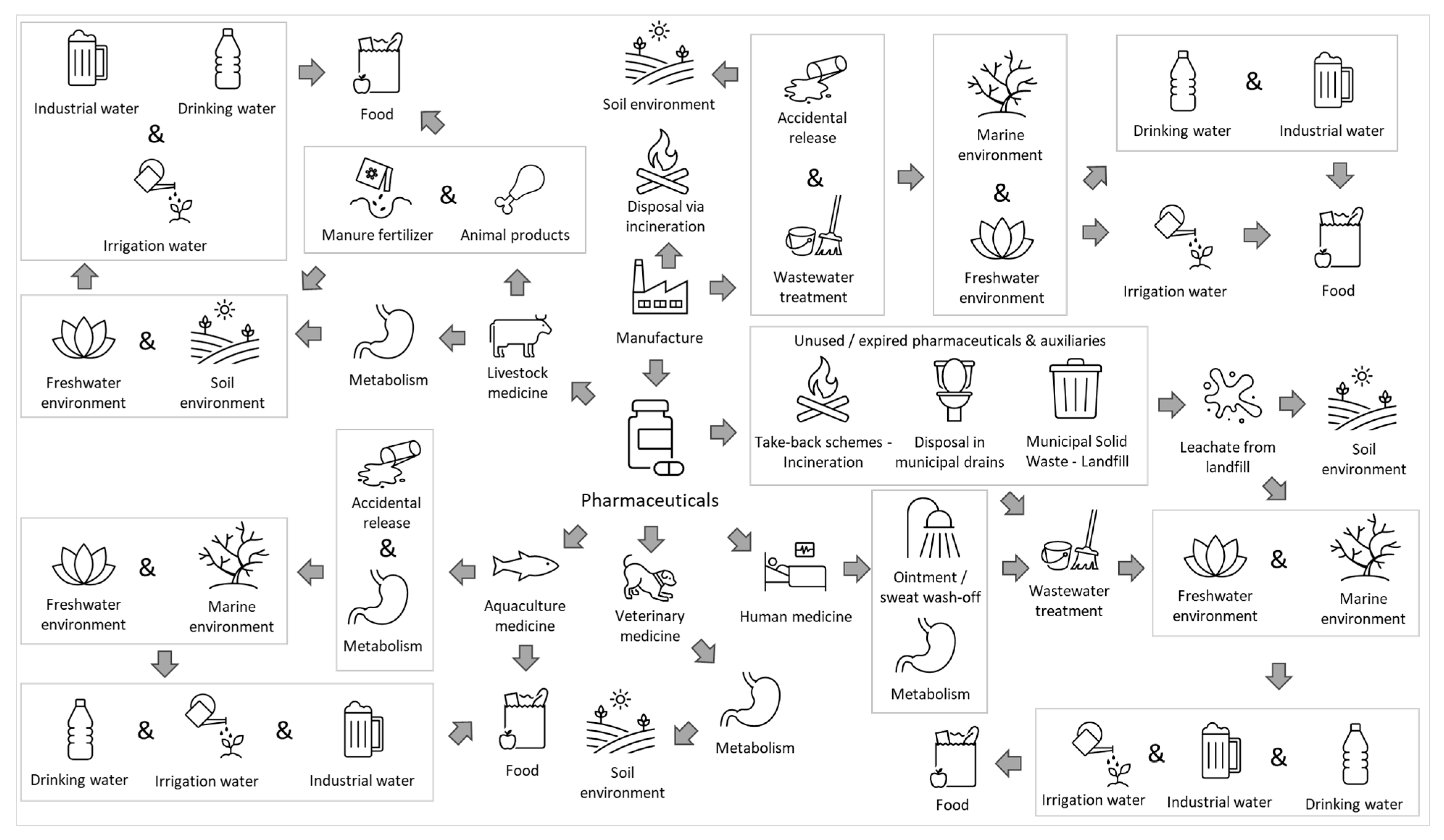
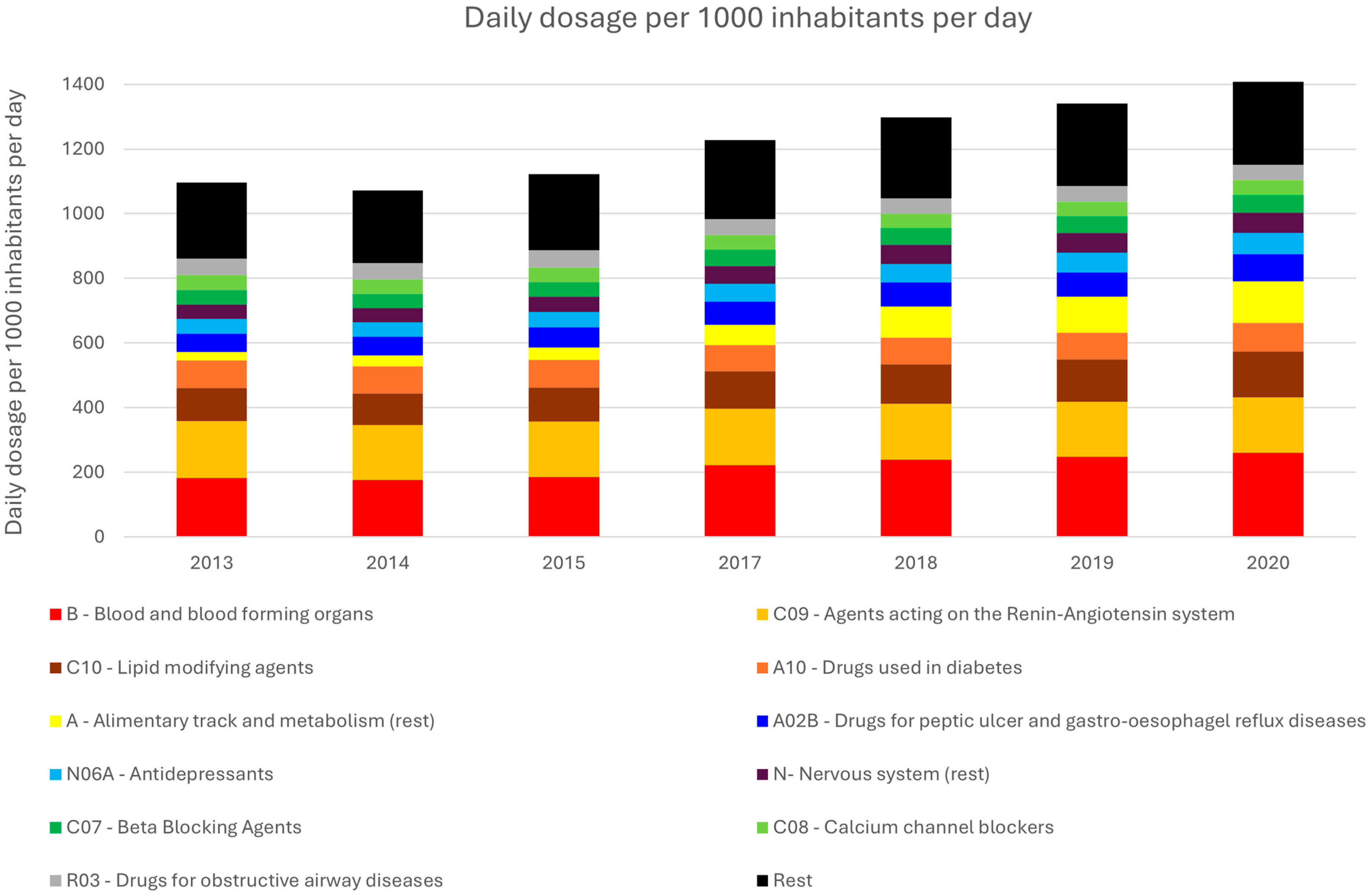
- The total amount of sales/consumption for specific pharmaceuticals in a certain region should be known to predict the compounds with the highest expected environmental concentrations. Interestingly, it has been reported that pharmaceutical removal efforts are often not motivated by market trends in pharmaceutical consumption [64].
- (b)
- The metabolism of pharmaceuticals needs to be considered in order to determine whether unmetabolized pharmaceuticals or their metabolites are expected to be found in wastewater and natural waters receiving the final effluent of WWTPs.
- (c)
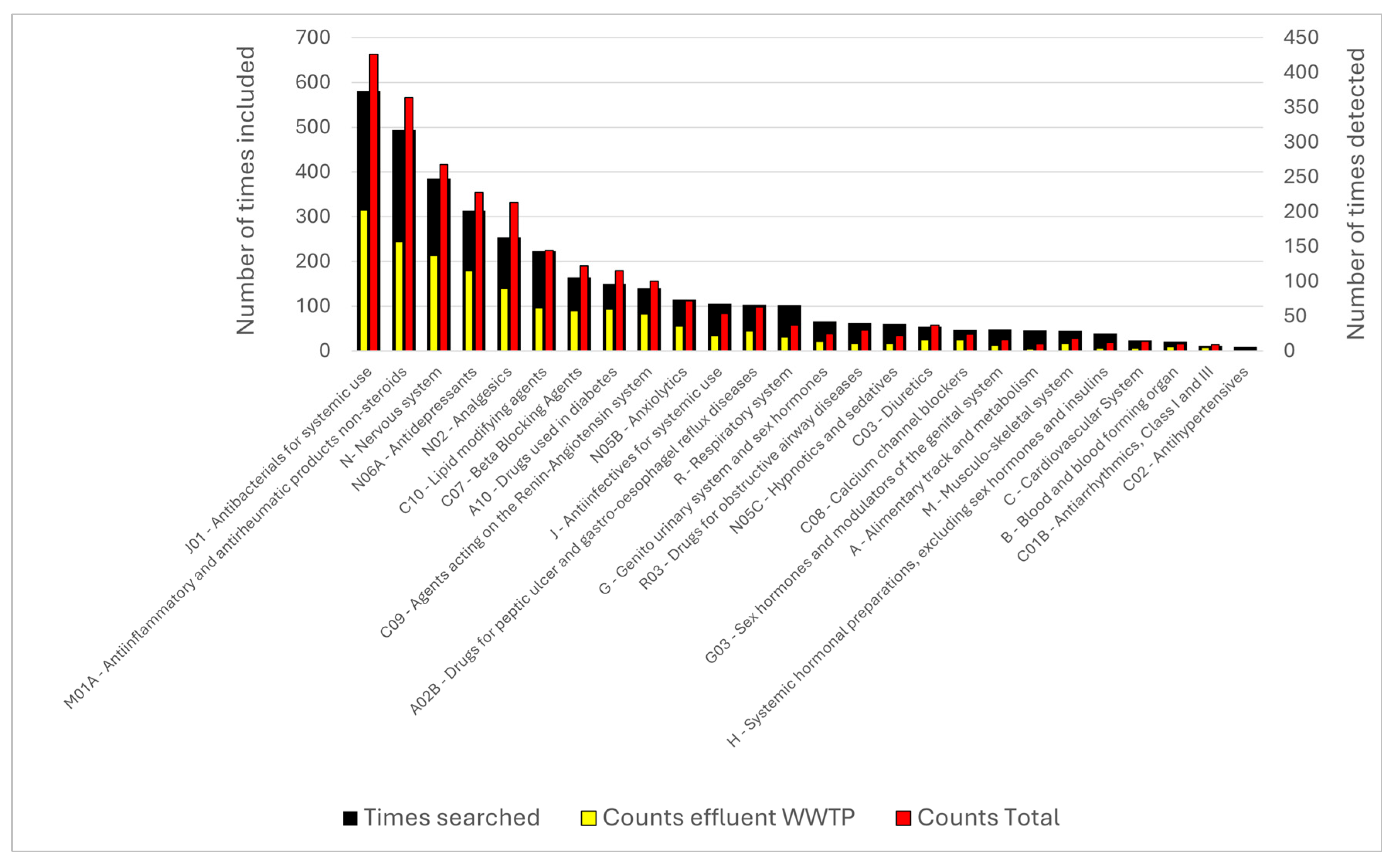
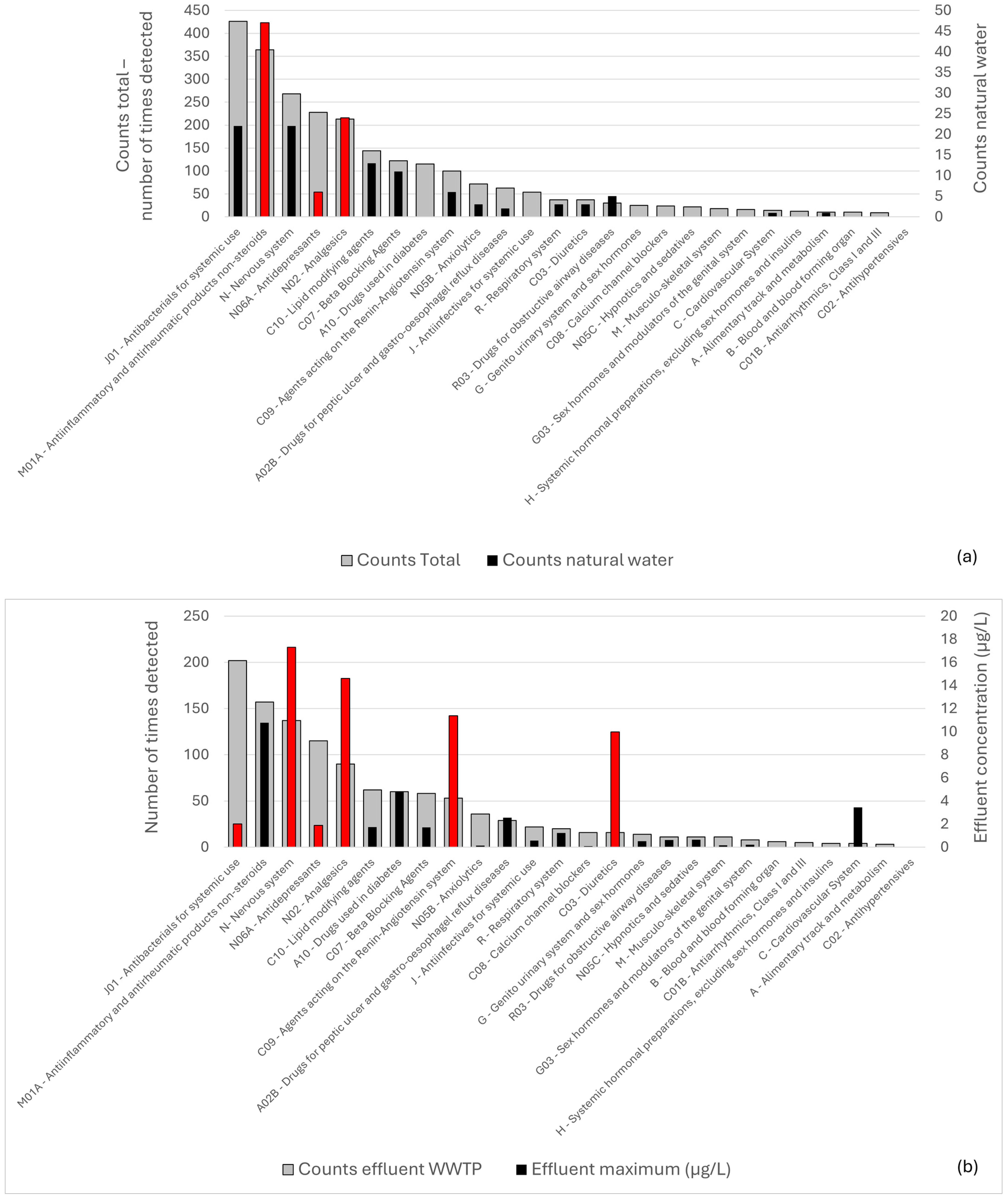
- Once excreted by the patient, the unmetabolized compounds and metabolites can undergo transformation in the WWTP, which can result in complete elimination from the aqueous phase (i.e., via degradation or adsorption), or the formation of transformation products, particularly when advanced water treatment techniques are applied (e.g., chlorination, ozonation) [23,24,25,26,27,28,29,30]. To that end, valuable information can be gained from scientific literature and databases concerning the detection of pharmaceuticals, metabolites, and transformation products in the environment and in WWTPs.
- (d)
- Finally, the ecotoxicity and bioaccumulation potential of these compounds on various organisms ought to be considered to prioritize pharmaceuticals with the most severe expected effects in ecosystems and human health.
2. Materials and Methods
2.1. Case Study Description: Pharmaceutical Market and Disposal in Greece
2.2. Pharmaceutical Sales and Usage in Greece
2.3. Presence of APIs, Metabolites, and Transformation Products in the Environment
2.4. Ecotoxicity of APIs, Metabolites and Transformation Products in the Environment
3. Results and Interpretation
3.1. Consumption Data for Pharmaceuticals in Greece
3.2. Pharmaceuticals Detected in the Environment, Drinking Water, and WWTPs in Greece
3.3. Expected Concentrations of Pharmaceutical-Related Pollutants Based on Consumption—Is There a Gap Between Consumption and Detection?
3.4. Ecotoxicity Assessment for Detected Compounds
3.5. Correlations Between Ecotoxicity Assessment, Dosage, and Detection in the Environment
4. Discussion
5. Conclusions
Supplementary Materials
Author Contributions
Funding
Institutional Review Board Statement
Informed Consent Statement
Data Availability Statement
Conflicts of Interest
Abbreviations
| API | Active Pharmaceutical Ingredient |
| ATC | Anatomical Therapeutic Chemical |
| CRED | Criteria for Reporting and Evaluating Ecotoxicity Data |
| EOPY | National Organization for the Provision of Health Services |
| IOBE | Economic and Industrial Research Foundation |
| LOD | Limit of Detection |
| MEC | Measured Environmental Concentration |
| NSAIDs | Nonsteroidal Anti-Inflammatory Drugs |
| OECD | Organization for Economic Co-operation and Development |
| OTC | Over the Counter |
| PNEC | Predicted No-Effect Concentration |
| R&D | Research and Development |
| RQ | Risk Quotient |
| SfEE | Hellenic Association of Pharmaceutical Companies |
| SuSDat | Substance Database |
| WWTPs | Wastewater Treatment Plant |
References
- Statista Website. Pharmaceutical Market Worldwide Revenue 2001–2021. Available online: https://www.statista.com/statistics/263102/pharmaceutical-market-worldwide-revenue-since-2001/ (accessed on 31 January 2023).
- Statista Website. Worldwide Pharmaceutical R&D Spending 2014–2028. Available online: https://www.statista.com/statistics/309466/global-r-and-d-expenditure-for-pharmaceuticals/ (accessed on 31 January 2023).
- Statista Website. CDER Drug Approvals U.S. 2008–2022. Available online: https://www.statista.com/statistics/817534/annual-novel-drug-approvals-by-cder/ (accessed on 31 January 2023).
- IQVIA Institute for Human Data Science. Global Trends in R&D 2025: Progress in Recapturing Momentum in Biopharma Innovation. 2025. Available online: https://www.iqvia.com/insights/the-iqvia-institute/reports-and-publications/reports/global-trends-in-r-and-d-2025 (accessed on 23 December 2025).
- United Nations Website. World Population Projected to Reach 9.8 Billion in 2050, and 11.2 Billion in 2100. Available online: https://www.un.org/en/desa/world-population-projected-reach-98-billion-2050-and-112-billion-2100 (accessed on 31 January 2023).
- Wernet, G.; Conradt, S.; Isenring, H.P.; Jiménez-González, C.; Hungerbühler, K. Life cycle assessment of fine chemical production: A case study of pharmaceutical synthesis. Int. J. Life Cycle Assess 2010, 15, 294–303. [Google Scholar] [CrossRef]
- De Soete, W.; Jiménez-González, C.; Dahlin, P.; Dewulf, J. Challenges and recommendations for environmental sustainability assessments of pharmaceutical products in the healthcare sector. Green Chem. 2017, 19, 3493–3509. [Google Scholar] [CrossRef]
- Jeswani, H.K.; Azapagic, A. Environmental impacts of healthcare and pharmaceutical products: Influence of product design and consumer behaviour. J. Clean. Prod. 2020, 253, 119860. [Google Scholar] [CrossRef]
- Bartolo, N.S.; Azzopardi, L.M.; Serracino-Inglott, A. Pharmaceuticals and the environment. Early Hum. Dev. 2021, 155, 105218. [Google Scholar] [CrossRef] [PubMed]
- Galant, O.; Cerfeda, G.; McCalmont, A.S.; James, S.L.; Porcheddu, A.; Delogu, F.; Crawford, D.E.; Colacino, E.; Spatari, S. Mechanochemistry can reduce life cycle environmental impacts of manufacturing active pharmaceutical ingredients. ACS Sustain. Chem. Eng. 2022, 10, 1430–1439. [Google Scholar] [CrossRef]
- Jimenez-Gonzalez, C.; Curzons, A.D.; Constable, D.J.; Cunningham, V.L. Expanding GSK’s solvent selection guide—Application of life cycle assessment to enhance solvent selections. Clean Technol. Environ. Policy 2005, 7, 42–50. [Google Scholar] [CrossRef]
- Henderson, R.K.; Jiménez-González, C.; Preston, C.; Constable, D.J.; Woodley, J.M. Peer review original research: EHS & LCA assessment for 7-ACA synthesis A case study for comparing biocatalytic & chemical synthesis. Ind. Biotechnol. 2008, 4, 180–192. [Google Scholar] [CrossRef]
- Jiménez-González, C.; Overcash, M.R. Energy optimization during early drug development and the relationship with environmental burdens. J. Chem. Technol. Biotechnol. 2000, 75, 983–990. [Google Scholar] [CrossRef]
- Lee, C.K.; Khoo, H.H.; Tan, R.B. Life cyle assessment based environmental performance comparison of batch and continuous processing: A case of 4-D-erythronolactone synthesis. Org. Process Res. Dev. 2016, 20, 1937–1948. [Google Scholar] [CrossRef]
- Kümmerer, K. Drugs in the environment: Emission of drugs, diagnostic aids and disinfectants into wastewater by hospitals in relation to other sources—A review. Chemosphere 2001, 45, 957–969. [Google Scholar] [CrossRef]
- Santos, L.H.; Araújo, A.N.; Fachini, A.; Pena, A.; Delerue-Matos, C.; Montenegro, M.C.B.S.M. Ecotoxicological aspects related to the presence of pharmaceuticals in the aquatic environment. J. Hazard. Mater. 2010, 175, 45–95. [Google Scholar] [CrossRef]
- Li, W.C. Occurrence, sources, and fate of pharmaceuticals in aquatic environment and soil. Environ. Pollut. 2014, 187, 193–201. [Google Scholar] [CrossRef]
- Boxall, A.B.; Rudd, M.A.; Brooks, B.W.; Caldwell, D.J.; Choi, K.; Hickmann, S.; Innes, E.; Ostapyk, K.; Staveley, J.P.; Verslycke, T.; et al. Pharmaceuticals and personal care products in the environment: What are the big questions? Environ. Health Perspect. 2012, 120, 1221–1229. [Google Scholar] [CrossRef]
- Bu, Q.; Shi, X.; Yu, G.; Huang, J.; Wang, B. Assessing the persistence of pharmaceuticals in the aquatic environment: Challenges and needs. Emerg. Contam. 2016, 2, 145–147. [Google Scholar] [CrossRef]
- Bu, Q.; Shi, X.; Yu, G.; Huang, J.; Wang, B.; Wang, J. Pay attention to non-wastewater emission pathways of pharmaceuticals into environments. Chemosphere 2016, 165, 515–518. [Google Scholar] [CrossRef]
- Mudgal, S.; De Toni, A.; Lockwood, S.; Salès, K.; Backhaus, T.; Sorensen, B.H. Study on the Environmental Risks of Medicinal Products. Doctoral Dissertation, BIO Intelligence Service, Villa Deshayes, Paris, 2013. Available online: https://hal.science/hal-03859880v1 (accessed on 23 December 2025).
- Emara, Y.; Lehmann, A.; Siegert, M.W.; Finkbeiner, M. Modeling pharmaceutical emissions and their toxicity-related effects in life cycle assessment (LCA): A review. Integr. Environ. Assess Manag. 2019, 15, 6–18. [Google Scholar] [CrossRef]
- Kanakaraju, D.; Glass, B.D.; Oelgemöller, M. Advanced oxidation process-mediated removal of pharmaceuticals from water: A review. J. Environ. Manag. 2018, 219, 189–207. [Google Scholar] [CrossRef]
- Kadmi, Y.; Favier, L.; Wolbert, D. N-nitrosamines, emerging disinfection by-products of health concern: An overview of occurrence, mechanisms of formation, control and analysis in water. Water Sci. Technol. Water Supply 2015, 15, 11–25. [Google Scholar] [CrossRef]
- Osorio, V.; Sanchís, J.; Abad, J.L.; Ginebreda, A.; Farré, M.; Pérez, S.; Barceló, D. Investigating the formation and toxicity of nitrogen transformation products of diclofenac and sulfamethoxazole in wastewater treatment plants. J. Hazard. Mater. 2016, 309, 157–164. [Google Scholar] [CrossRef]
- Lonappan, L.; Brar, S.K.; Das, R.K.; Verma, M.; Surampalli, R.Y. Diclofenac and its transformation products: Environmental occurrence and toxicity—A review. Environ. Int. 2016, 96, 127–138. [Google Scholar] [CrossRef]
- Han, E.J.; Lee, D.S. Significance of metabolites in the environmental risk assessment of pharmaceuticals consumed by human. Sci. Total Environ. 2017, 592, 600–607. [Google Scholar] [CrossRef] [PubMed]
- Grabarczyk, Ł.; Mulkiewicz, E.; Stolte, S.; Puckowski, A.; Pazda, M.; Stepnowski, P.; Białk-Bielińska, A. Ecotoxicity screening evaluation of selected pharmaceuticals and their transformation products towards various organisms. Environ. Sci. Pollut. Res. 2020, 27, 26103–26114. [Google Scholar] [CrossRef]
- Fatta-Kassinos, D.; Vasquez, M.I.; Kümmerer, K. Transformation products of pharmaceuticals in surface waters and wastewater formed during photolysis and advanced oxidation processes–degradation, elucidation of byproducts and assessment of their biological potency. Chemosphere 2011, 85, 693–709. [Google Scholar] [CrossRef]
- Brown, A.K.; Wong, C.S. Distribution and fate of pharmaceuticals and their metabolite conjugates in a municipal wastewater treatment plant. Water Res. 2018, 144, 774–783. [Google Scholar] [CrossRef]
- Al Aukidy, M.; Verlicchi, P.; Voulvoulis, N. A framework for the assessment of the environmental risk posed by pharmaceuticals originating from hospital effluents. Sci. Total Environ. 2014, 493, 54–64. [Google Scholar] [CrossRef]
- Bailly, E.; Levi, Y.; Karolak, S. Calibration and field evaluation of polar organic chemical integrative sampler (POCIS) for monitoring pharmaceuticals in hospital wastewater. Environ. Pollut. 2013, 174, 100–105. [Google Scholar] [CrossRef]
- Daouk, S.; Chèvre, N.; Vernaz, N.; Widmer, C.; Daali, Y.; Fleury-Souverain, S. Dynamics of active pharmaceutical ingredients loads in a Swiss university hospital wastewaters and prediction of the related environmental risk for the aquatic ecosystems. Sci. Total Environ. 2016, 547, 244–253. [Google Scholar] [CrossRef]
- Escher, B.I.; Baumgartner, R.; Koller, M.; Treyer, K.; Lienert, J.; McArdell, C.S. Environmental toxicology and risk assessment of pharmaceuticals from hospital wastewater. Water Res. 2011, 45, 75–92. [Google Scholar] [CrossRef] [PubMed]
- Frédéric, O.; Yves, P. Pharmaceuticals in hospital wastewater: Their ecotoxicity and contribution to the environmental hazard of the effluent. Chemosphere 2014, 115, 31–39. [Google Scholar] [CrossRef]
- Helwig, K.; Hunter, C.; MacLachlan, J.; McNaughtan, M.; Roberts, J.; Cornelissen, A.; Dagot, C.; Evenblij, H.; Klepiszewski, K.; Lyko, S.; et al. Micropollutant point sources in the built environment: Identification and monitoring of priority pharmaceutical substances in hospital effluents. J. Environ. Anal. Toxicol. 2013, 3, 1000177. [Google Scholar] [CrossRef]
- Kümmerer, K.; Henninger, A. Promoting resistance by the emission of antibiotics from hospitals and households into effluent. Clin. Microbiol. Infect. 2013, 9, 1203–1214. [Google Scholar] [CrossRef] [PubMed]
- Pérez-Alvarez, I.; Islas-Flores, H.; Gómez-Oliván, L.M.; Barceló, D.; De Alda, M.L.; Solsona, S.P.; Sánchez-Aceves, L.; SanJuan-Reyes, N.; Galar-Martínez, M. Determination of metals and pharmaceutical compounds released in hospital wastewater from Toluca, Mexico, and evaluation of their toxic impact. Environ. Pollut. 2018, 240, 330–341. [Google Scholar] [CrossRef]
- Ortner, P.; McCullagh, M. Hospice nurses and drug disposal: The convergence between nursing practice and the environment. J. Hosp. Palliat. Nurs. 2010, 12, 15–26. [Google Scholar] [CrossRef]
- Blair, B.D. Potential Upstream Strategies for the Mitigation of Pharmaceuticals in the Aquatic Environment: A Brief Review. Curr. Environ. Health Rep. 2016, 3, 153–160. [Google Scholar] [CrossRef] [PubMed]
- Lyko, S.; Nafo, I.; Evenblij, H.; Benetto, E.; Cornelissen, A.; Igos, E.; Klepiszewski, K.; Venditti, S.; Kovalova, L.; McArdell, C.; et al. Pharmaceutical Input and Elimination from local sources. In Final Report of the European Cooperation Project PILLS; Emschergenossenschaft: Essen, Germany, 2012. [Google Scholar]
- Paulus, G.K.; Hornstra, L.M.; Alygizakis, N.; Slobodnik, J.; Thomaidis, N.; Medema, G. The impact of on-site hospital wastewater treatment on the downstream communal wastewater system in terms of antibiotics and antibiotic resistance genes. Int. J. Hyg. Environ. Health 2019, 222, 635–644. [Google Scholar] [CrossRef] [PubMed]
- Xiang, J.; Wu, M.; Lei, J.; Fu, C.; Gu, J.; Xu, G. The fate and risk assessment of psychiatric pharmaceuticals from psychiatric hospital effluent. Ecotoxicol. Environ. Saf. 2018, 150, 289–296. [Google Scholar] [CrossRef]
- Chonova, T.; Lecomte, V.; Bertrand-Krajewski, J.L.; Bouchez, A.; Labanowski, J.; Dagot, C.; Lévi, Y.; Perrodin, Y.; Wiest, L.; Gonzalez-Ospina, A.; et al. The SIPIBEL project: Treatment of hospital and urban wastewater in a conventional urban wastewater treatment plant. Environ. Sci. Pollut. Res. 2018, 25, 9197–9206. [Google Scholar] [CrossRef]
- de Wilt, H.A. Pharmaceutical Removal: Synergy Between Biological and Chemical Processes for Wastewater Treatment. Doctoral Thesis, Wageningen University and Research, Wageningen, The Netherlands, 2018. [Google Scholar]
- Petrie, B. A review of combined sewer overflows as a source of wastewater-derived emerging contaminants in the environment and their management. Environ. Sci. Pollut. Res. 2021, 28, 32095–32110. [Google Scholar] [CrossRef]
- Gadupudi, C.K.; Rice, L.; Xiao, L.; Kantamaneni, K. Endocrine disrupting compounds removal methods from wastewater in the United Kingdom: A review. Science 2021, 3, 11. [Google Scholar] [CrossRef]
- Caldwell, D.J. Sources of Pharmaceutical Residues in the Environment and their Control. In Issues in Environmental Science and Technology—Pharmaceuticals in the Environment; Hester, R.E., Harrison, R.M., Eds.; Royal Society of Chemistry: London, UK, 2015. [Google Scholar] [CrossRef]
- Szymańska, U.; Wiergowski, M.; Sołtyszewski, I.; Kuzemko, J.; Wiergowska, G.; Woźniak, M.K. Presence of antibiotics in the aquatic environment in Europe and their analytical monitoring: Recent trends and perspectives. Microchem. J. 2019, 147, 729–740. [Google Scholar] [CrossRef]
- Stankiewicz, A.; Giebułtowicz, J.; Stankiewicz, U.; Wroczyński, P.; Nałęcz-Jawecki, G. Determination of selected cardiovascular active compounds in environmental aquatic samples–methods and results, a review of global publications from the last 10 years. Chemosphere 2015, 138, 642–656656. [Google Scholar] [CrossRef] [PubMed]
- Küster, A.; Adler, N. Pharmaceuticals in the environment: Scientific evidence of risks and its regulation. Philos. Trans. R. Soc. B Biol. Sci. 2014, 369, 20130587. [Google Scholar] [CrossRef]
- Kümmerer, K. Antibiotics in the aquatic environment—A review—Part I. Chemosphere 2009, 75, 417–434. [Google Scholar] [CrossRef]
- Kümmerer, K. Antibiotics in the aquatic environment—A review—Part II. Chemosphere 2009, 75, 435–441. [Google Scholar] [CrossRef]
- Janecko, N.; Pokludova, L.; Blahova, J.; Svobodova, Z.; Literak, I. Implications of fluoroquinolone contamination for the aquatic environment—A review. Environ. Toxicol. Chem. 2016, 35, 2647–2656. [Google Scholar] [CrossRef]
- Hernando, M.D.; Mezcua, M.; Fernández-Alba, A.R.; Barceló, D. Environmental risk assessment of pharmaceutical residues in wastewater effluents, surface waters and sediments. Talanta 2006, 69, 334–342. [Google Scholar] [CrossRef] [PubMed]
- Godoy, A.A.; Kummrow, F.; Pamplin, P.A.Z. Occurrence, ecotoxicological effects and risk assessment of antihypertensive pharmaceutical residues in the aquatic environment—A review. Chemosphere 2015, 138, 281–291. [Google Scholar] [CrossRef] [PubMed]
- The European Union. Directive (EU) 2024/3019 of the European Parliament and of the Council of 27 November 2024 Concerning Urban Wastewater Treatment (Recast); Official Journal of the European Union: Brussels, Belgium, 2024; Available online: https://eur-lex.europa.eu/legal-content/EN/TXT/PDF/?uri=OJ:L_202403019 (accessed on 23 December 2025).
- Zenker, A.; Cicero, M.R.; Prestinaci, F.; Bottoni, P.; Carere, M. Bioaccumulation and biomagnification potential of pharmaceuticals with a focus to the aquatic environment. J. Environ. Manag. 2014, 133, 378–387. [Google Scholar] [CrossRef]
- Bottoni, P.; Caroli, S. Presence of residues and metabolites of pharmaceuticals in environmental compartments, food commodities and workplaces: A review spanning the three-year period 2014–2016. Microchem. J. 2018, 136, 2–24. [Google Scholar] [CrossRef]
- Anand, U.; Adelodun, B.; Cabreros, C.; Kumar, P.; Suresh, S.; Dey, A.; Ballesteros, F., Jr.; Bontempi, E. Occurrence, transformation, bioaccumulation, risk and analysis of pharmaceutical and personal care products from wastewater: A review. Environ. Chem. Lett. 2022, 20, 3883–3904. [Google Scholar] [CrossRef]
- Malchi, T.; Maor, Y.; Tadmor, G.; Shenker, M.; Chefetz, B. Irrigation of root vegetables with treated wastewater: Evaluating uptake of pharmaceuticals and the associated human health risks. Environ. Sci. Technol. 2014, 48, 9325–9333. [Google Scholar] [CrossRef]
- Golovko, O.; Kaczmarek, M.; Asp, H.; Bergstrand, K.J.; Ahrens, L.; Hultberg, M. Uptake of perfluoroalkyl substances, pharmaceuticals, and parabens by oyster mushrooms (Pleurotus ostreatus) and exposure risk in human consumption. Chemosphere 2022, 291, 132898. [Google Scholar] [CrossRef]
- Cortes, G.; Rodriguez, P.; Marinov, E.; Sanseverino, D.; Lettieri, T. Selection of Substances for the 5th Watch List Under the Water Framework Directive; Publications Office of the European Union: Brussels, Belgium, 2025. [Google Scholar]
- Gonzalez Pena, O.I.; López Zavala, M.Á.; Cabral Ruelas, H. Pharmaceuticals market, consumption trends and disease incidence are not driving the pharmaceutical research on water and wastewater. Int. J. Environ. Res. Public Health 2021, 18, 2532. [Google Scholar] [CrossRef]
- OECD. Health at a Glance 2019: OECD Indicators; OECD Publishing: Paris, France, 2019. [Google Scholar] [CrossRef]
- Kadam, A.; Patil, S.; Patil, S.; Tumkur, A. Pharmaceutical waste management an overview. IJOPP 2016, 9, 2–8. [Google Scholar] [CrossRef]
- OECD Website. Pharmaceutical Spending. Available online: https://www.oecd.org/en/data/indicators/pharmaceutical-spending.html (accessed on 31 January 2023).
- European Centre for Disease Prevention and Control, Stockholm. Summary of the Latest Data on Antibiotic Consumption in the European Union. 2014. Available online: https://www.ecdc.europa.eu/sites/default/files/documents/antibiotics-consumption-EU-data-2014.pdf (accessed on 23 December 2025).
- Mitkidis, K.; Obolevich, V.; Chrysochou, P.; Mitkidis, P. Harmonisation of pharmaceutical take-back systems in the EU. Eur. J. Health Law 2021, 28, 445–471. [Google Scholar] [CrossRef]
- European Environment Agency Website. Proportion of Terrestrial Land Covered by Natura. 2000. Available online: https://www.eea.europa.eu/en/analysis/maps-and-charts/proportion-of-terrestrial-land-covered (accessed on 26 October 2022).
- Mitchell, D.; Vulcano, A.; Dias, M. Assessment of the Protection of Important Bird and Biodiversity Areas for Seabirds by Special Protection Areas of the Natura 2000 Network; Birdlife International Report: Cambridge, UK, 2022; Available online: https://www.birdlife.org/wp-content/uploads/2022/05/IBA-SPA-report-FINAL-min.pdf (accessed on 23 December 2025).
- Eurostat Website. Net Occupancy Rates of Bed Places in Hotels and Similar Accommodation Establishments in the Peak Month, Summer Season 2018 (%). Available online: https://ec.europa.eu/eurostat/statistics-explained/index.php?title=File:Net_occupancy_rates_of_bed_places_in_hotels_and_similar_accommodation_establishments_in_the_peak_month,_summer_season_2018_(%25).png (accessed on 27 October 2022).
- Hellenic Association of Pharmaceutical Companies (SFEE) Website. Available online: https://www.sfee.gr/wp-content/uploads/2022/06/F-F-2021.pdf (accessed on 19 September 2023).
- Foundation for Economic & Industrial Research (IOBE) Website. Available online: https://iobe.gr/wp-content/uploads/2022/05/RES_05_A_24062021_REP_GR.pdf (accessed on 23 December 2025).
- Alnahas, F.; Yeboah, P.; Fliedel, L.; Abdin, A.Y.; Alhareth, K. Expired medication: Societal, regulatory and ethical aspects of a wasted opportunity. Int. J. Environ. Res. Public Health 2020, 17, 787. [Google Scholar] [CrossRef]
- Health Care Without Harm Europe Website. Available online: https://europe.noharm.org/sites/default/files/documents-files/4646/2013-12%20Unused%20pharmaceuticals.pdf (accessed on 19 September 2023).
- Hellenic Government Website. Government Gazette 287Β_2007. Available online: https://www.elinyae.gr/ethniki-nomothesia/ya-86682007-fek-287b-232007 (accessed on 19 September 2023).
- OECD Website. Pharmaceutical Market Dataset. Available online: https://stats.oecd.org/viewhtml.aspx?datasetcode=HEALTH_PHMC&lang=en (accessed on 19 October 2022).
- Alygizakis, N.A.; Gago-Ferrero, P.; Borova, V.L.; Pavlidou, A.; Hatzianestis, I.; Thomaidis, N.S. Occurrence and spatial distribution of 158 pharmaceuticals, drugs of abuse and related metabolites in offshore seawater. Sci. Total Environ. 2016, 541, 1097–1105. [Google Scholar] [CrossRef]
- Andreozzi, R.; Raffaele, M.; Nicklas, P. Pharmaceuticals in STP effluents and their solar photodegradation in aquatic environment. Chemosphere 2003, 50, 1319–1330. [Google Scholar] [CrossRef] [PubMed]
- Antoniou, C.V.; Koukouraki, E.E.; Diamadopoulos, E. Analysis of selected pharmaceutical compounds and endocrine disruptors in municipal wastewater using solid-phase microextraction and gas chromatography. Water Environ. Res 2009, 81, 664–669. [Google Scholar] [CrossRef] [PubMed]
- Arditsoglou, A.; Voutsa, D. Passive sampling of selected endocrine disrupting compounds using polar organic chemical integrative samplers. Environ. Pollut. 2008, 156, 316–324. [Google Scholar] [CrossRef] [PubMed]
- Arditsoglou, A.; Voutsa, D. Determination of phenolic and steroid endocrine disrupting compounds in environmental matrices. ESPR 2008, 15, 228–236. [Google Scholar] [CrossRef] [PubMed]
- Arditsoglou, A.; Voutsa, D. Partitioning of endocrine disrupting compounds in inland waters and wastewaters discharged into the coastal area of Thessaloniki, Northern Greece. ESPR 2010, 17, 529–538. [Google Scholar] [CrossRef]
- Arditsoglou, A.; Voutsa, D. Occurrence and partitioning of endocrine-disrupting compounds in the marine environment of Thermaikos Gulf, Northern Aegean Sea, Greece. Mar. Pollut. Bull. 2012, 64, 2443–2452. [Google Scholar] [CrossRef]
- Borova, V.L.; Maragou, N.C.; Gago-Ferrero, P.; Pistos, C.; Thomaidis, N.S. Highly sensitive determination of 68 psychoactive pharmaceuticals, illicit drugs, and related human metabolites in wastewater by liquid chromatography–tandem mass spectrometry. Anal. Bioanal. Chem. 2014, 406, 4273–4285. [Google Scholar] [CrossRef]
- Botitsi, E.; Frosyni, C.; Tsipi, D. Determination of pharmaceuticals from different therapeutic classes in wastewaters by liquid chromatography–electrospray ionization–tandem mass spectrometry. Anal. Bioanal. Chem. 2007, 387, 1317–1327. [Google Scholar] [CrossRef]
- Chanioti, A.; Botitsi, H.; Antoniou, S.; Dasenakis, E.; Tsipi, D. Development of a Multi-class Analytical Method by SPE and LC-MS/MS for the Determination of Pharmaceuticals in Wastewater Samples. In Proceedings of the 15th International Conference on Environmental Science and Technology, Rhodes, Greece, 31 August–2 September 2017. [Google Scholar]
- Christophoridis, C.; Veloutsou, S.; Mitsika, E.; Zacharis, C.K.; Christia, C.; Raikos, N.; Fytianos, K. Determination of illicit drugs and psychoactive pharmaceuticals in wastewater from the area of Thessaloniki (Greece) using LC–MS/MS: Estimation of drug consumption. Environ. Monit. Assess 2021, 193, 249. [Google Scholar] [CrossRef]
- Dasenaki, M.E.; Thomaidis, N.S. Multianalyte method for the determination of pharmaceuticals in wastewater samples using solid-phase extraction and liquid chromatography–tandem mass spectrometry. Anal. Bioanal. Chem. 2015, 407, 4229–4245. [Google Scholar] [CrossRef]
- Gago-Ferrero, P.; Borova, V.; Dasenaki, M.E.; Thomaidis, N.S. Simultaneous determination of 148 pharmaceuticals and illicit drugs in sewage sludge based on ultrasound-assisted extraction and liquid chromatography–tandem mass spectrometry. Anal. Bioanal. Chem. 2015, 407, 4287–4297. [Google Scholar] [CrossRef]
- Galani, A.; Alygizakis, N.; Aalizadeh, R.; Kastritis, E.; Dimopoulos, M.A.; Thomaidis, N.S. Patterns of pharmaceuticals use during the first wave of COVID-19 pandemic in Athens, Greece as revealed by wastewater-based epidemiology. Sci. Total Environ. 2021, 798, 149014. [Google Scholar] [CrossRef] [PubMed]
- Gatidou, G.; Thomaidis, N.S.; Stasinakis, A.S.; Lekkas, T.D. Simultaneous determination of the endocrine disrupting compounds nonylphenol, nonylphenol ethoxylates, triclosan and bisphenol A in wastewater and sewage sludge by gas chromatography–mass spectrometry. J. Chromatogr. A 2007, 1138, 32–41. [Google Scholar] [CrossRef] [PubMed]
- Ibáñez, M.; Borova, V.; Boix, C.; Aalizadeh, R.; Bade, R.; Thomaidis, N.S.; Hernandez, F. UHPLC-QTOF MS screening of pharmaceuticals and their metabolites in treated wastewater samples from Athens. J. Hazard. Mater. 2017, 323, 26–35. [Google Scholar] [CrossRef]
- Kalaboka, M.; Chrimatopoulos, C.; Jimenez-Holgado, C.; Boti, V.; Sakkas, V.; Albanis, T. Exploring the Efficiency of UHPLC-Orbitrap MS for the Determination of 20 Pharmaceuticals and Acesulfame K in Hospital and Urban Wastewaters with the Aid of FPSE. Separations 2020, 7, 46. [Google Scholar] [CrossRef]
- Konstas, P.S.; Kosma, C.; Konstantinou, I.; Albanis, T. Photocatalytic treatment of pharmaceuticals in real hospital wastewaters for effluent quality amelioration. Water 2019, 11, 2165. [Google Scholar] [CrossRef]
- Kosma, C.I.; Lambropoulou, D.A.; Albanis, T.A. Occurrence and removal of PPCPs in municipal and hospital wastewaters in Greece. J. Hazard. Mater. 2010, 179, 804–817. [Google Scholar] [CrossRef] [PubMed]
- Kosma, C.I.; Lambropoulou, D.A.; Albanis, T.A. Investigation of PPCPs in wastewater treatment plants in Greece: Occurrence, removal and environmental risk assessment. Sci. Total Environ. 2014, 466, 421–438. [Google Scholar] [CrossRef]
- Kosma, C.I.; Lambropoulou, D.A.; Albanis, T.A. Comprehensive study of the antidiabetic drug metformin and its transformation product guanylurea in Greek wastewaters. Water Res. 2015, 70, 436–448. [Google Scholar] [CrossRef] [PubMed]
- Kosma, C.I.; Nannou, C.I.; Boti, V.I.; Albanis, T.A. Psychiatrics and selected metabolites in hospital and urban wastewaters: Occurrence, removal, mass loading, seasonal influence and risk assessment. Sci. Total Environ. 2019, 659, 1473–1483. [Google Scholar] [CrossRef]
- Kotti, M.; Papafilippaki, A.; Stavroulakis, G. Simultaneous determination of selected pharmaceuticals and plasticisers in urban stormwater in Chania (Greece). Int. J. Environ. Anal. Chem. 2021, 103, 3790–3800. [Google Scholar] [CrossRef]
- Koumaki, E.; Mamais, D.; Noutsopoulos, C. Environmental fate of non-steroidal anti-inflammatory drugs in river water/sediment systems. J. Hazard. Mater. 2017, 323, 233–241. [Google Scholar] [CrossRef]
- Koumaki, E.; Mamais, D.; Noutsopoulos, C. Assessment of the environmental fate of endocrine disrupting chemicals in rivers. Sci. Total Environ. 2018, 628, 947–958. [Google Scholar] [CrossRef]
- Koutsouba, V.; Heberer, T.; Fuhrmann, B.; Schmidt-Baumler, K.; Tsipi, D.; Hiskia, A. Determination of polar pharmaceuticals in sewage water of Greece by gas chromatography–mass spectrometry. Chemosphere 2003, 51, 69–75. [Google Scholar] [CrossRef] [PubMed]
- Loos, R.; Gawlik, B.M.; Locoro, G.; Rimaviciute, E.; Contini, S.; Bidoglio, G. EU-wide monitoring survey of polar persistent pollutants in European river waters. Environ. Pollut. 2008, 157, 561–568. [Google Scholar] [CrossRef]
- Loos, R.; Carvalho, R.; António, D.C.; Comero, S.; Locoro, G.; Tavazzi, S.; Paracchini, B.; Ghiani, M.; Lettieri, T.; Blaha, L.; et al. EU-wide monitoring survey on emerging polar organic contaminants in wastewater treatment plant effluents. Water Res. 2013, 4, 6475–6487. [Google Scholar] [CrossRef] [PubMed]
- Mandaric, L.; Kalogianni, E.; Skoulikidis, N.; Petrovic, M.; Sabater, S. Contamination patterns and attenuation of pharmaceuticals in a temporary Mediterranean river. Sci. Total Environ. 2019, 647, 561–569. [Google Scholar] [CrossRef]
- Miserli, K.; Nastopoulou, A.; Konstantinou, I. Removal of organic pollutants (pharmaceuticals and pesticides) from sewage sludge by hydrothermal carbonization using response surface methodology (RSM). J. Chem. Technol. Biotechnol. 2022, 97, 3111–3120. [Google Scholar] [CrossRef]
- Nannou, C.I.; Kosma, C.I.; Albanis, T.A. Occurrence of pharmaceuticals in surface waters: Analytical method development and environmental risk assessment. Int. J. Environ. Anal. Chem. 2015, 95, 1242–1262. [Google Scholar] [CrossRef]
- Nannou, C.I.; Boti, V.; Albanis, T. Accurate Mass Screening of Pharmaceuticals in Water and Sediment by Uhplc-Orbitrap Mass Spectrometry. In Proceedings of the 15th International Conference on Environmental Science and Technology, Rhodes, Greece, 31 August–2 September 2017. [Google Scholar]
- Nannou, C.I.; Boti, V.I.; Albanis, T.A. A modified QuEChERS approach for the analysis of pharmaceuticals in sediments by LC-Orbitrap HRMS. Anal. Bioanal. Chem. 2019, 411, 1383–1396. [Google Scholar] [CrossRef] [PubMed]
- Nannou, C.; Kaprara, E.; Psaltou, S.; Salapasidou, M.; Palasantza, P.A.; Diamantopoulos, P.; Lambropoulou, D.A.; Mitrakas, M.; Zouboulis, A. Monitoring of a broad set of pharmaceuticals in wastewaters by high-resolution mass spectrometry and evaluation of heterogenous catalytic ozonation for their removal in a pre-industrial level unit. Analytica 2022, 3, 195–212. [Google Scholar] [CrossRef]
- Nödler, K.; Voutsa, D.; Licha, T. Polar organic micropollutants in the coastal environment of different marine systems. Mar. Pollut. Bull. 2014, 85, 50–59. [Google Scholar] [CrossRef]
- Nödler, K.; Tsakiri, M.; Aloupi, M.; Gatidou, G.; Stasinakis, A.S.; Licha, T. Evaluation of polar organic micropollutants as indicators for wastewater-related coastal water quality impairment. Environ. Pollut. 2016, 211, 282–290. [Google Scholar] [CrossRef]
- Noutsopoulos, C.; Koumaki, E.; Sarantopoulos, V.; Mamais, D. Analytical and mathematical assessment of emerging pollutants fate in a river system. J. Hazard. Mater. 2019, 364, 48–58. [Google Scholar] [CrossRef]
- Ofrydopoulou, A.; Nannou, C.; Evgenidou, E.; Christodoulou, A.; Lambropoulou, D. Assessment of a wide array of organic micropollutants of emerging concern in wastewater treatment plants in Greece: Occurrence, removals, mass loading and potential risks. Sci. Total Environ. 2022, 802, 149860. [Google Scholar] [CrossRef]
- Papageorgiou, M.; Kosma, C.; Lambropoulou, D. Seasonal occurrence, removal, mass loading and environmental risk assessment of 55 pharmaceuticals and personal care products in a municipal wastewater treatment plant in Central Greece. Sci. Total Environ. 2016, 543, 547–569. [Google Scholar] [CrossRef]
- Papageorgiou, M.; Zioris, I.; Danis, T.; Bikiaris, D.; Lambropoulou, D. Comprehensive investigation of a wide range of pharmaceuticals and personal care products in urban and hospital wastewaters in Greece. Sci. Total Environ. 2019, 694, 133565. [Google Scholar] [CrossRef]
- Pothitou, P.; Voutsa, D. Endocrine disrupting compounds in municipal and industrial wastewater treatment plants in Northern Greece. Chemosphere 2008, 73, 1716–1723. [Google Scholar] [CrossRef]
- Samaras, V.G.; Thomaidis, N.S.; Stasinakis, A.S.; Gatidou, G.; Lekkas, T.D. Determination of selected non-steroidal anti-inflammatory drugs in wastewater by gas chromatography-mass spectrometry. Int. J. Environ. Anal. Chem. 2010, 90, 219–229. [Google Scholar] [CrossRef]
- Samaras, V.G.; Thomaidis, N.S.; Stasinakis, A.S.; Lekkas, T.D. An analytical method for the simultaneous trace determination of acidic pharmaceuticals and phenolic endocrine disrupting chemicals in wastewater and sewage sludge by gas chromatography-mass spectrometry. Anal. Bioanal. Chem. 2011, 399, 2549–2561. [Google Scholar] [CrossRef] [PubMed]
- Samaras, V.G.; Stasinakis, A.S.; Mamais, D.; Thomaidis, N.S.; Lekkas, T.D. Fate of selected pharmaceuticals and synthetic endocrine disrupting compounds during wastewater treatment and sludge anaerobic digestion. J. Hazard. Mater. 2013, 244, 259–267. [Google Scholar] [CrossRef] [PubMed]
- Stamatis, N.K.; Konstantinou, I.K. Occurrence and removal of emerging pharmaceutical, personal care compounds and caffeine tracer in municipal sewage treatment plant in Western Greece. J. Environ. Sci. Health B 2013, 48, 800–813. [Google Scholar] [CrossRef]
- Stamatis, N.; Hela, D.; Konstantinou, I. Occurrence and removal of fungicides in municipal sewage treatment plant. J. Hazard. Mater. 2010, 175, 829–835. [Google Scholar] [CrossRef]
- Stamatis, N.; Triantafyllidis, V.; Hela, D.; Konstantinou, I. Occurrence and distribution of selected pharmaceutical compounds on sewage-impacted section of River Acheloos, Western Greece. Int. J. Environ. Anal. Chem. 2013, 93, 1602–1619. [Google Scholar] [CrossRef]
- Stasinakis, A.S.; Gatidou, G.; Mamais, D.; Thomaidis, N.S.; Lekkas, T.D. Occurrence and fate of endocrine disrupters in Greek sewage treatment plants. Water Res. 2008, 42, 1796–1804. [Google Scholar] [CrossRef]
- Stasinakis, A.S.; Mermigka, S.; Samaras, V.G.; Farmaki, E.; Thomaidis, N.S. Occurrence of endocrine disrupters and selected pharmaceuticals in Aisonas River (Greece) and environmental risk assessment using hazard indexes. Environ. Sci. Pollut. Res. 2012, 19, 1574–1583. [Google Scholar] [CrossRef] [PubMed]
- Stasinakis, A.S.; Thomaidis, N.S.; Arvaniti, O.S.; Asimakopoulos, A.G.; Samaras, V.G.; Ajibola, A.; Mamais, D.; Lekkas, T.D. Contribution of primary and secondary treatment on the removal of benzothiazoles, benzotriazoles, endocrine disruptors, pharmaceuticals and perfluorinated compounds in a sewage treatment plant. Sci. Total Environ. 2013, 463, 1067–1075. [Google Scholar] [CrossRef]
- Terzopoulou, E.; Voutsa, D.; Kaklamanos, G. A multi-residue method for determination of 70 organic micropollutants in surface waters by solid-phase extraction followed by gas chromatography coupled to tandem mass spectrometry. Environ. Sci. Pollut. Res. 2015, 22, 1095–1112. [Google Scholar] [CrossRef]
- Thomaidi, V.S.; Stasinakis, A.S.; Borova, V.L.; Thomaidis, N.S. Is there a risk for the aquatic environment due to the existence of emerging organic contaminants in treated domestic wastewater? Greece as a case-study. J. Hazard. Mater. 2015, 283, 740–747. [Google Scholar] [CrossRef] [PubMed]
- Thomaidi, V.S.; Stasinakis, A.S.; Borova, V.L.; Thomaidis, N.S. Assessing the risk associated with the presence of emerging organic contaminants in sludge-amended soil: A country-level analysis. Sci. Total Environ. 2016, 548, 280–288. [Google Scholar] [CrossRef] [PubMed]
- Thomaidis, N.S.; Gago-Ferrero, P.; Ort, C.; Maragou, N.C.; Alygizakis, N.A.; Borova, V.L.; Dasenaki, M.E. Reflection of socioeconomic changes in wastewater: Licit and illicit drug use patterns. Environ. Sci. Technol. 2016, 50, 10065–10072. [Google Scholar] [CrossRef]
- Wang, C.; Ye, D.; Li, X.; Jia, Y.; Zhao, L.; Liu, S.; Xu, J.; Du, J.; Tian, L.; Li, J.; et al. Occurrence of pharmaceuticals and personal care products in bottled water and assessment of the associated risks. Environ. Int. 2021, 155, 106651. [Google Scholar] [CrossRef]
- NORMAN Database System Website. Available online: https://www.norman-network.com/nds/ (accessed on 17 October 2025).
- Dulio, V.; Koschorreck, J.; Van Bavel, B.; Van Den Brink, P.; Hollender, J.; Munthe, J.; Schlabach, M.; Aalizadeh, R.; Agerstrand, M.; Ahrens, L.; et al. The NORMAN Association and the European Partnership for Chemicals Risk Assessment (PARC): Let’s Cooperate! Environ. Sci. Eur. 2020, 32, 100. [Google Scholar] [CrossRef]
- ClinPGx Database Website. Available online: https://www.clinpgx.org (accessed on 17 October 2025).
- Yang, Q.; Gao, Y.; Ke, J.; Show, P.L.; Ge, Y.; Liu, Y.; Guo, R.; Chen, J. Antibiotics: An overview on the environmental occurrence, toxicity, degradation, and removal methods. Bioengineered 2021, 12, 7376–7416. [Google Scholar] [CrossRef]
- Zhu, K.; Huang, M.; Wang, Y.; Gu, Y.; Li, W.; Liu, G.; Tang, Y. MetaPredictor: In silico prediction of drug metabolites based on deep language models with prompt engineering. Brief Bioinform. 2024, 25, 374. [Google Scholar] [CrossRef]
- Kazmi, S.R.; Jun, R.; Yu, M.S.; Jung, C.; Na, D. In silico approaches and tools for the prediction of drug metabolism and fate: A review. Comput. Biol. Med. 2019, 106, 54–64. [Google Scholar] [CrossRef]
- Litsa, E.E.; Das, P.; Kavraki, L.E. Prediction of drug metabolites using neural machine translation. Chem. Sci. 2020, 11, 12777–12788. [Google Scholar] [CrossRef] [PubMed]
- Smith, A.M.E.; Lanevskij, K.; Sazonovas, A.; Harris, J. Impact of established and emerging software tools on the metabolite identification landscape. Front. Toxicol. 2022, 4, 932445. [Google Scholar] [CrossRef] [PubMed]
- Litsa, E.E.; Das, P.; Kavraki, L.E. Machine learning models in the prediction of drug metabolism: Challenges and future perspectives. Expert Opin. Drug Metab. Toxicol. 2022, 17, 1245–1247. [Google Scholar] [CrossRef] [PubMed]



| Pharmaceutical Class | Priority Compounds | Key Risk Drivers | Recommended Monitoring Frequency |
|---|---|---|---|
| Class M01A | Diclofenac | Moderate MEC Low PNEC | Monthly |
| Ibuprofen | High MEC Low PNEC | Monthly | |
| Naproxen | High MEC | Monthly | |
| Class J01 | Ciprofloxacin | Moderate MEC Low PNEC | Monthly |
| Moxifloxacin | Moderate MEC Moderate PNEC | Monthly | |
| Azithromycin | Moderate MEC Low PNEC | Monthly | |
| Clarithromycin | Moderate MEC Moderate PNEC | Monthly | |
| Metronidazole | Moderate PNEC | Quarterly | |
| NOT IN LIST (Biocide) | Triclosan | Moderate MEC | Quarterly |
| NOT IN LIST (Contrast agents) | Diatrizoic acid | Moderate MEC Low PNEC | Quarterly |
| Iopamidol | Low PNEC | Quarterly | |
| Class G03 | 17α-ethinyl estradiol | Low PNEC | Monthly |
| Etonogestrel | Low PNEC | Quarterly | |
| Class N | Valproic acid | High MEC | Quarterly |
| Class N06A | Sertraline | Moderate PNEC | Quarterly |
| O-desmethylvenlafaxine | Moderate MEC | Quarterly | |
| Class C10 | Gemfibrozil | Moderate MEC | Quarterly |
Disclaimer/Publisher’s Note: The statements, opinions and data contained in all publications are solely those of the individual author(s) and contributor(s) and not of MDPI and/or the editor(s). MDPI and/or the editor(s) disclaim responsibility for any injury to people or property resulting from any ideas, methods, instructions or products referred to in the content. |
© 2025 by the authors. Licensee MDPI, Basel, Switzerland. This article is an open access article distributed under the terms and conditions of the Creative Commons Attribution (CC BY) license.
Share and Cite
Chatzipanagiotou, K.-R.; Bon, A.; Petrakli, F.; Antonaropoulos, G.; Koumoulos, E.P. Prioritizing Pharmaceuticals for Environmental Monitoring in Greece: A Comprehensive Review of Consumption, Occurrence, and Ecological Risk. Toxics 2026, 14, 45. https://doi.org/10.3390/toxics14010045
Chatzipanagiotou K-R, Bon A, Petrakli F, Antonaropoulos G, Koumoulos EP. Prioritizing Pharmaceuticals for Environmental Monitoring in Greece: A Comprehensive Review of Consumption, Occurrence, and Ecological Risk. Toxics. 2026; 14(1):45. https://doi.org/10.3390/toxics14010045
Chicago/Turabian StyleChatzipanagiotou, Konstantina-Roxani, Adamantia Bon, Foteini Petrakli, George Antonaropoulos, and Elias P. Koumoulos. 2026. "Prioritizing Pharmaceuticals for Environmental Monitoring in Greece: A Comprehensive Review of Consumption, Occurrence, and Ecological Risk" Toxics 14, no. 1: 45. https://doi.org/10.3390/toxics14010045
APA StyleChatzipanagiotou, K.-R., Bon, A., Petrakli, F., Antonaropoulos, G., & Koumoulos, E. P. (2026). Prioritizing Pharmaceuticals for Environmental Monitoring in Greece: A Comprehensive Review of Consumption, Occurrence, and Ecological Risk. Toxics, 14(1), 45. https://doi.org/10.3390/toxics14010045