
Article

Feasibility of Using Animal Manure and Manure-Based Fertilizer as Soil Amendments: Veterinary Drugs Occurrence and Ecological Risk

1
College of Resources and Environmental Engineering, Shandong Agriculture and Engineering University, Jinan 250100, China
2
School of Chemical & Environmental Engineering, China University of Mining & Technology—Beijing, Beijing 100083, China
3
College of Forestry Engineering, Shandong Agriculture and Engineering University, Jinan 250100, China
4
Shandong Provincial Research Institute of Coal Geology Planning and Exploration, Jinan 250100, China
5
Shandong Agricultural Technology Center, Shandong Provincial Department of Agriculture and Rural Affairs, Jinan 250013, China
6
Reserach and Information Managemet Division, Inner Mongolia Academy of Forestry, Hohhot 010010, China
*
Author to whom correspondence should be addressed.
Toxics 2026, 14(1), 32; https://doi.org/10.3390/toxics14010032
Submission received: 27 November 2025 / Revised: 20 December 2025 / Accepted: 25 December 2025 / Published: 26 December 2025
(This article belongs to the Topic Biomass Use and its Health and Environmental Effects)

Highlights

What are the main findings?
  • Livestock manure contains higher drug residue levels than poultry manure.
  • Higher levels of drug residues can be found in beef cattle than in dairy cattle manure, and in broilers than in layers.
  • Tetracyclines are prevalent, with predominant residues in manure and organic fertilizers.
  • It is recommended to use organic fertilizer over manure to lower the ecological risk to soil biota.
What is the implication of the main finding?
  • The main findings provide important scientific support for ensuring the sustainable development of organic agriculture and the safety of agricultural products.

Abstract

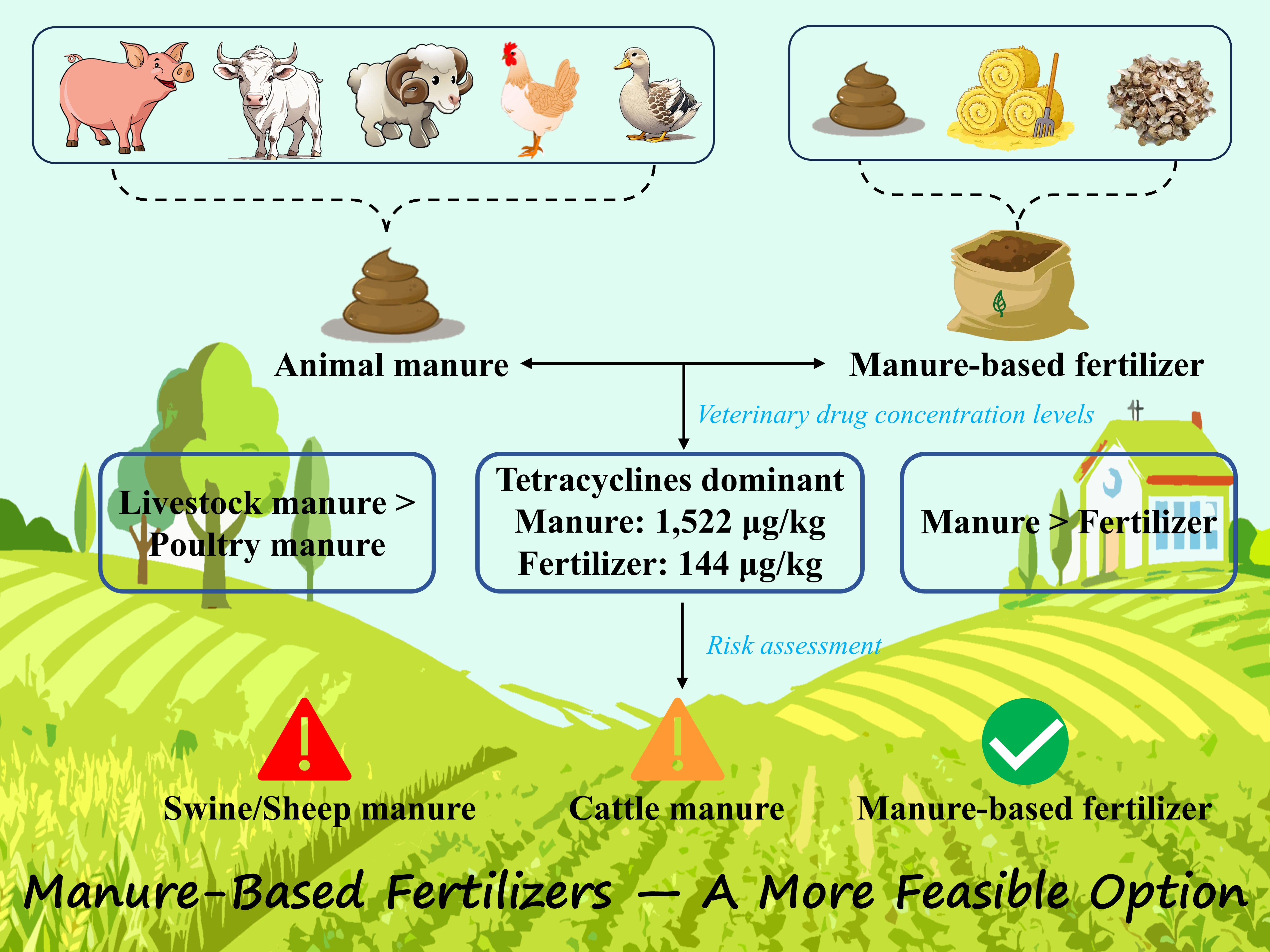
Veterinary drugs are widely present in animal manure and manure-based fertilizers, making their safety for use as soil amendments still ambiguous. This study investigated the concentrations of 17 typical veterinary drugs in animal manure and manure-based fertilizers from Shandong Province using solid-phase extraction coupled with high-performance liquid chromatography–tandem mass spectrometry and assessed their environmental risks to soil organisms based on risk quotient values. The established method demonstrated robust performance, with drug recovery rates ranging from 72.9% to 109%. Tetracyclines were identified as the most prevalent contaminants, with mean concentrations of 1522 μg/kg in animal manure and 144 μg/kg in manure-based fertilizers. Drug concentrations in manure-based fertilizers were generally lower than those in animal manure. Livestock manure contained higher drug concentrations compared to poultry manure. Influenced by farming practices, drug concentrations were higher in beef cattle manure than in dairy cattle manure, and higher in broiler manure than in layer manure. Manure-based fertilizers primarily derived their drug content from chicken, cattle, and sheep manure. Tetracyclines in swine and sheep manure posed high risks to soil organisms, while those in beef cattle manure and dairy cattle manure posed medium risks. In contrast, most drugs in manure-based fertilizers exhibited low risks. Comprehensive analysis of both concentration levels and ecological risks indicates that manure-based fertilizers represent a more feasible option for soil amendment. This study provides a theoretical foundation for better understanding the feasibility of applying animal manure and manure-based fertilizers to agricultural land.

Graphical Abstract

1. Introduction

China is a major agricultural economy with a substantial livestock and poultry industry [1]. It is estimated that the annual production of livestock and poultry manure in China reaches 3.8 billion tons [2]. Animal manure contains abundant nutrients such as organic nitrogen, phosphorus, and potassium, which can be used as fertilizer to enhance crop yields. Additionally, livestock manure serves as a primary raw material for organic fertilizer production, with an annual output of approximately 50 million tons in China, which shows a consistent year-on-year growth trend [3]. The application of animal manure and manure-based fertilizer has played a significant role in increasing grain production and maintaining soil fertility in China. However, in intensive farming practices, large quantities of veterinary drugs are used for treating and preventing animal diseases [4]. Most of these drugs are excreted as parent compounds and metabolites in manure and urine after entering the animals’ bodies, leading to high levels of residual veterinary drugs in manure and manure-based fertilizers [5]. When these drugs enter the soil environment, they may pose potential risk to the ecosystem and human health [6,7].
The main types of manure produced from intensive farming include swine, cattle, sheep, chicken, and duck manure. Cattle manure can be further categorized into beef cattle manure and dairy cattle manure, while chicken manure is classified as broilers manure or layers manure [6]. Therefore, the types of livestock and poultry manure are diverse. Organic fertilizers are produced from these raw manures through a fermentation process [8]. During this process, the manure undergoes a series of environmental chemical reactions such as oxidation, reduction, adsorption, and complexation, leading to changes in the levels of residual veterinary drug to the raw manure [9,10,11]. One study found that erythromycin degrade rate more than 90% in swine manure under aerobic composting for 40 days [12]. Another study investigated that average removal rates for total tetracyclines and their transformation products were 82% and 90%, respectively, during thermophilic composting [13]. Consequently, differences exist in veterinary drug concentrations between raw manure and organic fertilizers. However, a systematic understanding of these differences remains limited.
Drugs in animal manure and manure-based fertilizers include tetracyclines, macrolides, fluoroquinolones, sulfonamides, and others, with concentrations ranging from ng/kg to mg/kg [14]. For instance, studies have found that the average levels of tetracyclines in manure are on the order of mg/kg, macrolides are at μg/kg level, and sulfonamides are at ng/kg [15]. The ecological risks of the same drugs to soil organisms can vary depending on the species of soil organisms [16]. Different drugs also exhibit varying ecological risks to soil organisms [6]. Overall, the concentration levels of veterinary drugs in animal manure vary significantly, and the environmental risks posed by these drugs also differ. Therefore, systematic research on the concentration levels and ecological risks of different types of veterinary drugs in manure and manure-based fertilizer is of great significance for understanding the feasibility of their application to soil. This study selected Shandong Province, a region with intensive, high-density livestock and poultry farming in China, as the case study area. Samples of raw manure from large-scale farms and commercial organic fertilizers were collected. The concentrations of 17 typical residual drugs were determined using solid-phase extraction combined with high-performance liquid chromatography–tandem mass spectrometry (SPE–LC–MS/MS). The ecological risks of these drugs to soil organisms were assessed by applying the risk quotient (RQ) method to different types of manure and manure-based fertilizers. This study aims to systematically investigate the concentration levels of different veterinary drugs in livestock and poultry manure and manure-based fertilizers, as well as their ecological risks to soil organisms, thereby providing a theoretical reference for evaluating the safety of applying these materials to farmland.

2. Materials and Methods

2.1. Materials and Chemicals

LC-grade solvents methanol and acetonitrile were purchased from Thermo Fisher Scientifc Inc. Formic acid, ammonia water, sodium hydroxide, Na2EDTA–Mcllvaine buffer solution and ammonium acetate (analytical-grade) were purchased from Aladdin (Shanghai, China). Analytical-grade standards of 17 typical drugs were purchased from J&K Scientific Company (Beijing, China). These drugs include three tetracyclines (TCs) (tetracycline (TC), oxytetracycline (OTC), doxycycline (DC)), five fluoroquinolones (QAs) (ofloxacin (OFX), enrofloxacin (EFX), ciprofloxacin (CPX), norfloxacin (NFX), pefloxacin (PFX)), three sulfonamides (SAs) (sulfamonomethoxine (SMM), sulfamerazine (SMR), sulfadiazine (SD)), and one macrolide (MAs) (clarithromycin (CTM)). Additionally, we included chloramphenicol (CP, an amphenicol), griseofulvin (GSV, an antifungal), ampicillin (AMP, a β-lactam), diclofenac (DF, a non-steroidal anti-inflammatory), and trimethoprim (TP, a dihydrofolate reductase inhibitor) to cover a broader spectrum of drugs used in livestock and poultry farming. These five compounds (CP, GSV, AMP, DF, TP) were grouped together as “Others” in subsequent analyses.

2.2. Sample Collecting and Preparation

Livestock and poultry manure samples were collected in November 2024 from large-scale farms, including manure from broilers, layers, swine, ducks, beef cattle, dairy cattle, and sheep, for a total of 14 samples. Manure-based fertilizers were collected from September to October 2024 from commercial fertilizer companies in 12 cities within Shandong Province, for a total of 20 samples. Overall, 34 samples were collected, and the abbreviation of each sample are listed in Table 1. Detailed information on the collected samples is shown in Tables S1 and S2.
The collected samples were air-dried, homogenized, ground, and passed through a 60-mesh sieve. Then, 5 g of each sample was weighed into a 50 mL centrifuge tube, and 40 mL of extraction solution (methanol: acetonitrile: 0.1 M EDTA: McIlvaine buffer = 30:20:25:25, v/v) was added [17]. The mixture was vortexed thoroughly, sonicated for 10 min, and centrifuged at 10,000 r/min for 10 min. The supernatant containing the target drugs was obtained by passing the mixture through a 0.45 μm filter membrane. The extraction step was repeated, and the twice extracts were combined and diluted to 2000 mL. The supernatants were adjusted to pH 3 and pH 9 using formic acid and ammonia water, respectively, and labeled accordingly. Drugs were enriched using HLB solid-phase extraction (SPE) cartridges. The SPE cartridges were conditioned sequentially with 8 mL of methanol and 8 mL of ultrapure water. After conditioning, the solutions were passed through the SPE cartridges at a flow rate of approximately 3–5 mL/min. After enrichment, the HLB cartridges were rinsed with 8 mL of ultrapure water and dried under vacuum for 10 min. The enriched samples were eluted with 8 mL of methanol, and the eluates were collected in KD concentrators. The eluates were evaporated to near dryness under a gentle stream of nitrogen, subsequently redissolved in a mixture of methanol/water (10:90, v:v), to a final volume of 1.0 mL. The solutions were filtered through 0.22 μm PTFE membrane syringe filters and stored at –20 °C until analysis [18].

2.3. LC–MS/MS Analysis

Shim-pack XR–ODS reversed-phase column (2 mm × 75 mm, 2.2 μm, Shimadzu, Kyoto, Japan) was used to separate the analytes. The column temperature was set at 30 °C, the flow rate was 0.3 mL/min and injection volume was 10 μL. The mobile phase compositions were as follows: A, 0.2% formic acid and 2 mm/L ammonium formate in ultrapure water; B, acetonitrile. The solvents were mixed as follows: 0 min, 90% A; 0–5 min, 90–85% A; 5–7 min, 85–80% A; 7–11 min, 80–60% A; 11–14 min, 60–40% A; 14–16 min 40–5% A; 16–18 min, 5% A, 18–18.1 min, 5–90% A; 18.1–22 min, 90% A.
The analysis was performed using the multiple reaction monitoring (MRM) mode. The interface voltage for the ion source was –3.5 kV in positive ion mode and 4.5 kV in negative ion mode. The desolvation line (DL) temperature was 250 °C, and the heat block temperature was 400 °C. Nebulizing gas was nitrogen with a flow rate of 3 L/min; drying gas was nitrogen with a flow rate of 15 L/min; and collision-induced dissociation (CID) gas was argon. The mass spectrometry parameters and retention times for the drugs are shown in Table 2.

2.4. Quality Assurance

The mixed standard stock solution (10 μg/mL) was diluted to prepare a series of standard solutions with concentration gradients (0.5–500 ng/mL) for establishing the standard curve for each drug. Given its high dissolved organic carbon content, chicken manure was chosen for the matrix spiking experiment [19,20]. All samples were spiked with 100 ng of carbamazepine–d10 to serve as an internal standard, thereby compensating for matrix effects. After extraction using the standard method, the recovery rates for the 17 veterinary drugs were calculated (n = 6). The instrumental detection limit (LOD) was defined as a signal-to-noise ratio (S/N) of 3, and the instrumental quantification limit (LOQ) was defined as an S/N of 10. The method detection limit (MDL) was determined based on the instrumental LOD, recovery rate (R), and concentration factor (M) for each drug [21]. The uncertainty of the method was assessed by incorporating contributions from sample purity, calibration curve fitting, and spiked recovery rates [22]. The quality control parameters are listed in Table 3.

2.5. Risk Assessment

The risk quotient (RQ) approach was used to evaluate the potential environmental risks of the drugs. The RQ is defined as the ratio of the predicted environmental concentration in soil (PEC) to the predicted no-effect concentration (PNEC). Risk levels were categorized as follows: insignificant (RQ < 0.01), low (0.01 ≤ RQ < 0.1), medium (0.1 ≤ RQ < 1), and high (RQ ≥ 1.0) [23]. The calculation was performed with reference to Hong et al. [6]. The formulas used to derive the RQ are as follows:
P E C s = C A × M ρ × 10 × D
P N E C = N O E C   o r   E C 50 A F
R Q = P E C P N E C
Here, CA is the concentration of the tested drug (μg/kg); M is the dry weight of animal manure or manure-based fertilizer applied to agricultural soil (1000 kg/ha); D is the penetration depth of drugs after manure application (0.2 m); ρ is the soil density, set at 1300 kg/m3; and 10 is a conversion factor [6,16]. The above parameters were selected based on typical agricultural soil conditions to ensure a conservative estimate of the predicted environmental concentration. The water contents of chicken manure, duck manure, swine manure, cattle manure, and sheep manure were 27.8%, 34.8%, 38.6%, 44.5%, and 31.9%, respectively [24,25]. The average water content of manure-based fertilizers was 29.6% [6]. EC50 is the median effect concentration in the soil ecosystem, representing acute toxicity. NOEC is the no-observed-effect concentration in the soil ecosystem. The PNEC was derived by dividing the measured toxicity endpoint by an assessment factor (AF). The selection of the appropriate AF depends on the toxicity endpoint and the number of trophic levels covered, following the technical guidance from the European Commission [26,27]. Accordingly, an assessment factor of 1000 was applied to the EC50, and a factor of 10 was applied to the NOEC.
PNEC is a crucial parameter for calculating the environmental risk of drugs in soil. We collected ecotoxicity data from soil culture experiments in the literature to derive the PNEC values and to further investigate the risks of these drugs to the soil ecosystem. Detailed data are provided in the Supporting Information (Table S3).

2.6. Statistic Analysis

Data analysis for drug residues was conducted using Microsoft Office Excel 2019. Statistical analysis was performed with SPSS (version 22; SPSS, Inc., Chicago, IL, USA). Non-parametric Kruskal–Wallis tests were employed to assess the differences in drug content between sample groups. p < 0.05 was considered statistically significant. All residue levels of veterinary drugs are reported on a dry-weight basis.

3. Results

3.1. Residual Drugs Levels in Animal Manure

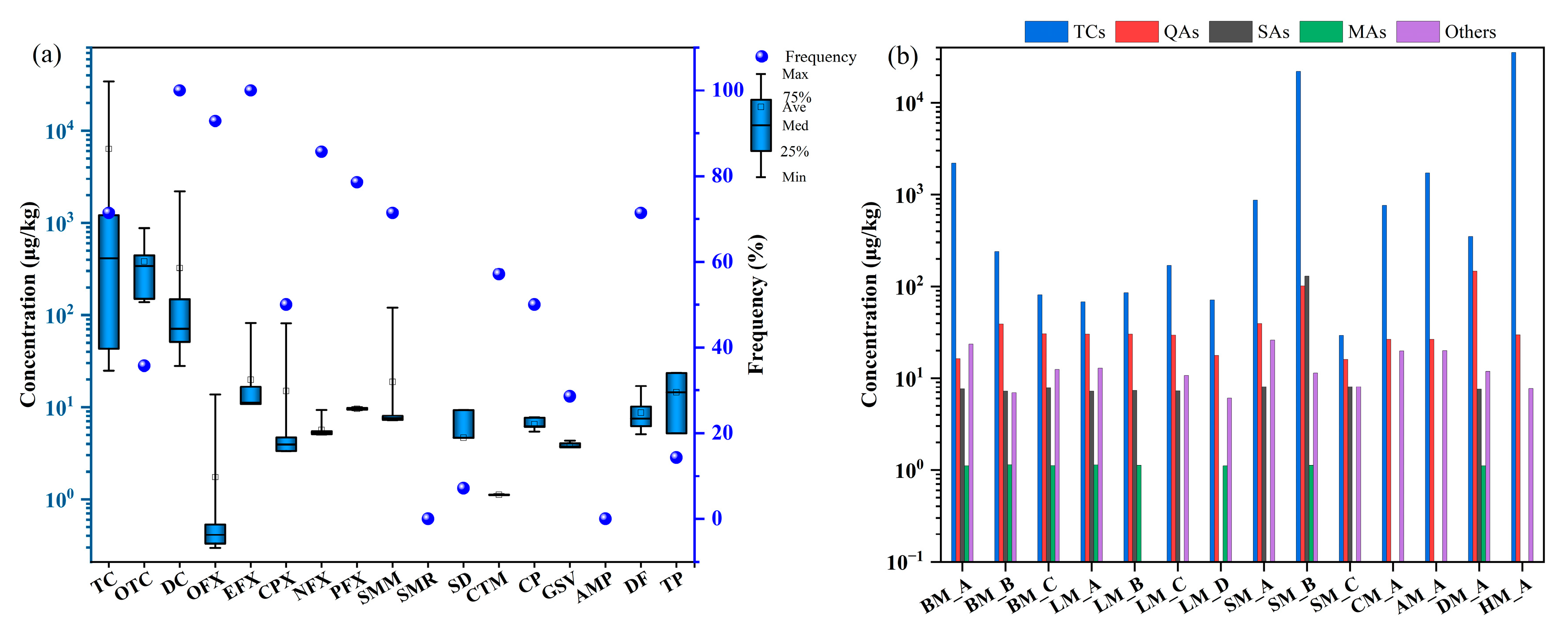
Of the 17 drugs investigated, 15 were detected in animal manure (Figure 1a). DC and EFX were the most ubiquitous, both with a 100% detection rate, in contrast to SMR and AMP, which were not detected. Among the detected drugs, TC was the predominant contaminant, exhibiting the highest mean concentration of 4079 μg/kg and a peak concentration of 34,277 μg/kg. The mean concentrations of DC and OTC were 324 μg/kg and 164 μg/kg, with maximums of 2202 μg/kg and 880 μg/kg, respectively. Detection rates of TC, DC, and OTC were 100%, 71.4%, and 35.7%, respectively. The detection rates of OFX, CPX, NFX, PFX, SMM, SD, CTM, CP, GSV, DF, and TP ranged from 7.14% to 92.8%, with concentrations falling within the same order of magnitude and an average concentration of 3.76 μg/kg.
Considerable variation was observed in the concentrations of different drug classes across manure samples (Figure 1b). TCs were the predominant drugs, with a mean concentration of 1522 μg/kg, substantially higher than that of QAs (8.27 μg/kg) and SAs (4.70 μg/kg) (p < 0.05). The Others and MAs had the lowest mean concentrations, at 2.53 μg/kg and 0.64 μg/kg, respectively. The concentration of TCs also varied by animal type. It was higher in broiler manure (841 μg/kg) than in layer manure (32.9 μg/kg) and higher in beef cattle manure (576 μg/kg) than in dairy cattle manure (256 μg/kg) (p < 0.05). Among livestock manure, average content of TCs ranked in the following order: sheep manure (11,769 μg/kg) > swine manure (2541 μg/kg) > cattle manure (416 μg/kg). Similarly, in poultry manure, chicken manure contained higher levels than duck manure (p < 0.05). Sample SM_B was notable for its high levels of TCs, QAs, and SAs (p < 0.05). Conversely, SAs and MAs were not detected in samples CM_A, AM_A, and HM_A.

3.2. Residual Drugs Levels in Manure-Based Fertilizers

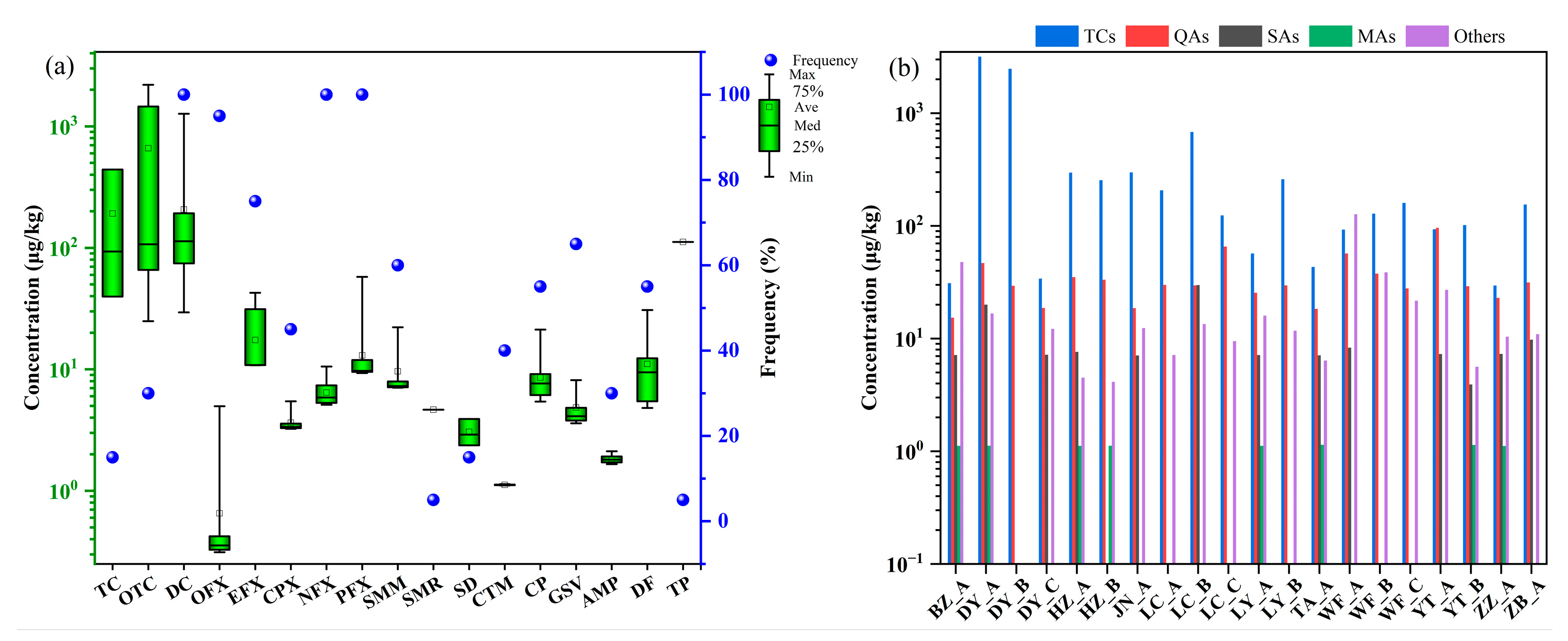
As shown in Figure 2a, all 17 drugs were detected in the manure-based fertilizer. Among them, DC, NFX, and PFX showed a detection frequency of 100%. The average concentration of DC was 207 μg/kg, with a maximum of 1270 μg/kg. NFX and PFX had average concentrations of 6.44 μg/kg (max: 10.6 μg/kg) and 13.0 μg/kg (max: 57.7 μg/kg), respectively. The detection rates of TC and OTC were 15% and 30%, respectively. Despite its lower detection frequency, OTC exhibited a high mean concentration of 198 μg/kg, with a maximum of 2199 μg/kg. The average concentration of TC was 28.7 μg/kg, with a maximum of 441 μg/kg. The concentration levels of EFX were lower than those of TCs, with an average of 13.1 μg/kg and a maximum of 36.2 μg/kg (p < 0.05). The detection frequency of OFX, CPX, SMM, SMR, SD, CTM, CP, GSV, AMP, DF, and TP ranged between 5% and 95%, with their concentration levels falling within the same order of magnitude and an average concentration of 3.53 μg/kg.
The concentration levels of different drug classes varied significantly across the manure-based fertilizers (Figure 2b). On average, TCs were the predominant drug class (144 μg/kg), followed by QAs (6.96 μg/kg) and the Others (4.02 μg/kg), while SAs and MAs were the least prevalent. Notably, samples DY_A and DY_B had exceptionally high concentrations of TCs, at 3166 μg/kg and 2472 μg/kg, respectively. Since DY_A was a mixture of cattle, chicken, and sheep manure and DY_B was primarily sheep manure, the high TC levels in these samples indicate that manure from these three animal types are the principal sources of tetracycline contamination.
The analysis revealed distinct patterns for different drug classes in the manure-based fertilizers. QAs were widespread, with detection frequency range from 55% to 100%, and concentrations between 15.3 μg/kg and 95.8 μg/kg, Notably, the QA level in sample YT_A was significantly higher than in other samples (p < 0.05). In contrast, SAs and MAs were less prevalent, detected at low frequencies (5–40%) and at an average concentration of 2.16 μg/kg and 0.45 μg/kg, respectively. The composition of the fertilizers could be traced to the source of drug contamination. For example, all three target SAs was found in sample LC_B, which primarily consisted of chicken manure. DF and CP appeared to originate from cattle manure, as their highest concentrations were found in samples BZ_A and WF_B, respectively. TP was uniquely detected in WF_A at 112 μg/kg and was traced to chicken manure. GSV and AMP were also primarily originated from cattle and chicken manure. Overall, the drugs in manure-based fertilizer were derived primarily from chicken and cattle manure.

3.3. Ecological Risk of Drugs in Manure and Manure-Based Fertilizer

In this study, the maximum PEC of the drugs was selected to calculate their risk quotients (RQ), and the results are shown in Table 4. Among the drugs, TCs posed a higher environmental risk. TC in manure posed a high risk to earthworms (RQ = 3.23) and Fe(III)-reducing microorganisms (RQ = 8.07). DC posed a high risk to vegetables in both manure (RQ = 6.12) and manure-based fertilizers (RQ = 3.44). Additionally, TC in manure and manure-based fertilizers posed a medium risk to plant germination, while OTC posed a medium risk to soil microbial activity. Therefore, TCs require special attention. QAs showed varied risks to plant growth in soil. For example, EFX in manure posed medium risk for wheat seed growth (RQ = 0.15), while in manure-based fertilizers it posed low risk (RQ = 0.09). DF and TP in manure-based fertilizer also exhibited toxic effects to plants, posing a medium risk (RQ = 0.1) to the vascular plant Lemna minor and low risk (RQ = 0.03) to plant seed germination, respectively. The RQ of SMR and SD for different soil species were all below 0.01, indicating a low risk from SAs.
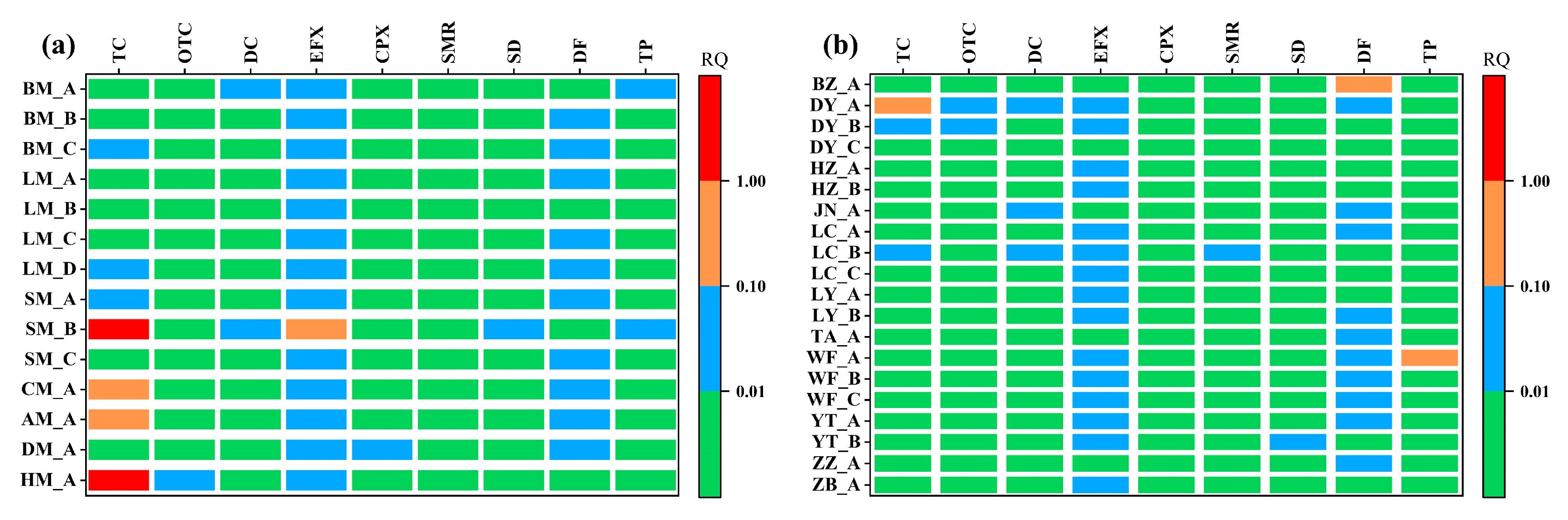
The potential ecological risks posed by individual samples were further evaluated (Figure 3). In swine manure (SM_B), TC posed a high risk to soil organisms, EFX posed a medium risk, while DC, SD, and TP posed low risks. Other drugs presented insignificant risk. In cattle manure (CM_A and AM_A), TC posed a medium risk, while EFX and DF posed low risks. In sheep manure (HM_A), TC posed a high risk, while OTC and EFX posed low risks. The primary risk drugs in chicken manure were EFX and DF, which exhibited low risks in the collected samples. Overall, swine manure (SM_B) contained the highest number of risk drugs with the most severe risk levels, followed by sheep and cattle manure, while chicken and duck manure posed the lowest drug risks.
In manure-based fertilizers, DF in sample BZ_A posed a medium risk to soil species. As this organic fertilizer is primarily composed of cattle manure and corn straws, it indicates that DF mainly originates from cattle manure. Similarly, TC posed a medium risk in sample DY_A, which is mainly composed of cattle manure, chicken manure, and corn straw, suggesting TC originates from these two types of manure. In sample WF_A, TP posed a medium risk. As this sample is primarily composed of chicken manure, it indicates that TP originates from chicken manure. Notably, EFX posed a low risk in 75% of the samples, and DF posed low to medium risks in 55% of the samples, indicating that EFX and DF in organic fertilizers should be given attention.

4. Discussion

In the livestock and poultry industry, veterinary drugs are primarily used to treat diseases, prevent infections, and promote growth. According to statistics, China’s farming industry released approximately 53,800 tons of antibiotics into the environment in 2013 [28,29]. TCs are the most extensively used veterinary drugs, with their share of total consumption increasing from 30.5% in 2018 to 45.9% in 2020 [6,29]. This prevalence explains why TCs are found in the highest concentrations in manure and manure-based fertilizers. Due to their broad-spectrum antibacterial properties, TCs are widely used in swine, cattle, and sheep farming to treat various infections caused by susceptible bacteria and pathogens [30]. Based on different farming purposes, we found that TC concentrations were significantly higher in broiler manure than in layer manure, and in beef cattle manure than in dairy cattle manure. The disparity of TC concentrations in manure can be attributed to their distinct husbandry practices. For poultry farming, broilers have a short feeding cycle and are often administered low-dose antibiotics over extended periods to ensure rapid growth, thus leading to the accumulation of drug residues in their bodies [31]. In contrast, layers have a longer feeding cycle and typically receive antibiotics intermittently in small amounts [27]. As a result, the drug content in layer manure is lower than that in broiler manure. For livestock farming, beef cattle are typically raised on a high-energy grain-based diet to promote rapid weight gain over a relatively shorter finishing period. This regimen often involves the use of feed additives, which may contribute to higher residual drug levels in their manure [32]. In contrast, dairy cattle are supplied with high-quality forage supplemented with protein sources like soybean meal, leading to lower drug intake [6].
The mean concentrations of TCs in sheep, swine, and cattle manure were 11,769 μg/kg, 2541 μg/kg, and 416 μg/kg, respectively. TCs are primarily used to treat respiratory tract and alimentary infections in livestock. Compared with swine and cattle, sheep are mostly raised under grazing or semi-grazing systems, which increases their exposure to external pathogens and raises their risk of disease infection by 2–3 times [33]. Consequently, both the dosage and frequency of TC application in sheep farming are significantly higher. Additionally, this study collected only one sheep manure sample. If this single sample was obtained from an animal during a disease phase, it could lead to an overestimation of the antibiotic content in sheep manure. In poultry manure, DC was the predominant TCs residue in chicken manure, whereas OTC was the main residue in duck manure. The difference in veterinary drug contamination is likely attributed to variations in disease patterns and medication practices between chickens and ducks [31,34,35]. Furthermore, studies have found that TC concentrations are generally higher in chicken manure than in duck manure, which may be mainly influenced by the metabolic capacity of the poultry for these drugs [36].
In animal manure, the average concentrations of different classes of drugs followed the following order: TCs (1522 μg/kg) > QAs (8.27 μg/kg) > SAs (4.70 μg/kg) > Others (2.53 μg/kg) > MAs (0.64 μg/kg). In manure-based fertilizers, the order was as follows: TCs (144 μg/kg) > QAs (6.96 μg/kg) > Others (4.02 μg/kg) > SAs (2.16 μg/kg) > MAs (0.45 μg/kg). Overall, the concentrations in manure-based fertilizers were significantly lower than those in animal manure. This reduction can be attributed to two main factors. On the one hand, manure-based fertilizers are composed not only of manure but also of materials such as straw, peanut shells, microbial residues, and plant ash, which dilute the drug content. On the other hand, during the composting process, drug compounds are biodegraded, leading to a further decrease in concentration [37].
To identify the potential risk of veterinary drugs to soil, the highest PEC was applied to calculate the RQ (Table 4). Although using the maximum detected concentration for the assessment could overestimate the ecological risk of certain veterinary drug residues, this approach helps to identify potentially high-risk drugs, such as TC and DC marked in this study. In contrast, if the mean PEC is used for estimation, the number of high-risk cases for soil organisms drops to zero, while the proportion of medium risk cases increases from 8.33% to 13.3%, and the proportion of low-risk cases decrease from 20% to 10%. This shows that for drugs with low detection rates or highly fluctuating concentrations, the choice of PEC can significantly influence the determination of risk levels. Therefore, a comprehensive risk assessment should fully account for individual differences among samples. Accordingly, in this study, the risk quotient was calculated separately for the residual drugs in each sample (Figure 3).
The ecological risk posed by TC is significantly higher than that of other drug classes, with sheep, swine, and cattle manure presenting particularly high to medium risks (Figure 3). In recent years, livestock manure has been widely applied to farmland to reduce the use of chemical fertilizers [38]. However, the ecological risks of residual drugs in manure to soil organisms cannot be overlooked. Previous studies have detected various antibiotic resistance genes—including sulfonamide resistance genes, tetracycline resistance genes, and the intI1 gene—in vegetables and crops grown in manure-amended soil [39,40]. In contrast, after composting, the ecological risk of TC to soil organisms is significantly reduced, and only one commercial organic fertilizer sample was found to pose a medium risk, while all others exhibited low or insignificant risk. It is therefore recommended that livestock and poultry manure be composted before land application, to mitigate the risks of drugs. Nevertheless, it must be emphasized that parent compound reduction does not necessarily eliminate risk, due to potential toxic metabolites or antibiotic resistance gene selection pressure [25,36]. Therefore, the persistence of drugs in the soil environment and their metabolites should be a key focus for future research.
EFX and DF also require attention. Risk assessment showed that these two compounds generally posed medium to low risks to soil organisms in most collected samples of manure and manure-based fertilizers. This can be attributed to two main factors. First, this study employed the most conservative PNEC values for RQ calculation. For instance, the NOEC for wheat seedling growth (PNEC = 13 µg/kg) was selected for EFX, which may have led to a potential overestimation of its risk to other organisms [41]. Second, EFX and DF are not easily degraded in the environment and are readily adsorbed by soil [42,43]. Consequently, they persist in animal manure for extended periods, increasing the likelihood of their transfer to surrounding environments.

5. Conclusions

In this study, a method for the determination of 17 veterinary drugs was established using SPE–LC–MS/MS, with a spike recovery range from 72.9% to 109%. The contents of veterinary drugs in manure and manure-based fertilizer were then determined. Results indicated that TCs were detected at the highest levels in both manure and manure-based fertilizers, with concentrations of 1522 μg/kg and 144 μg/kg, respectively. These were followed by QAs, SAs, and Others, all of which had mean concentrations within the same order of magnitude, ranging from 2.16 to 8.27 μg/kg. MAs showed the lowest concentrations (<1 μg/kg). The contents of veterinary drugs in manure-based fertilizer were significantly lower than in manure (p < 0.05). Risk assessment results revealed that the proportion of drugs posing a risk (RQ ≥ 0.01) in manure was 30.2%, while that in manure-based fertilizer was 20.6%. Overall, drug concentrations and associated ecological risks were lower in organic fertilizers than in livestock and poultry manure. Therefore, properly composted manure-based fertilizers present significantly lower ecological risks compared to raw manure and are preferable for land application. In the future, systematic studies are required to elucidate how specific composting or treatment technologies influence the degradation efficiency of different drug classes in manure. Additionally, monitoring a broader spectrum of emerging veterinary pharmaceuticals, antibiotics, and their transformation products across diverse regions and livestock types is needed.

Supplementary Materials

The following supporting information can be downloaded at: https://www.mdpi.com/article/10.3390/toxics14010032/s1, Table S1: Sample collection information of animal manure; Table S2: Sample collection information of manure-based fertilizer; Table S3: Median effective concentrations (EC50 or EC10) and no observed effect concentrations (NOEC or LOEC) of veterinary drugs in soil. References [44,45,46,47,48,49,50,51,52,53,54,55] are cited in Supplementary Materials.

Author Contributions

Conceptualization, Q.L.; methodology, Q.L. and S.Y.; software, Q.L. and Y.L.; validation, Y.L. and X.W.; formal analysis, D.Z. and X.G.; investigation, D.Z. and S.Y.; resources, D.Z.; data curation, X.G. and L.J.; writing—original draft preparation, Q.L.; writing—review and editing, L.J.; visualization, Q.L. and S.Y.; supervision, X.W.; project administration, L.J.; funding acquisition, Q.L., D.Z., and L.J. All authors have read and agreed to the published version of the manuscript.

Funding

This research was funded by the Shandong Agriculture and Engineering University Start–Up Fund for Talented Scholars, grant number 2025GCCZR–33, the Inner Mongolia Science and Technology Program, grant number 2025YFHH0155, and the Shandong Eco–Agricultural Technology System—Specialist Position for Harmless Utilization of Livestock and Poultry Manure, grant number SDAIT–30–07. The APC was funded by Shandong Eco–Agricultural Technology System—Specialist Position for Harmless Utilization of Livestock and Poultry Manure.

Institutional Review Board Statement

Not applicable.

Informed Consent Statement

Not applicable.

Data Availability Statement

Data will be made available on request.

Acknowledgments

The authors gratefully acknowledge all colleagues who provided assistance and critical feedback during this research. We also thank the anonymous reviewers for their thorough reviews and constructive comments.

Conflicts of Interest

The authors declare no conflicts of interest.

References

  1. Elahi, E.; Li, G.J.; Han, X.R.; Zhu, W.B.; Liu, Y.; Cheng, A.; Yang, Y.D. Decoupling livestock and poultry pollution emissions from industrial development: A step towards reducing environmental emissions. J. Environ. Manag. 2024, 350, 119654. [Google Scholar] [CrossRef] [PubMed]
  2. Jia, W.; Qin, W.; Zhang, Q.; Wang, X.; Ma, Y.; Chen, Q. Evaluation of crop residues and manure production and their geographical distribution in China. J. Clean. Prod. 2018, 188, 954–965. [Google Scholar] [CrossRef]
  3. Shi, T.-S.; Collins, S.L.; Yu, K.; Peñuelas, J.; Sardans, J.; Li, H.; Ye, J.-S. A global meta-analysis on the effects of organic and inorganic fertilization on grasslands and croplands. Nat. Commun. 2024, 15, 3411. [Google Scholar] [CrossRef]
  4. Chaturvedi, P.; Shukla, P.; Giri, B.S.; Chowdhary, P.; Chandra, R.; Gupta, P.; Pandey, A. Prevalence and hazardous impact of pharmaceutical and personal care products and antibiotics in environment: A review on emerging contaminants. Environ. Res. 2021, 194, 110664. [Google Scholar] [CrossRef]
  5. Muhammad, J.; Khan, S.; Su, J.Q.; Hesham, A.E.-L.; Ditta, A.; Nawab, J.; Ali, A. Antibiotics in poultry manure and their associated health issues: A systematic review. J. Soils Sediments 2020, 20, 486–497. [Google Scholar] [CrossRef]
  6. Hong, B.; Li, Q.; Li, J.; Zhou, M.; Wang, X.; He, B.; Yu, S. Spectrum of pharmaceutical residues in commercial manure-based organic fertilizers from multi-provinces of China mainland in relation to animal farming and possible environmental risks of fertilization. Sci. Total Environ. 2023, 894, 165029. [Google Scholar] [CrossRef]
  7. Li, S.; Zhu, Y.; Zhong, G.; Huang, Y.; Jones, K.C. Comprehensive assessment of environmental emissions, fate, and risks of veterinary antibiotics in China: An environmental fate modeling approach. Environ. Sci. Technol. 2024, 58, 5534–5547. [Google Scholar] [CrossRef]
  8. Zhang, Z.C.; Yang, H.K.; Wang, B.; Chen, C.; Zou, X.S.; Cheng, T.; Li, J. Aerobic co-composting of mature compost with cattle manure: Organic matter conversion and microbial community characterization. Bioresour. Technol. 2023, 382, 129187. [Google Scholar] [CrossRef]
  9. Zhou, Z.Y.; Liu, S.F.; Saleem, M.; Liu, F.; Hu, R.W.; Su, H.L.; Dong, D.; Luo, Z.W.; Wu, Y.J.; Zhang, Y.; et al. Unraveling phase-dependent variations of viral community, virus-host linkage, and functional potential during manure composting process. Bioresour. Technol. 2025, 419, 132081. [Google Scholar] [CrossRef] [PubMed]
  10. Zhao, E.W.; Li, Y.C.; Zhang, J.; Geng, B. A review on the degradation of antibiotic resistance genes during composting of livestock manure. Toxics 2025, 13, 667. [Google Scholar] [CrossRef]
  11. Shi, S.; Guo, Z.H.; Bao, J.X.; Jia, X.Y.; Fang, X.Y.; Tang, H.Y.; Zhang, H.X.; Sun, Y.; Xu, X.H. Machine learning-based prediction of compost maturity and identification of key parameters during manure composting. Bioresour. Technol. 2025, 419, 132024. [Google Scholar] [CrossRef] [PubMed]
  12. Feng, L.; Casas, M.E.; Ottosen, L.D.M.; Moller, H.B.; Bester, K. Removal of antibiotics during the anaerobic digestion of pig manure. Sci. Total Environ. 2017, 603, 219–225. [Google Scholar] [CrossRef] [PubMed]
  13. Wu, D.; Dai, S.; Feng, H.; Karunaratne, S.H.P.P.; Yang, M.; Zhang, Y. Persistence and potential risks of tetracyclines and their transformation products in two typical different animal manure composting treatments. Environ. Pollut. 2024, 341, 122904. [Google Scholar] [CrossRef]
  14. Wang, Y.T.; Wang, Y.H.; Shao, T.J.; Wang, R.Y.; Dong, Z.B.; Xing, B.S. Antibiotics and microplastics in manure and surrounding soil of farms in the Loess Plateau: Occurrence and correlation. J. Hazard. Mater. 2024, 465, 133434. [Google Scholar] [CrossRef] [PubMed]
  15. Li, C.; Li, Y.; Li, X.; Ma, X.; Ru, S.; Qiu, T.; Lu, A. Veterinary antibiotics and estrogen hormones in manures from concentrated animal feedlots and their potential ecological risks. Environ. Res. 2021, 198, 110463. [Google Scholar] [CrossRef]
  16. Zhou, X.; Wang, J.; Lu, C.; Liao, Q.; Gudda, F.O.; Ling, W. Antibiotics in animal manure and manure-based fertilizers: Occurrence and ecological risk assessment. Chemosphere 2020, 255, 127006. [Google Scholar] [CrossRef]
  17. Zhi, S.; Zhou, J.; Liu, H.; Wu, H.; Zhang, Z.; Ding, Y.; Zhang, K. Simultaneous extraction and determination of 45 veterinary antibiotics in swine manure by liquid chromatography-tandem mass spectrometry. J. Chromatogr. B 2020, 1154, 122286. [Google Scholar] [CrossRef]
  18. Li, Q.; Bu, Q.; Cao, H.; Hong, C.; Wu, X.; Guo, Y.; Jiang, W. Simultaneous determination of 33 pharmaceuticals in surface water using solid-phase extraction and liquid chromatography-tandem mass spectrometry. Environ. Monit. China 2023, 39, 206–217. (In Chinese) [Google Scholar]
  19. Wang, K.; He, C.; You, S.; Liu, W.; Wang, W.; Zhang, R.; Qi, H.; Ren, N. Transformation of organic matters in animal wastes during composting. J. Hazard. Mater. 2015, 300, 745–753. [Google Scholar] [CrossRef] [PubMed]
  20. Wang, K.; Li, X.; He, C.; Chen, C.-L.; Bai, J.; Ren, N.; Wang, J.-Y. Transformation of dissolved organic matters in swine, cow and chicken manures during composting. Bioresour. Technol. 2014, 168, 222–228. [Google Scholar] [CrossRef] [PubMed]
  21. Cao, H.; Bu, Q.; Li, Q.; Gao, X.; Xie, H.; Gong, W.; Wang, X.; Yang, L.; Tang, J. Development and applications of diffusive gradients in thin films for monitoring pharmaceuticals in surface waters. Environ. Pollut. 2022, 311, 119979. [Google Scholar] [CrossRef]
  22. Borecka, M.; Bialk-Bielinska, A.; Siedlewicz, G.; Kornowska, K.; Kumirska, J.; Stepnowski, P.; Pazdro, K. A new approach for the estimation of expanded uncertainty of results of an analytical method developed for determining antibiotics in seawater using solid-phase extraction disks and liquid chromatography coupled with tandem mass spectrometry technique. J. Chromatogr. A 2013, 1304, 138–146. [Google Scholar] [CrossRef]
  23. Li, J.P.; Li, W.; Liu, K.; Guo, Y.H.; Ding, C.; Han, J.A.; Li, P.P. Global review of macrolide antibiotics in the aquatic environment: Sources, occurrence, fate, ecotoxicity, and risk assessment. J. Hazard. Mater. 2022, 439, 129628. [Google Scholar] [CrossRef]
  24. Costa, M.S.S.d.M.; Cestonaro, T.; Costa, L.A.d.M.; Rozatti, M.A.T.; Carneiro, L.J.; Pereira, D.C.; Lorin, H.E.F. Improving the nutrient content of sheep bedding compost by adding cattle manure. J. Clean. Prod. 2015, 86, 9–14. [Google Scholar] [CrossRef]
  25. Gao, Y.; Lu, C.; Shen, D.; Liu, J.; Ma, Z.; Yang, B.; Ling, W.; Waigi, M.G. Elimination of the risks of colistin resistance gene (mcr-1) in livestock manure during composting. Environ. Int. 2019, 126, 61–68. [Google Scholar] [CrossRef] [PubMed]
  26. Hanna, N.; Tamhankar, A.J.; Lundborg, C.S. Antibiotic concentrations and antibiotic resistance in aquatic environments of the WHO Western Pacific and South-East Asia regions: A systematic review and probabilistic environmental hazard assessment. Lancet Planet Health 2023, 7, E45–E54. [Google Scholar] [CrossRef]
  27. Pan, Y.; Zeng, J.X.; Zhang, L.X.; Hu, J.X.; Hao, H.H.; Zeng, Z.L.; Li, Y.F. The fate of antibiotics and antibiotic resistance genes in Large-Scale chicken farm Environments: Preliminary view of the performance of National veterinary Antimicrobial use reduction Action in Guangdong, China. Environ. Int. 2024, 191, 108974. [Google Scholar] [CrossRef] [PubMed]
  28. Zhang, Q.Q.; Ying, G.G.; Pan, C.G.; Liu, Y.S.; Zhao, J.L. Comprehensive evaluation of antibiotics emission and fate in the river basins of China: Source analysis, multimedia modeling, and linkage to bacterial resistance. Environ. Sci. Technol. 2015, 49, 6772–6782. [Google Scholar] [CrossRef]
  29. Zhao, F.; Yang, L.; Li, M.; Chen, L. Antibiotic contamination in environment and implications on planetary health: A comprehensive perspective of China. Ecosyst. Health Sustain. 2025, 11, 0397. [Google Scholar] [CrossRef]
  30. Rusu, A.; Buta, E.L. The development of third-generation tetracycline antibiotics and new perspectives. Pharmaceutics 2021, 13, 2085. [Google Scholar] [CrossRef] [PubMed]
  31. Ayalew, H.; Zhang, H.J.; Wang, J.; Wu, S.G.; Qiu, K.; Qi, G.H.; Tekeste, A.; Wassie, T.; Chanie, D. Potential feed additives as antibiotic alternatives in broiler production. Front. Vet. Sci. 2022, 9, 916473. [Google Scholar] [CrossRef]
  32. Kisoo, L.; Muloi, D.M.; Oguta, W.; Ronoh, D.; Kirwa, L.; Akoko, J.; Fevre, E.M.; Moodley, A.; Wambua, L. Practices and drivers for antibiotic use in cattle production systems in Kenya. One Health 2023, 17, 100646. [Google Scholar] [CrossRef]
  33. Whatford, L.; van Winden, S.; Häsler, B. A systematic literature review on the economic impact of endemic disease in UK sheep and cattle using a One Health conceptualisation. Prev. Vet. Med. 2022, 209, 105756. [Google Scholar] [CrossRef] [PubMed]
  34. Adams, J.R.G.; Mehat, J.; La Ragione, R.; Behboudi, S. Preventing bacterial disease in poultry in the post-antibiotic era: A case for innate immunity modulation as an alternative to antibiotic use. Front. Immunol. 2023, 14, 1205869. [Google Scholar] [CrossRef]
  35. Mak, P.H.W.; Rehman, M.A.; Kiarie, E.G.; Topp, E.; Diarra, M.S. Production systems and important antimicrobial resistant-pathogenic bacteria in poultry: A review. J. Anim. Sci. Biotechnol. 2022, 13, 148. [Google Scholar] [CrossRef]
  36. Park, J.-A.; Pineda, M.; Peyot, M.-L.; Yargeau, V. Degradation of oxytetracycline and doxycycline by ozonation: Degradation pathways and toxicity assessment. Sci. Total Environ. 2023, 856, 159076. [Google Scholar] [CrossRef]
  37. Zhang, P.; He, H.; Wang, W.; Yan, J.; Song, W.; Yu, J.; An, B.; Cui, Z.; Yuan, X. Investigation of antibiotic and resistance gene removal from composting materials using trough composting and static placement. J. Environ. Chem. Eng. 2025, 13, 119396. [Google Scholar] [CrossRef]
  38. Duan, M.L.; Gu, J.; Wang, X.J.; Li, Y.; Zhang, R.R.; Hu, T.; Zhou, B.B. Factors that affect the occurrence and distribution of antibiotic resistance genes in soils from livestock and poultry farms. Ecotoxicol. Environ. Saf. 2019, 180, 114–122. [Google Scholar] [CrossRef] [PubMed]
  39. Wu, J.; Wang, J.; Li, Z.; Guo, S.; Li, K.; Xu, P.; Ok, Y.S.; Jones, D.L.; Zou, J. Antibiotics and antibiotic resistance genes in agricultural soils: A systematic analysis. Crit. Rev. Environ. Sci. Technol. 2023, 53, 847–864. [Google Scholar] [CrossRef]
  40. Wang, F.; Sun, R.; Hu, H.; Duan, G.; Meng, L.; Qiao, M. The overlap of soil and vegetable microbes drives the transfer of antibiotic resistance genes from manure-amended soil to vegetables. Sci. Total Environ. 2022, 828, 154463. [Google Scholar] [CrossRef]
  41. Gros, M.; Mas-Pla, J.; Boy-Roura, M.; Geli, I.; Domingo, F.; Petrović, M. Veterinary pharmaceuticals and antibiotics in manure and slurry and their fate in amended agricultural soils: Findings from an experimental field site (Baix Empordà, NE Catalonia). Sci. Total Environ. 2019, 654, 1337–1349. [Google Scholar] [CrossRef] [PubMed]
  42. Zha, Y.; Li, Q.; Liu, H.; Ge, Y.; Wei, Y.; Wang, H.; Zhang, L.; Fan, J.; Chen, Y.; Zhang, C. Occurrence and ecological risk assessment of antibiotics in manure and the surrounding soil from typical chicken farms in Hangzhou, China. Front. Environ. Sci. 2023, 11, 1241405. [Google Scholar] [CrossRef]
  43. Chen, H.; Jing, L.; Teng, Y.; Wang, J. Characterization of antibiotics in a large-scale river system of China: Occurrence pattern, spatiotemporal distribution and environmental risks. Sci. Total Environ. 2018, 618, 409–418. [Google Scholar] [CrossRef]
  44. Liu, F.; Ying, G.-G.; Tao, R.; Zhao, J.-L.; Yang, J.-F.; Zhao, L.-F. Effects of six selected antibiotics on plant growth and soil microbial and enzymatic activities. Environ. Pollut. 2009, 157, 1636–1642. [Google Scholar] [CrossRef] [PubMed]
  45. Pino, M.R.; Val, J.; Mainar, A.M.; Zuriaga, E.; Español, C.; Langa, E. Acute toxicological effects on the earthworm Eisenia fetida of 18 common pharmaceuticals in artificial soil. Sci. Total Environ. 2015, 518–519, 225–237. [Google Scholar] [CrossRef]
  46. Gomes, A.R.; Justino, C.; Rocha-Santos, T.; Freitas, A.C.; Duarte, A.C.; Pereira, R. Review of the ecotoxicological effects of emerging contaminants to soil biota. J. Environ. Sci. Health Part A 2017, 52, 992–1007. [Google Scholar] [CrossRef]
  47. Thiele-Bruhn, S. Microbial inhibition by pharmaceutical antibiotics in different soils—Dose-response relations determined with the iron(III) reduction test. Environ. Toxicol. Chem. 2005, 24, 869–876. [Google Scholar] [CrossRef]
  48. Jensen, J.; Krogh, P.H.; Sverdrup, L.E. Effects of the antibacterial agents tiamulin, olanquindox and metronidazole and the anthelmintic ivermectin on the soil invertebrate species Folsomia fimetaria (Collembola) and Enchytraeus crypticus (Enchytraeidae). Chemosphere 2003, 50, 437–443. [Google Scholar] [CrossRef]
  49. Thiele-Bruhn, S.; Beck, I.-C. Effects of sulfonamide and tetracycline antibiotics on soil microbial activity and microbial biomass. Chemosphere 2005, 59, 457–465. [Google Scholar] [CrossRef]
  50. Boleas, S.; Alonso, C.; Pro, J.; Fernández, C.; Carbonell, G.; Tarazona, J.V. Toxicity of the antimicrobial oxytetracycline to soil organisms in a multi-species-soil system (MS·3) and influence of manure co-addition. J. Hazard. Mater. 2005, 122, 233–241. [Google Scholar] [CrossRef] [PubMed]
  51. Xiao, M.; An, J.; Ji, Z.; Cui, S.; Li, P. Toxic effects of six typical antibiotics on seed germination and physiological characteristics of Chinese cabbage. Chin. J. Ecol. 2014, 33, 2775–2781. (In Chinese) [Google Scholar]
  52. Litskas, V.D.; Karamanlis, X.N.; Prousali, S.P.; Koveos, D.S. The xenobiotic doxycycline affects nitrogen transformations in soil and impacts earthworms and cultivated plants. J. Environ. Sci. Health Part A 2019, 54, 1441–1447. [Google Scholar] [CrossRef]
  53. Sidhu, H.; O’Connor, G.; Kruse, J. Plant toxicity and accumulation of biosolids-borne ciprofloxacin and azithromycin. Sci. Total Environ. 2019, 648, 1219–1226. [Google Scholar] [CrossRef]
  54. Chen, G.; den Braver, M.W.; van Gestel, C.A.M.; van Straalen, N.M.; Roelofs, D. Ecotoxicogenomic assessment of diclofenac toxicity in soil. Environ. Pollut. 2015, 199, 253–260. [Google Scholar] [CrossRef] [PubMed]
  55. Drzymała, J.; Kalka, J. Ecotoxic interactions between pharmaceuticals in mixtures: Diclofenac and sulfamethoxazole. Chemosphere 2020, 259, 127407. [Google Scholar] [CrossRef] [PubMed]
Figure 1. Drug concentrations in animal manure. (a) Concentration and detection frequency of individual drugs. (b) Concentration levels of five drug classes across different types of animal manure.
Toxics 14 00032 g001
Figure 2. Drug concentrations in manure-based fertilizers. (a) Concentration and detection frequency of individual drugs. (b) Concentration levels of five drug classes across different types of manure-based fertilizers.
Toxics 14 00032 g002
Figure 3. The potential risks to soil species by drugs in manure (a) and fertilizers (b) were assessed using risk quotient (RQ). The PNEC values for this assessment were derived primarily from chronic toxicity data (NOEC and LOEC), with acute toxicity data (EC50 or EC10) serving as substitutes when chronic data were unavailable. All RQs were calculated using the lowest available PNEC values for the target drugs.
Toxics 14 00032 g003
Table 1. The abbreviation of each sample.
ComponentsSampling SitesAbbreviation
Broiler manureLinyi CityBM_A
Broiler manureLinyi CityBM_B
Broiler manureLinyi CityBM_C
Layer manureLinyi CityLM_A
Layer manureLinyi CityLM_B
Layer manureLinyi CityLM_C
Layer manureLinyi CityLM_D
Swine manureBinzhou CitySM_A
Swine manureYantai CitySM_B
Swine manureJinan CitySM_C
Dairy cattle manureZibo CityCM_A
Beef cattle manureZibo CityAM_A
Duck manureLinyi CityDM_A
Sheep manureZibo CityHM_A
Organic fertilizerBinzhou CityBZ_A
Organic fertilizerDongying CityDY_A
Organic fertilizerDongying CityDY_B
Organic fertilizerDongying CityDY_C
Organic fertilizerHeze CityHZ_A
Organic fertilizerHeze CityHZ_B
Organic fertilizerJining CityJN_A
Organic fertilizerLiaocheng CityLC_A
Organic fertilizerLiaocheng CityLC_B
Organic fertilizerLiaocheng CityLC_C
Organic fertilizerLinyi CityLY_A
Organic fertilizerLinyi CityLY_B
Organic fertilizerTaian CityTA_A
Organic fertilizerWeifang CityWF_A
Organic fertilizerWeifang CityWF_B
Organic fertilizerWeifang CityWF_C
Organic fertilizerYantai CityYT_A
Organic fertilizerYantai CityYT_B
Organic fertilizerZaozhuang CityZZ_A
Organic fertilizerZibo CityZB_A
Table 2. Mass spectrum collection parameters for the 17 drugs.
DrugsCASMolecular WeightPrecursor Ion (m/z)Product Ion (m/z)Q1 Pre Bias/eVCE/eVQ3 Pre Bias/eVRetention Time/min
TC60-54-8444.4445.2410.10 *, 427.10–12–20, –14–28, –306.562
OTC79-57-2460.4461.2426.15 *, 442.90–17–19, –13–30, –215.613
DC24,390-14-5444.4445.2428.15 *, 413.30–12–19, –34–29, –1510.455
OFX82,419-36-1361.4362.1318.25 *, 261.10–13–20, –30–21, –176.215
EFX93,106-60-6359.4360.2316.10 *, 342.20–17–20, –22–15, –258.117
CPX85,721-33-1331.3332.2314.15 *, 231.00–16–22, –18–21, –306.870
NFX70,458-96-7319.3320.2302.10 *, 230.95–15–21, –17–21, –186.310
PFX70,458-92-3333.4334.3316.15 *, 302.15–16–19, –19–22, –206.587
SMM1220-83-3280.3281.1155.90 *, 92.10–13–18, –30–28, –178.834
SMR127-79-7264.3265.1156.10 *, 172.0–20–17, –18–29, –174.290
SD68-35-9250.3251.1156.00 *, 92.10–12–16, –28–29, –172.878
CTM81,103-11-9747.9748.4158.15 *, 590.40–28–34, –21–28, –3012.699
CP56-75-7323.1321.0152.15 *, 257.151617, 1128, 2911.130
GSV126-07-8352.8353.0215.05 *, 165.05–16–20, –21–22, –1614.141
AMP69-53-4349.4350.1106.15 *, 160.00–13–21, –17–19, –204.353
DF15,307-86-5278.1293.9250.10 *, 214.002212, 2127, 2315.768
TP738-70-5290.3291.2230.10 *, 261.05–14–24, –35–24, –224.271
Note: “*” represent daughter ions used for quantification.
Table 3. Detection limits, recoveries, calibration curve, correlation coefficient, and uncertainty of the method.
DrugsMDL (ng/L)Calibration CurveR2Recoveries (%)
(n = 6)
Uncertainty (%)
(k = 2)
TC1.16Y = 2.03X − 0.2080.998292.2 ± 2.566.27
OTC1.78Y = 0.998X − 0.1270.999492.7 ± 5.2413.9
DC4.76Y = 1.95X + 0.2080.998382.2 ± 3.527.67
OFX0.164Y = 6.36X + 0.0270.9995109 ± 0.6814.4
EFX0.732Y = 6.48X + 0.2140.9981104 ± 1.7713.8
CPX0.993Y = 1.49X + 0.0720.998096.6 ± 3.2410.4
NFX2.32Y = 0.811X − 0.0250.998787.5 ± 6.337.94
PFX0.668Y = 2.06X − 0.0970.9991106 ± 5.2111.3
SMM1.10Y = 0.418X + 0.0160.9993108 ± 5.649.99
SMR3.83Y = 0.530X − 0.0120.9993107 ± 5.828.47
SD0.417Y = 1.00X + 0.0150.999798.3 ± 4.1112.1
CTM0.10Y = 1.61X + 0.0560.999293.8 ± 5.3217.3
CP0.198Y = 0.768X + 0.0220.999586.3 ± 3.198.62
GSV0.819Y = 9.94X − 0.1630.998072.9 ± 4.5614.7
AMP1.79Y = 3.21X − 1.050.997689.2 ± 5.7910.2
DF1.09Y = 0.049X − 0.0010.9982110 ± 4.3115.4
TP0.02Y = 2.55X + 0.1150.9986108 ± 2.8815.3
Table 4. Risk quotients (RQs) of drugs in manure and fertilizers for several species in soil.
DrugsSpeciesPEMmanure aPEMfertilizer bPNEC cRQmanure dRQfertilizer e
TCSeed gemination (Oat, rice, cucumber)96811.910000.9680.119
Root elongation (Rice, cucumber)96811.930,0000.0320.0004
Earthworm (Eisenia foetida.)96811.93003.230.04
Microbial Fe(III) reduction96811.91208.070.01
OTCPlants24.959.510,0000.00250.006
Soil microbial respiration24.959.510000.0250.06
Soil microbial activity24.959.52500.9960.238
DCVegetable (Brassica chinensis L.)61.234.4106.123.44
Soil microbial activity61.234.47200.0850.048
Earthworm (Eisenia foetida.)61.234.430000.0200.011
Seedling growth (soil) tomato61.234.445440.0130.008
CPXPlants (Barley)2.050.1565000.0003~0
Phytotoxicity (Raphanus sativus, Lactuca sativa, Festuca arundinacea)2.050.1536100.0006~0
Worms (Eisenia foetida.)2.050.151800.0110.0008
EFXWorms (Lumbricus terrestris.)1.941.16100,000~0~0
Seed germination (soil) Cucumber1.941.169100.0020.001
Root elongation (soil) Cucumber1.941.169100.0020.001
Seedling growth (soil) Wheat1.941.16130.150.09
Seedling growth (soil) Tomato1.941.169500.0020.001
Seedling growth (soil) Wheat1.941.164700.0040.002
SMRSeed gemination (Oat, rice, cucumber)00.12610000.0001
Root elongation (soil) Rice00.12610000.0001
Root elongation (soil) Cucumber00.12610,0000~0
SDMicrobial Fe(III) reduction0.220.11370.0060.003
DFWorms (Eisenia fetida.)0.40.8390.50.0040.009
Springtail (Folsomia candida.)0.40.836250.00060.001
Plants (Vascular plant Lemna minor)0.40.838.270.0480.1
TPSeed gemination (Oat, rice, cucumber)0.123.031000.0010.03
Root elongation (soil) Cucumber0.123.0310000.00010.003
Root elongation (soil) Rice0.123.0330,000~0~0
Worms (Eisenia fetida.)0.123.032000~00.002
a Predicted environmental concentration of drugs based on detections in manure (PECmanure, μg/kg). b Predicted environmental concentration of drugs based on detections in fertilizer (PECfertilizer, μg/kg). c Predicted no-effect concentration of drugs (PNEC, μg/kg). d Risk quotients of drugs in manure (RQmanure). e Risk quotients of drugs in fertilizers (RQfertilizer).
Disclaimer/Publisher’s Note: The statements, opinions and data contained in all publications are solely those of the individual author(s) and contributor(s) and not of MDPI and/or the editor(s). MDPI and/or the editor(s) disclaim responsibility for any injury to people or property resulting from any ideas, methods, instructions or products referred to in the content.