Article

Lethal and Sublethal Effects of the Novel cis-Nitromethylene Neonicotinoid Cycloxaprid on the Green Peach Aphid, Myzus persicae (Sulzer) (Hemiptera: Aphididae)


1
Key Laboratory of Integrated Pest Management in Crops, Institute of Plant Protection, Chinese Academy of Agricultural Sciences, Ministry of Agriculture and Rural Affairs, Beijing 100193, China
2
College of Plant Protection, Fujian Agriculture and Forestry University, Fuzhou 350002, China
3
College of Plant Protection, Henan Agricultural University, Zhengzhou 450002, China
*
Author to whom correspondence should be addressed.
These authors contributed equally to this work.
Toxics 2026, 14(1), 30; https://doi.org/10.3390/toxics14010030
Submission received: 27 November 2025 / Revised: 22 December 2025 / Accepted: 25 December 2025 / Published: 26 December 2025

Highlights

What are the main findings?
  1. Cycloxaprid showed higher toxicity and control efficacy against resistant M. persicae than imidacloprid.
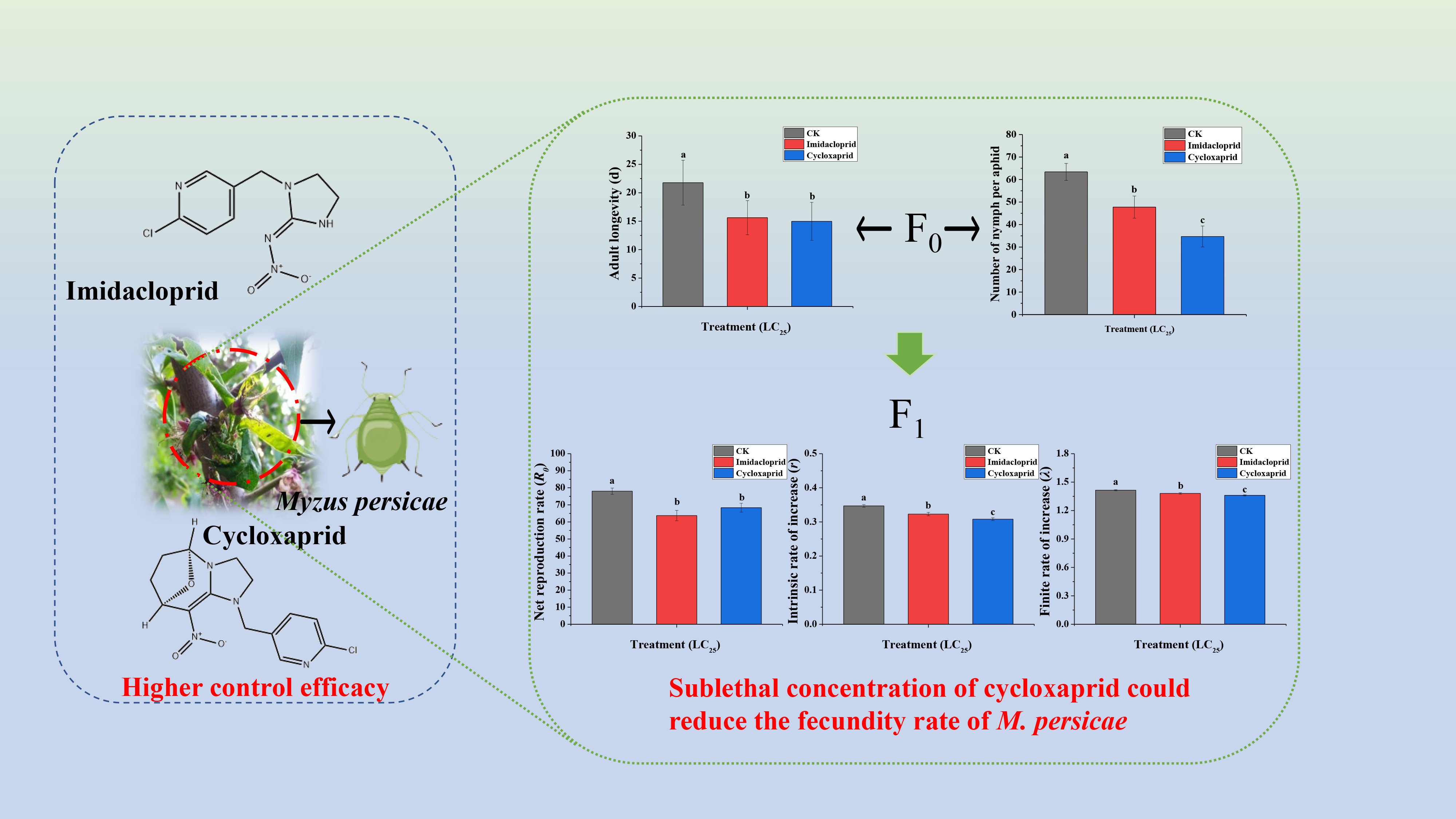
  2. Sublethal concentration of cycloxaprid could reduce the fecundity rate of M. persicae.
What are the implications of the main findings?
  1. Cycloxaprid is an ideal insecticide for the management of resistant M. persicae.
  2. Cycloxaprid-induced resurgence could therefore not occur.

Abstract
Myzus persicae is a worldwide insect pest with high resistance to many traditional insecticides. Cycloxaprid, a novel cis-configuration neonicotinoid insecticide, is effective in controlling neonicotinoid-resistant insect pests. Lethal and sublethal effects of cycloxaprid on M. persicae were conducted in this study. Results showed that cycloxaprid had higher toxicity to the laboratory and field resistant M. persicae than imidacloprid. Because of the resistance, imidacloprid showed lower control efficacy (<60%) against M. persicae, which falls short of the efficacy required for practical agricultural management. However, cycloxaprid exhibited higher control efficacies (>84.79%) against M. persicae in the field. In addition, in order to quantify the sublethal impacts of cycloxaprid, we conducted a life table analysis on M. persicae. When resistant M. persicae was treated with LC25 of cycloxaprid or imidacloprid, the longevity and fecundity of F1 adults were significantly decreased. Meanwhile, the intrinsic rate of increase (rm), finite rate of increase (λ) and net reproduction rate (Ri) of F1 generation M. persicae were reduced in cycloxaprid and imidacloprid treatments. Therefore, cycloxaprid shows high potential as a candidate insecticide for managing imidacloprid-resistant M. persicae. Importantly, our laboratory data indicate that exposure to its low sublethal concentration (LC25) inhibits population growth parameters, suggesting a low risk of inducing pest resurgence under such conditions.

Graphical Abstract

1. Introduction

The green peach aphid (GPA), Myzus persicae (Sulzer) (Hemiptera: Aphididae), is a highly destructive agricultural pest with a worldwide distribution, attacking hundreds of species from 40 plant families [1]. As a sap-feeding pest, M. persicae could cause severe damage by direct feeding, promoting growth of sooty mold, blocking photosynthesis and transmitting plant viruses [2]. Although the widespread use of chemical controls has led to the evolution of resistance to at least 80 different active ingredients in M. persicae, making this species one of the most strongly and widely resistant insect worldwide, at present, insecticides remain the primary tool for control of M. persicae worldwide [3]. Among these insecticides, neonicotinoids are the leading products, which have high selectivity and affinity for nicotinic acetylcholine receptors in insect central nervous system [4]. This resistance crisis has been exacerbated by the extensive and sustained application of key trans-nitromethylene neonicotinoids, including imidacloprid (2350-flod), thiamethoxam (270-fold), clothianidin (3013-fold) and thiacloprid (>2500-fold) [3,5,6]. The increasing number of resistance events mean there are very few effective insecticides remaining to control M. persicae. Therefore, a new insecticide with novel mechanisms should be introduced to against the resistant M. persicae.
Cycloxaprid belongs to a novel subclass of neonicotinoids featuring a cis-configured nitromethylene group, in direct contrast to the trans-configuration characteristic of other commercial neonicotinoids [7]. The novel chemical structure endows it different binding site and wide insecticidal spectrum [8,9]. Cycloxaprid has been reported to exhibit high insecticidal activity against many sap-sucking insect pests, such as Nilaparvata lugens [10,11], Apolygus lucorum [8], Aphis gossypii [12] and Bemisia tabaci [13]. Furthermore, cycloxaprid retains efficacy against pest populations that have developed resistance to established neonicotinoids like imidacloprid [8,10,12,14]. For example, cycloxaprid shows 2-fold higher activity against imidacloprid-resistant Bemisia tabaci when compared with imidacloprid [13]. In addition, it has been reported that cycloxaprid showed high insecticidal activity, low cross-resistance and different binding properties on insect nAChRs. Therefore, cycloxaprid is a potential insecticide for the control of insect pests, especially ones with high resistance to neonicotinoids [11].
A complete assessment of a novel insecticide requires evaluation beyond lethal toxicity to include its potential sublethal effects. Sublethal effects refer to the physiological or behavioral effects of pests exposed to low or sublethal concentrations of toxic substances [15]. Due to the degrade of pesticides after initial applications to crops, insect pests exposure to sublethal concentrations of pesticides in agro-ecosystems is a common phenomenon [16,17]. Sublethal concentrations of insecticide can’t kill the entire population of insects but exert physiological or behavioral induction on individuals, including decreased pests developmental time or increased adult longevity and reproduction [18,19,20,21]. However, these sublethal impairments carry significant ecological and resistance management risks, such as accelerated evolution of resistance and potential pest resurgence [19,22,23,24]. Therefore, a thorough evaluation of a pesticide’s total population-level impact is critical for informed insecticide selection and sustainable pest management. In addition, the sublethal effects of cycloxaprid on M. persicae have not been reported. Therefore, we used age-stage life table analysis to evaluate the sublethal effects of cycloxaprid on field M. persicae. This approach was adopted to generate essential data for resistance management strategies and to comprehensively assess the efficacy and potential risks associated with this novel insecticide.

2. Materials and Methods

2.1. M. persicae Strains

The susceptible strain M. persicae was reared in the laboratory and the field resistant strain of M. persicae was obtained from the experimental peach tree in Shandong Province, China. Two strains were maintained on radish seedlings (Raphanus sativus L.) without exposure to insecticides, under a 25 ± 1 °C, 60 ± 10% humidity with a L16:D8 h photoperiod.

2.2. Insecticides and Chemicals

Cycloxaprid (97%) and cycloxaprid 25% WP were provided by Shanghai Shengnong Pesticide Co., Ltd., Shanghai, China. Imidacloprid (95.5%) was provided by Jiangsu Kesheng Co., Ltd., Yancheng, China. Imidacloprid 10% WP was obtained from Nanjing Red Sun Co., Ltd., Nanjing, China. Triton X-100 and dimethylsulfoxide (DMSO) were obtained from Beijing chemical reagent Co., Ltd., Beijing, China.

2.3. Laboratory Trials of Cycloxaprid and Imidacloprid Toxicity

The toxicity of imidacloprid and cycloxaprid to M. persicae was determined using leaf-dipping method [14]. The concentration ranges for imidacloprid (susceptible strain: 1.56–25 mg/L; field strain: 25–400 mg/L) and cycloxaprid (susceptible strain: 1.25–20 mg/L; field strain: 5–80 mg/L) were chosen to encompass the anticipated LC50 values. A geometric series of five concentrations was prepared for each insecticide by serial dilution with an aqueous solution of Triton X-100 (0.05% w/v). Individual raphanus sativus leaves with about 50 adult M. persicae were dipped in the diluted solutions for 10 s or in to 0.05% Triton X-100 aqueous solution (as the control group). After drying, the leaves were transferred to 90 mm petri dishes containing filter paper moistened with deionized water. Then, M. persicae were reared at 27 ± 1 °C, 60 ± 10% humidity and a 14:10 h light:dark photoperiod. After 24 h, the mortality was observed under a microscope. Mortality was recorded when M. persicae exhibited no signs of movement or response to physical stimuli. Bioassays for each concentration consisted of 4 replicates. Laboratory toxicity tests were conducted on adult M. persicae.

2.4. Field Control Using Cycloxaprid and Imidacloprid

The field control effects of cycloxaprid on M. persicae were evaluated in Linyi city, Shandong Province (Coordinates: 35.25° N, 118.55° E). The active ingredient concentrations evaluated in the study were 100 mg·L−1 for cycloxaprid and 133.3 mg·L−1 for imidacloprid. The electric knapsack sprayer T-HS 16D (Shandong Agricultural Pharmaceutical Equipment Co., Ltd., Laiyang, China) was used to spray insecticide. In order to reduce the impact of other insecticides, no insecticide spray was applied until the scheduled insecticide application. Each plot contained two peach trees, and 10 leaves containing M. persicae were randomly selected from each plot. Control plots received an application of water only. Each treatment consisted of three repetitions. Bioassays were arranged in a complete randomized block design. The numbers of living M. persicae were investigated 3, 7 and 14 days after application. Within each experimental plot (treatment unit), 10 leaves with moderate and representative aphid infestation were randomly selected from the mid-canopy of the two peach trees (5 leaves per tree). To ensure randomness and avoid bias, leaves were selected from all four cardinal directions around the canopy. All live M. persicae (both nymphs and adults) on the upper and lower surfaces of each selected leaf were counted in situ using a hand-held magnifying lens, without disturbing the insects or removing the leaves. M. persicae were considered dead if they showed no movement and no response to gentle physical stimulation. Field efficacy trials were conducted primarily on adults and nymph populations of M. persicae.

2.5. Laboratory-Measured Sublethal Effects of Cycloxaprid and Imidacloprid

Sublethal effects experiments were conducted on adult M. persicae, with F1-generation phenotypes assessed to evaluate sublethal impacts. The sublethal effects of cycloxaprid and imidacloprid on M. persicae were evaluated using the concentration of LC25. In order to mimic the lower concentrations of pesticides that may occur in the field after initial insecticide application, LC25 concentrations of imidacloprid and cycloxaprid were used in this study. At least 300 adults were treated with LC25 of imidacloprid or cycloxaprid by the leaf dipping method. Control adults were treated with distilled water (containing 0.05% (w/v) Triton X-100). Mortality was calculated at 24 h after treatment. The surviving M. persicae were transferred to a separated petri dish with fresh cabbage leaves. After 12 h, the offspring produced by the F0 adults were collected and used as the F1 generation in the life table experiment. At least 100 neonate nymphs of each group were tested individually. Population parameters such as development time of each stage, total longevity, survival and fecundity of F1 generation were recorded every day. Newly born nymphs were recorded and removed daily. The longevity of M. persicae and the number of nymphs produced per adult were recorded until it adult died. All experiments were carried out at 27 ± 1 °C, 60 ± 5% RH and 16:8 (L:D) h photoperiod.

2.6. Statistical Analysis

Statistical software SPSS 13.0 (SPSS Inc., Chicago, IL, USA) was used to calculate the sublethal concentration (LC25), median lethal concentration (LC50) and their 95% confidence intervals (CIs). In the field experiment, the efficacies of insecticides were transformed using arcsine square root transformation, expressed in degrees as (180/π) × arcsin ( x ), prior to statistical analysis. Data were statistically analyzed using one-way analysis of variance (ANOVA) followed by Fisher’s LSD tests and t-tests (α = 0.05). The daily fecundity, longevity and survivorship of M. persicae individuals were analyzed using the theory and method of age stage and a two-sex life table. The Age-specific Survival Rate (lx), Age-specific Fecundity (mx), Age-specific Maternity (lxmx), Reproductive Value (vx), Age-stage Survival Rate (sxj), Age-stage Life Expectancy (exj), Age-specific Life Expectancy (ex), Average Population (APOP), Total Population (TPOP), Intrinsic Rate of Increase (rm), Finite Rate of Increase (λ), Net Reproduction Rate (Ri) and Mean Generation Time (T) were calculated. In the TWOSEX-Mschart computer program, bootstrapping methods (100,000 repetitions used in the bootstrapping procedure) were used to evaluate mean values, standard errors and significant differences. The data were constructed using Origin 7.0 software (OriginLab Corporaton, Northampton, MA, USA).

3. Results

3.1. Toxicity of Cycloxaprid and Imidacloprid Against Different Strains of M. persicae

The LC50 and LC25 values of cycloxaprid and imidacloprid against laboratory susceptible and field resistant strains of M. persicae were shown in Table 1. The results showed that cycloxaprid showed higher toxicity against both strains of M. persicae than imidacloprid. The LC50 values of cycloxaprid were 2.28 and 8.31 mg·L−1, respectively for the laboratory susceptible and field resistant strains of M. persicae. However, the LC50 values of imidacloprid were up to 5.99 and 90.43 mg·L−1, respectively for two strains. A significant decrease in susceptibility to imidacloprid was observed in the field strain of M. persicae, and this field strain showed moderate resistance to imidacloprid compared with the laboratory susceptible strain. The LC25 values of cycloxaprid and imidacloprid were 3.05 and 25.28 mg·L−1, respectively for the field strain, and these concentrations were used as sublethal concentrations for subsequent experiments.

3.2. The Control Efficacies of Cycloxaprid and Imidacloprid Against M. persicae in the Field

Table 2 showed the control efficacies of cycloxaprid and imidacloprid against M. persicae in the field. The results demonstrated that cycloxaprid had better control efficacies against M. persicae than imidacloprid. The efficacy of cycloxaprid was up to 93.33% after 3 days treatment at the concentration of 100 mg·L−1. Moreover, cycloxaprid showed long persistence, and the efficacy was 84.79% after 14 days treatment, whereas imidacloprid showed lower control efficacy (<60%) against M. persicae.

3.3. Sublethal Effects of Cycloxaprid and Imidacloprid on F0 Generation of M. persicae

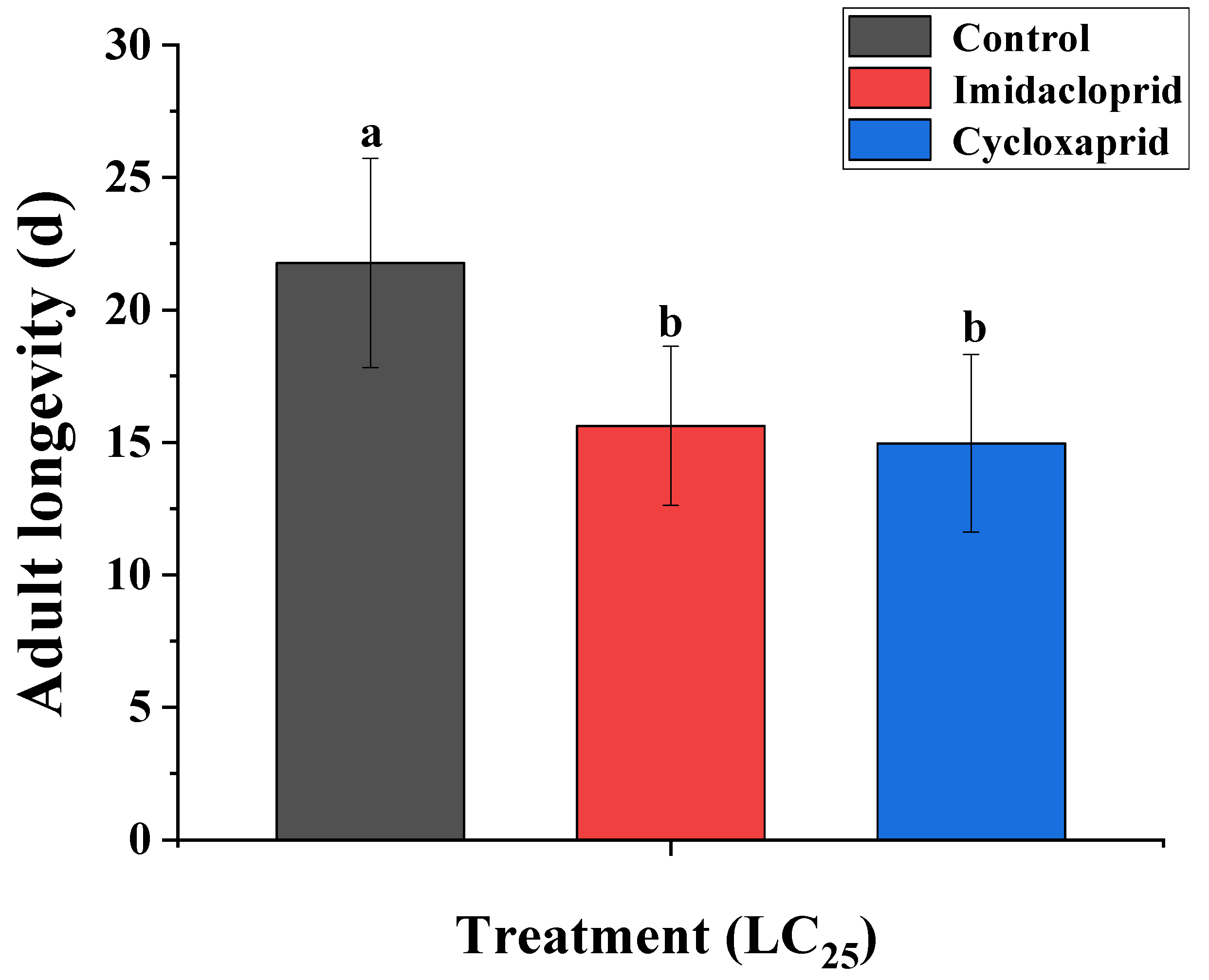
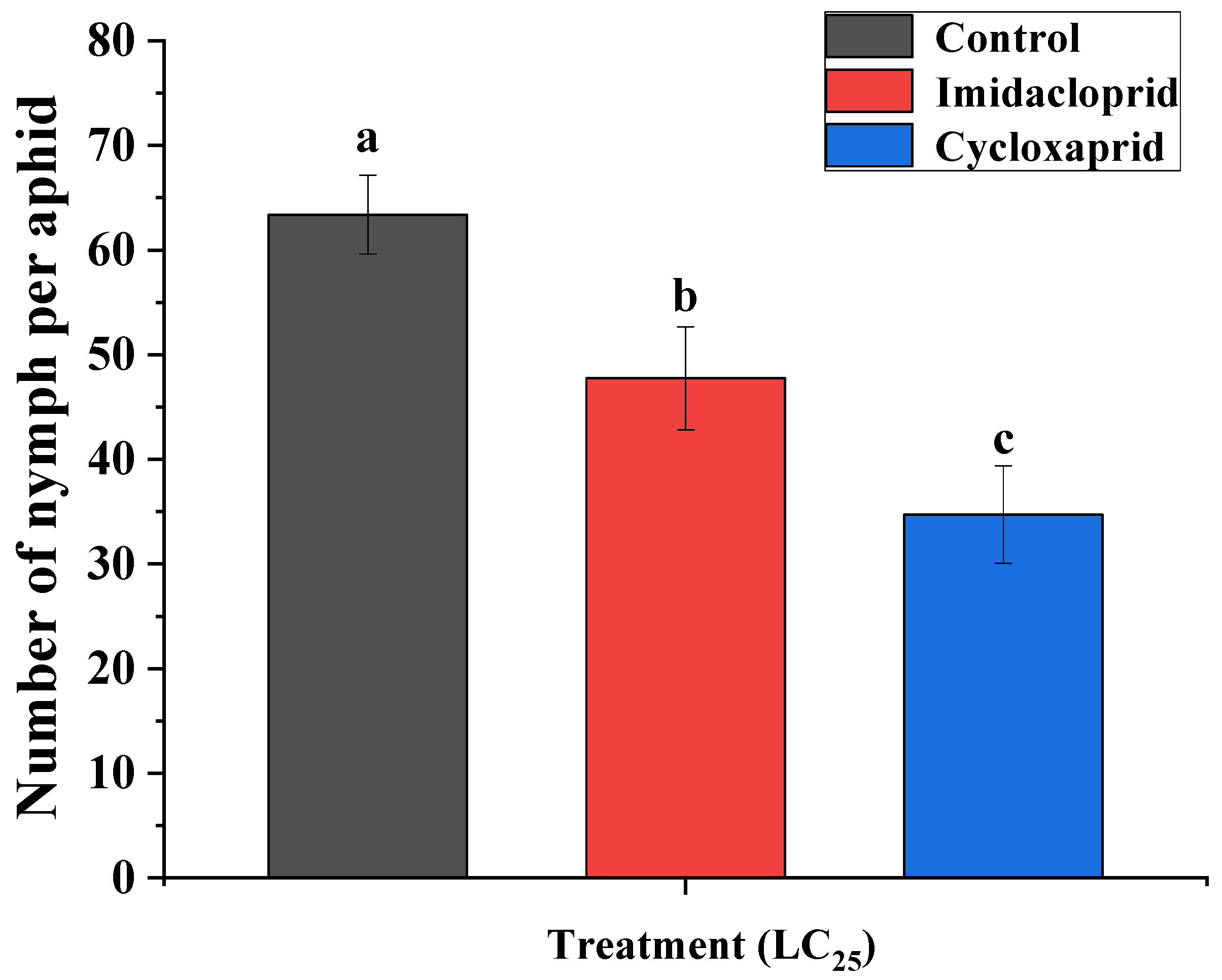
The result suggested that the LC25 values of cycloxaprid and imidacloprid to the field strain of M. persicae were 3.05 and 25.28 mg·L−1, respectively. Figure 1 and Figure 2 showed the sublethal effects of cycloxaprid and imidacloprid on adult longevity and fecundity for the F0 generation of M. persicae. Compared with the control group, LC25 of cycloxaprid and imidacloprid significantly decreased the longevity and fecundity of F0 generation of M. persicae. Moreover, Figure 2 showed that cycloxaprid had a more significant inhibition on the fecundity of F0 generation of M. persicae than imidacloprid.

3.4. Intergenerational Effects of Cycloxaprid and Imidacloprid on the F1 Generation of M. persicae

The sublethal effects of imidacloprid and cycloxaprid on the fecundity, longevity and development time of M. persicae in the F1 generation were also investigated (Table 3). Cycloxaprid significantly prolonged the developmental time of 1st instar 2nd instar nymph, while the developmental time of adults were shortened by cycloxaprid and imidacloprid. Moreover, cycloxaprid and imidacloprid significantly decreased the fecundity and increased the total preoviposition period (TPOP) of M. persicae. Therefore, F1-generation M. persicae treated with LC25 of cycloxaprid and imidacloprid generated lower offspring than the control aphids.
The bootstrap methods of life table were used to estimate the transgenerational effects of sublethal cycloxaprid and imidacloprid on population dynamics. The rm, λ, Ri and T were calculated and analyzed (Table 4). Significant differences were observed in the cycloxaprid- and imidacloprid-treated groups compared with the control. LC25 of cycloxaprid and imidacloprid significantly decreased the net reproductive rate, intrinsic rate of increase and finite rate of increase (λ), while the mean generation time of F1 generation was increased by sublethal concentration of cycloxaprid.
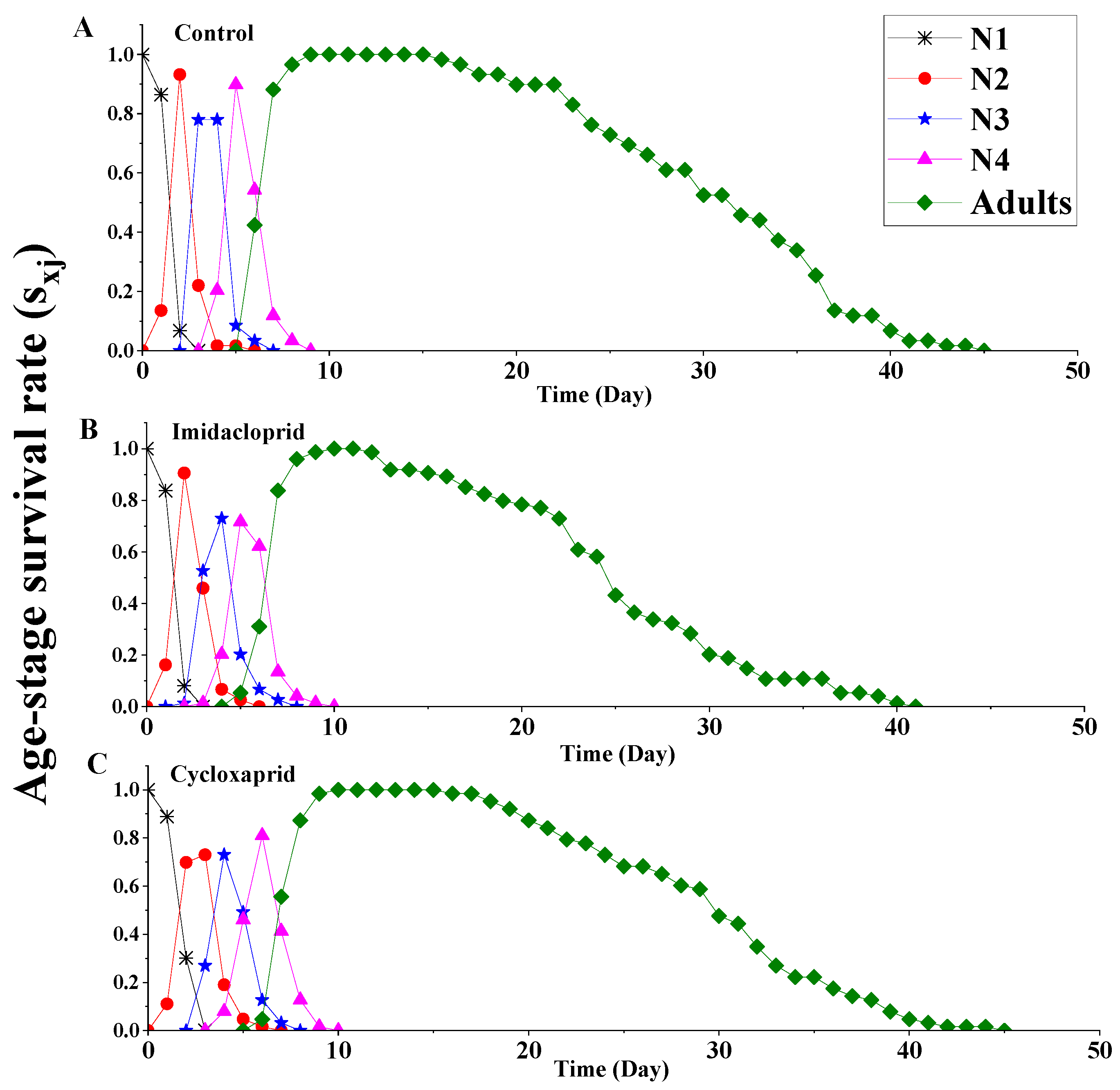
Age-stage survival rate (Sxj) curves represent the probability that a newborn nymph will survive to age x and stage j after treatment by imidacloprid or cycloxaprid at LC25 concentration (Figure 3). The adult stage became shorter if the F0 adults were treated with LC25 of imidacloprid. The maximal survival rate for second-instar (N2), third-instar (N3) and fourth-instar (N4) nymphs was lower in the cycloxaprid-treated group than in the control group. At the same time, the maximal survival rate of adults was reduced by exposure to the sublethal concentration of imidacloprid.
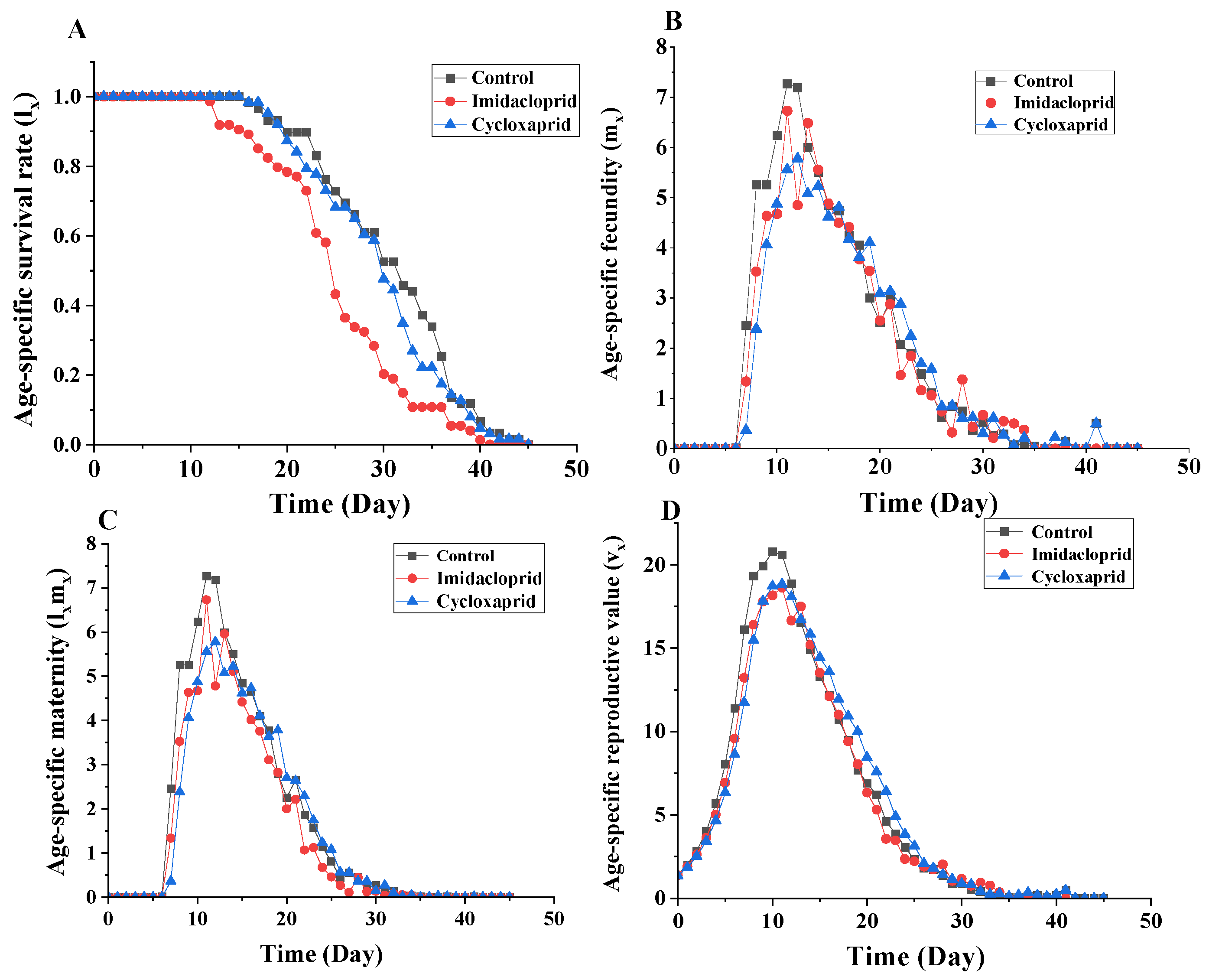
The age-specific survival rate (lx) curve shows the probability that a newborn nymph will survive to age x, and the curve is a simplified overview of the survival history, regardless of the different developmental stage. The age-specific survival rate of imidacloprid-treated M. persicae was significantly lower than that of the control group (Figure 4A). Based on the age-specific fecundity (mx) curve, the highest peak in control M. persicae occurred at the age of 12 days (Figure 4B). However, the age-specific fecundity of cycloxaprid-treated M. persicae was lower than that of the control group at the age of 6 to 15 days. The lxmx value changed depending on lx and mx, the maximum lxmx values were 7.27, 6.73 and 5.78 for the control, imidacloprid-treated and cycloxaprid-treated group, respectively (Figure 4C). Cycloxaprid and imidacloprid could reduce the age-specific reproductive value (vx) of F1-generation M. persicae (Figure 4D). The maximum vx values of cycloxaprid-treated (18.83 at the age of 11 days) and imidacloprid-treated (18.63 at the age of 11 days) group were lower than that of the control group (20.78 at the age of 11 days).
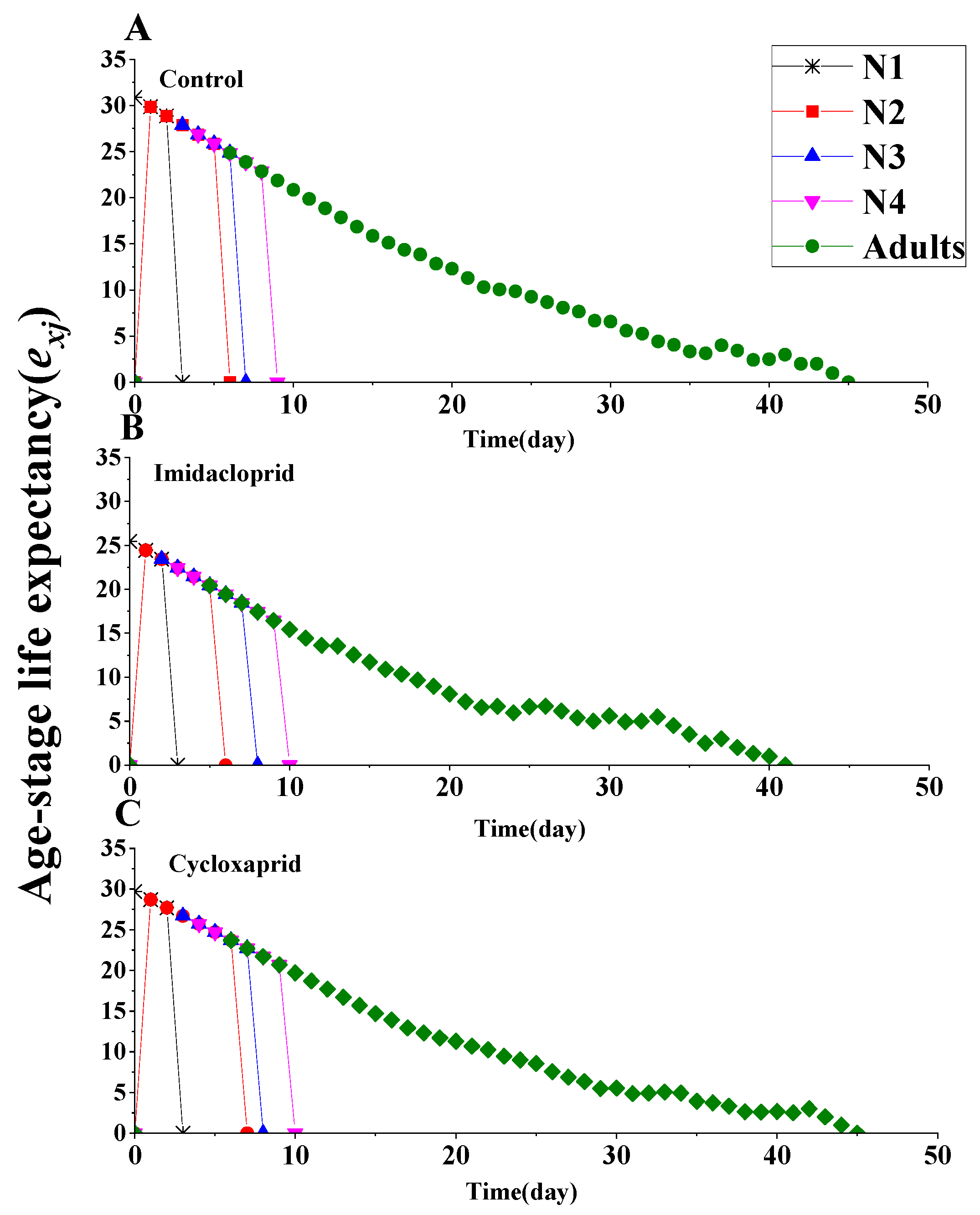
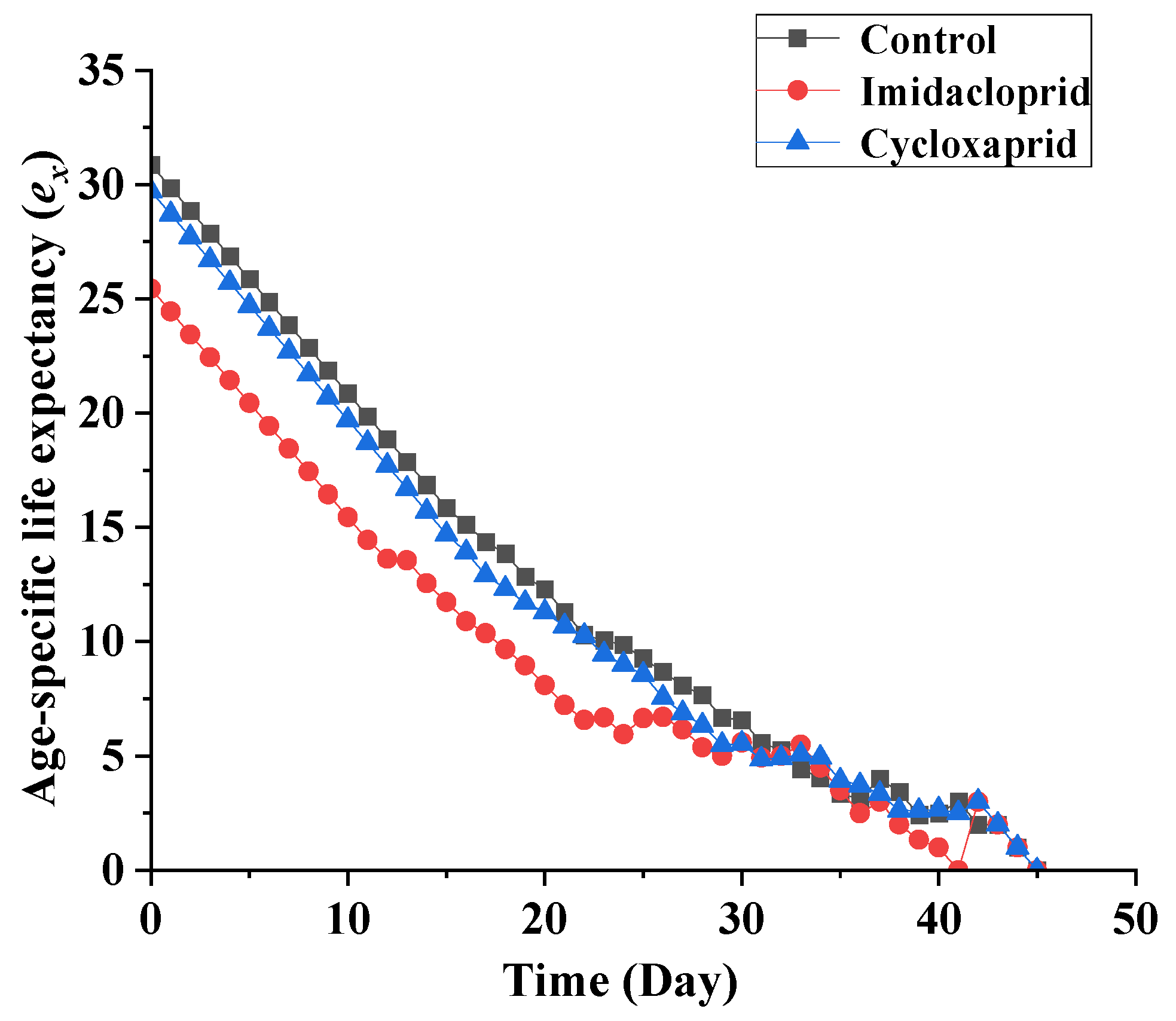
Age-specific life expectancy (ex) curve indicates that the life expectancy of an individual of age x. According to Figure 5, imidacloprid and cycloxaprid reduced the life expectancy of F1 generation M. persicae. Age-stage life expectancy (exj) curve indicates the time that an individual of age x and stage y is expected to live (Figure 6). The life expectancy of first-instar nymphs, second-instar nymphs, third-instar nymphs, fourth-instar nymphs and adults were 30.86, 29.86, 27.86, 26.86 and 24.86 days, respectively, for the control group, while these values were only 25.45, 24.45, 23.45, 22.45 and 20.45 days, respectively, for imidacloprid-treated M. persicae, and were 29.70, 28.70, 26.70, 25.70 and 23.70, respectively, for cycloxaprid-treated M. persicae (Figure 6).

4. Discussion

The widespread usage of chemicals has contributed to insecticide resistance [25,26], and even worse, since 2010, the resistance of M. persicae to neonicotinoid insecticides increased dramatically [27]. Imidacloprid is a representative neonicotinoid and it is active on a broad range of sap-feeding Insects, including M. persicae [28]. However, there were 569 documented cases of imidacloprid resistance in 2021, 99 of those cases involving M. persicae [27]. Similarly, our study confirmed a moderate level of resistance to imidacloprid (RR = 15.97) in the field population of M. persicae from Linyi city, Shandong Province. Moreover, the field control efficiency of imidacloprid against M. persicae was lower than 55.2% at 133.33 mg·L−1. This result obviously cannot satisfy the demand of agricultural production practices. The emergence of multi-insecticide resistance in Myzus persicae has posed a significant challenge to its sustainable management [29,30]. Thus, faced with the fact that there are increasing cases of pest resistance to neonicotinoids, especially for sap-feeding pests such as M. persicae, there is a requirement for the use of new insecticidal chemistries with novel mechanisms to maintain the effective pest control efficacy and to delay the resistance development and to reduce the negative impacts to the environment [27,31,32].
Cycloxaprid was the first cis-nitromethylene neonicotinoid insecticide, whereas in all other neonicotinoid insecticides, the cyano or nitro cyano group is in the trans-configuration [33]. Cycloxaprid acts on insect nAChRs as other commercial neonicotinoid insecticides such as imidacloprid, but it only had partially overlapped binding sites with imidacloprid in the insect central nervous system [11]. Therefore, cycloxaprid not only showed high toxicity to Hemipteran insect pests such as Aphis craccivora, A. gossypii, Bemisia tabaci and N. lugens, but also was seldom affected by the resistance to other neonicotinoid insecticides in pests, such as imidacloprid resistance in A. gossypii, B. tabaci and N. lugens [10,11,12,13]. Similarly, our results suggested that the control effect of cycloxaprid was more than 90% at 100 mg·L−1 within 7 days in field. It is obviously superior to imidacloprid (Table 2). In addition, the field results are consistent with those obtained in the laboratory (Table 1). Briefly, compared with imidacloprid, cycloxaprid showed higher toxicity and control efficacy to M. persicae in laboratory in the field. Therefore, cycloxaprid is regarded as a promising insecticide against M. persicae.
Sublethal pesticide effects on pests typically result in changes to biological characteristics such as growth, fecundity and lifespan [34,35,36]. M. persicae will also be exposed to sublethal concentrations of cycloxaprid in the field due to uncontrollable factors such as degradation. The accurate assessment of the overall insecticide efficacy could be obtained by estimating either lethal or sublethal effects [37]. Therefore, we not only investigated the toxicity and field control effect, but also studied the sublethal effects of cycloxaprid on M. persicae. The incorrect use of insecticides may lead to pest outbreaks [38]. For example, sublethal concentrations of imidacloprid, thiamethoxam, acetamiprid and lambda-cyhalothrin exposure increased pest fecundity in the parent generation or their offspring generations [18,24,39,40,41]. The LC25 dose is not only useful for mimicking low field concentrations, but doses below LC30 are also widely considered safe for natural enemies in integrated pest management (IPM) programs. However, our study demonstrated that LC25 of cycloxaprid significantly reduced the longevity and fecundity of F0 and F1 generations of M. persicae adults. Therefore, the intrinsic rate of increase (rm), net reproductive rate (Ri) and finite rate of increase (λ) of the F1 generation M. persicae were significantly inhibited by sublethal concentration (LC25) of cycloxaprid. In addition, cycloxaprid significantly prolonged the developmental time of 1st instar and 2nd instar nymphs, thereby increasing the mean generation time of F1 generations of M. persicae. Compared with the control and imidacloprid-treated group, cycloxaprid had the highest inhibition on the age-specific fecundity of M. persicae. So, we concluded that a sublethal dose of cycloxaprid is likely to inhibit rather than promote the population growth of M. persicae. Similarly, it has been reported that the longevity and fertility of cotton aphid adults was significantly decreased when treated with LC10 and LC40 of cycloxaprid [42]. It is important to note that while the observed sublethal effects (e.g., reduced rm, Ri and λ) were statistically significant in our controlled laboratory study, their exact magnitude and practical impact in the agricultural fields remain to be quantified. Field populations are exposed to spatially and temporally variable insecticide residues, and their response may be influenced by additional biotic and abiotic factors not present in the laboratory. Thus, further field-based studies monitoring population dynamics after sublethal exposure are warranted to confirm the ecological implications of these findings and to validate cycloxaprid long-term management potential against M. persicae.
In conclusion, cycloxaprid is identified as a promising neonicotinoid insecticide for the management of M. persicae. It is highly toxic against the imidacloprid-resistant M. persicae. In addition, the sublethal concentration of cycloxaprid can reduce the fecundity rate of M. persicae. Therefore, based on our laboratory data, a resurgence in the M. persicae population is less likely to be induced by exposure to low sublethal concentrations of cycloxaprid, as compared to some other insecticides that have shown hormetic effects. However, the definitive assessment of this risk under complex field conditions, where residual concentrations are dynamic and heterogeneous, requires further investigation. Given its unique cis-nitromethylene structure and partially non-overlapping binding site, cycloxaprid should be rotated with insecticides from entirely different chemical classes to mitigate selection pressure and delay the evolution of broad-spectrum resistance. Cycloxaprid is an excellent candidate to replace or alternate with conventional neonicotinoids in regions where high resistance to the latter has been confirmed, as shown in this study. This study will contribute to the overall assessment of cycloxaprid on M. persicae and provide data support for the integrated control of M. persicae.

5. Conclusions

This study demonstrates that cycloxaprid, a cis-nitromethylene neonicotinoid, represents a superior chemical alternative for managing imidacloprid-resistant M. persicae. Its distinct configuration confers not only higher acute toxicity but also, crucially, a more favorable ecotoxicological profile at sublethal levels. By significantly inhibiting the fecundity and suppressing the population growth parameters of resistant M. persicae, cycloxaprid exposure presents a low risk of inadvertently triggering pest resurgence, a common pitfall with some conventional insecticides. These combined attributes of high efficacy against resistant pests and population-suppressing sublethal effects position cycloxaprid as an ideal candidate for inclusion in integrated resistance management (IRM) strategies. To maximize its sustainable utility, its deployment should be strategically rotated with compounds from other, unrelated mode-of-action groups. Thus, cycloxaprid offers a potent tool not merely for immediate control, but for the sustainable, long-term management of resistant M. persicae populations in agricultural systems.

Author Contributions

Conceptualization, L.C.; methodology, J.Z., C.R. and L.W.; formal analysis, J.Z., L.W., Z.C., Q.Y. and W.W.; investigation, J.Z., L.W., Q.W. and W.H.; resources, L.C.; data curation, J.Z. and L.W.; writing—original draft preparation, J.Z., L.W. and L.C.; writing—review and editing, J.Z., L.W. and L.C. All authors have read and agreed to the published version of the manuscript.

Funding

This research was funded by the National Key Research & Development Program of China (2022YFD1700205), National Natural Science Foundation of China (32272603), Central Public-interest Scientific Institution Basal Research Fund (Y2024QC03) and the Agricultural Science and Technology Innovation Program (CAASZDRW202412).

Institutional Review Board Statement

Not applicable.

Informed Consent Statement

Not applicable.

Data Availability Statement

The raw data associated with this study are available from the corresponding author upon reasonable request.

Acknowledgments

We acknowledge the financial support of this investigation by the National Key Research & Development Program of China (2022YFD1700205), National Natural Science Foundation of China (32272603), Central Public-interest Scientific Institution Basal Research Fund (Y2024QC03) and the Agricultural Science and Technology Innovation Program (CAASZDRW202412).

Conflicts of Interest

The authors declare no competing financial interests.

References

  1. Ali, M.Y.; Naseem, T.; Arshad, M.; Ashraf, I.; Rizwan, M.; Tahir, M.; Rizwan, M.; Sayed, S.; Ullah, M.I.; Khan, R.R.; et al. Host-Plant Variations Affect the Biotic Potential, Survival, and Population Projection of Myzus persicae (Hemiptera: Aphididae). Insects 2021, 12, 375. [Google Scholar] [CrossRef]
  2. Fingu-Mabola, J.C.; Bawin, T.; Francis, F. Direct and Indirect Effect via Endophytism of Entomopathogenic Fungi on the Fitness of Myzus persicae and Its Ability to Spread PLRV on Tobacco. Insects 2021, 12, 89. [Google Scholar] [CrossRef]
  3. Bass, C.; Puinean, A.M.; Andrews, M.; Cutler, P.; Daniels, M.; Elias, J.; Paul, V.L.; Crossthwaite, A.J.; Denholm, I.; Field, L.M.; et al. Mutation of a Nicotinic Acetylcholine Receptor β Subunit Is Associated with Resistance to Neonicotinoid Insecticides in the Aphid Myzus persicae. BMC Neurosci. 2011, 12, 51. [Google Scholar] [CrossRef] [PubMed]
  4. Mourikes, V.E.; Santacruz-Márquez, R.; Deviney, A.; Neff, A.; Laws, M.J.; Flaws, J.A. Neonicotinoids Differentially Modulate Nicotinic Acetylcholine Receptors in Immature and Antral Follicles in the Mouse Ovary†. Biol. Reprod. 2024, 111, 472–482. [Google Scholar] [CrossRef]
  5. Slater, R.; Paul, V.L.; Andrews, M.; Garbay, M.; Camblin, P. Identifying the Presence of Neonicotinoidresistant Peach-Potato Aphid (Myzus persicae) in the Peach-Growing Regions of Southern France and Northern Spain. Pest Manag. Sci. 2012, 68, 634–638. [Google Scholar] [CrossRef] [PubMed]
  6. Troczka, B.J.; Singh, K.S.; Zimmer, C.T.; Vontas, J.; Nauen, R.; Hayward, A.; Bass, C. Molecular Innovations Underlying Resistance to Nicotine and Neonicotinoids in the Aphid Myzus persicae. Pest Manag. Sci. 2021, 77, 5311–5320. [Google Scholar] [CrossRef]
  7. Shao, X.; Lee, P.W.; Liu, Z.; Xu, X.; Li, Z.; Qian, X. Cis-Configuration: A New Tactic/Rationale for Neonicotinoid Molecular Design. J. Agric. Food Chem. 2011, 59, 2943–2949. [Google Scholar] [CrossRef]
  8. Pan, H.; Liu, Y.; Liu, B.; Lu, Y.; Xu, X.; Qian, X.; Wu, K.; Desneux, N. Lethal and Sublethal Effects of Cycloxaprid, a Novel Cis-Nitromethylene Neonicotinoid Insecticide, on the Mirid Bug Apolygus lucorum. J. Pest Sci. 2014, 87, 731–738. [Google Scholar] [CrossRef]
  9. Wang, R.; Fang, Y.; Mu, C.; Qu, C.; Li, F.; Wang, Z.; Luo, C. Baseline Susceptibility and Cross-Resistance of Cycloxaprid, a Novel Cis-Nitromethylene Neonicotinoid Insecticide, in Bemisia tabaci MED from China. Crop Prot. 2018, 110, 283–287. [Google Scholar] [CrossRef]
  10. Fang, Y.; Xie, P.; Dong, C.; Han, Y.; Tang, T.; Liu, Y.; Zhong, J.; Bai, L.; Zhou, X. Cross-Resistance and Baseline Susceptibility of Brown Planthopper Nilaparvata lugens (Hemiptera: Delphacidae) From China to Cycloxaprid. J. Econ. Entomol. 2018, 111, 2359–2363. [Google Scholar] [CrossRef] [PubMed]
  11. Zhang, Y.; Xu, X.; Bao, H.; Shao, X.; Li, Z.; Liu, Z. The Binding Properties of Cycloxaprid on Insect Native nAChRs Partially Explain the Low Cross-Resistance with Imidacloprid in Nilaparvata lugens. Pest Manag. Sci. 2019, 75, 246–251. [Google Scholar] [CrossRef] [PubMed]
  12. Cui, L.; Qi, H.; Yang, D.; Yuan, H.; Rui, C. Cycloxaprid: A Novel Cis-Nitromethylene Neonicotinoid Insecticide to Control Imidacloprid-Resistant Cotton Aphid (Aphis gossypii). Pestic. Biochem. Physiol. 2016, 132, 96–101. [Google Scholar] [CrossRef]
  13. Cui, L.; Wang, Q.; Wang, Q.; Wang, L.; Yuan, H.; Rui, C. Cycloxaprid: A Novel Cis-Nitromethylene Neonicotinoid Insecticide to Control Bemisia tabaci. Pest Manag. Sci. 2020, 76, 1705–1712. [Google Scholar] [CrossRef] [PubMed]
  14. Yang, Y.; Zhang, Y.; Yang, B.; Fang, J.; Liu, Z. Transcriptomic Responses to Different Doses of Cycloxaprid Involved in Detoxification and Stress Response in the Whitebacked Planthopper, Sogatella furcifera. Entomol. Exp. Appl. 2016, 158, 248–257. [Google Scholar] [CrossRef]
  15. Liu, X.; Fu, Z.; Zhu, Y.; Gao, X.; Liu, T.-X.; Liang, P. Sublethal and Transgenerational Effects of Afidopyropen on Biological Traits of the Green Peach Aphid Myzus persicae (Sluzer). Pestic. Biochem. Physiol. 2022, 180, 104981. [Google Scholar] [CrossRef]
  16. Qu, Y.; Xiao, D.; Li, J.; Chen, Z.; Biondi, A.; Desneux, N.; Gao, X.; Song, D. Sublethal and Hormesis Effects of Imidacloprid on the Soybean aphid Aphis glycines. Ecotoxicology 2015, 24, 479–487. [Google Scholar] [CrossRef]
  17. Shang, J.; Yao, Y.-S.; Zhu, X.-Z.; Wang, L.; Li, D.-Y.; Zhang, K.-X.; Gao, X.-K.; Wu, C.-C.; Niu, L.; Ji, J.-C.; et al. Evaluation of Sublethal and Transgenerational Effects of Sulfoxaflor on Aphis gossypii via Life Table Parameters and 16S rRNA Sequencing. Pest Manag. Sci. 2021, 77, 3406–3418. [Google Scholar] [CrossRef]
  18. Liao, X.; Ali, E.; Li, W.; He, B.; Wan, H. Sublethal Effects of Sulfoxaflor on the Development and Reproduction of the Brown Planthopper, Nilaparvata lugens (Stl). Crop Prot. 2019, 118, 6–14. [Google Scholar] [CrossRef]
  19. Wang, L.; Zhu, J.; Wang, Q.; Ji, X.; Wang, W.; Huang, W.; Rui, C.; Cui, L. Hormesis Effects of Sulfoxaflor on Aphis gossypii Feeding, Growth, Reproduction Behaviour and the Related Mechanisms. Sci. Total Environ. 2023, 872, 162240. [Google Scholar] [CrossRef] [PubMed]
  20. Wu, C.; Sun, T.; He, M.; Zhang, L.; Zhang, Y.; Mao, L.; Zhu, L.; Jiang, H.; Zheng, Y.; Liu, X. Sublethal Toxicity, Transgenerational Effects, and Transcriptome Expression of the Neonicotinoid Pesticide Cycloxaprid on Demographic Fitness of Coccinella Septempunctata. Sci. Total Environ. 2022, 842, 156887. [Google Scholar] [CrossRef]
  21. Xiang, X.; Liu, S.; Wang, X.; Zhang, Y.; Gong, C.; Chen, L.; Zhang, S.; Shen, L. Sublethal Effects of Sulfoxaflor on Population Projection and Development of the White-Backed Planthopper, Sogatella furcifera (Hemiptera: Delphacidae). Crop Prot. 2019, 120, 97–102. [Google Scholar] [CrossRef]
  22. Rix, R.R.; Ayyanath, M.M.; Christopher Cutler, G. Sublethal Concentrations of Imidacloprid Increase Reproduction, Alter Expression of Detoxification Genes, and Prime Myzus persicae for Subsequent Stress. J. Pest Sci. 2016, 89, 581–589. [Google Scholar] [CrossRef]
  23. Chen, L.; Wang, X.; Zhang, Y.; Yang, R.; Jiang, C. The Population Growth, Development and Metabolic Enzymes of the White-Backed Planthopper, Sogatella furcifera (Hemiptera: Delphacidae) under the Sublethal Dose of Triflumezopyrim. Chemosphere 2020, 247, 125865. [Google Scholar] [CrossRef]
  24. Ullah, F.; Gul, H.; Tariq, K.; Desneux, N.; Song, D. Thiamethoxam Induces Transgenerational Hormesis Effects and Alteration of Genes Expression in Aphis gossypii. Pestic. Biochem. Physiol. 2020, 165, 104557. [Google Scholar] [CrossRef]
  25. Mezei, I.; Bielza, P.; Siebert, M.W.; Torne, M.; Gomez, L.E.; Valverde-Garcia, P.; Belando, A.; Moreno, I.; Grávalos, C.; Cifuentes, D.; et al. Sulfoxaflor Efficacy in the Laboratory against Imidacloprid-Resistant and Susceptible Populations of the Green Peach Aphid, Myzus persicae: Impact of the R81T Mutation in the Nicotinic Acetylcholine Receptor. Pestic. Biochem. Physiol. 2020, 166, 104582. [Google Scholar] [CrossRef]
  26. Charaabi, K.; Boukhris-Bouhachem, S.; Makni, M.; Denholm, I. Occurrence of Target-Site Resistance to Neonicotinoids in the Aphid Myzus persicae in Tunisia, and Its Status on Different Host Plants. Pest Manag. Sci. 2018, 74, 1297–1301. [Google Scholar] [CrossRef] [PubMed]
  27. Mezei, I.; Valverde-Garcia, P.; Siebert, M.W.; Gomez, L.E.; Torne, M.; Watson, G.B.; Raquel, A.M.; Fereres, A.; Sparks, T.C. Impact of the Nicotinic Acetylcholine Receptor Mutation R81T on the Response of European Myzus persicae Populations to Imidacloprid and Sulfoxaflor in Laboratory and in the Field. Pestic. Biochem. Physiol. 2022, 187, 105187. [Google Scholar] [CrossRef]
  28. Jeschke, P.; Nauen, R. Neonicotinoids-from Zero to Hero in Insecticide Chemistry. Pest Manag. Sci. 2008, 64, 1084–1098. [Google Scholar] [CrossRef] [PubMed]
  29. Bass, C.; Puinean, A.M.; Zimmer, C.T.; Denholm, I.; Field, L.M.; Foster, S.P.; Gutbrod, O.; Nauen, R.; Slater, R.; Williamson, M.S. The Evolution of Insecticide Resistance in the Peach Potato Aphid, Myzus persicae. Insect Biochem. Mol. Biol. 2014, 51, 41–51. [Google Scholar] [CrossRef]
  30. Pym, A.; Umina, P.A.; Reidy-Crofts, J.; Troczka, B.J.; Matthews, A.; Gardner, J.; Hunt, B.J.; van Rooyen, A.R.; Edwards, O.R.; Bass, C. Overexpression of UDP-Glucuronosyltransferase and Cytochrome P450 Enzymes Confers Resistance to Sulfoxaflor in Field Populations of the Aphid, Myzus persicae. Insect Biochem. Mol. Biol. 2022, 143, 103743. [Google Scholar] [CrossRef] [PubMed]
  31. Lamberth, C.; Jeanmart, S.; Luksch, T.; Plant, A. Current Challenges and Trends in the Discovery of Agrochemicals. Science 2013, 341, 742–746. [Google Scholar] [CrossRef]
  32. Ward, S.; Jalali, T.; Rooyen, A.V. The Evolving Story of Sulfoxaflor Resistance in the Green Peach Aphid, Myzus persicae (Sulzer). Pest Manag. Sci. 2024, 80, 866–873. [Google Scholar] [CrossRef]
  33. Shao, X.; Fu, H.; Xu, X.; Xu, X.; Liu, Z.; Li, Z.; Qian, X. Divalent and Oxabridged Neonicotinoids Constructed by Dialdehydes and Nitromethylene Analogues of Imidacloprid: Design, Synthesis, Crystal Structure, and Insecticidal Activities. J. Agric. Food Chem. 2010, 58, 2696–2702. [Google Scholar] [CrossRef] [PubMed]
  34. Ju, D.; Liu, Y.-X.; Liu, X.; Dewer, Y.; Mota-Sanchez, D.; Yang, X.-Q. Exposure to Lambda-Cyhalothrin and Abamectin Drives Sublethal and Transgenerational Effects on the Development and Reproduction of Cydia pomonella. Ecotoxicol. Environ. Saf. 2023, 252, 114581. [Google Scholar] [CrossRef]
  35. Nath, A.; Gadratagi, B.G.; Maurya, R.P.; Ullah, F.; Patil, N.B.; Adak, T.; Govindharaj, G.P.P.; Ray, A.; Mahendiran, A.; Desneux, N.; et al. Sublethal Phosphine Fumigation Induces Transgenerational Hormesis in a Factitious Host, Corcyra cephalonica. Pest Manag. Sci. 2023, 79, 3548–3558. [Google Scholar] [CrossRef]
  36. Shi, Y.; Chen, H.; Wu, S.; Xia, F.; He, M.; Yang, L.; Li, R.; Liao, X.; Li, M. Sublethal Effects of Nitenpyram on the Biological Traits and Metabolic Enzymes of the White-Backed Planthopper, Sogatella furcifera (Hemiptera: Delphacidae). Crop Prot. 2022, 155, 105931. [Google Scholar] [CrossRef]
  37. Salvanagh, N.R.; Mehrkhou, F.; Fourozan, M. Lethal and Sublethal Effects of Flonicamid and BIo2 on Life Span and Population Growth Parameters of Greenhouse Whitefly, Trialeurodes vaporariorum,(Hemiptera: Aleyrodidae). Phytoparasitica 2024, 52, 90. [Google Scholar] [CrossRef]
  38. Guedes, R.N.C.; Smagghe, G.; Stark, J.D.; Desneux, N. Pesticide-Induced Stress in Arthropod Pests for Optimized Integrated Pest Management Programs. Annu. Rev. Entomol. 2016, 61, 43–62. [Google Scholar] [CrossRef] [PubMed]
  39. Ullah, F.; Gul, H.; Desneux, N.; Gao, X.; Song, D. Imidacloprid-Induced Hormesis Effects on Demographic Traits of the Melon Aphid, Aphis gossypii. Entomol. Gen. 2019, 39, 325–337. [Google Scholar] [CrossRef]
  40. Ullah, F.; Gul, H.; Desneux, N.; Qu, Y.; Song, D. Acetamiprid-Induced Hormetic Effects and Vitellogenin Gene (Vg) Expression in the Melon Aphid, Aphis gossypii. Entomol. Gen. 2019, 39, 259–270. [Google Scholar] [CrossRef]
  41. Wang, L.; Wang, Q.; Wang, Q.; Rui, C.; Cui, L. The Feeding Behavior and Life History Changes in Imidacloprid-Resistant Aphis gossypii Glover (Homoptera: Aphididae). Pest Manag. Sci. 2020, 76, 1402–1412. [Google Scholar] [CrossRef] [PubMed]
  42. Yuan, H.B.; Li, J.H.; Liu, Y.Q.; Cui, L.; Lu, Y.H.; Xu, X.Y.; Li, Z.; Wu, K.M.; Desneux, N. Lethal, Sublethal and Transgenerational Effects of the Novel Chiral Neonicotinoid Pesticide Cycloxaprid on Demographic and Behavioral Traits of Aphis gossypii (Hemiptera: Aphididae). Insect Sci. 2017, 24, 743–752. [Google Scholar] [CrossRef] [PubMed]
Figure 1. Sublethal effects of cycloxaprid and imidacloprid on adult longevity for the F0 generation of M. persicae. Error bars represent 95% confidence intervals (95% CI). Different letters suggest significant differences between groups and were determined by Student t-test using SAS 9.2 (p < 0.05).
Toxics 14 00030 g001
Figure 2. Sublethal effects of cycloxaprid and imidacloprid on adult fecundity for the F0 generation of M. persicae. Error bars represent 95% confidence intervals (95% CI). Different letters suggest significant differences between groups and were determined by Student t-test using SAS 9.2 (p < 0.05).
Toxics 14 00030 g002
Figure 3. Age-stage survival rate (Sxj) of the F1 generation of M. persicae descending from F0 individuals exposed to LC25 of cycloxaprid and imidacloprid. (A) it represents the control group; (B) it represents the imidacloprid treatment group; (C) it represents the cycloxaprid treatment group.
Toxics 14 00030 g003
Figure 4. Age-specific survival rate (lx) (A), Age-specific fecundity (mx) (B), Age-specific maternity (lxmx) (C), and Age-specific reproductive value (vx) (D) of the F1 generation of M. persicae descending from F0 individuals exposed to LC25 of cycloxaprid and imidacloprid.
Toxics 14 00030 g004
Figure 5. Age-specific life expectancy (ex) of the F1 generation of M. persicae descending from F0 individuals exposed to LC25 of cycloxaprid and imidacloprid.
Toxics 14 00030 g005
Figure 6. Age-stage life expectancy (exj) of the F1 generation of M. persicae descending from F0 individuals exposed to LC25 of cycloxaprid and imidacloprid. (A) it represents the control group; (B) it represents the imidacloprid treatment group; (C) it represents the cycloxaprid treatment group.
Toxics 14 00030 g006
Table 1. Toxicities of cycloxaprid and imidacloprid against M. persicae after 24 h.
InsecticidesStrainSlope ± SE 1LC50
(mg·L−1)
95% CI 2 (mg·L−1)LC25
(mg·L−1)
95% CI 2 (mg·L−1)pRR 3
Cycloxapridfield1.55 ± 0.268.315.16–13.413.051.45–6.400.01983.65
laboratory1.76 ± 0.052.282.07–2.520.940.84–1.050.00011.00
Imidaclopridfield1.22 ± 0.1290.4377.60–105.3925.2819.84–32.220.009115.97
laboratory1.61 ± 0.095.995.04–7.132.201.69–2.880.00011.00
1 SE, standard error. 2 95% CI, 95% confidence interval. 3 RR, resistance ratio, LC50 of the field strain/LC50 of the susceptible strain.
Table 2. Field efficacies of cycloxaprid and imidacloprid to M. persicae.
InsecticideDiluted FoldsAIC 1
(mg·L−1)
NAPA 2
(per Plot)
Efficacy % 3
3 Days7 Days14 Days
10% Imidacloprid WP 4750133.3327340.57 ± 0.22 b53.78 ± 0.69 b55.24 ± 2.24 b
25% Cycloxaprid WP 52500100.0428093.33 ± 5.43 a95.31 ± 3.95 a84.79 ± 5.57 a
Means followed by a different letter are significantly different (p < 0.05 ANOVA). 1 AIC: Active ingredient concentration. 2 NAPA: Number of Aphids prior to application. 3 Survey results at different times after chemical treatment. 4 10% Imidacloprid WP: A wettable powder formulation containing 10% (weight/weight) of the active ingredient imidacloprid. 5 25% Cycloxaprid WP: A wettable powder formulation containing 25% (weight/weight) of the active ingredient cycloxaprid.
Table 3. Transgenerational effects of cycloxaprid and imidacloprid on developmental time and fecundity of the F1 generation of M. persicae when their parents (F0) were treated with the LC25 concentration of cycloxaprid and imidacloprid.
VariablesControlTreatments (Mean ± SE 4)
ImidaclopridCycloxaprid
1st instar1.932 ± 0.058 b1.919 ± 0.057 b2.190 ± 0.078 a
2nd instar1.322 ± 0.070 b1.622 ± 0.073 a1.794 ± 0.093 a
3rd instar1.678 ± 0.070 a1.568 ± 0.064 a1.651 ± 0.082 a
4th instar1.797 ± 0.062 a1.743 ± 0.061 a1.905 ± 0.077 a
Adult (d)24.136 ± 0.917 a18.595 ± 0.826 b21.158 ± 0.884 b
Mean longevity (d)30.864 ± 0.919 a25.446 ± 0.810 b29.698 ± 0.862 a
Fecundity (offspring)78.017 ± 1.828 a63.716 ± 3.053 b68.365 ± 2.604 b
APOP 1 (d)0.728 ± 0.058 b0.972 ± 0.070 a0.825 ± 0.057 ab
TPOP 2 (d)7.458 ± 0.103 c7.808 ± 0.096 b8.365 ± 0.117 a
GRR 3 (offspring/individual)82.648 ± 1.467 a75.032 ± 2.408 b74.683 ± 2.300 b
Different letters within the same row suggest significant differences among control, LC25 concentrations of cycloxaprid and imidacloprid treatments. (at the p < 0.05, paired bootstrap test using TWOSEX MS chart program with 10,000 replications). 1 APOP: Adult pre-reproductive period. 2 TPOP: Total pre-reproductive period. 3 GRR: gross reproduction rate. 4 SE: Standard error.
Table 4. Transgenerational effects of cycloxaprid and imidacloprid on population parameters of the F1 generation of M. persicae.
Population ParameterControlTreatments (Mean ± SE 1)
ImidaclopridCycloxaprid
intrinsic rate of increase (rm) (d−1)0.347 ± 0.004 a0.323 ± 0.005 b0.308 ± 0.004 c
Net reproduction rate (Ri) (d−1)78.017 ± 1.828 a63.716 ± 3.053 b68.365 ± 2.604 b
Mean generation time (T) (d)12.532 ± 0.129 b12.873 ± 0.132 b13.722 ± 0.152 a
Finite rate of increase (λ) (d−1)1.415 ± 0.006 a1.381 ± 0.007 b1.361 ± 0.006 c
Different letters within the same row indicate significant differences among control, LC25 concentrations of cycloxaprid and imidacloprid treatments. (at the p < 0.05, paired bootstrap test using TWOSEX MS chart program with 10,000 replications). 1 SE: Standard error.
Disclaimer/Publisher’s Note: The statements, opinions and data contained in all publications are solely those of the individual author(s) and contributor(s) and not of MDPI and/or the editor(s). MDPI and/or the editor(s) disclaim responsibility for any injury to people or property resulting from any ideas, methods, instructions or products referred to in the content.