Article

Seasonal Characteristics and Source Apportionment of Water-Soluble Inorganic Ions of PM2.5 in a County-Level City of Jing–Jin–Ji Region


1
State Key Laboratory of Environmental Criteria and Risk Assessment, Chinese Research Academy of Environmental Sciences, Beijing 100012, China
2
Institute of Atmospheric Environment, Chinese Academy of Environmental Sciences, Beijing 100012, China
3
Appraisal Center for Environment and Engineering, Ministry of Ecology and Environment, Beijing 100012, China
4
Key Laboratory of Geospatial Technology for the Middle and Lower Yellow River Regions, Ministry of Education, College of Geography and Environmental Science, Henan University, Kaifeng 475004, China
5
School of Earth Sciences, Yunnan University, Kunming 650500, China
*
Author to whom correspondence should be addressed.
Toxics 2026, 14(1), 17; https://doi.org/10.3390/toxics14010017
Submission received: 24 November 2025 / Revised: 16 December 2025 / Accepted: 17 December 2025 / Published: 24 December 2025
(This article belongs to the Section Toxicity Reduction and Environmental Remediation)

Abstract

Water-soluble inorganic ions (WSIIs) are major components of PM2.5 and play a prominent role in atmospheric acidification. Previous studies have mainly focused on urban areas, whereas research pertaining to county-level cities remains comparatively limited. To fill this gap, PM2.5 samples were collected from March 2018 to February 2019 in Botou, a county-level city in the Jing–Jin–Ji region. Seasonal variation of WSII were studied, and their sources was apportioned by Positive Matrix Factorization (PMF) model. Annual PM2.5 concentrations were 79.15 ± 48.44 mg/m3, which is 2.26 times of the Level II standard limit specified the National Ambient Air Quality Standard. Nitrate (NO3) was the most abundant ion, followed by ammonium (NH4+) and sulfate (SO42−). The secondary inorganic aerosols (SIA, i.e., SO42−, NO3, and NH4+) constituted 35.1± 4.7% of PM2.5 mass. PM2.5 mass, SO42−, NO3, NH4+, K+, and Cl showed highest concentrations in winter. Ammonium salts were existed as ammonium sulfate ((NH4)2SO4) and ammonium nitrate (NH4NO3) in spring, summer, and autumn, while it also can be existed as ammonium chloride (NH4Cl) in winter. PMF analysis shows that the sources of WSIIs dominated by secondary source and followed by biomass burning. These results highlight the need for improved controls on gaseous precursors (NH3, NO2 and SO2) and biomass burning to effectively reduce PM2.5.

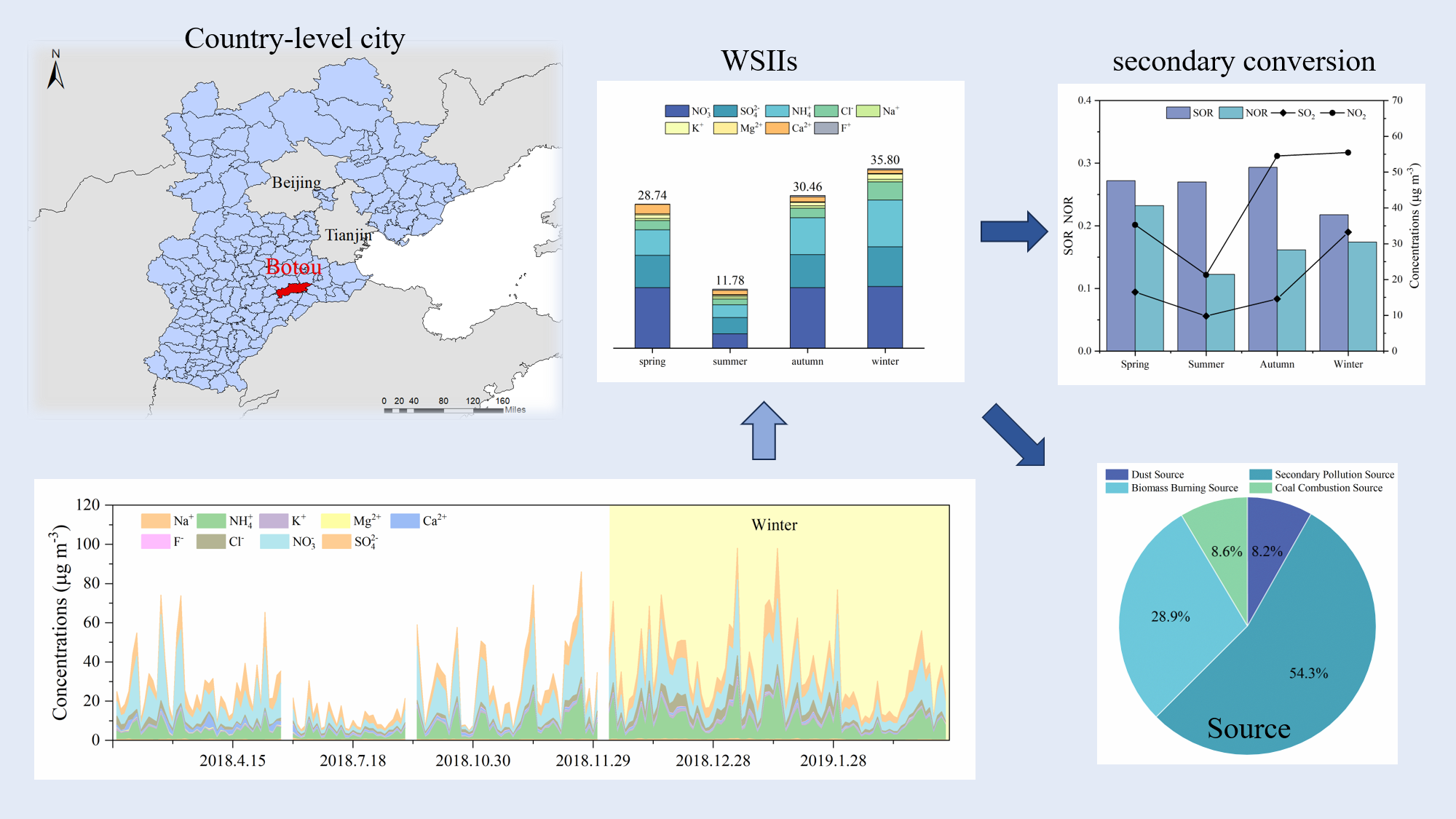
Graphical Abstract

1. Introduction

In recent years, with the implementation of pollution prevention and control measures, China’s air quality has been improved significantly, and the concentration of PM2.5 has dropped significantly. However, PM2.5 in many cities has not yet attained Class 2 standard of the Ambient Air Quality Standards. According to the 2022 Bulletin on the State of the Ecology and Environment in China [1], 25% of Chinese cities have PM2.5 levels that exceed the established standard, and there is a long way to go to control PM2.5 pollution. Water-soluble inorganic ions (WSIIs) are an important part of atmospheric PM2.5, accounting for more than 20–70% of PM2.5 mass concentration. WSIIs can affect the acidity of atmospheric precipitation [2], reduce atmospheric visibility [3], affect the optical properties of aerosols, and impact the earth’s radiation balance by absorbing and diffusing solar radiation [4]. Therefore, the research on chemical characteristics of water-soluble inorganic ions is helpful for understanding their chemical characteristics and behaviors, as well as the formation mechanism of environmental aerosols.
The composition of PM2.5 is notably complex, including a variety of trace elements, water-soluble inorganic ions, organic carbon, inorganic carbon, and other substances. Among these components, WSIIs are an important component of PM2.5, accounting for one-third or more of PM2.5 [5,6,7]. Currently, extensive research has been undertaken to explore the chemical properties, formation mechanisms, and origins of WSIIs in atmospheric PM2.5. However, variations in geographical conditions, energy structures, meteorological factors, resident’s lifestyles, and industrial structures across different regions result in diverse formation mechanisms of PM2.5 pollution. This diversity, in turn, leads to significant differences in the chemical composition and concentration levels of WSIIs between urban and background regions [8]. Furthermore, previous studies have mainly focused on urban areas [9,10,11,12], whereas research pertaining to county-level cities remains comparatively limited.
In recent years, with adjustments to the industrial structure of large- and medium-sized cities in China, the transfer of traditional industries to county-level regions, and the growing agglomeration of population in county seats, the focus of urbanization has shifted from cities to surrounding county-level cities. Notably, as a direct consequence, the air pollution issue in county-level cities has garnered increasing scholarly and regulatory attention. Since county-level cities have a greater diversity of potential pollution sources than urban areas and their environmental regulatory capacity is lower than that of urban areas, air pollution in county-level cities tends to be more pronounced. Although the PM2.5 concentration in most urban areas in China has shown a significant downward trend, the annual average PM2.5 mass concentration in 2640 county-level cities in China increased from 29.52 mg/m3 to 42.83 mg/m3 between 2000 and 2010 [13]. Notably, this upward trend has persisted through subsequent years. By 2020, the total resident population in China’s county-level cities had reached 745 million [14], reflecting their significant demographic weight. Therefore, there is an urgent need to investigate the chemical characteristics of PM2.5 water-soluble inorganic ions, with a specific focus on county-level cities.
As a core political, economic, and developmental hub, the Jing-Jin-Ji region has experienced a substantial surge in energy consumption amid sustained socioeconomic development. This change has exerted adverse impacts and severe pressure on the environment of this region. The average annual PM2.5 mass concentration in the Jing-Jin-Ji region was 64.9 mg/m3 in 2017 [15]. At present, research on PM2.5 in the Jing-Jin-Ji region mainly focuses on urban areas, such as Beijing [16], Tianjin [17,18], Shijiazhuang [19,20], and Tangshan [20], while studies targeting county-level cities are relatively scarce. In this study, ambient PM2.5 samples were collected in Botou (a county-level city administered by Cangzhou, in Jing-Jin-Ji region, which lies in proximity to Beijing and Tianjin and borders the Bohai Sea to the east) between 2018 and 2019 covering a one-year period to capture seasonal variability. The research was designed to investigate the seasonal variability of PM2.5-associated water-soluble ions and the formation mechanisms of secondary aerosols in Botou. Furthermore, the Positive Matrix Factorization (PMF) model was employed to quantify and apportion the key sources of PM2.5-associated water-soluble ions. The results are expected to provide empirical data and a theoretical foundation for formulating targeted PM2.5 abatement strategies in Botou and even the Jing-Jin-Ji region. Moreover, the results offer valuable insights for air quality management in other county-level cities with similar industrial and geographic contexts.

2. Materials and Methods

2.1. Research Area and Sample Collection

The sampling site is situated on the rooftop of the Botou Municipal Government (38.084° N; 116.578° E), with close proximity to a provincial-level ambient air quality monitoring station, as shown in Figure 1. The site is approximately 10 m above ground level and is surrounded by residential districts and major urban roadways, endowing it with strong spatial representativeness for ambient air quality. In this study, a TH-16A four-channel intelligent ambient air particulate matter sampler (Wuhan Tianhong Instrument Co., Ltd, Wuhan, China) was used for ambient PM2.5 samples collection, with a sampling flow rate of 16.7 L·min−1. Two of the four channels were equipped with 47 mm diameter PTFE (polytetrafluoroethylene) and quartz fiber filters respectively for sampling in parallel. PTFE filter was primarily used for mass determination and inorganic element quantification, while quartz filters were primarily used for carbonaceous component analysis and the target water-soluble ion analysis. For the purposes of this study, only the characteristics of water-soluble ions were characterized. To ensure the representativeness and temporal continuity of the dataset, the sampling period was from March 2018 to February 2019, encompassing four distinct seasons, with daily sampling conducted from 10:00 to 09:00 the following day (23 h sampling duration). A total of 202 valid samples were obtained, after excluding samples affected by rainfall, snow, power outages, or equipment maintenance.

2.2. Sample Analysis

A 1/8 portion was cut from the quartz fiber filter, immersed in 20.00 mL of 18.2 MΩ.cm deionized water, vortexed thoroughly, and then placed in an ultrasonic bath (40 KHz frequency, 25 ± 2 °C) for 15 min of extraction. Following a 5 min equilibration period, the supernatant was collected via vacuum filtration through a 0.22 µm nylon syringe filter for subsequent ion chromatography (IC) analysis. In this study, a ion chromatography (ICS-900, Dionex Corporation, Sunnyvale, MA, USA) was used for the quantitative determination of 9 major target water-soluble ions in the samples, including Na+, Mg2+, Ca2+, K+, NH4+, SO42−, F, Cl, and NO3. The separation column utilized was a Dionex IonPacTM AS22 analytical column (Dionex Corporation) (4 × 250 mm), equipped with a Dionex IonPacTM AG22 guard column (Dionex Corporation) (4 × 50 mm); the eluent was a mixed solution of 4.5 mM Na2CO3 and 1.4 mM NaHCO3, delivered at a flow rate of 1.0 mL × min at 30 °C. Ultrasonic-assisted extraction was selected to enhance the leaching efficiency of water-soluble ions from the solid filter matrix, which is a well-established pretreatment approach for IC analysis of atmospheric particulate matter. Stringent quality assurance (QA) and quality control (QC) measures were implemented throughout the analytical process to ensure data reliability, in compliance with environmental protection standards of China [21,22]. These measures included: (1) procedural blanks (n = 10) analyzed alongside samples to correct for background contamination; (2) duplicate samples (10% of total samples) with relative standard deviations (RSDs) < 5%; (3) calibration curves for each ion with correlation coefficients (R2) ≥ 0.999; and (4) spiked recovery tests ranging from 85% to 115%.

2.3. Sources of Gaseous Pollutants and Meteorological Data

Conventional pollutant data (SO2, NO2, O3) used in the study were all obtained from the automatic monitoring datasets from nearby national ambient air quality monitoring stations (NAQMS) in proximity to the filter sampling site. Key meteorological data (relative humidity, temperature) were acquired from the Cangzhou Meteorological Bureau with an hourly time resolution to match the temporal coverage of sampling and pollutant monitoring.

2.4. Sulfur Oxidation Ratio (SOR) and Nitrogen Oxidation Ratio (NOR)

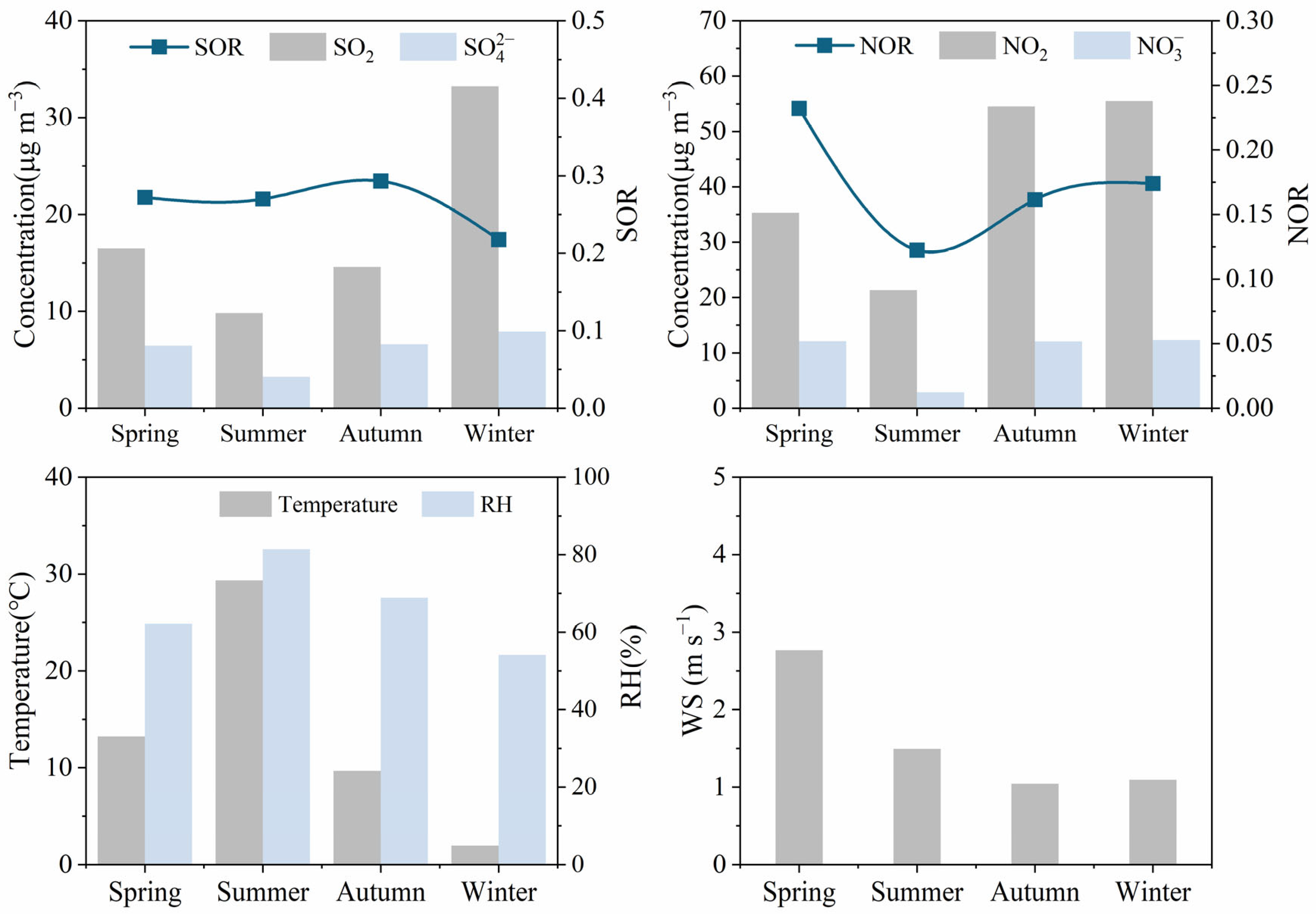
The SOR and NOR are widely used to quantify the conversion degree of gaseous SO2 and NOX to particulate SO42− and NO3 in atmospheric particles [23]. When SOR or NOR exceed 0.1, the SO42− and NO3 in atmospheric PM2.5 predominantly originate from the gas-to-particle secondary conversion of SO2 and NO2 [23]. The higher the SOR or NOR value, the greater the conversion degree of gaseous SO2 and NO2 to form secondary aerosol components. Their respective calculation equations are defined as follows:
S O R = c S O 4 2 c S O 4 2 + c S O 2
N O R = c N O 3 c N O 3 + c N O 2
where, c ( S O 4 2 ) and c ( N O 3 ) denote the mass concentrations of particulate sulfate and nitrate ions in the atmosphere. Meanwhile, c(SO2) and c(NO2) represent the mass concentrations of SO2 and NO2. The unit of c S O 4 2 , c ( N O 3 ), c(SO2) and c(NO2) was μmol/m3.

2.5. Positive Matrix Factorization (PMF)

PMF is a widely used receptor-oriented approach for particulate matter source apportionment, derived from traditional factor analysis [24]. It leverages ambient observational dataset from receptor sites to quantify the chemical profiles of potential pollution sources and their respective contributions to total ambient pollutant concentrations. First, the PMF model quantifies the uncertainty associated with each individual chemical component in particulate matter based on component-specific weights, and then identifies the dominant pollution source categories and quantifies their contribution ratios via an iterative least squares algorithm. Its core principle involves factorizing the original concentration matrix   X n m into two factor matrices, specifically the source contribution matrix G n p and the source profile matrix F p m , along with a residual matrix E n m that accounts for discrepancies between observed and modeled concentrations. The mathematical expression is defined as follows:
X n × m = k = 1 p   G n × p F p × m + E
In the formula, X n × m represents the concentration of the m-th chemical component in the n-th sample (µg/m3), while p denotes the number of identified pollution source categories (factors) derived from the analysis. Matrices Gn×p and Fp×m correspond to the source contribution matrix and the source profile matrix, respectively, with all elements restricted to non-negative values—a key constraint of the PMF algorithm that aligns with the physical meaning of source contributions and chemical profiles.
Following iterative runs of the PMF model, the optimal Q value (representing the goodness-of-fit of the model) is derived, thereby confirming the final source profile matrix (F) and the source contribution matrix ( G ) . The mathematical expression for the Q function is defined as follows:
Q = i = 1 m   j = 1 n   E i j σ i j 2
where σ i j denotes the analytical uncertainty (or standard deviation) of the j-th chemical component in the i-th sample, and E i j is the residual term between the observed and modeled concentration of the j-th component in the i-th sample data.

3. Results and Discussion

3.1. Seasonal Variation of PM2.5 Mass Concentration

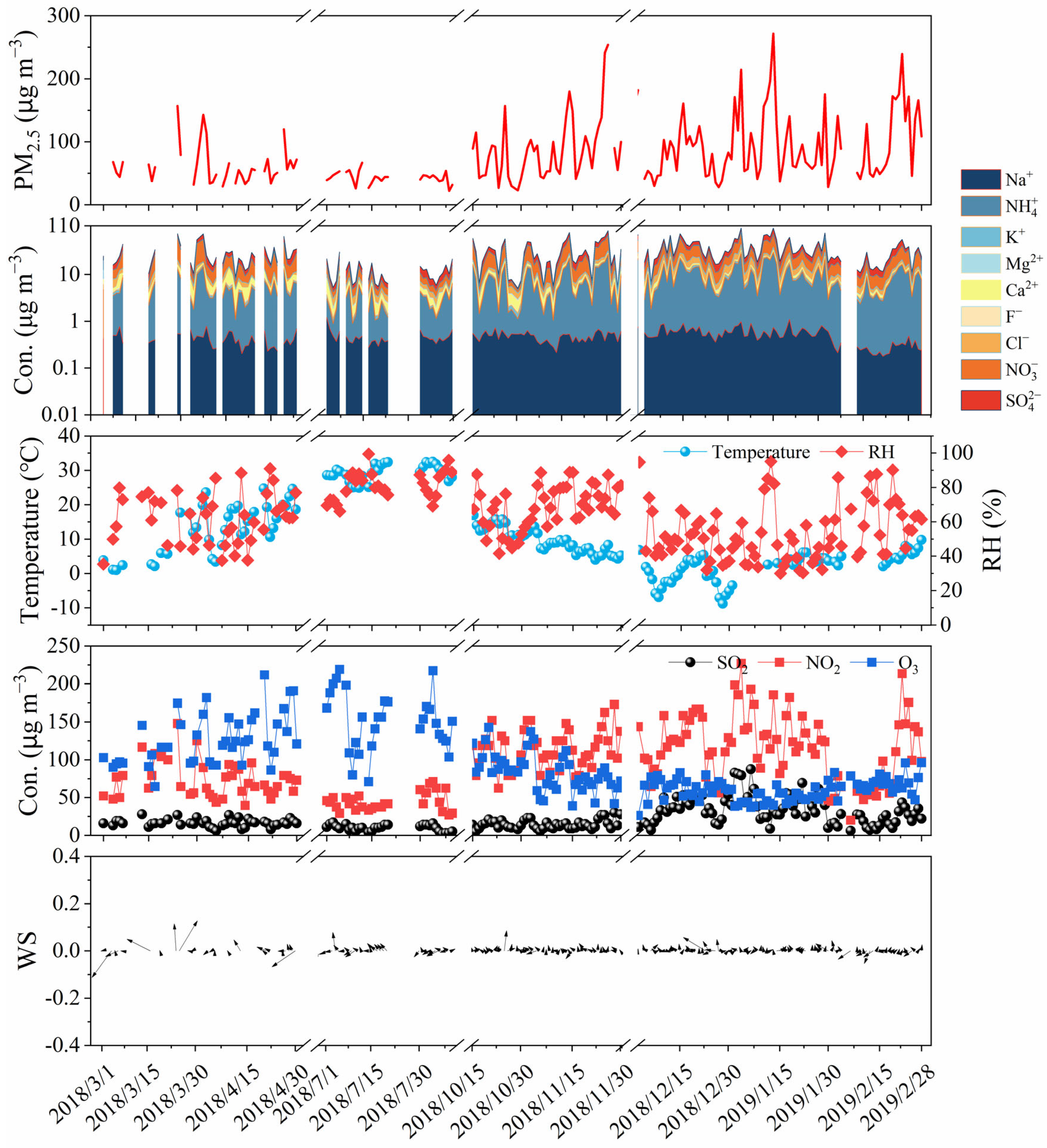
Figure 2 present the time variations of PM2.5 mass concentration, WSIIs, target gaseous pollutants, and key meteorological parameters during the sampling period. Throughout the entire observation period, the annual average value of PM2.5 in Botou was (79 ± 48) μg/m3, which is 2.26 times the annual Level II standard limit for PM2.5 (35 μg/m3) specified the National Ambient Air Quality Standard (GB 3095-2012) [25] of China and higher than the corresponding annual mean PM2.5 concentration in Beijing during the same 2018–2029 period (67 ± 60 μg/m3) [26].
The PM2.5 concentration exhibits distinct seasonal variability, with the descending order: winter (95 ± 53 μg/m3) > autumn (87 ± 50 μg/m3) > spring (63 ± 32 μg/m3) > summer (43 ± 9 μg/m3). This seasonal pattern is strongly associated with seasonal variation in meteorological conditions and anthropogenic emission. The notably elevated PM2.5 concentration in winter is mainly attributed to enhanced anthropogenic emissions driven by centralized heating. Furthermore, unfavorable atmospheric diffusion conditions promote the accumulation and transport of primary pollutants and secondary transformation of gaseous precursors [27]. Notably, the maximum daily PM2.5 concentration recorded on January 3, 2019, reached 193.42 μg/m3. The meteorological conditions on that day were characterized by an ambient relative humidity of 59% and calm wind conditions (wind speed 0.82 m/s), which further inhibited pollutant diffusion. Spring PM2.5 is also moderately elevated, mainly affected by regional dust events (e.g., sandstorms, blowing dust, and floating dust). In summer, enhanced wind speeds and increased precipitation frequency favor pollutant diffusion and wet deposition, thereby effectively lowering ambient PM2.5. The seasonal variation characteristics of PM2.5 in Botou are consistent with that of major cities in Jing-jin-ji region such as Shijiazhuang [28], reflecting the regional consistency of PM2.5 pollution drivers in Jing-jin-ji region.

3.2. Seasonal Variation of WSIIs

Figure 2 and Table 1 present the annual average concentration and seasonal variation characteristics of WSIIs. During the observation period, the annual average concentration of the total water-soluble inorganic ions in Botou was (29.67 ± 19.39) μg/m3, accounting for 44.43% of the ambient PM2.5 mass concentration, indicating a substantial contribution of WSIIs to PM2.5 mass. The individual WSIIs follow this order, in descending order of concentration: NO3 > NH4+ > SO42− > Cl > Ca2+ > K+ > Na+ > F > Mg2+. The annual average concentration of SIA was 24.51 μg/m3, accounting for about 35% of the total PM2.5 mass concentration, which are the primary components of secondary aerosols, indicating their dominant contribution to PM2.5. Specifically, NO3, SO42−, and NH4+ accounted for 15%, 10%, and 10% of the PM2.5 mass concentration, respectively. Compared with SIA, the contribution ratios of Cl, Ca2+ and K+ are relatively minor, with contribution ratios of 4%, 2%, and 1% respectively, while the proportions of Na+, F, and Mg2+ are all less than 1%.
NO3 showed the highest concentration in spring, autumn, and winter (12.07–12.32 μg/m3) and the lowest in summer (2.87 μg/m3). It is noted that the concentration variations of NO3- were much higher than its precursor NO2. The maximum concentration of NO3- was observed in autumn and winter, which was 4.31–4.21 times higher than summer, while the concentration of its precursor NO2 was 2.56–2.60 times higher in autumn and winter than in summer. The seasonal variation of NO3- concentration reflects the seasonal changes in its precursor NO2 and the seasonal impact on thermodynamic equilibrium. In summer, NOX is prone to form HNO3 through photochemical reactions, which further leads to the formation of secondary particles, as shown in Formula 5. But elevated ambient temperature enhances the thermal dissociation of ammonium nitrate (NH4NO3), and thus reduces the concentration of particulate NO3 [2]. Although the photochemical activity of the atmosphere is not strong in autumn and winter, high NO2 concentration, the relatively low temperature and certain relative humidity are conducive to the secondary formation of NO3. Gaseous HNO3 tends to react with NH3 for neutralization, and then convert into NH4NO3 under low-temperature conditions. According to the findings of Stockwell et al. [29], a study published in 2000 showed that approximately 33% (mole fraction) of the NOX emitted during winter in the San Joaquin Canyon region of central California, USA, was converted into particulate matter. Furthermore, the elevated PM2.5 concentrations in these two seasons provide increased aerosol surfaces and elevated concentrations of the gaseous precursor (NO2) concentration for nitrate heterogeneous formation reactions, thereby promoting the heterogeneous secondary formation of NO3 [30]. The comparable concentration of NO3 in spring, relative to autumn and winter, was due to a higher NOR, even though the NO2 concentration was lower (Figure 3).
N O 2 + O H + M H N O 3 + M
The seasonal variation of SO42− exhibits a variation pattern in winter (7.89 μg/m3)> autumn (6.59 μg/m3) > spring (6.46 μg/m3) > summer (3.24 μg/m3) (Table 1 and Figure 3). The SO42− concentrations in winter were 2.43 times of that in summer. The highest SO42- concentration in winter is related to enhanced emission of gaseous precursor (SO2) from residential coal combustion for winter heating. Although photochemical transformation is limited in this season, substantial SO2 can still be oxidized to generate significant amounts of SO42− via reactions in cloud/fog droplets under conditions of low temperature and certain humidity [31], as shown in Formulas 6 and 7. It has been demonstrated that elevated levels of humidity can expedite the transformation of SO2 into particulate matter, thereby amplifying the formation of SO42–. While summer exhibits higher temperatures, stronger photochemical oxidation capacity, and a higher SOR compared to other seasons, the concentration of SO42− remains lower than in other seasons. This is primarily attributable to the lower SO2 concentration in summer, further underscoring the significant influence of local SO2 on emissions on sulfate formation. The seasonal variation trend of SO42− in Botou differs from that in Beijing [32], where SO42− concentration peaks in summer and reaches its lowest in winter, largely due to the stronger SOR in summer.
S O 2 + H 2 O H + + H S O 3
H S O 3 + H 2 O 2 S O 4 2 + H + + H 2 O
The seasonal variation of NH4+ is similar to SO42−: winter (9.33 μg/m3) > autumn (7.36 μg/m3) > spring (5.08 μg/m3) > summer (2.54 μg/m3). NH4+ strongly linked to the secondary formation of the ionic species SO42− and NO3, primarily through the neutralization of acidic precursors to form ammonium salts (e.g., (NH4)2SO4, NH4NO3).
Cl and K+ exhibits similar seasonal variation pattern with highest concentration in winter (3.63 μg/m3 for Cl and 1.05 μg/m3 for K+) and the lowest in summer (1.16 μg/m3 for Cl and 0.27 μg/m3 for K+). Their concentration in spring and autumn was close. As a land-based city, the main source of Cl in Botou is coal combustion [33]. K+ mainly comes from biomass combustion [34]. The highest concentration of Cl and K+ in winter is associated with increased emissions during the heating period and stable meteorological conditions [35].
Ca2+ and Mg2+ reach their peak concentrations in spring (0.22 μg/m3 and 1.85 μg/m3), which may be related to the low precipitation, strong wind and sandstorms, or floating weather caused by the Mongolian monsoon in spring.
To further investigate the concentration levels of water-soluble ions in PM2.5 in Botou, we compare them with the concentration levels of WSIIs in PM2.5 from other cities in China, as shown in Table 2. The mass concentrations of PM2.5 and WSIIs in Botou are relatively lower than many prefecture-level cities, such as Hefei, Handan, Xi’an, Taiyuan, and Urumqi.

3.3. Existing Formation of SIA

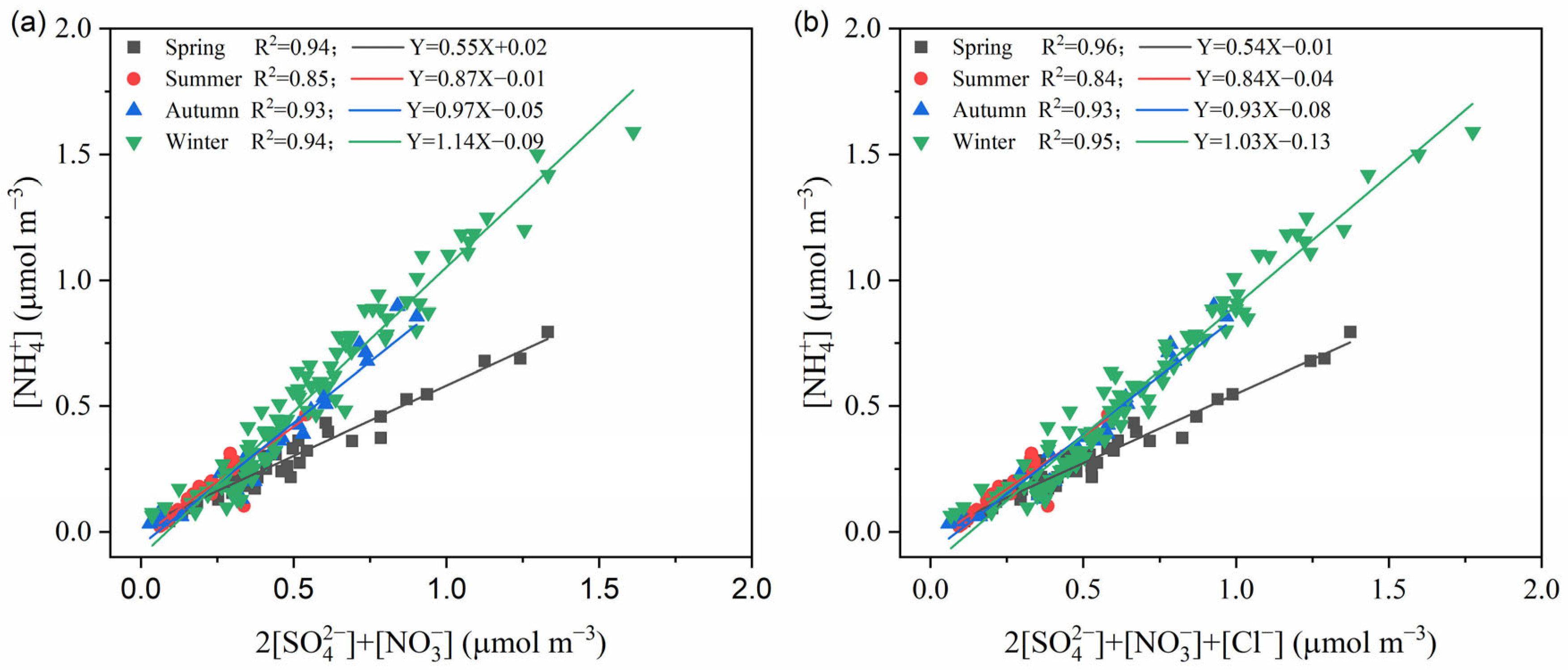
Research has demonstrated that NH4+ is the most important alkaline ion in PM2.5. The initial step in the process involves the combination of the acidic ion SO42− with (NH4)2SO4 and NH4HSO4. Thereafter, the remaining NH4+ reacts with NO3 and Cl ions [39]. In all four seasons of Botou, the molar concentration ratios of NH4+ to SO42− are all greater than 2, being 2.10, 2.09, 2.98, and 3.15 respectively, indicating the PM2.5 was ammonia-rich state. This finding suggests that the presence of SO42− and NH4+ is indicative of a complete combination reaction, resulting in the formation of (NH4)2SO4. This process is accompanied by the retention of excess NH4+. To further analyze the existing forms of ammonium salts in Botou across the four seasons, we examine the correlations between [NH4+] and 2[SO42−] + [NO3] (Figure 4). In spring and summer, a robust correlation is observed between [NH4+] and the combined concentrations of [SO42−] + [NO3]. The slopes of the fitting curves were 0.55 and 0.87 respectively, suggesting that [SO42−] and [NO3] are in excess while the cation [NH4+] is insufficient in these two seasons. Thus, ammonium salts mainly exist in the forms of (NH4)2SO4 and NH4NO3 in these two seasons, and the remaining [SO42−] and [NO3] may react with other cations. In autumn, the slope between [NH4+] and 2[SO42−] + [NO3] is 0.97, which is close to 1, meaning ammonium salts primarily exist as (NH4)2SO4 and NH4NO3. During the winter months, the slope increases to 1.14, suggesting an excess of NH4+. Meanwhile, the slope of the fitting curve between [NH4+] and 2[SO42−] + [NO3] + [Cl] is 1.03, which is proximate to 1. This suggests that ammonium salts in winter mainly exist in the forms of (NH4)2SO4, NH4NO3, and NH4Cl.

3.4. Analysis of WSIIs Sources

3.4.1. NO3/SO42− Ratio

SO42−, a constituent of atmospheric composition, is predominantly derived from the secondary transformation of SO2 and emissions resulting from coal combustion [41]. NO3 is principally derived from the secondary transformation of NO2 in exhaust gases emitted by vehicles and other means of transportation [32]. Therefore, the ratio of these two ions can be used to compare the contribution of mobile sources and stationary sources to nitrogen and sulfur in the atmosphere [42,43]. During the study period, the seasonal variation characteristics of the NO3/SO42− ratio exhibited the following order of magnitude: spring (1.9) > autumn (1.7) > winter (1.5) > summer (0.9). The ratio of NO3/SO42− during spring, autumn and winter is all greater than 1, indicating that the contribution of mobile sources is greater than that of stationary sources in these seasons. In contrast, the ratio in summer was less than 1, which may be attributable to the decomposition and volatilization of nitrate induced by the elevated temperatures characteristic of the summer season. This process results in a decline in the NO3 concentration. Furthermore, elevated temperatures and humidity levels during the summer months promote the formation of SO42−, thereby further diminishing the NO3/SO42− ratio [44]. In this study, the concentration level of NO3- was generally higher than that of SO42-. This finding suggests that the regulatory measures implemented in Botou, including the oversight of coal-fired enterprises such as power plants and heating facilities, along with the management of dispersed coal combustion by residents in surrounding rural areas, have yielded initial outcomes. The issue of SO2 emissions have been effectively controlled. However, NOX pollution, mainly from motor vehicle emissions, remains at a relatively high level [45].

3.4.2. Ion Correlation Analysis

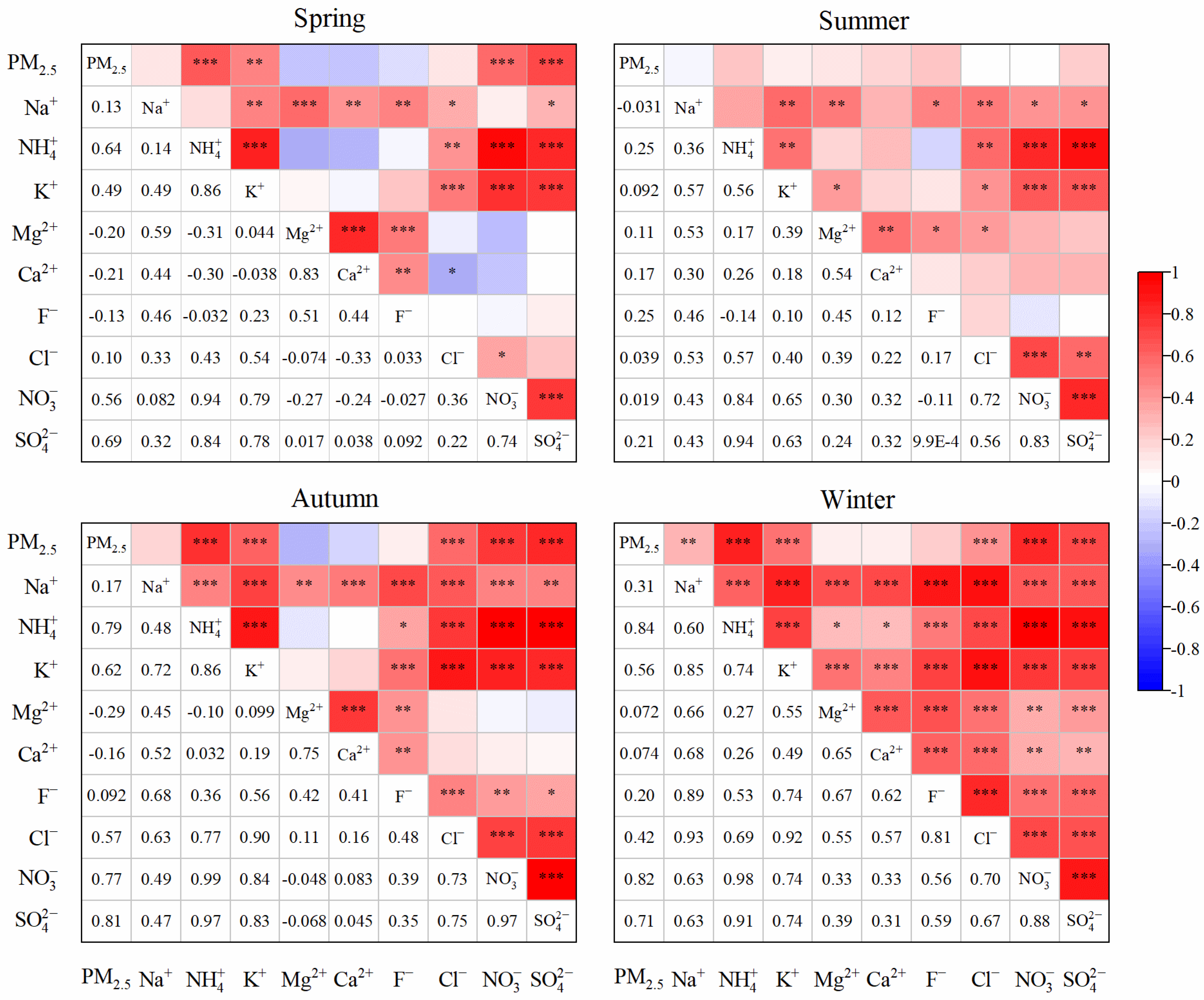
In order to more thoroughly investigate the sources of WSIIs in PM2.5 of Botou and the correlation characteristics between each ion, this study conducts a correlation analysis on WSIIs. As shown in Figure 5, SIA exhibites significant correlations in all four seasons (correlation coefficients all greater than 0.8), indicating that the primary pollution sources and secondary transformation accumulation processes of the three ions are similar. In addition, SIA has been shown to exhibit a notable correlation with PM2.5 in autumn and winter, which suggests that secondary conversion has a significant impact on the formation of PM2.5 [46]. NH4+ demonstrates a substantial correlation with SO42−, NO3, and Cl throughout the year. This phenomenon may attributed to the propensity of NH4+ to form complexes with SO42− and NO3. And the excess NH4+ combines with Cl to form NH4Cl, which is consistent with the previous analysis. Ca2+ is a tracer for construction and road dust [47]. A significant correlation has been observed between Ca2+ and Mg2+ in all four seasons, implying that these two ions may have a common origin, potentially derived from dust sources such as soil and construction activities. A moderate correlation between K+ and Cl was observed in summer, with a coefficient of determination of r = 0.4. This correlation was found to be significant in other seasons as well. This result suggests that these two water-soluble ions may have the same sources throughout the year, such as biomass burning sources, mineral dust, and fossil fuel combustion sources [48]. Throughout the year, Na+ and Cl exhibit a relationship characterized by the shared presence of a common source, which may be attributed to sea salt or sea fog. K+ and Ca2+ only show a certain correlation in winter with a relatively low correlation coefficient, and no obvious correlation is observed in the other three seasons. This indicates that although mineral dust contributes to the source of K+, it is not the main source of K+. There is no significant correlation in the other three seasons. Although mineral dust contributes to the source of K+, it is not its main source.

3.4.3. PMF Analysis

Based on the EPAPM5.0 software, this study conducts source apportionment of WSIIs during the observation period and identifies four main pollution source factors. As shown in Figure 6, the PMF model results indicate that the measured total mass concentration of WSIIs has a high correlation with the fitted total mass concentration of WSIIs (R2 = 0.98). The ratio of Q target value to Q theoretical value is 1.05, which proves that the source apportionment results obtained in this study are reasonable.
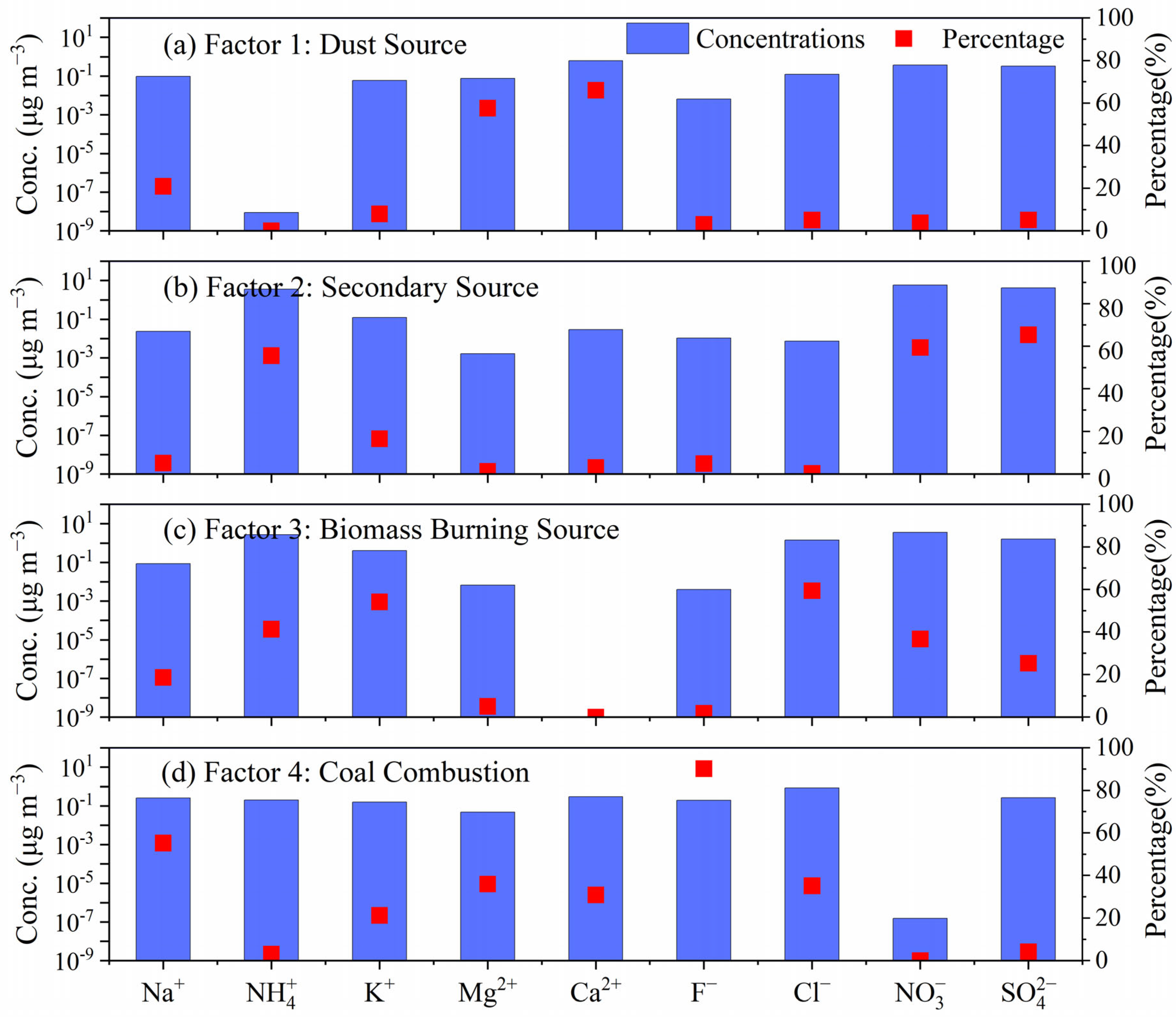
In factor 1, the contributions of Ca2+ (66%) and Mg2+ (58%) are significant. The presence of these two ions is typically attributed to construction, soil disturbance, and road dust emissions [49,50]. Therefore, factor 1 is identified as the dust source. In factor 2, SO42− (65%), NO3 (59%), and NH4+ (56%) have relatively high contribution. These ions mainly come from the secondary conversion process of pollutants such as SO2 and NOX [51,52]. Therefore, factor 2 is regarded as the secondary source. Factor 3 is characterized by the highest contributions of Cl (59%) and K+ (54%), while NO3 (37%) and SO42− (25%) also have relatively large contributions. It is important to note that K+ is frequently utilized as a tracer ion in the study of biomass burning [53]. The KCl produced by biomass burning may react with NO3- and SO42− form K2SO4 and KNO3 during atmospheric transport. Factor 3 is thus classified as the biomass burning source. Finally, factor 4 demonstrates the highest proportion of F (90%), while Na+ (55%), Cl (35%), and Mg2+ (36%) also account for a considerable proportion. It has been determined that F is mainly derived from waste incineration and coal combustion activities. Consequently, factor 4 is identified as the coal combustion source.
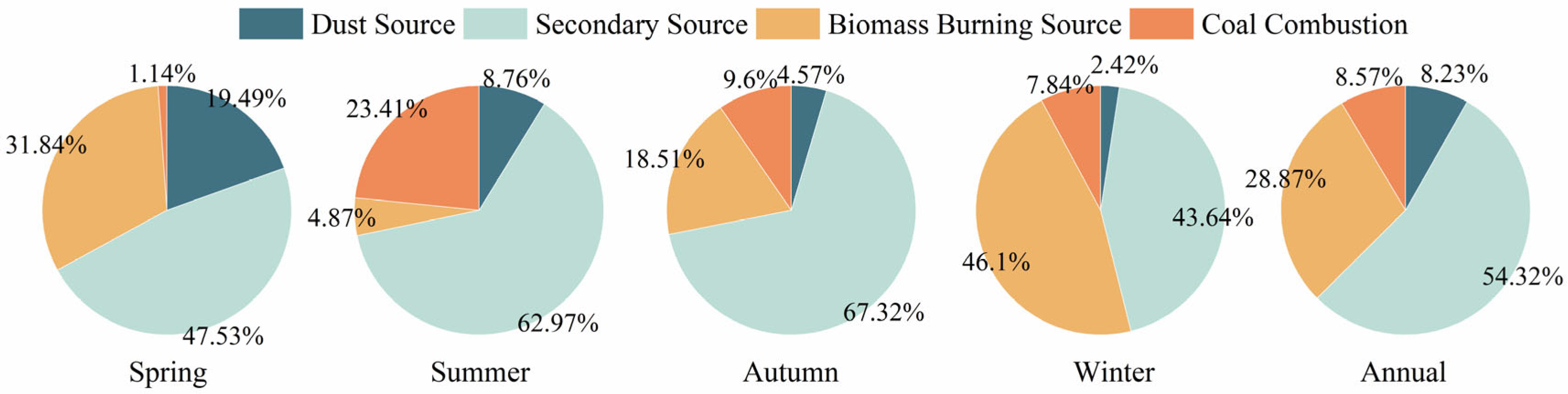
A notable seasonal variation is evident in the contribution of different pollution sources to PM2.5 in Botou, as shown in Figure 7. The secondary source accounts for a relatively high proportion in all seasons with the high proportion in autumn reaching 67.32%, while it drops to 43.64% in winter. This trend indicates that the secondary source makes a particularly significant contribution to PM2.5 in Botou highlighting that the control of precursor substances of secondary pollutants is the key to improving the air quality in Botou. The contribution of the biomass burning source is relatively prominent in spring and winter, accounting for 31.84% and 46.1%. The contribution exhibits a minimum in the summer months, with a contribution of 4.87%. This phenomenon may be associated with the substantial incineration of crop residue during the spring and winter seasons. This results in an augmented contribution from biomass burning sources during these periods. The contribution of coal combustion source is the highest in summer (accounting for 23.4%) and the lowest in spring (accounting for 1.14%). The predominant rationale for the increased proportion of coal combustion source during summer may is likely associated with the diminished contribution of biomass burning. The decline in straw burning during the summer months has led to an increase in the contribution of coal combustion as a source of air pollutants. In addition, the seasonal variation of dust source shows a relatively high proportion in spring, reaching 19.49%. This phenomenon may be attributed to the recurrent occurrence of sandstorms during the spring months, which leads to an augmented contribution of dust particles to the PM2.5 concentration.
To summarize, the atmospheric pollution in Botou exhibits a multifaceted pattern of contamination, with dust source contributing 8.2%, secondary source accounting for 54.3%, biomass burning source representing 28.9%, and coal combustion source representing 8.6%. A comprehensive review of the extant literature reveals that secondary source has been identified as the most significant contributor to fine particulate matter, a finding consistent with research results from Xi’an [6] and Lüliang [54]. This finding underscores the pivotal role of emission reduction and control measures for the gaseous precursors of secondary sources are the key to tackling Botou’s atmospheric pollution. In addition, biomass burning makes a significant contribution in winter and spring seasons. It is recommended to strengthen the management of crop straw burning during these two seasons to reduce the contribution of biomass burning to PM2.5. The implementation of targeted control strategies has been identified as a pivotal approach for effectively mitigating PM2.5 concentrations in Botou, thereby enhancing the city’s air quality.

4. Conclusions

The annual average mass concentration of PM2.5 is (79 ± 48) μg/m3 during the observation period. The PM2.5 demonstrate a marked seasonal variation, characterized by the following descending order: winter > autumn > spring > summer. The total concentration of WSIIs is highest in winter and lowest in summer, which is mainly associated with winter heating activities and unfavorable atmospheric diffusion conditions. The sum of SO42−, NO3, and NH4+ constitute 35± 4% of PM2.5 mass. The proportion of secondary aerosols is notably high, indicating their dominant contribution. This result underscores the necessity to prioritize the management of their precursor substances, including SO2, NO2, and NH3, in order to effectively address the issue of air quality. PM2.5 in Botou has been determined to be an ammonia-rich state on an annual average basis. The ammonium salts have been identified as (NH4)2SO4 and NH4NO3 in spring, summer, and autumn, while it also can exist as (NH4Cl) in winter. The NO3/SO42− ratio indicates that the contribution of mobile sources in Botou is greater than that of stationary sources in spring, autumn, and winter. This shows that NOX pollution remains at a relatively high level. Throughout the year, significant correlations have been observed among SIA components, with all components demonstrating notable associations with PM2.5. These findings suggest a predominant relationship between PM2.5 and the secondary generation of aerosols. PMF analysis shows that the air pollution in Botou is characterized by a mixed pollution pattern dominated by secondary source, biomass burning source, coal combustion source and dust source. Among them, secondary source is the main source, so emission reduction and control measures for gaseous precursors (NH3, NO2 and SO2) from secondary source are the key to controlling air pollution in this region. Subsequent research should integrate meteorological parameters (relative humidity, temperature), aerosol water content, and aerosol acidity to thoroughly investigate the formation mechanisms and influencing factors of SIA. Moreover, this study concentrated on water-soluble ions; henceforth, endeavors should incorporate carbon components and inorganic elements to systematically examine changes in the chemical characteristics of PM2.5.

Author Contributions

S.G. (Shuangyun Guo) analyzed the data. L.R. designed the study, performed data observation and processing. Y.X. guided and revised the structural content of the dissertation. S.G. (Shuangyun Guo) and L.R. wrote the manuscript. Y.G., X.Y., G.L., S.G. (Shuang Gao), Q.M. and Y.S. revised the structural content of the dissertation. All authors participated in relevant scientific discussions and provided comments on the manuscript. All authors have read and agreed to the published version of the manuscript.

Funding

This work was supported by the Jing–Jin–Ji Regional Integrated Environmental Improvement-National Science and Technology Major Project of Ministry of Ecology and Environment of China (No. 2025ZD1201100).

Institutional Review Board Statement

Not applicable.

Informed Consent Statement

Not applicable.

Data Availability Statement

The data presented in this study are available on request from the corresponding author.

Conflicts of Interest

The authors declare no conflicts of interest.

Abbreviations

WSIIswater-soluble inorganic ions
PMFPositive Matrix Factorization
BTHBeijing–Tianjin–Hebei
SORSulfur Oxidation Ratio
NORNitrogen Oxidation Ratio
SIAsecondary inorganic aerosols

References

  1. Ministry of Ecology and Environment of the People’s Republic of China. 2022 China Ecological and Environmental Status Bulletin; Ministry of Ecology and Environment of the People’s Republic of China: Beijing, China, 2023.
  2. He, Q.; Yan, Y.; Guo, L.; Zhang, Y.; Zhang, G.; Wang, X. Characterization and source analysis of water-soluble inorganic ionic species in PM2.5 in Taiyuan city, China. Atmos. Res. 2017, 184, 48–55. [Google Scholar] [CrossRef]
  3. Liu, Z.; Xie, Y.; Hu, B.; Wen, T.; Xin, J.; Li, X.; Wang, Y. Size-resolved aerosol water-soluble ions during the summer and winter seasons in Beijing: Formation mechanisms of secondary inorganic aerosols. Chemosphere 2017, 183, 119–131. [Google Scholar] [CrossRef] [PubMed]
  4. Carslaw, K.S.; Lee, L.A.; Reddington, C.L.; Pringle, K.J.; Rap, A.; Forster, P.M.; Mann, G.W.; Spracklen, D.V.; Woodhouse, M.T.; Regayre, L.A. Large contribution of natural aerosols to uncertainty in indirect forcing. Nature 2013, 503, 67–71. [Google Scholar] [CrossRef]
  5. Zhao, P.S.; Dong, F.; He, D.; Zhao, X.J.; Zhang, X.L.; Zhang, W.Z.; Yao, Q.; Liu, H.Y. Characteristics of concentrations and chemical compositions for PM2.5 in the region of Beijing, Tianjin, and Hebei, China. Atmos. Chem. Phys. 2013, 13, 4631–4644. [Google Scholar] [CrossRef]
  6. Li, J.; Ren, L.; Wu, Y.; Zhang, R.; Yang, X.; Li, G.; Gao, E.; An, J.; Xu, Y. Different variations in PM2.5 sources and their specific health risks in different periods in a heavily polluted area of the Beijing-Tianjin-Hebei region of China. Atmos. Res. 2024, 308, 107519. [Google Scholar] [CrossRef]
  7. Ryoo, I.; Ren, L.; Li, G.; Zhou, T.; Wang, M.; Yang, X.; Kim, T.; Cheong, Y.; Kim, S.; Chae, H.; et al. Effects of seasonal management programs on PM2.5 in Seoul and Beijing using DN-PMF: Collaborative efforts from the Korea-China joint research. Environ. Int. 2024, 191, 108970. [Google Scholar] [CrossRef]
  8. Chansuebsri, S.; Kraisitnitikul, P.; Wiriya, W.; Chantara, S. Fresh and aged PM2.5 and their ion composition in rural and urban atmospheres of Northern Thailand in relation to source identification. Chemosphere 2022, 286, 131803. [Google Scholar] [CrossRef] [PubMed]
  9. Huang, X.; Liu, Z.; Zhang, J.; Zhang, J.; Wen, T.; Ji, D.; Wang, Y. Seasonal variation and secondary formation of size-segregated aerosol water-soluble inorganic ions during pollution episodes in Beijing. Atmos. Res. 2016, 168, 70–79. [Google Scholar] [CrossRef]
  10. Zhang, L.; Chen, Z.; Hao, Z.; Chen, Q. On the characteristics of solar radiative transfer and participating media in Harbin, China. J. Photonics Energy 2019, 10, 023504. [Google Scholar] [CrossRef]
  11. Tang, J.; Yang, Z.; Tui, Y.; Wang, J. Fine particulate matter pollution characteristics and source apportionment of Changchun atmosphere. Environ. Sci. Pollut. Res. 2022, 29, 12694–12705. [Google Scholar] [CrossRef]
  12. Yi, H.; Li, D.; Li, J.; Xu, L.; Huang, Z.; Xiao, H.; Tong, L. The Interrelated Pollution Characteristics of Atmospheric Speciated Mercury and Water-Soluble Inorganic Ions in Ningbo, China. Atmosphere 2023, 14, 1594. [Google Scholar] [CrossRef]
  13. Han, C.; Xu, R.; Gao, C.X.; Yu, W.; Zhang, Y.; Han, K.; Yu, P.; Guo, Y.; Li, S. Socioeconomic disparity in the association between long-term exposure to PM2.5 and mortality in 2640 Chinese counties. Environ. Int. 2021, 146, 106241. [Google Scholar] [CrossRef]
  14. Wang, W.; Chen, C.; Liu, D.; Wang, M.; Han, Q.; Zhang, X.; Feng, X.; Sun, A.; Mao, P.; Xiong, Q.; et al. Health risk assessment of PM2.5 heavy metals in county units of northern China based on Monte Carlo simulation and APCS-MLR. Sci. Total Environ. 2022, 843, 156777. [Google Scholar] [CrossRef]
  15. Wang, L.; Xiong, Q.; Wu, G.; Gautam, A.; Jiang, J.; Liu, S.; Zhao, W.; Guan, H. Spatio-Temporal Variation Characteristics of PM2.5 in the Beijing–Tianjin–Hebei Region, China, from 2013 to 2018. Int. J. Environ. Res. Public Health 2019, 16, 4276. [Google Scholar] [CrossRef]
  16. Yang, Y.; Zhou, R.; Yu, Y.; Yan, Y.; Liu, Y.; Di, Y.; Wu, D.; Zhang, W. Size-resolved aerosol water-soluble ions at a regional background station of Beijing, Tianjin, and Hebei, North China. J. Environ. Sci. 2017, 55, 146–156. [Google Scholar] [CrossRef] [PubMed]
  17. Ran, Z.; Wang, X.; Yin, X.; Liu, Y.; Han, M.; Cheng, Y.; Han, J.; Jin, T. Comparison of PM2.5 components and secondary formation during the heavily polluted period of two megacities in China. Int. J. Environ. Sci. Technol. 2024, 21, 885–894. [Google Scholar] [CrossRef]
  18. Zhang, Q.; Yang, L.; Peng, J.; Wu, L.; Mao, H. Characteristics, sources, and health risks of inorganic elements in PM2.5 and PM10 at Tianjin Binhai international airport. Environ. Pollut. 2023, 332, 121988. [Google Scholar] [CrossRef]
  19. Wang, C.; Hui, F.; Wang, Z.; Zhu, X.; Zhang, X. Chemical characteristics of size-fractioned particles at a suburban site in Shijiazhuang, North China: Implication of secondary particle formation. Atmos. Res. 2021, 259, 105680. [Google Scholar] [CrossRef]
  20. Pang, N.; Gao, J.; Zhao, P.; Wang, Y.; Xu, Z.; Chai, F. The impact of fireworks control on air quality in four Northern Chinese cities during the Spring Festival. Atmos. Environ. 2021, 244, 117958. [Google Scholar] [CrossRef]
  21. HJ 800-2016; Ambient Air-Determination of the Water Soluble Cations (Li+, Na+, NH4+, K+, Ca2+, Mg2+) from Atmospheric Particles Ion Chromatography. China Environmental Science Press: Beijing, China, 2016.
  22. HJ 799-2016; Ambient Air-Determination of the Water Soluble Anions (F, Cl, Br, NO2, NO3, PO43−, SO32−, SO42−) from Atmospheric Particles-Ion Chromatography. China Environmental Science Press: Beijing, China, 2016.
  23. Pierson, W.R.; Brachaczek, W.W.; Mckee, D.E. Sulfate Emissions from Catalyst-Equipped Automobiles on the Highway. J. Air Pollut. Control. Assoc. 1979, 29, 255–257. [Google Scholar] [CrossRef]
  24. Hopke, P.K.; Dai, Q.; Li, L.; Feng, Y. Global review of recent source apportionments for airborne particulate matter. Sci. Total Environ. 2020, 740, 140091. [Google Scholar] [CrossRef]
  25. GB 3095-2012; Ambient Air Quality Standards. China Environmental Science Press: Beijing, China, 2012.
  26. Luo, L.; Bai, X.; Liu, S.; Wu, B.; Liu, W.; Lv, Y.; Guo, Z.; Lin, S.; Zhao, S.; Hao, Y. Fine particulate matter (PM2.5/PM1.0) in Beijing, China: Variations and chemical compositions as well as sources. J. Environ. Sci. 2022, 121, 187–198. [Google Scholar] [CrossRef]
  27. Wen, W.; Cheng, S.; Liu, L.; Chen, X.; Wang, X.; Wang, G.; Li, S. PM2.5 Chemical Composition Analysis in Different Functional Subdivisions in Tangshan, China. Aerosol Air Qual. Res. 2016, 16, 1651–1664. [Google Scholar] [CrossRef]
  28. Xie, Y.; Liu, Z.; Wen, T.; Zhang, Z.; Zheng, N.; Fang, X.; Xiao, H. Characteristics of chemical composition and seasonal variations of PM2.5 in Shijiazhuang, China: Impact of primary emissions and secondary formation. Sci. Total Environ. 2019, 677, 215–229. [Google Scholar] [CrossRef] [PubMed]
  29. Stockwell, W.R.; Watson, J.G.; Robinson, N.F.; Steiner, W.; Sylte, W.W. The ammonium nitrate particle equivalent of NOX emissions for wintertime conditions in Central California’s San Joaquin Valley. Atmos. Environ. 2000, 34, 4711–4717. [Google Scholar] [CrossRef]
  30. Yang, J.; Wang, S.; Zhang, R.; Yin, S. Elevated particle acidity enhanced the sulfate formation during the COVID-19 pandemic in Zhengzhou, China. Environ. Pollut. 2022, 296, 118716. [Google Scholar] [CrossRef]
  31. Zhang, Y.; Huang, W.; Cai, T.; Fang, D.; Wang, Y.; Song, J.; Hu, M.; Zhang, Y. Concentrations and chemical compositions of fine particles (PM2.5) during haze and non-haze days in Beijing. Atmos. Res. 2016, 174–175, 62–69. [Google Scholar] [CrossRef]
  32. Gao, J.; Wang, K.; Wang, Y.; Liu, S.; Zhu, C.; Hao, J.; Liu, H.; Hua, S.; Tian, H. Temporal-spatial characteristics and source apportionment of PM2.5 as well as its associated chemical species in the Beijing-Tianjin-Hebei region of China. Environ. Pollut. 2018, 233, 714–724. [Google Scholar] [CrossRef] [PubMed]
  33. Deng, M.; Chen, D.; Zhang, G.; Cheng, H. Policy-driven variations in oxidation potential and source apportionment of PM2.5 in Wuhan, central China. Sci. Total Environ. 2022, 853, 158255. [Google Scholar] [CrossRef]
  34. Thurston, G.D.; Ito, K.; Lall, R. A source apportionment of U.S. fine particulate matter air pollution. Atmos. Environ. 2011, 45, 3924–3936. [Google Scholar] [CrossRef]
  35. Xie, Y.; Lu, H.; Yi, A.; Zhang, Z.; Zheng, N.; Fang, X.; Xiao, H. Characterization and source analysis of water–soluble ions in PM2.5 at a background site in Central China. Atmos. Res. 2020, 239, 104881. [Google Scholar] [CrossRef]
  36. Deng, X.-l.; Shi, C.-e.; Wu, B.-w.; Yang, Y.; Jin, Q.; Wang, H.; Zhu, S.; Yu, C. Characteristics of the water-soluble components of aerosol particles in Hefei, China. J. Environ. Sci. 2016, 42, 32–40. [Google Scholar] [CrossRef]
  37. Meng, C.C.; Wang, L.T.; Zhang, F.F.; Wei, Z.; Ma, S.M.; Ma, X.; Yang, J. Characteristics of concentrations and water-soluble inorganic ions in PM2.5 in Handan City, Hebei province, China. Atmos. Res. 2016, 171, 133–146. [Google Scholar] [CrossRef]
  38. Wang, Z.; Wang, R.; Wang, J.; Wang, Y.; McPherson Donahue, N.; Tang, R.; Dong, Z.; Li, X.; Wang, L.; Han, Y. The seasonal variation, characteristics and secondary generation of PM2.5 in Xi’an, China, especially during pollution events. Environ. Res. 2022, 212, 113388. [Google Scholar] [CrossRef]
  39. Liu, K.; Ren, J. Seasonal characteristics of PM2.5 and its chemical species in the northern rural China. Atmos. Pollut. Res. 2020, 11, 1891–1901. [Google Scholar] [CrossRef]
  40. Li, K.; Talifu, D.; Gao, B.; Zhang, X.; Wang, W.; Abulizi, A.; Wang, X.; Ding, X.; Liu, H.; Zhang, Y. Temporal Distribution and Source Apportionment of Composition of Ambient PM2.5 in Urumqi, North-West China. Atmosphere 2022, 13, 781. [Google Scholar] [CrossRef]
  41. Cheng, C.; Shi, M.; Liu, W.; Mao, Y.; Hu, J.; Tian, Q.; Chen, Z.; Hu, T.; Xing, X.; Qi, S. Characteristics and source apportionment of water-soluble inorganic ions in PM2.5 during a wintertime haze event in Huanggang, central China. Atmos. Pollut. Res. 2021, 12, 111–123. [Google Scholar] [CrossRef]
  42. Erdős, G.; Balogh, A. Statistical properties of mirror mode structures observed by Ulysses in the magnetosheath of Jupiter. J. Geophys. Res. Space Phys. 1996, 101, 1–12. [Google Scholar] [CrossRef]
  43. Yao, X.; Chan, C.K.; Fang, M.; Cadle, S.; Chan, T.; Mulawa, P.; He, K.; Ye, B. The water-soluble ionic composition of PM2.5 in Shanghai and Beijing, China. Atmos. Environ. 2002, 36, 4223–4234. [Google Scholar] [CrossRef]
  44. Wang, H.; Tian, M.; Chen, Y.; Shi, G.; Liu, Y.; Yang, F.; Zhang, L.; Deng, L.; Yu, J.; Peng, C. Seasonal characteristics, formation mechanisms and source origins of PM2.5 in two megacities in Sichuan Basin, China. Atmos. Chem. Phys. 2018, 18, 865–881. [Google Scholar] [CrossRef]
  45. Masiol, M.; Hopke, P.K.; Felton, H.D.; Frank, B.P.; Rattigan, O.V.; Wurth, M.J.; LaDuke, G.H. Analysis of major air pollutants and submicron particles in New York City and Long Island. Atmos. Environ. 2017, 148, 203–214. [Google Scholar] [CrossRef]
  46. Sun, Z.; Zong, Z.; Tian, C.; Li, J.; Sun, R.; Ma, W.; Li, T.; Zhang, G. Reapportioning the sources of secondary components of PM2.5: A combined application of positive matrix factorization and isotopic evidence. Sci. Total Environ. 2021, 764, 142925. [Google Scholar] [CrossRef]
  47. Zhou, J.; Xing, Z.; Deng, J.; Du, K. Characterizing and sourcing ambient PM2.5 over key emission regions in China I: Water-soluble ions and carbonaceous fractions. Atmos. Environ. 2016, 135, 20–30. [Google Scholar] [CrossRef]
  48. Liu, H.; Zheng, J.; Qu, C.; Zhang, J.; Wang, Y.; Zhan, C.; Yao, R.; Cao, J. Characteristics and Source Analysis of Water-Soluble Inorganic Ions in PM10 in a Typical Mining City, Central China. Atmosphere 2017, 8, 74. [Google Scholar] [CrossRef]
  49. Huang, X.; Liu, Z.; Liu, J.; Hu, B.; Wen, T.; Tang, G.; Zhang, J.; Wu, F.; Ji, D.; Wang, L. Chemical characterization and source identification of PM2.5 at multiple sites in the Beijing–Tianjin–Hebei region, China. Atmos. Chem. Phys. 2017, 17, 12941–12962. [Google Scholar] [CrossRef]
  50. Liu, H.; Tian, H.; Zhang, K.; Liu, S.; Cheng, K.; Yin, S.; Liu, Y.; Liu, X.; Wu, Y.; Liu, W. Seasonal variation, formation mechanisms and potential sources of PM2.5 in two typical cities in the Central Plains Urban Agglomeration, China. Sci. Total Environ. 2019, 657, 657–670. [Google Scholar] [CrossRef] [PubMed]
  51. Kurokawa, J.; Ohara, T. Long-term historical trends in air pollutant emissions in Asia: Regional Emission inventory in ASia (REAS) version 3. Atmos. Chem. Phys. 2020, 20, 12761–12793. [Google Scholar] [CrossRef]
  52. Liu, B.; Song, N.; Dai, Q.; Mei, R.; Sui, B.; Bi, X.; Feng, Y. Chemical composition and source apportionment of ambient PM2.5 during the non-heating period in Taian, China. Atmos. Res. 2016, 170, 23–33. [Google Scholar] [CrossRef]
  53. Yamasoe, M.A.; Artaxo, P.; Miguel, A.H.; Allen, A.G. Chemical composition of aerosol particles from direct emissions of vegetation fires in the Amazon Basin: Water-soluble species and trace elements. Atmos. Environ. 2000, 34, 1641–1653. [Google Scholar] [CrossRef]
  54. Liu, T.; Mu, L.; Li, X.; Li, Y.; Liu, Z.; Jiang, X.; Feng, C.; Zheng, L. Characteristics and source apportionment of water-soluble inorganic ions in atmospheric particles in Lvliang, China. Environ. Geochem. Health 2023, 45, 4203–4217. [Google Scholar] [CrossRef] [PubMed]
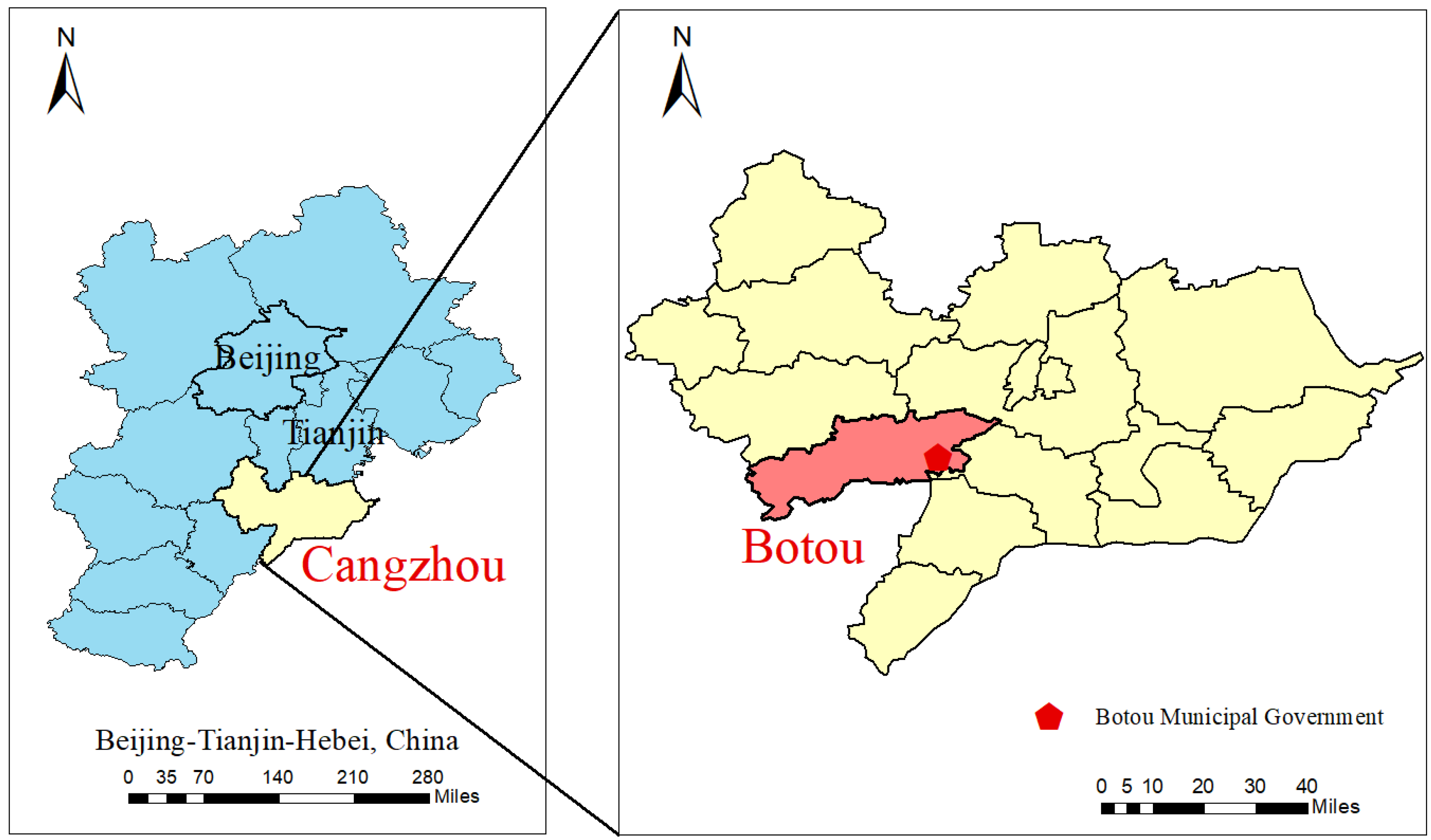
Figure 1. Distribution map of sampling point.
Toxics 14 00017 g001
Figure 2. Time series of PM2.5 mass concentration, WSIIs, gaseous pollutants, and meteorological paremeters at sampling site.
Toxics 14 00017 g002
Figure 3. Seasonal distribution of SOR and NOR in Botou.
Toxics 14 00017 g003
Figure 4. Scatter plots of [NH4+] V.S. (2[SO42−] + [NO3]) (a) and [NH₄₊] V.S. (2[SO₄²⁻] + [NO₃⁻] + [Cl]) (b) in different seasons.
Toxics 14 00017 g004
Figure 5. Spearman correlations of PM2.5 and water-soluble ions. Note: * indicates significance: * indicates p < 0.05; ** indicates p < 0.01; *** indicates p < 0.001.
Toxics 14 00017 g005
Figure 6. PM2.5 factor spectrum in Botou.
Toxics 14 00017 g006
Figure 7. Sources apportionment of water-soluble ions in different seasons in Botou.
Toxics 14 00017 g007
Table 1. Seasonal variation of water-soluble ion composition in PM2.5 (μg/m3).
ComponentAnnualSpringSummerAutumnWinter
Na+0.48 ± 0.170.42 ± 0.140.47 ± 0.170.48 ± 0.110.51 ± 0.21
Cl2.51 ± 1.791.83 ± 0.921.16 ± 0.161.91 ± 0.843.63 ± 2.13
Ca2+1.04 ± 0.821.85 ± 1.310.88 ± 0.631.00 ± 0.340.71 ± 0.35
Mg2+0.14 ± 0.090.25 ± 0.120.12 ± 0.050.11 ± 0.030.11 ± 0.04
K+0.78 ± 0.480.71 ± 0.320.27 ± 0.090.66 ± 0.311.05 ± 0.53
NH4+7.02 ± 5.695.08 ± 3.002.54 ± 1.927.36 ± 6.069.33 ± 6.11
F0.22 ± 0.110.06 ± 0.060.24 ± 0.040.28 ± 0.050.26 ± 0.09
NO310.86 ± 8.7212.08 ± 9.532.87 ± 1.8812.07 ± 9.3212.32 ± 7.87
SO42−6.63 ± 4.076.46 ± 3.843.24 ± 2.046.59 ± 4.077.89 ± 4.01
SIA/WSIIs (%) 78 ± 1178 ± 1069 ± 1178 ± 1581 ± 7
SIA/PM2.5 (%)35 ± 1445 ± 1525 ± 1329 ± 1438 ± 12
WSIIs/PM2.5 (%)44 ± 1657 ± 1635 ± 1535 ± 1447 ± 14
Table 2. Mass concentration of WSIIs and PM2.5 in Botou and other cities (μg/m3).
SitesSampling TimePM2.5FClNO3SO42−Na+NH4+K+Mg2+Ca2+
Botou2018.3–2019.279.15 ± 48.440.22 ± 0.112.51 ± 1.7910.86 ± 8.726.63 ± 4.070.48 ± 0.177.02 ± 5.690.78 ± 0.480.14 ± 0.091.04 ± 0.82
Hefei [36]2012.9–2013.886.29/1.2115.1415.560.487.820.960.305.24
Handan [37]2013139.4/4.420.625.20.713.01.80.11.0
Handan [37]2014116.0/4.516.717.80.614.42.00.21.0
Xi’an [38]2018.3–2018.10134.90.101.512.17.60.754.50.890.264.7
Taiyuan [39]2017.8–2016.5109.6/3.413.119.10.512.71.30.82.6
Urumqi [40]2017.9–2018.8158.850.520.3713.4613.581.9310.880.250.221.93
Disclaimer/Publisher’s Note: The statements, opinions and data contained in all publications are solely those of the individual author(s) and contributor(s) and not of MDPI and/or the editor(s). MDPI and/or the editor(s) disclaim responsibility for any injury to people or property resulting from any ideas, methods, instructions or products referred to in the content.