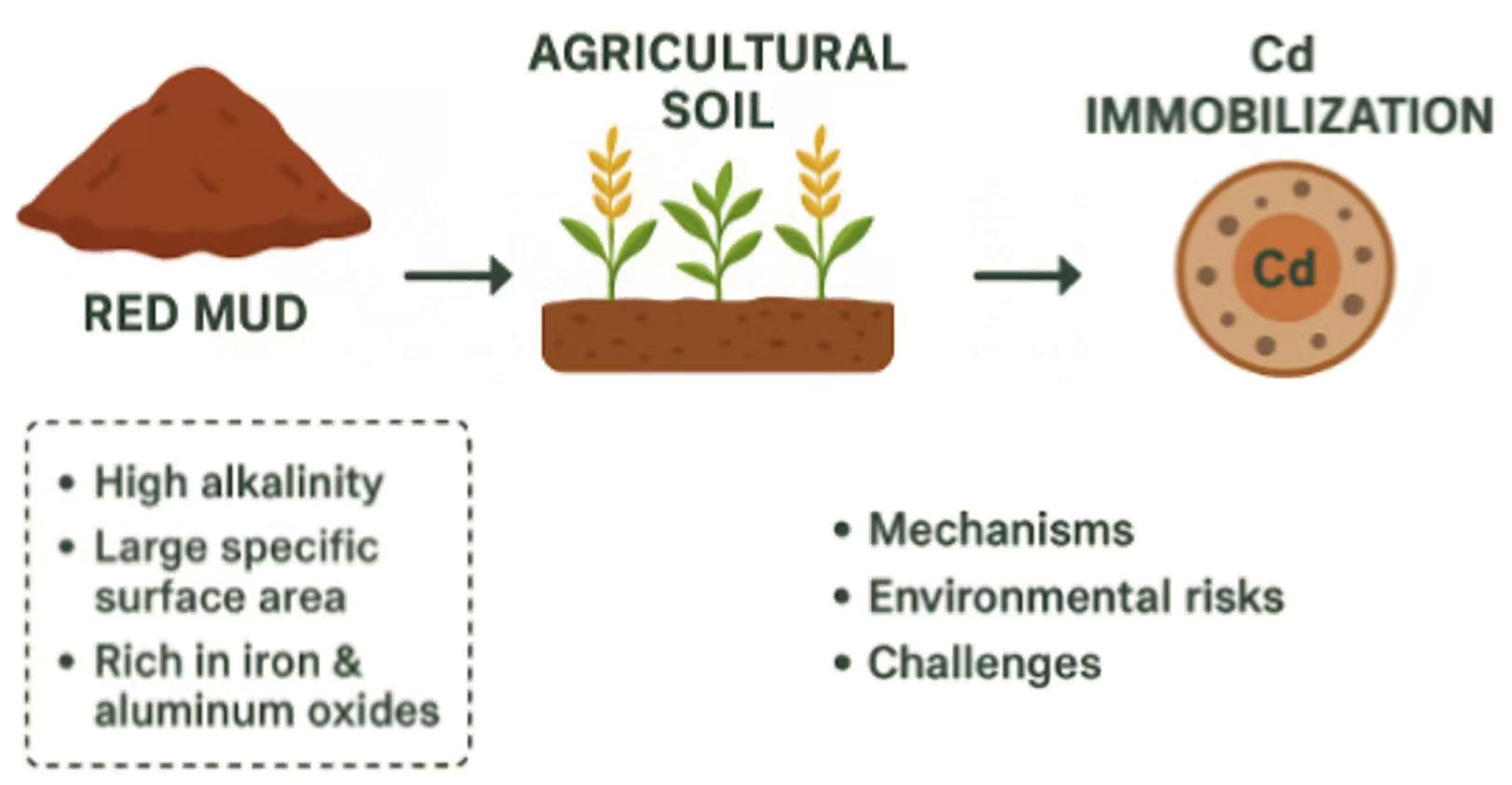

The Use of Red Mud in Agricultural Soil Cadmium Remediation: A Critical Review

 ,
,
Abstract
1. Introduction
2. Red Mud Characteristics
2.1. Red Mud Composition
2.2. Red Mud Physical and Chemical Properties
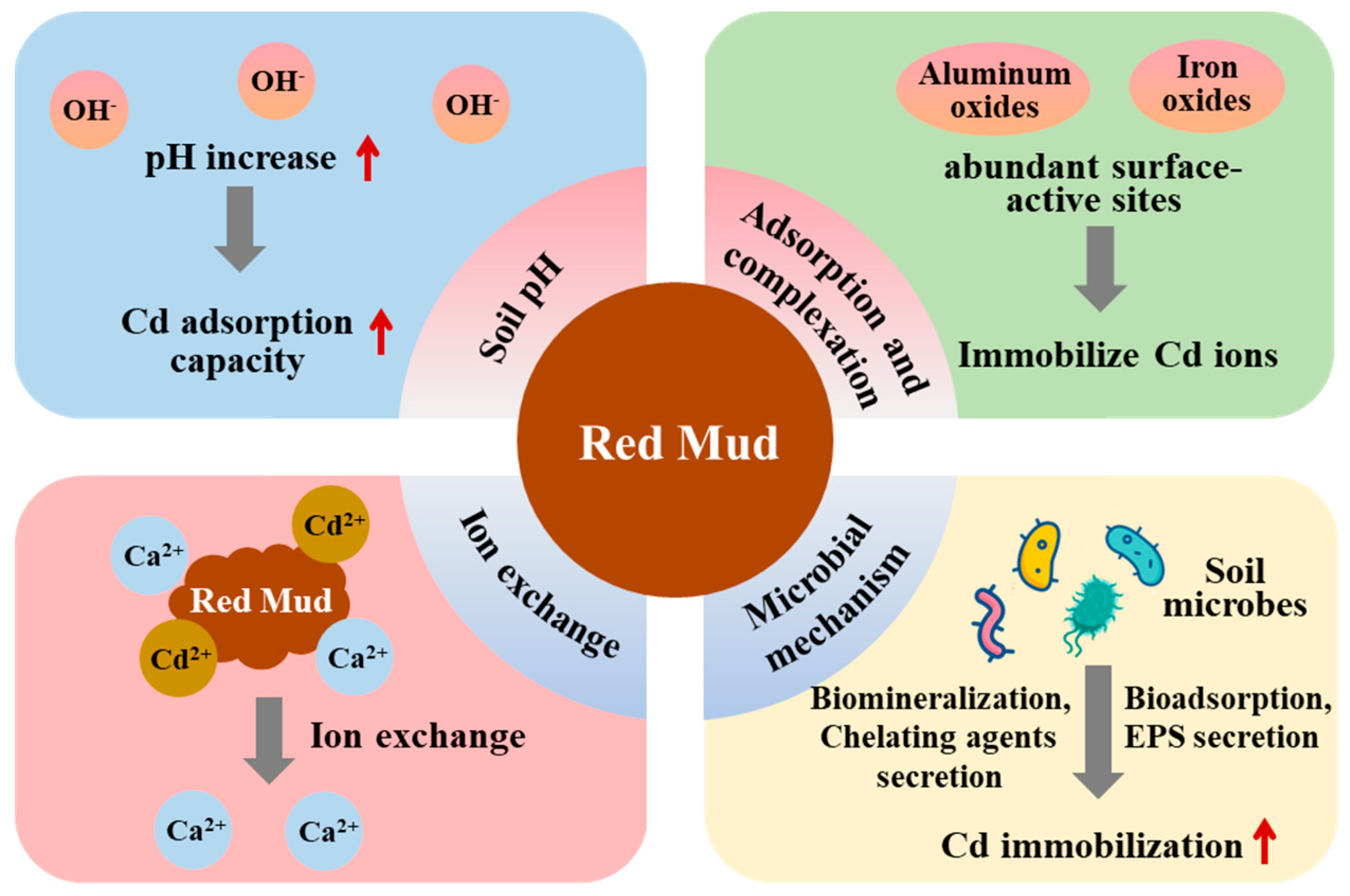
3. Mechanisms of Soil Cd Remediation by Red Mud
3.1. Soil pH Regulation by Red Mud
3.2. Adsorption and Complexation of Soil Cd by Red Mud
3.3. Ion Exchange
3.4. Microbial Mechanism
4. The Utilization of Red Mud-Based Passivator in Agricultural Soil for Cd Remediation
4.1. Original Red Mud
4.2. Combined with Other Amendments

| Amendments | Application Dosage | Soil pH Before Application | Soil Cd Concentration (mg·kg−1) | Available Cd Content After Application (mg kg−1) | Change in Extractable Cd Concentration (%) | Plant Cd Uptake (%) | Reference |
|---|---|---|---|---|---|---|---|
| Red mud, Silicon fertilizer, Phosphorus fertilizer | 1800 kg ha−2 + 600 kg ha−2 + 675 kg ha−2 | 5.6 | 0.47 | 0.23 | −47% | −63% | [62] |
| Red mud, Corn straw | 0.5% + 0.1% (w/w) | 8.9 | 1.13 | 0.58 | −49% | - | [61] |
| Red mud, Rape straw | 0.5% + 0.1% (w/w) | 8.9 | 1.13 | 0.65 | −42% | - | [61] |
| Red mud, Diatomite, Lime (5:3:2) | 0.6 kg m−2 | 5.8 | - | - | −29% | −59% | [69] |
| Red mud, Diatomite, Lime (5:3:2) | 0.6 kg m−2 | 5.8 | - | - | −72% | −72% | [69] |
| Red mud, Astragalus sinicus L. straw | 22,500 kg hm−2 + 3000 kg hm−2 | 5.4 | - | - | −25% | −45% | [70] |
| Red mud, Astragalus sinicus L. straw | 22,500 kg hm−2 + 4500 kg hm−2 | 5.4 | - | - | −31% | −55% | [70] |
| Red mud, Lime, Kaolin (7:1:4) | 0.16% | 5.5 | 1.28 | 0.76 | −28% | −47% | [63] |
| Red mud, Lime, Kaolin (5:3:4) | 0.16% | 5.5 | 1.28 | 0.62 | −41% | −49% | [63] |
| Red mud, Lime, Kaolin (4:4:4) | 0.16% | 5.5 | 1.28 | 0.59 | −43% | −56% | [63] |
| Red mud, Lime, Kaolin (2: 6:4) | 0.16% | 5.5 | 1.28 | 0.45 | −57% | −82% | [63] |
| Red mud, Biochar, Sepiolite (3:5:3) | 5000 kg·hm−2 | 5.4 | 0.82 | 0.25 | −47% | −87% | [64] |
4.3. Red Mud Pre-Treatments
5. Environmental Risks of Red Mud Application
5.1. Toxic Heavy Metals in Red Mud
5.2. High Alkalinity of Red Mud
5.3. High Sodium Content in Red Mud
5.4. Effect of Red Mud on Soil Microbes
6. Outlook on Remediation of Cadmium-Contaminated Agricultural Soil Using Red Mud
- (1)
- The specificity and uncertainty of the remediation effect
- (2)
- The long-term effects of red mud on soil Cd immobilization
- (3)
- The economic cost of soil Cd remediation by red mud
7. Conclusions
Author Contributions
Funding
Data Availability Statement
Conflicts of Interest
References
- Swain, B.; Akcil, A.; Lee, J. Red mud valorization an industrial waste circular economy challenge; review over processes and their chemistry. Crit. Rev. Environ. Sci. Technol. 2022, 52, 520–570. [Google Scholar] [CrossRef] [Scilit]
- Li, Q.; Geng, C.; Zhang, H.; Shi, X.; Liu, J.; Chen, C. The large-scale sustainable utilization status of bauxite residue (red mud): Challenges and perspectives for China. Environ. Rev. 2024, 33, 1–16. [Google Scholar] [CrossRef] [Scilit]
- Akcil, A.; Swami, K.R.; Gardas, R.L.; Hazrati, E.; Dembele, S. Overview on hydrometallurgical recovery of rare-earth metals from red mud. Minerals 2024, 14, 587. [Google Scholar] [CrossRef] [Scilit]
- Qi, Y. The neutralization and recycling of red mud—A review. J. Phys. Conf. Ser. 2021, 1759, 012004. [Google Scholar] [CrossRef] [Scilit]
- Sun, Z.; Wu, J.; Cheng, H.; Zhang, G.; Zhou, F.; Feng, E.; Chen, Z.; Cao, Y. Research progress on the extraction of strategic critical metals (rare earth elements, gallium, and germanium) and the high-value utilization of major element silicon from bulk mineral-metallurgical solid waste. J. Environ. Chem. Eng. 2025, 13, 118119. [Google Scholar] [CrossRef] [Scilit]
- Li, X.F.; Zhang, T.A.; Lv, G.Z.; Wang, K.; Wang, S. Summary of research progress on metallurgical utilization technology of red mud. Minerals 2023, 13, 737. [Google Scholar] [CrossRef] [Scilit]
- Fang, C.; Lou, R.; Ju, Y.; Jia, Y.; Wu, J.; Chen, Y.; Zhang, Y.; Deng, X.; Lv, B.; Chen, X. Critical metal recovery from red mud: A systematic review of sustainable extraction technologies and circular economy potential. J. Environ. Chem. Eng. 2025, 13, 118985. [Google Scholar] [CrossRef] [Scilit]
- Meshram, N.; Lini Dev, K. Sustainable Utilization of Red Mud as Recycled Waste: A Critical Review and Future Research Directions. Indian Geotech. J. 2024, 54, 1–16. [Google Scholar] [CrossRef] [Scilit]
- Wu, D.; Zhang, H.; Cheng, Y.; Yu, P.; Fu, T. Research status and carbon reduction analysis of red mud in the field of building materials. Particuology 2025, 104, 303–331. [Google Scholar] [CrossRef] [Scilit]
- Singh, V.; Bano, S.; Chauhan, V.B.; Pal, P.; Kumar, A.; Srivastava, J.B. Red mud as a sustainable road construction material: An experimental investigation. Constr. Build. Mater. 2024, 411, 134549. [Google Scholar] [CrossRef] [Scilit]
- Gao, Y.; Li, Z.; Xin, G.; Shen, Q.; Zhang, J.; Yang, Y. Utilization of high-volume red mud application in cement based grouting material: Effects on mechanical properties at different activation modes. J. Mater. Civil Eng. 2023, 35, 04023011. [Google Scholar] [CrossRef] [Scilit]
- Liu, Y.; Zhang, L.; Xue, B.; Chen, L.; Wang, G.; Wang, J.; Wan, H.; Lin, X.; Zhu, G. Simulation of red mud/phosphogypsum-based artificial soil engineering applications in vegetation restoration and ecological reconstruction. Sci. Total Environ. 2024, 951, 175656. [Google Scholar] [CrossRef] [Scilit] [PubMed]
- Liu, Y.; Zhang, L.; Chen, L.; Xue, B.; Wang, G.; Zhu, G.; Gou, W.; Yang, D. Potential of artificial soil preparation for vegetation restoration using red mud and phosphogypsum. Sci. Total Environ. 2024, 941, 173553. [Google Scholar] [CrossRef] [Scilit] [PubMed]
- Archambo, M.; Kawatra, S.K. Red mud: Fundamentals and new avenues for utilization. Min. Proc. Ext. Metall. Rev. 2021, 42, 427–450. [Google Scholar] [CrossRef] [Scilit]
- Jia, K.; Zhou, Z.; Singh, S.V.; Wang, C. A review of the engineered treatment of red mud: Construction materials, metal recovery, and soilization revegetation. Results Eng. 2024, 24, 102927. [Google Scholar] [CrossRef] [Scilit]
- Raj, R.; Yadav, B.; Yadav, J.S.; Kumar, S. Red mud utilisation for sustainable construction and soil improvement: A comprehensive review. Discov. Sustain. 2024, 5, 398. [Google Scholar] [CrossRef] [Scilit]
- Xie, W.M.; Zhou, F.P.; Bi, X.L.; Chen, D.D.; Li, J.; Sun, S.Y.; Liu, J.Y.; Chen, X.Q. Accelerated crystallization of magnetic 4A-zeolite synthesized from red mud for application in removal of mixed heavy metal ions. J. Hazard. Mater. 2018, 358, 441–449. [Google Scholar] [CrossRef] [Scilit]
- Sun, X.; Hu, C.; Li, T.; Zhang, J.; Su, Y.; Jiang, M. Research progress on iron-rich industrial waste as environmentally functional material. Sustain. Chem. Pharm. 2024, 42, 101772. [Google Scholar] [CrossRef] [Scilit]
- Rai, S.; Bahadure, S.; Chaddha, M.J.; Agnihotri, A. Utilization of Aluminium Industry Solid Waste (Red Mud/Bauxite Residue) in Pollution Control. In Innovations in Sustainable Mining: Balancing Environment, Ecology and Economy; Springer: Cham, Switzerland, 2021; pp. 21–43. [Google Scholar]
- Li, J.; Li, X.; Fischel, M.; Lin, X.; Zhou, S.; Zhang, L.; Wang, L.; Yan, J. Applying red mud in cadmium contamination remediation: A scoping review. Toxics 2024, 12, 347. [Google Scholar] [CrossRef] [Scilit]
- Hamid, Y.; Tang, L.; Hussain, B.; Usman, M.; Lin, Q.; Rashid, M.S.; He, Z.; Yang, X. Organic soil additives for the remediation of cadmium contaminated soils and their impact on the soil-plant system: A review. Sci. Total Environ. 2020, 707, 136121. [Google Scholar] [CrossRef] [Scilit] [PubMed]
- Yan, G.; Hua, Y.; Jin, H.; Huang, Q.; Zhou, G.; Xu, Y.; He, Y.; Zhu, Z. Sly-miR398 participates in cadmium stress acclimation by regulating antioxidant system and cadmium transport in tomato (Solanum lycopersicum). Int. J. Mol. Sci. 2023, 24, 1953. [Google Scholar] [CrossRef] [Scilit] [PubMed]
- Li, H.; Luo, N.; Li, Y.W.; Cai, Q.Y.; Li, H.Y.; Mo, C.H.; Wong, M.H. Cadmium in rice: Transport mechanisms, influencing factors, and minimizing measures. Environ. Pollut. 2017, 224, 622–630. [Google Scholar] [CrossRef] [Scilit] [PubMed]
- Song, L.; Zhou, J.; Xu, X.; Na, M.; Xu, S.; Huang, Y.; Zhang, J.; Li, X.; Zheng, X. Inoculation of cadmium-tolerant bacteria to regulate microbial activity and key bacterial population in cadmium-contaminated soils during bioremediation. Ecotox. Environ. Saf. 2024, 271, 115957. [Google Scholar] [CrossRef] [Scilit]
- Wang, M.; Liu, X. Applications of red mud as an environmental remediation material: A review. J. Hazard. Mater. 2021, 408, 124420. [Google Scholar] [CrossRef] [Scilit]
- Wang, F.; Xu, J.; Yin, H.; Zhang, Y.; Pan, H.; Wang, L. Sustainable stabilization/solidification of the Pb, Zn, and Cd contaminated soil by red mud-derived binders. Environ. Pollut. 2021, 284, 117178. [Google Scholar] [CrossRef] [Scilit]
- Xu, Z.; Lu, Z.; Zhang, L.; Fan, H.; Wang, Y.; Li, J.; Lin, Y.; Liu, H.; Guo, S.; Xu, M.; et al. Red mud based passivator reduced Cd accumulation in edible amaranth by influencing root organic matter metabolism and soil aggregate distribution. Environ. Pollut. 2021, 275, 116543. [Google Scholar] [CrossRef] [Scilit]
- Hu, C.; Zhao, Z.; Lyu, M.; Chen, Z.; Xin, L.; Chen, H. Application of red mud in hydrothermal remediation of Cd-and petroleum-contaminated soil. J. Environ. Chem. Eng. 2024, 12, 113333. [Google Scholar] [CrossRef] [Scilit]
- Wang, P.; Liu, D. Physical and chemical properties of sintering red mud and bayer red mud and the implications for beneficial utilization. Materials 2012, 5, 1800–1810. [Google Scholar] [CrossRef] [Scilit]
- Kalkan, E.; Nadaroglu, H.; Dikbas, N.; Tasgin, E.; Celebi, N. Bacteria-Modified Red Mud for Adsorption of Cadmium Ions from Aqueous Solutions. Pol. J. Environ. Stud. 2013, 22, 417–429. [Google Scholar]
- Babisk, M.; Amaral, L.; Ribeiro, L.; Vieira, C.; Prado, U.; Gadioli, M.; Oliveira, M.; Luz, F.; Monteiro, S.; Garcia Filho, F. Evaluation and application of sintered red mud and its incorporated clay ceramics as materials for building construction. J. Mater. Res. Technol. 2020, 9, 2186–2195. [Google Scholar] [CrossRef] [Scilit]
- Shoppert, A.; Loginova, I.; Rogozhnikov, D.; Karimov, K.; Chaikin, L. Increased as adsorption on maghemite-containing red mud prepared by the alkali fusion-leaching method. Minerals 2019, 9, 60. [Google Scholar] [CrossRef] [Scilit]
- Shoppert, A.; Loginova, I.; Napol’skikh, A. Obtaining of Pigment-Quality Magnetite from Sintering Process Red Mud. IOP Conf. Ser. Mater. Sci. Eng. 2020, 969, 012056. [Google Scholar] [CrossRef] [Scilit]
- Xiao, W.; Liu, Y.; Jun, W. Characteristics of red mud in combined process and its performance on Pb (II) removal in aqueous solution. Chin. J. Environ. Eng. 2020, 14, 515–522. [Google Scholar]
- Liu, D.Y.; Wu, C.S. Stockpiling and comprehensive utilization of red mud research progress. Materials 2012, 5, 1232–1246. [Google Scholar] [CrossRef] [Scilit]
- Xiao, Y.; Tiong, M.; Mo, K.H.; Guo, M.; Ling, T. Recycling Bayer and sintering red muds in brick production: A review. J. Zhejiang Univ.-Sci. A 2022, 23, 335–357. [Google Scholar] [CrossRef] [Scilit]
- Xue, S.; Zhu, F.; Kong, X.; Wu, C.; Huang, L.; Huang, N.; Hartley, W. A review of the characterization and revegetation of bauxite residues (Red mud). Environ. Sci. Pollut. Res. 2016, 23, 1120–1132. [Google Scholar] [CrossRef] [Scilit] [PubMed]
- Wang, Y.; Li, F.; Song, J.; Xiao, Y.; Luo, L.; Yang, Z.; Chai, L. Stabilization of Cd-, Pb-, Cu-and Zn-contaminated calcareous agricultural soil using red mud: A field experiment. Environ. Geochem. Health 2018, 40, 2143–2153. [Google Scholar] [CrossRef] [Scilit] [PubMed]
- Luo, L.; Ma, C.; Ma, Y.; Zhang, S.; Lv, J.; Cui, M. New insights into the sorption mechanism of cadmium on red mud. Environ. Pollut. 2011, 159, 1108–1113. [Google Scholar] [CrossRef] [Scilit]
- Wang, J.; Wang, P.M.; Gu, Y.; Kopittke, P.M.; Zhao, F.J.; Wang, P. Iron–manganese (oxyhydro) oxides, rather than oxidation of sulfides, determine mobilization of Cd during soil drainage in paddy soil systems. Environ. Sci. Technol. 2019, 53, 2500–2508. [Google Scholar] [CrossRef] [Scilit]
- Christensen, T.H. Cadmium soil sorption at low concentrations: I. Effect of time, cadmium load, pH, and calcium. Water Air Soil Poll. 1984, 21, 105–114. [Google Scholar] [CrossRef] [Scilit]
- Gray, C.W.; Dunham, S.J.; Dennis, P.G.; Zhao, F.J.; McGrath, S.P. Field evaluation of in situ remediation of a heavy metal contaminated soil using lime and red-mud. Environ. Pollut. 2006, 142, 530–539. [Google Scholar] [CrossRef] [Scilit] [PubMed]
- Srivastava, P.; Singh, B.; Angove, M. Competitive adsorption behavior of heavy metals on kaolinite. J. Colloid Interf. Sci. 2005, 290, 28–38. [Google Scholar] [CrossRef] [Scilit] [PubMed]
- Guo, L.; Xu, X.; Wang, Q.; Yuan, X.; Niu, C.; Dong, X.; Liu, X.; Lei, H.; Zhou, L. A comprehensive investigation of the adsorption behaviour and mechanism of industrial waste sintering and bayer red muds for heavy metals. Environ. Geochem. Health 2024, 46, 434. [Google Scholar] [CrossRef] [Scilit] [PubMed]
- Lombi, E.; Zhao, F.J.; Zhang, G.; Sun, B.; Fitz, W.; Zhang, H.; McGrath, S.P. In situ fixation of metals in soils using bauxite residue: Chemical assessment. Environ. Pollut. 2002, 118, 435–443. [Google Scholar] [CrossRef] [Scilit]
- Lackovic, K.; Angove, M.J.; Wells, J.D.; Johnson, B.B. Modeling the adsorption of Cd (II) onto Muloorina illite and related clay minerals. J. Colloid Interf. Sci. 2003, 257, 31–40. [Google Scholar] [CrossRef] [Scilit]
- Serrano, S.; O’Day, P.A.; Vlassopoulos, D.; García-González, M.T.; Garrido, F. A surface complexation and ion exchange model of Pb and Cd competitive sorption on natural soils. Geochim. Cosmochim. Acta 2009, 73, 543–558. [Google Scholar] [CrossRef] [Scilit]
- Shi, L.; Chen, H.; Wu, C.; Huang, L.; Cui, M.; Xue, S. Effects of red mud and the combinations on lead, cadmium, and arsenic availability in contaminated soil. J. Univ. Chin. Acad. Sci. 2018, 35, 617. [Google Scholar]
- Lin, L.; Wu, X.; Deng, X.; Lin, Z.; Liu, C.; Zhang, J.; He, T.; Yi, Y.; Liu, H.; Wang, Y.; et al. Mechanisms of low cadmium accumulation in crops: A comprehensive overview from rhizosphere soil to edible parts. Environ. Res. 2024, 245, 118054. [Google Scholar] [CrossRef] [Scilit]
- Yan, J.; Li, X.; Pan, Z.; Lin, X.; Zuo, Q.; Zhou, J.; Zhou, S.; Sui, F.; Zhang, L.; Fischel, M.H.H. Red mud causes dynamic changes in the soil microbial community and cadmium fractions in a slightly cadmium-contaminated paddy soil. J. Hazard. Mater. 2025, 493, 138349. [Google Scholar] [CrossRef] [Scilit]
- Galan-Freyle, N.J.; Aranguren-Diaz, Y.; Ospina-Maldonado, S.L.; Chapuel-Aguillon, P.F.; Pertuz-Peña, M.F.; Hernandez-Rivera, S.P.; Pacheco-Londoño, L.C. Exploring cadmium bioaccumulation and bioremediation mechanisms and related genes in soil microorganisms: A review. Environ. Sci. Pollut. Res. 2025, 32, 20215–20231. [Google Scholar] [CrossRef] [Scilit]
- Yan, J.; Li, X.; Li, J.; Zhou, J.; Shi, J.; Liu, K.; Chen, X.; Zhou, S.; Sun, W.; Sui, F.; et al. Red mud amendments reduce cadmium mobility in paddy soil and limit cadmium accumulation in rice grains: A mechanistic investigation. Plant Soil 2025, 514, 477–494. [Google Scholar] [CrossRef] [Scilit]
- Peng, M.; Qu, Z.; Sun, T.; Huang, L.; Li, Z. Improving soil environment and wheat growth by regulating the rhizosphere soil microbial community through inorganic acid application under red mud alkali stress. Plant Soil 2025, 515, 1–20. [Google Scholar] [CrossRef] [Scilit]
- Ahmad, H.; Shah, M.A.; Khan, R.; Ali, S.; Khan, K.; Zheng, X.; Zhou, X.B. Unveiling the Potential of Rhizospheric Bacillus subtilis to Enhance Nitrogen Metabolism, Soil Microbiota, and Nutrient Uptake Under Cadmium Stress in Maize. Physiol. Plant. 2025, 177, e70613. [Google Scholar] [CrossRef] [Scilit] [PubMed]
- Xu, Z.M.; Zhang, Y.X.; Wang, L.; Liu, C.G.; Sun, W.M.; Wang, Y.F.; Long, S.X.; He, X.T.; Lin, Z.; Liang, J.L. Rhizobacteria communities reshaped by red mud based passivators is vital for reducing soil Cd accumulation in edible amaranth. Sci. Total. Environ. 2022, 826, 154002. [Google Scholar] [CrossRef] [Scilit]
- Fan, M.R.; Luo, L.; Liao, Y.L. Effects of red mud on the remediation of Pb, Zn and Cd in heavy metal contaminated paddy soil. ACS Agric. Sci. Technol. 2012, 13, 388–392. [Google Scholar]
- Zhang, Y.; Liang, C.H.; Liang, S.W. Effects of lime-containing substances on cadmium speciation in soil and cadmium uptake by lettuces. J. Yangzhou Univ. (Agric. Life Sci. Ed.) 2017, 38, 90–95. [Google Scholar]
- Li, B.; Yang, J.; Wei, D.; Chen, S.; Li, J.; Ma, Y. Field evidence of cadmium phytoavailability decreased effectively by rape straw and/or red mud with zinc sulphate in a Cd-contaminated calcareous soil. PLoS ONE 2014, 9, e109967. [Google Scholar] [CrossRef] [Scilit]
- Zhu, Q.; Luo, H.; Wu, G.; Zhou, Y. Stabilization of cadmium in soil using modified red mud-zeolite composite material. J. Agro-Environ. Sci. 2016, 35, 907–912. [Google Scholar]
- Zhou, R.; Liu, X.; Luo, L.; Zhou, Y.; Wei, J.; Chen, A.; Tang, L.; Wu, H.; Deng, Y.; Zhang, F. Remediation of Cu, Pb, Zn and Cd-contaminated agricultural soil using a combined red mud and compost amendment. Int. Biodeterior. Biodegrad. 2017, 118, 73–81. [Google Scholar] [CrossRef] [Scilit]
- Rui, Z.; Lv, Y.Z. Effectiveness and longevity of amendments to a cadmium-contaminated soil. J. Integr. Agr. 2020, 19, 1097–1104. [Google Scholar]
- Yang, J.; Zou, Z.; Yang, H.; Wu, J.; Yang, Z.; Fang, C.; Wei, X. Effects of combination soil amendments on availability and migration of Cd in soil and rice. Front. Environ. Sci. 2025, 13, 1548784. [Google Scholar] [CrossRef] [Scilit]
- Li, Y.; Yin, Y.; Zhu, S.; Zhang, X.; Huang, Y.; Wang, Z.; Shang, J. Effects of different combined amendments on Cd uptake and accumulation by rice. J. Agro-Environ. Sci. 2020, 39, 47–255. [Google Scholar]
- Zhao, C.; Xu, C.; Wang, F.; Long, L.; Liu, K. Effects of different amendments on cadmium migration in soil-potato system. Soils Crops 2023, 9, 326–335. [Google Scholar]
- Wang, K.; Jia, R.; Li, L.; Jiang, R.; Qu, D. Community structure of Anaeromyxobacter in Fe (III) reducing enriched cultures of paddy soils. J. Soils Sediments 2020, 20, 1621–1631. [Google Scholar] [CrossRef] [Scilit]
- Wang, C.; Huang, Y.; Yang, X.; Xue, W.; Zhang, X.; Zhang, Y.; Pang, J.; Liu, Y.; Liu, Z. Burkholderia sp. Y4 inhibits cadmium accumulation in rice by increasing essential nutrient uptake and preferentially absorbing cadmium. Chemosphere 2020, 252, 126603. [Google Scholar] [CrossRef] [Scilit]
- Wang, J.; Lu, X.; Zhang, J.; Ouyang, Y.; Wei, G.; Xiong, Y. Rice intercropping with alligator flag (Thalia dealbata): A novel model to produce safe cereal grains while remediating cadmium contaminated paddy soil. J. Hazard. Mater. 2020, 394, 122505. [Google Scholar] [CrossRef] [Scilit]
- Zhu, S.; Xu, T.; Li, Q.; Deng, X.Y.; Zhou, X.; Zhu, G. Remediation effect of cadmium contaminated soil by the combination of Lactobacillus plantarum and red mud. IOP Conf. Ser. Earth Environ. Sci. 2021, 821, 012021. [Google Scholar] [CrossRef] [Scilit]
- Li, H.; Liu, Y.; Zhou, Y.; Zhang, J.; Mao, Q.; Yang, Y.; Huang, H.; Liu, Z.; Peng, Q.; Luo, L. Effects of red mud based passivator on the transformation of Cd fraction in acidic Cd-polluted paddy soil and Cd absorption in rice. Sci. Total. Environ. 2018, 640, 736–745. [Google Scholar] [CrossRef] [Scilit]
- Fan, M.; Liu, X.; Zhou, Y.; Núñez-Delgado, A.; Luo, L.; Long, S.; Huang, H.; Hu, L.; Liao, Y. Effects of the combined application of Chinese Milk vetch (Astragalus sinicus L.) and red mud to remediate the cadmium-polluted acidic Paddy soil. Sustainability 2022, 14, 13192. [Google Scholar] [CrossRef] [Scilit]
- Yang, T.; Wang, Y.; Sheng, L.; He, C.; Sun, W.; He, Q. Enhancing Cd (II) sorption by red mud with heat treatment: Performance and mechanisms of sorption. J. Environ. Manag. 2020, 255, 109866. [Google Scholar] [CrossRef] [Scilit] [PubMed]
- Pang, Y.; Zhao, C.; Li, Y.; Li, Q.; Xiang, B.; Peng, D.; Huang, T. Cadmium adsorption performance and mechanism from aqueous solution using red mud modified with amorphous MnO2. Sci. Rep. 2022, 12, 4424. [Google Scholar] [CrossRef] [Scilit]
- Morsali, S.; Yildirim, F. Environmental impact assessment of red mud utilization in concrete production: A life cycle assessment study. Environ. Dev. Sustain. 2024, 26, 12219–12238. [Google Scholar] [CrossRef] [Scilit]
- Winkler, D.; Bidlo, A.; Bolodár-Varga, B.; Erdő, Á.; Horváth, A. Long-term ecological effects of the red mud disaster in Hungary: Regeneration of red mud flooded areas in a contaminated industrial region. Sci. Total Environ. 2018, 644, 1292–1303. [Google Scholar] [CrossRef] [Scilit] [PubMed]
- Rékási, M.; Feigl, V.; Uzinger, N.; Gruiz, K.; Makó, A.; Anton, A. Effects of leaching from alkaline red mud on soil biota: Modelling the conditions after the Hungarian red mud disaster. Chem. Ecol. 2013, 29, 709–723. [Google Scholar] [CrossRef] [Scilit]
- Ujaczki, É.; Feigl, V.; Farkas, É.; Vaszita, E.; Gruiz, K.; Molnár, M. Red mud as acidic sandy soil ameliorant: A microcosm incubation study. J. Chem. Technol. Biotechnol. 2016, 91, 1596–1606. [Google Scholar] [CrossRef] [Scilit]
- Yang, J.; Wang, L.; Li, J.; Wei, D.; Chen, S.; Guo, Q.; Ma, Y. Effects of rape straw and red mud on extractability and bioavailability of cadmium in a calcareous soil. Front. Environ. Sci. Eng. 2015, 9, 419–428. [Google Scholar] [CrossRef] [Scilit]
- Meng, X.; Yang, J.; Zheng, G.; Xia, T. Effects of red mud on cadmium uptake and accumulation by rice and chemical changes in rhizospheres by rhizobox method. Minerals 2022, 12, 929. [Google Scholar] [CrossRef] [Scilit]
- Peng, Y.; Zhang, T.; Tang, B.; Li, X.; Cui, S.; Guan, C.Y.; Zhang, B.; Chen, Q. Interception of fertile soil phosphorus leaching with immobilization materials: Recent progresses, opportunities and challenges. Chemosphere 2022, 308, 136337. [Google Scholar] [CrossRef] [Scilit]
- Rédey, A.; Yuzhakova, T.; Utasi, A.; Kovács, Z.; Lakó, J.; Kovács, J.; Domokos, E.; Dióssy, L. Lessons learnt from an environmental catastrophe in Hungary. Glob. J. Adv. Pure Appl. Sci. 2013, 1, 520–531. [Google Scholar]
- Feigl, V.; Anton, A.; Uzigner, N.; Gruiz, K. Red mud as a chemical stabilizer for soil contaminated with toxic metals. Water Air Soil Poll. 2012, 223, 1237–1247. [Google Scholar] [CrossRef] [Scilit]
- Barrow, N.J.; Hartemink, A.E. The effects of pH on nutrient availability depend on both soils and plants. Plant Soil 2023, 487, 21–37. [Google Scholar] [CrossRef] [Scilit]
- Liang, Z.; Peng, X.; Luan, Z.; Li, W.; Zhao, Y. Reduction of phosphorus release from high phosphorus soil by red mud. Environ. Earth Sci. 2012, 65, 581–588. [Google Scholar] [CrossRef] [Scilit]
- Kong, T.; Mendelssohn, I.A. The impact of red mud on growth of wetland vegetation and substrate fertility. Wetl. Ecol. Manag. 1996, 4, 3–14. [Google Scholar] [CrossRef] [Scilit]
- Hua, Y.; Heal, K.V.; Friesl-Hanl, W. The use of red mud as an immobiliser for metal/metalloid-contaminated soil: A review. J. Hazard. Mater. 2017, 325, 17–30. [Google Scholar] [CrossRef] [Scilit]
- Zhou, Y.; Cui, Y.T.; Yang, J.; Chen, L.; Qi, J.; Zhang, L.; Zhang, J.; Huang, Q.; Zhou, T.; Zhao, Y.; et al. Roles of red mud in remediation of contaminated soil in mining areas: Mechanisms, advances and perspectives. J. Environ. Manag. 2024, 356, 120608. [Google Scholar] [CrossRef] [Scilit] [PubMed]
- Naz, M.; Dai, Z.; Hussain, S.; Tariq, M.; Danish, S.; Khan, I.U.; Qi, S.; Du, D. The soil pH and heavy metals revealed their impact on soil microbial community. J. Environ. Manag. 2022, 321, 115770. [Google Scholar] [CrossRef] [Scilit]
- Xiong, R.; He, X.; Gao, N.; Li, Q.; Qiu, Z.; Hou, Y.; Shen, W. Soil pH amendment alters the abundance, diversity, and composition of microbial communities in two contrasting agricultural soils. Microbiol. Spectr. 2024, 12, e04165-23. [Google Scholar] [CrossRef] [Scilit]
- Feigl, V.; Ujaczki, É.; Vaszita, E.; Molnár, M. Influence of red mud on soil microbial communities: Application and comprehensive evaluation of the Biolog EcoPlate approach as a tool in soil microbiological studies. Sci. Total. Environ. 2017, 595, 903–911. [Google Scholar] [CrossRef] [Scilit]
- Garau, G.; Castaldi, P.; Santona, L.; Deiana, P.; Melis, P. Influence of red mud, zeolite and lime on heavy metal immobilization, culturable heterotrophic microbial populations and enzyme activities in a contaminated soil. Geoderma 2007, 142, 47–57. [Google Scholar] [CrossRef] [Scilit]
- Wang, C.; Zhang, X.; Sun, R.; Cao, Y. Neutralization of red mud using bio-acid generated by hydrothermal carbonization of waste biomass for potential soil application. J. Clean. Prod. 2020, 271, 122525. [Google Scholar] [CrossRef] [Scilit]

| Red Mud Type | Origin | Composition % | Reference | |||||||
|---|---|---|---|---|---|---|---|---|---|---|
| SiO2 | Fe2O3 | Al2O3 | CaO | MgO | TiO2 | Na2O | K2O | |||
| Bayer | Guizhou, China | 8.5 | 26.4 | 19.0 | 21.8 | - | 7.4 | 4.8 | 0.07 | [29] |
| Brazil | 12.2 | 34.5 | 22.1 | 3.8 | - | 3.6 | 5.3 | 0.7 | [30] | |
| Turkey | 17.3 | 35.0 | 20.2 | 5.3 | 0.3 | 4.0 | 9.4 | - | [31] | |
| Russia | 12.04 | 53.21 | 13.3 | 5.98 | - | 5.48 | 5.16 | - | [32] | |
| sintering | Guizhou, China | 17.3 | 10.4 | 10.4 | 40.2 | - | 7.1 | 3.5 | 0.05 | [29] |
| Russia | 12.05 | 40.10 | 12.8 | 8.40 | - | 4.10 | 7.82 | - | [32] | |
| Russia | 4.0 | 16.6 | 34.8 | 4.8 | 0.8 | 1.80 | 33.0 | - | [33] | |
| combined | Chongqing, China | 24.4 | 8.5 | 21.7 | 25.5 | 1.2 | 3.7 | 6.9 | 2.8 | [34] |
| Red Mud Type | pH | Particle Size Range (μm) | Permeability (m2·s−1) | Shear Strength (kPa) | Exchangeable Sodium Content (%) | Reference |
|---|---|---|---|---|---|---|
| Bayer | 11.3 ± 1.0 | 2–18 | 10−5–10−6 | 40–45 | 53–91 | [20,29,37] |
| Sintering | 10–12 | 1–20 | 10−4–11−5 | 287 | - | [20,29,37] |
| Red Mud Addition Rate (% w/w) | Red Mud pH | Cd Concentration in Soil (mg·kg−1) | Soil pH After Red Mud Addition | Available Cadmium (Cd) Content After Red Mud Addition (mg kg−1) | Change in Extractable Cd Concentration (%) | Plant Uptake Cd Change (%) | Reference |
|---|---|---|---|---|---|---|---|
| 0.5% | 11.1 | 1.5 | - | - | −46.7% | −36.7% | [58] |
| 1% | 11.7 | 50.5 | 4.80/6.80 | 37.3 | −26.14% | - | [50] |
| 1% | - | - | 4.84/6.10 | −10% | - | [27] | |
| 2% | 11.7 | 50.5 | 4.80/8.00 | 36.4 | −27.92% | −75% | [50] |
| 4% | - | - | 4.84/7.87 | - | −19% | - | [27] |
| 4% | 12.5 | 1.79 | 7.13/11.29 | 1.33 | −25.70% | - | [56] |
| 5% | - | 4.36 | 6.71/7.87 | 2.90 | −33.34% | −48.01% | [57] |
| 6% | - | - | 4.84/8.13 | - | −24% | −49.68% | [27] |
| Pre-Treatment | Description | Effects |
|---|---|---|
| Heat treatment | Calcination at 600–1000 °C | Changes red mud’s structure and phases and significantly enhances red mud’s Cd adsorption capacity. |
| Neutralization treatment | Raw red mud is mixed with acid solutions (HCl, HNO3) or CO2 | Reduces the amount of alkali discharged into the environment. |
| Ball milling treatment | Ball milling | Specific surface area exposes additional adsorption sites, resulting in a marked enhancement of Cd immobilization. |
Disclaimer/Publisher’s Note: The statements, opinions and data contained in all publications are solely those of the individual author(s) and contributor(s) and not of MDPI and/or the editor(s). MDPI and/or the editor(s) disclaim responsibility for any injury to people or property resulting from any ideas, methods, instructions or products referred to in the content. |
© 2025 by the authors. Licensee MDPI, Basel, Switzerland. This article is an open access article distributed under the terms and conditions of the Creative Commons Attribution (CC BY) license.
Share and Cite
Sun, W.; Xie, W.; Wang, L.; Wang, L.; Gong, Y.; Li, X.; Wang, C.; Yan, J.; Lin, X. The Use of Red Mud in Agricultural Soil Cadmium Remediation: A Critical Review. Toxics 2026, 14, 16. https://doi.org/10.3390/toxics14010016
Sun W, Xie W, Wang L, Wang L, Gong Y, Li X, Wang C, Yan J, Lin X. The Use of Red Mud in Agricultural Soil Cadmium Remediation: A Critical Review. Toxics. 2026; 14(1):16. https://doi.org/10.3390/toxics14010016
Chicago/Turabian StyleSun, Weiwei, Wenyi Xie, Lei Wang, Lei Wang, Yang Gong, Xuwei Li, Chi Wang, Jiali Yan, and Xiaochen Lin. 2026. "The Use of Red Mud in Agricultural Soil Cadmium Remediation: A Critical Review" Toxics 14, no. 1: 16. https://doi.org/10.3390/toxics14010016
APA StyleSun, W., Xie, W., Wang, L., Wang, L., Gong, Y., Li, X., Wang, C., Yan, J., & Lin, X. (2026). The Use of Red Mud in Agricultural Soil Cadmium Remediation: A Critical Review. Toxics, 14(1), 16. https://doi.org/10.3390/toxics14010016