Article

Prenatal Metal Exposures and Associations with Kidney Injury Biomarkers in Children

by
Maria D. Politis
1,*,
Meizhen Yao
1,
Chris Gennings
1,
Marcela Tamayo-Ortiz
2,
Damaskini Valvi
1,
Seunghee Kim-Schulze
3,4,
Jingjing Qi
3,
Chitra Amarasiriwardena
1,
Ivan Pantic
5,6,
Mari Cruz Tolentino
7,
Guadalupe Estrada-Gutierrez
8,
Jason H. Greenberg
9,
Martha M. Téllez-Rojo
5,
Robert O. Wright
1,10,
Alison P. Sanders
11,† and
Maria José Rosa
1,†
1
Department of Environmental Medicine and Public Health, Icahn School of Medicine at Mount Sinai, New York, NY 10029, USA
2
Occupational Health Research Unit, Mexican Social Security Institute, Mexico City 06600, Mexico
3
Human Immune Monitoring Center, Icahn School of Medicine at Mount Sinai, New York, NY 10029, USA
4
Department of Oncological Science, Icahn School of Medicine at Mount Sinai, New York, NY 10029, USA
5
Center for Nutrition and Health Research, National Institute of Public Health, Cuernavaca 62100, Mexico
6
Department of Developmental Neurobiology, National Institute of Perinatology, Mexico City 06600, Mexico
7
Department of Nutrition, National Institute of Perinatology, Mexico City 06600, Mexico
8
Research Direction, National Institute of Perinatology, Mexico City 06600, Mexico
9
Department of Pediatrics, Section of Nephrology, Yale University School of Medicine, New Haven, CT 06510, USA
10
Department of Pediatrics, Icahn School of Medicine at Mount Sinai, New York, NY 10029, USA
11
Department of Environmental and Occupational Health, University of Pittsburgh, Pittsburgh, PA 15260, USA
*
Author to whom correspondence should be addressed.
These authors contributed equally to this work.
Toxics 2022, 10(11), 692; https://doi.org/10.3390/toxics10110692

Submission received: 12 October 2022 / Revised: 9 November 2022 / Accepted: 11 November 2022 / Published: 16 November 2022

Abstract

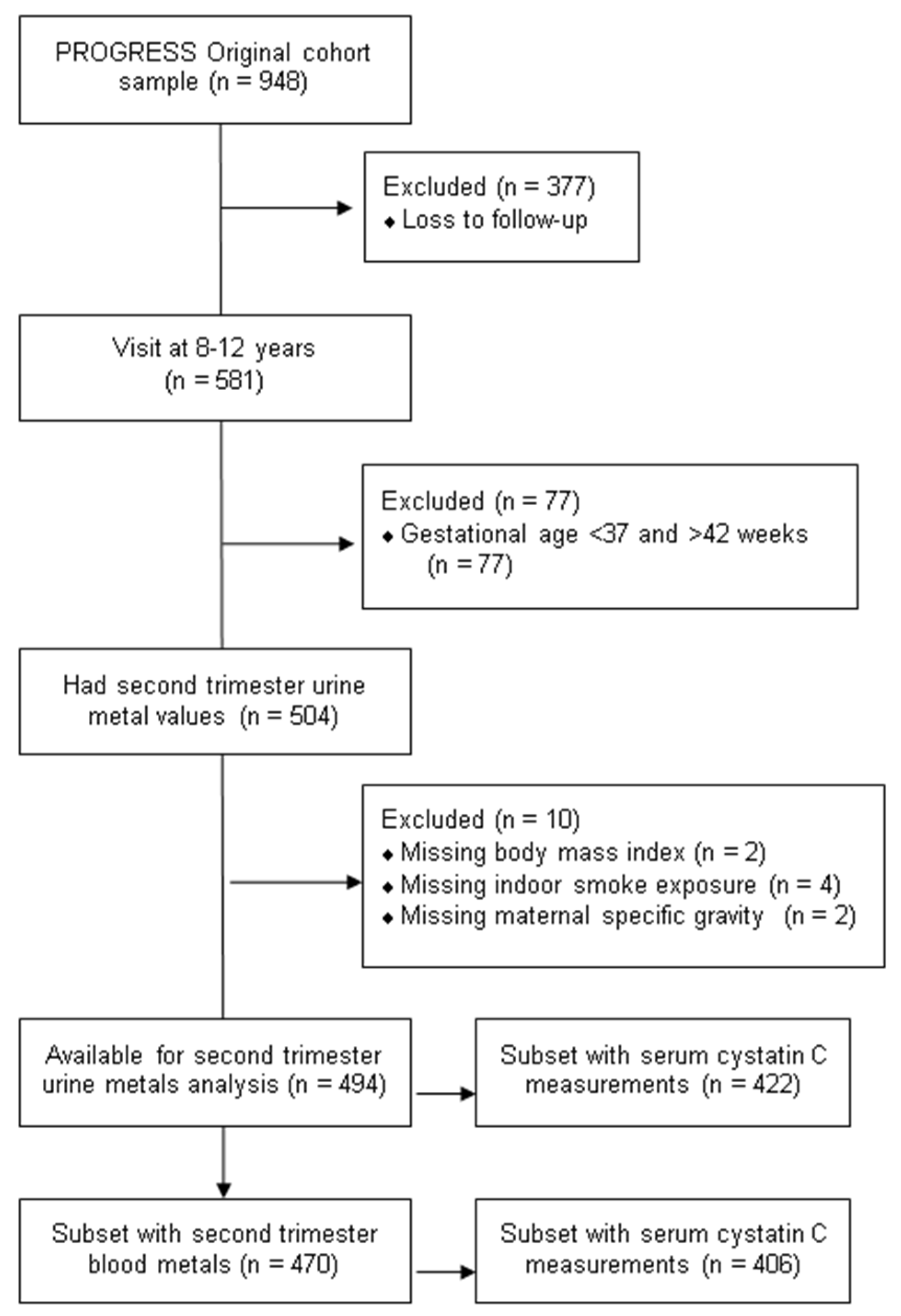
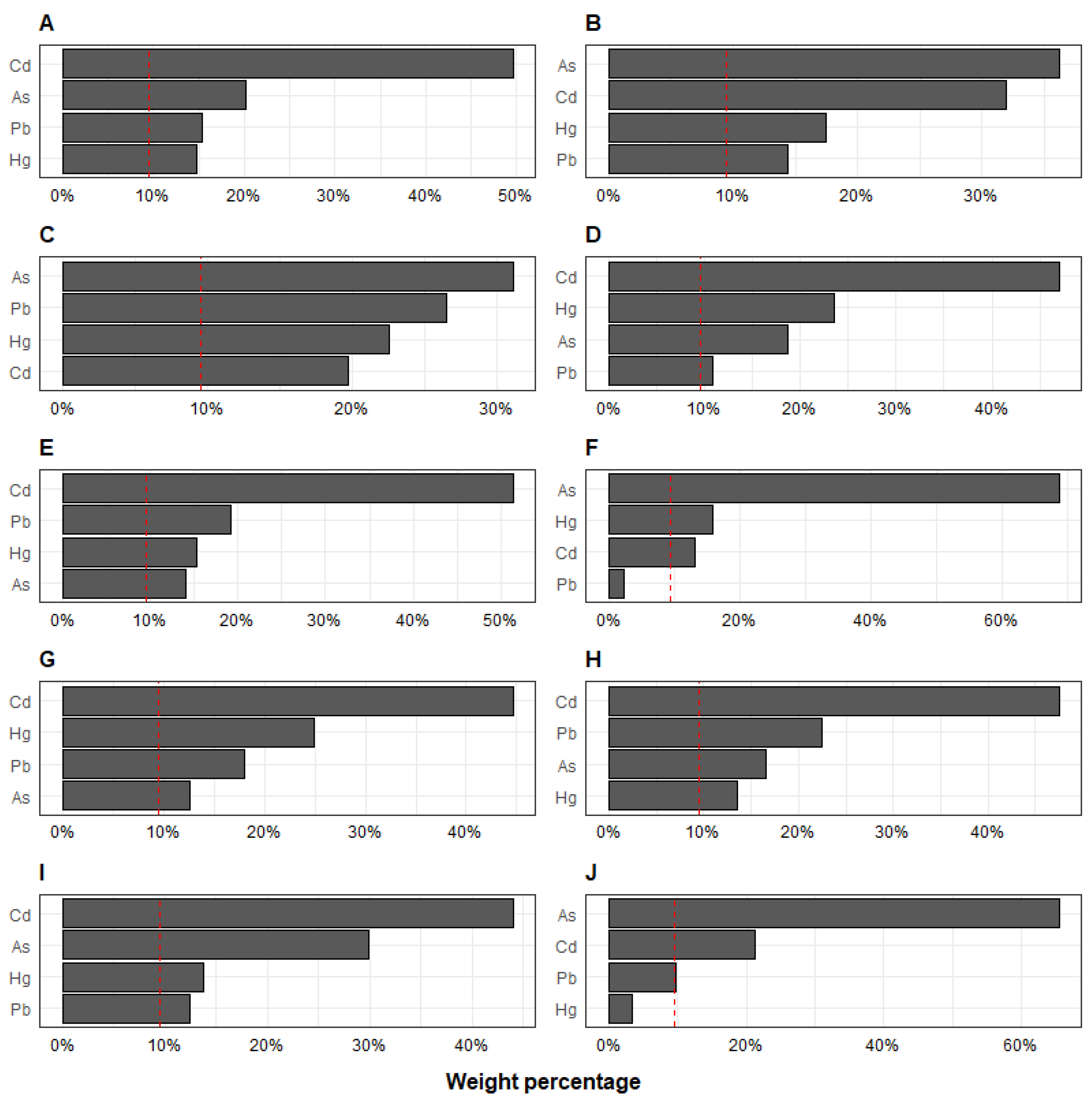
Prenatal exposure to arsenic (As), cadmium (Cd), mercury (Hg), and lead (Pb) may be nephrotoxic, yet limited studies have examined subclinical kidney injury biomarkers in children. We assessed whether metal exposure in the second trimester (2T), a crucial time of kidney development, is associated with altered urine kidney injury and function biomarkers in preadolescent children. Analyses included 494 children participating in a birth cohort study in Mexico City. Concentrations of As, Cd, and Pb were measured from pregnant women in 2T blood and urine, and Hg in urine only. Kidney biomarkers were measured from children in urine at age 8–12 years. We assessed the associations between individual metals and (1) kidney biomarkers using linear regression and (2) a multi-protein kidney mixture using weighted quantile sum (WQS) regression. Associations of separate urine and blood metal mixtures with individual kidney biomarkers were assessed via WQS. Within the multi-protein mixture, the association with increased urinary As was predominated by urine alpha-1-microglobulin (A1M), interferon gamma-induced protein 10 (IP10), and fatty acid binding protein 1; the association with increased urinary Cd was predominated by A1M, clusterin, and albumin. The urine metal mixture was associated with increased albumin (0.23 ng/mL; 95% confidence interval (CI): 0.10, 0.37), IP10 (0.15 ng/mL; 95% CI: 0.02, 0.28), and cystatin C (0.17 ng/mL; 95% CI: 0.04, 0.31); these associations were mainly driven by urinary As and Cd. We observed null associations between prenatal blood or urine metal mixtures and estimated glomerular filtration rate. Higher prenatal urinary metals, individually and as a mixture were associated with altered kidney injury biomarkers in children. Further research and longer participant follow-up are required to ascertain the risk of kidney disease later in life.
Keywords: heavy metals; renal health; mixture; arsenic; cadmium; lead; mercury heavy metals; renal health; mixture; arsenic; cadmium; lead; mercury