Article

Financial and Market Performance-Driven TQM: The Mediating Roles of Supply Chain Resilience and Corporate Social Performance

by
Mahmoud Abdulhadi Alabdali
1,2,
Mohammad Asif Salam
3,*,
Mohammed Abu Jahed
4 and
Ummee Kulsum
4
1
Faculty of Business Studies, Arab Open University, Jeddah 21473, Saudi Arabia
2
TAM Development Company, Riyadh 13516, Saudi Arabia
3
Department of Business Administration, Faculty of Economics and Administration, King Abdulaziz University, Jeddah 23589, Saudi Arabia
4
Department of Management, School of Business, Saint Bonaventure University, 3261 West State Road, St. Bonaventure, NY 14778, USA
*
Author to whom correspondence should be addressed.
Logistics 2026, 10(8), 172; https://doi.org/10.3390/logistics10080172
Submission received: 4 March 2026 / Revised: 9 July 2026 / Accepted: 17 July 2026 / Published: 31 July 2026

Abstract

Total quality management (TQM) is widely regarded as a critical approach for improving firm performance, yet evidence on the mechanisms linking TQM practices to financial and market outcomes remains fragmented, with most prior studies testing only direct effects. This study examines whether supply chain resilience (SCR) and corporate social performance (CSP) mediate the relationship between TQM practices and firms’ financial and market performance (FMP). Drawing on the resource-based view and stakeholder theory, a conceptual model was tested using partial least squares structural equation modeling (PLS-SEM) complemented by necessary condition analysis (NCA), based on survey data from 330 firms operating in Saudi Arabia. The results show that TQM practices do not have a significant direct effect on FMP but have strong positive effects on SCR and CSP. SCR and CSP, in turn, significantly predict FMP, and both fully mediate the TQM–FMP relationship (indirect effects: 0.381 via SCR; 0.252 via CSP). The NCA further identifies SCR and CSP as necessary conditions for achieving higher FMP. The findings indicate that the financial and market benefits of TQM are realized through building resilient supply chains and stronger social performance, rather than directly. These results offer managers and policymakers a clearer roadmap for translating TQM investments into sustainable performance outcomes.

1. Introduction

Total quality management (TQM) has demonstrated a significant impact globally, with numerous studies highlighting its efficacy. For instance, Mittal et al. [1] report improved productivity and profitability in the Indian industry due to TQM practices. In Japan, implementing TQM has been linked to the country’s post-war industrial success [2], with companies such as Toyota exemplifying its benefits through their renowned quality systems [3]. In the United States, Motorola, widely recognized as the originator of Six Sigma in the mid-1980s, reported substantial cost savings and quality gains following the firm-wide deployment of this TQM-related methodology [4]. Additionally, a survey of Peruvian firms finds that those employing TQM reported improvement in market share [5]. On a global scale, the International Organization for Standardization (ISO) [6] reports that over 1 million companies in more than 189 countries are certified to ISO 9001, a TQM-related standard, underscoring the widespread adoption and international relevance of TQM practices.
Yas et al. [7] investigate the implementation of TQM practices in the Saudi manufacturing sector. They find that TQM significantly improves operational efficiency, customer satisfaction, and competitive advantage. Zighan et al. [8] examine how TQM enhances supply chain resilience (SCR) among pharmaceutical firms in the Middle East. The findings indicate that TQM practices, when integrated with advanced supply chain (SC) strategies, markedly increase a firm’s ability to withstand disruptions, particularly during the COVID-19 pandemic. Additionally, Alofan et al. [9] explore the impact of TQM on corporate social performance (CSP) in Saudi Arabian companies. Firms adopting TQM not only improve internal processes but also enhance social responsibility initiatives, aligning with Saudi Vision 2030 [10].
Although TQM has been extensively adopted by organizations globally to enhance operational efficiency and customer satisfaction, its integration with SCR and CSP in the Saudi Arabian context has not been thoroughly examined. This gap in research gap is critical given Saudi Arabia’s unique, transitioning economic, cultural, and regulatory environment, which is undergoing significant transformation under Vision 2030. Therefore, this study explores the interplay among TQM, SCR, and CSP within Saudi organizations. The objective is to identify how TQM practices can be optimized to improve SC robustness and foster socially responsible business practices, ultimately contributing to the broader goal of enhancing sustainable business performance in line with national development goals [11]. Accordingly, this study addresses two complementary research questions: the first concerns direct effects, and the second examines the underlying transmission mechanism:
RQ1. 
To what extent do TQM practices directly influence firms’ financial and market performance (FMP)?
This question isolates the direct-effects component of the model. It tests whether the bundle of TQM practices, strategic planning, customer focus, information and analysis, human resource management, and process management, translates on its own into measurable financial and market gains, or whether the often-assumed direct link is empirically weaker than the literature suggests once intervening capabilities are explicitly modeled.
RQ2. 
Through which intermediate organizational capabilities, specifically SCR and CSP, are the effects of TQM practices on FMP transmitted?
Whereas RQ1 examines whether TQM matters directly, RQ2 shifts the focus to how and through what mechanisms TQM matters. It positions SCR and CSP as theoretically grounded mediating mechanisms: SCR captures the operational and risk-buffering pathway consistent with the RBV, and CSP captures the stakeholder-oriented pathway consistent with stakeholder theory. Answering RQ2, therefore, clarifies whether the value of TQM is realized internally through resilient supply chains, externally through socially responsible conduct, or both, and provides a roadmap for managers seeking to convert TQM investments into sustained financial and market outcomes within the context of Saudi Vision 2030.
This study addresses a specific gap: while TQM, supply chain resilience, and corporate social performance have each been linked to firm outcomes, the joint mechanism through which TQM’s effect on financial-market performance is channeled, via both a capability pathway (SCR) and a legitimacy pathway (CSP), has not been empirically tested. By estimating both pathways in a single model and decomposing the direct, indirect, and total effects, this study tests whether TQM’s financial-market payoff is direct, mediated, or absent, and identifies the specific mechanisms through which it operates.
This study employs stakeholder theory (ST) [12] and uses the resource-based view (RBV) [13] as the theoretical underpinning of the conceptual model. The model specifies relationships among TQM, SCR, CSP, and FMP outcomes and tests for mediation and moderation effects. This study contributes to theory by offering a more nuanced understanding of how firms can leverage internal resources and external relationships to achieve sustainable success. Additionally, it provides managers with a roadmap for implementing TQM practices that enhance SCR and CSP, driving both financial and market success.
The remainder of the paper is organized as follows. Section 2 reviews the literature and develops the conceptual model and hypotheses. Section 3 describes the methodology, Section 4 presents the results, and Section 5 discusses the findings and their theoretical and practical implications. The final section outlines limitations and suggests directions for future research.

2. Research Background

2.1. Underpinning Theories

This research investigates how TQM practices affect FMP by examining the mediating roles of SCR and CSP [1,14,15]. Saudi Vision 2030 emphasizes operational excellence, sustainability, and global competitiveness, encouraging firms to adopt TQM practices. Unlike many emerging markets, Saudi industries are undergoing rapid economic transformation and greater integration into global supply chains, making resilience and sustainability particularly important for managing disruptions and meeting growing stakeholder expectations under Vision 2030.
This study draws on the RBV and ST as complementary theoretical foundations for explaining how TQM influences FMP through internal capability development and external stakeholder engagement [12,13,16,17]. From the RBV perspective, TQM practices constitute valuable organizational resources and routines [13,18]. However, such routines yield sustained competitive advantage only when they evolve into capabilities that are valuable, rare, inimitable, and non-substitutable (VRIN) [13,17]. ST emphasizes that organizations should create value for multiple stakeholder groups, including customers, employees, suppliers, communities, and regulators, rather than focusing solely on shareholder interests [12,17,19]. In this context, CSP reflects the firm’s ability to meet stakeholder expectations and strengthen organizational legitimacy [20].
By integrating these perspectives and introducing new factors, this study aims to optimize internal strengths while ensuring ethical and effective stakeholder engagement [10,17,21]. This integrated approach fosters a well-rounded, resilient business management strategy that enhances TQM, SCR, and FMP [22,23,24]. TQM is a multifaceted approach encompassing several core components [25,26]. TQM’s strategic planning (SP) aligns long-term strategies with quality initiatives, integrating quality management into the firm’s strategic direction [27,28]. TQM’s CF emphasizes understanding and meeting customer needs and expectations, fostering a customer-centric culture that prioritizes customer satisfaction and loyalty [7,29,30]. TQM’s information and analysis (IA) utilizes data systems to track performance, identify improvement opportunities, and drive quality-focused decisions [31,32]. TQM’s human resource management (HRM) develops the workforce to support quality initiatives through training and involvement, fostering a culture of continuous improvement [33,34,35]. TQM’s process management (PM) optimizes and controls processes to ensure consistent quality outcomes, reduce variability, and improve efficiency [36,37,38].
Although several intervening capabilities, including operational agility, innovation capability, and operational performance, could plausibly mediate the link between TQM and FMP, the present study isolates SCR and CSP as the two theoretically privileged mechanisms. This justification follows directly from the dual-theory lens adopted here, with each theory mapping onto a distinct mediating pathway.
First, RBV explains the TQM → SCR pathway through a capability-building logic. RBV holds that competitive advantage emerges when firms convert internal practices into resources that are valuable, rare, inimitable, and non-substitutable (VRIN) [13]. TQM practices, process standardization, data-driven decision-making, supplier integration, and continuous improvement are operational routines; on their own, they are imitable and therefore unable to deliver sustained advantages. What renders them VRIN is their accumulation, over time, into a higher-order organizational capability. SCR captures precisely this higher-order capability: the firm’s tacit, path-dependent ability to anticipate, absorb, and recover from supply chain disruptions. SCR is therefore not merely a parallel outcome of TQM but its capability-level expression—the resource through which TQM’s operational routines are converted into durable competitive advantage. Alternative candidates, such as agility or innovation, while related, capture narrower aspects (responsiveness; novelty generation) and do not fully embody the absorptive and recovery dimensions through which TQM’s operational discipline translates into protected revenue streams under uncertainty.
Second, ST explains the TQM → CSP → FMP pathway through a stakeholder-legitimacy logic. ST argues that long-term firm performance depends on the firm’s ability to create and balance value across multiple stakeholder groups—customers, employees, suppliers, communities, regulators, and investors [12,19]. TQM is, at its core, a stakeholder-oriented management philosophy: customer focus addresses customer interests, HRM addresses employee interests, supplier integration addresses supplier interests, and process management embeds environmental and ethical considerations into operations. CSP aggregates these stakeholder-directed practices into an externally observable signal of legitimacy and trustworthiness. ST predicts that this legitimacy signal, rather than internal efficiency alone, attracts customer loyalty, investor confidence, and favorable regulatory treatment, all of which feed into FMP. Operational performance, by contrast, is internally oriented and does not capture this external legitimacy mechanism, which is why ST points specifically to CSP as the theoretically appropriate mediator for the social-responsibility pathway.
The two theories are therefore complementary rather than redundant: RBV explains the internal capability that converts TQM into resilience, while ST explains the external legitimacy that converts TQM into stakeholder-driven market rewards.
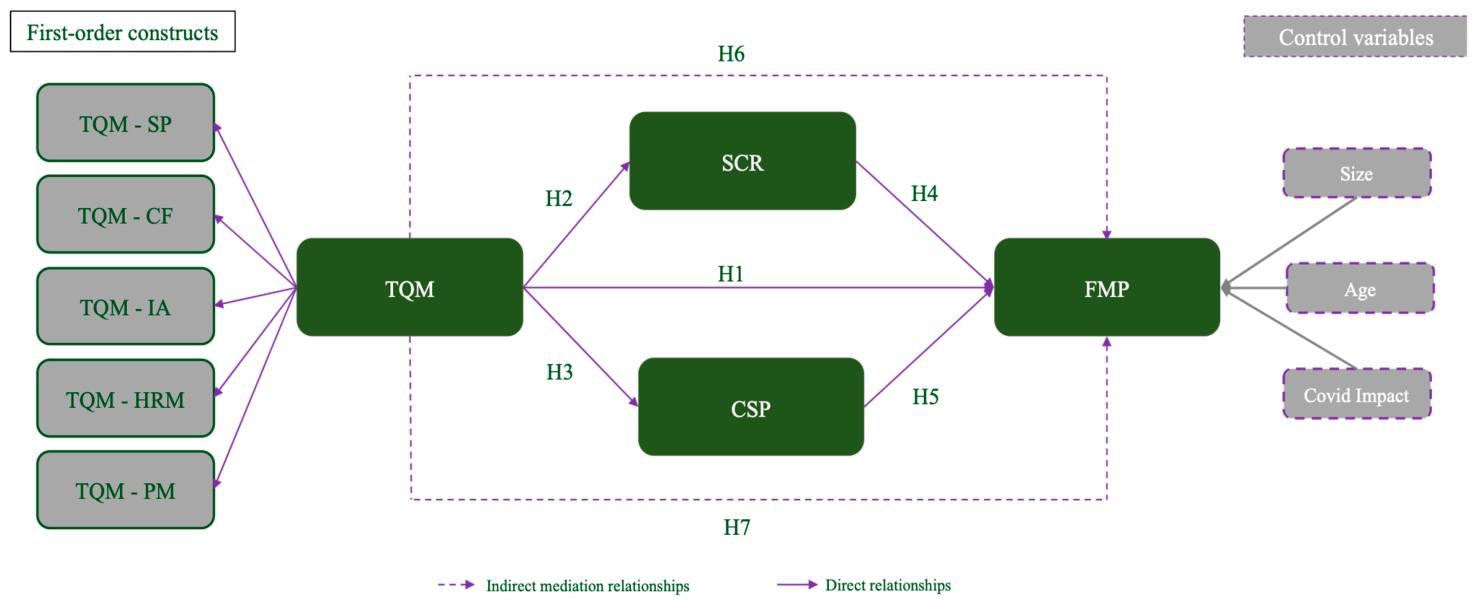
This research contributes to the literature by demonstrating that combining RBV and ST can yield a comprehensive strategic framework. This framework enhances internal resource management and external stakeholder engagement, ultimately improving organizational performance. The research model is shown in Figure 1.

2.2. Study Hypotheses

2.2.1. TQM and FMP

TQM, with its focus on continuous improvement, customer satisfaction, process optimization, and employee engagement, fundamentally alters an organization’s operational and strategic dynamics [10,36,39]. A primary pathway through which TQM influences financial performance is by improving operational efficiency and reducing costs [40,41,42]. By emphasizing process optimization, waste reduction, and defect prevention, TQM practices streamline operations and boost productivity, thereby lowering production costs and enhancing profit margins [34,43].
Moreover, TQM’s customer-centric approach is crucial for improving market performance [26,33,35]. By consistently meeting and exceeding customer expectations, firms can achieve higher customer satisfaction and loyalty [44,45]. Satisfied customers are more likely to become repeat buyers and brand advocates, enhancing market reputation and expanding market share [17,23,46]. Additionally, the emphasis on employee involvement and continuous improvement fosters a culture of engagement and innovation [32,47]. Engaged employees are more productive and innovative, contributing to superior product offerings and operational excellence, which further drive financial and market success [8,21,27].
Empirical studies support this relationship, showing that firms implementing TQM practices report significant improvements in financial metrics such as “return on assets,” “return on equity,” and “profit margins” [24,48,49]. Additionally, market performance indicators, including “market share,” “customer retention rates,” and “brand equity,” show marked improvement when TQM principles are adopted [5,50,51]. Therefore, the relationship between TQM practices and a firm’s FMP is both theoretically sound and empirically validated, underscoring the strategic importance of integrating TQM into organizational practices to achieve sustained competitive advantage and superior business outcomes [52]. Thus, the first hypothesis is:
H1. 
TQM practices directly impact a firm’s FMP.

2.2.2. TQM and SCR

At its core, TQM focuses on continuous improvement, process optimization, and stakeholder engagement, which together foster an SC that can withstand disruptions and recover swiftly [5,49]. TQM practices improve process control and standardization. By implementing rigorous quality controls and standardized procedures, organizations can reduce variability and increase predictability across their SCs [14,41,53]. This heightened consistency makes the SC more resilient to disruptions, enabling steady operations even when unexpected challenges arise [36,51].
Consistent with the RBV [13], this study treats SCR as the higher-order, path-dependent capability into which TQM’s repeatable routines are accumulated; imitation becomes difficult and competitive advantage becomes sustainable at this capability level rather than at the level of individual practices.
Moreover, TQM’s emphasis on supplier collaboration and relationship management is crucial to building resilience. Strong partnerships and open communication with suppliers improve alignment and coordination, both essential for responding effectively to disruptions [9,54]. This collaborative approach facilitates joint problem-solving and fosters innovation, allowing the SC to adapt swiftly to changing conditions and emerging threats [45,55].
Additionally, TQM practices promote a proactive stance on risk management. Through continuous monitoring and improvement initiatives, firms can identify potential vulnerabilities within their SCs and implement preventive measures to mitigate risks before they escalate [2,47,48]. This proactive approach ensures that the SC is better prepared to handle disruptions, minimizing their impact on operations [22,56].
Organizations that adopt TQM practices report higher SC reliability, flexibility, and responsiveness [27,28,57]. These firms are better equipped to manage unexpected events, such as natural disasters, supply shortages, and demand fluctuations, thereby maintaining continuity and mitigating the adverse effects of disruptions [23,44,58]. Therefore, the relationship between TQM practices and SCR is both theoretically sound and empirically validated, underscoring the strategic importance of integrating TQM principles into SC management to enhance overall resilience and stability [32,37,52].
H2. 
TQM practices significantly impact SCR.

2.2.3. TQM and CSP

TQM’s emphasis on SP aligns organizational goals with broader social responsibilities, ensuring that operations contribute positively to society [27,28,47]. By integrating social and environmental objectives into their strategic plans, companies address sustainability, ethical governance, and community engagement, thereby enhancing their CSP [22.40]. Moreover, a strong CF under TQM not only aims to meet customer needs but also to understand and act on the social concerns of their customer base [49,57]. Companies that prioritize customer feedback and societal trends develop high-quality, socially responsible products and services, significantly improving their social standing and reputation [17,36,54].
Framed through ST [12], this pathway reflects the conversion of TQM’s stakeholder-oriented routines, customer focus, employee development, supplier collaboration, and ethically embedded processes into an aggregated, externally legible record of stakeholder value creation, which serves as the operational definition of CSP adopted here.
IA practices within TQM support social performance by providing data and insights for informed decision-making [9,24,45]. By monitoring social impact metrics, such as environmental performance, labor practices, and community investments, firms can identify improvement opportunities and continuously enhance their social initiatives [2,41,44,48,53,55].
TQM’s approach to HRM fosters an inclusive and ethical workplace culture [14,24,37]. By emphasizing employee engagement, training, and development, companies ensure fair labor practices and enhance employee well-being, translating into better workplace conditions, higher employee satisfaction, and improved social performance [34,43,47].
Within TQM, PM can contribute to CSP indirectly by creating operational conditions that reduce waste, lower emissions, tighten supplier specifications, and standardize sourcing protocols, thereby making socially responsible outcomes more achievable [52,58]. We do not claim that PM, as an operational discipline, is itself an expression of ethical commitment; rather, consistent with ST, PM becomes relevant to CSP when its outputs (e.g., measurable reductions in environmental footprint, verifiable supplier compliance) align with stakeholder expectations and translate into observable social outcomes [35,42,54]. Under this framing, PM supports, rather than demonstrates, a firm’s social performance, and its contribution to CSP is contingent on whether process outcomes are intentionally oriented toward stakeholder-relevant objectives [28,33].
Studies show that companies implementing comprehensive TQM frameworks report improved sustainability metrics, ethical business practices, and community engagement [24,32,36]. These improvements fulfill regulatory and ethical obligations and strengthen the company’s reputation and competitive position [9,54,55]. Thus, the relationship between TQM practices and CSP is robust and multifaceted [2,47,48]. By integrating SP, CF, IA, HRM, and PM into their TQM frameworks, companies achieve significant improvements in social performance [27,28,57]. Taken together, this evidence suggests that an integrated TQM framework is associated with improvements in social performance, though the strength of this association depends on how deliberately firms orient their SP, CF, IA, HRM, and PM practices toward stakeholder-relevant outcomes [35,44,54]:
H3. 
TQM practices significantly impact CSP.

2.2.4. SCR and FMP

SCR, defined as the ability to anticipate, prepare for, respond to, and recover from disruptions, is crucial for maintaining continuous operations and meeting market demand amid unexpected challenges [59,60]. A resilient SC directly affects a firm’s financial performance by minimizing disruption-related costs [17,47,52]. When SCs are resilient, companies can avoid or quickly mitigate the effects of events such as natural disasters, geopolitical tensions, and supplier failures [27,54]. This capability reduces downtime, maintains production schedules, and prevents costly delays, thereby protecting revenue streams and profit margins [35,45,48]. Additionally, resilient SCs are better equipped to manage inventory levels efficiently, reducing the costs associated with excess stock or stockouts [41,44,60]. This operational efficiency translates into better financial outcomes through improved cash flow and reduced operational expenses [22,36,58].
From a market performance perspective, SCR enhances a company’s ability to consistently meet customer expectations [32,50]. Firms with resilient SCs can deliver products on time, maintain high product quality, and adapt to shifts in customer demand more effectively than less resilient counterparts [5,61]. This reliability fosters customer trust and loyalty, leading to increased market share and a stronger competitive position [2,42,47]. Moreover, companies known for their SCR are often perceived as more reliable and capable partners, which can attract new customers and business opportunities, further bolstering market performance [33,54].
Empirical studies support the significant impact of SCR on FMP [10,15,36]. Research indicates that firms with resilient SCs report higher profitability, return on assets, and return on equity [12,13,30]. Additionally, they tend to perform better in market share growth, customer retention, and overall market reputation [27,28]. The ability to navigate and recover from SC disruptions not only safeguards a company’s immediate financial health but also contributes to its long-term strategic success [24,42,49].
The relationship between SCR and a firm’s FMP is both theoretically sound and empirically validated. A resilient SC ensures operational continuity, cost efficiency, and customer satisfaction, all essential to achieving superior financial performance and competitive advantage [9,17]. Therefore, investing in strategies and practices that enhance SCR is a crucial component of a firm’s overall business strategy, directly influencing its economic success and market leadership [36,37,58].
H4. 
SCR significantly determines a firm’s FMP.

2.2.5. CSP and FMP

Socially responsible practices drive economic success and competitive advantage. CSP encompasses a company’s efforts to operate ethically and sustainably, positively impacting society [16,47]. These efforts not only fulfill moral and regulatory obligations but also yield tangible financial and market benefits [19,24].
CSP directly affects a firm’s financial performance by enhancing its reputation and building stakeholder trust [17,60,62]. Companies with strong CSP practices are more likely to attract and retain customers who prioritize ethical consumption. This customer loyalty can translate into higher sales and revenue [24,47,49]. Additionally, firms with high CSP often enjoy stronger relationships with investors and financial institutions, which increasingly factor social responsibility into investment decisions [9,34,54]. These relationships can lead to more favorable financing terms and a lower cost of capital, contributing to improved financial performance [28,43,61].
From a market performance perspective, strong CSP practices can differentiate a company from its competitors [36,45]. In an era when consumers and businesses are increasingly aware of social and environmental issues, companies that excel in CSP can leverage their commitment to social responsibility as a unique selling proposition [12,35,54]. This differentiation can enhance brand equity, attract new customers, and increase market share [42,44,58]. Moreover, companies with robust CSP initiatives are better positioned to anticipate and adapt to regulatory changes in environmental and social governance, thereby reducing the risk of compliance costs and potential fines [2,30,57].
Empirical research indicates a positive correlation between CSP and FMP [17,55,63]. Studies show that firms with high CSP scores tend to achieve higher profitability, return on assets, and stock market performance [1,21,37]. These firms also experience enhanced customer loyalty, improved employee satisfaction, and greater operational efficiency, all of which contribute to a stronger market position [22,27,32]. Furthermore, strong CSP can mitigate risks associated with negative publicity and social activism, protecting the firm’s reputation and supporting sustainability [41,48,54].
The relationship between CSP and a firm’s FMP is robust and well-substantiated. Companies that prioritize social responsibility not only contribute to societal well-being but also enhance their economic success and competitive advantage [39,45]. By integrating ethical, sustainable, and socially responsible practices into their business strategies, firms can achieve superior financial performance, increased market share, and improved sustainability [24,36]. Thus, CSP is not only a moral imperative but also a strategic asset that drives overall business performance [17,64].
H5. 
CSP significantly influences a firm’s FMP.

2.2.6. SCR as a Mediator

TQM practices and a firm’s FMP underscore the pivotal role of a resilient SC in translating TQM initiatives into tangible economic benefits. TQM practices—such as SP, CF, IA, HRM, and PM—are designed to enhance operational efficiency and customer satisfaction [1,34,65]. However, these practices reach their full potential only when a firm’s SC is resilient, enabling the firm to withstand and adapt to disruptions [17,24,36].
TQM practices contribute to SCR by fostering a culture of continuous improvement, data-driven decision-making, and proactive risk management [2,9,66]. For instance, SP under TQM ensures that SC risks are identified and mitigated through comprehensive contingency plans [27,45,50]. CF encourages firms to build strong relationships with suppliers and partners, enhancing collaboration and flexibility across the SC [49,62]. IA provides critical insights to anticipate disruptions and respond swiftly, while HRM ensures employees are well trained to handle SC challenges [44,54]. PM optimizes workflows and reduces vulnerabilities, making the SC more robust and adaptable [32,61,63].
A resilient supply chain mediates the relationship between TQM practices and FMP by ensuring that the benefits of TQM are fully realized even amid disruptions [36,41,64]. When supply chains are resilient, companies can maintain consistent product quality and delivery schedules, which are core objectives of TQM [39,54]. This consistency protects revenue streams, reduces operational costs, and enhances customer satisfaction, thereby improving financial performance [14,35,57]. Additionally, a resilient SC enhances a firm’s market performance by fostering reliability and trust among customers and partners [12,24,58]. Firms known for their resilience are better positioned to capture market opportunities and respond to shifts in demand, thereby strengthening their competitive position [15,42,47].
Empirical evidence supports the mediating role of SCR in the relationship between TQM and FMP. Studies indicate that firms with strong TQM practices and resilient supply chains report higher profitability, return on assets, and market share growth than those lacking either capability [16,48,51]. These firms also demonstrate greater agility in adapting to market changes and disruptions, further enhancing their market performance [2,9,18,34].
SCR plays a critical mediating role in the relationship between a firm’s TQM practices and FMP. TQM practices lay the foundation for operational excellence and customer satisfaction, but their full impact is realized only when the SC is resilient enough to sustain these improvements under adverse conditions [17,22,44]. Therefore, investing in SCR is essential for firms seeking to maximize the benefits of their TQM initiatives and achieve superior financial and market outcomes [54,62]. This integrated approach ensures that companies are not only efficient and customer-focused but also agile and robust in the face of disruptions, driving long-term success and competitive advantage [36,37,58].
H6. 
SCR significantly mediates the relationship between firms’ TQM practices and FMP.

2.2.7. CSP as a Mediator

TQM practices and a firm’s FMP demonstrate that socially responsible actions amplify the benefits of TQM initiatives. TQM practices, such as SP, CF, IA, HRM, and PM, enhance operational efficiency and customer satisfaction while strengthening a firm’s commitment to social responsibility. This commitment, in turn, improves FMP [27,36,63].
TQM practices inherently support CSP by embedding quality, ethics, and sustainability into the core operations of the business [17,44]. SP under TQM ensures that corporate goals align with social and environmental responsibilities, thereby fostering sustainability [1,42]. A strong CF encourages firms to address customers’ social concerns and ethical preferences, leading to the development of high-quality, socially responsible products and services [24,34,39]. IA provides the data needed to track and improve social performance metrics, such as environmental impact and community engagement [49,56,58]. HRM under TQM promotes fair labor practices, employee well-being, and inclusivity, whereas PM optimizes operations to reduce waste and enhance sustainability [32,60,62].
CSP acts as a mediator, translating internal efficiencies and quality improvements achieved through TQM into external benefits that enhance FMP [2,5,54]. When firms excel in CSP, they build a positive reputation and strong relationships with stakeholders, including customers, investors, and communities [24,41,48]. This reputation leads to increased customer loyalty, better access to capital, and stronger market positioning [35,42,47]. Financially, firms with high CSP often experience lower operational costs owing to sustainable practices and a reduced risk of regulatory fines and penalties. Marketwise, these firms attract customers who value ethical practices, thereby increasing market share and competitive advantage [36,45].
Empirical evidence supports CSP’s mediating role in the relationship between TQM and FMP. Studies show that firms with robust TQM practices and high CSP scores achieve better financial outcomes, including higher profitability, return on assets, and stock market performance [43,50]. These firms also report greater customer loyalty, higher employee satisfaction, and improved operational efficiency [44,48,61]. The positive social impact of their operations further strengthens their market position, making them more resilient and adaptable to market changes [17,36,54].
CSP significantly mediates the relationship between a firm’s TQM practices and FMP. TQM practices lay the foundation for operational excellence and customer satisfaction, while CSP ensures that these gains align with broader social and environmental goals [34,44,58]. By integrating TQM and CSP, firms can achieve superior financial performance and market success, driven by a reputation for quality and social responsibility [16,17]. This approach enhances economic performance and supports sustainable business practices, ultimately benefiting the firm and society [60,62].
H7. 
CSP significantly mediates the relationship between firms’ TQM practices and the FMP.

3. Methodology

3.1. Measurement Scales

Corporate social performance (CSP) and financial and market performance (FMP) are the study’s performance variables. CSP was measured using four items on a five-point Likert scale (1 = “strongly disagree,” 5 = “strongly agree”). FMP was measured with five items assessing performance over the past three years relative to significant industry competitors (1 = extremely low; 5 = extremely high).
TQM is conceptualized as a higher-order construct comprising five sub-constructs: strategic planning (SP), customer focus (CF), information and analysis (IA), human resource management (HRM), and process management (PM). Although leadership is included as a distinct dimension in some TQM frameworks (e.g., MBNQA, EFQM), it is not modeled as a separate first-order construct in the present study for three reasons. First, the measurement instrument is adapted from Sila [67], whose validated framework positions leadership as an antecedent enabler of the practice-level dimensions rather than as a parallel TQM practice; retaining the five practice-oriented dimensions preserves fidelity to that framework. Second, the substantive content typically captured by a leadership scale, articulating a quality-oriented vision, communicating strategic direction, allocating resources to quality initiatives, and shaping a supportive organizational culture, is already embedded in the items used to measure SP (mission clarity, long-term goal setting, resource allocation for quality strategies) and HRM (employee involvement, recognition, alignment of HR policies with quality plans, top-down and bottom-up communication). Modeling leadership as an additional first-order dimension would therefore introduce conceptual redundancy inside the higher-order TQM construct. Third, given the structural complexity of the model, which specifies TQM as a second-order construct feeding two mediators (SCR and CSP) and one outcome (FMP), a parsimonious set of non-overlapping practice dimensions is preferable for interpretability and for minimizing inflation of within-construct multicollinearity. The five retained dimensions, therefore, reflect a deliberate, framework-consistent operationalization rather than an incidental omission.
All constructs were measured using multi-item reflective scales adapted from previously validated instruments, drawn primarily from Sila [67] and the underlying NIST [68] Baldrige criteria, alongside earlier foundational work by Saraph et al. [69], Anderson et al. [70], Flynn et al. [61], and Bou-Llusar et al. [71]. TQM is conceptualized as a higher-order construct comprising several quality management practices, each measured with multiple validated items. Strategic Planning (6 items) evaluates mission clarity, long-term goal setting, and resource allocation (e.g., “We take a clear long-term view on how to achieve our goals”); Customer Focus (6 items) measures customer satisfaction, relationship building, and the use of feedback to improve processes (e.g., “Customer complaints are used as input to improve our processes”); Information and Analysis (7 items) focuses on data collection, performance analysis, and benchmarking (e.g., “We formally benchmark the best practices and performances of other industries”); Human Resource Management (8 items) examines employee involvement, recognition, training, and alignment with quality objectives (e.g., “We recognize and reward our employees for superior quality performance”); Process Management (7 items) evaluates error reduction, continuous improvement, and innovation within processes (e.g., “We emphasize the continuous improvement of quality in all work processes”); and Supplier Management (8 items) captures supplier quality assurance and selection (e.g., “We usually select our suppliers based on quality rather than price or schedule”). Beyond the TQM dimensions, the study measures three further constructs. Supply Chain Resilience (5 items), adapted from Gölgeci and Ponomarov [72], assesses the firm’s ability to respond to and recover from supply chain disruptions (e.g., “Our firm’s supply chain is able to adequately respond to unexpected disruptions by quickly restoring its product flow”). Firm performance is captured through Corporate Social Performance (4 items), focusing on environmental sustainability and societal contributions (e.g., “Our activities for environmental protection”), and Financial and Market Performance (5 items), assessing market share, profitability, and competitive positioning (e.g., “Our site’s overall competitive position”). The full measurement items have been adapted from the literature and are available in the cited sources.

3.2. Control Variables

To rule out confounding effects, we controlled for firm size, age, and the impact of COVID-19 when assessing the influence of the primary predictors on the dependent variable. Various theories suggest how these factors might influence the relationship between TQM and FMP [73,74,75]. Consequently, firm size, age, and the impact of COVID-19 were used as control variables in this study, each measured with a single item. Firm age was determined by asking about the duration of business operations, while size was assessed based on the total number of full-time employees. The impact of COVID-19 was evaluated using a three-point scale ranging from severe to moderate to no impact.

3.3. Analytical Strategy

This study employed a combination of partial least squares structural equation modeling (PLS-SEM) in SmartPLS 4.0 [76] and necessary condition analysis (NCA), following the protocol outlined by Richter et al. [77]. The process involved three key steps: First, PLS-SEM was utilized to specify the measurement and structural models. Second, NCA was applied to establish the minimum thresholds for each exogenous variable required to assess the relationships among TQM practices, SCR, CSP, and FMP. Third, bottleneck analysis was conducted to determine the number of cases that failed to meet the necessary conditions. The findings from both SEM and NCA were then compared and synthesized into a comprehensive conclusion, highlighting both sufficient (should-have) and necessary (must-have) factors.
PLS-SEM is appropriate for this study, given its suitability for complex models involving multiple constructs, including multidimensional constructs and mediating relationships, as well as its ability to handle non-normal data and support prediction-oriented research [78]. Given the exploratory examination of relationships among constructs and the focus on explaining variance, PLS-SEM provides robust and flexible estimation.
NCA is applied alongside PLS-SEM to test a logic that PLS-SEM cannot address. PLS-SEM identifies predictors whose average contribution is sufficient to raise FMP (should-have), whereas NCA identifies predictors that must reach a minimum threshold for a given FMP level to be attainable at all (must-have). Combining the two provides a more complete account of how TQM, SCR, and CSP relate to FMP, distinguishing sufficient mechanisms from necessary conditions [77].

3.4. Sampling and Data Collection

The study’s respondents were selected from Saudi Arabia. Because widely used secondary databases in the region, such as Fortune’s Most Admired Companies and Bloomberg, are limited, a survey was considered the most appropriate method for collecting primary data. In this study, a purposive sampling technique was used for data collection, and the participants were drawn from medium- to large-sized industrial manufacturing and consumer goods firms listed in the 2023 Saudi Stock Exchange (Tadawul) directory. The research primarily focused on B2B enterprises with a comprehensive understanding of TQM procedures, selecting organizations within the same supply chain, including both upstream suppliers and downstream customers. These industries were selected due to their substantial societal and operational impacts [79,80,81]. Individual informants were chosen for their knowledge of TQM-related procedures, while top-level executives, such as CEOs, CFOs, and operations managers, were selected for their involvement in TQM-related decision-making and practical expertise in operations and business processes.
The preliminary questionnaire was developed following a comprehensive literature review and pilot-tested with 10 senior executives from publicly traded businesses who were excluded from the final sample. Their feedback was used to confirm content validity, and minor modifications were made before finalizing the survey instrument. To address common biases in survey-based research, the protocols outlined by Spector and Brannick [82] were followed. The questionnaire was kept concise, with careful attention to phrasing, and the independent and dependent variables were strategically separated within the survey to reduce bias.
Nine hundred firms were randomly selected to ensure an adequate sample size. A questionnaire, cover letter, and prepaid return envelope were sent to each firm. Of 340 responses, 10 were incomplete and excluded, yielding a final sample of 330 firms (36.67% response rate). This rate is consistent with B2B research involving senior executives and is considered sufficient in the Saudi Arabian context. Moreover, following established PLS-SEM guidelines, the minimum sample size should be ten times the maximum number of formative indicators or structural paths [83]. The final sample size substantially exceeds the required threshold, supporting the sample’s adequacy for reliable estimation and generalizability within the study context.
Of the 330 valid responses, the majority were from service-oriented enterprises (62%), while industrial manufacturing companies and consumer goods manufacturers accounted for 8.6% and 4.6%, respectively. Most responding firms were in the service sector; 43.3% of enterprises employed 500 or fewer employees; and 73.6% had been operational for 10 to 50 years. Table 1 presents a comprehensive analysis of the demographic attributes of the participating enterprises, including their principal industry, employee count, and years of operation.

3.5. Common Method Bias and Non-Response Bias

The survey questionnaire was carefully designed to address common method bias (CMB). To mitigate this issue, we emphasized the privacy and confidentiality of responses and clearly stated the study’s purpose at the beginning of the questionnaire. Despite these precautions, the self-reported nature of the data still introduced the potential for CMB to influence the observed associations [84]. To assess the likelihood of CMB, we employed two methods. First, we conducted Harman’s one-factor test, which indicated a low likelihood of CMB. The primary component accounted for only 43.6% of the variance, well below the 50% threshold, indicating that no dominant factor explained the variance [84].
Next, we evaluated collinearity in the structural model by analyzing all factor-level “variance inflation factors (VIFs)”. All VIFs ranged from 1.69 to 2.73, well below the recommended threshold of 3.3 [85]. This confirmed that collinearity and CMB were unlikely to pose significant problems in the study. Kock [85] argues that a VIF exceeding 3.3 indicates pathological collinearity, potentially suggesting CMB contamination in the model. Therefore, since all VIFs in the inner model from the full collinearity test were below 3.3, we concluded that the model was free from CMB.
Additionally, we assessed non-response bias by comparing early and late respondents, as suggested by Armstrong and Overton [86] and Groves [87]. The analysis found no significant differences in key characteristics, including staff count and years of operation, among the survey respondents (n = 330), the sampled population (n = 900), and the total population. This test assumes that late responses are more representative of the general population than early ones. An independent-samples t-test showed no significant differences across any variables in this study. Consequently, we determined that non-response bias was not a concern in our research.

4. Results

4.1. Assessment and Validation of Measures

The validity of the constructs was assessed by examining their reliability, convergent validity, and discriminant validity. Reliability was evaluated using Composite Reliability (CR) and Cronbach’s Alpha (CA). As shown in Table 2, all CR and CA values exceeded the recommended threshold of 0.70 [83], indicating strong reliability.
Convergent validity was assessed using item loadings and Average Variance Extracted (AVE) values. Items with low loadings were excluded from the final analysis. In the final model, all item loadings exceeded 0.7, and all AVE values surpassed 0.5 [83], indicating adequate convergent validity (Table 2).
Discriminant validity was evaluated by comparing the square roots of the AVE values with the inter-construct correlations (Table 3). Additionally, the Heterotrait-Monotrait Ratio of Correlations (HTMT) was used, and all HTMT values remained below the 0.90 threshold, confirming the distinctiveness of the constructs. At the item level, discriminant validity was further assessed using cross-loadings, ensuring that each item loaded more highly on its own construct than on any other construct. These results are presented in the cross-loading matrix (Table 4).
The dimensions of the second-order constructs were evaluated using the criteria outlined by Hair et al. [83]. Table 2, Table 3 and Table 4 confirm that all criteria were met, thereby validating the reliability and validity of the second-order constructs.

4.2. Necessary Condition Analysis

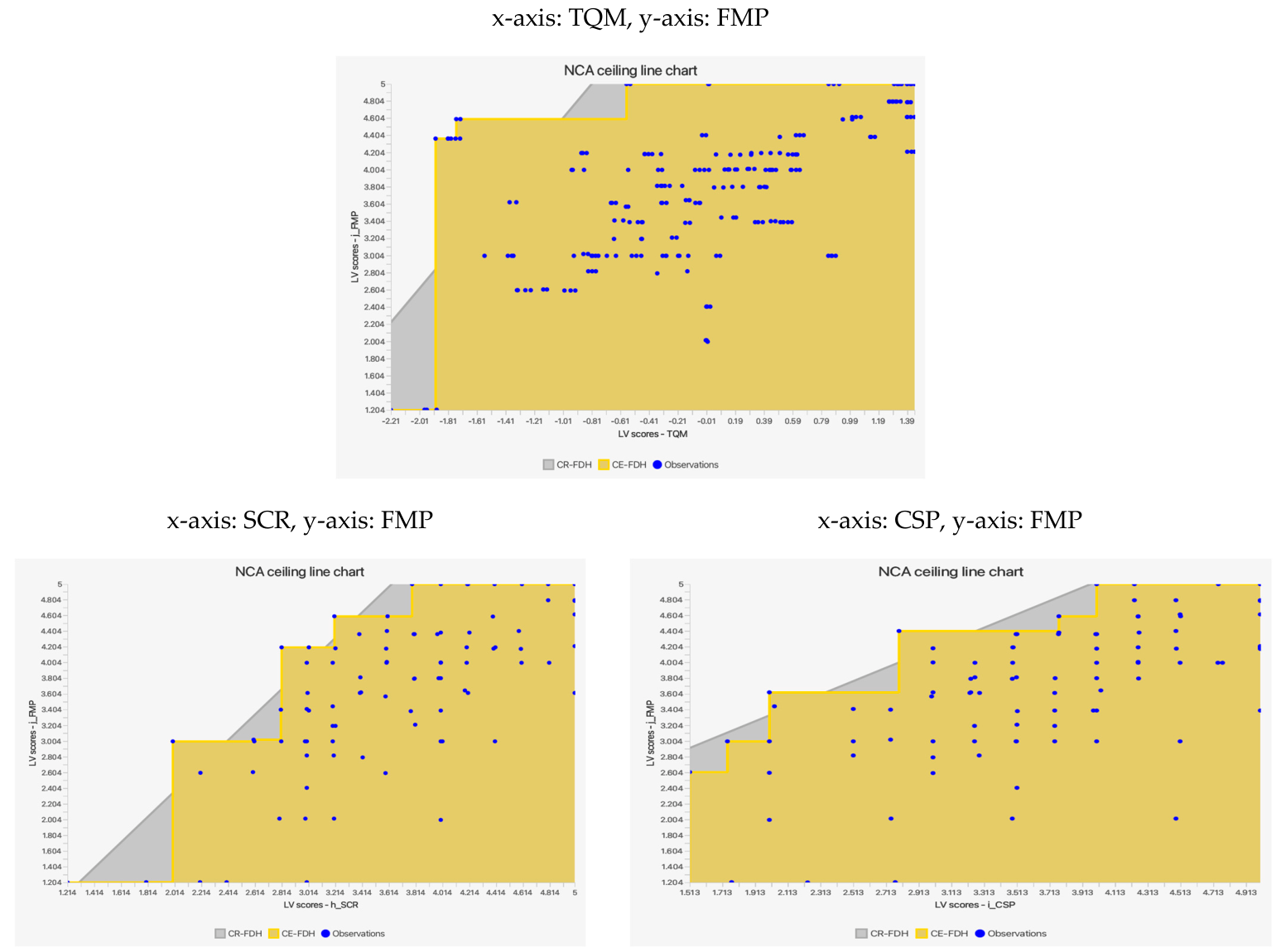
The NCA results, presented in Table 5, show the effect sizes and statistical significance of each exogenous latent variable with respect to the endogenous variable FMP. Given the discrete nature of the measurement items, particularly appropriate for Likert-scale data, the Ceiling Envelopment—Free Disposal Hull (CE-FDH) approach was employed [88]. The results indicate that TQM has a relatively small effect size (d = 0.127), suggesting that it is less necessary for achieving FMP. Conversely, SCR has a significant effect size (d = 0.359), indicating that it is a critical bottleneck for FMP. Additionally, CSP shows a moderate effect size (d = 0.214), underscoring its importance in attaining FMP, though to a lesser extent than SCR.
The NCA scatter plots with CE-FDH ceiling lines for TQM, SCR, and CSP further illustrate the necessity of these variables for FMP (see Figure 2). The plots confirm that SCR and CSP are crucial to achieving higher FMP levels, whereas TQM plays a less significant role in this context. The scatter plots demonstrate that as firms increase their SCR and CSP levels, they are more likely to achieve higher FMP outcomes, highlighting the non-compensatory nature of these variables.
Overall, the analysis indicates that SCR is the most critical necessary condition for FMP, followed by CSP. Both show large effect sizes and higher thresholds as higher FMP is targeted. This suggests that firms aiming to enhance their market performance must focus on improving SCR and sustainability performance. TQM, while important, appears to be less of a bottleneck than SCR and CSP. Count data further support this interpretation, showing that as firms aim for higher levels of FMP, an increasing number meet the necessary thresholds for SCR and CSP. At the 100th percentile, 41 firms met the SCR threshold, while 51 reached the required level for CSP, reinforcing their pivotal role in driving market performance.
The bottleneck table (Table 6) reports, for each targeted level of FMP (expressed as a percentage of its maximum observed value in the sample), the minimum required score on the original five-point scale for each predictor. Numerical entries indicate the threshold below which the corresponding FMP level cannot be attained, regardless of the other predictors’ values; entries marked “NN” indicate that the predictor is not a necessary condition at that FMP level. Reading the table row-wise therefore shows how the “floor” for SCR and CSP rises as firms target higher FMP outcomes.
Taken together, the NCA findings complement, rather than duplicate, the PLS-SEM results. PLS-SEM estimates the average, additive contribution of each predictor to FMP under a compensatory logic, in which a deficit in one predictor can, in principle, be offset by strength in another (should-have conditions). NCA tests a different, non-compensatory logic: whether a minimum level of each predictor must be present for a given level of FMP to be attainable at all (must-have conditions). Applied to this study, PLS-SEM shows that SCR and CSP fully mediate the effect of TQM on FMP, whereas NCA shows that SCR and CSP additionally function as necessary thresholds—firms cannot substitute high TQM adoption for weak resilience or weak social performance and still reach high FMP. This dual evidence strengthens the theoretical claim that SCR and CSP are not merely transmission channels but structurally required capabilities for realizing the financial and market benefits of TQM.

4.3. Structural Model Evaluation

We evaluated the structural model using multiple criteria to assess its robustness. The results show that the model’s endogenous variables, SCR (R2 = 0.706), CSP (R2 = 0.536), and FMP (R2 = 0.625), exhibit strong explanatory power, consistent with Hair et al. [83]. These R2 values indicate that the model explains a substantial proportion of the variance in SCR, CSP, and FMP.
The model’s predictive relevance was also evaluated using cross-validated redundancy (Q2) values. The Q2 values for SCR, CSP, and FMP were 0.704, 0.531, and 0.429, respectively. Because all Q2 values were positive, the model demonstrates substantial predictive relevance [89].
To evaluate the overall fit of the model, we used the goodness-of-fit index. The model achieved a goodness-of-fit value of 0.701, reflecting strong predictive capability and supporting the global validation of the PLS model [90,91].
Additionally, a post hoc power analysis was conducted in G*Power 3.1.9.2 [92] to assess the adequacy of the statistical parameters. The analysis estimated a power of 0.99 for the base model, given a sample size of 330, a significance level of 0.05, and an effect size of 0.10. This power value, which exceeds the recommended threshold of 0.80, confirms the statistical robustness of the hypothesized relationships in the model.

4.4. Results of Hypothesis Testing

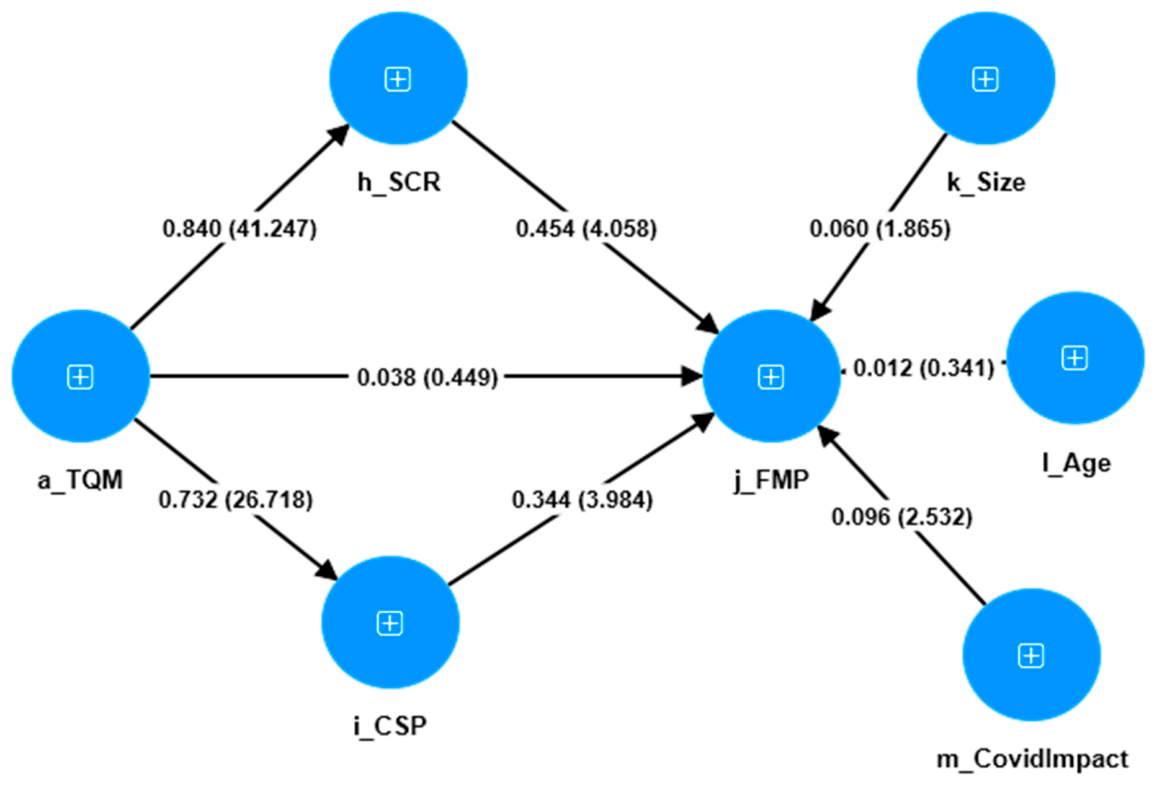
H1 posits that TQM methods directly influence a firm’s FMP. However, the findings do not support this hypothesis (β = 0.038; t = 0.449). The lack of evidence for H1 stems from the complete mediation of the link between TQM practices and FMP. The overall impact of TQM on FMP is substantial; however, the direct influence is minimal when the mediating variables are considered.
The findings indicate that TQM techniques have a substantial positive effect on SCR (β = 0.840; t = 41.247) and CSP (β = 0.732; t = 26.718). Consequently, H2 and H3 are supported. Figure 3 shows that the standardized path coefficients between SCR and FMP (β = 0.456; t = 4.058) and between CSP and FMP (β = 0.345; t = 3.984) are statistically significant, thus corroborating H4 and H5.
The significance of the indirect effects in the mediation analysis was assessed using bootstrapping [93]. The indirect effect of TQM techniques on FMP via SCR is 0.381, with a bias-corrected 95% confidence interval of [0.199, 0.367]. The indirect effect of TQM techniques on FMP via CSP is 0.252, with a bias-corrected 95% confidence interval of [0.128, 0.367]. Consequently, H6 and H7 are supported, indicating that SCR and CSP fully mediate the association between TQM practices and FMP when the direct effect of TQM on FMP is controlled.
Furthermore, business size, firm age, and the effects of COVID-19 were included as control variables in the model. The findings indicate that business size does not significantly affect the model results. The impact of COVID-19 is substantial, as shown in Table 7.

5. Discussion

The most theoretically consequential finding of this study is the non-significant direct effect of TQM on FMP. This contrasts with an influential strand of the literature that reports a positive direct relationship [94,95,96] and instead aligns with a smaller but growing body of work that finds the TQM–performance link to be mediated, conditional, or context-dependent [97,98,99]. Three explanations help reconcile our findings with the broader literature.
TQM is an operational-level construct, whereas FMP is a financial-market-level construct shaped by investor expectations, industry shocks, and macro-level factors. The distance between these levels makes a direct link empirically unlikely unless intermediate mechanisms, capability-based or legitimacy-based, translate operational discipline into outcomes visible to and valued by capital markets. Our results suggest that such translation does not occur automatically.
TQM is a bundle of practices, not a single lever. Prior studies reporting direct effects have typically not controlled for the downstream mechanisms through which individual TQM dimensions operate. Once SCR and CSP are included as mediators, the bundle’s direct effect on FMP dissolves, suggesting that earlier direct-effect findings may partly reflect unmodeled mediation rather than a genuine direct causal path.
H1’s non-significance is not a null finding; it is a theoretically informative refinement of the TQM–performance relationship, indicating that the financial-market payoff of TQM in contemporary industry settings flows through specific capability- and legitimacy-based mechanisms rather than a direct causal path.
The significant paths TQM → SCR (H2) and SCR → FMP (H4), combined with the significant indirect effect TQM → SCR → FMP (H6), indicate that supply chain resilience is one of two pathways through which TQM generates financial-market value. Interpreting this pattern against the prior literature yields three insights.
First, our finding extends the work of Agyabeng-Mensah et al. [44] and Birkie et al. [100], who established that TQM principles—process standardization, supplier integration, and continuous improvement—strengthen resilience. The present study adds empirical evidence that this capability upgrade is not merely operationally useful; it is financially consequential, as it translates operational discipline into the protection of revenue streams during disruptions. In the post-COVID environment, where disruption is a recurrent feature of supply chains rather than an exception, resilience has emerged as a rent-generating capability in the strict RBV sense: valuable (it protects revenue), rare (not all firms achieve it), inimitable (because it is rooted in routines and supplier relationships built over time), and non-substitutable (no alternative capability performs the same function).
Second, the full mediation of TQM → FMP by SCR (in combination with CSP) refines Chowdhury et al.’s [101] claim that resilience drives performance. Our evidence suggests that resilience is not merely a driver but a necessary conduit. Without the resilience conversion, TQM’s financial-market benefits do not materialize.
Third, this result carries a boundary implication often overlooked in the TQM literature: TQM’s financial-market payoff is contingent on disruption exposure. In stable environments, the resilience-to-FMP path may weaken because resilience’s protective value goes unused. Our full-mediation finding, therefore, has a latent contextual condition, industry volatility, that future research should explicitly investigate.
The significant paths TQM → CSP (H3) and CSP → FMP (H5), along with the significant indirect effect TQM → CSP → FMP (H7), establish corporate social performance as the second mediator. While SCR operates through an RBV logic of protected operational capability, CSP operates through a distinct ST logic of stakeholder legitimacy.
Our finding on TQM → CSP confirms and extends Arhin and Cobblah [33] and Silvestri et al. [24]: TQM practices, particularly supplier management, employee involvement, and process management, produce outcomes—reduced waste, ethical sourcing, and employee well-being—that stakeholders recognize as socially responsible. The theoretical point our data permits, which prior work has not fully articulated, is that the CSP conversion is neither automatic nor incidental. TQM generates CSP only when firms intentionally orient quality routines toward stakeholder-relevant outcomes (as argued in Section 2.2.3). The significance of H3 in our data, therefore, indicates that, in the sampled firms, such orientation is occurring but the full-mediation structure suggests that it is precisely this orientation, rather than TQM qua TQM, that carries the financial-market signal.
On the CSP → FMP relationship, our result aligns with the meta-analytic consensus [102,103] that CSP is positively associated with financial performance. However, because this effect is mediated rather than standalone in our model, it clarifies the mechanism: investors and market participants appear to interpret CSP not as a moral signal but as a capability indicator—evidence that the firm manages intangible stakeholder relationships competently, which in turn predicts long-term cash-flow stability. CSP’s contribution to FMP is therefore best understood as a legitimacy premium, conceptually distinct from but empirically complementary to the capability premium delivered by SCR.
Considered as a whole, the pattern of findings—a non-significant direct path, two significant indirect paths, and full mediation—makes a theoretical contribution that exceeds the sum of the individual hypotheses (see Table 8).
The study shows that TQM, as a bundle of operational practices, no longer satisfies the VRIN criteria on its own, whereas its downstream transformation into SCR does. This suggests a refinement of RBV’s application to quality management: the locus of competitive advantage has shifted from possessing quality practices to converting them into dynamic, disruption-responsive capabilities. TQM is a platform; resilience is the rent-generating capability built on top of it.
The study shows that ST’s prediction that stakeholder-aligned practices deliver financial returns holds, but operates through a specific translation mechanism. TQM activities are not perceived by stakeholders as socially responsible in themselves; they must first be converted into verifiable social-performance outcomes, which then function as legitimacy signals to capital-market actors. This positions CSP as the operational interface between internal quality routines and external stakeholder evaluation.
Most importantly, the study shows that RBV and ST are not competing explanations of TQM’s financial-market value but rather parallel, complementary mechanisms. Capability (SCR) and legitimacy (CSP) operate simultaneously; neither alone accounts for the full mediation, and together they exhaust TQM’s total effect on FMP. This parallel-mediation architecture—one RBV pathway, one ST pathway, both required—is, to our knowledge, a novel empirical contribution to the TQM–performance literature and offers a template for future studies seeking to reconcile capability-based and stakeholder-based explanations of the financial value of operational practices.
By doing so, firms can achieve dual benefits of enhanced reputation and financial success, as socially responsible practices attract customers, investors, and other stakeholders who value ethical and sustainable business operations [17,44,60]. The substantial mediating effect of CSP between TQM and FMP underscores the interconnected role of quality management and corporate social responsibility in driving financial success.

5.1. Theoretical Contributions

This study makes significant theoretical contributions to TQM, SCR, and CSP by integrating RBV and ST into the TQM framework. By examining both direct and mediated relationships between TQM practices and firm performance, it provides a comprehensive understanding of how TQM contributes to organizational success and sustainability.
First, this study addresses a crucial gap in the literature by elucidating the mediating roles of SCR and CSP in the relationship between TQM and firm performance, and by tying each mediator to a distinct theoretical mechanism. The non-significant direct path from TQM to FMP, combined with the significant indirect paths through SCR and CSP, provides empirical support for the theoretical claim that TQM’s effect on financial outcomes is realized at the capability level (RBV) and at the stakeholder-legitimacy level (ST), not at the level of individual practices. This finding moves the literature beyond the recurrent assumption of a direct TQM–performance link and specifies the dual transmission mechanism through which the link actually operates.
Second, this study integrates SCR and CSP into the TQM framework to provide a view of organizational performance. By treating SCR and CSP as integral to TQM’s impact, we highlight the multifaceted benefits of TQM practices. This integration aligns with ST, which emphasizes addressing the needs and interests of various stakeholders, including customers, employees, suppliers, and the community. TQM practices such as SP, CF, IA, HRM, and PM not only improve operational efficiency and financial outcomes but also strengthen SCR and enhance a firm’s ethical and social standing. This approach fulfills diverse stakeholders’ expectations and supports sustainability.
Third, our study contributes to the evolving discourse on the contextual application of TQM, particularly in Saudi Arabia’s unique economic, cultural, and regulatory environment. By situating our study within Saudi Vision 2030, we provide empirical evidence that TQM can be leveraged to align with national development goals. This contextual focus offers valuable insights for scholars and practitioners seeking to adapt and implement TQM practices, specifically SP, CF, IA, HRM, and PM, across diverse regional settings, thereby enriching the global dialogue on quality management.
Fourth, using PLS-based structural equation modeling to analyze data from 330 firms across various industrial sectors adds methodological rigor to the study. This robust analytical approach ensures the validity and reliability of our findings and contributes to methodological advancement in TQM research. By employing sophisticated statistical techniques, we provide a replicable model that future researchers can utilize to explore similar relationships in different contexts.
Finally, our study underscores the strategic importance of integrating TQM with contemporary business imperatives such as resilience and social responsibility. By demonstrating TQM’s positive effects on SCR and CSP, we provide a theoretical foundation for future research to explore synergies among quality management, resilience, and ethical business practices. This intersectional approach fosters a deeper understanding of how organizations can achieve competitive advantage and sustainability through integrated management practices, resonating with both RBV and ST.
This study advances the theoretical landscape of TQM by uncovering the mediating roles of SCR and CSP, integrating RBV and ST within the TQM framework, contextualizing TQM’s application in Saudi Arabia, employing robust methodological tools, and highlighting the strategic importance of management practices. These contributions provide a comprehensive and insightful foundation for future studies exploring the multifaceted impacts of TQM practices on organizational performance.

5.2. Practical Implications

Consistent with the full-mediation pattern observed in the structural model, the following implications are framed around the two mechanisms, supply chain resilience and corporate social performance, through which TQM translates into financial and market performance in this study.
The findings from this study offer several practical implications for managers, policymakers, and practitioners seeking to enhance firm performance by leveraging TQM as a foundational platform whose financial and market benefits are realized through the intermediate capabilities of supply chain resilience and corporate social performance. By understanding the direct and indirect effects of TQM on financial, market, and social performance, organizations can more effectively strategize and implement quality management initiatives. For instance, integrating TQM with advanced SC strategies has been shown to significantly strengthen firms’ ability to withstand disruptions through supply chain resilience and corporate social performance, which fully mediate this relationship, especially during crises such as the COVID-19 pandemic. Emphasizing components such as SC flexibility and agility can bolster resilience. As Gunasekaran et al. [104] show, TQM practices are positively associated with these critical components. Implementing continuous improvement practices can further enhance resilience in specific sectors, such as food supply chains.
TQM practices should be integrated with CSP initiatives to reflect a commitment to sustainable and ethical business practices. This attracts socially conscious customers and investors, enhancing the firm’s reputation and market performance. For example, firms that adopt TQM not only improve internal processes but also strengthen their social responsibility initiatives, aligning with broader sustainability goals such as Saudi Vision 2030. By fostering ethical behavior and socially responsible practices, organizations can build trust and reputation. This alignment with societal expectations not only elevates CSP but also drives market performance, as research indicates a positive relationship between TQM and investor confidence. For instance, Flynn et al. [61] report a 20% improvement in productivity and a 15% increase in profitability due to TQM practices. Similarly, Oakland and Oakland [105] found a 30% improvement in market share among firms employing TQM.
The global relevance of TQM practices underscores their potential to confer a competitive advantage worldwide. With more than one million companies certified to ISO 9001 [68], organizations that implement TQM can achieve better quality control, efficiency, and market share. This is critical for firms in emerging markets such as Saudi Arabia, where TQM adoption aligns with national development goals and enhances competitiveness on a global scale.
Policymakers should support the implementation of TQM practices through incentives and regulatory frameworks. This includes providing resources for training and development, fostering a culture of continuous improvement, and promoting ISO 9001 certification. Encouraging firms to integrate TQM with CSP initiatives can drive sustainable business practices. Policies that reward ethical and socially responsible behavior can further incentivize firms to adopt comprehensive quality management frameworks.
Because the financial and market benefits of TQM in this study flow entirely through SCR and CSP, integrating TQM practices with deliberate investments in supply chain resilience and corporate social performance is not merely complementary but necessary for achieving superior FMP. By strategically implementing TQM, building resilience, and committing to ethical practices, organizations can navigate challenges and capitalize on opportunities for sustainable growth. These insights are particularly relevant for firms in dynamic, transforming economies, such as Saudi Arabia, where alignment with national development goals can further enhance long-term success.

6. Conclusions

Given the ever-increasing complexity and volatility of the global business landscape, this study reaffirms TQM’s critical role as a cornerstone of sustainable organizational success. Importantly, this role is not exercised directly on financial and market outcomes but is mediated in full by supply chain resilience and corporate social performance, which together constitute the mechanisms through which TQM’s operational discipline is converted into durable financial and market value. Empirical evidence shows that TQM practices do not enhance FMP directly; rather, their financial and market benefits are fully realized through the mediating capabilities of SCR and CSP, both of which are pivotal for navigating contemporary business challenges.
The study underscores that TQM is not merely a set of operational guidelines but a strategic framework that embeds quality in an organization’s culture. By fostering continuous improvement, employee involvement, and a relentless focus on customer satisfaction, TQM enables firms to build more resilient supply chains that withstand disruptions, whether from natural disasters, economic shocks, or geopolitical tensions. Moreover, the emphasis on CSP highlights the growing importance of ethical and sustainable practices for attracting socially conscious customers and investors, thereby strengthening an organization’s market position and long-term viability.
These findings offer actionable insights into the multifaceted benefits of TQM, and specifically clarify that TQM’s value in contemporary industry settings is not delivered directly but is transmitted through two complementary mechanisms, a capability pathway (SCR) grounded in RBV and a legitimacy pathway (CSP) grounded in stakeholder theory. By integrating TQM principles across all operations and aligning them with broader strategic goals, organizations can achieve operational excellence while contributing to societal well-being. This dual focus on internal efficiency and external responsibility positions firms to better manage risks and capitalize on emerging opportunities, thus driving sustained growth and competitive advantage.
The study’s implications extend beyond the immediate context, suggesting that TQM has universal applicability across diverse industries and geographic regions. The demonstrated success across diverse cultural and regulatory environments, including the significant improvements observed in Saudi Arabia, underscores TQM’s adaptability and global relevance. By aligning TQM initiatives with national and international quality standards, organizations can enhance their global competitiveness and reputation.

Limitations and Future Research

Despite the valuable insights provided by this study, several limitations should be acknowledged, which open avenues for future research. The study’s respondents, while diverse across industrial sectors, are limited to firms operating within a specific geographic region. This regional focus may limit the generalizability of the findings to other contexts with different economic, cultural, and regulatory environments. The use of cross-sectional, single-informant, and self-reported survey data limits the ability to infer causality between TQM practices and firm performance outcomes and may increase the potential for common method bias. Although the findings indicate strong associations, longitudinal and multi-respondent studies are needed to confirm these relationships over time. The constructs of SCR and CSP were measured using specific indicators that may not capture the full complexity of these concepts. Future studies could benefit from more comprehensive and nuanced measurement tools. The study does not account for industry-specific factors that may condition the strength of the observed associations between TQM practices and firm outcomes. Different industries may face unique challenges and opportunities that shape how TQM relates to their performance. Accordingly, the findings of this study should be interpreted as evidence of theoretically grounded associations and mediated relationships, rather than as definitive causal effects.
To move beyond the associational evidence provided here, future research should employ longitudinal designs. This approach would allow examination of how the relationships among TQM practices, SCR, CSP, and firm performance evolve over time, and whether the mediated patterns observed in this study are reproduced under temporally ordered data. Expanding the research to include firms across diverse geographic regions and cultural contexts could provide a broader global perspective on the role of TQM. Comparative studies could reveal how cultural and regulatory differences shape the implementation and outcomes of TQM practices. Future studies should also explore the interplay between TQM and emerging digital technologies, such as artificial intelligence, the Internet of Things, and blockchain. Understanding how these technologies interact with TQM practices could yield new insights into their joint association with operational excellence and innovation. Investigating TQM’s application in specific industries, such as healthcare, manufacturing, and services, could uncover tailored strategies that address unique industry challenges. Sector-specific studies could provide detailed guidelines for implementing TQM effectively across different contexts. Expanding the scope of performance metrics to include environmental sustainability and social impact could provide a more comprehensive view of TQM’s benefits.
Future research should develop and validate comprehensive frameworks that integrate financial, operational, social, and environmental performance indicators. Incorporating perspectives from diverse stakeholders, including employees, customers, suppliers, and community members, could deepen understanding of TQM’s role across organizational contexts. Qualitative and mixed-methods studies can provide deeper insights into how TQM practices are perceived and experienced across stakeholder groups.
Managers, policymakers, and scholars are encouraged to engage with these insights to foster innovation and strategic adaptation for sustainable success. Each firm, through its unique experiences and strategies, contributes to an evolving body of knowledge that will undoubtedly inspire future research and practice. The journey of integrating TQM with SCR and CSP is an enduring pursuit. As William A. Foster stated, quality is never an accident; it is always the result of high intention, sincere effort, intelligent direction, and skillful execution; it represents the wise choice among many alternatives.


7. Glossary

Corporate social performance: The effectiveness of an organization in managing its responsibilities toward society and the environment, going beyond mere compliance with legal requirements to actively contribute to societal well-being.
Human resource management: The organization’s approach to managing its workforce cycle activities, such as recruiting, developing, retaining, rewarding, and engaging employees to achieve organizational goals.
Process management: Optimizing and controlling organizational processes to ensure consistent quality outcomes.
Supply chain resilience: The capability of a supply chain to anticipate, prepare for, respond to, and recover from disruptions, ensuring continuity and sustainability of operations.
Total quality management: A comprehensive management approach focused on continuously improving the quality of organizational processes, products, and services by involving all employees and ensuring customer satisfaction.

Author Contributions

Conceptualization, M.A.A., M.A.S. and M.A.J.; formal analysis, M.A.A., M.A.S. and M.A.J.; software, M.A.A.; data curation, M.A.S. and M.A.J.; methodology, M.A.S. and M.A.A.; supervision, M.A.S.; validation, M.A.A. and M.A.S.; writing—original draft, M.A.A., M.A.S. and M.A.J.; writing—review and editing, M.A.A., M.A.J. and U.K.; funding acquisition, M.A.S. All authors have read and agreed to the published version of the manuscript.

Funding

This project was funded by the Deanship of Scientific Research (DSR) at King Abdulaziz University, Jeddah, Saudi Arabia, under grant no. IPP: 61-120-2026.

Institutional Review Board Statement

This study received a waiver for ethical review as per the official ‘Scientific Research Ethical Controls’ document of King Abdulaziz University, which exempts anonymous, minimal-risk survey research with adult professionals that does not involve interventions, vulnerable populations, or the collection of identifiable or sensitive data from formal IRB review by the King Abdulaziz University.

Informed Consent Statement

Verbal informed consent was obtained from the participants. Verbal consent was obtained rather than written because the research was anonymous, did not involve direct interaction with human subjects, and did not collect any personal or sensitive information. The data was analyzed using aggregate averages of respondents’ responses, without identifying individual responses.

Data Availability Statement

The raw data supporting the conclusions of this article will be made available by the authors on request.

Conflicts of Interest

Author Mahmoud Abdulhadi Alabdali was employed by the TAM Development Company. The remaining authors declare that the research was conducted in the absence of any commercial or financial relationships that could be construed as a potential conflict of interest.

Abbreviations

The following abbreviations are used in this manuscript:
TQMTotal quality management
SPStrategic planning
CFCustomer focus
IAInformation and analysis
HRMHuman resource management
PMProcess management
SCRSupply chain resilience
SCPCorporate social performance
FMPFinancial and market performance
STStakeholder theory
RBVResource-based view
PLS-SEMPartial Least Squares Structural Equation Modeling
NCANecessary condition analysis

References

  1. Mittal, A.; Gupta, P.; Kumar, V.; Antony, J.; Cudney, E.A.; Furterer, S.L. TQM practices and their impact on organisational performance: The case of India’s deming-award industries. Total Qual. Manag. Bus. Excell. 2023, 34, 1410–1437. [Google Scholar] [CrossRef]
  2. Hallioui, A.; Herrou, B.; Katina, P.F.; Santos, R.S.; Egbue, O.; Jasiulewicz-Kaczmarek, M.; Soares, J.M.; Marques, P.C. A review of sustainable total productive maintenance (STPM). Sustainability 2023, 15, 12362. [Google Scholar] [CrossRef]
  3. Oh, E.T.; Chen, H.C.; Nakamoto, R.; Liu, R.J. Alliance portfolio configuration strategies as catalysts for innovation: Evidence from international alliances between Japanese and Taiwanese manufacturing corporations. Technol. Forecast. Soc. Chang. 2024, 200, 123061. [Google Scholar] [CrossRef]
  4. Patel, A.S.; Patel, K.M. Critical review of literature on Lean Six Sigma methodology. Int. J. Lean Six Sigma 2021, 12, 627–674. [Google Scholar] [CrossRef]
  5. Benzaquen, J.; Charles, V. A stratified bootstrapping approach to assessing the success of TQM implementation in Peruvian companies. Total Qual. Manag. Bus. Excell. 2022, 33, 178–201. [Google Scholar] [CrossRef]
  6. ISO 9001:2015; Quality Management Systems—Requirements. International Organization for Standardization (ISO): Geneva, Switzerland, 2015. Available online: https://www.iso.org/standard/62085.html (accessed on 25 May 2024).
  7. Yas, H.; Alsaud, A.B.; Almaghrabi, H.A.; Almaghrabi, A.A.; Othman, B. The effects of TQM practices on performance of organizations: A case of selected manufacturing industries in Saudi Arabia. Manag. Sci. Lett. 2021, 11, 503–510. [Google Scholar] [CrossRef]
  8. Zighan, S.; Dwaikat, N.Y.; Alkalha, Z.; Abualqumboz, M. Knowledge management for supply chain resilience in pharmaceutical industry: Evidence from the Middle East region. Int. J. Logist. Manag. 2024, 35, 1142–1167. [Google Scholar] [CrossRef]
  9. Alofan, F.; Chen, S.; Tan, H. National cultural distance, organizational culture, and adaptation of management innovations in foreign subsidiaries: A fuzzy set analysis of TQM implementation in Saudi Arabia. J. Bus. Res. 2020, 109, 184–199. [Google Scholar] [CrossRef]
  10. Aichouni, M.; Touahmia, M.; Alshammari, S.; Said, M.A.; Aichouni, A.B.E.; Almudayries, M.; Aljohani, H. An empirical study of the contribution of total quality management to occupational safety and health performance in Saudi organizations. Int. J. Environ. Res. Public Health 2023, 20, 1495. [Google Scholar] [CrossRef] [PubMed]
  11. Salam, M.A.; Jahed, M.A.; Alabdali, M.A.; Abourokbah, S.H. Unpacking the Protective Role of Supply Chain Resilience and Robustness: The Mediating Influence of Absorptive Capacity Within a Resource Orchestration Framework. Logistics 2026, 10, 89. [Google Scholar] [CrossRef]
  12. Friedman, A.L.; Miles, S. Developing stakeholder theory. J. Manag. Stud. 2002, 39, 1–21. [Google Scholar] [CrossRef]
  13. Barney, J. Firm resources and sustained competitive advantage. J. Manag. 1991, 17, 99–120. [Google Scholar] [CrossRef]
  14. Hassan, A.S.; Jaaron, A.A.M. Total quality management for enhancing organizational performance: The mediating role of green manufacturing practices. J. Clean. Prod. 2021, 308, 127366. [Google Scholar] [CrossRef]
  15. Zaid, A.A.; Sleimi, M. Effect of total quality management on business sustainability: The mediating role of green supply chain management practices. J. Environ. Plan. Manag. 2023, 66, 524–548. [Google Scholar] [CrossRef]
  16. Barauskaite, G.; Streimikiene, D. Corporate social responsibility and financial performance of companies: The puzzle of concepts, definitions and assessment methods. Corp. Soc. Responsib. Environ. Manag. 2021, 28, 278–287. [Google Scholar] [CrossRef]
  17. Felicetti, A.M.; Ammirato, S.; Corvello, V.; Iazzolino, G.; Verteramo, S. Total quality management and corporate social responsibility: A systematic review of the literature and implications of the COVID-19 pandemics. Total Qual. Manag. Bus. Excell. 2022, 1–20. [Google Scholar] [CrossRef]
  18. Jahed, M.A. An Empirical Investigation of Supply Chain Management Practice, Agility and Competitive Advantage in Apparel Industry of Bangladesh. Doctoral Dissertation, Curtin University, Perth, Australia, 2016. [Google Scholar]
  19. Pfajfar, G.; Shoham, A.; Małecka, A.; Zalaznik, M. Value of corporate social responsibility for multiple stakeholders and social impact—Relationship marketing perspective. J. Bus. Res. 2022, 143, 46–61. [Google Scholar] [CrossRef]
  20. Konadu, R.; Owusu-Agyei, S.; Lartey, T.A.; Danso, A.; Adomako, S.; Amankwah-Amoah, J. CEOs’ reputation, quality management and environmental innovation: The roles of stakeholder pressure and resource commitment. Bus. Strategy Environ. 2020, 29, 2310–2323. [Google Scholar] [CrossRef]
  21. Osei, M.B.; Papadopoulos, T.; Acquaye, A.; Stamati, T. Improving sustainable supply chain performance through organisational culture: A competing values framework approach. J. Purch. Supply Manag. 2023, 29, 100821. [Google Scholar] [CrossRef]
  22. Albloushi, B.; Alharmoodi, A.; Jabeen, F.; Mehmood, K.; Farouk, S. Total quality management practices and corporate sustainable development in manufacturing companies: The mediating role of green innovation. Manag. Res. Rev. 2023, 46, 20–45. [Google Scholar] [CrossRef]
  23. Alsawafi, A.; Lemke, F.; Yang, Y. The impacts of internal quality management relations on the triple bottom line: A dynamic capability perspective. Int. J. Prod. Econ. 2021, 232, 107927. [Google Scholar] [CrossRef]
  24. Silvestri, C.; Silvestri, L.; Piccarozzi, M.; Ruggieri, A. TQM and sustainability: A study of the methods and CSFs of TQM for achieving sustainability. Total Qual. Manag. Bus. Excell. 2024, 35, 226–272. [Google Scholar] [CrossRef]
  25. Ali, K.; Johl, S.K. Soft and hard TQM practices: Future research agenda for industry 4.0. Total Qual. Manag. Bus. Excell. 2022, 33, 1625–1655. [Google Scholar] [CrossRef]
  26. Saragih, J.; Tarigan, A.; Pratama, I.; Wardati, J.; Silalahi, E.F. The impact of total quality management, supply chain management practices and operations capability on firm performance. Pol. J. Manag. Stud. 2020, 21, 384–397. [Google Scholar] [CrossRef]
  27. Adem, M.K.; Virdi, S.S. The structural link between TQM practices and financial performance: The mediating role of operational performance. Int. J. Qual. Reliab. Manag. 2024, 41, 392–422. [Google Scholar] [CrossRef]
  28. Al-Zoubi, Z.; Qablan, A.; Issa, H.B.; Bataineh, O.; Al Kaabi, A.M. The degree of implementation of total quality management in universities and its relationship to the level of community service from the perspectives of faculty members. Sustainability 2023, 15, 2404. [Google Scholar] [CrossRef]
  29. Mittal, A.; Gupta, P. An empirical study on enhancing product quality and customer satisfaction using quality assurance approach in an Indian manufacturing industry. Int. J. Math. Eng. Manag. Sci. 2021, 6, 878–893. [Google Scholar] [CrossRef]
  30. Sheth, J.N.; Jain, V.; Ambika, A. The growing importance of customer-centric support services for improving customer experience. J. Bus. Res. 2023, 164, 113943. [Google Scholar] [CrossRef]
  31. Casino, F.; Kanakaris, V.; Dasaklis, T.K.; Moschuris, S.; Stachtiaris, S.; Pagoni, M.; Rachaniotis, N.P. Blockchain-based food supply chain traceability: A case study in the dairy sector. Int. J. Prod. Res. 2021, 59, 5758–5770. [Google Scholar] [CrossRef]
  32. Chau, K.Y.; Tang, Y.M.; Liu, X.; Ip, Y.K.; Tao, Y. Investigation of critical success factors for improving supply chain quality management in manufacturing. Enterp. Inf. Syst. 2021, 15, 1418–1437. [Google Scholar] [CrossRef]
  33. Arhin, E.P.; Cobblah, C. Total quality management implementation practices and customer satisfaction: The role of innovative employee behavior and employee empowerment. Manag. Res. Q. 2024, 1, 26–41. [Google Scholar] [CrossRef]
  34. Egwunatum, S.I.; Anumudu, A.C.; Eze, E.C.; Awodele, I.A. Total quality management (TQM) implementation in the Nigerian construction industry. Eng. Constr. Archit. Manag. 2022, 29, 354–382. [Google Scholar] [CrossRef]
  35. Lehyani, F.; Zouari, A.; Ghorbel, A.; Tollenaere, M.; Sá, J.C. Knowledge management and total quality management impact on employee effectiveness in emerging industries: Case of Tunisian small and medium enterprises. Sustainability 2023, 15, 3872. [Google Scholar] [CrossRef]
  36. Ahmed, W.; Huma, S. Impact of lean and agile strategies on supply chain risk management. Total Qual. Manag. Bus. Excell. 2021, 32, 33–56. [Google Scholar] [CrossRef]
  37. Liao, S.H.; Hu, D.C.; Shih, Y.S. Supply chain collaboration and innovation capability: The moderated mediating role of quality management. Total Qual. Manag. Bus. Excell. 2021, 32, 298–316. [Google Scholar] [CrossRef]
  38. Sharma, S.; Modgil, S. TQM, SCM and operational performance: An empirical study of Indian pharmaceutical industry. Bus. Process Manag. J. 2019, 26, 331–370. [Google Scholar] [CrossRef]
  39. Antony, J.; McDermott, O.; Sony, M.; Toner, A.; Bhat, S.; Cudney, E.A.; Doulatabadi, M. Benefits, challenges, critical success factors and motivations of Quality 4.0–A qualitative global study. Total Qual. Manag. Bus. Excell. 2023, 34, 827–846. [Google Scholar] [CrossRef]
  40. Hegab, H.; Shaban, I.; Jamil, M.; Khanna, N. Toward sustainable future: Strategies, indicators, and challenges for implementing sustainable production systems. Sustain. Mater. Technol. 2023, 36, e00617. [Google Scholar] [CrossRef]
  41. Jum’a, L.; Zimon, D.; Sroufe, R.; Tyan, J. Sustainable supply chain management’s impact on triple bottom line performance: Does the firm size matter? Corp. Soc. Responsib. Environ. Manag. 2024, 31, 4673–4693. [Google Scholar] [CrossRef]
  42. Kazancoglu, Y.; Sagnak, M.; Kayikci, Y.; Kumar Mangla, S. Operational excellence in a green supply chain for environmental management: A case study. Bus. Strat. Environ. 2020, 29, 1532–1547. [Google Scholar] [CrossRef]
  43. Abbas, J. Impact of total quality management on corporate green performance through the mediating role of corporate social responsibility. J. Clean. Prod. 2020, 242, 118458. [Google Scholar] [CrossRef]
  44. Agyabeng-Mensah, Y.; Afum, E.; Agnikpe, C.; Cai, J.; Ahenkorah, E.; Dacosta, E. Exploring the mediating influences of total quality management and just in time between green supply chain practices and performance. J. Manuf. Technol. Manag. 2020, 32, 156–175. [Google Scholar] [CrossRef]
  45. Salimian, H.; Rashidirad, M.; Soltani, E. Supplier quality management and performance: The effect of supply chain oriented culture. Prod. Plan. Control 2021, 32, 942–958. [Google Scholar] [CrossRef]
  46. Shahid, M.I.; Hashim, M.; Baig, S.A.; Manzoor, U.; Rehman, H.U.; Fatima, F. Managing supply chain risk through supply chain integration and quality management culture. Supply Chain Forum Int. J. 2024, 25, 62–74. [Google Scholar] [CrossRef]
  47. Napier, E.; Knight, G.; Luo, Y.; Delios, A. Corporate social performance in international business. J. Int. Bus. Stud. 2023, 54, 61–77. [Google Scholar] [CrossRef] [PubMed]
  48. Gupta, S.; Khanna, P.; Soni, U. Analyzing the interaction of critical success factor for TQM implementation—A grey-DEMATEL approach. Oper. Manag. Res. 2023, 16, 1619–1640. [Google Scholar] [CrossRef]
  49. Le, T.T. Corporate social responsibility and SMEs’ performance: Mediating role of corporate image, corporate reputation and customer loyalty. Int. J. Emerg. Mark. 2023, 18, 4565–4590. [Google Scholar] [CrossRef]
  50. Lim, A.F.; Ooi, K.B.; Tan, G.W.H.; Cham, T.H.; Alryalat, M.A.A.; Dwivedi, Y.K. Adapt or die: A competitive digital supply chain quality management strategy. J. Enterp. Inf. Manag. 2024, 37, 698–720. [Google Scholar] [CrossRef]
  51. Zhang, C.; Moreira, M.R.A.; Sousa, P.S.A. A bibliometric view on the use of total quality management in services. Total Qual. Manag. Bus. Excell. 2021, 32, 1466–1493. [Google Scholar] [CrossRef]
  52. Devi, Y.; Srivastava, A.; Koshta, N.; Chaudhuri, A. The role of operations and supply chains in mitigating social disruptions caused by COVID-19: A stakeholder dynamic capabilities view. Int. J. Logist. Manag. 2023, 34, 1219–1244. [Google Scholar] [CrossRef]
  53. Rahman, H.U.; Zahid, M.; Khan, P.A.; Al-Faryan, M.A.S.; Hussainey, K. Do corporate sustainability practices mitigate earnings management? The moderating role of firm size. Bus. Strat. Environ. 2024, 33, 5423–5444. [Google Scholar] [CrossRef]
  54. Sarkar, B.; Sarkar, M.; Ganguly, B.; Cárdenas-Barrón, L.E. Combined effects of carbon emission and production quality improvement for fixed lifetime products in a sustainable supply chain management. Int. J. Prod. Econ. 2021, 231, 107867. [Google Scholar] [CrossRef]
  55. Singh, J.; Singh, H.; Kumar, A. Impact of lean practices on organizational sustainability through green supply chain management—an empirical investigation. Int. J. Lean Six Sigma 2020, 11, 1035–1068. [Google Scholar] [CrossRef]
  56. Psarommatis, F.; Sousa, J.; Mendonça, J.P.; Kiritsis, D. Zero-defect manufacturing the approach for higher manufacturing sustainability in the era of industry 4.0: A position paper. Int. J. Prod. Res. 2022, 60, 73–91. [Google Scholar] [CrossRef]
  57. Peng, X.; Prybutok, V.; Xie, H. Integration of supply chain management and quality management within a quality focused organizational framework. Int. J. Prod. Res. 2020, 58, 448–466. [Google Scholar] [CrossRef]
  58. Xu, J.; Yu, Y.; Wu, Y.; Zhang, J.Z.; Liu, Y.; Cao, Y.; Eachempati, P. Green supply chain management for operational performance: Anteceding impact of corporate social responsibility and moderating effects of relational capital. J. Enterp. Inf. Manag. 2022, 35, 1613–1638. [Google Scholar] [CrossRef]
  59. Alsmairat, M.A.K.; Al-Ma’aitah, N.; Al-hwameil, T.; Elrehail, H. Supply chain partnership and sustainable performance: Does TQM mediate the relationship? Int. J. Qual. Serv. Sci. 2024, 16, 63–86. [Google Scholar] [CrossRef]
  60. Zhang, Q.; Ma, Y. The impact of environmental management on firm economic performance: The mediating effect of green innovation and the moderating effect of environmental leadership. J. Clean. Prod. 2021, 292, 126057. [Google Scholar] [CrossRef]
  61. Flynn, B.B.; Schroeder, R.G.; Sakakibara, S. A framework for quality management research and an associated measurement instrument. J. Oper. Manag. 1994, 11, 339–366. [Google Scholar] [CrossRef]
  62. Akanmu, M.D.; Hassan, M.G.; Mohamad, B.; Nordin, N. Sustainability through TQM practices in the food and beverages industry. Int. J. Qual. Reliab. Manag. 2023, 40, 335–364. [Google Scholar] [CrossRef]
  63. Canbay, K.; Akman, G. Investigating changes of total quality management principles in the context of Industry 4.0: Viewpoint from an emerging economy. Technol. Forecast. Soc. Chang. 2023, 189, 122358. [Google Scholar] [CrossRef]
  64. Yu, Y.; Xu, J.; Huo, B.; Zhang, J.Z.; Cao, Y. The impact of supply chain social responsibility on sustainable performance. J. Clean. Prod. 2023, 385, 135666. [Google Scholar] [CrossRef]
  65. Abdallah, A.B.; Alfar, N.A.; Alhyari, S. The effect of supply chain quality management on supply chain performance: The indirect roles of supply chain agility and innovation. Int. J. Phys. Distrib. Logist. Manag. 2021, 51, 785–812. [Google Scholar] [CrossRef]
  66. Buzzao, G.; Rizzi, F. The role of dynamic capabilities for resilience in pursuing business continuity: An empirical study. Total Qual. Manag. Bus. Excell. 2023, 34, 1353–1385. [Google Scholar] [CrossRef]
  67. Sila, I. Examining the effects of contextual factors on TQM and performance through the lens of organizational theories: An empirical study. J. Oper. Manag. 2007, 25, 83–109. [Google Scholar] [CrossRef]
  68. National Institute of Standards and Technology. Baldrige Excellence Framework (Business/Nonprofit). Last Modified May 11, 2026. Available online: https://www.nist.gov/baldrige/publications/baldrige-excellence-framework/businessnonprofit#busnonprofit (accessed on 25 May 2024).
  69. Saraph, J.V.; Benson, P.G.; Schroeder, R.G. An instrument for measuring the critical factors of quality management. Decis. Sci. 1989, 20, 810–829. [Google Scholar] [CrossRef]
  70. Anderson, J.C.; Rungtusanatham, M.; Schroeder, R.G.; Devaraj, S. A path analytic model of a theory of quality management underlying the Deming management method: Preliminary empirical findings. Decis. Sci. 1995, 26, 637–658. [Google Scholar] [CrossRef]
  71. Bou-Llusar, J.C.; Escrig-Tena, A.B.; Roca-Puig, V.; Beltrán-Martín, I. An empirical assessment of the EFQM Excellence Model: Evaluation as a TQM framework relative to the MBNQA Model. J. Oper. Manag. 2009, 27, 1–22. [Google Scholar] [CrossRef]
  72. Gölgeci, I.; Ponomarov, S.Y. How does firm innovativeness enable supply chain resilience? The moderating role of supply uncertainty and interdependence. Technol. Anal. Strateg. Manag. 2015, 27, 267–282. [Google Scholar] [CrossRef]
  73. Galbreath, J.; Shum, P. Do customer satisfaction and reputation mediate the CSR–FP link? Evidence from Australia. Aust. J. Manag. 2012, 37, 211–229. [Google Scholar] [CrossRef]
  74. Orlitzky, M.; Siegel, D.S.; Waldman, D.A. Strategic corporate social responsibility and environmental sustainability. Bus. Soc. 2011, 50, 6–27. [Google Scholar] [CrossRef]
  75. Weber, M. The business case for corporate social responsibility: A company-level measurement approach for CSR. Eur. Manag. J. 2008, 26, 247–261. [Google Scholar] [CrossRef]
  76. Ringle, C.M.; Becker, J.M.; Cheah, J.H.; Sarstedt, M. PLS-SEMs most wanted guidance. Int. J. Contemp. Hosp. Manag. 2022, 35, 321–346. [Google Scholar] [CrossRef]
  77. Richter, N.F.; Schubring, S.; Hauff, S.; Ringle, C.M.; Sarstedt, M. When predictors of outcomes are necessary: Guidelines for the combined use of PLS-SEM and NCA. Ind. Manag. Data Syst. 2020, 120, 2243–2267. [Google Scholar] [CrossRef]
  78. Hair, J.F.; Risher, J.J.; Sarstedt, M.; Ringle, C.M. When to use and how to report the results of PLS-SEM. Eur. Bus. Rev. 2019, 31, 2–24. [Google Scholar] [CrossRef]
  79. Burritt, R.L.; Schaltegger, S.; Zvezdov, D. Carbon management accounting: Explaining practice in leading German companies. Aust. Account. Rev. 2011, 21, 80–98. [Google Scholar] [CrossRef]
  80. De Beer, P.; Friend, F. Environmental accounting: A management tool for enhancing corporate environmental and economic performance. Ecol. Econ. 2006, 58, 548–560. [Google Scholar] [CrossRef]
  81. Molina-Azorín, J.F.; Claver-Cortés, E.; Pereira-Moliner, J.; Tarí, J.J. Environmental practices and firm performance: An empirical analysis in the Spanish hotel industry. J. Clean. Prod. 2009, 17, 516–524. [Google Scholar] [CrossRef]
  82. Spector, P.E.; Brannick, M.T. Common method variance or measurement bias? The problem and possible solutions. In The Sage Handbook of Organizational Research Methods; SAGE Publications: London, UK, 2009; pp. 346–362. [Google Scholar]
  83. Hair, J.F.; Ringle, C.M.; Sarstedt, M. PLS-SEM: Indeed a silver bullet. J. Mark. Theory Pract. 2011, 19, 139–152. [Google Scholar] [CrossRef]
  84. Podsakoff, P.M.; MacKenzie, S.B.; Lee, J.Y.; Podsakoff, N.P. Common method biases in behavioral research: A critical review of the literature and recommended remedies. J. Appl. Psychol. 2003, 88, 879–903. [Google Scholar] [CrossRef] [PubMed]
  85. Kock, N. Common method bias in PLS-SEM: A full collinearity assessment approach. Int. J. E-Collab. 2015, 11, 1–10. [Google Scholar] [CrossRef]
  86. Armstrong, J.S.; Overton, T.S. Estimating nonresponse bias in mail surveys. J. Mark. Res. 1977, 14, 396–402. [Google Scholar] [CrossRef]
  87. Groves, R.M. Nonresponse rates and nonresponse bias in household surveys. Int. J. Public Opin. Q. 2006, 70, 646–675. [Google Scholar] [CrossRef]
  88. Dul, J.; Van der Laan, E.; Kuik, R. A statistical significance test for necessary condition analysis. Organ. Res. Methods 2020, 23, 385–395. [Google Scholar] [CrossRef]
  89. Chin, J.L. Introduction to the special issue on diversity and leadership. Am. Psychol. 2010, 65, 150. [Google Scholar] [CrossRef] [PubMed]
  90. Cohen, J. Statistical Power Analysis for the Behavioral Sciences; Lawrence Erlbaum Associates: Hillsdale, NJ, USA, 1988. [Google Scholar]
  91. Wetzels, M.; Odekerken-Schröder, G.; van Oppen, C. Using PLS path modeling for assessing hierarchical construct models: Guidelines and empirical illustration. MIS Q. 2009, 33, 177–195. [Google Scholar] [CrossRef]
  92. Faul, F.; Erdfelder, E.; Buchner, A.; Lang, A.G. Statistical power analyses using G*Power 3.1: Tests for correlation and regression analyses. Behav. Res. Methods 2009, 41, 1149–1160. [Google Scholar] [CrossRef] [PubMed]
  93. Preacher, K.J.; Hayes, A.F. Asymptotic and resampling strategies for assessing and comparing indirect effects in multiple mediator models. Behav. Res. Methods 2008, 40, 879–891. [Google Scholar] [CrossRef] [PubMed]
  94. Sahoo, S. Quality management, innovation capability and firm performance: Empirical insights from Indian manufacturing SMEs. TQM J. 2019, 31, 1003–1027. [Google Scholar] [CrossRef]
  95. Singh, D.; Singh, H.; Singh, J.; Kumar, R. Exploring the relationship between dimensions of quality management practices and business performance. Int. J. Product. Qual. Manag. 2019, 28, 128–142. [Google Scholar] [CrossRef]
  96. Shafiq, M.; Lasrado, F.; Hafeez, K. The effect of TQM on organisational performance: Empirical evidence from the textile sector of a developing country using SEM. Total Qual. Manag. Bus. Excell. 2019, 30, 31–52. [Google Scholar] [CrossRef]
  97. Zehir, C.; Ertosun, Ö.G.; Zehir, S.; Müceldilli, B. Total quality management practices’ effects on quality performance and innovative performance. Procedia-Soc. Behav. Sci. 2012, 41, 273–280. [Google Scholar] [CrossRef]
  98. Bouranta, N.; Psomas, E.; Suárez-Barraza, M.F.; Jaca, C. The key factors of total quality management in the service sector: A cross-cultural study. Benchmarking Int. J. 2019, 26, 893–921. [Google Scholar] [CrossRef]
  99. Jaca, C.; Psomas, E. Total quality management practices and performance outcomes in Spanish service companies. Total Qual. Manag. Bus. Excell. 2015, 26, 958–970. [Google Scholar] [CrossRef]
  100. Birkie, S.E.; Trucco, P.; Fernandez Campos, P. Effectiveness of resilience capabilities in mitigating disruptions: Leveraging on supply chain structural complexity. Supply Chain. Manag. Int. J. 2017, 22, 506–521. [Google Scholar] [CrossRef]
  101. Chowdhury, F.; Audretsch, D.B.; Belitski, M. Institutions and entrepreneurship quality. Entrep. Theory Pract. 2019, 43, 51–81. [Google Scholar] [CrossRef]
  102. Orlitzky, M.; Schmidt, F.L.; Rynes, S.L. Corporate social and financial performance: A meta-analysis. Organ. Stud. 2003, 24, 403–441. [Google Scholar] [CrossRef]
  103. Wang, G.; Gunasekaran, A.; Ngai, E.W.; Papadopoulos, T. Big data analytics in logistics and supply chain management: Certain investigations for research and applications. Int. J. Prod. Econ. 2016, 176, 98–110. [Google Scholar] [CrossRef]
  104. Gunasekaran, A.; Patel, C.; McGaughey, R.E. A framework for supply chain performance measurement. Int. J. Prod. Econ. 2004, 87, 333–347. [Google Scholar] [CrossRef]
  105. Oakland, J.; Oakland, J.S. Statistical Process Control; Routledge: London, UK, 2007. [Google Scholar]
Figure 1. The conceptual model.
Logistics 10 00172 g001
Figure 2. NCA scatter plots with CE-FDH ceiling lines.
Logistics 10 00172 g002
Figure 3. The structural model results.
Logistics 10 00172 g003
Table 1. Demographics of the respondent firms.
MetricFrequencyPercentage (%)
Primary business
Industrial manufacturing288.6%
Consumer product manufacturing309.2%
Export-import154.6%
Distribution and logistics4915.0%
Service20462.6%
Number of employees
500 or less14143.3%
501–10003912.0%
1001–1500154.6%
1501–2000103.1%
2001–2500144.3%
2501–3000113.4%
3001 or more9629.4%
Number of years in business
10 years or less6018.4%
11–50 years24073.6%
50 years or more268.0%
Table 2. Assessment of the measurement properties.
ConstructItemLoadings
(FOC)
Loadings
(SOC)
CACRAVE
TQM—Strategic planning (SP)SP20.8450.9120.8590.8990.755
SP30.894
SP40.856
SP50.883
SP60.898
TQM—Customer focus (CF)CF20.8900.9070.7810.8520.627
CF40.904
CF50.891
CF60.860
TQM—Information and analysis (IA)IA10.8920.8950.7410.8580.582
IA20.853
IA30.820
IA50.846
IA60.826
TQM—Human resource management (HRM)HRM20.9170.9390.7980.8780.664
HRM60.943
HRM70.933
TQM—Process management (PM)PM20.943 0.8050.8850.672
PM30.924
PM50.933
PM60.937
PM70.925
Supply Chain Resilience (SCR)SCR1 0.8990.9540.9590.846
SCR2 0.876
SCR3 0.908
SCR4 0.903
SCR5 0.866
Corporate Social Performance (CSP)CSP1 0.9270.9350.9350.793
CSP2 0.951
CSP3 0.930
CSP4 0.915
Financial and Market Performance (FMP)FMP1 0.8720.9340.9370.834
FMP2 0.870
FMP3 0.884
FMP4 0.883
FMP5 0.856
Note: FOC = first-order construct; SOC = second-order construct; CA = Cronbach’s alpha; CR = composite reliability; AVE = average variance extracted.
Table 3. Discriminant validity: inter-construct correlations vs. square root of AVE.
First-Order Constructs of TQM PracticesFornell–Larcker Discriminant Validity
ConstructsSPCFIAHRMPM
Strategic planning (SP)0.875
Customer focus (CF)0.7920.886
Information & analysis (IA)0.7630.7950.848
Human resource mgt (HRM)0.8150.8030.7710.931
Process management (PM)0.8200.8130.7730.9190.932
Second-order constructs
ConstructsTQMPSCRCSPFMP
TQM practices0.920
Supply chain resilience (SCR)0.8400.890
Corporate social performance (CSP)0.7320.8380.913
Financial & market performance (FMP)0.6710.7650.7340.873
Note: AVE = average variance extracted.
Table 4. Assessment of the measurement properties—cross-loadings (second-order constructs).
Construct/ItemTQM PracticesSupply Chain ResilienceCorporate Social PerformanceFinancial and Market Performance
SP0.9120.7520.6840.636
CF0.9070.7000.5270.485
IA0.8950.8100.6670.688
HRM0.9390.7770.6970.598
PM0.9440.8080.7610.653
SCR10.7950.8990.7310.660
SCR20.7600.8760.7370.655
SCR30.7180.9080.7860.732
SCR40.7730.9030.7700.672
SCR50.6930.8660.7030.688
CSP10.6370.8010.9130.661
CSP20.6420.6920.9020.626
CSP30.6500.7240.9160.660
CSP40.7360.8320.9220.726
FMP10.5820.6830.6470.872
FMP20.5290.6010.5530.870
FMP30.5300.6670.6440.884
FMP40.5530.6600.6770.883
FMP50.7130.7140.6690.856
Table 5. NCA effect sizes and significance.
Latent VariableCE-FDH Effect Size (d)Permutation p-Value
TQM0.1270.000
SCR0.3590.000
CSP0.2140.000
Table 6. Bottleneck tables.
FMPTQMSCRCSP
Value
0%1.204−1.9751.802NN
10%1.584−1.8992.000NN
20%1.963−1.8992.000NN
30%2.343−1.8992.000NN
40%2.723−1.8992.0001.744
50%3.102−1.8992.8062.000
60%3.482−1.8992.8122.000
70%3.861−1.8992.8122.792
80%4.241−1.8993.2062.792
90%4.620−0.5683.7864.000
100%5.000−0.5683.7864.000
Count
0%1.2046.0006.0000.000
10%1.58411.0007.0000.000
20%1.96311.0007.0000.000
30%2.34311.0007.0000.000
40%2.72311.0007.0006.000
50%3.10211.00034.00011.000
60%3.48211.00040.00011.000
70%3.86111.00040.00058.000
0%4.24111.00096.00058.000
10%4.62082.000158.000171.000
20%5.00082.000158.000171.000
Percentile
0%1.2041.8181.8180.000
10%1.5843.3332.1210.000
20%1.9633.3332.1210.000
30%2.3433.3332.1210.000
40%2.7233.3332.1211.818
50%3.1023.33310.3033.333
60%3.4823.33312.1213.333
70%3.8613.33312.12117.576
0%4.2413.33329.09117.576
10%4.62024.84847.87951.818
20%5.00024.84847.87951.818
Table 7. Hypothesis results.
PathPoint EstimateT-Valuep-ValueBCI LLBCI ULResult
H1: TQM → FMP0.0380.4490.653−0.1150.218Not accepted
H2: TQM → SCR0.84041.24700.7970.878Accepted
H3: TQM → CSP0.73226.71800.6720.781Accepted
H4: SCR → FMP0.4564.05800.2390.678Accepted
H5: CSP → FMP0.3453.98400.1720.509Accepted
H6: TQM → SCR → FMP0.3814.02700.1990.572Full mediation
H7: TQM → CSP → FMP0.2524.09100.1280.367Full mediation
Notes: BCI LL = Biased corrected lower limit; BCI UL = Biased corrected upper limit.
Table 8. Summary of findings.
ConstructPLS-SEM ResultsNCA Results
TQMSignificant determinantSignificant and relevant necessary condition
SCRSignificant determinantSignificant and relevant necessary condition
CSPSignificant determinantSignificant and relevant necessary condition
Disclaimer/Publisher’s Note: The statements, opinions and data contained in all publications are solely those of the individual author(s) and contributor(s) and not of MDPI and/or the editor(s). MDPI and/or the editor(s) disclaim responsibility for any injury to people or property resulting from any ideas, methods, instructions or products referred to in the content.