Article

Measuring Digitalization in Air Cargo Logistics: Development of an Evaluation Framework for Air Cargo Carriers


by
Kristína Kováčiková
1,*,
Andrej Novák
1,
Martina Kováčiková
2 and
Alena Novák Sedláčková
1
1
Air Transport Department, University of Zilina, Univerzitna 1, 010 26 Zilina, Slovakia
2
Department of Communications, University of Zilina, Univerzitna 1, 010 26 Zilina, Slovakia
*
Author to whom correspondence should be addressed.
Logistics 2026, 10(7), 160; https://doi.org/10.3390/logistics10070160
Submission received: 3 June 2026 / Revised: 3 July 2026 / Accepted: 8 July 2026 / Published: 13 July 2026

Abstract

Background: The air cargo sector is undergoing significant digital transformation driven by increasing demands for operational efficiency, transparency, and real-time information exchange. Despite the growing importance of digitalization, substantial differences remain in the level of technological implementation and system integration among air cargo carriers, while sector-specific evaluation frameworks remain limited. Methods: This study develops an evaluation framework for measuring digitalization in air cargo logistics. The framework is based on five evaluation pillars and a structured set of indicators covering electronic documentation, real-time shipment tracking, automation, digital communication, technological capabilities, and system integration. A scoring-based assessment methodology was applied to three international air cargo carriers to enable comparative evaluation of their digital maturity. Results: The assessment revealed substantial differences in digitalization among the evaluated carriers, indicating that higher levels of system integration, automation, and real-time data utilization revealed substantial differences in digital maturity among the evaluated carriers. Conclusions: The proposed framework provides a structured, sector-specific approach for assessing digitalization in air cargo logistics. It contributes to existing research by enabling systematic comparison of digital maturity among air cargo carriers while providing a practical benchmarking and decision-support tool for digital transformation initiatives.

1. Introduction

Air cargo logistics plays an important role in global supply chains and international trade. The sector enables the rapid transportation of high-value, time-sensitive, and perishable goods, including pharmaceuticals, medical supplies, electronic components, and e-commerce shipments [1]. Although air freight accounts for only a relatively small proportion of total cargo volume worldwide, it represents a substantial share of the total value of internationally traded goods due to its speed, reliability, and global reach [2]. The increasing interconnectedness of global markets and the growing importance of fast delivery services have further strengthened the strategic significance of air cargo transport within modern logistics systems [3]. At the same time, the operational environment of air cargo logistics has become considerably more complex. Contemporary supply chains require continuous coordination among multiple stakeholders, including freight forwarders, air cargo carriers, airport operators, customs authorities, and ground handling companies [4]. The growing pressure on delivery speed, shipment visibility, and service reliability has significantly increased the importance of accurate and timely information exchange throughout the logistics chain. In such conditions, operational inefficiencies caused by fragmented communication, paper-based documentation, or delayed data transmission may negatively affect transport performance and disrupt the continuity of logistics operations [4,5,6].
As a result, digital transformation has become one of the key development priorities in the air cargo sector. Logistics companies increasingly rely on digital technologies to improve operational efficiency, enhance process transparency, and optimize cargo handling activities [7,8]. The transition from conventional administrative procedures toward integrated digital systems enables faster information processing and more effective coordination of logistics operations [9]. Digitalization is therefore no longer perceived solely as a technological upgrade but rather as a broader transformation affecting operational management, communication processes, and decision-making across the entire air cargo supply chain [10]. Particular attention has recently been devoted to technologies supporting automation and real-time data exchange. Electronic air waybills (e-AWB), cloud-based logistics platforms, API-enabled communication systems, IoT monitoring devices, and automated cargo handling solutions are becoming increasingly common within modern air cargo operations [10,11]. In parallel, initiatives such as IATA ONE Record seek to establish interoperable standards for digital data sharing among supply chain participants [12]. These developments contribute to higher levels of operational transparency, lower administrative burden, improved cargo monitoring, and faster processing of logistics information. Nevertheless, the implementation of digital technologies remains uneven among air cargo carriers [13]. Significant differences can be observed in the level of system integration, the use of automation technologies, the availability of real-time shipment tracking, and the adoption of advanced digital infrastructure. While some carriers have developed highly integrated digital ecosystems supported by automated logistics processes and data-driven management, others continue to operate using only partially digitalized or fragmented systems. Such disparities directly influence operational flexibility, service quality, and overall competitiveness within the rapidly evolving air cargo market [14].
The growing importance of digital transformation has increased the need for systematic approaches capable of evaluating the level of digitalization in air cargo logistics. Existing research has extensively addressed the implementation of individual digital technologies and broader digital transformation trends in logistics and transportation. However, relatively limited attention has been devoted to the development of comprehensive evaluation frameworks specifically designed for assessing digitalization among air cargo carriers. This highlights the need for structured assessment approaches that would enable comparative evaluation of digital maturity and facilitate the identification of strengths, weaknesses, and development opportunities within air cargo logistics systems.

1.1. Literature Review

Digital transformation has become one of the most intensively discussed topics in contemporary logistics and supply chain research. The growing complexity of global trade, the rapid expansion of e-commerce, and increasing customer expectations regarding delivery speed and service transparency have significantly accelerated the implementation of digital technologies across logistics systems [15]. Several authors emphasize that modern logistics operations are no longer evaluated solely based on transportation performance or cost efficiency, but increasingly according to their ability to process, integrate, and utilize operational data in real time [16,17,18]. As a result, digitalization is gradually becoming a fundamental determinant of competitiveness within transport and logistics markets. Existing studies primarily focus on the impact of Industry 4.0 technologies on logistics performance and operational optimization [19,20]. Research has increasingly addressed technologies such as cloud computing, big data analytics, artificial intelligence, blockchain, digital twins, robotic process automation, and the Internet of Things (IoT) [21,22]. According to numerous authors, these technologies contribute to higher operational flexibility, improved information visibility, faster decision-making, and more efficient coordination among supply chain participants [20,21,22,23,24]. In addition, digital integration enables logistics companies to automate repetitive administrative processes and reduce operational inefficiencies associated with fragmented communication structures [25].
Several researchers argue that the importance of digital transformation extends beyond technological innovation itself [26,27,28,29]. Digitalization increasingly affects organizational structures, strategic management, communication models, and inter-organizational collaboration within logistics ecosystems. In this context, digital transformation is frequently associated with the transition toward data-driven logistics systems characterized by high levels of connectivity, interoperability, and process integration [30]. Existing research suggests that organizations capable of effectively integrating digital technologies into operational and managerial processes achieve higher levels of supply chain responsiveness and resilience [31]. Recent literature has devoted considerable attention to the role of real-time data exchange in logistics operations [32]. Several studies emphasize that access to accurate and continuously updated operational information significantly improves transport planning, inventory management, risk mitigation, and customer service quality [32,33,34]. Real-time visibility has become particularly important in complex logistics systems involving multiple stakeholders and geographically dispersed supply chain networks [34]. Consequently, digital platforms capable of integrating operational data from various logistics participants are increasingly viewed as essential components of modern supply chain management [35].
The COVID-19 pandemic further intensified academic and practical interest in logistics digitalization. Existing studies indicate that supply chains with higher levels of digital integration demonstrated greater resilience, adaptability, and operational continuity during periods of disruption [36,37,38,39,40]. Several authors highlight that the pandemic exposed the vulnerabilities of insufficiently digitalized logistics systems, particularly those dependent on manual administrative procedures and fragmented information exchange [38,39,40]. As a result, recent research increasingly discusses digital transformation not only as a tool for operational optimization but also as a strategic mechanism supporting supply chain resilience and long-term sustainability.
In parallel with the growing implementation of digital technologies, increasing attention has been devoted to the concept of digital maturity. Research has gradually shifted from examining individual technologies toward evaluating the broader readiness of organizations to operate within digitally integrated environments [41,42]. Several authors define digital maturity as the ability of organizations to effectively implement, integrate, and utilize digital technologies across operational and managerial activities [42,43,44,45]. Existing maturity models commonly assess dimensions such as technological infrastructure, process integration, automation capabilities, data management, organizational flexibility, and digital competencies [46,47]. However, the structure and scope of these frameworks differ considerably across individual studies and industrial sectors. A substantial proportion of existing digital maturity models has been developed for manufacturing industries, smart factories, or general supply chain systems [48,49,50]. Research addressing transportation-specific sectors remains comparatively less extensive. Numerous studies examining logistics digitalization focus primarily on road transport, warehouse management, or urban logistics systems, while sectors characterized by high operational complexity and intensive information exchange requirements receive relatively less attention [51,52,53]. This is particularly relevant in the case of air cargo logistics, where operational coordination and data interoperability play a central role throughout the transportation process.
Air cargo logistics represents one of the most information-intensive segments of the transportation industry. Due to the time-sensitive nature of cargo operations, efficient coordination among freight forwarders, airport operators, customs authorities, ground handling agents, and air cargo carriers is essential for maintaining operational continuity and service reliability [54]. Many authors emphasize that information quality and processing speed directly influence cargo handling efficiency, transportation reliability, and customer satisfaction within air cargo operations [55,56,57,58]. Consequently, digital technologies have become increasingly important for improving operational coordination, shipment visibility, and logistics process management in air cargo transport [59]. Research focusing on digitalization in air cargo logistics has primarily examined electronic documentation systems and digital communication standards. Several studies discuss the implementation e-AWB, Cargo-XML standards, cloud-based logistics platforms, and API-enabled communication systems facilitating automated data exchange among logistics stakeholders [60,61,62,63]. According to the existing literature, these technologies contribute to faster cargo processing, reduced documentation errors, lower administrative burden, and improved operational transparency. Researchers also emphasize that interoperable digital communication standards are becoming increasingly important due to the growing interconnectedness of international logistics networks [64]. Particular attention has recently been devoted to the development of real-time cargo monitoring technologies. Existing research increasingly examines the application of GPS tracking systems, RFID technologies, IoT sensors, and cloud-based monitoring platforms within air cargo logistics [65,66]. Several authors argue that real-time cargo visibility significantly improves transport security, risk management, and operational responsiveness [67,68,69]. These technologies are especially important in the transportation of high-value and temperature-sensitive cargo categories, including pharmaceuticals, biological materials, and perishable products, where continuous monitoring of environmental conditions is essential for maintaining cargo integrity [70].
Automation technologies represent an important area of current research in air cargo logistics. Various studies examine the growing use of automated storage and retrieval systems (ASRS), robotic cargo handling technologies, autonomous guided vehicles, and robotic process automation within cargo terminals and logistics hubs [71,72,73,74,75]. Existing findings suggest that automation contributes to reduced handling times, higher operational accuracy, improved resource utilization, and lower dependency on manual labor [74,75]. In addition, digital booking platforms and online cargo marketplaces are increasingly transforming commercial interactions within air cargo logistics by enabling automated quotations, real-time capacity booking, and direct integration between logistics systems [76].
In recent years, academic interest has also expanded toward the role of integrated digital ecosystems within air cargo operations. Many authors emphasize that future air cargo logistics systems will increasingly depend on interconnected digital platforms capable of enabling seamless information exchange among all supply chain participants [77,78,79,80]. Initiatives such as IATA ONE Record are frequently discussed as important milestones supporting the transition toward standardized and interoperable data-sharing environments within global air cargo logistics. Research indicates that such integration may contribute not only to operational efficiency but also to higher levels of supply chain transparency and collaborative decision-making [79,80].
Table 1 provides a comparative overview of selected studies related to digital transformation, digital maturity, and digitalization assessment in logistics and air cargo transport. Table 1 includes following categories: authors, research focus, sector, methodology, main dimensions of digitalization, key findings, and identified limitations.
The reviewed literature demonstrates that digital transformation is increasingly perceived as a strategic factor influencing logistics performance, operational efficiency, supply chain visibility, and organizational adaptability. Existing research highlights the growing importance of real-time information exchange, process automation, and integrated digital infrastructures across transportation and logistics systems. At the same time, current studies indicate that the level of digital implementation and technological integration differs considerably across logistics sectors and operational environments, particularly within highly complex transport systems such as air cargo logistics.

1.2. Research Gap and Aim of the Article

The literature review confirms that digital transformation has become a strategic priority across logistics and transportation systems. Existing research extensively discusses the implementation of Industry 4.0 technologies, real-time data exchange, automation tools, and integrated digital platforms within supply chain operations. Considerable attention has also been devoted to digital maturity models and organizational readiness for digital transformation in logistics environments. Many existing studies remain focused either on general supply chain systems or on isolated technological applications rather than on transportation-specific operational environments.
Within air cargo logistics, current research primarily examines individual digital technologies such as electronic air waybills, IoT-based monitoring systems, automated cargo handling solutions, or digital communication standards. While these studies provide valuable insights into the operational benefits of digitalization, relatively limited attention has been devoted to the development of comprehensive evaluation approaches capable of systematically assessing and comparing the level of digitalization among air cargo carriers. Existing maturity models often lack adaptation to the operational characteristics of air cargo logistics, including intensive real-time information exchange, high process interdependency, and the need for continuous coordination among multiple stakeholders. At the same time, significant differences can be observed in the level of technological integration and digital infrastructure implemented by individual air cargo carriers. These disparities influence operational efficiency, shipment visibility, process automation, and overall logistics performance. However, the current literature provides only limited comparative assessment tools capable of evaluating these differences through a structured and measurable framework specifically designed for air cargo operations.
Although existing studies provide valuable insights into digital transformation in logistics, several methodological limitations remain. Most existing frameworks have been developed for general logistics or manufacturing environments and therefore do not adequately reflect the operational characteristics of air cargo logistics. Furthermore, many studies focus on individual technologies rather than providing a comprehensive multidimensional assessment framework, limiting their applicability for comparative evaluation across air cargo carriers. These methodological shortcomings further justify the development of a sector-specific evaluation framework.
The aim of this article is therefore to develop an evaluation framework for measuring the level of digitalization in air cargo logistics. The proposed framework is based on a multi-dimensional structure reflecting key areas of digital logistics processes, including electronic documentation, digital communication, process automation, real-time cargo monitoring, and data integration. The framework is subsequently applied to selected air cargo carriers to assess their level of digital maturity and enable comparative evaluation of their technological capabilities and logistics processes. The article contributes to existing research in several ways. First, it extends current discussions on digital transformation in logistics by focusing specifically on the operational environment of air cargo transport. Second, it proposes a structured and adaptable evaluation framework suitable for comparative assessment of digitalization among air cargo carriers. Finally, the study provides practical insights into the role of digital technologies in supporting operational efficiency, process transparency, and integrated logistics management within air cargo logistics systems. To achieve the stated objective, the study addresses the following research questions:
RQ1: Which key dimensions and indicators should be included in a comprehensive framework for assessing the level of digitalization in air cargo logistics?
RQ2: To what extent can the proposed evaluation framework identify differences in digital maturity among selected international air cargo carriers?

2. Materials and Methods

2.1. Research Design

The study applies a comparative evaluation approach aimed at assessing the level of digitalization in air cargo logistics. The research focuses on the development and application of an evaluation framework designed to measure the level of digital maturity among selected air cargo carriers. The study combines qualitative and quantitative research elements to enable structured assessment of technological implementation, operational integration, and digital process utilization within air cargo logistics systems.
The research process consisted of several consecutive stages. In the first stage, a comprehensive review of scientific literature related to digital transformation, logistics digitalization, Industry 4.0 technologies, and digital maturity assessment was conducted. Particular attention was devoted to studies examining digital integration, process automation, real-time information exchange, and technology adoption within transportation and logistics environments. The literature review served as the basis for identifying the principal dimensions influencing digitalization in air cargo logistics. In the second stage, a structured evaluation framework was developed. The framework was designed to reflect the operational characteristics of air cargo logistics, particularly the importance of real-time coordination, digital communication, process interoperability, and integrated data exchange among logistics stakeholders. Subsequently, a set of evaluation indicators was established to assess the level of digital implementation within selected operational areas. The third stage involved the application of the proposed framework to selected international air cargo carriers. The evaluation process was based on comparative analysis using publicly available operational and technological information. The obtained results were subsequently aggregated and interpreted to identify similarities and differences in digitalization levels among the evaluated carriers.
The overall research procedure applied in this study is summarized in Figure 1. The figure illustrates the individual stages of the research process, including literature analysis, identification of digitalization dimensions, development of the evaluation framework, selection of indicators, comparative assessment of selected air cargo carriers, and interpretation of the obtained results.

2.2. Framework Development Procedure

The evaluation framework was developed based on findings identified in the reviewed literature and current digitalization trends observed in logistics and air cargo transport. Existing studies increasingly emphasize that digital transformation in logistics should not be evaluated solely according to the implementation of isolated technologies but rather through the level of operational integration, interoperability, automation, and data utilization within logistics systems [81,82,83].
Many authors highlight that digital maturity assessment requires a multidimensional perspective reflecting both technological and process-oriented aspects of logistics operations [84,85]. Therefore, the framework proposed in this study was designed as a multi-pillar structure incorporating key dimensions associated with digital logistics management in air cargo transport.
The framework development process included: identification of key digitalization dimensions in logistics and air cargo operations, selection of evaluation indicators reflecting operational digitalization, establishment of a comparative scoring methodology and definition of aggregation and evaluation procedures.
The selection of dimensions and indicators was influenced by the operational characteristics of air cargo logistics, including intensive information exchange, shipment monitoring requirements, cargo documentation processing, and the growing importance of integrated digital communication platforms. Consideration was given to technologies and operational solutions frequently discussed within current literature on logistics digitalization and smart transport systems.
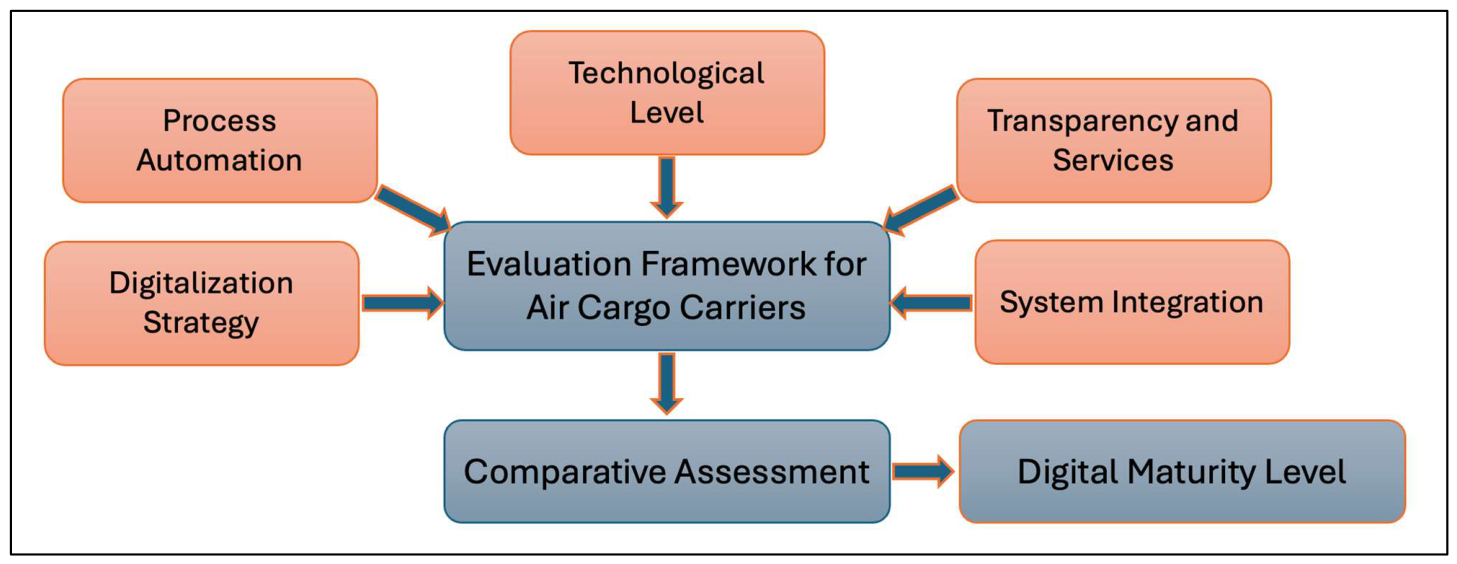
The structure of the proposed digitalization evaluation framework is presented in Figure 2. Figure 2 illustrates the principal dimensions incorporated into the framework and their role in the comparative assessment of digital maturity among selected air cargo carriers.

2.3. Structure of the Evaluation Framework

The comparative assessment of digitalization in air cargo logistics was based on five principal evaluation pillars reflecting key operational and technological areas associated with digital transformation in cargo transport systems. The framework structure, previously illustrated in Figure 2, enabled systematic evaluation of technological capabilities, operational integration, and digital maturity among the selected air cargo carriers.
The framework was designed to assess digitalization through a multidimensional approach incorporating both strategic and operational aspects of digital transformation in air cargo logistics. Particular attention was devoted to areas directly influencing process efficiency, information exchange, technological integration, cargo visibility, and customer-oriented digital services. The detailed structure of the proposed evaluation framework, including the principal evaluation pillars, individual indicators, and weighting distribution, is summarized in Table 2. The detailed indicator-based evaluation scores presented in Table A1 in Appendix A. Equal weights (20% each) were assigned to the five evaluation pillars. This approach was intentionally adopted to avoid introducing subjective bias in the absence of an established weighting methodology for assessing digitalization in air cargo logistics. As the proposed framework represents an initial sector-specific model, equal weighting provides a transparent, reproducible, and easily interpretable basis for comparative evaluation. Future research may refine the weighting scheme using expert-based methods or multi-criteria decision-making techniques.
The first evaluation pillar focuses on digitalization strategy and examines the extent to which carriers incorporate digital transformation into their operational and strategic activities. This dimension evaluates the existence of formal digitalization strategies, investments in digital technologies, and the implementation of innovation-oriented projects supporting technological development and operational modernization. Strategic orientation toward digital transformation is considered an important prerequisite for long-term technological integration and operational adaptability within the air cargo sector. The second pillar evaluates process automation within cargo handling and operational management activities. Particular attention is devoted to the implementation of electronic documentation systems, especially e-AWB, automated cargo processing procedures, and automated cargo handling technologies. Process automation represents one of the key factors influencing operational efficiency, reduction in administrative burden, and acceleration of cargo handling operations within modern air cargo logistics systems. The technological level pillar examines the implementation of advanced digital technologies supporting operational monitoring and intelligent decision-making. This dimension includes IoT-based shipment monitoring, sensor technologies, and the utilization of artificial intelligence within logistics processes. The implementation of these technologies contributes to higher operational visibility, improved cargo monitoring capabilities, and more efficient processing of operational information in real time. The fourth evaluation pillar focuses on system integration and interoperability within digital logistics environments. The assessment examines the level of API integration, implementation of digital data exchange standards such as Cargo-XML and IATA ONE Record, and the use of digital communication systems enabling interconnected operational management. System interoperability increasingly represents a critical requirement for efficient coordination among logistics stakeholders and seamless exchange of operational information across air cargo supply chains. The final pillar addresses transparency and digital services provided within cargo logistics operations. This dimension evaluates shipment tracking capabilities, customer-oriented digital platforms, and the accessibility of operational information. High levels of transparency and digital service availability contribute to improved customer experience, increased shipment visibility, and more efficient communication between carriers and logistics partners.
The proposed framework enables comparative evaluation of digital maturity among air cargo carriers while simultaneously supporting more detailed analysis of individual operational dimensions associated with logistics digitalization. The multidimensional structure of the framework also facilitates identification of technological strengths, operational limitations, and varying levels of digital integration across selected air cargo logistics systems.

2.4. Data Collection and Evaluation Methodology

The comparative assessment was based on secondary data obtained from publicly available sources. Where available, industry reports and publications issued by international aviation organizations were used to complement company-reported information and improve the consistency and reliability of the evaluation. The analyzed materials included annual reports, sustainability reports, corporate technology presentations, official company websites, airport and logistics publications, and industry reports focused on air cargo digitalization and logistics technologies. Additional information was obtained from publications issued by international aviation and logistics organizations, particularly those addressing digital communication standards, cargo process automation, and data interoperability within air cargo transport. To ensure comparability, the same evaluation framework, indicator definitions, scoring criteria, and assessment procedure were consistently applied to all evaluated air cargo carriers.
The evaluation methodology applied a scoring-based assessment approach enabling comparative analysis of digitalization levels among selected air cargo carriers. Individual evaluation indicators were assessed using a predefined point scale reflecting the extent of digital implementation and operational integration within each analyzed area. The scoring procedure considered the availability and practical implementation of digital technologies, the degree of process automation, the level of system interoperability, and the utilization of real-time operational data. Where sufficient evidence regarding the implementation of a specific digital technology was not available from reliable public sources, no assumptions were made regarding its implementation status in order to preserve the objectivity and consistency of the evaluation.
Each indicator was evaluated using a five-point ordinal scale, where a score of 1 indicated the absence or very limited implementation of the evaluated digital solution, while a score of 5 represented comprehensive implementation and integration into operational processes. Intermediate scores reflected progressive levels of implementation, considering not only the presence of the technology but also its operational utilization, level of integration with other systems, and its contribution to cargo logistics processes. The evaluation focused on the practical level of implementation rather than on the mere existence of a particular technology or digital solution. The scoring criteria were applied consistently across all evaluated carriers to ensure the comparability and transparency of the assessment.

2.4.1. Evaluation of Digitalization Pillars

Digitalization strategy represents one of the fundamental prerequisites for long-term technological transformation within air cargo logistics systems. The implementation of digital technologies in cargo operations requires not only operational modernization but also strategic coordination of investments, innovation activities, and technological development objectives. Existing research increasingly emphasizes that organizations with clearly defined digital transformation strategies achieve higher levels of technological integration, operational flexibility, and adaptability to rapidly changing logistics environments. Within the proposed evaluation framework, the digitalization strategy pillar focuses on the extent to which air cargo carriers systematically incorporate digital transformation into their strategic and operational management processes. Particular attention is devoted to investments in digital technologies, implementation of innovation-oriented projects, and long-term support for operational digitalization. Strategic orientation toward digital transformation significantly influences the ability of carriers to integrate advanced technologies into cargo handling operations and broader logistics management systems. The evaluation also considers the role of innovation initiatives aimed at improving operational efficiency, shipment visibility, and digital coordination among logistics stakeholders. In recent years, many air cargo carriers have increasingly invested in intelligent cargo terminals, cloud-based logistics systems, AI-supported operational planning, and automated communication platforms. These developments demonstrate that digitalization strategy has become closely connected with broader organizational modernization and competitiveness within the global air cargo market.
Process automation represents a critical component of digital transformation in air cargo logistics due to the operational complexity and time sensitivity of cargo transport activities. The growing volume of cargo shipments and increasing pressure on operational efficiency have accelerated the implementation of automated systems within cargo terminals, warehouse operations, and administrative procedures. Automation technologies contribute to reducing manual workload, minimizing operational errors, and improving the speed and reliability of cargo handling processes. Within the proposed framework, the process automation pillar evaluates the implementation of electronic documentation systems, automated cargo processing procedures, and automation technologies integrated into operational workflows. Emphasis is placed on e-AWB, which significantly reduce paper-based documentation and improve communication efficiency among logistics stakeholders. Existing studies indicate that electronic documentation contributes to lower processing times, higher operational transparency, and improved data accuracy within air cargo operations. In addition to documentation digitalization, increasing attention is devoted to automated cargo handling technologies and robotic operational support systems. Modern cargo terminals increasingly utilize automated storage systems, conveyor technologies, robotic handling equipment, and intelligent sorting solutions aimed at improving operational capacity and reducing dependency on manual labor. The implementation of automation technologies therefore represents an important indicator of operational digital maturity within contemporary air cargo logistics systems.
The technological level pillar evaluates the implementation of advanced digital technologies supporting real-time operational visibility, intelligent monitoring, and data-driven decision-making within air cargo logistics. Technological innovation has become one of the principal drivers of operational modernization in the air cargo sector, particularly in relation to cargo tracking, environmental monitoring, and predictive operational management. Particular attention within this pillar is devoted to IoT-based shipment monitoring systems, sensor technologies, and artificial intelligence applications integrated into logistics operations. IoT technologies enable continuous collection and transmission of operational data related to cargo location, transport conditions, and shipment status throughout the transportation process. Sensor technologies are especially important for temperature-sensitive and high-value cargo categories requiring continuous environmental monitoring and operational supervision. Artificial intelligence technologies increasingly support predictive analytics, operational planning, cargo capacity management, and risk identification within air cargo logistics systems. Existing research suggests that the integration of intelligent technologies contributes to improved operational responsiveness, enhanced decision-making capabilities, and more efficient utilization of logistics resources. Consequently, the technological level of digital infrastructure significantly influences the operational competitiveness and adaptability of air cargo carriers.
System integration represents one of the key pillars influencing the effectiveness of digital logistics ecosystems within air cargo transport. Due to the involvement of multiple stakeholders in cargo operations, efficient coordination depends heavily on the interoperability of digital systems and the ability to exchange operational data in real time. Fragmented communication structures and isolated information systems may significantly reduce operational efficiency and limit process transparency within logistics networks. The proposed framework evaluates system integration through indicators related to API connectivity, implementation of digital data exchange standards, and digital communication capabilities. Importance is assigned to interoperability standards such as Cargo-XML and IATA ONE Record, which aim to support standardized and interconnected data exchange among logistics stakeholders. These standards increasingly represent essential components of modern air cargo logistics systems and support more efficient operational coordination across global supply chains. API-based integration and cloud-connected operational platforms enable real-time synchronization of logistics information and facilitate direct communication among carriers, freight forwarders, airports, and customs authorities. Higher levels of system integration contribute to reduced communication delays, improved operational visibility, and more efficient processing of logistics information. As a result, interoperability and digital connectivity are becoming critical determinants of digital maturity within air cargo logistics operations.
Transparency and digital service availability have become increasingly important dimensions of modern air cargo logistics systems. Customers and logistics partners increasingly expect continuous shipment visibility, real-time operational information, and accessible digital communication throughout the transportation process. Consequently, air cargo carriers are progressively expanding customer-oriented digital platforms and online service capabilities to improve operational transparency and customer experience. Within the proposed framework, this pillar evaluates shipment tracking systems, customer platforms, and the accessibility of operational information provided by carriers. Shipment visibility represents one of the most significant components of digital logistics services, particularly in time-sensitive transport operations where customers require accurate and continuously updated cargo information. Real-time tracking technologies contribute not only to customer satisfaction but also to improved operational coordination and disruption management. Customer-oriented digital platforms increasingly enable online cargo booking, automated quotations, shipment monitoring, and direct communication between logistics stakeholders. The availability of integrated digital services supports higher levels of operational transparency and facilitates faster access to logistics information. Existing trends therefore indicate that transparency and digital customer services are becoming important competitive factors within the rapidly evolving air cargo logistics market.

2.4.2. Evaluation of Digitalization Indicators

Each indicator was evaluated using a five-point assessment scale, where lower values represented limited or insufficient implementation of digital solutions, while higher values indicated advanced levels of technological integration and operational digitalization. The scoring scale applied within the evaluation process is presented in Table 3.
The final digitalization score was calculated using a weighted aggregation approach combining individual indicator scores and pillar weights. The evaluation methodology incorporated both the relative importance of the principal evaluation pillars and the weighting of individual indicators within each pillar. This approach enabled balanced assessment of strategic, operational, and technological dimensions associated with digitalization in air cargo logistics.
The overall digitalization score was calculated according to Equation (1):
O D S = j = 1 m ( P W j × i = 1 n ( I S i j × I W i j ) ) ,
where
  • ODS = Overall Digitalization Score,
  • PWj = weight of evaluation pillar,
  • ISij = score of individual indicator,
  • IWij = weight of individual indicator,
  • m = number of pillars,
  • n = number of indicators.
The obtained scores were subsequently aggregated and converted into percentage values to improve comparability and interpretability of the results. The methodology enabled both overall comparative assessment of digital maturity among selected air cargo carriers and more detailed analysis of individual operational dimensions associated with logistics digitalization.
The proposed scoring methodology was designed to ensure methodological consistency and comparability across carriers while maintaining sufficient flexibility for evaluating different operational approaches and levels of technological implementation within air cargo logistics systems.

2.5. Selection of Air Cargo Carriers

The evaluation framework was applied to three international air cargo carriers representing different operational approaches to digitalization and logistics technology integration. The carrier selection process considered several criteria, including global market relevance, implementation of digital technologies, operational scale, and availability of publicly accessible information regarding digital logistics processes and technological infrastructure. The selected sample includes Lufthansa Cargo, Turkish Cargo, and Cargolux. Lufthansa Cargo was selected due to its extensive use of digital cargo monitoring systems, integrated logistics technologies, and advanced operational management solutions. Turkish Cargo represents a rapidly developing carrier investing significantly in automation technologies and intelligent cargo terminal infrastructure, particularly through the SMARTIST logistics hub. Cargolux was selected as a major European cargo carrier emphasizing digital booking systems, platform integration, and digital communication technologies within cargo operations.
The selected carriers represent different levels of technological integration and digital operational maturity, thereby enabling comparative analysis of digitalization approaches within air cargo logistics. The diversity of the selected sample also supports broader interpretation of digital transformation trends currently influencing the air cargo sector. The empirical application presented in this study should be regarded as a pilot demonstration of the proposed evaluation framework rather than a statistically representative assessment of the global air cargo industry. Accordingly, the primary objective was to verify the applicability and practical usability of the framework using a purposively selected sample of carriers with different levels of digitalization and sufficient publicly available information. Future research may extend the framework to a larger and more diverse sample of air cargo carriers to enable broader validation and comparative analysis.

3. Results

3.1. Comparative Assessment of Air Cargo Carriers

The proposed evaluation framework was subsequently applied to selected international air cargo carriers to assess their level of digital maturity and operational digitalization. The comparative assessment focused on Lufthansa Cargo, Turkish Cargo, and Cargolux, which represent different approaches to digital transformation, technological integration, and implementation of digital logistics solutions within air cargo operations.
The evaluation results revealed noticeable differences in the level of digitalization among the analyzed carriers. Variations were identified particularly in the areas of digital strategy implementation, process automation, technological infrastructure, system interoperability, and customer-oriented digital services. The comparative assessment was conducted using the weighted scoring methodology described in Section 2.4, where individual indicators were evaluated using a five-point scoring scale and subsequently converted into percentage values for improved comparability and interpretability of the obtained results. The comparative evaluation results of the selected air cargo carriers are presented in Table 4.
The obtained results indicate that Turkish Cargo achieved the highest overall level of digitalization among the evaluated carriers, reaching an overall digitalization level of 96.0%. The carrier demonstrated the strongest performance across all evaluation pillars, particularly in the areas of digitalization strategy, process automation, system integration, and transparency and digital services, where maximum evaluation values were achieved. The strong performance of Turkish Cargo is closely associated with extensive investments in intelligent cargo infrastructure, implementation of advanced automation technologies, and development of integrated digital logistics systems supporting real-time operational management. Lufthansa Cargo achieved the second-highest level of digital maturity, with an overall digitalization level of 73.3%. The carrier demonstrated balanced performance across most evaluation pillars, particularly within transparency and services, process automation, and system integration. Lufthansa Cargo also showed strong implementation of shipment monitoring systems and customer-oriented digital services. However, comparatively lower results were identified within the technological level pillar, particularly in relation to the implementation of advanced intelligent technologies and IoT-supported operational systems. Cargolux achieved the lowest overall digitalization level among the evaluated carriers, reaching 62.7%. Despite lower overall results, the carrier demonstrated relatively stable performance in the areas of process automation, system integration, and customer communication services. Nevertheless, the evaluation identified lower levels of technological advancement, particularly in relation to artificial intelligence utilization, IoT implementation, and advanced digital infrastructure integration. These limitations influenced the carrier’s overall digital maturity score and highlighted differences in the extent of technological transformation among the evaluated carriers.
The comparative assessment further indicates that the most significant differences among the evaluated carriers were observed within the technological level and digitalization strategy pillars. These dimensions appear to represent critical determinants influencing the broader digital maturity of air cargo logistics systems. In contrast, the transparency and services pillar achieved comparatively stronger results across all evaluated carriers, suggesting that customer-oriented digital services and shipment visibility technologies have become increasingly important components of contemporary air cargo logistics operations.

3.2. Comparative Analysis of Digitalization Levels

The comparative analysis of digitalization levels provided a more detailed overview of differences in digital maturity among the evaluated air cargo carriers. The obtained results revealed varying levels of technological integration, process automation, interoperability, and customer-oriented digital service implementation across the analyzed logistics systems. The comparative structure of the evaluation framework enabled identification of both operational strengths and technological limitations associated with the digital transformation of individual carriers.
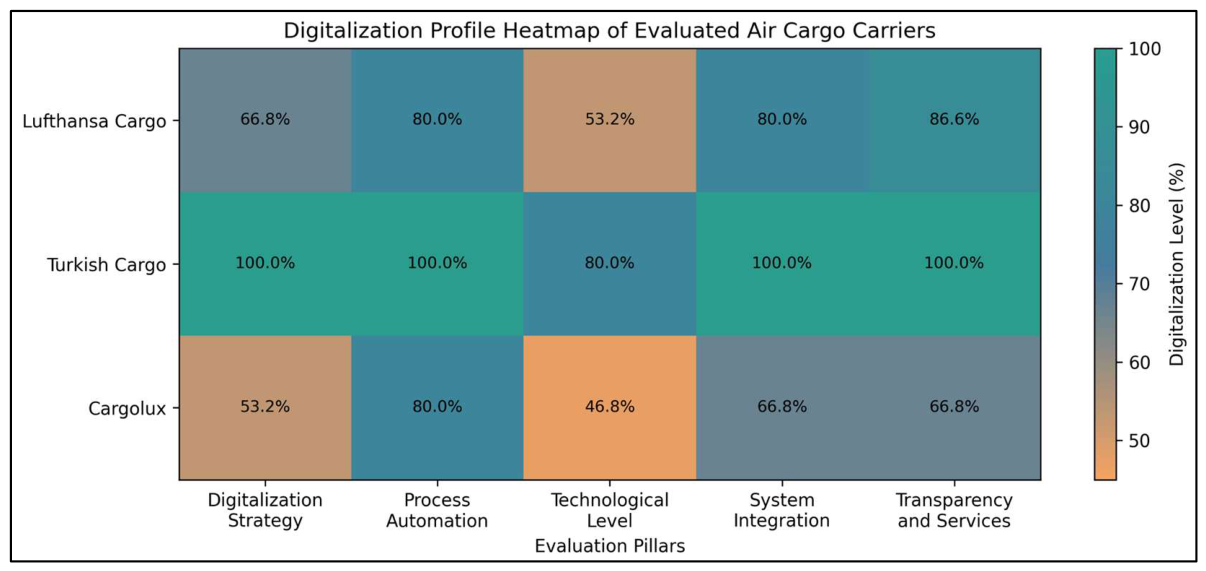
The results presented in Figure 3 illustrate the comparative performance of the evaluated carriers across the five principal evaluation pillars incorporated within the proposed framework.
The graphical comparison demonstrates that Turkish Cargo achieved the highest evaluation scores across all analyzed pillars, indicating a highly integrated and technologically advanced digital logistics ecosystem. Particularly strong results were observed within digitalization strategy, process automation, and system integration, where the carrier achieved maximum evaluation values. These results reflect the carrier’s extensive investments in intelligent cargo infrastructure, automated logistics systems, and advanced digital operational management technologies. Lufthansa Cargo demonstrated comparatively balanced digitalization performance across most evaluation pillars. The carrier achieved strong results particularly within transparency and services, process automation, and system integration, indicating a relatively high level of operational integration and customer-oriented digitalization. However, lower evaluation values were identified within the technological level pillar, suggesting more moderate implementation of advanced intelligent technologies and IoT-supported operational systems compared with Turkish Cargo. Cargolux achieved lower digitalization levels across most evaluation pillars, particularly within technological level and digitalization strategy. Nevertheless, the carrier demonstrated relatively stable performance within process automation and customer-oriented digital services. These findings suggest that although the carrier has implemented several digital operational solutions, the broader integration of advanced digital technologies and intelligent logistics systems remains comparatively limited.
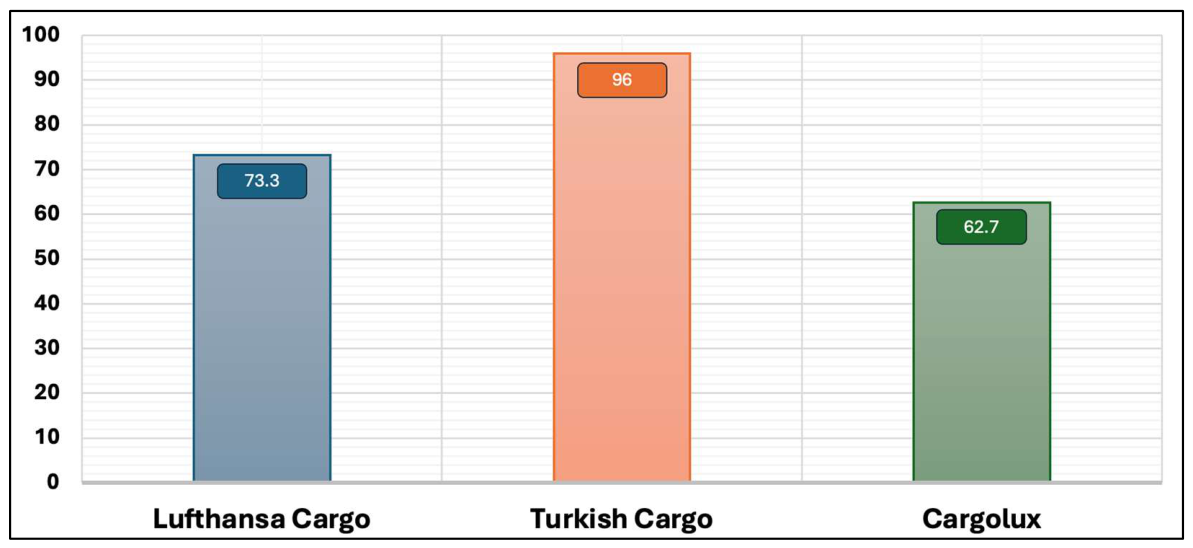
The comparative analysis further indicates that the largest differences among the evaluated carriers were identified within technological level and digitalization strategy. In contrast, smaller differences were observed within transparency and services, suggesting that shipment visibility and customer communication technologies have become increasingly standardized within contemporary air cargo logistics operations. The overall digitalization levels of the evaluated air cargo carriers are summarized in Figure 4.
The overall comparison confirms the dominant position of Turkish Cargo, which achieved the highest digitalization level of 96.0%, followed by Lufthansa Cargo with 73.3%, while Cargolux reached 62.7%. The obtained results indicate substantial differences in the extent of digital transformation and technological integration among the evaluated carriers. The findings also suggest that strategic investments in automation technologies, intelligent cargo infrastructure, and interconnected logistics systems significantly influence the overall digital maturity of air cargo logistics operations.

3.3. Digitalization Gap Analysis

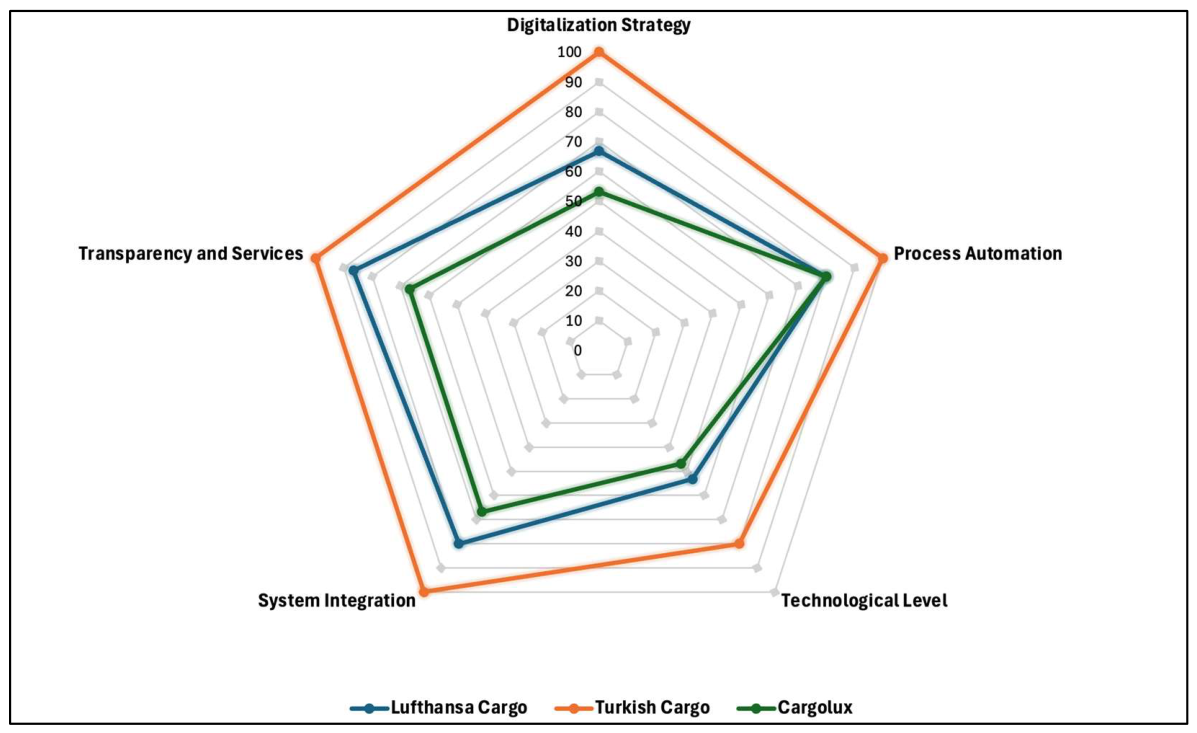
The comparative evaluation identified several significant disparities in the level of digitalization among the analyzed air cargo carriers. Although all evaluated carriers demonstrated certain levels of digital integration and implementation of digital operational solutions, the obtained results indicate considerable differences in technological maturity, operational interoperability, and strategic digital transformation capabilities. The largest digitalization gaps were identified within the digitalization strategy and technological level pillars. Turkish Cargo achieved the highest evaluation scores within both dimensions due to extensive investments in intelligent cargo infrastructure, automation technologies, and integrated digital logistics systems. In contrast, lower evaluation results achieved particularly by Cargolux indicate more limited implementation of innovation-oriented technologies and comparatively lower integration of advanced digital operational systems. These findings suggest that strategic commitment to digital transformation significantly influences the broader digital maturity of air cargo logistics operations. Substantial disparities were also identified within the system integration pillar. While Turkish Cargo demonstrated highly integrated operational systems and extensive implementation of interoperability standards, Lufthansa Cargo and Cargolux achieved lower levels of digital connectivity and operational integration. The results therefore indicate that interoperability and real-time data exchange remain important challenges affecting operational coordination within the air cargo sector. The comparative differences identified across individual evaluation pillars are illustrated in Figure 5.
The graphical comparison highlights that the most substantial disparities were observed within digitalization strategy and technological level, where the differences between the highest and lowest evaluation scores exceeded 30 percentage points. Comparatively smaller differences were identified within process automation and transparency and services, suggesting that customer-oriented digital services and certain automation technologies have become more broadly implemented across the evaluated carriers. Despite the identified disparities, all evaluated carriers demonstrated relatively strong implementation of shipment tracking systems and digital communication platforms. These findings indicate that operational transparency and customer visibility have become increasingly standardized requirements within contemporary air cargo logistics systems. Nevertheless, differences remain in the level of intelligent automation, integration of AI-supported technologies, and implementation of advanced interoperability standards.
The identified digitalization gaps reflect broader challenges associated with digital transformation within the air cargo sector. The implementation of advanced digital technologies requires substantial financial investments, technological expertise, and long-term strategic coordination. Consequently, carriers with stronger investment capabilities and more aggressive digital transformation strategies can achieve higher levels of operational integration and technological maturity. The results additionally suggest that future development of air cargo logistics will increasingly depend on intelligent automation, interoperability, real-time operational visibility, and integration of advanced digital decision-support systems. The identified disparities therefore emphasize the importance of coordinated digitalization strategies and continuous technological modernization to improve operational efficiency, cargo visibility, and competitiveness within the global air cargo market.

4. Discussion

4.1. Interpretation of the Findings

The conducted comparative evaluation confirmed that substantial differences currently exist in the level of digitalization among air cargo carriers. The obtained results demonstrated that digital maturity within air cargo logistics is not determined solely by the implementation of isolated digital technologies, but rather by the degree of integration between technological infrastructure, process automation, interoperability, and strategic digital transformation initiatives. The analysis revealed that carriers investing more intensively in intelligent logistics systems, automation technologies, and integrated digital ecosystems achieve significantly higher levels of operational digital maturity.
In addition to strategic investments, the level of digitalization may also be influenced by external and organizational factors, including airport infrastructure, regulatory requirements, regional digital readiness, organizational culture, managerial commitment to digital transformation, collaboration among logistics stakeholders, and the operational complexity of carrier networks. These contextual conditions may facilitate or constrain the implementation of advanced digital technologies and should therefore be considered when interpreting the evaluation results.
The findings of this study are consistent with previous research emphasizing the growing importance of digital transformation within logistics and transport systems. Several authors argue that digitalization represents a critical determinant of operational efficiency, flexibility, and supply chain responsiveness in contemporary logistics environments [15,22,35]. Similarly, the results obtained in this study indicate that carriers demonstrating higher levels of technological integration and automation also achieve stronger operational digital maturity and broader implementation of customer-oriented logistics services. The strong performance achieved by Turkish Cargo particularly supports previous findings associated with Logistics 4.0 and intelligent logistics systems. Existing studies emphasize that automation technologies, IoT-based monitoring, artificial intelligence, and integrated operational systems significantly improve logistics efficiency, cargo visibility, and operational responsiveness [23,43]. The implementation of intelligent cargo infrastructure and highly automated operational systems therefore appears to represent an increasingly important competitive advantage within the air cargo sector.
The identified importance of interoperability and system integration also corresponds with findings presented in previous digital maturity research. This finding can be explained by the inherently networked nature of air cargo logistics, where efficient cargo movement depends on continuous information exchange among carriers, freight forwarders, airport operators, customs authorities, and ground handling agents. Consequently, higher levels of interoperability facilitate faster decision-making, reduce administrative delays, and improve coordination across the entire logistics chain. Several studies highlight that real-time information exchange, API connectivity, and standardized digital communication protocols are becoming essential prerequisites for efficient logistics coordination and supply chain integration [41,48]. The results of this study similarly demonstrate that carriers achieving higher levels of digital connectivity and interoperability also demonstrate broader digital maturity and more effective integration of operational logistics processes.
The comparatively lower evaluation results identified within the technological level pillar among certain carriers additionally support previous observations regarding uneven adoption of advanced digital technologies across logistics systems. Although digital communication platforms and cargo tracking technologies are becoming increasingly standardized within the air cargo sector, implementation of more advanced intelligent technologies such as AI-supported operational systems, predictive analytics, and IoT-enabled automation remains inconsistent [20,37]. This finding suggests that technological modernization within air cargo logistics continues to depend heavily on investment capabilities, strategic priorities, and organizational readiness for digital transformation. This may be explained by the relatively high investment costs associated with advanced intelligent technologies, differences in organizational digital capabilities, and the varying pace of digital transformation across international air cargo carriers. The results additionally indicate that customer-oriented digital services and operational transparency are becoming increasingly important components of competitive air cargo logistics systems. All evaluated carriers demonstrated relatively strong implementation of shipment tracking systems and digital communication platforms, which supports conclusions presented in previous studies emphasizing the growing importance of real-time visibility and customer accessibility within logistics operations [30,82]. Increasing customer expectations regarding transparency, responsiveness, and digital accessibility therefore continue to accelerate the adoption of customer-oriented digital technologies across the air cargo industry.
The comparative assessment of the three evaluated carriers also illustrates how different digitalization strategies may translate into varying levels of digital maturity. Turkish Cargo achieved the highest overall evaluation, which may be associated with its extensive investments in intelligent cargo infrastructure, automation technologies, and the SMARTIST logistics hub. Lufthansa Cargo demonstrated consistently high scores across multiple dimensions due to its advanced implementation of digital communication platforms, electronic documentation, and integrated cargo management systems. Although Cargolux achieved comparatively lower scores in several evaluation pillars, the results indicate significant progress in customer-oriented digital services and system integration while also highlighting opportunities for further development in advanced automation and intelligent technologies. These observations support the practical applicability of the proposed framework in identifying both strengths and areas for improvement among individual air cargo carriers.

4.2. Research Implications

An important contribution of this study lies in the development of a dedicated evaluation framework specifically designed for the operational environment of air cargo logistics. While existing digital maturity models and logistics digitalization frameworks frequently focus on general supply chain systems, manufacturing environments, or broader transportation sectors, relatively limited attention has been devoted to sector-specific assessment approaches reflecting the operational characteristics of air cargo transport. The proposed framework therefore extends existing research by integrating strategic, technological, operational, and customer-oriented dimensions into a unified evaluation structure adapted to the requirements of air cargo logistics systems.
The multidimensional structure of the framework enables systematic comparative assessment of digital maturity across individual operational areas, including process automation, interoperability, real-time shipment visibility, and digital communication. In contrast to more generalized digital maturity models, the proposed framework incorporates indicators directly associated with air cargo operational processes and contemporary logistics digitalization trends, including e-AWB implementation, Cargo-XML and IATA ONE Record interoperability standards, IoT-supported monitoring technologies, and intelligent cargo infrastructure. The framework therefore contributes not only to theoretical discussions on logistics digitalization but also provides a practical benchmarking and decision-support tool applicable within the air cargo industry.
From a theoretical perspective, the proposed framework contributes to the growing body of knowledge on digital transformation in logistics by providing a structured, sector-specific approach to evaluating digital maturity in air cargo operations. Unlike existing maturity models developed for broader logistics environments, the framework explicitly reflects the technological and operational characteristics of air cargo logistics, thereby extending the methodological approaches currently available in the literature.
From a practical perspective, the proposed framework offers a standardized approach for assessing the level of digitalization across air cargo carriers using a consistent set of indicators and evaluation criteria. The framework can support comparative benchmarking, identification of digitalization gaps, and monitoring of digital transformation progress, while also providing a structured basis for evaluating future technological initiatives within air cargo logistics.
From a managerial perspective, the proposed evaluation framework may serve as a practical decision-support tool for air cargo carriers and logistics stakeholders. The framework enables systematic identification of technological strengths and operational weaknesses across individual dimensions of digitalization, thereby supporting benchmarking activities, strategic planning, and prioritization of future digital investments. The structured evaluation approach may also facilitate monitoring of digital transformation progress and assessment of organizational readiness for implementation of advanced logistics technologies. The findings of this study additionally emphasize that successful digital transformation within air cargo logistics requires not only technological investments, but also strategic coordination and long-term integration of digital initiatives across operational processes. Carriers implementing fragmented or isolated digital solutions may achieve partial operational improvements; however, broader digital maturity appears to depend primarily on interoperability, integration of operational systems, and alignment between technological modernization and organizational strategy.

4.3. Research Limitations

Despite the practical and theoretical contributions of this study, several limitations should be acknowledged. The evaluation framework was applied to a limited sample of selected air cargo carriers, which may restrict broader generalization of the obtained results across the entire air cargo sector. In addition, the assessment was based primarily on publicly available information and secondary data sources related to digital technologies and operational processes implemented by the evaluated carriers. Although the proposed scoring methodology enabled structured and comparable evaluation of digitalization levels, future studies may further enhance the analytical robustness of the framework through incorporation of additional operational datasets, expert validation procedures, and quantitative performance indicators. Nevertheless, the proposed framework provides a systematic and adaptable approach for comparative assessment of digital maturity within air cargo logistics systems. Furthermore, as the empirical application was intended to demonstrate the applicability of the proposed evaluation framework, the study does not seek to establish statistically significant relationships among variables or to provide statistically generalizable findings.
Another limitation of the proposed framework is that it evaluates the level of digitalization independently of organizational size, fleet size, cargo volume, or market share. Consequently, the assessment focuses on the implementation and integration of digital technologies rather than on the overall scale of carrier operations. In addition, the empirical application should be regarded as a pilot demonstration of the proposed framework rather than a statistically representative assessment of the global air cargo industry. The use of publicly available secondary data may also introduce reporting bias, as the availability and level of detail of disclosed information may differ among carriers despite efforts to cross-check multiple information sources.

4.4. Future Research

Future research could expand the proposed framework by incorporating a larger sample of air cargo carriers, additional operational indicators, and expert-based validation approaches. Further studies may also apply advanced multi-criteria decision-making methods, fuzzy logic models, or AI-supported evaluation techniques to improve scoring precision and analytical robustness. Longitudinal application of the proposed framework could provide valuable insights into the evolution of digital maturity over time, enabling assessment of the effectiveness of digital transformation initiatives and changes in technological priorities within the air cargo sector. Future research could also investigate alternative weighting schemes based on expert judgment or multi-criteria decision-making methods and evaluate the robustness of the proposed framework through sensitivity analysis.

5. Conclusions

The presented study focused on the development of an evaluation framework for measuring the level of digitalization in air cargo logistics. The proposed framework incorporated five principal evaluation pillars reflecting strategic, operational, technological, and customer-oriented dimensions of digital transformation within air cargo logistics systems. The framework was subsequently applied to selected international air cargo carriers using a comparative scoring methodology. The obtained results confirmed substantial differences in digital maturity among the evaluated carriers. Turkish Cargo achieved the highest level of digitalization due to extensive implementation of automation technologies, integrated digital systems, and intelligent cargo infrastructure. Lufthansa Cargo demonstrated relatively balanced digital maturity, particularly in the areas of operational integration and customer-oriented digital services, while Cargolux achieved lower evaluation results mainly within advanced technological implementation and intelligent operational systems.
The study confirmed that process automation, interoperability, real-time operational visibility, and strategic digital transformation initiatives represent important determinants influencing digital maturity within air cargo logistics. At the same time, the findings indicate that customer-oriented digital services and shipment tracking technologies are becoming increasingly standardized across contemporary air cargo operations.
An important contribution of this article lies in the development of a sector-specific evaluation framework adapted to the operational characteristics of air cargo logistics. The proposed framework may serve as a practical benchmarking and decision-support tool for comparative assessment of digital maturity among air cargo carriers and logistics stakeholders.
Future research may further extend the framework through incorporation of additional operational indicators, expert validation methods, and broader comparative analyses involving larger samples of air cargo carriers.

Author Contributions

Conceptualization, K.K. and A.N.; methodology, K.K. and M.K.; software, K.K. and M.K.; validation, K.K., A.N. and A.N.S.; formal analysis, M.K. and A.N.S.; investigation, K.K. and A.N.; resources, A.N.; data curation, K.K. and A.N.; writing—original draft preparation, K.K., A.N., M.K. and A.N.S.; writing—review and editing, K.K., A.N., M.K. and A.N.S.; visualization, K.K.; supervision, M.K.; project administration, A.N.; funding acquisition, A.N. All authors have read and agreed to the published version of the manuscript.

Funding

This research was funded by VEGA 1/0555/26 “Research on the Competitiveness of European Regional Airports”.

Institutional Review Board Statement

Not applicable.

Informed Consent Statement

Not applicable.

Data Availability Statement

The original contributions presented in this study are included in the article. Further inquiries can be directed to the corresponding author.

Conflicts of Interest

The authors declare no conflicts of interest.

Abbreviations

The following abbreviations are used in this manuscript:
AIArtificial Intelligence
APIApplication Programming Interface
ASRSAutomated Storage and Retrieval Systems
e-AWBElectronic Air Waybills
GPSGlobal Positioning System
IATAInternational Air Transport Association
IoTInternet of Things
RFIDRadio-Frequency Identification

Appendix A

The detailed indicator-based evaluation scores presented in Table A1 provide a comprehensive overview of the scoring process applied to the selected air cargo carriers across all evaluation pillars and indicators incorporated within the proposed framework. The assessment was conducted using publicly available information obtained primarily from annual reports, sustainability reports, official company websites, and corporate publications related to digital technologies and logistics operations implemented by the evaluated carriers.
Table A1. Detailed Indicator-Based Evaluation Scores of Selected Air Cargo Carriers.
Evaluation PillarIndicatorLufthansa CargoTurkish CargoCargolux
Digitalization StrategyDigital strategy implementation453
Investments in digitalization353
Innovation projects352
Process AutomationElectronic documentation (e-AWB)454
Process automation level454
Cargo handling automation454
Technological LevelIoT shipment monitoring342
Sensor technologies242
Artificial Intelligence utilization343
System IntegrationSystem connectivity (API integration)453
Data exchange (Cargo-XML, ONE Record)453
Digital communication454
Transparency and ServicesShipment tracking554
Customer platforms453
Information accessibility453
Overall Average Score3.674.803.14
Overall Digitalization Level (%)73.3%96.0%62.7%

References

  1. Merkert, R. Air cargo logistics: The dawning of a golden decade? In Global Logistics and Supply Chain Strategies for the 2020s: Vital Skills for the Next Generation; Springer International Publishing: Cham, Switzerland, 2022; pp. 135–149. [Google Scholar] [CrossRef]
  2. IATA. Value of Air Cargo: Air Cargo Makes It Happen; International Air Transport Association: Geneva, Switzerland, 2024; Available online: https://www.iata.org/en/programs/cargo/sustainability/benefits/ (accessed on 20 May 2026).
  3. O’Connell, J.F. Air Cargo. In The Airline Industry—A Comprehensive Overview; Routledge: London, UK, 2025; pp. 460–512. [Google Scholar] [CrossRef]
  4. Sales, M.; Scholte, S. Air Cargo Management: Air Freight and the Global Supply Chain; Routledge: London, UK, 2023; 256p. [Google Scholar] [CrossRef]
  5. Guntuka, L.; Corsi, T.M.; Cantor, D.E. Recovery from plant-level supply chain disruptions: Supply chain complexity and business continuity management. Int. J. Oper. Prod. Manag. 2024, 44, 1–31. [Google Scholar] [CrossRef]
  6. Juvvala, R.; Sangle, S.; Tiwari, M.K. Post-COVID challenges and opportunities: Rethinking ESG performance in the logistics sector. Int. J. Prod. Res. 2025, 63, 1256–1274. [Google Scholar] [CrossRef]
  7. Baimukhanbetova, E.; Tazhiyev, R.; Sandykbayeva, U.; Jussibaliyeva, A. Digital technologies in the transport and logistics industry: Barriers and implementation problems. Eurasian J. Econ. Bus. Stud. 2023, 67, 82–96. [Google Scholar] [CrossRef]
  8. Burinskiene, A.; Daskevic, D. The investigation on the application of digital technologies for logistics business competitiveness. Teh. Glas. 2024, 18, 626–637. [Google Scholar] [CrossRef]
  9. Cichosz, M.; Wallenburg, C.M.; Knemeyer, A.M. Digital transformation at logistics service providers: Barriers, success factors and leading practices. Int. J. Logist. Manag. 2020, 31, 209–238. [Google Scholar] [CrossRef]
  10. IATA. e-AWB Implementation Playbook; International Air Transport Association: Geneva, Switzerland, 2018; Available online: https://www.iata.org/contentassets/c43eecf576c2435a93dc667d79736839/e-awb-implementation-playbook.pdf (accessed on 20 May 2026).
  11. Adenigbo, A.J.; Mageto, J.; Luke, R. Adopting technological innovations in the air cargo logistics industry in South Africa. Logistics 2023, 7, 84. [Google Scholar] [CrossRef]
  12. IATA. ONE Record: Data Sharing Standard for Air Cargo; International Air Transport Association: Geneva, Switzerland, 2026; Available online: https://www.iata.org/en/programs/cargo/e/one-record/ (accessed on 20 May 2026).
  13. Jurgelāne-Kaldava, I.; Effenberger, W.V.; Batenko, A.; Čižiūnienė, K. Digitalization of Air Cargo Supply Chains: A Case Study of Latvia. Systems 2025, 13, 468. [Google Scholar] [CrossRef]
  14. McKinsey & Company. Digital Logistics: Technology Race Gathers Momentum; McKinsey & Company: New York, NY, USA, 2023; Available online: https://www.mckinsey.com/capabilities/operations/our-insights/digital-logistics-technology-race-gathers-momentum (accessed on 20 May 2026).
  15. Büyüközkan, G.; Göçer, F. Digital supply chain: Literature review and a proposed framework for future research. Comput. Ind. 2018, 97, 157–177. [Google Scholar] [CrossRef]
  16. Vial, G. Understanding digital transformation: A review and a research agenda. J. Strateg. Inf. Syst. 2019, 28, 118–144. [Google Scholar] [CrossRef]
  17. Verhoef, P.C.; Broekhuizen, T.; Bart, Y.; Bhattacharya, A.; Dong, J.Q.; Fabian, N.; Haenlein, M. Digital transformation: A multidisciplinary reflection and research agenda. J. Bus. Res. 2021, 122, 889–901. [Google Scholar] [CrossRef]
  18. Wamba, S.F.; Gunasekaran, A.; Akter, S.; Ren, S.J.; Dubey, R.; Childe, S.J. Big data analytics and firm performance: Effects of dynamic capabilities. J. Bus. Res. 2017, 70, 356–365. [Google Scholar] [CrossRef]
  19. Barreto, L.; Amaral, A.; Pereira, T. Industry 4.0 implications in logistics: An overview. Procedia Manuf. 2017, 13, 1245–1252. [Google Scholar] [CrossRef]
  20. Winkelhaus, S.; Grosse, E.H. Logistics 4.0: A systematic review towards a new logistics system. Int. J. Prod. Res. 2020, 58, 18–43. [Google Scholar] [CrossRef]
  21. Hofmann, E.; Rüsch, M. Industry 4.0 and the current status as well as future prospects on logistics. Comput. Ind. 2017, 89, 23–34. [Google Scholar] [CrossRef]
  22. Frank, A.G.; Dalenogare, L.S.; Ayala, N.F. Industry 4.0 technologies: Implementation patterns in manufacturing companies. Int. J. Prod. Econ. 2019, 210, 15–26. [Google Scholar] [CrossRef]
  23. Strandhagen, J.O.; Vallandingham, L.R.; Fragapane, G.; Strandhagen, J.W.; Stangeland, A.B.H.; Sharma, N. Logistics 4.0 and emerging sustainable business models. Adv. Manuf. 2017, 5, 359–369. [Google Scholar] [CrossRef]
  24. Xu, L.D.; Xu, E.L.; Li, L. Industry 4.0: State of the art and future trends. Int. J. Prod. Res. 2018, 56, 2941–2962. [Google Scholar] [CrossRef]
  25. Pauzuoliene, J.; Kavecke, I.; Pyra, M. Smart technologies integration and challenges in the context of logistics companies. Eur. Res. Stud. J. 2024, 27, 981–1000. [Google Scholar] [CrossRef]
  26. Bharadwaj, A.; El Sawy, O.A.; Pavlou, P.A.; Venkatraman, N. Digital business strategy: Toward a next generation of insights. MIS Q. 2013, 37, 471–482. [Google Scholar] [CrossRef]
  27. Attah, R.U.; Garba, B.M.P.; Gil-Ozoudeh, I.; Iwuanyanwu, O. Strategic frameworks for digital transformation across logistics and energy sectors: Bridging technology with business strategy. Open Access Res. J. Sci. Technol. 2024, 12, 070–080. [Google Scholar] [CrossRef]
  28. Matt, C.; Hess, T.; Benlian, A. Digital transformation strategies. Bus. Inf. Syst. Eng. 2015, 57, 339–343. [Google Scholar] [CrossRef]
  29. Warner, K.S.R.; Wäger, M. Building dynamic capabilities for digital transformation: An ongoing process of strategic renewal. Long Range Plan. 2019, 52, 326–349. [Google Scholar] [CrossRef]
  30. Ivanov, D.; Dolgui, A. A digital supply chain twin for managing the disruption risks and resilience in the era of Industry 4.0. Prod. Plan. Control 2020, 32, 775–788. [Google Scholar] [CrossRef]
  31. Queiroz, M.M.; Ivanov, D.; Dolgui, A.; Fosso Wamba, S. Impacts of epidemic outbreaks on supply chains: Mapping a research agenda amid the COVID-19 pandemic through a structured literature review. Ann. Oper. Res. 2022, 319, 1159–1196. [Google Scholar] [CrossRef] [PubMed]
  32. Kache, F.; Seuring, S. Challenges and opportunities of digital information at the intersection of big data analytics and supply chain management. Int. J. Oper. Prod. Manag. 2017, 37, 10–36. [Google Scholar] [CrossRef]
  33. Choi, T.M.; Wallace, S.W.; Wang, Y. Big data analytics in operations management. Prod. Oper. Manag. 2018, 27, 1868–1883. [Google Scholar] [CrossRef]
  34. Waller, M.A.; Fawcett, S.E. Data science, predictive analytics, and big data: A revolution that will transform supply chain design and management. J. Bus. Logist. 2013, 34, 77–84. [Google Scholar] [CrossRef]
  35. Ben-Daya, M.; Hassini, E.; Bahroun, Z. Internet of Things and supply chain management: A literature review. Int. J. Prod. Res. 2019, 57, 4719–4742. [Google Scholar] [CrossRef]
  36. Ivanov, D. Predicting the impacts of epidemic outbreaks on global supply chains: A simulation-based analysis. Transp. Res. Part E Logist. Transp. Rev. 2020, 136, 101922. [Google Scholar] [CrossRef] [PubMed]
  37. Queiroz, M.M.; Wamba, S.F.; Machado, M.C.; Telles, R. Smart production systems drivers for business process management improvement: An integrative framework. Bus. Process Manag. J. 2020, 26, 1075–1092. [Google Scholar] [CrossRef]
  38. Dolgui, A.; Ivanov, D.; Sokolov, B. Reconfigurable supply chain: The X-network. Int. J. Prod. Res. 2020, 58, 4138–4163. [Google Scholar] [CrossRef]
  39. Nandi, S.; Sarkis, J.; Hervani, A.A.; Helms, M.M. Redesigning supply chains using blockchain-enabled circular economy and COVID-19 experiences. Sustain. Prod. Consum. 2021, 27, 10–22. [Google Scholar] [CrossRef] [PubMed]
  40. Ivanov, D.; Dolgui, A.; Sokolov, B.; Ivanova, M. Literature review on disruption recovery in the supply chain. Int. J. Prod. Res. 2017, 55, 6158–6174. [Google Scholar] [CrossRef]
  41. Schumacher, A.; Erol, S.; Sihn, W. A maturity model for assessing Industry 4.0 readiness and maturity of manufacturing enterprises. Procedia CIRP 2016, 52, 161–166. [Google Scholar] [CrossRef]
  42. Mittal, S.; Khan, M.A.; Romero, D.; Wuest, T. A critical review of smart manufacturing and Industry 4.0 maturity models. J. Manuf. Syst. 2018, 49, 194–214. [Google Scholar] [CrossRef]
  43. Bibby, L.; Dehe, B. Defining and assessing Industry 4.0 maturity levels—Case of the defence sector. Prod. Plan. Control 2018, 29, 1030–1043. [Google Scholar] [CrossRef]
  44. Thordsen, T.; Bick, M. A decade of digital maturity models: Much ado about nothing? Inf. Syst. e-Bus. Manag. 2023, 21, 947–976. [Google Scholar] [CrossRef]
  45. Gökalp, E.; Şener, U.; Eren, P.E. Development of an assessment model for Industry 4.0: Industry 4.0-MM. In Software Process Improvement and Capability Determination; Springer: Cham, Switzerland, 2017; pp. 128–142. [Google Scholar] [CrossRef]
  46. Tubis, A.A.; Koliński, A.; Werbińska-Wojciechowska, S. Digital maturity of logistics processes assessed in the areas of technological support for performance measurement, employees and process management. Appl. Sci. 2024, 14, 7893. [Google Scholar] [CrossRef]
  47. Golinska-Dawson, P.; Werner-Lewandowska, K.; Kolinska, K.; Kolinski, A. Impact of market drivers on the digital maturity of logistics processes in a supply chain. Sustainability 2023, 15, 3120. [Google Scholar] [CrossRef]
  48. Albrecht, T.; Baier, M.S.; Gimpel, H.; Meierhöfer, S.; Röglinger, M.; Schlüchtermann, J.; Will, L. Leveraging digital technologies in logistics 4.0: Insights on affordances from intralogistics processes. Inf. Syst. Front. 2024, 26, 755–774. [Google Scholar] [CrossRef]
  49. Baglio, M.; Creazza, A.; Dallari, F. ‘Logistics 4.0’ technologies in the 3PL industry: A maturity model. Prod. Plan. Control 2025, 36, 1696–1712. [Google Scholar] [CrossRef]
  50. Ferraro, S.; Leoni, L.; Cantini, A.; De Carlo, F. Trends and recommendations for enhancing maturity models in supply chain management and logistics. Appl. Sci. 2023, 13, 9724. [Google Scholar] [CrossRef]
  51. Kıyıklık, A.; Kuşakcı, A.O.; Mbowe, B. A digital transformation maturity model for the airline industry with a self-assessment tool. Decis. Anal. J. 2022, 3, 100055. [Google Scholar] [CrossRef]
  52. Halpern, N.; Budd, T.; Suau-Sanchez, P.; Bråthen, S.; Mwesiumo, D. Conceptualising airport digital maturity and dimensions of technological and organisational transformation. J. Airpt. Manag. 2021, 15, 182–203. [Google Scholar] [CrossRef]
  53. Machado, N.T.; Rodriguez, C.M.T. A measurement model of logistics 5.0 maturity: An integrative review and framework proposal based on literature. ITEGAM-JETIA 2025, 11, 171–178. [Google Scholar] [CrossRef]
  54. Le, T.V.; Fan, R. Digital twins for logistics and supply chain systems: Literature review, conceptual framework, research potential and practical challenges. Comput. Ind. Eng. 2024, 187, 109768. [Google Scholar] [CrossRef]
  55. Klar, R.; Fredriksson, A.; Angelakis, V. Assessing the maturity of digital twinning solutions for ports. In 2023 IEEE International Conference on Pervasive Computing and Communications Workshops and Other Affiliated Events, Atlanta, GA, USA, 13–17 March 2023; IEEE: New York, NY, USA, 2023; pp. 552–557. [Google Scholar] [CrossRef]
  56. Yang, L. Research on Cargo Service Quality Improvement Strategy of AC Airlines. Bachelor’s Thesis, Haaga-Helia University of Applied Sciences, Helsinki, Finland, 2023. Available online: https://www.theseus.fi/bitstream/handle/10024/802590/Yang_Longxi.pdf?sequence=2&isAllowed=y (accessed on 20 May 2026).
  57. Kupfer, F.; Meersman, H.; Onghena, E.; Van de Voorde, E. The underlying drivers and future development of air cargo. J. Air Transp. Manag. 2017, 61, 6–17. [Google Scholar] [CrossRef]
  58. Gardiner, J.; Ison, S.; Humphreys, I. Factors influencing cargo airlines’ choice of airport: An international survey. J. Air Transp. Manag. 2005, 11, 393–399. [Google Scholar] [CrossRef]
  59. Zhang, A.; Zhang, Y. Issues on liberalization of air cargo services in international aviation. J. Air Transp. Manag. 2002, 8, 275–287. [Google Scholar] [CrossRef]
  60. Yuan, X.M.; Low, J.M.W.; Tang, L.C. Roles of the airport and logistics services on the economic outcomes of an air cargo supply chain. Int. J. Prod. Econ. 2010, 127, 215–225. [Google Scholar] [CrossRef]
  61. Heinbach, C.; Meier, P.; Thomas, O. Designing a shared freight service intelligence platform for transport stakeholders using mobile telematics. Inf. Syst. e-Bus. Manag. 2022, 20, 847–888. [Google Scholar] [CrossRef]
  62. Xu, X.; He, Y. Blockchain application in modern logistics information sharing: A review and case study analysis. Prod. Plan. Control 2024, 35, 886–900. [Google Scholar] [CrossRef]
  63. Ferreira, B.; Reis, J. A systematic literature review on the application of automation in logistics. Logistics 2023, 7, 80. [Google Scholar] [CrossRef]
  64. Barbu, M.; Vevera, A.V.; Barbu, D.C. Standardization and interoperability—Key elements of digital transformation. In Digital Transformation: Technology, Tools, and Studies; Springer Nature: Cham, Switzerland, 2024; pp. 87–94. [Google Scholar] [CrossRef]
  65. Tsang, Y.P.; Choy, K.L.; Wu, C.H.; Ho, G.T.S.; Lam, H.Y.; Tang, V. An intelligent model for assuring food quality in managing a multi-temperature food distribution centre. Food Control 2018, 90, 81–97. [Google Scholar] [CrossRef]
  66. Lee, I.; Lee, K. The Internet of Things: Applications, investments, and challenges for enterprises. Bus. Horiz. 2015, 58, 431–440. [Google Scholar] [CrossRef]
  67. Zhong, R.Y.; Xu, X.; Klotz, E.; Newman, S.T. Intelligent manufacturing in the context of Industry 4.0: A review. Engineering 2017, 3, 616–630. [Google Scholar] [CrossRef]
  68. Ngai, E.W.T.; Moon, K.K.L.; Riggins, F.J.; Yi, C.Y. RFID research: An academic literature review and future research directions. Int. J. Prod. Econ. 2008, 112, 510–520. [Google Scholar] [CrossRef]
  69. Kováčiková, K.; Novák, A.; Novák Sedláčková, A.; Kováčiková, M. The environmental consequences of engine emissions in air and road transport. Atmosphere 2024, 15, 903. [Google Scholar] [CrossRef]
  70. Badia-Melis, R.; Mc Carthy, U.; Ruiz-Garcia, L.; Garcia-Hierro, J.; Villalba, J.I.R. New trends in cold chain monitoring applications—A review. Food Control 2018, 86, 170–182. [Google Scholar] [CrossRef]
  71. Boysen, N.; de Koster, R.; Weidinger, F. Warehousing in the e-commerce era: A survey. Eur. J. Oper. Res. 2019, 277, 396–411. [Google Scholar] [CrossRef]
  72. Azadeh, K.; de Koster, R.; Roy, D. Robotized and automated warehouse systems: Review and recent developments. Transp. Sci. 2019, 53, 917–945. [Google Scholar] [CrossRef]
  73. Fragapane, G.; de Koster, R.; Sgarbossa, F.; Strandhagen, J.O. Planning and control of autonomous mobile robots for intralogistics: Literature review and research agenda. Eur. J. Oper. Res. 2021, 294, 405–426. [Google Scholar] [CrossRef]
  74. Javaid, M.; Haleem, A.; Singh, R.P.; Suman, R. Substantial capabilities of robotics in enhancing Industry 4.0 implementation. Cogn. Robot. 2021, 1, 58–75. [Google Scholar] [CrossRef]
  75. Cheng, D. Improving supply chain and logistics through automation. J. Enterp. Bus. Intell. 2023, 3, 106–114. [Google Scholar] [CrossRef]
  76. Bueno-Pascual, F.E. Forces Transforming Transport and Logistics into Smarter Sustainable. In Advances in Logistics Engineering; IntechOpen: London, UK, 2024; 156p. [Google Scholar]
  77. Leung, K.H.; Choy, K.L.; Ho, G.T.S.; Siu, P.K.Y. A B2B smart supply chain management framework for air cargo logistics. Sustainability 2022, 14, 1124. [Google Scholar] [CrossRef]
  78. Remencová, T.; Novák, A.; Sedláčková, A.N.; Kováčiková, K. Digital maturity of selected regional airports in the Slovak and Czech Republic. In New Trends in Civil Aviation, Prague, Czech Republic, 7–8 December 2022; IEEE: New York, NY, USA, 2022; pp. 43–49. [Google Scholar] [CrossRef]
  79. Treiblmaier, H. Combining blockchain technology and the physical internet to achieve triple bottom line sustainability: A comprehensive research agenda for modern logistics and supply chain management. Logistics 2019, 3, 10. [Google Scholar] [CrossRef]
  80. Reyna, A.; Martín, C.; Chen, J.; Soler, E.; Díaz, M. On blockchain and its integration with IoT: Challenges and opportunities. Future Gener. Comput. Syst. 2018, 88, 173–190. [Google Scholar] [CrossRef]
  81. Lagorio, A.; Zenezini, G.; Mangano, G.; Pinto, R. A systematic literature review of innovative technologies adopted in logistics management. Int. J. Logist. Res. Appl. 2022, 25, 1043–1066. [Google Scholar] [CrossRef]
  82. Frederico, G.F.; Garza-Reyes, J.A.; Kumar, V.; Kumar, A. Performance measurement for supply chains in the Industry 4.0 era: A balanced scorecard approach. Int. J. Product. Perform. Manag. 2021, 70, 789–807. [Google Scholar] [CrossRef]
  83. Dyczkowska, J.A.; Chamier-Gliszczyński, N.; Olkiewicz, M.; Królikowski, T. Evaluation of IT systems in logistics. Procedia Comput. Sci. 2024, 246, 4297–4306. [Google Scholar] [CrossRef]
  84. Kinkel, S.; Baumgartner, M.; Cherubini, E. Prerequisites for the adoption of AI technologies in manufactur-ing—Evidence from a worldwide sample of manufacturing companies. Technovation 2022, 110, 102375. [Google Scholar] [CrossRef]
  85. Sony, M.; Naik, S. Key ingredients for evaluating Industry 4.0 readiness for organizations: A literature review. Benchmarking Int. J. 2020, 27, 2213–2232. [Google Scholar] [CrossRef]
Figure 1. Research methodology workflow.
Logistics 10 00160 g001
Figure 2. Structure of the digitalization framework.
Logistics 10 00160 g002
Figure 3. Comparative Digitalization Levels across Evaluation Pillars.
Logistics 10 00160 g003
Figure 4. Overall Digitalization Levels of Evaluated Air Cargo Carriers.
Logistics 10 00160 g004
Figure 5. Comparative Digitalization Heatmap across Evaluation Pillars.
Logistics 10 00160 g005
Table 1. Overview of Selected Studies on Digital Transformation and Digital Maturity in Logistics and Air Transport.
AuthorsResearch FocusSectorMethodologyMain DimensionsKey FindingsLimitations
Tubis et al., 2024 [46]Digital maturity assessment of logistics processesLogistics processesDigital maturity modelProcess management, employee support, performance measurementHigher digital maturity improves process efficiency and organizational performanceFocused on general logistics enterprises, not transport specific sectors
Golinska-Dawson et al., 2023 [47]Digital maturity of logistics processes Supply chain logisticsMaturity model and Bayesian analysisLogistics 4.0 technologies, market trends, process digitalizationExternal market trends positively influence logistics digitalizationLimited focus on transportation-specific operational environments
Albrecht et al., 2024 [48]Logistics 4.0 and digital technology affordancesIntralogisticsSystematic literature review and expert interviewsAutomation, connectivity, digital platforms, data integrationDigital technologies enable more integrated and responsive logistics systemsResearch oriented mainly toward intralogistics processes
Baglio et al., 2025 [49]Logistics 4.0 maturity model for 3PL providersThird-party logisticsFramework development and pilot validationLogistics technologies, service integration, process maturityMaturity assessment supports strategic technology investment decisionsFocused on 3PL providers than cargo transport operations
Ferraro et al., 2023 [50]Review of maturity models in supply chain management Supply chain management and logisticsLiterature reviewProcess maturity, digital transformation, organizational readinessExisting maturity models vary significantly in structure and applicabilityLack of sector-specific maturity assessment frameworks
Kiylilik et al., 2022 [51]Digital transformation maturity model for airlinesAirline industryFuzzy AHP and self-assessment toolOrganizational readiness, technology integration, digital capabilitiesDigital maturity assessment supports airline transformation strategiesFocused mainly on airlines in general rather than cargo logistics
Halpern et al., 2021 [52]Airport digital maturity and organizational transformationAirport managementIntegrative literature reviewTechnological transformation, organizational readiness, digital infrastructureDigital maturity requires both technological and organizational adaptationPassenger-oriented airport focus rather than cargo operations
Machado & Rodriguez, 2025 [53]Logistics 5.0 maturity measurement modelLogistics systemsIntegrative review and framework proposalAI, IoT, process management, sustainability, analyticsLogistics maturity depends on technology and processesConceptual framework without transport-sector application
Le & Fan, 2023 [54]Digital twins in logistics and supply chain systemsLogistics and supply chainsLiterature review and conceptual frameworkDigital twins, transparency, analytics, resilienceDigital twins support transparent and resilient logistics systemsPrimarily conceptual discussion
Klar et al., 2022 [55]Digital twin maturity assessment in portsPort logisticsMaturity-level evaluation frameworkDigital integration, technological readiness, operational coordinationPort digital maturity depends on technological integration and resourcesPort-oriented perspective rather than air cargo logistics
Table 2. Structure of the Digitalization Evaluation Framework.
Evaluation PillarIndicatorsOperational FocusWeight (%)
Digitalization StrategyDigital strategy implementationStrategic orientation toward digital transformation, investments in digital technologies, support for innovation-driven operational development20
Investments in digitalization
Innovation projects
Process AutomationElectronic documentation e-AWBAutomation of cargo handling and administrative procedures aimed at improving operational efficiency and reducing manual processing20
Process automation level
Cargo handling automation
Technological LevelIoT shipment monitoringImplementation of advanced digital technologies supporting real-time monitoring, intelligent decision-making, and operational visibility20
Sensor technologies
Artificial Intelligence utilization
System IntegrationSystem connectivity (API integration)Interoperability and connectivity of logistics systems enabling efficient data exchange and coordinated operational management20
Data exchange (Cargo-XML, ONE Record)
Digital Communication
Transparency and ServicesShipment trackingDigital services and information accessibility supporting shipment visibility, customer communication, and service transparency20
Customer platforms
Information accessibility
Table 3. Scoring Scale for Evaluation of Digitalization Indicators.
ScoreLevel of DigitalizationDescription
1Very LowMinimal implementation of digital technologies and limited operational integration
2LowPartial implementation of selected digital solutions with limited interoperability
3ModerateModerate level of digitalization with functional operational integration
4HighAdvanced implementation of digital technologies and integrated digital processes
5Very HighHighly integrated digital ecosystem with advanced automation and real-time operational capabilities
Table 4. Comparative Evaluation Results of Selected Air Cargo Carriers.
Evaluation PillarLufthansa CargoTurkish CargoCargolux
Score%Score%Score%
Digitalization Strategy3.3466.85.00100.02.6653.2
Process Automation4.0080.05.00100.04.0080.0
Technological Level2.6653.24.0080.02.3446.8
System Integration4.0080.05.00100.03.3466.8
Transparency and Services4.3386.65.00100.03.3462.7
Overall Score3.674.803.14
Overall Digitalization Level (%)73.396.062.7
Disclaimer/Publisher’s Note: The statements, opinions and data contained in all publications are solely those of the individual author(s) and contributor(s) and not of MDPI and/or the editor(s). MDPI and/or the editor(s) disclaim responsibility for any injury to people or property resulting from any ideas, methods, instructions or products referred to in the content.