


Traceability Model in an Agri-Food Chain: Application of Structural Equations

 , and
, and
Abstract
1. Introduction
2. Traceability from Theory and Hypothesis Development
3. Materials and Methods
3.1. Classification of the Research
3.2. Data Collection and Initial Processing
3.3. Measuring Instruments
3.4. Data Analysis
4. Results
Measurement Model Quality
5. Discussion
6. Conclusions
Author Contributions
Funding
Institutional Review Board Statement
Informed Consent Statement
Data Availability Statement
Acknowledgments
Conflicts of Interest
Abbreviations
| FSC | Food Supply Chain |
| BCT | Blockchain Technology |
| AI | Artificial Intelligence |
| IoT | Internet of Things |
Appendix A

| Code | Author/Year | Variable | Question | Item | Code |
|---|---|---|---|---|---|
| COO | (Sanders 2008, Shou, Zhao et al. 2021) [40,46] | Coordination | Coordination with the buyer | 1. To what extent is strategic planning done with buyers? | CCOO1 |
| 2. To what extent is new product and program planning done with buyers? | CCOO2 | ||||
| 3. To what extent is product conception and design planning done with buyers? | CCOO3 | ||||
| 4. To what extent is operational information shared with buyers? | CCOO4 | ||||
| 5. To what extent is production planning coordinated? | CCOO5 | ||||
| 6. To what extent is the integrated database used to share information with buyers? | CCOO6 | ||||
| Coordination with suppliers | 1. To what extent is strategic planning done with suppliers? | CCOO7 | |||
| 2. To what extent is new product and program planning done with suppliers? | CCOO8 | ||||
| 3. To what extent is product conception and design done with suppliers? | CCOO9 | ||||
| 4. To what extent is operational information shared with suppliers? | CCOO10 | ||||
| 5. To what extent is production planning coordinated with suppliers? | CCOO11 | ||||
| 6. To what extent is the integrated database used to share information with suppliers? | CCOO12 | ||||
| SCT | (Bosona and Gebresenbet 2013, Khan, Lee et al. 2019, Khan, Parvaiz et al. 2022, Khan 2022) [3,45,60,61] | Supply Chain traceability | 1. To what extent do you believe traceability can overcome ongoing and persistent ambiguities in the supply chain? | SCT01 | |
| 2. To what extent do you believe that traceability technology can help management control procurement and effectively plan inventory management? | SCT02 | ||||
| 3. To what extent do you agree that it increases consumer confidence in our product and reduces customer complaints? | SCT03 | ||||
| 4. To what extent do you believe technology and traceability can help increase the number of customers? | SCT04 | ||||
| 5. To what extent do you believe it is important to maintain contact with stakeholders until the product reaches consumers? | SCT05 | ||||
| 6. To what extent do you believe your company’s traceability system allows you to share information regularly and proactively with stakeholders? | SCT06 | ||||
| 7. To what extent do you believe your company’s traceability system increases access to contracts and markets? | SCT07 | ||||
| 8. To what extent does your company regularly verify that the product is sourced appropriately? | SCT08 | ||||
| 9. To what extent do you believe your company’s traceability system improves the competitiveness of supply chain members? | SCT09 | ||||
| ALT | (Shou, Zhao et al. 2021) [40] | Actor-level traceability | 1. To what extent can your product identification and traceability system identify and track products from production to delivery? | ALT01 | |
| 2. To what extent can your product identification and traceability system efficiently identify and track the source of raw materials and parts? | ALT02 | ||||
| 3. How reliably is each batch of products uniquely identified? | ALT03 | ||||
| 4. To what extent can each supplier of raw materials or components be identified by your product identification and traceability system? | ALT04 | ||||
| CS | (Bozarth, Warsing et al. 2009, Shou, Zhao et al. 2021) [40,62] | Customer Satisfaction | 1. What is the level of customer satisfaction with the products and services you provide? | CS01 | |
| 2. To what extent do customers seem satisfied with your responsiveness to their problems? | CS02 | ||||
| 3. How frequently do you have repeat customers? | CS03 | ||||
| 4. To what extent are your company’s quality standards consistently met by your customers? | CS04 | ||||
| 5. What is the level of customer satisfaction with product quality over the past three years? | CS05 | ||||
| 6. How well do you meet and/or exceed customer requirements and expectations? | CS06 | ||||
| DT V6 | (Khan, Imtiaz et al. 2021, Khan 2022) [16,52] | Digital Transformations | Blockchain technology Blockchain technology Blockchain technology | 1. To what extent is shared-record technology used for traceability in the supply chain? | DT01 |
| 2. To what extent is shared-record technology used to maintain data confidentiality, integrity, and availability? | DT02 | ||||
| 3. Within your company, to what extent is shared-record technology used to improve traceability in the supply chain? | DT03 | ||||
| 4. To what extent is shared-record technology used as a database to track the origins, use, and destination of supplies? | DT04 | ||||
| 5. To what extent is shared-record technology used to prevent confusion among partners involved in the supply chain? | DT05 | ||||
| (Ongena, Haan et al. 2020, Khan, Imtiaz et al. 2021, Khan 2022) [3,52,63] | Artificial intelligence | 1. To what extent does your company use artificial intelligence to verify human judgment in the supply chain? | DT06 | ||
| 2. To what extent does artificial intelligence prevent errors, helping to maintain confidentiality? | DT07 | ||||
| 3. To what extent do you use computers to handle personal data more carefully than humans to improve traceability in the supply chain? | DT08 | ||||
| 4. To what extent do you believe humans make more mistakes than computers? | DT09 | ||||
| 5. To what extent do you use artificial intelligence for tracking and tracing to support supply chain sustainability? | DT10 | ||||
References
- Rossi, S.; Gemma, S.; Borghini, F.; Perini, M.; Butini, S.; Carullo, G.; Campiani, G. Agri-food traceability today: Advancing innovation towards efficiency, sustainability, ethical sourcing, and safety in food supply chains. Trends Food Sci. Technol. 2025, 163, 105154. [Google Scholar] [CrossRef]
- Sarpong, S. Traceability and supply chain complexity: Confronting the issues and concerns. Eur. Bus. Rev. 2014, 26, 271–284. [Google Scholar] [CrossRef]
- Khan, M.; Parvaiz, G.S.; Dedahanov, A.T.; Abdurazzakov, O.S.; Rakhmonov, D.A. The Impact of Technologies of Traceability and Transparency in Supply Chains. Sustainability 2022, 14, 16336. [Google Scholar] [CrossRef]
- Teufel, J.; Lopez, V.; Greiter, A.; Kampffmeyer, N.; Hilbert, I.; Eckerstorfer, M.; Narendja, F.; Heissenberger, A.; Simon, S. Strategies for Traceability to Prevent Unauthorised GMOs (Including NGTs) in the EU: State of the Art and Possible Alternative Approaches. Foods 2024, 13, 369. [Google Scholar] [CrossRef] [PubMed]
- Farina, G.; Kocian, A.; Brunori, G.; Chessa, S.; Lai, M.B.; Nardi, D.; Schifanella, C.; Bonura, S.; Masi, N.; Comella, S. nteroperable Traceability in Agrifood Supply Chains: Enhancing Transport Systems Through IoT Sensor Data, Blockchain, and DataSpace. Sensors 2025, 25, 3419. [Google Scholar] [CrossRef] [PubMed]
- Campbell, H. Breaking new ground in food regime theory: Corporate environmentalism, ecological feedbacks and the ‘food from somewhere’regime? Agric. Hum. Values 2009, 26, 309–319. [Google Scholar] [CrossRef]
- Schermer, M. From “Food from Nowhere” to “Food from Here:” changing producer–consumer relations in Austria. Agric. Hum. Values 2015, 32, 121–132. [Google Scholar] [CrossRef]
- FAO. Globefish Quaterly Species Analysis; FAO: Rome, Italy, 2025; Available online: https://openknowledge.fao.org/server/api/core/bitstreams/e99a304b-8d6c-4169-87ed-cc1b82b00eb3/content (accessed on 17 January 2026).
- Nguyen, L. Shrimp Overtakes Oil as Ecuador’s Top Export in 2025. World Ports Org. Available online: https://www.worldports.org/shrimp-overtakes-oil-as-ecuadors-top-export-in-2025/ (accessed on 17 January 2026).
- Sonnino, R.; Marsden, T. Beyond the divide: Rethinking relationships between alternative and conventional food networks in Europe. J. Econ. Geogr. 2006, 6, 181–199. [Google Scholar] [CrossRef]
- Lu, X.; Taghipour, A. A Review of Supply Chain Digitalization and Emerging Research Paradigms. Logistics 2025, 9, 47. [Google Scholar] [CrossRef]
- Yin, S.; Han, F.; Chen, M.; Li, K.; Li, Q. Chinese urban consumers’ preferences for white shrimp: Interactions between organic labels and traceable information. Aquaculture 2020, 521, 735047. [Google Scholar] [CrossRef]
- Davis, R.; Boyd, C.E.; Wakefield, J.; Shatova, O.; McNevin, A.; Harris, B.; Davis, D.A. Trace element concentrations in white leg shrimp Litopenaeus vannamei from retail stores in the EU, UK, and USA and the ability to discern country of origin with classification models. Curr. Res. Food Sci. 2021, 4, 655–661. [Google Scholar] [CrossRef] [PubMed]
- Violino, S.; Chatzievangelou, D.; Sperandio, G.; Amato, S.G.; Fini, C.; Ciorciaro, D.; Figorilli, S.; Ripa, C.; Vasta, S.; Antonucci, F. From Sea to Table: The Role of Traceability in Italian Seafood Consumption. Foods 2025, 14, 3469. [Google Scholar] [CrossRef] [PubMed]
- Wesseler, J. The EU’s farm–to–fork strategy: An assessment from the perspective of agricultural economics. Appl. Econ. Perspect. Policy 2022, 44, 1826–1843. [Google Scholar] [CrossRef]
- Khan, M.A.; Hossain, M.E.; Shahaab, A.; Khan, I. ShrimpChain: A blockchain-based transparent and traceable framework to enhance the export potentiality of Bangladeshi shrimp. Smart Agric. Technol. 2022, 2, 100041. [Google Scholar] [CrossRef]
- Khuu, T.D.; Nguyen, T.N.H.; Tran, N.H.N.; Saito, Y.; Matsuishi, T. How much do farmers expect to implement for traceability? Evidence from a double-bound choices experiment of Vietnamese shrimp aquaculture. Asian Fish. Sci. 2021, 34, 82–92. [Google Scholar] [CrossRef]
- Lindartono, Y.W.; Aldianto, L. From Farm to Table: Transforming The Shrimp Industry through Food Traceability and Business Differentiation Strategies at PT. Udang Maju Sejahtera. Int. J. Curr. Sci. Res. Rev. 2023, 6, 3470–3477. [Google Scholar] [CrossRef]
- Hilmi, Y.S.; Nugroho, A.D.; Hasan, M.A.; Lakner, Z.; Unger-Plasek, B.; Temesi, Á. Regional analysis in consumer preferences for sustainable palm oil foods: A systematic review. Trends Food Sci. Technol. 2025, 162, 105102. [Google Scholar] [CrossRef]
- Nugroho, A.D. Comparing the effects of information globalization on agricultural producer prices in developing and developed countries. AGRIS-Line Pap. Econ. Inform. 2024, 16, 93–107. [Google Scholar] [CrossRef]
- Aung, M.M.; Chang, Y.S. Traceability in a food supply chain: Safety and quality perspectives. Food Control 2014, 39, 172–184. [Google Scholar] [CrossRef]
- Low, X.Y.; Yunus, N.A.; Muhamad, I.I. Development of Traceability System for Seafood Supply Chains in Malaysia. Chem. Eng. Trans. 2021, 89, 427–432. [Google Scholar] [CrossRef]
- Plakantara, S.P.; Karakitsiou, A. Transforming Agrifood Supply Chains with Digital Technologies: A Systematic Review of Safety and Quality Risk Management. Oper. Res. Forum 2025, 6, 113. [Google Scholar] [CrossRef]
- Bekkouche, S.; de-Magistris, T. Digitalization in the European agri-food supply chain: A scoping review of traceability, transparency, and sustainability. Front. Blockchain 2025, 8, 1701872. [Google Scholar] [CrossRef]
- Islam, S.; Manning, L.; Cullen, J.M. Systematic assessment of food traceability information loss: A case study of the Bangladesh export shrimp supply chain. Food Control 2022, 142, 109257. [Google Scholar] [CrossRef]
- Yap, T.L.; Nayak, R.; Vu, N.T.H.; Bui, D.T.; Pham, T.T.T.; Allen, D.W.E. Adopting blockchain-based traceability in the fruit supply chain in a developing economy: Facilitators and barriers. Inf. Technol. People 2025, 38, 419–441. [Google Scholar] [CrossRef]
- Gupta, R.; Umang, P. Blockchain ecosystems redefining partnerships in SCM for enhanced transparency and sustainability. In Global Partnerships and Governance of Supply Chain Systems; IGI Global Scientific Publishing: Hershey, PA, USA, 2025; pp. 95–124. [Google Scholar] [CrossRef]
- Ortiz-Moriano, M.P.; Machado-Schiaffino, G.; Garcia-Vazquez, E.; Ardura, A. Traceability challenges and heavy metal risks in commercial shrimp and prawn. Food Control 2024, 157, 110193. [Google Scholar] [CrossRef]
- Marcillo, J.A.G.; León, C.V.; Calero, J.G. Estudio del mercado internacional para la exportación del camarón ecuatoriano hacia el mercado español. In Proceedings of the Congreso Internacional en Administración de Negocios Internacionales (CIANI), Bucaramanga, Colombia, 27–29 September 2017; pp. 378–391. Available online: https://dialnet.unirioja.es/servlet/articulo?codigo=6290971 (accessed on 17 January 2026).
- Kutsmus, N.; Zinchuk, T.; Usiuk, T.; Prokopchuk, O.; Palamarchuk, T. War in Ukraine: Impact on global agri-food trade. Sci. Horiz. 2024, 27, 130–142. [Google Scholar] [CrossRef]
- Nielsen, M.; Ankamah-Yeboah, I.; Staahl, L.; Nielsen, R. Price transmission in the trans-atlantic northern shrimp value chain. Mar. Policy 2018, 93, 71–79. [Google Scholar] [CrossRef]
- Campbell, E.; Becker, J.A.; Bracher, P.; Budhiraja, B.; Chaiyapechara, S.; Chen, W.N.; Colyer, L.; Karoonuthaisiri, N.; Keeffe, G.; McKinley, J.; et al. Challenges and strategies for globallyesilient shrimp aquaculture. npj Sci. Food 2026, 10, 140. [Google Scholar] [CrossRef] [PubMed]
- Vijay, T.A.; Raju, M.S. Supply Chain Vulnerability and Resilience: A Case of Harvested Shrimp from Kerala, India. Int. J. Rural. Manag. 2024, 20, 45–64. [Google Scholar] [CrossRef]
- Benmamoun, Z.; Khlie, K.; Agarwal, V.; Jebbor, I.; Jha, C.K.; El Kadi, H. A multicriteria risk management model for Agri-food industrial companies. Environ. Dev. Sustain. 2025, 1–22. [Google Scholar] [CrossRef]
- Sablón Cossio, N.; Orozco Crespo, E.; Ruajo, A.; Acevedo Suárez, A.J.; Ruiz Cedeño, M. Análisis de integración de la cadena de suministros en la industria textil en Ecuador. Un Caso de Estudio. Ingeniare. Rev. Chil. Ing. 2021, 29, 94–108. [Google Scholar] [CrossRef]
- Cooper, M.C.; Lambert, D.M.; Pagh, J.D. Supply chain management: More than a new name for logistics. Int. J. Logist. Manag. 1997, 8, 1–14. [Google Scholar] [CrossRef]
- Gereffi, G. Beyond the producer-driven/buyer-driven dichotomy the evolution of global value chains in the internet era. IDS Bull. 2001, 32, 30–40. [Google Scholar] [CrossRef]
- Mirali, F.; Jebbor, I.; Raouf, Y.; Benmamoun, Z.; Jizat, J.E.M.; Hachimi, H. Benmamoun, Driving Manufacturing Excellence: The Role of Lean Strategies and Mediating Factors in Performance Improvement. Manag. Prod. Eng. Rev. 2025, 16, 1–11. [Google Scholar] [CrossRef]
- Pardillo-Baez, Y.; Sequeira, M.; Bäckstrand, J. Alternative distribution channels in the agri-food supply chain: A case study of REKO-rings in Sweden. In Proceedings of the 33rd Annual International IPSERA Conference, Rio de Janeiro, Brazil, 24–27 March 2024. [Google Scholar]
- Shou, Y.; Zhao, X.; Dai, J.; Xu, D. Matching traceability and supply chain coordination: Achieving operational innovation for superior performance. Transp. Res. Part E Logist. Transp. Rev. 2021, 145, 102181. [Google Scholar] [CrossRef]
- Krstić, M.; Elia, V.; Agnusdei, G.P.; De Leo, F.; Tadić, S.; Miglietta, P.P. Evaluation of the agri-food supply chain risks: The circular economy context. Br. Food J. 2024, 126, 113–133. [Google Scholar] [CrossRef]
- Liu, Z.; Yu, X.; Liu, N.; Liu, C.; Jiang, A.; Chen, L. Integrating AI with detection methods, IoT, and blockchain to achieve food authenticity and traceability from farm-to-table. Trends Food Sci. Technol. 2025, 158, 104925. [Google Scholar] [CrossRef]
- Halder, S.; Islam, M.; Mamun, Q.; Mahboubi, A.; Walsh, P.; Zahidul Islam, M. A comprehensive survey on AI-enabled secure social industrial Internet of Things in the agri-food supply chain. Smart Agric. Technol. 2025, 11, 100902. [Google Scholar] [CrossRef]
- Hastig, G.M.; Sodhi, M.S. Blockchain for supply chain traceability: Business requirements and critical success factors. Prod. Oper. Manag. 2020, 29, 935–954. [Google Scholar] [CrossRef]
- Bosona, T.; Gebresenbet, G. Food traceability as an integral part of logistics management in food and agricultural supply chain. Food Control 2013, 33, 32–48. [Google Scholar] [CrossRef]
- Sanders, N.R. Pattern of information technology use: The impact on buyer–suppler coordination and performance. J. Oper. Manag. 2008, 26, 349–367. [Google Scholar] [CrossRef]
- Sharma, A.; Bhatia, T.; Singh, R.K.; Sharma, A. Developing the framework of blockchain-enabled agri-food supply chain. Bus. Process Manag. J. 2024, 30, 291–316. [Google Scholar] [CrossRef]
- Hodapp, D.; Hanelt, A. Interoperability in the era of digital innovation: An information systems research agenda. J. Inf. Technol. 2022, 37, 407–427. [Google Scholar] [CrossRef]
- Chan, K.K. Supply chain traceability systems—Robust approaches for the digital age. In The Digital Supply Chain; Elsevier: Amsterdam, The Netherlands, 2022; pp. 163–179. [Google Scholar] [CrossRef]
- Vern, P.; Panghal, A.; Mor, R.S.; Kumar, V.; Jagtap, S. Blockchain-based traceability framework for agri-food supply chain: A proof-of-concept. Oper. Manag. Res. 2025, 18, 554–573. [Google Scholar] [CrossRef]
- Razak, G.M.; Hendry, L.C.; Stevenson, M. Supply chain traceability: A review of the benefits and its relationship with supply chain resilience. Prod. Plan. Control. 2023, 34, 1114–1134. [Google Scholar] [CrossRef]
- Khan, M.I.; Imtiaz, S.; Parvaiz, G.; Hussain, A.; Bae, J. Integration of Internet-of-Things With Blockchain Technology to Enhance Humanitarian Logistics Performance. IEEE Access 2021, 9, 25422–25436. [Google Scholar] [CrossRef]
- Hao, F.; Guo, Y.; Zhang, C.; Chon, K.K.S.K.S. Blockchain=better food? The adoption of blockchain technology in food supply chain. Int. J. Contemp. Hosp. Manag. 2024, 36, 3340–3360. [Google Scholar] [CrossRef]
- Zhuo, X.; Sun, Y.; Zhou, S. Impact of Consumers Traceability Awareness on Blockchain Adoption in Supply Chains. IEEE Trans. Eng. Manag. 2025, 72, 1140–1153. [Google Scholar] [CrossRef]
- Sharma, A.; Singh, R.K. Blockchain-enabled agri-food supply chain framework: A case of Indian agri-food industry using TISM. J. Glob. Oper. Strateg. Sourc. 2025, 18, 740–763. [Google Scholar] [CrossRef]
- Zhao, Y.; Zhang, M.; Mujumdar, A.S.; Adhikari, B.; Rui, L. AI-based low-altitude delivery fresh food supply Chain: Research progress and trends. Trends Food Sci. Technol. 2025, 161, 105056. [Google Scholar] [CrossRef]
- Montaño Blacio, M.; Borbor, R.; Gómez, Ó.; Figueroa, J.; Sánchez, J.; Torres, W. The IoT revolution in aquaculture: Technological advances in automated feeding and water quality monitoring in shrimp ponds. J. Appl. Res. Technol. 2025, 23, 266–274. [Google Scholar] [CrossRef]
- Kim, E.J.; Joung, J.A.; Kim, M.S.; Lee, S.S.; Choi, J.H. Perspectives on food traceability based on consumer perception in Korea. Food Eng. Prog. 2019, 23, 233–242. [Google Scholar] [CrossRef]
- Levin, K. Study design III: Cross-sectional studies. Evid.-Based Dent. 2006, 7, 24–25. [Google Scholar] [CrossRef] [PubMed]
- Khan, M.; Lee, H.Y.; Bae, J.H. The role of transparency in humanitarian logistics. Sustainability 2019, 11, 2078. [Google Scholar] [CrossRef]
- Khan, M.; Parvaiz, G.S.; Tohirovich Dedahanov, A.; Iqbal, M.; Junghan, B. Research trends in humanitarian logistics and sustainable development: A bibliometric analysis. Cogent Bus. Manag. 2022, 9, 2143071. [Google Scholar] [CrossRef]
- Bozarth, C.C.; Warsing, D.P.; Flynn, B.B.; Flynn, E.J. The impact of supply chain complexity on manufacturing plant performance. J. Oper. Manag. 2009, 27, 78–93. [Google Scholar] [CrossRef]
- Ongena, Y.P.; Haan, M.; Yakar, D.; Kwee, T.C. Patients’ views on the implementation of artificial intelligence in radiology: Development and validation of a standardized questionnaire. Eur. Radiol. 2020, 30, 1033–1040. [Google Scholar] [CrossRef] [PubMed]
- Hair, J.F.; Sarstedt, M.; Ringle, C.M.; Gudergan, S.P. Advanced Issues in Partial Least Squares Structural Equation Modeling (PLS-SEM), 2nd ed.; SAGE Publications: Thousand Oaks, CA, USA, 2023. [Google Scholar]
- Guenther, P.; Guenther, M.; Ringle, C.M.; Zaefarian, G.; Cartwright, S. Improving PLS-SEM use for business marketing research. Ind. Mark. Manag. 2023, 111, 127–142. [Google Scholar] [CrossRef]
- Cronbach, L.J. Coefficient alpha and the internal structure of tests. Psychometrika 1951, 16, 297–334. [Google Scholar] [CrossRef]
- Henseler, J. Bridging Design and Behavioral Research with Variance-Based Structural Equation Modeling. J. Advert. 2017, 46, 178–192. [Google Scholar] [CrossRef]
- Le, T.T. The association of corporate social responsibility and sustainable consumption and production patterns: The mediating role of green supply chain management. J. Clean. Prod. 2023, 414, 137435. [Google Scholar] [CrossRef]
- Agyabeng-Mensah, Y.; Afum, E.; Acquah, I.S.K.; Dacosta, E.; Baah, C.; Ahenkorah, E. The role of green logistics management practices, supply chain traceability and logistics ecocentricity in sustainability performance. Int. J. Logist. Manag. 2021, 2, 538–566. [Google Scholar] [CrossRef]
- Prachayapipat, M.; Kongtana, J.; Skulitsariyaporn, C.; Snongtaweeporn, T. Role of green supply chain management practices on manufacturing company performance: A moderating role of supply chain traceability and institutional pressures. Int. J. Sup. Chain. Mgt. 2020, 2, 572–581. [Google Scholar]
- Singagerda, F.; Fauzan, A.; Desfiandi, A. The role of supply chain visibility, supply chain flexibility, supplier development on business performance of logistics companies. Uncertain Supply Chain Manag. 2022, 2, 463–470. [Google Scholar] [CrossRef]
- Sunmola, F.T.; Apeji, U.D. Modelling supply chain visibility: A framework with considerations for manufacturing and business. J. Manuf. Technol. Manag. 2024, 7, 1354–1374. [Google Scholar] [CrossRef]
- Verduga Alcívar, D.A.; Guillermo-Muñoz, E.; Sablón Cossío, N. Support vector machines for predicting the level of integration in agri-food chains. Ing. Univ. Eng. Dev. J. 2023, 17. [Google Scholar] [CrossRef]
| Phase | Step | Quantity |
|---|---|---|
| Primary production | Internal larval rearing | 29 |
| Export larval rearing | 9 | |
| Production and cultivation | 93 | |
| Storage | Collection centre | 4 |
| Secondary production | Shrimp production: Heading deveining, peeling | 22 |
| Production of value-added products from shrimp waste | 2 | |
| Sale | Processing for the local market | 14 |
| Direct and indirect exports | 27 | |
| Total | 200 | |
| Size of the Company | Frequency | Percent |
|---|---|---|
| Large enterprise (200 or more employees) | 13 | 17.8 |
| Medium-sized enterprise A (50 to 99 employees) | 20 | 27.4 |
| Medium-sized enterprise B (100 to 199 employees) | 15 | 20.5 |
| Micro enterprise (1 to 9 employees) | 19 | 26 |
| Small enterprise (10 to 49 employees) | 6 | 8.2 |
| Total | 73 | 100 |
| Factor | Item | Mean | Standard Deviation |
|---|---|---|---|
| Coordination (COO) Mean: 3.041 | COO01 | 3.233 | 1.309 |
| COO02 | 3.082 | 1.322 | |
| COO03 | 3 | 1.271 | |
| COO04 | 2.89 | 1.223 | |
| COO05 | 3.082 | 1.352 | |
| COO06 | 2.712 | 1.277 | |
| COO07 | 3.301 | 1.143 | |
| COO08 | 3.192 | 1.094 | |
| COO09 | 3.096 | 1.112 | |
| COO10 | 3.041 | 1.039 | |
| COO11 | 3.014 | 1.176 | |
| COO12 | 2.849 | 1.119 | |
| Supply Chain Traceability (SCT) Mean: 3.359 | SCT01 | 3.274 | 1.162 |
| SCT02 | 3.301 | 1.257 | |
| SCT03 | 3.616 | 1.278 | |
| SCT04 | 3.438 | 1.26 | |
| SCT05 | 3.493 | 1.273 | |
| SCT06 | 3.219 | 1.337 | |
| SCT07 | 3.178 | 1.358 | |
| SCT08 | 3.411 | 1.28 | |
| SCT09 | 3.301 | 1.289 | |
| Actor-level Traceability (ALT) Mean: 3.212 | ALT01 | 3 | 1.228 |
| ALT02 | 3.137 | 1.317 | |
| ALT03 | 3.438 | 1.182 | |
| ALT04 | 3.274 | 1.219 | |
| Customer Satisfaction (CS) Mean: 3.810 | CS01 | 3.836 | 1.194 |
| CS02 | 3.767 | 1.222 | |
| CS03 | 3.973 | 1.227 | |
| CS04 | 3.753 | 1.168 | |
| CS05 | 3.753 | 1.211 | |
| CS06 | 3.781 | 1.184 | |
| Digital Transformations (DTs) Mean: 2.743 | DT01 | 2.959 | 1.308 |
| DT02 | 3.055 | 1.333 | |
| DT03 | 2.918 | 1.431 | |
| DT04 | 3 | 1.385 | |
| DT05 | 2.932 | 1.388 | |
| DT06 | 2.301 | 1.213 | |
| DT07 | 2.411 | 1.312 | |
| DT08 | 2.808 | 1.341 | |
| DT09 | 2.575 | 1.097 | |
| DT10 | 2.466 | 1.261 |
| Factor | Item | Loading/Weights | t-Value | CA | CR | AVE |
|---|---|---|---|---|---|---|
| Coordination (COO) | COO01 | 0.866 | 30.012 | 0.968 | 0.969 | 0.725 |
| COO02 | 0.875 | 33.092 | ||||
| COO03 | 0.885 | 39.920 | ||||
| COO04 | 0.887 | 37.362 | ||||
| COO05 | 0.889 | 39.338 | ||||
| COO06 | 0.795 | 15.386 | ||||
| COO07 | 0.820 | 16.487 | ||||
| COO08 | 0.869 | 23.670 | ||||
| COO09 | 0.823 | 14.608 | ||||
| COO10 | 0.844 | 20.753 | ||||
| COO11 | 0.840 | 17.268 | ||||
| COO12 | 0.813 | 14.607 | ||||
| Supply Chain Traceability (SCT) | SCT01 | 0.905 | 37.087 | 0.968 | 0.972 | 0.792 |
| SCT02 | 0.937 | 59.276 | ||||
| SCT03 | 0.811 | 14.242 | ||||
| SCT04 | 0.912 | 42.761 | ||||
| SCT05 | 0.904 | 39.164 | ||||
| SCT06 | 0.864 | 28.030 | ||||
| SCT07 | 0.899 | 27.547 | ||||
| SCT08 | 0.856 | 23.495 | ||||
| SCT09 | 0.915 | 40.406 | ||||
| Actor-level Traceability (ALT) | ALT01 | 0.932 | 51.233 | 0.938 | 0.955 | 0.842 |
| ALT02 | 0.940 | 76.098 | ||||
| ALT03 | 0.880 | 27.923 | ||||
| ALT04 | 0.918 | 43.644 | ||||
| Customer Satisfaction (CS) | CS01 | 0.953 | 63.421 | 0.981 | 0.983 | 0.907 |
| CS02 | 0.940 | 59.091 | ||||
| CS03 | 0.946 | 60.428 | ||||
| CS04 | 0.945 | 60.842 | ||||
| CS05 | 0.960 | 92.958 | ||||
| CS06 | 0.972 | 71.162 | ||||
| Digital Transformations (DTs) | DT01 | 0.839 | 64.256 | 0.976 | 0.971 | 0.760 |
| DT02 | 0.818 | 84.092 | ||||
| DT03 | 0.895 | 91.053 | ||||
| DT05 | 0.898 | 81.996 | ||||
| DT06 | 0.931 | 23.102 | ||||
| DT07 | 0.939 | 15.366 | ||||
| DT08 | 0.951 | 40.713 | ||||
| DT09 | 0.960 | 4.944 | ||||
| DT10 | 0.945 | 30.922 |
| Relationship Between Constructs | HTMT | Mean | 2.5% | 97.5% |
|---|---|---|---|---|
| Coordination ↔ Actor-level traceability | 0.929 | 0.929 | 0.870 | 0.974 |
| Customer satisfaction ↔ Actor-level traceability | 0.692 | 0.688 | 0.496 | 0.840 |
| Customer satisfaction ↔ Coordination | 0.669 | 0.663 | 0.468 | 0.812 |
| Digital transformations ↔ Actor-level traceability | 0.736 | 0.736 | 0.562 | 0.869 |
| Digital transformations ↔ Coordination | 0.828 | 0.828 | 0.718 | 0.908 |
| Digital transformations ↔ Customer satisfaction | 0.435 | 0.431 | 0.230 | 0.612 |
| Supply chain traceability ↔ Actor-level traceability | 0.796 | 0.792 | 0.654 | 0.900 |
| Supply chain traceability ↔ Coordination | 0.799 | 0.796 | 0.658 | 0.895 |
| Supply chain traceability ↔ Customer satisfaction | 0.840 | 0.837 | 0.739 | 0.910 |
| Supply chain traceability ↔ Digital transformations | 0.733 | 0.733 | 0.609 | 0.832 |
| Relationship | Path Coefficient | t-Value | p-Value | Supported | |
|---|---|---|---|---|---|
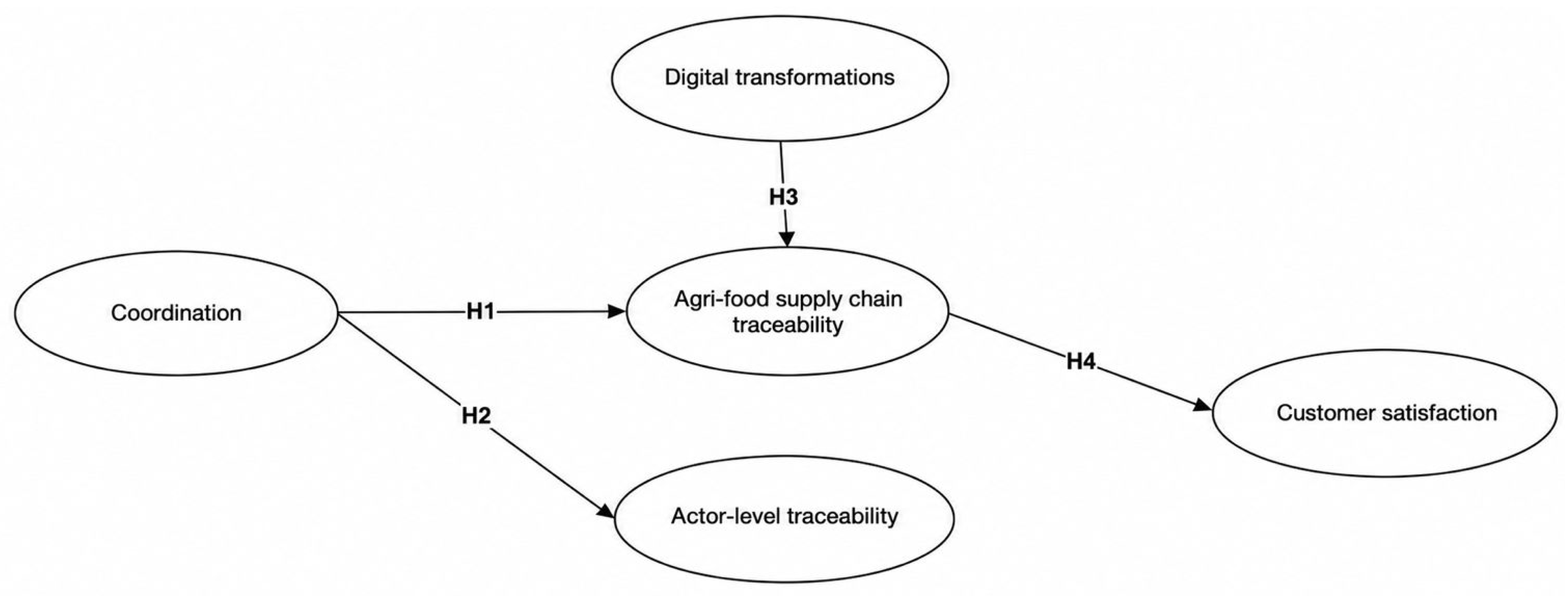
| H1 | COO → SCT | 0.562 | 4.392 | <0.001 | Yes |
| H2 | COO → ALT | 0.890 | 35.691 | <0.001 | Yes |
| H3 | DT → SCT | 0.244 | 1.878 | 0.060 | Not Supported |
| H4 | SCT → CS | 0.818 | 18.438 | <0.001 | Yes |
Disclaimer/Publisher’s Note: The statements, opinions and data contained in all publications are solely those of the individual author(s) and contributor(s) and not of MDPI and/or the editor(s). MDPI and/or the editor(s) disclaim responsibility for any injury to people or property resulting from any ideas, methods, instructions or products referred to in the content. |
© 2026 by the authors. Licensee MDPI, Basel, Switzerland. This article is an open access article distributed under the terms and conditions of the Creative Commons Attribution (CC BY) license.
Share and Cite
Cossío, N.S.; Rudi, G.R.; Coq-Huelva, D.; Pulido-Rojano, A. Traceability Model in an Agri-Food Chain: Application of Structural Equations. Logistics 2026, 10, 140. https://doi.org/10.3390/logistics10060140
Cossío NS, Rudi GR, Coq-Huelva D, Pulido-Rojano A. Traceability Model in an Agri-Food Chain: Application of Structural Equations. Logistics. 2026; 10(6):140. https://doi.org/10.3390/logistics10060140
Chicago/Turabian StyleCossío, Neyfe Sablón, Giselle Rodríguez Rudi, Daniel Coq-Huelva, and Alexander Pulido-Rojano. 2026. "Traceability Model in an Agri-Food Chain: Application of Structural Equations" Logistics 10, no. 6: 140. https://doi.org/10.3390/logistics10060140
APA StyleCossío, N. S., Rudi, G. R., Coq-Huelva, D., & Pulido-Rojano, A. (2026). Traceability Model in an Agri-Food Chain: Application of Structural Equations. Logistics, 10(6), 140. https://doi.org/10.3390/logistics10060140

