Article

Disturbance-Aware Multi-Criteria Network Optimization for Carrier Selection and Risk-Aware Routing in Multimodal Logistics Systems


1
Department of Navigation and Maritime Safety, Odesa National Maritime University, Mechnikov 34, 65029 Odessa, Ukraine
2
The Faculty of Operation and Economics of Transport and Communications, University of Žilina, Univerzitná 8215, 010 26 Žilina, Slovakia
3
Transport Department, Stanislaw Staszic State University of Applied Sciences in Piła, ul. Podchorazych 10, 64-920 Pila, Poland
*
Author to whom correspondence should be addressed.
Logistics 2026, 10(5), 97; https://doi.org/10.3390/logistics10050097
Submission received: 17 February 2026 / Revised: 24 March 2026 / Accepted: 26 March 2026 / Published: 1 May 2026

Abstract

Background: Efficient carrier selection and routing in multimodal logistics networks is increasingly complex due to operational uncertainty, fluctuating service reliability, and the need for disturbance-aware decision-support tools. This study develops an integrated optimization framework for simultaneous carrier selection and routing under operational disturbances. Methods: A disturbance-aware multi-criteria network optimization model is proposed that incorporates transportation cost, delivery time, reliability, and economic risk within a unified mathematical formulation. Operational disturbances are represented as parametric perturbations of network costs, enabling recalculation of routing decisions. Computational experiments were conducted on an illustrative multimodal network and additional synthetic networks. Results: The results show that routing decisions remain stable under disturbance levels up to 5% and reconfigure under higher perturbations. Comparative analysis with a classical cost-minimization routing model illustrates a potential reduction in expected economic risk exposure of approximately 25–30% within the illustrative experimental setting while maintaining comparable transportation time. Conclusions: The proposed framework integrates carrier selection and routing decisions in multimodal logistics systems and supports risk-aware decision-making under operational uncertainty.

1. Introduction

Efficient carrier selection and routing in multimodal logistics networks is becoming a critical requirement for modern supply chains operating under high uncertainty, operational robustness, and increasing competitive pressure. Global transport systems are now exposed to unstable travel times, fluctuating service reliability, volatile carrier performance, and complex multimodal coordination requirements. These conditions significantly increase the complexity of routing decisions and require adaptive, intelligence-driven tools capable of dynamically balancing cost, time, reliability, and operational risk.
Although numerous optimization models have been proposed in the literature, most existing approaches rely on static parameters, assume stable network conditions, or consider a limited subset of performance indicators. Current models rarely integrate disturbance sensitivity, multimodal compatibility, and competitive intelligence into a unified decision-making framework. This creates a methodological gap, especially when routing decisions must remain robust under changing operational constraints and operational robustness.
Thus, the sources on which the study is grounded deal with aspects both fundamental and applied in conducting research into multimodal transport organization, such as legal regulation, route optimization, some aspects of safety, technical efficiency, and the making of intelligent decision algorithms. This serves as a methodological basis necessitated for further scope, leading to research into the subject of the efficient work of an autonomous transport system functioning in a complex logistical environment.
Despite the extensive literature on multimodal routing and carrier selection, existing approaches typically suffer from several limitations:
(i)
Routing and carrier selection are often treated separately;
(ii)
Risk is incorporated implicitly or probabilistically without explicit economic penalty structures;
(iii)
Most models rely on static parameters and do not incorporate routing reconfiguration under operational disturbances;
(iv)
Reliability and risk trade-offs are rarely integrated within a unified network-based mathematical formulation.
Consequently, there is a need for a disturbance-aware multi-criteria optimization framework that explicitly models carrier-level heterogeneity, disturbance sensitivity, and economic risk within a single decision-making structure.
To address this problem, this paper develops a disturbance-aware multi-criteria optimization model that incorporates cost, time, reliability, and risk into an integrated carrier selection and routing framework suitable for multimodal logistics networks. The model reflects real-world disturbances, heterogeneous transport modes, and carrier behavior variability. On top, it aims to include aspects of competitive intelligence and thereby broaden the scope of evaluation while also highlighting the constraints of operational robustness. The objective is to develop and validate a unified optimization framework that adapts to operational disturbances while maintaining service reliability.
The contribution of this study is fourfold:
-
Development of a unified carrier–route optimization model integrating cost, time, reliability, and explicit economic risk;
-
Incorporation of carrier-level variability within a multimodal network formulation;
-
Disturbance-sensitive adaptive recalculation mechanism;
-
Flexible switching between cost-minimization and time-minimization objectives within a single modeling framework, allowing adaptation to different logistics priorities.
The remainder of the paper is structured as follows. Section 2 reviews the related literature on multimodal routing optimization and carrier selection models. Section 3 presents the mathematical formulation of the proposed disturbance-aware multi-criteria network optimization model. Section 4 describes the computational experiments and validation results. Section 5 discusses the implications and limitations of the proposed approach and, finally, Section 6 concludes the paper and outlines directions for future research.

2. Literature Review

This section reviews existing research on multimodal routing optimization, carrier selection, and decision-making models under uncertainty in logistics systems. Adaptive multi-criterion optimization for carrier selection and routing in stable multimodal networks is based on several blocks of knowledge. Legal and institutional frameworks form “decision corridors” for routes and carrier selection: collisions and liability models in multimodal transport are studied [1], transport safety models are formalized [2], the imperatives of multimodal system development in the context of integration [3] and contemporary threats to sustainable shipping—from military risks to climate change [4]—are analyzed, and so are special import security control regimes, particularly for food products [5]. Additionally, the impact of economic crises on the restructuring of route structures [6], the nature of threats to the shipping industry [7], and multidimensional approaches to the assessment of intermodal systems [8] are taken into account.
This approach allows ports to be evaluated based on service efficiency indicators [9], while the integration of sea and dry ports demonstrates how “ambidextrous” hubs simultaneously perform buffering and distribution functions [10]. The efficiency of tramp fleets under COA [11] and logit models for booking voyage charters [12] introduce realistic uncertainty in tonnage supply. Practices of shipment consolidation [13] and proper cargo preparation in intermodal chains [14] reduce the risks of delays/damage, while the formalization of multimodal road transport as a multi-stage multi-criteria task [15] links routes with intra-city delivery. Requirements for the safe handling of deck cargo [16] and the influence of a system of factors in the transportation of oversized cargo [17] are detailed separately. Technical reliability and operational stability of transport systems are also influenced by diagnostic and monitoring approaches developed in related engineering domains [18,19,20], illustrating how technical condition monitoring and reliability assessment can support risk-aware decision-making in complex transport systems, while energy assessments in agricultural chains serve as an analog for internal “energy calculation” of logistics solutions [21,22], and risks associated with temperature factors on the railway are considered as another component of network safety [23]. The component method in the logistics of high-tech product supply complements the concept of structured organization of flows and stocks [24].
The algorithmic core of optimization is based on a wide range of methods, so combinations of routes and modes of transport in container multimodal systems are solved using dynamic programming methods [25], and multi-criteria route planning is solved using genetic algorithms [26]. Specialized crossover operators [27] and schemes for reducing penalties for tour violations [28] are adapted directly to maritime freight tasks. Automated design, comparison, and selection of routes in multimodal systems [29], optimization of large mixed fleet tasks in an urban environment [30], and formalization of multimodal road transport as a multi-stage multi-criteria task [15] create an applied basis for integrated “route + carrier” models. Structural optimization of multimodal routes [31] and searching through options against the backdrop of real constraints demonstrate how network topology can be adjusted to predicted loads and points of failure. Tabu search in intermodal logistics [32] and dynamic stochastic routing modeling [33] are used to solve large-scale problems. General approaches to optimization under uncertainty [34] and uncertainty theory in the optimization of international multimodal routes [35] allow for the construction of robust solutions, and the selection of optimal routes in extended transport networks under uncertainty complements [36]. There are also more advanced schemes for routing under time risk [37], simulation modeling of multimodal transport flows [38], a legal framework for multimodal transport system coordination [39], and route construction taking into account the advantages of multimodality in the IoT environment [40]. Optimization of business processes in container multimodal logistics [41], machine learning algorithms in multimodal services [42], the design of a multimodal ride-sharing system [43], the multi-layer structure and stability assessment of regional rail networks [44], and passenger flow assessment based on smart cards [45] expand the toolkit, taking into account the actual behavior of the system.
Digitalization and energy–entropy approaches shape the modern context of decision-making. Blockchain platforms for multimodal electronic documents reduce transaction friction and accelerate switching between links in the chain [46], while intelligent decision support systems (DSSs) for the development of megacity infrastructure demonstrate how to integrate multi-source data into strategic planning [47]. The entropy paradigm of managing project-oriented organizations [48] and the direct use of entropy as an optimization objective function for multimodal transport [49] offer a way to balance between flow diversification and concentration risk, complementing classical energy balances. The quality of expert assessments of ship operation risks [50] directly affects the weights of criteria in multi-criteria models, while the concepts city route networks, framework for multi-objective control and cargo handling [51,52,53] set strict limits for any optimization decisions. Finally, good practices in project management [54,55,56] and consideration of risks in transport ensuring operational stability [57] within which a disturbance-aware multi-criteria model for selecting a carrier and route in stable multimodal logistics networks should operate.
Geopolitical and legal factors affecting the functioning of transport corridors that influence route risks are discussed in [57,58]. The transformation of international logistics in the context of globalization and relocation of processes, taking into account risks, is discussed in [59,60,61], including the issues of intangible assets and competitiveness of shipping. Optimization approaches to the quality of port services and equipment replacement [62,63], as well as methods for diagnosing technical systems [64], create the basis for integrating operational parameters into network models. The issues of resilience of logistics systems and resistance to attacks or disturbances are discussed in [65], while spatial and node optimization of multimodal networks are discussed in [66,67]. Methods based on data-driven forecasting and classification can also be adapted to support carrier risk assessment in multimodal logistics systems [68]. Practical aspects of optimizing international transportation and managing logistics departments are discussed in [69,70].
To summarize the main directions of existing research and highlight the methodological gap addressed in this study, Table 1 presents a comparative overview of representative studies on multimodal routing and carrier selection models.
As shown in Table 1, most existing studies address either routing optimization or multimodal decision problems separately, while limited attention has been given to integrating carrier-level heterogeneity, explicit economic risk modeling, and disturbance-sensitive recalculation within a unified network formulation. The proposed model addresses this gap by combining these elements within a single adaptive optimization framework.
The reviewed studies highlight significant progress in multimodal transport optimization; however, existing models rarely integrate carrier-level heterogeneity, disturbance sensitivity, and explicit economic risk modeling within a unified framework. This research gap motivates the development of the proposed disturbance-aware multi-criteria network optimization model.

3. Materials and Methods

Multimodal transport within this study is considered at the local level, i.e., for a single request without taking into account other transports by the operator in the same time interval. This approach allows us to focus on optimizing a specific transport scheme and selecting a set of carriers, taking into account the specifics of multimodal risks that are entirely dependent on the operator.
The main feature of multimodal transport is the presence of several consecutive transport links, each of which affects the total cost, delivery time, and level of risk. Therefore, the optimization model must take into account the relationship between individual segments of the route within a single network structure.
In the local consideration of multimodal transport, it is proposed to use the transport problem model in a network setting, transforming the constraints and objective function considering the “multimodal” specifics. It should be noted that in the classical setting, the transport network was used at the routing level for the transport vehicle, i.e., as an analog of road maps, but, for this example, the transport network is considered at a higher level, as transport links form a transport scheme by different types of transport for integrated systems.
The proposed optimization framework builds on the classical concept of network flow formulations, as used in routing and logistics optimization problems. A key feature of these models is their primary focus on optimizing transportation costs or travel times within a pre-specified network structure. Conversely, routes involving heterogeneity at each truckload, at-risk monetary indicators and the ability to recalculate quickly in the event of disturbances are incorporated into the original models. This amended framework therefore treats the routing decision as a means of affecting multiple operational targets while maintaining a unified, network-based formulation.
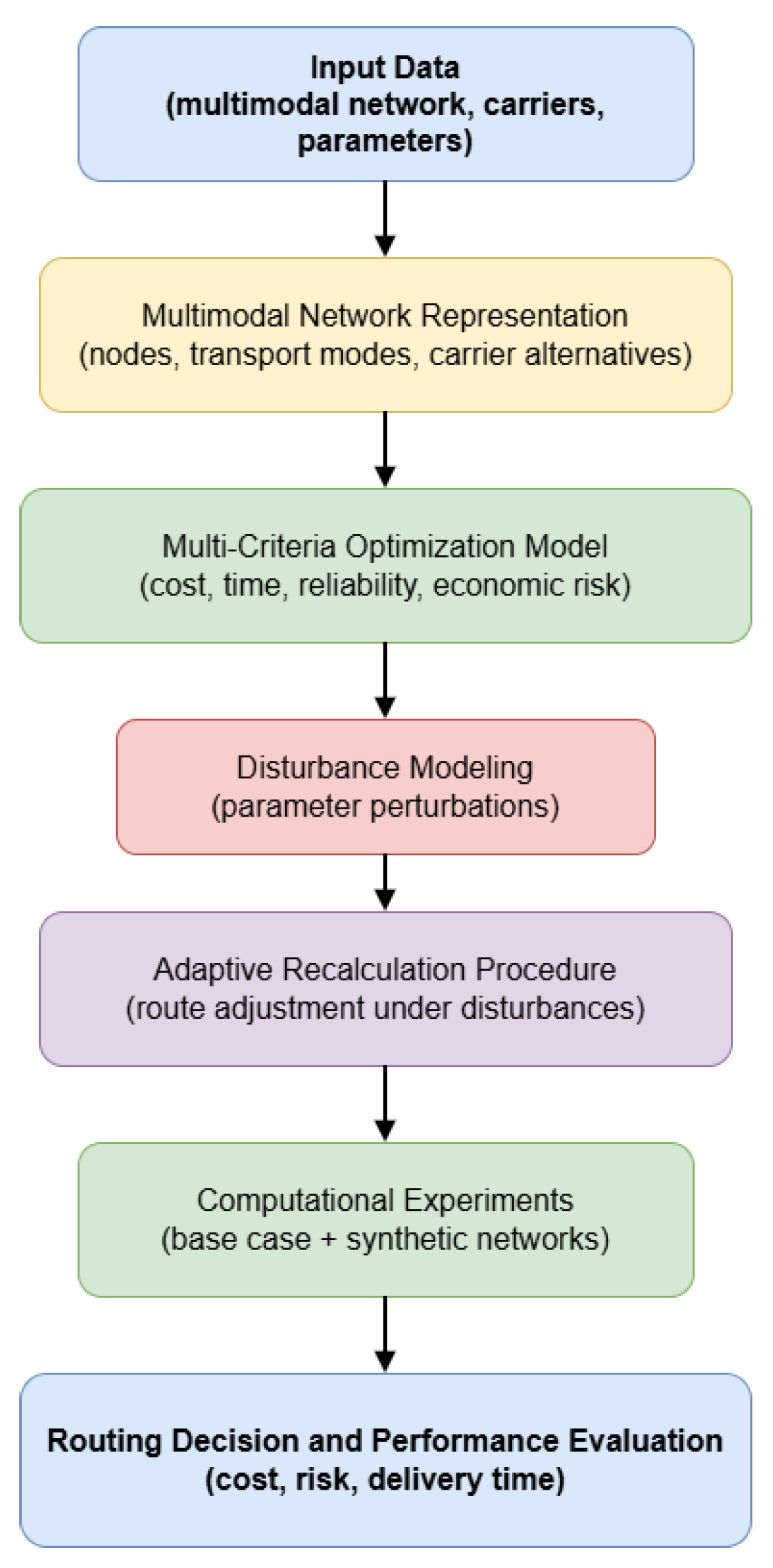
The overall methodological framework of the study is illustrated in Figure 1. The proposed approach integrates multimodal network representation, multi-criteria optimization modeling, disturbance simulation, and adaptive recalculation procedures to determine robust routing and carrier selection decisions.
Let us consider a transport network consisting of N nodes and corresponding transport “communications,” which reflect the presence of certain transport links between the network nodes. A i , i = 1 , n ¯ and related transportation “utilities” A i j k , i = 1 , n 1 ¯ , j = 2 , n ¯ , k = 1 , 2 , 3 , which reflect the presence of certain transportation links between network nodes A i , A j ; k corresponds to the type of transport: k = 1—road transport, k = 2—railway transportation, and k = 3—water transport (maritime, inland).
The study covers road, rail, and maritime transport; air transport is not included in the model due to the specific nature of containerized maritime transport.
Let: N—set of network nodes, indexed by i, jN;
K—set of transport modes, indexed by kK;
Lijk—set of available carriers operating between nodes i and j by transport mode k;
AkN × N—set of feasible transport links for mode k.
Decision variable: x i j k , l = 1 , if   carrier   l L i j k   is   selected 0 , otherwise
Parameters: C i j k , l —transportation cost; T i j k , l —transportation time; R i j k , l —economic risk indicator; and p i j k , l —probability of safe delivery.
This transportation network is characterized by the following matrix A k , k = 1 , 2 , 3 for each mode of transport; the elements of this matrix A i j k = 0 ; 1 , i = 1 , n ¯ , j = 1 , n ¯ , k = 1 , 2 , 3 are either 0 or 1, taking into account the presence or absence of a transport connection:
A k = 0 A 12 k A 1 n k A 21 k 0 A 2 n k A n 1 k A n 2 k 0 , k = 1 , 2 , 3 .
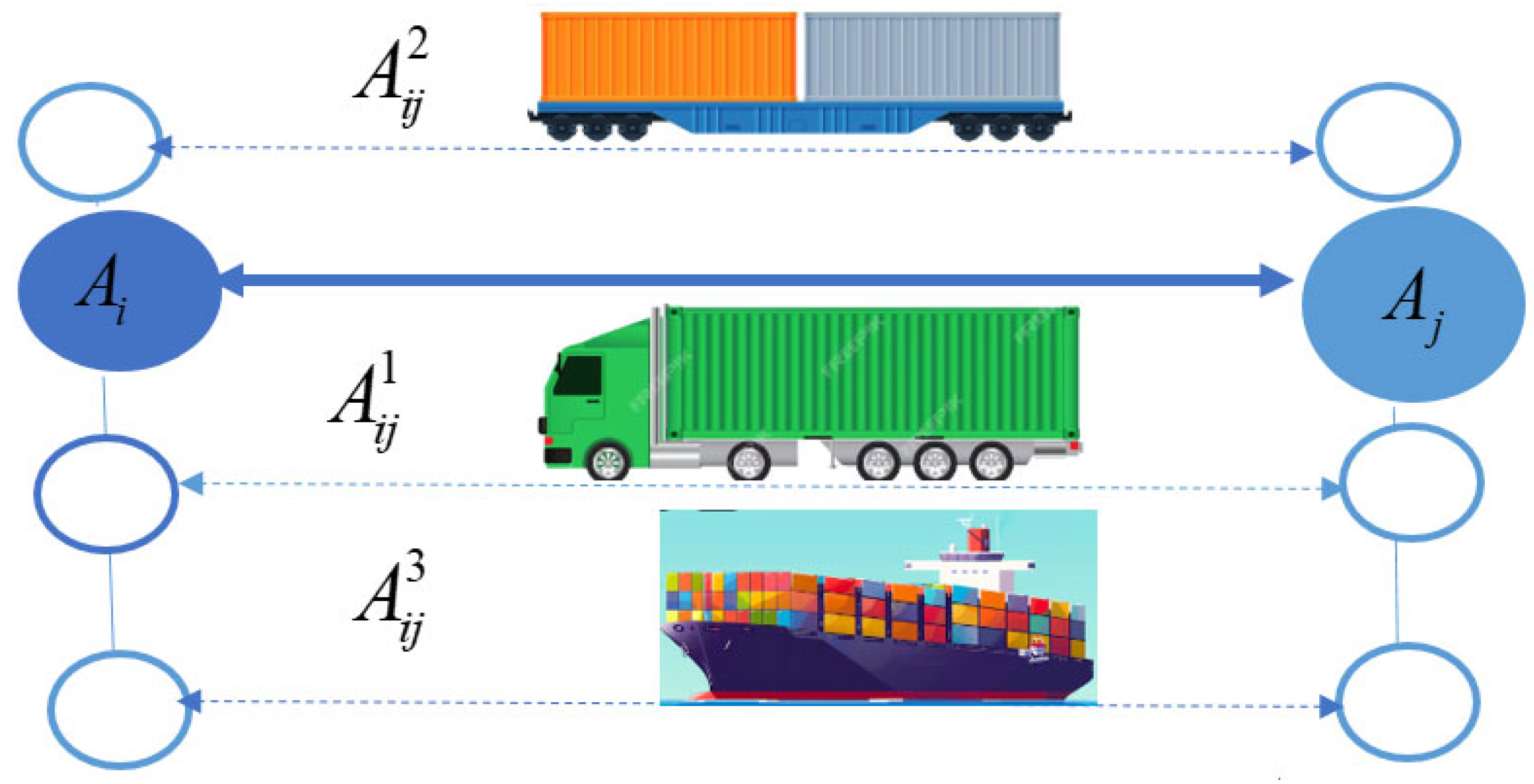
The adjacency structure is assumed symmetric for the illustrative example; however, the formulation remains valid for directed networks (Figure 2);
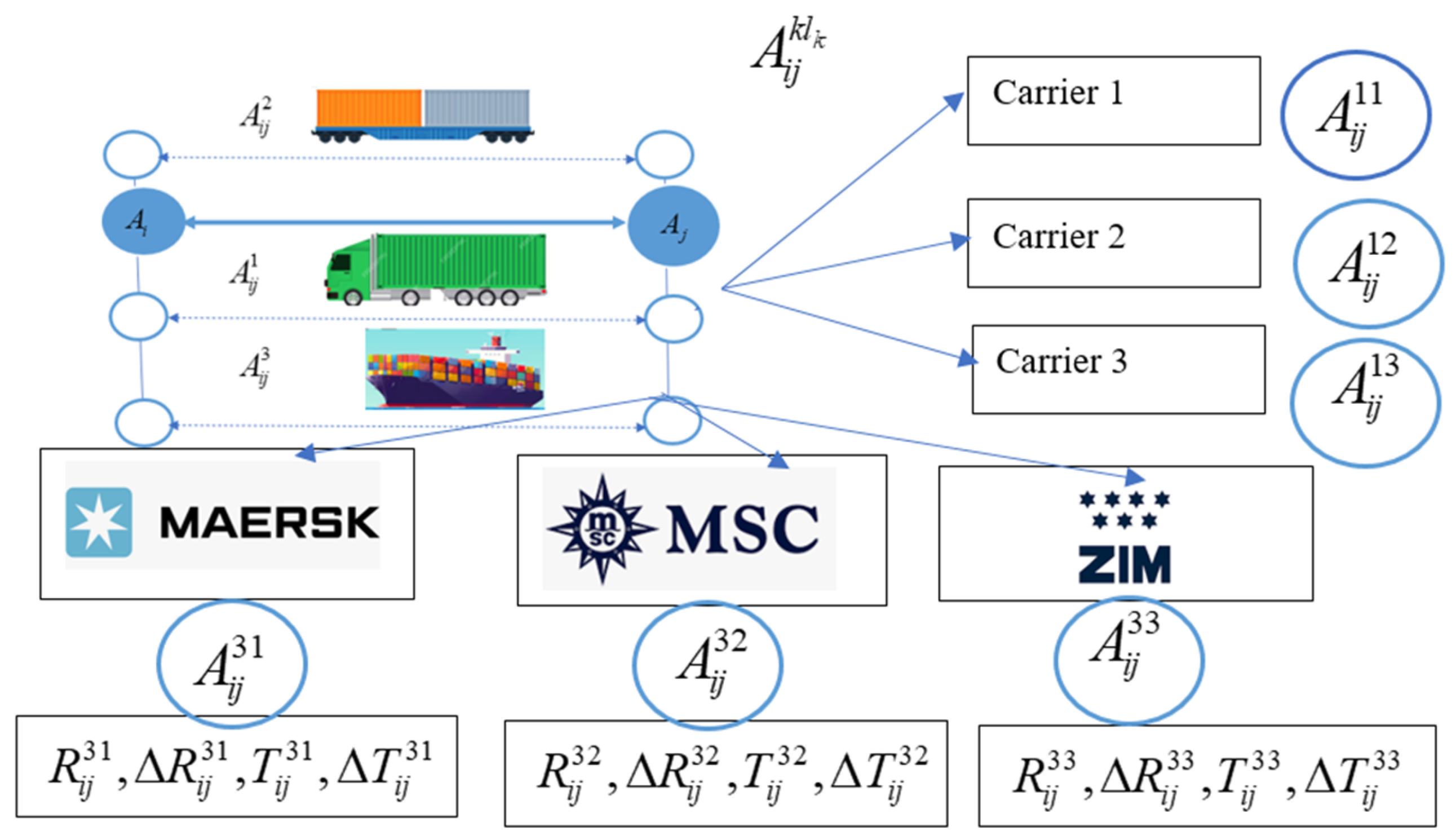
Each transport communication of a certain type of transport is also characterized by alternativeness or its absence. If for k = 2 (rail transportation) there is no alternative from the point of view of the carrier, given that there is only one carrier—the railroad—there is an alternative for other modes of transport. For example, maritime transportation between a certain pair of ports can be carried out by different liner carriers with different relevant characteristics—transit time, cost, schedule reliability, number of departures, and time interval between departures. As for road transport, the alternatives are even greater, and many multimodal operators have their own fleet of vehicles.
Therefore A i j k = 0 ; 1 , i = 1 , n ¯ , j = 1 , n ¯ , k = 1 , 2 , 3 should be supplemented with consideration of alternative carriers:
A i j k l k = 0 ; 1 , i = 1 , n ¯ , j = 1 , n ¯ , k = 1 , 2 , 3 , l k Ω i j k ,
where Ω i j k is a set of carriers of a type of transport k on communication A i j k and l k is the serial number of the carrier for a certain type of transport on this communication. So, if A i j k = 0 ; 1 , i = 1 , n ¯ , j = 1 , n ¯ , k = 1 , 2 , 3 are transport communications in terms of the mode of transport, then A i j k l k = 0 ; 1 , i = 1 , n ¯ , j = 1 , n ¯ , k = 1 , 2 , 3 , l k Ω i j k are transport communications from the point of view of carriers of a certain type of transport (Figure 2).
Taking into account the above, the main characteristics of each multimodal transportation are: costs (cost) R , transport time T , risks Δ R and reliability. The reliability is proposed to be assessed, for example, by probabilistic characteristics—the probability of timely transportation and the possible increase in transportation time with a certain probability Δ T .
It should be noted that in this case, the risks Δ R are understood in an economic sense, precisely because the multimodal operator assumes all possible risks, primarily the risk of increased delivery costs due to additional costs that were not previously foreseen, especially if the operator carries out, for example, road transportation with its own vehicles. This is a common practice and most operators have their own vehicles and act as carriers, Figure 3.
Thus, each carrier l k Ω i j k , i = 1 , n ¯ , j = 1 , n ¯ , k = 1 , 2 , 3 is characterized by the following set:
R i j k l k , Δ R i j k l k , T i j k l k , Δ T i j k l k l k Ω i j k , i = 1 , n ¯ , j = 1 , n ¯ , k = 1 , 2 , 3 ,
where R i j k l k , Δ R i j k l k , T i j k l k , Δ T i j k l k , respectively, cost, possible risk of cost (cost) increase, including penalties for violation of multimodal transportation conditions (time, safety, etc.), transportation time, and possible increase in transportation time. This rank, Δ R i j k l k , is an indicator that has the following structure:
Δ R i j k l k = R f i n i j k l k + R a d d   i j k l k ,
R f i n i j k l k —possible fines; R a d d   i j k l k —possible additional costs.
Let us introduce:
x i j k l k = 0 ; 1 —a control parameter, the essence of which is the choice of a particular carrier l k and a certain type of transportation k for transportation by communication ij; the choice of a particular carrier corresponds to the value x i j k l k = 1 . It should be noted that the choice of carriers for the maritime component is not made from the set of all carriers operating in this direction of transportation (communication), but from the set of Ω i j k Ω i j k , those whose schedule meets the requirements for departure time.
Another clarification is that the control parameters correspond to the availability of certain communications. For example, if transportation from the first point is possible only to the second and third points, that is, there are A 12 k l k , A 13 k l k , then consider the appropriate control parameters x 12 k l k , x 13 k l k .
Thus, the model of forming the optimal scheme and composition of carriers for multimodal transportation (delivery) is as follows.
The objective function meets the optimality criterion—the total costs of a multimodal operator—taking into account possible risks:
i = 1 n 1 j = 2 n k = 1 3 l k Ω i j k ( R i j k l k + Δ R i j k l k ) x i j k l k min .
This expression takes into account the entire route of the cargo, taking into account all types of transport and carriers.
To ensure comparability of heterogeneous criteria (cost, time, risk), normalization is applied:
C ˜ i j = C i j C min C max C min , T ˜ i j = T i j T min T max T min .
This prevents dominance of any single criterion due to scale differences.
In the numerical implementation used for computational experiments, the objective Function (5) was applied in its operational form combining transportation cost and explicit economic risk components. The weighted multi-criteria formulation J = w1C + w2T + w3R represents a generalized extension of the model that allows flexible adjustment of decision-maker preferences when multiple criteria are considered simultaneously. In the illustrative case study presented in this paper, the cost-risk formulation was used as the primary optimization objective, while transportation time was incorporated through Constraint (7).
Given the need to meet transportation deadlines, the following restriction takes into account the total time of multimodal transportation:
i = 1 n 1 j = 2 n k = 1 3 l k Ω i j k ( T i j k l k + Δ T i j k l k ) x i j k l k T * ,
where T * —the maximum period of multimodal transportation specified by the shipper. It should be noted that if the “area of compromise” approach is followed, this restriction may be adjusted:
i = 1 n 1 j = 2 n k = 1 3 l Ω i j k ( T i j k l + Δ T i j k l ) x i j k l T * + Δ T * ,
where Δ T * —permissible increase in the specified period of multimodal transportation according to the conditions of the shipper.
The following are two groups of constraints that ensure the formation of a scheme in which, if necessary, the plots are sequenced.
The first group of model constraints takes into account the need for cargo to “exit” each intermediate point—the nodes of the transportation network:
j = 1 n k = 1 3 l k Ω i j k x i j k l k = j = 1 n k = 1 3 l k Ω i j k x j i k l k , i = 2 , n 1 ¯ .
It should be noted that this model is focused on a network of any kind in terms of transport links, so the constraint expressions take into account any “traversal” of transport nodes from the first to the last.
The second group of restrictions reflects the specifics of the first and last points, i.e., the cargo must leave the first point and enter the last one:
j = 2 n k = 1 3 l k Ω i j k x 1 j k l k = 1
j = 1 n 1 k = 1 3 l k Ω i j k x j n k l = 1
The flow conservation Constraints (9)–(11) ensure that exactly one unit of flow leaves the origin node and reaches the destination node while maintaining continuity at intermediate nodes. Given the binary nature of the decision variables and the structure of the network formulation, the model produces a single connected path from source to destination.
In the computational implementation, recovered solutions were additionally verified for the absence of disconnected components and cycles. For all tested instances, the resulting solutions corresponded to simple feasible routes without subtours.
The model can also be supplemented by taking into account the safety of the cargo as another indicator of reliability:
min I i j k l k x i j k l k > 0 |   i = 1 , n 1 ¯ , j = 2 , n ¯ , k = 1 , 2 , 3 , l k Ω i j k I * ,
where 0 I i j k l k 1 , i = 1 , n 1 ¯ , j = 2 , n ¯ , k = 1 , 2 , 3 , l k Ω i j k —the probability of cargo safety during transportation by a certain company of a certain type of transport on a particular communication.
The set of possible values of variables (control parameters)
x i j k l k = 0 ; 1 , i = 1 , n 1 ¯ , j = 2 , n ¯ , k = 1 , 2 , 3 , l k Ω i j k
completes the model assembly.
It should be noted that the proposed optimization model (5), (8)–(13) is a development of the existing model, the development of which is formed by taking into account the risks of a multimodal operator, cargo safety, possible increase in time and consideration of a set of carriers for road and water transport, which more fully takes into account the essence of multimodal transportation, bringing the theoretical result closer to practical utility.
All variables and parameters used in (5)–(13) have been explicitly defined to ensure mathematical clarity. The objective function is expressed as min J = w 1 C + w 2 T + w 3 R , where Cij—cost; Tij—travel time; Rij—risk factor; w1, w2, w3—scalar weights; and the reliability coefficient reflects the importance of cargo delivery reliability in the multi-criteria formulation.
The weights w1, w2, w3 reflect decision-maker priorities and may be determined using AHP, entropy-based weighting, or scenario-based sensitivity analysis. In the computational experiments presented in this study, equal weights were assumed for the considered criteria to demonstrate the structural behavior of the proposed optimization framework without introducing additional preference bias.

4. Results

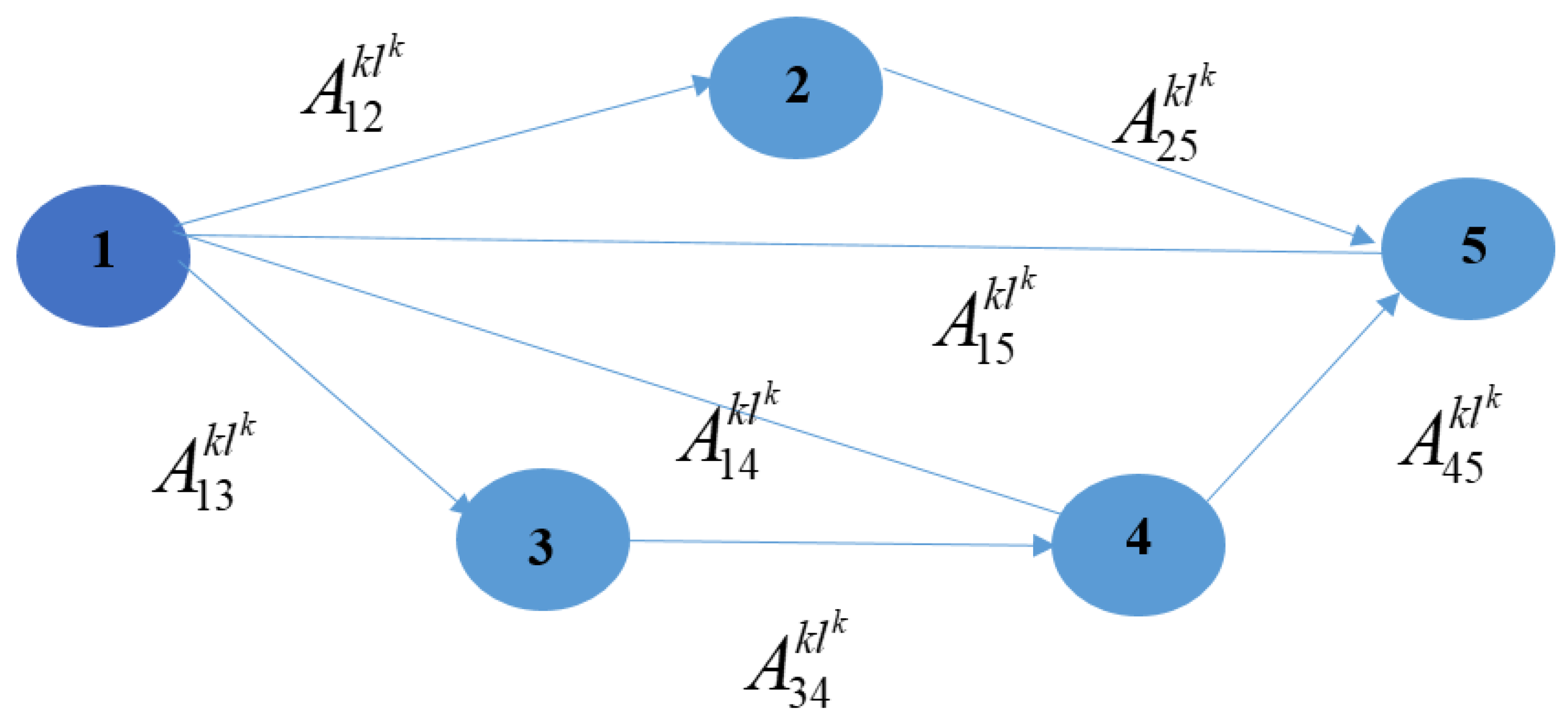
The experimental calculations were carried out for the following example (Figure 4). We consider a network of communications from the first point (cargo dispatch) to the fifth point (destination). The description of possible alternatives for each communication is given in Table 2.
Therefore, and in accordance with the proposed model in general, for this example we have the following model (transportation is carried out from point 1 to point 5).
The optimization problem contains binary decision variables, but to ensure computational feasibility within the illustrative example, continuous relaxation was applied during numerical implementation. In particular, variables are allowed to take values within the interval x ∈ [0, 1], and the solution was obtained using the SLSQP constrained nonlinear optimization algorithm implemented in the SciPy library.
After optimization was completed, a procedure for restoring binary solutions based on threshold conversion was applied: variables with values greater than 0.5 were taken as equal to 1, after which the resulting solution was checked for route correctness and flow consistency. For the network examples considered, the relaxed solution coincided with quasi-binary values, and the recovery procedure ensured that acceptable simple routes from the source to the destination were obtained. The proposed approach is computationally efficient for small and medium-sized problems and can be considered a practical approximation of the original mixed-integer formulation. The integer feasibility of recovered solutions was manually verified for all tested scenarios.
Figure 5, Figure 6 and Figure 7, and Table 3 and Table 4 demonstrate the process of generating the model’s input data and the optimization results.
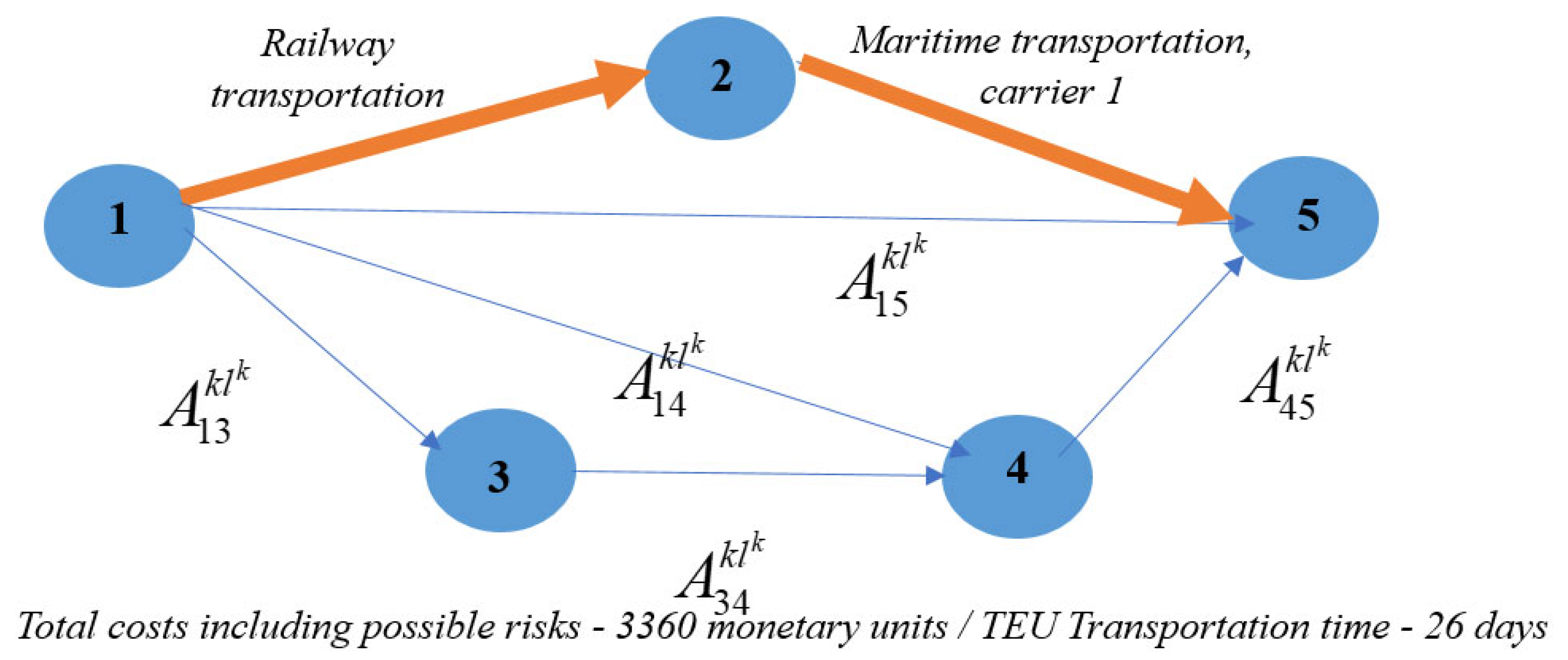
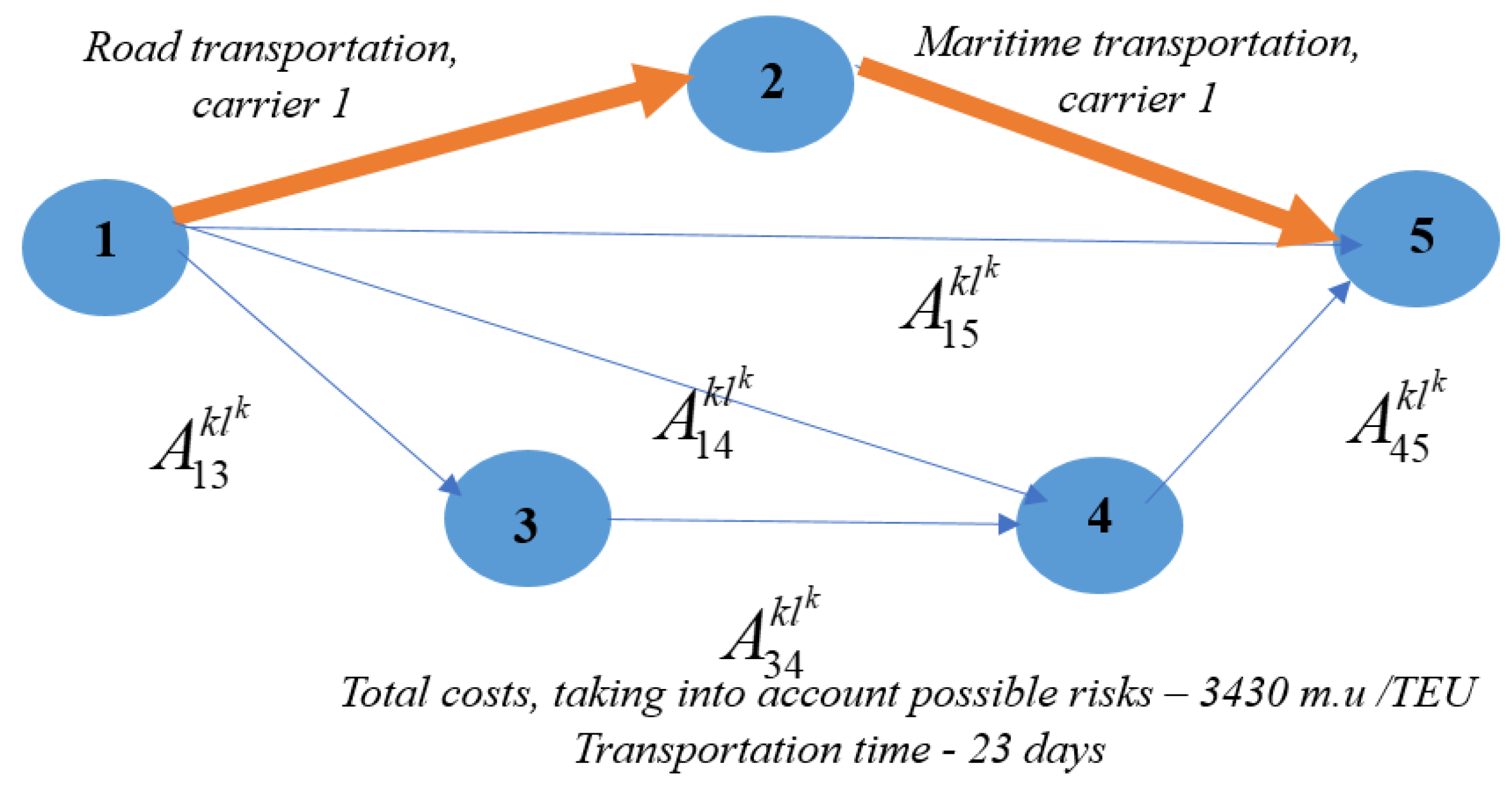
For the basic version of the time limit T* = 28 days, the optimal scheme and carriers are shown in Figure 5, while the variant T* = 25 days is shown in Figure 6. Further, for the basic variant of the time constraint, the cost of transportation through the transport hub was changed (Figure 5).
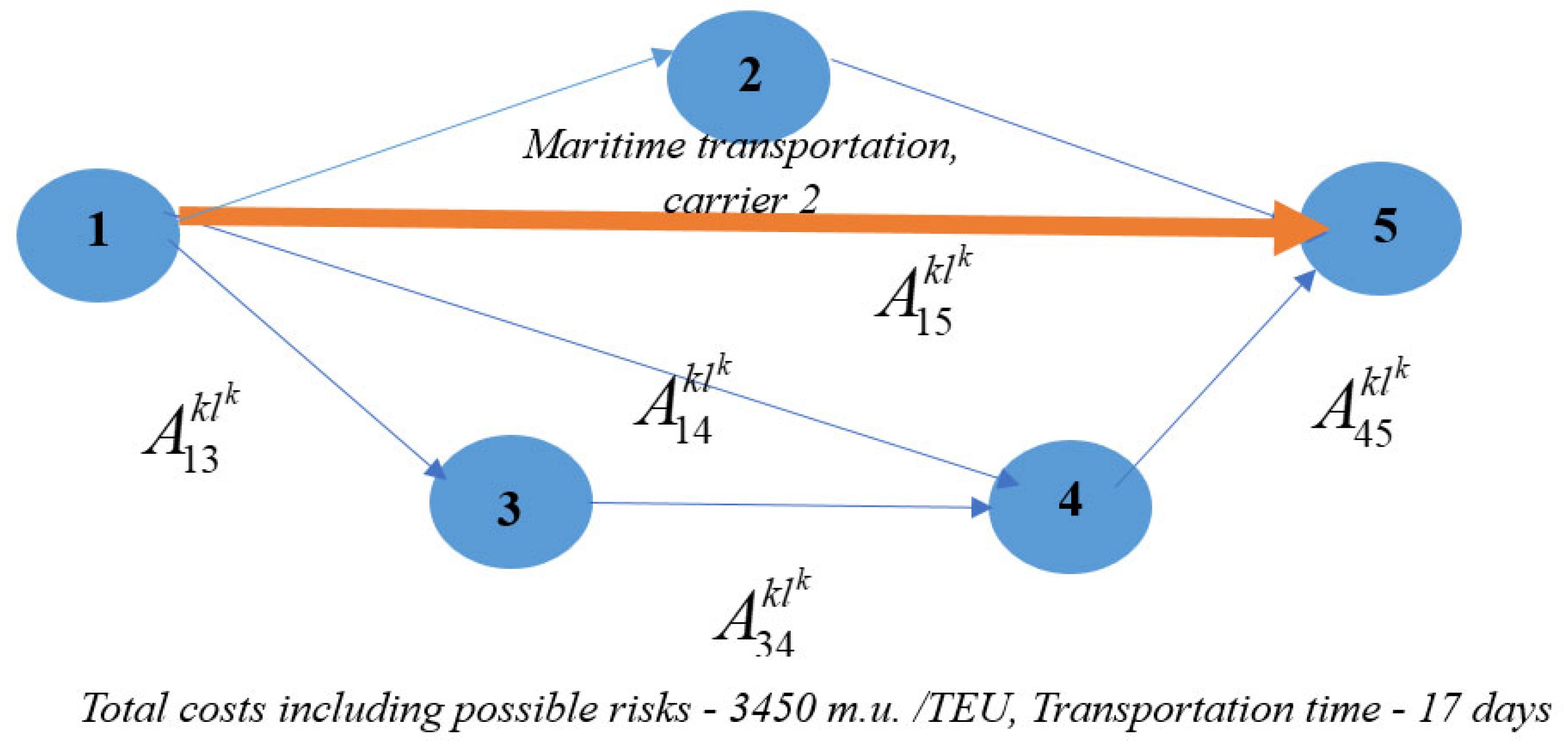
As a result, the optimal option changed to direct transportation by sea (Figure 7).
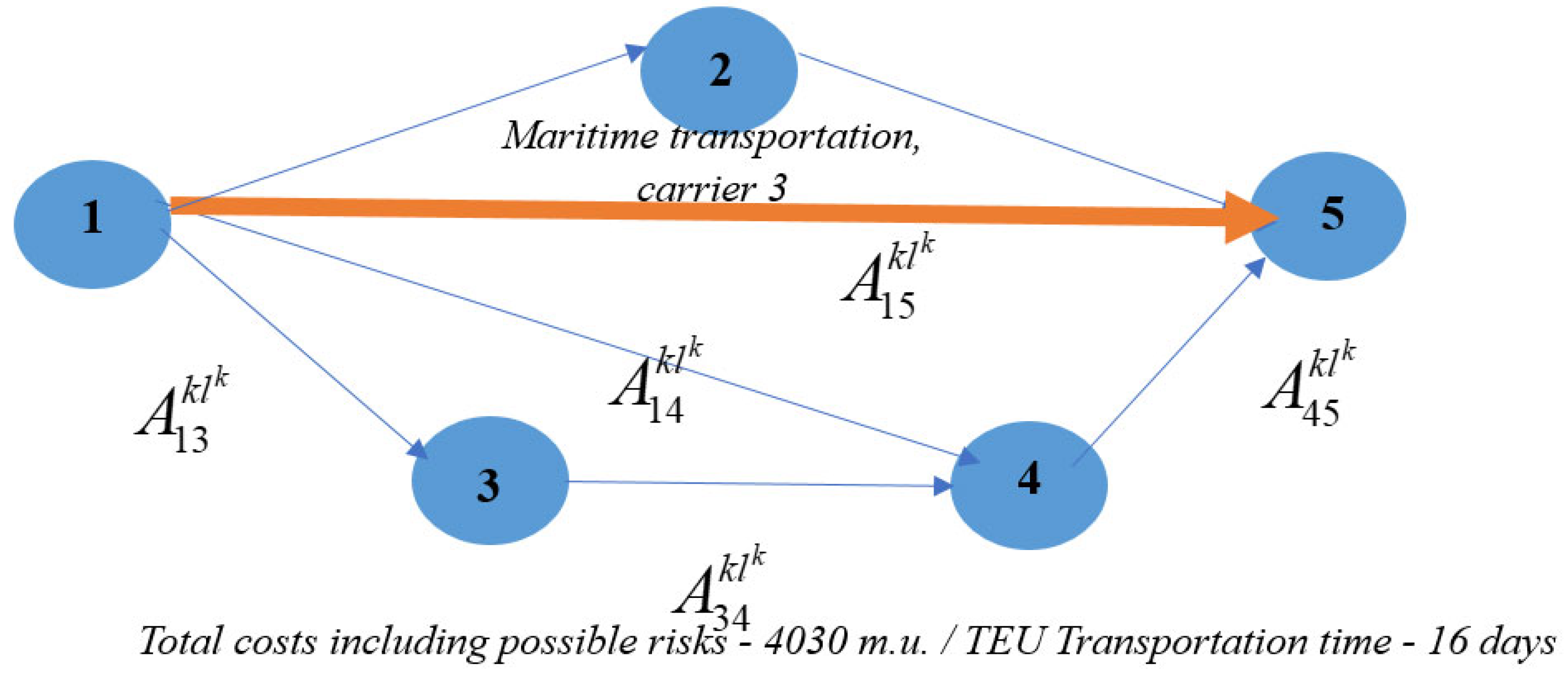
The further reduction in the permissible time of multimodal transportation to T* = 17 affected the change in communications A 15 3 carrier from the second to the fourth (see Table 4). The value of the objective function—the time of multimodal transportation—for this optimal variant is 3750 m.u./TEU, transportation time 17 days.
The behavior of the proposed model under operational disturbances was evaluated by recalculating routing decisions for disturbance levels of 0%, 5%, and 10%. For each possible disruption scenario, the system recalculated carrier and route choices dynamically and based on cost data alone. The natural cause of these constant routing decisions across possible cases was “adaptation to operational disturbances,” thereby displaying the dynamic nature of the model.
Operational disturbances are modeled as parametric perturbations of cost parameters within the transport network: Cij′ = Cij(1 + δ), δ ∈ [0, 0.1], where δ represents the intensity of disruption reflecting operational fluctuations such as fuel price variation, congestion, or carrier performance instability. For each disturbance level, the optimization problem is recalculated, enabling adaptive routing and carrier reconfiguration.
It should be noted that this model can be used with a change in the optimality criterion, namely, to consider “transportation time” as a criterion, it takes into account a possible increase if this criterion is more preferable (for example, in the case of urgent transportation).
In this case, the optimality criterion (the model’s objective function) is the same:
i = 1 4 j = 2 5 k = 1 3 l Ω i j k ( T i j k l + Δ T i j k l ) x i j k l min .
The total transportation cost must not exceed the predefined budget level R * , if necessary:
i = 1 n 1 j = 2 n k = 1 3 l k Ω i j k ( R i j k l k + Δ R i j k l k ) x i j k l k R * .
For the example under consideration, let us introduce restrictions on the cost of transportation R * = 5000 m.u./TEU and use the transportation time as the optimization criterion (Figure 7).
The optimization results are shown in Figure 8.
Thus, as a result of experimental studies of the proposed model, it was found that changing the initial data logically and adequately affects the optimization result, which substantiates the reliability of the proposed model. In addition, the possibility of changing the optimality criterion provides more opportunities to find the best options in terms of the shipper’s requirements.
The present study focuses on demonstrating the operational behavior of the proposed model under different optimization scenarios rather than explicitly constructing a full Pareto frontier of cost–time–risk trade-offs.
To illustrate the effect of decision-maker preferences, an additional scenario with alternative weight configuration (w1 = 0.5, w2 = 0.3, w3 = 0.2) was tested. The resulting routing structure remained consistent with the baseline solution, indicating that the proposed formulation produces stable routing decisions under moderate variations in criterion importance.

5. Discussion

5.1. Implications for Theory

The results of this study contribute to the theoretical development of multimodal logistics optimization by extending classical network flow models toward integrated carrier–route decision-making under operational disturbances. Unlike traditional approaches that treat routing and carrier selection separately, the proposed framework demonstrates how these decisions can be unified within a single mathematical structure while explicitly incorporating economic risk.
The findings also contribute to the growing body of literature on disturbance-aware optimization by showing that routing decisions can remain stable under moderate perturbations and reconfigure under higher disturbance levels. This supports the concept of structural robustness in multimodal logistics networks and provides a bridge between deterministic optimization models and more advanced robust or stochastic approaches.
Furthermore, the inclusion of carrier-level heterogeneity and explicit risk modeling expands the theoretical understanding of multi-criteria logistics optimization, highlighting the importance of integrating operational variability directly into network-based formulations.
For the illustrative case study considered in this work, the possible increase in transportation time (ΔT) was assumed equal to 1 day for all transport links. This simplification was introduced to focus on demonstrating the behavior of the proposed routing and carrier-selection mechanism. In practical applications, the parameter ΔT may vary across carriers and transport modes depending on operational reliability and schedule variability.
In addition, the preservation of the selected routing structure under moderate disturbance levels indicates the stability of the proposed optimization framework. It is proposed to consider this condition either before calculations, i.e., not to consider as alternatives transportation options (carriers) for which the safety is below the minimum acceptable I * , or to check the optimal option for the condition of preservation, and to make the final decision taking into account the cost and time of multimodal transportation (in fact, the “trade-off area” continues to change). For example, if given, and according to the results of the optimization, the preservation of I = 0.990 , the shipper will most likely agree to this option if the cost and time are satisfactory.
Thus, integral criteria for selecting transportation options are appropriate and effective in the transportation or delivery decision process; however, using each criterion separately within the optimization model—either as a criterion or as a constraint—is appropriate and more “visible” for decision making and allows for a maneuverable approach with “compromise zones” that is more preferable and convenient, given the visibility of the results to shipper customers.
Sensitivity Analysis. The model was tested under disturbance levels of 0%, 5%, and 10%. Results show that routing decisions remained stable within a 5% perturbation range, while higher disturbances triggered routing reconfiguration. This confirms the robustness of the proposed formulation.
To systematically evaluate robustness under operational disturbances, multiplicative perturbations were applied to cost parameters according to: Cij′ = Cij (1 + δ), where δ ∈ {0%, 5%, 10%, 15%}.
For each disturbance level, the optimization problem was recalculated, and route structure stability was recorded, Table 5.
The results indicate that routing decisions remain structurally stable for disturbance levels up to 5%. At higher perturbation levels (10% and above), routing reconfiguration occurs, reflecting rational response to increased cost volatility. The objective value grows approximately proportionally to disturbance intensity, while the explicit risk-aware formulation prevents excessive penalty accumulation.
This confirms that the proposed model demonstrates both stability under moderate fluctuations and flexibility under significant disruptions.
Extended Validation on Synthetic Networks. To further evaluate the scalability and structural robustness of the proposed formulation, additional synthetic multimodal network instances were generated with eight and 10 nodes. Each network included heterogeneous carrier alternatives for road and maritime transport segments. Cost, time, and risk parameters were generated within realistic ranges derived from the base case (cost variation ±15%, time variation ±10%, risk variation ±20%). The same optimization procedure (continuous relaxation with recovery) was applied, as shown in Table 6.
The synthetic instances demonstrate a gradual increase in network dimensionality and carrier heterogeneity. As the number of nodes increases, the number of feasible transport links and decision variables grows nonlinearly, reflecting the realistic expansion of multimodal logistics systems. This allows assessment not only of solution quality but also of structural scalability of the proposed formulation.
To evaluate the effectiveness and robustness of the proposed optimization framework, the obtained solutions were compared with a classical cost-minimization routing model commonly used in logistics planning. The baseline model determines the shortest path in the transport network based solely on transportation cost, without explicitly considering economic risk, carrier heterogeneity, or disturbance sensitivity.
In contrast, the proposed model integrates multiple operational criteria, including transportation cost, delivery time, reliability indicators, and expected economic risk. This allows the routing decision process to account for uncertainty and operational variability within the multimodal logistics system.
The comparative results demonstrate that while the proposed model may lead to slightly higher nominal transportation cost in some cases, it significantly reduces expected economic risk and improves the stability of routing decisions under disturbance scenarios, Table 7.
The results indicate that while the proposed model produces slightly higher nominal transportation costs, it significantly reduces expected penalty exposure across all tested instances. The relative reduction in economic risk ranges between 25% and 30%, while transportation time remains unchanged. This confirms the effectiveness of integrating risk-aware decision variables into the routing framework.
In addition to solution quality, computational scalability was evaluated. Runtime performance was recorded for each synthetic instance using identical solver settings, Table 8.
The computational time increases approximately proportionally to the number of decision variables, indicating stable scaling behavior for small- and medium-sized networks. All instances converged successfully, confirming the numerical stability of the relaxed optimization framework and recovery procedure.
The results demonstrate that the proposed risk-aware formulation consistently reduces expected penalty exposure by approximately 25–30% compared to the cost-only baseline while maintaining comparable delivery time. The computational time increases approximately linearly with network size, confirming scalability for small- and medium-scale multimodal systems.
The computational experiments presented in this study were conducted on a hypothetical multimodal transport network designed to illustrate the behavior of the proposed optimization model. The example network represents a simplified logistics system with several transport nodes, alternative carriers, and multimodal connections. Such an illustrative setting allows controlled evaluation of routing decisions, disturbance sensitivity, and adaptive recalculation mechanisms. In addition to the base example, synthetic networks of larger size were generated to assess the scalability of the proposed optimization framework. The parameter ranges used in the experiments reflect realistic variations observed in multimodal logistics operations.
Computational Settings and Reproducibility. The optimization was implemented in Python (version 3.10) using the SciPy optimize. minimize function with the SLSQP (Sequential Least Squares Programming) algorithm. Decision variables were relaxed to continuous values within the interval [0, 1], followed by threshold-based recovery to binary solutions.
The solver was configured with the following parameters:
-
Maximum number of iterations: 500;
-
Convergence tolerance: 1 × 10⁻⁶;
-
Constraint tolerance: 1 × 10⁻⁶;
-
Initial solution: uniform feasible initialization satisfying flow constraints.
All computations were performed on a standard workstation (Intel i7 processor, 16 GB RAM). In the computational experiments, the reliability threshold was not activated as a binding constraint; therefore, no explicit value of I * was imposed.
For synthetic instances, cost parameters were generated within ±15% of base-case values, transportation time within ±10%, and risk parameters within ±20%. Disturbance intensity δ was applied multiplicatively to cost parameters across the network to represent a generalized disturbance scenario affecting the overall transport system (e.g., fuel price increases, congestion effects, or market-wide operational fluctuations). This simplified representation allows systematic analysis of routing sensitivity to cost volatility. In practical applications, the disturbance parameter may be applied selectively to specific transport links or carriers to represent localized disruptions.
The integer feasibility of recovered solutions was verified manually for all tested scenarios by checking: (i) flow conservation, (ii) absence of disconnected components, and (iii) absence of cycles. All reported results can be reproduced using the described parameter ranges and solver settings.

5.2. Implications for Practice and Policy

The proposed model provides a practical decision-support framework for multimodal logistics operators operating under uncertainty. By integrating cost, time, and economic risk within a unified optimization structure, it enables more robust carrier selection and routing decisions in environments characterized by fluctuating costs, variable reliability, and operational disturbances.
The expected economic risk reduction demonstrates that using risk-aware decision criteria will enhance operational resilience while keeping transportation time increases at manageable levels. This situation holds special importance for logistics businesses which manage international supply chains because their operations face risks from disruptions like congestion, fuel price changes, and geopolitical events.
The framework demonstrates that transportation planning needs to assess both system stability and resilience through a policy perspective. The ability to evaluate routing behavior under disturbance scenarios can support infrastructure planning, risk assessment, and the development of more robust multimodal transport systems.

5.3. Limitations and Future Research

The proposed method has several benefits, yet it contains multiple limitations that need recognition. The researchers executed their computational tests on synthetic networks which served as demonstration networks, but the testing results did not reflect the authentic operational patterns of actual logistics networks. The research should demonstrate the model’s performance on actual transportation networks that handle extensive operations while using real-world data.
The disturbance modeling approach uses uniform parametric perturbations which impact all cost parameters. In real-world scenarios, disturbances are typically localized and asymmetric, affecting specific links or carriers rather than the entire network simultaneously. The model would achieve better operational performance through improved real-world applicability when extended to include both stochastic and scenario-based disturbance modeling methods.
The study investigates time-related uncertainty through its current research because it uses a basic time uncertainty framework, which presumes all delays occur at a constant rate. The research will advance to more accurate reliability assessment methods that use probability-based timing models.
The research aims to investigate how real-time data can be combined with dynamic optimization methods and multi-objective Pareto analysis to strengthen decision-making capabilities inside the proposed framework.

6. Conclusions

Within the framework of the study, a disturbance-aware multi-criteria optimization model for carrier selection and routing in multimodal logistics networks was developed. The proposed approach integrates cost, delivery time, reliability, and economic risk indicators into a single mathematical structure, taking into account the heterogeneity of carriers. The results of a numerical experiment showed that the model ensures stability of decisions with parameter perturbations of up to 5% and adaptive route restructuring at higher levels of destabilization. The introduction of explicit modeling of penalty economic risks reduces potential exposure to financial losses compared to the classic cost minimization model without risk consideration. The scientific novelty lies in combining carrier selection and routing in a single network model with a mechanism for parametric adaptation to operational disturbances. The proposed structure allows for flexible switching between cost minimization and delivery time minimization criteria without changing the basic model. The practical significance of the work lies in the possibility of applying the model as a decision support tool for multimodal operators in conditions of uncertainty and market fluctuations.
Despite the advantages of the proposed approach, a number of limitations should be considered. Computational experiments were conducted on a hypothetical multimodal transport network and synthetic examples designed to demonstrate the behavior of the model under controlled conditions. In real logistics systems, additional factors can significantly influence the decision-making process, including the stochastic nature of transportation time, dynamic fluctuations in demand, and constraints related to real-time operational management.
From a management perspective, the model can be used as a decision support tool for multimodal logistics operators, enabling risk-oriented carrier selection and adaptive route planning under uncertainty. Further research should focus on scaling the model for real transport networks, integrating stochastic disturbance models, and using real-time data flows for dynamic optimization of logistics processes.

Author Contributions

Conceptualization, S.O. and O.M.; methodology, S.O. and O.M.; software, V.B.; validation, S.O., O.M. and M.J.; formal analysis, S.O.; investigation, S.O., P.G. and V.B.; resources, M.J., E.T. and T.D.; data curation, V.B.; writing—original draft preparation, S.O.; writing—review and editing, O.M., M.J., P.G., E.T. and T.D.; visualization, V.B.; supervision, O.M. and M.J.; project administration, O.M.; funding acquisition, M.J., E.T. and T.D. All authors have read and agreed to the published version of the manuscript.

Funding

This work is the result of the Project VEGA No.1/0312/25: Research on the economic efficiency of inland water transport, 2025–2027.

Institutional Review Board Statement

Not applicable.

Informed Consent Statement

Not applicable.

Data Availability Statement

The data supporting the findings of this study are available within the article. Synthetic network instances were generated according to the parameter ranges described in the Computational Settings section. Additional details may be provided by the corresponding author upon reasonable request.

Acknowledgments

During the preparation of this manuscript, the authors used (DeepL 26.3.1, Grammarly v1.2.244) for language refinement, structural editing, and improvement of clarity. The authors carefully reviewed and edited the generated content and take full responsibility for the final version of the manuscript.

Conflicts of Interest

The authors declare no conflicts of interest.

References

  1. Celik, M.; Akyar, D. Legal aspects of multimodal transportation: A Turkish approach in multimodal transport problems. In Proceedings of the Third Mediterranean International Congress on Social Sciences (MECAS III), Budapest, Hungary, 19–22 June 2018; Dobra Knjiga d.o.o.: Sarajevo, Bosnia and Herzegovina, 2018. [Google Scholar]
  2. Chakrabartty, S.N. Port performance measurement from perspective of users. J. Marit. Res. 2023, 20, 26–33. [Google Scholar]
  3. Cherednichenko, K.; Ivannikova, V.; Sokolova, O.; Yanchuk, M. Model of transport safety assessment in multimodal transportation systems. Transport 2023, 38, 204–213. [Google Scholar] [CrossRef] [Scilit]
  4. Gurnak, V.; Khomenko, I.; Volynets, L. Imperatives of multimodal transport development in accordance with the tendencies of the transformational changes of the national economy in the conditions of European integration. Econ. Ecol. Socium 2018, 2, 75–88. [Google Scholar] [CrossRef] [Scilit]
  5. Hao, C.; Yue, Y.-X. Optimization on combination of transport routes and modes on dynamic programming for a container multimodal transport system. Procedia Eng. 2016, 137, 382–390. [Google Scholar] [CrossRef] [Scilit]
  6. Jeevan, J.; Rozar, N.; Razik, M.A.; Salleh, N.H.M.; Othman, M.R.; Ngah, A.H.; Usman, I. The symbiotic relationship between seaports and dry ports: An analysis of the ambidextrous functionalities of freight nodes and implications on regional development. J. Marit. Res. 2022, 19, 44–53. [Google Scholar]
  7. Kang, F.; Li, X.; Li, J. Analysis of multi-objective multimodal transport route planning based on genetic algorithm. In Application of Intelligent Systems in Multi-Modal Information Analytics; Springer: Cham, Switzerland, 2021. [Google Scholar] [CrossRef] [Scilit]
  8. Kapur, S. Food import safety and international trade: Comparing regulatory regimes in India and the U.S.A. Lex Portus 2024, 10, 7–29. [Google Scholar] [CrossRef] [Scilit]
  9. Kichkina, O.; Kichkin, O. Automation of the construction, comparison and selection of delivery routes and schemes in the multimodal transportation system. J. Mech. Eng. Transp. 2024, 18, 73–79. [Google Scholar] [CrossRef] [Scilit]
  10. Kisielewski, P.; Duda, J.; Karkula, M.; Skalna, I.; Redmer, A.; Fierek, S. Optimization of urban transport vehicle tasks for large, mixed fleet of vehicles and real-world constraints. Arch. Transp. 2024, 70, 65–78. [Google Scholar] [CrossRef] [Scilit]
  11. Kivalov, S. Current threats to sustainable shipping—From war risks to climate changes. Lex Portus 2024, 10, 15–24. [Google Scholar] [CrossRef] [Scilit]
  12. Koskina, Y.; Onyshenko, S.; Drozhzhyn, O.; Melnyk, O. Efficiency of tramp fleet operating under the contracts of affreightment. Sci. J. Silesian Univ. Technol. Ser. Transp. 2023, 120, 137–149. [Google Scholar] [CrossRef] [Scilit]
  13. Kotenko, S.; Hanzhurenko, I.; Vasylyuk, M.; Lavrushchenko, Y.; Kucher, I. The economic crisis as a factor in changing the structure of multimodal transportation routes. Financ. Credit Act. Probl. Theory Pract. 2022, 6, 277–284. [Google Scholar] [CrossRef] [Scilit]
  14. Kuchma, O. Approaches to the formation of consolidated shipments in multimodal transport systems. Sci. Notes Taurida Natl. Univ. Ser. Econ. Manag. 2024, 35, 70–75. [Google Scholar] [CrossRef] [Scilit]
  15. Lomotko, D.; Prymachenko, H. Formalization of multimodal truck transportation as a multi-stage and multi-objective transport problem. Collect. Sci. Work. Ukr. State Univ. Railw. Transp. 2023, 105–116. [Google Scholar] [CrossRef] [Scilit]
  16. Onyshchenko, S.; Melnyk, O. Efficiency of ship operation in transportation of oversized and heavy cargo by optimizing the speed mode considering the impact of weather conditions. Transp. Telecommun. 2022, 23, 73–80. [Google Scholar] [CrossRef] [Scilit]
  17. Melnyk, O.; Onyshchenko, S.; Onishchenko, O.; Koskina, Y.; Lohinov, O.; Veretennik, O.; Stukalenko, O. Fundamental concepts of deck cargo handling and transportation safety. Eur. Transp.-Trasp. Eur. 2024, 98, 1. [Google Scholar] [CrossRef] [Scilit]
  18. Onyshchenko, S.; Melnyk, O. Modelling of changes in ship’s operational condition during transportation of oversized and heavy cargo. Technol. Audit Prod. Reserv. 2020, 6, 66–70. [Google Scholar] [CrossRef] [Scilit]
  19. Nehring, K.; Lasota, M.; Zabielska, A.; Jachimowski, R. A multifaceted approach to assessing intermodal transport. Sci. J. Silesian Univ. Technol. Ser. Transp. 2023, 121, 141–165. [Google Scholar] [CrossRef] [Scilit]
  20. Onyshchenko, S.; Koskina, Y.; Savelieva, I. Developing a logit model for the provision of the process of managing the conclusion of voyage chartering transactions. East.-Eur. J. Enterp. Technol. 2016, 6, 26–31. [Google Scholar] [CrossRef] [Scilit]
  21. Qian, X.; Shen, L.; Yang, D.; Zhang, Z.; Jin, Z. Research on multimodal transport of electronic documents based on blockchain. Big Data Cogn. Comput. 2024, 8, 67. [Google Scholar] [CrossRef] [Scilit]
  22. Qiao, C.; Niu, K.; Ma, W. Multimodal network path optimization based on a two-stage algorithm in the perspective of sustainable transport development. Adv. Control Appl. Eng. Ind. Syst. 2024, 6, e187. [Google Scholar] [CrossRef] [Scilit]
  23. Romanuke, V.V.; Romanov, A.Y.; Malaksiano, M.O. Crossover operators in a genetic algorithm for maritime cargo delivery optimization. J. Eta Marit. Sci. 2022, 10, 223–236. [Google Scholar] [CrossRef] [Scilit]
  24. Romanuke, V.V.; Romanov, A.Y.; Malaksiano, M.O. A genetic algorithm improvement by tour constraint violation penalty discount for maritime cargo delivery. Syst. Res. Inf. Technol. 2023, 2, 104–126. [Google Scholar] [CrossRef] [Scilit]
  25. Rouky, N.; Boukachour, J.; Boudebous, D.; Alaoui, A. Optimization under uncertainty: Generality and application to multimodal transport. Int. J. Supply Oper. Manag. 2023, 10, 223–244. [Google Scholar] [CrossRef]
  26. Ru, S. Vehicle logistics intermodal route optimization based on Tabu search algorithm. Sci. Rep. 2024, 14, 11859. [Google Scholar] [CrossRef] [Scilit]
  27. Taran, I.; Olzhabayeva, R.; Oliskevych, M.; Danchuk, V. Structural optimization of multimodal routes for cargo delivery. Arch. Transp. 2023, 67, 49–70. [Google Scholar] [CrossRef] [Scilit]
  28. Trofymchuk, O.; Stenin, A.; Soldatova, M.; Drozdovich, I. Intelligent decision support systems in the development of megalopolis infrastructure. Syst. Res. Inf. Technol. 2022, 2, 61–74. [Google Scholar] [CrossRef] [Scilit]
  29. Wang, F.; Gong, X.; Ni, Y.; Zhan, J.; Che, H. The study on the optimization of container multimodal transport business process in Shandong. E3S Web Conf. 2018, 38, 04025. [Google Scholar] [CrossRef] [Scilit]
  30. Wang, X.; Zhang, P.; Du, Z.; Tian, A.-Q.; Lv, H. Research on optimization of international multimodal transportation routes based on uncertainty theory. Transp. Res. Rec. 2024, 2678, 798–821. [Google Scholar] [CrossRef] [Scilit]
  31. Warczek, J.; Wójak, R. Good practices in the cargo preparation process in intermodal transport. Sci. J. Silesian Univ. Technol. Ser. Transp. 2022, 115, 193–210. [Google Scholar] [CrossRef] [Scilit]
  32. Xu, S.; Wu, M.; Kwon, T.J.; Perchanok, M. Optimization models for snowplow routes and depot locations: A real-world implementation. Transp. Res. Rec. 2022, 2676, 199–211. [Google Scholar] [CrossRef] [Scilit]
  33. Xu, W.; Rong, M. Research on optimization of expressway logistics path based on multimodal transport in IoT environment. Wirel. Pers. Commun. 2021, 126, 1981–1997. [Google Scholar] [CrossRef] [Scilit]
  34. Yang, H.-L.; Dong, F.; Liu, D. Segmented procurement optimization of container multimodal transport service based on convergent combination. J. Transp. Syst. Eng. Inf. Technol. 2014, 14, 17–22. [Google Scholar] [CrossRef] [Scilit]
  35. Zhang, T.; Cheng, J.; Zou, Y. Multimodal transportation routing optimization based on multi-objective Q-learning under time uncertainty. Complex Intell. Syst. 2024, 10, 3133–3152. [Google Scholar] [CrossRef] [Scilit]
  36. Shumylo, O.; Yarovenko, V.; Malaksiano, M.; Melnyk, O. Comprehensive assessment of hull geometry influence on maneuvering performance and propulsion parameters. Pomorstvo 2023, 37, 314–325. [Google Scholar] [CrossRef] [Scilit]
  37. Dolzhenko, N.; Assilbekova, I.; Konakbay, Z.; Garmash, O.; Muratbekova, G. Organization of Transport Services and Transport Process Safety. Period. Polytech. Transp. Eng. 2025, 53, 277–291. [Google Scholar] [CrossRef] [Scilit]
  38. Khussanov, A.; Kaldybayeva, B.; Prokhorov, O.; Khussanov, Z.; Kenzhebekov, D.; Yevadilla, M.; Janabayev, D. Agent-Based Simulation Modeling of Multimodal Transport Flows in Transportation System of Kazakhstan. Logistics 2025, 9, 172. [Google Scholar] [CrossRef] [Scilit]
  39. Wittenberg, D.; Paschke, A.; Kukuk, A.; Pannek, J. Information Requirements and Legal Framework for Multimodal Transport System Coordination. Logistics 2024, 8, 123. [Google Scholar] [CrossRef] [Scilit]
  40. Bazaluk, O.; Kotenko, S.; Nitsenko, V. Entropy as an objective function of optimization multimodal transportations. Entropy 2021, 23, 946. [Google Scholar] [CrossRef] [Scilit]
  41. Beresford, C.A.K.; Banomyong, R.; Pettit, S. A Critical Review of a Holistic Model Used for Assessing Multimodal Transport Systems. Logistics 2021, 5, 11. [Google Scholar] [CrossRef] [Scilit]
  42. Servos, N.; Liu, X.; Teucke, M.; Freitag, M. Travel Time Prediction in a Multimodal Freight Transport Relation Using Machine Learning Algorithms. Logistics 2019, 4, 1. [Google Scholar] [CrossRef] [Scilit]
  43. Demeyer, S.; Audenaert, P.; Pickavet, M.; Demeester, P. Dynamic and stochastic routing for multimodal transportation systems. IET Intell. Transp. Syst. 2013, 7, 183–190. [Google Scholar] [CrossRef] [Scilit]
  44. Ju, Y.; Yuan, H.; Li, Z.; Gan, M.; Chen, Y. Multilayer structures and resilience evaluation for multimode rail transit system. IET Intell. Transp. Syst. 2023, 17, 1225–1236. [Google Scholar] [CrossRef] [Scilit]
  45. Wu, Y.; Liu, T.; Gong, L.; Luo, Q.; Du, B. Mining smart card data to estimate transfer passenger flow. IET Intell. Transp. Syst. 2024, 18, 1830–1846. [Google Scholar] [CrossRef] [Scilit]
  46. Cangialosi, E.; Di Febbraro, A.; Sacco, N. Designing a multimodal generalised ride sharing system. IET Intell. Transp. Syst. 2016, 10, 308–316. [Google Scholar] [CrossRef] [Scilit]
  47. Melnyk, O.M.; Onishchenko, O.A.; Shyshkin, O.V.; Volkov, O.M.; Volyanskyy, S.M.; Maulevych, V.O.; Kreitser, K.O. Enhancing shipboard technical facility performance using low-sulfur fuels. J. Chem. Technol. 2024, 32, 233–245. [Google Scholar] [CrossRef] [Scilit]
  48. Raskin, L.; Sira, O.; Parfeniuk, Y. Selection of the optimum route in an extended transportation network under uncertainty. Adv. Inf. Syst. 2021, 5, 62–68. [Google Scholar] [CrossRef] [Scilit]
  49. Bekirova, L.; Bayramov, A. Detection of temperature factors affecting railway traffic safety and risk analysis. Adv. Inf. Syst. 2022, 6, 45–50. [Google Scholar] [CrossRef] [Scilit]
  50. Fedorovich, O.; Pronchakov, Y.; Leshchenko, Y.; Yelizieva, A. Component method in logistics of high-tech production supplies. Adv. Inf. Syst. 2021, 5, 40–45. [Google Scholar] [CrossRef] [Scilit]
  51. Zinchenko, S.; Tovstokoryi, O.; Mateichuk, V.; Nosov, P.; Popovych, I.; Kyrychenko, K. Application of the conditional optimization method in the problem of vessel stormy sailing. CEUR Workshop Proc. 2024, 3790, 388–398. [Google Scholar]
  52. Zhuk, M.; Pivtorak, H.; Kovalyshyn, V.; Gits, I. Simulation of Transfer Probability in the City Route Network: Case Study of Lviv, Ukraine. Period. Polytech. Transp. Eng. 2024, 52, 282–291. [Google Scholar] [CrossRef] [Scilit]
  53. Zinchenko, S.; Tovstokoryi, O.; Nosov, P.; Popovych, I. Automatic Adjustment of the Dynamic Positioning System Redundant Structure by Determinant. CEUR Workshop Proc. 2025, 4048, 68–80. [Google Scholar] [CrossRef] [Scilit]
  54. Shakhov, A.; Piterska, V.; Botsaniuk, V.; Sherstiuk, O. Mechanisms for Goal Setting and Risk Management of Concession Projects in Seaports. In International Scientific and Technical Conference on Computer Sciences and Information Technologies; IEEE: Zbarazh, Ukraine, 2020; Volume 2, pp. 185–189. [Google Scholar] [CrossRef] [Scilit]
  55. Holovin, O.; Piterska, V.; Shakhov, A.; Sherstiuk, O. Project-Based Management of the Production Equipment Maintenance and Repair Information System. CEUR Workshop Proc. 2022, 3295, 76–85. [Google Scholar]
  56. Piterska, V.; Lohinov, D.; Lohinova, L. Risk Management Mechanisms in Higher Education Institutions Based on the Information Support of Innovative Projects. In International Scientific and Technical Conference on Computer Sciences and Information Technologies; IEEE: Lviv, Ukraine, 2022; pp. 410–413. [Google Scholar] [CrossRef] [Scilit]
  57. Kormych, B.; Averochkina, T.; Kormych, L. Black Sea Grain Initiative: Bringing Lawfare to Conventional Armed Conflict. Aust. J. Marit. Ocean Aff. 2025, 17, 140–157. [Google Scholar] [CrossRef] [Scilit]
  58. Kormych, B.; Averochkina, T.; Gaverskyi, V. The Public Administration of Territorial Seas: Ukrainian Case. Int. Environ. Agreem. Politics Law Econ. 2020, 20, 577–595. [Google Scholar] [CrossRef] [Scilit]
  59. Kabanova, O.; Popel, S.; Okseniuk, K.; Kopylova, O.; Piriashvili, O. The Evolution of International Logistics in the Era of Globalisation: Opportunities and Challenges for Business Operations. Acta Logist. 2025, 12, 509–516. [Google Scholar] [CrossRef] [Scilit]
  60. Zhikharieva, V. Benchmarking of Intangible Assets in the Shipping Industry. Trans. Marit. Sci. 2025, 14, 1–12. [Google Scholar] [CrossRef] [Scilit]
  61. Nitsenko, V.; Tepliuk, M.; Velychko, O.; Koliadenko, S.; Hanzhurenko, I.; Melnichenko, O.; Moskvichenko, I. Revitalization of Stevedoring Activities, Risk Management and Relocation of Logistics Processes in Ukrainian Agribusiness. Sci. J. Silesian Univ. Technol. Ser. Transp. 2025, 126, 171–188. [Google Scholar] [CrossRef] [Scilit]
  62. Gonchar, O.; Kholodenko, A.; Navrozova, Y. Optimization of Port Services Quality Indicators. In Proceedings of the International Conference on Advanced Computer Information Technologies (ACIT); IEEE: Wrocław, Poland, 2023; pp. 265–269. [Google Scholar] [CrossRef] [Scilit]
  63. Kholodenko, A.; Navrozova, Y.; Shumylo, O.; Pashchenko, V.; Gonchar, O.; Zabolotnyi, O. Optimization Terms of Equipment Replacement Based on the Profit Intensity Criterion. In 2023 IEEE 4th KhPI Week on Advanced Technology (KhPI Week 2023)—Conference Proceedings; IEEE: Kharkiv, Ukraine, 2023. [Google Scholar] [CrossRef] [Scilit]
  64. Varbanets, R.; Minchev, D.; Kucherenko, Y.; Zalozh, V.; Kyrylash, O.; Tarasenko, T. Methods of Real-Time Parametric Diagnostics for Marine Diesel Engines. Pol. Marit. Res. 2024, 31, 71–84. [Google Scholar] [CrossRef] [Scilit]
  65. Lu, Y.; Wang, Q.; Huang, S.; Yu, W.; Yao, S. Resilience Quantification and Recovery Strategy Simulation for Urban Underground Logistics Systems under Node and Link Attacks: A Case Study of Nanjing City. Int. J. Crit. Infrastruct. Prot. 2024, 47, 100704. [Google Scholar] [CrossRef] [Scilit]
  66. Deshmukh, A.; Song, D. Probing into Hinterland Connectivity with a Web of Transport Modes and Logistics Nodes: A Case of Indian Container Ports. Transp. Res. Part A Policy Pract. 2024, 189, 104200. [Google Scholar] [CrossRef] [Scilit]
  67. Zhang, H.; Zhang, J.; Zheng, C.; Wang, B.; Chen, J. Node Location of Bi-Level Urban Metro-Based Ground-Underground Logistics Distribution. Multimodal Transp. 2024, 3, 100119. [Google Scholar] [CrossRef] [Scilit]
  68. Kaewfak, K.; Pharino, C.; Ouppara, N. Advanced Analytical Methods for Risk Mitigation in Multimodal Freight Transport. Symmetry 2024, 16, 1394. [Google Scholar] [CrossRef] [Scilit]
  69. Kunda, N.; Naumovets, D. Logistics Approach to Optimization of International Road Transportation. Transp. Dev. 2023, 3, 196–208. [Google Scholar] [CrossRef] [Scilit]
  70. Kovtsur, K.; Ptytsia, N.; Kuziev, I. Implementation of a Motivational Policy for the Activities of Logistics Departments at Enterprises. Transp. Dev. 2022, 2, 53–63. [Google Scholar] [CrossRef] [Scilit]
Figure 1. Research methodology framework.
Logistics 10 00097 g001
Figure 2. Alternative transportation options by mode of transport.
Logistics 10 00097 g002
Figure 3. Alternative transportation options from the perspective of carriers.
Logistics 10 00097 g003
Figure 4. Scheme of transport communications for the design example.
Logistics 10 00097 g004
Figure 5. The optimal scheme and composition of carriers for the basic variant of the time limit T* = 28 days.
Logistics 10 00097 g005
Figure 6. The optimal scheme and composition of carriers for the basic variant of the time limit T* = 25 days.
Logistics 10 00097 g006
Figure 7. The optimal scheme and composition of carriers for the time limit option T* = 28 days with an increase in the cost of transportation through point 2.
Logistics 10 00097 g007
Figure 8. Optimal scheme and composition of carriers for the variant of time limitation T* = 17 days when changing the criterion for transportation time.
Logistics 10 00097 g008
Table 1. Summary of representative studies on multimodal routing optimization.
StudyMethod/ApproachProblem AddressedKey Limitations
Hao & Yue (2016) [5]Dynamic programmingOptimization of route–mode combinations in container multimodal transportNo risk modeling and static parameters
Kang et al. (2021) [7]Genetic algorithmMulti-objective multimodal route planningCarrier heterogeneity not considered
Taran et al. (2023) [27]Structural network optimizationMultimodal route design under structural constraintsNo adaptive recalculation under disturbances
Xu et al. (2022) [32]Optimization models for routing problemsRoute and depot optimization in logistics systemsFocus on routing without multimodal carrier modeling
Zhang et al. (2024) [35]Multi-criteria Q-learningRouting under time uncertaintyNo integrated carrier selection mechanism
This studyDisturbance-aware multi-criteria network optimizationIntegrated carrier selection and routing under operational disturbancesDisturbance-aware risk modeling and adaptive recalculation
Table 2. Possible alternatives for transport communications.
CommunicationType of TransportationTransportation Companies
A 12 k = 1, 2l1 = 1, 2
l2 = 1
A 13 k = 1, 2l1 = 1, 2
l2 = 1
A 14 k = 3l3 = 1, 2, 3, 4
A 15 k = 3l3 = 1, 2, 3, 4
A 25 k = 3l3 = 1, 2, 3
A 45 k = 3l3 = 1, 2
A 34 k = 3l3 = 1, 2, 3, 4
Table 3. Characteristics of transportation for alternative carriers by different types of transport.
CommunicationType of TransportationTransportation Companies R i j k l k , m.u. Δ R i j k l k , m.u. T i j k l k , Days Δ T i j k l k , Days
A 12 k = 1l1 = 1100010051
l1 = 2120010051
k = 2l2 = 19508081
A 13 k = 1l1 = 1140010051
l1 = 2150015051
k = 2l2 = 1120010081
A 14 k = 3l3 = 15400200201
l3 = 25200120221
l3 = 35600100241
l3 = 4610080201
A 15 k = 3l3 = 1350030181
l3 = 2340050171
l3 = 3400030161
l3 = 4370050171
A 25 k = 3l3 = 1230030181
l3 = 2250040161
l3 = 3240030161
A 45 k = 3l3 = 1240050171
l3 = 22500180201
A 34 k = 3l3 = 11800100101
l3 = 2200080111
l3 = 319004081
l3 = 4175010091
m.u. denotes the monetary units used to represent transportation costs in the illustrative example.
Table 4. Optimization results for different variants of time and cost constraints.
CommunicationType of TransportationType of Transportation x i j k l k
T* = 28 Days
x i j k l k
T* = 25 Days
Impact on Objective Value
x i j k l k
T* = 28 Days
x i j k l k
T* = 17 Days
A 12 k = 1l1 = 10100
l1 = 20000
k = 2l2 = 11000
A 13 k = 1l1 = 10000
l1 = 20000
k = 2l2 = 10000
A 14 k = 3l3 = 10000
l3 = 20000
l3 = 30000
l3 = 40000
A 15 k = 3l3 = 10000
l3 = 20010
l3 = 30000
l3 = 40001
A 25 k = 3l3 = 11100
l3 = 20000
l3 = 30000
A 45 k = 3l3 = 10000
l3 = 20000
A 34 k = 3l3 = 10000
l3 = 20000
l3 = 30000
l3 = 40000
Table 5. Sensitivity of objective value and route stability to disturbance intensity.
Disturbance δObjective Value (m.u.)Selected Route ChangedExpected Risk (m.u.)
0%3750No300
5%3925No315
10%4100Yes340
15%4350Yes380
Table 6. Synthetic network characteristics.
InstanceNodesTransport LinksCarrier AlternativesDecision Variables
Base case571824
Synthetic A8143664
Synthetic B102058110
Table 7. Comparative performance.
ModelInstanceTotal Cost (m.u.)Expected Risk (m.u.)Time (Days)
Baseline (cost-only)5 nodes368042017
Proposed model5 nodes375030017
Baseline (cost-only)8 nodes552067022
Proposed model8 nodes563048022
Baseline (cost-only)10 nodes701088026
Proposed model10 nodes716061026
Table 8. Computational performance.
InstanceVariablesConstraintsRuntime (s)Convergence
5 nodes24180.021Yes
8 nodes64400.083Yes
10 nodes110720.176Yes
Disclaimer/Publisher’s Note: The statements, opinions and data contained in all publications are solely those of the individual author(s) and contributor(s) and not of MDPI and/or the editor(s). MDPI and/or the editor(s) disclaim responsibility for any injury to people or property resulting from any ideas, methods, instructions or products referred to in the content.