
Dynamic Resource-Capability View, Agility, and Resilience in Supply Chain: An Organizational Strategy Perspective


Abstract
1. Introduction
2. Literature Review
2.1. Dynamic Resource-Capability Based View
2.2. SCA&R
3. Research Design and Methods
3.1. Sample and Data Collection
3.2. Study Measures
4. Results
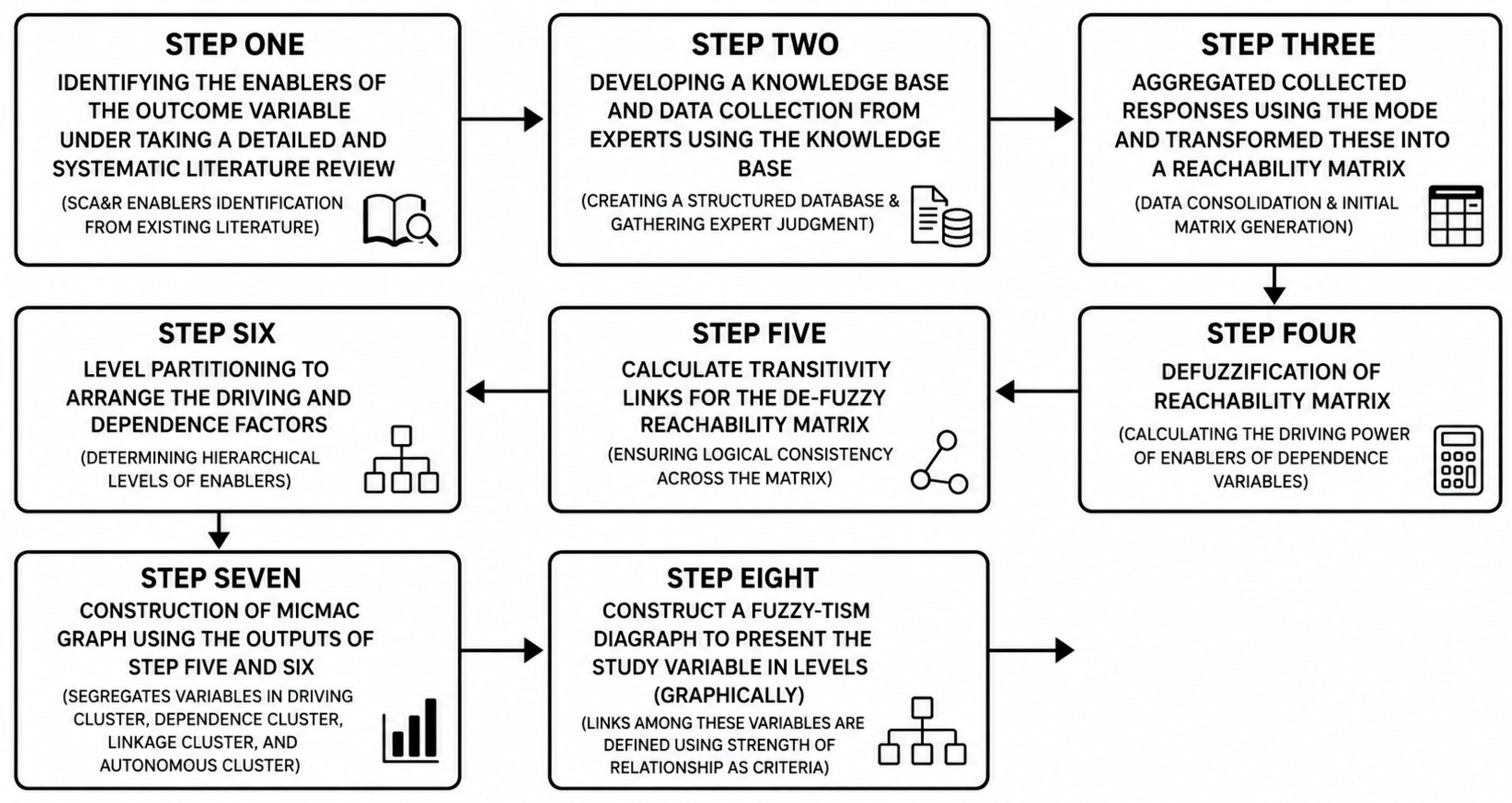
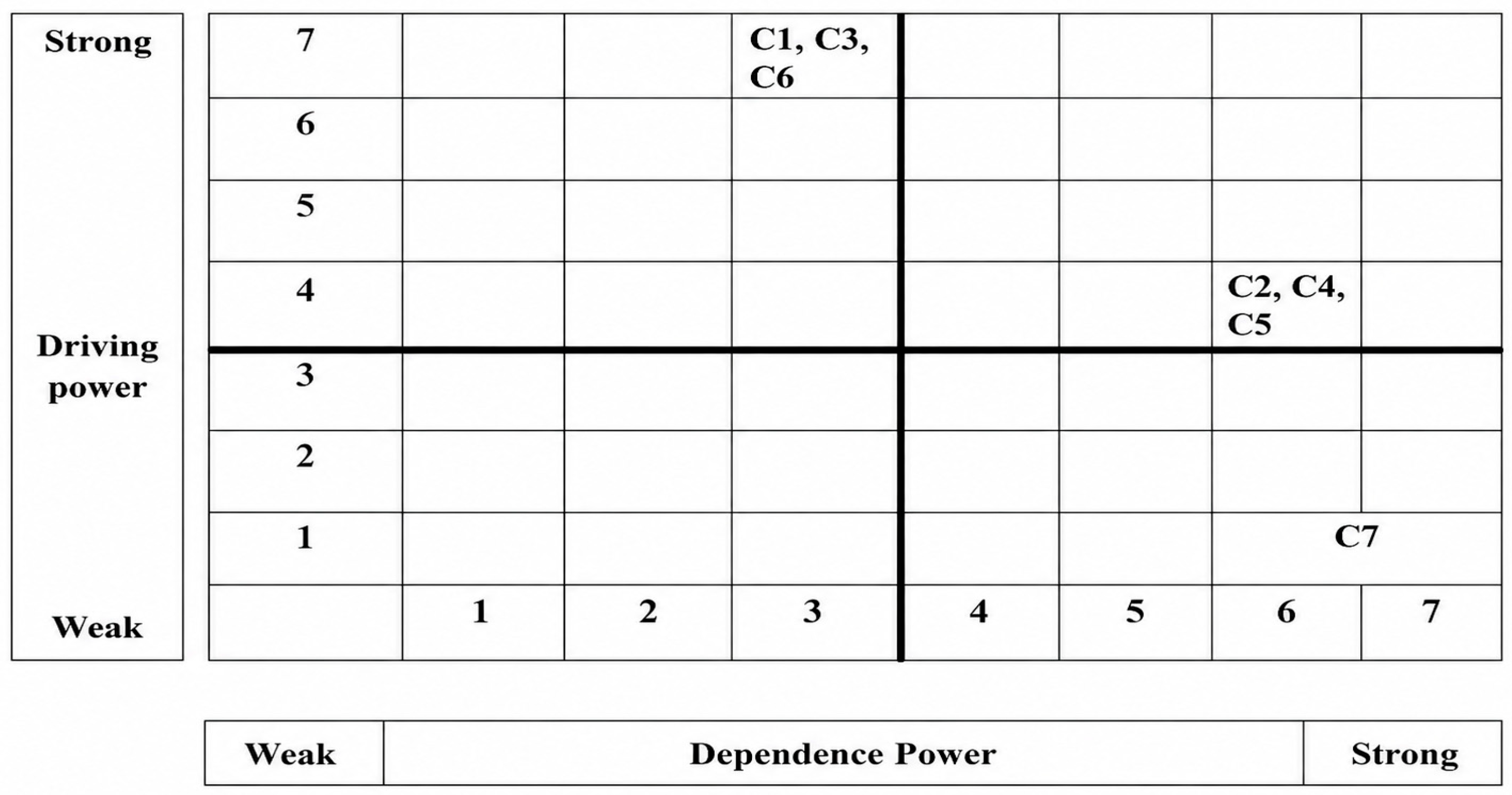
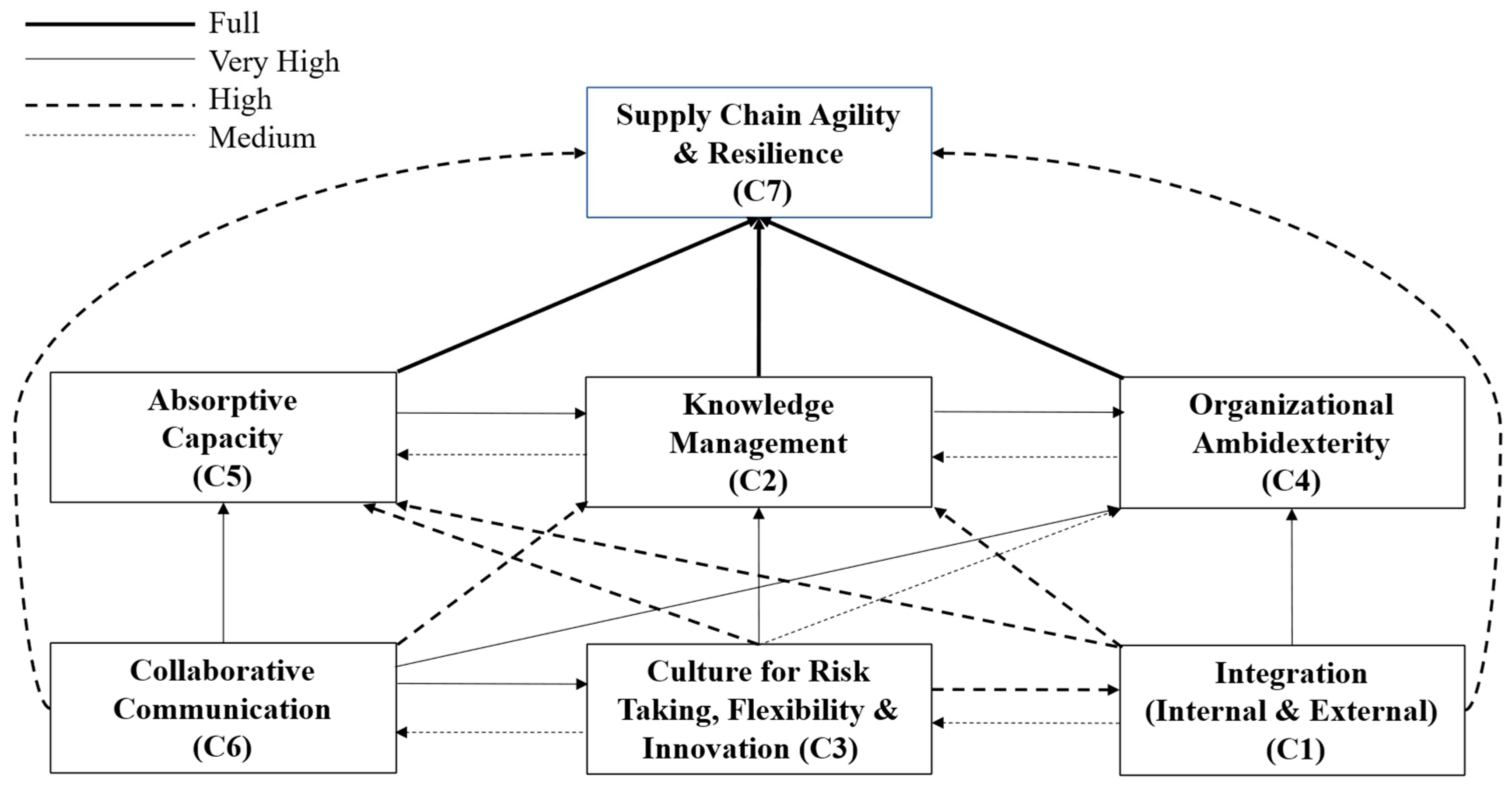
4.1. Fuzzy TISM Analysis
4.2. Sensitivity Analysis
5. Discussion
5.1. Theoretical Implications
5.2. Managerial Implications
6. Conclusions
Author Contributions
Funding
Institutional Review Board Statement
Informed Consent Statement
Data Availability Statement
Conflicts of Interest
References
- Naughton, S.; Golgeci, I.; Arslan, A. Supply chain agility as an acclimatisation process to environmental uncertainty and organisational vulnerabilities: Insights from British SMEs. Prod. Plan. Control 2020, 31, 1164–1177. [Google Scholar] [CrossRef]
- Zighan, S.; Dwaikat, N.Y.; Alkalha, Z.; Abualqumboz, M. Knowledge management for supply chain resilience in pharmaceutical industry: Evidence from the Middle East region. Int. J. Logist. Manag. 2024, 35, 1142–1167. [Google Scholar] [CrossRef]
- Santhi, A.R.; Muthuswamy, P. Pandemic, War, Natural Calamities, and Sustainability: Industry 4.0 Technologies to Overcome Traditional and Contemporary Supply Chain Challenges. Logistics 2022, 6, 81. [Google Scholar] [CrossRef]
- Martinez-Sanchez, A.; Lahoz-Leo, F. Supply chain agility: A mediator for absorptive capacity. Balt. J. Manag. 2018, 13, 264–278. [Google Scholar] [CrossRef]
- Gligor, D.; Holcomb, M.; Maloni, M.J.; Davis-Sramek, E. Achieving financial performance in uncertain times: Leveraging supply chain agility. Transp. J. 2019, 58, 247–279. [Google Scholar] [CrossRef]
- Goaill, M.M.; Al-Hakimi, M.A. Does absorptive capacity moderate the relationship between entrepreneurial orientation and supply chain resilience? Cogent Bus. Manag. 2021, 8, 1962487. [Google Scholar] [CrossRef]
- Pu, G.; Gao, X.; Qiao, J. Impact of supply chain quality management practices on supply chain resilience: A dynamic capability perspective. Bus. Process Manag. J. 2026, 32, 105–126. [Google Scholar] [CrossRef]
- Gligor, D.M.; Holcomb, M.C.; Stank, T.P. A multidisciplinary approach to supply chain agility: Conceptualization and scale development. J. Bus. Logist. 2013, 34, 94–108. [Google Scholar] [CrossRef]
- Altay, N.; Gunasekaran, A.; Dubey, R.; Childe, S.J. Agility and Resilience as Antecedents of Supply Chain Performance Under Moderating Effects of Organisational Culture Within the Humanitarian Setting: A Dynamic Capability View. Prod. Plan. Control 2018, 29, 1158–1174. [Google Scholar] [CrossRef]
- Um, J.; Han, N. Understanding the relationships between global supply chain risk and supply chain resilience: The role of mitigating strategies. Supply Chain Manag. 2020, 26, 240–255. [Google Scholar] [CrossRef]
- Yamin, M.A.; Almuteri, S.D.; Bogari, K.J.; Ashi, A.K. The influence of strategic human resource management and artificial intelligence in determining supply chain agility and supply chain resilience. Sustainability 2024, 16, 2688. [Google Scholar] [CrossRef]
- Gölgeci, I.; Ponomarov, S.Y. How does firm innovativeness enable supply chain resilience? The moderating role of supply uncertainty and interdependence. Technol. Anal. Strateg. Manag. 2015, 27, 267–282. [Google Scholar] [CrossRef]
- Ji, L.; Yuan, C.; Feng, T.; Wang, C. Achieving the environmental profits of green supplier integration: The roles of supply chain resilience and knowledge combination. Sustain. Dev. 2020, 28, 978–989. [Google Scholar] [CrossRef]
- Novak, D.C.; Wu, Z.; Dooley, K.J. Whose resilience matters? Addressing issues of scale in supply chain resilience. J. Bus. Logist. 2021, 42, 323–335. [Google Scholar] [CrossRef]
- Alsmairat, M.A.; Hussain, S.; AlOqool, A.; Ali, W. Does supply chain resilience mediate the relationship between CRM dimensions and customer satisfaction? FIIB Bus. Rev. 2024. first published online. [Google Scholar] [CrossRef]
- Chowdhury, T.M.; Anzum, K.M.T. From Resilience to Flexibility: A Hybrid SEM-ANN Model of AI-Enabled Adaptive Supply Chains. Glob. J. Flex. Syst. Manag. 2026, 27, 123–153. [Google Scholar] [CrossRef]
- Yang, Y.; Xu, X. Post-disaster grain supply chain resilience with government aid. Transp. Res. Part E 2015, 76, 139–159. [Google Scholar] [CrossRef]
- Ribeiro, J.P.; Barbosa-Povoa, A. Supply Chain Resilience: Definitions and quantitative modeling approaches—A literature review. Comput. Ind. Eng. 2018, 115, 109–122. [Google Scholar] [CrossRef]
- Gligor, D.M. The role of demand management in achieving supply chain agility. Supply Chain Manag. 2014, 19, 577–591. [Google Scholar] [CrossRef]
- Gligor, D.M.; Holcomb, M.C. Antecedents and consequences of supply chain agility: Establishing the link to firm performance. J. Bus. Logist. 2012, 33, 295–308. [Google Scholar] [CrossRef]
- Gligor, D.M.; Holcomb, M.C.; Feizabadi, J. An exploration of the strategic antecedents of firm supply chain agility: The role of a firm’s orientation. Int. J. Prod. Econ. 2016, 179, 24–34. [Google Scholar] [CrossRef]
- Gligor, D.; Bozkurt, S.; Gölgeci, I.; Maloni, M.J. Does supply chain agility create customer value and satisfaction for loyal B2B business and B2C end-customers? Int. J. Phys. Distrib. Logist. Manag. 2020, 50, 721–743. [Google Scholar] [CrossRef]
- Zhu, M.; Gao, H. The antecedents of supply chain agility and their effect on business performance: An organizational strategy perspective. Oper. Manag. Res. 2021, 14, 166–176. [Google Scholar] [CrossRef]
- Mukherjee, S.; Sharma, R.; Panigrahi, R.R.; Shrivastava, A.K. Leveraging Digital Transformation to Enhance Circular Supply Chain Performance: A Systematic Review. FIIB Bus. Rev. 2026. first published online. [Google Scholar] [CrossRef]
- Tukamuhabwa, B.R.; Stevenson, M.; Busby, J.; Zorzini, M. Supply chain resilience: Definition, review and theoretical foundations for further study. Int. J. Prod. Res. 2015, 53, 5592–5623. [Google Scholar] [CrossRef]
- Iftikhar, A.; Ali, I.; Stevenson, M. The silver lining of supply chain complexity: Building supply chain resilience and robustness through exploitation and exploration. Supply Chain Manag. 2024, 29, 244–259. [Google Scholar] [CrossRef]
- Zaman, S.I.; Khan, S.A.; Kusi-Sarpong, S. Investigating the relationship between supply chain finance and supply chain collaborative factors. Benchmarking Int. J. 2024, 31, 1941–1975. [Google Scholar] [CrossRef]
- Cruz-Sánchez, O.; Cruz-Cázares, C.; Hernandez-Vivanco, A. Business model innovation from dynamic capabilities perspective: A systematic literature review. J. Bus. Res. 2026, 204, 115835. [Google Scholar] [CrossRef]
- Haq, M.Z.U.; Syed, T.A.; Akbar, U.; Aslam, H. Triple-A supply chains: The bridge between supply chain analytics and supply chain resilience. IEEE Trans. Eng. Manag. 2026, 73, 1210–1223. [Google Scholar] [CrossRef]
- Ibidunni, A.S.; Agbi, B.D.; Kehinde, B.E. Interacting effects of tacit knowledge and learning orientation in improving firm performance. J. Knowl. Econ. 2023, 14, 2539–2560. [Google Scholar] [CrossRef]
- Ho, H.X.; Nguyen, P.D.; Nguyen-Phuong, K.T. Fostering sustainable supply chain performance: A mixed-method approach of the moderated mediation model involving learning orientation, innovation, agility, and environmental complexity. Supply Chain Manag. 2026, 31, 122–142. [Google Scholar] [CrossRef]
- Min, H. Blockchain technology for enhancing supply chain resilience. Bus. Horiz. 2019, 62, 35–45. [Google Scholar] [CrossRef]
- Wong, C.Y.; Wong, C.W.Y.; Boon-Itt, S. Integrating environmental management into supply chains a systematic literature review and theoretical framework. Int. J. Phys. Distrib. Logist. Manag. 2015, 45, 43–68. [Google Scholar] [CrossRef]
- Tarigan, Z.J.H.; Siagian, H.; Jie, F. Impact of internal integration, supply chain partnership, supply chain agility, and supply chain resilience on sustainable advantage. Sustainability 2021, 13, 5460. [Google Scholar] [CrossRef]
- Chunsheng, L.; Wong, C.W.Y.; Yang, C.-C.; Shang, K.-C.; Lirn, T.-C. Value of supply chain resilience: Roles of culture, flexibility, and integration. Int. J. Phys. Distrib. Logist. Manag. 2020, 50, 80–100. [Google Scholar] [CrossRef]
- Koç, E.; Delibaş, M.B.; Anadol, Y. Environmental uncertainties and competitive advantage: A sequential mediation model of supply chain integration and supply chain agility. Sustainability 2022, 14, 8928. [Google Scholar] [CrossRef]
- Braunscheidel, M.J.; Suresh, N.C. The organizational antecedents of a firm’s supply chain agility for risk mitigation and response. J. Oper. Manag. 2009, 27, 119–140. [Google Scholar] [CrossRef]
- Zhu, C.Y.; Zhang, D.L. An empirical study on the mechanism of dynamic capacity formation in the supply chain. Sustainability 2022, 14, 15044. [Google Scholar] [CrossRef]
- Mukherjee, S.; Nagariya, R.; Mathiyazhagan, K.; Scuotto, V. Linking supply chain resilience with knowledge management for achieving supply chain performance. J. Knowl. Manag. 2024, 28, 971–993. [Google Scholar] [CrossRef]
- Pal, T.; Ganguly, K.; Chaudhuri, A. Digitalisation in food supply chains to build resilience from disruptive events: A combined dynamic capabilities and knowledge-based view. Supply Chain Manag. 2024, 29, 1042–1062. [Google Scholar] [CrossRef]
- Sabahi, S.; Parast, M.M. Firm innovation and supply chain resilience: A dynamic capability perspective. Int. J. Logist. Res. Appl. 2020, 23, 254–269. [Google Scholar] [CrossRef]
- Khazanchi, S.; Lewis, M.W.; Boyer, K.K. Innovation-supportive culture: The impact of organizational values on process innovation. J. Oper. Manag. 2007, 25, 871–884. [Google Scholar] [CrossRef]
- Pellathy, D.A.; In, J.; Mollenkopf, D.A.; Stank, T.P. Middle-range theorizing on logistics customer service. Int. J. Phys. Distrib. Logist. Manag. 2018, 48, 2–18. [Google Scholar] [CrossRef]
- Siva, K.; Anbanandam, R. Impact of risk management culture on supply chain resilience: An empirical study from the Indian manufacturing industry. Proc. Inst. Mech. Eng. Part O J. Risk Reliab. 2020, 234, 246–259. [Google Scholar]
- Alzoubi, H.M.; Alkayid, K.; El Khatib, M.; Al-Nakeeb, A.; Al Harmoodi, S.; Ahmed, G. Harnessing technology innovation and process excellence: Integrating lean six sigma, business process management, and strategic alignment to enhance supply chain agility and organizational performance. J. Proj. Manag. 2026, 11, 347–360. [Google Scholar] [CrossRef]
- O’Reilly, C.A., III; Tushman, M.L. Organizational ambidexterity: Past, present, and future. Acad. Manag. Perspect. 2013, 27, 324–338. [Google Scholar] [CrossRef]
- Wang, Y.; Yan, F.; Jia, F.; Chen, L. Building supply chain resilience through ambidexterity: An information processing perspective. Int. J. Logist. Res. Appl. 2023, 26, 172–189. [Google Scholar] [CrossRef]
- Gu, M.; Yang, L.; Huo, B. The impact of information technology usage on supply chain resilience and performance: An ambidextrous view. Int. J. Prod. Econ. 2021, 232, 107956. [Google Scholar] [CrossRef]
- Tuan, L.T. Organizational ambidexterity and supply chain agility: The mediating role of external knowledge sharing and moderating role of competitive intelligence. Int. J. Logist. Res. Appl. 2016, 19, 583–603. [Google Scholar] [CrossRef]
- Vega, D.; Arvidsson, A.; Saïah, F. Resilient supply management systems in times of crisis. Int. J. Oper. Prod. Manag. 2023, 43, 70–98. [Google Scholar] [CrossRef]
- Lee, S.M.; Rha, J.S. Ambidextrous supply chain as a dynamic capability: Building a resilient supply chain. Manag. Decis. 2016, 54, 2–23. [Google Scholar] [CrossRef]
- Ocicka, B.; Mierzejewska, W.; Brzeziński, J. Creating supply chain resilience during and post-COVID-19 outbreak: The organizational ambidexterity perspective. Decision 2022, 49, 129–151. [Google Scholar] [CrossRef]
- Volberda, H.; Foss, N.; Lyles, M. Absorbing the concept of absorptive capacity: How to realize its potential in the organization field. Organ. Sci. 2010, 21, 931–951. [Google Scholar] [CrossRef]
- Kong, F.; Li, J.; Wang, H. The mechanism of network openness in achieving supply chain resilience: The role of the depth and breadth of digital absorptive capacity. Bus. Process Manag. J. 2025, 1–26. [Google Scholar] [CrossRef]
- Roh, J.; Tokar, T.; Swink, M.; Williams, B. Supply chain resilience to low-/high-impact disruptions: The influence of absorptive capacity. Int. J. Logist. Manag. 2022, 33, 214–238. [Google Scholar] [CrossRef]
- Chen, C.-J. Developing a model for supply chain agility and innovativeness to enhance firms’ competitive advantage. Manag. Decis. 2019, 57, 1511–1534. [Google Scholar] [CrossRef]
- Cheng, J.H.; Lu, K.L. Enhancing effects of supply chain resilience: Insights from trajectory and resource-based perspectives. Supply Chain Manag. 2017, 22, 329–340. [Google Scholar] [CrossRef]
- Liu, F.; Song, J.S.; Tong, J.D. Building supply chain resilience through virtual stockpile pooling. Prod. Oper. Manag. 2016, 25, 1745–1762. [Google Scholar] [CrossRef]
- Pan, X.; Pan, X.; Song, M.; Guo, R. The influence of green supply chain management on manufacturing enterprise performance: Moderating effect of collaborative communication. Prod. Plan. Control 2020, 31, 245–258. [Google Scholar] [CrossRef]
- Nguyen, M.P.; Thai, V.V.; Chan, C.; Lau, K.H.; Nguyen, M.T.N.; Do, H.P.N. The interplay among trust, reciprocity, and commitment factors in facilitating supply chain collaboration: The case of Vietnamese fishery industry. Asia Pac. J. Mark. Logist. 2025, 37, 150–170. [Google Scholar] [CrossRef]
- Wu, Y. Blockchain-enabled sustainable supply chain management: A study on the impact of collaboration optimization. Manag. Decis. 2026, 64, 1378–1404. [Google Scholar] [CrossRef]
- Bamel, N.; Bamel, U. Big data analytics based enablers of supply chain capabilities and firm competitiveness: A fuzzy-TISM approach. J. Enterp. Inf. Manag. 2021, 34, 559–577. [Google Scholar] [CrossRef]
- Bamel, N.; Dhir, S.; Sushil, S. Inter-partner dynamics and joint venture competitiveness: A fuzzy TISM approach. Benchmarking 2019, 26, 97–116. [Google Scholar] [CrossRef]
- Golgeci, I.; Bouguerra, A.; Rofcanin, Y. The human impact on the emergence of firm supply chain agility: A multilevel framework. Pers. Rev. 2020, 49, 733–754. [Google Scholar] [CrossRef]
- Spieske, A.; Birkel, H. Improving supply chain resilience through industry 4.0: A systematic literature review under the impressions of the COVID-19 pandemic. Comput. Ind. Eng. 2021, 158, 107452. [Google Scholar] [CrossRef]
- Sirmon, D.G.; Hitt, M.A.; Ireland, R.D.; Gilbert, B.A. Resource orchestration to create competitive advantage: Breadth, depth, and life cycle effects. J. Manag. 2011, 37, 1390–1412. [Google Scholar] [CrossRef]
- Ahmadi, T.; Hesaraki, A.F.; Morsch, J.P. Exploring IT-driven supply chain capabilities and resilience: The roles of supply chain risk management and complexity. Supply Chain Manag. 2025, 30, 50–66. [Google Scholar] [CrossRef]
- Pereira, V.; Bamel, U. Extending the resource and knowledge-based view: A critical analysis into its theoretical evolution and future research directions. J. Bus. Res. 2021, 132, 557–570. [Google Scholar] [CrossRef]
- McKinsey. Supply Chain 4.0—The Next-Generation Digital Supply Chain. Available online: https://www.mckinsey.com/business-functions/operations/our-insights/supply-chain-40--the-next-generation-digital-supply-chain (accessed on 14 March 2026).



| Name of Variables | C1 | C2 | C3 | C4 | C5 | C6 | C7 |
|---|---|---|---|---|---|---|---|
| Integration (C1) | 1 | 0.7 | 0.5 | 0.9 | 0.7 | 0.5 | 0.5 |
| Knowledge management (C2) | 0.1 | 1 | 0.3 | 0.9 | 0.5 | 0.3 | 1 |
| Culture for flexibility, risk management, and innovation (C3) | 0.7 | 0.9 | 1 | 0.5 | 0.7 | 0.5 | 0.5 |
| Organizational ambidexterity (C4) | 0 | 0.5 | 0.1 | 1 | 0.5 | 0.3 | 1 |
| Absorptive capacity (C5) | 0.1 | 0.9 | 0.3 | 0.7 | 1 | 0.1 | 1 |
| Collaborative communication (C6) | 0.3 | 0.7 | 0.9 | 0.9 | 0.9 | 1 | 0.5 |
| Supply chain agility and resilience (C7) | 0.1 | 0 | 0.3 | 0 | 0 | 0.1 | 1 |
| Name of Variables | C1 | C2 | C3 | C4 | C5 | C6 | C7 |
|---|---|---|---|---|---|---|---|
| Integration (C1) | 1 | 1 | 1 | 1 | 1 | 1 | 1 |
| Knowledge management (C2) | 0 | 1 | 0 | 1 | 1 | 0 | 1 |
| Culture for flexibility, risk management, and innovation (C3) | 1 | 1 | 1 | 1 | 1 | 1 | 1 |
| Organizational ambidexterity (C4) | 0 | 1 | 0 | 1 | 1 | 0 | 1 |
| Absorptive capacity (C5) | 0 | 1 | 0 | 1 | 1 | 0 | 1 |
| Collaborative communication (C6) | 0 | 1 | 1 | 1 | 1 | 1 | 1 |
| Supply chain agility and resilience (C7) | 0 | 0 | 0 | 0 | 0 | 0 | 1 |
| Name of Variables | C1 | C2 | C3 | C4 | C5 | C6 | C7 | DP |
|---|---|---|---|---|---|---|---|---|
| Integration (C1) | 1 | 1 | 1 | 1 | 1 | 1 | 1 | 7 |
| Knowledge management (C2) | 0 | 1 | 0 | 1 | 1 | 0 | 1 | 4 |
| Culture for flexibility, risk management, and innovation (C3) | 1 | 1 | 1 | 1 | 1 | 1 | 1 | 7 |
| Organizational ambidexterity (C4) | 0 | 1 | 0 | 1 | 1 | 0 | 1 | 4 |
| Absorptive capacity (C5) | 0 | 1 | 0 | 1 | 1 | 0 | 1 | 4 |
| Collaborative communication (C6) | 1 * | 1 | 1 | 1 | 1 | 1 | 1 | 7 |
| Supply chain agility and resilience (C7) | 0 | 0 | 0 | 0 | 0 | 0 | 1 | 1 |
| Dependence | 3 | 6 | 3 | 6 | 6 | 3 | 7 |
| Name of Variables | Reachability Set | Antecedent Set | Intersection | Level |
|---|---|---|---|---|
| Integration (C1) | 1, 2, 3, 4, 5, 6, 7 | 1, 3, 6 | 1, 3, 6 | |
| Knowledge management (C2) | 2, 4, 5, 7 | 1, 2, 3, 4, 5, 6 | 2, 4, 5 | |
| Culture for flexibility, risk management, and innovation (C3) | 1, 2, 3, 4, 5, 6, 7 | 1, 3, 6 | 1, 3, 6 | |
| Organizational ambidexterity (C4) | 2, 4, 5, 7 | 1, 2, 3, 4, 5, 6 | 2, 4, 5 | |
| Absorptive capacity (C5) | 2, 4, 5, 7 | 1, 2, 3, 4, 5, 6 | 2, 4, 5 | |
| Collaborative communication (C6) | 1, 2, 3, 4, 5, 6, 7 | 1, 3, 6 | 1, 3, 6 | |
| Supply chain agility and resilience (C7) | 7 | 1, 2, 3, 4, 5, 6, 7 | 7 | Level 1 |
| Variables | Reachability Set | Antecedent Set | Intersection | Level |
|---|---|---|---|---|
| Integration (C1) | 1, 2, 3, 4, 5, 6 | 1, 3, 6 | 1, 3, 6 | |
| Knowledge management (C2) | 2, 4, 5 | 1, 2, 3, 4, 5, 6 | 2, 4, 5 | Level 2 |
| Culture for flexibility, risk management, and innovation (C3) | 1, 2, 3, 4, 5, 6 | 1, 3, 6 | 1, 3, 6 | |
| Organizational ambidexterity (C4) | 2, 4, 5 | 1, 2, 3, 4, 5, 6 | 2, 4, 5 | Level 2 |
| Absorptive capacity (C5) | 2, 4, 5 | 1, 2, 3, 4, 5, 6 | 2, 4, 5 | Level 2 |
| Collaborative communication (C6) | 1, 2, 3, 4, 5, 6 | 1, 3, 6 | 1, 3, 6 |
| Variables | Reachability Set | Antecedent Set | Intersection | Level |
|---|---|---|---|---|
| Integration (C1) | 1, 3, 6 | 1, 3, 6 | 1, 3, 6 | Level 3 |
| Culture for flexibility, risk management, and innovation (C3) | 1, 3, 6 | 1, 3, 6 | 1, 3, 6 | Level 3 |
| Collaborative communication (C6) | 1, 3, 6 | 1, 3, 6 | 1, 3, 6 | Level 3 |
| Name of Variables | Reachability Set | Antecedent Set | Intersection | Level |
|---|---|---|---|---|
| Integration (C1) | 1, 2, 3, 4, 5, 6, 7 | 1, 2, 3, 4, 5, 6 | 1, 2, 3, 4, 5, 6 | |
| Knowledge management (C2) | 1, 2, 3, 4, 5, 6, 7 | 1, 2, 3, 4, 5, 6 | 1, 2, 3, 4, 5, 6 | |
| Culture for flexibility, risk management, and innovation (C3) | 1, 2, 3, 4, 5, 6, 7 | 1, 2, 3, 4, 5, 6, 7 | 1, 2, 3, 4, 5, 6, 7 | |
| Organizational ambidexterity (C4) | 1, 2, 3, 4, 5, 6, 7 | 1, 2, 3, 4, 5, 6 | 1, 2, 3, 4, 5, 6 | |
| Absorptive capacity (C5) | 1, 2, 3, 4, 5, 6, 7 | 1, 2, 3, 4, 5, 6 | 1, 2, 3, 4, 5, 6 | |
| Collaborative communication (C6) | 1, 2, 3, 4, 5, 6, 7 | 1, 2, 3, 4, 5, 6 | 1, 2, 3, 4, 5, 6 | |
| Supply chain agility and resilience (C7) | 3, 7 | 1, 2, 3, 4, 5, 6, 7 | 3, 7 | Level 1 |
| Name of Variables | Reachability | Antecedent Set | Intersection | Level |
|---|---|---|---|---|
| Integration (C1) | 1, 2, 4, 5 | 1, 3 | 1 | |
| Knowledge management (C2) | 2, 4, 7 | 1, 2, 3, 5, 6 | 2 | |
| Culture for flexibility, risk management, and innovation (C3) | 1, 2, 3, 5 | 3, 6 | 3 | |
| Organizational ambidexterity (C4) | 4, 7 | 1, 2, 4, 5, 6 | 4 | |
| Absorptive capacity (C5) | 2, 4, 5, 7 | 1, 3, 5, 6 | 5 | |
| Collaborative communication (C6) | 2, 3, 4, 5, 6 | 6 | 6 | |
| Supply chain agility and resilience (C7) | 7 | 2, 4, 5, 7 | 7 | Level 1 |
Disclaimer/Publisher’s Note: The statements, opinions and data contained in all publications are solely those of the individual author(s) and contributor(s) and not of MDPI and/or the editor(s). MDPI and/or the editor(s) disclaim responsibility for any injury to people or property resulting from any ideas, methods, instructions or products referred to in the content. |
© 2026 by the authors. Licensee MDPI, Basel, Switzerland. This article is an open access article distributed under the terms and conditions of the Creative Commons Attribution (CC BY) license.
Share and Cite
Rana, S.; Bamel, U. Dynamic Resource-Capability View, Agility, and Resilience in Supply Chain: An Organizational Strategy Perspective. Logistics 2026, 10, 112. https://doi.org/10.3390/logistics10050112
Rana S, Bamel U. Dynamic Resource-Capability View, Agility, and Resilience in Supply Chain: An Organizational Strategy Perspective. Logistics. 2026; 10(5):112. https://doi.org/10.3390/logistics10050112
Chicago/Turabian StyleRana, Sudhir, and Umesh Bamel. 2026. "Dynamic Resource-Capability View, Agility, and Resilience in Supply Chain: An Organizational Strategy Perspective" Logistics 10, no. 5: 112. https://doi.org/10.3390/logistics10050112
APA StyleRana, S., & Bamel, U. (2026). Dynamic Resource-Capability View, Agility, and Resilience in Supply Chain: An Organizational Strategy Perspective. Logistics, 10(5), 112. https://doi.org/10.3390/logistics10050112