1. Introduction
In December 2019, COVID-19 emerged in Wuhan, China, and spread all over the world in a very short span of time. Consequently, the World Health Organization (WHO) declared COVID-19 as a pandemic on 11 March 2020 [
1]. As a result, countries worldwide implemented lockdowns to prevent the disease outbreak, pausing almost all economic activities. Employees of both organized and unorganized sectors are affected by such a regulatory move. Employees from the organized sector either worked from home or were fired from their jobs, while many in the unorganized sector lost their jobs, particularly in India. As per the report from CMIE, around 10 million Indians lost their jobs during the second wave of COVID-19 [
2]. However, no official data from the government can be found [
3]. Indian migrant workers have faced multiple hardships with the shutdown of factories and workplaces. Due to this, the masses found little purpose for staying at their work location. In India, it has been estimated that around 37% of the total population are found to be migrants, and an exodus of these migrants began after a few weeks of lockdown [
4]. This exodus compromised the idea of lockdown and ended up spreading the disease to several locations. With food shortage and uncertainty about the future, there is a large-scale evacuation of migrants. Due to the surge in demand of reaching their native place, the transportation system countered several constraints while serving these migrants. Government restrictions, increased monitoring and policing, and limited modes of transportation resulted in several mishaps for the migrants. It has been reported that 884 deaths were due to non-COVID-19 reasons during lockdown [
5]. It has been mentioned that some deaths (around 50%) were due to transport-related issues. In particular, the reasons were walking (non-availability of transport mode), an accident during travelling and suicides due to an inability to go home. Another critical issue that emerged from these deaths is the lack of basic necessities in the shelters provided by the government [
4]. Lack of facilities (transport availability and appropriate shelter in this case) can be attributed to limited understanding of migrants’ behaviour and associated factors. Such behaviour analysis can help decision-makers make the evacuation process efficient and help them to devise better planning for such events.
To make the evacuation process efficient, it is required to incorporate all four steps of the disaster cycle, namely prepare, mitigate, response and recover. However, it can be observed from the migrants’ exodus that these lockdown restrictions are not planned properly [
6]. There was a lack of evidence-based decision-making during this event. In response to such an exodus, central and state governments later arranged transport modes for them. Overall, there is a need to understand migrants’ behaviour to make the evacuation process efficient. Pandemic-induced evacuation of economically disadvantaged populations is still empirically understudied, despite an increasing amount of research on evacuation behaviour during natural catastrophe [
7]. Lockdowns were ineffectual in numerous areas of India due to the significant “crisis of mobility” caused by the COVID-19 outbreak, as migrant workers frantically tried to return home by all means possible [
8]. During the initial lockdown wave, almost 43.3 million interstate migrants went back to their home states, with millions using non-traditional methods. Low-wealth mobile groups are consistently underrepresented in evacuation behaviour models, despite the fact that income, employment status, and resource access are known to impact emergency responses. Furthermore, natural hazard scenarios have been the main emphasis of multinomial logistic frameworks in catastrophe contexts [
9], with no extension to public health emergency evacuations. Accordingly, this paper attempts to understand the migrants’ behaviour during the pandemic. In this study, evacuation behaviour of migrants is expressed in terms of the transport mode used for evacuation and shelter planning. Migrants’ choice of transport mode and shelter is influenced by multiple factors, including the type of shelter, age, income, and duration of stay (detailed more in
Section 3). Once the underlying relationship of mode choice and shelter planning is analyzed, it can help decision-makers for future crises. Therefore, the key research objectives (Ros) of this study are now stated: (RO1) identify socio-economic determinants of transport mode choice during COVID-19 evacuation; (RO2) examine factors shaping shelter type selection; (O3) derive actionable policy recommendations for inclusive emergency planning. The key contributions of this study are as follows:
One of the first empirical studies to jointly model transport mode and shelter choice among migrants during pandemic-induced displacement in India.
Application of multinomial logistic regression to examine evacuation behaviour across socio-economic strata in a developing-country context.
Empirical evidence bridging humanitarian logistics, emergency transport planning, and public health policy for low-income and informal-sector migrants.
Actionable insights for policymakers to target evacuation resources toward the most vulnerable migrant segments.
The rest of this paper is structured as follows:
Section 2 explains the review of the previous study to determine the evacuees’ behaviour. The materials and methods are explained in
Section 3. The multinomial logistics regression model is developed, and results are proposed in
Section 4 including discussion and insights of developed models. Conclusions and future work are proposed in
Section 5.
2. Literature Review
Evacuation planning is an established research domain that attracts scholars from multiple disciplines, including engineering, management, computer science, mathematics, transportation studies, and environmental science. The interdisciplinary nature of this field reflects the complex challenges associated with large-scale population movement during emergencies, which involve infrastructure planning, behavioural decision-making, logistical coordination, and risk management, among many other critical activities [
10,
11]. Over the past few decades, considerable research has focused on developing analytical models, simulation frameworks, and optimization techniques to support effective evacuation planning and disaster response. These approaches include traffic simulation models, routing optimization algorithms, and behavioural modelling techniques aimed at improving evacuation efficiency and minimizing risk during crises [
12,
13].
The majority of evacuation literature focuses on sudden-onset hazards such as hurricanes, floods, wildfires, earthquakes, and nuclear accidents, where immediate physical threats necessitate rapid relocation of affected populations [
14]. In such contexts, previous literature examines operational aspects of evacuation systems, including traffic management, route optimization, fleet allocation, shelter location planning, and emergency communication strategies [
15]. Simulation-based approaches have been widely used to analyze crowd dynamics and traffic flow during evacuation, while optimization models assist in designing efficient routing and shelter allocation strategies for humanitarian logistics operations [
16].
Beyond operational planning, a substantial body of research has focused on predicting human behaviour during evacuation, as evacuee decisions significantly influence evacuation efficiency and congestion levels. Studies have applied a wide range of modelling techniques to capture evacuation behaviour, including statistical models, simulation methods, machine learning algorithms, and optimization-based frameworks [
13,
17]. Among these approaches, agent-based simulation (ABS) has emerged as one of the most widely used methods for modelling human behaviour in evacuation scenarios because it represents each evacuee as an autonomous agent capable of interacting with the environment and other agents [
18]. This approach allows researchers to capture emergent phenomena such as crowd congestion, panic behaviour, and route selection under uncertainty. In evacuation contexts, agent-based models have been used to simulate crowd dynamics during emergencies, accounting for spatial interactions among evacuees and their environment [
19]. Recent methodological developments have further integrated optimization techniques with agent-based epidemic simulations. For instance, Akopov [
20] proposed a hybrid multi-swarm particle swarm optimization algorithm to improve the calibration and solution efficiency of agent-based epidemiological models. More integrated simulation approaches such as system dynamics (SD) and agent-based modelling (ABM) have further expanded the analytical toolkit for studying complex crisis scenarios. SD models capture feedback relationships between epidemiological processes, policy interventions, and social responses. For example, Jia, Li, and Fang [
21] developed a SD framework to analyze COVID-19 prevention and control strategies, demonstrating how policy measures dynamically influence infection spread and healthcare capacity over time.
In the context of epidemics and pandemics, researchers have employed dynamic epidemiological models to study disease spread and its interaction with population behaviour. One of the most widely used frameworks is the susceptible–infected–recovered (SIR) model, which divides the population into three compartments—susceptible (S), infected (I), and recovered (R)—and models disease transmission through a system of differential equations. The SIR model and its extensions have been widely used to forecast infection trajectories and evaluate the potential impact of public health interventions during pandemics [
22,
23].
Despite these methodological advances, most evacuation behaviour studies continue to focus on immediate evacuation scenarios associated with natural disasters or technological hazards. Comparatively fewer studies examine evacuation behaviour during prolonged or slow-onset crises, such as public health emergencies or pandemics, where mobility decisions are influenced not only by immediate safety concerns but also by economic vulnerability, mobility restrictions, and uncertainty regarding future conditions. The COVID-19 pandemic generated unprecedented disruptions to mobility and livelihoods worldwide. In India, lockdown measures triggered large-scale reverse migration of workers from urban centres to their native places, highlighting the need to extend traditional evacuation frameworks to incorporate socio-economic constraints, public health risks, and migration dynamics [
24].
Within the evacuation literature, relatively few studies have specifically examined transport mode choice behaviour during emergency relocation. Duan et al. [
25] employed a multinomial logit model to analyze determinants influencing evacuation mode selection in Xi’an, emphasizing the role of spatial accessibility and household characteristics during short-notice evacuation scenarios. Similarly, Suman et al. [
26] utilized multinomial logistic regression to explore how improvements in public transport systems may encourage shifts from private to public transport during evacuation. Borowski and Stathopoulos [
27] examined the potential role of ride-sourcing services in facilitating small-scale urban evacuation through a survey-based case study.
Table 1 summarizes this recent literature and also presents their shortcomings or outcomes.
Few studies have explored related aspects of evacuation decision-making and mobility behaviour. Rahman and Baker [
28] analyzed mode-switching behaviour using multinomial logistic regression in the context of infrastructure development, while McCaffrey et al. [
29] investigated factors influencing evacuation decisions during wildfires in the United States. Toledo et al. [
30] also examined travel behaviour during wildfire evacuation events. In hurricane evacuation contexts, Bian et al. [
31] and Sadri et al. [
32] applied nested logit models to estimate evacuation mode choice demand and analyze traveller behaviour. Additionally, Yin et al. [
33] identified determinants affecting vehicle choice during hurricane evacuations, while Liu et al. [
34] proposed a framework to analyze household gathering behaviour and mode choice decisions during no-notice evacuations. Comprehensive reviews further highlight emerging research directions in evacuation modelling, including the integration of advanced technologies, improved behavioural modelling techniques, and consideration of vulnerable populations with specific mobility or medical needs during evacuation [
10].
Despite the substantial body of literature on evacuation planning and modelling, several important gaps remain. First, most existing studies focus on evacuation behaviour in the context of sudden-onset natural disasters, whereas comparatively limited attention has been given to evacuation dynamics during prolonged public health crises such as pandemics. Pandemic-induced mobility differs fundamentally from traditional disaster evacuation because decisions are shaped not only by immediate safety concerns but also by economic vulnerability, mobility restrictions, and uncertainty regarding disease transmission [
35,
36]. Second, while numerous studies examine evacuation decision-making or transport mode choice independently, relatively few have investigated the joint decision-making process involving both transport mode and shelter selection, which are inherently interconnected during crisis relocation. Third, although simulation-based approaches such as ABM and SD have advanced the understanding of epidemic spread and crowd dynamics, empirical studies that estimate behavioural determinants of evacuation decisions using primary survey data remain limited, particularly in developing-country contexts. The large-scale reverse migration observed in India during the COVID-19 lockdown presents a unique opportunity to examine evacuation behaviour under pandemic conditions.
Table 1.
Recent studies addressing evacuation.
Table 1.
Recent studies addressing evacuation.
| Reference | Study Region | Context/Hazard | Methodology | Limitation/Research Gap |
|---|
| Borowski & Stathopoulos [27] examine the role of ride-sourcing platforms in evacuation transportation decisions | USA | Urban emergency evacuation | Discrete choice model using stated preference survey | Focuses on ride-sourcing adoption rather than broader evacuation mobility or shelter decisions |
| Phiophuead & Kunsuwan [37] identify socio-demographic and travel-related determinants affecting evacuation mode choice | Thailand | Flood and landslide evacuation | Binary logistic regression | Focuses only on government vs. private vehicles and does not consider shelter decisions |
| Urbane et al. [38] examine optimal evacuation mode split and role of information in evacuation behaviour | Not location-specific | Rapid-onset disasters (tsunami and wildfire) | Simulation and empirical comparison | Focuses on simulation outcomes rather than empirical behavioural modelling |
| Thakur et al. [39] analyse socio-demographic and risk-related determinants affecting evacuation decisions | Auckland, New Zealand | Volcanic eruption evacuation | Logistic regression with stated preference survey | Focuses primarily on evacuation decisions rather than detailed mode and shelter choice interactions |
| Xu et al. [40] investigate transportation mode choice during return phase after evacuation | USA | Post-disaster return mobility | Logistic regression, machine learning, causal inference | Focuses on post-disaster return rather than evacuation decisions themselves |
| Lu et al. [41] explore heterogeneous travel mode choices during unexpected transport disruptions | Xi’an, China | Urban transport disruptions | Mixed logit model | Focuses on transit disruption rather than disaster evacuation contexts |
| This Study | India | Mode choice during pandemic | Multinomial logistic regression | Addresses evacuation choice in prolonged crisis such as pandemic |
Addressing these gaps, the present study develops a multinomial logistic regression framework to analyze the determinants of transport mode and shelter choice decisions among migrants during the COVID-19-induced evacuation in India, thereby contributing empirical insights to the literature on evacuation behaviour and crisis mobility planning. In addition to the empirical studies discussed above, evacuation decision-making can be explained through Random Utility Theory (RUT), which underpins discrete choice models such as the multinomial logit model used in this study [
42]. According to RUT, individuals select the alternative that maximizes their perceived utility under existing economic and accessibility constraints. Accordingly, the explanatory variables used in this study capture key determinants of evacuation behaviour. Socio-demographic characteristics (age, gender, marital status, education) reflect heterogeneity in mobility needs and risk perception during emergencies [
43]. Economic variables (employment type and household income) represent financial capacity and vulnerability during crisis relocation. Accessibility-related factors, including vehicle ownership and current commuting mode, determine the feasible transport options available during evacuation. Residential context and social conditions, such as living arrangements and duration of stay, influence access to support networks and shelter alternatives, while previous disaster experience captures preparedness and risk awareness in evacuation decision-making [
44]. Together, these variables provide the theoretical basis for analyzing transport mode and shelter choice decisions during evacuation.
5. Conclusions
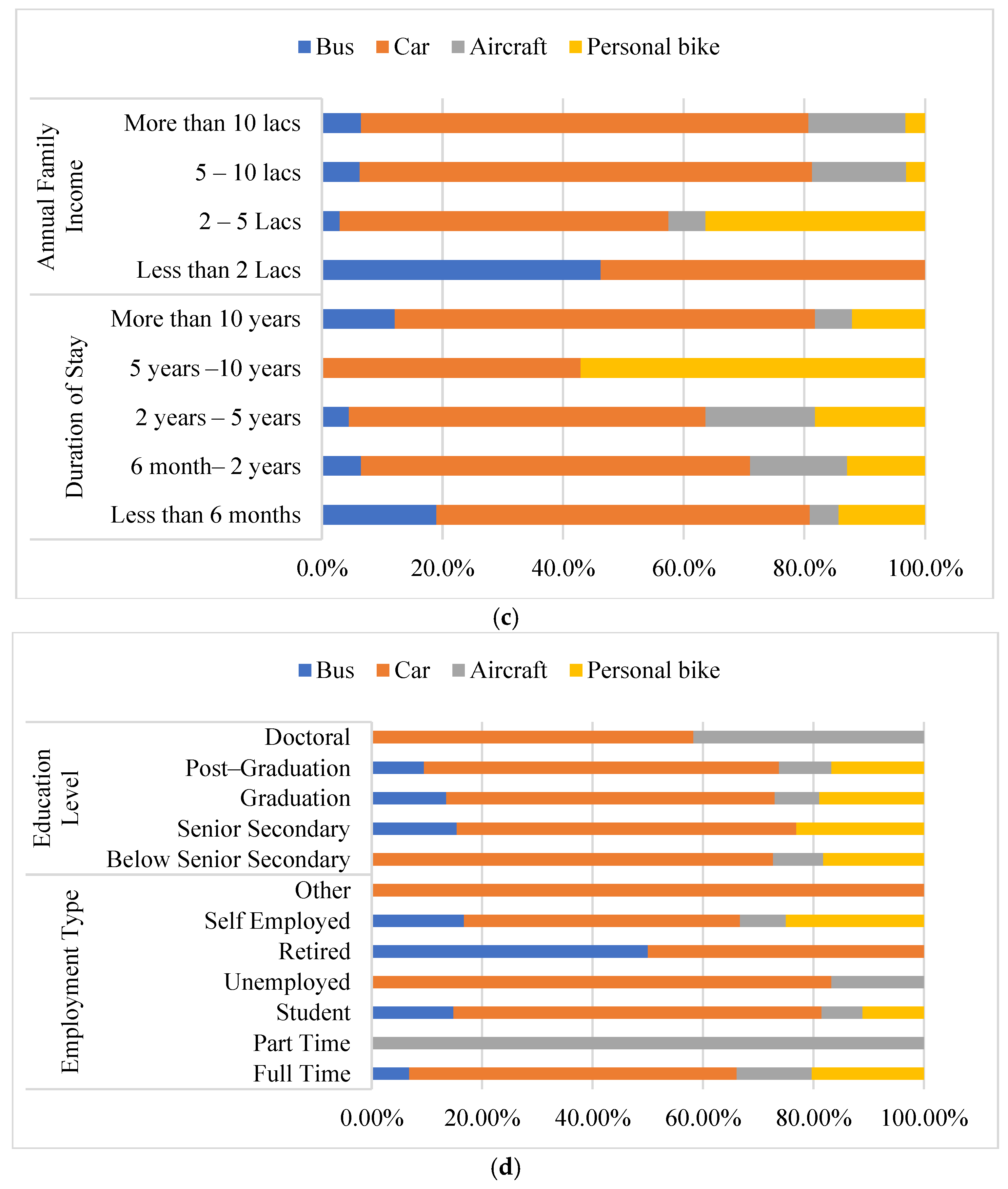
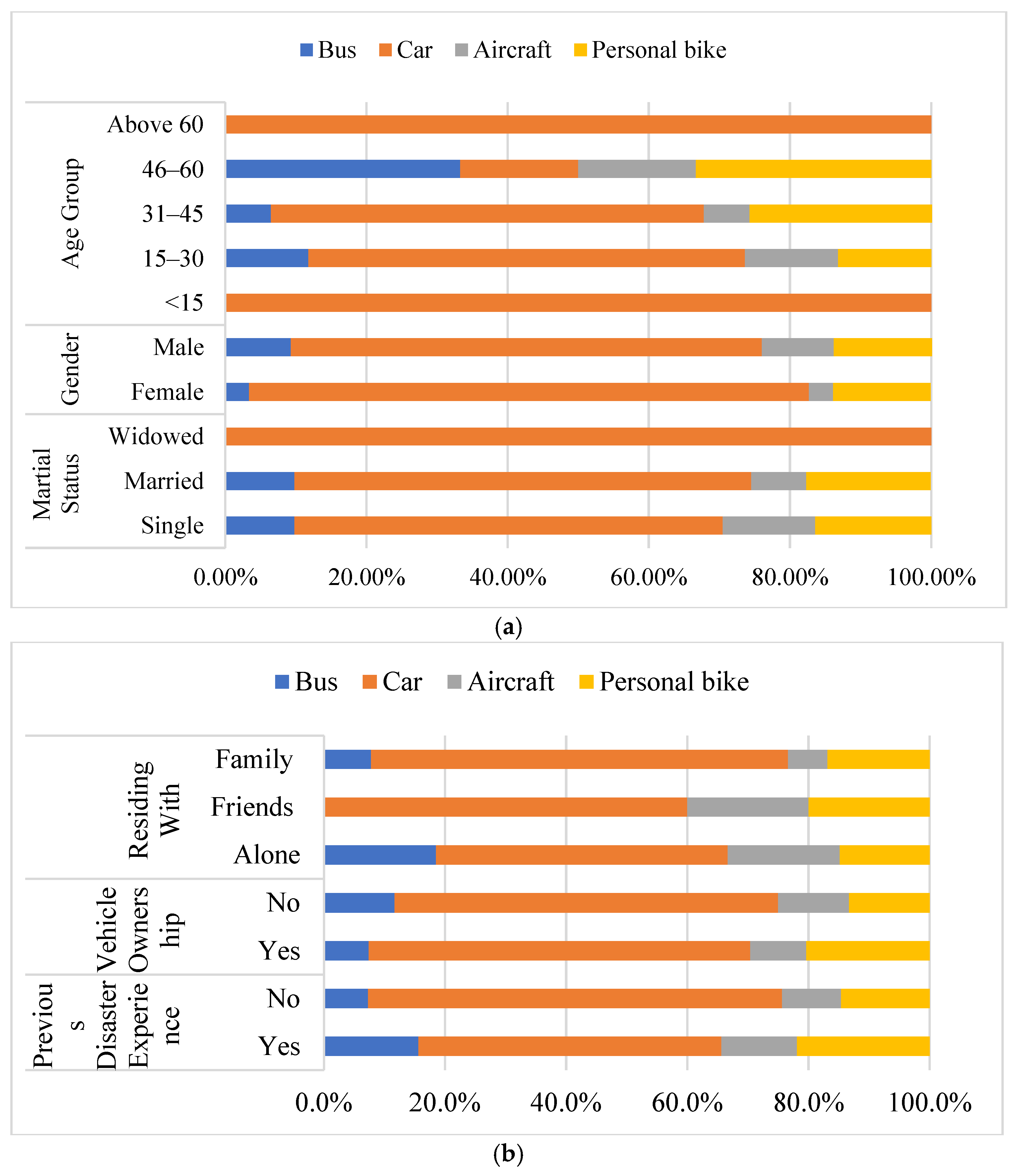
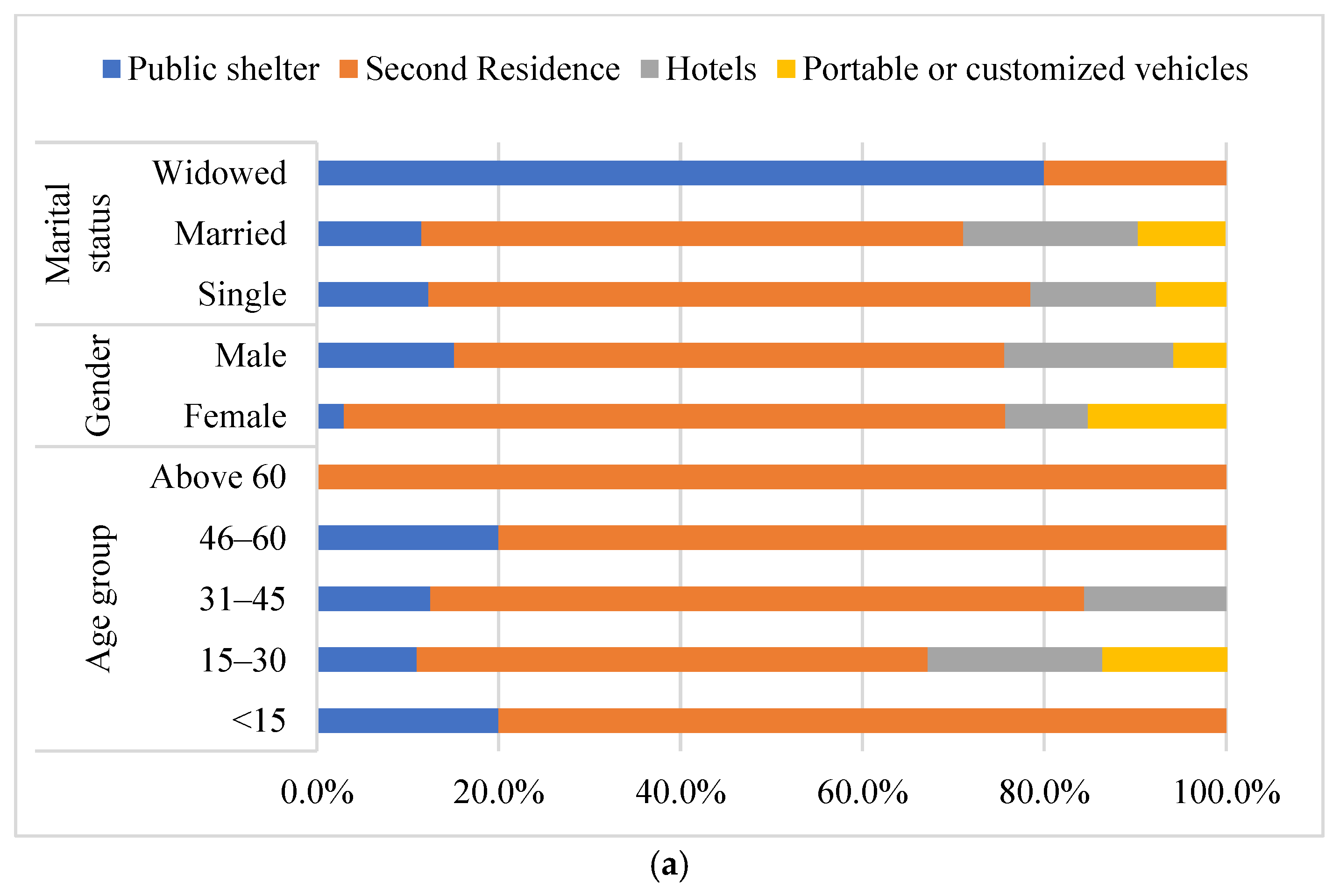
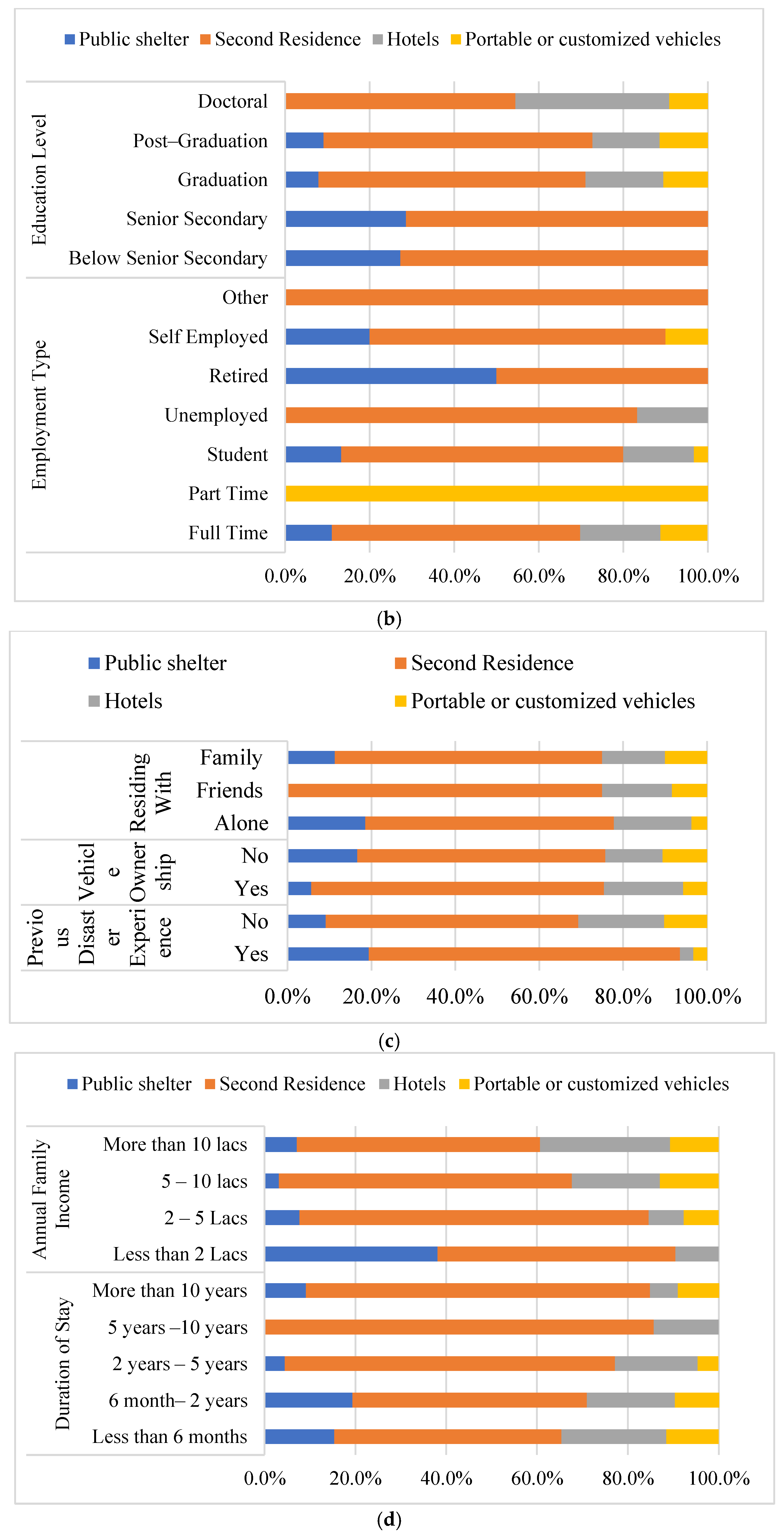
COVID-19 outbreaks have spread quickly around the world, resulting in lockdowns across the globe to reduce contact rates. During lockdown, many lost jobs, food, and other basics. Masses fled to their hometowns and other safe places. Tourists, students, migrant labourers, or employees who lost their jobs in India have limited options, which is complex for both the government and evacuees. This study investigates evacuee behaviour in Delhi, focusing on evacuation decisions regarding shelter and transport mode choice. The study adopted multinomial logistic regression to analyze the choices of respondents.
This study provides empirical evidence that socio-economic characteristics significantly determine both transport mode and shelter choices of migrants during pandemic-induced evacuation. Income is the strongest predictor of mode choice; higher-income migrants strongly prefer car and aircraft over bus, while gender and education level are critical determinants of shelter preference. These findings confirm that evacuation behaviour is not uniform and that one-size-fits-all emergency logistics planning will systematically disadvantage low-income and female migrants. The results of this study suggest leveraging several modes of transportation to maintain social distancing and other basic requirements to avoid the transmission of COVID-19. According to population demographics, future evacuation planners can derive the appropriate fleet plan using the outcomes of this study. This study can give direction to policymakers for better planning considering socio-economic variables of migrants during such a disease outbreak in future. As an example, for emergency transport planners, subsidized or reserved bus capacity for migrants in the lowest income bracket (<2 lakhs annual income) should be incorporated into pandemic evacuation protocols. For shelter authorities, public shelters must address safety perceptions, particularly for female evacuees, since the results show women strongly avoid public shelter options. For policymakers, a pre-registered migrant database in Delhi (and other NCR cities) would enable needs-based resource allocation during future crises
This study has several limitations. First, the sample is restricted to Delhi NCR; results may not generalize to other Indian cities with different demographic profiles. Second, data were collected via an online survey, potentially underrepresenting migrants with limited digital access, precisely the most economically vulnerable group. Third, the cross-sectional design prevents causal inference. Fourth, the sample size, while adequate for MNL estimation, limits subgroup analyses. Future research should employ larger, multi-city samples and consider longitudinal designs to track behavioural change across pandemic phases.