Article

Emergent Competitiveness in Artisanal Furniture: A Case Study from Misantla, Mexico

by
Luis Enrique García-Santamaría
1,
Eduardo Fernández-Echeverría
2,*,
Gregorio Fernández-Lambert
1,*,
Nora Amalia Parra-Hernández
1,
Elizabeth Delfín-Portela
3,
Areli Brenis-Dzul
4,
José Aparicio-Urbano
5 and
Juan Manuel Carrión-Delgado
6
1
Laboratory of Logistics and Sustainability in Emerging Economies, Tecnológico Nacional de México/Instituto Tecnológico Superior de Misantla, Misantla 93850, Mexico
2
Department of Industrial Engineering, Research and Graduate Studies Division, Master’s Program in Environmental Sciences, Tecnológico Nacional de México/Instituto Tecnológico Superior de Zacapoaxtla, Carretera a Acuaco, Zacapoaxtla, Km 8 Totoltepec, Zacapoaxtla 73680, Mexico
3
Graduate Studies and Research Division, Universidad Euro Hispanoamericana, Xalapa-Enríquez 91097, Mexico
4
Industrial Engineering Division, Tecnológico Nacional de México/Instituto Tecnológico de Orizaba, Orizaba 94320, Mexico
5
Industrial Engineering Division, Tecnológico Nacional de México/Tecnológico de Estudios Superiores de Jocotitlán, Jocotitlán 50700, Mexico
6
Department of Industrial Engineering, Tecnológico Nacional de México/Instituto Tecnológico Superior de Xalapa, Xalapa-Enríquez 91096, Mexico
*
Authors to whom correspondence should be addressed.
Logistics 2026, 10(3), 66; https://doi.org/10.3390/logistics10030066
Submission received: 27 December 2025 / Revised: 18 February 2026 / Accepted: 11 March 2026 / Published: 15 March 2026
(This article belongs to the Section Sustainable Supply Chains and Logistics)

Abstract

Background: This study examines the competitive dynamics of the artisanal wooden furniture industry in Misantla, Veracruz, Mexico, a predominantly informal productive system characterized by family-managed production units and strong territorial embeddedness. Methods: A mixed-methods research design was employed. Quantitative data were collected from 187 family-managed production units (86 woodworking units and 101 workshops) using a structured questionnaire based on five-level Likert scales assessing external efficiency, collective efficiency, and innovation. Statistical analyses included descriptive measures and chi-square tests to examine associations between competitiveness and collective strategies, while qualitative validation and thematic interpretation based on expert assessments were used to contextualize sectoral practices and structural constraints. Results: The findings indicate a low overall competitiveness score (1.92/5), associated with informal practices, limited technical training, and weak supply chain integration. Despite these constraints, the sector maintains a strong cultural identity and contributes to its local economy. Conclusions: Artisanal supply chains can achieve functional levels of logistics performance through internal coordination dynamics. Strengthening collaboration mechanisms is a viable strategy for improving logistics performance in artisanal manufacturing systems in emerging economies. These findings provide empirical evidence to support the design of collaborative strategies that integrate traditional craftsmanship with modern supply chain practices in artisanal micro-industries.

1. Introduction

1.1. Industry Context

The artisanal industry, structured around family-managed frameworks in semiurban communities, plays an important role in local economies by generating self-employment opportunities and preserving traditional cultural practices [1]. Within this sector, the wooden furniture industry (WFI) faces persistent challenges associated with high levels of informality, limited technological adoption, and fragmented stakeholder processes [2]. In 2020, this industry experienced a 10% decline in global market share, largely due to the COVID-19 pandemic. However, in 2021 and 2022, it demonstrated resilience, achieving annual growth rates of approximately 4%, highlighting its economic relevance and recovery capacity [3].
At the global level, artisanal sectors in emerging economies face internal and external structural barriers that constrain competitiveness. Internally, limited access to modern infrastructure, the production of unique and non-standardized items, fragmented organizational structures, and the absence of formal fiscal frameworks restrict access to public and private support programs [4]. These conditions also limit firms’ ability to negotiate, scale production [5], and are integrated into formal supply chains [6]. Externally, competitiveness is further constrained by weak inclusive logistics networks, limited institutional support for sustainability-oriented initiatives [7], and cultural perceptions that undervalue artisanal products compared to industrial alternatives [8]. This contrasts with countries such as Italy and Germany, where the artisanal furniture industry operates within highly specialized systems supported by advanced technology and industrial cluster strategies [9]. Similarly, in Brazil, cooperation among competing firms within the same cluster has strengthened sectoral sustainability and competitiveness through circular practices and integration into international value chains [8].
Although the literature documents strategies such as cluster formation and competitive integration in artisanal contexts [10], informal family-managed production units remain underexplored, particularly regarding the specific challenges they face in achieving sustainability and competitiveness [11]. Most empirical studies focus on cultural preservation, craftsmanship value, or isolated firm-level performance improvements without jointly examining internal competitiveness, external efficiency, collective efficiency, and innovation from a supply chain perspective. Consequently, the mechanisms through which collective dynamics shape competitiveness in informal artisanal industries are not yet well-understood. Recent studies emphasize the need to jointly analyze internal and external enterprise processes to better explain performance dynamics in traditional sectors [12]. In this context, economies of specialization, labor market conditions, and innovation capacity have been identified as relevant factors for enhancing competitiveness [13].
In Mexico, particularly in urban and suburban communities, the artisanal WFI has historically operated under informal, family-managed arrangements characterized by fragmented processes and limited collaboration. While its cultural significance and contribution to local development have been documented [14], empirical evidence linking collective efficiency and supply chain articulation to measurable competitiveness outcomes remains limited. Previous studies have largely adopted descriptive or case-based approaches without statistically examining the role of collective strategies in shaping competitive performance. A representative case is the artisanal furniture industry of Misantla (AFIM), defined by strong familial heritage. Workshops are typically located within household spaces, and owners often assume dual roles as both carpenters and managers [15]. Although the industry functions as a short supply chain focused on fabrication and finishing services, it faces a significant competitive disadvantage compared to mass-produced modular furniture.
This article presents the results of a study that evaluates the competitiveness of the AFIM, focusing on internal and external process efficiency, innovation capacity, and business performance. The novelty of this research lies in its integrated analytical framework, which simultaneously examines competitiveness, external efficiency, collective efficiency, and innovation within an informal, family-managed artisanal supply chain. Moreover, the study provides empirical evidence—based on statistical testing—that collective efficiency is strongly associated with competitiveness, moving beyond purely descriptive analyses of artisanal production. The findings offer a comprehensive perspective on the sector’s internal and external dynamics and support the design of collaborative strategies that balance cultural preservation with the modernization of operational practices.
These results expand knowledge of the factors influencing competitiveness in artisanal industries in emerging economies and support the development of theoretical and applied frameworks aimed at strengthening collaborative and competitive strategies in this sector.

1.2. Competitiveness and the Artisanal Wooden Furniture Industry

The literature on the artisanal WFI has largely examined competitiveness through descriptive approaches focused on cultural value, craft preservation, and firm-level production practices. Although these studies highlight the sector’s economic and social relevance, they provide limited explanations of competitive performance from a supply chain perspective. Collective efficiency, external efficiency, and innovation are frequently addressed; however, they are typically analyzed as separate dimensions. This fragment treatment limits our understanding of how productive cooperation, external articulation and competitiveness interact within informal artisanal industries.
Collective efficiency, as conceptualized by Schmitz, posits that micro and small enterprises can enhance competitiveness through joint actions and coordinated production without relying on economies of scale. Empirical evidence in the furniture sector indicates that cooperation among artisanal firms contributes to operational stability and continuity [8,16]. External efficiency, reflected in relationships with suppliers, customers, and institutions, also shapes competitive performance, as weak external articulation restricts access to knowledge, technology, and markets, thereby limiting innovation capacity in traditional sectors [9]. Innovation in artisanal furniture production is generally incremental and linked to process reorganization and the gradual adoption of shared practices rather than isolated firm-level initiatives [16]. This study adopts an integrated analytical framework that simultaneously examines competitiveness, collective efficiency, external efficiency, and innovation within an informal, family-managed artisanal supply chain. By addressing these dimensions jointly, the study responds to a gap in the literature, where they have typically been examined in isolation.

1.3. Hypothesis Development

Competitiveness in traditional, small-scale, and highly fragmented industries depends not only on individual firm capabilities but also on the degree of coordination and collective efficiency developed among sectoral units [8,16]. Coordination mechanisms, shared learning, and inter-firm cooperation facilitate operational integration and strengthen competitive performance in furniture clusters and artisanal supply chains [9,17].
From a supply chain perspective, competitiveness can be understood as the outcome of two complementary dimensions: (i) internal collective efficiency, associated with joint actions, trust-based labor relations, and cooperative mechanisms; and (ii) external collective efficiency, linked to territorial economies, supplier and customer relationships, and institutional interaction [11,18]. Insufficient articulation among productive actors reduces logistical capacity and constrains the development of long-term competitive advantages [19,20].
The AFIM—characterized by informality and fragmented production—provides an appropriate context to examine whether competitiveness levels are statistically associated with collective efficiency dimensions. However, given the exploratory and cross-sectional nature of the study, these relationships were evaluated under a statistical independence framework rather than as causal effects [21,22]. Accordingly, the following hypotheses were formulated:
H01. 
The level of competitiveness is independent of external collective efficiency.
H11. 
The level of competitiveness is not independent of external collective efficiency.
H02. 
The level of competitiveness is independent of internal collective efficiency based on joint actions.
H12. 
The level of competitiveness is not independent of internal collective efficiency based on joint actions.
Given the exploratory and cross-sectional design, these hypotheses were tested using chi-square (χ2) independence tests applied to contingency tables, complemented by Cramér’s V to estimate the magnitude of associations. This approach allows for statistical evaluation of the relationship between competitiveness and collective efficiency without inferring causality.

2. Materials and Methods

The study adopted a quantitative, cross-sectional, exploratory, and descriptive research design based on a structured questionnaire administered to productive units within the artisanal wooden furniture sector. Expert informant validation was incorporated to support the interpretation of quantitative results as a complementary element rather than as an alternative analytical approach. This integration of quantitative and qualitative strengthens the interpretation and enhances the validity of conclusions [23]. The industry operates primarily within family-managed settings, producing colonial and baroque-style furniture using tropical woods such as cedar and mahogany, reinforcing its cultural identity and local economy contribution [11].
The sample was classified into two categories within the artisanal wooden furniture supply chain. Woodworking units (n = 86) are family-managed units responsible for the manufacturing process, from wood processing to assembly and final finishing. Workshops (n = 101) are smaller units specialized in specific stages, including assembly, sub-assembly, machining, or complementary services. Together, these categories comprise the 187 productive units analyzed.
Given the informal and geographically dispersed nature of the industry, a non-probabilistic snowball sampling technique was used. This method is appropriate for accessing populations not formally registered or reluctant to disclose business information [24]. However, while effective for accessing the target population, this approach limits the generalizability of the results. To mitigate this limitation, cross-validation was conducted with sector specialists, including two master carpenters with over 20 years of experience, one academic specializing in value chains, and one wood industry consultant. This process ensured the relevance and consistency of the data [24]. Data were collected using a structured questionnaire (Questionnaire-Appendix A.1) comprising five sections and 166 items (Table 1) including multiple-choice (MC) and open-ended (OE) questions.
The questionnaire employed five-level Likert scales to measure competitiveness, external efficiency, collective efficiency, and business innovation (Table 2). To maximize participation and response quality, face-to-face interviews were conducted, with an estimated completion time of no more than 20 min.
The instrument was adapted from previously validated questionnaires based on the theoretical value chain model reported by [25] and supported by empirical studies [17,18]. Adaptation involved contextual wording adjustments while preserving the original dimensional structure. All modifications were documented and validated through expert judgment.
Internal consistency was assessed using Cronbach’s alpha. The overall reliability was acceptable for an exploratory study (α = 0.81). Each dimension was evaluated independently to justify composite indices, with reliability levels ranging from acceptable to good (Table 3). Dimensions with a larger number of items, such as external efficiency and collective efficiency, showed higher Cronbach’s alpha values, whereas competitiveness and innovation presented moderate but adequate reliability.
Two questionnaires were excluded due to incomplete or inconsistent responses; therefore, 187 complete instruments were analyzed. A pilot test was conducted in 12 workshops and 8 woodworking units (approximately 3% of the total economic units) to assess clarity and contextual relevance rather than to generate statistical inference [26].
Data collection took place between August 2020 and August 2021. Although 645 economic units were identified [15], probabilistic sampling was not feasible due to temporary workshop closures and the geographic dispersion [27]. Snowball sampling facilitated participant identification through referral networks, which is appropriate in informal and trust-based production systems [28].
Sample size estimation was used as a methodological reference. An initial size was calculated assuming probabilistic sampling (95% confidence level, p = 0.5, margin of error = 0.06), resulting in 267 units (Equation (1)). After adjustment for a finite population (N = 645), the reference size of 189 participants was obtained (Equation (2)). Given the non-probabilistic design, this value served only as a sufficiency benchmark. The final sample size consisted of 187 valid questionnaires.
n 0 = Z 2 p ( 1 p ) E 2
where:
Z: Critical value of the normal distribution for a given confidence level (1 − α).
p: Expected proportion of the population at maximum variance.
E: Maximum tolerated error.
n = n 0 1 + n 0 1 N
where:
n 0 = Initial sample size; calculated using Equation (1).
N = Size of the finite population.
Data were organized using Microsoft Excel® to ensure traceability and facilitate analysis. To evaluate the hypotheses developed in Section 1.3, chi-square (χ2) independence tests were applied to contingency tables constructed between competitiveness levels and collective efficiency dimensions (Section 2, Section 3 and Section 4 of the questionnaire; Table 1; Appendix A.2).
The “Innovation and Business Performance” dimension was excluded from inferential testing because it reflects firm-level strategies rather than collective supply chain dynamics. Accordingly, it is reported descriptively to contextualize sector maturity.
Likert-scales responses were aggregated into five competitiveness levels (Initial, Emerging, Reliable, Competent, and World Class), as defined in Table 4. Observed and expected frequencies were calculated under independence assumption. All χ2 assumptions were satisfied, as the expected frequencies exceeded five and observations were independent.
A significance level of α = 0.005 was adopted to control Type I error associated with multiple comparisons. Because χ2 statistics are sensitive to sample size, Cramér’s V was used to estimate effect size and provide standardized interpretation of association strength [21,29]. Statistics were calculated according to Equation (A3) (Appendix A.2). For interpretative reference, values of approximately 0.10 indicate small effects, 0.30 moderate effects, and above 0.50 strong associations [22,30].
In line with the exploratory and cross-sectional design of the study, and consistent with the independence-based formulation of the hypotheses, structural equation modeling techniques (e.g., PLS-SEM) were not employed. The analytical objective is to examine statistical association between categorized competitiveness levels and collective efficiency dimensions rather than to estimate causal or predictive structural relationships among latent constructs.
The questionnaire, starting from Section 2, utilized a five-level Likert scale, with each Likert level corresponding to one of the five competitiveness levels (Table 4) defined by [31]. This linkage enables the measurement of the competitive evolution of workshops and woodworking units [32,33].
An inductive thematic analysis was conducted to describe the internal and external dynamics across five analytical dimensions (Table 5), supported by expert feedback to contextualize quantitative findings [34,35].
Eight semi-structured interviews were conducted with key informants, including four master carpenters, two academics specialized in productive chains, and two wood-sector consultants. Informants were selected through purposive sampling. Interviews were conducted in person, lasted of 40–60 min and were documented through structured field notes to ensure confidentiality. Data were analyzed using inductive thematic analysis involving open coding, theme development, and triangulation with quantitative results. Given the complementary role of qualitative data, coding was performed manually. Identified themes were incorporated into Section 3 as contextual explanatory elements.
The study complied with ethical research standards. Participation was voluntary, no personal data were collected, and respondents were informed of the study objectives prior to participation.

3. Results

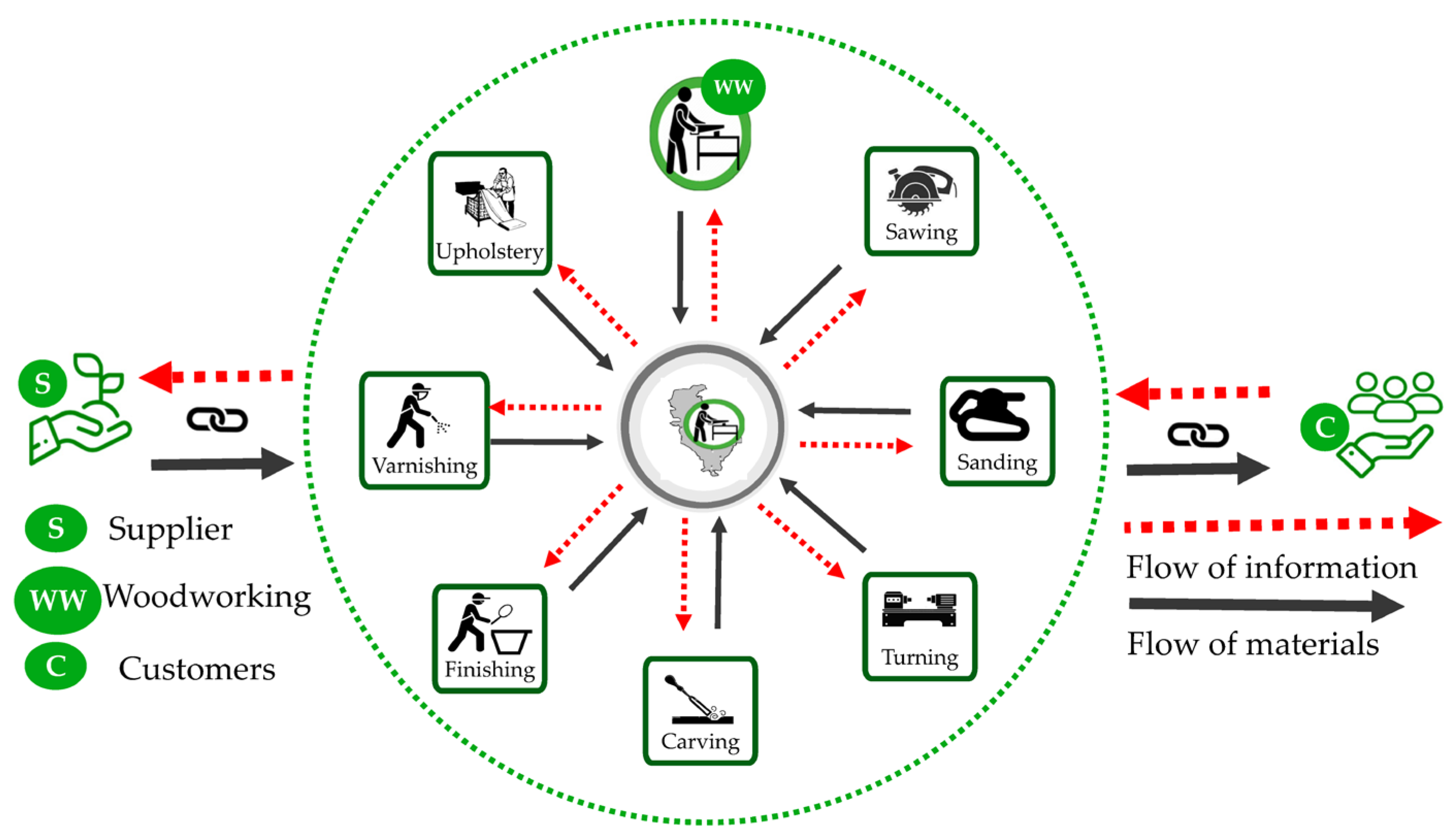
The results indicate that the WFI in Misantla operates within a predominantly informal structure composed of four main actors: sawmills, input suppliers, assembly and sub-assembly units, and final customers (Figure 1). The absence of formal coordination among these actors generates inefficiencies in production flows and constrains value chain integration. This structural fragmentation is consistently reflected in the stakeholders’ perceptions, who reported a lack of articulated planning, coordination, and information-sharing practices across supply chain stages. As one interviewee stated: “Work is fragmented; each actor purchases materials and sells independently—there is no integrated supply chain as such” (Interviewee 4).
The identification of supply chain actors in the artisanal wooden furniture industry of Misantla was based on questionnaire responses from workshops and woodworking units, complemented by semi-structured interviews and field observations. Items related to input sourcing, production processes, outsourced services, and marketing channels enabled the identification of the four key actor groups. The lack of formal coordination was evidenced by the reported absence of productive agreements, joint planning mechanisms, and systematic information exchange. Accordingly, Figure 1 schematically represents this structure, integrating quantitative survey data with qualitative validation provided by key informants.
Most production units employed between one and five workers (74.9%), reflecting the microenterprise nature of the sector. Additionally, 79.7% of units were owner-managed, while only 20.3% involved family members in managerial roles. This centralized management model, combined with low formal professionalization, directly influences decisions related to input procurement, inventory management, and production scheduling, as well as the mechanisms through which operational knowledge is transferred within the workforce [36].
Regarding operational experience, between 37% and 38% of workshops and woodworking units reported more than 11 years of activity, and approximately 28% reported more than 20 years of operation, indicating long-term engagement and accumulated artisanal knowledge. In terms of workforce education, 77% of workers had completed secondary education, 22% primary education, and only 1% held university-level degrees (Table 6). Moreover, only 9% of units employed relatives or acquaintances, limiting structured knowledge transfer and succession planning and affecting the continuity and efficiency of production processes along the supply chain.
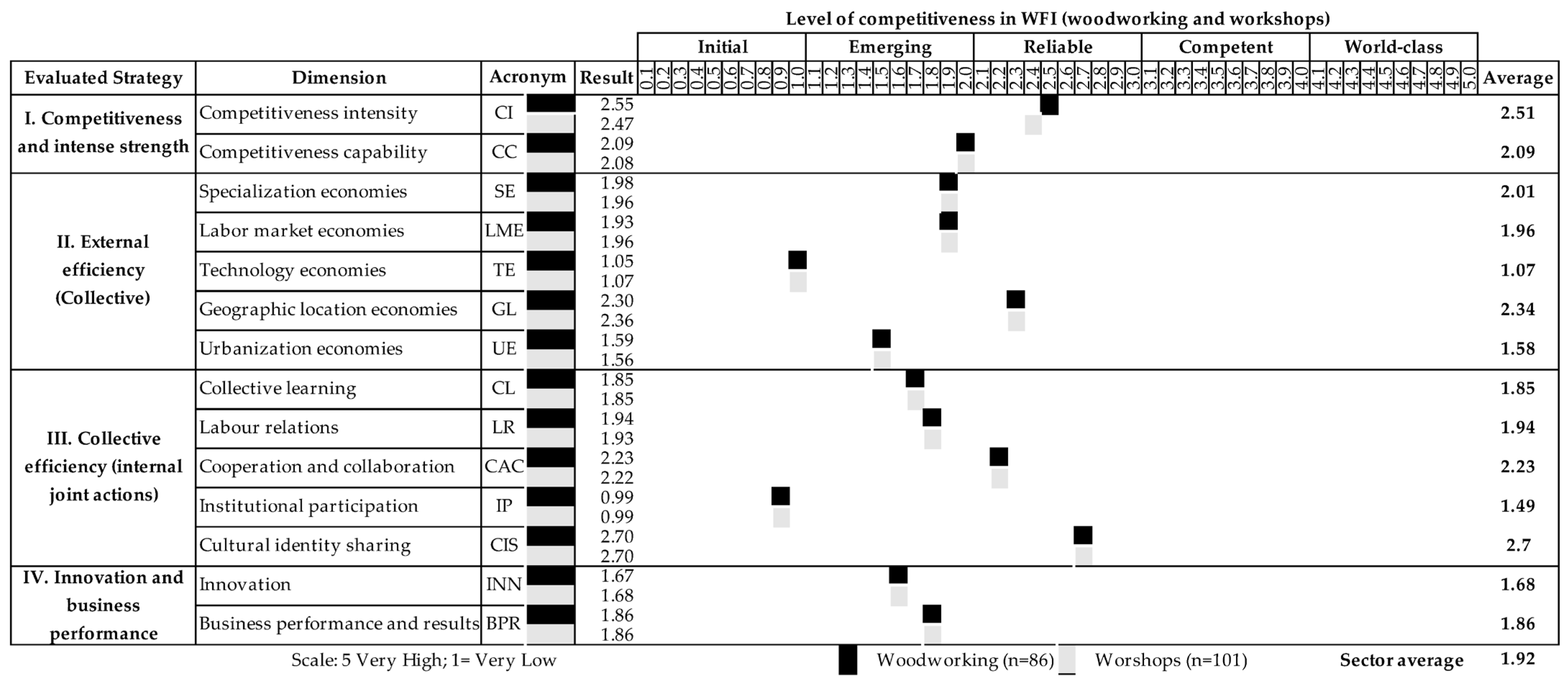
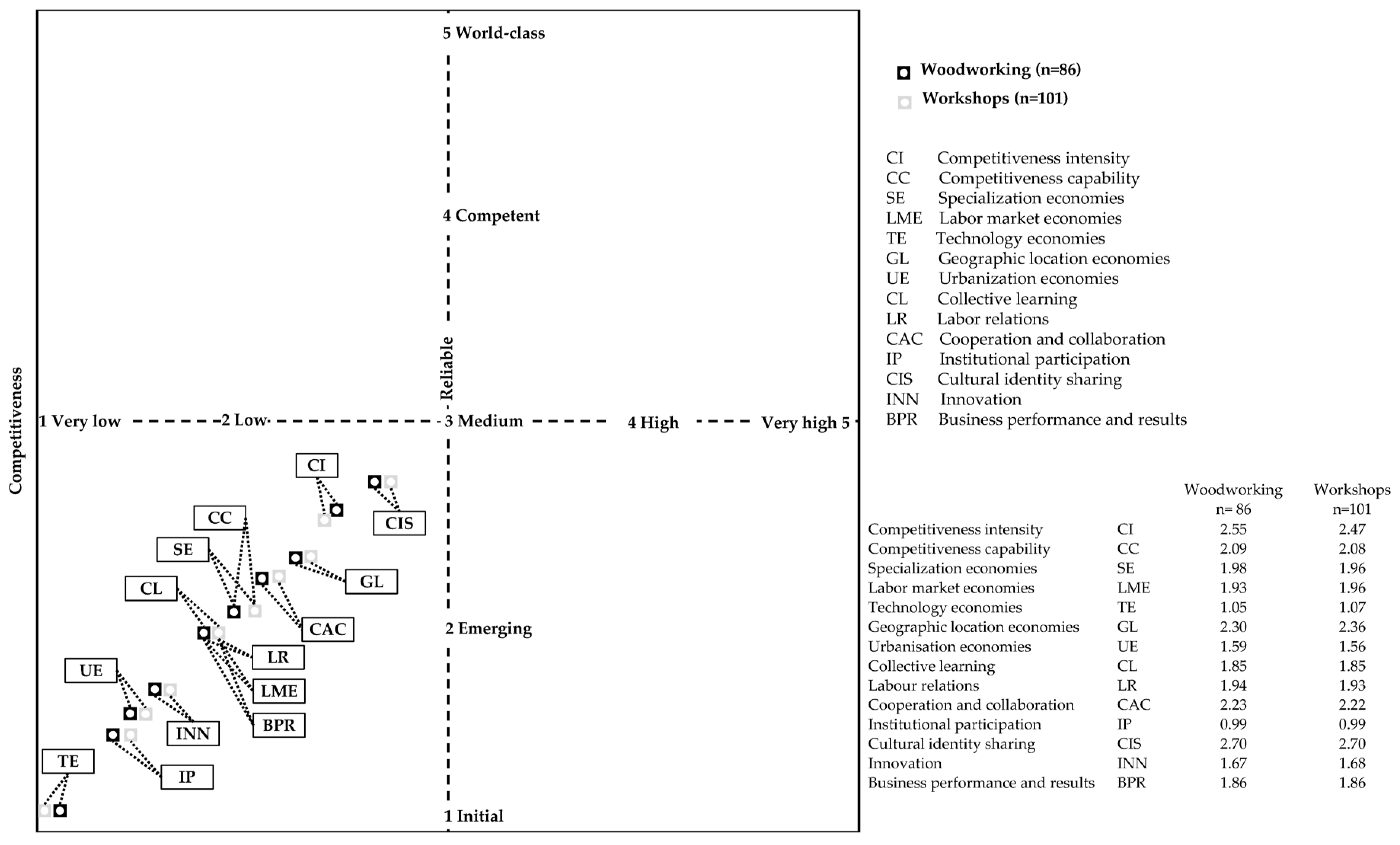
Performance evaluation across four strategic dimensions—competitiveness and labor intensity, external efficiency, collective efficiency, and innovation and business performance—revealed average scores below 3 on a five-point scale (Figure 2). Differences between workshops and woodworking units were minimal (Figure 3), positioning the sector at an emerging level of competitiveness, primarily oriented towards local markets. Although woodworking units led core production activities and shared inputs with workshops, limited technological capability constrained production throughput, responsiveness, and overall logistics performance.
The overall competitiveness score was 1.92 on a five-point scale, reflecting a management pattern centered on corrective actions rather than strategic planning, with limited innovation and specialization [37]. Scores for competitiveness and labor intensity were 2.51 and 2.09, respectively, indicating competitive pressure from metal, plastic, and low-cost modular furniture. While artisanal products retain cultural value and originality, high production costs and reliance on manual processes reduce operational flexibility and supply chain efficiency. Qualitative evidence reinforces this pattern, highlighting limited coordination and cooperation among workshops. As noted by two participants “each workshop operates independently; there are no agreements or joint planning mechanisms” (Interviewees 2 and 3).
External efficiency scores ranged from 1.07 to 2.34, reflecting structural constrains related to skills availability, technology adoption, and territorial collaboration.
Low scores in labor market economies (1.97) and technological economies (1.07) indicate insufficient skilled personnel, high turnover, and limited diffusion of best manufacturing practices. Weak inter-firm linkages restrict opportunities to exploit economies of scale, clustering effects, or coordinated logistics flows. The absence of auxiliary firms and support networks further constrains expansion into new markets and reduces collective competitiveness.
Internal or collective efficiency scores ranged from 1.49 to 2.70. Knowledge transfer relies primarily on empirical learning and informal relationships, with limited inter-unit collaboration. Low institutional participation (1.49) and weak articulation with universities and government agencies constrain the development of shared capabilities.
Although cultural identity achieved the highest score (2.70), this strength did not translate into sustained competitive advantages at the supply chain level. From the perspective of carpenters, this situation is associated with the artisanal nature of furniture production and the lack of formal cooperation arrangements. As one informant explained: “We do help each other at times, but it is not organized or consistent” (Interviewee 1).
Innovation and business performance recorded the lowest scores (1.68 and 1.86, respectively), indicating limited technological adoption, the absence of formal market strategies, and strong dependence on direct sales or local intermediaries. Fewer than 2% of units used digital platforms or structured exhibition strategies, which constrains market reach and logistics scalability.
The chi-square test of independence (χ2 = 1055.52; df = 16; α = 0.005) confirmed a statistically significant association between competitiveness and internal collective efficiency based on joint actions (Table 7; Appendix A.2). Accordingly, the null hypothesis H02 was rejected in favor of the alternative hypothesis H12, indicating that the competitiveness level of woodworking units and workshops is not independent of internal collective efficiency based on joint actions. However, the inclusion of effect size through Cramér’s V revealed that this association is small to moderate in magnitude (V = 0.218), allowing for a more precise assessment of its practical relevance.
Consistent with these results, the null hypothesis H01 was rejected in favor of H11, confirming that the level of competitiveness is not independent of external collective efficiency dimensions associated with territorial and relational economies. Comparatively, internal collective efficiency (CL, LR, CAC, IP, CIS) exhibited the largest effect size, followed by competitive intensity and capacity (CI, CC; V = 0.211), whereas external collective efficiency associated with territorial economies (SE, LME, TE, GL, UE) showed a relatively lower influence (V = 0.185). From a logistics perspective, these results indicate that mechanisms of operational integration, inter-workshop coordination, and internal process alignment exert a more direct impact on supply chain competitive performance than external environment economies or isolated competitive capacities.
The findings reveal a structural pattern of limited competitiveness, characterized by technological and organizational constraints that hinder production coordination, knowledge transfer, and overall supply chain performance, consistent with an emerging stage of competitive maturity within the sector. The rejection of H01 and H02 provides statistical support for the proposed associative framework linking competitiveness with collective efficiency dimensions in the Misantla WFI while remaining fully consistent with the exploratory and non-causal scope of the study.
Qualitative results: Emerging themes from expert interviews
To complement the quantitative analysis, the qualitative component was synthesized through a thematic analysis. Table 8 summarizes the main themes identified from semi-structured interviews with key informants from the artisanal wooden furniture sector, highlighting their relevance to coordination, integration, and overall supply chain performance.

4. Discussion

The WFI in Misantla operates under technological and organizational constrains that weaken its competitiveness and limit supply chain integration Unlike more advanced European sectors, where innovation and coordinated production systems support quality and market responsiveness [20,38], the Misantla WFI shows limited inter-firm collaboration and weak institutional linkages. Similar challenges have been documented in emerging furniture industries such as Indonesia, where insufficient cooperative strategies and the low adoption of integrated supply chain practices constrain collective upgrading [7,19]. In contrast to digitally enabled and flexible production models common in Europe and Asia [39,40,41], the sector remains largely manual and fragmented. This indicates that the competitiveness gap is rooted less in craftsmanship and more in limited logistics coordination and systemic integration across the value chain.
This gap reflects a structural technological divide that constrains productivity, operational efficiency, and the WFI’s integration into broader markets. The limited participation of family members (9%) further restricts intergenerational knowledge transfer and weakens collective innovation capacity—an uncommon pattern in family-based microenterprises, where internal support structures typically sustain technical continuity [25,42]. Addressing these constraints requires strengthening human capital and progressively integrating digital tools and Industry 4.0 practices adapted to artisanal production [5,9]. Tailored technology transfer policies are therefore essential to enhance coordination, modernize logistics processes, and improve competitiveness without eroding cultural identity.
In Misantla, the training of new artisans relies primarily on informal methods; however, this approach does not consistently improve skills or ensure talent retention. This contrasts with findings by [42], who indicate that family businesses investing in structured training programs strengthen personnel competencies and achieve greater workforce stability.
High staff turnover in the Misantla WFI reflects patterns observed in other emerging furniture industries, where limited technical skills and resistance to change hinder sectoral upgrading [43,44]. Evidence from Latin America further indicates that weak human capital development and insufficient inter-firm coordination constitute critical bottlenecks to competitiveness in artisanal production systems [17,45]. These constraints directly affect operational stability and limit the consolidation of coordinated supply chain structures.
Consequently, the WFI in Misantla must restructure its production processes and progressively modernize its technological base to enhance operational performance, and supply chain experiences such as the Chinese furniture industry demonstrate that upgrading production systems and strengthening collective organization can significantly improve competitiveness [46]. Comparable constraints—limited collaboration and outdated production methods—have also been documented in Malaysia [47], reinforcing the need for coordinated technological transition strategies.
As in other regions of Mexico, custom furniture production, although culturally valuable, is structurally less efficient than mass production systems [48]. The findings show that weak cooperation between workshops and woodworking units, combined with a fragmented production structure, constrains collective competitiveness and limits supply chain coordination. As noted by [11], product quality largely depends on individual technical expertise, reinforcing a model based on isolated capabilities rather than shared strategies and integrated operational planning.
It is important to clarify that innovation and entrepreneurial performance were not modeled as dependent variables in relation to competitiveness or collective efficiency. Instead, they were treated as descriptive indicators of the structural and organizational maturity of the artisanal wooden furniture sector. This approach is consistent with the exploratory design of the study, which focused on collective coordination mechanisms and supply chain articulation rather than firm-level causal modeling. Although the findings suggest that limited collective efficiency may constrain innovation capacity, testing direct or mediated effects would require a different analytical framework such as multivariate or longitudinal models.
From a hypothesis-testing perspective, the rejection of H02 in favor of H12 confirms that the competitiveness of the artisanal wood furniture industry in Misantla is statistically associated with internal collective efficiency based on joint actions. This result highlights the relevance of operational coordination, shared learning, and cooperative practices as structural elements linked to supply chain competitive performance, without implying causal relationships.
In particular, the rejection of H01 indicates that external collective efficiency, associated with territorial and relational economies, is also statistically related to competitiveness levels, although with a smaller effect size. This suggests that external conditions contribute to competitive performance but play a secondary role compared to internal coordination mechanisms among workshops and production units.
The findings highlight the need to strengthen collective learning, improve labor coordination, and promote structured cooperation between workshops and woodworking units so that the sector can operate as an integrated system rather than as isolated actors. Expanding institutional engagement while preserving cultural identity is essential for coordinated upgrading. In contrast to consolidated European clusters, where inter-firm collaboration enhances resilience and innovation [41,49,50], the Misantla WFI remains fragmented, limiting organizational maturity and supply chain integration.
Strengthening linkages between academia and production units could reduce the coordination gap by fostering collective learning and applied innovation [14]. The results reinforce that collective efficiency is closely associated with competitive performance in the artisanal WFI. In line with [8], the development of regional cooperation platforms and dual training programs could formalize artisanal knowledge, enhance professionalization, and consolidate a shared capabilities base critical for long-term supply chain sustainability.
Limited investment in training and human capital development remains a structural constraint in the Latin American artisanal furniture sector [45]. In Misantla, weak coordination among production units reinforces informal labor arrangements and slows adaptation to market demands, limiting long-term sustainability [7]. These findings are consistent with evidence from Brazil and Colombia, where insufficient collective adaptation reduces the persistence and growth potential of family-based furniture enterprises [8,17,20].
Long-term competitiveness depends on the capacity of local industries to develop collective strategies and shared value frameworks that support innovation and differentiation [25]. However, limited collaboration between SMEs and educational institutions constrains the generation of sustained synergies and collective upgrading [50,51]. In many emerging economies, such integration remains weak, as linkages among artisanal producers and other economic actors are often sporadic and rarely evolve into stable production or learning networks [52].
Although Misantla’s furniture reflects European design influences, aesthetic differentiation alone does not constitute a sustainable competitive advantage. As documented in Mexican artisanal workshops, custom production—while culturally valuable—tends to be less efficient than mass production systems due to fragmented processes and limited integration across production stages [53]. At the same time, competition from more technologically advanced industries in Italy and Germany intensifies market pressure [3]. Limited digital adoption further restricts access to dynamic markets. Bridging this gap requires integrating digital transformation as a complementary dimension of artisanal competitiveness, supported by intermediary structures capable of facilitating Industry 4.0 adoption among small-scale producers [9].
Consistent with [8], the WFI in Misantla—strongly rooted in family-based and individual production models—has not yet incorporated digital manufacturing technologies that could support shared efficiencies and long-term upgrading. Transitioning toward a networked collaboration model grounded in progressive digitalization and collective learning emerges as a viable pathway to strengthen supply chain integration, enhance technological adaptation, and preserve cultural resilience within the artisanal sector [11].
Competitiveness in the Misantla WFI depends not only on production scale but on the effective integration of artisanal skills, appropriate technology, and collective work organization within a coordinated supply chain framework. Closing these gaps requires structured human capital development, stronger inter-firm cooperation networks, and the promotion of sustainable innovation as a driver of regional upgrading. The findings provide empirical guidance for policy design aimed at strengthening rural artisanal micro-industries. Enhancing technological capabilities and collective coordination in Misantla offers a replicable pathway for improving competitiveness in culturally rooted production systems across Latin America.

5. Conclusions

The competitiveness of the artisanal wooden furniture industry (WFI) in Misantla is primarily driven by artisan skills and intergenerational knowledge, which constitute its strongest cultural asset. However, structural weaknesses—such as limited technological adoption, low innovation (1.68), and weak inter-firm cooperation—constrain growth, placing the sector at an emergent stage of competitiveness (overall score 1.92/5). Cultural identity remains the sector’s main intangible strength (2.70), highlighting a system that prioritizes corrective over strategic approaches.
The study identifies statistically significant associations between competitiveness and both internal and external collective efficiency dimensions. While these findings do not imply causal relationships, they indicate that collective coordination mechanisms—particularly joint actions among workshops and carpentries—form part of the structural conditions shaping the sector’s competitive performance. This delineates the scope of the study clearly and provides a useful analytical reference for examining artisanal supply chains with similar characteristics.
Professionalization of the artisanal workforce is critical for sustainable development. With 77% of workers holding only secondary education and just 1% with university-level training, there is significant potential to enhance skills through structured technical training, collaboration with educational institutions, and collective learning. Gradual integration of digital tools and innovative practices can complement traditional craftsmanship, creating a hybrid model that improves efficiency, market reach, and resilience without compromising cultural heritage.
Strengthening networks among workshops, woodworking units, and institutions is essential for fostering sustainable production systems. Initial alliances can catalyze broader collaboration with universities and government entities, enabling the sector to leverage its cultural assets while enhancing competitiveness. This combination of skill development, collective learning, and progressive technological adoption offers a replicable model for other artisanal micro-industries across Latin America, aligning tradition with sustainable economic growth.

Author Contributions

Conceptualization: L.E.G.-S., E.F.-E. and G.F.-L.; Methodology: L.E.G.-S., E.D.-P. and G.F.-L.; Validation: E.F.-E. and L.E.G.-S.; Formal analysis: G.F.-L., E.D.-P., A.B.-D. and L.E.G.-S.; Investigation: N.A.P.-H., J.A.-U., J.M.C.-D., L.E.G.-S. and E.D.-P.; data curation: L.E.G.-S., E.F.-E., J.M.C.-D. and G.F.-L.; Original draft preparation: E.F.-E., E.D.-P., J.A.-U. and N.A.P.-H.; Review and editing: L.E.G.-S., G.F.-L. and J.M.C.-D.; Visualization: L.E.G.-S. and E.F.-E.; Supervision: E.F.-E. and E.D.-P.; Project administration: L.E.G.-S. and G.F.-L. All authors have read and agreed to the published version of the manuscript.

Funding

This research received no external funding.

Institutional Review Board Statement

This study is waived for ethical review in compliance with the Tecnológico Nacional de México (TecNM)/Instituto Tecnológico Superior de Misantla’s Research Policy on Research Ethics by Institution Committee.

Informed Consent Statement

Informed consent was obtained from all subjects involved in the study.

Data Availability Statement

The original contributions presented in this study are included in the article. Further inquiries can be directed to the corresponding authors.

Conflicts of Interest

The authors declare no conflicts of interest.

Appendix A

Appendix A.1. Questionnaire

Instructions. This questionnaire examines competitiveness, collective efficiency, innovation, and business performance in the artisanal wooden furniture industry.
In the Demographic section, answer as you feel is correct, but in more sections, please read each statement and select the option that best reflects your company’s current situation. All items are rated using a five-point Likert scale: 1 = Very low, 2 = Low, 3 = Moderate, 4 = High, and 5 = Very high
There are no right or wrong answers. Please respond based on your experience.
All responses are confidential and will be used only for academic purposes. Results will be reported in aggregate form. Thank you for your cooperation.
ItemSurvey ItemScale
(1) Demographic and Socioeconomic Data (16)
1.1Company typeOpen-ended
1.2Company characteristicsOpen-ended
1.3Is carpentry your main source of income?Open-ended
1.4Respondent’s positionMultiple choice
1.5Years of experience in the positionMultiple choice
1.6Years working in the companyMultiple choice
1.7Type of furniture industryMultiple choice
1.8Number of collaboration agreementsMultiple choice
1.9Sector with which collaboration agreements are establishedOpen-ended
1.1Origin of the sector with collaboration agreementsOpen-ended
1.11Number of employeesMultiple choice
1.12Membership in chambers or business associationsMultiple choice
1.13Type of customers servedMultiple choice
1.14Main wood supplierMultiple choice
1.15Main suppliers of inputs and materialsMultiple choice
1.16Is your company more competitive than others?Open-ended
(2) Competitiveness and Intense Strength
Competitiveness Intensity (14)
2.1Difficulty of opening a new carpentry workshop in the municipalityLikert (1–5)
2.2Competition from similar or substitute wooden furniture productsLikert (1–5)
2.3Intensity of competition to attract customersLikert (1–5)
2.4Existence of agreements between companies and suppliersLikert (1–5)
2.5Ability to negotiate purchase prices and agreementsLikert (1–5)
2.6Ability to negotiate selling prices and agreementsLikert (1–5)
2.7Capacity to sell furniture in new markets and customer segmentsLikert (1–5)
2.8Competition to purchase wood at lower prices and adequate qualityLikert (1–5)
2.9Competition to purchase materials at lower prices and adequate qualityLikert (1–5)
2.1Impact of production costs on company profitabilityLikert (1–5)
2.11Impact of labor costs on company profitabilityLikert (1–5)
2.12Need to reduce selling prices below competitorsLikert (1–5)
2.13Perception of competitors (1 = colleagues, 5 = enemies)Likert (1–5)
2.14Degree of collaboration (1) versus competition (5)Likert (1–5)
Competitiveness Capability (10)
2.15Availability of local workshops and specialized servicesLikert (1–5)
2.16Easy of establishing subcontracting agreementsLikert (1–5)
2.17Access to customers through digital platformsLikert (1–5)
2.18Reduction in production costs over the last 10 yearsLikert (1–5)
2.19Use of quality image as a competitive strategyLikert (1–5)
2.2Stakeholder satisfaction with company profitsLikert (1–5)
2.21Improvement in technological and commercial positioningLikert (1–5)
2.22Improvement in reputation, image, and market shareLikert (1–5)
2.23Availability of information for decision-makingLikert (1–5)
2.24Negotiation capacity with suppliers and customersLikert (1–5)
II. External Efficiency (Collective) (52)
Specialization Economies (10)
3.1Ability to respond to changing market demandsLikert (1–5)
3.2Collaboration to manufacture components and reduce costsLikert (1–5)
3.3Stable relationships with suppliers and customersLikert (1–5)
3.4Availability of specialized jobs required by customer designsLikert (1–5)
3.5Availability of skilled workers based on traditionLikert (1–5)
3.6Availability of specialized servicesLikert (1–5)
3.7Stable and mutually beneficial relationshipsLikert (1–5)
3.8Availability of machinery and equipment suppliersLikert (1–5)
3.9Existence of standardized manufacturing methodsLikert (1–5)
3.1Sharing of standardized production methodsLikert (1–5)
Labor Market Economies (10)
3.11Easy of hiring personnel when requiredLikert (1–5)
3.12Availability of skilled labor in the regionLikert (1–5)
3.13Skill development through work experienceLikert (1–5)
3.14Labor mobility among workshopsLikert (1–5)
3.15Risk of unemployment among artisansLikert (1–5)
3.16Employment stability in the furniture sectorLikert (1–5)
3.17Workers’ willingness to improve skillsLikert (1–5)
3.18Investment in working trainingLikert (1–5)
3.19Employee contribution of ideasLikert (1–5)
3.2Existence of labor groups or associationsLikert (1–5)
Technology Economies (8)
3.21Information and technology transfer among companiesLikert (1–5)
3.22Transfer of tacit knowledgeLikert (1–5)
3.23Transfer of specialized technological knowledgeLikert (1–5)
3.24Inter-company integration for innovationLikert (1–5)
3.25Collaboration with educational institutionsLikert (1–5)
3.26Joint generation of new knowledge and innovationLikert (1–5)
3.27Regional capacity to create and reorganize knowledgeLikert (1–5)
3.28Existence of formal and informal knowledge-sharing channelsLikert (1–5)
Geographic Location Economies (14)
3.29Presence of intermediate input suppliersLikert (1–5)
3.3Cost advantages due to geographic proximity (inputs)Likert (1–5)
3.31Cost advantages due to geographic proximity (distribution)Likert (1–5)
3.32Subcontracting of complementary activitiesLikert (1–5)
3.33Cooperation through shared resourcesLikert (1–5)
3.34Access to local, national, and export marketsLikert (1–5)
3.35Transportation costs of inputsLikert (1–5)
3.36Transportation costs of finished furnitureLikert (1–5)
3.37Local infrastructure availabilityLikert (1–5)
3.38Regional infrastructure availabilityLikert (1–5)
3.39Presence of support and auxiliary companiesLikert (1–5)
3.4Government and institutional supportLikert (1–5)
3.41Impact of regional economic growthLikert (1–5)
3.42Availability of SME support programsLikert (1–5)
Urbanization Economies (10)
3.43Access to large-volume customers through collaborationLikert (1–5)
3.44Reduction in commercialization costs through collaborationLikert (1–5)
3.45Access to shared sector-specific resourcesLikert (1–5)
3.46Reduction in coordination costsLikert (1–5)
3.47Joint access to high-demand marketsLikert (1–5)
3.48Access to shared financial resourcesLikert (1–5)
3.49Reduction in administrative costsLikert (1–5)
3.5External economies of scaleLikert (1–5)
3.51Collective control of the production processLikert (1–5)
3.52Maintenance of product quality through collaborationLikert (1–5)
III. Collective Efficiency (Internal Joint Actions) (55)
Collective Learning (10)
4.1Prior experience of current managers and technical staff in carpentry workshops from the same sector within the regionLikert (1–5)
4.2Number of managers, technicians, and employees hired in the last five years who mainly reside in the regionLikert (1–5)
4.3Number of managers, technicians, and employees mainly trained in regional educational institutionsLikert (1–5)
4.4Number of managers, technicians, and employees attending training or specialization courses in company facilities or regional institutionsLikert (1–5)
4.5Number of supplier firms, especially those providing complex machinery and technology, that offer technical advice and trainingLikert (1–5)
4.6Extent to which labor, production, technological, and commercial experiences are shared with other carpentry workshopsLikert (1–5)
4.7Outcomes of cooperation based on information exchange that lead to new products, technologies, or management practicesLikert (1–5)
4.8Participation in formal or informal networks enables acquisition of new information and knowledgeLikert (1–5)
4.9Participation in technical forums, communities of practice, trade fairs, courses, and conferencesLikert (1–5)
4.1Extent to which collaboration enables joint generation of knowledge and innovations that improve competitivenessLikert (1–5)
Labor Relations (11)
4.11Existence of regular, long-term contracts or agreements with regional suppliers and/or customersLikert (1–5)
4.12Existence of relationships based on trust and low opportunistic behavior with other regional carpentry workshopsLikert (1–5)
4.13Extent to which relationships are based on stable joint work teamsLikert (1–5)
4.14Extent to which relationships are based on shared experience and motivationsLikert (1–5)
4.15Ability to adjust production processes to market and stakeholder needsLikert (1–5)
4.16Coordination of joint activities that improve productivity, efficiency, and qualityLikert (1–5)
4.17Flexibility and adaptability to demand and environmental changesLikert (1–5)
4.18Risk sharing and reduction through agreements with other regional firmsLikert (1–5)
4.19Reduction in inventories and required assets through cooperationLikert (1–5)
4.2Contribution of cooperation to management modernizationLikert (1–5)
4.21Overall access to relevant information through frequent contactsLikert (1–5)
Cooperation and Collaboration (12)
4.22External collective image of regional carpentry workshopsLikert (1–5)
4.23Customer perception and reputation of regional wooden furniture productsLikert (1–5)
4.24Benefits from joint promotion and image diffusionLikert (1–5)
4.25Joint participation in trade fairs and exhibitionsLikert (1–5)
4.26Joint actions to share costs and conduct promotional activitiesLikert (1–5)
4.27Sense of shared territorial and sectoral visionLikert (1–5)
4.28Coordination between competitive and cooperative actionsLikert (1–5)
4.29Influence of company reputation on customers, competitors, and suppliersLikert (1–5)
4.3Influence of sector reputation on customers, competitors, and suppliersLikert (1–5)
4.31Expected compensation when providing favors to other agentsLikert (1–5)
4.32Degree to which opportunistic behavior is socially sanctionedLikert (1–5)
4.33Number of conflicts resolved through amicable agreementsLikert (1–5)
Institutional Participation (9)
4.34Existence of regional institutions providing information on products and technologiesLikert (1–5)
4.35Existence of regional institutions providing information on customers and marketsLikert (1–5)
4.36Importance and usefulness of institutional information for competitivenessLikert (1–5)
4.37Participation of institutions supporting R&D activitiesLikert (1–5)
4.38Participation of educational institutions offering sector-specific trainingLikert (1–5)
4.39Participation of institutions promoting products and firms nationally and internationallyLikert (1–5)
4.4Importance of participation in business and professional associationsLikert (1–5)
4.41Collaboration with universities and technical or research centersLikert (1–5)
4.42Degree of participation in business associations and sector planning forumsLikert (1–5)
Cultural Identity Sharing (13)
4.43Level of shared language and mutual understandingLikert (1–5)
4.44Level of trust and social relationshipsLikert (1–5)
4.45Social recognition of carpentry activity by the regional populationLikert (1–5)
4.46Intention to form a collective leading economic groupLikert (1–5)
4.47Existence of common strategic elements among regional firmsLikert (1–5)
4.48Sense of shared culture and work valuesLikert (1–5)
4.49Willingness to share behavioral normsLikert (1–5)
4.5Number of jointly organized social eventsLikert (1–5)
4.51Sense of pride in being located in the regionLikert (1–5)
4.52Pride in belonging to the regional carpentry groupLikert (1–5)
4.53Perception of a shared future for the sectorLikert (1–5)
4.54Level of unplanned strategic complementarityLikert (1–5)
4.55Perception of a common institutional strategic planLikert (1–5)
Innovation and Business Performance (19)
Innovation (9)
5.1Improvement in production process efficiencyLikert (1–5)
5.2Improvement in production system reorganizationLikert (1–5)
5.3Adoption of updated production technologyLikert (1–5)
5.4Increase in value added through innovationLikert (1–5)
5.5Improvement in product or service quality and usabilityLikert (1–5)
5.6Improvement in product or service designLikert (1–5)
5.7Improvement in research and development activitiesLikert (1–5)
5.8Improvement in marketing and commercializationLikert (1–5)
5.9Application of acquired knowledge to other products or sectorsLikert (1–5)
Business Performance and Results (10)
5.1Increase in market shareLikert (1–5)
5.11Increase in total sales and revenuesLikert (1–5)
5.12Increase in net profitabilityLikert (1–5)
5.13Improvement in product qualityLikert (1–5)
5.14Increase in employee productivityLikert (1–5)
5.15Reduction in total costsLikert (1–5)
5.16Reduction in product returnsLikert (1–5)
5.17Reduction in customer complaintsLikert (1–5)
5.18Reduction in product rejectionsLikert (1–5)
5.19Reduction in customer penaltiesLikert (1–5)

Appendix A.2

Method for the Chi-square (χ2) test for a contingency table [32,33]: Based on the dimensions for measuring Collective Efficiency (r1 = CL, r2 = LR, r3 = CAC, r4 = IP, and r5 = CIS), and with the observed values (o1, o2, o3,…, oij); based on the rules of probability, it is expected that they occur with expected values (e1, e2, e3,…, eij) (Table A1). To know whether the oij differs significantly from the eij, we tested the following hypotheses:
HA02. 
The level of competitiveness of woodworking units and workshops in the Misantla WFI is independent of internal collective efficiency based on joint actions.
HA12. 
The level of competitiveness in the woodworking units and workshops in the Misantla WFI is not independent of internal collective efficiency.
The equations to validate this hypothesis are described in Equations (A1) and (A2).
e i j   = r i   c j n
where:
e i j = expected frequencies; ri = refers to the row-wise rating category; cj = refers to the ranked category per column; n = total sum of rows and columns.
χ 2 = i = 1 r   j = c     ( o i j e i j ) 2 e i j
where:
χ 2 = the test statistic; o i j = observed frequencies; e i j = expected frequencies.
Table A1. Observed (oij) and expected (eij) frequencies in woodworking and workshops.
Dimensions (ri) Level of Competitiveness (cj)
12345Total (ri)
CLeij200.90277.63282.90172.9075.63
oij180.00276.00238.00221.0095.001010.00
LReij221.00305.40311.20190.2083.20
oij152.00345.00407.00170.0037.001111.00
CACeij241.09333.16339.49207.4990.76
oij206.00306.00354.00232.00114.001212.00
IPeij180.82249.87254.62155.6268.07
oij440.00356.00101.0012.000.00909.00
CISeij261.18360.93367.78224.7898.33
oij127.00244.00456.00316.00170.001313.00
Total oij 1105.001527.001556.00951.00416.00n = 5555.00
Effect size estimation: Cramér’s V
Given that large sample sizes may yield statistically significant results even when associations are weak, the magnitude of the relationship between collective efficiency dimensions and competitiveness levels was further assessed using Cramér’s V, a standardized effect size measure suitable for contingency tables of any dimension [21,29]. Accordingly, Cramér’s V was calculated using Equation (A3).
V = χ 2 n ( k 1 )
where:
V denotes the effect size (Cramér’s V); χ2 is the chi-square statistic; n is the total number of observations; and k = min (r, c), with r representing the number of rows and c the number of columns.
Cramér’s V ranges from 0 to 1 and provides a standardized measure of association strength. In practical terms, values close to 0.10 are commonly interpreted as indicating small effects, values around 0.30 as moderate effects, and values above 0.50 as relatively strong associations; however, these thresholds should be regarded as indicative and context-dependent [22,30]. The chi-square statistics, sample sizes, and corresponding Cramér’s V values obtained for each analytical section are summarized in Table A2.
Table A2. Chi-square test results and Cramér’s V for the competitiveness and collective efficiency dimensions.
Analyzed Sectionχ2dfnTable SizeCramér’s V
Competitiveness vs. competitive intensity and capacity (CI, CC)107.84424242 × 50.211
II. External collective efficiency (SE, LME, TE, GL, UE)718.061652525 × 50.185
III. Internal collective efficiency (CL, LR, CAC, IP, CIS)1055.551655555 × 50.218

References

  1. González-Flores, A. La nanoempresa como forma de organización económica: Su reconocimiento para Mexico. Rev. Venez. Análisis Coyunt. 2015, 21, 175–186. [Google Scholar]
  2. Grant, R. Informality. In Handbook of African Economic Development; Carmody, P., Murphy, J.T., Eds.; Chapter 29; Edward Elgar Publishing: Cheltenham, UK, 2024; pp. 435–447. [Google Scholar] [CrossRef]
  3. World Furniture Online. World Furniture Outlook 2025/2026. 2025. Available online: https://www.worldfurnitureonline.com/report/world-furniture-outlook/ (accessed on 22 January 2025).
  4. Ershad Sarabi, S.; Han, Q.; Romme, A.G.L.; de Vries, B.; Wendling, L. Key enablers of and barriers to the uptake and implementation of nature-based solutions in urban settings: A review. Resources 2019, 8, 121. [Google Scholar] [CrossRef]
  5. Lepore, D.; Coacci, F. Intermediaries boosting the digital transformation of SMEs: A comparative analysis between Italy and the Russian Federation. State Munic. Manag. Sch. Notes 2020, 4, 178–184. [Google Scholar] [CrossRef]
  6. Barbaritano, M.; Bravi, L.; Savelli, E. Sustainability and quality management in the Italian luxury furniture sector: A circular economy perspective. Sustainability 2019, 11, 3089. [Google Scholar] [CrossRef]
  7. Djunaidi, M.; Sholeh, M.A.A.; Mufiid, N.M. Analysis of green supply chain management application in Indonesian wood furniture industry. AIP Conf. Proc. 2018, 1977, 020015. [Google Scholar] [CrossRef]
  8. Sellitto, M.A.; Luchese, J. Systemic cooperative actions among competitors: The case of a furniture cluster in Brazil. J. Ind. Compet. Trade 2018, 18, 513–528. [Google Scholar] [CrossRef]
  9. Pagano, A.; Carloni, E.; Galvani, S.; Bocconcelli, R. The dissemination mechanisms of Industry 4.0 knowledge in traditional industrial districts: Evidence from Italy. Compet. Rev. 2020, 31, 27–53. [Google Scholar] [CrossRef]
  10. Maldonado-Guzmán, G.; Pinzón-Castro, S.Y.; Rodríguez-González, R.M. The impact of information and communication technology on Mexican SMEs growth. Adv. Manag. Appl. Econ. 2020, 10, 1792–7552. [Google Scholar]
  11. García-Santamaría, L.E.; Fernández-Lambert, G.; Mayett-Moreno, Y.; Alarcón-Ruíz, T.; Parra-Hernández, N. Cadenas rurales de suministro para la producción de muebles de madera en Misantla, Veracruz. Rev. Mex. Cienc. For. 2023, 14, 58–86. [Google Scholar] [CrossRef]
  12. Isabelle, D.; Horak, K.; McKinnon, S.; Palumbo, C. Is Porter’s Five Forces framework still relevant? A study of the capital/labour intensity continuum via mining and IT industries. TIM Rev. 2020, 10, 28–41. [Google Scholar] [CrossRef]
  13. Lozano-Uvario, K.M. Inserción de las Empresas Globales en las Dinámicas Produtivas Locales: Identificación y Análisis de las Estrategias en la Cadena de Valor de Madera-Muebles en México; AMECIDER-ITM: Mexico City, Mexico, 2016; Volume 1, pp. 1–27. Available online: http://ru.iiec.unam.mx/3211/1/051-Lozano.pdf (accessed on 15 June 2025).
  14. Jerónimo-Niniz, J.C.; Fregoso-Jasso, G.S.; Gaytán-Cortés, J. Clúster como estrategia para desarrollar económicamente la industria mueblera del municipio de Nahuatzen, Michoacán. In Principales Indicadores de Innovación y Estrategias Financieras Para Estimular la Competitividad en Diversos Sectores Económicos; Vizcaíno, A.d.J., Sánchez-Gutiérrez, J., Gaytán-Cortés, J., Eds.; Universidad de Guadalajara: Guadalajara, Mexico, 2020; pp. 108–120. Available online: https://www.researchgate.net/profile/Jose-Sanchez-Gutierrez/publication/342493048_Principales_indicadores_de_Innovacion_y_las_Estrategias_Financieras_para_estimular_la_Competitividad_en_diversos_Sectores_Economicos/links/5ef71c42a6fdcc4ca433acbe/Principales-indicadores-de-Innovacion-y-las-Estrategias-Financieras-para-estimular-la-Competitividad-en-diversos-Sectores-Economicos.pdf (accessed on 25 July 2025).
  15. DMC-Municipio de Misantla. Unidades Económicas del Municipio de Misantla 2024; Municipio de Misantla: Misantla, Mexico, 2024; Available online: https://www.economia.gob.mx/datamexico/es/profile/geo/misantla?covidMetricSelector=withoutProcessOption#education-and-employment (accessed on 14 November 2025).
  16. Schmitz, H. Collective efficiency: Growth path for small-scale industry. J. Dev. Stud. 1995, 31, 529–566. [Google Scholar] [CrossRef]
  17. López-Jiménez, J.; Martínez-Gutiérrez, B.; Hernández-Malpica, P.E.; Rodríguez-Barquero, R. Determinants of performance cluster: Case applied to furniture industry in Barranquilla, Colombia. TEC Empres. 2016, 10, 29–38. [Google Scholar] [CrossRef]
  18. Pezoa Fuentes, C.A. Elementos Competitivos en Base a la Eficiencia Colectiva de las Empresas Pertenecientes a un Clúster Emergente: El Clúster Minero de Antofagasta. Doctoral Dissertation, Universitat Rovira i Virgili, Tarragona, Spain, 2010. Available online: https://www.tdx.cat/handle/10803/8823 (accessed on 16 November 2025).
  19. Clements, C.; Alwang, J.; Achdiawan, R. Value chain approaches in a stagnant industry: The case of furniture production in Jepara, Indonesia. Bull. Indones. Econ. Stud. 2019, 55, 341–365. [Google Scholar] [CrossRef]
  20. Sellitto, M.A.; Camfield, C.G.; Buzuku, S. Green innovation and competitive advantages in a furniture industrial cluster: A survey and structural model. Sustain. Prod. Consum. 2020, 23, 94–104. [Google Scholar] [CrossRef]
  21. McHugh, M.L. The chi-square test of independence. Biochem. Med. 2013, 23, 143–149. [Google Scholar] [CrossRef]
  22. Field, A. Discovering Statistics Using IBM SPSS Statistics; Sage Publications Ltd.: London, UK, 2024; Available online: https://vlb-content.vorarlberg.at/fhbscan1/330900091084.pdf (accessed on 13 March 2023).
  23. Brown, T.J.; Suter, T.A.; Churchill, G.A. Basic Marketing Research: Customer Insights and Managerial Action, 10th ed.; Cengage Learning: Boston, MA, USA, 2017; pp. 70–150. Available online: https://www.cengage.com/c/basic-marketing-research-customer-insights-and-managerial-action-10e-brown-suter-churchill/9780357901847/ (accessed on 12 July 2025).
  24. Naderifar, M.; Goli, H.; Ghaljaie, F. Snowball sampling: A purposeful method of sampling in qualitative research. Strides Dev. Med. Educ. 2017, 14, e67670. [Google Scholar] [CrossRef]
  25. Porter, M.E. Estrategia Competitiva: Técnicas Para el Análisis de los Sectores Industriales y de la Competencia; Grupo Editorial Patria: Ciudad de México, Mexico, 2015; p. 33–40, 47–52. [Google Scholar]
  26. Kimberlin, C.L.; Winterstein, A.G. Validity and reliability of measurement instruments used in research. Am. J. Health-Syst. Pharm. 2008, 65, 2276–2284. [Google Scholar] [CrossRef]
  27. Navarrete, J.M. El muestreo en la investigación cualitativa. Investig. Soc. 2000, 4, 165–180. [Google Scholar] [CrossRef]
  28. Bernard, H.R. Social Research Methods: Qualitative and Quantitative Approaches; SAGE Publications, Inc.: Thousand Oaks, CA, USA, 2013; pp. 145–160. [Google Scholar]
  29. Sullivan, G.M.; Feinn, R. Using effect size—Or why the p-value is not enough. J. Grad. Med. Educ. 2012, 4, 279–282. [Google Scholar] [CrossRef]
  30. Akoglu, H. User’s guide to correlation coefficients. Turk. J. Emerg. Med. 2018, 18, 91–93. [Google Scholar] [CrossRef]
  31. Solleiro, J.L.; Castañón, R. Competitividad y sistemas de innovación: Los retos para la inserción de México en el contexto global. Rev. Iberoam. 2005, 5, 165–197. [Google Scholar]
  32. MacDonald, P.L.; Gardner, R.C. Type I error rate comparisons of post hoc procedures for I × J Chi-Square tables. Educ. Psychol. Meas. 2000, 60, 735–754. [Google Scholar] [CrossRef]
  33. Humble, S. Quantitative Analysis of Questionnaires: Techniques to Explore Structures and Relationships; Routledge: London, UK, 2020. [Google Scholar]
  34. Braun, V.; Clarke, V. Reflecting on reflexive thematic analysis. Qual. Res. Sport Exerc. Health 2019, 11, 589–597. [Google Scholar] [CrossRef]
  35. Trainor, L.R.; Bundon, A. Developing the craft: Reflexive accounts of doing reflexive thematic analysis. Qual. Res. Sport Exerc. Health 2021, 13, 705–726. [Google Scholar] [CrossRef]
  36. Jayantilal, S.; Jorge, S.F.; Palacios, T.B. Paternalism in family firms’ successor selection. Acad. Strateg. Manag. J. 2020, 19, 1–15. [Google Scholar]
  37. Jobb, D.J.; Xie, B.; Arthanari, T. Supply chain and operations practice and performance in Chinese furniture manufacturing. Int. J. Prod. Econ. 2008, 112, 683–699. [Google Scholar] [CrossRef]
  38. Papadopoulos, I.; Platogianni, E.; Trigkas, M.; Karagouni, G. The use of internet marketing by Greek furniture SMEs. In Proceedings of the 6th International Conference on Contemporary Marketing Issues (ICCMI), Athens, Greece, 27–29 June 2018; Available online: https://www.researchgate.net/publication/328095020_The_use_of_Internet_Marketing_by_Greek_Furniture_SMEs (accessed on 16 November 2025).
  39. Azemi, F.; Hajrizi, E.; Maloku, B. Maturity level of Kosovo manufacturing industry with regard to Industry 4.0. Int. J. Bus. Technol. 2018, 6, 8. [Google Scholar] [CrossRef]
  40. Pangemanan, S.A.; Waluko, I.M. Marketing strategy analysis for small and medium-scale business enterprises (SMEs) for home industry furniture in Leilem, the Regency of Minahasa. In Proceedings of the 2nd International Joint Conference on Science and Technology (IJCST); IOP Publishing Ltd.: Bristol, UK, 2017; Volume 953, p. 012033. [Google Scholar] [CrossRef]
  41. Matarazzo, M.; Penco, L.; Profumo, G.; Quaglia, R. Digital transformation and customer value creation in Made in Italy SMEs: A dynamic capabilities perspective. J. Bus. Res. 2021, 123, 642–656. [Google Scholar] [CrossRef]
  42. López-Gómez, E. En torno al concepto de competencia: Un análisis de fuentes. Profesorado. Rev. Curric. Form. Profr. 2016, 20, 311–322. [Google Scholar]
  43. Norman, M.; Canby, K. India’s Wooden Furniture and Wooden Handicrafts: Risk of Trade in Illegally Harvested Wood; Report; Forest Trends: Washington, DC, USA, 2020; Available online: https://acortar.link/85XCiA (accessed on 16 November 2025).
  44. Guerrero, J.E.; Leavengood, S.; Gutiérrez-Pulido, H.; Fuentes-Talavera, F.J.; Sánchez-Gutiérrez, J. Applying Lean Six Sigma in the wood furniture industry: A case study in a small company. Qual. Manag. J. 2017, 24, 6–19. [Google Scholar] [CrossRef]
  45. Lechuga-Cardozo, J.I. Industria de la madera en Colombia: Recursos claves para el resultado exportador. Rev. Acad. Neg. 2018, 4, 15–24. [Google Scholar]
  46. Xiong, X.; Ma, Q.; Yuan, Y.; Wu, Z.; Zhang, M. Current situation and key manufacturing considerations of green furniture in China: A review. J. Clean. Prod. 2020, 267, 121957. [Google Scholar] [CrossRef]
  47. Abu, F.; Gholami, H.; Zameri, M.; Saman, M.; Zakuan, N. The implementation of lean manufacturing in the furniture industry: A review and analysis on the motives, barriers, challenges, and the applications. J. Clean. Prod. 2019, 234, 660–680. [Google Scholar] [CrossRef]
  48. Ding, J.; Wang, M.; Zeng, X.; Qu, W.; Vassiliadis, V.S. Mass personalization strategy under Industrial Internet of Things: A case study on furniture production. Adv. Eng. Inform. 2021, 50, 101439. [Google Scholar] [CrossRef]
  49. Pezeshki, Y.; Baboli, A.; Cheikhrouhou, N.; Modarres, M.; Akbari Jokar, M.R. A rewarding-punishing coordination mechanism based on trust in a divergent supply chain. Eur. J. Oper. Res. 2013, 230, 527–538. [Google Scholar] [CrossRef]
  50. Brun, L.C.; Buciuni, G.; Frederick, S.; Gereffi, G.; Xiao, Y. The Furniture Value Chain in North Carolina; Center on Globalization, Governance & Competitiveness at the Social Science Research Institute, Duke University: Durham, NC, USA, 2013; Available online: https://www.researchgate.net/publication/282670244_The_Furniture_Value_Chain_in_North_Carolina?channel=doi&linkId=5617d02708ae88df90e02966&showFulltext=true (accessed on 12 January 2024).
  51. Qiu, X.; Cano-Kollmann, M.; Mudambi, R. Competitiveness and connectivity in design innovation: A study of the Norwegian furniture industry. Compet. Rev. 2017, 27, 533–548. [Google Scholar] [CrossRef]
  52. Ratnasingam, J.; Yi, L.Y.; Azim, A.A.; Halis, R.; Choon Liat, L.; Khoo, A.; Daud, M.M.; Senin, A.L.; Latib, H.A.; Bueno, M.V.; et al. Assessing the awareness and readiness of the Malaysian furniture industry for Industry 4.0. BioResources 2020, 15, 4866–4885. [Google Scholar] [CrossRef]
  53. Méndez Bravo, J.C.; Méndez Bravo, M.A. Análisis de eficiencia en los procesos de las fábricas artesanales de muebles de madera. Innova Res. J. 2017, 2, 20–29. [Google Scholar] [CrossRef]
Figure 1. Value agents in the supply chain of Misantla WFI.
Logistics 10 00066 g001
Figure 2. Performance results for the four main dimensions of the WFI in Misantla, Veracruz, Mexico.
Logistics 10 00066 g002
Figure 3. Sector performance in the Misantla WFI, Veracruz-Mexico, compared to level of competitiveness.
Logistics 10 00066 g003
Table 1. Questionnaire structure.
SectionItemsQuestionsMCOE
(1) Demographic and socioeconomic data161 to 16610
(2) Competitiveness and intense strength2417 to 40240
(3) External efficiency (collective)5241 to 92520
(4) Collective efficiency (internal joint actions)5593 to 147550
(5) Innovation and entrepreneur performance19148 to 166190
Total16616615610
Table 2. Description of questionnaire dimensions.
DimensionDescription
Competitiveness and intense strengthRefers to a company’s ability to distinguish itself in different contexts—economic, social, and political—to adapt to change and maintain effective relationships with other industry players, customers, and suppliers.
External efficiency (collective)Refers to the ability to respond to market demands through collaborative relationships with suppliers, competitors, and customers. These cooperative strategies ensure stability in human resources, technology, investment, and risk, strengthening sector competitiveness.
Collective efficiency (internal joint actions)Refers to how several companies in the same sector can undertake joint actions, rather than individual and isolated efforts, to improve their competitiveness.
Innovation and entrepreneur performanceRefers to how the introduction of innovations—whether in processes, products, or functionalities—can positively impact a company’s performance, boosting business results and outcomes.
Table 3. Internal consistency of the questionnaire dimensions (Cronbach’s alpha).
DimensionItemsCronbach’s Alpha
Competitiveness and intense strength240.78
External efficiency (collective)520.83
Collective efficiency (internal joint actions)550.86
Innovation and entrepreneur performance190.74
Overall instrument1500.81
Table 4. Level of competitiveness in WFI woodworking and workshops.
Competitive LevelInitialEmergingReliableCompetentWorld-Class
Measure scale0–1 (Very low)1–2 (Low)2–3 (Medium)3–4 (High)4–5 (Very high)
PriorityOpennessSurvivalDifferentiationInnovationLeadership
Best practicesNo established practicesManagement and administrative systemsContinuous improvement and benchmarkingNew products developmentAccelerated product obsolescence
Market coverageLocal premise and some customersLocalNationalInternational regionGlobal
Management levelAdapting operationsOperationQuality or exportQuality and exportTechnological management
Technological capabilityAdapt and imitationImitationAdoption and improvementDevelopmentLicensing
Attitude toward changeReactive (impulsive)ReactsAdaptPromotesGenerate
Table 5. Dimensions analyzed in this study.
DimensionObjective
Workshop characteristicsUnderstand the production environment and determine the main circumstances and practices within the workshop.
Competitiveness strategiesAssess the productive techniques, work methods, decision-making processes, and external advisory sources utilized by carpenters to enhance productivity.
Collaboration among workshopsDetermine the degree of cooperation and collaboration among carpentries and workshops and its impact on collective efficiency.
External efficiencyIdentify external factors influencing competitiveness, such as relationships with suppliers and customers.
Innovation practicesDescribe innovation practices in design and manufacturing and evaluate the technological capabilities adopted.
Table 6. Demographic profile of respondents in Misantla, Veracruz, Mexico (2020–2021).
VariableVariableWorkshops (n = 101)Woodworking Units (n = 86)TotalTotal (%)
Number of employees1–5924814074.9
6–107233016.1
Employment of relatives and/or friends.215179.0
Role in the companyOwner856414979.7
Family Business SMEs.16223820.3
Company seniorityTwenty years or more/or since its foundation.33215428.9
<1 year3694.8
1–56232915.5
6–1013112412.8
>1146257138.0
Education levelNo formal education.3363.2
Primary15122714.5
Secondary786614477.0
High school4484.3
Bachelor1121.0
Table 7. Association between competitiveness and collective efficiency dimensions: χ2 test and Cramér’s V.
DimensionTest Statistic  ( χ 2 ) Chi-Squared  ( χ 2 )  Statistic Value Cramér’s VSmall-to-Moderate AssociationConclusion
I. Competitiveness and intense strength (CI, CC).χ2 = 107.84χ2 (α, df) = 14.8602
α = 0.005, df = 4
0.211Small-to-moderate associationThe level of competitiveness is not independent of competitive intensity and capacity.
II. External efficiency (Collective) (SE, LME, TE, GL, UE)χ2 = 718.06χ2 (α, df) = 34.26
α = 0.005, df = 16
0.185Small associationThe level of competitiveness is not independent of collective efficiency (external economies).
III. Collective efficiency (internal joint actions) (CL, LR, CAC, IP, CIS).χ2 = 1055.52χ2 (α, df) = 34.26
α = 0.005, df = 16
0.218Small-to-moderate association, the largest among the analyzed dimensions.The level of competitiveness is not independent of the collective efficiency of the workshops.
χ2 (α, gl), where P (1 − α); df = (ri − 1) (cj − 1). Note: χ2 (α, df) denotes the critical value of the chi-square distribution at significance level α; degrees of freedom were calculated as df = (ri − 1) (cj − 1). Cramér’s V is reported as an effect size measure to assess the strength of the association.
Table 8. Emerging qualitative themes from interviews with sector informants.
SubjectDescriptionComments
Fragmented coordination among production unitsHorizontal coordination among workshops and woodworking units is limited, leading to deficiencies in production planning, low synchronization of workflows, and reactive operational decisions, which negatively affect collective efficiency.“Each workshop operates independently; coordination only occurs when there is an urgent order, not as part of a planned process.” (Master carpenter, 22 years of experience)
Reliance on individual capabilities in the absence of collective strategiesCompetitiveness relies primarily on individual skills and family experience rather than shared mechanisms for purchasing, scheduling, or production coordination, limiting supply chain integration.“What keeps us going is experience, not shared strategies. Everyone solves problems in their own way.” (Workshop owner)
Limited integration of external support into operational processesExternal actors such as suppliers, advisors, and intermediaries play a marginal role in decision-making and production organization, reducing the contribution of external economies to operational performance.“Suppliers sell us the material, but they do not take part in how we plan or improve production.” (Master carpenter, 30 years of experience)
Innovation constrained by organizational and logistical limitationsInnovation practices focus mainly on incremental product design, with limited attention to process optimization, logistics coordination, or delivery planning due to organizational fragmentation.“We innovate in furniture designs when the client asks for it, but not in how we organize production or deliveries.” (Master carpenter, 25 years of experience)
Disclaimer/Publisher’s Note: The statements, opinions and data contained in all publications are solely those of the individual author(s) and contributor(s) and not of MDPI and/or the editor(s). MDPI and/or the editor(s) disclaim responsibility for any injury to people or property resulting from any ideas, methods, instructions or products referred to in the content.