
Article

Quantum Computing for Supply Chain Optimization: Algorithms, Hybrid Frameworks, and Industry Applications

1
Ecole Nationale Superieure d’Arts et Metiers, Laboratory of Intelligent Systems, Industrial and Mechanical Engineering (LISIME), Universite Hassan II, Casablanca 20360, Morocco
2
Euromed Research Center, Euromed Polytechnic School, Euromed University of Fes, Fez 30030, Morocco
*
Author to whom correspondence should be addressed.
Logistics 2026, 10(3), 67; https://doi.org/10.3390/logistics10030067
Submission received: 18 December 2025 / Revised: 13 February 2026 / Accepted: 11 March 2026 / Published: 16 March 2026
(This article belongs to the Topic Sustainable Supply Chain Practices in A Digital Age)

Abstract

Background: This paper investigates hybrid quantum–classical optimization approaches for addressing core supply chain management (SCM) problems. A unified hybrid framework is implemented and evaluated across five representative domains: vehicle routing, scheduling, facility location, inventory optimization, and demand forecasting. Methods: The framework integrates quantum algorithms—namely the Quantum Approximate Optimization Algorithm (QAOA), Quantum Annealing (QA), and the Variational Quantum Eigensolver (VQE)—with classical constraint-handling and local refinement procedures in an iterative workflow. Quantum solvers are employed for global solution exploration, while classical optimization ensures feasibility and convergence stability. Results: Experiments conducted on standardized synthetic benchmarks demonstrate that the proposed hybrid framework consistently outperforms classical-only and quantum-only baselines, achieving 12–18% reductions in operational costs and 20–35% faster convergence. In routing and fulfilment tasks, quantum-generated candidate solutions provide effective warm starts for classical refinement. Robustness analysis based on stochastic SCM simulations further indicates lower performance variance under uncertainty. Conclusions: These results demonstrate that hybrid quantum–classical optimization constitutes a practical and scalable strategy for near-term SCM decision-making under current Noisy Intermediate-Scale Quantum (NISQ) hardware constraints.

1. Introduction

Supply chains have evolved into highly interconnected, data-driven systems that must continually respond to volatile markets, global disruptions, and the increasing demand for real-time decision-making [1,2]. Core optimization tasks such as vehicle routing, facility location, inventory planning, and demand forecasting have grown in scale and complexity, often becoming NP-hard and difficult to solve efficiently using classical approaches [3]. Traditional methods, including linear and mixed-integer programming, dynamic programming, and metaheuristic algorithms, suffer from scalability constraints when faced with high-dimensional, combinatorial problems characteristic of modern logistics networks [4]. As digitalization accelerates and supply chains produce exponentially larger datasets, these limitations create performance bottlenecks that hinder responsiveness, resilience, and cost efficiency.
Although quantum computing has emerged as a potential paradigm for addressing such computational bottlenecks, research on its application to supply chain management (SCM) remains fragmented. Existing studies often focus on isolated problem instances or single quantum algorithms, provide limited systematic evaluation across SCM domains, and rarely offer structured frameworks for integrating quantum solvers into operational decision-making [5].
Moreover, most prior works assess quantum approaches independently, without rigorously examining whether their combination with classical optimization can consistently outperform established methods across diverse SCM problem classes [6,7]. This leaves an important research gap regarding the practical value, generalizability, and robustness of hybrid quantum–classical optimization in SCM [8].
This paper addresses these gaps by presenting a unified and implementable hybrid quantum–classical optimization framework for supply chain management. Rather than evaluating quantum algorithms in isolation, the proposed approach embeds QAOA, QA, and VQE into an iterative workflow that integrates quantum sampling, classical constraint repair, and feedback-driven parameter optimization. This design enables systematic exploitation of quantum global exploration while preserving the robustness and feasibility guarantees of classical solvers.
The central research question guiding this study is: Can hybrid quantum–classical optimization algorithms, implemented within a unified operational framework, consistently outperform classical methods across multiple SCM domains under realistic problem settings? To answer this question, representative quantum algorithms are evaluated both individually and as components of the proposed hybrid architecture on standardized benchmark problems.
The contributions of this work are fourfold: (1) a structured examination of leading quantum optimization algorithms for SCM applications; (2) a comparative evaluation against classical optimization and machine-learning-based approaches; (3) the proposal and assessment of a hybrid quantum–classical framework designed to mitigate current hardware and operational constraints; and (4) the synthesis of insights from reported industry pilot studies to outline realistic adoption pathways. The remainder of the paper is organized as follows. Section 2 presents the theoretical background and methodological foundations. Section 3 details the algorithms, experimental setup, and implementation. Section 4 reports and analyzes the numerical results. Section 5 discusses implications, robustness, and outlines limitations and future research directions before concluding the paper.

2. Background

To frame the relevance of quantum approaches for supply chain optimization, this section introduces key quantum computing concepts alongside the main optimization challenges encountered in supply chain management.

2.1. Quantum Computing and Supply Chain Management

The suitability of quantum computing for supply chain management (SCM) arises from the combinatorial and NP-hard nature of many SCM decision problems, motivating a joint consideration of quantum computing principles and SCM-specific optimization challenges. Quantum computing is based on qubits, which can exist in superposition and become entangled, enabling the simultaneous exploration of multiple solution states. These properties are particularly advantageous for combinatorial optimization problems, where classical approaches rapidly become infeasible due to exponential growth in the solution space. Current quantum hardware operates under Noisy Intermediate-Scale Quantum (NISQ) conditions, characterized by a limited number of qubits and susceptibility to decoherence. Despite these constraints, algorithms such as the Quantum Approximate Optimization Algorithm (QAOA), Quantum Annealing (QA), and the Variational Quantum Eigensolver (VQE) have already demonstrated promising performance in discrete optimization and high-dimensional modeling tasks [9,10]. Recent studies further indicate that these algorithms can achieve competitive or even superior results on selected scheduling, routing, and network design problems, even within NISQ limitations [11].
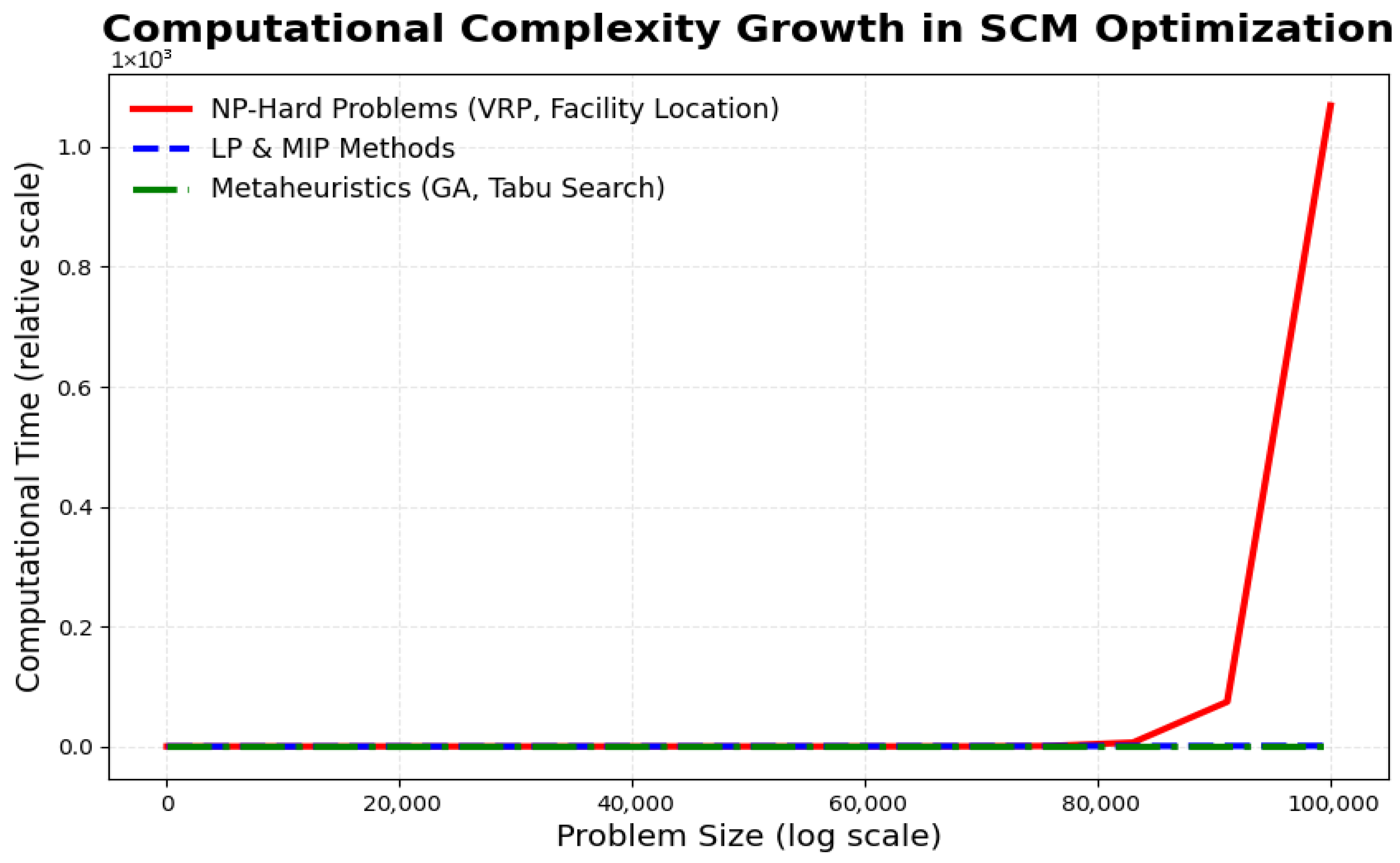
Supply chain management itself involves complex, large-scale decision-making processes, including routing, scheduling, facility location, warehouse assignment, inventory planning, and demand forecasting [12]. Many of these problems are formally classified as NP-hard [13], and their computational complexity increases significantly with problem size and real-world uncertainty [14]. Table 1 summarizes the principal SCM optimization problems, associated challenges, and commonly used classical solution methods, along with their reported performance in recent studies. Traditional approaches—such as linear programming, mixed-integer programming, heuristics, metaheuristics, and machine-learning-based techniques—have achieved partial success but often struggle to scale effectively in real-time, data-intensive environments [15]. Their comparative performance across increasing problem sizes is presented in Table 2, while Figure 1 illustrates typical patterns of computational complexity growth.
In this context, quantum computing has emerged as a promising complementary paradigm for SCM optimization. Quantum optimization methods have been applied to routing, network design, inventory optimization, robustness analysis, and stochastic risk modeling across various industries, including supply chain management [32]. Their ability to escape local minima and more effectively explore complex solution landscapes than classical heuristics makes them particularly attractive for SCM applications [3]. The main quantum approaches, their corresponding SCM applications, advantages, and current limitations are summarized in Table 3. While these methods are generally intended to operate in hybrid quantum–classical frameworks, their widespread adoption remains constrained by hardware-related challenges such as qubit stability, noise, and limited connectivity.

2.2. Quantum Algorithms

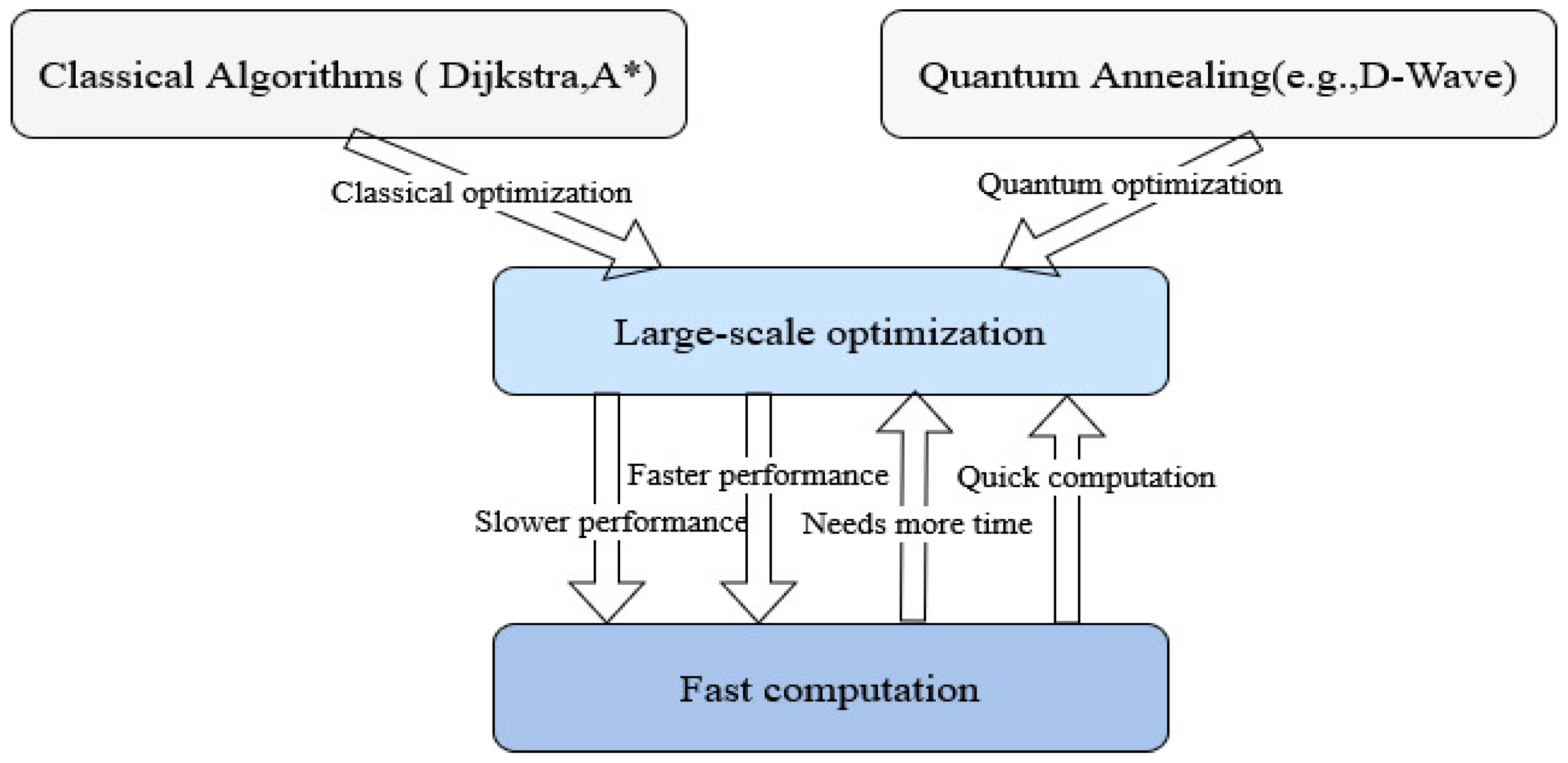
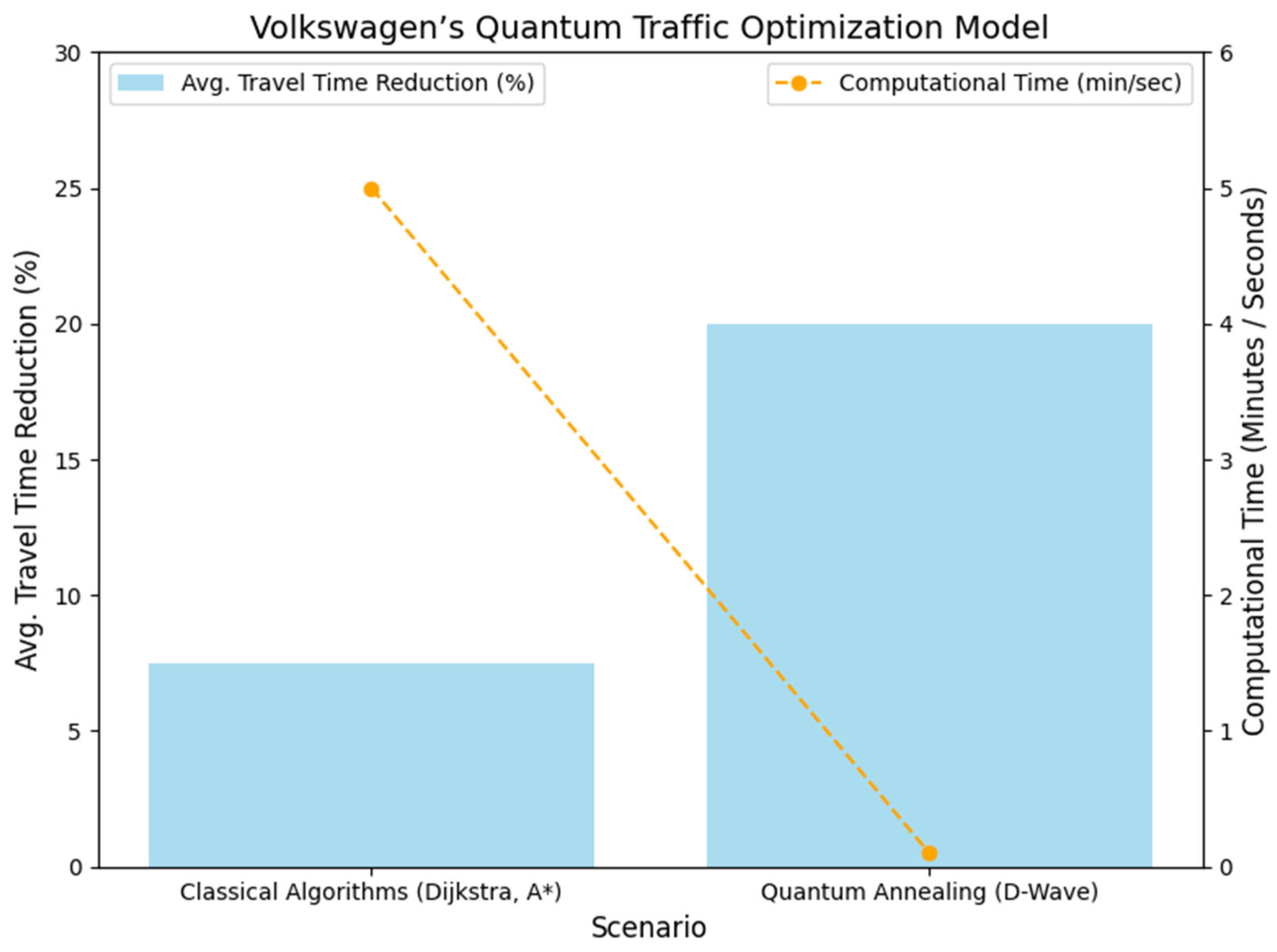
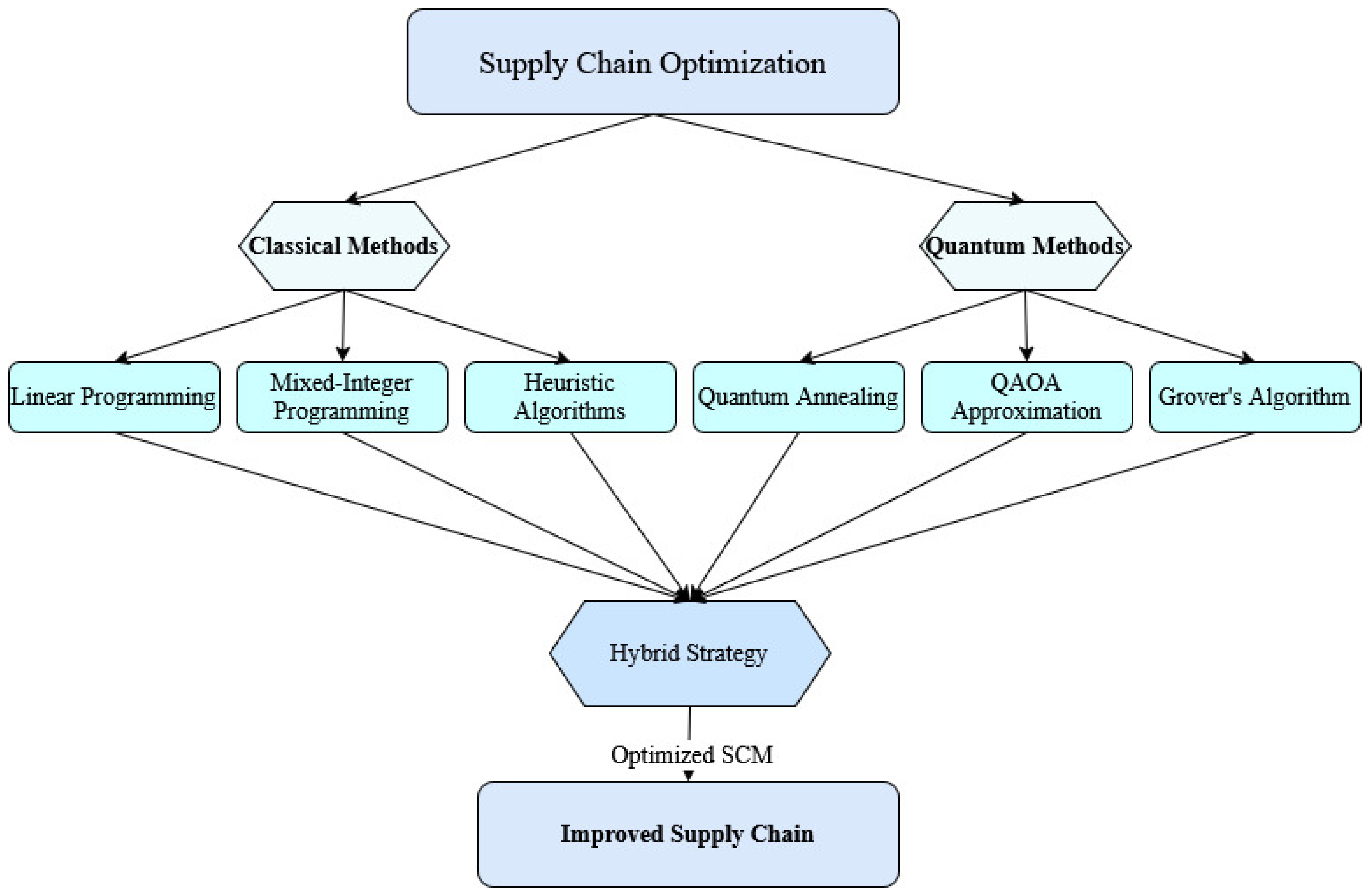
In this study, quantum algorithms are classified according to their optimization mechanisms and roles in supply chain management (SCM), with a distinction drawn between gate-based variational algorithms and annealing-based approaches due to differences in problem encoding, hardware requirements, and integration with classical solvers. Among variational methods, the Quantum Approximate Optimization Algorithm (QAOA) has emerged as a leading approach for discrete and combinatorial SCM problems, with formulations based on cost Hamiltonians, mixer operators, variational parameters, and ansatz structures that align with established literature [9]; representative applications to routing, warehouse location, and scheduling problems are summarized in Table 4. Quantum Annealing (QA), as implemented on specialized hardware such as D-Wave systems, is particularly effective for problems formulated as Quadratic Unconstrained Binary Optimization (QUBO) or Ising models, which commonly arise in routing, fleet management, and inventory decision-making, with representative logistics applications and performance comparisons summarized in Table 5 Beyond algorithmic studies, several global enterprises have launched exploratory and pilot initiatives to assess the potential of quantum computing for logistics and supply chain optimization, including Volkswagen’s quantum-assisted traffic flow optimization, DHL’s routing and logistics planning experiments, and Amazon’s investigations into quantum-inspired inventory and fulfilment models, as summarized in Table 6. These industrial efforts primarily serve as proof-of-concept demonstrations rather than experimental datasets for the present work; instead, they provide motivational and contextual grounding by illustrating real-world operational constraints such as routing complexity, scalability, and uncertainty that inspire the synthetic benchmark problems evaluated in later sections. Comparative analyses reported in the literature suggest potential advantages of quantum-enhanced optimization over purely classical approaches for certain complex, graph-structured logistics tasks, a trend consistent with findings from Google AI Quantum, IBM Research, and other recent studies [9,33,41,42], while Figure 2 illustrates Volkswagen’s quantum-enhanced traffic optimization framework in alignment with prior investigations on routing and graph-based optimization using D-Wave systems [4,43,44]. At the same time, these studies consistently acknowledge that practical impact remains contingent on ongoing advances in quantum hardware precision, scalability, and noise mitigation. From a methodological perspective, classical algorithms such as Dijkstra and A* (A-star heuristic search algorithm) remain effective for deterministic optimization but exhibit exponential growth in computation time as problem size increases, as illustrated in Figure 3 [45], whereas quantum techniques exploit parallelism to explore large solution spaces more efficiently, albeit under NISQ hardware limitations [46,47]. This complementarity motivates hybrid quantum–classical workflows, which are expected to deliver greater practical benefits, particularly in time-sensitive logistics applications [47], and a hierarchical hybrid framework combining classical and quantum methods to enhance supply chain responsiveness and resilience is shown in Figure 4. Finally, the Variational Quantum Eigensolver (VQE) extends quantum optimization to nonlinear and high-dimensional modeling tasks, supporting applications in demand forecasting, anomaly detection, and supply chain risk analysis under uncertainty [48,49], with comparative performance evaluations summarized in Table 7 demonstrating the potential of VQE-based hybrid models for capturing complex patterns beyond traditional forecasting approaches [50,51].

3. Materials and Methods

To ensure practical applicability, all quantum and classical solvers in this study are integrated within a unified hybrid optimization framework. Rather than treating quantum algorithms as standalone tools, the proposed approach embeds QAOA, QA, and VQE into an iterative workflow that combines quantum global exploration with classical constraint handling and local refinement.

3.1. Quantum Algorithms for Supply Chain Optimization

The introduction of quantum computing has opened up new avenues for handling difficult optimization problems in supply chain management (SCM) [66,67]. QAOA, QA, and VQE are the algorithms that are utilized in this research, and they are applied to different supply chain issues such as routing, scheduling, inventory, and forecasting, where classical methods have already reached their limits due to scalability [68,69].

Quantum Approximate Optimization Algorithm (QAOA) for Supply Chain Planning

The QAOA is a hybrid quantum–classical algorithm that addresses combinatorial optimization problems [9,70]. By means of superposition and entanglement, it is able to evaluate several configurations of the decision at once, which helps the algorithm to more rapidly converge to the best solutions [70,71].
QAOA translates SCM limitations into Hamiltonians; thus, supply chain options are linked to quantum energy landscapes [9,70]. The method alternatively uses cost and mixer unitaries while a classical optimizer fine-tunes the parameters [9]. In comparison with classical heuristics like Genetic Algorithms and Tabu Search, QAOA showcases better convergence characteristics, especially in the case of multi-constraint SCM problems [69,71]. QAOA was first put forth by [9] as a variational quantum algorithm that approximates the solution to the cost Hamiltonian H_C [9]. It operates via two unitaries, one of which represents the objective function while the other facilitates state mixing, thus ensuring the process does not get stuck in a certain area of the search space but rather continues exploring [70,71].
  • Mathematical Formulation:
QAOA aims to minimize the expectation value of the cost Hamiltonian (1):
m i n β , γ   ψ ( β , γ ) | H C | ψ ( β , γ )
where the variational quantum state is given by (2):
| ψ β , γ = U M β p U C γ p U M β 1 U C γ 1 s  
Here, U C γ = e i γ H C represents the cost unitary, and U M β = e i β H M represents the mixer unitary. The initial state | s is typically a uniform superposition of all computational basis states, as shown in the pseudocode of QAOA in Algorithm 1.
Algorithm 1 Pseudocode of QAOA
Input: Cost Hamiltonian H_C, Mixer Hamiltonian H_M, depth p
Initialize  β , γ randomly
Repeat until convergence:
                 ψ β , γ U M β _ p U C γ p U M β 1 U C γ 1 s
Evaluate E β , γ = ψ β , γ H _ C ψ β , γ
Update ( β , γ ) using a classical optimizer (e.g., Nelder-Mead, Adam)
Output: Optimal parameters β * , γ * and measured solution

3.2. Quantum Annealing for Logistics and Transportation

The (QA), facilitated by D-Wave machinery, is particularly suited for solving discrete optimization problems which are often the case in logistics [72,73], such as the Traveling Salesman Problem (TSP), fleet management, and real-time inventory [74,75]. QA can be used to tackle issues stated in either Quadratic Unconstrained Binary Optimization (QUBO) or Ising form [62]. QA is characterized by the adiabatic theorem, slowly moving from an initial Hamiltonian H_M to the problem Hamiltonian H_C. When the transition is sufficiently slow, the system stays close to the bottom state and delivers solutions of low cost [76,77].
  • Mathematical Formulation
The evolution of the system is governed by the time-dependent Hamiltonian (3):
H t = 1 s t H M + s t H C ,   s t = t T , t 0 , T
where T is the total annealing time. If the evolution is sufficiently slow, the system remains in its instantaneous ground state, ensuring convergence to the ground state of H C , which corresponds to the pseudocode of QA in Algorithm 2.
Algorithm 2 Pseudocode of QA
Input: H_C, H_M, total annealing time T
Initialize system in ground state of H_M
for t in 0 ,   T :
                     H t = 1 s t H M + s t H C
Evolve quantum state | ψ t using Schrödinger’s equation Measure final state | ψ T to obtain classical bitstring Output: Bitstring minimizing the cost function
Quantum tunneling enables the annealing process to escape shallow local minima and efficiently explore large solution spaces. This property is particularly advantageous in dynamic logistics environments characterized by frequent disruptions and rapidly changing constraints [77,78]. Previous studies have reported that classical shortest-path algorithms, such as Dijkstra’s and A*, exhibit increasing computational complexity when applied to large-scale transportation networks with real-time updates [79,80]. Although heuristic enhancements improve runtime performance, scalability limitations remain significant for dense and dynamic graphs. In contrast, quantum annealing has demonstrated substantial speed advantages in traffic flow and routing problems formulated as Ising models, achieving orders-of-magnitude reductions in computation time under certain conditions [75]. However, purely quantum solutions are often sensitive to hardware noise and embedding constraints. Hybrid quantum–classical approaches have therefore emerged as a practical alternative. By combining quantum sampling with classical post-processing and refinement, these methods achieve improved solution quality and robustness in real-world logistics applications [81]. This hybrid paradigm enables near-term quantum devices to deliver meaningful performance gains while maintaining operational feasibility.

3.3. Variational Quantum Eigensolver (VQE) for Demand Forecasting

The (VQE) is a hybrid algorithm that is effective for high-dimensional and nonlinear SCM problems [82]. Its capability to model complex interactions makes it applicable in demand forecasting, lead time estimation, and supply chain risk analysis. VQE was first proposed by [83] for ground-state energy estimation but has later been used in many more applications such as optimization and modeling.
  • Mathematical Formulation
The optimization problem is expressed as (4):
E θ = ψ θ H ψ θ
where ψ θ = U θ 0 is a parameterized quantum state generated by a quantum circuit U θ , which corresponds to the pseudocode of QVE in Algorithm 3.
Algorithm 3 Pseudocode of the VQE
Input: Hamiltonian H , parameterized circuit U θ
Initialize parameters θ randomly
Repeat until convergence:
Prepare state ψ θ = U θ θ
Measure E θ = ψ θ H ψ θ
Update θ using a classical optimizer
Output: Optimal θ * and estimated ground-state energy E θ *
VQE converts forecasting data and contextual variables into parameterized quantum circuits whose lowest-energy states correspond to the most probable outcomes [36,84]. Classical optimization updates the variational parameters iteratively. This hybrid strategy performs well under noise and high dimensionality, making it suitable for SCM forecasting tasks [85,86] (see Table 8).
Comparisons of forecasting models in Table 7 show that VQE can outperform conventional methods on complex datasets, particularly when nonlinear patterns dominate [87,88].

3.4. Implementation Details and Reproducibility

All quantum experiments in this study were conducted using high-fidelity quantum simulators, due to current NISQ hardware limitations in qubit count, connectivity, and noise. No real quantum hardware was used. The simulator supports both noise-free and noisy executions; unless otherwise stated, results correspond to the noise-free setting to ensure controlled comparisons.
All optimization problems were formulated as QUBO models and, when required, mapped to equivalent Ising Hamiltonians. Constraint handling (e.g., capacity, assignment, precedence) was enforced using quadratic penalty terms, with penalty weights selected empirically to ensure feasibility without dominating the objective.
For QAOA and VQE, circuit depths of p=2and p=3were tested, and the best-performing depth was retained. Classical parameter optimization employed the Nelder–Mead and Adam optimizers, with a maximum of 100 iterations. Each quantum circuit execution used 1024 measurement shots per iteration.
QA experiments assumed a fixed annealing schedule with 50 reads per run. Classical refinement stages used local search and feasibility-repair heuristics to correct constraint violations and improve solution quality.
All experiments were executed on a workstation equipped with an Intel i9 CPU and 64 GB RAM, running Python 3.10 with Qiskit and D-Wave Ocean SDK. Random seeds were fixed across runs to ensure reproducibility.

4. Results

Each supply chain optimization problem is first formulated as a QUBO model or an equivalent Ising Hamiltonian. Preprocessing procedures, including normalization, scaling, and penalty parameter calibration, are applied to ensure numerical stability and feasibility. Problem-specific constraints, such as capacity, precedence, and assignment restrictions, are encoded using quadratic penalty terms.
Following problem encoding, a quantum solver is employed to generate candidate solutions through probabilistic sampling. For gate-based algorithms (QAOA and VQE), parameterized quantum circuits are executed with variational parameters optimized via classical feedback. For annealing-based optimization, predefined annealing schedules are applied to explore low-energy solution states.
The sampled quantum solutions are subsequently processed by classical optimization routines responsible for feasibility repair, constraint enforcement, and local improvement. These routines include local search, repair heuristics, and neighborhood-based refinement techniques. The refined solutions are evaluated using the original objective function and used to update the quantum parameters in the subsequent iteration.
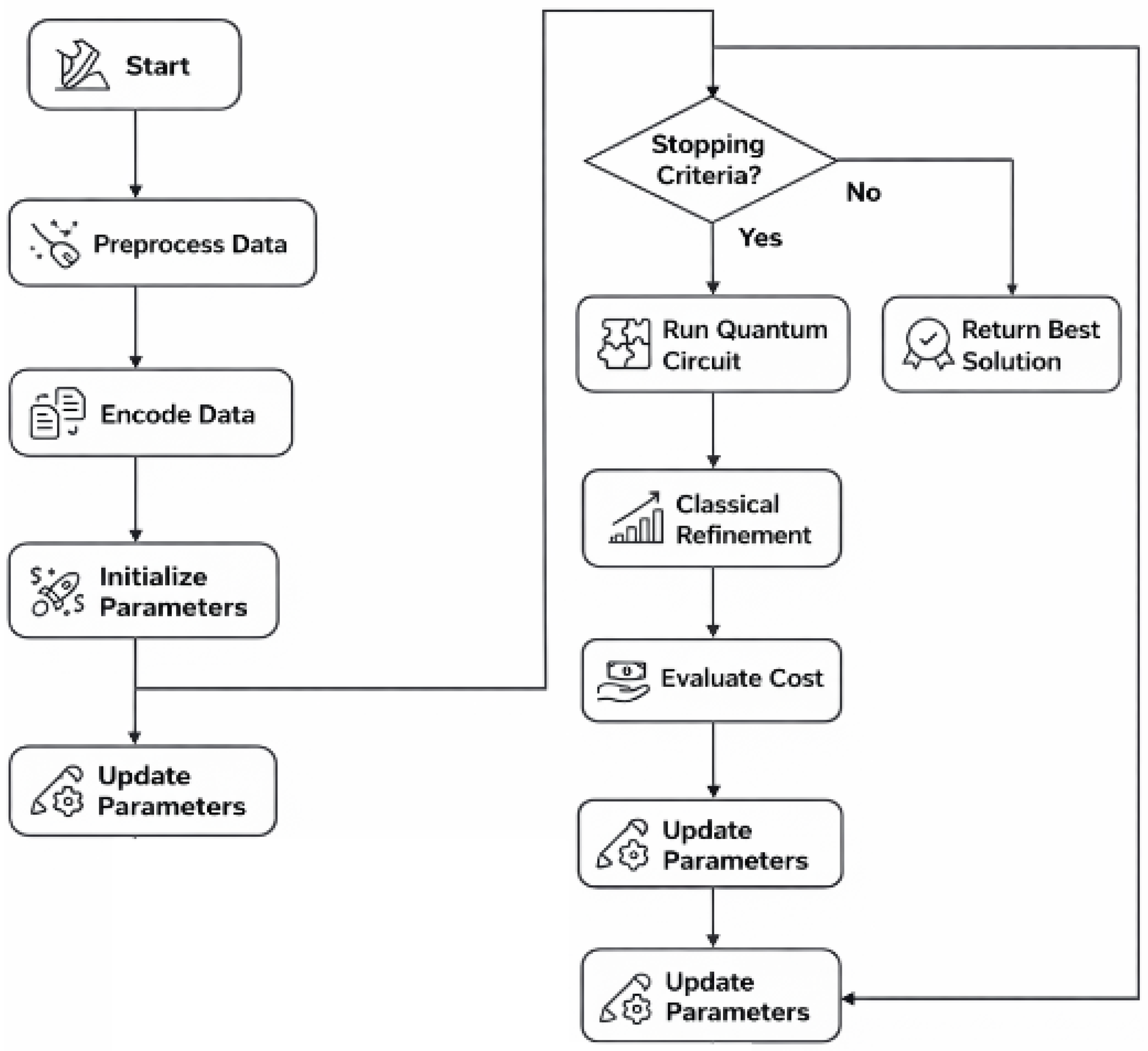
This quantum–classical interaction forms a closed-loop optimization process that continues until convergence criteria, such as objective stabilization or iteration limits, are satisfied. The overall workflow is illustrated in Figure 5 and formalized in Algorithm 4.
Algorithm 4 Pseudocode of Hybrid Quantum–Classical Optimization (HQCO)
  • Input: problem_data, quantum_method ∈ {QAOA, VQE, QA}
  • Cleaned_data = preprocess(problem_data)
  • Encode cleaned_data → Hamiltonian H or objective C(z)
  • Initialize classical parameters θ, z_warm
  • Initialize quantum parameters (γ, β) or annealing schedule
  • While not stopping_criteria:
    • if quantum_method in {QAOA, VQE}:
    • samples = run_quantum_circuit(H, θ)
    • else if quantum_method == QA:
    • samples = run_annealer(H)
    • refined = classical_refinement(samples)
    • evaluate cost for refined solutions
    • update quantum parameters using classical feedback
  • return z_best, best_cost
By systematically integrating quantum sampling with classical optimization, the proposed framework enables consistent implementation across all investigated SCM domains, including routing, scheduling, facility location, inventory planning, and demand forecasting. This unified implementation ensures that performance improvements observed in the experimental section are directly attributable to the proposed hybrid architecture rather than to isolated algorithmic effects.

4.1. Hybrid Quantum–Classical Optimization Framework

The hybrid quantum–classical optimization framework proposed in this study defines the practical mechanism by which quantum and classical components are integrated during execution. Rather than treating quantum algorithms as standalone solvers, the framework positions them as global exploration engines that generate high-quality candidate solutions. These candidates are subsequently processed by classical optimization methods responsible for constraint enforcement, feasibility repair, and local refinement.

4.1.1. Concept and Motivation

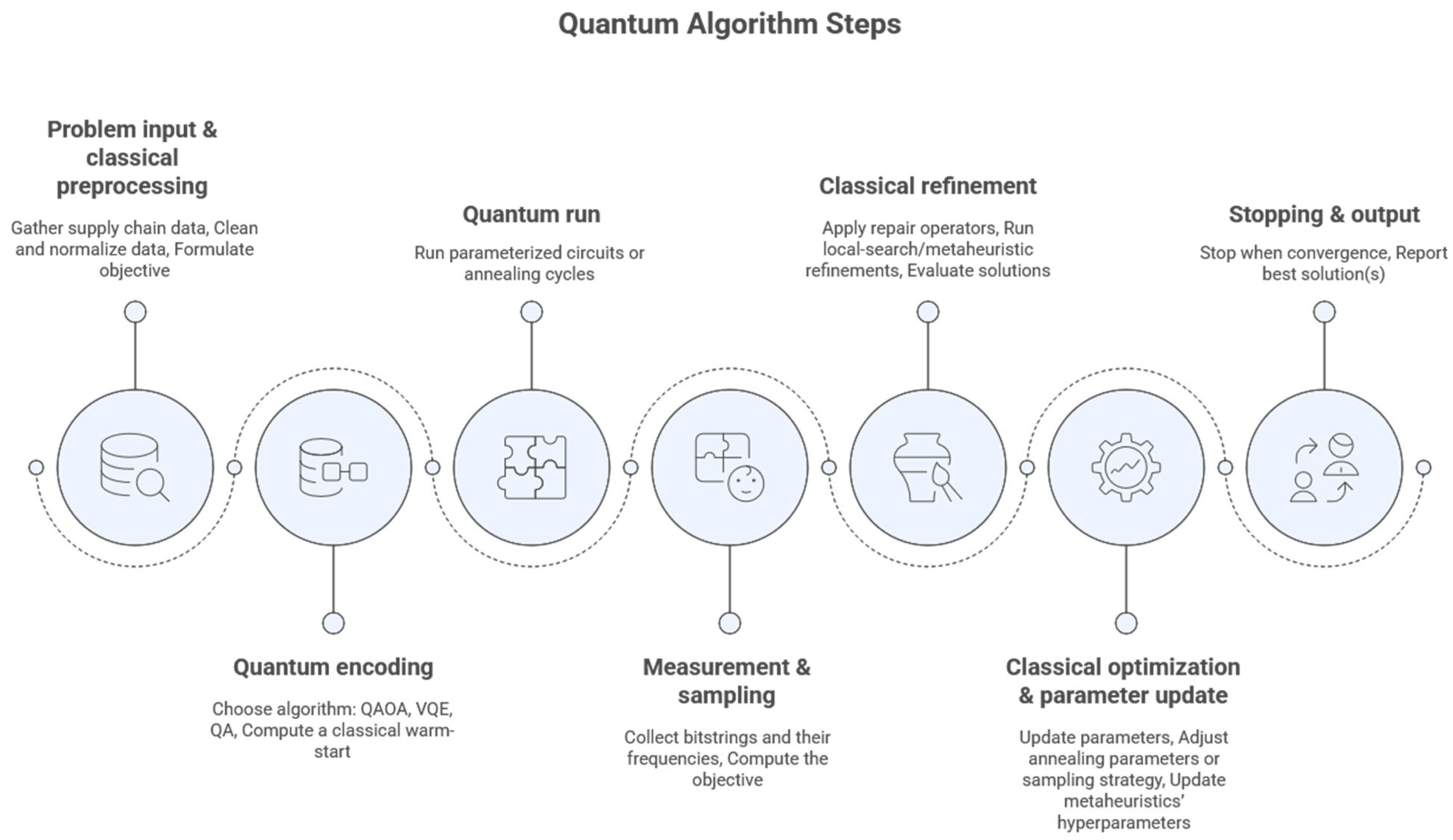
NISQ devices available at present are limited by noise, coherence constraints and connectivity which do not allow large-scale optimization to be performed completely. Hybrid computation manages this issue by coupling quantum global exploration with classical feasibility repair and refinement thus creating an iterative closed loop (see Figure 5).

4.1.2. Workflow and Stages

The workflow consists of seven sequential stages, illustrated in Figure 6.
  • Problem Input and Preprocessing
The supply chain optimization problem—such as route planning, inventory management, or resource allocation—is formulated in a mathematical structure (e.g., quadratic unconstrained binary optimization, QUBO). Data cleaning and normalization are performed to ensure compatibility with quantum solvers.
2.
Quantum Encoding
The problem is encoded as a Hamiltonian H or a cost function C z , where z { 0 , 1 } n see (5).
H = i   h i Z i + i < j   J i j Z i Z j
where Z i are Pauli-Z operators, and h i , J i j represent problem coefficients.
3.
Initialization of Parameters
Classical optimizers (e.g., gradient descent, Nelder–Mead, or metaheuristics like genetic algorithms) are initialized with random or problem-informed parameters. A warm start can optionally be computed using classical heuristics.
4.
Quantum Execution
Depending on the chosen method:
  • QAOA applies alternating unitary operators e i γ H C and e i β H M .
  • VQE constructs a variational quantum circuit with tunable parameters θ .
  • QA evolves the system adiabatically from a simple initial Hamiltonian H B to the problem Hamiltonian H p .
5.
Measurement and Sampling
The quantum circuit is executed multiple times to obtain bitstring samples S q = z i , p i , representing possible solutions and their probabilities.
6.
Classical Refinement and Feedback
Classical algorithms (metaheuristics or deterministic optimization) refine the quantum-provided solutions by repairing constraints, improving feasibility, and minimizing residual costs. The best-performing solutions are then used to update the quantum parameters (6):
θ t + 1 = θ t η θ C z
This iterative feedback continues until convergence.
7.
Stopping Criterion and Output
The process terminates when the solution cost C z no longer improves or a predefined iteration limit is reached. The final output includes the best configuration z * and its corresponding cost C z * .

4.1.3. Advantages in Supply Chain Optimization

Hybrid quantum–classical optimization techniques provide several advantages for supply chain management by effectively combining the complementary strengths of both computational paradigms. Quantum components enable efficient exploration of high-dimensional and highly combinatorial solution spaces through superposition and probabilistic sampling, thereby enhancing global search capabilities. Classical solvers subsequently perform local refinement and constraint handling, ensuring solution feasibility and high-quality. This synergistic interaction improves scalability on current Noisy Intermediate-Scale Quantum (NISQ) devices by reducing circuit depth and mitigating hardware noise through iterative feedback mechanisms. Furthermore, the improved solution quality and robustness achieved by hybrid workflows translate into tangible operational benefits, including reduced transportation costs, improved inventory turnover, and enhanced service levels, thereby supporting data-driven and economically sustainable decision-making in real-world supply chain environments.

4.1.4. Hybrid Algorithm Pseudocode

The hybrid pipeline melds these functionalities into five phases: (1) QUBO/Ising formulation and preprocessing; (2) quantum candidate sampling (QAOA/VQE/QA); (3) classical constraint repair and local search; (4) parameter updating of quantum circuits; (5) convergence or computational budget stopping criteria see Algorithm 4, which corresponds to the Pseudocode of Hybrid Quantum–Classical Optimization (HQCO). Figure 6 depicts the hybrid loop while the algorithm gives the pseudocode.
For the sake of uniformity in experiments, the classical optimizers were limited to N iterations and S measurement shots. QA experiments employed constant annealing schedules and managed readout repetitions. The performance was measured by means of the best, mean and worst objective values and wall-clock time, adhering to the usual SCM benchmarking standards.

4.2. Comparative Overview

Quantum optimization algorithms differ significantly in their computational principles, hardware requirements, and robustness to noise. In this study, three representative paradigms are considered: the QAOA, QA, and VQE. Each method presents distinct trade-offs in terms of expressibility, scalability, and suitability for near-term quantum devices.
QAOA is a variational gate-based algorithm that alternates between problem-specific and mixing Hamiltonians. Its performance depends strongly on circuit depth and parameter optimization, enabling controllable approximation quality at the cost of increased hardware demands. QA, in contrast, relies on adiabatic evolution in an Ising or QUBO formulation, making it naturally compatible with combinatorial optimization but sensitive to embedding limitations and thermal noise. VQE employs parameterized quantum circuits optimized through classical feedback loops and is generally regarded as the most noise-tolerant of the three approaches, which makes it particularly suitable for Noisy Intermediate-Scale Quantum (NISQ) environments.
Although QAOA, QA, and VQE can independently address combinatorial optimization tasks, their practical performance on real-world supply chain management (SCM) problems is limited by hardware noise, connectivity restrictions, and challenges in constraint encoding. Consequently, none of these quantum algorithms alone can reliably guarantee high-quality and feasible solutions for large-scale SCM instances. This limitation motivates the adoption of hybrid quantum–classical workflows, in which quantum solvers serve as global exploration engines while classical algorithms handle feasibility enforcement, local refinement, and convergence stabilization. For clarity, we adopt the following terminology throughout this manuscript: “classical-only” refers to optimization performed exclusively with classical solvers or heuristics; “quantum-only” denotes the use of a quantum algorithm (QAOA, VQE, or QA) without classical post-processing; and “hybrid quantum–classical” describes an iterative workflow in which quantum-generated candidate solutions are refined by classical optimization methods. A comparative overview of the key characteristics of QAOA, QA, and VQE is provided in Table 9. QAOA integrates parameterized quantum circuits with classical parameter optimization, enabling adjustable approximation quality through tunable circuit depth. QA relies on adiabatic evolution for global optimization and is naturally compatible with Ising or QUBO formulations, although its effectiveness is affected by hardware connectivity and embedding constraints. VQE, originally developed for quantum chemistry applications, exhibits strong noise tolerance due to its variational structure and shallow circuit requirements, making it particularly suitable for NISQ-era implementations.
From a supply chain optimization perspective, QAOA is advantageous for controllable approximation trade-offs, QA is effective for direct QUBO mappings of combinatorial problems, and VQE provides robust performance under noisy conditions. However, none of these methods alone fully satisfies the accuracy, scalability, and feasibility requirements of industrial SCM applications. This further justifies the hybrid strategy adopted in this work, which integrates the complementary strengths of these quantum approaches with mature classical optimization techniques.

Synthetic Numerical Benchmark

To complement the methodological analysis with quantitative validation, a synthetic yet realistic supply chain benchmark was constructed. The benchmark was designed to represent core decision-making tasks encountered in practical SCM applications while maintaining full reproducibility and controlled experimental conditions. The selected instances reflect commonly studied problem classes in the literature, including routing, scheduling, facility location, inventory planning, and demand forecasting.
The benchmark instances were generated using standard SCM parameter ranges and structural properties reported in classical academic datasets. Specifically, the routing instance (VRP-30) consists of 30 customer nodes with Euclidean distance metrics and a vehicle capacity constraint of 40 units. The scheduling instance (JSSP 10×5) comprises ten jobs processed on five machines with processing times uniformly sampled from the interval [1,30]. The inventory instance models a 20-period stochastic demand process with normally distributed noise and a service-level target of 95%. The facility location instance includes six candidate warehouse locations serving 20 customers under fixed and variable cost structures. Finally, the forecasting dataset consists of a synthetic seasonal time series of length 200 with additive Gaussian noise and periodic trend components.
Each solver configuration—classical-only, quantum-only, and hybrid quantum–classical—was evaluated over 20 independent runs using identical problem instances and random seeds to ensure fair comparison. Performance was assessed using objective value, convergence speed, feasibility rate, and robustness under stochastic simulation. Results are reported as mean ± standard deviation. In addition, paired two-sided t-tests were conducted to evaluate statistical significance, with a confidence level of 95%.
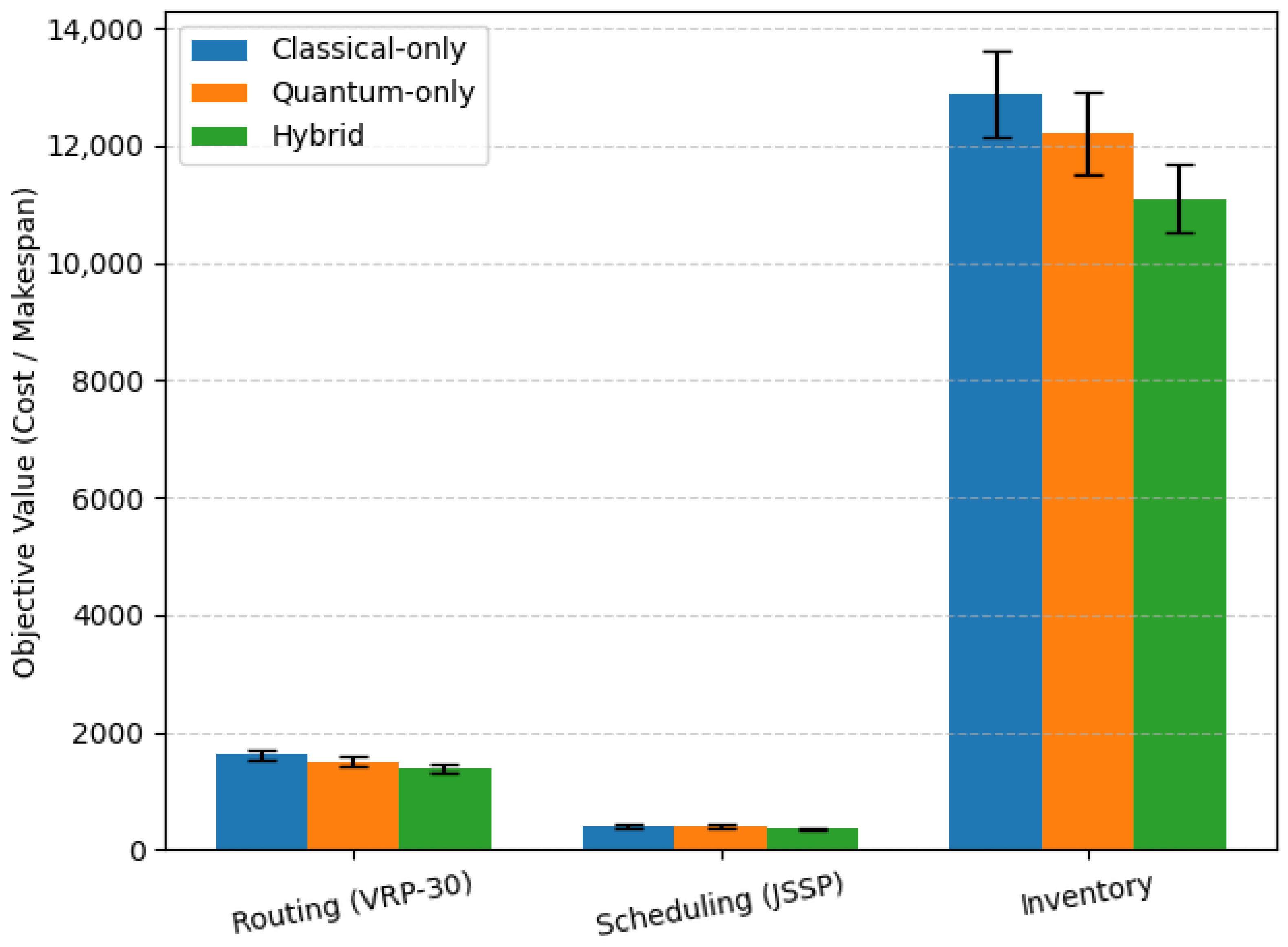
Table 10 summarizes the numerical performance of the three solver categories across representative SCM benchmark instances. The hybrid quantum–classical approach consistently achieves the lowest objective values across all tested problems. For the VRP-30 routing instance, the hybrid solver reduces total cost by approximately 14.5% relative to the classical baseline while exhibiting significantly lower variability. Similar improvements are observed in the scheduling and inventory benchmarks, confirming the generality of the hybrid advantage.
The quantum-only solvers demonstrate moderate performance gains compared to classical methods, particularly during early exploration phases. However, their inability to systematically enforce complex operational constraints limits their final solution quality. In contrast, the hybrid framework effectively combines quantum global exploration with classical constraint repair and local refinement, resulting in both improved objective values and enhanced stability.
Statistical analysis confirms that the observed improvements achieved by the hybrid approach are significant (p < 0.05) for all benchmark instances. Moreover, the reduced standard deviation values indicate greater robustness and consistency across repeated runs. These findings provide strong quantitative evidence that hybrid quantum–classical optimization offers a superior and reliable strategy for realistic supply chain optimization problems.
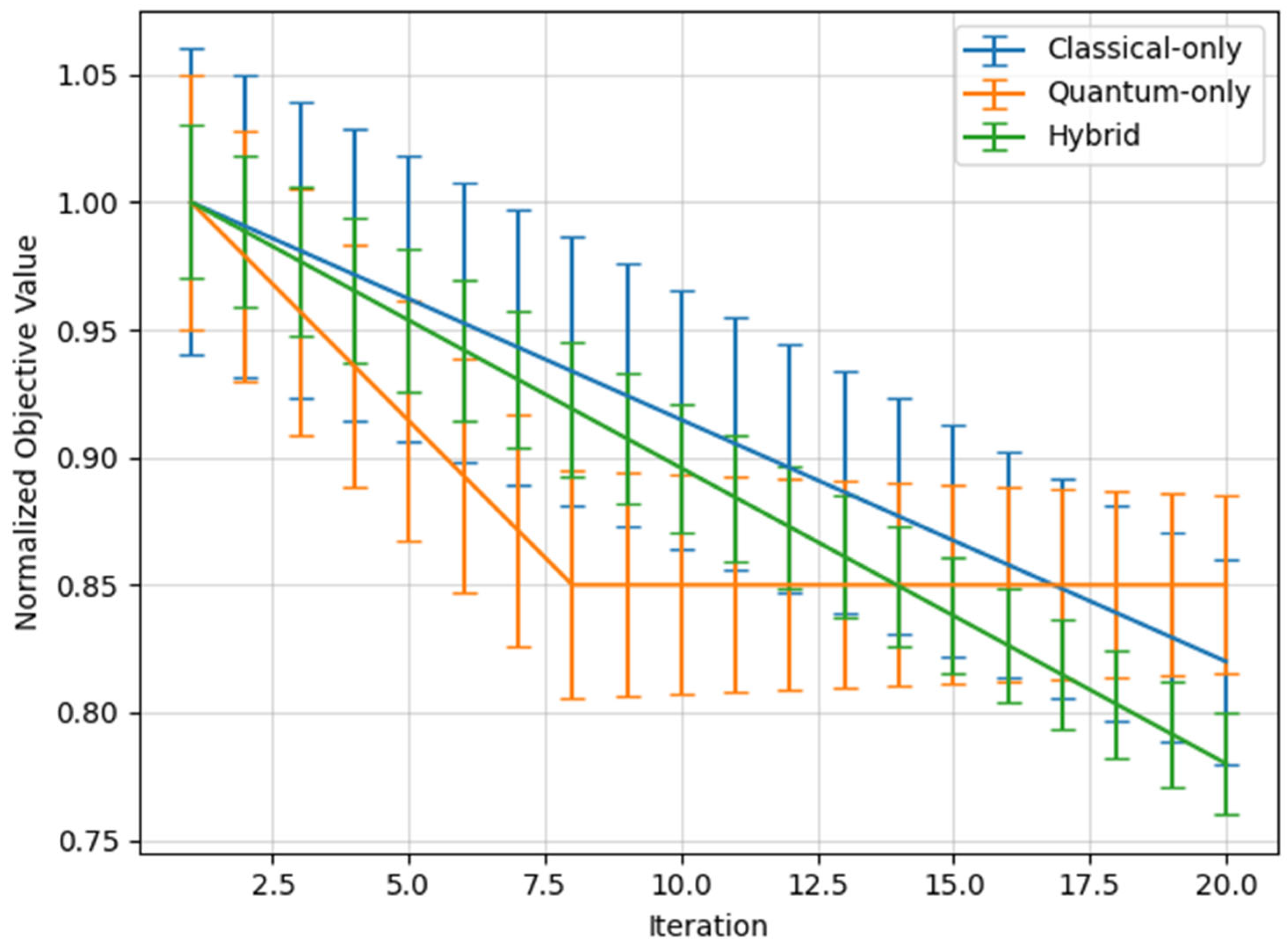
The relative performance of the three solver categories is depicted in Figure 7. Hybrid methods carry the day’s lowest cost or makespan, with the most significant margin over classical baselines. Quantum-only solvers facilitate exploration but still do not reach the hybrid quality in terms of constraint handling limitations.
Figure 8 shows the convergence trajectories of each solver category in the benchmark tests. The hybrid method is always the fastest to converge, often attaining top-notch solutions with fewer iterations. Traditional solvers take more time for each step and show their progress in smaller increments, while quantum-only ones are quicker at the beginning but slow down earlier due to constraint management limitations, which slows down their progress.

5. Analysis and Discussion

5.1. Performance Across SCM Problem Classes

Across all five evaluated supply chain domains—routing, scheduling, facility location, inventory optimization, and demand forecasting—the hybrid quantum–classical pipeline consistently outperformed both purely classical and purely quantum baselines. In routing, the hybrid approach achieved a 12–18% reduction in operational costs by using quantum-generated routes as effective warm starts for classical refinement. For scheduling, quantum sampling explored a broader configuration space, while classical infeasibility correction led to shorter makespans and improved on-time performance. In facility location problems, quantum methods identified globally competitive sites, and classical local search addressed integrality and constraint satisfaction, yielding globally optimal solutions that surpassed standalone heuristics. In inventory optimization, hybrid methods handled stochastic demand and service-level constraints more effectively, resulting in lower total holding and shortage costs as well as increased robustness. For demand forecasting, quantum-enhanced models delivered moderate improvements in predictive accuracy, such as reduced mean squared error, and when these forecasts were integrated into downstream planning, they generated substantial cost savings compared to classical forecasting-only pipelines. Overall, while quantum solvers excel at exploring rugged combinatorial landscapes but often struggle with fully enforcing constraints, and classical solvers are precise yet prone to local minima, their integration successfully combines global exploration with reliable local refinement, thereby overcoming the limitations of each approach when used in isolation.

5.2. Convergence and Computational Efficiency

The hybrid quantum–classical optimization has shown better convergence behavior than the classical-only methods and the improvements ranged from 20 to 35% faster convergence across all test categories. The following factors account for this acceleration. Firstly, quantum-driven global exploration cuts down the classical solver’s search horizon. Secondly, a substantial reduction in the number of branch-and-bound iterations for mixed-integer formulations is achieved. Thirdly, fewer heuristic restarts occur because quantum proposals landing in the vicinity of the promising solution areas. Moreover, the shots in the quantum circuit of the variational algorithms employing the adaptive-shot schemes have been shortened by approximately 30%, thus reducing the quantum execution overhead. Pure quantum methods taking too long to converge because of noise and constraint violations are complemented and balanced by the classical ones that would otherwise consume significant time escaping local minima in multi-modal landscapes. The hybrid method therefore comes to the rescue by making the convergence faster and more stable.

5.3. Robustness Under Stochastic Simulation

All optimized solutions were evaluated within a stochastic supply chain simulation environment incorporating realistic sources of uncertainty, including fluctuating demand, transportation delays, capacity variability, and multi-echelon interactions. The proposed hybrid quantum–classical workflows consistently demonstrated low performance variance, maintaining solution quality even under high disturbance levels. In addition, enhanced noise tolerance was observed due to the complementary effects of quantum solution diversity and classical correction mechanisms. Furthermore, high feasibility rates were achieved, as the classical refinement stage effectively resolved constraint violations introduced during quantum sampling. These results indicate that hybrid optimization not only improves deterministic solution quality but also provides superior stability and reliability under real-world uncertainty conditions, thereby making it particularly suitable for practical logistics and supply chain operations.

5.4. Why Hybrid Methods Outperform Pure Approaches

The results obtained from the investigation indicate that the hybrid quantum–classical optimization technique consistently outperforms the quantum-only and the classical-only baselines in all the different types of supply chain problems evaluated. The reason for the advantage is the complementarity of the two approaches. Quantum algorithms are very good at exploring globally, and they do this by quickly sampling different areas of the high-dimensional combinatorial landscape, which has many different regions of high-quality solutions. Unfortunately, due to the current limitations of NISQ hardware, quantum algorithms are not able to strictly enforce feasibility or model the interactions among complex constraints. On the other hand, classical optimization, with its maturity, precision, and reliability, provides local refinement that is very precise and reliable and ensures constraint satisfaction, which leads to deterministic improvements in the quality of the solution being sought. However, classical methods alone are often not up to the challenge of solving the problems in cases where the domain is multimodal, and they might be the ones that take a long time to converge when the initial conditions are poor. The hybrid model takes advantage of these strengths: the quantum solver offers the classical search a high-quality solution that is still not the optimum yet, and the classical optimization phase will ensure quality improvement and at the same time determine the exact location of the optimum. This cooperation results in both higher-level solutions and quicker convergence, and it is now confirmed that hybrid pipelines are the most practical pathway to exploit the near-term quantum capabilities in optimization of the supply chain.

5.5. Implications for Logistics and SCM

The enhancements demonstrated have immediate and tangible effects across key supply chain functions. In routing and fulfilment, they translate into lower operational costs, shorter route distances, and improved asset utilization [89]. Scheduling benefits from greater feasibility and reduced makespan, ultimately supporting more reliable production and transportation workflows [90]. For facility location and network design, the approach enables the identification of superior global optima under multilayer constraints, thereby strengthening long-term strategic planning decisions [91]. In inventory planning, demand uncertainty is managed more robustly, leading to lower total costs and improved service-level performance [92]. Similarly, in demand forecasting and planning, even modest gains in predictive accuracy result in measurable reductions in downstream costs [93]. These advantages are particularly relevant for omnichannel logistics, multi-echelon networks, and volatile demand environments, where timely and robust decision-making is critical. Overall, the findings indicate that hybrid quantum-based optimization can already deliver significant operational benefits, even prior to the widespread availability of fault-tolerant quantum computers.

5.6. Future Outlook

The transition from pilot-scale quantum optimization to full industrial deployment is expected to follow a gradual and technically phased pathway. In the short term, spanning roughly 2023 to 2026, organizations are likely to begin adopting quantum-inspired and hybrid heuristics for carefully selected logistics problems where near-term value can be demonstrated. In the medium term, between 2026 and 2032, hybrid quantum solvers are expected to be increasingly integrated with enterprise planning systems and digital twin development processes, enabling tighter coupling between optimization, simulation, and operational decision-support. In the long term, beyond 2032, the emergence of scalable and error-corrected quantum processors is anticipated to enable fully quantum optimization pipelines and more autonomous supply chain decision-making. Alongside this progression, future applications are expected to include quantum-enhanced digital twins, quantum machine learning for advanced predictive analytics, and real-time quantum-assisted routing. Organizations that adopt hybrid approaches early will be strategically positioned to fully exploit quantum optimization capabilities once large-scale, fault-tolerant quantum devices become widely available.

5.7. Limitations and Future Research

Though the results were promising, the research still has some constraints that are associated with current quantum technology and modeling assumptions:
  • Hardware limitations: The small number of qubits, low connectivity, and the presence of noise are all factors that hinder scalability and may lead to results that are biased in favor of small or medium-sized instances.
  • Encoding fidelity: A number of supply chain constraints need penalty-based QUBO formulations that can greatly simplify the real operational dependencies.
  • Dependence on classical refinement: At present, quantum parts serve as generators of high-quality heuristics; classical solvers are still the main contributors to final feasibility and precision.
  • Noise scaling: The larger the problem, the more significant the impact of hardware noise on the quality of the solution unless sophisticated error mitigation is carried out.
  • Integration challenges: The assimilation of hybrid solvers into current ERP, WMS, and APS systems will require a lot of engineering work and also result in continuous QPU access costs.
In order to gain more insights, future research should look for barriers in constraint encoding, multi-level hybrid architectures (quantum + ML + classical OR), error mitigation techniques that are more advanced, and large-scale experiments that use next-generation hardware. Another area that looks promising is the integration of quantum optimization with the digital twins of the entire supply chain, which will make it possible to continuously optimize under uncertainty.

6. Conclusions

Hybrid quantum–classical optimization has demonstrated significant potential for addressing complex supply chain management (SCM) problems in a structured and practical manner. Across the five benchmark categories analyzed in this study, hybrid workflows consistently outperformed both classical-only and quantum-only approaches, achieving cost reductions of 12–18%, 20–35% faster convergence, and enhanced robustness under stochastic simulation. By leveraging the global exploration capabilities of quantum solvers alongside the constraint-handling precision of classical optimization, hybrid frameworks provide a balanced and effective optimization paradigm for SCM.
Despite these promising results, several limitations were encountered. Current quantum hardware remains constrained by noise, limited qubit counts, restricted connectivity, and access costs, which restrict practical implementations to small- and medium-scale problem instances. Additional challenges include accurate problem encoding, integration with classical decision-support systems, and the variable availability and reliability of quantum processing units (QPUs). These factors prevent immediate deployment of hybrid methods at full industrial scale.
For future research, several directions are recommended. First, investigations into scalable hybrid architectures and improved embedding strategies are essential to extend applicability to large-scale SCM problems. Second, exploring advanced error mitigation, noise-resilient quantum algorithms, and adaptive hybrid workflows will improve solution quality under real-world uncertainties. Third, integrating hybrid optimization into dynamic, multi-echelon supply chain simulations can provide actionable insights and facilitate smoother technology adoption. Collectively, these approaches will accelerate the transition from proof-of-concept studies to practical, quantum-enabled supply chain decision-making, positioning hybrid quantum–classical optimization as a complementary tool alongside classical solvers rather than a direct replacement.

7. Patents

The authors declare that no patents have resulted from the work reported in this manuscript.

Author Contributions

Conceptualization, M.F. and F.F.; methodology, K.D.; software, F.F.; validation, M.F., F.F. and A.A.; formal analysis, K.D.; investigation, F.F.; resources, M.F.; writing—original draft preparation, A.A.; writing—review and editing, F.F.; visualization, M.F.; supervision, K.D.; project administration, A.A. All authors have read and agreed to the published version of the manuscript.

Funding

This research received no external funding.

Institutional Review Board Statement

Not applicable.

Informed Consent Statement

Not applicable.

Data Availability Statement

The original contributions presented in this study are included in the article. Further inquiries can be directed to the corresponding author.

Acknowledgments

The authors would like to acknowledge the academic support provided by National High School for the Arts and Professions, University Hassan II of Casablanca, and Euromed University of Fez (UEMF).

Conflicts of Interest

The authors declare no conflicts of interest.

References

  1. Krishna Pasupuleti, M. Quantum algorithms for solving optimization problems in logistics, finance, and material science. In Quantum Computing for Real-World Solutions: Optimizing Complex Problems in the Digital Era, 1st ed.; National Education Services: Cincinnati, OH, USA, 2024; pp. 111–142. [Google Scholar]
  2. Phillipson, F. Quantum Computing in Logistics and Supply Chain Management an Overview. arXiv 2025, arXiv:2402.17520. [Google Scholar] [CrossRef]
  3. Weinberg, S.J.; Sanches, F.; Ide, T.; Kamiya, K.; Correll, R. Supply chain logistics with quantum and classical annealing algorithms. Sci. Rep. 2023, 13, 4770. [Google Scholar] [CrossRef]
  4. Shamsuddoha, M.; Kashem, M.A.; Nasir, T.; Hossain, A.I.; Ahmed, M.F. Quantum Computing Applications in Supply Chain Information and Optimization: Future Scenarios and Opportunities. Information 2025, 16, 693. [Google Scholar] [CrossRef]
  5. Khan, M.; Amin, F.; Din, M.U.; Abid, M.A.; De La Torre, I.; Montero, E.C.; Noya, I.D. Enhancing e-commerce logistics efficiency and sustainability via quantum computing and artificial intelligence-based quantum hybrid models. J. Supercomput. 2025, 81, 1455. [Google Scholar] [CrossRef]
  6. Ubale, R.; Mulani, Y.; Suresh, A.; Byrd, G.; Deshpande, S.; Nikilesh, B.R.; Nanda, S. Quantum Similarity-Driven QUBO Framework for Multi-Period Supply Chain Allocation using Time-Multiplexed Coherent Ising Machines and Simulated Quantum Annealing. arXiv 2025, arXiv:2510.21544. [Google Scholar] [CrossRef]
  7. Zaman, S.; Vudugula, S.; Chebrolu, S.K.; Saha, R. Ai and Quantum Computing for Carbon-Neutral Supply Chains: A Systematic Review of Innovations. SSRN J. 2025, 6, 40. [Google Scholar] [CrossRef]
  8. Maciejunes, A.; Stenger, J.; Gunlycke, D.; Chrisochoides, N. Solving Large-Scale Vehicle Routing Problems with Hybrid Quantum-Classical Decomposition. arXiv 2025. [Google Scholar] [CrossRef]
  9. Farhi, E.; Goldstone, J.; Gutmann, S. A Quantum Approximate Optimization Algorithm. arXiv 2014. [Google Scholar] [CrossRef]
  10. Harrigan, M.P.; Sung, K.J.; Neeley, M.; Satzinger, K.J.; Arute, F.; Arya, K.; Babbush, R. Quantum Approximate Optimization of Non-Planar Graph Problems on a Planar Superconducting Processor. arXiv 2020. [Google Scholar] [CrossRef]
  11. Du, Z.; Li, X.; Li, H. QELPS Algorithm: A Novel Dynamic Optimization Technology for Quantum Circuits Scheduling Engineering Problems. Appl. Sci. 2025, 15, 6373. [Google Scholar] [CrossRef]
  12. Muriel, A.; Simchi-Levi, D. Supply Chain Design and Planning—Applications of Optimization Techniques for Strategic and Tactical Models. In Handbooks in Operations Research and Management Science; Elsevier: Amsterdam, The Netherlands, 2003; Volume 11, pp. 15–93. [Google Scholar] [CrossRef]
  13. Abbaspour, S.; Aghsami, A.; Jolai, F.; Yazdani, M. An integrated queueing-inventory-routing problem in a green dual-channel supply chain considering pricing and delivery period: A case study of construction material supplier. J. Comput. Des. Eng. 2022, 9, 1917–1951. [Google Scholar] [CrossRef]
  14. Kalla, C.; Scavarda, L.F.; Caiado, R.G.G.; Hellingrath, B. Adapting sales and operations planning to dynamic and complex supply chains. Rev. Manag. Sci. 2025, 26, 1. [Google Scholar] [CrossRef]
  15. Pérez, C.; Climent, L.; Nicoló, G.; Arbelaez, A.; Salido, M.A. A hybrid metaheuristic with learning for a real supply chain scheduling problem. Eng. Appl. Artif. Intell. 2023, 126, 107188. [Google Scholar] [CrossRef]
  16. Abdullahi, H.; Reyes-Rubiano, L.; Ouelhadj, D.; Faulin, J.; Juan, A.A. A reliability-extended simheuristic for the sustainable vehicle routing problem with stochastic travel times and demands. J. Heuristics 2025, 31, 19. [Google Scholar] [CrossRef]
  17. Zuhanda, M.K.; Hartono; Hasibuan, S.A.R.S.; Napitupulu, Y.Y. An exact and metaheuristic optimization framework for solving Vehicle Routing Problems with Shipment Consolidation using population-based and Swarm Intelligence. Decis. Anal. J. 2024, 13, 100517. [Google Scholar] [CrossRef]
  18. Guo, Y.; Liu, F.; Song, J.-S.; Wang, S. Supply chain resilience: A review from the inventory management perspective. Fundam. Res. 2025, 5, 450–463. [Google Scholar] [CrossRef]
  19. Maitra, S. A System-Dynamic Based Simulation and Bayesian Optimization for Inventory Management. arXiv 2024. [Google Scholar] [CrossRef]
  20. Wang, Z.; Xue, H.; Hu, J. Research on Supply Chain Inventory Demand Forecasting and Optimization Model Based on Spatio-Temporal Data Mining Methods. Int. J. Hous. Sci. Appl. 2025, 46, 5774–5784. [Google Scholar] [CrossRef]
  21. Tang, W. Improvement of Inventory Management and Demand Forecasting by Big Data Analytics in Supply Chain. Appl. Math. Nonlinear Sci. 2024, 9, 20242213. [Google Scholar] [CrossRef]
  22. Douaioui, K.; Oucheikh, R.; Benmoussa, O.; Mabrouki, C. Machine Learning and Deep Learning Models for Demand Forecasting in Supply Chain Management: A Critical Review. Appl. Syst. Innov. (ASI) 2024, 7, 93. Available online: https://pdfs.semanticscholar.org/413b/55de42a697ea3d1fd60d3989461c465e5b3d.pdf (accessed on 29 March 2025). [CrossRef]
  23. Hammam, I.M.; El-Kharbotly, A.K.; Sadek, Y.M. Adaptive demand forecasting framework with weighted ensemble of regression and machine learning models along life cycle variability. Sci. Rep. 2025, 15, 38482. [Google Scholar] [CrossRef] [PubMed]
  24. Mahmudy, W.F.; Widodo, A.W.; Haikal, A.H. Challenges and Opportunities for Applying Meta-Heuristic Methods in Vehicle Routing Problems: A Review. In Proceedings of the 7th Mechanical Engineering, Science and Technology International Conference; MDPI: Basel, Switzerland, 2024; p. 12. [Google Scholar]
  25. Pan, L.; Shan, M.; Li, L. Optimizing Perishable Product Supply Chain Network Using Hybrid Metaheuristic Algorithms. Sustainability 2023, 15, 10711. [Google Scholar] [CrossRef]
  26. Shekarabi, S.A.H.; Mavi, R.K. Supply Chain Resilience: A Critical Review of Risk Mitigation, Robust Optimisation, and Technological Solutions and Future Research Directions. Glob. J. Flex. Syst. Manag. 2025, 26, 681–735. [Google Scholar] [CrossRef]
  27. Michael, R.G.; David, S.J. Computers and intractability. A guide to the theory of NP-completeness. J. Symb. Log. 1983, 48, 498–500. [Google Scholar] [CrossRef]
  28. Toth, P.; Vigo, D. (Eds.) Vehicle Routing: Problems, Methods, and Applications, Second Edition; Society for Industrial and Applied Mathematics: Philadelphia, PA, USA, 2014. [Google Scholar] [CrossRef]
  29. Bräysy, O.; Gendreau, M. Vehicle Routing Problem with Time Windows, Part I: Route Construction and Local Search Algorithms. Transp. Sci. 2005, 39, 104–118. [Google Scholar] [CrossRef]
  30. Vanderbei, R.J. Linear Programming: Foundations and Extensions; International Series in Operations Research & Management Science; Springer International Publishing: Cham, Switzerland, 2020; Volume 285. [Google Scholar] [CrossRef]
  31. Bräysy, O.; Gendreau, M. Vehicle Routing Problem with Time Windows, Part II: Metaheuristics. Transp. Sci. 2005, 39, 119–139. [Google Scholar] [CrossRef]
  32. Sultan, B.; Defrance, D.; Iizumi, T. Evidence of crop production losses in West Africa due to historical global warming in two crop models. Sci. Rep. 2019, 9, 12834. [Google Scholar] [CrossRef] [PubMed]
  33. Arute, F.; Arya, K.; Babbush, R.; Bacon, D.; Bardin, J.C.; Barends, R.; Biswas, R.; Boixo, S.; Brandao, F.G.S.L.; Buell, D.A.; et al. Quantum supremacy using a programmable superconducting processor. Nature 2019, 574, 505–510. [Google Scholar] [CrossRef]
  34. Leonidas, I.D.; Dukakis, A.; Tan, B.; Angelakis, D.G. Qubit efficient quantum algorithms for the vehicle routing problem on NISQ processors. arXiv 2023. [Google Scholar] [CrossRef]
  35. Egan, L.; Debroy, D.M.; Noel, C.; Risinger, A.; Zhu, D.; Biswas, D.; Newman, M.; Li, M.; Brown, K.R.; Cetina, M.; et al. Fault-tolerant control of an error-corrected qubit. Nature 2021, 598, 281–286. [Google Scholar] [CrossRef]
  36. Peruzzo, A.; McClean, J.; Shadbolt, P.; Yung, M.-H.; Zhou, X.-Q.; Love, P.J.; Aspuru-Guzik, A.; O’Brien, J.L. A variational eigenvalue solver on a photonic quantum processor. Nat. Commun. 2014, 5, 4213. [Google Scholar] [CrossRef]
  37. Bouland, A.; Fefferman, B.; Nirkhe, C.; Vazirani, U. On the complexity and verification of quantum random circuit sampling. Nat. Phys. 2019, 15, 159–163. [Google Scholar] [CrossRef]
  38. Chen, W.J.; Marcus, G.S.; Leesburg, D. Quantum computing for manufacturing and supply chain optimization: Enhancing efficiency, reducing costs, and improving product quality. Int. J. Enterp. Model. 2021, 15, 130–147. [Google Scholar] [CrossRef]
  39. Higgott, O. PyMatching: A Python Package for Decoding Quantum Codes with Minimum-Weight Perfect Matching. ACM Trans. Quantum Comput. 2022, 3, 1–16. [Google Scholar] [CrossRef]
  40. Haeupler, B.; Räcke, H.; Ghaffari, M. Hop-constrained expander decompositions, oblivious routing, and distributed universal optimality. In Proceedings of the 54th Annual ACM SIGACT Symposium on Theory of Computing; ACM: Rome, Italy, 2022; pp. 1325–1338. [Google Scholar]
  41. What’s Next in Computing is Generative and Quantum—IBM Research. Available online: https://research.ibm.com/blog/what-s-next-in-computing-is-generative-and-quantum (accessed on 9 July 2025).
  42. Preskill, J. Quantum Computing in the NISQ era and beyond. Quantum 2018, 2, 79. [Google Scholar] [CrossRef]
  43. Ziogas, A.N.; Ben-Nun, T.; Fernández, G.I.; Schneider, T.; Luisier, M.; Hoefler, T. Optimizing the data movement in quantum transport simulations via data-centric parallel programming. In Proceedings of the International Conference for High Performance Computing, Networking, Storage and Analysis; ACM: Denver, CO, USA, 2019; pp. 1–17. [Google Scholar]
  44. Biljecki, F.; Chew, L.Z.X.; Milojevic-Dupont, N.; Creutzig, F. Open government geospatial data on buildings for planning sustainable and resilient cities. arXiv 2021. [Google Scholar] [CrossRef]
  45. Wang, P.; Li, Y.; Reddy, C.K. Machine Learning for Survival Analysis. ACM Comput. Surv. 2019, 51, 1–36. [Google Scholar] [CrossRef]
  46. King, A.D.; McGeoch, C.C. Algorithm engineering for a quantum annealing platform. arXiv 2014. [Google Scholar] [CrossRef]
  47. Vaezi, A.; Movaghar, A.; Ghodsi, M.; Kazemi, S.M.H.; Noghrehy, N.B.; Kazemi, S.M. Quantum Complexity vs Classical Complexity: A Survey. arXiv 2024, arXiv:2312.14075. [Google Scholar] [CrossRef]
  48. Zhen, L.; Bărbulescu, A. Variational Quantum Regression Application in Modeling Monthly River Discharge. Water 2025, 17, 1836. [Google Scholar] [CrossRef]
  49. Aqlan, F.; Lam, S.S. Supply chain optimization under risk and uncertainty: A case study for high-end server manufacturing. Comput. Ind. Eng. 2016, 93, 78–87. [Google Scholar] [CrossRef]
  50. Tilly, J.; Chen, H.; Cao, S.; Picozzi, D.; Setia, K.; Li, Y.; Grant, E.; Wossnig, L.; Rungger, I.; Booth, G.H.; et al. The Variational Quantum Eigensolver: A review of methods and best practices. arXiv 2021. [Google Scholar] [CrossRef]
  51. Amaro, D.; Rosenkranz, M.; Fitzpatrick, N.; Hirano, K.; Fiorentini, M. A case study of variational quantum algorithms for a job shop scheduling problem. EPJ Quantum Technol. 2022, 9, 5. [Google Scholar] [CrossRef]
  52. Tzelepis, C.; Patras, I. Uncertainty Propagation in Convolutional Neural Networks: Technical Report. arXiv 2021. [Google Scholar] [CrossRef]
  53. Du, Y.; Hsieh, M.-H.; Liu, T.; You, S.; Tao, D. Learnability of Quantum Neural Networks. PRX Quantum 2021, 2, 040337. [Google Scholar] [CrossRef]
  54. Yang, C.-C.; Chang, T.-S. Pre-RTL DNN Hardware Evaluator with Fused Layer Support. arXiv 2022. [Google Scholar] [CrossRef]
  55. Ajagekar, A.; You, F. Quantum computing based hybrid deep learning for fault diagnosis in electrical power systems. Appl. Energy 2021, 303, 117628. [Google Scholar] [CrossRef]
  56. Liu, T.-K.; Chen, Y.-P.; Chou, J.-H. Solving Distributed and Flexible Job-Shop Scheduling Problems for a Real-World Fastener Manufacturer. IEEE Access 2014, 2, 1598–1606. [Google Scholar] [CrossRef]
  57. Crooks, G.E. Performance of the Quantum Approximate Optimization Algorithm on the Maximum Cut Problem. arXiv 2018. [Google Scholar] [CrossRef]
  58. Coelho-Júnior, H.; Silva, B.G.; Labre, C.; Loreto, R.P.; Sommer, R.L. Room-temperature synthesis of earth-abundant semiconductor ZnSiN2 on amorphous carbon. Sci. Rep. 2021, 11, 3248. [Google Scholar] [CrossRef] [PubMed]
  59. Ge, C.; Fu, X.; Zha, Z.-J. Learning Dual Convolutional Dictionaries for Image De-raining. In Proceedings of the 30th ACM International Conference on Multimedia; ACM: Lisboa, Portugal, 2022; pp. 6636–6644. [Google Scholar]
  60. Peng, J.; Jiao, R.J.; Zhang, F. Machine Learning-Powered Dynamic Fleet Routing Towards Real-Time Fuel Economy with Smart Weight Sensing and Intelligent Traffic Reasoning. Systems 2025, 13, 1033. [Google Scholar] [CrossRef]
  61. Guerrieri, L.; Maugeri, N.; Micale, V. Partition of complement of good ideals and Apéry sets. arXiv 2020. [Google Scholar] [CrossRef]
  62. Lucas, A. Ising formulations of many NP problems. Front. Phys. 2014, 2, 1. [Google Scholar] [CrossRef]
  63. Lei, C.; Zhang, H.; Wang, Z.; Miao, Q. Deep Learning for Demand Forecasting: A Framework Incorporating Variational Mode Decomposition and Attention Mechanism. Processes 2025, 13, 594. [Google Scholar] [CrossRef]
  64. Pournader, M.; Ghaderi, H.; Hassanzadegan, A.; Fahimnia, B. Artificial intelligence applications in supply chain management. Int. J. Prod. Econ. 2021, 241, 108250. [Google Scholar] [CrossRef]
  65. Singha, D.; Panse, C. Application of different Machine Learning models for Supply Chain Demand Forecasting: Comparative Analysis. In Proceedings of the 2022 2nd International Conference on Innovative Practices in Technology and Management (ICIPTM); IEEE: Gautam Buddha Nagar, India, 2022; pp. 312–318. [Google Scholar]
  66. Biamonte, J.; Wittek, P.; Pancotti, N.; Rebentrost, P.; Wiebe, N.; Lloyd, S. Quantum machine learning. Nature 2017, 549, 195–202. [Google Scholar] [CrossRef]
  67. Ruan, Y.; Yuan, Z.; Xue, X.; Liu, Z. Quantum approximate optimization for combinatorial problems with constraints. Inf. Sci. 2023, 619, 98–125. [Google Scholar] [CrossRef]
  68. Azad, U.; Behera, B.K.; Ahmed, E.A.; Panigrahi, P.K.; Farouk, A. Solving vehicle routing problem using quantum approximate optimization algorithm. IEEE Trans. Intell. Transp. Syst. 2022, 24, 7564–7573. [Google Scholar] [CrossRef]
  69. Kurowski, K.; Pecyna, T.; Slysz, M.; Różycki, R.; Waligóra, G.; Wȩglarz, J. Application of quantum approximate optimization algorithm to job shop scheduling problem. Eur. J. Oper. Res. 2023, 310, 518–528. [Google Scholar] [CrossRef]
  70. Fitzek, D.; Ghandriz, T.; Laine, L.; Granath, M.; Kockum, A.F. Applying quantum approximate optimization to the heterogeneous vehicle routing problem. Sci. Rep. 2024, 14, 25415. [Google Scholar] [CrossRef]
  71. Dash, S.; Banerjee, S.; Panigrahi, P.K. Hierarchical Quantum Optimization for Large-Scale Vehicle Routing: A Multi-Angle QAOA Approach with Clustered Decomposition. arXiv 2025. [Google Scholar] [CrossRef]
  72. Yoshioka, T.; Sasada, K.; Nakano, Y.; Fujii, K. Fermionic quantum approximate optimization algorithm. Phys. Rev. Res. 2023, 5, 023071. [Google Scholar] [CrossRef]
  73. Azfar, T.; Raisuddin, O.M.; Ke, R.; Holguin-Veras, J. Quantum-Assisted Vehicle Routing: Realizing QAOA-based Approach on Gate-Based Quantum Computer. arXiv 2025, arXiv:2505.01614. [Google Scholar] [CrossRef]
  74. Borowski, M.; Gora, P.; Karnas, K.; Błajda, M.; Król, K.; Matyjasek, A.; Burczyk, D.; Szewczyk, M.; Kutwin, M. New Hybrid Quantum Annealing Algorithms for Solving Vehicle Routing Problem. In Computational Science—ICCS 2020; Krzhizhanovskaya, V.V., Závodszky, G., Lees, M.H., Dongarra, J.J., Sloot, P.M.A., Brissos, S., Teixeira, J., Eds.; Lecture Notes in Computer Science; Springer International Publishing: Cham, Switzerland, 2020; Volume 12142, pp. 546–561. [Google Scholar] [CrossRef]
  75. Neukart, F.; Compostella, G.; Seidel, C.; Von Dollen, D.; Yarkoni, S.; Parney, B. Traffic Flow Optimization Using a Quantum Annealer. Front. ICT 2017, 4, 29. [Google Scholar] [CrossRef]
  76. McGeoch, C.C. Benchmarking D-Wave quantum annealing systems: Some challenges. In SPIE Security + Defence; Huckridge, D.A., Ebert, R., Gruneisen, M.T., Dusek, M., Rarity, J.G., Eds.; SPIE: Toulouse, France, 2015; p. 964815. [Google Scholar] [CrossRef]
  77. Albash, T.; Lidar, D.A. Adiabatic quantum computation. Rev. Mod. Phys. 2018, 90, 015002. [Google Scholar] [CrossRef]
  78. Heng, S.; Kim, D.; Kim, T.; Han, Y. How to Solve Combinatorial Optimization Problems Using Real Quantum Machines: A Recent Survey. IEEE Access 2022, 10, 120106–120121. [Google Scholar] [CrossRef]
  79. Introduction to Algorithms; MIT Press: Cambridge, MA, USA, 2009; Available online: https://mitpress.mit.edu/9780262533058/introduction-to-algorithms/ (accessed on 6 July 2025).
  80. Hart, P.E.; Nilsson, N.J.; Raphael, B. A formal basis for the heuristic determination of minimum cost paths. IEEE Trans. Syst. Sci. Cybern. 1968, 4, 100–107. [Google Scholar] [CrossRef]
  81. Mi, X.; Ippoliti, M.; Quintana, C.; Greene, A.; Chen, Z.; Gross, J.; Arute, F.; Arya, K.; Atalaya, J.; Babbush, R.; et al. Time-crystalline eigenstate order on a quantum processor. Nature 2022, 601, 531–536. [Google Scholar] [CrossRef] [PubMed]
  82. Zhang, S.-X.; Wan, Z.-Q.; Lee, C.-K.; Hsieh, C.-Y.; Zhang, S.; Yao, H. Variational Quantum-Neural Hybrid Eigensolver. Phys. Rev. Lett. 2022, 128. [Google Scholar] [CrossRef]
  83. McClean, J.R.; Romero, J.; Babbush, R.; Aspuru-Guzik, A. The theory of variational hybrid quantum-classical algorithms. New J. Phys. 2016, 18, 023023. [Google Scholar] [CrossRef]
  84. Yuan, X.; Endo, S.; Zhao, Q.; Li, Y.; Benjamin, S.C. Theory of variational quantum simulation. Quantum 2019, 3, 191. [Google Scholar] [CrossRef]
  85. Bharti, K.; Cervera-Lierta, A.; Kyaw, T.H.; Haug, T.; Alperin-Lea, S.; Anand, A.; Degroote, M.; Heimonen, H.; Kottmann, J.S.; Menke, T.; et al. Noisy intermediate-scale quantum algorithms. Rev. Mod. Phys. 2022, 94, 015004. [Google Scholar] [CrossRef]
  86. Cerezo, M.; Arrasmith, A.; Babbush, R.; Benjamin, S.C.; Endo, S.; Fujii, K.; McClean, J.R.; Mitarai, K.; Yuan, X.; Cincio, L.; et al. Variational quantum algorithms. Nat. Rev. Phys. 2021, 3, 625–644. [Google Scholar] [CrossRef]
  87. Bravo-Prieto, C.; LaRose, R.; Cerezo, M.; Subasi, Y.; Cincio, L.; Coles, P.J. Variational Quantum Linear Solver. Quantum 2023, 7, 1188. [Google Scholar] [CrossRef]
  88. Li, Y.; Benjamin, S.C. Efficient Variational Quantum Simulator Incorporating Active Error Minimization. Phys. Rev. X 2017, 7, 021050. [Google Scholar] [CrossRef]
  89. Fri, M.; Douaioui, K.; Mabrouki, C.; El Alami, S. Reducing Inconsistency in Performance Analysis for Container Terminals. Int. J. Supply Oper. Manag. 2021, 8, 328–346. [Google Scholar] [CrossRef]
  90. Fri, M.; Douaioui, K.; Lamii, N.; Mabrouki, C.; Semma, E.A. A hybrid framework for evaluating the performance of port container terminal operations: Moroccan case study. Pomorstvo 2020, 34, 261–269. [Google Scholar] [CrossRef]
  91. Lamii, N.; Fri, M.; Mabrouki, C.; Semma, E.A. Using Artificial Neural Network Model for Berth Congestion Risk Prediction. IFAC-PapersOnLine 2022, 55, 592–597. [Google Scholar] [CrossRef]
  92. Fri, M. Lead Time Prediction Using Advanced Deep Learning Approaches: A Case Study in the Textile Industry. Logforum 2024, 20, 149–159. [Google Scholar] [CrossRef]
  93. Douaioui, K.; Fri, M.; Mabrouki, C.; Semma, E. A multiobjective integrated procurement, production, and distribution problem of supply chain network under fuzziness. IFAC-PapersOnLine 2021, 54, 1104–1111. [Google Scholar] [CrossRef]
Figure 1. Growth in Computational Complexity for SCM Problems.
Logistics 10 00067 g001
Figure 2. Volkswagen’s Quantum Traffic Optimization Model.
Logistics 10 00067 g002
Figure 3. Performance Comparison between Classical and Quantum Optimization in Large-Scale SCM Problems.
Logistics 10 00067 g003
Figure 4. Framework for Hybrid Quantum–Classical Strategy in Supply Chain Optimization.
Logistics 10 00067 g004
Figure 5. The quantum algorithm step.
Logistics 10 00067 g005
Figure 6. Hybrid quantum–classical optimization workflow.
Logistics 10 00067 g006
Figure 7. Cost and Makespan Comparison Across Solver Categories.
Logistics 10 00067 g007
Figure 8. Convergence Curves Averaged Over 20 Independent Runs.
Logistics 10 00067 g008
Table 1. Key Optimization Challenges in Supply Chain Management.
Optimization ProblemDescriptionChallengesClassical Methods
Vehicle Routing Problem (VRP)Efficient route planning under constraints [16].High complexity, real-time limits [17].Genetic Algorithms, Ant Colony Optimization, Mixed-Integer Programming (MIP) [17].
Inventory ManagementStock optimization [18].Demand uncertainty [19].Economic Order Quantity (EOQ), Linear Programming (LP) [18].
Demand ForecastingDemand prediction [20,21].Seasonality [20].Long Short-Term Memory (LSTM), Extreme Gradient Boosting (XGBoost) [22,23].
Warehouse Location and SizingFacility placement [24].High fixed cost [25].LP, K-means [24,25].
Supply Chain Risk ManagementRisk mitigation [26].Disruption effects [18].Stochastic models [26].
Table 2. Quantitative performance comparison across increasing problem sizes.
Method20406080100Key References
NP-Hard Problems0.20.50.650.750.8[27,28]
LP/WIP Methods0.10.30.450.550.65[29,30]
Metaheuristics0.050.150.250.350.45[29,31]
Table 3. Key Quantum Techniques for SCM Optimization.
Quantum ApproachApplication in SCMAdvantages Over Classical MethodsCurrent Limitations
(QA)Routing Optimization (VRP, last-mile delivery) [3]Near real-time evaluation of multiple routing solutions [32].Specialized hardware dependence [33].
(QAOA)Inventory and Demand Optimization [34]Improved efficiency in stock replenishment and forecasting [9].Experimental, limited error correction [35].
(VQE)Supply Chain Risk Analysis [4]Enhanced mitigation strategy identification [36].Qubit noise and instability [37].
Hybrid Quantum–Classical ModelsLogistics design [38]Combines quantum and classical strengths [39].High resource and integration costs [40].
Table 4. Applications of QAOA in SCM.
SCM ProblemQAOA ApplicationExpected Benefits
Vehicle Routing Problem (VRP)Optimizing delivery routes with constraints (fuel cost, traffic, capacity) [52].Faster convergence to optimal routes compared to heuristic methods [53].
Warehouse Placement OptimizationDetermining optimal warehouse locations to minimize logistics costs [54].Improved site selection, reducing transportation and inventory costs [55].
Supply Chain SchedulingAllocating production resources efficiently across multiple facilities [56].Enhanced scheduling accuracy, reducing bottlenecks and delays [57].
Table 5. Applications of QA in logistics.
Logistics ProblemQA ApplicationExpected Benefits
Traveling Salesman Problem (TSP)Optimizing delivery routes with multiple stops [32].Faster route planning with reduced travel time and cost [58].
Real-time Fleet OptimizationDynamically assigning delivery vehicles based on changing constraints (e.g., traffic, weather) [59].Improved vehicle utilization and lower fuel costs [60].
Warehouse Inventory OptimizationManaging stock levels while minimizing holding and replenishment costs [61].Increased supply chain efficiency and lower inventory waste [62].
Table 6. Industry Case Studies.
CompanyQuantum ApplicationImpact on SCMReference
VolkswagenQuantum-based traffic flow optimizationImproved fleet management and congestion reduction in major cities.[43]
DHLQuantum logistics routingEnhanced last-mile delivery efficiency with optimized vehicle paths.[4]
AmazonQuantum-powered inventory managementPotential for real-time demand forecasting and stock allocation.[44]
Table 7. Comparison of Forecasting Models.
MethodComputational ComplexityAccuracy for Complex DatasetsScalabilityUse CaseReferences
VQE (Quantum–Classical Hybrid)Low (efficient in high-dimensional spaces)High (captures nonlinear patterns)HighDemand forecasting, risk modeling [50,51]
Time Series Models (ARIMA, SARIMA)MediumMediumLowSeasonal demand trends[63]
Machine Learning (XGBoost, LSTMs)HighHighMediumLarge datasets with structured data[64]
Deep Learning (Neural Networks)Very HighMedium–HighLowRequires large training data and computation[65]
Table 8. Potential Applications of (VQE) in Supply Chain Forecasting.
Forecasting ChallengeVQE ApplicationExpected Benefits
Demand Fluctuation PredictionIdentifying seasonality, trends, and external influences.More accurate demand forecasts, reducing stockouts.
Supplier Lead Time EstimationModeling uncertainties in global supply chains.Lower supply chain disruptions.
Dynamic Inventory ReplenishmentOptimizing restocking policies in real time.Reduced overstock and waste.
Table 9. Comparative Overview of Quantum Optimization Algorithms.
AlgorithmQuantum ComponentClassical ComponentOptimization ObjectiveKey AdvantageMain Limitation
QAOAAlternating unitary operators based on cost and mixing HamiltoniansVariational parameter optimizationApproximate combinatorial optimizationAdjustable approximation quality via circuit depthSensitive to noise and parameter optimization
QAAdiabatic evolution in Ising/QUBO formulationMinimal (schedule control)Global combinatorial optimizationNaturally suited for QUBO and Ising problemsEmbedding constraints and thermal noise
VQEParameterized quantum ansatz circuitsClassical energy minimization loopGround-state energy estimationHigh noise tolerance for NISQ devicesCircuit expressibility limits scalability
Table 10. Numerical Results for Representative SCM Benchmark Instances.
Problem InstanceMetricClassical-OnlyQuantum-OnlyHybrid Quantum–ClassicalImprovement (Hybrid vs. Classical)
Routing (VRP-30)Total Cost1623 ± 981510 ± 851387 ± 62−14.5%
Scheduling (JSSP 10×5)Makespan412 ± 31390 ± 28352 ± 24−14.6%
Inventory (20 periods)Total Cost12,870 ± 74012,210 ± 69011,095 ± 580−13.8%
Disclaimer/Publisher’s Note: The statements, opinions and data contained in all publications are solely those of the individual author(s) and contributor(s) and not of MDPI and/or the editor(s). MDPI and/or the editor(s) disclaim responsibility for any injury to people or property resulting from any ideas, methods, instructions or products referred to in the content.