
Willingness to Implement Logistics and Supply Chain Resilience Strategies Amid COVID-19: Insights from Japanese Manufacturing Firms


Abstract
1. Introduction
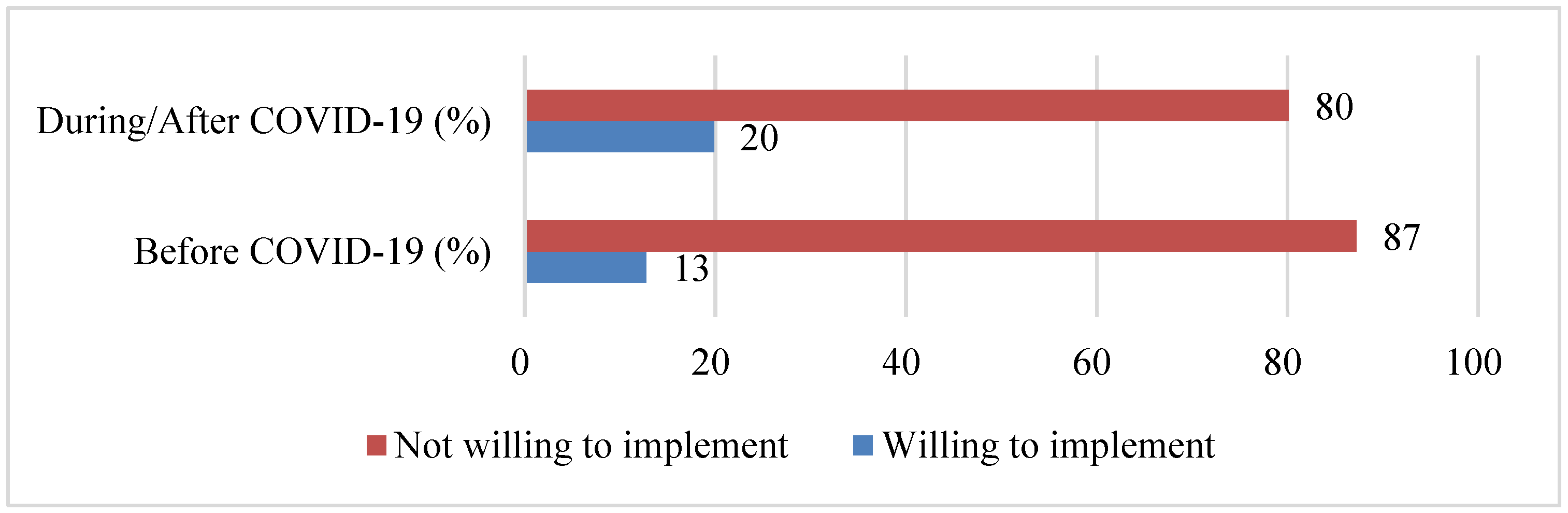
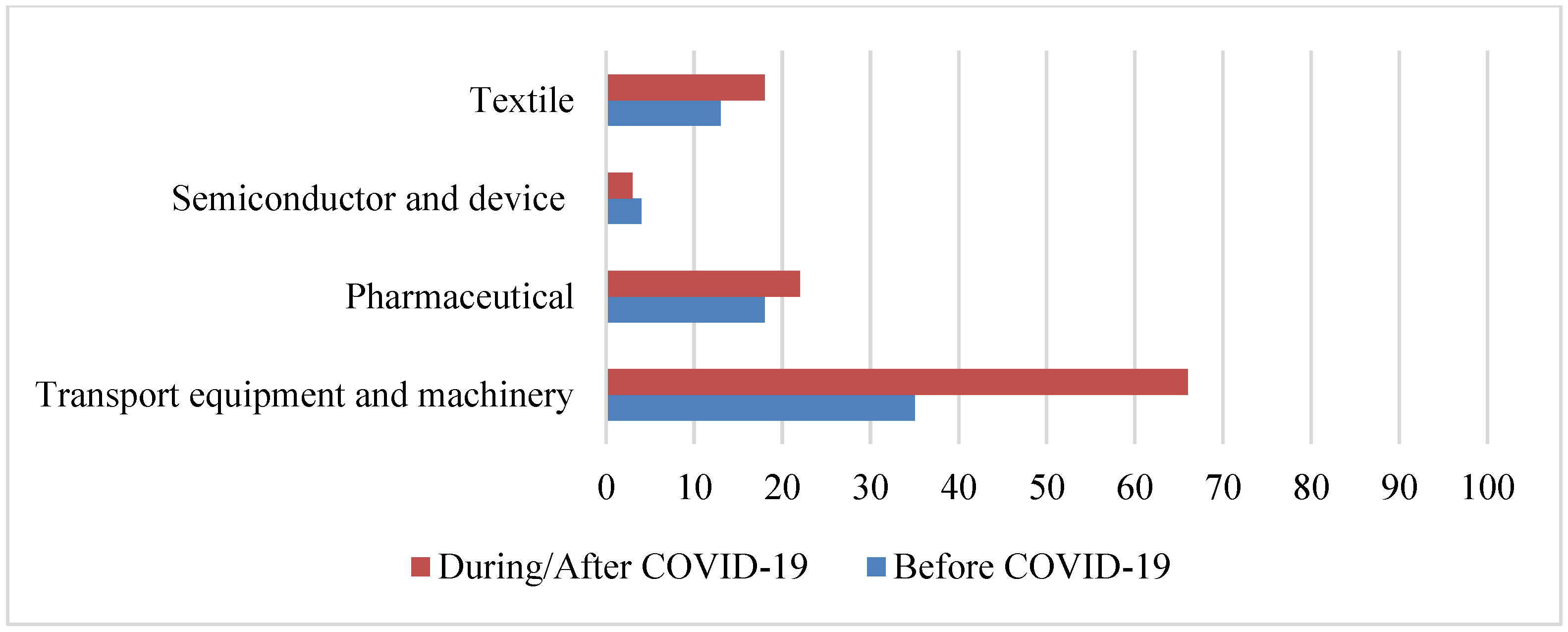
- RQ 1: How did Japanese manufacturing firms’ willingness to implement SCRESTs differ before and during/after the COVID-19 pandemic?
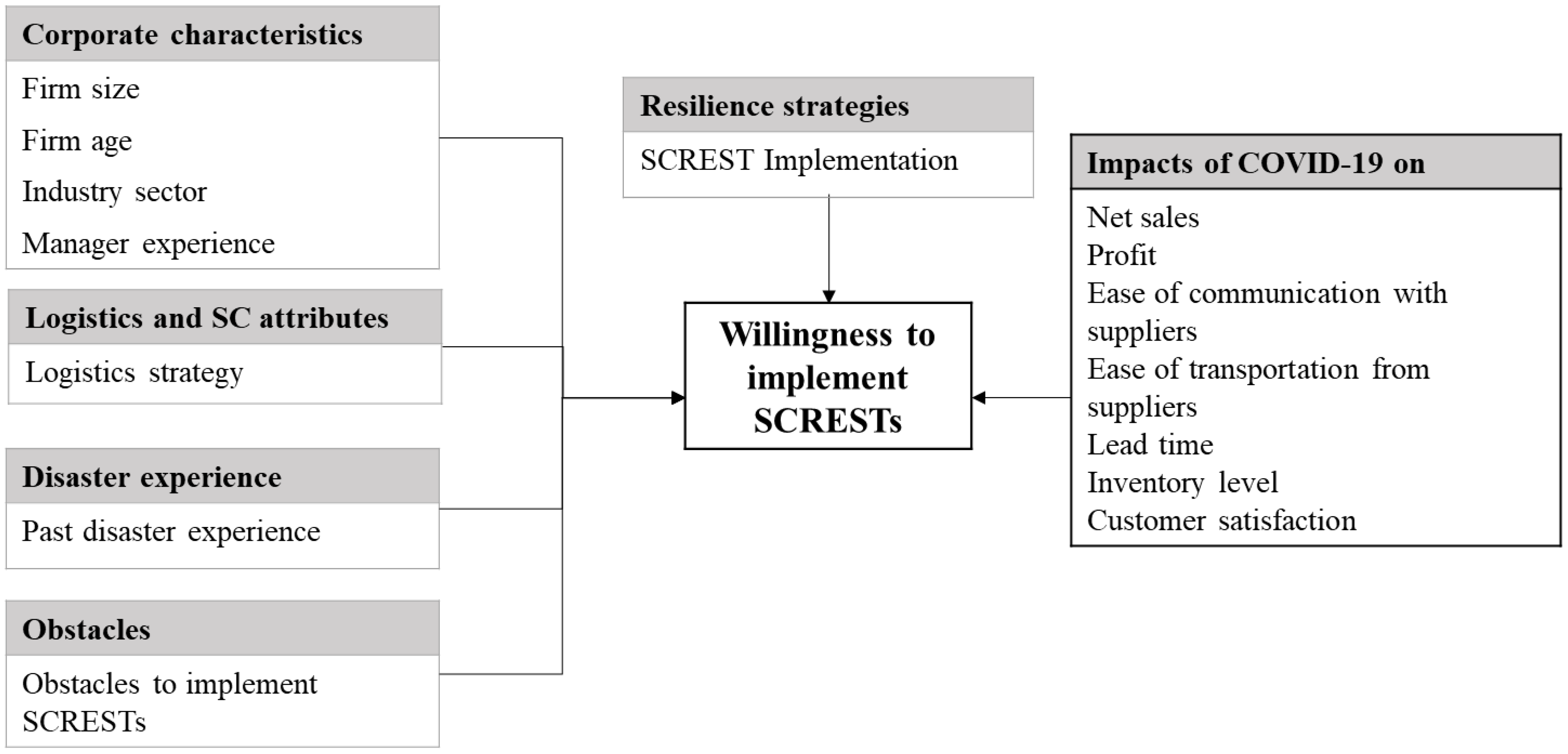
- RQ 2: What firm-level and structural factors influenced the willingness to implement SCRESTs across these periods?
- RQ 3: Does the prior implementation of SCRESTs causally influence firms’ willingness to adopt such strategies in the future?
2. Literature Review
2.1. Significance of Logistics and SC Resilience
2.2. Logistics and Supply Chain Resilience Strategies
2.3. Willingness to Implement SCRESTs
3. Methods
3.1. McNemar’s Test
3.2. Binary Choice Model
3.3. Average Treatment Effect on Treated
4. Survey and Data
4.1. Survey
4.2. Descriptive Statistics
4.3. Willingness to Implement SCREST
5. Results
5.1. Impact of the COVID-19 Pandemic on the Willingness to Implement SCRESTs
5.2. Factors Influencing the Willingness to Implement SCRESTs
5.3. Impact of Past Implementation of SCRESTs on Future Willingness
6. Discussion
6.1. The Impact of the COVID-19 Pandemic on Willingness to Implement SCRESTs
6.2. Factors Influencing Firms’ Willingness to Implement SCRESTs
6.3. Influence of the Past Implementation of SCRESTs on Firms’ Future Willingness to Implement SCRESTs
7. Conclusions
7.1. Implications
7.2. Limitations and Future Research
Author Contributions
Funding
Institutional Review Board Statement
Informed Consent Statement
Data Availability Statement
Conflicts of Interest
Abbreviations
| ATET | Average Treatment Effect on the Treated |
| ATETPSM | Average Treatment Effect on the Treated Propensity Score Matching |
| BCP | Business Continuity Planning |
| LEs | Large Enterprises |
| METI | Ministry of Economy Trade and Industry |
| PSM | Propensity Score Matching |
| SC | Supply Chain |
| SCRESTs | Supply Chain Resilience Strategies |
| SMEs | Small and Medium-size Enterprises |
References
- López, C.; Ishizaka, A. A hybrid FCM-AHP approach to predict impacts of offshore outsourcing location decisions on supply chain resilience. J. Bus. Res. 2019, 103, 495–507. [Google Scholar] [CrossRef] [Scilit]
- Golgeci, I.; Yildiz, H.E.; Andersson, U.R. The rising tensions between efficiency and resilience in global value chains in the post-COVID-19 world. Transnatl. Corp. J. 2020, 27, 127–141. [Google Scholar] [CrossRef] [Scilit]
- Lechler, S.; Canzaniello, A.; Roßmann, B.; von der Gracht, H.A.; Hartmann, E. Real-time data processing in supply chain management: Revealing the uncertainty dilemma. Int. J. Phys. Distrib. Logist. Manag. 2019, 49, 1003–1019. [Google Scholar] [CrossRef] [Scilit]
- Sadeek, S.N.; Hanaoka, S. Assessment of text-generated supply chain risks considering news and social media during disruptive events. Soc. Netw. Anal. Min. 2023, 13, 96. [Google Scholar] [CrossRef] [Scilit]
- Vural, C.A.; Balci, G.; Balci, E.S.; Gocer, A. Looking inside the panarchy: Reorganisation capabilities for food supply chain resilience against geopolitical crises. Supply Chain Manag. 2025, 30, 1–19. [Google Scholar] [CrossRef] [Scilit]
- Herold, D.M.; Nowicka, K.; Pluta-Zaremba, A.; Kummer, S. COVID-19 and the pursuit of supply chain resilience: Reactions and lessons learned from logistics service providers (LSPs). Supply Chain Manag. 2021, 26, 702–714. [Google Scholar] [CrossRef] [Scilit]
- Das, D.; Datta, A.; Kumar, P.; Kazancoglu, Y.; Ram, M. Building supply chain resilience in the era of COVID-19: An AHP-DEMATEL approach. Oper. Manag. Res. 2022, 15, 249–267. [Google Scholar] [CrossRef] [Scilit]
- Kiers, J.; Seinhorst, J.; Zwanenburg, M.; Stek, K. Which strategies and corresponding competences are needed to improve supply chain resilience: A COVID-19-based review. Logistics 2022, 6, 12. [Google Scholar] [CrossRef] [Scilit]
- Gebhardt, M.; Spieske, A.; Birkel, H. The future of the circular economy and its effect on supply chain dependencies: Empirical evidence from a Delphi study. Transp. Res. Part E Logist. Transp. Rev. 2022, 157, 102570. [Google Scholar] [CrossRef] [Scilit]
- Rhomri, M.; Laqrib, Y.Z. A bibliometric analysis of research on supply chain resilience: Using Scopus and Web of Science. Sustain. Manuf. Serv. Econ. 2025, 4, 100032. [Google Scholar] [CrossRef] [Scilit]
- Klibi, W.; Martel, A.; Guitouni, A. The design of robust value-creating supply chain networks: A critical review. Eur. J. Oper. Res. 2010, 203, 282–293. [Google Scholar] [CrossRef] [Scilit]
- Brandon-Jones, E.; Squire, B.; Autry, C.W.; Petersen, K.J. A contingent resource-based perspective of supply chain resilience and robustness. J. Supply Chain Manag. 2014, 50, 55–73. [Google Scholar] [CrossRef] [Scilit]
- Dehghani, E.; Jabalameli, M.S.; Jabbarzadeh, A.; Pishvaee, M.S. Resilient solar photovoltaic supply chain network design under business-as-usual and hazard uncertainties. Comput. Chem. Eng. 2018, 111, 288–310. [Google Scholar] [CrossRef] [Scilit]
- Barbieri, P.; Boffelli, A.; Elia, S.; Fratocchi, L.; Kalchschmidt, M.; Samson, D. What can we learn about reshoring after COVID-19? Oper. Manag. Res. 2020, 13, 131–136. [Google Scholar] [CrossRef] [Scilit]
- Xu, S.; Zhang, X.; Feng, L.; Yang, W. Disruption risks in supply chain management: A literature review based on bibliometric analysis. Int. J. Prod. Res. 2020, 58, 3508–3526. [Google Scholar] [CrossRef] [Scilit]
- Ponomarov, S.Y.; Holcomb, M.C. Understanding the concept of supply chain resilience. Int. J. Logist. Manag. 2009, 20, 124–143. [Google Scholar] [CrossRef] [Scilit]
- Ambulkar, S.; Blackhurst, J.; Grawe, S. Firm’s resilience to supply chain disruptions: Scale development and empirical examination. J. Oper. Manag. 2015, 33–34, 111–122. [Google Scholar] [CrossRef] [Scilit]
- Coronavirus Is Proving We Need More Resilient Supply Chains. Available online: https://hbr.org/2020/03/coronavirus-is-proving-that-we-need-more-resilient-supply-chains (accessed on 15 January 2026).
- Zhu, G.; Chou, M.C.; Tsai, C.W. Lessons learned from the COVID-19 pandemic exposing the shortcomings of current supply chain operations: A long-term prescriptive offering. Sustainability 2020, 12, 5858. [Google Scholar] [CrossRef] [Scilit]
- Paul, A.; Saha, S.C. A systematic literature review on flexible strategies and performance indicators for supply chain resilience. Glob. J. Flex. Syst. Manag. 2025, 26, S207–S231. [Google Scholar] [CrossRef] [Scilit]
- Maharjan, R.; Kato, H. Logistics and supply chain resilience of Japanese companies: Perspectives from impacts of the COVID-19 pandemic. Logistics 2023, 7, 27. [Google Scholar] [CrossRef] [Scilit]
- Creazza, A.; Colicchia, C.; Dallari, F. Who cares? Supply chain managers’ perceptions regarding cyber supply chain risk management in the digital transformation era. Supply Chain Manag. 2021, 27, 30–53. [Google Scholar] [CrossRef] [Scilit]
- Prataviera, L.B.; Creazza, A.; Melacini, M.; Dallari, F. Heading for tomorrow: Resilience strategies for post-COVID-19 grocery supply chains. Sustainability 2022, 14, 1942. [Google Scholar] [CrossRef] [Scilit]
- Maharjan, R.; Kato, H. Resilient supply chain network design: A systematic literature review. Transp. Rev. 2022, 42, 739–761. [Google Scholar] [CrossRef] [Scilit]
- Colicchia, C.; Strozzi, F. Supply chain risk management: A new methodology for a systematic literature review. Supply Chain Manag. 2012, 17, 403–418. [Google Scholar] [CrossRef] [Scilit]
- Christopher, M.; Peck, H. Building the resilient supply chain. Int. J. Logist. Manag. 2004, 15, 1–14. [Google Scholar] [CrossRef] [Scilit]
- Wieland, A.; Wallenburg, C.M. Dealing with supply chain risks: Linking risk management practices and strategies to performance. Int. J. Phys. Distrib. Logist. Manag. 2012, 42, 887–905. [Google Scholar] [CrossRef] [Scilit]
- Rice, J.B., Jr.; Caniato, F. Building a secure and resilient supply network. Supply Chain Manag. Rev. 2003, 7, 22–30. [Google Scholar]
- Ivanov, D. Introduction to Supply Chain Resilience, 1st ed.; Springer: Cham, Switzerland, 2021. [Google Scholar]
- Pu, G.; Yang, R.; Wu, M. The effect of interorganizational citizenship behavior on supply chain resilience: An organizational learning perspective. Supply Chain Manag. 2025, 30, 476–495. [Google Scholar] [CrossRef] [Scilit]
- Hohenstein, N.-O.; Fiesel, E.; Hartmann, E.; Giunipero, L. Research on the phenomenon of supply chain resilience: A systematic review and paths for further investigation. Int. J. Phys. Distrib. Logist. Manag. 2015, 45, 90–117. [Google Scholar] [CrossRef] [Scilit]
- Khourshed, N.; Beshr, M. Evaluating supply chain performance measurement system (SCPMS) lifecycle during unexpected events. Prod. Manuf. Res. 2024, 12, 2345616. [Google Scholar] [CrossRef] [Scilit]
- Xiao, Q.; Khan, M.S. Exploring factors influencing supply chain performance: Role of supply chain resilience with a mixed-method approach—Empirical evidence from the Chinese healthcare sector. Cogent Bus. Manag. 2024, 11, 2287785. [Google Scholar] [CrossRef] [Scilit]
- Cinti, A.; Marcone, M.R.; Sabatini, A.; Temperini, V. Enhancing supply chain resilience through the supply network approach. J. Bus. Ind. Mark. 2025, 40, 858–876. [Google Scholar] [CrossRef] [Scilit]
- Van Hoek, R. Research opportunities for a more resilient post-COVID-19 supply chain—Closing the gap between research findings and industry practice. Int. J. Oper. Prod. Manag. 2020, 40, 341–355. [Google Scholar] [CrossRef] [Scilit]
- Craighead, C.W.; Ketchen, D.J.; Darby, J.L. Pandemics and supply chain management research: Toward a theoretical toolbox. Decis. Sci. 2020, 51, 838–866. [Google Scholar] [CrossRef] [Scilit]
- Verma, S.; Gustafsson, A. Investigating the emerging COVID-19 research trends in the field of business and management: A bibliometric analysis approach. J. Bus. Res. 2020, 118, 253–261. [Google Scholar] [CrossRef] [Scilit]
- Chowdhury, P.; Paul, S.K.; Kaisar, S.; Moktadir, M.A. COVID-19 pandemic-related supply chain studies: A systematic review. Transp. Res. Part E Logist. Transp. Rev. 2021, 148, 102271. [Google Scholar] [CrossRef] [Scilit]
- Trabucco, M.; De Giovanni, P. Achieving resilience and business sustainability during COVID-19: The role of lean supply chain practices and digitalization. Sustainability 2021, 13, 12369. [Google Scholar] [CrossRef] [Scilit]
- Maharjan, R.; Kato, H. Can logistics and supply chain resilience strategies minimize the impacts of disruptions: Evidence from Japan. Int. J. Logist. Manag. 2024, 35, 1465–1482. [Google Scholar] [CrossRef] [Scilit]
- Qi, Y.; Wang, X.; Zhang, M.; Wang, Q. Developing supply chain resilience through integration: An empirical study on an e-commerce platform. J. Oper. Manag. 2022, 69, 477–496. [Google Scholar] [CrossRef] [Scilit]
- Trakoonsanti, L.; Trakulsunti, Y.; Sommanawat, K.; Norasedsophon, S.; Areerakulkan, N. Exploring supply chain adaptations in the pharmaceutical sector: Insights from Thailand’s experience during the COVID-19 pandemic. OPSEARCH 2025, 1–26. [Google Scholar] [CrossRef] [Scilit]
- Künzli, S. Why Are Some Firms More Resilient than Others? The Effect of Firm and Managerial Characteristics on Organizational Resilience. Master’s Thesis, University of Groningen, Groningen, The Netherlands, 2016. [Google Scholar]
- Todo, Y.; Oikawa, K.; Ambashi, M.; Kimura, F.; Urata, S. Robustness and resilience of supply chains during the COVID-19 pandemic: Findings from a questionnaire survey on the supply chain links of firms in ASEAN and India. ERA Discuss. Pap. 2021, unpublished work. [Google Scholar]
- McNemar, Q. Note on the sampling error of the difference between correlated proportions or percentages. Psychometrika 1947, 12, 153–157. [Google Scholar] [CrossRef] [Scilit] [PubMed]
- Kumar-M, P.; Mishra, A. Inferential statistics for the hypothesis testing of non-parametric data. In R for Basic Biostatistics in Medical Research; Srinivasan, A., Mishra, A., Kumar-M, P., Eds.; Springer: Singapore, 2024. [Google Scholar]
- Pan, X.; Li, M.; Wang, M.; Zong, T.; Song, M. The effects of a smart logistics policy on carbon emissions in China: A difference-in-differences analysis. Transp. Res. Part E Logist. Transp. Rev. 2020, 137, 101939. [Google Scholar] [CrossRef] [Scilit]
- Pan, X.; Uddin, M.K.; Ai, B.; Pan, X.; Saima, U. Influential factors of carbon emissions intensity in OECD countries: Evidence from symbolic regression. J. Clean. Prod. 2019, 220, 1194–1201. [Google Scholar] [CrossRef] [Scilit]
- Ben-Akiva, M.; Lerman, S. Discrete Choice Analysis: Theory and Application to Travel Demand; MIT Press: Cambridge, MA, USA, 1985. [Google Scholar]
- Li, M. Using the propensity score method to estimate causal effects: A review and practical guide. Organ. Res. Methods 2012, 16, 188–226. [Google Scholar]
- Abdia, Y.; Kulasekera, K.B.; Datta, S.; Boakye, M.; Kong, M. Propensity scores based methods for estimating average treatment effect and average treatment effect among treated: A comparative study. Biom. J. 2017, 59, 967–985. [Google Scholar] [CrossRef] [Scilit]
- Becker, S.O.; Ichino, A. Estimation of average treatment effects based on propensity scores. Stata J. 2002, 2, 358–377. [Google Scholar] [CrossRef] [Scilit]
- Manufacturing as an Attractive Sector. Available online: https://www.jetro.go.jp/ext_images/en/invest/img/attractive_sectors/form/AS2024_manufacturing_en.pdf (accessed on 16 January 2026).
- Pharmaceutical Industry in Japan—Statistics & Facts. Available online: https://www.statista.com/topics/4544/pharmaceutical-industry-in-japan/ (accessed on 16 January 2026).
- Japan Lays Out ‘National Project’ for Chips After Lost Decades. Available online: https://www.japantimes.co.jp/news/2021/06/04/business/japan-chip-strategy/ (accessed on 16 January 2026).
- Togashi, M. Japan Prioritizes Semiconductor Industry in Bid to Enhance Economic Security. Available online: https://www.iiss.org/blogs/analysis/2022/03/japan-prioritises-semiconductor-industry-in-bid-to-enhance-economic-security (accessed on 16 January 2026).
- Japan—The Key Asian Market of Textile and Apparel. Available online: https://www.indiantextilemagazine.in/japan-the-key-asian-market-of-textile-and-apparel/ (accessed on 16 January 2026).
- Japan, Australia, and India Target Indo-Pacific Supply-Chain Code. Available online: https://asia.nikkei.com/Spotlight/Supply-Chain/Japan-Australia-and-India-target-Indo-Pacific-supply-chain-code (accessed on 16 January 2026).
- Todo, Y.; Nakajima, K.; Matous, P. How do supply chain networks affect resilience of firms to natural disasters? Evidence from the Great East Japan Earthquake. J. Reg. Sci. 2015, 55, 209–229. [Google Scholar] [CrossRef] [Scilit]
- Fundamental Plan for National Resilience. Available online: https://www.cas.go.jp/jp/seisaku/kokudo_kyoujinka/en/fundamental_plan.html (accessed on 16 January 2026).
- Todo, Y. Focus of Economic Security: Excessive Onshoring Is Weakening Supply Chains. Available online: https://www.rieti.go.jp/en/papers/contribution/todo/08.html (accessed on 16 January 2026).
- Suzuki, K. Investing in Supply Chain Resilience in the Indo-Pacific. Available online: https://www.cgai.ca/investing_in_supply_chain_resilience_in_the_indo_pacific (accessed on 11 April 2022).
- Grötsch, V.M.; Blome, C.; Schleper, M.C. Antecedents of proactive supply chain risk management: A contingency theory perspective. Int. J. Prod. Res. 2013, 51, 2842–2867. [Google Scholar] [CrossRef] [Scilit]
- Baghersad, M.; Zobel, C.W.; Lowry, P.B.; Chatterjee, S. The roles of prior experience and location on the severity of supply chain disruptions. Int. J. Prod. Res. 2022, 60, 5051–5070. [Google Scholar]
- Okada, M.; Shirahada, K. Organizational learning for sustainable semiconductor supply chain operation: A case study of a Japanese company in cross-border M&A. Sustainability 2022, 14, 15316. [Google Scholar]



| S.N. | SCRESTs | Explanation |
|---|---|---|
| 1 | Multiple sourcing [24] | Having multiple suppliers for the same input. |
| 2 | Facility dispersion [24] | Locating facilities across different geographic regions. |
| 3 | Backup supplier [21] | Maintaining an alternative supplier for emergencies. |
| 4 | Lateral transshipment [21,24] | Transferring goods between facilities at the same SC level. |
| 5 | Rerouting [24] | Redirecting product flows through alternative transportation paths. |
| 6 | Facility fortification [24] | Strengthening facilities to withstand disruptions. |
| 7 | Facility redundancy [24] | Maintaining additional facilities beyond normal operational needs |
| 8 | Inventory prepositioning [24] | Placing inventory in advance at strategic locations. |
| 9 | Adding extra production capacity [24] | Increasing capacity beyond regular demand requirements. |
| 10 | Collaboration with suppliers [24] | Coordinating and sharing information with suppliers. |
| 11 | Business continuity planning [21] | Developing plans to sustain operations during disruptions. |
| Test 2 Positive | Test 2 Negative | Row Total | |
|---|---|---|---|
| Test 1 positive | a | b | a + b |
| Test 1 negative | c | d | c + d |
| Column total | a + c | b + d | N |
| Variable | Frequency | Percentage (%) |
|---|---|---|
| Firm size | ||
| SME | 520 | 94.7 |
| LE | 29 | 5.3 |
| Industrial sector | ||
| Transport equipment and machinery manufacturing | 343 | 62 |
| Pharmaceutical manufacturing | 62 | 11 |
| Semiconductor and device manufacturing | 39 | 7 |
| Textile manufacturing | 105 | 19 |
| Firm age | ||
| Less than or equal to 10 years | 32 | 6 |
| 11–20 years | 49 | 9 |
| 21–50 years | 200 | 36 |
| 51–100 years | 240 | 44 |
| Greater than or equal to 101 years | 28 | 5 |
| Logistics strategy | ||
| Fully used in-house logistics assets | 77 | 14 |
| Partially used own logistics assets | 169 | 31 |
| Fully outsourced to logistics companies | 241 | 44 |
| Partially outsourced to logistics companies | 46 | 8 |
| Others | 16 | 3 |
| Manager experience | ||
| Less than or equal to 5 years | 62 | 12 |
| 6–10 years | 63 | 12 |
| 11–15 years | 76 | 15 |
| 16–20 years | 64 | 12 |
| Greater than or equal to 20 years | 255 | 49 |
| Case (Pre-Pandemic) | Control (During/Post-Pandemic) | Total | |
|---|---|---|---|
| Willing to Implement | Not Willing to Implement | ||
| Willing to implement | 47 | 23 | 70 |
| Not willing to implement | 62 | 417 | 479 |
| Total | 109 | 440 | 549 |
| Variables | Pre-Pandemic | During/Post-Pandemic | ||||
|---|---|---|---|---|---|---|
| Coefficient | S. E. | z | Coefficient | S. E. | z | |
| Firm size (0: SME; 1: LE) | 1.340 * | 0.577 | 2.32 | −0.156 | 0.526 | −0.30 |
| Firm age (0: 20 years or less; 1: 21 years or more) | 0.149 | 0.477 | 0.31 | −0.046 | 0.375 | −0.12 |
| Industrial sector (base line is the textile manufacturing sector) | ||||||
| Transport equipment and machinery | −0.734 | 0.434 | −1.69 | 0.192 | 0.371 | 0.52 |
| Pharmaceutical | 0.291 | 0.524 | 0.56 | 0.558 | 0.489 | 1.14 |
| Semiconductor and device | −0.730 | 0.809 | −0.90 | −1.924 * | 0.937 | −2.05 |
| Manager experience | 0.091 | 0.114 | 0.79 | 0.058 | 0.089 | 0.65 |
| Logistics strategy | −1.488 * | 0.717 | −2.07 | −2.014 ** | 0.654 | −3.08 |
| Past disaster experience | −0.610 | 0.361 | −1.69 | 0.040 | 0.283 | 0.14 |
| Obstacle | 2.156 *** | 0.349 | 6.18 | −2.204 *** | 0.305 | −7.23 |
| SCREST implementation | 3.087 *** | 0.433 | 7.13 | 2.235 *** | 0.378 | 5.92 |
| COVID-19 impact | ||||||
| Impact on net sales | — | — | — | 0.033 | 0.272 | 0.12 |
| Impact on profit | — | — | — | −0.219 | 0.264 | −0.83 |
| Impact on ease of communication with suppliers | — | — | — | −0.250 | 0.289 | −0.87 |
| Impact on ease of access to transportation from suppliers | — | — | — | 0.363 | 0.236 | 1.54 |
| Impact on lead time | — | — | — | −0.14 | 0.206 | −0.68 |
| Impact on inventory level | — | — | — | 0.004 | 0.177 | 0.02 |
| Impact on customer satisfaction | — | — | — | −0.545 | 0.291 | −1.87 |
| Pseudo R2 | 0.4033 | 0.3553 | ||||
| ATET | AI Robust S.E. | z | P > |z| | |
|---|---|---|---|---|
| Willingness to implement SCRESTs | 0.4912 | 0.0667 | 7.36 | 0.000 *** |
Disclaimer/Publisher’s Note: The statements, opinions and data contained in all publications are solely those of the individual author(s) and contributor(s) and not of MDPI and/or the editor(s). MDPI and/or the editor(s) disclaim responsibility for any injury to people or property resulting from any ideas, methods, instructions or products referred to in the content. |
© 2026 by the authors. Licensee MDPI, Basel, Switzerland. This article is an open access article distributed under the terms and conditions of the Creative Commons Attribution (CC BY) license.
Share and Cite
Maharjan, R.; Kato, H.; Choi, S. Willingness to Implement Logistics and Supply Chain Resilience Strategies Amid COVID-19: Insights from Japanese Manufacturing Firms. Logistics 2026, 10, 65. https://doi.org/10.3390/logistics10030065
Maharjan R, Kato H, Choi S. Willingness to Implement Logistics and Supply Chain Resilience Strategies Amid COVID-19: Insights from Japanese Manufacturing Firms. Logistics. 2026; 10(3):65. https://doi.org/10.3390/logistics10030065
Chicago/Turabian StyleMaharjan, Rajali, Hironori Kato, and Sunkyung Choi. 2026. "Willingness to Implement Logistics and Supply Chain Resilience Strategies Amid COVID-19: Insights from Japanese Manufacturing Firms" Logistics 10, no. 3: 65. https://doi.org/10.3390/logistics10030065
APA StyleMaharjan, R., Kato, H., & Choi, S. (2026). Willingness to Implement Logistics and Supply Chain Resilience Strategies Amid COVID-19: Insights from Japanese Manufacturing Firms. Logistics, 10(3), 65. https://doi.org/10.3390/logistics10030065