

Transport of Immunobiologicals in Brazil: A Multiple Case Study

 , ,
, ,  , and
, and
Abstract
1. Introduction
2. Literature Review
3. Materials and Methods
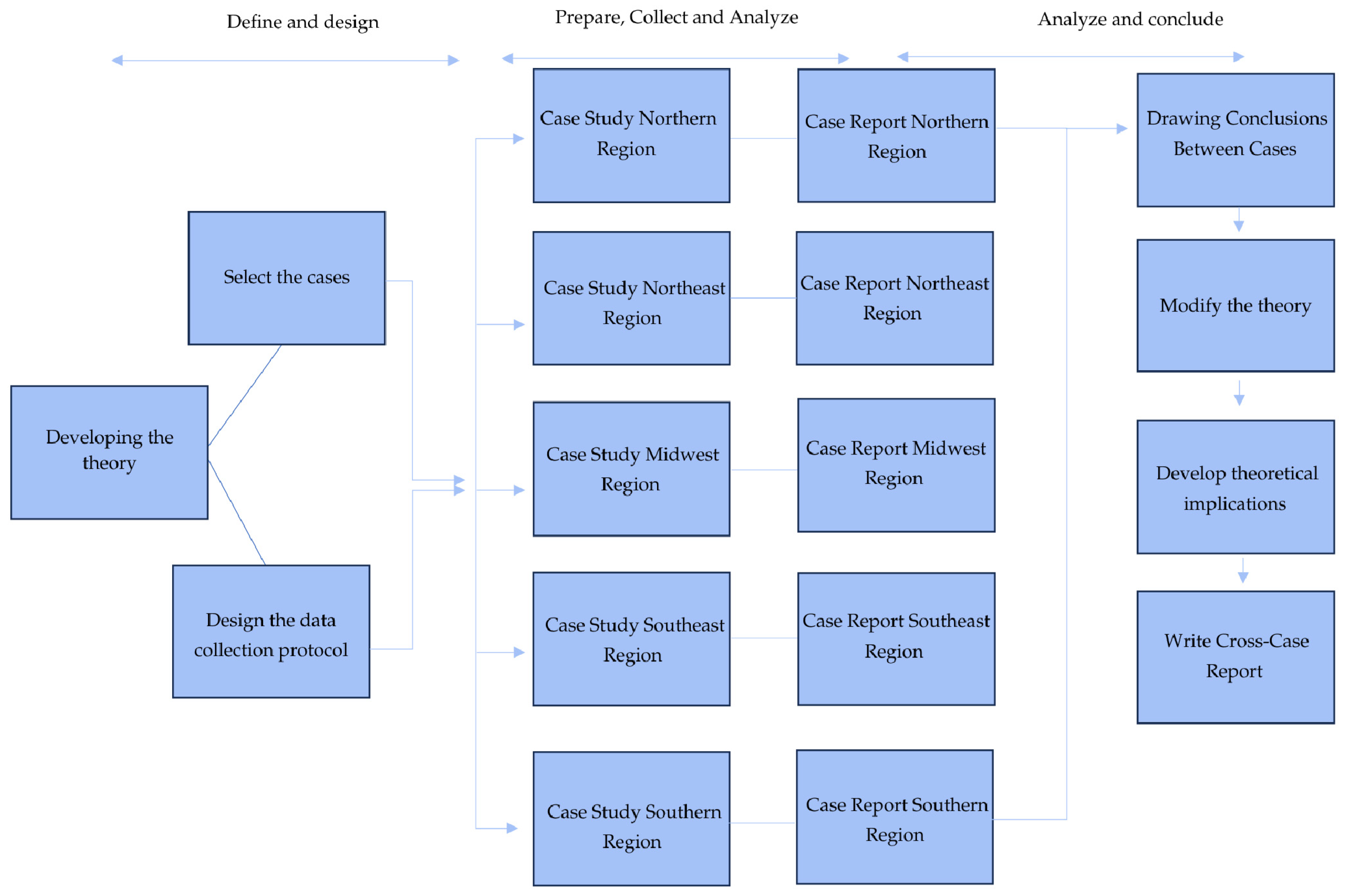
3.1. Research Design
3.2. Study Setting
3.3. Data Collection
3.4. Data Analysis
4. Findings
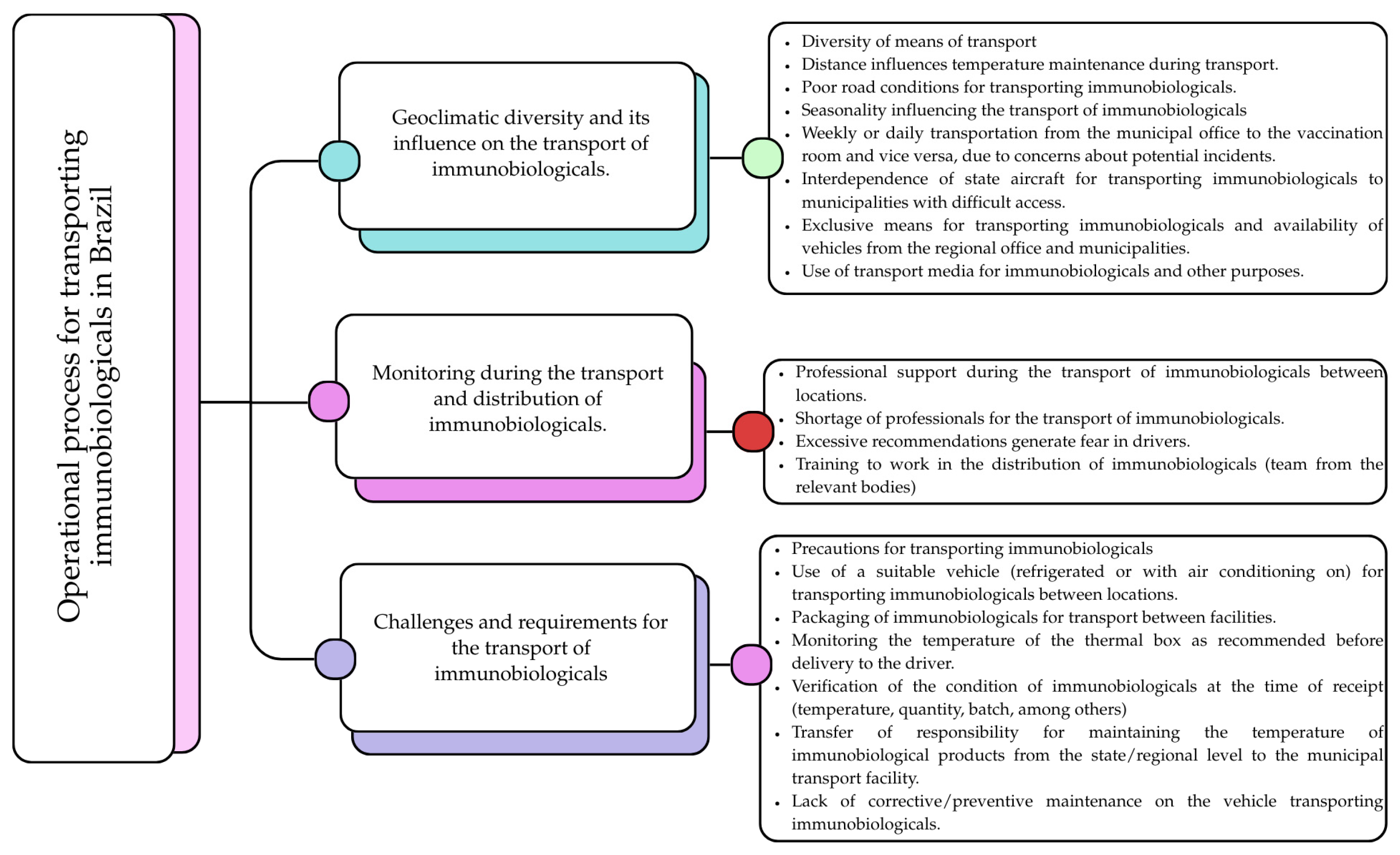
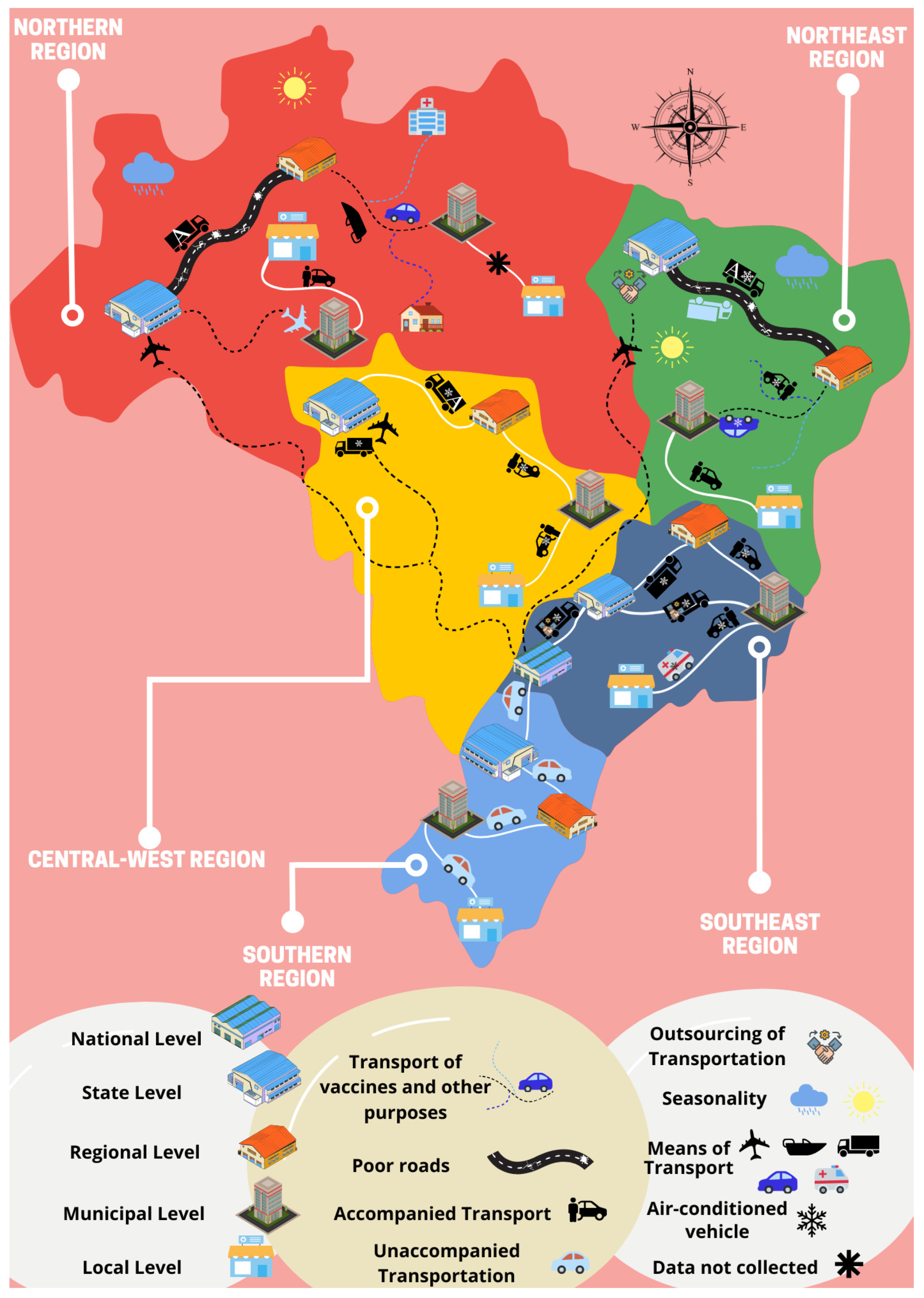
4.1. Geoclimatic Diversity, Means of Transportation and Their Influence on the Transportation of Immunobiologicals
“The municipalities that are part of, that are dependent on the polo de I (regional center), they are far away. Some can only be reached by road, but usually by boat or speedboat”(E2 Regional, North).
“The Ministry of Health delivers them to us. [...] it comes by land in refrigerated trucks and sometimes it comes by air”(E25 State, Midwest).
“How difficult our transportation is, from us (state center) to them (municipalities). There are also difficulties between them [...] there are municipalities where the distances are sometimes quite far from the regional headquarters”(E1 State, North).
“The main difficulty is precisely distribution to the most difficult places to access. We find basic units (local level) that are far from the headquarters (municipal level). So we have to be more careful with the equipment we have”(E8 Municipal, Northeast).
“Our vaccine arrives by land and currently our road is not good [...] The road is really bad, so it usually takes a while. By car it’s taking about 4, almost 6 hours, by (truck). Sometimes it takes a little over 6 hours”(E2 Regional, North).
“From my municipality to the regional office it’s 105 km, with a good road we used to get there in up to 2 hours, but now it’s 4 hours, 3 and a half hours. It depends, if it’s raining it’s 4 hours”(E15 Municipal, Northeast).
“Sometimes it’s easy to get to the municipality because it’s flood season and sometimes it’s easy to get to the municipality because it’s dry. At other times, the journey is longer because it’s in flood or drought”(E1 State, North).
“Every Friday my vaccines go to the cold chain (the municipal office), and every Monday they go through this transportation. Because I get vaccinated practically every day, so it’s interesting that I have the vaccine at the clinic, but every week it goes through this route [...] because I don’t trust the structure. [...] Here in the city, any time the weather changes, the power goes out, so in order not to have to relocate out of hours, we think it’s safer to send it every Friday.”(E12 Local, Northeast).
“So when they hear that there’s an airplane, they try to call the representative so that they can take the immunobiologicals. We have a lot of difficulty with transportation, especially by air. [...] It’s only when they run into the issue of transportation, of not having a plane, that they really get stuck, without being able to get it”(E1 Northern State).
“That’s why we go in a special car, we don’t go in another car together with patients or another car that’s going to take care of other things there. We just go to pick them up and come back. It’s a specific car just for that [...]”(E15 municipal Nordeste).
“Hence our logistical difficulties, because the transport that serves the base (regional level) is transport for all sectors, not just immunization. [...] These are the two vehicles we have at our disposal. When they are available”(E19 Northeast Regional).
“It’s the car that’s available at the moment [...] it’s not necessarily always the car with air conditioning”(E34 Municipal/Local Southeast).
“Sometimes, the municipality comes with a car that comes to bring patients and then it comes back at whatever time it can. So how are we going to guarantee the quality of these immunobiologicals? That temperature?”(E18 Northeast Regional).
“We pick it up every week and there’s always one thing or another for us to pick up at the regional office or resolve”(E8 Municipal Nordeste).
4.2. Monitoring the Transportation and Distribution of Immunobiologicals
“The representative of the municipality makes the delivery on the flight and from there it is brought to the municipality by the pilot, there is no specific professional accompanying, no. [...] It is the person responsible who makes the delivery (of vaccines), there is the driver and there is the person responsible for making the deliveries to the UBS (local instance). It’s not a specific professional. It’s not a nurse or a technician. Sometimes the technician goes, but not regularly”(E3 Municipal, North).
“We always send a professional [...] to check the temperature, to check any emergency situation that might occur during transportation, so that he can get there and certify the material supply note together with the technician from the health region that is receiving these doses.”(E4 State, Northeast).
“If it’s a small amount, only one driver goes, but if it’s a larger amount, COVID-19 vaccines, campaign vaccines, usually a nursing technician goes”(E26 Regional, Midwest).
“The central office (regional level) takes it (to the municipal/local level). The driver arrives and a technician (nursing technician) comes, there are usually three of them, the driver and two more technicians”(E31 Local, Southeast).
“No one comes to monitor the temperature, it’s just the driver, so there’s no control over the Ministry of Health’s trip”(E39 State, South).
“Not even the municipality itself can send the coordinator or a nursing technician, because it will be taking away from the functions, which it has within the municipality, to come and get vaccine”(E5 Regional, Northeast).
“When there were more staff here in the vaccine room, they always asked one of the nurses to come along, because then they could control the temperature. But now it’s a bit tight, so he (the driver) goes alone”(E38 Local, Southeast).
“We’ve had the most difficulty with the professional driver [...] Because we only have one truck driver to do this transportation”(E39 State, South).
“Then we did a training session with the drivers, they receive the spreadsheet, they check it, the delivery person shows them and counts along with them. Oh... here’s two hundred doses of that, then he shows the paper, then he signs it”(E6 Regional, Northeast).
“I now have a nursing technician for a year (2022). She’s helping a lot to monitor the receipt of vaccines, the deliveries [...] We’ve trained this person to check and she’ll pass anything different on to me”(E32 State, Southeast).
4.3. Challenges and Requirements for Transporting Immunobiologicals
“We manage to conserve and, generally, we already take two isopores, two thermal boxes, because then we don’t have any problems during this journey. Because these are trips in which we sometimes have to deal with other problems, we take this precaution [...]”(E8 Municipal, Northeast).
“[...] We open the boxes, take out the datalogger, which is a little device that records temperature fluctuations during transportation, and give it to the driver”(E33 Regional, Southeast).
“From the central office to the regional offices, we have a datalogger to monitor [...] we have this control up to the regional health offices”(E39 State, South).
“It (transportation) is done in those thermal containers and in small cars, which are also air-conditioned. They (municipal staff) take care to always send an air-conditioned car”(E12 Local, Northeast).
“Our car doesn’t have air conditioning, it’s a car without air conditioning, it’s a Ranger (medium-sized vehicle)”(E21 Municipal, Northeast).
“We have four refrigerated trucks. These trucks do the routes [...] We do half the regional routes one week and half the next”(E25 State, Midwest).
“We have air-conditioning in the car, it’s not a van, that’s what it’s for, but inside the car we have air-conditioning which helps a lot”(E37 Municipal/Local, Southeast).
“He arrives early, acclimatizes the ice packs (reusable ice reels), assembles the boxes, lets them reach temperature. As it’s close by, the temperature that leaves here usually reaches there”(E35 Municipal, Southeast).
“These containers come with thermometers on top, and we wait for the temperature of the container to start distributing the vaccine. Once it’s been placed in the Styrofoam according to what they’ve asked for, we close the Styrofoam, wait for the temperature to be right and send it to the municipality by the driver who comes to pick it up”(E5 Regional, Northeast).
“They (the municipal office) come with a thermal box with a temperature control. We check it, see what time it left, what temperature it is, how long it takes to get to their municipality, and if necessary we add more icex (reusable ice reel) or remove it if the temperature is too low”(E33 Regional, Southeast).
“Every time this immunobiological arrives, there is a form to fill in the temperature that was received to be sent to the state PNI (state body). There’s a team responsible for receiving it [...]. Then the thermal box is sealed and only opened by the nursing technician who is in the room (local instance), who monitors the temperature when she opens the box”(E3 Municipal, North).
“We check the temperature that we’ve written down, there (municipal level) is a form that we write down as soon as we leave and another form that we fill in when we get here”(E28 Local, Midwest).
“We guarantee our temperature here within the cold chain, now it’s gone we don’t know anymore”(E2 Regional, North).
“When they (vaccines) are released by the state PNI (state body), the municipal health secretary signs an agreement taking responsibility for these immunobiologicals (transportation). Generally, at the weekend, from Friday onwards, he has to sign this form. Even if something unforeseen happens, he is responsible”(E3 Municipal, North).
“Although we have a truck that does this service, but for bureaucratic reasons maintenance ends up being more difficult. So the truck spends some time at a standstill until it’s up and running again [...] Because it’s no good just going in for maintenance when it breaks down, it has to be preventative.”(E7 Regional, Northeast).
“Difficulty, we currently have 3 vehicles at our disposal, but we have some obstacles in relation to the maintenance of these vehicles [...] because they are cars that are always having some problem in terms of maintenance, breakdowns [...] and because the sector is very large I need the cars to do other activities”(E21 Municipal, Northeast).
4.4. Cross-Case Synthesis
4.4.1. North Region
4.4.2. Northeast Region
4.4.3. Midwest Region
4.4.4. Southeast Region
4.4.5. South Region
5. Discussion
5.1. Implications for Theory
5.2. Implications for Practice
5.3. Limitations of the Study and Future Research Directions
6. Final Considerations
Supplementary Materials
Author Contributions
Funding
Institutional Review Board Statement
Informed Consent Statement
Data Availability Statement
Conflicts of Interest
References
- Kartoglu, U.; Ames, H. Ensuring quality and integrity of vaccines throughout the cold chain: The role of temperature monitoring. Expert Rev. Vaccines 2022, 21, 799–810. [Google Scholar] [CrossRef] [Scilit]
- Ministério da Saúde (BR). Manual de Rede de Frio do Programa Nacional de Imunizações, 6th ed; Ministério da Saúde: Brasília, Brazil, 2025. Available online: https://www.gov.br/saude/pt-br/centrais-de-conteudo/publicacoes/guias-e-manuais/2025/rede-de-frio-pni.pdf (accessed on 30 October 2025).
- Centers for Disease Control and Prevention. Vaccine Storage and Handling Toolkit; Centers for Disease Control and Prevention: Atlanta, GA, USA, 2024. Available online: https://www.cdc.gov/vaccines/hcp/downloads/storage-handling-toolkit.pdf (accessed on 30 October 2025).
- Ministério da Saúde (BR). Plano Nacional de Operacionalização da Vacinação Contra a COVID-19, 2nd ed.; Ministério da Saúde: Brasília, Brazil, 2022. Available online: https://www.gov.br/saude/pt-br/centrais-de-conteudo/publicacoes/svsa/covid-19/plano-nacional-de-operacionalizacao-da-vacinacao-contra-a-covid-19-pno-2a-edicao-com-isbn/view (accessed on 30 October 2025).
- Ashok, A.; Brison, M.; Letallec, Y. Improving cold chain systems: Challenges and solutions. Vaccine 2017, 35, 2217–2223. [Google Scholar] [CrossRef] [Scilit]
- Chen, Y.; Chen, M.; Hu, T. Designing a sustainable-resilient vaccine cold chain network in uncertain environments. Comput. Chem. Eng. 2025, 194, 108936. [Google Scholar] [CrossRef] [Scilit]
- Ayala-Zambrano, S.; Jäckel, R.; Gutiérrez-Urueta, G.L.; Ramos Blanco, A.; Monreal Jiménez, C. Parametric optimization of cylindrical vaccine transport containers with dual phase change materials to prevent vaccine freezing and heat damage using artificial neural networks. J. Energy Storages 2025, 109, 115239. [Google Scholar] [CrossRef] [Scilit]
- Bhatt, T.; Jain, N.; Ng, E.K.Y. Sustaining vaccine potency in cold chain logistics: Numerical analysis of extended cooling duration in glycerol-infused n-tetradecane phase-change materials. Fluids 2025, 10, 32. [Google Scholar] [CrossRef] [Scilit]
- Asamoah, A.; Enyan, N.I.E.; Diji, A.K.; Domfeh, C. Cold Chain management by healthcare providers at a district in Ghana: A mixed methods study. Biomed. Res. Int. 2021, 2021, 7559984. [Google Scholar] [CrossRef] [Scilit]
- Eyong, E.M.; Njoh, A.A.; Etutu, S.J.M.; Bachir, H.B.; Ndoula, S.T.; Saidou, Y.; Wanji, S. Factors associated with a measles outbreak in three health districts of Cameroon in 2019: A cross-sectional study. Pan Afr. Med. J. 2023, 46, 41. [Google Scholar] [CrossRef] [Scilit]
- Falcón, V.C.; Porras, Y.V.V.; Altamirano, C.M.G.; Kartoglu, U. A vaccine cold chain temperature monitoring study in the United Mexican States. Vaccine 2020, 38, 5202–5211. [Google Scholar] [CrossRef] [Scilit] [PubMed]
- Seabra Filho, F.T.; Moura, A.D.A.; Braga, A.V.L.; Jereissati, N.C.C.; Câncio, K.S.; Silva, M.G.C.D. Physical wastage of immunobiological products in the state of Ceará, Brazil, 2014-2016. Epidemiol. Serv. Saude 2020, 29, e2019004. [Google Scholar] [CrossRef] [Scilit] [PubMed]
- Gebretnsae, H.; Hadgu, T.; Ayele, B.; Gebre-Egziabher, E.; Woldu, M.; Tilahun, M.; Abraha, A.; Wubayehu, T.; Medhanyie, A.A. Knowledge of vaccine handlers and status of cold chain and vaccine management in primary health care facilities of Tigray region, Northern Ethiopia: Institutional based cross-sectional study. PLoS ONE 2022, 17, e0269183. [Google Scholar] [CrossRef] [Scilit]
- Patine, F.S.; Lourenção, L.G.; Wysocki, A.D.; Santos, M.L.S.G.; Rodrigues, I.C.; Vendramini, S.H.F. Analysis of vaccine loss due to temperature change. Rev. Bras. Enferm. 2021, 74, e20190762. [Google Scholar] [CrossRef] [Scilit]
- Ministério da Saúde (BR). Manual de Normas e Procedimentos para Vacinação, 2nd ed.; Ministério da Saúde: Brasília, Brazil, 2024. Available online: https://www.gov.br/saude/pt-br/centrais-de-conteudo/publicacoes/guias-e-manuais/2024/manual-de-normas-e-procedimentos-para-vacinacao.pdf/view (accessed on 30 October 2025).
- Agência Nacional de Vigilância Sanitária (BR). Resolução de Diretoria Colegiada—RDC no. 430, de 8 de Outubro de 2020. Dispõe Sobre as Boas Práticas de Distribuição, Armazenagem e de Transporte de Medicamentos; ANVISA: Brasília, Brazil, 2020; Available online: https://anvisalegis.datalegis.net/action/ActionDatalegis.php?acao=abrirTextoAto&link=S&tipo=RDC&numeroAto=00000430&seqAto=000&valorAno=2020&orgao=RDC/DC/ANVISA/MS&cod_modulo=310&cod_menu=8542 (accessed on 30 October 2025).
- Das, M.K.; Arora, N.K.; Mathew, T.; Vyas, B.; Sindhu, M.; Yadav, A. Temperature integrity and exposure to freezing temperature during vaccine transfer under the universal immunization program in Three States of India. Indian J. Public Health 2019, 63, 139–142. [Google Scholar] [CrossRef] [Scilit]
- Ross, J.C.; Saidu, Y.; Nzuobontane, D.; Voukings, M.Z.; Embrey, S.R. Application of the remaining vaccine vial monitor life calculation to field temperature monitoring data to improve visibility into cold chain equipment performance. Vaccine 2020, 38, 7683–7687. [Google Scholar] [CrossRef] [Scilit]
- Turner, N.; Laws, A.; Roberts, L. Assessing the effectiveness of cold chain management for childhood vaccines. J. Prim. Health Care 2011, 3, 278–282. [Google Scholar] [CrossRef] [Scilit]
- Amaral, G.G.; Guimaraes, E.A.A.; Tavares, L.O.M.; Silva, B.S.; Cortez, D.N.; Oliveira, V.C. Adequacy assessment of immunobiological agent conservation in the Western Health macro-region of Minas Gerais State, Brazil: A descriptive study, 2017. Epidemiol. Serv. Saúde 2021, 30, e20201017. [Google Scholar] [CrossRef] [Scilit]
- Oliveira, V.C.; Duarte, D.C.; Silva, S.S.; Pessoa, M.T.C.; Gontijo, T.L.; Guimarães, E.A.A. Avaliação da cadeia de frio do transporte de vacina: Estudo transversal em Minas Gerais, Brasil. Rev. APS 2019, 22, 530–543. [Google Scholar] [CrossRef] [Scilit]
- Cohen, M.; Rodríguez, R.; Guerrero, A.; Valverde, A.; Rodríguez, A.M.A.; Casillas, C.; Zepeda, G.; Artigas, J.N.; Padrón, L.; de Arco, L.F.; et al. Disponibilidad y acceso a vacunas respiratorias en Latinoamérica: Reporte del Foro Latinoamericano de Sociedades Respiratorias 2024. Respirar 2025, 17, 99–108. [Google Scholar] [CrossRef] [Scilit]
- Kristensen, D.D.; Lorenson, T.; Bartholomew, K.; Villadiego, S. Can thermostable vaccines help address cold-chain challenges? Results from stakeholder interviews in six low- and middle-income countries. Vaccine 2016, 34, 899–904. [Google Scholar] [CrossRef] [Scilit] [PubMed]
- Sinnei, D.K.; Karimi, P.N.; Maru, S.M.; Karengera, S.; Bizimana, T. Evaluation of vaccine storage and distribution practices in rural healthcare facilities in Kenya. J. Pharm. Policy Pract. 2023, 16, 25. [Google Scholar] [CrossRef] [Scilit]
- Kanja, L.W.; Karimi, P.N.; Maru, S.M.; Kayumba, P.C.; Hitimana, R. Factors that affect vaccines availability in public health facilities in Nairobi City County: A cross-sectional study. Pan Afr. Med. J. 2021, 38, 72. [Google Scholar] [CrossRef] [Scilit]
- Lestari, F.; Sudaryo, M.K.; Djalante, R.; Adiwibowo, A.; Kadir, A.; Zakianis; Satyawardhani, S.A. Estimating the flood, landslide, and heavy rainfall susceptibility of vaccine transportation after 2021 flooding in South Kalimantan Province, Indonesia. Sustainability 2024, 16, 1554. [Google Scholar] [CrossRef] [Scilit]
- Lim, J.; Norman, B.A.; Rajgopal, J. Redesign of vaccine distribution networks. Int. Trans. Oper. Res. 2022, 29, 200–225. [Google Scholar] [CrossRef] [Scilit]
- Ministério da Saúde (BR). Lei no. 6.360, de 23 de Setembro de 1976. Dispõe Sobre a Vigilância Sanitária a que Ficam Sujeitos os Medicamentos, as Drogas, os Insumos Farmacêuticos e Correlatos, Cosméticos, Saneantes e Outros Produtos, e dá Outras Providências; Ministério da Saúde: Brasília, Brazil, 1976. Available online: http://www.planalto.gov.br/ccivil_03/leis/L6360.htm (accessed on 10 February 2026).
- Agência Nacional de Vigilância Sanitária (BR). Portaria no. 802, de 08 de Outubro de 1998; ANVISA: Brasília, Brazil, 1998. Available online: https://bvsms.saude.gov.br/bvs/saudelegis/anvisa/1998/prt0802_08_10_1998.html (accessed on 10 February 2026).
- Hanson, C.M.; George, A.M.; Sawadogo, A.; Schreiber, B. Is freezing in the vaccine cold chain an ongoing issue? A literature review. Vaccine 2017, 35, 2127–2133. [Google Scholar] [CrossRef] [Scilit]
- Lamba, H.; Sharma, D.; Dhir, S.; Sushil, S.; Ghosh, R.; Bagchi, S.; Singh, S.; Pooja, P.; Kothari, K.; Monfardini, E.; et al. Ensuring Vaccine Temperature Integrity: Monitoring from Storage to Last-Mile Delivery. Glob. J. Flex. Syst. Manag. 2024, 25, 559–578. [Google Scholar] [CrossRef] [Scilit]
- Yin, R.K. Pesquisa Qualitativa do Tipo Estudo de Caso: Planejamento e Métodos, 5th ed.; Bookman: São Paulo, Brazil, 2015. [Google Scholar]
- Amaral, G.G. Avaliação da Cadeia de frio de Imunobiológicos no Brasil: Estudo Misto. Programa de Pós-graduação Enfermagem em Saúde Pública. Ph.D. Thesis, Escola de Enfermagem de Ribeirão Preto da Universidade de São Paulo, Ribeirão Preto, Brazil, 2023. Available online: https://repositorio.usp.br/item/003225588 (accessed on 30 October 2025).
- Amaral, G.G.; Sousa, L.G.; Silva, S.P.; Karter, A.L.; Silva, B.S.; Zacharias, F.C.M.; Schonholzer, T.E.; Araújo, A.C.d.M.; de Oliveira, V.C.; Pinto, I.C. Análise das condições operacionais para conservação de imunobiológicos nas salas de vacinação do Brasil: Estudo misto. Cad. Saúde Pública 2024, 40, e00014924. [Google Scholar] [CrossRef] [Scilit] [PubMed]
- Eisenhardt, K.M. Building theories from case study research. Acad. Manag. Rev. 1989, 14, 532–550. [Google Scholar] [CrossRef] [Scilit]
- Tong, A.; Sainsbury, P.; Craig, J. Consolidated criteria for reporting qualitative research (COREQ): A 32-item checklist for interviews and focus group. Int. J. Qual. Health Care 2007, 19, 349–357. [Google Scholar] [CrossRef] [Scilit] [PubMed]
- Instituto Brasileiro de Geografia e Estatística (BR). População residente das Unidades da Federação e Grandes Regiões, Enviada ao Tribunal de Contas da União; IBGE: Rio de Janeiro, Brazil, 2024. Available online: https://ftp.ibge.gov.br/Estimativas_de_Populacao/Estimativas_2024/estimativa_dou_2024.pdf (accessed on 30 October 2025).
- Amaral, G.G.; Oliveira, V.C.; Guimarães, E.A.A.; Reis, I.A.; Viegas, S.M.F.; Pinto, I.C.; Oliveira, M.M. Evaluation of the psychometric properties of the Immunobiological Agent Conservation Assessment Scale. J. Nurs. Meas. 2020, 28, 1–18. [Google Scholar] [CrossRef] [Scilit]
- Bardin, L. Análise de Conteúdo; Edições: São Paulo, Brazil, 2016; p. 70. [Google Scholar]
- Gioia, D.A.; Corley, K.G.; Hamilton, A.L. Seeking qualitative rigor in inductive research: Notes on the Gioia methodology. Organ. Res. Methods 2013, 16, 15–31. [Google Scholar] [CrossRef] [Scilit]
- Netto, G.C. Contribuição Para Melhorar o Gerenciamento Logístico da Cadeia de Frio de Imunobiológicos no Programa de Imunização do Brasil. Master’s Thesis, Departamento de Engenharia Civil e Ambiental, Universidade de Brasília, Brasília, Brazil, 2008. Available online: https://repositorio.unb.br/handle/10482/1686 (accessed on 30 October 2025).
- Zabinsky, Z.B.; Zameer, M.; Petroianu, L.P.G.; Muteia, M.M.; Coelho, A.L. Route Optimization Tool (RoOT) for distribution of vac-cines and health products. Gates Open Res. 2021, 5, 34. [Google Scholar] [CrossRef] [Scilit]
- Enayati, S.; Campbell, J.F.; Li, H. Vaccine distribution with drones for less developed countries: A case study in Vanuatu. Vaccine X 2023, 14, 100312. [Google Scholar] [CrossRef] [Scilit] [PubMed]
- Figueiredo, N.M.; Blanco, C.J.C. Water level forecasting and navigability conditions of the Tapajós River-Amazon-Brazil. La Houille Blanche 2016, 102, 53–64. [Google Scholar] [CrossRef] [Scilit]
- Boeck, K.D.; Decouttere, C.; Jónasson, J.O.; Vandaele, N. Vaccine supply chains in resource-limited settings: Mitigating the impact of rainy season disruptions. Eur. J. Oper. Res. 2022, 301, 300–317. [Google Scholar] [CrossRef] [Scilit]
- Confederação Nacional do Transporte (BR). Pesquisa CNT de Rodovias; Confederação Nacional do Transporte, CNT: Brasília, Brazil, 2024; Available online: https://pesquisarodovias.cnt.org.br/painel (accessed on 30 October 2025).
- Pacheco, F.C.; França, G.V.A.; Elidio, G.A.; Domingues, C.M.A.S.; de Oliveira, C.; Guilhem, D.B. Trends and spatial distribution of MMR vaccine coverage in Brazil during 2007–2017. Vaccine 2019, 37, 2651–2655. [Google Scholar] [CrossRef] [Scilit]
- Morais, J.N.; Quintilio, M.S.V. Fatores que levam à baixa cobertura vacinal de crianças e o papel da enfermagem: Revisão literária. Rev. Interfaces Saúde Humanas Tecnol. 2021, 9, 1054–1063. [Google Scholar] [CrossRef] [Scilit]
- Fahrni, M.L.; Ismail, I.A.; Refi, D.M.; Almeman, A.; Yaakob, N.C.; Saman, K.M.; Mansor, N.F.; Noordin, N.; Babar, Z.-U. Management of COVID-19 vaccines cold chain logistics: A scoping review. J. Pharm. Policy Pract. 2022, 15, 16. [Google Scholar] [CrossRef] [Scilit]
- Musamih, A.; Jayaraman, R.; Salah, K.; Hasan, H.R.; Yaqoob, I.; Al-Hammadi, Y. Blockchain-based solution for distribution and delivery of COVID-19 vaccines. IEEE Access. 2021, 9, 71372–71387. [Google Scholar] [CrossRef] [Scilit]
- Wu, W.; Shen, L.; Zhao, Z.; Harish, A.R.; Zhong, R.Y.; Huang, G.Q. Internet of everything and digital twin enabled service platform for cold chain logistics. J. Ind. Inf. Integr. 2023, 33, 100443. [Google Scholar] [CrossRef] [Scilit]
- Bakkabulindi, P.; Wafula, S.T.; Ssebagereka, A.; Sekibira, R.; Mutebi, A.; Ameny, J.; Abewe, C.; Isunju, J.B. Improving the last mile delivery of vaccines through an informed push model: Experiences, opportunities and costs based on an implementation study in a rural district in Uganda. PLoS Glob. Public Health 2024, 4, e0002647. [Google Scholar] [CrossRef] [Scilit]
- Lin, Q.; Zhao, Q.; Lev, B. Cold chain transportation decision in the vaccine supply chain. Eur. J. Oper. Res. 2020, 283, 182–195. [Google Scholar] [CrossRef] [Scilit]
- Andrade, H.S.; Cazarim, M.S.; Oliveira, V.C.; Baldoni, A.O.; Guimarães, E.A.A. Evaluation of Immunobiological Cold Chain Costs. J. Nurs. Meas. 2024, 32, 591–599. [Google Scholar] [CrossRef] [Scilit]
- Reid, E.; Barkes, J.; Morrison, C.; Ung, A.; Patel, R.; Rebarker, C.; Panchal, P.; Vasa, S. Design and Testing of a Thermoelectrically-Cooled Portable Vaccine Cooler. J. Young Investig. 2018, 35, 50–55. [Google Scholar] [CrossRef] [Scilit]
- Vardavas, C.; Zisis, K.; Nikitara, K.; Lagou, I.; Marou, V.; Aslanoglou, K.; Phalkey, R.; Leonardi-Bee, J.; Fernandez, E.; Condell, O.; et al. Cost of the COVID-19 pandemic versus the cost-effectiveness of mitigation strategies in EU/UK/OECD: A systematic review. BMJ Open 2023, 13, e077602. [Google Scholar] [CrossRef] [Scilit] [PubMed]
- Oliveira, M.M.; Oliveira, V.C.; Ferreira, A.P.; Reis, I.A.; Torres, H.C.; Amaral, G.G.; Guimarães, E.A.A. Validity of an instrument to evaluate the immunobiological cold chain. Av. Enfermería 2020, 38, 170–181. [Google Scholar] [CrossRef] [Scilit]
- Amaral, G.G. Evaluation of the Immunobiological Cold Chain in Brazil: A Mixed Study. Ph.D. Thesis, University of São Paulo, Ribeirão Preto, Brazil, 2023. Available online: https://www.teses.usp.br/teses/disponiveis/22/22133/tde-26082024-133302/ (accessed on 30 October 2025).
- Yin, R.K. Qualitative Research: Case Study Methods, 5th ed.; Bookman: São Paulo, Brazil, 2018. [Google Scholar]



| Cross-Synthesis of the Five Multiple Cases: Similar Characteristics and Particularities in the Five Brazilian Regions | Brazilian Regions |
|---|---|
| Dependence on government aircraft for transportation | North |
| Difficulty of access in remote areas | North |
| Seasonality impacting positively or negatively on transportation | North, Northeast |
| Sharing vehicles on the same trip to transport immunobiologicals and other demands | North, Northeast |
| Difficulty in finding vehicles to transport immunobiologicals | North, Northeast, Southeast |
| Transportation accompanied by a professional in addition to the driver at some point between the state and local levels | North, Northeast, Midwest and Southeast |
| Shortage of refrigerated truck drivers | South |
| Transportation unaccompanied by health professionals or technicians, only by drivers | North, Northeast, Southeast and South |
| Need for different means of transportation (land, air, river) | North, Midwest |
| Use of vehicles suitable for transporting immunobiologicals (refrigerated or air-conditioned) | Midwest, Northeast, Southeast |
| Training of distribution professionals, including drivers | North, Northeast, Southeast |
| Institutions facing difficulties in having professionals accompanying transportation | Northeast (regional and municipal), Southeast (local), South |
| Lack of maintenance of transport vehicles | North, Northeast |
| Transfer of responsibility for maintaining the temperature of the vaccine from the state/region to municipal transportation | North |
Disclaimer/Publisher’s Note: The statements, opinions and data contained in all publications are solely those of the individual author(s) and contributor(s) and not of MDPI and/or the editor(s). MDPI and/or the editor(s) disclaim responsibility for any injury to people or property resulting from any ideas, methods, instructions or products referred to in the content. |
© 2026 by the authors. Licensee MDPI, Basel, Switzerland. This article is an open access article distributed under the terms and conditions of the Creative Commons Attribution (CC BY) license.
Share and Cite
Andrade, T.I.X.d.; Viegas, S.M.d.F.; Amaral, G.G.; Castro, L.C.d.; Ferreira, W.V.; Tardetti, F.F.S.; Pinto, I.C.; Guimarães, E.A.d.A.; Oliveira, V.C.d. Transport of Immunobiologicals in Brazil: A Multiple Case Study. Logistics 2026, 10, 62. https://doi.org/10.3390/logistics10030062
Andrade TIXd, Viegas SMdF, Amaral GG, Castro LCd, Ferreira WV, Tardetti FFS, Pinto IC, Guimarães EAdA, Oliveira VCd. Transport of Immunobiologicals in Brazil: A Multiple Case Study. Logistics. 2026; 10(3):62. https://doi.org/10.3390/logistics10030062
Chicago/Turabian StyleAndrade, Thayane Ingrid Xavier de, Selma Maria da Fonseca Viegas, Gabriela Gonçalves Amaral, Larissa Carvalho de Castro, Wiara Viana Ferreira, Francieli Fontana Sutile Tardetti, Ione Carvalho Pinto, Eliete Albano de Azevedo Guimarães, and Valéria Conceição de Oliveira. 2026. "Transport of Immunobiologicals in Brazil: A Multiple Case Study" Logistics 10, no. 3: 62. https://doi.org/10.3390/logistics10030062
APA StyleAndrade, T. I. X. d., Viegas, S. M. d. F., Amaral, G. G., Castro, L. C. d., Ferreira, W. V., Tardetti, F. F. S., Pinto, I. C., Guimarães, E. A. d. A., & Oliveira, V. C. d. (2026). Transport of Immunobiologicals in Brazil: A Multiple Case Study. Logistics, 10(3), 62. https://doi.org/10.3390/logistics10030062