1. Introduction
Global supply chains are under significant pressure to become more resilient and transparent, driven by increasing market disruptions and consumer demands for accountability. Modern logistics management is moving toward logistics 4.0, which emphasises the use of digital tools to improve operational performance and visibility [
1]. However, as supply chains become increasingly complex, collecting data alone is no longer sufficient. The focus has shifted to ensuring that this data is secure, immutable, and shared among partners without risk of fraud or error [
2].
Although blockchain integration with IoT is often proposed as a trust-enabling mechanism, its practical implementation remains constrained by unresolved tensions—such as oracle reliability, high integration costs, and the lack of interoperable standards—that challenge the scalability and governance of real-time inventory systems.
In industries such as the automotive sector, this combination enhances traceability and efficiency by creating a permanent record of every component’s journey [
3]. Furthermore, the use of blockchain-enabled IoT capabilities is increasingly seen as a driver for sustainable firm performance, particularly in the retail sector, where it helps verify ethical sourcing and environmental claims [
4]. By automating trust through smart contracts, organisations can theoretically reduce their reliance on intermediaries and streamline their distribution processes [
5].
Despite these promising benefits, a significant gap exists between the conceptual potential of these technologies and their practical implementation. One of the primary technical hurdles is the oracle problem, which concerns ensuring that external data from IoT sensors submitted to a blockchain is accurate and trustworthy [
6]. Because a blockchain cannot verify the authenticity of data received from external sources, any sensor-level error or manipulation can compromise the entire system [
7]. Persistent tensions, oracle reliability, interoperability, and transparency, privacy conflicts, motivate this review, highlighting gaps in socio-technical governance and conceptual integration. To address data quality issues, dependable oracles are needed to verify data before it is recorded on the ledger [
8].
Beyond the technical issues of data integrity, managerial and strategic tensions also hinder widespread adoption. For instance, while firms recognise the value of real-time monitoring, they often face high integration costs and a lack of standardised protocols for connecting different engineering systems [
9]. There is also a notable tension between the need for data transparency and the requirement for business privacy, as companies are often reluctant to share sensitive inventory data on a shared ledger [
10]. Current literature suggests that while Industry 4.0 provides the tools for mitigation, many firms still lack the strategic framework necessary to reconcile these competing priorities [
11].
Current discourse on IoT–blockchain integration reflects not only technical challenges but also unresolved scholarly debates. For example, the push toward autonomous logistics enabled by smart contracts raises critical questions regarding the balance between automation and human oversight, with competing perspectives on accountability, decision authority, and ethical governance [
12]. Similarly, efforts to achieve end-to-end transparency through distributed ledger technologies continue to clash with privacy and confidentiality imperatives, prompting divergent technical and governance-oriented proposals ranging from zero-knowledge proofs to permissioned and hybrid blockchain architectures [
13]. Collectively, these debates underscore that IoT–blockchain integration is not merely a system design challenge but a contested socio-technical frontier shaped by technological capabilities, institutional constraints, and governance choices, thereby motivating the need for systematic synthesis to clarify emerging conceptual trajectories and practical trade-offs [
14].
While foundational reviews such as [
15] have successfully established a typology of business requirements and critical success factors for blockchain-based traceability, they primarily focus on the Industry 4.0 paradigm, which prioritises technological maturity, automation, and operational efficiency as the primary drivers of adoption. In contrast, this study bridges a significant research gap by examining the transition toward Industry 5.0, a shift that moves beyond purely technology-driven frameworks to incorporate value-driven dimensions such as human-centricity, social sustainability, and multi-tier resilience [
16]. Industry 4.0 predominantly emphasises machine-led autonomy through advanced automation, cyber-physical systems, and data-driven decision making, whereas Industry 5.0 reconfigures decision authority by foregrounding human–machine collaboration and explicitly embedding governance, ethical oversight, and societal values within socio-technical systems [
17]. Using a longitudinal bibliometric analysis spanning 2019 to 2025, this research finds that the transparency–trust–efficiency model is no longer merely a technical challenge of data integrity but is increasingly defined by the need for collaborative intelligence and ethical governance [
3]. Thus, this study adds a novel interpretive layer to the literature by demonstrating how the oracle problem and data silos are being addressed not through further automation but through the integration of human intuition and socio-technical frameworks essential to the next industrial evolution [
7].
This study addresses these gaps by conducting a B-SLR to map the evolution of IoT–blockchain integration. This study adopts a Bibliometric–Systematic Literature Review (B-SLR) approach, combining quantitative science mapping (bibliometric analysis) with qualitative synthesis of full-text articles. The B-SLR method ensures both breadth—through citation and co-word analysis—and depth—through interpretive integration of conceptual frameworks, offering a rigorous basis for theory development. Unlike previous reviews that focus solely on either the technical architecture or the general benefits of digitalisation, this research examines the specific intersection of real-time visibility and supply chain trust [
18]. By analysing the current research landscape from 2019 to 2025, this paper identifies emerging themes and theoretical frameworks that are advancing the field toward an integrated transparency–trust–efficiency paradigm.
This synthesis provides a more precise roadmap for researchers and practitioners navigating the complexities of modern digital supply chain optimisation.
The specific research questions are:
RQ1: What are the major publication trends, key authors, and leading sources in the field of IoT–blockchain integration for inventory visibility and traceability?
RQ2: How have conceptual and technological frameworks evolved to enhance transparency, trust, and efficiency in real-time supply chain management?
RQ3: What emerging themes and future research directions can be identified to guide theoretical development and practical implementation in smart logistics?
The significance of this study lies in its dual methodological and theoretical contributions. Methodologically, it provides a reproducible, data-driven mapping of scholarly progress, consolidating scattered research streams into a coherent knowledge structure. Theoretically, it advances understanding of how the fusion of IoT and blockchain technologies transforms visibility and traceability mechanisms, contributing to the emerging discourse on intelligent, sustainable, and resilient supply chains. For practitioners and policymakers, the findings will inform the design of integrated digital frameworks that enhance decision-making, risk mitigation, and sustainability compliance in logistics networks.
Gap 1 →
Section 3 and
Section 4.1; Gap 2 →
Section 4.3 and
Section 4.4; Gap 3 →
Section 5 and
Section 6. The remainder of this paper is organised as follows:
Section 2 reviews the relevant literature, outlining the conceptual foundations and prior research on IoT–blockchain integration;
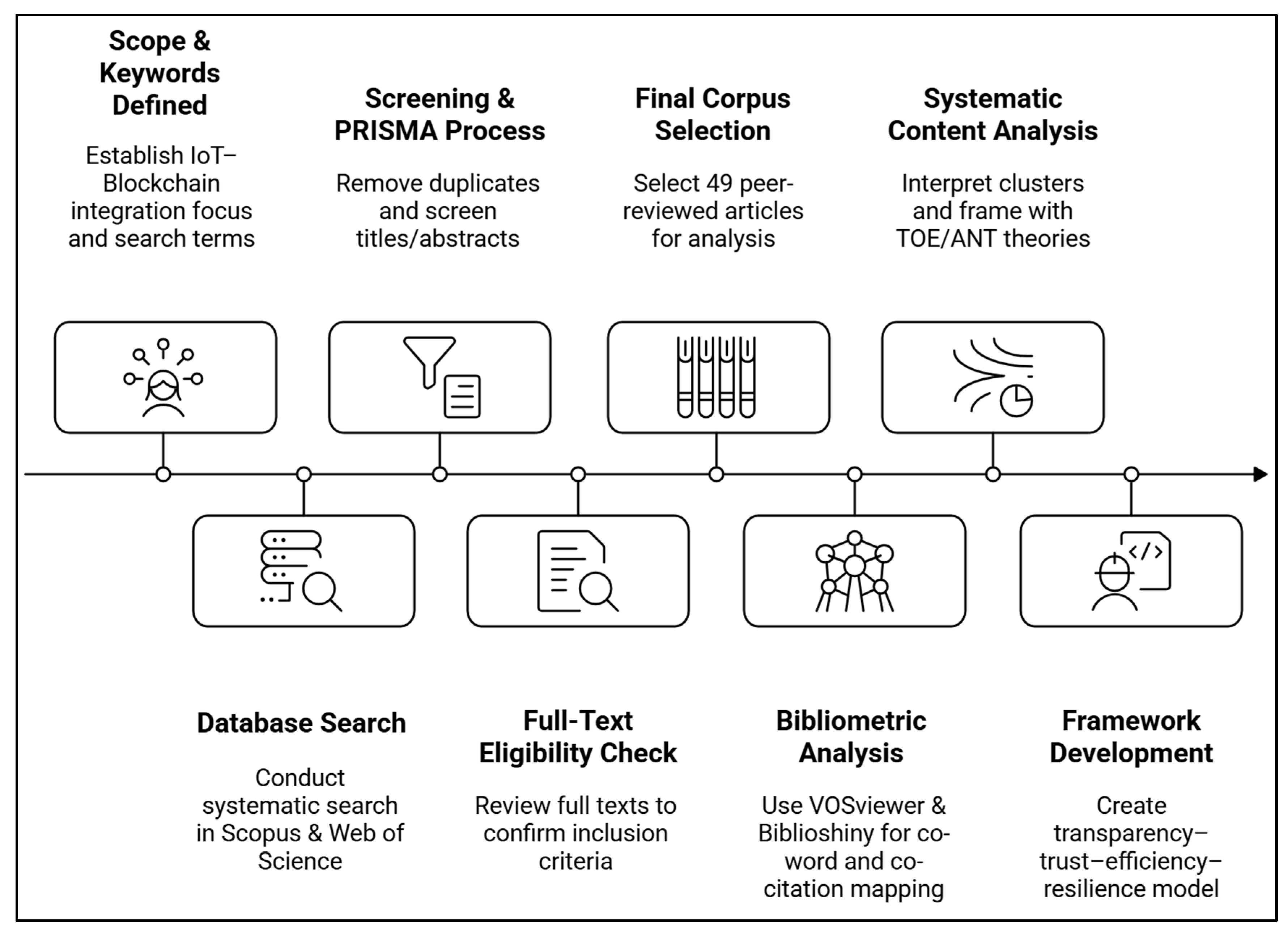
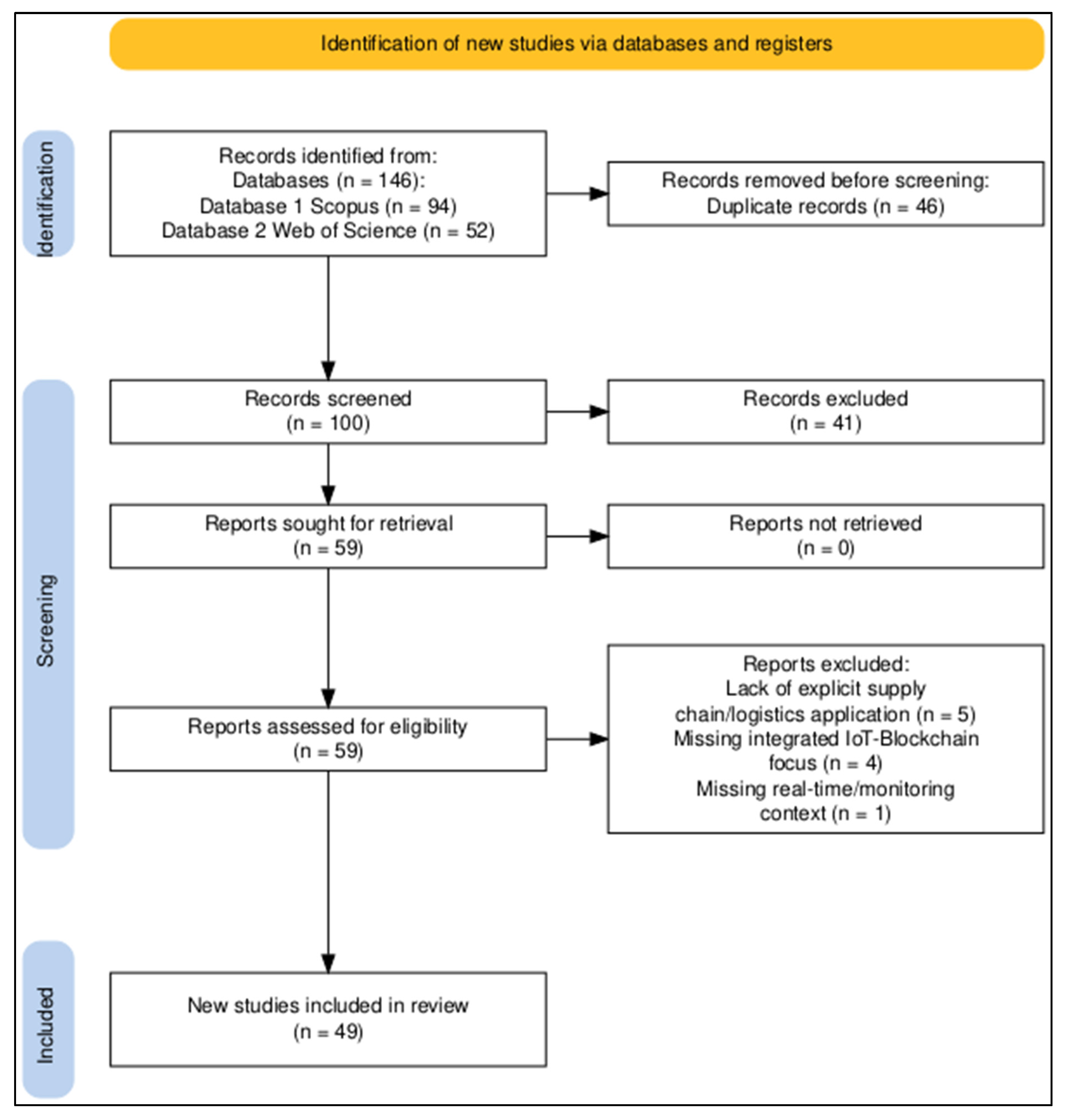
Section 3 details the methodology, including the bibliometric and systematic review procedures;
Section 4 presents and analyses the bibliometric results and thematic visualisations;
Section 5 discusses the key theoretical and managerial implications; and
Section 6 concludes with future research directions and policy recommendations.
4. Results
4.1. Descriptive Analysis
4.1.1. Main Findings
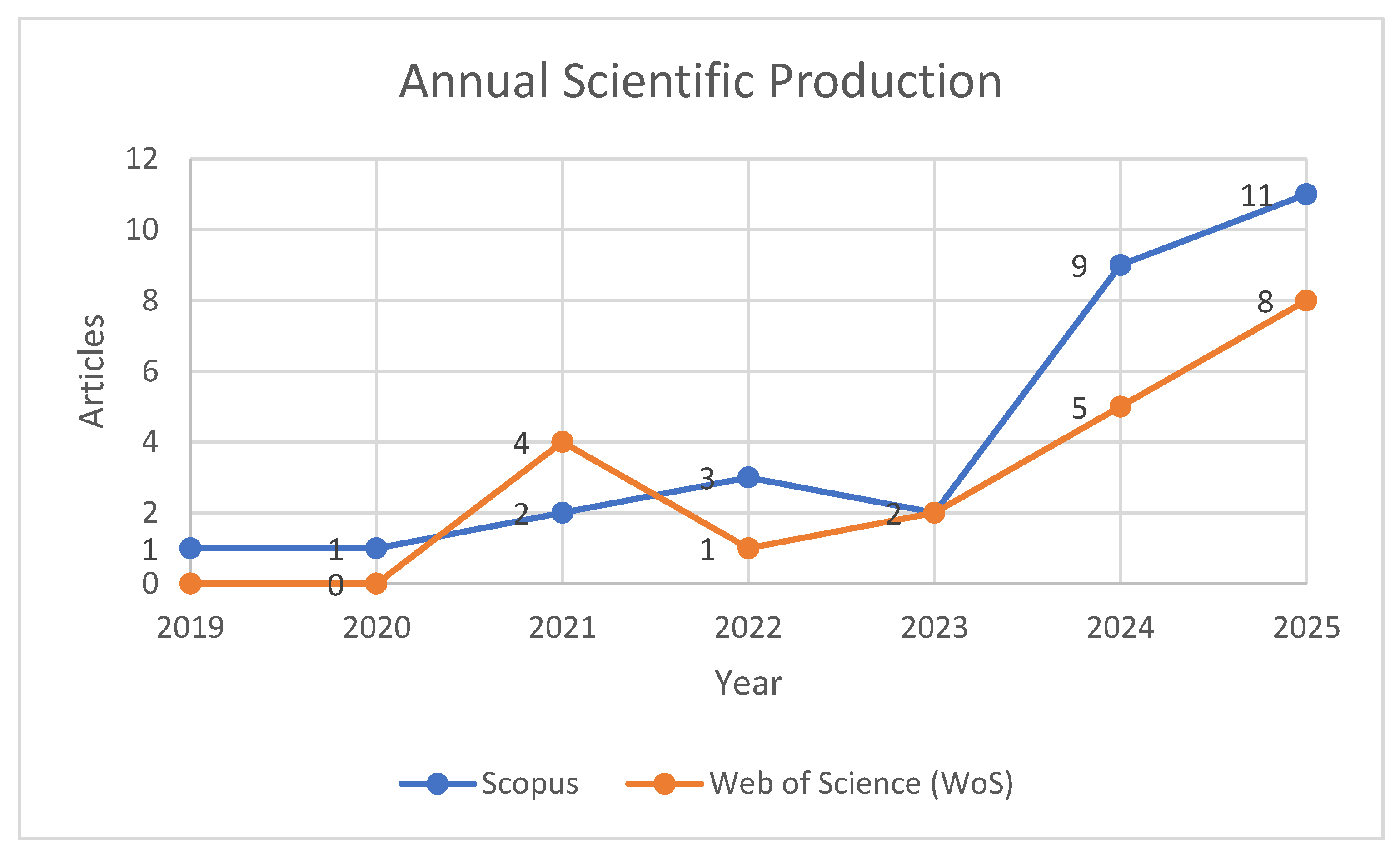
As demonstrated in
Table 5 and
Figure 3, the finalised corpus comprises 49 peer-reviewed journal articles published between 2019 and 2025. Scopus rose from 1 article in 2019 to 11 in 2025, and Web of Science increased from 0 to 8 articles over the same period, reflecting an acceleration in scholarly interest in recent years. The data reveal a significant upward trajectory in academic interest, characterised by an Annual Growth Rate of 63.35%. While the field produced minimal output in 2019 and 2020, with only one publication each year, a notable surge began in 2021, with six articles. Following a brief period of stabilisation in 2022 and 2023, with four publications annually, output increased dramatically to 14 articles in 2024 and peaked at 19 publications in 2025. This rapid acceleration underscores the growing urgency within the logistics discipline to integrate sensing and ledger technologies to enhance supply chain resilience.
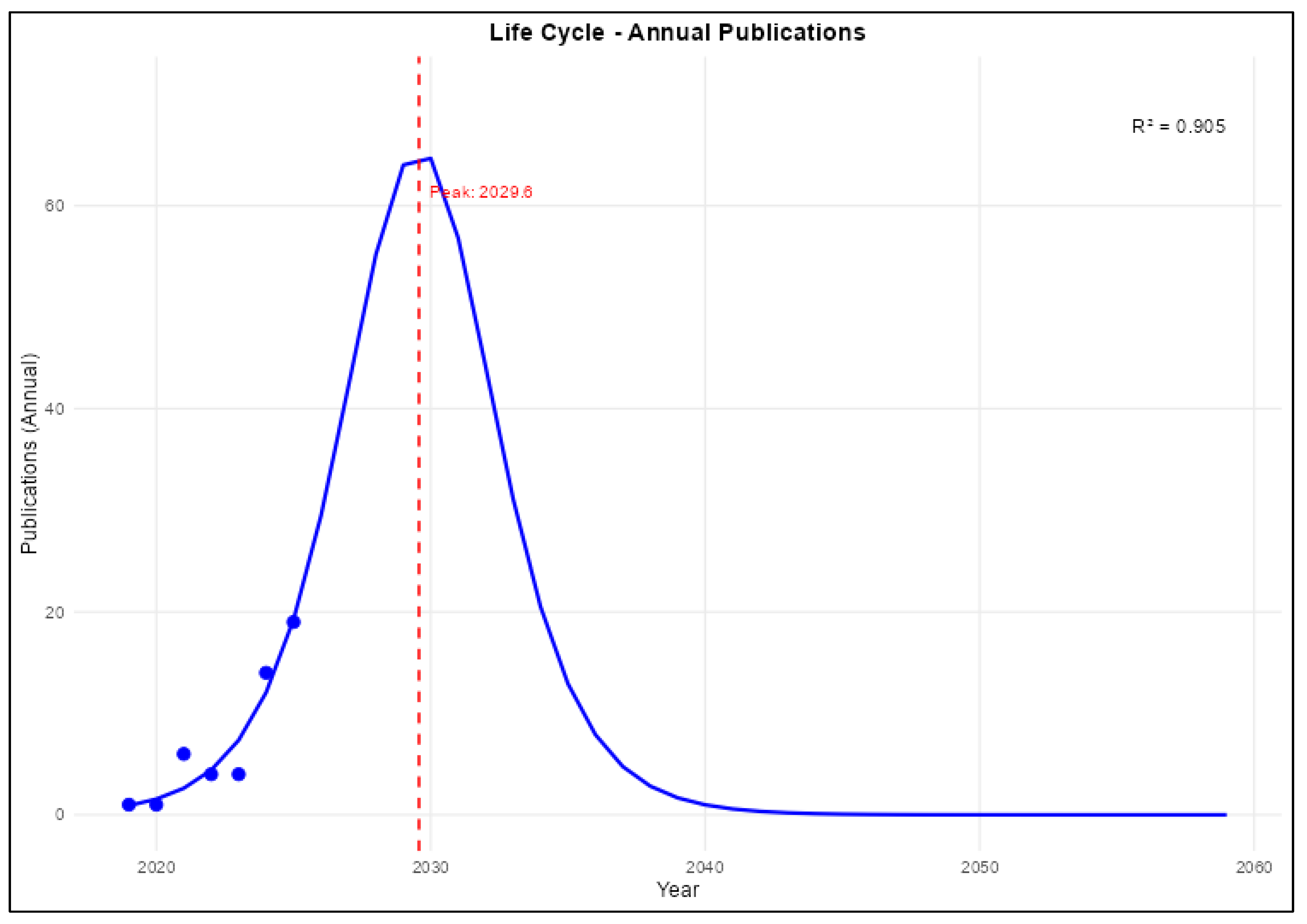
The literature life cycle, presented in
Figure 4, indicates that the research area is currently in a high-growth phase. By applying a logistic growth model to the publication data, the analysis identifies a peak annual production of approximately 65 publications, projected to occur around 2029. The life-cycle metrics indicate that the field entered its current accelerated development stage in mid-2025. This temporal mapping confirms that the integration of IoT and Blockchain is moving beyond early exploratory pilots into a consolidated stage of framework development and empirical validation, aligning with the maturation of Industry 5.0 concepts.
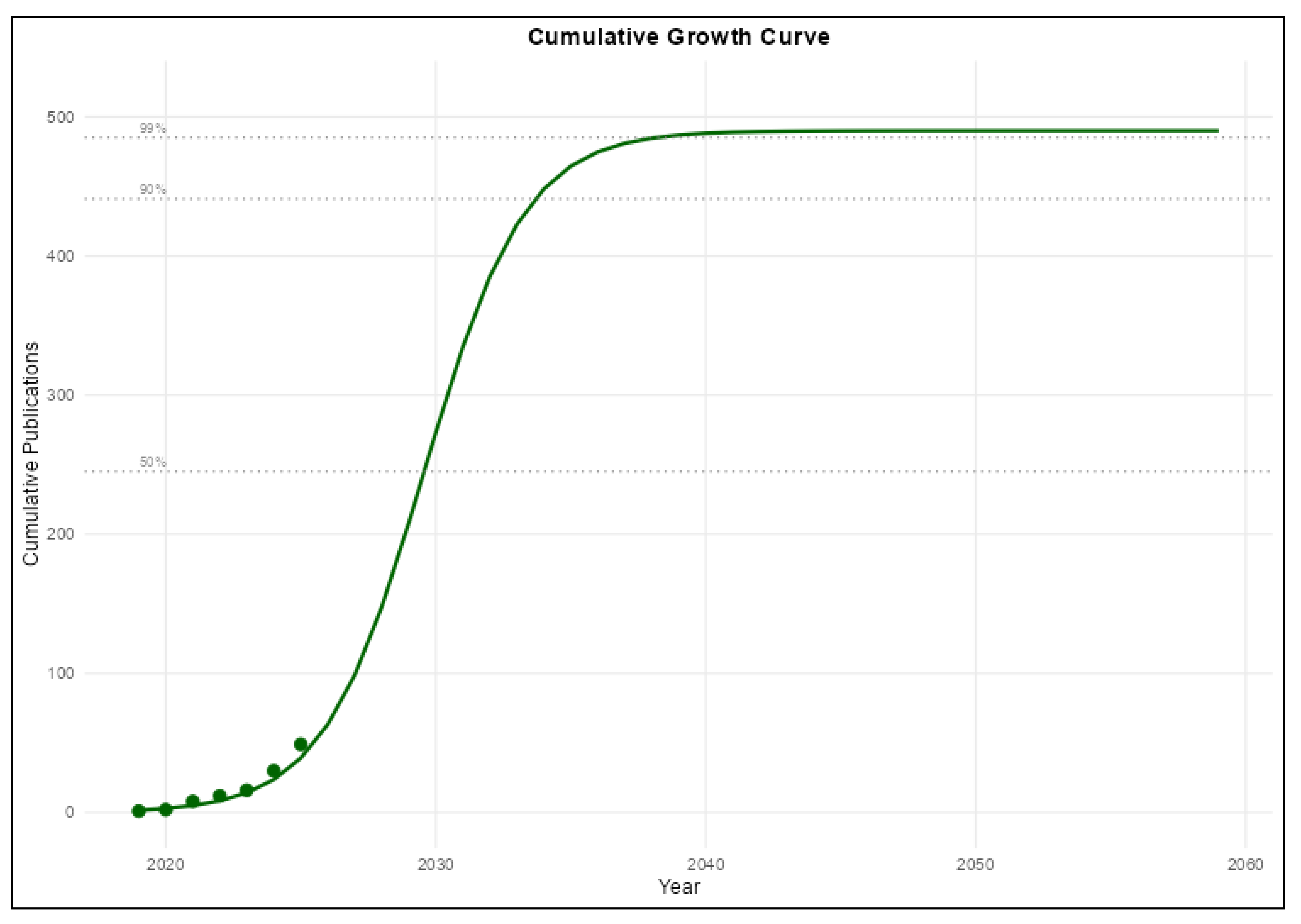
Finally, the Cumulative Growth Curve depicted in
Figure 5 illustrates the total volume of knowledge produced since the inception of this niche. The curve shows a gentle incline during the initial years, followed by a sharp steepening starting in 2024. More than 67% of research in this field was published in the past 24 months. Such a trend suggests a shift from fragmented technological discussions toward a more cohesive, synthesised body of knowledge, providing the empirical foundation for the transparency–trust–efficiency model proposed in this study.
4.1.2. Most Cited
The analysis of citation counts provides a measure of the academic influence and foundational role of specific studies in the field of IoT–blockchain integration. Citation values are normalised and time-adjusted, not raw counts, to ensure fair comparison across years.
Table 5 lists the top ten most globally cited documents in the corpus. To further understand the geographic distribution of research influence. To address citation inflation and recency bias, normalised citation metrics were applied alongside raw citation counts. This adjustment scales each article’s citations relative to the average for its publication year, ensuring that older, highly cited papers do not disproportionately dominate and that recent contributions are fairly represented in trend and influence analyses.
Table 6 presents the citation performance by country.
As indicated in
Table 6, the article by [
68], published in the journal
Logistics, currently holds the highest total citation count, establishing it as a seminal work in the integration of digital technologies for supply chain transparency. While older papers often accumulate more total citations, the Total Citations (TC) per year metric reflects a study’s current momentum. Notably, the work by [
24] has the highest average annual citations (29.50), reflecting its immediate relevance to contemporary debates on offsite manufacturing and data traceability. Furthermore, the Normalised TC score, which adjusts citation counts to the year’s average, confirms that [
24] work significantly outperforms its peers, indicating a significant shift toward technical integration validated in construction environments.
The data in
Table 7 indicate that China and the United Kingdom are the primary hubs of high-impact research in this domain, together accounting for over 50% of total citations. While China leads in total volume, the United Kingdom exhibits a remarkably high Average Article Citation rate of 83, suggesting that UK-based publications are highly concentrated and influential. This pattern indicates that while research production is geographically diverse, including emerging contributions from Egypt, Bangladesh, and Morocco, the intellectual leadership remains centred in regions with established Industry 4.0 and 5.0 infrastructure. This distribution provides evidence of a global effort to improve logistics transparency through digital means, while also pointing to a potential digital divide in the implementation of these complex technologies.
The longitudinal analysis of author production, as summarised in
Table 8, highlights the evolving scholarly impact and thematic diversity within the domain of IoT and blockchain integration. Ref. [
24] emerges as a highly influential contributor, achieving the highest total citations (59) and citations per year (29.5), accounting for nearly 30% of the total citation impact within this group. Consistent research trajectories are evident in the collaborative work of [
77], whose 2024 and 2025 publications on the industrial metaverse and digital twin factories collectively received 30 citations. Similarly, ref. [
78] (2024, 2025) demonstrate thematic continuity by addressing the complexity of inventory management and the transition toward Pharma 4.0. The data further reflects a broad sectoral expansion, with authors such as [
79] focusing on smart agriculture and food security, while recent 2025 contributions from Ababio, Abdellah, and Abbas indicate a sustained momentum toward secure industrial digital twins and sustainable construction frameworks.
4.2. The Intellectual Structure of the Field
Co-Citation Analysis
To further delineate the intellectual structure of the research field, this section analyses the citation performance over time and the distribution of core publication outlets. The temporal distribution of citations provides insight into the periods of highest academic impact. As detailed in
Table 9, the mean total citations per article (MeanTCperArt) and the mean total citations per year (MeanTCperYear) vary across the 2019–2025 timeframe.
The data indicate that although publication volume peaked in 2024 and 2025, the highest average annual citation impact occurred between 2020 and 2021. This suggests that the foundational frameworks for IoT–blockchain integration were established during this period, thereby catalysing a subsequent surge in research output. The lower citation counts in the most recent years (2024–2025) are attributed to the “citation time-lag” effect, in which newer papers take longer to be indexed and cited by subsequent studies, rather than to a lack of scholarly relevance.
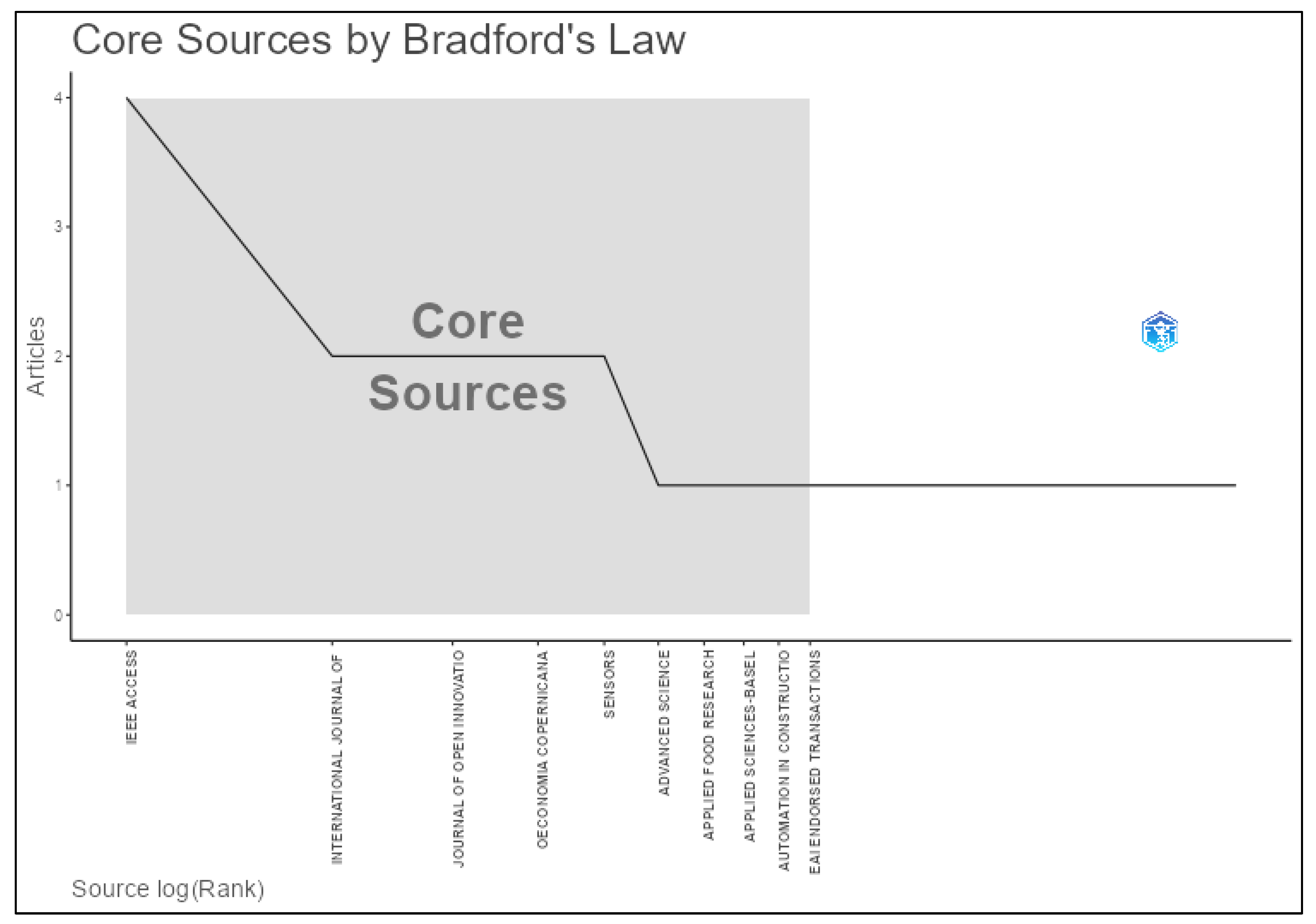
To identify the most influential journals in the field,
Figure 6 applies Bradford’s Law, which categorises journals into three zones based on their productivity. According to this law, a small core of journals (Zone 1) provides the highest concentration of articles on a specific topic. The analysis identifies 12 core journals in Zone 1, which together published approximately one-third of the final corpus (n = 49). The leading sources in Zone 1 include:
IEEE Access (4 articles)
International Journal of Service Science, Management, Engineering, and Technology (2 articles)
Journal of Open Innovation: Technology, Market, and Complexity (2 articles)
Oeconomia Copernicana (2 articles)
Sensors (2 articles)
The distribution of core sources reflects a multidisciplinary focus, spanning information technology, management science, and sensors. This diversity supports the reviewers’ observation that integrating IoT and Blockchain to achieve real-time visibility is not merely a technical challenge but also a cross-disciplinary management concern. The presence of high-impact journals in the core zone further validates the methodological rigour of the literature selection process.
4.3. The Conceptual Structure
The conceptual structure of the research field is examined through co-word analysis to identify the dominant themes and the cognitive architecture of IoT–blockchain integration. This analysis examines the frequency and co-occurrence of keywords to reveal how core concepts are linked within scientific discourse.
Co-Word Analysis
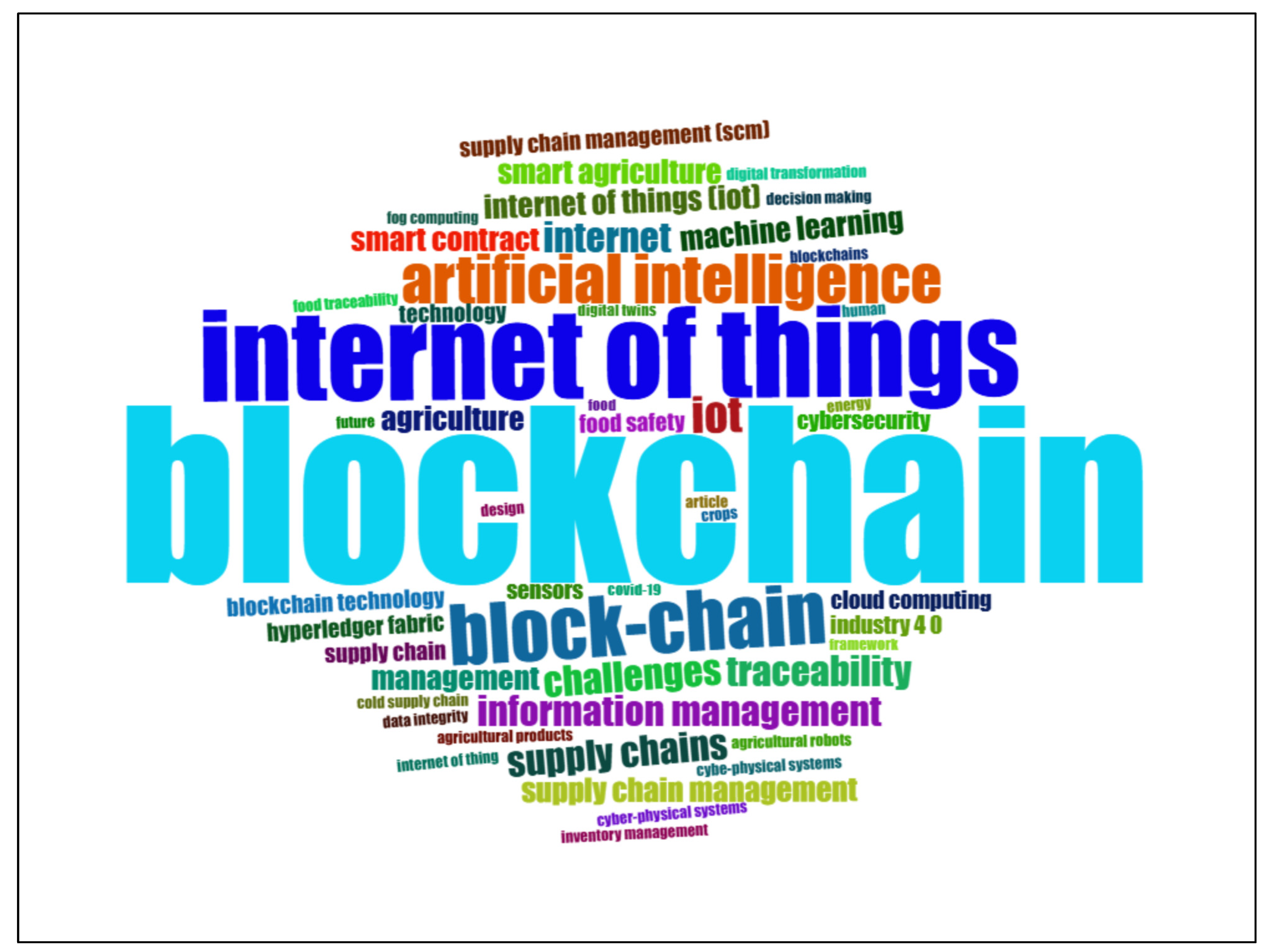
The word cloud in
Figure 7 presents a visual representation of the most prominent terms in the 49 included articles. The size of each word corresponds to its frequency in the corpus, highlighting the central roles of Blockchain and the Internet of Things. These terms serve as the primary anchors of the research, reflecting the literature’s fundamental technological focus. Additional key terms, such as artificial intelligence, traceability, and smart contracts, indicate the specific technological domains and functional applications most frequently discussed in the context of real-time inventory visibility.
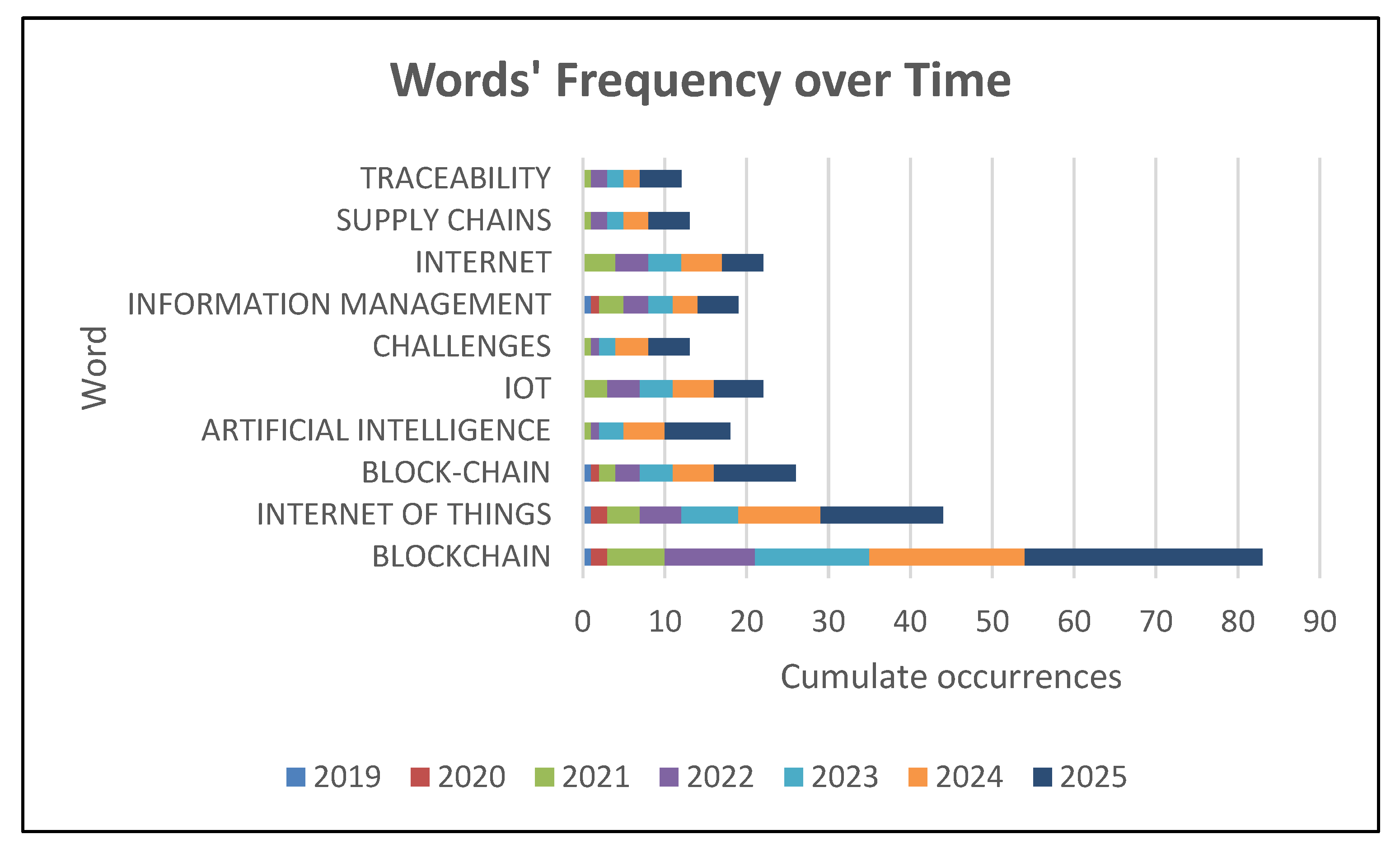
To provide a more detailed quantitative perspective,
Figure 8 presents the word-frequency analysis. These data confirm that Blockchain is the most frequent keyword, appearing 29 times, followed by Internet of Things, with 15 occurrences. Other notable terms include Blockchain (10), artificial intelligence (8), and IoT (6). The high frequency of terms such as challenges, traceability, and information management, which each appear 5 times, suggests a strong scholarly interest in resolving operational barriers and enhancing data integrity in logistics. The presence of emerging technologies such as machine learning and smart agriculture, alongside established concepts such as supply chain management, demonstrates the field’s expanding scope from generic technological descriptions to specialised industry applications.
The distribution of these keywords suggests that the conceptual structure is moving beyond isolated technological silos. The frequent co-occurrence of these terms indicates that research is increasingly focusing on integrating sensing and trust layers to address complex supply chain requirements. This alignment of keywords supports the proposed transparency–trust–efficiency model, as the literature consistently links the data-gathering capabilities of IoT with the secure, decentralised verification provided by Blockchain.
The conceptual landscape of the research field is further elucidated through the analysis of thematic clusters and network visualisations, which categorise the intellectual components into functional domains. This systematic mapping identifies how keywords interrelate to form the cognitive structure of the discourse on IoT-blockchain integration.
4.4. Thematic Map
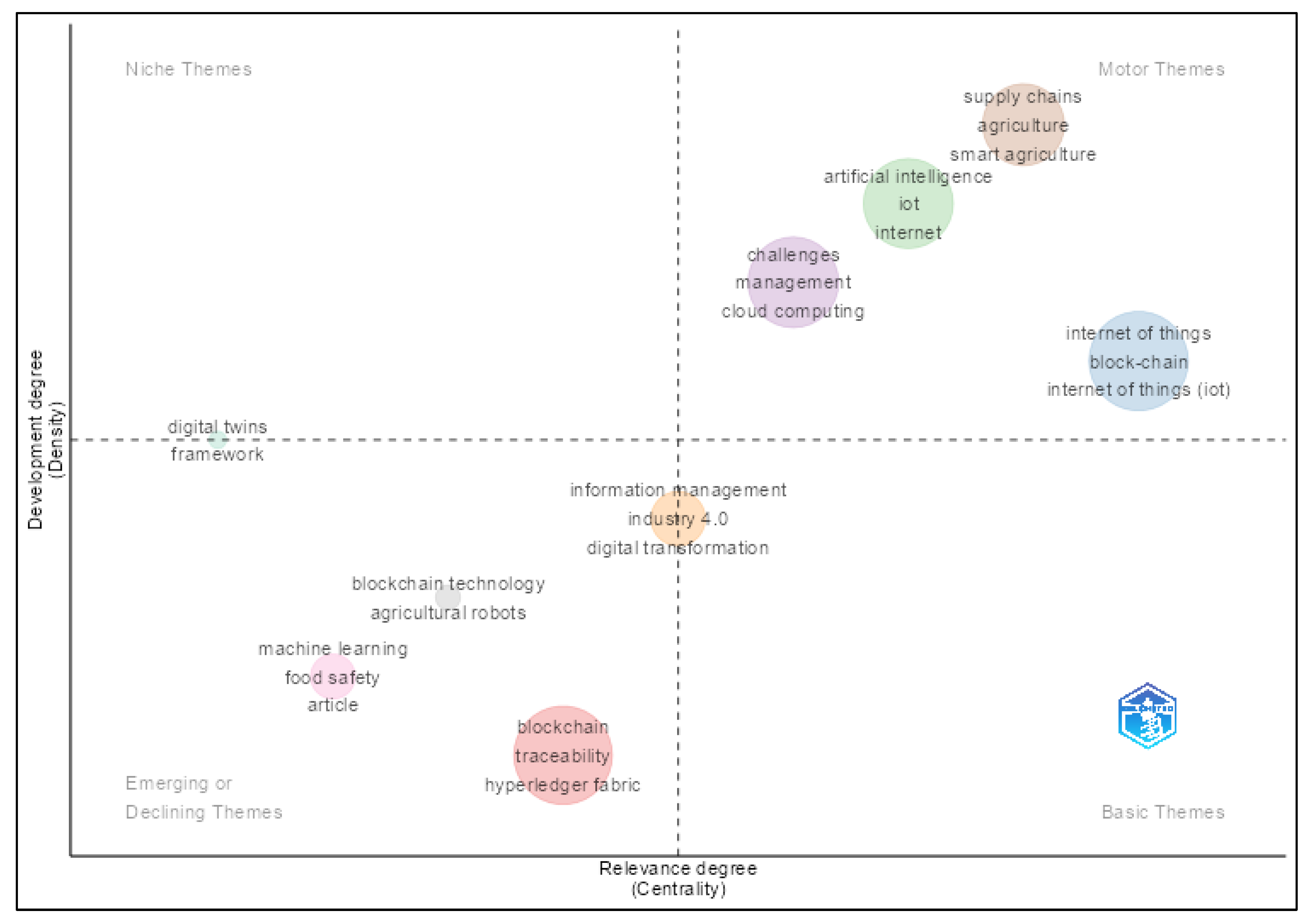
The thematic map classifies the research topics into four distinct quadrants based on their centrality and density. Centrality represents the degree of interaction between a cluster and other parts of the network. It serves as a measure of a theme’s importance in the development of the entire research field. Density measures the internal strength of a cluster, indicating the extent to which a specific theme has developed.
Clustering and Network Visualisations
The results of the clustering analysis are summarised in
Table 10, which details the Callon centrality and density metrics for each identified thematic group. The bibliometric analysis identified nine clusters (
Table 10); six core clusters (IoT, blockchain, supply chains, challenges, artificial intelligence, information management) informed the conceptual synthesis, while three (machine learning, blockchain technology, digital twins) were treated as moderators/boundary conditions. Blockchain: governance-centric; IoT: automation-centric; AI: optimisation-centric; Challenges: risk-centric; Supply Chains: resilience-centric; Digital Twins: simulation-centric. This quantitative assessment provides the empirical basis for categorising the themes into motor, niche, basic, or emerging quadrants.
The analysis identifies the integration of Blockchain and the Internet of Things as a motor theme, characterised by high centrality and high density. Specific expected themes—regulatory governance, energy efficiency, and standards—appear less prominent in our bibliometric results, owing to methodological and structural limitations. First, the 2019–2025 window and journal-only inclusion favour logistics and information systems outlets, whereas governance and standards materials often appear in policy reports, standards bodies’ documents, or conference proceedings, which were excluded by design. Second, terminological variation disperses these topics across synonyms (e.g., “compliance,” “policy alignment,” “ISO/IEC,” “throughput per watt”), reducing their centrality in author keyword co-occurrence even when they are present in the full text. Third, cross-disciplinary dispersion (energy and industrial engineering journals versus logistics/IS sources) weakens co-word links with our IoT–Blockchain focus, thereby diminishing cluster density despite conceptual relevance. Finally, recency effects and normalised citation adjustments attenuate the visibility of very recent regulatory initiatives and standards work that have not yet accrued stable citation patterns. These factors explain the observed bibliometric prominence without implying thematic insignificance; accordingly, we treat governance, energy efficiency, and standards as boundary conditions and moderators in the conceptual synthesis and highlight them in the future research agenda.
This indicates that the core technological intersection is both well-developed and essential to the field’s overall structure. Traceability and smart contracts appear as niche themes, suggesting highly specialised areas of technical development. Conversely, themes relating to digital twins and Industry 5.0 are classified as emerging, representing the newest frontiers of the research that are gaining prominence but are not yet fully mature. Underexplored clusters—digital twins, machine learning, and blockchain technology—show low density and centrality, signalling gaps in governance integration and predictive analytics for Industry 5.0.
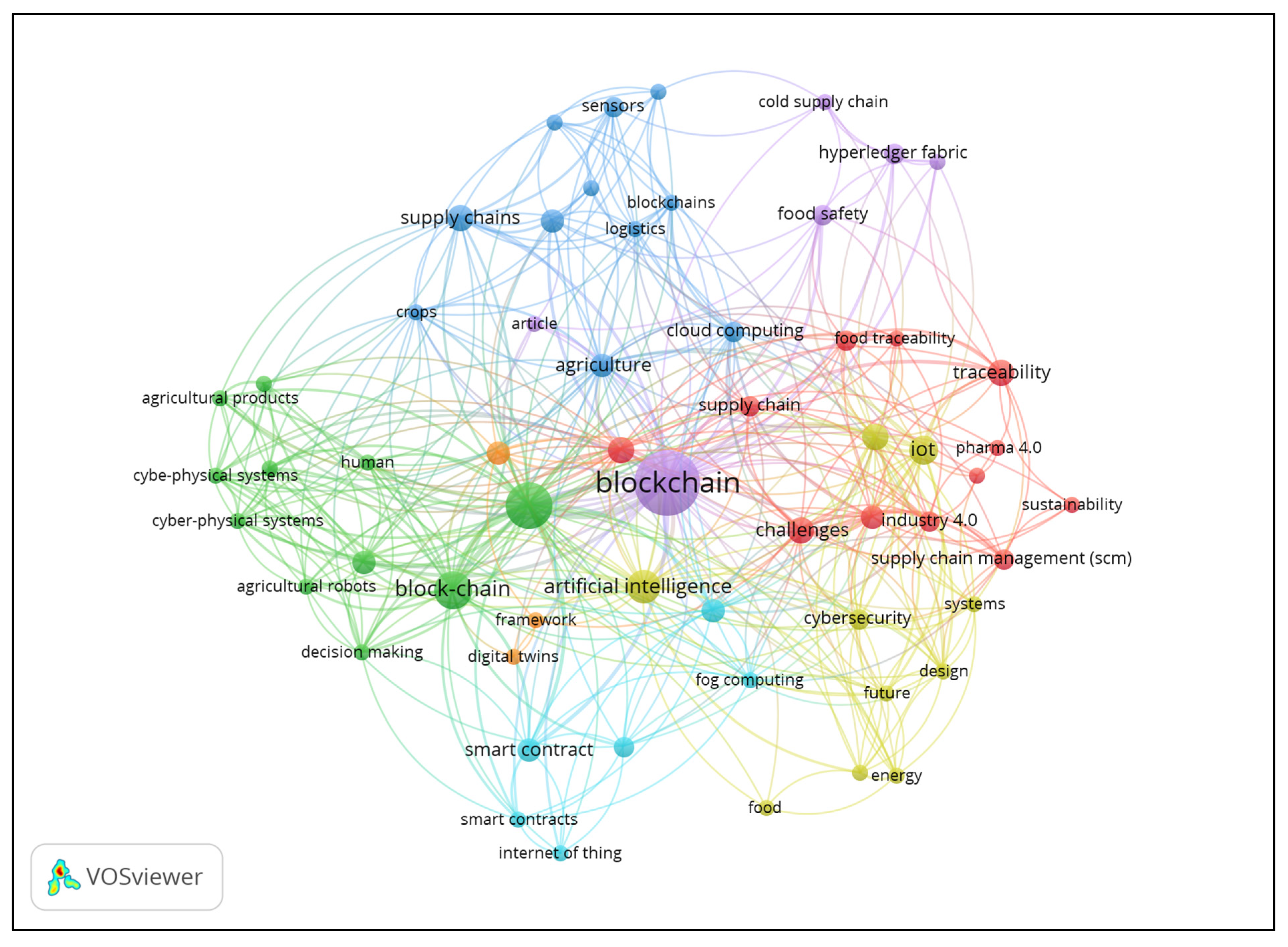
Further refinement of the intellectual structure is shown in
Figure 9, which displays the co-word network generated by VOSviewer. This map emphasises the distance and link strength between clusters, providing a structural view of the field. The network reveals three major clusters: a primary cluster focused on the technical integration of Blockchain and IoT, a secondary cluster centred on supply chain management and information systems, and a tertiary cluster highlighting specific industrial applications such as agriculture and healthcare. The strong inter-cluster linkages confirm the transition toward a socio-technical framework in which visibility leads to verifiable trust.
4.5. The Social Structure
The social structure of the research field is analysed to understand the patterns of scientific collaboration and the network of relationships between researchers and geographic regions. This analysis provides insight into the degree of knowledge sharing and the formation of academic clusters within the IoT–blockchain integration domain.
Collaboration Network Analysis
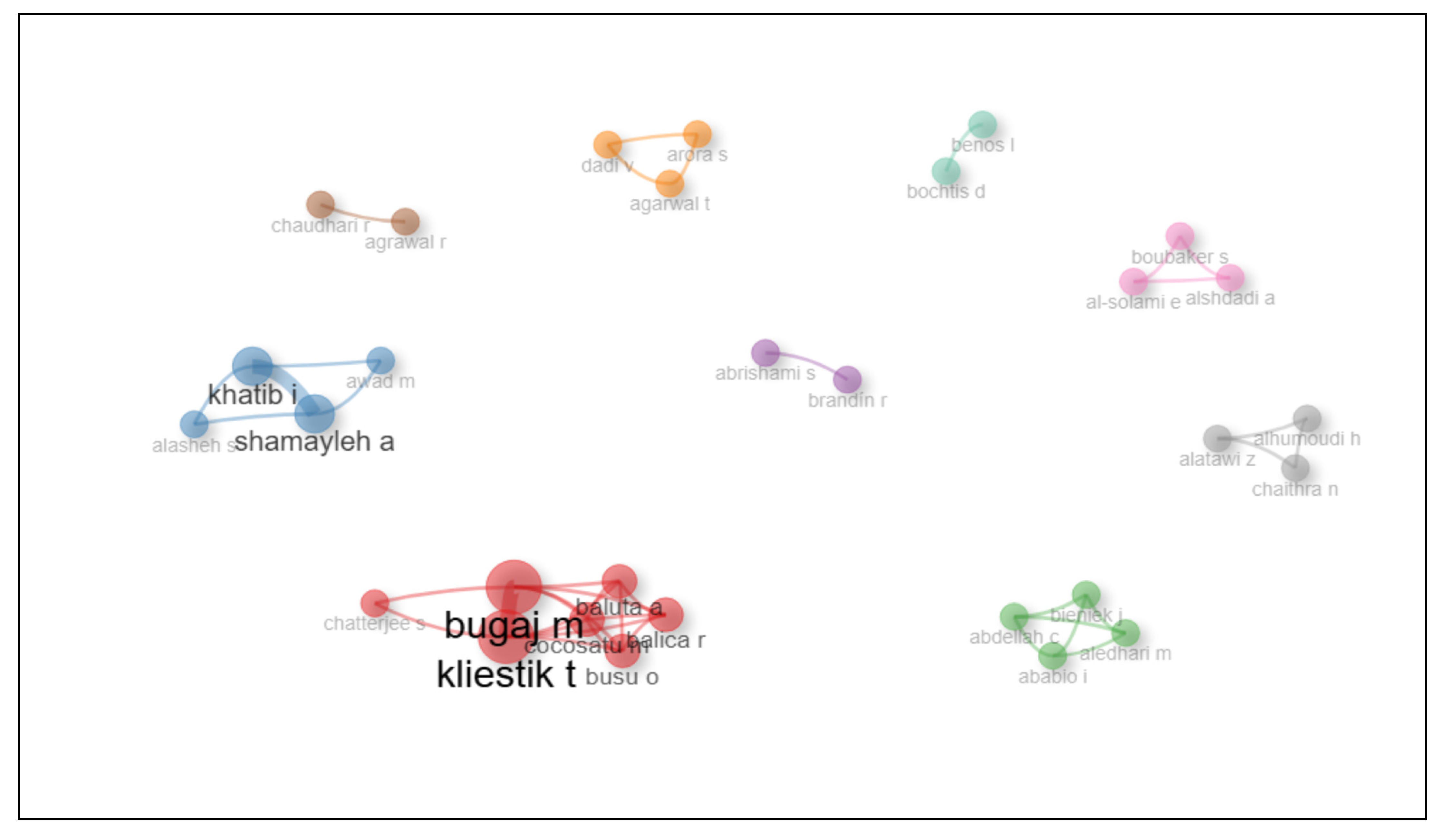
The author collaboration network depicted in
Figure 10 shows the collaborative ties between researchers. The network analysis reveals several distinct clusters, most notably a high-density group involving authors such as [
77]. The proximity of nodes within this cluster suggests a sustained collaborative relationship and a shared research focus on industrial digital twins and algorithmic economies. The existence of these groups indicates that while the field is geographically diverse, intellectual development is often driven by localised centres of expertise.
The geographic distribution of these collaborations is further detailed in
Table 11, which presents the frequency of joint research efforts among countries. As presented in
Table 11, the collaboration patterns exhibit a strong regional focus, particularly within Central and Eastern Europe. The strongest tie is observed between the Czech Republic and Slovakia, with two collaborations. Additionally, intercontinental collaborations are emerging, such as those between the United Kingdom and South Africa, and between India and the Central European cluster.
These results suggest that while global interest in the transparency–trust–efficiency model is widespread, the research’s structural backbone remains rooted in regional academic partnerships. This finding aligns with the Industry 5.0 vision of fostering resilient systems through collaborative networks. However, it also highlights the need for broader international cooperation to standardise IoT–blockchain architectures across diverse regulatory environments.
Overall, the results demonstrate that scholarship on IoT–blockchain integration for real-time inventory visibility and traceability has entered a rapid consolidation phase, with publication output accelerating sharply in 2024–2025. The field’s conceptual core stabilises around tightly linked themes such as Blockchain, the Internet of Things, supply chains, information management, and challenges, alongside emerging frontiers (for example, digital twins and Industry 5.0) that signal a shift from exploratory pilots toward integrative socio-technical architectures. The citation and collaboration patterns further indicate that influence is concentrated in a small set of high-impact contributions and regional research hubs. Visibility becomes computational trust and how that trust is translated into operational efficiency under real-world constraints (privacy, scalability, interoperability, and oracle reliability).
The following section, therefore, develops the framework directly from these empirically observed clusters and tensions, before the discussion critically interprets the findings through the selected theoretical lenses and contrasts them with prior literature to surface the key mechanisms, boundary conditions, and implications for Industry 5.0 logistics practice.
4.6. Toward a Theoretical Model of the IoT–Blockchain Transparency–Trust–Efficiency-Supply Chain Resilience
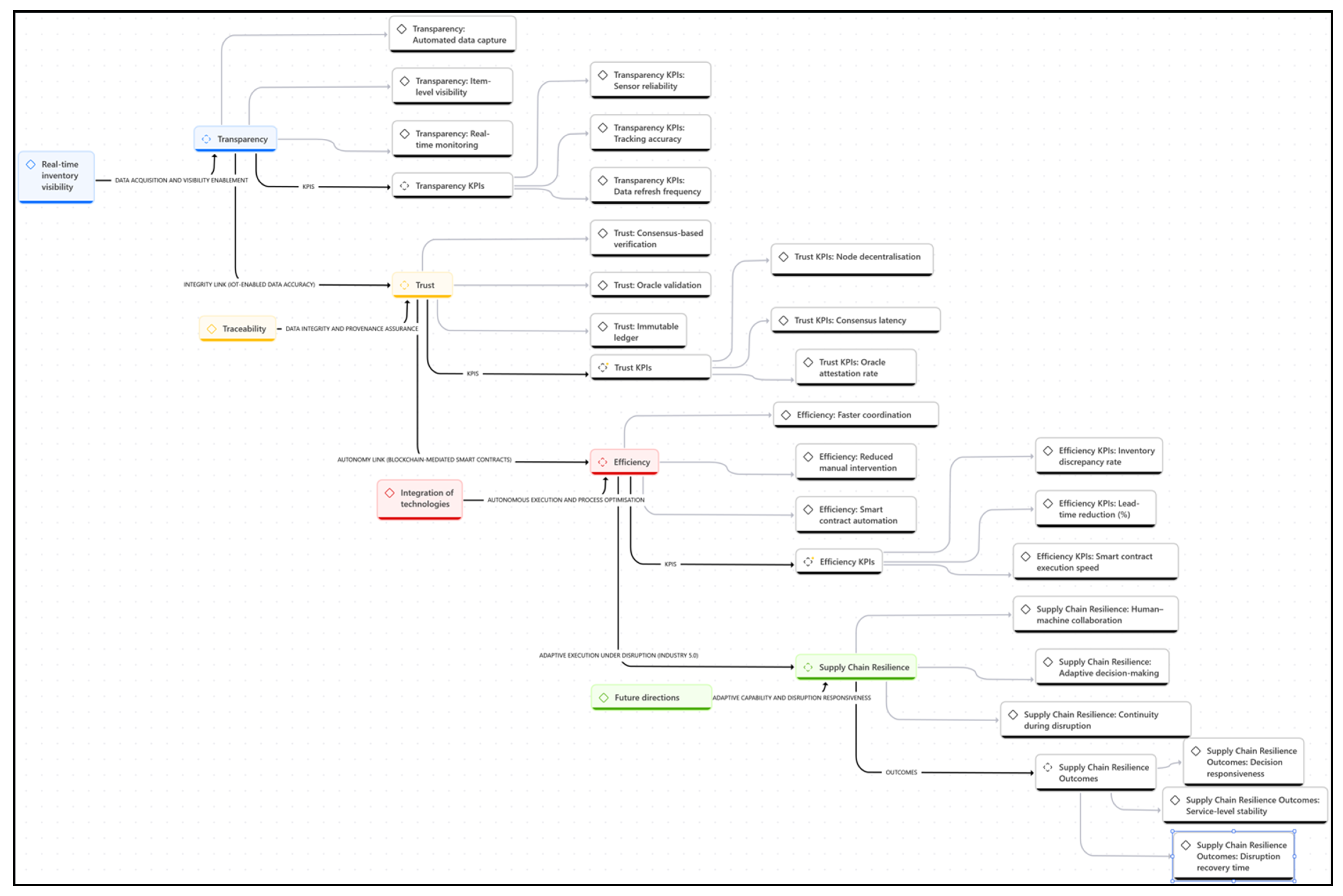
Figure 11, Theoretical Model of the IoT–Blockchain Transparency–Trust–Efficiency–Supply Chain Resilience synthesises the empirical patterns and thematic structures identified in the study into a parsimonious, testable architecture that links four analytically distinct layers: (i) Transparency (IoT/sensing), (ii) Trust (Blockchain/integrity), (iii) Efficiency (Managerial/execution), and (iv) Supply Chain Resilience (Industry 5.0 outcome). The model is purpose-built to convert real-time data acquisition into verifiable provenance, automate execution at speed, and ultimately sustain continuity and service-level stability under disruption.
The bibliometric–systematic results revealed a motor theme centred on the tight coupling of Blockchain and the IoT, accompanied by niche emphases on traceability and smart contracts, and emerging emphases on digital twins and Industry 5.0. These distributions warrant a layered design in which sensing outputs are operationally translated into integrity guarantees, which in turn are translated into execution speed. Accordingly, the model formalises four cross-layer mechanisms (links shown in
Figure 11):
Data acquisition and visibility enablement (Real-time inventory visibility ⟶ Transparency).
Real-time monitoring, item-level visibility, and automated data capture (IoT) are posited to increase transparency, operationalised by data refresh frequency, tracking accuracy, and sensor reliability. These measurable indicators reflect the field’s shift from reactive monitoring to continuous visibility, and they directly anchor the sensing layer to observable performance.
Data integrity and provenance assurance (Traceability ⟶ Trust).
Immutable ledgers, oracle validation, and consensus-based verification (Blockchain) are posited to elevate trust by securing provenance and reducing counterparty ambiguity. The mechanism explicitly addresses the oracle problem—data must be attested before on-chain commitment—so oracle attestation rate, consensus latency, and node decentralisation serve as integrity KPIs. This instantiation moves beyond general claims about “trust” to measurable computational assurances.
Autonomous execution and process optimisation (Integration of technologies ⟶ Efficiency).
Smart-contract automation and reduced manual intervention are posited to increase efficiency, as evidenced by faster smart-contract execution, shorter lead times (%), and lower inventory discrepancy rates. The mechanism centres on autonomy (machine-triggered actions from validated sensor inputs) and directly operationalises the field’s move from visibility to actionability at managerial speed.
Finally, the Resilience block aggregates outcome variables—disruption recovery time, service-level stability, and decision responsiveness—that the results highlighted as the sector’s practical frontier under Industry 5.0 (adaptive decision-making and human–machine collaboration). This outcome placement reflects the observed transition from fragmented pilots to socio-technical architectures that sustain continuity during shocks.
The observed acceleration of publications (2019–2025) and the concentration of core sources around IoT–Blockchain themes justify a condensed, layered model rather than a diffuse checklist. The empirical identification of tightly linked keyword clusters (e.g., blockchain–IoT–supply chains) provides the construct scaffolding (Transparency, Trust, Efficiency) and their ordering, which the model codifies as sequential mechanisms culminating in resilience.
The field’s shift from monitoring to automation—with Oracle reliability and smart contracts as central features—requires the specific links shown in
Figure 10. Thus, the model formalises
visibility →
verifiable provenance →
autonomous execution, with KPIs at each layer that researchers and managers can instrument directly. This responds to the need for actionable frameworks that elevate transparency and trust while delivering efficiency outcomes.
Emergent themes (digital twins, human-centricity, socio-technical governance) are integrated as moderators of the Trust → Efficiency → Resilience pathway, clarifying how human–machine collaboration and adaptive decision-making stabilise service levels under disruption. The model thus provides a forward-looking framework for Industry 5.0 resilience that can incorporate new capabilities (e.g., AI assistants, federated learning) without altering the core mechanisms.
The model operationalises the technology context via IoT (Transparency KPIs) and Blockchain (Trust KPIs); the organisation context via managerial execution routines (Efficiency KPIs); and the Environment context via regulatory and market pressures manifesting in traceability and sustainability demands that shape the Trust layer’s design choices (e.g., consensus throughput, decentralisation). This shifts TOE from descriptive determinants to mechanistic coupling, namely, how technology choices causally drive organisational performance and resilience outcomes through instrumented pathways.
By treating sensors, ledgers, oracles, validators, and smart contracts as non-human actants that translate physical states into digital commitments, the model specifies how successful translation (attested data → immutable record → automated action) enables human managers to mobilise credible information for adaptive decisions. ANT is thus extended from narrative mapping to operational constructs with KPIs (attestation rates, latency, node structure) that diagnose where translation failures degrade trust and efficiency.
Transparency (IoT domain—sensing layer).
Definition: The extent to which inventory states are captured and refreshed at item-level granularity with minimal blind spots.
Operationalisation: Real-time monitoring, item-level visibility, automated data capture; KPIs: data refresh frequency, tracking accuracy, sensor reliability. Higher values imply lower information asymmetry in the physical flow.
Trust (Blockchain domain—integrity layer).
Definition: The degree of computational assurance that recorded states and provenance are tamper-evident and consensus-validated.
Operationalisation: Immutable ledger, oracle validation, consensus-based verification; KPIs: oracle attestation rate, consensus latency, node decentralisation. Trust rises when exogenous data are attested, and on-chain commitments are distributed and timely.
Efficiency (Managerial domain—execution layer).
Definition: The degree to which coordination, reconciliation, and control actions are automated and accelerated with reduced manual frictions.
Operationalisation: Smart-contract automation, reduced manual intervention, faster coordination; KPIs: smart-contract execution speed, lead-time reduction (%), inventory discrepancy rate. Efficiency manifests when verified states trigger autonomous workflows that compress cycle times and errors.
Supply Chain Resilience (Industry 5.0 outcome).
Definition: The capability to sustain continuity, adapt decisions rapidly, and maintain service levels during disruptions through human–machine collaboration.
Operationalisation: Continuity during disruption, adaptive decision-making, human–machine collaboration; Outcomes: disruption recovery time, service-level stability, decision responsiveness. Resilience is an emergent property of trustworthy visibility and fast execution under uncertainty.
The model’s ordering (Transparency → Trust → Efficiency → Resilience) follows the empirical co-word structure, with Blockchain as the central node linking sensing outputs to managerial applications. The thematic map indicates that IoT–Blockchain integration is simultaneously central and dense (motor theme). The inclusion of Oracle KPIs addresses the persistent reliability bottleneck. The inclusion of execution-speed metrics (latency, lead-time reduction) reflects the broader shift from visibility to actionability, and the resilience outcomes align with the sector’s trajectory toward socio-technical systems that withstand volatility.
Each KPI is grounded in observed research emphasis and provides a means of falsification through quantitative measurement.
This model contributes by (i) replacing diffuse lists with causal, instrumented mechanisms that specify how data acquisition becomes verifiable provenance and then automated execution; (ii) embedding measurable KPIs at each layer to enable empirical testing and managerial steering; (iii) extending TOE/ANT from descriptive frames to operational designs capable of diagnosing failure points (sensing unreliability; attestation gaps; consensus/contract latency); and (iv) linking Industry 5.0 outcomes to concrete upstream design choices, thereby making resilience a modelled consequence of transparency and trust, not a rhetorical aspiration.
5. Discussion
This discussion interprets the empirical patterns reported in
Section 4 and connects them to the layered mechanisms in
Figure 11, Theoretical Model of the IoT–Blockchain Transparency–Trust–Efficiency–Supply Chain Resilience. We synthesise how the observed intellectual structure, thematic clusters, and KPIs collectively answer RQ1–RQ3, and we provide concrete visual artefacts for inclusion to aid replication and managerial uptake. The IoT–Blockchain Transparency–Trust–Efficiency-Supply Chain Resilience model is analytically derived from the literature and intended as a conceptual guide; empirical validation remains a future research priority.
Operationalisation Guidance for Future Empirical Studies:
To facilitate empirical testing, each construct in the transparency–trust–efficiency–resilience model can be operationalised using concrete indicators and replicable data sources. Transparency (IoT/sensing) may be measured via data refresh frequency (events/minute), tracking accuracy (percentage of correctly geo-tagged or condition-tagged items), and sensor reliability (mean time between failure/false positives), using device logs, edge gateways, and warehouse management system (WMS) exports. Trust (blockchain/integrity) can be captured through oracle attestation rate (share of sensor events verified by TEEs/HSMs or attestation protocols), consensus latency (median block/transaction finality in seconds), and node decentralisation (Herfindahl–Hirschman Index of validating nodes), drawing on ledger telemetry, validator dashboards, and oracle service reports. Efficiency (managerial execution) can be assessed via smart-contract execution speed (event-to-action latency), lead-time reduction (%) (order-to-delivery cycle compression relative to baseline), and inventory discrepancy rate (mismatches per 1000 items), using ERP/WMS timestamps, process mining traces, and audit counts. Resilience (Industry 5.0 outcome) may be evaluated with disruption recovery time (hours to service restoration), service-level stability (fill rate/OTIF variance under shock), and decision responsiveness (median time to human-in-the-loop override or exception handling), derived from incident logs, service-level KPIs, and control-room records. Where appropriate, researchers should triangulate system telemetry (IoT, ledger, ERP) with managerial surveys (e.g., governance practices, human-oversight protocols) and event studies around disruptions to enhance construct validity and reduce mono-method bias.
The results (
Section 4.1,
Section 4.2,
Section 4.3 and
Section 4.4) show a pronounced consolidation around the
IoT–Blockchain nexus, with smart contracts, traceability, and oracle reliability as prominent enabling subthemes. This mirrors domain-wide scientometric mappings that identify Blockchain–IoT as a core motor theme and highlight scalability, privacy, and interoperability as persistent boundary conditions for supply chain deployment [
85,
86]. The bibliometric surge in 2024–2025 aligns with sectoral shifts from descriptive pilots to implementable architecture decision models for selecting oracle platforms [
87], cross-network oracle interoperability [
88], and performance evaluation of permissioned cross-chain transactions [
89].
Figure 12 illustrates the thematic evolution of IoT–blockchain research, showing a clear progression from emerging, fragmented topics to more central, mature research streams. Core motor themes, such as IoT–blockchain integration in supply chains, smart agriculture, and artificial intelligence–enabled IoT, exhibit high centrality and density, indicating their consolidation as dominant drivers of the field. In contrast, digital twins and framework-oriented studies remain positioned as niche or emerging themes, reflecting ongoing conceptual development but limited integration into the core knowledge structure. Basic themes, including general IoT and blockchain applications, remain highly relevant but exhibit lower internal cohesion, suggesting foundational importance without deep theoretical consolidation. Overall, the figure demonstrates a shift from exploratory technological experimentation toward application-driven, integrative, and performance-oriented research trajectories in real-time visibility and traceability between 2019 and 2025.
Table 12 provides a structured comparison of integrated frameworks. This table categorises the literature into the four layers of the theoretical model and identifies the specific technological collaborations that resolve supply chain tensions.
RQ2 asked how frameworks have evolved to enhance transparency, trust, and efficiency in real-time supply chains. The evidence supports a layered mechanism: Transparency (IoT) → Trust (Blockchain) → Efficiency (Execution).
Transparency (IoT/sensing).
Real-time monitoring and item-level capture improve data refresh frequency and tracking accuracy, but visibility becomes actionable only when sensor outputs are attested to before on-chain commitment. Sectoral designs demonstrate secure edge sensing using TEEs/HSMs, improving integrity in logistics flows [
93]. Cross-sector bibliometrics also indicate the rising prominence of IIoT security as a precursor to trustworthy visibility pipelines [
101].
Trust (Blockchain/integrity).
Trust hinges on the reliability of the oracle and the performance of consensus. Multiple architectures address the oracle problem: (i) MCDM decision support to choose secure, cost-effective oracle platforms [
87]; (ii) VRF + reputation to select high-quality oracle nodes, empirically reducing variance and increasing accuracy [
21]; (iii) distributed oracles with Intel SGX for data integrity and availability, improving response times even under malicious servers [
20]. Reputation designs grounded in decentralised identity and ODE-based scoring simultaneously strengthen privacy and trust [
102]. Meanwhile, threshold signatures and signcryption reduce congestion and protect transmissions from eavesdropping and quantum attacks, aligning integrity with performance [
103,
104].
Efficiency (Managerial/execution).
Smart contracts translate verified states into autonomous actions, shortening lead times and reducing inventory discrepancies. Reviews of integrated frameworks highlight the orchestration of IoT + AI + Blockchain for predictive analytics, real-time monitoring, and secure data exchange, collectively improving efficiency and decision speed [
105,
106]. Transparency gains from smart contracts yield greater auditability and responsiveness in supply chains, albeit with scalability and compatibility caveats that must be engineered [
107].
RQ3 sought emerging themes and directions that guide theoretical development and practice. The results point to human-centric governance, digital twins, and sector-specific frameworks (e.g., agri-food, healthcare, transport), where privacy-preserving credentials and auditable oracle controls stabilise service levels under disruption.
Identity, credentials, and privacy-by-design.
Chained verifiable credentials support non-repudiation and automated compliance, strengthening traceability in complex manufacturing chains [
96]. Privacy-preserving vehicular crowdsensing via oracles ensures reliability and fairness while maintaining computational efficiency, signalling the cross-sector generalisability of privacy-centric oracle designs [
108]. In healthcare, integrity and multi-system interoperability mechanisms for Oracle data flows maintain authenticity while improving performance [
109].
Auditable controls and accountability.
Treating oracles as service organisations under existing audit standards provides control objectives (collection, storage, transformation, transmission) that bridge computational trust with institutional accountability [
110]. This governance layer complements technical assurance mechanisms and is pivotal in regulated supply chains.
Interoperability and cross-chain coordination.
Oracle-mediated cross-chain approaches for consortium blockchains achieve secure bidirectional data interactions, answering the practical need for B2B coordination across heterogeneous ledgers [
111]. Persona-preserving reputation and DID-based scoring systems further balance privacy and trust in multi-party ecosystems [
102].
The ordering Transparency → Trust → Efficiency → Resilience, is empirically anchored by the co-word centrality of
Blockchain as the bridge from sensing to managerial applications and by sectoral deployments where verified data trigger autonomous coordination [
112]. Extending TOE, the model translates adoption antecedents into mechanistic couplings with KPIs; extending ANT, it renders non-human actants (sensors, oracles, validators, contracts) diagnosable via performance metrics that surface translation failures (e.g., low attestation, high latency) before they erode service stability.
The synthesis reveals several methodological weaknesses across the reviewed studies. First, most contributions rely heavily on descriptive bibliometric mapping or conceptual proposals, with limited empirical validation of integrated IoT–Blockchain frameworks in real-world settings. Second, longitudinal designs are virtually absent, thereby limiting insights into adoption trajectories and performance over time. Third, mixed-method approaches that combine quantitative mapping with qualitative case evidence remain underutilised, reducing the explanatory depth of socio-technical dynamics. Finally, interoperability and governance issues are often treated as technical challenges without incorporating organisational or behavioural perspectives, limiting the generalisability of proposed solutions. Addressing these weaknesses through multi-method, context-aware research designs represents a critical priority for advancing the field.
Future research should expand data sources, adopt longitudinal and mixed-method designs, use advanced normalisation, standardise taxonomies, and apply transparent coder resolution protocols to improve rigour and reproducibility.
Practically, resilience improves when organisations:
Harden the sensing-to-ledger pipeline with TEEs/HSMs and integrity verification filters;
Engineer interoperability and throughput via oracle-based cross-chain protocols and consensus tuning;
Instrument autonomous execution with smart contracts and analytics to compress lead times and reduce discrepancies.
Two caveats follow from the results: (i) citation time-lag for 2024–2025 studies cautions against under-weighting recent designs (e.g., interoperability, oracle reputation mechanisms) as they have not yet accumulated citations; and (ii) sectoral unevenness in empirical deployments highlights the need for longitudinal trials that report KPI trajectories (attestation, latency, execution speed, lead-time reduction) alongside resilience outcomes.
The field exhibits rapid consolidation around IoT–Blockchain integration with motor themes in smart contracts and oracle designs; interoperability, privacy, and scalability persist as boundary conditions [
86].
Frameworks have evolved from visibility to verifiable provenance and autonomous execution via TEEs/HSMs, VRF-reputation selection, distributed SGX oracles, and threshold cryptography, yielding measurable gains in accuracy, latency, and cycle time [
20,
21,
93,
104,
105,
106,
107,
112].
Emerging directions emphasise governance and human-centrism—verifiable credentials, privacy-preserving reputation, auditable oracle controls, and cross-chain protocols—that stabilise service levels under disruption and support Industry 5.0 resilience [
96,
102,
109,
111,
113,
114].
Future Research Directions and Specific Questions
Building on the transparency–trust–efficiency–resilience continuum and the observed weak/emerging clusters, we outline targeted research questions to shape the next phase of inquiry:
Transparency (IoT/sensing)
RQ-T1: How do changes in data refresh frequency and tracking accuracy at item-level granularity influence downstream trust metrics (e.g., oracle attestation rate) under different supply chain contexts?
RQ-T2: What combinations of sensing hardware and edge analytics reduce false positives/negatives sufficiently to justify on-chain commitments without inflating operational costs?
Trust (blockchain/integrity & governance)
RQ-TR1: Which oracle validation designs (e.g., TEEs/HSMs, VRF-based reputation) most effectively improve attestation rates while maintaining acceptable consensus latency in permissioned versus public networks?
RQ-TR2: How do privacy-preserving credentials (e.g., verifiable credentials, ZKPs) alter the transparency–privacy trade-off in multi-party logistics and what governance protocols enable auditability without disclosure of sensitive data?
Efficiency (managerial execution & interoperability)
RQ-E1: To what extent do smart-contract execution speeds and event-to-action latency translate into measurable lead-time reduction and lower inventory discrepancy rates in real deployments?
RQ-E2: Which cross-chain or oracle-mediated interoperability mechanisms sustain throughput (transactions/second) while preserving integrity across heterogeneous consortia?
Resilience (Industry 5.0 outcomes & human oversight)
RQ-R1: How do human-in-the-loop overrides and exception-handling protocols affect disruption recovery time and service-level stability in autonomous logistics settings?
RQ-R2: What role do digital twins (simulation-centric) play in enhancing decision responsiveness during shocks, and how should twin fidelity be benchmarked against real-world telemetry?
Cross-cutting (underexplored clusters and methodological advances)
RQ-C1: How can standardisation efforts (data schemas, IoT/ledger interoperability standards) reduce terminology dispersion and improve co-word centrality for governance and energy-efficiency themes?
RQ-C2: Which longitudinal, mixed-method designs best capture the evolution of attestation, latency, and resilience KPIs across multi-year deployments, and how do organisational factors mediate these trajectories?
Each question is designed for empirical tractability using combined system telemetry (IoT, ledger, ERP/WMS), governance documentation (credentials, audit logs), and process mining of event traces, enabling replication and comparative analysis across sectors.
6. Conclusions
Recognising the growing imperative to integrate IoT and Blockchain into supply chain ecosystems, firms are increasingly adopting these technologies to enhance transparency and operational resilience. Achieving meaningful benefits from this transformation requires strategic alignment across technical, organisational, and governance dimensions. While many enterprises continue to grapple with interoperability and trust challenges, this study provides a comprehensive synthesis of current trends. It illustrates how layered frameworks can advance efficiency and adaptive capacity in Industry 5.0 logistics.
This research underscores the transformative role of the convergence of IoT and blockchain in advancing transparency, trust, and operational agility across supply chains. The bibliometric analysis reveals a sharp escalation in scholarly contributions between 2019 and 2025, with China and the United Kingdom emerging as dominant knowledge hubs and journals such as IEEE Access and Oeconomia Copernicana serving as influential publication outlets. Core thematic clusters include real-time inventory visibility, oracle-based integrity mechanisms, and smart-contract-driven automation, while emerging directions highlight digital twins, federated learning, and socio-technical governance. Theoretical perspectives such as TOE and Actor–Network Theory were frequently applied to interpret adoption dynamics and resilience outcomes within Industry 5.0 frameworks.
This study enriches theoretical perspectives on IoT–blockchain integration by consolidating empirical evidence and structuring dominant conceptual approaches such as TOE and ANT. It organises insights into four interdependent layers—transparency, trust, efficiency, and resilience—clarifying how technological adoption, governance mechanisms, and performance outcomes are systematically connected. Furthermore, it identifies critical gaps, including insufficient longitudinal validation, limited cross-technology orchestration, and underexplored socio-technical governance, thereby laying a foundation for advancing integrated models that align with Industry 5.0 principles and practical supply chain resilience strategies.
Despite notable advancements, this review identifies persistent gaps in real-world deployment, interoperability, and readiness in resource-limited environments. Future investigations should prioritise strategies to mitigate integration barriers, foster multi-stakeholder collaboration, and align conceptual models with operational practices to accelerate Industry 5.0-driven supply chain transformation. By consolidating bibliometric and thematic insights, this study offers actionable guidance for scholars and practitioners, supporting informed decisions regarding the adoption of secure, transparent, and resilient digital frameworks within logistics ecosystems.
The scarcity of qualitative investigations exposes a methodological limitation within the current body of research. With the overwhelming reliance on bibliometric and quantitative synthesis, there is insufficient evidence to determine whether interpretive approaches could yield richer insights into organisational dynamics and technology adoption processes. Future studies should therefore incorporate qualitative or mixed-method designs to explore how IoT–blockchain frameworks influence decision-making, governance practices, and resilience strategies in real-world supply chain environments.
This review enables three critical advances. For theory development, it consolidates fragmented constructs into a layered IoT–Blockchain Transparency–Trust–Efficiency-Supply Chain Resilience model, offering a conceptual scaffold for future frameworks that integrate socio-technical governance with technological mechanisms. For empirical research, it provides guidance on the operationalisation of each construct. It identifies underexplored clusters—such as digital twins and privacy-centric governance—where longitudinal and mixed-method studies can generate explanatory depth. For practice, the synthesis informs decision-makers on emerging architectures and governance models that balance automation with human oversight, guiding investments in interoperable, resilient IoT–Blockchain ecosystems. By linking bibliometric evidence to actionable pathways, this review moves beyond descriptive mapping to shape the next generation of theory-driven, empirically validated, and practically relevant research in Industry 5.0 logistics.