1. Introduction
The rapid expansion of the global maritime transportation industry has intensified competition among shipbuilding companies, compelling them to simultaneously enhance operational efficiency, cost-effectiveness, and product quality. In such a highly competitive environment, shipyards are required to meet increasingly demanding customer expectations while adhering to strict delivery schedules and international safety standards [
1,
2]. The competitiveness of a shipyard is commonly reflected through three key performance indicators: short construction lead times, minimized production costs, and assured product quality that fully meets owner specifications [
3]. These indicators collectively determine the overall productivity and reputation of a shipyard in the global market [
4]. Maintaining all three aspects consistently throughout the ship construction process is a challenging task that requires not only efficient project management, but also strong coordination among multiple departments, suppliers, and subcontractors throughout the entire supply chain.
A crucial element supporting these performance indicators lies in the supplier selection process, which directly affects production continuity, overall cost efficiency, and the quality of the final ship product [
5,
6]. In the shipbuilding industry, procurement activities involve an extensive range of specialized materials and components, such as hull structures, propulsion systems, equipment and electronic subsystems sourced from multiple domestic and international vendors [
7,
8]. The performance and reliability of these suppliers play a decisive role in ensuring that projects meet cost goals, adhere to construction schedules, and comply with strict quality and safety standards. Therefore, selecting suppliers capable of meeting these stringent requirements is not simply an administrative task but a strategic decision that directly influences the success of ship construction projects. However, supplier selection in this context is inherently complex because it requires the simultaneous evaluation of multiple and often conflicting criteria, including cost competitiveness, product quality, delivery reliability, service capability, and supply capacity [
9,
10,
11]. The unique characteristics of long project durations in shipbuilding, high capital investment, and intricate interdependencies between components further intensify this complexity, as any delay or deficiency in material supply can propagate through the production chain, causing significant schedule deviations and financial losses [
12,
13]. Despite the critical role of supplier selection, many shipyards still rely heavily on subjective judgment or experience-based decision-making processes, often without structured analytical methods or objective evaluation tools [
14]. Such approaches may lead to inconsistent assessments, hidden biases, and increased vulnerability to disruptions, ultimately undermining both operational efficiency and the resilience of the shipbuilding supply chain.
Beyond traditional economic and operational indicators, risk has emerged as a central consideration in contemporary supplier evaluation. The shipbuilding supply chain is uniquely complex due to its long production cycles, high capital commitments, and strong technological interdependencies among components and subsystems [
15]. This study highlights risk-related supplier evaluation under uncertainty. This is relevant to shipbuilding procurement because material delays or non-compliance can directly disrupt construction milestones and classification approval processes. These characteristics expose shipyards to multiple categories of risk, including scheduling delays caused by late deliveries, increasing procurement costs, supplier bankruptcy, and the potential for material inconsistency or defects that can compromise structural integrity [
16,
17]. Despite the strategic importance of these risks, the majority of existing studies on supplier selection continue to emphasize cost reduction or performance maximization, while treating risk either superficially or as a secondary criterion within the decision-making process. The limited integration of risk as a systematic and quantifiable evaluation dimension reflects a significant gap in the literature, particularly in the context of shipbuilding, where disruption at any stage can spread throughout the project timeline [
18,
19]. Addressing this shortcoming requires a more holistic decision-support framework that incorporates risk assessment alongside conventional criteria, enabling shipyards to identify more reliable suppliers, strengthen project reliability, and improve overall supply chain resilience [
20]. This approach is essential to support long-term competitiveness and continuity in shipbuilding operations, especially under increasing uncertainty in global supply networks. However, prior studies have not systematically quantified and integrated supplier-related risks as a core decision criterion within a structured hybrid MCDM framework.
Recent maritime supply chain volatility has further intensified procurement risk in industrial projects. For instance, disruptions affecting key international shipping routes have increased transit uncertainty, contributed to higher maritime transport costs, and reduced schedule reliability in global logistics networks. Such conditions have been highlighted in recent UNCTAD assessments, which emphasize the significant impact of the Red Sea-related disruptions on container shipping dynamics and the sustained upward pressure on transport costs. These developments strengthen the motivation for integrating risk explicitly as a core criterion in supplier selection, particularly in shipbuilding procurement where material availability, delivery punctuality, and compliance requirements are critical for maintaining production schedules.
Addressing this gap, the present study develops a risk-oriented strategy for material supplier selection that aligns with the operational complexity and strategic demands of the shipbuilding supply chain. By positioning risk as a central evaluation dimension, the framework advances beyond conventional cost- or performance-driven models and offers a more holistic assessment of supplier reliability, which is critical in shipbuilding where long project durations and intricate production interdependencies amplify the impact of supplier-related disruptions [
21,
22]. This study discusses risk-aware multi-criteria decision-making in supplier selection. Its findings support the need to quantify disruption and quality risks, which are critical in shipbuilding due to long lead times and strict material certification requirements. To operationalize this approach, the study employs a hybrid multi-criteria decision-making (MCDM) method that integrates both structured expert judgment and quantitative analysis [
23,
24,
25,
26]. The Best Worst Method (BWM) is used to derive consistent and robust criteria weights, while the Technique for Order of Preference by Similarity to Ideal Solution (TOPSIS) generates a discriminative ranking of supplier alternatives based on their proximity to an ideal performance profile [
27,
28,
29,
30]. This combined approach enhances methodological rigor, transparency, and traceability in procurement decisions, enabling shipyards to balance cost efficiency, quality performance, and risk exposure in a systematic manner. Overall, the proposed model contributes to strengthening supplier selection practices, supporting long-term strategic partnerships, and improving supply chain resilience and project reliability within the shipbuilding industry.
This study offers both theoretical and practical contributions. Theoretically, it advances the literature on supplier selection in the maritime sector by introducing an integrated decision-making framework that systematically incorporates risk within a multi-criteria evaluation structure. Practically, the findings provide shipyards with a robust decision-support tool to identify dependable suppliers and to develop a Quality–Risk-Oriented Multi-Sourcing Strategy that strengthens supply chain resilience, mitigates operational uncertainties, and supports sustainable and competitive shipbuilding operations. The remainder of this paper is organized as follows:
Section 2 presents establishing the theoretical underpinnings and key constructs of the study;
Section 3 describes the methodological design and analytical procedures;
Section 4 provides the empirical outcomes of the proposed framework;
Section 5 offers the results in relation to existing scholarship and industry implications; and
Section 6 concludes the paper with a synthesis of key insights and recommendations for future research. Therefore, the objectives of this study are as follows: (1) to develop a risk-integrated supplier selection framework for shipbuilding materials using a hybrid BWM–TOPSIS approach; (2) to quantify and prioritize evaluation criteria, including risk-related factors, using BWM; (3) to rank supplier alternatives using TOPSIS; and (4) to provide managerial insights to support a quality–risk-oriented multi-sourcing strategy.
2. Literature Review and Conceptual Framework
2.1. Supplier Selection and Risk-Based Decision Models
Supplier selection in shipbuilding is inherently complex due to extended project durations, substantial capital investment, and the interdependent material flows that span multiple production phases. Across various industrial sectors, the literature consistently highlights Multi-Criteria Decision-Making (MCDM) methods as reliable and robust tools for evaluating suppliers under multiple, often conflicting, criteria [
31,
32,
33]. Within shipbuilding, several studies have applied structured decision models to address this complexity. For example, the study in [
34] developed a supplier selection model focused on ship component procurement, emphasizing cost efficiency and schedule compliance. Although this study demonstrated the importance of systematic evaluation, it remained limited to conventional performance-based indicators. Similarly, the research in [
35] employed the Analytic Hierarchy Process (AHP) to capture the multi-criteria nature of supplier decisions, yet its findings revealed persistent operational challenges, including recurrent supplier errors that disrupt production continuity. Although valuable, these approaches fail to address the dynamic or risk-related factors inherent in shipyard supply chains.
Recent studies have increasingly extended supplier selection toward resilience, sustainability, and ESG-driven decision-making, reflecting the growing need to balance cost–service trade-offs with disruption and compliance risks. For example, recent hybrid MCDM frameworks have combined weighting and ranking mechanisms to support resilient supplier selection under uncertainty, while also incorporating sustainability-related criteria and managerial interpretability. Such developments confirm the relevance of hybrid MCDM models as a practical tool for procurement decision support in complex supply chain environments.
Despite these contributions, a clear research gap remains. The study in [
36] presented a more comprehensive framework by integrating qualitative and quantitative assessments, but it did not explicitly consider risk-related elements nor the strategic dimension of supplier selection within shipyard operations. Similarly, the study in [
37] examined interdependencies and feedback among criteria within the shipbuilding supply chain, offering meaningful insights into the complex relationships between evaluation factors. However, the criteria used in their analysis required deeper investigation, particularly regarding operational risks, disruptions, or vulnerabilities that commonly arise in large-scale shipbuilding projects [
38]. These limitations highlight the need for a more rigorous and risk-sensitive approach that goes beyond traditional performance criteria.
Although several studies incorporate risk-related indicators into supplier selection, most remain generic and are not tailored to the operational and regulatory characteristics of shipbuilding procurement. In shipbuilding, supplier disruptions may directly affect production schedules, material compliance, and classification requirements, resulting in cascading impacts on project delivery. Existing risk-aware models often treat risk as a secondary attribute or use qualitative descriptions without systematic quantification and integration into the weighting–ranking process. Therefore, a structured hybrid MCDM framework that explicitly integrates risk as a core criterion is still required for shipbuilding material procurement.
Furthermore, existing studies have generally not incorporated risk as a core component of the supplier selection process. The research in [
39] on selecting suppliers for marine safety equipment, for instance, applies criteria that do not reflect the extensive technical and operational challenges associated with raw material procurement in shipyards. Similarly, although the work in [
40] provides a strategic framework aligned with Industry 4.0 principles, it does not introduce a specific MCDM modelling approach capable of integrating operational risk factors. These gaps clearly indicate that current supplier selection frameworks in shipbuilding have yet to fully embrace risk-based considerations or establish a structured strategy that connects risk indicators with supplier ranking outcomes. Consequently, there is a pressing need to develop a risk-integrated supplier selection model that enhances supply chain control, supports informed decision-making, and strengthens long-term operational resilience within shipyards.
2.2. Multi-Criteria Decision-Making Approaches in Supplier Selection
MCDM methods have been widely adopted as effective tools for supporting structured supplier evaluation because they enable decision-makers to incorporate multiple performance dimensions into a coherent analytical process. Classical approaches such as AHP, ANP, and PROMETHEE have been applied across manufacturing and logistics sectors, yet their use in shipbuilding remains relatively limited and often affected by methodological constraints, including inconsistency in pairwise comparisons or limited ability to manage extreme weighting conditions [
12,
27,
41]. Recent studies show increasing adoption of more advanced MCDM techniques, with the Best Worst Method (BWM) gaining prominence due to its ability to produce highly consistent comparisons while reducing decision-maker burden. By comparing only the best and worst criteria, BWM provides more stable and reliable weighting outputs suitable for complex industrial contexts where criteria importance varies significantly [
33]. Similarly, TOPSIS continues to be widely employed for ranking alternatives based on their closeness to an ideal solution [
28]. Its methodological simplicity, ability to handle both qualitative and quantitative indicators, and interpretability make it effective for evaluating suppliers across competing dimensions such as cost, quality, delivery reliability, and operational performance.
Despite these methodological advancements, the literature seldom integrates risk explicitly into MCDM frameworks for shipyard supplier selection. Most studies emphasize traditional criteria cost, quality, delivery, and service without adequately addressing risk factors such as supply disruption probability, material failure consequences, financial instability of suppliers, or compliance-related risks [
39]. This gap underscores the need for a comprehensive, risk-aware decision model tailored to the distinctive characteristics of shipbuilding supply chains [
31]. Building on these insights, this study adopts a hybrid MCDM approach that leverages BWM for deriving robust and consistent criteria weights and TOPSIS for ranking supplier alternatives, enhanced by the inclusion of risk-related variables [
13]. The resulting conceptual framework provides a more resilient and operationally aligned supplier selection strategy that supports both short-term decision accuracy and long-term supply chain robustness in shipbuilding enterprises.
Table 1 shows the summary of related supplier selection studies and risk integration in shipbuilding and relevant industries.
The study employed structured interviews and expert consultations to identify supplier evaluation criteria and risk factors relevant to shipbuilding material procurement. The respondents consisted of representatives from three shipyards and two ship production experts (
), each with more than five years of professional experience in the shipbuilding sector. The interviews were conducted using a structured question guide (
Appendix A), focusing on (i) practical criteria used in supplier selection, (ii) major procurement risks experienced in shipbuilding projects, and (iii) the relative importance of each criterion to support the BWM pairwise comparison process. The final criteria list and definitions were consolidated based on expert responses and validated through a consensus review prior to quantitative analysis.
2.3. Research Framework
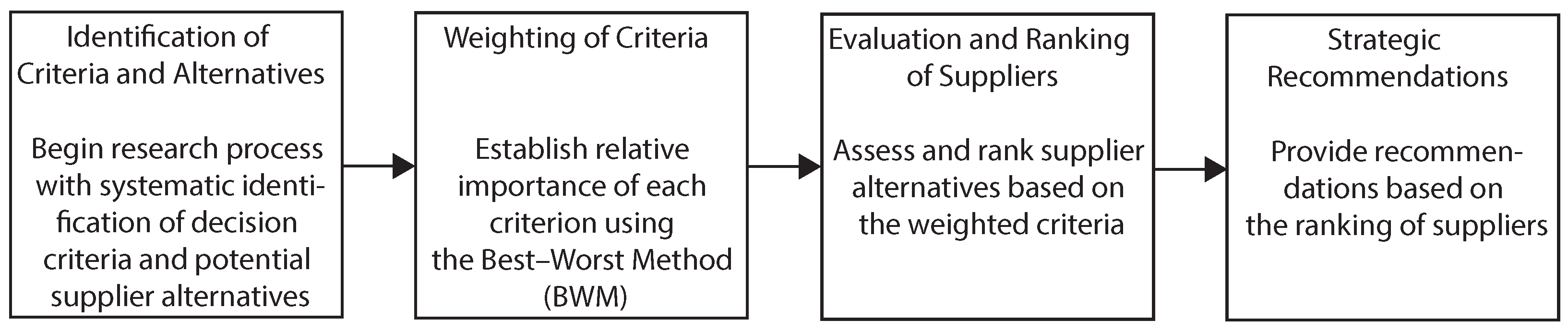
This study employs a mixed-methods framework that integrates qualitative insights with quantitative decision analysis, specifically through the application of Multi-Criteria Decision Making (MCDM). The overarching goal is to develop a structured and replicable strategy for selecting material suppliers within the shipbuilding industry, where procurement decisions are highly consequential due to their impact on production schedules, cost efficiency, and structural reliability. The study draws upon empirical data obtained from interviews and focused group discussions with shipyard professionals, as well as from questionnaire surveys used to ascertain the relative importance of selection criteria and to evaluate supplier alternatives. The methodological steps adopted in this research are depicted in
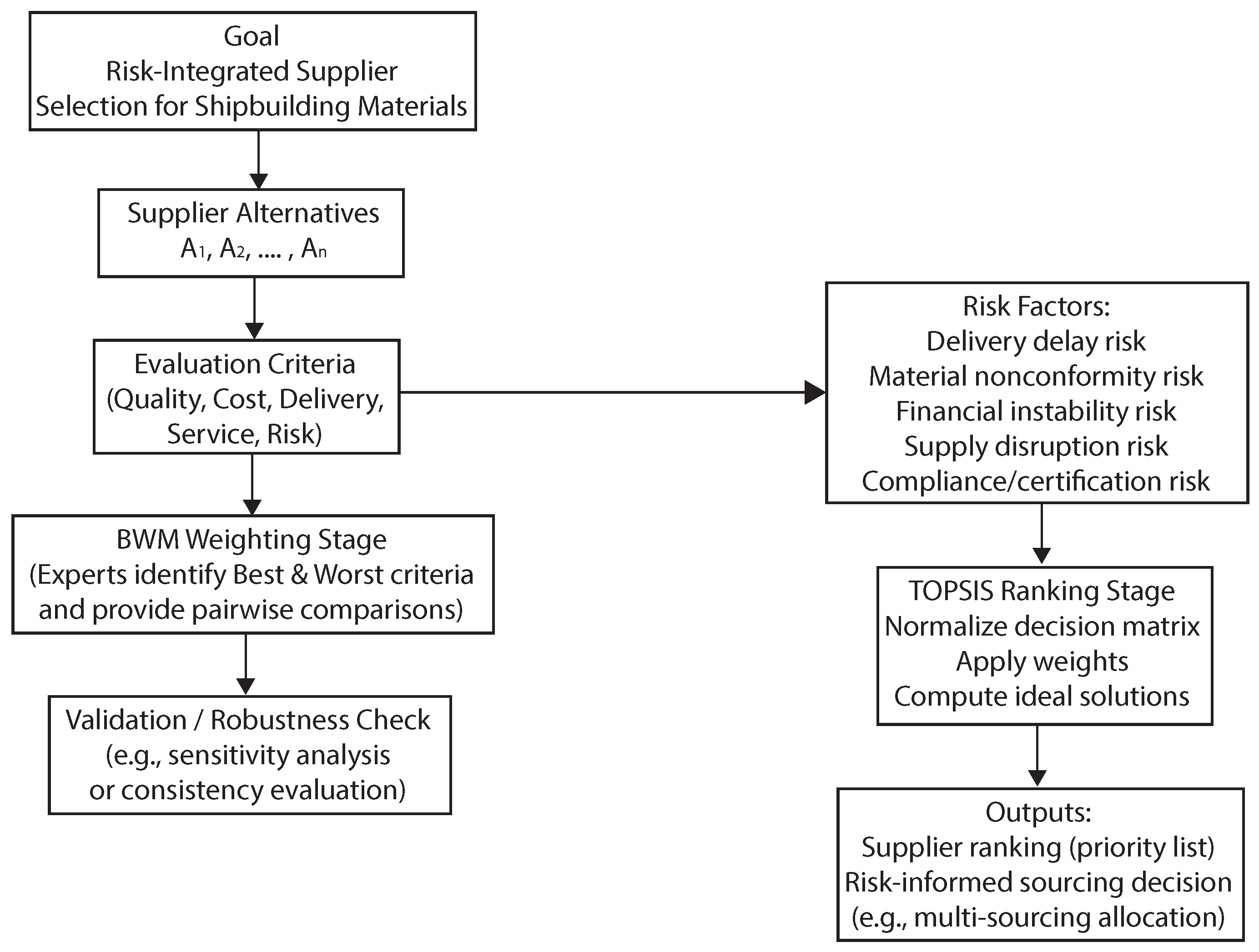
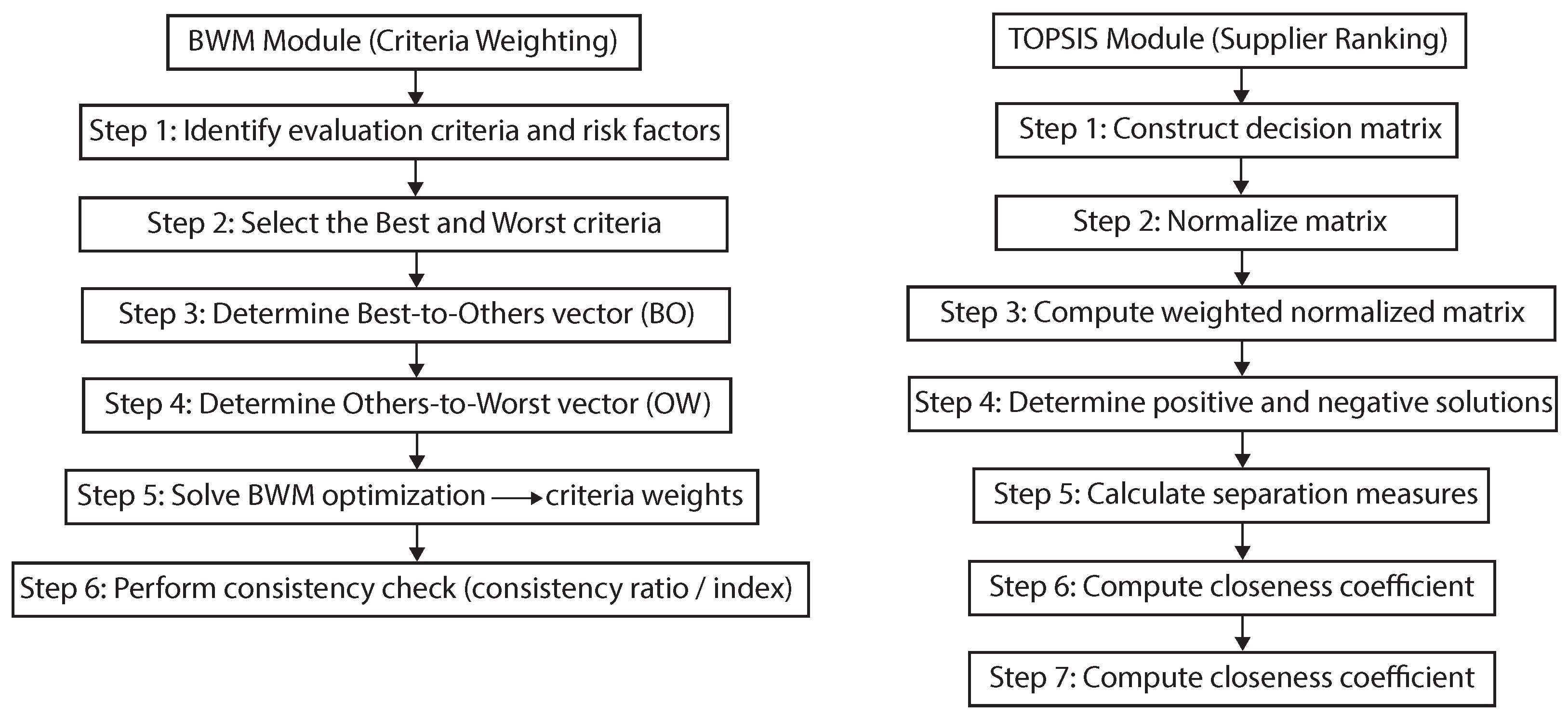
Figure 1 and are described in detail below. The Risk-integrated hybrid BWM–TOPSIS framework for shipbuilding material supplier selection can be shown in
Figure 2.
The research process commences with a systematic identification of decision criteria and potential supplier alternatives. This stage involves mapping the operational environment of shipyards to determine the factors that most strongly influence supplier performance. The identification of criteria is derived from expert knowledge, industry practice, and relevant literature, ensuring that both technical and non-technical considerations such as compliance with marine standards, cost stability, delivery performance, production capacity, and risk-related factors are incorporated. At the same time, the list of supplier alternatives is compiled based on existing supply networks of the participating shipyards, along with potential suppliers capable of meeting the material specifications required for ship construction. This dual identification process ensures that the assessment framework is both context-sensitive and comprehensive. Step-by-step procedure of the hybrid BWM–TOPSIS approach can be shown in
Figure 3.
The qualitative phase was conducted to identify and confirm the evaluation criteria and risk factors relevant to supplier selection for shipbuilding materials. Data were obtained through structured interviews and expert consultations involving representatives from three shipyards and two experts in ship production, resulting in a total of five participants. All participants had more than five years of professional experience in the maritime/shipbuilding sector, ensuring that the criteria reflected practical procurement and production requirements.
The qualitative information was analyzed using an importance-level approach, where participants assessed the relative importance of potential criteria and risk factors based on their operational experience. The identified criteria were then consolidated by removing overlaps and combining similar items, leading to a finalized set of criteria that served as the input for the subsequent hybrid BWM–TOPSIS evaluation.
After defining the criteria and alternatives, the study advances to the weighting phase, where the relative importance of each criterion is established. The Best–Worst Method (BWM) is employed due to its ability to generate consistent and robust weight estimations with fewer pairwise comparisons than traditional methods. Experts are asked to identify the most critical (best) and least critical (worst) criteria, followed by assessing the preference of the best criterion over all others and the preference of all criteria over the worst. These comparisons are then optimized mathematically to yield a set of weights that satisfy a consistency requirement. The Consistency Ratio (CR) is evaluated to ensure that expert judgments fall within an acceptable threshold (CR < 0.1), indicating reliability and minimizing cognitive bias in the weighting process. This step not only quantifies the priority structure of the decision criteria but also reveals the underlying strategic preferences of the shipyard industry.
The third stage of the methodology involves assessing and ranking the supplier alternatives based on the weighted criteria. Each supplier is evaluated using performance data obtained either from the participating shipyards or through survey responses, depending on data availability. These evaluations are integrated with the criterion weights to compute an overall performance score for each supplier. The ranking produced from this process provides a transparent and data-driven basis for identifying the most and least favorable suppliers. The incorporation of weighted criteria ensures that the ranking reflects not only the suppliers’ operational capability but also the strategic importance of each evaluation dimension as perceived by the industry.
The final stage of the methodology focuses on translating the ranking results into actionable strategic recommendations. This stage recognizes that supplier selection is not merely an evaluative task but a strategic decision that influences long-term procurement stability and risk exposure. Based on the ranking outcomes, the study formulates targeted strategies such as establishing long-term partnerships with high-performing suppliers, developing risk mitigation plans for suppliers with uncertain performance histories, and designing feedback and monitoring mechanisms to continuously track supplier reliability, quality consistency, and responsiveness. These strategies offer shipyards a structured reference that strengthens decision-making, enhances supply chain resilience, and supports continuous improvement in procurement operations.
3. Materials and Methods
3.1. Study Object and Data Description
The empirical context of this study is the shipbuilding industry, a sector characterized by tightly integrated production processes, rigorous quality requirements, and a strong dependence on material supply stability. Material procurement forms a critical component of the shipbuilding supply chain, where inconsistencies in delivery performance, quality compliance, or supplier capability can substantially affect construction schedules, project costs, and operational efficiency. Given these challenges, shipyards require structured and evidence-based mechanisms to assess supplier performance and support strategic sourcing decisions.
To capture procurement decision logic within shipyard operations, this study collected primary data from professionals directly involved in supplier evaluation and supply chain coordination. The respondents consisted of procurement managers, quality assurance specialists, and operational planners with extensive experience in managing material suppliers. Data collection was carried out through semi-structured interviews followed by structured questionnaires designed for the implementation of the Best–Worst Method (BWM). This two-stage approach ensured that both contextual insights and quantitative pairwise judgments were represented in the dataset.
Based on preliminary expert consultations, five evaluation criteria were identified as central to supplier assessment within the shipbuilding environment:
Risk (C3) represents the supplier-related uncertainty that may affect procurement performance and project execution in shipbuilding. In this study, Risk (C3) was operationalized through several sub-components commonly encountered in shipbuilding material sourcing, including delivery delay risk, material nonconformity/quality failure risk, financial instability risk, supply disruption risk, and compliance/certification risk. During the evaluation process, these sub-components were discussed with experts and consolidated into a single risk criterion to maintain model simplicity while ensuring that multiple risk dimensions were explicitly considered in the scoring stage.
These criteria represent operationally actionable factors that shipyards routinely monitor. Broader macro-level conditions—such as geopolitical uncertainty or global market volatility—were excluded to ensure the analysis focuses on dimensions directly influenced by shipyard procurement practices. This bounded scope strengthens the applicability of the resulting decision model to real-world organizational processes.
The BWM data obtained from respondents consist of two sets of comparisons: the Best-to-Others (B-to-O) pairwise evaluations and the Others-to-Worst (O-to-W) pairwise evaluations. The B-to-O matrix reflects how strongly the criterion identified as the most important is preferred over each remaining criterion, thereby revealing the internal priority hierarchy within the decision-making process. Conversely, the O-to-W matrix quantifies the relative importance of each criterion compared to the least important one, providing the lower constraints required for the BWM optimization model. Together, these datasets constitute the foundation for deriving consistent and theoretically sound criterion weights.
This study operates under the assumption that the supplier-selection strategy developed herein possesses long-term relevance and can be applied sustainably within shipyard procurement operations. The use of expert-derived BWM data ensures that the resulting weight structure reflects both the tacit knowledge and strategic preferences of practitioners, thereby enhancing the practical utility of the model. As such, the findings are positioned to contribute to both academic discourse in supply chain decision-making and managerial practice in shipbuilding material procurement.
It should be noted that this study focuses on supplier-level operational risks relevant to shipbuilding material procurement. Therefore, macro-level external factors such as geopolitical uncertainty, exchange rate fluctuations, and market price volatility were not explicitly modeled. Although this scope improves the practical applicability of the framework using expert-based evaluation, these macro-level factors may influence supplier reliability in practice and should be incorporated in future studies through scenario-based or probabilistic extensions.
3.2. Best Worst Method (BWM)
To determine the optimal weights of the evaluation criteria, this study employs the Best–Worst Method (BWM), a structured multi-criteria weighting technique introduced by Rezaei [
42]. The fundamental principle of BWM is to derive a set of criteria weights that is maximally consistent with the pairwise preference information provided by decision makers.
In the BWM procedure, the decision maker first identifies the most important (best) criterion B and the least important (worst) criterion W. Subsequently, two preference vectors are elicited:
The Best-to-Others vector , where represents the preference strength of criterion B over criterion j,
The Others-to-Worst vector , where denotes the preference of criterion j relative to W.
Practical illustration: For example, assume an expert identifies Quality (C1) as the Best criterion and Cost (C2) as the Worst criterion. If the expert states that the Best criterion is five times more important than Delivery (i.e., ), then the BWM enforces the relationship . This preference is translated into the constraint . Similarly, if the expert indicates that Delivery is three times more important than the Worst criterion (i.e., ), the model includes . By minimizing , the BWM obtains a consistent set of weights that best fits all expert comparisons.
Both sets of comparisons follow a predefined ordinal scale (typically 1–9).
Given these inputs, the objective is to determine a non-negative weight vector
that satisfies the normalization constraint
while minimizing the maximum deviation
from the pairwise comparison constraints. The linear BWM model is formulated as follows:
The model in Equation (
3) seeks a set of weights that minimizes the maximum absolute inconsistency between the derived weight ratios and the preference ratios provided by the decision maker. Because the constraints contain fractional expressions, they are commonly linearized by multiplying both sides to obtain:
The linearized form in Equation (
4) is computationally efficient and is the form most commonly used in empirical studies.
Based on the preference inputs of Respondent 1 in this study, criterion
was selected as the best and
as the worst. The corresponding constraints derived from Equation (
4) are:
with the weight normalization constraint:
Solving this system using the BWM linear optimization framework (e.g., via the BWM Solver) yields the optimal normalized weights for all criteria, ensuring maximum consistency with the decision maker’s preferences.
Role and Interpretation of the Deviation Parameter in BWM
In the Best–Worst Method, the deviation parameter
plays a central role in quantifying the degree of inconsistency between the decision maker’s pairwise comparisons and the resulting weight vector. Ideally, the pairwise assessments should satisfy
where
denotes the preference of the Best criterion over criterion
j, and
denotes the preference of criterion
j over the Worst criterion. However, such equalities rarely hold exactly in practice. To accommodate this imperfection, BWM introduces the deviation variable
, representing the maximum allowable discrepancy between the implied ratios and the actual weight ratios.
The linear BWM formulation seeks to minimize this maximum deviation:
subject to
Here,
represents the minimum achievable inconsistency given the decision maker’s evaluations. A smaller value of
indicates a more coherent preference structure. To assess the acceptability of this inconsistency, a Consistency Ratio (CR) is computed as
where
is the Consistency Index corresponding to the chosen Best–Worst comparison scale. Values of
indicate that the judgments fall within the theoretically acceptable level of inconsistency.
In the BWM weighting stage, criteria judgments were obtained from five professionals (n = 5), consisting of representatives from three shipyards and two ship production experts, each with more than five years of experience in the shipbuilding sector.
3.3. Technique for Order Preference by Similarity to Ideal Solution (TOPSIS)
The Technique for Order Preference by Similarity to Ideal Solution (TOPSIS) is grounded in the principle that the most desirable alternative is characterized by the minimum geometric distance from a positive ideal benchmark and, simultaneously, the maximum geometric distance from a negative ideal benchmark. After constructing the weighted normalized decision matrix
each alternative is embedded within an
n-dimensional evaluation space.
The positive ideal solution (PIS) is defined as a vector consisting of the maximum performance levels for benefit-type criteria and the minimum levels for cost-type criteria. Denoting the benefit criterion set by
J and the cost criterion set by
, the PIS is formally expressed as
Conversely, the negative ideal solution (NIS) aggregates the minimum values of benefit criteria and the maximum values of cost criteria, namely
Let
denote the weighted normalized performance vector of alternative
i, and let
and
represent the PIS and NIS vectors, respectively. The geometric separation between each alternative and the two reference solutions is computed using an Euclidean (
-norm) metric. The distance to the PIS can be shown in
Appendix B.
From an interpretative perspective, TOPSIS constructs a geometric decision framework in which alternatives are positioned relative to idealized benchmark vectors. The resulting preference ordering emerges directly from the spatial configuration of these alternatives within the criterion space. This geometric reasoning makes TOPSIS particularly suitable for multi-criteria decision-making in complex supply chain systems—such as shipbuilding material procurement—where multiple performance attributes, trade-offs, and interdependencies must be evaluated within a coherent and analytically robust structure.
4. Technical Analysis of Supplier Selection Results
4.1. Identification of Material Supplier Criteria and Alternatives
The identification of supplier evaluation criteria and alternatives represents a fundamental step in establishing an objective and structured procurement framework within the shipbuilding industry. Evaluation criteria serve as measurable parameters for assessing, comparing, and ranking supplier performance, whereas alternatives denote the candidate suppliers to be evaluated. In this study, the criteria were determined through a series of interviews with senior procurement personnel at a national shipyard company. The criteria adopted are summarized in
Table 2. The keywords and exemplars in
Table 2 were derived from supplier selection practice in shipbuilding and synthesized from expert interview responses, supported by recent industry risk discussions on maritime infrastructure disruptions.
Based on the reviewed literature, supplier selection in industrial procurement is commonly evaluated using performance-based criteria such as cost, quality, delivery, and service capability. However, in shipbuilding material procurement, supplier-related risks (e.g., delay, nonconformity, and documentation issues) can directly affect production schedules and compliance requirements. Therefore, this study selected five core criteria (C1–C5) by combining widely adopted supplier selection dimensions reported in the literature with shipbuilding-specific risk considerations validated through expert interviews. This approach ensures that the final criteria set is both theoretically grounded and practically relevant to the shipbuilding context.
In this study, four supplier alternatives were evaluated because these suppliers represent the available and feasible candidates for the targeted shipbuilding material procurement case, based on shipyard procurement records and expert validation. Therefore, the ranking reflects a case-based decision context, rather than an exhaustive evaluation of all potential suppliers in the market. While this scope supports practical decision-making for the participating shipyards, the generalizability of the ranking can be improved in future work by expanding the number of supplier alternatives and testing the framework across multiple procurement cases.
Interviews conducted with the shipyard revealed that procurement decisions must balance economic, technical, and operational considerations. While cost (C1) remains a central parameter due to its influence on the overall project budget, the stringent requirements of ship construction elevate the importance of material quality (C2). Moreover, supply-chain uncertainties necessitate the inclusion of risk (C3), while the complexity of documentation, classification approval, and coordination processes justifies the importance of service (C4). The dynamic nature of material demand across construction stages further underscores the relevance of order capacity (C5).
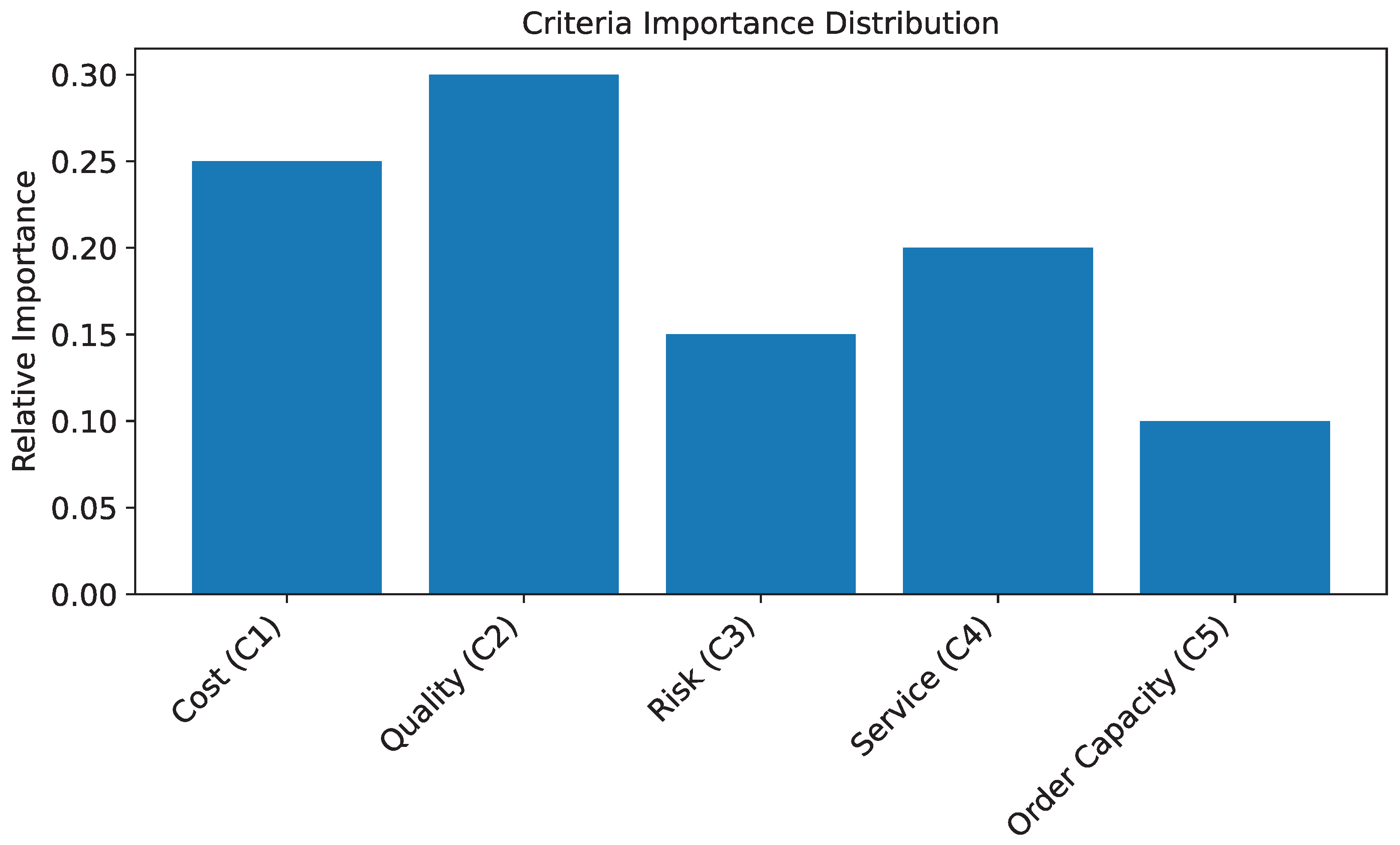
To enhance transparency and analytical clarity, the relative importance of each criterion was visualized through a proportional distribution chart, as shown in
Figure 4. The illustrative distribution indicates that quality (C2) receives the highest weight, followed by cost (C1) and service (C4). This aligns with industry practice, where compliance with technical standards is non–negotiable due to its structural and safety implications.
The visualization underscores that suppliers demonstrating strong quality assurance, documentation readiness, and service responsiveness are more likely to be prioritized in the subsequent multi-criteria evaluation process. Although risk and order capacity are assigned relatively lower weights, their inclusion remains strategically important, as deficiencies in these aspects may trigger cascading production delays and disrupt the overall supply chain. Therefore, even low-weight criteria carry latent impact that must be addressed systematically during evaluation.
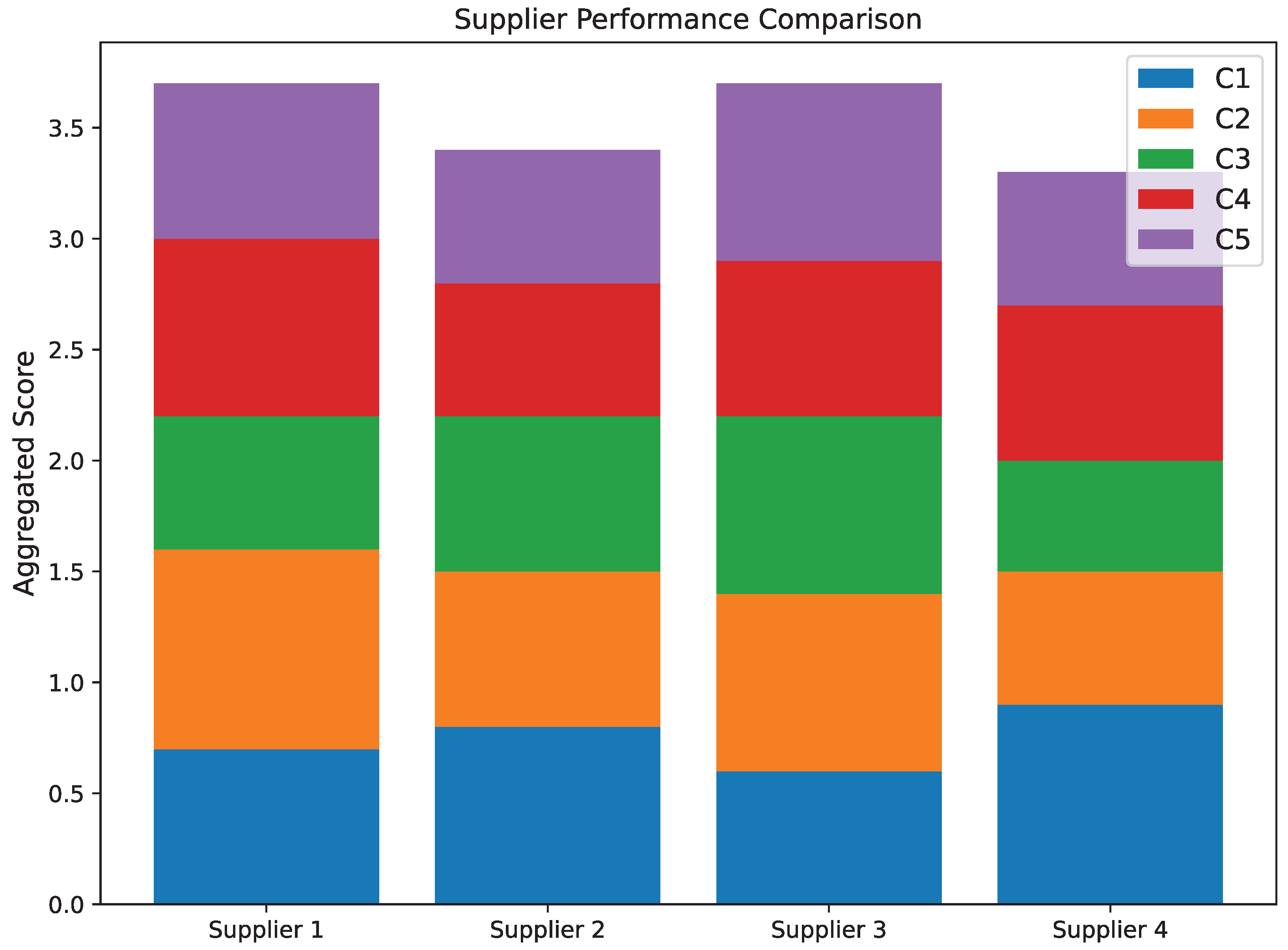
Four suppliers namely Supplier 1, Supplier 2, Supplier 3, and Supplier 4 were identified as alternatives in this study, selected from documented procurement records and their prior involvement in delivering shipbuilding materials. Their inclusion ensures an assessment grounded in empirical performance rather than speculative assumptions. A preliminary comparison of normalized performance scores across the five criteria is illustrated in
Figure 5, enabling early detection of performance trends before applying a formal MCDM method such as TOPSIS. Initial observations suggest that Supplier 3 maintains relatively balanced performance across criteria, whereas Supplier 4 demonstrates strong cost competitiveness but comparatively weaker quality and service indicators—further reinforcing the necessity of a structured decision-making framework capable of capturing multidimensional trade-offs.
Integration of the narrative and graphical analysis produces several key insights. First, the high importance assigned to quality indicates that suppliers unable to consistently meet classification standards will be penalized, even if they offer lower costs. Furthermore, cost–service trade-offs are evident, as suppliers presenting lower cost tend to exhibit weaker service performance, which may lead to administrative delays or documentation challenges. Although risk and order capacity have comparatively lower weights, their operational significance remains notable, since disruptions or limited capacity may hinder block assembly or outfitting stages. Overall, the observed variability among supplier performance profiles underscores the suitability of quantitative Multi-Criteria Decision-Making (MCDM) frameworks, such as TOPSIS, to systematically capture and evaluate trade-offs across multiple criteria.
Overall, the determination of criteria and alternatives provides a robust foundation for the subsequent multi-criteria evaluation phase and reflects the operational realities of shipyard procurement processes.
4.2. Determination of Criteria Weights and Prioritized Factors
In this study, the Best Worst Method (BWM) was employed to determine the relative importance of the criteria involved in the selection of material suppliers for the shipyard industry. The BWM was selected due to its ability to produce more consistent pairwise comparisons than traditional multi-criteria decision-making (MCDM) approaches such as the Analytic Hierarchy Process (AHP), while requiring fewer evaluative judgments. This makes BWM particularly suitable for expert-based assessments in industrial decision-making where cognitive burden must be minimized.
The BWM procedure begins by asking respondents to identify the most important (best) and least important (worst) criteria based on their knowledge and professional judgment. Once the best and worst criteria are determined, two sets of comparisons are conducted: (i) Best-to-Others (BO), where the best criterion is compared with all other criteria, and (ii) Others-to-Worst (OW), where all criteria are compared relative to the worst criterion. A preference scale ranging from 1 to 9 is used, in which a value of 1 indicates equal importance, whereas a value of 9 denotes extreme dominance of one criterion over another. The results of these comparisons are shown in
Table 3 and
Table 4.
The results in
Table 3 and
Table 4 indicate noticeable variation in expert judgments. While several respondents selected Quality or Risk as the most critical criterion, Respondent 2 identified Cost as the Best criterion. This variation reflects the practical reality of shipbuilding procurement, where decision priorities may differ depending on stakeholder roles and project constraints. For example, procurement personnel may prioritize cost competitiveness, whereas production and quality stakeholders may emphasize compliance, reliability, and risk avoidance due to the schedule-critical nature of shipbuilding projects. Rather than indicating inconsistency, this difference highlights the multi-perspective nature of supplier selection in shipbuilding and supports the need for a structured MCDM approach to consolidate diverse expert preferences into a unified weighting scheme.
As shown in
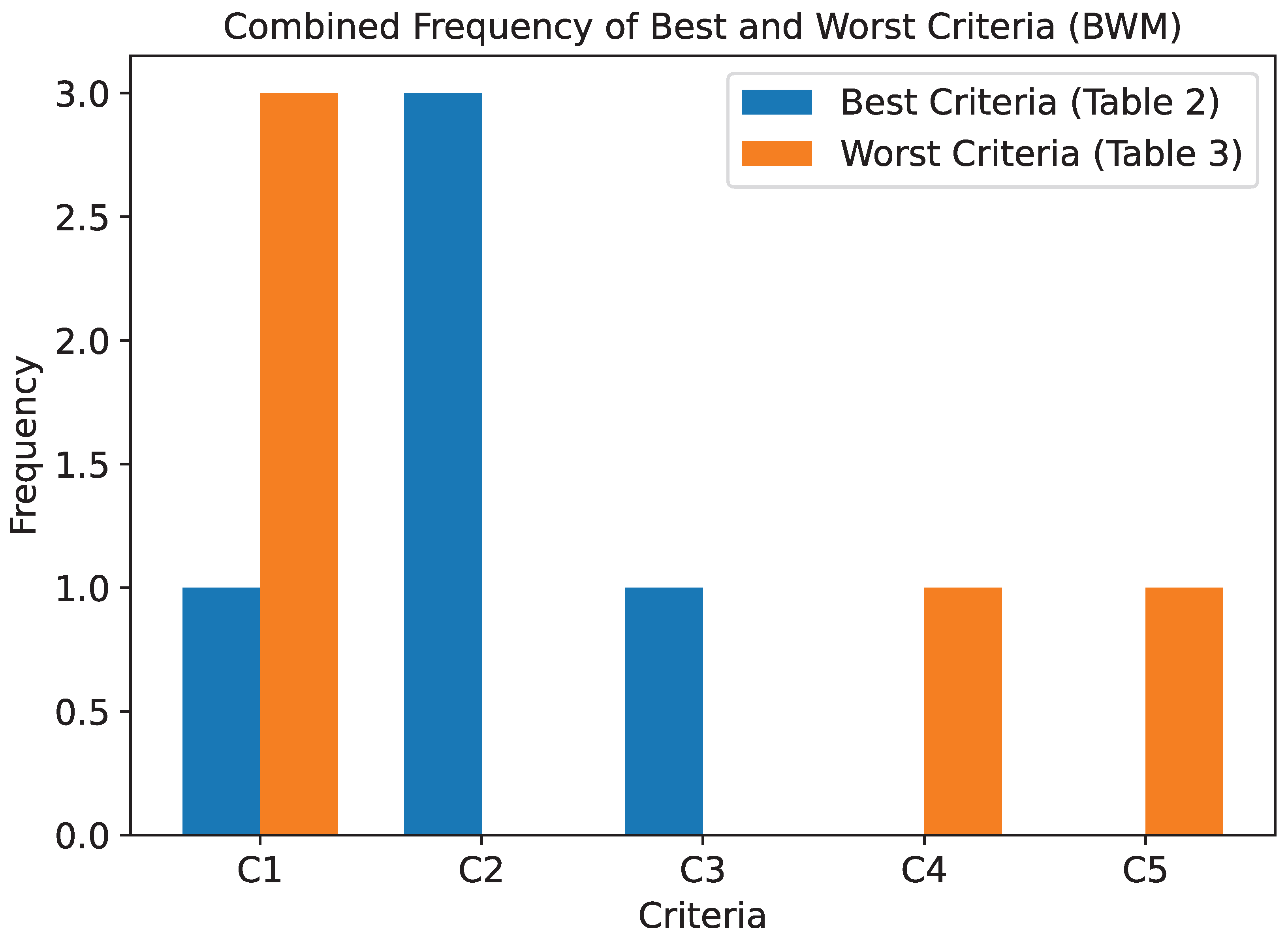
Table 3, Quality (C2) was selected as the best criterion by three respondents, indicating its dominant role in supplier evaluation within the shipyard industry. Risk (C3) also appeared as a best criterion once, suggesting that operational safety and reliability are considered important during procurement decisions. In contrast,
Table 4 shows that Cost (C1) was most frequently identified as the worst criterion, appearing three times, implying that economic considerations may be secondary to quality and risk in the context of critical marine operations.
These findings support the premise that decision-making in the shipyard sector is driven predominantly by technical robustness and risk mitigation rather than cost minimization. This aligns with previous studies in maritime procurement, which emphasize that material reliability and service performance have a more substantial impact on long-term operational safety. The comparison matrices in
Table 3 and
Table 4 thus serve as the primary inputs for solving the BWM optimization model to derive the optimal weight of each criterion.
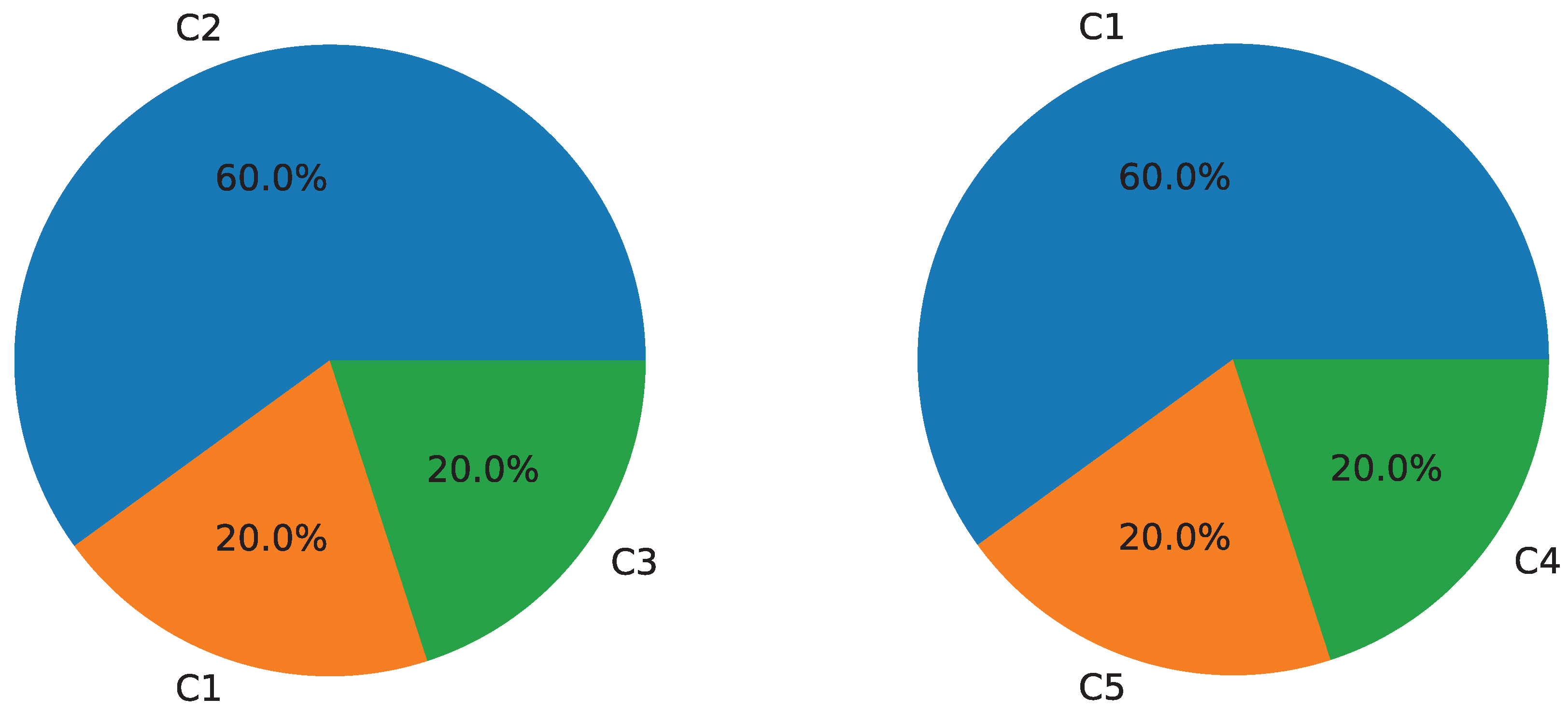
The graphical evaluation of the Best Worst Method (BWM) results provides an essential view of the underlying decision-making preferences among respondents in the supplier selection process. As shown in the pie chart of Best Criteria in
Figure 6 Quality (C2) dominates with 60% of total responses, while Cost (C1) and Risk (C3) each account for 20%. This finding confirms that the respondents strongly prioritize technical performance and material reliability, which is a crucial requirement in shipyard operations where structural integrity and long-term durability are fundamental. Therefore, the supplier evaluation process appears to follow a performance-driven approach, in which cost-saving considerations are not prioritized ahead of safety and operational reliability.
A more comprehensive comparison is provided by the combined bar chart in
Figure 7, which illustrates the frequency distribution of both Best and Worst criteria derived from the BWM assessment, revealing a clear prioritization pattern among respondents. Quality (C2) consistently emerges as the most influential criterion, whereas Cost (C1) is predominantly identified as the least important, indicating that supplier evaluation decisions are guided primarily by performance-oriented considerations rather than cost minimization. Risk (C3) also demonstrates strategic relevance, as it appears as a Best criterion but never as a Worst, suggesting that risk mitigation and adherence to engineering standards are perceived as integral components of shipyard procurement. Meanwhile, Service (C4) and Order Capacity (C5) exhibit fluctuating responses, implying that they act as complementary or secondary criteria, gaining importance only after the fundamental requirements of quality and safety are satisfied. The results are further supported by the pie chart of Worst Criteria in
Figure 7, where Cost (C1) accounts for 60% of responses, reinforcing the notion that economic factors are deprioritized compared to technical robustness and operational reliability. Overall, the three graphical outputs collectively indicate that procurement decisions within the shipyard industry follow a value-based approach, emphasizing long-term performance, safety compliance, and risk reduction—thereby reflecting typical characteristics of safety-critical industrial environments.
Based on the pairwise comparisons provided by Respondent 1, the optimal weights for each criterion were computed using the linear Best Worst Method (BWM) with the assistance of the BWM Solver. The results are presented in
Table 5. Quality (C2) received the highest weight, followed by Risk (C3), while Cost (C1) was assigned the lowest weight. The consistency value (Ksi = 0.043) confirms that the judgments are coherent and consistent with the methodological requirements of BWM.
The same BWM procedure was applied to the remaining respondents, and the results are summarised in
Table 6. The mean values indicate that Quality (C2) and Risk (C3) are the most influential criteria, reflecting a performance-oriented procurement strategy in shipyard operations. Cost (C1), Service (C4), and Order Capacity (C5) exhibit lower weights, suggesting that they are considered only after safety and quality requirements are met. The overall consistency index (mean Ksi = 0.043) confirms the robustness and reliability of the evaluation results.
4.3. Evaluation and Ranking of Supplier Alternatives
The Technique for Order Preference by Similarity to Ideal Solution (TOPSIS) was employed to rank the performance of material suppliers in the shipyard industry. The method evaluates each alternative based on its proximity to an ideal solution (maximum performance) and its distance from a negative ideal solution (minimum performance). The first step in the procedure is the normalization of the decision matrix to eliminate unit disparities and ensure a fair comparison among criteria. The normalized decision matrix obtained from the initial assessment is presented in Equation (
15).
Equation (
16) presents the normalized decision matrix
, where each value
represents the relative performance of supplier
i under criterion
j after removing unit differences across criteria. In practical terms, a higher normalized value indicates that the supplier performs better with respect to that criterion compared to other suppliers in the candidate set. For benefit-type criteria (e.g., Quality and Service), larger values are preferred, while for cost-type criteria (e.g., Cost and certain risk indicators), lower original values result in more favorable normalized performance after applying the appropriate transformation.
The normalized matrix was subsequently multiplied by the optimal criteria weights derived from the BWM method (
Table 6). This integration ensures that the decision-making process considers both the performance scores and the relative significance of each criterion. The resulting weighted normalized matrix is presented in Equation (
16).
Equation (
16) shows the weighted normalized matrix
, which is obtained by multiplying the normalized values by the corresponding criteria weights
. Therefore,
reflects not only how well a supplier performs under a given criterion, but also how important that criterion is in the overall decision model. Consequently, criteria with higher weights contribute more strongly to differentiating the suppliers and shaping the final TOPSIS ranking.
An examination of Equation (
16) reveals clear trends in supplier performance. Suppliers 3 and 4 exhibit stronger overall values, particularly under the criteria of Quality (C2) and Risk (C3), which were identified as the most influential parameters based on the BWM weighting scheme. In contrast, Suppliers 1 and 2 show moderate performance levels but appear less competitive in certain technical dimensions, indicating potential areas for improvement such as service consistency and operational reliability.
The consistently high values observed in the second and third columns of Equation (
16) reinforce the importance of quality assurance and risk mitigation in shipyard procurement decisions. Meanwhile, the contribution of Cost (C1) remains comparably lower across all alternatives, reflecting that supplier selection in safety-critical industries prioritizes long-term reliability rather than short-term cost minimization.
The weighted matrix serves as the basis for the subsequent stages of the TOPSIS analysis, including the determination of the Positive Ideal Solution (PIS), the Negative Ideal Solution (NIS), and the computation of Euclidean distances. These steps enable the calculation of closeness coefficients, ultimately facilitating the ranking of suppliers according to their relative performance in the decision space.
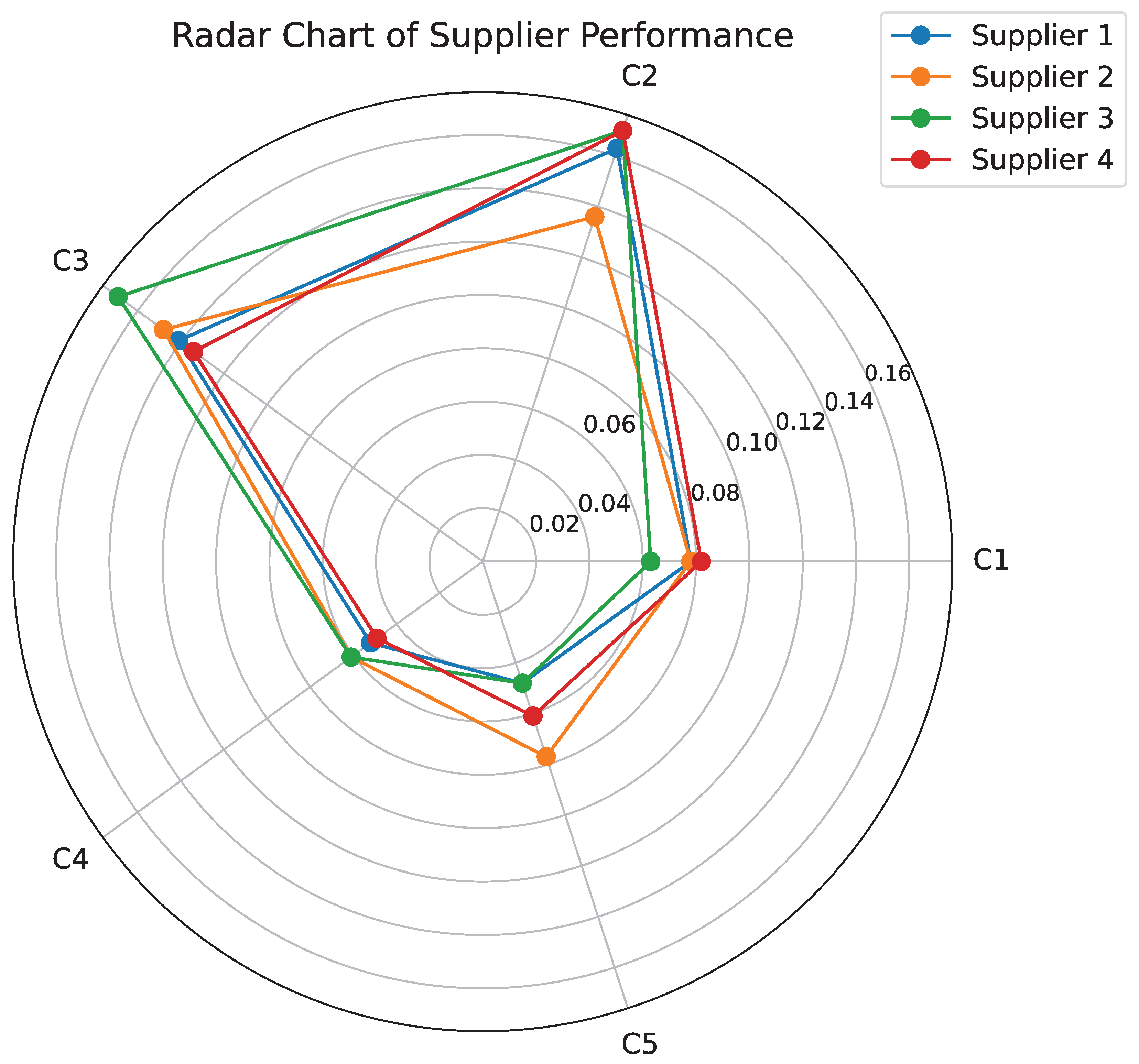
The radar plot presented in
Figure 8 provides a comprehensive visual comparison of supplier performance across the five evaluation criteria and serves as a strong validation of the ranking results obtained from the TOPSIS analysis. Supplier 3 demonstrates the most extensive coverage across the radar axes, particularly in Quality (C2) and Risk (C3), which were previously identified as the most critical criteria based on the BWM weighting process. This suggests that Supplier 3 is highly aligned with the strategic priorities of shipyard procurement, where product reliability, operational safety, and compliance with engineering standards are fundamental considerations. In contrast, Supplier 1 and Supplier 2 exhibit noticeably narrower performance profiles, especially in technical attributes, indicating potential limitations in their ability to consistently meet performance demands. Supplier 4 displays a moderately strong and balanced distribution, showing competitive capability, especially in C2 and C3, although still slightly below Supplier 3. Moreover, the radar chart illustrates that performance differences among suppliers are not uniformly distributed; rather, they are predominantly influenced by C2 and C3, which reinforces the assertion that technical reliability and risk mitigation play a more decisive role than cost minimization in the supplier selection process. Consequently, this visual evidence supports the argument that procurement decisions in the shipyard industry should employ a multidimensional evaluation framework, placing emphasis on performance-critical criteria instead of relying solely on economic factors.
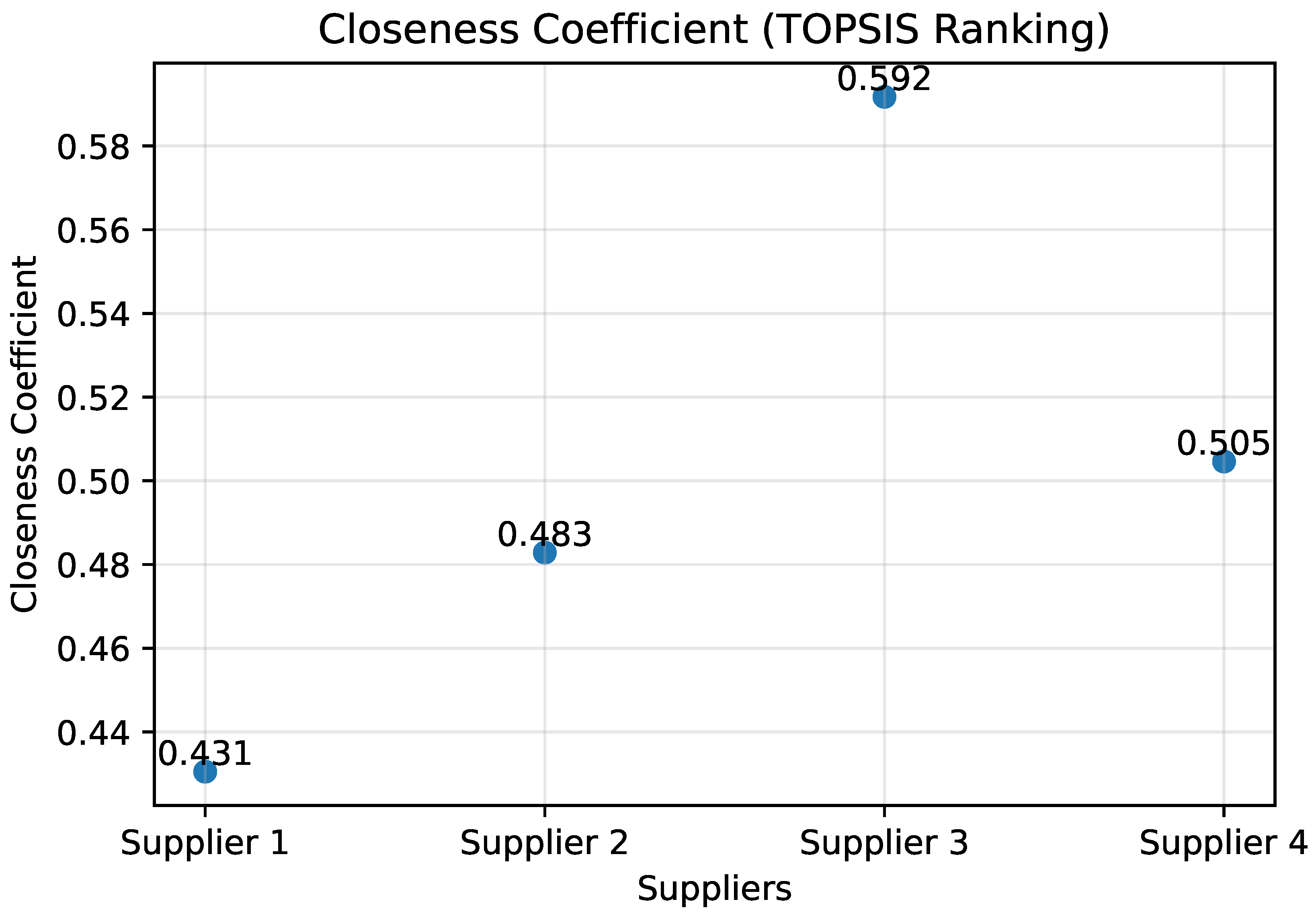
The closeness coefficients for the four suppliers are illustrated in
Figure 9, revealing a clear differentiation in their overall performance. Supplier 3 achieved the highest closeness coefficient (0.592), indicating the strongest alignment with the positive ideal solution and thus the most favorable overall performance across all evaluation criteria. Supplier 4 secured the second position (0.505), suggesting that it may serve as a reliable alternative or backup supplier in procurement decisions. In contrast, Supplier 2 (0.483) and Supplier 1 (0.431) reported lower scores, suggesting weaker alignment with the ideal solution and highlighting areas where technical capability and operational consistency may require significant improvements. From a decision-making perspective, the gap between Supplier 3 and Supplier 1 (approximately 15%) demonstrates that the selection of Supplier 3 is supported by a substantial performance advantage rather than marginal difference. Furthermore, the results reveal a distinct two-tier performance structure: Supplier 3 and Supplier 4 form the upper tier with competitive capabilities, while Supplier 1 and Supplier 2 occupy a lower tier, indicating relatively limited suitability for procurement in high-risk industrial environments. This distinction validates the effectiveness of the TOPSIS method in capturing multidimensional performance differences and ensuring objective prioritization among suppliers based on both technical and operational criteria.
4.4. Filtering and Consolidation Procedure
The initial list of candidate criteria was derived from the literature and expert interviews. In the screening stage, criteria were retained only if they satisfied the following filters: (i) relevance to shipbuilding materials procurement, (ii) applicability to supplier evaluation in operational practice, and (iii) non-redundancy with other criteria. Criteria that were overlapping in meaning (e.g., highly correlated descriptors of delivery performance) were merged into a single criterion to avoid duplication. After screening and consolidation, the final set of criteria (C1–C5) was used in the BWM weighting process.
Similarly, supplier alternatives were selected based on practical availability and feasibility for the targeted procurement case. Only suppliers that had active procurement records and were considered eligible by the participating shipyards were included in the TOPSIS evaluation.
4.5. Formulation of a Risk-Based Material Supplier Selection Strategy
The combined application of BWM and TOPSIS in this study not only identifies the most suitable supplier but also provides a robust foundation for formulating strategic procurement policies within the shipyard industry. The results indicate that quality assurance and risk mitigation are the most dominant criteria, suggesting the need for a decision-making approach based on Quality Risk Management (QRM). This implies that the evaluation of suppliers should not solely rely on cost considerations; instead, it should incorporate safety compliance, technical performance stability, and long-term operational reliability. Such an approach is particularly relevant in the shipyard context, where material failure may lead to production delays, safety hazards, and increased maintenance costs.
Based on these findings, the industry can adopt a Strategic Multi-Sourcing Model to enhance procurement resilience. This model can be implemented through three key strategies. First, the Core Supplier Strategy focuses on developing long-term collaborative partnerships with high-performing suppliers, particularly those that demonstrate superior performance in Quality (C2) and Risk (C3). These suppliers may be integrated into production planning and quality assurance procedures to ensure consistent material reliability. Second, the Priority Criteria Management Strategy ensures that resource allocation and procurement decisions are aligned with the most influential criteria identified through the BWM–TOPSIS analysis. This enables companies to focus investment and monitoring on criteria with the highest impact on operational safety and performance. Third, the Non-Critical Supplier Strategy may be applied for low-risk items or services, for which flexible procurement mechanisms such as periodic bidding or vendor rotation can be adopted to maintain cost efficiency without jeopardizing supply continuity.
The integration of these strategies enables the development of a structured supplier segmentation framework, categorizing suppliers based on their strategic relevance and risk contribution. This approach facilitates a transition from transactional purchasing practices toward proactive and risk-informed supplier management. Overall, the BWM-TOPSIS methodology acts not only as a decision-making instrument but also as a strategic tool that supports the enhancement of supply chain robustness, operational performance, and industrial competitiveness in the shipyard sector.
Based on the closeness coefficients, Supplier 3 achieves the highest overall performance due to consistently strong scores across the most influential criteria, followed by Supplier 4, Supplier 2, and Supplier 1. This ranking indicates that Supplier 3 is closest to the positive ideal solution and furthest from the negative ideal solution, confirming its suitability as the preferred supplier option under the proposed risk-integrated evaluation framework.
To illustrate the operational implementation of the proposed strategies, a hypothetical procurement case is considered in which a shipyard plans to procure a batch of shipbuilding materials from four candidate suppliers. Based on the TOPSIS results (Supplier 3 > Supplier 4 > Supplier 2 > Supplier 1), Supplier 3 is selected under the Core Supplier Strategy and assigned the primary procurement share (e.g., 50–60).
5. Discussion of Findings
Five key criteria were identified as the basis for material supplier selection in the shipyard industry, namely cost, quality, risk, service, and order capacity. The weighting process using the BWM method produced a Consistency Ratio (CR) below 0.10, indicating a high level of validity and reliability in the decision-making process. Among the criteria, Quality (C2) emerged as the most dominant with an optimal weight of 0.320, reflecting the industry’s strict requirement that materials for ship construction must comply with the technical specifications and regulatory standards set by international classification bureaus such as BKI, ABS, and Lloyd’s Register. Neglecting this criterion could result in structural failures, costly rework, project delays, or legal disputes with vessel owners, indicating that shipyards adopt a zero-tolerance approach to material quality. The Risk criterion (C3), which ranked second with a weight of 0.297, further illustrates the importance of supply chain resilience. Shipbuilding projects are commonly governed by strict schedules and penalty clauses; hence, suppliers presenting high operational or logistical risks may disrupt production, incur idle costs, and adversely affect the reputation of the shipyard. This underscores the relevance of embedding risk mitigation into procurement strategies to ensure operational continuity.
The evaluation using the TOPSIS method revealed that Supplier 3 achieved the highest preference score (0.592), indicating its suitability for critical and high-value projects due to its strong performance in quality and risk-related criteria. Supplier 4, which ranked second with a score of 0.504, may serve as a dependable backup or complementary supplier given its balanced performance profile. Based on these findings, the shipyard industry may implement a procurement strategy founded on Quality Risk Management (QRM) combined with a Strategic Multi-Sourcing approach. This would reduce dependency on single suppliers and enhance resilience. Three key strategic directions can be formulated: (i) the Core Supplier Strategy, which focuses on establishing long-term partnerships with a limited number of high-performing suppliers; (ii) the Priority Criteria Management Strategy, which ensures that financial and operational resources are allocated to criteria with the highest strategic impact; and (iii) the Non-Critical Supplier Strategy, which aims to ensure operational flexibility and cost efficiency for suppliers of low-risk materials or components.
Despite providing a structured and systematic framework, this study presents certain limitations. The decision-making process relies on expert judgement, which introduces potential subjectivity if the assessments do not fully reflect real operational conditions. Moreover, the current model focuses solely on external supplier performance and does not incorporate the internal capacity and operational readiness of the shipyard, which may influence the final procurement decision. Additionally, the BWM–TOPSIS methodology adopts a static evaluation model, while the shipyard industry operates in a dynamic environment. To overcome this drawback, future research could integrate Fuzzy Set Theory to better account for uncertainty and qualitative assessment, and develop a dynamic decision-support model capable of continuously monitoring supplier performance and adapting to real-time operational changes.
Furthermore, it should be noted that the analytical outcomes presented in this study are inherently dependent on the perspectives of the participating experts. Any change in the composition, background, or experience level of the respondents may lead to different priority weights, supplier rankings, and strategic recommendations. Therefore, the results should be interpreted as representative of the specific expert group involved, and further validation with broader or alternative respondent groups is recommended to enhance generalizability.
To clarify the operational implementation of the proposed strategies, a brief illustrative example is provided. Assume four suppliers are evaluated for a shipbuilding material category, yielding TOPSIS closeness coefficients that result in the ranking Supplier 3 > Supplier 4 > Supplier 2 > Supplier 1. Under this outcome, Supplier 3 is assigned as the Core Supplier Strategy, meaning that it receives the main contract allocation and is engaged under longer-term procurement planning to ensure stable quality and reduced disruption risk. Supplier 4 is treated as a Secondary/Core Backup Supplier, where procurement volume is maintained at a moderate level to provide redundancy and flexibility in case of delivery or compliance issues.
In this setting, Priority Criteria Management is applied by focusing managerial controls and contractual clauses on the highest-weighted criteria (e.g., Risk and Quality). For instance, the procurement team may require additional documentation and certification checks, tighter delivery monitoring, and penalties for nonconformity. Finally, Supplier 2 and Supplier 1 are categorized under the Non-Critical Supplier Strategy, where they are used mainly for low-priority orders or as emergency alternatives, with limited order allocation to avoid excessive exposure to potential supply disruption or schedule delay risks.
Limitations and Future Work
This study has several limitations that should be acknowledged. First, the empirical investigation was conducted within a national shipbuilding context and involved a limited number of respondents. Therefore, the resulting criteria weights and supplier ranking reflect a case-based decision environment and may not be fully generalizable to global shipyards operating under different sourcing policies, logistics exposure, and supplier market structures. Future studies should validate the proposed framework through multi-case comparisons across shipyards in different geographical regions and procurement scales.
Second, the framework relies on expert judgement for criteria weighting and supplier scoring. Although the BWM consistency indices confirm acceptable internal consistency, subjective bias may still influence the final weights. To enhance robustness under uncertainty, future research may adopt fuzzy hybrid extensions that can model linguistic assessments and imprecise information more effectively. For instance, Jiang and Wang (2025) proposed an intuitionistic fuzzy entropy–BWM-based approach for supplier selection in shipbuilding enterprises, demonstrating the potential advantages of integrating objective entropy weights with subjective expert judgements in uncertain environments.
This study applies a crisp (non-fuzzy) hybrid BWM–TOPSIS approach to ensure computational simplicity, transparency, and practical interpretability for shipbuilding procurement decision-makers. Although fuzzy extensions can better capture linguistic vagueness in expert judgements, the present study employs structured pairwise comparison scales and consistency checks within the BWM procedure to control subjective variation and to produce stable criteria weights. In addition, the crisp TOPSIS formulation provides a straightforward and auditable ranking mechanism that can be implemented without additional parameterization of membership functions, which may introduce further modelling subjectivity when the expert sample is limited. Nevertheless, incorporating fuzzy logic remains a relevant extension for future work, particularly for modelling uncertainty in supplier performance data and linguistic evaluations in complex procurement environments.
6. Conclusions
The results of the criteria determination process identified five key factors influencing material supplier selection in the shipyard industry, namely cost, quality, risk, service, and order capacity. The weighting analysis using the BWM method indicates that shipyards prioritize criteria that directly affect safety, reliability, and project scheduling. Quality and risk, with optimal weights of 0.320 and 0.297 respectively, emerged as the most critical criteria, reflecting the industry’s emphasis on zero-defect performance and resilient supply chain management rather than cost minimization alone. In contrast, cost, order capacity, and service were categorized as supporting criteria, providing flexibility but requiring careful consideration to ensure that efficiency does not compromise material reliability or stability of supply. This prioritization demonstrates that achieving technical compliance and operational robustness is a prerequisite before economic considerations can be introduced.
The supplier ranking using the TOPSIS method further validates this interpretation. Supplier 3 obtained the highest preference score (0.592), demonstrating superior overall performance and the closest proximity to the ideal solution, particularly in the quality and risk dimensions. Supplier 4, with a preference score of 0.504, was identified as a strong secondary option, ensuring operational continuity and reducing dependency on any single supplier. Based on these findings, a strategic direction is recommended in the form of a quality- and risk-oriented multi-sourcing strategy that incorporates the principles of Quality Risk Management (QRM). This approach is expected to foster a resilient supply chain by allocating a substantial portion of procurement to high-performing core suppliers while employing complementary suppliers to enhance flexibility, mitigate risks, and safeguard material availability in dynamic operational environments.
Looking forward, the proposed risk-integrated supplier selection framework is expected to support a more structured and transparent decision-making culture in shipbuilding procurement by transforming supplier evaluation from experience-driven judgement into a consistent and auditable risk-aware process. By explicitly incorporating risk considerations into supplier weighting and ranking, the framework can assist shipyards in improving procurement reliability, reducing schedule disruptions, and strengthening quality assurance in material sourcing. Future implementation of this framework in routine procurement workflows may also enable continuous improvement through periodic re-evaluation and adaptation to evolving operational requirements.
To strengthen the generalizability of risk-integrated supplier selection in shipbuilding, the following research questions (RQs) and hypotheses (Hs) are proposed based on the results of Equation (
15) and the contribution of this study.
RQ1 (Priority 1): How does the weighting of risk criteria influence the TOPSIS ranking stability and supplier selection outcomes in shipbuilding material procurement?
H1: Increasing the weight of risk criteria significantly changes supplier rankings and reduces the selection probability of suppliers with high disruption exposure, even when their cost performance is competitive.
RQ2 (Priority 2): How does risk-integrated supplier selection affect long-term procurement cost and schedule performance in national versus global shipyard supply bases?
H2: Risk-integrated selection yields greater reductions in disruption-driven indirect costs (e.g., delay penalties and rework) for globally sourced materials compared to nationally sourced materials due to higher exposure to logistics uncertainty.
RQ3 (Priority 3): To what extent does supplier performance variability over time affect the accuracy of a static BWM–TOPSIS evaluation?
Author Contributions
Conceptualization, S.R.W.P., B.S., B.W., E.W., S.W. and T.P.; methodology, S.R.W.P.; software, S.R.W.P.; validation, S.R.W.P., B.S. and T.P.; formal analysis, S.R.W.P.; investigation, S.R.W.P.; resources, S.R.W.P.; data curation, S.R.W.P.; writing—original draft preparation, S.R.W.P.; writing—review and editing, S.R.W.P.; visualization, S.R.W.P.; supervision, B.S., B.W., E.W. and S.W.; project administration, B.S., B.W., E.W., S.W. and T.P.; funding acquisition, S.R.W.P. All authors have read and agreed to the published version of the manuscript.
Funding
This research was funded by doctoral program at Institut Teknologi Sepuluh Nopember (ITS).
Institutional Review Board Statement
Ethical review and approval were waived for this study because it involved minimal-risk expert interviews and anonymous professional evaluations that did not collect personal or sensitive data. This determination is consistent with international ethical guidelines (e.g., WMA Declaration of Helsinki and COPE Guidelines) which primarily govern biomedical or interventional research involving risk to human subjects.
Informed Consent Statement
Informed consent was obtained from all subjects involved in the study.
Data Availability Statement
The original contributions presented in this study are included in the article. Further inquiries can be directed to the corresponding author.
Acknowledgments
The author gratefully acknowledges the academic support and guidance provided throughout the investigation.
Conflicts of Interest
The authors declare no conflicts of interest.
Appendix A. Interview and Questionnaire Protocol
Appendix A.1. Interview Specifications
The interviews were conducted in structured sessions during [Month–Month, Year]. Each session lasted approximately (30–60) minutes and followed the same sequence of questions. Respondents were informed of the study purpose and participated voluntarily. Notes were recorded for analysis, and the criteria list was validated through a final cross-check with all respondents.
Respondent profile: The participant group consisted of shipyard procurement/production personnel and ship production experts with professional experience exceeding five years in the shipbuilding sector.
Appendix A.2. Structured Interview Questions
The following interview questions were used to derive criteria and risk factors for supplier selection in shipbuilding material procurement:
Respondent background: What is your role in shipbuilding procurement/production, and how many years of experience do you have in shipbuilding projects?
Procurement context: What type of shipbuilding materials do you typically procure (e.g., steel plates, profiles, outfitting items), and what are the most critical procurement challenges in your projects?
Criteria identification: What criteria do you consider when selecting suppliers for shipbuilding materials (e.g., cost, quality, delivery, service, capacity)?
Quality considerations: What quality indicators are most important (e.g., compliance with specifications, defect rate, traceability, certification)?
Delivery and capacity considerations: What delivery-related factors are most critical (e.g., lead time, punctuality, volume consistency, responsiveness to schedule changes)?
Risk identification: What supplier-related risks most frequently affect shipbuilding material procurement (e.g., late delivery, nonconforming materials, missing documentation, supply disruptions, financial instability)?
Risk handling practices: How do you currently manage or mitigate these risks during procurement (e.g., multi-sourcing, penalties, additional inspections, buffer inventory)?
Prioritization task: Among the identified criteria, which one is the most important Best and which one is the least important Worst for decision-making in your context?
Importance judgement (BWM input): Using a 1–9 scale, how strongly does the Best criterion outweigh each of the other criteria (Best-to-Others comparison)?
Importance judgement (BWM input): Using a 1–9 scale, how strongly does each criterion outweigh the Worst criterion (Others-to-Worst comparison)?
Final validation: Are any criteria missing, redundant, or unclear? If so, what revisions should be made to the criteria definitions before quantitative analysis?
Appendix B
Appendix B.1
The distance to the PIS is then given by
Similarly, the distance to the NIS is calculated as
For a more rigorous representation, define
Hence, the Euclidean distances can be expressed in quadratic form:
In contexts where correlations between criteria are relevant, the Euclidean formulation can be generalized via a Mahalanobis-type metric. Let
denote the covariance matrix of the weighted normalized criteria. The generalized TOPSIS distances become
Once the separation measures have been determined, the relative closeness of each alternative to the ideal solution is obtained. The classical TOPSIS closeness coefficient is defined as
where higher values of
indicate alternatives closer to the ideal and further from the anti-ideal.
To enhance discriminative capability in complex multi-criteria environments, a nonlinear generalized closeness measure may be adopted:
thereby amplifying the ranking sensitivity between alternatives exhibiting small differences in their separation measures.
References
- Alfnes, E.; Gosling, J.; Naim, M.; Dreyer, H.C.; Høgseth, H.C. Critical success factors for remanufacturing and reuse of equipment in the engineer-to-order shipbuilding industry. Int. J. Prod. Econ. 2025, 287, 109697. [Google Scholar] [CrossRef]
- Dimakis, G.R.; Tsironis, G.; Tsagarakis, K.P.; Marinakis, Y. A textual analytics approach to sustainable supply chain dynamics in European maritime logistics. Supply Chain. Anal. 2025, 12, 100163. [Google Scholar] [CrossRef]
- Arif, M.S.; Gunbeyaz, S.A.; Kurt, R.E.; Supomo, H. Stakeholder Perspectives on Multipurpose Shipyard Integration in Indonesia: Benefits, Challenges, and Implementation Pathways. Sustainability 2025, 17, 8368. [Google Scholar] [CrossRef]
- Baihaqi, I.; Lazakis, I.; Supomo, H. A novel shipyard performance measurement approach through an integrated Value Engineering and Risk Assessment (VENRA) framework using a hybrid MCDM tool. Proc. Inst. Mech. Eng. Part M J. Eng. Marit. Environ. 2024, 238, 911–932. [Google Scholar] [CrossRef]
- Güneri, B.; Deveci, M. Evaluation of supplier selection in the defense industry using q-rung orthopair fuzzy set based EDAS approach. Expert Syst. Appl. 2023, 222, 119846. [Google Scholar] [CrossRef]
- Silva, A.C.; Seleme, R.; Silva, W.R.; Zattar, I.C.; Nara, E.O.B.; Júnior, O.C.; Benitez, L.B. Evaluation and Choice Criteria of Sustainable Suppliers in the Construction Industry: A Comparative Study in Brazilian Companies. Sustainability 2022, 14, 15711. [Google Scholar] [CrossRef]
- George, B.; Loo, J.; Jie, W. Recent advances and future trends on maintenance strategies and optimisation solution techniques for offshore sector. Ocean Eng. 2022, 250, 110986. [Google Scholar] [CrossRef]
- Zhang, X.; Chen, D. Shipbuilding 4.0: A Systematic Literature Review. Appl. Sci. 2024, 14, 6363. [Google Scholar] [CrossRef]
- Araz, C.; Ozkarahan, I. Shipbuilding 4.0: Supplier evaluation and management system for strategic sourcing based on a new multicriteria sorting procedure. Int. J. Prod. Econ. 2007, 206, 585–606. [Google Scholar] [CrossRef]
- Hariri, A.; Domingues, P.; Sampaio, P. Integration of multi-criteria decision-making approaches adapted for quality function deployment: An analytical literature review and future research agenda. Int. J. Qual. Reliab. Manag. 2023, 40, 2326–2350. [Google Scholar] [CrossRef]
- Mirzaee, H.; Ashtab, S. Sustainability, Resiliency, and Artificial Intelligence in Supplier Selection: A Triple-Themed Review. Sustainability 2024, 16, 8325. [Google Scholar] [CrossRef]
- Reis, J. Exploring Applications and Practical Examples by Streamlining Material Requirements Planning (MRP) with Python. Logistics 2023, 7, 91. [Google Scholar] [CrossRef]
- Nunes, L.J.R. Application of Mixed-Integer Linear Programming Models for the Sustainable Management of Vine Pruning Residual Biomass: An Integrated Theoretical Approach. Sustainability 2024, 4, 131. [Google Scholar] [CrossRef]
- Fedushko, S.; Molodetska, K.; Syerov, Y. Analytical method to improve the decision-making criteria approach in managing digital social channels. Heliyon 2023, 9, e16828. [Google Scholar] [CrossRef]
- Alfnes, E.; Gosling, J.; Naim, M.; Dreyer, H.C. Rearticulating supply chain design and operation principles to mitigate uncertainty in the Norwegian engineer-to-order shipbuilding sector. Int. J. Prod. Econ. 2023, 262, 108903. [Google Scholar] [CrossRef]
- Alajmi, A.M.; Memon, Z.A. A Review on Significant Factors Causing Delays in Saudi Arabia Construction Projects. Smart Cities 2022, 5, 1465–1487. [Google Scholar] [CrossRef]
- Burggräf, P.; Adlon, T.; Minderjahn, R.; Schäfer, N.; Fassmer, T. Application of stochastic risk simulation to increase depth of production planning. Int. J. Nav. Archit. Ocean. Eng. 2023, 15, 100545. [Google Scholar] [CrossRef]
- Cui, Z.; Wang, H.; Xu, J. Risk Assessment of Concentralized Distribution Logistics in Cruise-Building Imported Materials. Processes 2023, 11, 859. [Google Scholar] [CrossRef]
- Woo, J.H.; Zhu, H.; Lee, D.K.; Chung, H.; Jeong, Y. Assessment Framework of Smart Shipyard Maturity Level via Data Envelopment Analysis. Processes 2021, 13, 1964. [Google Scholar] [CrossRef]
- Wei, X.; Prybutok, V.; Sauser, B. Review of supply chain management within project management. Proj. Leadersh. Soc. 2021, 2, 100013. [Google Scholar] [CrossRef]
- Stanić, V.; Hadjina, M.; Fafandjel, N.; Matulja, T. Toward Shipbuilding 4.0—An Industry 4.0 Changing the Face of the Shipbuilding Industry. Brodogradnja 2018, 69, 111–128. [Google Scholar] [CrossRef]
- Molina Vargas, D.G.; Vijayan, K.K.; Mork, O.J. Augmented Reality for Future Research Opportunities and Challenges in the Shipbuilding Industry: A Literature Review. Procedia Manuf. 2020, 45, 497–503. [Google Scholar] [CrossRef]
- Wei, Y.-M. Hybrid Multi-Criteria Decision-Making Framework for the Strategic Evaluation of Business Development Models. Information 2025, 16, 454. [Google Scholar] [CrossRef]
- Sun, X.; Yu, B.; Li, R. Designing an innovative Multi-Criteria Decision Making (MCDM) framework for optimized teaching and delivery of physical education curriculum. Sci. Rep. 2025, 15, 29598. [Google Scholar] [CrossRef] [PubMed]
- Castro, D.M.; Parreiras, F.S. A review on multi-criteria decision-making for energy efficiency in automotive engineering. Appl. Comput. Inform. 2021, 17, 53–78. [Google Scholar] [CrossRef]
- Montella, L.; Liu, X.; Monaco, R.; Murino, T.; Nielsen, P.S. An integrated multi-criteria decision making framework for industrial excess heat recovery and utilization. Energy 2025, 318, 134721. [Google Scholar] [CrossRef]
- Menon, R.R.; Ravi, V. Using AHP-TOPSIS methodologies in the selection of sustainable suppliers in an electronics supply chain. Clean. Mater. 2022, 5, 100130. [Google Scholar] [CrossRef]
- Chung, H.-Y.; Chang, K.-H.; Yao, J.-C. Addressing Environmental Protection Supplier Selection Issues in a Fuzzy Information Environment Using a Novel Soft Fuzzy AHP–TOPSIS Method. Systems 2023, 11, 293. [Google Scholar] [CrossRef]
- Gharib, H.; Kovács, G. Multi-Criteria Decision-Making Algorithm Selection and Adaptation for Performance Improvement of Two Stroke Marine Diesel Engines. J. Mar. Sci. Eng. 2025, 13, 1916. [Google Scholar] [CrossRef]
- Ouraki, K.; Hadi-Vencheh, A.; Jamshidi, A.; Yazdi, A.K. An Enhanced Hierarchical Fuzzy TOPSIS-ANP Method for Supplier Selection in an Uncertain Environment. Mathematics 2025, 13, 3417. [Google Scholar] [CrossRef]
- Jangid, P.; Kumar, T.; Jahnvi; Dhanuk, K.; Sharma, M.K. A stability and robustness analysis of multi-criteria decision methods in logistics. Decis. Anal. 2025, 16, 100618. [Google Scholar] [CrossRef]
- Avramova, T.; Peneva, T.; Ivanov, A. Overview of Existing Multi-Criteria Decision-Making (MCDM) Methods Used in Industrial Environments. Technologies 2025, 13, 444. [Google Scholar] [CrossRef]
- Peykani, P.; Emrouznejad, A.; Nouri, M. Best-Worst Multi-Criteria Decision-Making Method: A Review of the Literature. Socio-Econ. Plan. Sci. 2025, 9, 102345. [Google Scholar] [CrossRef]
- Ruuska, I.; Ahola, T.; Martinsuo, M.; Westerholm, T. Supplier capabilities in large shipbuilding projects. Int. J. Proj. Manag. 2013, 31, 542–553. [Google Scholar] [CrossRef]
- Al Hazza, M.H.; Abdelwahed, A.; Ali, M.Y.; Sidek, A.B.A. An Integrated Approach for Supplier Evaluation and Selection using the Delphi Method and Analytic Hierarchy Process (AHP): A New Framework. Int. J. Technol. 2022, 13, 16–25. [Google Scholar] [CrossRef]
- Olaniyi, E.O.; Solarte-Vasquez, M.C.; Inkinen, T. Smart regulations in maritime governance: Efficacy, gaps, and stakeholder perspectives. Mar. Pollut. Bull. 2024, 202, 116341. [Google Scholar] [CrossRef]
- Alfnes, E.; Gosling, J.; Naim, M.; Dreyer, H.C. Exploring systemic factors creating uncertainty in complex engineer-to-order supply chains: Case studies from Norwegian shipbuilding first tier suppliers. Int. J. Prod. Econ. 2021, 240, 108211. [Google Scholar] [CrossRef]
- Meng, S.; Wu, X. Risk analysis of cruise ship supply chain based on the set pair analysis-Markov chain model. Ocean Coast. Manag. 2023, 245, 106855. [Google Scholar] [CrossRef]
- Okumus, D.; Gunbeyaz, S.A.; Kurt, R.E.; Turan, O. Towards a circular maritime industry: Identifying strategy and technology solutions. J. Clean. Prod. 2023, 382, 134935. [Google Scholar] [CrossRef]
- Senna, P.P.; Barros, A.C.; Bonnin Roca, J.; Azevedo, A. Development of a digital maturity model for Industry 4.0 based on the technology-organization-environment framework. Comput. Ind. Eng. 2023, 185, 109645. [Google Scholar] [CrossRef]
- Chen, C.; Zhang, X.; Wang, G.; Feng, F.; Sun, C.; He, Q. A Hybrid Multi-Criteria Decision-Making Framework for Ship-Equipment Suitability Evaluation Using Improved ISM, AHP, and Fuzzy TOPSIS Methods. J. Mar. Sci. Eng. 2023, 11, 607. [Google Scholar] [CrossRef]
- Rezaei, J. Best-worst multi-criteria decision-making method. Omega 2015, 53, 49–57. [Google Scholar] [CrossRef]
- Kara, M.E.; Ecer, F. Supplier Risk Assessment Based on Best-Worst Method and K-Means Clustering: A Case Study. Sustainability 2018, 10, 1066. [Google Scholar]
- Tian, Z.-P.; Wang, J.-Q.; Zhang, H.-Y.; Chen, X.-H. Green Supplier Selection Using Improved TOPSIS and Best-Worst Method Under Intuitionistic Fuzzy Environment. Informatica 2018, 29, 773–800. [Google Scholar] [CrossRef]
- Leong, W.Y.; Lam, H.K.S.; Ooi, K.-B. A New Integrated Multi-Criteria Decision-Making Model for Resilient Supplier Selection. Logistics 2021, 5, 8. [Google Scholar] [CrossRef]
| Disclaimer/Publisher’s Note: The statements, opinions and data contained in all publications are solely those of the individual author(s) and contributor(s) and not of MDPI and/or the editor(s). MDPI and/or the editor(s) disclaim responsibility for any injury to people or property resulting from any ideas, methods, instructions or products referred to in the content. |



 ,
,