Article

Incentive Strategies and Dynamic Game Analysis for Supply Chain Quality Governance from the Perspective of Agricultural Product Liability

1
College of Economics and Management, Fujian Agriculture and Forestry University, Fuzhou 350002, China
2
College of Digital Economy, Fujian Agriculture and Forestry University, Quanzhou 362000, China
*
Author to whom correspondence should be addressed.
Logistics 2026, 10(2), 46; https://doi.org/10.3390/logistics10020046
Submission received: 15 January 2026 / Revised: 5 February 2026 / Accepted: 10 February 2026 / Published: 12 February 2026

Abstract

Background: From the perspective of product liability, this study explores how agricultural product e-commerce enterprises can enhance the quality of the agricultural product supply chain through quality incentive strategies. Methods: Based on a tripartite evolutionary game model, the strategic interactions among farmers, agricultural product e-commerce enterprises, and the government are analyzed. Results: The research finds that whether the system converges to the ideal equilibrium of “high-quality production—ex-ante quality cost-sharing—collaborative governance” depends on the combined effects of revenue distribution, liability costs, and external incentives or penalties. Among these, government-led collaborative governance plays a key guiding role in incentivizing enterprises and influencing farmers’ behaviors. The incentive measures implemented by e-commerce enterprises and government penalties can effectively curb farmers’ low-quality production behaviors. Conclusions: The study further reveals how factors such as ex-ante cost-sharing, liability allocation, and farmers’ conformity psychology affect the stability of agricultural product supply chain quality, thereby providing theoretical support for constructing a “policy-platform-farmer” collaborative governance framework.

1. Introduction

In the current era of the digital economy, liability arising from agricultural product quality exhibits new characteristics. The emergence of new business models, such as e-commerce, has intensified issues like information asymmetry regarding agricultural product quality [1]. Against this backdrop, rising consumer demands for product quality and stronger awareness of rights protection have increased the costs associated with agricultural product liability incidents. Simultaneously, the trend toward green consumption imposes higher standards for agricultural product quality. *The 2024 Report on Consumer Complaint Data and Typical Cases in China’s Fresh Food E-commerce* indicates that among all complaints from fresh food e-commerce users, product quality issues rank first, accounting for 41.67%. Within these, 60% of agricultural product quality complaints originate from the production source, yet platforms bear 80% of the compensation liability. This also exposes structural deficiencies in the current quality liability system [2,3]. Although the E-commerce Law enacted in 2021 strengthens the responsibility of agricultural product e-commerce enterprises, it fails to resolve the core contradiction of how quality costs should be effectively shared between the source (farmers) and intermediate links (enterprises)—the issue of “incentive incompatibility” [4]. This has led to problems such as adverse selection, where farmers exit e-commerce channels due to excessively high quality testing costs [5]. Data from the State Administration for Market Regulation show that, as of 2023, complaints related to agricultural products have continued to increase for three consecutive years, with issues such as pesticide residues and misrepresentation of inferior products as superior accounting for 63% of these complaints. These macro-level data quantify the scale of governance failure and indicate that traditional command-and-control regulation or purely market-based contracts alone are insufficient to address this complex challenge [6].
In response to the aforementioned challenges, scholars have conducted a series of investigations from different perspectives. Collaboration between the government and the private sector (including farmers and agricultural enterprises) has long been a prominent topic in public administration, agricultural economics, and agricultural policy studies [7,8]. In the agricultural sector, much of the relevant research focuses on macro-level policy frameworks through which the government guides agricultural production and development via subsidies, technology extension, infrastructure investment, and other means [9,10,11]. Although models of collaboration among “farmers–agricultural product e-commerce enterprises–government” have been widely discussed, existing research lacks refined theoretical modeling and mechanistic analysis of the strategic interactions among these three parties within dynamic supply chain contexts. This is particularly evident regarding the transmission pathway of how government intervention guides farmers’ high-quality production behaviors by influencing the incentives of agricultural product e-commerce enterprises. This theoretical gap becomes especially prominent from the perspective of product liability.
Shifting to the field of supply chain management, while there has been extensive discussion on quality incentive contracts (such as cost-sharing and revenue-sharing) [12,13], and attention has been paid to the impact of government management measures like subsidies and fines on the decisions of manufacturers and intermediaries—for example, Sheu et al. studied the influence of government intervention on green supply chain competition and found that green subsidy incentives can stimulate manufacturers’ willingness for green production [9], and Yang et al. investigated pricing and green decisions in green supply chains under fuzzy uncertainty with government intervention [14]—existing research has failed to treat “government regulation” as an endogenous game player with an independent objective function and strategic choice capability. Consequently, current models struggle to answer: How will different government regulatory models (e.g., collaborative governance vs. strict regulation) affect the design of incentive contracts by agricultural product e-commerce enterprises, and thereby influence farmers’ production decisions? Specifically, in agricultural product supply chains dominated by e-commerce enterprises, how do the three parties engage in long-term gaming and reach equilibrium regarding “quality cost-sharing” and “liability risk allocation”? Which key parameters (such as ex-ante quality costs, liability costs, and spillover benefits) determine the system’s evolution toward a high-quality synergistic state?
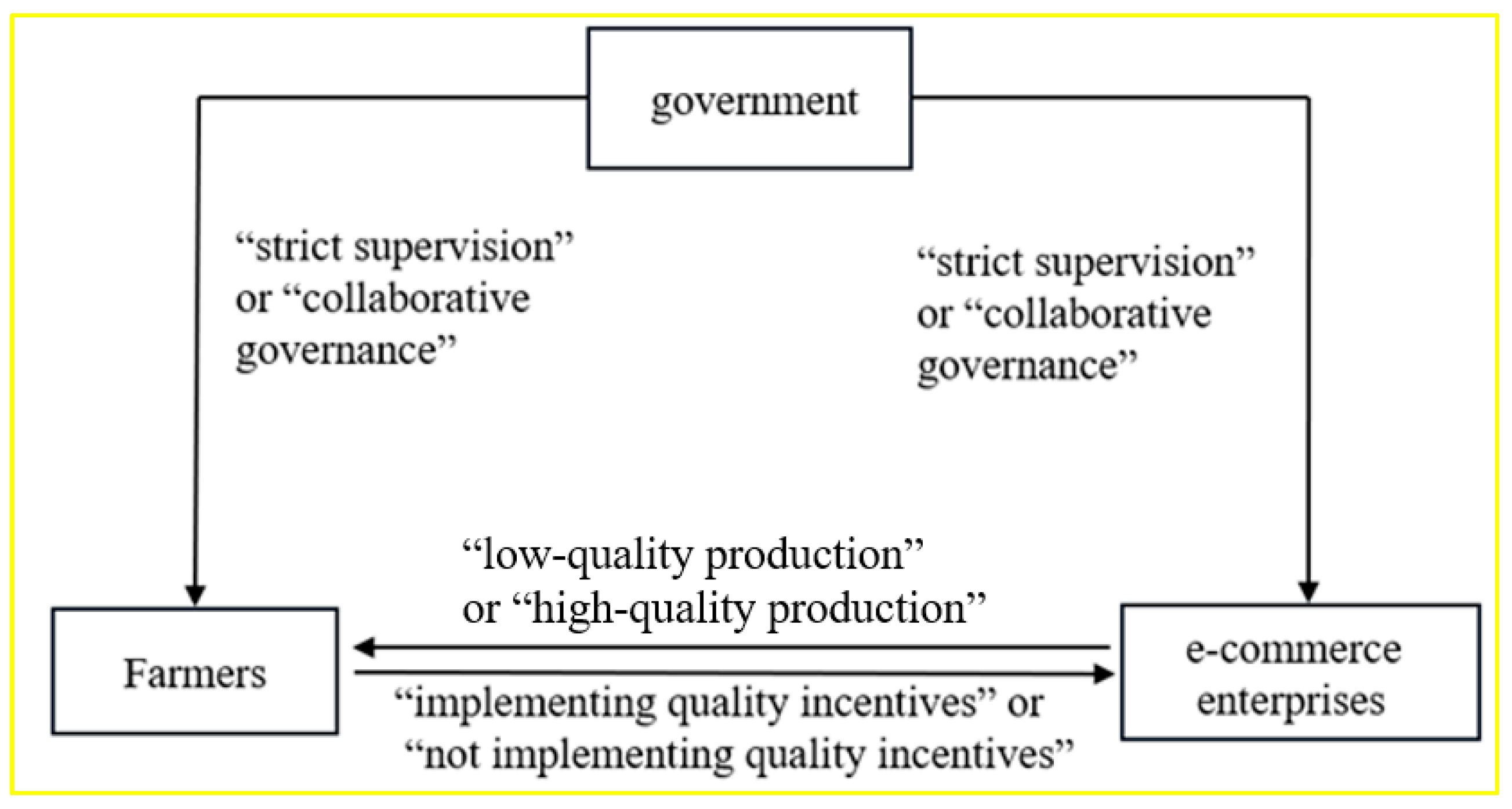
Therefore, to address the aforementioned theoretical gaps, this paper focuses on the issue of supply chain quality collaboration in agricultural product e-commerce enterprise-dominated contexts and introduces evolutionary game theory as the analytical framework. It aims to reveal how farmers, agricultural product e-commerce enterprises, and the government engage in dynamic gaming concerning quality costs and liability risks from the perspective of product liability. Furthermore, it explores under what conditions the government’s “collaborative governance” strategy can endogenously evolve and stabilize, thereby explaining the systemic conditions for forming a high-quality cooperative equilibrium between agricultural product e-commerce enterprises and farmers. The tripartite game strategy diagram is shown in Figure 1.

2. Materials and Methods

2.1. Assumptions and Parameter Settings

This study employs evolutionary game theory as the analytical framework. This method is suitable for investigating strategic interactions and population dynamics among bounded rationality agents and has been widely applied in fields such as policy analysis and supply chain coordination [15,16]. The objective of this research is to reveal, through a theoretical model, the inherent logic and conditions for tripartite collaborative governance among “farmers–enterprises–government.” The conclusions are analytical in nature, providing propositions for subsequent empirical testing. The research hypotheses are as follows:
(1)
Strategy space and probability distribution. The probability of farmers choosing high-quality production is x , and the probability of low-quality production is 1 x . The probability of agricultural product e-commerce enterprises adopting an ex-ante cost-sharing strategy is y , and the probability of not adopting this strategy is 1 y . The probability of the government choosing collaborative governance is z , and the probability of strict supervision is 1 z .
(2)
Production costs and revenue structure. Referring to the literature by Liu Xiaoli [17], the cost for farmers engaging in high-quality production is denoted as C H , and the direct revenue as R F H ; the e-commerce enterprise and the government also gain marginal benefits M E and M G , respectively. When producing with low quality, the farmer’s cost is C L , direct revenue is R F L , and the farmer incurs a negative utility F N due to reputational loss. With probability m (where 0 < m < 1 ), the farmer obtains a spillover benefit m R F L , reflecting partial gains from quality and safety through speculative behavior.
(3)
Information Asymmetry and Herd Mentality. Drawing on research by Yang Haojun [18] and Papanastasiou, Y. & Savva, N et al. [19], farmers, constrained by limited knowledge and information asymmetry, tend to be influenced by group behavior when making decisions. If other farmers choose high-quality production, low-quality producers will perceive psychological pressure C P , leading to a perceived benefit loss of f C P , where f (0 < f < 1) is the herding coefficient, representing the degree to which farmers are influenced by group behavior.
(4)
E-commerce enterprise liability and cost-sharing. Based on studies by Zhu Q et al. [20] and Chen Y et al. [2], this paper defines the revenue obtained by e-commerce enterprises from selling agricultural products as R E . However, it must bear the product liability cost L caused by farmers’ quality defects. The e-commerce enterprise and the farmer bear proportions α and 1 − α of this cost, respectively, with 0 < α < 1. To improve farmer product quality, the e-commerce enterprise may implement an ex-ante quality cost-sharing policy: it bears a proportion γ (0 < γ < 1) of the farmer’s quality cost, while the farmer bears the remaining 1 − γ, satisfying α + γ ≤ 1.
(5)
Government supervision cost and penalty mechanism. Drawing on the research of Zhu Qinghua [21], the government’s cost for strict supervision, C S , is typically higher than that for collaborative governance, C C , i.e., C S > C C , though the exact relationship may vary with policy implementation efficiency. The probability of the government detecting low-quality production by farmers is p. Under strict supervision, the penalty imposed on farmers is P S , and under collaborative governance, it is P C (with P S > P C ). Here, it is further assumed that the government’s strategy choice (strict supervision or collaborative governance) does not affect the detection probability p; rather, decisions are driven by cost differences and penalty severity.
(6)
Incentive and penalty mechanisms under collaborative governance. Drawing on the studies of Tao X [22] and Su Xin et al. [23], under government-led collaborative governance, agricultural product e-commerce enterprises will provide a bonus H to farmers engaged in high-quality production, while farmers producing low-quality products are required to compensate the e-commerce enterprises with a fine P F . E-commerce enterprises that adopt quality cost-sharing measures gain brand and market strategic value V , while those that do not incur an opportunity cost C F . Collaborative governance enhances government credibility and regulatory efficiency, generating public benefit R C .
The relevant symbols involved in this study and their meanings are listed in Table 1.

2.2. Subsection

Based on the above assumptions, the mixed strategy game matrix for farmers, e-commerce enterprises, and government regulatory agencies is shown in Table 2.

3. Analysis of the Evolutionary Game Mode

3.1. Stability Analysis of the Evolutionary Strategies of Game Participants

According to evolutionary game theory, if the fitness of a particular strategy exceeds the population’s average fitness, the proportion of this strategy within the population will gradually increase. Its growth rate is described by the replicator dynamics differential equation—the higher the value of the replicator dynamics, the greater the growth rate of the strategy’s proportion [24]. This section reveals how different initial conditions and external parameters affect the co-evolution outcomes of “farmers–agricultural product e-commerce enterprises–government” by constructing and solving the replicator dynamics equations.
Based on the payoff matrix in Table 2, the expected payoffs for farmers, agricultural product e-commerce enterprises, and the government under different strategic choices are calculated as follows.

3.1.1. Expected Payoffs and Stability Analysis for Farmers

The expected payoffs for farmers adopting high-quality production and low-quality production strategies, as well as the average expected payoff, are as follows:
U F H = y × z × [ R F H + H ( 1 r ) × C H ] + y × ( 1 z ) × [ R F H ( 1 r ) × C H ] + ( 1 y ) × z × ( R FH + H C H ) + ( 1 y ) × ( 1 z ) × ( R F H C H ) U F L = y × z × [ ( 1 + m ) × R F L ( 1 r ) × C L f × C P F N β P C P F ( 1 α ) × L ] + y × ( 1 z ) × [ ( 1 + m ) × R F L ( 1 r ) × C L f × C P F N β P S ( 1 α ) × L ] + ( 1 y ) × z × [ ( 1 + m ) × R F L C L f × C P F N β P C P F ] + ( 1 y ) × ( 1 z ) × [ ( 1 + m ) × R F L C L f × C P F N β P S ] U ¯ F = x × U F H + ( 1 x ) × U F L
The replication dynamic equation for the production strategy of farmers is
F ( x ) = x × ( U F H U ¯ F ) = x × ( 1 x ) × ( U F H U F L ) = x × ( 1 x ) × [ R F H ( 1 + m ) × R F L C H + C L + f × C P + F N + β P S + z × ( H + β P C β P S + P F ) + y × r ( C H C L ) + y × ( 1 α ) × L ]
Taking the partial derivative of the replication dynamic equation F ( x ) in Equation (1) with respect to x yields
F ( x ) = ( 1 2 x ) × [ R F H ( 1 + m ) × R F L C H + C L + f × C P + F N + β P S + z × ( H + β P C β P S + P F ) + y × r ( C H C L ) + y × ( 1 α ) × L ]
The parameter represents the rate of change in the production strategy of farmers. Here, it indicates that farmers tend to adopt a high-quality production strategy; conversely, it suggests a tendency toward choosing a low-quality production strategy.
According to the stability theorem of differential equations, the probability of farmers choosing high-quality production must satisfy the following conditions: when F ( x ) = 0 and F ( x ) < 0 , x is an evolutionarily stable strategy. When F ( x ) = 0 , the conditions x = 0 , x 0 = 1 , and y 0 = ( 1 + m ) × R F L R F H + C H C L f × C P F N β P S z × ( H + β P C β P S + P F ) r ( C H C L ) + ( 1 α ) × L are obtained.
When y = y 0 , F ( x ) = 0 . At this point, regardless of the value of x , the strategic choice of farmers remains in a stable state, meaning the probability of their strategy selection does not change over time.
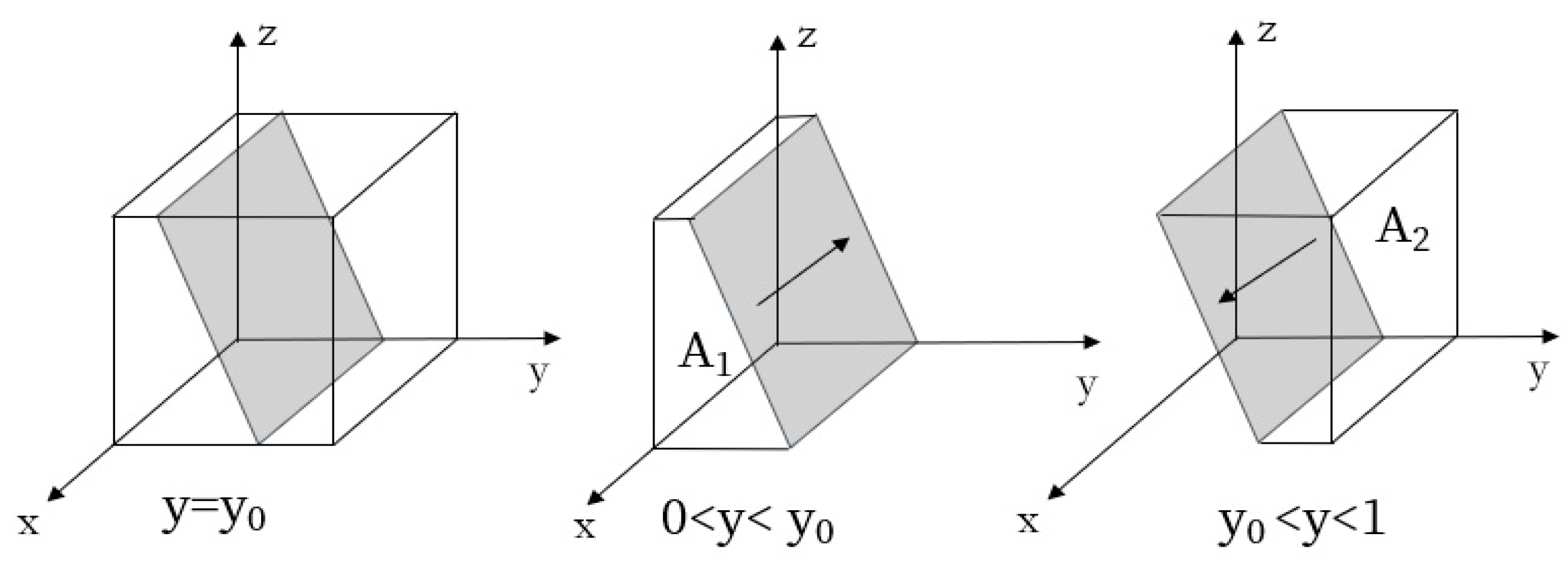
When y y 0 , it can be inferred that x = 0 and x = 1 are two potential stable states for x . Whether these become evolutionarily stable strategies requires further analysis. Based on this, the following two cases are considered: First, when 0 < y < y 0 , substituting x = 0 an x = 1 into F ( x ) yields F ( 0 ) < 0 and F ( 1 ) > 0 . Thus, x = 0 is a stable point. When the probability that agricultural product e-commerce enterprises choose to adopt the ex-ante cost-sharing strategy is lower than y 0 , the evolutionarily stable strategy for farmers is low-quality production. Second, when y 0 < y < 1 , substituting x = 0 and x = 1 into F ( x ) yields F ( 0 ) > 0 and F ( 1 ) < 0 . Thus, x = 1 is a stable point. When the probability that agricultural product e-commerce enterprises choose to adopt the ex-ante cost-sharing strategy is higher than y 0 , the evolutionarily stable strategy for farmers is high-quality production.
In summary, the evolutionary phase diagram for farmers’ decision-making, as shown in Figure 2, can be derived. Herein, A1 and A2 denote the probability of low-quality and high-quality production by farmers, respectively, in the phase diagram of farmers’ strategy evolution.
Figure 2 shows that the probability of farmers engaging in low-quality production corresponds to the volume VA1 of region A1, while the probability of stably producing high-quality agricultural products corresponds to the volume VA2 of region A2. The calculations yield
V A 1 = 0 1 0 1 ( 1 + m ) × R F L R F H + C H C L f × C P F N β P S z × ( H + β P C β P S + P F ) r ( C H C L ) + ( 1 α ) × L d z d x = 2 × [ ( 1 + m ) × R F L R F H + C H C L f × C P F N β P S ] ( H + β P C β P S + P F ) 2 × [ r ( C H C L ) + ( 1 α ) × L ]
V A 2 = 1 V A 1 = 1 2 × [ ( 1 + m ) × R F L R F H + C H C L f × C P F N β P S ] ( H + β P C β P S + P F ) 2 × [ r ( C H C L ) + ( 1 α ) × L ]
Inference 1. 
The probability of farmers producing high-quality products is positively correlated with sales revenue, perceived revenue loss, reputational loss, bonuses given by e-commerce enterprises to farmers for high-quality production, penalties paid by farmers to e-commerce enterprises for low-quality production, and government penalties for low-quality production. Conversely, it is negatively correlated with the spillover benefits of low-quality production, costs saved from low-quality production, and the liability costs incurred.
Proof. 
Based on the expression for the probability of high-quality production VA2 among farmers, taking the first-order partial derivatives with respect to each factor yields V A 2 / ( 1 + m ) R F L < 0 , V A 2 / R F H > 0 , V A 2 / ( C H C L ) < 0 , V A 2 / f C P > 0 , V A 2 / F N > 0 , V A 2 / H > 0 , V A 2 / P C > 0 , V A 2 / P F > 0 , V A 2 / P S > 0 , V A 2 / L < 0 . Therefore, an increase in R F H , f C P , F N , H , P C , P F and P S or a decrease in ( 1 + m ) R F L , C H C L , L , will lead to an increase in the probability of farmers adopting high-quality production. □
Interpretation of Inference 1: Enhancing economic incentives (such as sales revenue and bonuses) and non-economic constraints (such as reputational loss and penalties) for high-quality production can effectively curb farmers’ low-quality production behavior. Within a government-led collaborative governance framework, agricultural product e-commerce enterprises can strengthen guidance for farmers’ behavior by establishing reward-penalty mechanisms. Meanwhile, the cost savings and spillover benefits from low-quality production reduce farmers’ motivation for high-quality production, while liability costs impose a reverse constraint. Through collaborative governance, the government and enterprises can jointly enhance the benefits of high-quality production, increase the costs of low-quality behavior, and optimize production processes to reduce the costs associated with high-quality production. Consequently, this encourages farmers to choose high-quality production, thereby improving the overall quality level of the supply chain.
Inference 2. 
The probability of farmers engaging in high-quality production increases with the probability of agricultural product e-commerce enterprises adopting an ex-ante cost-sharing strategy and the rate of government collaborative governance.
Proof. 
Based on the stability analysis of the farmer’s strategy, let z 0 = ( 1 + m ) × R F L R F H + C H C L f × C P F N β P S y × r ( C H C L ) y × ( 1 α ) × L H + β P C β P S + P F . When 0 < z < z 0 and 0 < y < y 0 , we have F ( 0 ) < 0 , indicating that x = 0 is the evolutionarily stable strategy. Conversely, x = 1 becomes the evolutionarily stable strategy. Therefore, as y and z gradually increase, the farmer’s stable strategy shifts from x = 0 (low-quality production) to x = 1 (high-quality production). □
Interpretation of Inference 2: The stronger the tendency of enterprises to adopt quality incentive measures, the more inclined farmers are to adopt high-quality production as an evolutionarily stable strategy. At this point, the probability of government collaborative governance reaches its maximum, which helps to fully mobilize the enthusiasm of both farmers and enterprises. Measures such as enhancing the strategic value of enterprises can create more cooperative opportunities for both parties. The collaborative governance between the government and enterprises not only improves the economic benefits of high-quality agricultural products but also enhances the market competitiveness and sustainable development capabilities of both sides.

3.1.2. Expected Payoffs and Stability Analysis for Agricultural Product E-Commerce Enterprises

The expected payoffs for agricultural product e-commerce enterprises adopting an ex-ante cost-sharing strategy and not adopting such a strategy ( U E Y , U E N ) , as well as the average expected payoff ( U ¯ E ) , are denoted as follows:
U E Y = x × z × ( R E + M E + V r C H H ) + x × ( 1 z ) × ( R E + M E r C H ) + ( 1 x ) × z × ( R E + P F r C L α L ) + ( 1 x ) × ( 1 z ) × ( R E r C L α L ) U E N = x × z × R E + M E H C F + x × 1 z × R E + M E + 1 x × z × ( R E + P F L ) + ( 1 x ) × ( 1 z ) × ( R E L ) U ¯ E = y × U E Y + ( 1 y ) × U E N
The replication dynamic equation for the strategic choice of agricultural product e-commerce enterprises is
F ( y ) = y × ( U E Y U ¯ E ) = y × ( 1 y ) × ( U E Y U E N ) = y × 1 y × [ ( 1 α ) × L γ C L + x × ( C L × γ C H × γ + α L L ) + x × z × ( V + C F ) ]
Taking the partial derivative of the replication dynamic equation F ( y ) in Equation (2) with respect to y yields
F ( y ) = ( 1 2 y ) × [ ( 1 α ) × L γ C L + x × γ × ( C L C H ) x × ( 1 α ) × L + x × z × ( V + C F ) ]
The parameter F ( y ) represents the rate of change in the strategy adopted by the agricultural product e-commerce enterprise. When F ( y ) > 0 , it indicates that the enterprise tends to adopt the ex-ante quality cost-sharing strategy; conversely, when F ( y ) < 0 , it suggests a tendency not to adopt such a strategy.
According to the stability theorem of differential equations, for the probability y of the enterprise choosing to adopt the ex-ante quality cost-sharing strategy to be an evolutionarily stable strategy, it must satisfy F ( y ) = 0 and F ( y ) < 0 . Setting F ( y ) = 0 , we obtain y = 0 , y = 1 , and: x 0 = γ C L ( 1 α ) × L γ × ( C L C H ) ( 1 α ) × L + z × ( V + C F ) ] .
When x = x 0 , F ( y ) = 0 . In this case, regardless of the value of y, all behavioral strategies of the agricultural product e-commerce enterprise are in a stable state, meaning the probability of its strategy selection does not change over time.
When x x 0 , y = 0 and y = 1 emerge as two potential stable states for y. Whether these become evolutionarily stable strategies requires further analysis. Based on this, the following two cases are discussed:
Case 1: When 0 < x < x 0 , substituting y = 0 and y = 1 into F ( y ) yields F ( 0 ) < 0 and F ( 1 ) > 0 . Therefore, y = 0 is a stable point. When the probability of farmers choosing high-quality production is lower than x 0 , not adopting the ex-ante quality cost-sharing strategy is the evolutionarily stable strategy for the agricultural product e-commerce enterprise.
Case 2: When x 0 < x < 1 , substituting y = 0 and y = 1 into F ( y ) yields F ( 0 ) > 0 and F ( 1 ) < 0 . Therefore, y = 1 is a stable point. When the probability of farmers choosing high-quality production is higher than x 0 , adopting the ex-ante quality cost-sharing strategy is the evolutionarily stable strategy for the agricultural product e-commerce enterprise.
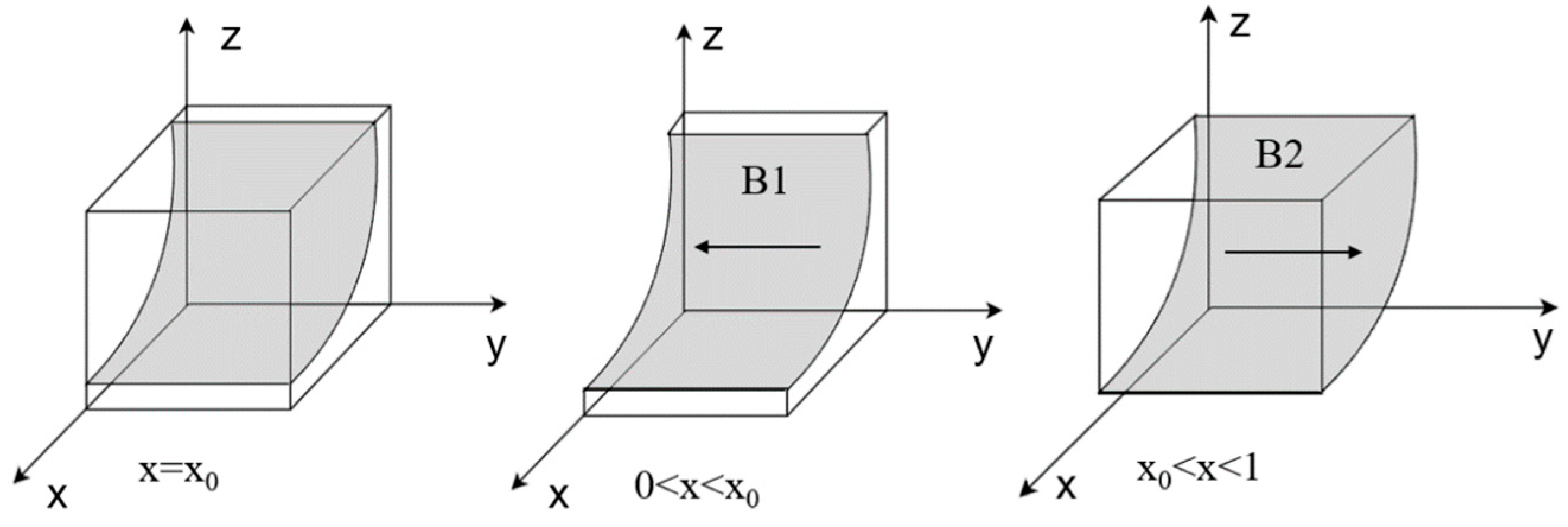
In summary, the evolutionary phase diagram for the decision-making of agricultural product e-commerce enterprises can be derived as shown in the figure below. In the phase diagram, B1 and B2 denote the probabilities of the e-commerce agricultural enterprise opting out of and adopting the ex ante quality cost-sharing strategy, respectively.
Figure 3 indicates that the probability of the agricultural product e-commerce enterprise not adopting the ex-ante quality cost-sharing strategy corresponds to the volume VB1 of region B1, while the probability of adopting such measures corresponds to the volume VB2 of region B2. The calculation yields.
V B 1 = 0 1 0 1 γ C L ( 1 α ) × L γ × ( C L C H ) ( 1 α ) × L + z × ( V + C F ) d z d x = γ C L ( 1 α ) × L V + C F ln ( 1 + V + C F γ × ( C L C H ) ( 1 α ) × L )
V B 2 = 1 V B 1 = 1 γ C L ( 1 α ) × L V + C F ln ( 1 + V + C F γ × ( C L C H ) ( 1 α ) × L )
Inference 3. 
The probability of agricultural product e-commerce enterprises adopting the ex-ante quality cost-sharing strategy is positively correlated with the share of liability costs borne by farmers, the opportunity costs incurred, and the strategic value of the enterprise under government collaborative governance, while it is negatively correlated with the magnitude of the quality costs they bear.
Proof. 
Taking the first-order partial derivatives of VB2 with respect to each relevant factor yields the following: V B 2 / γ C L < 0 , V B 2 / γ C H < 0 , V B 2 / ( 1 α ) L > 0 , V B 2 / V > 0 , and V B 2 / C F > 0 . From this, it can be concluded that an increase in ( 1 α ) L , γ C H , V and C F or a decrease in γ C L will lead to an increase in the probability of agricultural product e-commerce enterprises adopting the ex-ante quality cost-sharing strategy. □
Interpretation of Inference 3: Through collaborative governance, the government can enhance the exposure and, consequently, the strategic value of agricultural product e-commerce enterprises that implement the ex-ante quality cost-sharing strategy. Enterprises that do not adopt such measures will face higher opportunity costs. Guided by this dynamic, agricultural product e-commerce enterprises are more inclined to employ the ex-ante quality cost-sharing strategy. Furthermore, the lower the proportion of ex-ante quality costs shared by the enterprise, the higher its potential benefits.
Inference 4. 
The probability of agricultural product e-commerce enterprises adopting the ex-ante quality cost-sharing strategy increases with the rise in both the probability of farmers engaging in high-quality production and the probability of government collaborative governance.
Proof. 
Based on the stability analysis of the strategic choice for agricultural product e-commerce enterprises, let z 0 = γ C L ( 1 α ) × L x × [ γ × ( C L C H ) ( 1 α ) × L ] V C F . When 0 < x < x 0 and 0 < z < z 0 , y = 0 is the evolutionarily stable strategy; when x 0 < x < 1 and z 0 < z < 1 , y = 1 is the evolutionarily stable strategy. Therefore, as x and z increase, the probability of the enterprise adopting the ex-ante quality cost-sharing strategy gradually shifts from y = 0 to y = 1 , meaning it rises with the increase of x and z . □
Interpretation of Inference 4: The strategic choice of farmers to produce high-quality products and the strengthening of government collaborative governance jointly influence the stable strategy of agricultural product e-commerce enterprises. An increase in both probabilities encourages enterprises to be more inclined toward adopting the ex-ante quality cost-sharing strategy. Hence, the key to promoting collaborative development in the agricultural product e-commerce industry lies in guiding farmers to standardize production, improve product quality, and providing corresponding support and incentives through government-led collaborative governance.

3.1.3. Expected Payoffs and Stability Analysis for the Government

The expected payoffs for the government adopting collaborative governance with strict supervision and the average expected payoff are as follows:
U G G = x × y × ( R C + M G C C ) + x × 1 y × ( M G C C ) + ( 1 x ) × y × β P C C C + ( 1 x ) × ( 1 y ) × β P C C C U G N = x × y × ( M G C S ) + x × ( 1 y ) × ( M G C S ) + ( 1 x ) × y × ( β P S C S ) + ( 1 x ) × ( 1 y ) × ( β P S C S ) U ¯ G = z × U G G + ( 1 z ) × U G N
The replication dynamic equation for the government’s strategic choice is
F ( z ) = z × ( U G G U ¯ G ) = z × ( 1 z ) × ( U G G U GN ) = z × 1 z × [ C S C C + β × ( P C P S ) + R C × x × y x × β × ( P C P S ) ]
Taking the partial derivative of the replication dynamic equation in Equation (3), denoted as F ( z ) , with respect to z , yields
F ( z ) = 1 2 z × [ C S C C + β × ( P C P S ) + R C × x × y x × β × ( P C P S ) ]
F ( z ) represents the rate of change in the government’s supervision strategy. When F ( z ) > 0 , it indicates that the government tends to adopt a strict supervision strategy; when F ( z ) < 0 , it suggests a tendency toward a collaborative governance strategy.
According to the stability theorem of differential equations, for the probability z of the government adopting an evolutionarily stable supervision strategy, it must satisfy F ( z ) = 0 and F ( z ) < 0 . Setting F ( z ) = 0 yields z = 0 , z = 1 , and x 0 = C C C S β × ( P S P C ) R C × y β × ( P S P C ) .
When x = x 0 , F ( z ) = 0 . At this point, regardless of the value of z , all behavioral strategies of the government are in a stable state, meaning the probability of their strategy selection does not change over time.
When x x 0 , it can be inferred that z = 0 and z = 1 may represent two potential stable states for z. Whether these become evolutionarily stable strategies requires further analysis. Based on this, the following two cases are discussed.
Case 1: When 0 < x < x 0 , substituting z = 0 and z = 1 into F ( z ) yields F ( 0 ) < 0 and F ( 1 ) > 0 . Therefore, z = 0 is the stable point. When the probability of farmers choosing high-quality production is lower than x 0 , the government selecting strict supervision is the evolutionarily stable strategy.
Case 2: When x 0 < x < 1 , substituting z = 0 and z = 1 into F ( z ) yields F ( 0 ) > 0 and F ( 1 ) < 0 . Therefore, z = 1 is the stable point. When the probability of farmers choosing high-quality production is higher than x 0 , the government selecting collaborative governance is the evolutionarily stable strategy.
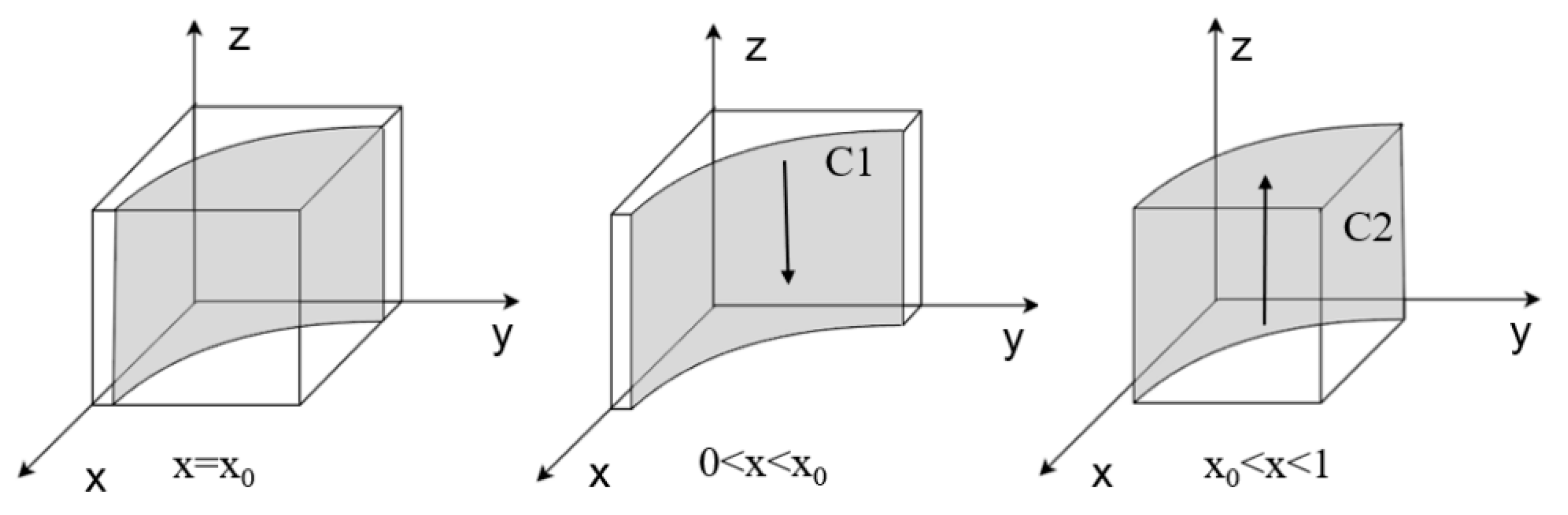
In summary, the evolutionary phase diagram for government decision-making can be derived as shown in the figure below. In the phase diagram of strategy evolution, C1 denotes the probability of the government adopting a strict regulation strategy, and C2 denotes the probability of adopting a collaborative governance strategy.
Figure 4 shows that the probability of the government adopting strict supervision measures corresponds to the volume VC1 of region C1, while the probability of adopting collaborative governance corresponds to the volume VC2 of region C2. The calculation yields.
V C 1 = 0 1 0 1 C C C S β × ( P S P C ) R C × y β × ( P S P C ) d y d x = C C C S β × ( P S P C ) R C ln | 1 + R C β × ( P C P S ) |
V C 2 = 1 V C 1 = 1 C C C S β × ( P S P C ) R C ln | 1 + R C β × ( P C P S ) |
Inference 5. 
The probability of government collaborative governance is positively correlated with the costs of strict supervision, the penalty intensity under collaborative governance, and the public benefits. It is negatively correlated with the costs of collaborative governance and the penalty intensity under strict supervision.
Proof. 
Taking the first-order partial derivatives of VC2 with respect to each factor yields V C 2 / C S > 0 , V C 2 / P C > 0 , V C 2 / R C > 0 , V C 2 / C C < 0 , and V C 2 / P S < 0 . Therefore, an increase in C S ,   P C ,   R C or a decrease in C C ,   P S will lead to an increase in the probability of government collaborative governance. □
Interpretation of Inference 5: Under strict supervision, the government incurs higher costs. Collaborative governance can reduce these costs and, through effective penalties for low-quality production behavior, enhance public benefits. Consequently, when collaborative governance more effectively reduces supervision costs, increases the impact of penalties, and boosts public benefits, the government is more inclined to choose a collaborative governance strategy. Conversely, when the costs of collaborative governance are high or the penalty effects are not significant, the government tends to reduce the probability of adopting collaborative governance.
Inference 6. 
The probability of government collaborative governance increases as the probability of farmers engaging in high-quality production or the probability of agricultural product e-commerce enterprises adopting the ex-ante cost-sharing strategy rises.
Proof. 
Based on the stability analysis of the government’s strategy, let y 0 = C C C S β × ( P C P S ) + x × β × ( P S P C ) R C × x . When 0 < x < x 0 and 0 < y < y 0 , z = 0 is the evolutionarily stable strategy; when x 0 < x < 1 and y 0 < y < 1 , z = 1 is the evolutionarily stable strategy. Therefore, as x and y increase, the stable strategy shifts gradually from z = 0 to z = 1 , meaning that z rises with the increase of x and y . □
Interpretation of Inference 6: When farmers are more inclined toward high-quality production, or when agricultural product e-commerce enterprises are more willing to adopt pre-quality cost-sharing measures, the government is more motivated to adopt a collaborative governance strategy. This is because the increase in high-quality production and pre-quality cost-sharing measures contributes to more efficient governance and better public benefits, thereby incentivizing the government to strengthen collaborative governance.
Synthesizing all the inferences, this study reveals the interactive mechanisms among farmers, agricultural product e-commerce enterprises, and the government. The quality choices of farmers, the cost-sharing decisions of enterprises regarding quality, and the collaborative governance strategies of the government mutually influence one another, collectively constructing an incentive-and-constraint-based governance system for the agricultural supply chain. The research indicates that the key to achieving the improvement of agricultural product quality and the synergistic optimization of the supply chain lies in the government incentivizing enterprises to adopt the ex-ante cost-sharing strategy through collaborative governance policies, thereby encouraging farmers to shift toward high-quality production. This forms a virtuous cycle of “policy guidance–enterprise participation–farmer response.”

4. Analysis of Tripartite Evolutionary Game Equilibrium Points

To theoretically determine the long-term evolutionary equilibrium of the system, based on the replicator dynamics differential equations derived for the three parties in the previous section, the stability theorem of differential equations is applied. By analyzing the eigenvalues of the Jacobian matrix of the differential equation system, it can be determined whether a specific equilibrium point constitutes an evolutionarily stable strategy (ESS): if a local equilibrium point satisfies the condition that the determinant of the Jacobian matrix (det J) is greater than zero and its trace (tr J) is less than zero, then it is an evolutionarily stable strategy [25,26]. Based on this theorem, we systematically solve all possible pure-strategy and mixed-strategy equilibrium points in the system and compute the eigenvalues (or the determinant and trace) of their respective Jacobian matrices. This allows for the theoretical screening of all potential evolutionarily stable strategies (ESSs).
By simultaneously solving Equations (1)–(3), the replicator dynamic equations for each agent under the e-commerce enterprise-led quality incentive strategy from the perspective of product liability can be obtained, as shown in Equation (4). Based on the replicator dynamic equations, the Jacobian matrix of the tripartite game system is constructed, given by Equation (5).
F ( x ) = x × ( 1 x ) × [ R F H ( 1 + m ) × R F L C H + C L + f × C P + F N + β P S + z × ( H + β P C β P S + P F ) + y × r ( C H C L ) + y × ( 1 α ) × L ] F ( y ) = y × 1 y × [ ( 1 α ) × L γ C L + x × ( C L × γ C H × γ + α L L ) + x × z × ( V + C F ) ] F z = z × 1 z × [ C S C C + β × ( P C P S ) x × β × ( P C P S ) + R C × x × y ]
J = J 1 J 2 J 3 J 4 J 5 J 6 J 7 J 8 J 9 = F ( x ) / x F ( x ) / y F ( x ) / z F ( y ) / x F ( y ) / y F ( y ) / z F ( z ) / x F ( z ) / y F ( z ) / z = 1 2 x × [ R F H ( 1 + m ) × R F L C H + C L + f C P + F N + P S × β + y × r × ( C H C L ) + y × ( 1 α ) × L + z × β × ( P C P S ) + z × ( H + P F ) ] x × 1 x × [ ( 1 α ) × L + r × ( C H C L ) x × 1 x × [ H + P F + β × ( P C P S ) ] y × 1 y × [ z × ( C F + V ) ( 1 α ) × L r × ( C H C L ) ] 1 2 × y × [ ( 1 α ) × L ( 1 α ) × L × x C L × r ( C H C L ) × r × x + ( C F + V ) × x × z ] x × y × 1 y × ( C F + V ) z × 1 z × [ ( P S P C ) × β + R C × y ] R C × x × z × 1 z 1 2 × z × [ C S C C + ( P C P S ) × β ( P C P S ) × β × x + R C × x × y )

Stability Analysis of Equilibrium Points in the Tripartite Evolutionary Game System

According to the findings of Friedman [25], in asymmetric games where information asymmetry holds, the evolutionarily stable strategy is a pure strategy. By setting the replicator dynamic equations to zero, fourteen evolutionary equilibrium points of the system can be derived. Among these, eight are pure-strategy solutions, while the rest are non-pure-strategy solutions. The pure-strategy solutions are: E1 (0,0,0), E2 (1,0,0), E3 (0,1,0), E4 (0,0,1), E5 (1,1,0), E6 (1,0,1), E7 (0,1,1), and E8 (1,1,1). Substituting these eight pure-strategy solutions into the Jacobian matrix yields the corresponding eigenvalues for each equilibrium point, as presented in Table 3.
According to Table 3, equilibrium points E1, E2, E3, and E5 possess eigenvalues with positive real parts, failing to satisfy the conditions for a stable evolutionary strategy. Therefore, the analysis proceeds with the remaining four potential stable points.
Scenario 1: When 1 α × L < C L × γ and R F H + H C H < 1 + m × R F L C L f C P F N P F P C × β , meaning the net benefit for farmers from high-quality production is less than that from low-quality production, E4 (0,0,1) becomes an evolutionarily stable point of the system. The corresponding evolutionarily stable strategy is (low-quality production, no ex-ante quality cost-sharing measures, cooperative governance). This stable point indicates that, under the current conditions, farmers tend to choose low-quality production because the returns from high-quality production are insufficient to offset the additional costs required. If the liability costs borne by farmers increase or the net benefits from low-quality production decrease, the likelihood of this inequality holding will be reduced.
Scenario 2: When 1 α × L > C L × γ and R F H + H 1 γ × C H < 1 + m × R F L 1 γ × C L F N P F f C P 1 α × L β × P C , meaning the net benefit for farmers from high-quality production is less than that from low-quality production even when the e-commerce enterprise implements ex-ante quality cost-sharing measures, E7 (0,1,1) becomes an evolutionarily stable point of the system. The corresponding evolutionarily stable strategy is (low-quality production, implementation of ex-ante quality cost-sharing measures, and cooperative governance). However, this represents a non-ideal equilibrium: even with the participation of the government and consumers in governance, farmers still opt for low-quality production. This indicates that the current incentive structure is insufficient to guide behavior towards high-quality production. It necessitates adjustments through policy reforms, market-based incentives, or optimization of liability allocation to alter the farmers’ benefit structure.
Scenario 3: When C F < C H × γ V and R F H + H C H > ( 1 + m ) × R F L C L f C P F N P F P C × β , meaning the net benefit for farmers from high-quality production exceeds that from low-quality production, E6 (1,0,1) becomes an evolutionarily stable point of the system. The corresponding evolutionarily stable strategy is (high-quality production, no ex-ante quality cost-sharing measures, and cooperative governance). This finding indicates that the cooperative governance mechanism is not only effective but also cost-efficient, enabling both the government and e-commerce enterprises to achieve higher market quality standards and production efficiency with lower governance costs.
Scenario 4: When C C R C < C S (i.e., the net benefit for farmers from high-quality production exceeds that from low-quality production), C F > C H × γ V , and R F H + H 1 γ × C H > 1 + m × R F L 1 γ × C L f C P F N P F 1 α × L P C × β , the net benefit for farmers from high-quality production when the e-commerce enterprise implements ex-ante quality cost-sharing measures is greater than that from low-quality production; then, E8 (1,1,1) becomes an evolutionarily stable point of the system. This is the corresponding evolutionarily stable strategy (high-quality production, implementation of ex-ante quality cost-sharing measures, and cooperative governance).
This indicates that, under the current conditions, promoting high-quality production relies on the dual support of a cooperative governance mechanism and ex-ante quality cost-sharing measures. The cooperative governance mechanism effectively enhances market regulation efficiency and production initiative. However, due to the relatively high costs associated with high-quality production, the government or e-commerce enterprises still need to provide economic support to reduce farmers’ production costs. This suggests that in the process of advancing high-quality production, the synergistic role of policy support and market mechanisms is a critical factor in ensuring system stability and sustainable development.

5. Numerical Simulation

To validate the effectiveness of the evolutionary stability analysis and examine the dynamic impact of relevant parameters on the system’s evolutionary trajectory, this study determines the magnitude and reasonable ranges of related parameters by integrating real-world cases and relevant literature. First, referencing the high-quality agricultural product production base construction project in Zhejiang Province (2023), which provides subsidies for certified agricultural products and sets standards for sales incentives, the government’s reward for high-quality production (H) is established. Second, based on typical penalty cases from the Ministry of Agriculture and Rural Affairs’ “Agricultural Product Quality and Safety Supervision and Spot Check” (third quarter of 2023), where fines of tens of thousands of RMB were imposed for producing low-quality agricultural products, the standard for government penalties (P) is defined. Finally, according to the 2022 Green Food Consumption Trends Report jointly released by the China Green Food Development Center and a major e-commerce platform, which indicates that high-quality agricultural products command a price premium of 25% to 40% compared to ordinary counterparts while ordinary products can still maintain stable sales volume and basic revenue through promotions, the production revenue for farmers (R) is determined. The relative magnitudes and value ranges of other key parameters (such as production cost C, liability cost L, quality cost-sharing ratio γ, quality inspection probability β, etc.) are set by synthesizing literature relevant to this study [17,23,24].
Ensuring the robustness of the parameters within a reasonable range, the tripartite evolutionary game model is simulated and analyzed using MATLAB R2023b (The MathWorks, Inc., Natick, MA, USA) software. Building upon the relatively stable state E8 (1,1,1) of the system, specific initial variable values are assigned as shown in Table 4.

5.1. Evolution Paths of the Three Game Agents

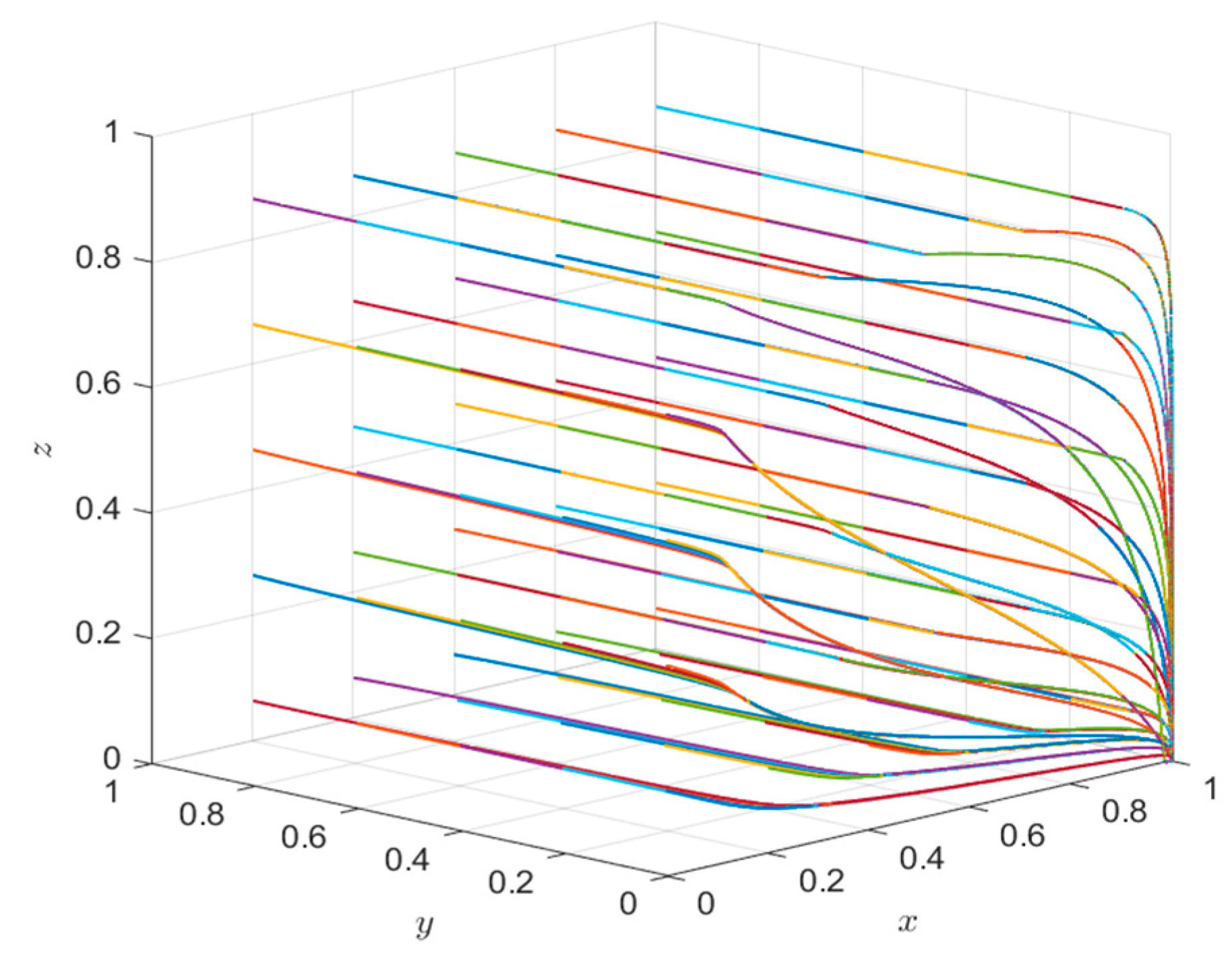
By substituting the parameter set into the model, the simulation results are obtained as shown in Figure 5. The figure reveals that the trajectories exhibit a relatively complex distribution without a clear tendency to converge towards a specific region. This indicates that the strategic choices of the three parties are interdependent and intricate. Different combinations of initial strategy probabilities lead to diverse evolutionary outcomes, reflecting the high sensitivity of the tripartite game to its initial conditions. Some trajectories gradually approach areas with higher coordinate values, implying that under certain conditions, the system evolves towards a state with higher probabilities of farmers choosing high-quality production, e-commerce enterprises sharing costs, and the government engaging in cooperative governance, tending towards a positive stable strategy. Conversely, the direction of other trajectories is ambiguous, suggesting that under different initial conditions, the system’s evolutionary outcome is difficult to predict, and a stable strategic pattern has not yet emerged. This phenomenon can be attributed to the following reasons.
First, the strategic choices of each party are influenced by numerous factors. For instance, farmers must consider production costs, market returns, and regulatory pressure; e-commerce enterprises focus on cost–benefit analysis and market share; while the government needs to balance regulatory resources and social outcomes. The intricate interplay of these factors results in a wide variety of strategic combinations. This complexity leads to the convoluted distribution of trajectories, where different initial probability combinations correspond to distinct evolutionary paths, making it difficult to observe simple, overarching patterns.
Second, the outcomes of evolutionary games are highly sensitive to initial strategy probabilities. Minor differences in initial probabilities can be amplified through the iterative game process, leading to entirely different evolutionary directions. The diverse trajectories in the figure reflect the significant variation in system evolution under different initial states. This is not indicative of poor game performance but rather underscores the crucial influence of initial conditions on the final result.
Third, in the absence of strong incentive or constraint mechanisms, it is challenging for the three parties to form a unified and clear-cut strategy. For example, without sufficient economic incentives for farmers to consistently pursue high-quality production or lacking stringent regulations to compel e-commerce enterprises to share costs, the strategies of all parties may undergo repeated adjustments. This leads to complex system evolution paths and increased uncertainty.

5.2. Impact of the Ex-Ante Quality Cost-Sharing Ratio on the System’s Evolutionary Outcome

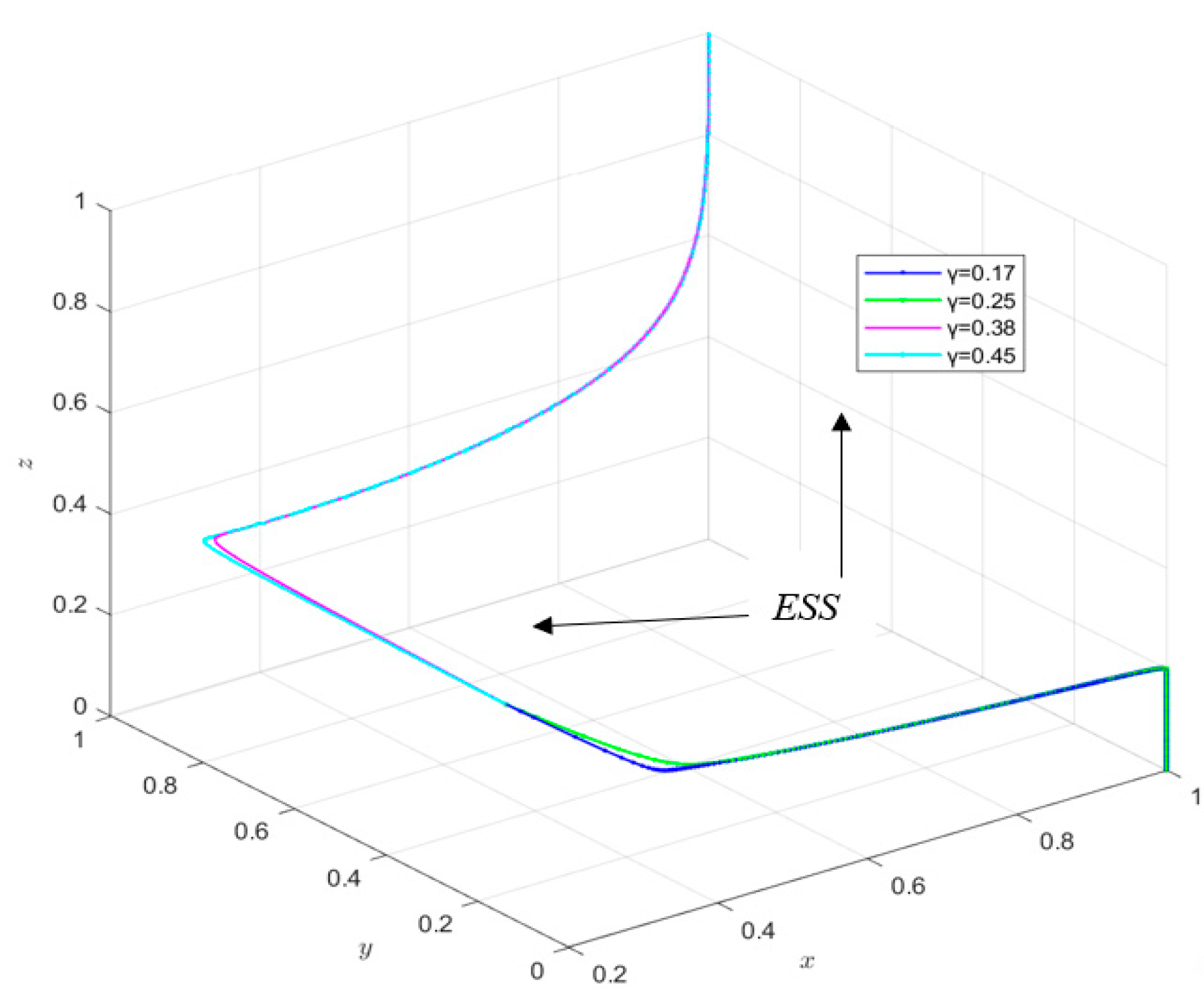
Setting the values of the ex-ante quality cost-sharing ratio (γ) at 0.17, 0.48, 0.64, and 0.86, the simulation results are shown in Figure 6, exhibiting an overall upward trend. This indicates that as the ex-ante quality cost-sharing ratio increases, the probability of the government choosing cooperative governance gradually rises, and the system tends to evolve towards the evolutionarily stable strategy point. This suggests that a higher cost-sharing ratio by e-commerce enterprises drives the system towards a more stable state characterized by more proactive cooperation among all parties.
Furthermore, in Figure 6, the lower section of the plot shows a relatively flat state. That is, when the probability of the agricultural product e-commerce enterprise adopting the ex-ante cost-sharing strategy increases, the probability of farmers choosing high-quality production (x) and the probability of the government choosing cooperative governance (z) change only slightly, resulting in a relatively gentle system evolution. This may be attributed to the following reasons.
First, at this stage, the parties involved may exhibit a certain degree of inertia in adjusting their strategies. Farmers might not yet fully recognize the long-term impact of the e-commerce enterprise’s cost-sharing strategy on themselves. Consequently, even as γ increases, the change in x is not pronounced. Similarly, the government, based on past experience or its current assessment of the market, may not rapidly and significantly adjust its cooperative governance probability (z) in direct response to changes in the e-commerce enterprise’s strategy.
Second, the degree of change in the e-commerce enterprise’s cost-sharing strategy has not yet exerted a sufficiently strong impact on the interest structures of farmers and the government. For instance, the proportion or scope of cost-sharing might be limited, insufficient to strongly incentivize farmers to increase the probability of high-quality production or to convince the government of the necessity to significantly intensify cooperative governance, leading to the overall gentle evolution of the system.
Third, there may be a lag in information transmission among the three parties. Information regarding the e-commerce enterprise’s adoption of the cost-sharing strategy might not be communicated to farmers and the government promptly and effectively. Alternatively, the conveyed information may not be fully understood or valued, preventing farmers and the government from making timely strategic adjustments and causing the system’s evolution to proceed slowly during this phase. (Similar trends observed subsequently will not be reiterated in detail here.)

5.3. Impact of Product Liability Sharing Ratio on System Evolution Outcomes

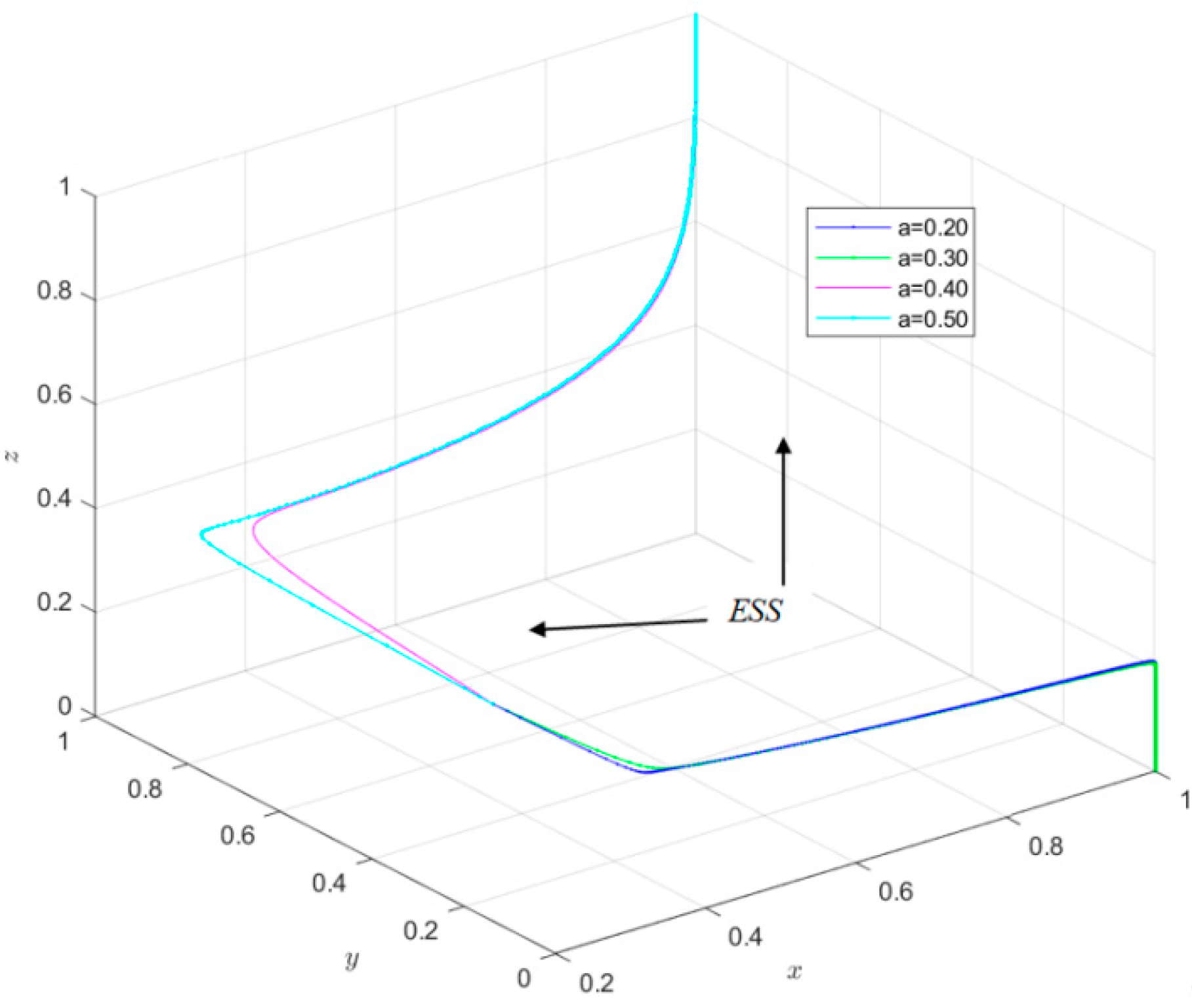
Setting the product liability cost-sharing ratio α to values of 0.18, 0.48, 0.64, and 0.73, the simulation results are shown in Figure 7. When α is set to 0.18 (represented by the red dashed line), its evolutionary path is distinctly different from those of other values. This suggests that under a lower liability cost-sharing ratio, the interaction dynamics of strategy selection among the three parties differ from other scenarios. This may be attributed to the reduced cost pressure borne by each party at this level, leading to different motivations and directions for strategy adjustment, which consequently causes a deviation in the evolutionary path. For α values of 0.48, 0.64, and 0.73, the curves exhibit an overall upward trend. This indicates that as the product liability cost-sharing ratio increases, the probability of the government choosing collaborative governance gradually rises. Simultaneously, this may drive farmers and e-commerce enterprises to evolve towards more proactive strategies (high-quality production, cost-sharing), steering the system toward a stable equilibrium point. This demonstrates that appropriately increasing the cost-sharing ratio helps incentivize all parties to adopt strategies more conducive to system stability.

5.4. Impact of Farmers’ Herding Coefficient on System Evolution Outcomes

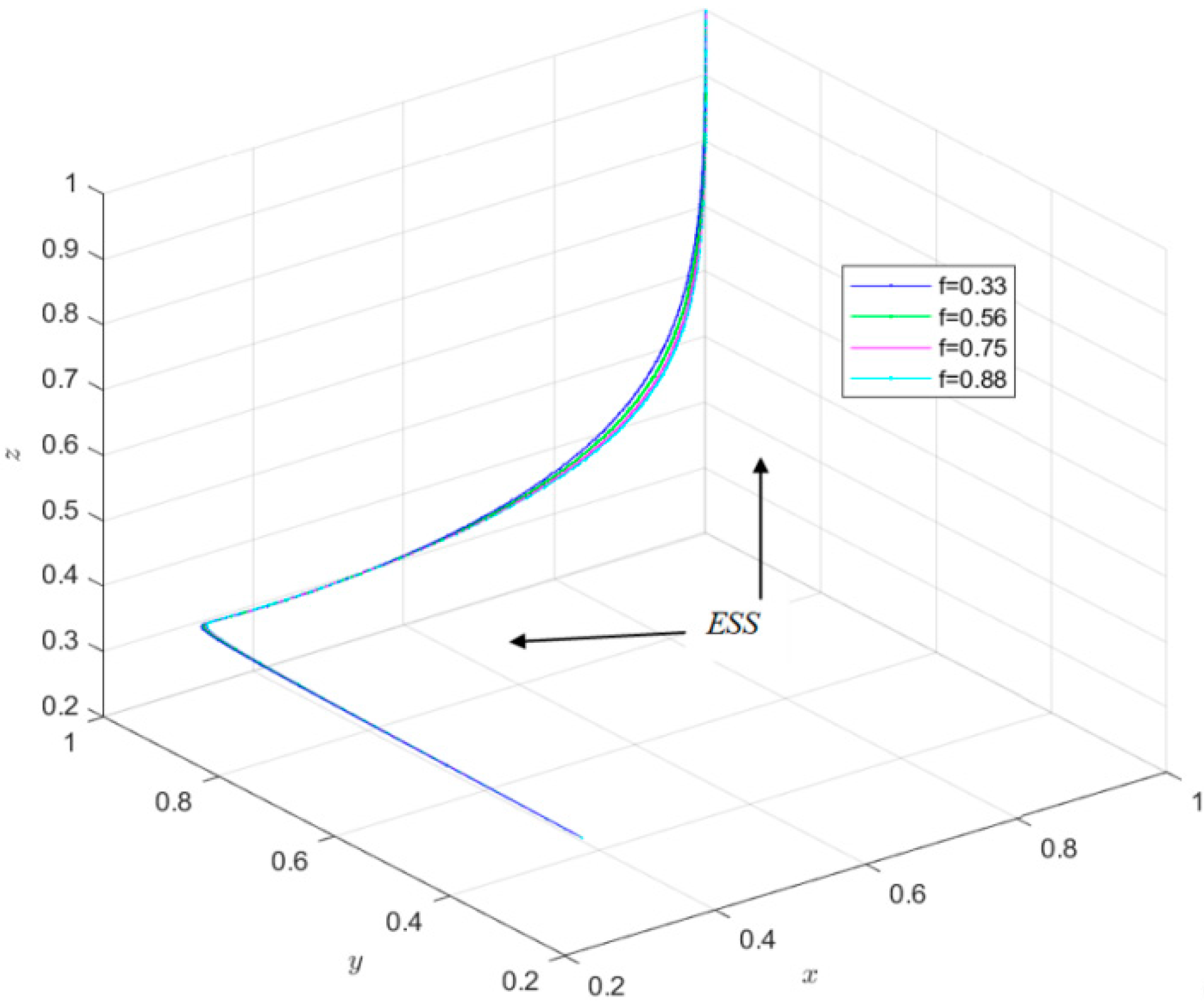
Setting the farmers’ herding coefficient ƒ to values of 0.33, 0.56, 0.75, and 0.88, the simulation results are shown in Figure 8, displaying an overall upward trend. This indicates that as the farmers’ herding coefficient ƒ increases, the probability of the government choosing collaborative governance gradually rises, and the system shows a tendency to evolve towards a more stable state. This implies that the greater the extent to which farmers are influenced by the behavior of other farmers, the more likely it is to prompt the government to adopt a collaborative governance strategy, thereby driving the system in a positive direction.

5.5. Impact of Farmers’ Spillover Benefit Coefficient on System Evolution Outcomes

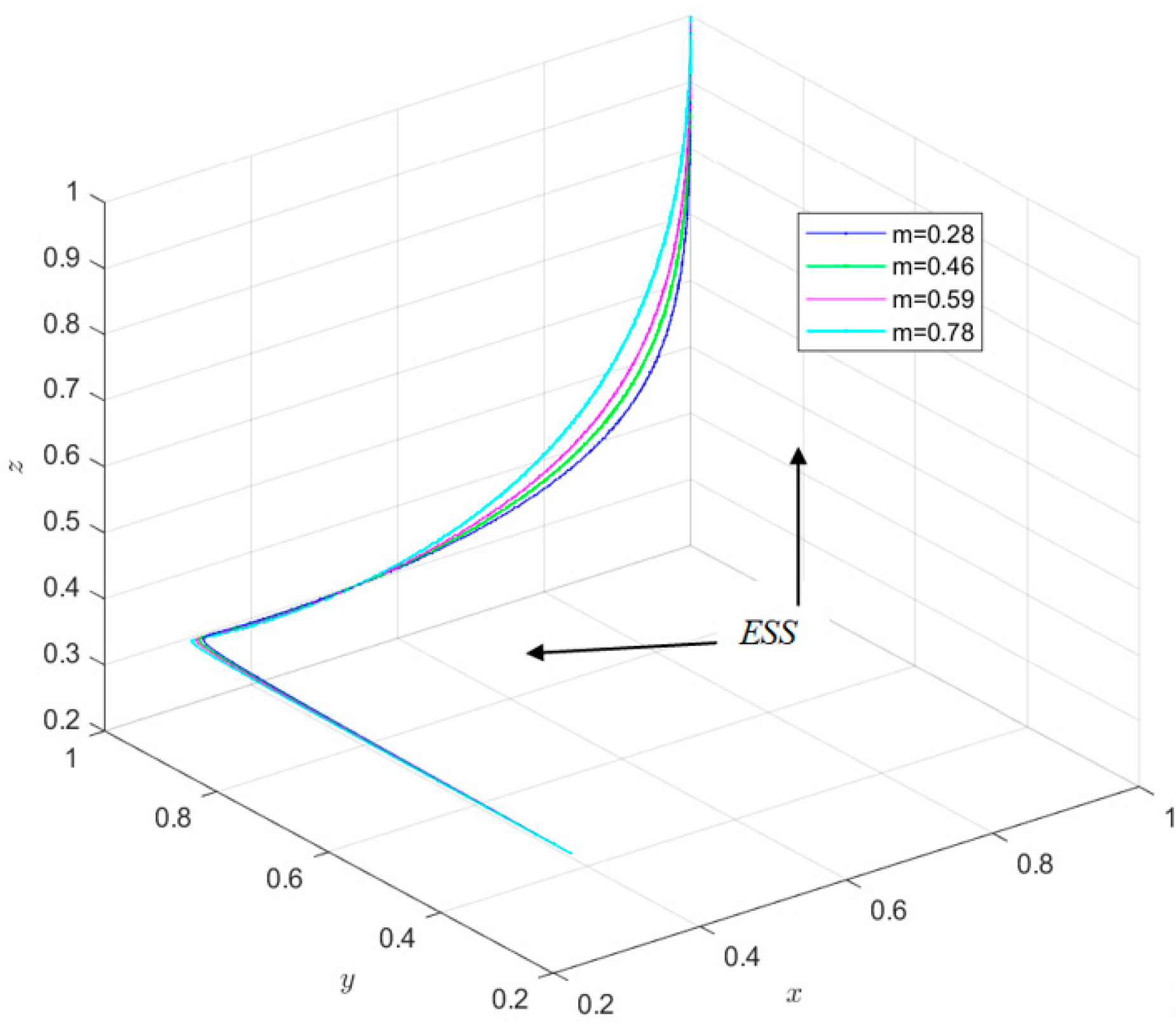
Setting the farmers’ spillover benefit coefficient m to values of 0.28, 0.46, 0.59, and 0.78, the simulation results are shown in Figure 9. Overall, the evolutionary trends of all curves are similar, exhibiting an upward trajectory. This indicates that regardless of the specific value, the system evolves towards a state where the probability of the government adopting collaborative governance increases. Furthermore, a higher value of m corresponds to a relatively more pronounced upward curve. This suggests that an increase in the spillover benefit coefficient accelerates the system’s evolution toward a state where the government exhibits a stronger inclination for collaborative governance and all parties tend more towards proactive cooperative strategies, thereby pushing the system to reach the ideal stable state more quickly.
This phenomenon can be interpreted as follows: a higher spillover coefficient implies that farmers can obtain greater potential benefits from speculative behavior, which might superficially appear to encourage such actions. However, within the game-theoretic system, strategic adjustments by the other entities (the e-commerce enterprise and the government) impose constraints on the farmers. The mechanisms of collaborative governance and cost-sharing can effectively curb low-quality production, ensuring the stable improvement of supply chain quality. When farmers perceive that the other two parties are more inclined towards proactive strategies, they will also opt for high-quality production to secure their own long-term interests. This reflects the mutual influence and checks-and-balances among the strategies of all parties in the game. Changes in the spillover coefficient trigger a chain reaction, incentivizing all three parties to move in the direction of active cooperation, creating a synergistic effect that ultimately leads to a stable state conducive to enhancing the quality and safety of agricultural products.

5.6. Impact of the Government’s Detection Rate of Low-Quality Production by Farmers on Evolution Outcomes

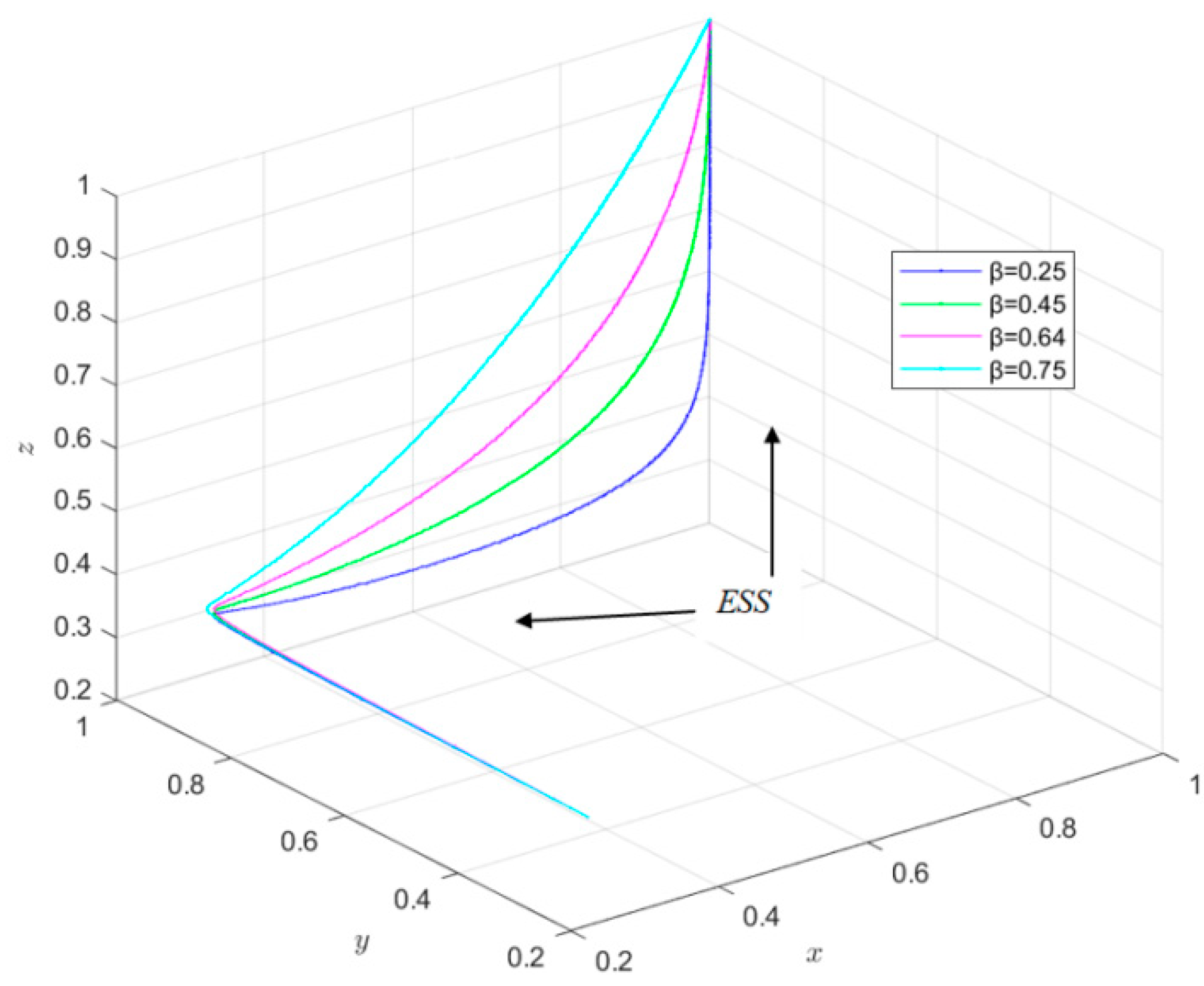
Setting the government’s detection rate of low-quality production by farmers, β, to values of 0.25, 0.45, 0.64, and 0.75, the simulation results are shown in Figure 10. Overall, the curves exhibit an upward trend. This indicates that as the value of β increases—meaning the government’s detection rate of low-quality production by farmers improves—the probability of the government choosing collaborative governance gradually rises. Simultaneously, the system shows a tendency to evolve towards an evolutionary stable strategy, suggesting that strengthening regulatory efforts drives the system toward a more stable state with more active cooperation among all parties.
When the probability of the e-commerce enterprise adopting ex-ante cost-sharing measures increases, the government’s strategic choice shifts accordingly. A turning point occurs when the probability of the e-commerce enterprise’s strategy choice reaches 1. At this point, farmers begin to adjust their strategies, with the probability of opting for high-quality production gradually increasing, and the evolutionary rate of β also accelerates. This is because, as the liability cost decreases, the net benefit of low-quality production rises relatively, which may incentivize more farmers to choose low-quality production initially. This persists until the government’s detection rate reaches a new equilibrium and the e-commerce enterprise implements ex-ante cost-sharing measures, leading to rapid strategic adjustments at certain points and thus forming the observed turning point.

6. Discussion

6.1. Implications for Theory

Positive interaction and collaboration among farmers, agricultural product e-commerce enterprises, and the government contribute to improving the quality and safety of agricultural products. Factors such as the biological characteristics of agricultural products, information asymmetry, and technological constraints introduce certain risks to farmers’ production practices. In response to this phenomenon, agricultural product e-commerce enterprises can formulate quality incentive measures to enhance farmers’ production motivation, thereby achieving mutual benefits for both parties. The means and intensity of government regulation, the efficiency of supervision, and the associated regulatory costs can help maintain stability for both farmers and e-commerce enterprises. Therefore, this study constructs an evolutionary game model involving three parties: farmers, agricultural product e-commerce enterprises, and the government. Using evolutionary game theory, it explores how the different behavioral choices of these three parties within a supply chain environment dominated by agricultural product e-commerce enterprises, from the perspective of product liability, drive the evolutionary game model toward a stable equilibrium. Based on the above model analysis, this study derives the following theoretical insights:
In terms of collaborative governance, the research finds that the government can guide agricultural product e-commerce enterprises to transform quality responsibilities into effective incentives for farmers by establishing reward and penalty mechanisms. This reveals that collaborative governance in the agricultural product supply chain is not a static arrangement but a dynamic process that evolves with adjustments in policy parameters [27].
In terms of supply chain incentives, the model indicates that the quality cost-sharing strategies of agricultural product e-commerce enterprises are directly influenced by government regulation. Under clearly defined product liability constraints, enterprises must weigh liability risks against investments in quality incentives, thereby transforming external pressures into internal drivers for quality governance within the agricultural product supply chain. This expands traditional supply chain incentive theories [28].
In terms of behavioral aspects, by incorporating factors such as farmers’ bounded rationality and herd mentality, the study finds that group behavior and psychological pressure can enhance the effectiveness of formal quality incentive strategies [19]. This suggests that in agricultural product supply chains dominated by e-commerce enterprises, quality incentive measures must integrate behavioral insights with liability constraints, forming a governance mechanism that combines “hard rules” with “soft influence.”

6.2. Implications for Practice and Policy

Based on the aforementioned evolutionary game analysis, this study proposes the following managerial implications to promote the high-quality and synergistic development of the agricultural product e-commerce supply chain.
Based on the aforementioned evolutionary game analysis, this study proposes the following managerial implications to promote the high-quality collaborative development of the agricultural product e-commerce supply chain. The model evolution reveals that the government’s collaborative governance holds a cost advantage, the quality incentives from agricultural product e-commerce enterprises can be effectively transmitted, and farmers’ accountability costs are key to their behavior. The goal is to drive the government, agricultural product e-commerce enterprises, and farmers to form a synergistic force for quality improvement through mechanism linkage.
For the government, the key to better regulating agricultural product quality lies in a role transition: from a direct regulator to a “rule-maker” and “enterprise enabler.” Specifically, first, the government should take the lead in establishing a composite incentive system, integrating economic incentives such as fiscal subsidies and credit preferences with constraining measures like a “production area blacklist” and market access restrictions. This precisely adjusts farmers’ “accountability costs” and expected returns. Second, it is necessary to invest in building digital public infrastructure, such as a unified traceability platform and standardized data interfaces, significantly reducing compliance and traceability costs across the entire chain, thereby better manifesting the “cost advantage of collaborative governance.” Finally, the government can authorize and utilize the real-time transaction and evaluation data from agricultural product e-commerce enterprises to construct a dynamic quality risk map. This shifts the regulatory model from static spot checks to big data-based real-time warning and precise intervention, achieving “dynamic policy adjustment”.
For agricultural product e-commerce enterprises, the core is to transform external quality pressure into internal supply chain management capabilities and brand assets. These enterprises can design and implement market-oriented, in-depth incentive contracts. For example, packaging “quality premium payments,” “order guarantees,” and “technical agricultural input support” for contracted farmers directly shares the initial costs of their high-quality production, thereby securing a supply of superior products. Furthermore, they can actively act as “governance partners,” proactively adopting and promoting high-quality group standards developed in collaboration with the government, internalizing them as platform access rules, and extending management upstream. By fully leveraging their technological advantages, they can develop lightweight production management tools for farmers and selectively share key process data with the government’s traceability platform, becoming a “digital outpost” for regulation and jointly building a risk firewall.
Finally, under the dual governance of the government and agricultural product e-commerce enterprises, a sustainable, positive governance cycle is formed: the government’s scientific rules and public services lower the institutional costs for platforms and farmers to participate in high-quality production; the platforms’ market-oriented incentives and management investments amplify policy effectiveness and drive production transformation; and the steady improvement in farmer quality, in turn, continuously strengthens consumer trust and market foundations.

6.3. Limitations and Future Research Directions

It should be noted that this study has several limitations. For instance, the data collection and parameter assignments in the model primarily rely on literature estimates or surveys, which involve a degree of subjectivity and may introduce bias. Regarding model assumptions, the strategy space for each party is simplified to a limited set of options, overlooking the prevalence of mixed strategies and gradual adjustment strategies in reality. Furthermore, the study operates under the assumption that government policies can be perfectly implemented. However, real-world friction—such as enforcement costs and local protectionism—can significantly diminish policy effectiveness, a nuance not fully captured by the idealized assumptions of this model.
Future research could be extended in the following directions. First, while this paper focuses on the impact of ex-ante quality cost-sharing measures, subsequent work could investigate other incentive mechanisms, such as ex-post revenue-sharing contracts. Second, this study centers on the tripartite game equilibrium among farmers, e-commerce enterprises, and the government. Future models could incorporate traceability technologies like blockchain to examine how ensuring precise accountability enhances supply chain transparency and management efficacy. Finally, our model primarily considers the direct influence of e-commerce enterprises on quality levels. In practice, however, agricultural product quality is co-determined by multiple stages, including production, processing, and distribution. Future research could develop models from the perspective of coordinated quality decisions among multiple enterprises across the supply chain to more comprehensively reveal the dynamics of quality formation.

7. Conclusions

This study systematically analyzes the strategic evolution patterns and influencing factors among farmers, agricultural product e-commerce enterprises, and the government by constructing a tripartite evolutionary game model. The findings reveal that when farmers opt for high-quality production, and enterprises adopt ex-ante quality cost-sharing measures, the government tends to favor a collaborative governance strategy. Conversely, a decrease in farmers’ willingness for high-quality production or the government’s inclination for collaborative governance diminishes the enterprise’s motivation to implement quality incentives.
The quality incentive measures adopted by agricultural product e-commerce enterprises directly influence farmers’ production decisions. The implementation of these incentives increases the liability cost for farmers, thereby driving them to improve quality to avoid risks and penalties, while simultaneously helping enterprises reduce their overall liability and cost burden. However, when the liability cost borne by farmers for low-quality production falls below the quality cost shared by the enterprise, the latter often lacks the motivation to implement incentives due to insufficient marginal benefits from the quality investment.
Within the government’s collaborative governance framework, enterprises comprehensively weigh quality costs, strategic value, and opportunity costs to decide whether to adopt quality incentives. If the opportunity cost exceeds the sum of the shared cost and strategic value, enterprises tend to implement the incentives. The research further indicates that government collaborative governance holds a cost advantage over strict regulation and can yield superior public benefits under comparable penalty levels, thus demonstrating greater policy sustainability. By promoting quality measures through collaborative governance, the government indirectly encourages farmers to bear higher liability costs and shift towards high-quality production, ultimately facilitating a comprehensive quality transformation of the entire supply chain.

Author Contributions

Conceptualization, J.Z.; methodology, J.Z.; writing—original draft preparation, H.L.; writing—review and editing, J.Z. and H.L.; visualization, H.L.; supervision, J.Z. All authors have read and agreed to the published version of the manuscript.

Funding

This research received no external funding.

Institutional Review Board Statement

Not applicable.

Informed Consent Statement

Not applicable.

Data Availability Statement

The original contributions presented in this study are included in the article. Further inquiries can be directed to the corresponding author.

Conflicts of Interest

The authors declare no conflicts of interest.

References

  1. Qi, T.; Sun, R.; Guo, C. The Operation Mechanism of Agricultural Products Supply Chain and Profit Allocation Model in the Context of Asymmetric Information. Agric. Sci. Technol. 2016, 17, 197–200+233. [Google Scholar]
  2. Chen, Y.; Hua, X. Ex Ante Investment, Ex Post Remedies, and Product Liability. Int. Econ. Rev. 2012, 53, 845–866. [Google Scholar] [CrossRef]
  3. Fan, J.; Ni, D.; Tang, X. Product quality choice in two-echelon supply chains under post-saleliability: Insights from wholesale price contracts. Int. J. Prod. Res. 2017, 55, 2556–2574. [Google Scholar] [CrossRef]
  4. Cachon, G.P. Supply Chain Coordination with Contracts. In Handbooks in Operations Research and Management Science; Elsevier: Amsterdam, The Netherlands, 2003; Volume 11. [Google Scholar] [CrossRef]
  5. Antle, J.M.; Capalbo, S.M. Econometric-Process Models for Integrated Assessment of Agricultural Production Systems. Am. J. Agric. Econ. 2001, 83, 389–401. [Google Scholar] [CrossRef]
  6. Fecke, W.; Danne, M.; Musshoff, O. E-commerce in agriculture—The case of crop protection product purchases in a discrete choice Experiment. Comput. Electron. Agric. 2018, 151, 126–135. [Google Scholar] [CrossRef]
  7. Weiss, J.A. Review of Reinventing Government: How the Entrepreneurial Spirit is Transforming the Public Sector. Acad. Manag. Rev. 1995, 20, 229–235. [Google Scholar] [CrossRef]
  8. Williamson, O.E. The Economic Institutions of Capitalism: Firms, Markets, Relational Contracting; Free Press: New York, NY, USA, 1985. [Google Scholar] [CrossRef]
  9. Sheu, J.B.; Chen, Y.J. Impact of government financial intervention on competition among green supply Chains. Int. J. Prod. Econ. 2012, 138, 201–213. [Google Scholar] [CrossRef]
  10. Park, S.; Yuan, Z.; Zhang, H. Technology training, buyer-supplier relationship, and quality upgrading in an agricultural supply chain. Rev. Econ. Stat. 2025, 107, 711–727. [Google Scholar] [CrossRef]
  11. Feng, L.D.; Gu, M.D. Product Innovation Strategy Based on Quality Heterogeneous Preference and Green Incentive Policies. Enterp. Econ. 2020, 2, 40–50. [Google Scholar] [CrossRef]
  12. Yoo, S.; Choi, T.; Kim, D. Multitier Incentive Strategies for Quality Improvement: Case of Three Tier Supply Chain. Decis. Sci. 2021, 52, 1137–1168. [Google Scholar] [CrossRef]
  13. Li, B.Y.; Ma, D.Q.; Dai, G.X.; Hu, J.S. Dynamic Quality Improvement Strategy of “Connecting Agriculture with Supermarkets” Supply Chain Considering Reference Quality Effect. Oper. Res. Manag. Sci. 2021, 30, 52–59. [Google Scholar] [CrossRef]
  14. Yang, D.; Xiao, T. Pricing and green level decisions of a green supply chain with governmental interventions under fuzzy Uncertainties. J. Clean. Prod. 2017, 149, 1174–1187. [Google Scholar] [CrossRef]
  15. Chen, H.; Feng, Q.; Cao, J. Rent-seeking mechanism for safety supervision in the Chinese coal industry based on a tripartite game model. Energy Policy 2014, 72, 140–145. [Google Scholar] [CrossRef]
  16. Li, X.; Qiao, L.; Zhao, T.; Kou, C. Exploring Sustainable Agricultural Supply Chain Financing: Risk Sharing in Three-Party Game Theory. Sustainability 2025, 17, 10003. [Google Scholar] [CrossRef]
  17. Liu, X.L.; Fu, J.Y.; Chen, K.L. Analysis on the Cooperative Behavior of Participants in E-commerce of Agricultural Products—Based on Traceability of Agricultural Products Quality and Safety. Mod. Manag. 2023, 43, 159–166. [Google Scholar] [CrossRef]
  18. Yang, H.J. Research on the Operational Mechanism of Agricultural Product Supply Chain Models from the Perspective of Information Asymmetry. J. Commer. Econ. 2016, 158–160. [CrossRef]
  19. Papanastasiou, Y.; Savva, N. Dynamic pricing in the presence of social learning and strategic consumers. Manag. Sci. 2017, 63, 919–939. [Google Scholar] [CrossRef]
  20. Zhu, Q.; Li, X.; Zhao, S. Cost sharing models for green product production and marketing in a food supply chain. Ind. Manag. Data Syst. 2018, 118, 654–682. [Google Scholar] [CrossRef]
  21. Zhu, Q.; Dou, Y. An Evolutionary Model between Governments and Core-enterprises in Green Supply Chains. Syst. Eng. Theory Pract. 2007, 27, 85–89. [Google Scholar] [CrossRef]
  22. Tao, X. A Study on the Evolutionary Game of the Four-Party Agricultural Product Supply Chain Based on Collaborative Governance and Sustainability. Sustainability 2025, 17, 1762. [Google Scholar] [CrossRef]
  23. Su, X.; Liu, H.L. Simulation Study on the Evolutionary Game of Agricultural Product Quality and Safety Under Farmer-Enterprise Cooperation. J. Agrotech. Econ. 2015, 11. [Google Scholar] [CrossRef]
  24. Fan, J.C.; Wan, N.N.; Li, Y.H.; Ni, D.B. Quality Incentive Strategies in Supply Chains Based on Product Liability Under Different Power Structure. J. Syst. Manag. 2023, 32, 438–462. [Google Scholar]
  25. Friedman, D.; Fung, M.K.Y. Evolutionary Games in Economics. Econometrica 1991, 59, 637–666. [Google Scholar] [CrossRef]
  26. Weibull, J.W. Evolutionary Game Theory; MIT Press: Cambridge, UK, 1995. [Google Scholar]
  27. Freeman, J. Collaborative governance in the administrative state. UCLA Law Rev. 1997, 45, 1–98. [Google Scholar]
  28. Corbett, C.J.; DeCroix, G.A. Shared-savings contracts for indirect materials in supply chains: Channel profits and environmental impacts. Manag. Sci. 2001, 47, 881–893. [Google Scholar] [CrossRef]
Figure 1. Tripartite game strategy.
Logistics 10 00046 g001
Figure 2. Farmer-strategy evolution phase diagram.
Logistics 10 00046 g002
Figure 3. Agricultural product e-commerce enterprise strategy evolution phase diagram.
Logistics 10 00046 g003
Figure 4. Government strategy evolution phase diagram.
Logistics 10 00046 g004
Figure 5. System evolution path.
Logistics 10 00046 g005
Figure 6. Impact of γ variation on system evolution results.
Logistics 10 00046 g006
Figure 7. Impact of α variation on system evolution results.
Logistics 10 00046 g007
Figure 8. Impact of f variation on system evolution results.
Logistics 10 00046 g008
Figure 9. Impact of m variation on system evolution results.
Logistics 10 00046 g009
Figure 10. Impact of β variation on system evolution results.
Logistics 10 00046 g010
Table 1. Model symbols and meanings.
SymbolMeaningSymbolMeaning
xProbability of farmers producing high-qualityPS, PCPenalty imposed by the government on farmers for low-quality production
yProbability of e-commerce enterprises adopting quality incentivesHBonus given by e-commerce enterprises to farmers for high-quality production
zProbability of government adopting collaborative governancePFPenalty paid by farmers to e-commerce enterprises for low-quality production
CH, CLCost of high-quality production and low-quality production by farmersVBrand and market strategic value obtained by e-commerce enterprises
REH, RELRevenue from high-quality production and low-quality production by farmersCFOpportunity cost incurred by e-commerce enterprises
ME, MGMarginal benefit obtained by e-commerce enterprises and governmentRCPublic benefit under government collaborative governance
CPPsychological pressure on farmersmSpillover coefficient of farmers
RERevenue obtained by e-commerce enterprises from selling agricultural productsƒHerding coefficient of farmers
LLiability costγProportion of quality cost borne by e-commerce enterprises
FNReputational loss of farmersαProportion of liability cost shared by e-commerce enterprises
CS, CCCost incurred by the government under strict supervision, collaborative governanceβProbability of the government detecting low-quality production by farmers during supervision
Table 2. Tripartite payoff matrix.
StrategyGovernment
Collaborative Governance (z)Strict Supervision (1 − z)
Farmershigh-quality production (x)enterprisesimplementing quality incentives (y)RFH + H − (1 − γ)CH;
RE + ME + V − γCH − H;
RC + MG − CC
RFH − (1 − γ)CH;
RE + ME − γCH;
MG − CS
NOT implementing quality incentives (1 − y)RFH + H − CH;
RE + ME − H − CF;
MG − CC
RFH − CH;
RE + ME;
MG − CS
low-quality production (1 − x)enterprisesimplementing quality incentives (y)(1 + m)RFL − (1 − γ)CL − ƒCP − FN − βPC − PF − (1 − α)L;
RE + PF − γCL − αL;
βPC − CC
(1 + m)RFL − (1 − γ)CL − ƒCP − FN − βPS − (1 − α)L;
RE − γCL − αL;
βPS − CS
NOT implementing quality incentives (1 − y)(1 + m)RFL − CL − ƒCP − FN − βPC − PF;
RE + PF − L;
βPC − CC
(1 + m)RFL − CL − ƒCP − FN − βPS;
RE − L;
βPS − CS
Note: The payoffs for farmers, agricultural product e-commerce enterprises, and the government are listed from top to bottom, respectively.
Table 3. Eigenvalues of equilibrium points.
Equilibrium Pointsλ1λ2λ3
E1 (0,0,0)RFH − (1 + m) × RFL + CL − CH + fCP + FN + PS × β(1 − α) × L − CL × γCS − CC + β × (PC − PS) > 0
E2 (1,0,0)−[RFH − (1 + m) × RFL + CL − CH + fCP + FN + PS × β]−CH × γCS − CC > 0
E3 (0,1,0)RFH − (1 + m) × RFL + (1 − γ) × CL–(1 − γ) × CH + fCP + FN + PS × β + (1 − α) × L−(1 − α) × L + CL × γCS − CC + β × (PC − PS) > 0
E4 (0,0,1)RFH − (1 + m) × RFL + CL − CH + fCP + FN + H + PF + PC × β(1 − α) × L − CL × γCC − CS − β × (PC − PS) < 0
E5 (1,1,0)−[RFH − (1 + m) × RFL + (1 − γ) × CL–(1 − γ) × CH + fCP + FN + PS × β + (1 − α) × L]CH × γ > 0CS − CC + RC > 0
E6 (1,0,1)−[RFH − (1 + m) × RFL + CL − CH + fCP + FN + β × PC + H + PF]CF + V − CH × γCC − CS < 0
E7 (0,1,1)RFH − (1 + m) × RFL + (1 − γ) × CL–(1 − γ) × CH + fCP + FN + (1 − α) × L + β × PC + H + PF−(1 − α) × L + CL × γCC − CS − β × (PC − PS) < 0
E8 (1,1,1)−[RFH − (1 + m) × RFL + (1 − γ) × CL–(1 − γ) × CH + fCP + FN + (1 − α) × L + β × PC + H + PF]CH × γ − V − CFCC − CS − RC < 0
Table 4. Parameters and their initial values.
ParametersInitial ValuesParametersInitial ValuesParametersInitial Values
CH150L75V70
CL120FN80CF75
RFH220CS110RC100
RFL200CC90γ0.4
ME50PS130ƒ0.6
MG60PC100α0.55
CP80H80β0.4
RE200PF80m0.3
Disclaimer/Publisher’s Note: The statements, opinions and data contained in all publications are solely those of the individual author(s) and contributor(s) and not of MDPI and/or the editor(s). MDPI and/or the editor(s) disclaim responsibility for any injury to people or property resulting from any ideas, methods, instructions or products referred to in the content.