1. Introduction
Helicopter air ambulance (HAA) systems constitute a vital component of emergency medical logistics, where rapid aerial transport capability often determines the difference between life and death. Timely response—defined here as the interval from dispatch notification to helicopter arrival at the patient location—is a decisive factor in patient survival, particularly in trauma and cardiac emergencies, where the probability of mortality increases sharply with every minute of delay [
1,
2]. Despite their critical role, HAA operations remain highly sensitive to multiple stochastic factors that collectively influence the time-to-care outcome. However, much of the existing HAA literature evaluates performance using mean response times or single-point estimates, which obscure variability and underestimate the probability of extreme delays, highlighting the importance of probabilistic modeling.
Weather variability, airspace congestion, patient location, and on-scene requirements interact dynamically to determine overall system responsiveness [
3,
4]. Adverse weather can reduce visibility and impose flight restrictions [
5], while congested air corridors, especially near dense urban zones, generate holding delays and limit safe approach paths [
6]. Spatial heterogeneity further amplifies operational complexity. Missions originating in rural catchments often require longer travel distances and present more constrained landing environments [
7]. In contrast, urban missions may benefit from proximity but face delays caused by competing airspace users and regulatory separation standards. Additionally, patient stabilization time at the scene introduces another uncertain interval before transfer [
8,
9]. Collectively, these factors produce stochastic fluctuations in total response time, suggesting that deterministic averages alone fail to represent true system behavior.
While environmental factors are largely uncontrollable, operational readiness and procedural efficiency are among the few controllable elements in this system. Specifically, while environmental conditions such as weather, airspace congestion, and patient location are largely uncontrollable, managerial decisions regarding base readiness, standby posture, and training constitute actionable levers for improving response-time reliability. Ground-standby configurations, where crews are positioned adjacent to the helicopter, reduce activation delays, while airborne standby allows for near-instantaneous dispatch, albeit with higher operational costs [
2,
10]. Understanding the trade-offs among these configurations requires not only a descriptive assessment but also a quantitative model capable of representing their probabilistic dependencies and interactions under varied traffic and weather conditions [
11]. This trade-off is central to stochastic reliability because readiness policies primarily influence the variability and tail behavior of response times—reducing the likelihood of extreme delays—rather than merely shifting the mean.
Monte Carlo simulation provides such a methodological foundation by enabling repeated random sampling across distributions of uncertain parameters, thereby approximating realistic traffic and operational dynamics. When applied to HAA missions, this approach extends traditional traffic flow theory to the airspace domain, treating each mission as a stochastic flow entity influenced by congestion, route conflicts, and network constraints. In this sense, HAA operations can be conceptualized as an aerial analog to surface emergency traffic, governed by similar queuing principles, bottlenecks, and capacity constraints.
The growing interest in advanced air mobility (AAM) and UAS Traffic Management (UTM) further amplifies the significance of this research. As future low-altitude traffic systems become increasingly congested with autonomous and crewed aircraft sharing limited airspace, understanding the probabilistic dynamics of emergency air operations will be essential for maintaining both safety and efficiency.
The purpose of this research is to apply Monte Carlo simulation to quantify the impact of both controllable and uncontrollable factors on HAA response-time reliability and to identify operational strategies that minimize delays and variability under uncertainty. Specifically, the study addresses the following research questions:
RQ1. How do base readiness postures, operational protocols, and environmental variability collectively influence the probability distribution of HAA response times?
RQ2. What operational strategies most effectively reduce “tail risk” (extreme delays) and improve reliability in stochastic operating environments?
This study contributes to the broader field of traffic management and flow optimization by extending traffic theory to emergency medical air operations. Practically, the findings provide EMS and aviation planners with data-driven tools to optimize standby strategies, mitigate delay risks, and enhance the overall resilience of emergency response networks.
The remainder of this paper is organized as follows:
Section 2 synthesizes current HAA logistics and identifies gaps in stochastic modeling.
Section 3 details the methodology, including the mathematical distributions used to operationalize environmental friction.
Section 4 presents the results across ten simulation scenarios.
Section 5 discusses the logistics trade-offs of standby protocols, and
Section 6 concludes with policy recommendations.
3. Methodology
3.1. Method Selection and Justification
This study employs a quantitative method using Monte Carlo simulation. Monte Carlo simulation is a powerful technique for understanding the impact of risk and uncertainty in prediction and forecasting models [
17]. It facilitates the exploration of various scenarios by simulating numerous possible outcomes based on random variables [
18]. The choice of Monte Carlo simulation is justified due to its ability to handle complex requirements with multiple uncertainties, providing robust solutions that account for variability in operational scenarios [
11].
This method is particularly effective in handling uncertainty and variability, making it ideal for modeling HEMS operations, which are subject to numerous unpredictable factors. It allows researchers to generate many possible outcomes based on the input variables, providing a comprehensive view of potential scenarios and their impacts on response times. This approach enables the identification of optimal strategies to minimize delays and improve operational efficiency [
17,
18]. Integrating these theoretical foundations strengthens the rationale for using Monte Carlo simulation, highlighting its robustness and applicability to complex, variable systems like helicopter air ambulance operations.
Various models, including deterministic and stochastic, have been employed to study and improve response times in emergency medical services. Deterministic models, characterized by using fixed, predetermined variable values, provide clear system analyses and are beneficial in scenarios with minimal variability. However, they fall short in dynamic environments where variability is critical [
19]. In contrast, stochastic models capture the complexity and variability inherent in real-world systems by incorporating randomness and probabilistic elements.
Prior simulation-based studies in emergency medical services have employed a range of modeling approaches, including queueing-based EMS models, deterministic travel-time optimization, and discrete-event simulation frameworks. Queueing and deterministic models have been effective for estimating average system performance and resource utilization, but typically rely on steady-state assumptions and fixed travel times that limit their ability to capture response-time variability and extreme delays. Discrete-event simulation has been applied to EMS planning to represent event sequencing and resource contention; however, its application to helicopter emergency medical services has been comparatively limited and often focused on nominal performance rather than reliability outcomes. The present study builds on this body of work by using Monte Carlo simulation to explicitly model uncertainty across all mission phases and to evaluate response-time reliability and tail-risk behavior, rather than mean performance alone.
Addressing these research gaps involves developing advanced simulation models that integrate multiple influencing factors, evaluating the effectiveness of various operational interventions, determining the focus for resource allocation, and incorporating stochastic elements to better represent real-world uncertainties. By filling these gaps, this study aims to provide a more comprehensive understanding of optimizing HAA services, ultimately leading to improved patient outcomes and more efficient resource use.
3.2. Model Parametrization: Controllable and Probabilistic Inputs
To accurately simulate the HAA mission profile, the model incorporates both controllable inputs (decision variables) and probabilistic inputs (random variables). The selection of these variables and their distributions is grounded in operations research literature and HAA operational characteristics.
3.2.1. Controllable Inputs
Base Response Time (BRT). Base Response Time (BRT) represents the interval between call receipt and helicopter liftoff and is a primary determinant of overall response-time performance in helicopter emergency medical services. This interval reflects crew readiness, aircraft preflight procedures, dispatch coordination, and organizational protocols. Empirical studies have demonstrated substantial variability in activation times across systems and operating contexts; for example, Tomazin et al. [
10] reported activation times ranging from 2.9 to 17 min across different European HEMS programs. In operational practice, industry benchmarks commonly target approximately 10 min for daytime operations and up to 20 min for night operations, reflecting additional safety checks, reduced visibility, and crew duty considerations [
14]. In the present model, BRT serves as a key controllable parameter through which organizational readiness and procedural efficiency are represented.
Response Protocol Adjustments (RPA). Response protocol adjustments represent strategic operational choices regarding crew positioning and readiness posture. Two primary configurations were modeled. Ground Standby assumes that flight crews are prepositioned at or near the aircraft, enabling rapid mobilization and reducing BRT to approximately 5 min. Airborne Standby represents a more aggressive readiness posture in which the aircraft is already airborne or taxi-ready, allowing near-immediate response and modeled here as a 1 min activation interval [
1,
3]. While airborne standby can substantially reduce response times and mitigate tail-risk delays, it is also associated with increased operational costs and crew workload. Accordingly, RPA is treated as a policy lever for comparative analysis rather than an implicit recommendation.
Training and Efficiency Improvements (TEI). Training and efficiency improvements (TEI) capture the effects of targeted interventions aimed at reducing procedural delays during dispatch and activation. These interventions may include recurrent crew drills, simulator-based training, enhanced dispatch protocols, and the use of decision-support tools such as weather assessment aids. Prior studies suggest that focused training and process refinement can reduce dispatch and takeoff times by several minutes without compromising safety [
1,
5]. In the model, TEI is implemented as a systematic reduction in BRT, representing incremental gains in organizational efficiency rather than structural changes to the operational system.
3.2.2. Probabilistic Inputs
Weather Impact (WI). Weather-related delays were modeled using a Uniform Distribution with a range of 0–10 min. Weather variability is widely recognized as a major source of uncertainty in helicopter air ambulance operations, particularly due to visibility limitations, wind conditions, precipitation, and the need for conservative routing or holding decisions during marginal conditions [
5,
10]. In the absence of consistent, high-resolution historical weather delay data specific to individual HEMS missions, a uniform distribution was used illustratively to represent minor but unpredictable deviations around nominal flight conditions. This approach reflects the assumption that small weather-related disruptions can occur with roughly equal likelihood across a bounded range and allows the model to capture stochastic delay effects without imposing unsupported distributional structure.
Air Traffic Impact (ATI). Air traffic–related delays were modeled using a Triangular Distribution with a minimum of 0 min, a most-likely value (mode) of 2 min, and a maximum of 5 min. This distribution was selected to represent bounded uncertainty in processes where delays are typically modest but occasionally elevated due to air traffic control (ATC) sequencing, temporary airspace restrictions, or congestion near urban corridors [
6,
20]. The triangular form is commonly used in exploratory simulation studies when only minimum, most-likely, and worst-case estimates are available [
6]. Here, it reflects the operational reality that most HEMS flights experience minimal ATC delay, while a smaller subset encounters moderate disruptions due to competing airspace users or flow management constraints.
Flight Time to Location (FTLI). Flight time to the incident location was modeled using a Normal Distribution to capture natural variability in aircraft performance, routing, and operational conditions [
10,
17]. Separate parameterizations were used for urban and rural missions to reflect spatial heterogeneity in service areas. Urban missions were modeled with a mean of 20 min (SD = 5), reflecting shorter distances but potential routing complexity, whereas rural missions were modeled with a mean of 40 min (SD = 5), reflecting longer travel distances and fewer routing alternatives. This distinction aligns with prior HEMS studies showing systematic differences in response profiles between urban and rural environments.
Patient Location Impact (PLI). Patient location impact, representing on-scene access, patient stabilization, and preparation for transport, was modeled using a Triangular Distribution (minimum 5 min, mode 10 min, maximum 20 min). On-scene time is known to vary substantially based on patient condition, terrain accessibility, landing zone characteristics, and coordination with ground responders [
7,
8,
9,
20]. The triangular distribution captures this variability while emphasizing a most-likely stabilization interval, consistent with observational studies of HEMS on-scene operations. As with other probabilistic inputs, this parameterization is intended to reflect plausible variability rather than provide a predictive on-scene time model.
Flight Time to Hospital (FTHI). Flight time from the incident location to the receiving hospital was modeled using a Normal Distribution, analogous to FTLI, to represent variability in routing, weather conditions, and airspace interactions during the transport phase [
2,
12,
17]. This approach assumes that outbound and return legs are subject to similar sources of stochastic variation, while allowing the total transport time to reflect cumulative uncertainty across mission phases.
Alternative positively skewed distributions (e.g., lognormal or gamma) were not selected because the study emphasizes comparative scenario behavior rather than empirical fitting, and available data did not support defensible parameter estimation.
3.3. Population and Sample
The model applies to HAA organizations operating under Part 135 of the FAA regulations within the United States [
21]. The operational parameters were derived to represent a typical single-pilot Bell 407 air ambulance configuration operating in a metropolitan environment similar to Denver, Colorado. This location provides a representative mix of urban density and rural outlying areas. The data for parameter ranges were collected from relevant emergency management literature and historical operational studies [
9,
13].
3.4. Scope and Intended Use of the Model
The model developed in this study is intended as a decision-support and sensitivity-analysis tool rather than a predictive operational simulator. Model inputs are illustrative and are used to compare the relative impacts of alternative operational policies across scenarios. Consequently, results should be interpreted comparatively rather than as forecasts of absolute response times for any specific HEMS provider. Empirical calibration and predictive validation using historical operational data are identified as necessary steps for future work.
3.5. Modeling Process
The modeling process is illustrated in
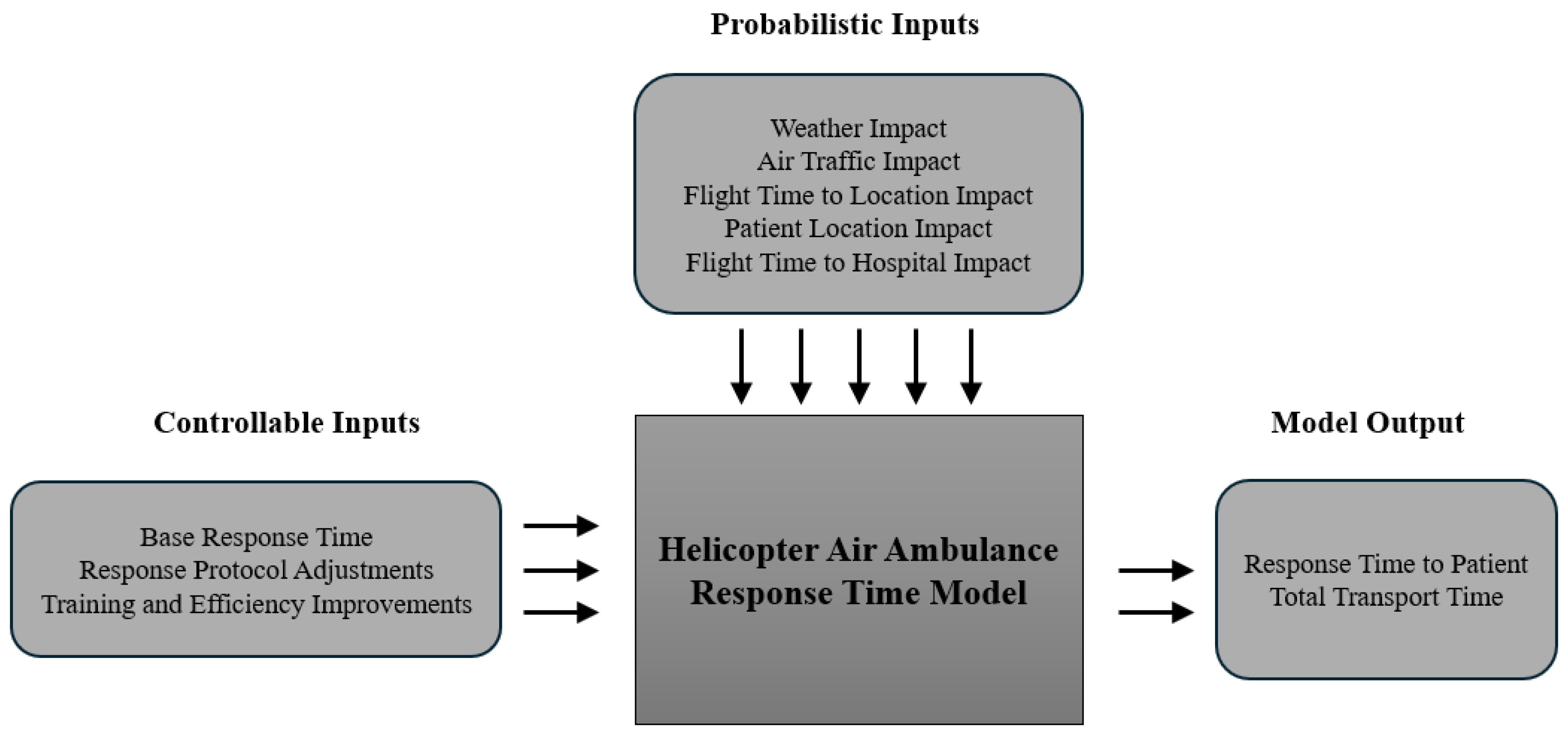
Figure 1 (Conceptual Model). The simulation logic aggregates the controllable inputs (e.g., BRT based on the selected scenario) and samples from the probabilistic distributions for every iteration.
The model calculates these outputs for 1000 iterations per scenario to generate a robust probability distribution.
3.6. Simulation Scenarios and Execution
The model was executed for ten distinct scenarios to test sensitivity to environmental and operational factors:
Day Urban (DU): Baseline standard operations.
Day Urban + TEI (DUTE): Baseline with training improvements.
Night Urban (NU): Baseline night operations.
Night Urban + TEI (NUTE): Night operations with training.
Day Urban Ground Standby (DUGSTBY).
Day Urban Airborne Standby (DUASTBY).
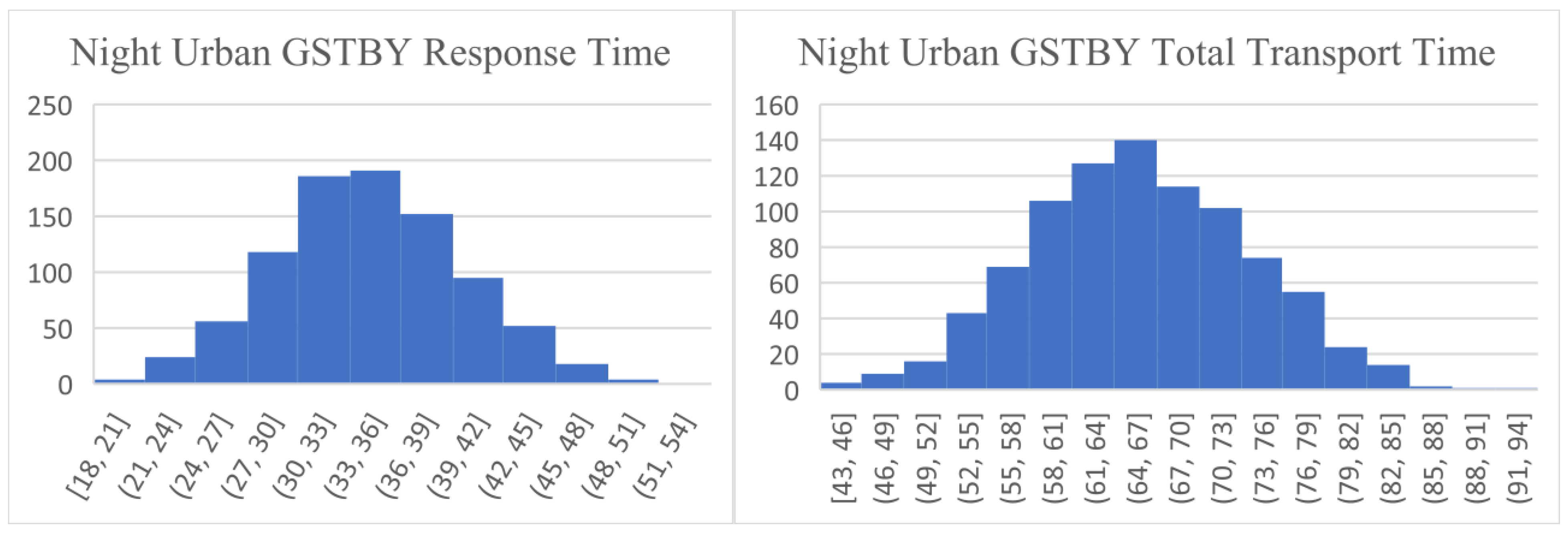
Night Urban Ground Standby (NUGSTBY).
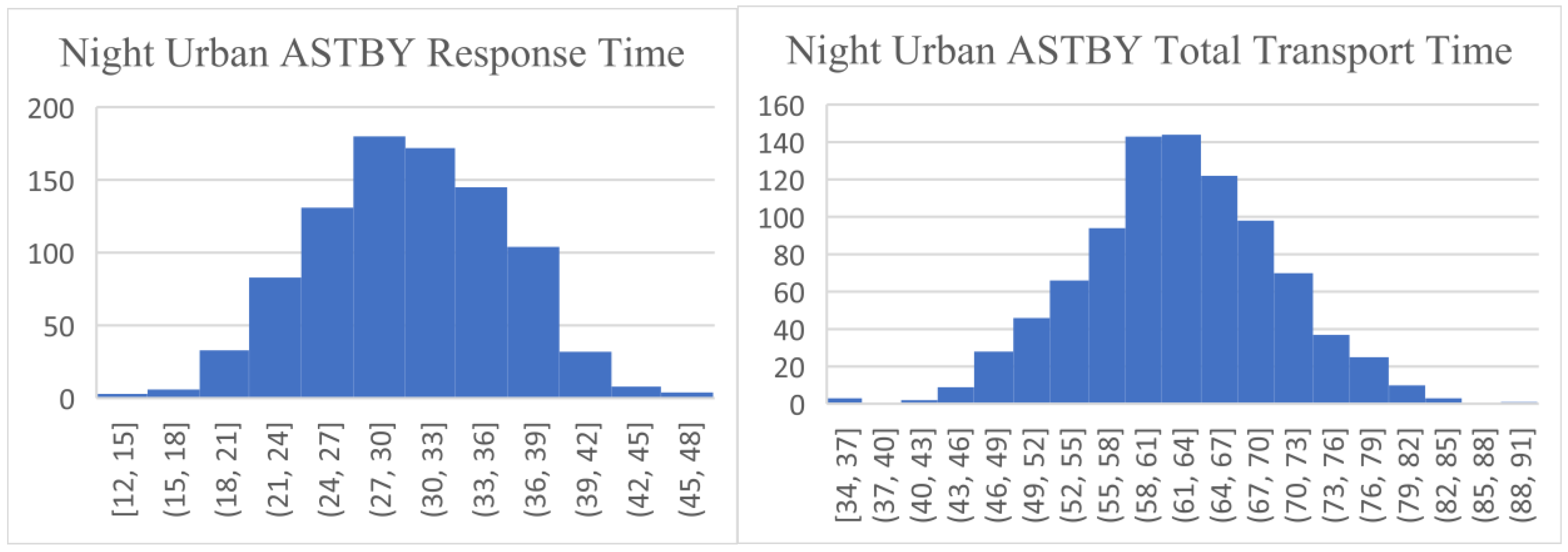
Night Urban Airborne Standby (NUASTBY).
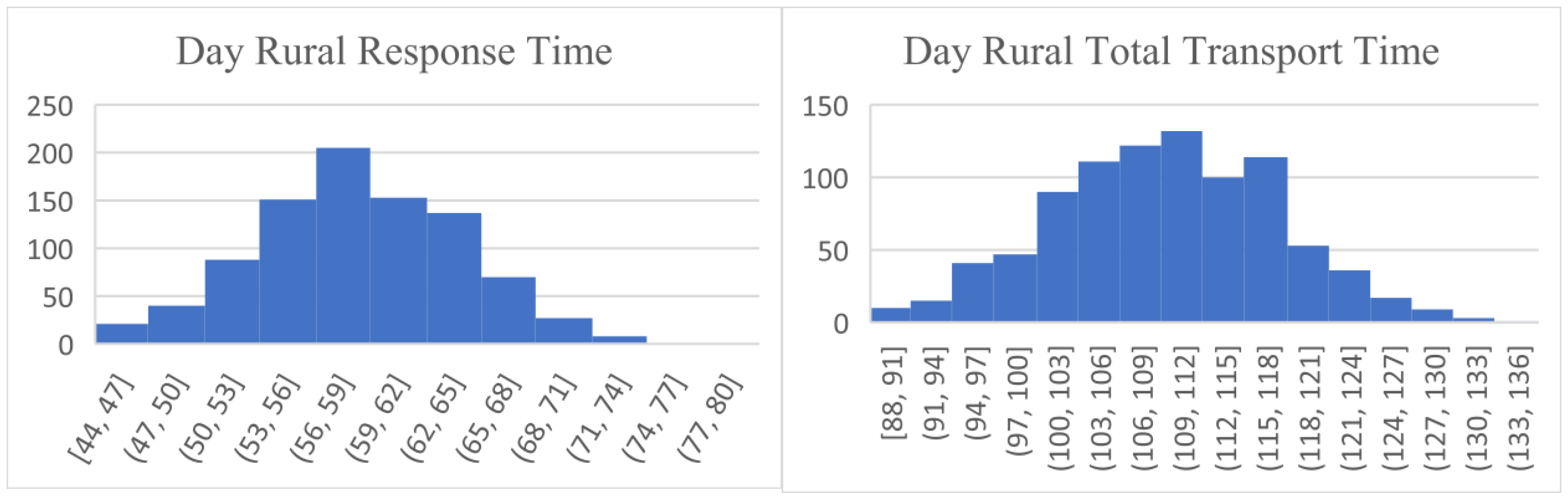
Day Rural (DR): Baseline rural operations.
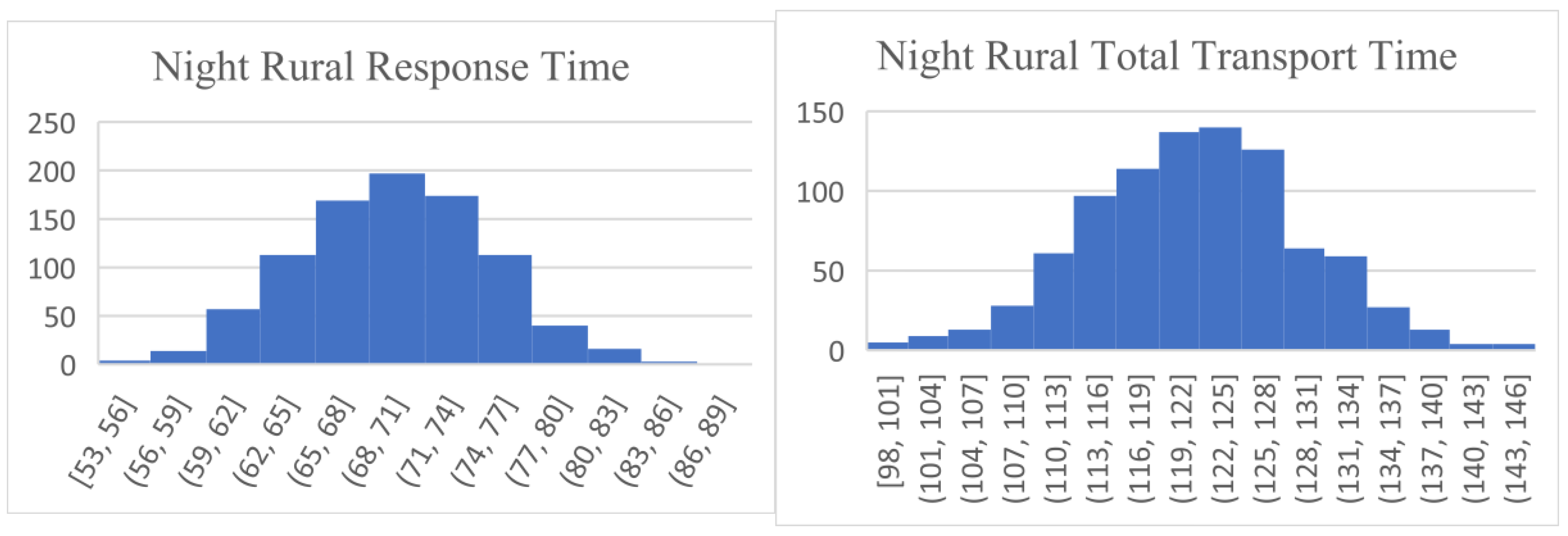
Night Rural (NR): Baseline night rural operations.
Data collected included mean response times, standard deviations, and the probabilities of exceeding 45 min and 60 min thresholds.
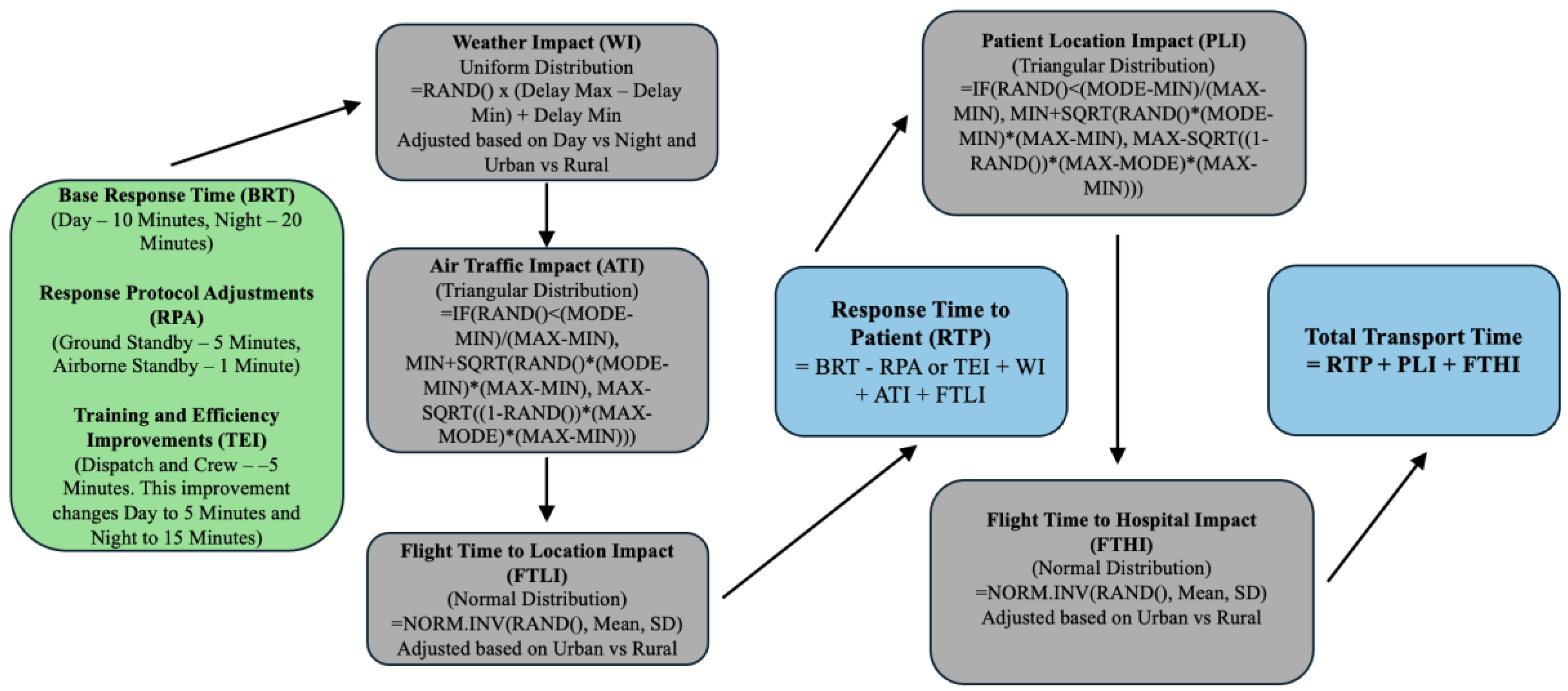
Figure 2 illustrates the structural definition of the model used for the Monte Carlo simulation. The green, rounded rectangular boxes represent the six controllable input variables. The gray, rounded rectangular boxes represent the five uncontrollable input variables, specified as probability distributions supplying random values to the model. The gray boxes also include the type of distribution and formulas used. The blue, rounded rectangular boxes represent the model output variables, including the calculations used to determine the output.
3.7. Operational Mission Structure
Each simulated HEMS mission follows a standardized operational sequence: call receipt, crew mobilization, wheels-up delay, flight to the incident location, on-scene patient management, and flight to the receiving hospital. This structure reflects common HEMS operational practice and provides a transparent mapping between conceptual drivers and model inputs.
Response time to location (RT) is computed as
The total response time (TT) is computed as
where (BRT) denotes base response time (a controllable factor influenced by training and standby policy), (WI) represents weather-related delay, (ATI) represents air-traffic-related delay, (FTL) is flight time to the incident location, (PLI) is on-scene patient loading and intervention time, and (FTH) is flight time from the scene to the receiving hospital. Each component is sampled independently per Monte Carlo iteration according to the distributions described above.
3.8. Model Verification and Validation
Model verification was conducted through logical consistency checks, including validation of component bounds, non-negativity constraints, and correctness of the response-time aggregation equation. Simulation convergence was assessed by confirming stability of summary statistics as the number of Monte Carlo iterations increased.
Model verification performed:
Unit tests: confirm TT = sum (components) for 100 random iterations; check no negative times.
Logical tests: conditional branches (e.g., no airborne launch when weather prohibits flight) exercised with boundary values.
Range checks: confirm sampled values fall within specified min/max for each distribution.
Convergence check: compared mean RT and P (RT > 45) at 1000 vs. 5000 draws; differences were minimal.
Empirical validation plan (future work): Fit parametric distributions to historical dispatch and flight logs, run out-of-sample prediction tests, and compare observed exceedance probabilities to simulated values.
Formal empirical validation against operational HEMS data was not performed in this study because several input parameters were illustrative. Consequently, results are presented as comparative scenario insights rather than predictive estimates. Future work will focus on validating the model using historical dispatch and flight records and assessing out-of-sample predictive performance.
4. Results
4.1. Operational Assumptions and Simulation Inputs
This study focuses on HAA services operating within the United States under CFR Part 135 regulations. Part 135 defines the operating requirements for commuter and on-demand operations, including HAA services. This study is geographically centered on the Denver, Colorado, metropolitan area, but can be generalized to other regions with similar urban and rural characteristics. The helicopter model simulated in this study is a Bell 407, a common choice for air ambulance services due to its performance, reliability, and suitability for medical equipment and personnel.
The operational inputs used in this study include historical operational data collected from various emergency management sources covering a wide range of operational scenarios, including base locations specifically within urban and rural settings, to ensure a comprehensive analysis of different geographical impacts on response times. Hypothetical weather and air traffic data were used to model the impact on HAA operations. Patient location data was collected to represent a range of urban and rural emergency scenarios. This includes hypothetical distances from operational bases to patient locations and typical on-scene times required for patient stabilization and preparation for transport. Information on response protocols (e.g., ground standby and airborne standby) and training procedures was gathered from the literature. This data includes average response times during day and night operations and the impact of training and efficiency improvements on reducing these times. The Bell 407 helicopter’s performance data, including average cruise speed and typical flight times, was used to ensure realistic simulation parameters.
By integrating this demographic information, the study aims to provide a realistic and comprehensive analysis of HAA response times and their influencing factors. Combining operational data, weather conditions, air traffic patterns, patient locations, and helicopter performance ensures that the simulation model accurately reflects real-world conditions and provides valuable insights for improving HAA services.
The use of hypothetical but operationally realistic weather, air traffic, and patient-location inputs was intentional. These inputs were selected to isolate system-level behavior and evaluate response-time reliability across a broad range of plausible operating conditions rather than to reproduce any single historical dataset. This approach is consistent with simulation-based systems analysis, where controlled stochastic inputs are used to assess sensitivity, variability, and structural limitations in complex operational systems. Accordingly, results are interpreted comparatively across scenarios rather than as predictive estimates for any specific HAA provider.
4.2. Simulation Results
Simulation execution. For each scenario, we executed 1000 independent Monte Carlo iterations (each iteration draws a fresh sample from each input distribution and computes RT per the aggregation equation). Model checks included unit-sum/non-negativity checks for component durations, logical tests for bounds and conditional branches, and a convergence check comparing summary statistics at 1000 and 5000 iterations. The model implementation was coded in Excel with documented worksheets for inputs, random draws, aggregation, and outputs; ancillary checks (range and formula audits) were performed to verify correctness. Formal empirical validation against historical operational logs is outside this study’s scope and is described in
Section 5 as future work.
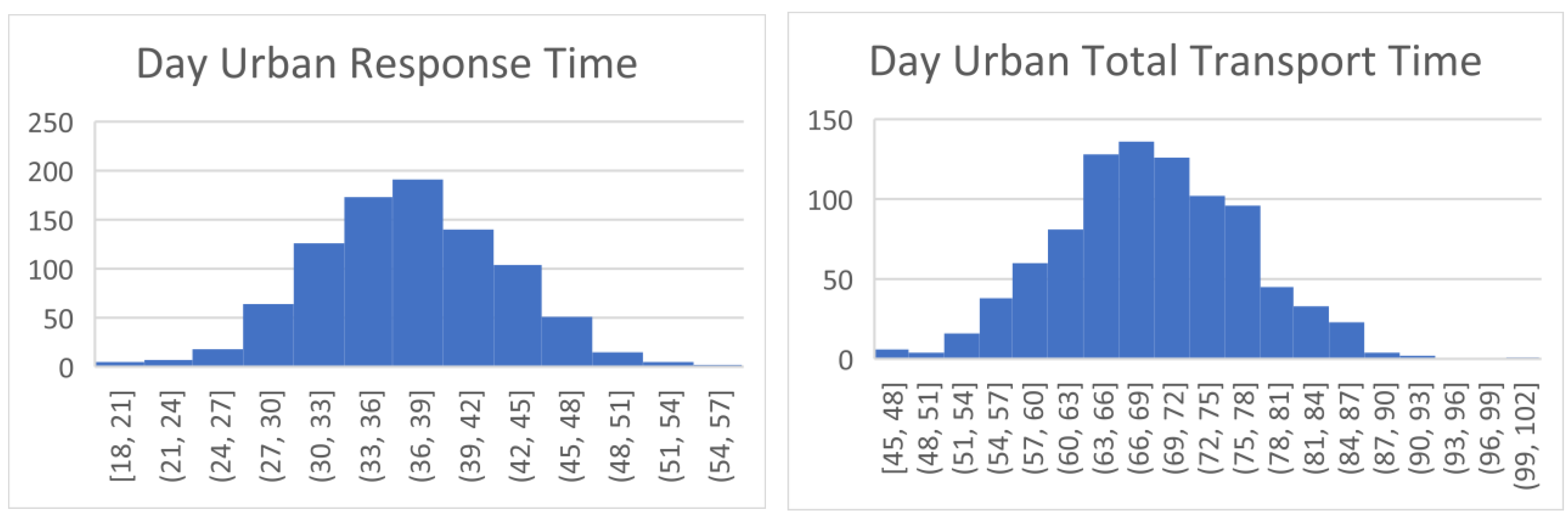
Scenario 1 established a baseline for daytime urban (DU) operations, yielding a mean response time of 37.252 min (SD = 5.91) and a total transport time of 68.725 min (SD = 8.32). As illustrated in
Figure 3, the model recorded 95 instances where response times exceeded the 45 min threshold, corresponding to a 9.5% probability of occurrence. Notably, zero instances breached the 60 min mark, resulting in a 0% probability of exceeding that threshold.
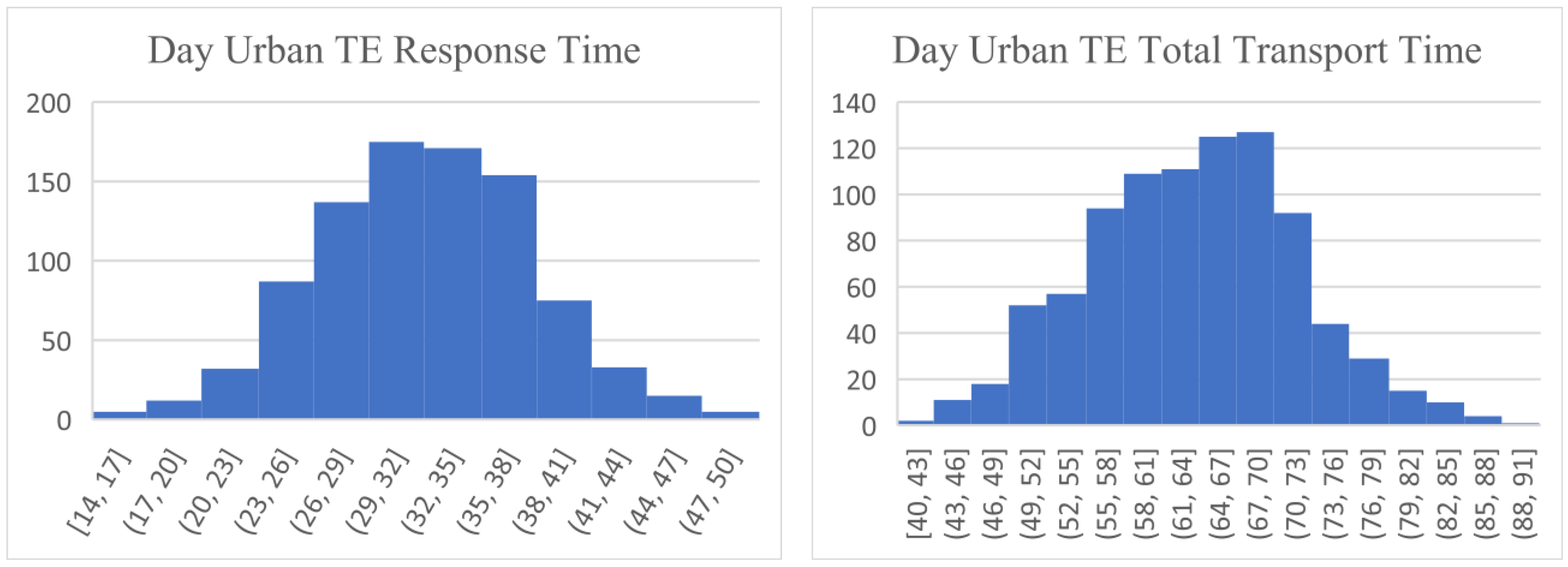
In Scenario 2, the incorporation of training and efficiency improvements (DUTE) into the daytime urban model reduced the mean response time to 32.436 min (SD = 5.77) and total transport time to 63.834 min (SD = 8.28). As shown in
Figure 4, this intervention significantly improved reliability, resulting in only 16 instances where the response time exceeded 45 min (1.78% probability). Similar to the baseline, no instances exceeded the 60 min limit (0% probability).
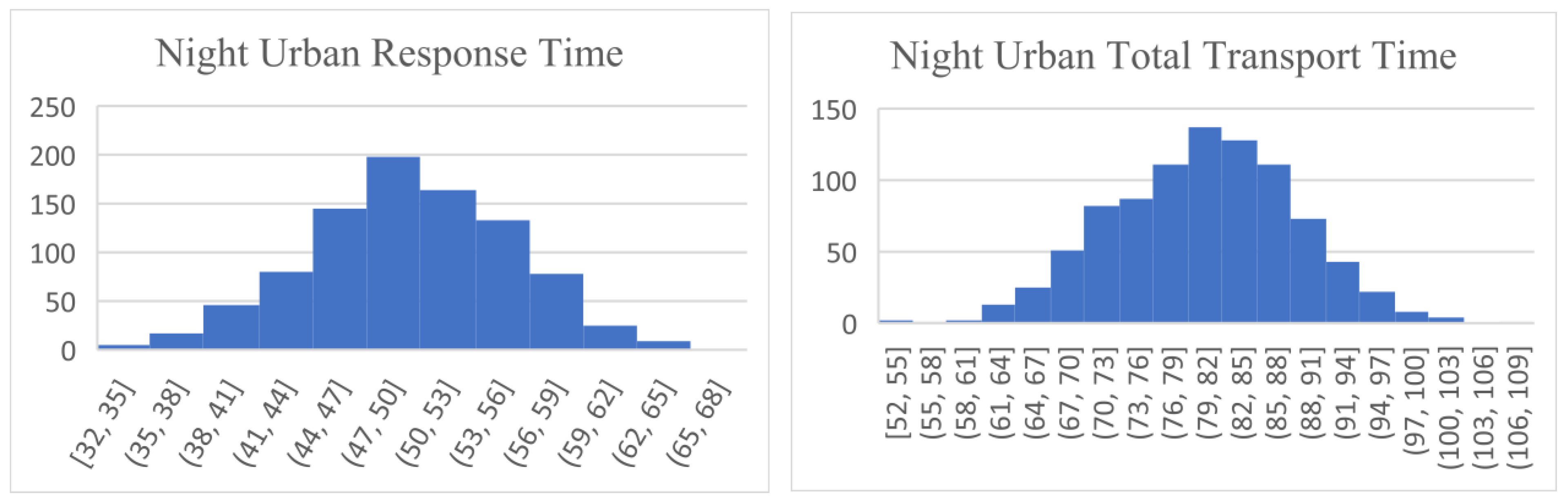
The transition to night urban (NU) operations in Scenario 3 introduced significant delays, shifting the mean response time to 49.183 min (SD = 5.66) and the total transport time to 80.330 min (SD = 7.79).
Figure 5 highlights a critical reliability gap in this baseline: 695 instances exceeded the 45 min threshold, representing a 69.5% probability of occurrence. A smaller subset of these flights also breached the 60 min limit, underscoring the substantial tail risk inherent in night operations.
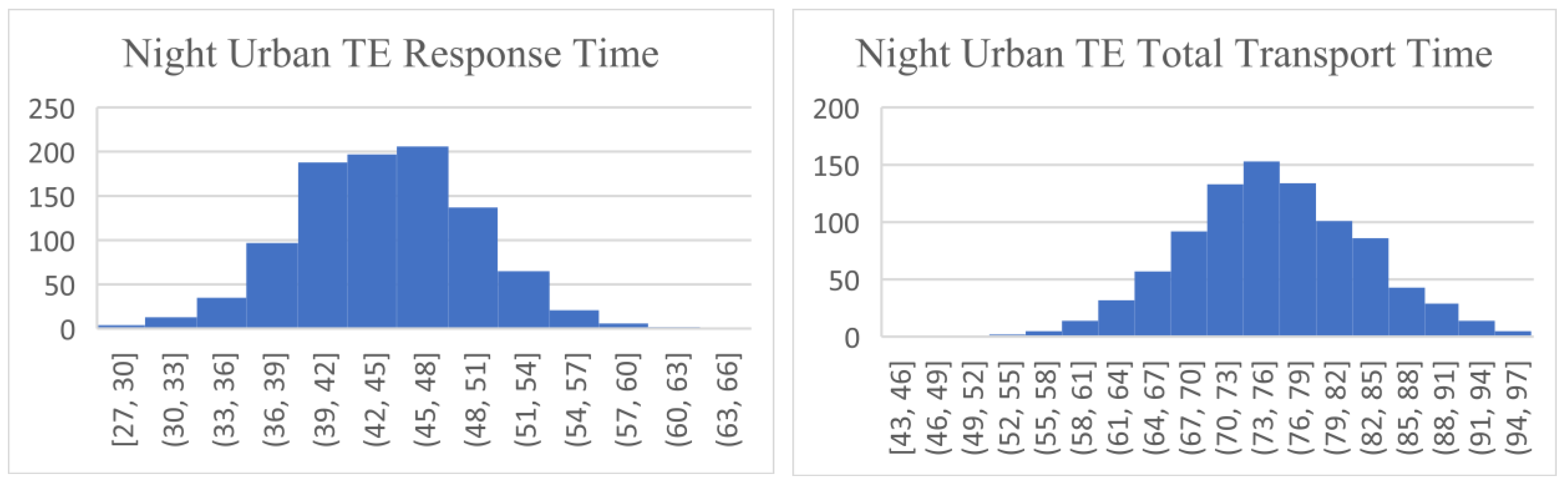
Applying training and efficiency improvements to the night urban environment (NUTE) in Scenario 4 lowered the mean response time to 44.124 min (SD = 5.21) and the total transport time to 75.415 min (SD = 7.46). While the 45 min exceedance rate remained elevated at 39.7% (397 instances), extreme delays were largely mitigated; only three instances exceeded 60 min, yielding a probability of 0.30% (
Figure 6). This represents a substantial reduction in extreme delays relative to the baseline night operations. These results are consistent with prior HAA and emergency response modeling studies that report heightened sensitivity of response-time reliability to night operations and environmental friction rather than isolated mission variability.
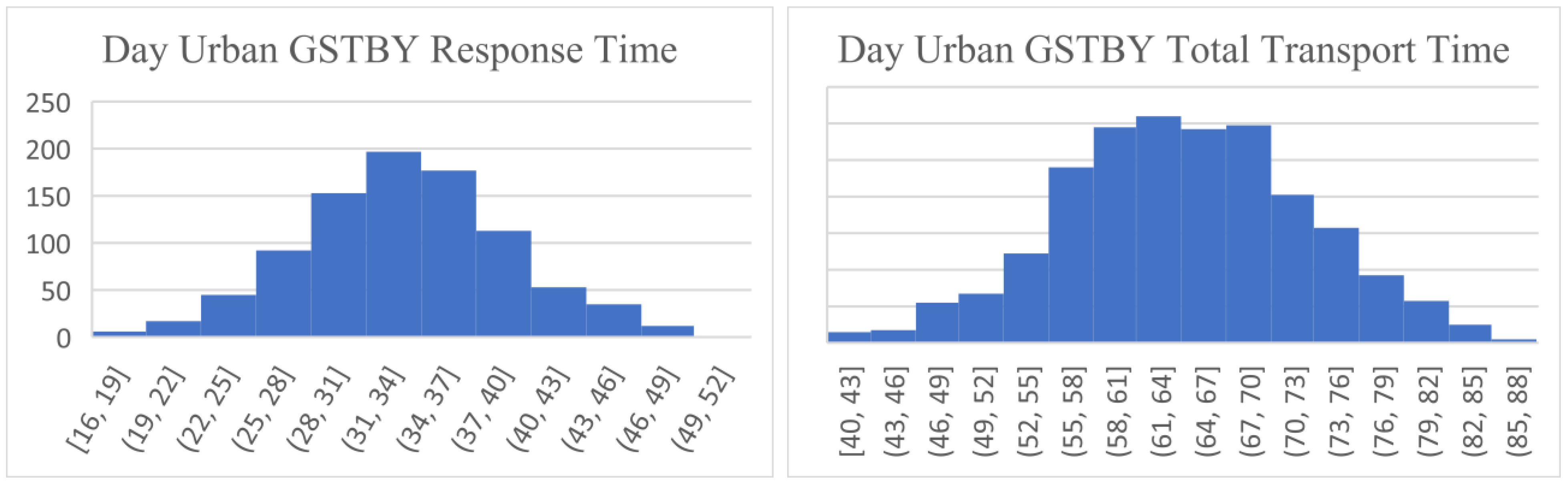
Scenario 5 modified the readiness posture to Ground Standby (DUGSTBY) during daytime urban missions, resulting in a mean response time of 32.446 min (SD = 5.87) and a total transport time of 63.798 min (SD = 8.00). As detailed in
Figure 7, this protocol achieved high reliability, with only 15 instances exceeding 45 min (1.66% probability) and zero instances surpassing the 60 min threshold (0% probability).
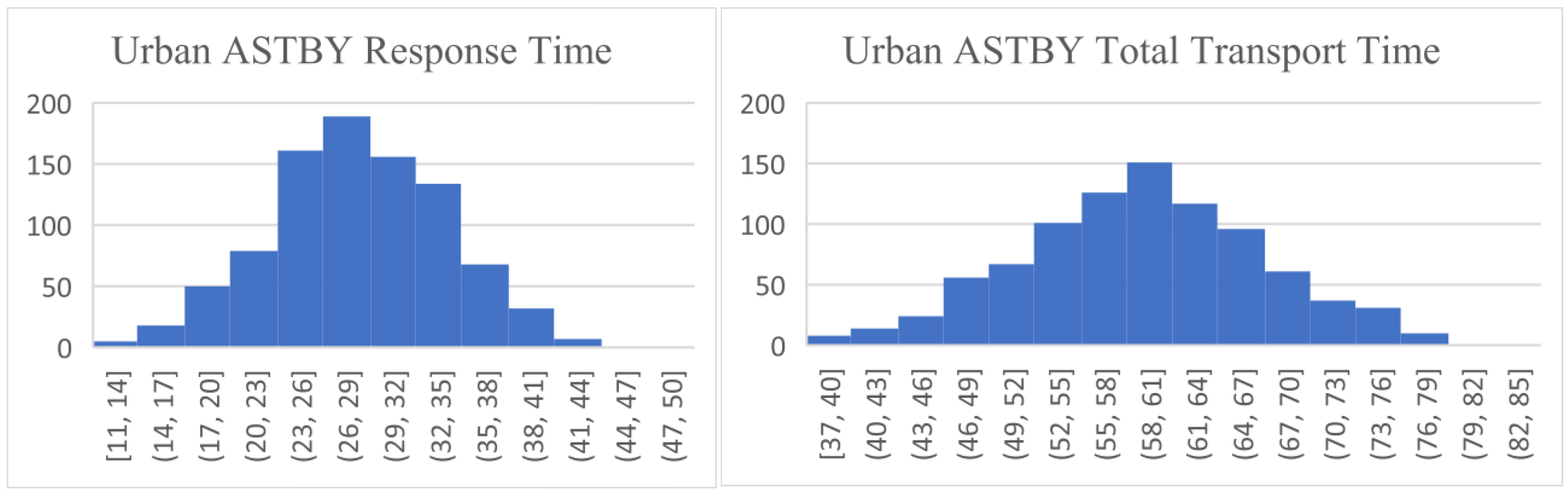
The Airborne Standby (DUASTBY) configuration tested in Scenario 6 demonstrated superior performance for daytime urban missions, achieving the lowest mean response time of 28.264 min (SD = 5.78) and a total transport time of 59.695 min (SD = 7.97).
Figure 8 confirms the robustness of this strategy, showing only a single instance where the response time exceeded 45 min (0.11% probability) and no violations of the 60 min limit (0% probability). Overall, Scenario 6 produced the most efficient results across all daytime metrics.
Implementing 7 effectively countered nocturnal friction, resulting in a mean response time of 34.418 min (SD = 5.51) and a total transport time of 66.254 min (SD = 7.81).
Figure 9 illustrates the resilience of this posture, where only 29 instances exceeded 45 min (3.22% probability), and zero instances breached the 60 min mark (0% probability).
The Airborne Standby protocol proved highly effective even in the challenging night urban environment (NUASTBY) during Scenario 8, delivering a mean response time of 30.193 min (SD = 5.52) and a total transport time of 61.911 min (SD = 7.83). As shown in
Figure 10, this posture virtually eliminated delay risks, with merely four instances exceeding 45 min (0.44% probability) and none exceeding 60 min (0% probability). Similar reductions in response-time variability associated with enhanced readiness postures have been reported in prior EMS logistics and emergency aviation studies, where proactive resource positioning mitigates delay propagation.
Rural operations introduce distance constraints that significantly impact reliability, as seen in Scenario 9. This day, rural (DR) simulation recorded a mean response time of 58.156 min (SD = 5.55) and a total transport time of 109.660 min (SD = 8.11).
Figure 11 reveals severe service gaps: 893 instances exceeded the 60 min threshold (89.3% probability), while 330 instances specifically exceeded the 45 min mark (36.63% probability).
Finally, Scenario 10 exhibited the highest latency during night rural (NR) operations, with a mean response time of 69.860 min (SD = 5.21) and a total transport time of 121.331 min (SD = 7.70). As depicted in
Figure 12, the system failed to meet the 45 min response-time threshold in all 1000 iterations, yielding a 100% failure rate. Furthermore, 874 instances exceeded the 60 min benchmark (87.4% probability), indicating a structural inability to meet standard time goals in this setting. The pronounced degradation observed in rural night operations aligns with prior findings that geographic dispersion and base distance impose structural constraints on HAA response performance that cannot be overcome through procedural efficiency alone.
The severe performance degradation observed in the rural scenarios—particularly under night operations—reflects a structural limitation of the modeled HAA system rather than stochastic variability or isolated parameter effects. In these configurations, extended base-to-incident distances, reduced night cruise profiles, and compounded operational constraints collectively prevent response benchmarks from being achieved. Importantly, the results indicate that procedural interventions such as training enhancements or standby posture adjustments are insufficient to overcome these geographic and operational constraints within the modeled system. Consequently, rural night operations represent a distinct operational regime in which response-time reliability is governed primarily by network geometry and base placement rather than incremental improvements in readiness or efficiency.
The following tables compare the results for the four-day scenarios, illustrated in
Table 1, the four-night scenarios in
Table 2, and the two rural scenarios in
Table 3. These tables highlight the variability in response times across different scenarios, demonstrating the significant impact of operational strategies on improving HEMS efficiency.
5. Discussion
5.1. The Logistics of “Tail Risk” and Resilience
The simulation results reveal that while training and efficiency improvements (TEI) lower the average response time, they do not adequately mitigate “tail risk”, the statistical probability of extreme delays. In high-friction environments like urban night operations, the system remains vulnerable to cascading delays from weather and congestion.
This study extends the healthcare logistics resilience framework by operationalizing resilience at the level of response-time reliability rather than average performance alone. Specifically, resilience is quantified through the probability of extreme delays and the system’s ability to maintain service within critical thresholds under adverse operating conditions. By embedding this framework within a Monte Carlo simulation of helicopter air ambulance operations, the study translates abstract resilience concepts into measurable, scenario-specific performance outcomes.
The effectiveness of Ground Standby identified in this study does not represent a novel operational concept but rather a confirmation and contextual extension of resilience principles within the helicopter air ambulance domain. While readiness postures have been discussed qualitatively in prior EMS and healthcare logistics literature, this study provides a quantitative, probabilistic demonstration of how Ground Standby functions as a resilience mechanism by reducing tail-risk exposure rather than merely improving mean response times. In this sense, the contribution is methodological, showing how simulation can be used to evaluate resilience interventions under uncertainty in time-critical aviation medical systems.
These findings on ‘tail-risk’ corroborate the healthcare logistics resilience framework proposed by Sohrabi et al. [
16], which emphasizes that healthcare logistics resilience is not merely determined by average performance but by the system’s ability to maintain operations during extreme, low-probability disruptions [
16]. Our model demonstrates that for HAA, “Ground Standby” serves as a critical resilience-building intervention that prevents the system from cascading into failure during high-friction night operations. By prioritizing readiness postures over simple speed drills, HAA providers can ensure that the “Golden Hour” remains attainable even during peak operational stress.
5.2. Impact of Training and Efficiency
Training and efficiency improvements (TEI) proved effective in reducing mean response times, particularly in urban daytime settings, where they reduced the >45 min failure rate from 9.5% to 1.8%. These findings echo traffic operations modeling, which shows that local improvements in system readiness yield measurable reductions in overall network delay [
3,
5]. However, data from Night Urban scenarios suggest a limitation: while TEI reduced the mean, the probability of delay remained unacceptably high (39.7%). This suggests that procedural efficiency alone is insufficient to overcome structural delays inherent in night operations. Beyond increased average response times, night operations systematically amplify variability by introducing compounding safety constraints, conservative decision-making, and reduced operational margins. These factors disproportionately affect the upper tail of the response-time distribution, explaining why training and efficiency improvements reduce mean performance but leave substantial residual delay risk at night. From a logistics perspective, this distinction highlights that nighttime reliability is governed less by procedural speed and more by structural readiness and system posture.
5.3. Effectiveness and Cost–Benefit of Standby Protocols
The comparison of Ground and Airborne Standby protocols highlighted their substantial influence on system responsiveness. Airborne Standby produced the greatest improvement, effectively eliminating the “tail risk” of delays. From a traffic flow perspective, Airborne Standby acts as a pre-activated resource that removes the “queue” at the dispatch node.
However, this operational superiority comes with significant trade-offs. While the simulation quantifies the time savings, the economic reality is that Airborne Standby incurs high fuel and maintenance costs. The data suggest a targeted application: utilizing Airborne Standby during high-risk windows (e.g., night operations or peak traffic) provides a necessary buffer against failure, whereas standard readiness may be sufficient for day urban operations where the baseline failure rate is manageable. A formal cost-effectiveness analysis incorporating helicopter operating costs, duty cycles, and mission frequency is required before operational recommendations can be made. The present study provides a comparative analytical foundation upon which such evaluations can be built.
5.4. Challenges in Rural Operations
In this context, geographic determinism refers to the dominant influence of spatial factors—such as base-to-incident distance, terrain, and service-area dispersion—on response-time performance, irrespective of procedural efficiency or operational readiness enhancements. The rural results (Scenarios 9 and 10) highlight a geographic determinism that readiness cannot overcome. With Night Rural operations showing a 87.4% probability of exceeding the 60 min “Golden Hour,” the simulation indicates that simply flying faster or launching sooner yields diminishing returns. This finding supports a network design approach [
8,
9]. To achieve reliability in rural sectors, logistics planners must focus on base reallocation—physically moving resources closer to demand centers—rather than relying solely on procedural speed.
5.5. Day vs. Night Operations
The simulations confirmed that night operations exhibit systematically higher response times, driven by reduced visibility and operational caution. Even with efficiency improvements, nighttime missions maintained longer tail delays than daytime equivalents. This reinforces the need for adaptive traffic management strategies, such as distinct “Night Mode” protocols where ground standby becomes the standard requirement to compensate for the inherent slowness of nocturnal flight planning [
15].
5.6. Limitations
Several limitations should be acknowledged. First, input distributions were not empirically fitted and therefore do not represent validated operational probability models. Second, the simulation does not explicitly model resource contention, aircraft availability, or dynamic feedback loops that may arise in multi-mission environments. Third, economic costs associated with alternative operational policies were not modeled. These limitations define clear directions for future research, including empirical calibration, discrete-event or agent-based extensions, and formal cost-effectiveness analysis.
6. Conclusions
This study developed a stochastic simulation framework to model the medical logistics reliability of helicopter emergency medical services (HEMS) response times, addressing the complex interplay of controllable and uncontrollable variables under uncertainty. By applying Monte Carlo simulation, the research quantified how logistical factors—including base readiness, standby protocols, training improvements, weather variability, airspace congestion, and patient distance—jointly affect total response time within an emergency medical logistics network. The results demonstrated that targeted operational strategies—particularly efficiency training and Airborne Standby—significantly reduce both mean and tail response times, improving the likelihood of meeting critical 45 and 60 min thresholds essential for survival in time-sensitive medical emergencies.
6.1. Theoretical Significance
Beyond operational insights, this study contributes to medical logistics and transportation modeling by conceptualizing HEMS operations as a stochastic flow network governed by environmental and procedural constraints. Traditional logistics and traffic-flow theories focus primarily on surface networks. However, as low-altitude airspace becomes increasingly integrated into multimodal emergency systems, the principles of flow optimization, queuing, and capacity management become equally vital to aerial medical logistics. The Monte Carlo framework developed here demonstrates how stochastic simulation can extend these principles to the air medical domain, enabling quantitative assessments of logistical reliability, resilience, and service-level performance under uncertainty.
Moreover, the study’s findings have implications for emerging UAS Traffic Management (UTM) and Advanced Air Mobility (AAM) frameworks. As future airspace systems become more congested with autonomous and crewed vehicles, HEMS missions will require priority routing and deconfliction mechanisms that preserve rapid medical response. The probabilistic insights derived from this research provide a foundation for designing such adaptive logistics systems, where response-time reliability can be integrated into real-time airspace management and medical dispatch algorithms. In this way, the study bridges the gap between emergency medical logistics and next-generation mobility systems.
6.2. Practical Implications
The findings have direct implications for emergency medical service logistics planning, policy, and operational management. First, EMS and aviation authorities can use the simulation framework as a decision-support tool for strategic base placement and resource allocation to optimize coverage and minimize regional disparities in time-to-care. Second, integrating probabilistic delay modeling into air traffic and dispatch systems could enable predictive routing that dynamically adjusts to weather and congestion conditions. Third, the results provide an empirical basis for regulatory and funding priorities, emphasizing investment in training programs, airborne readiness, and adaptive night operations. Finally, the stochastic framework can inform the development of real-time decision-support dashboards, allowing air ambulance dispatchers to visualize reliability forecasts—analogous to predictive logistics control in ground transportation systems—thereby enabling faster, data-driven deployment decisions.
6.3. Limitations and Future Research
While the simulation offers valuable insights into medical logistics system performance, several limitations constrain its generalizability. The study’s reliance on historical data and regional assumptions (focused on the Denver metropolitan area) may limit its applicability to regions with differing weather, terrain, or regulatory contexts. Simplifying assumptions—such as static emergency demand, constant staffing levels, and fixed network geometry—do not fully capture the dynamic and adaptive nature of real-world HEMS logistics. Additionally, the selection of probability distributions for key variables influences model outputs; inaccuracies in these assumptions could introduce bias. Formal statistical comparison of scenario outputs (e.g., bootstrapped CI for differences in tail probabilities, KS tests for distributional differences) is recommended for operational studies.
Future research should incorporate dynamic demand modeling, adaptive base relocation algorithms, and integration with real-time weather and traffic data streams to better capture the responsiveness of medical logistics networks. Extending the framework to include cost-effectiveness, aircraft maintenance cycles, and regulatory constraints would further enhance its decision-making utility. Importantly, coupling the Monte Carlo approach with agent-based or discrete-event simulation could more comprehensively represent multi-aircraft coordination, air traffic control dynamics, and shared airspace management—providing a holistic logistics model for emergency medical aviation within integrated air mobility systems.